

ISO 4666-1:2010
(Main)Rubber, vulcanized — Determination of temperature rise and resistance to fatigue in flexometer testing — Part 1: Basic principles
General Information
- Abstract
ISO 4666-1:2010 establishes general principles for flexometer testing and defines the terms used. Flexometer testing makes possible predictions regarding the durability of rubbers in finished articles subject to dynamic flexing in service such as tyres, bearings, supports, V-belts, and cable-pulley insert rings. However, owing to the wide variations in service conditions, no simple correlation between the accelerated tests specified in the various parts of ISO 4666 and service performance can be assumed.
- Status
- Published
- Publication Date
- 28-Sep-2010
- Technical Committee
- ISO/TC 45/SC 2 - Testing and analysis
- Drafting Committee
- ISO/TC 45/SC 2/WG 3 - Degradation tests
- Current Stage
- 9093 - International Standard confirmed
- Start Date
- 04-Jan-2024
- Completion Date
- 29-Aug-2026
Buy Documents
ISO 4666-1:2010 - Rubber, vulcanized — Determination of temperature rise and resistance to fatigue in flexometer testing — Part 1: Basic principles Released:9/29/2010
ISO 4666-1:2010 - Caoutchouc vulcanisé — Détermination de l'élévation de température et de la résistance a la fatigue dans les essais aux flexometres — Partie 1: Principes fondamentaux Released:9/29/2010
Overview
ISO 4666-1:2010 - "Rubber, vulcanized - Determination of temperature rise and resistance to fatigue in flexometer testing - Part 1: Basic principles" sets out the general principles, definitions and test conditions for flexometer testing of vulcanized rubber. It explains how to measure temperature rise and determine fatigue life under cyclic flexing, and it defines key terms used across the ISO 4666 series. The standard is intended to support accelerated durability evaluations for rubber components subject to dynamic flexing (for example tyres, bearings, supports, V‑belts and cable‑pulley insert rings) while noting that simple correlations to in‑service performance cannot be assumed.
Key topics and requirements
- Definitions and concepts: Terms such as loading, pre‑stress/pre‑strain, cyclic stress/strain amplitude, heat generation, temperature rise, fatigue life, limiting fatigue deformability/stress are defined.
- Test conditions: Type and magnitude of loading (constant stress, constant strain, etc.) must be chosen to reflect intended use and to discriminate between materials.
- Test pieces: Cylindrical specimens prepared and conditioned per ISO 23529. Minimum 16 hours between vulcanization and testing; non‑product tests generally within 4 weeks (product tests preferably within 3 months). Conditioning for at least 3 hours at standard lab temperatures.
- Sample count: Two specimens for single temperature‑rise or fatigue tests; for plotting fatigue life curves use at least five, preferably ten specimens.
- Apparatus: Flexometers must be sturdy and precise; specific machine types are detailed in ISO 4666‑2/3/4. Elevated‑temperature tests require a thermostated enclosure per ISO 23529.
- Temperature measurement: Two accepted approaches - interior measurement (fine needle probe or embedded sensor) or surface measurement. Permissible measurement error: ±1 °C. Insulation is recommended to minimize conductive heat loss.
- Procedures: Basic procedures for temperature of test, measurement of temperature rise, determination of fatigue life and limiting fatigue parameters are covered; full machine‑specific procedures are in Parts 2–4.
Practical applications and who uses it
ISO 4666-1:2010 is used by:
- R&D and materials engineers developing rubber compounds and formulations to evaluate dynamic heat generation and fatigue resistance.
- Design and testing laboratories conducting accelerated durability assessments on tyres, belts, seals, bearings and other flexing rubber parts.
- Quality control and certification bodies establishing comparative performance data for production batches.
- OEMs and suppliers validating component suitability for dynamic service conditions.
Practical benefits include early detection of formulations prone to heat‑induced degradation, comparative ranking of compounds under controlled cyclic loading, and determination of limiting fatigue stress/strain for design guidance.
Related standards
- ISO 4666‑2: Rotary flexometer (machine specifics)
- ISO 4666‑3: Compression flexometer (constant‑strain type)
- ISO 4666‑4: Constant‑stress flexometer
- ISO 23529: Preparation and conditioning of rubber test pieces
- Referenced fatigue/flex‑cracking guidance: ISO 132, ISO 6943
Keywords: ISO 4666-1:2010, flexometer testing, temperature rise, fatigue life, rubber vulcanized, limiting fatigue deformability, rubber testing standards.
Relations
- Effective Date
- 09-Feb-2026
- Effective Date
- 15-Apr-2008
Buy Documents
ISO 4666-1:2010 - Rubber, vulcanized — Determination of temperature rise and resistance to fatigue in flexometer testing — Part 1: Basic principles Released:9/29/2010
ISO 4666-1:2010 - Caoutchouc vulcanisé — Détermination de l'élévation de température et de la résistance a la fatigue dans les essais aux flexometres — Partie 1: Principes fondamentaux Released:9/29/2010
Get Certified
Connect with accredited certification bodies for this standard

DIN CERTCO
DIN Group product certification.

Smithers Quality Assessments
US management systems and product certification.
Sponsored listings
Frequently Asked Questions
ISO 4666-1:2010 is a standard published by the International Organization for Standardization (ISO). Its full title is "Rubber, vulcanized — Determination of temperature rise and resistance to fatigue in flexometer testing — Part 1: Basic principles". This standard covers: ISO 4666-1:2010 establishes general principles for flexometer testing and defines the terms used. Flexometer testing makes possible predictions regarding the durability of rubbers in finished articles subject to dynamic flexing in service such as tyres, bearings, supports, V-belts, and cable-pulley insert rings. However, owing to the wide variations in service conditions, no simple correlation between the accelerated tests specified in the various parts of ISO 4666 and service performance can be assumed.
ISO 4666-1:2010 establishes general principles for flexometer testing and defines the terms used. Flexometer testing makes possible predictions regarding the durability of rubbers in finished articles subject to dynamic flexing in service such as tyres, bearings, supports, V-belts, and cable-pulley insert rings. However, owing to the wide variations in service conditions, no simple correlation between the accelerated tests specified in the various parts of ISO 4666 and service performance can be assumed.
ISO 4666-1:2010 is classified under the following ICS (International Classification for Standards) categories: 83.060 - Rubber. The ICS classification helps identify the subject area and facilitates finding related standards.
ISO 4666-1:2010 has the following relationships with other standards: It is inter standard links to EN ISO 15136-1:2009, ISO 4666-1:1982. Understanding these relationships helps ensure you are using the most current and applicable version of the standard.
ISO 4666-1:2010 is available in PDF format for immediate download after purchase. The document can be added to your cart and obtained through the secure checkout process. Digital delivery ensures instant access to the complete standard document.
Standards Content (Sample)
INTERNATIONAL ISO
STANDARD 4666-1
Second edition
2010-10-01
Rubber, vulcanized — Determination of
temperature rise and resistance to fatigue
in flexometer testing —
Part 1:
Basic principles
Caoutchouc vulcanisé — Détermination de l'élévation de température et
de la résistance à la fatigue dans les essais aux flexomètres —
Partie 1: Principes fondamentaux
Reference number
©
ISO 2010
PDF disclaimer
This PDF file may contain embedded typefaces. In accordance with Adobe's licensing policy, this file may be printed or viewed but
shall not be edited unless the typefaces which are embedded are licensed to and installed on the computer performing the editing. In
downloading this file, parties accept therein the responsibility of not infringing Adobe's licensing policy. The ISO Central Secretariat
accepts no liability in this area.
Adobe is a trademark of Adobe Systems Incorporated.
Details of the software products used to create this PDF file can be found in the General Info relative to the file; the PDF-creation
parameters were optimized for printing. Every care has been taken to ensure that the file is suitable for use by ISO member bodies. In
the unlikely event that a problem relating to it is found, please inform the Central Secretariat at the address given below.
© ISO 2010
All rights reserved. Unless otherwise specified, no part of this publication may be reproduced or utilized in any form or by any means,
electronic or mechanical, including photocopying and microfilm, without permission in writing from either ISO at the address below or
ISO's member body in the country of the requester.
ISO copyright office
Case postale 56 • CH-1211 Geneva 20
Tel. + 41 22 749 01 11
Fax + 41 22 749 09 47
E-mail copyright@iso.org
Web www.iso.org
Published in Switzerland
ii © ISO 2010 – All rights reserved
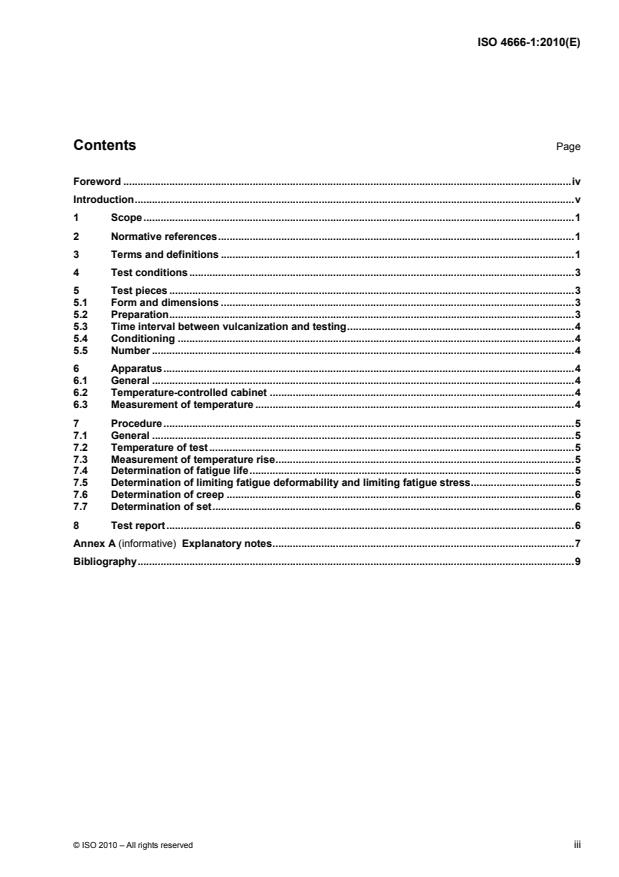
Contents Page
Foreword .iv
Introduction.v
1 Scope.1
2 Normative references.1
3 Terms and definitions .1
4 Test conditions .3
5 Test pieces .3
5.1 Form and dimensions .3
5.2 Preparation.3
5.3 Time interval between vulcanization and testing.4
5.4 Conditioning .4
5.5 Number .4
6 Apparatus.4
6.1 General .4
6.2 Temperature-controlled cabinet .4
6.3 Measurement of temperature .4
7 Procedure.5
7.1 General .5
7.2 Temperature of test .5
7.3 Measurement of temperature rise.5
7.4 Determination of fatigue life.5
7.5 Determination of limiting fatigue deformability and limiting fatigue stress.5
7.6 Determination of creep .6
7.7 Determination of set.6
8 Test report.6
Annex A (informative) Explanatory notes.7
Bibliography.9
Foreword
ISO (the International Organization for Standardization) is a worldwide federation of national standards bodies
(ISO member bodies). The work of preparing International Standards is normally carried out through ISO
technical committees. Each member body interested in a subject for which a technical committee has been
established has the right to be represented on that committee. International organizations, governmental and
non-governmental, in liaison with ISO, also take part in the work. ISO collaborates closely with the
International Electrotechnical Commission (IEC) on all matters of electrotechnical standardization.
International Standards are drafted in accordance with the rules given in the ISO/IEC Directives, Part 2.
The main task of technical committees is to prepare International Standards. Draft International Standards
adopted by the technical committees are circulated to the member bodies for voting. Publication as an
International Standard requires approval by at least 75 % of the member bodies casting a vote.
Attention is drawn to the possibility that some of the elements of this document may be the subject of patent
rights. ISO shall not be held responsible for identifying any or all such patent rights.
ISO 4666-1 was prepared by Technical Committee ISO/TC 45, Rubber and rubber products, Subcommittee
SC 2, Testing and analysis.
This second edition cancels and replaces the first edition (ISO 4666-1:1982), which has been technically
revised.
ISO 4666 consists of the following parts, under the general title Rubber, vulcanized — Determination of
temperature rise and resistance to fatigue in flexometer testing:
⎯ Part 1: Basic principles
⎯ Part 2: Rotary flexometer
⎯ Part 3: Compression flexometer (constant-strain type)
⎯ Part 4: Constant-stress flexometer
iv © ISO 2010 – All rights reserved
Introduction
All rubbers show viscoelastic behaviour. When subjected to cyclic deformation, they absorb a part of the
deformation energy and convert this into heat. The heat generated leads to a temperature rise, which can be
considerable in the interior of relatively thick components because of the low thermal conductivity of rubbers.
In cases where the cyclic deformation is large or the temperature reaches high values, it is possible for
damage to the rubber to occur through fatigue-initiated breakdown. The breakdown begins in the interior of
the rubber, spreads outwards, and can finally lead to the complete breakdown of the component.
The tests specified in the various parts of this International Standard yield either temperature rise data or the
fatigue life of the rubber under given test conditions. Measurement of fatigue life over a range of conditions
can be used to determine the limiting fatigue deformability or limiting fatigue stress of the rubber. The
instruments used, commonly called flexometers, subject test pieces to cycles of either constant-stress
amplitude or constant-strain amplitude.
A distinction should be made between flexometer tests and fatigue tests conducted on thin test pieces
undergoing tensile deformation or bending. In the fatigue tests, the temperature rise is generally negligible
owing to the rapid dissipation of heat generated, and failure results from the initiation and growth of cracks
[1]
which ultimately sever the test piece. ISO 132 specifies tests for the determination of flex cracking and cut
growth using the De Mattia-type machine. The determination of resistance to tension fatigue is specified in
[3]
ISO 6943 .
INTERNATIONAL STANDARD ISO 4666-1:2010(E)
Rubber, vulcanized — Determination of temperature rise and
resistance to fatigue in flexometer testing —
Part 1:
Basic principles
1 Scope
This part of ISO 4666 establishes general principles for flexometer testing and defines the terms used.
Flexometer testing makes possible predictions regarding the durability of rubbers in finished articles subject to
dynamic flexing in service such as tyres, bearings, supports, V-belts, and cable-pulley insert rings. However,
owing to the wide variations in service conditions, no simple correlation between the accelerated tests
specified in the various parts of this International Standard and service performance can be assumed.
2 Normative references
The following referenced documents are indispensable for the application of this document. For dated
references, only the edition cited applies. For undated references, the latest edition of the referenced
document (including any amendments) applies.
1)
ISO 4664-1:— , Rubber, vulcanized or thermoplastic — Determination of dynamic properties — Part 1:
General guidance
ISO 23529, Rubber — General procedures for preparing and conditioning test pieces for physical test
methods
3 Terms and definitions
For the purposes of this document, the terms and definitions given in ISO 4664-1 and the following apply.
3.1
loading
subjection of the test piece to a predetermined stress or strain, either static or cyclic
3.2
pre-stress
σ
p
constant static stress to which the test piece is subjected during the test
NOTE 1 Pre-stress is expressed in pascals.
NOTE 2 Pre-stress can be used to simulate product requirements or simply to hold the test piece in the apparatus.
NOTE 3 The term “mean stress” (ISO 4664-1:—) is equivalent or near equivalent to “pre-stress”.
1) To be published. (Revision of ISO 4664-1:2005)
3.3
pre-strain
ε
p
constant static strain to which the test piece is subjected during the test
NOTE 1 Pre-strain can be used to simulate product requirements or simply to hold the test piece in the apparatus.
NOTE 2 The term “mean strain” (ISO 4664-1:—) is equivalent or near equivalent to “pre-strain”.
3.4
cyclic stress amplitude
σ
a
τ
a
ratio of the force amplitude (cyclic force) superimposed upon the pre-strain or pre-stress to the appropriate
cross-sectional area of the unstressed test piece
NOTE 1 Cyclic stress amplitude is expressed in pascals.
NOTE 2 The term “maximum stress amplitude” (ISO 4664-1:—) is equivalent or near equivalent to “cyclic stress
amplitude”.
3.5
cyclic strain amplitude
ε
a
γ
a
deformation amplitude (cyclic deformation) superimposed upon the pre-strain or pre-stress
NOTE 1 For certain flexometers, the cyclic strain is smaller than the pre-strain.
NOTE 2 In a compression flexometer, the pre-stress, σ , acts in the same direction as the cyclic strain amplitude, ε . In
p a
a rotary flexometer, a cyclic shear strain, γ , or cyclic shear stress, τ , acts at right angles to an axial compression pre-
a a
strain, ε , or axial compression pre-stress, σ .
p p
NOTE 3 The term “maximum strain amplitude” (ISO 4664-1:—) is equivalent or near equivalent to “cyclic strain
amplitude”.
3.6
heat generation
total heat generated in the test piece by energy absorption during the test
NOTE “Heat generation” should be distinguished from the deprecated, but sometimes used, expression “heat
build-up”, which is normally associated with the temperature rise in the test piece.
3.7
temperature rise
increase in temperature of the test piece
NOTE The temperature rise is taken as the difference between the temperature measured at a given point in the test
piece at a given time during the test and either the temperature at the beginning of the test or the ambient temperature.
3.8
fatigue breakdown
change in chemical structure, physical structure or composition of the test piece under the simultaneous
action of stress and temperature
3.9
fatigue life
N
number of cycles required to produce failure or breakdown under a given static and cyclic loading
2 © ISO 2010 – All rights reserved
3.10
fatigue deformability
cyclic strain amplitude corresponding to a given fatigue Iife
3.11
fatigue stress
cyclic stress amplitude corresponding to a given fatigue Iife
3.12
limiting fatigue deformability
ε
∞
γ
∞
cyclic strain amplitude at which the fatigue life curve becomes essentially parallel to the log N axis
See Figure 1.
3.13
limiting fatigue stress
σ
∞
τ
∞
cyclic stress amplitude at which the fatigue life curve becomes essentially parallel to the log N axis
See Figure 1.
4 Test conditions
The relative ratings of rubbers having different moduli depend upon the type of loading used to evaluate them:
a) σ and σ or τ constant;
p a a
b) σ and ε or γ constant;
p a a
c) ε and σ or τ constant;
p a a
d) ε and ε or γ constant.
p a a
Both the type and magnitude of loading shou
...
NORME ISO
INTERNATIONALE 4666-1
Deuxième édition
2010-10-01
Caoutchouc vulcanisé — Détermination
de l'élévation de température et de la
résistance à la fatigue dans les essais
aux flexomètres —
Partie 1:
Principes fondamentaux
Rubber, vulcanized — Determination of temperature rise and resistance
to fatigue in flexometer testing —
Part 1: Basic principles
Numéro de référence
©
ISO 2010
PDF – Exonération de responsabilité
Le présent fichier PDF peut contenir des polices de caractères intégrées. Conformément aux conditions de licence d'Adobe, ce fichier
peut être imprimé ou visualisé, mais ne doit pas être modifié à moins que l'ordinateur employé à cet effet ne bénéficie d'une licence
autorisant l'utilisation de ces polices et que celles-ci y soient installées. Lors du téléchargement de ce fichier, les parties concernées
acceptent de fait la responsabilité de ne pas enfreindre les conditions de licence d'Adobe. Le Secrétariat central de l'ISO décline toute
responsabilité en la matière.
Adobe est une marque déposée d'Adobe Systems Incorporated.
Les détails relatifs aux produits logiciels utilisés pour la création du présent fichier PDF sont disponibles dans la rubrique General Info
du fichier; les paramètres de création PDF ont été optimisés pour l'impression. Toutes les mesures ont été prises pour garantir
l'exploitation de ce fichier par les comités membres de l'ISO. Dans le cas peu probable où surviendrait un problème d'utilisation,
veuillez en informer le Secrétariat central à l'adresse donnée ci-dessous.
DOCUMENT PROTÉGÉ PAR COPYRIGHT
© ISO 2010
Droits de reproduction réservés. Sauf prescription différente, aucune partie de cette publication ne peut être reproduite ni utilisée sous
quelque forme que ce soit et par aucun procédé, électronique ou mécanique, y compris la photocopie et les microfilms, sans l'accord écrit
de l'ISO à l'adresse ci-après ou du comité membre de l'ISO dans le pays du demandeur.
ISO copyright office
Case postale 56 • CH-1211 Geneva 20
Tel. + 41 22 749 01 11
Fax + 41 22 749 09 47
E-mail copyright@iso.org
Web www.iso.org
Publié en Suisse
ii © ISO 2010 – Tous droits réservés
Sommaire Page
Avant-propos .iv
Introduction.v
1 Domaine d'application .1
2 Références normatives.1
3 Termes et définitions .1
4 Conditions d'essai.3
5 Éprouvettes.4
5.1 Forme et dimensions .4
5.2 Préparation.4
5.3 Intervalle de temps entre la vulcanisation et l'essai.4
5.4 Conditionnement .4
5.5 Nombre .4
6 Appareillage .5
6.1 Généralités .5
6.2 Enceinte à température contrôlée .5
6.3 Mesurage de la température.5
7 Mode opératoire.5
7.1 Généralités .5
7.2 Température de l'essai.5
7.3 Mesurage de l'élévation de température.6
7.4 Détermination de la résistance à la fatigue .6
7.5 Détermination du seuil de déformation ou du seuil de contrainte.6
7.6 Détermination du fluage .6
7.7 Détermination de la déformation rémanente.6
8 Rapport d'essai.7
Annexe A (informative) Notes explicatives .8
Bibliographie.10
Avant-propos
L'ISO (Organisation internationale de normalisation) est une fédération mondiale d'organismes nationaux de
normalisation (comités membres de l'ISO). L'élaboration des Normes internationales est en général confiée
aux comités techniques de l'ISO. Chaque comité membre intéressé par une étude a le droit de faire partie du
comité technique créé à cet effet. Les organisations internationales, gouvernementales et non
gouvernementales, en liaison avec l'ISO participent également aux travaux. L'ISO collabore étroitement avec
la Commission électrotechnique internationale (CEI) en ce qui concerne la normalisation électrotechnique.
Les Normes internationales sont rédigées conformément aux règles données dans les Directives ISO/CEI,
Partie 2.
La tâche principale des comités techniques est d'élaborer les Normes internationales. Les projets de Normes
internationales adoptés par les comités techniques sont soumis aux comités membres pour vote. Leur
publication comme Normes internationales requiert l'approbation de 75 % au moins des comités membres
votants.
L'attention est appelée sur le fait que certains des éléments du présent document peuvent faire l'objet de
droits de propriété intellectuelle ou de droits analogues. L'ISO ne saurait être tenue pour responsable de ne
pas avoir identifié de tels droits de propriété et averti de leur existence.
L'ISO 4666-1 a été élaborée par le comité technique ISO/TC 45, Élastomères et produits à base
d'élastomères, sous-comité SC 2, Essais et analyses.
Cette deuxième édition annule et remplace la première édition (ISO 4666-1:1982), qui a fait l'objet d'une
révision technique.
L'ISO 4666 comprend les parties suivantes, présentées sous le titre général Caoutchouc vulcanisé —
Détermination de l'élévation de température et de la résistance à la fatigue dans les essais aux flexomètres:
⎯ Partie 1: Principes fondamentaux
⎯ Partie 2: Flexomètre à rotation
⎯ Partie 3: Flexomètre à compression (type à déformation constante)
⎯ Partie 4: Flexomètre à contrainte constante
iv © ISO 2010 – Tous droits réservés
Introduction
Tous les caoutchoucs présentent un comportement viscoélastique. Lorsqu'ils sont soumis à des déformations
cycliques, ils absorbent une partie de l'énergie de déformation et la transforment en chaleur. Cette quantité de
chaleur entraîne une élévation de température, qui peut être très importante à l'intérieur de pièces
relativement épaisses en raison de la faible conductivité thermique des caoutchoucs. Dans le cas où la
déformation cyclique est importante ou dans celui où la température atteint des valeurs élevées, il est possible
qu'il se produise une détérioration du caoutchouc provoquée par la fatigue. La détérioration commence à
l'intérieur du caoutchouc, s'étend vers l'extérieur et peut finalement conduire à la détérioration complète de la
pièce.
Les essais spécifiés dans les différentes parties de l'ISO 4666 renseignent soit sur l'augmentation de
température, soit sur la durée de vie en fatigue du caoutchouc dans des conditions d'essais données. La
mesure de la durée de vie en fatigue dans une gamme de conditions peut être utilisée pour déterminer la
limite d’endurance en déformation ou en contrainte du caoutchouc. Les instruments utilisés, couramment
appelés flexomètres, peuvent soumettre les éprouvettes à des cycles soit d'amplitude de contrainte constante,
soit d'amplitude de déformation constante.
Il convient de faire une distinction entre les essais aux flexomètres et les essais de fatigue effectués sur des
éprouvettes minces sollicitées en traction ou en flexion. Pour les essais de fatigue, l'élévation de température
est généralement négligeable du fait de la dissipation rapide de la chaleur engendrée, et la détérioration
[1]
provient de l'amorçage et de la propagation de craquelures qui finalement rompent l'éprouvette. L'ISO 132
spécifie des essais pour la détermination du craquelage par flexion et de la propagation des craquelures avec
[3]
une machine du type De Mattia. La détermination de la résistance à la fatigue est spécifiée dans l'ISO 6943 .
NORME INTERNATIONALE ISO 4666-1:2010(F)
Caoutchouc vulcanisé — Détermination de l'élévation de
température et de la résistance à la fatigue dans les essais aux
flexomètres —
Partie 1:
Principes fondamentaux
1 Domaine d'application
La présente partie de l'ISO 4666 établit les principes généraux pour les essais aux flexomètres et définit les
termes utilisés.
Les essais aux flexomètres permettent des prévisions concernant la durabilité des caoutchoucs dans des
produits finis soumis à des flexions dynamiques en service, tels que pneumatiques, paliers, appuis, courroies
trapézoïdales et garnitures annulaires de poulies pour câbles. Toutefois, étant données les grandes variations
des conditions de service, il n'est pas possible d'assurer qu'il existe une corrélation simple entre les essais
accélérés décrits dans les différentes parties de l'ISO 4666 et les performance en service.
2 Références normatives
Les documents de référence suivants sont indispensables pour l'application du présent document. Pour les
références datées, seule l'édition citée s'applique. Pour les références non datées, la dernière édition du
document de référence s'applique (y compris les éventuels amendements).
1)
ISO 4664-1:— , Caoutchouc vulcanisé ou thermoplastique — Détermination des propriétés dynamiques —
Partie 1: Lignes directrices
ISO 23529, Caoutchouc — Procédures générales pour la préparation et le conditionnement des éprouvettes
pour les méthodes d'essais physiques
3 Termes et définitions
Pour les besoins du présent document, les termes et définitions donnés dans l'ISO 4664-1 ainsi que les
suivants s'appliquent.
3.1
sollicitation
soumission de l'éprouvette à une contrainte ou à une déformation prédéterminée, soit statique, soit cyclique
1) À publier. (révision de l'ISO 4666-1:2005)
3.2
précontrainte
σ
p
contrainte statique constante à laquelle l'éprouvette est soumise pendant l'essai
NOTE 1 Elle est exprimée en pascals.
NOTE 2 Elle peut être utilisée pour simuler les exigences de fonctionnement du produit ou simplement pour maintenir
l'éprouvette dans l'appareillage.
NOTE 3 Le terme «contrainte moyenne» (voir l'ISO 4664-1:—) est équivalent ou presque équivalent à «précontrainte».
3.3
prédéformation
ε
p
déformation statique constante à laquelle l'éprouvette est soumise pendant l'essai
NOTE 1 Elle peut être utilisée pour simuler les exigences de fonctionnement du produit ou simplement pour maintenir
l'éprouvette dans l'appareillage.
NOTE 2 Le terme «déformation moyenne» (voir l'ISO 4664-1:—) est équivalent ou presque équivalent à
«prédéformation».
3.4
amplitude de contrainte cyclique
σ
a
τ
a
rapport de l'amplitude de la force (force cyclique) superposée à la précontrainte ou à la prédéformation, sur
l'aire de la section appropriée de l'éprouvette non contrainte
NOTE 1 Elle est exprimée en pascals.
NOTE 2 Le terme «amplitude maximale de contrainte» (voir l'ISO 4664-1:—) est équivalent ou presque équivalent à
«amplitude de contrainte cyclique».
3.5
amplitude de déformation cyclique
ε
a
γ
a
amplitude de la déformation absolue (déformation cyclique) superposée à la précontrainte ou à la
prédéformation
NOTE 1 Pour certains flexomètres, la contrainte cyclique est inférieure à la précontrainte.
NOTE 2 Dans un flexomètre à compression, la précontrainte, σ , agit dans la même direction que l'amplitude de la
p
déformation cyclique, ε . Dans un flexomètre rotatif, la déformation de cisaillement cyclique, γ , ou la contrainte de
a a
cisaillement cyclique, τ , agit perpendiculairement à la prédéformation axiale de compression, ε , ou à la précontrainte
a p
axiale de compression, σ .
p
NOTE 3 Le terme «amplitude maximale de déformation» (voir l'ISO 4664-1:—) est équivalent ou presque équivalent à
«amplitude de déformation cyclique».
3.6
génération de chaleur
chaleur totale engendrée dans l'éprouvette par absorption d'énergie pendant l'essai
NOTE Il convient de distinguer ce terme de celui d’«échauffement», expression déconseillée mais parfois utilisée qui
est normalement associée à l'élévation de température dans l'éprouvette.
2 © ISO 2010 – Tous droits réservés
3.7
élévation de température
augmentation de température de l'éprouvette
NOTE L'élévation de température est la différence entre la température mesurée en un point donné de l'éprouvette à
un moment donné de l'essai et la température au début de l'essai ou la température ambiante.
3.8
détérioration par fatigue
changement de structure chimique, de structure physique ou de composition de l'éprouvette sous l'action
simultanée de la contrainte et de la température
3.9
durée de vie en fatigue
N
nombre de cycles nécessaires pour produire une défaillance ou une rupture sous une charge statique et
cyclique donnée
3.10
déformabilité de fatigue
amplitude de déformation cyclique correspondant à une durée de vie en fatigue donnée
3.11
contrainte de fatigue
amplitude de contrainte cyclique correspondant à une durée de vie en fatigue donnée
3.12
limite d’endurance en déformation
ε
∞
γ
∞
amplitude de déformation cyclique à laquelle la courbe de résistance à la fatigue devient pratiquement
parallèle à l'axe log N
Voir Figure 1.
3.13
limite d’endurance en contrainte
σ
∞
τ
∞
amplitude de contrainte cyclique à laquelle la courbe de résistance à la fatigue devient pratiquement parallèle
à l'axe log N
Voir Figure 1.
4 Conditions d'essai
Le classement relatif des caoutchoucs ayant des modules différents dépend du type de contrainte utilisé pour
les évaluer:
a) σ et σ ou τ constantes;
p a a
b) σ et ε ou γ constantes;
p a a
c) ε et σ ou τ constantes;
p a a
d) ε et ε ou γ constantes.
p a a
Il convient que le type et la valeur de la contrainte soient dictés par l'usage auquel est destiné le caoutchouc.
Dans les essais de génération de chaleur, il convient que la valeur soit suffisamment élevée pour générer une
élévation de température qui soit suffisamment sélective, mais pas assez élevée pour provoquer une
détérioration.
Dans les essais de résistance à la f
...