

ISO 4833-2:2013
(Main)Microbiology of the food chain — Horizontal method for the enumeration of microorganisms — Part 2: Colony count at 30 °C by the surface plating technique
General Information
- Abstract
ISO 4833-2:2013 specifies a horizontal method for enumeration of microorganisms that are able to grow and form colonies on the surface of a solid medium after aerobic incubation at 30 °C. The method is applicable to: a) products intended for human consumption or for animal feed; b) environmental samples in the area of food and feed production and food handling. ISO 4833-2:2013 is applicable to: 1) products containing heat-sensitive organisms that are likely to form a significant proportion of the total flora (e.g. psychrotrophic organisms in chilled and frozen foods, dried foods, other foods that may contain heat-sensitive organisms); 2) products containing obligately aerobic bacteria that are likely to form a significant proportion of the total flora (e.g. Pseudomonas spp.); 3) products that contain small particles that can prove difficult to distinguish from colonies in a pour plate; 4) products whose intense colour prevents the recognition of colonies in a pour plate; 5) products for which distinction between different types of colony is required as part of the assessment of food quality. In addition to the manual spread plating technique, an annex to ISO 4833-2:2013 also specifies the use of a spiral plater, a rapid method of performing surface colony counts. The applicability of ISO 4833-2:2013 to the examination of certain fermented food and animal feeds is limited and other media or incubation conditions can be more appropriate. However, this method can be applied to such products even though it is possible that the predominant microorganisms in these products are not detected effectively. For some matrices, the method described in ISO 4833-2:2013 can give different results to those obtained using the method described in ISO 4833‑1.
- Status
- Published
- Publication Date
- 18-Aug-2013
- Technical Committee
- ISO/TC 34/SC 9 - Microbiology
- Drafting Committee
- ISO/TC 34/SC 9/WG 28 - Enumeration of micro-organisms at 30 degrees C
- Current Stage
- 9092 - International Standard to be revised
- Start Date
- 06-Jan-2026
- Completion Date
- 29-Aug-2026
Buy Documents



ISO 4833-2:2013 - Microbiology of the food chain -- Horizontal method for the enumeration of microorganisms

ISO 4833-2:2013 - Microbiology of the food chain — Horizontal method for the enumeration of microorganisms — Part 2: Colony count at 30 °C by the surface plating technique/19/2013



ISO 4833-2:2013 - Microbiologie de la chaîne alimentaire -- Méthode horizontale pour le dénombrement des micro-organismes

ISO 4833-2:2013 - Microbiologie de la chaîne alimentaire — Méthode horizontale pour le dénombrement des micro-organismes — Partie 2: Comptage des colonies à 30 °C par la technique d'ensemencement en surface/19/2013


ISO 4833-2:2013 - Microbiology of the food chain — Horizontal method for the enumeration of microorganisms — Part 2: Colony count at 30 °C by the surface plating technique/12/2015
Overview
ISO 4833-2:2013 - "Microbiology of the food chain - Horizontal method for the enumeration of microorganisms - Part 2: Colony count at 30 °C by the surface plating technique" defines a standardized surface-plating method to enumerate aerobic bacteria, yeasts and moulds that form colonies on solid media after incubation at 30 °C. The method is intended for food and feed products and for environmental samples from food/feed production and handling areas. An annex also describes a rapid surface-count option using a spiral plater.
Key topics and technical requirements
- Scope & applicability: Designed for products with heat-sensitive or obligately aerobic organisms (e.g., psychrotrophs, Pseudomonas spp.), foods with small particles or intense colour, and situations where colony morphology discrimination is needed. Applicability to some fermented foods and feeds is limited; alternative media/incubation may be more appropriate.
- Principle: Surface plate specified sample volumes on Plate Count Agar (PCA); incubate aerobically at 30 ± 1 °C for 72 ± 3 h, then count colonies on plates with fewer than 300 colonies.
- Culture media: Plate Count Agar (PCA) is specified (enzymatic digest of animal tissues, yeast extract, glucose, agar; skimmed milk powder may be added for dairy). Preparation, pH control and sterilization follow ISO 11133.
- Sample handling: Test portion, initial suspension and decimal dilutions in accordance with ISO 6887; follow ISO 7218 for general microbiological requirements.
- Inoculation volumes: Typical inoculum is 0.1 ml per plate; for lower detection limits, 1.0 ml may be used on larger or multiple plates. Pour 15–20 ml agar into plates (90–100 mm or 140 mm diameter).
- Counting rules: Include pinpoint colonies, treat spreading colonies as single colonies with guidance for partially overgrown plates; select plates with fewer than 300 colonies for calculation.
- Quality & performance: Media productivity and performance testing per ISO 11133; reference strains and productivity ratio criteria are provided.
Applications and users
- Who uses it: Food and feed microbiology laboratories, QA/QC teams, regulatory agencies, contract testing labs, and equipment suppliers (e.g., plate spreaders, spiral platers).
- Practical uses: Routine total viable counts for raw materials, finished products, environmental monitoring of production areas, product release testing, shelf-life studies and troubleshooting suspected aerobic spoilage.
- Benefits: Standardized enumeration, improved colony discrimination on coloured or particulate matrices, and an option for higher throughput using a spiral plater.
Related standards
- ISO 4833-1 (pour plate technique) - complementary method
- ISO 6887 - sample preparation and dilutions
- ISO 7218 - general microbiology requirements
- ISO 11133 - culture media preparation and performance testing
Keywords: ISO 4833-2, surface plating technique, colony count at 30 °C, Plate Count Agar, spiral plater, microbiology of the food chain, enumeration of microorganisms, aerobic incubation.
Relations
- Effective Date
- 12-Feb-2026
- Effective Date
- 24-Jul-2021
- Effective Date
- 22-Jun-2013
Buy Documents
ISO 4833-2:2013 - Microbiology of the food chain -- Horizontal method for the enumeration of microorganisms
ISO 4833-2:2013 - Microbiology of the food chain — Horizontal method for the enumeration of microorganisms — Part 2: Colony count at 30 °C by the surface plating technique/19/2013
ISO 4833-2:2013 - Microbiologie de la chaîne alimentaire -- Méthode horizontale pour le dénombrement des micro-organismes
ISO 4833-2:2013 - Microbiologie de la chaîne alimentaire — Méthode horizontale pour le dénombrement des micro-organismes — Partie 2: Comptage des colonies à 30 °C par la technique d'ensemencement en surface/19/2013
ISO 4833-2:2013 - Microbiology of the food chain — Horizontal method for the enumeration of microorganisms — Part 2: Colony count at 30 °C by the surface plating technique/12/2015
Frequently Asked Questions
ISO 4833-2:2013 is a standard published by the International Organization for Standardization (ISO). Its full title is "Microbiology of the food chain — Horizontal method for the enumeration of microorganisms — Part 2: Colony count at 30 °C by the surface plating technique". This standard covers: ISO 4833-2:2013 specifies a horizontal method for enumeration of microorganisms that are able to grow and form colonies on the surface of a solid medium after aerobic incubation at 30 °C. The method is applicable to: a) products intended for human consumption or for animal feed; b) environmental samples in the area of food and feed production and food handling. ISO 4833-2:2013 is applicable to: 1) products containing heat-sensitive organisms that are likely to form a significant proportion of the total flora (e.g. psychrotrophic organisms in chilled and frozen foods, dried foods, other foods that may contain heat-sensitive organisms); 2) products containing obligately aerobic bacteria that are likely to form a significant proportion of the total flora (e.g. Pseudomonas spp.); 3) products that contain small particles that can prove difficult to distinguish from colonies in a pour plate; 4) products whose intense colour prevents the recognition of colonies in a pour plate; 5) products for which distinction between different types of colony is required as part of the assessment of food quality. In addition to the manual spread plating technique, an annex to ISO 4833-2:2013 also specifies the use of a spiral plater, a rapid method of performing surface colony counts. The applicability of ISO 4833-2:2013 to the examination of certain fermented food and animal feeds is limited and other media or incubation conditions can be more appropriate. However, this method can be applied to such products even though it is possible that the predominant microorganisms in these products are not detected effectively. For some matrices, the method described in ISO 4833-2:2013 can give different results to those obtained using the method described in ISO 4833‑1.
ISO 4833-2:2013 specifies a horizontal method for enumeration of microorganisms that are able to grow and form colonies on the surface of a solid medium after aerobic incubation at 30 °C. The method is applicable to: a) products intended for human consumption or for animal feed; b) environmental samples in the area of food and feed production and food handling. ISO 4833-2:2013 is applicable to: 1) products containing heat-sensitive organisms that are likely to form a significant proportion of the total flora (e.g. psychrotrophic organisms in chilled and frozen foods, dried foods, other foods that may contain heat-sensitive organisms); 2) products containing obligately aerobic bacteria that are likely to form a significant proportion of the total flora (e.g. Pseudomonas spp.); 3) products that contain small particles that can prove difficult to distinguish from colonies in a pour plate; 4) products whose intense colour prevents the recognition of colonies in a pour plate; 5) products for which distinction between different types of colony is required as part of the assessment of food quality. In addition to the manual spread plating technique, an annex to ISO 4833-2:2013 also specifies the use of a spiral plater, a rapid method of performing surface colony counts. The applicability of ISO 4833-2:2013 to the examination of certain fermented food and animal feeds is limited and other media or incubation conditions can be more appropriate. However, this method can be applied to such products even though it is possible that the predominant microorganisms in these products are not detected effectively. For some matrices, the method described in ISO 4833-2:2013 can give different results to those obtained using the method described in ISO 4833‑1.
ISO 4833-2:2013 is classified under the following ICS (International Classification for Standards) categories: 07.100.30 - Food microbiology. The ICS classification helps identify the subject area and facilitates finding related standards.
ISO 4833-2:2013 has the following relationships with other standards: It is inter standard links to EN ISO 4833-2:2013, ISO 4833-2:2013/Amd 1:2022, ISO 4833:2003. Understanding these relationships helps ensure you are using the most current and applicable version of the standard.
ISO 4833-2:2013 is available in PDF format for immediate download after purchase. The document can be added to your cart and obtained through the secure checkout process. Digital delivery ensures instant access to the complete standard document.
Standards Content (Sample)
INTERNATIONAL ISO
STANDARD 4833-2
First edition
2013-09-01
Microbiology of the food chain —
Horizontal method for the
enumeration of microorganisms —
Part 2:
Colony count at 30 °C by the surface
plating technique
Microbiologie de la chaîne alimentaire — Méthode horizontale pour
le dénombrement des micro-organismes —
Partie 2: Comptage des colonies à 30 °C par la technique
d’ensemencement en surface
Reference number
©
ISO 2013
© ISO 2013
All rights reserved. Unless otherwise specified, no part of this publication may be reproduced or utilized otherwise in any form
or by any means, electronic or mechanical, including photocopying, or posting on the internet or an intranet, without prior
written permission. Permission can be requested from either ISO at the address below or ISO’s member body in the country of
the requester.
ISO copyright office
Case postale 56 • CH-1211 Geneva 20
Tel. + 41 22 749 01 11
Fax + 41 22 749 09 47
E-mail copyright@iso.org
Web www.iso.org
Published in Switzerland
ii © ISO 2013 – All rights reserved
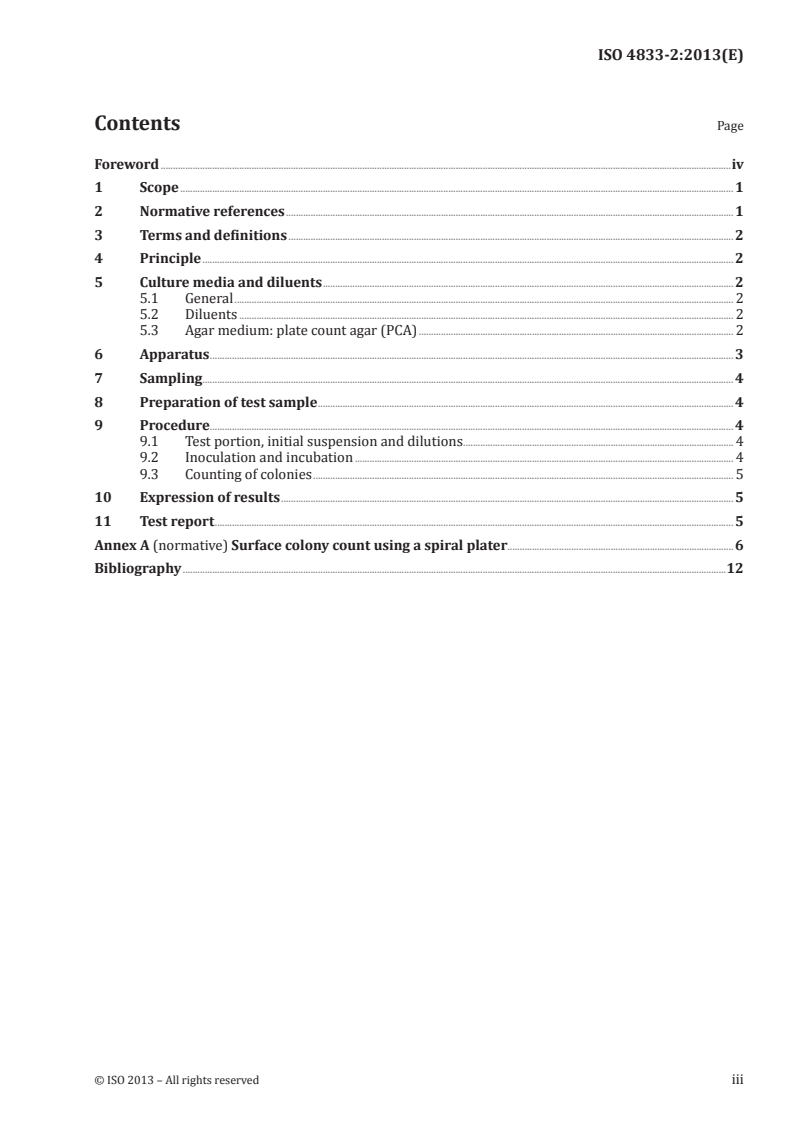
Contents Page
Foreword .iv
1 Scope . 1
2 Normative references . 1
3 Terms and definitions . 2
4 Principle . 2
5 Culture media and diluents . 2
5.1 General . 2
5.2 Diluents . 2
5.3 Agar medium: plate count agar (PCA) . 2
6 Apparatus . 3
7 Sampling . 4
8 Preparation of test sample . 4
9 Procedure. 4
9.1 Test portion, initial suspension and dilutions . 4
9.2 Inoculation and incubation . 4
9.3 Counting of colonies . 5
10 Expression of results . 5
11 Test report . 5
Annex A (normative) Surface colony count using a spiral plater. 6
Bibliography .12
Foreword
ISO (the International Organization for Standardization) is a worldwide federation of national standards
bodies (ISO member bodies). The work of preparing International Standards is normally carried out
through ISO technical committees. Each member body interested in a subject for which a technical
committee has been established has the right to be represented on that committee. International
organizations, governmental and non-governmental, in liaison with ISO, also take part in the work.
ISO collaborates closely with the International Electrotechnical Commission (IEC) on all matters of
electrotechnical standardization.
The procedures used to develop this document and those intended for its further maintenance are
described in the ISO/IEC Directives, Part 1. In particular the different approval criteria needed for the
different types of ISO documents should be noted. This document was drafted in accordance with the
editorial rules of the ISO/IEC Directives, Part 2, www.iso.org/directives.
Attention is drawn to the possibility that some of the elements of this document may be the subject of
patent rights. ISO shall not be held responsible for identifying any or all such patent rights. Details of any
patent rights identified during the development of the document will be in the Introduction and/or on
the ISO list of patent declarations received, www.iso.org/patents.
Any trade name used in this document is information given for the convenience of users and does not
constitute an endorsement.
The committee responsible for this document is ISO/TC 34, Food products, Subcommittee SC 9,
Microbiology.
This first edition, together with ISO 4833-1, cancels and replaces ISO 4833:2003.
ISO 4833 consists of the following parts, under the general title Microbiology of the food chain —
Horizontal method for the enumeration of microorganisms:
— Part 1: Colony count at 30 °C by the pour plate technique
— Part 2: Colony count at 30 °C by the surface plating technique
iv © ISO 2013 – All rights reserved
INTERNATIONAL STANDARD ISO 4833-2:2013(E)
Microbiology of the food chain — Horizontal method for
the enumeration of microorganisms —
Part 2:
Colony count at 30 °C by the surface plating technique
1 Scope
This part of ISO 4833 specifies a horizontal method for enumeration of microorganisms that are able to
grow and form colonies on the surface of a solid medium after aerobic incubation at 30 °C. The method
is applicable to:
a) products intended for human consumption or for animal feed;
b) environmental samples in the area of food and feed production and food handling.
This part of ISO 4833 is applicable to:
1) products containing heat-sensitive organisms that are likely to form a significant proportion of the
total flora (e.g. psychrotrophic organisms in chilled and frozen foods, dried foods, other foods that
may contain heat-sensitive organisms);
2) products containing obligately aerobic bacteria that are likely to form a significant proportion of
the total flora (e.g. Pseudomonas spp.);
3) products that contain small particles that can prove difficult to distinguish from colonies in a pour plate;
4) products whose intense colour prevents the recognition of colonies in a pour plate;
5) products for which distinction between different types of colony is required as part of the assessment
of food quality.
In addition to the manual spread plating technique, this part of ISO 4833 also specifies the use of a spiral
plater, a rapid method of performing surface colony counts (Annex A).
The applicability of this part of ISO 4833 to the examination of certain fermented food and animal feeds
is limited and other media or incubation conditions can be more appropriate. However, this method can
be applied to such products even though it is possible that the predominant microorganisms in these
products are not detected effectively.
For some matrices, the method described in this part of ISO 4833 can give different results to those
obtained using the method described in ISO 4833-1.
2 Normative references
The following documents, in whole or in part, are normatively referenced in this document and are
indispensable for its application. For dated references, only the edition cited applies. For undated
references, the latest edition of the referenced document (including any amendments) applies.
ISO 6887 (all parts), Microbiology of food and animal feeding stuffs — Preparation of test samples, initial
suspension and decimal dilutions for microbiological examination
ISO 7218, Microbiology of food and animal feeding stuffs — General requirements and guidance for
microbiological examinations
ISO 11133, Microbiology of food, animal feed and water — Preparation, production, storage and performance
testing of culture media
3 Terms and definitions
For the purposes of this document, the following terms and definitions apply.
3.1
microorganism
entity of microscopic size, encompassing bacteria, fungi, protozoa and viruses
[SOURCE: ISO/TS 11139:2006, 2.26]
Note 1 to entry: For the purposes of this part of ISO 4833, microorganisms are bacteria, yeasts and moulds that
are able to produce colonies under the conditions specified in this part of ISO 4833.
4 Principle
A specified quantity of the test sample, or a specified quantity of an initial suspension in the case of
other products, is surface plated on a solid agar culture medium contained in Petri dishes.
Other plates are prepared under the same conditions using decimal dilutions of the test sample or of the
initial suspension.
The plates are incubated under aerobic conditions at 30 °C for 72 h.
The number of microorganisms per gram of sample or the number of microorganisms per millilitre of
sample is calculated from the number of colonies obtained on the plates containing fewer than 300 colonies.
5 Culture media and diluents
5.1 General
Follow ISO 11133 for the preparation, production and performance testing of culture media.
5.2 Diluents
Use the diluent(s) specified in ISO 6887 for the product concerned or the specific International Standard
dealing with the product under examination.
5.3 Agar medium: plate count agar (PCA)
5.3.1 Composition
Enzymatic digest of animal tissues 5,0 g
Yeast extract 2,5 g
Glucose, anhydrous (C H O ) 1,0 g
6 12 6
a
Agar 9 g to 18 g
Water 1 000 ml
a
Depending on the gel strength of the agar.
When dairy products are examined, add skimmed milk powder at 1,0 g/l of the culture medium. The
skimmed milk powder shall be free from inhibitory substances.
2 © ISO 2013 – All rights reserved
5.3.2 Preparation
Dissolve the components or the dehydrated complete medium in the water, by heating if necessary. Mix
thoroughly and leave to stand for several minutes.
Adjust the pH (6.5), if necessary, so that after sterilization it is 7,0 ± 0,2 at 25 °C.
Dispense the medium into flasks or bottles (6.9) of suitable capacity. Sterilize in an autoclave (6.1) at
121 °C for 15 min.
If the medium is to be used immediately, cool it in a water bath (6.4) maintained at 47 °C to 50 °C before
use. If not, allow the medium to solidify in the flask or bottle. Before use, melt the medium completely in
a boiling water bath, then cool it in the water bath (6.4) maintained at 47 °C to 50 °C.
5.3.3 Preparation of agar plates
Pour 15 ml to 20 ml of the medium into sterile Petri dishes (6.6) and allow to solidify.
The plates may be stored at (5 ± 3) °C for up to 4 weeks.
Immediately before use, the agar plates should be dried in accordance with ISO 11133.
5.3.4 Performance testing of the culture medium
5.3.4.1 General
Plate count agar is a non-selective medium, used in this part of ISO 4833 as a pre-poured plate for surface
inoculation. Productivity shall be tested according to ISO 11133.
5.3.4.2 Productivity
Incubation (30 ± 1) °C for (72 ± 3) h
a
Control strains Escherichia coli WDCM 00013 or WDCM 00012 [World Data Centre for Microor-
ganisms (WDCM)]
a
Bacillus subtilis subsp. spizizenii WDCM 00003
Staphylococcus aureus WDCM 00032 or WDCM 00034
Reference medium Tryptone soya agar
Control method Quantitative
Criterion Productivity ratio (PR) ≥0,7
a
The strains to be used by the user laboratory (minimum). See Reference [15] for information on culture collection strain
numbers and contact details.
6 Apparatus
Disposable apparatus is an acceptable alternative to re-usable glassware and plastic if it has suitable
specifications.
Usual microbiological laboratory equipment (see ISO 7218) and in particular the following.
6.1 Oven for dry sterilization or autoclave for wet sterilization, used in accordance with ISO 7218.
6.2 Drying cabinet or incubator, ventilated by convection, for drying plates, capable of being
maintained between 37 °C and 55 °C, or laminar flow cabinet.
6.3 Incubator, capable of being maintained at (30 ± 1) °C.
6.4 Water baths, capable of being maintained at 47 °C to 50 °C, and another capable of maintaining
water at boiling point.
6.5 pH-meter, accurate to within ±0,1 pH unit at 25 °C.
6.6 Petri dishes, made of glass or plastic, of diameter 90 mm to 100 mm, or140 mm.
[1]
6.7 Total delivery graduated pipettes, sterile, of nominal capacities 0,1 ml and 1 ml, ISO 835
[2]
class A, or automatic pipettes, ISO 8655-2, with use of sterile tips.
6.8 Colony-counting equipment (optional), consisting of an illuminated base and, optionally, a
mechanical or electronic digital counter.
6.9 Bottles or flasks, of appropriate capacity, for preparation, sterilization and, if necessary, storage
of culture media.
6.10 Spreaders, made of glass, plastic or steel, sterile, for spreading the inoculum on the surface of
the culture medium.
7 Sampling
Sampling is not part of the method specified in this part of ISO 4833. See the specific International
Standard dealing with the product concerned. If there is no specific International Standard, it is
recommended that the parties concerned come to an agreement on this subject.
It is important the laboratory receive a truly representative sample which has not been damaged or
changed during transport or storage.
8 Preparation of test sample
Prepare the test sample in accordance with the specific International Standard appropriate to the
product concerned.
9 Procedure
9.1 Test portion, initial suspension and dilutions
Follow the specifications of ISO 6887 or the specific International Standard appropriate to the
product concerned.
9.2 Inoculation and incubation
9.2.1 Transfer, using a sterile pipette (6.7), 0,1 ml of the test sample, if the product is liquid, or of the
initial suspension in the case of other products, to the centre o
...
INTERNATIONAL ISO
STANDARD 4833-2
First edition
2013-09-01
Microbiology of the food chain —
Horizontal method for the
enumeration of microorganisms —
Part 2:
Colony count at 30 °C by the surface
plating technique
Microbiologie de la chaîne alimentaire — Méthode horizontale pour
le dénombrement des micro-organismes —
Partie 2: Comptage des colonies à 30 °C par la technique
d’ensemencement en surface
Reference number
©
ISO 2013
© ISO 2013
All rights reserved. Unless otherwise specified, no part of this publication may be reproduced or utilized otherwise in any form
or by any means, electronic or mechanical, including photocopying, or posting on the internet or an intranet, without prior
written permission. Permission can be requested from either ISO at the address below or ISO’s member body in the country of
the requester.
ISO copyright office
Case postale 56 • CH-1211 Geneva 20
Tel. + 41 22 749 01 11
Fax + 41 22 749 09 47
E-mail copyright@iso.org
Web www.iso.org
Published in Switzerland
ii © ISO 2013 – All rights reserved
Contents Page
Foreword .iv
1 Scope . 1
2 Normative references . 1
3 Terms and definitions . 2
4 Principle . 2
5 Culture media and diluents . 2
5.1 General . 2
5.2 Diluents . 2
5.3 Agar medium: plate count agar (PCA) . 2
6 Apparatus . 3
7 Sampling . 4
8 Preparation of test sample . 4
9 Procedure. 4
9.1 Test portion, initial suspension and dilutions . 4
9.2 Inoculation and incubation . 4
9.3 Counting of colonies . 5
10 Expression of results . 5
11 Test report . 5
Annex A (normative) Surface colony count using a spiral plater. 6
Bibliography .12
Foreword
ISO (the International Organization for Standardization) is a worldwide federation of national standards
bodies (ISO member bodies). The work of preparing International Standards is normally carried out
through ISO technical committees. Each member body interested in a subject for which a technical
committee has been established has the right to be represented on that committee. International
organizations, governmental and non-governmental, in liaison with ISO, also take part in the work.
ISO collaborates closely with the International Electrotechnical Commission (IEC) on all matters of
electrotechnical standardization.
The procedures used to develop this document and those intended for its further maintenance are
described in the ISO/IEC Directives, Part 1. In particular the different approval criteria needed for the
different types of ISO documents should be noted. This document was drafted in accordance with the
editorial rules of the ISO/IEC Directives, Part 2, www.iso.org/directives.
Attention is drawn to the possibility that some of the elements of this document may be the subject of
patent rights. ISO shall not be held responsible for identifying any or all such patent rights. Details of any
patent rights identified during the development of the document will be in the Introduction and/or on
the ISO list of patent declarations received, www.iso.org/patents.
Any trade name used in this document is information given for the convenience of users and does not
constitute an endorsement.
The committee responsible for this document is ISO/TC 34, Food products, Subcommittee SC 9,
Microbiology.
This first edition, together with ISO 4833-1, cancels and replaces ISO 4833:2003.
ISO 4833 consists of the following parts, under the general title Microbiology of the food chain —
Horizontal method for the enumeration of microorganisms:
— Part 1: Colony count at 30 °C by the pour plate technique
— Part 2: Colony count at 30 °C by the surface plating technique
iv © ISO 2013 – All rights reserved
INTERNATIONAL STANDARD ISO 4833-2:2013(E)
Microbiology of the food chain — Horizontal method for
the enumeration of microorganisms —
Part 2:
Colony count at 30 °C by the surface plating technique
1 Scope
This part of ISO 4833 specifies a horizontal method for enumeration of microorganisms that are able to
grow and form colonies on the surface of a solid medium after aerobic incubation at 30 °C. The method
is applicable to:
a) products intended for human consumption or for animal feed;
b) environmental samples in the area of food and feed production and food handling.
This part of ISO 4833 is applicable to:
1) products containing heat-sensitive organisms that are likely to form a significant proportion of the
total flora (e.g. psychrotrophic organisms in chilled and frozen foods, dried foods, other foods that
may contain heat-sensitive organisms);
2) products containing obligately aerobic bacteria that are likely to form a significant proportion of
the total flora (e.g. Pseudomonas spp.);
3) products that contain small particles that can prove difficult to distinguish from colonies in a pour plate;
4) products whose intense colour prevents the recognition of colonies in a pour plate;
5) products for which distinction between different types of colony is required as part of the assessment
of food quality.
In addition to the manual spread plating technique, this part of ISO 4833 also specifies the use of a spiral
plater, a rapid method of performing surface colony counts (Annex A).
The applicability of this part of ISO 4833 to the examination of certain fermented food and animal feeds
is limited and other media or incubation conditions can be more appropriate. However, this method can
be applied to such products even though it is possible that the predominant microorganisms in these
products are not detected effectively.
For some matrices, the method described in this part of ISO 4833 can give different results to those
obtained using the method described in ISO 4833-1.
2 Normative references
The following documents, in whole or in part, are normatively referenced in this document and are
indispensable for its application. For dated references, only the edition cited applies. For undated
references, the latest edition of the referenced document (including any amendments) applies.
ISO 6887 (all parts), Microbiology of food and animal feeding stuffs — Preparation of test samples, initial
suspension and decimal dilutions for microbiological examination
ISO 7218, Microbiology of food and animal feeding stuffs — General requirements and guidance for
microbiological examinations
ISO 11133, Microbiology of food, animal feed and water — Preparation, production, storage and performance
testing of culture media
3 Terms and definitions
For the purposes of this document, the following terms and definitions apply.
3.1
microorganism
entity of microscopic size, encompassing bacteria, fungi, protozoa and viruses
[SOURCE: ISO/TS 11139:2006, 2.26]
Note 1 to entry: For the purposes of this part of ISO 4833, microorganisms are bacteria, yeasts and moulds that
are able to produce colonies under the conditions specified in this part of ISO 4833.
4 Principle
A specified quantity of the test sample, or a specified quantity of an initial suspension in the case of
other products, is surface plated on a solid agar culture medium contained in Petri dishes.
Other plates are prepared under the same conditions using decimal dilutions of the test sample or of the
initial suspension.
The plates are incubated under aerobic conditions at 30 °C for 72 h.
The number of microorganisms per gram of sample or the number of microorganisms per millilitre of
sample is calculated from the number of colonies obtained on the plates containing fewer than 300 colonies.
5 Culture media and diluents
5.1 General
Follow ISO 11133 for the preparation, production and performance testing of culture media.
5.2 Diluents
Use the diluent(s) specified in ISO 6887 for the product concerned or the specific International Standard
dealing with the product under examination.
5.3 Agar medium: plate count agar (PCA)
5.3.1 Composition
Enzymatic digest of animal tissues 5,0 g
Yeast extract 2,5 g
Glucose, anhydrous (C H O ) 1,0 g
6 12 6
a
Agar 9 g to 18 g
Water 1 000 ml
a
Depending on the gel strength of the agar.
When dairy products are examined, add skimmed milk powder at 1,0 g/l of the culture medium. The
skimmed milk powder shall be free from inhibitory substances.
2 © ISO 2013 – All rights reserved
5.3.2 Preparation
Dissolve the components or the dehydrated complete medium in the water, by heating if necessary. Mix
thoroughly and leave to stand for several minutes.
Adjust the pH (6.5), if necessary, so that after sterilization it is 7,0 ± 0,2 at 25 °C.
Dispense the medium into flasks or bottles (6.9) of suitable capacity. Sterilize in an autoclave (6.1) at
121 °C for 15 min.
If the medium is to be used immediately, cool it in a water bath (6.4) maintained at 47 °C to 50 °C before
use. If not, allow the medium to solidify in the flask or bottle. Before use, melt the medium completely in
a boiling water bath, then cool it in the water bath (6.4) maintained at 47 °C to 50 °C.
5.3.3 Preparation of agar plates
Pour 15 ml to 20 ml of the medium into sterile Petri dishes (6.6) and allow to solidify.
The plates may be stored at (5 ± 3) °C for up to 4 weeks.
Immediately before use, the agar plates should be dried in accordance with ISO 11133.
5.3.4 Performance testing of the culture medium
5.3.4.1 General
Plate count agar is a non-selective medium, used in this part of ISO 4833 as a pre-poured plate for surface
inoculation. Productivity shall be tested according to ISO 11133.
5.3.4.2 Productivity
Incubation (30 ± 1) °C for (72 ± 3) h
a
Control strains Escherichia coli WDCM 00013 or WDCM 00012 [World Data Centre for Microor-
ganisms (WDCM)]
a
Bacillus subtilis subsp. spizizenii WDCM 00003
Staphylococcus aureus WDCM 00032 or WDCM 00034
Reference medium Tryptone soya agar
Control method Quantitative
Criterion Productivity ratio (PR) ≥0,7
a
The strains to be used by the user laboratory (minimum). See Reference [15] for information on culture collection strain
numbers and contact details.
6 Apparatus
Disposable apparatus is an acceptable alternative to re-usable glassware and plastic if it has suitable
specifications.
Usual microbiological laboratory equipment (see ISO 7218) and in particular the following.
6.1 Oven for dry sterilization or autoclave for wet sterilization, used in accordance with ISO 7218.
6.2 Drying cabinet or incubator, ventilated by convection, for drying plates, capable of being
maintained between 37 °C and 55 °C, or laminar flow cabinet.
6.3 Incubator, capable of being maintained at (30 ± 1) °C.
6.4 Water baths, capable of being maintained at 47 °C to 50 °C, and another capable of maintaining
water at boiling point.
6.5 pH-meter, accurate to within ±0,1 pH unit at 25 °C.
6.6 Petri dishes, made of glass or plastic, of diameter 90 mm to 100 mm, or140 mm.
[1]
6.7 Total delivery graduated pipettes, sterile, of nominal capacities 0,1 ml and 1 ml, ISO 835
[2]
class A, or automatic pipettes, ISO 8655-2, with use of sterile tips.
6.8 Colony-counting equipment (optional), consisting of an illuminated base and, optionally, a
mechanical or electronic digital counter.
6.9 Bottles or flasks, of appropriate capacity, for preparation, sterilization and, if necessary, storage
of culture media.
6.10 Spreaders, made of glass, plastic or steel, sterile, for spreading the inoculum on the surface of
the culture medium.
7 Sampling
Sampling is not part of the method specified in this part of ISO 4833. See the specific International
Standard dealing with the product concerned. If there is no specific International Standard, it is
recommended that the parties concerned come to an agreement on this subject.
It is important the laboratory receive a truly representative sample which has not been damaged or
changed during transport or storage.
8 Preparation of test sample
Prepare the test sample in accordance with the specific International Standard appropriate to the
product concerned.
9 Procedure
9.1 Test portion, initial suspension and dilutions
Follow the specifications of ISO 6887 or the specific International Standard appropriate to the
product concerned.
9.2 Inoculation and incubation
9.2.1 Transfer, using a sterile pipette (6.7), 0,1 ml of the test sample, if the product is liquid, or of the
initial suspension in the case of other products, to the centre o
...
NORME ISO
INTERNATIONALE 4833-2
Première édition
2013-09-01
Microbiologie de la chaîne
alimentaire — Méthode horizontale
pour le dénombrement des micro-
organismes —
Partie 2:
Comptage des colonies à 30 °C par
la technique d’ensemencement en
surface
Microbiology of the food chain — Horizontal method for the
enumeration of microorganisms —
Part 2: Colony count at 30 °C by the surface plating technique
Numéro de référence
©
ISO 2013
DOCUMENT PROTÉGÉ PAR COPYRIGHT
© ISO 2013
Droits de reproduction réservés. Sauf indication contraire, aucune partie de cette publication ne peut être reproduite ni utilisée
sous quelque forme que ce soit et par aucun procédé, électronique ou mécanique, y compris la photocopie, l’affichage sur
l’internet ou sur un Intranet, sans autorisation écrite préalable. Les demandes d’autorisation peuvent être adressées à l’ISO à
l’adresse ci-après ou au comité membre de l’ISO dans le pays du demandeur.
ISO copyright office
Case postale 56 • CH-1211 Geneva 20
Tel. + 41 22 749 01 11
Fax + 41 22 749 09 47
E-mail copyright@iso.org
Web www.iso.org
Publié en Suisse
ii © ISO 2013 – Tous droits réservés
Sommaire Page
Avant-propos .iv
1 Domaine d’application . 1
2 Références normatives . 1
3 Termes et définitions . 2
4 Principe . 2
5 Milieux de culture et diluants . 2
5.1 Généralités . 2
5.2 Diluants . 2
5.3 Milieu gélosé: gélose pour dénombrement (PCA) . 3
6 Appareillage . 4
7 Échantillonnage . 4
8 Préparation de l’échantillon pour essai . 5
9 Mode opératoire. 5
9.1 Prise d’essai, suspension mère et dilutions . 5
9.2 Ensemencement et incubation . 5
9.3 Dénombrement des colonies . 5
10 Expression des résultats. 6
11 Rapport d’essai . 6
Annexe A (normative) Comptage des colonies en surface au moyen d’un dispositif
d’ensemencement en spirale . 7
Bibliographie .13
Avant-propos
L’ISO (Organisation internationale de normalisation) est une fédération mondiale d’organismes
nationaux de normalisation (comités membres de l’ISO). L’élaboration des Normes internationales est
en général confiée aux comités techniques de l’ISO. Chaque comité membre intéressé par une étude
a le droit de faire partie du comité technique créé à cet effet. Les organisations internationales,
gouvernementales et non gouvernementales, en liaison avec l’ISO participent également aux travaux.
L’ISO collabore étroitement avec la Commission électrotechnique internationale (CEI) en ce qui concerne
la normalisation électrotechnique.
Les procédures utilisées pour élaborer le présent document et celles destinées à sa mise à jour sont
décrites dans les Directives ISO/CEI, Partie 1. Il convient, en particulier, de prendre note des différents
critères d’approbation requis pour les différents types de documents ISO. Le présent document a été
rédigé conformément aux règles de rédaction données dans les Directives ISO/CEI, Partie 2, www.iso.
org/directives.
L’attention est appelée sur le fait que certains des éléments du présent document peuvent faire l’objet de
droits de propriété intellectuelle ou de droits analogues. L’ISO ne saurait être tenue pour responsable
de ne pas avoir identifié de tels droits de propriété et averti de leur existence. Les détails concernant les
références aux droits de propriété intellectuelle ou autres droits analogues identifiés lors de l’élaboration
du document sont indiqués dans l’Introduction et/ou sur la liste ISO des déclarations de brevets reçues,
www.iso.org/brevets.
Les éventuelles appellations commerciales utilisées dans le présent document sont données pour
information à l’intention des utilisateurs et ne constituent pas une approbation ou une recommandation.
Le comité chargé de l’élaboration du présent document est l’ISO/TC 34, Produits alimentaires, sous-
comité SC 9, Microbiologie.
Cette première édition, conjointement avec l’ISO 4833-1, annule et remplace l’ISO 4833:2003.
L’ISO 4833 comprend les parties suivantes, présentées sous le titre général Microbiologie de la chaîne
alimentaire —Méthode horizontale pour le dénombrement des micro-organismes:
— Partie 1: Comptage des colonies à 30 °C par la technique d’ensemencement en profondeur
— Partie 2: Comptage des colonies à 30 °C par la technique d’ensemencement en surface
iv © ISO 2013 – Tous droits réservés
NORME INTERNATIONALE ISO 4833-2:2013(F)
Microbiologie de la chaîne alimentaire — Méthode
horizontale pour le dénombrement des micro-organismes —
Partie 2:
Comptage des colonies à 30 °C par la technique
d’ensemencement en surface
1 Domaine d’application
La présente partie de l’ISO 4833 spécifie une méthode horizontale de dénombrement des micro-
organismes capables de se développer et de former des colonies à la surface d’un milieu solide après
incubation aérobie à 30 °C. La méthode est applicable:
a) aux produits destinés à la consommation humaine ou aux aliments pour animaux;
b) aux échantillons d’environnement dans le domaine de la production d’aliments destinés à l’homme
ou aux animaux et de la préparation des aliments.
La présente partie de l’ISO 4833 est applicable:
1) aux produits contenant des organismes sensibles à la chaleur susceptibles de former une partie
significative de l’ensemble de la flore (par exemple des organismes psychrotrophes présents dans
des aliments réfrigérés et congelés, des aliments secs, d’autres aliments pouvant contenir des
organismes sensibles à la chaleur);
2) aux produits contenant des bactéries aérobies susceptibles de former une partie significative de
l’ensemble de la flore (par exemple Pseudomonas spp.);
3) aux produits contenant de petites particules qu’il peut se révéler difficile de distinguer des colonies
dans une boîte ensemencée en profondeur;
4) aux produits dont la couleur intense empêche la reconnaissance des colonies dans une boîte
ensemencée en profondeur;
5) aux produits pour lesquels il est nécessaire de faire la différence entre les différents types de
colonies dans le cadre de l’évaluation de la qualité des aliments.
En plus de la technique d’ensemencement en surface manuelle, la présente partie de l’ISO 4833 spécifie
également l’utilisation d’un dispositif d’ensemencement en spirale, méthode rapide de dénombrement
des colonies en surface (Annexe A).
La présente partie de l’ISO 4833 peut ne pas être adaptée à l’analyse de certains aliments fermentés
et aliments pour animaux et d’autres milieux ou conditions d’incubation peuvent être plus appropriés.
Toutefois, cette méthode peut être appliquée à de tels produits, même si elle ne détecte pas totalement
les micro-organismes présents en majorité dans ces produits.
Pour certaines matrices, la méthode décrite dans la présente partie de l’ISO 4833 peut donner des
résultats différents de ceux obtenus avec la méthode décrite dans l’ISO 4833-1.
2 Références normatives
Les documents ci-après, dans leur intégralité ou non, sont des références normatives indispensables à
l’application du présent document. Pour les références datées, seule l’édition citée s’applique. Pour les
références non datées, la dernière édition du document de référence s’applique (y compris les éventuels
amendements).
ISO 6887 (toutes les parties), Microbiologie des aliments — Préparation des échantillons, de la suspension
mère et des dilutions décimales en vue de l’examen microbiologique
ISO 7218, Microbiologie des aliments — Exigences générales et recommandations
ISO 11133, Microbiologie des aliments et de l’eau — Préparation, production, stockage et essais de
performance des milieux de culture
3 Termes et définitions
Pour les besoins du présent document, les termes et définitions suivants s’appliquent.
3.1
micro-organisme
entité de taille microscopique, comprenant les bactéries, les champignons, les protozoaires et les virus
[SOURCE: ISO/TS 11139:2006, 2.26]
Note 1 à l’article: Pour les besoins de la présente partie de l’ISO 4833, les micro-organismes sont des bactéries, levures
et moisissures capables de produire des colonies dans les conditions spécifiées dans la présente partie de l’ISO 4833.
4 Principe
Une quantité déterminée de l’échantillon pour essai, ou une quantité déterminée de suspension mère
dans le cas d’autres produits, est ensemencée à la surface d’un milieu de culture gélosé solide contenu
dans des boîtes de Petri.
D’autres boîtes sont préparées dans les mêmes conditions, à partir de dilutions décimales de l’échantillon
pour essai ou de la suspension mère.
Les boîtes sont incubées dans des conditions aérobies à 30 °C pendant 72 h.
Le nombre de micro-organismes par gramme d’échantillon ou le nombre de micro-organismes par
millilitre d’échantillon est calculé à partir du nombre de colonies obtenues sur les boîtes contenant
moins de 300 colonies.
5 Milieux de culture et diluants
5.1 Généralités
Suivre l’ISO 11133 pour la préparation, la production et les essais de performance du milieu de culture.
5.2 Diluants
Utiliser le ou les diluants spécifiés dans l’ISO 6887 pour le produit concerné ou la Norme internationale
spécifique du produit soumis à examen.
2 © ISO 2013 – Tous droits réservés
5.3 Milieu gélosé: gélose pour dénombrement (PCA)
5.3.1 Composition
Digestat enzymatique de tissus d’animaux 5,0 g
Extrait de levure 2,5 g
Glucose anhydre (C H O ) 1,0 g
6 12 6
a
Gélose 9 g à 18 g
Eau 1 000 ml
a
En fonction du pouvoir gélifiant de la gélose.
Dans le cas de l’analyse de produits laitiers, ajouter 1,0 g de poudre de lait écrémé par litre de milieu de
culture. La poudre de lait écrémé doit être exempte de substances inhibitrices.
5.3.2 Préparation
Dissoudre, dans de l’eau, les composants ou le milieu complet déshydraté, en chauffant si nécessaire.
Mélanger soigneusement et laisser reposer plusieurs minutes.
Ajuster le pH (6.5), si nécessaire, de sorte qu’après stérilisation, il soit de 7,0 ± 0,2 à 25 °C.
Répartir le milieu dans des fioles ou flacons (6.9) de capacité appropriée. Stériliser pendant 15 min à
l’autoclave (6.1) à 121 °C.
Si le milieu est à utiliser extemporanément, le refroidir dans un bain d’eau (6.4) maintenu entre 47 °C et
50 °C, avant utilisation. Sinon, le laisser se solidifier dans une fiole ou dans un flacon. Avant utilisation,
faire fondre complètement le milieu dans un bain d’eau bouillante, puis le refroidir dans un bain d’eau
(6.4) maintenu entre 47 °C et 50 °C.
5.3.3 Préparation des boîtes gélosées
Verser entre 15 ml et 20 ml de milieu dans des boîtes de Petri stériles (6.6) et laisser solidifier.
Les boîtes peuvent être stockées à (5 ± 3) °C pendant 4 semaines au plus.
Immédiatement avant utilisation, il est recommandé de sécher les boîtes gélosées conformément à l’ISO 11133.
5.3.4 Essai de performance du milieu de culture
5.3.4.1 Généralités
La gélose pour dénombrement (PCA) est un milieu non sélectif, utilisé dans la présente partie de l’ISO 4833
comme milieu pré-coulé pour ensemencement en surface. Les essais portant sur la productivité doivent
être réalisés conformément à l’ISO 11133.
5.3.4.2 Productivité
Incubation (72 ± 3) h à (30 ± 1) °C
a
Souches témoins Escherichia coli WDCM 00013 ou WDCM 00012 [World Data Centre for
Microorganisms (WDMC), Centre mondial de données pour les micro-orga-
nismes]
a
Bacillus subtilis subsp. spizizenii WDCM 00003
Staphylococcus aureus WDCM 00032 ou WDCM 00034
Milieu de référence Gélose tryptone soja
Méthode de contrôle Quantitative
Critère Rapport de productivité (RP) ≥ 0,7
a
Souches à utiliser par le laboratoire utilisateur (au minimum). Voir la Référence [15] pour obtenir des informations sur les
références des souches de collections et les coordonnées des centres concernés.
6 Appareillage
Le matériel à usage unique est acceptable au même titre que la verrerie et le matériel en plastique
réutilisables, si leurs spécifications sont appropriées.
Matériel courant de laboratoire de microbiologie (voir l’ISO 7218) et, en particulier, ce qui suit.
6.1 Four pour la stérilisation en chaleur sèche ou autoclave pour la stérilisation en chaleur humide,
utilisé conformément à l’ISO 7218.
6.2 Étuve ou armoire de séchage, ventilée par convection, pour sécher les boîtes, pouvant être
maintenue entre 37 °C et 55 °C, ou hotte à flux d’air laminaire.
6.3 Étuve, pouvant être maintenue à (30 ± 1) °C.
6.4 Bains d’eau, l’un pouvant maintenir une température comprise entre 47 °C et 50 °C et l’autre
pouvant maintenir l’eau au point d’ébullition.
6.5 pH-mètre, d’une précision de ± 0,1 unité pH à 25 °C.
6.6 Boîtes de Petri, en verre ou en plastique, de 90 mm à 100 mm, ou 140 mm de diamètre.
6.7 Pipettes graduées à écoulement total, stériles, ayant une capacité nominale de 0,1 ml et de
[1] [2]
1 ml, ISO 835 classe A, ou pipettes automatiques, ISO 8655-2 , utilisant des embouts stériles.
6.8 Appareil de comptage des colonies (facultatif), constitué d’une base éclairée et d’un compteur
(facultatif) mécanique ou électronique à affichage numérique.
6.9 Fioles ou flacons, de capacité appropriée pour la préparation, la stérilisation et, si nécessaire, le
stockage des milieux de culture.
6.10 Spatules, en verre, en plastique ou en métal, stériles, servant à étaler l’inoculum sur le milieu de
culture.
7 Échantillonnage
L’échantillonnage ne fait pas partie de la méthode spécifiée dans la présente partie de l’ISO 4833. Se
reporter à la Norme internationale spécifique traitant du produit concerné. S’il n’existe aucune Norme
internationale spécifique, il est recommandé aux parties intéressées de convenir d’un accord à ce sujet.
4 © ISO 2013 – Tous droits réservés
Il est important que le laboratoire reçoive un échantillon réellement représentatif, non endommagé ou
modifié pendant le transport ou le stockage.
8 Préparation de l’échantillon pour essai
Préparer l’échantillon pour essai conformément à la Norme internationale spécifique du produit concerné.
9 Mode opératoire
9.1 Prise d’essai, suspension mère et dilutions
Suivre les spécifications de l’ISO 6887 ou la Norme internationale spécifique appropriée au produit concerné.
9.2 Ensemencement et incubation
9.2.1 Au moyen d’une pipette stérile (6.7), transférer 0,1 ml de l’échantillon pour essai si le produit est
liquide, ou de la suspension mère dans le cas d’autres produits, au centre de deux boîtes de milieu gélosé
(5.3). Si des boîtes sont préparées à partir de plus d’une dilution, le nombre de boîtes par dilution peut
être réduit à une boîte (voir l’ISO 7218).
Si, pour certains produits, il est souhaitable de dénombrer de faibles quantités d’organismes, les limites
de détection peuvent être augmentées d’un facteur de 10 en ensemençant 1,0 ml de l’échantil
...
NORME ISO
INTERNATIONALE 4833-2
Première édition
2013-09-01
Microbiologie de la chaîne
alimentaire — Méthode horizontale
pour le dénombrement des micro-
organismes —
Partie 2:
Comptage des colonies à 30 °C par
la technique d’ensemencement en
surface
Microbiology of the food chain — Horizontal method for the
enumeration of microorganisms —
Part 2: Colony count at 30 °C by the surface plating technique
Numéro de référence
©
ISO 2013
DOCUMENT PROTÉGÉ PAR COPYRIGHT
© ISO 2013
Droits de reproduction réservés. Sauf indication contraire, aucune partie de cette publication ne peut être reproduite ni utilisée
sous quelque forme que ce soit et par aucun procédé, électronique ou mécanique, y compris la photocopie, l’affichage sur
l’internet ou sur un Intranet, sans autorisation écrite préalable. Les demandes d’autorisation peuvent être adressées à l’ISO à
l’adresse ci-après ou au comité membre de l’ISO dans le pays du demandeur.
ISO copyright office
Case postale 56 • CH-1211 Geneva 20
Tel. + 41 22 749 01 11
Fax + 41 22 749 09 47
E-mail copyright@iso.org
Web www.iso.org
Publié en Suisse
ii © ISO 2013 – Tous droits réservés
Sommaire Page
Avant-propos .iv
1 Domaine d’application . 1
2 Références normatives . 1
3 Termes et définitions . 2
4 Principe . 2
5 Milieux de culture et diluants . 2
5.1 Généralités . 2
5.2 Diluants . 2
5.3 Milieu gélosé: gélose pour dénombrement (PCA) . 3
6 Appareillage . 4
7 Échantillonnage . 4
8 Préparation de l’échantillon pour essai . 5
9 Mode opératoire. 5
9.1 Prise d’essai, suspension mère et dilutions . 5
9.2 Ensemencement et incubation . 5
9.3 Dénombrement des colonies . 5
10 Expression des résultats. 6
11 Rapport d’essai . 6
Annexe A (normative) Comptage des colonies en surface au moyen d’un dispositif
d’ensemencement en spirale . 7
Bibliographie .13
Avant-propos
L’ISO (Organisation internationale de normalisation) est une fédération mondiale d’organismes
nationaux de normalisation (comités membres de l’ISO). L’élaboration des Normes internationales est
en général confiée aux comités techniques de l’ISO. Chaque comité membre intéressé par une étude
a le droit de faire partie du comité technique créé à cet effet. Les organisations internationales,
gouvernementales et non gouvernementales, en liaison avec l’ISO participent également aux travaux.
L’ISO collabore étroitement avec la Commission électrotechnique internationale (CEI) en ce qui concerne
la normalisation électrotechnique.
Les procédures utilisées pour élaborer le présent document et celles destinées à sa mise à jour sont
décrites dans les Directives ISO/CEI, Partie 1. Il convient, en particulier, de prendre note des différents
critères d’approbation requis pour les différents types de documents ISO. Le présent document a été
rédigé conformément aux règles de rédaction données dans les Directives ISO/CEI, Partie 2, www.iso.
org/directives.
L’attention est appelée sur le fait que certains des éléments du présent document peuvent faire l’objet de
droits de propriété intellectuelle ou de droits analogues. L’ISO ne saurait être tenue pour responsable
de ne pas avoir identifié de tels droits de propriété et averti de leur existence. Les détails concernant les
références aux droits de propriété intellectuelle ou autres droits analogues identifiés lors de l’élaboration
du document sont indiqués dans l’Introduction et/ou sur la liste ISO des déclarations de brevets reçues,
www.iso.org/brevets.
Les éventuelles appellations commerciales utilisées dans le présent document sont données pour
information à l’intention des utilisateurs et ne constituent pas une approbation ou une recommandation.
Le comité chargé de l’élaboration du présent document est l’ISO/TC 34, Produits alimentaires, sous-
comité SC 9, Microbiologie.
Cette première édition, conjointement avec l’ISO 4833-1, annule et remplace l’ISO 4833:2003.
L’ISO 4833 comprend les parties suivantes, présentées sous le titre général Microbiologie de la chaîne
alimentaire —Méthode horizontale pour le dénombrement des micro-organismes:
— Partie 1: Comptage des colonies à 30 °C par la technique d’ensemencement en profondeur
— Partie 2: Comptage des colonies à 30 °C par la technique d’ensemencement en surface
iv © ISO 2013 – Tous droits réservés
NORME INTERNATIONALE ISO 4833-2:2013(F)
Microbiologie de la chaîne alimentaire — Méthode
horizontale pour le dénombrement des micro-organismes —
Partie 2:
Comptage des colonies à 30 °C par la technique
d’ensemencement en surface
1 Domaine d’application
La présente partie de l’ISO 4833 spécifie une méthode horizontale de dénombrement des micro-
organismes capables de se développer et de former des colonies à la surface d’un milieu solide après
incubation aérobie à 30 °C. La méthode est applicable:
a) aux produits destinés à la consommation humaine ou aux aliments pour animaux;
b) aux échantillons d’environnement dans le domaine de la production d’aliments destinés à l’homme
ou aux animaux et de la préparation des aliments.
La présente partie de l’ISO 4833 est applicable:
1) aux produits contenant des organismes sensibles à la chaleur susceptibles de former une partie
significative de l’ensemble de la flore (par exemple des organismes psychrotrophes présents dans
des aliments réfrigérés et congelés, des aliments secs, d’autres aliments pouvant contenir des
organismes sensibles à la chaleur);
2) aux produits contenant des bactéries aérobies susceptibles de former une partie significative de
l’ensemble de la flore (par exemple Pseudomonas spp.);
3) aux produits contenant de petites particules qu’il peut se révéler difficile de distinguer des colonies
dans une boîte ensemencée en profondeur;
4) aux produits dont la couleur intense empêche la reconnaissance des colonies dans une boîte
ensemencée en profondeur;
5) aux produits pour lesquels il est nécessaire de faire la différence entre les différents types de
colonies dans le cadre de l’évaluation de la qualité des aliments.
En plus de la technique d’ensemencement en surface manuelle, la présente partie de l’ISO 4833 spécifie
également l’utilisation d’un dispositif d’ensemencement en spirale, méthode rapide de dénombrement
des colonies en surface (Annexe A).
La présente partie de l’ISO 4833 peut ne pas être adaptée à l’analyse de certains aliments fermentés
et aliments pour animaux et d’autres milieux ou conditions d’incubation peuvent être plus appropriés.
Toutefois, cette méthode peut être appliquée à de tels produits, même si elle ne détecte pas totalement
les micro-organismes présents en majorité dans ces produits.
Pour certaines matrices, la méthode décrite dans la présente partie de l’ISO 4833 peut donner des
résultats différents de ceux obtenus avec la méthode décrite dans l’ISO 4833-1.
2 Références normatives
Les documents ci-après, dans leur intégralité ou non, sont des références normatives indispensables à
l’application du présent document. Pour les références datées, seule l’édition citée s’applique. Pour les
références non datées, la dernière édition du document de référence s’applique (y compris les éventuels
amendements).
ISO 6887 (toutes les parties), Microbiologie des aliments — Préparation des échantillons, de la suspension
mère et des dilutions décimales en vue de l’examen microbiologique
ISO 7218, Microbiologie des aliments — Exigences générales et recommandations
ISO 11133, Microbiologie des aliments et de l’eau — Préparation, production, stockage et essais de
performance des milieux de culture
3 Termes et définitions
Pour les besoins du présent document, les termes et définitions suivants s’appliquent.
3.1
micro-organisme
entité de taille microscopique, comprenant les bactéries, les champignons, les protozoaires et les virus
[SOURCE: ISO/TS 11139:2006, 2.26]
Note 1 à l’article: Pour les besoins de la présente partie de l’ISO 4833, les micro-organismes sont des bactéries, levures
et moisissures capables de produire des colonies dans les conditions spécifiées dans la présente partie de l’ISO 4833.
4 Principe
Une quantité déterminée de l’échantillon pour essai, ou une quantité déterminée de suspension mère
dans le cas d’autres produits, est ensemencée à la surface d’un milieu de culture gélosé solide contenu
dans des boîtes de Petri.
D’autres boîtes sont préparées dans les mêmes conditions, à partir de dilutions décimales de l’échantillon
pour essai ou de la suspension mère.
Les boîtes sont incubées dans des conditions aérobies à 30 °C pendant 72 h.
Le nombre de micro-organismes par gramme d’échantillon ou le nombre de micro-organismes par
millilitre d’échantillon est calculé à partir du nombre de colonies obtenues sur les boîtes contenant
moins de 300 colonies.
5 Milieux de culture et diluants
5.1 Généralités
Suivre l’ISO 11133 pour la préparation, la production et les essais de performance du milieu de culture.
5.2 Diluants
Utiliser le ou les diluants spécifiés dans l’ISO 6887 pour le produit concerné ou la Norme internationale
spécifique du produit soumis à examen.
2 © ISO 2013 – Tous droits réservés
5.3 Milieu gélosé: gélose pour dénombrement (PCA)
5.3.1 Composition
Digestat enzymatique de tissus d’animaux 5,0 g
Extrait de levure 2,5 g
Glucose anhydre (C H O ) 1,0 g
6 12 6
a
Gélose 9 g à 18 g
Eau 1 000 ml
a
En fonction du pouvoir gélifiant de la gélose.
Dans le cas de l’analyse de produits laitiers, ajouter 1,0 g de poudre de lait écrémé par litre de milieu de
culture. La poudre de lait écrémé doit être exempte de substances inhibitrices.
5.3.2 Préparation
Dissoudre, dans de l’eau, les composants ou le milieu complet déshydraté, en chauffant si nécessaire.
Mélanger soigneusement et laisser reposer plusieurs minutes.
Ajuster le pH (6.5), si nécessaire, de sorte qu’après stérilisation, il soit de 7,0 ± 0,2 à 25 °C.
Répartir le milieu dans des fioles ou flacons (6.9) de capacité appropriée. Stériliser pendant 15 min à
l’autoclave (6.1) à 121 °C.
Si le milieu est à utiliser extemporanément, le refroidir dans un bain d’eau (6.4) maintenu entre 47 °C et
50 °C, avant utilisation. Sinon, le laisser se solidifier dans une fiole ou dans un flacon. Avant utilisation,
faire fondre complètement le milieu dans un bain d’eau bouillante, puis le refroidir dans un bain d’eau
(6.4) maintenu entre 47 °C et 50 °C.
5.3.3 Préparation des boîtes gélosées
Verser entre 15 ml et 20 ml de milieu dans des boîtes de Petri stériles (6.6) et laisser solidifier.
Les boîtes peuvent être stockées à (5 ± 3) °C pendant 4 semaines au plus.
Immédiatement avant utilisation, il est recommandé de sécher les boîtes gélosées conformément à l’ISO 11133.
5.3.4 Essai de performance du milieu de culture
5.3.4.1 Généralités
La gélose pour dénombrement (PCA) est un milieu non sélectif, utilisé dans la présente partie de l’ISO 4833
comme milieu pré-coulé pour ensemencement en surface. Les essais portant sur la productivité doivent
être réalisés conformément à l’ISO 11133.
5.3.4.2 Productivité
Incubation (72 ± 3) h à (30 ± 1) °C
a
Souches témoins Escherichia coli WDCM 00013 ou WDCM 00012 [World Data Centre for
Microorganisms (WDMC), Centre mondial de données pour les micro-orga-
nismes]
a
Bacillus subtilis subsp. spizizenii WDCM 00003
Staphylococcus aureus WDCM 00032 ou WDCM 00034
Milieu de référence Gélose tryptone soja
Méthode de contrôle Quantitative
Critère Rapport de productivité (RP) ≥ 0,7
a
Souches à utiliser par le laboratoire utilisateur (au minimum). Voir la Référence [15] pour obtenir des informations sur les
références des souches de collections et les coordonnées des centres concernés.
6 Appareillage
Le matériel à usage unique est acceptable au même titre que la verrerie et le matériel en plastique
réutilisables, si leurs spécifications sont appropriées.
Matériel courant de laboratoire de microbiologie (voir l’ISO 7218) et, en particulier, ce qui suit.
6.1 Four pour la stérilisation en chaleur sèche ou autoclave pour la stérilisation en chaleur humide,
utilisé conformément à l’ISO 7218.
6.2 Étuve ou armoire de séchage, ventilée par convection, pour sécher les boîtes, pouvant être
maintenue entre 37 °C et 55 °C, ou hotte à flux d’air laminaire.
6.3 Étuve, pouvant être maintenue à (30 ± 1) °C.
6.4 Bains d’eau, l’un pouvant maintenir une température comprise entre 47 °C et 50 °C et l’autre
pouvant maintenir l’eau au point d’ébullition.
6.5 pH-mètre, d’une précision de ± 0,1 unité pH à 25 °C.
6.6 Boîtes de Petri, en verre ou en plastique, de 90 mm à 100 mm, ou 140 mm de diamètre.
6.7 Pipettes graduées à écoulement total, stériles, ayant une capacité nominale de 0,1 ml et de
[1] [2]
1 ml, ISO 835 classe A, ou pipettes automatiques, ISO 8655-2 , utilisant des embouts stériles.
6.8 Appareil de comptage des colonies (facultatif), constitué d’une base éclairée et d’un compteur
(facultatif) mécanique ou électronique à affichage numérique.
6.9 Fioles ou flacons, de capacité appropriée pour la préparation, la stérilisation et, si nécessaire, le
stockage des milieux de culture.
6.10 Spatules, en verre, en plastique ou en métal, stériles, servant à étaler l’inoculum sur le milieu de
culture.
7 Échantillonnage
L’échantillonnage ne fait pas partie de la méthode spécifiée dans la présente partie de l’ISO 4833. Se
reporter à la Norme internationale spécifique traitant du produit concerné. S’il n’existe aucune Norme
internationale spécifique, il est recommandé aux parties intéressées de convenir d’un accord à ce sujet.
4 © ISO 2013 – Tous droits réservés
Il est important que le laboratoire reçoive un échantillon réellement représentatif, non endommagé ou
modifié pendant le transport ou le stockage.
8 Préparation de l’échantillon pour essai
Préparer l’échantillon pour essai conformément à la Norme internationale spécifique du produit concerné.
9 Mode opératoire
9.1 Prise d’essai, suspension mère et dilutions
Suivre les spécifications de l’ISO 6887 ou la Norme internationale spécifique appropriée au produit concerné.
9.2 Ensemencement et incubation
9.2.1 Au moyen d’une pipette stérile (6.7), transférer 0,1 ml de l’échantillon pour essai si le produit est
liquide, ou de la suspension mère dans le cas d’autres produits, au centre de deux boîtes de milieu gélosé
(5.3). Si des boîtes sont préparées à partir de plus d’une dilution, le nombre de boîtes par dilution peut
être réduit à une boîte (voir l’ISO 7218).
Si, pour certains produits, il est souhaitable de dénombrer de faibles quantités d’organismes, les limites
de détection peuvent être augmentées d’un facteur de 10 en ensemençant 1,0 ml de l’échantil
...
МЕЖДУНАРОДНЫЙ ISO
СТАНДАРТ 4833-2
Первое издание
2013-09-01
Микробиология в цепи создания
пищевой продукции. Горизонтальный
метод подсчета микроорганизмов.
Часть 2.
Метод подсчета колоний при
температуре 30 °С при посеве на
поверхность среды в чашках
Microbiology of the food chain. Horizontal method for the enumeration
of microorganisms.
Part 2: Colony-count at 30 degrees C by the surface plating technique
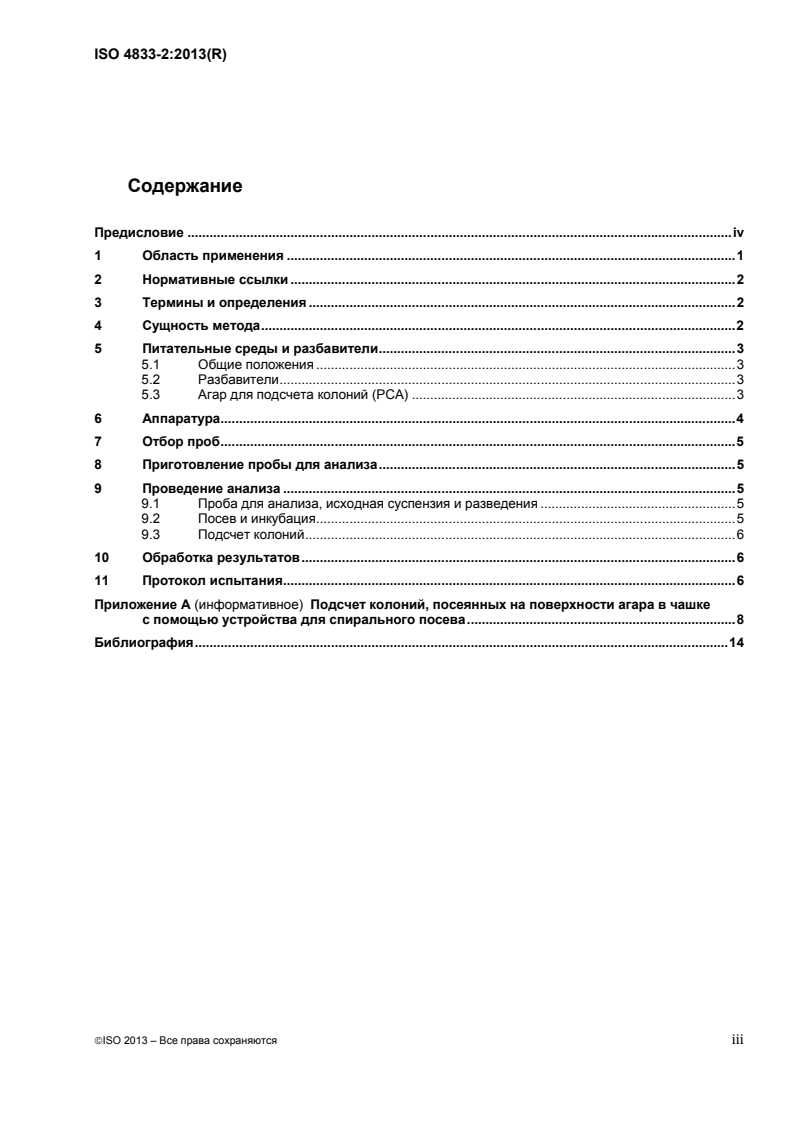
Ответственность за подготовку русской версии несёт GOST R
(Российская Федерация) в соответствии со статьёй 18.1 Устава ISO
Ссылочный номер
©
ISO 2013
Отказ от ответственности при работе в PDF
Настоящий файл PDF может содержать интегрированные шрифты. В соответствии с условиями лицензирования, принятыми
фирмой Adobe, этот файл можно распечатать или смотреть на экране, но его нельзя изменить, пока не будет получена
лицензия на установку интегрированных шрифтов в компьютере, на котором ведется редактирование. В случае загрузки
настоящего файла заинтересованные стороны принимают на себя ответственность за соблюдение лицензионных условий
фирмы Adobe. Центральный секретариат ISO не несет никакой ответственности в этом отношении.
Adobe - торговый знак фирмы Adobe Systems Incorporated.
Подробности, относящиеся к программным продуктам, использованным для создания настоящего файла PDF, можно найти в
рубрике General Info файла; параметры создания PDF были оптимизированы для печати. Были приняты во внимание все
меры предосторожности с тем, чтобы обеспечить пригодность настоящего файла для использования комитетами-членами
ISO. В редких случаях возникновения проблемы, связанной со сказанным выше, просьба проинформировать Центральный
секретариат по адресу, приведенному ниже.
ДОКУМЕНТ ЗАЩИЩЕН АВТОРСКИМ ПРАВОМ
Все права сохраняются. Если не указано иное, никакую часть настоящей публикации нельзя копировать или использовать в
какой-либо форме или каким-либо электронным или механическим способом, включая фотокопии и микрофильмы, без
предварительного письменного согласия ISO, которое должно быть получено после запроса о разрешении, направленного по
адресу, приведенному ниже, или в комитет-член ISO в стране запрашивающей стороны.
ISO copyright office
Case postale 56 • CH-1211 Geneva 20
Tel. + 41 22 749 01 11
Fax + 41 22 734 09 47
E-mail copyright @ iso.org
Web www.iso.org
Опубликовано в Швейцарии
ii ©ISO 2013 – Все права сохраняются
Содержание
Предисловие .iv
1 Область применения .1
2 Нормативные ссылки .2
3 Термины и определения .2
4 Сущность метода.2
5 Питательные среды и разбавители.3
5.1 Общие положения .3
5.2 Разбавители.3
5.3 Агар для подсчета колоний (РСА) .3
6 Аппаратура.4
7 Отбор проб.5
8 Приготовление пробы для анализа.5
9 Проведение анализа .5
9.1 Проба для анализа, исходная суспензия и разведения .5
9.2 Посев и инкубация.5
9.3 Подсчет колоний.6
10 Обработка результатов.6
11 Протокол испытания.6
Приложение A (информативное) Подсчет колоний, посеянных на поверхности агара в чашке
с помощью устройства для спирального посева.8
Библиография.14
©ISO 2013 – Все права сохраняются iii
Предисловие
Международная организация по стандартизации (ISO) всемирная федерация национальных органов
по стандартизации (комитеты-члены ISO). Работа по подготовке международных стандартов обычно
ведется через технические комитеты ISO. Каждый комитет-член ISO, проявляющий интерес к
тематике, по которой учрежден технический комитет, имеет право быть представленным в этом
комитете. Международные организации, государственные и негосударственные, имеющие связи с ISO,
также принимают участие в работе. ISO тесно сотрудничает с Международной электротехнической
комиссией (IEC) по всем вопросам стандартизации в области электротехники.
Процедуры, используемые для разработки данного документа, и процедуры, предусмотренные для его
дальнейшего ведения, описаны в Директивах ISO/IEC Directives, Part 1. В частности, следует отметить
различные критерии утверждения, требуемые для различных типов документов ISO. Проект данного
документа был разработан в соответствии с редакционными правилами Директив ISO/IEC Directives,
Part 2. www.iso.org/directives.
Необходимо обратить внимание на возможность того, что ряд элементов данного документа могут
быть предметом патентных прав. Международная организация ISO не должна нести ответственность
за идентификацию таких прав, частично или полностью. Сведения о патентных правах,
идентифицированных при разработке документа, будут указаны во Введении и/или в перечне
полученных ISO объявлениях о патентном праве. www.iso.org/patents.
Любое торговое название, использованное в данном документе, является информацией,
предоставляемой для удобства пользователей, а не свидетельством в пользу того или иного товара
или той или иной компании.
Технический комитет, несущий ответственность за данный документ, ISO/TC 34, Пищевые продукты,
Подкомитет SC 9, Микробиология.
Настоящее первое издание наряду с ISO 4833-1 отменяет и заменяет ISO 4833:2003.
ISO 4833 состоит из следующих частей под общим названием Микробиология в цепи создания
пищевой продукции. Горизонтальный метод подсчета микроорганизмов:
⎯ Часть 1. Метод подсчета колоний при температуре 30 °С при посеве заливкой
⎯ Часть 2. Метод подсчета колоний при температуре 30 °С при посеве на поверхность
среды в чашках
iv © ISO 2013 – Все права сохраняются
МЕЖДУНАРОДНЫЙ СТАНДАРТ ISO 4833-2:2013(R)
Микробиология в цепи создания пищевой продукции.
Горизонтальный метод подсчета микроорганизмов.
Часть 2.
Метод подсчета колоний при температуре 30 °С при посеве
на поверхность среды в чашках
1 Область применения
Настоящая часть ISO 4833 устанавливает горизонтальный метод подсчета микроорганизмов, которые
растут и образуют колонии на поверхности твердой среды после аэробной инкубации при температуре
30 °С. Этот метод применяется к
а) продуктам, предназначенным для потребления человеком и животными;
b) пробам окружающей среды в зоне производства и отгрузки пищевых продуктов и кормов для
животных.
Данная часть ISO 4833 применяется также к
1) продукции, содержащей чувствительные к нагреванию микроорганизмы, которые составляют
значительную долю общей флоры (например, психотрофные организмы в охлажденных и
замороженных пищевых продуктах, сушеных и других пищевых продуктах, которые могут
содержать чувствительные к нагреванию микроорганизмы;
2) продукции, содержащей облигатно-аэробные бактерии, которые составляют значительную долю
общей флоры (например, Pseudomonus spp.);
3) продукции, содержащей небольшие частицы, которые могут затруднить различение
поверхностных колоний от колоний, посеянных заливкой;
4) продукции, интенсивный цвет которой мешает опознаванию колоний глубинного посева;
5) продукции, для которой различие между типами колоний требуется как часть оценки качества
продукции.
В дополнение к способу посева распределения по поверхности среды вручную, данная часть ISO 4833
также устанавливает применение аппарата для спирального посева бактерий на чашки, ускоренный
метод выполнения подсчета поверхностных колоний (Приложение А).
Применимость данной части ISO 4833 к изучению определенных сброженных пищевых продуктов и
кормов для животных ограничена, и более подходящими могут быть другие питательные среды и
условия инкубации. В то же время, данный метод можно применить и к такой продукции, даже если
существует возможность, что преобладающие микроорганизмы в этих продуктах будут неэффективно
обнаруживаться.
Для некоторых матриц метод, установленный в данной части ISO 4833, может давать результаты,
отличающиеся от результатов, полученных методом, установленным в ISO 4833-1.
©ISO 2013 – Все права сохраняются 1
2 Нормативные ссылки
Следующие ссылочные документы являются обязательными при применении данного документа. Для
датированных ссылок применяется только цитированное издание документа. Для недатированных
ссылок необходимо использовать самое последнее издание нормативного ссылочного документа
(включая любые изменения).
ISO 6887 (все части), Микробиология пищевых продуктов и кормов для животных. Подготовка
образцов для испытания, исходной суспензии и десятичных разведений для микробиологических
исследований
ISO 7218, Микробиология пищевых продуктов и кормов для животных. Общие правила и
руководство по проведению микробиологических исследований
ISO 11133, Микробиология пищевых продуктов, кормов для животных и воды. Приготовление,
производство, хранение и проверка соответствия требованиям питательных сред
3 Термины и определения
Применительно к данному документу используется следующие термины и определения.
3.1
микроорганизм
microorganism
организм микроскопического размера, включая бактерии, грибы и плесень, простейшие
(одноклеточные) и вирусы
[ИСТОЧНИК: ISO/TS 11139:2006, 2.26]
Примечание 1 к статье: В данной части ISO 4833 микроорганизмами являются бактерии, дрожжи и плесени,
которые способны создавать колонии в условиях, установленных в данной чаcти ISO 4833.
4 Сущность метода
Установленное количество жидкой пробы или установленное количество исходной суспензии в случае
других продуктов, распределяют по поверхности плотной агаровой среды в чашках Петри.
Готовят еще несколько чашек в таких же условиях, используя десятичные разбавления испытуемой
пробы или исходной суспензии.
Чашки подвергают аэробной инкубации при температуре 30 °С в течение 72 ч.
Количество микроорганизмов на миллилитр или грамм пробы рассчитывают по числу колоний,
полученных на чашках, содержащих меньше 300 колоний.
2 ©ISO 2013 – Все права сохраняются
5 Питательные среды и разбавители
5.1 Общие положения
Для подготовки, производства и проверки соответствия требованиям питательных сред см. ISO 11133.
5.2 Разбавители
Пользуются разбавителями, установленными в ISO 6887 для рассматриваемого продукта или в
конкретном международном стандарте, касающемся исследуемого продукта.
5.3 Агар для подсчета колоний (РСА)
5.3.1 Состав
Ферментативный перевар казеина 5,0 г
Дрожжевой экстракт 2,5 г
Глюкоза, безводная (СН О ) 1,0 г
6 12 6
а
Агар от 9 г до 18 г
Вода 1 000 мл
а
В зависимости от прочности геля – агара
При исследовании молочных продуктов добавляют 1,0 г снятого порошкового молока на литр
питательной среды. Порошковое снятое молоко не должно содержать ингибиторных добавок.
5.3.2 Подготовка
Растворяют компоненты или обезвоженную полную среду в воде, если необходимо, при нагревании.
Тщательно перемешивают и оставляют на несколько минут.
Регулируют рН (6.5), если необходимо, так чтобы после стерилизации рН составил 7,0 ± 0,2 при
температуре 25 °С.
Распределяют среду по колбам или склянкам (6.9) подходящей вместимости. Стерилизуют в
автоклаве(6.1) при температуре 121 °С в течение 15 мин.
Если среда будет использоваться немедленно, охлаждают ее до температуры от 47 °С до 50 °С на
водяной бане (6.4) перед использованием. Если не предполагается использовать среду сразу, дают ей
застыть в колбе или склянке. Перед применением среду плавят полностью на кипящей водяной бане,
затем охлаждают на водяной бане (6.4), поддерживаемой при температуре от 47 °С до 50 °С.
©ISO 2013 – Все права сохраняются
5.3.3 Подготовка агаровой среды в чашках
Заливают от 15 мл до 20 мл питательной среды в стерильные чашки Петри (6.6) и дают застыть.
Чашки можно хранить при температуре (5 ± 3) °С в течение до 4 недель.
Непосредственно перед применением чашки с агаром следует подсушить в соответствии с ISO 11133.
5.3.4 Оценочное испытание для обеспечения качества питательной среды
5.3.4.1 Общие положения
Агар для подсчета колоний на чашках является неселективной средой, используемой в данной части
ISO 4833 для заливки в чашки для последующего посева на поверхность среды. Ее продуктивность
должна проверяться в соответствии с ISO 11133.
5.3.4.2 Продуктивность
Инкубация
(30 ± 1) °С в течение (72 ± 3) ч
a
Контрольные штаммы Echerichia cоli WDCM 00013 или WDCM 00012 [World data Centre for
Microorganisms (WDCM)]]
Bacillus subtilis subsp. Spizizenii WDCM 00003
Staphylococcus aureus WDCM 00032 или WDCM 00034
Контрольная среда Триптоновый соевый агар
Контрольный метод Количественный
Критерий
Коэффициент продуктивности (PR) W 0,7
а
Лаборатория пользователя должна использовать, как минимум, указанные штаммы. См. Ссылку [15] в отношении
информации по номерам коллекционных штаммов культур и контактам.
6 Аппаратура
Одноразовая аппаратура является приемлемой альтернативой многоразовой стеклянной и
пластмассовой посуде, если отвечает соответствующим требованиям.
Обычное микробиологическое лабораторное оборудование (см. ISO 7218) и, в частности, следующее:
6.1 Устройство для сухой стерилизации (печь) или влажной стерилизации (автоклав),
используемые в соответствии с ISO 7218.
6.2 Сушильный шкаф или инкубатор (термостат), вентилируемый конвекционным способом для
сушки чашек со средой и обеспечивающий работу при температуре от 37°C до 55 °C, или шкаф с
ламинарным потоком воздуха.
4 ©ISO 2013 – Все права сохраняются
6.3 Инкубатор (термостат), обеспечивающий работу при температуре (30 ± 1) °C
6.4 Водяные бани, одна обеспечивает работу при температуре от 47 °C до 50 °C, и вторая – при
температуре кипения воды.
6.5 рН-метр, точностью в пределах ± 0,1 единиц рН при температуре 25 °С.
6.6 Чашки Петри, стеклянные или пластмассовые, диаметром от 90 мм до 100 мм, или 140 мм.
6.7 Пипетки для полного слива, градуированные, стерильные, номинальной вместимостью
[1] [2]
0,1 мл и 1 мл, по ISO 835 класс А, или автоматические пипетки по ISO 8655-2 с использованием
стерильных наконечников.
6.8 Устройство для подсчета колоний (необязательно), включающее освещенное основание с и
(необязательно) механический или электронный цифровой счетчик.
6.9 Колбы или склянки, соответствующей вместимости для приготовления, стерилизации и, при
необходимости, хранения питательной среды.
6.10 Спредер, стеклянный, пластмассовый или стальной, стерильный, для распространения
посевного материала по поверхности питательной среды.
7 Отбор проб
Отбор проб не является частью метода, установленного в данной части ISO 4833. Отбор проб может
проводиться в соответствии с конкретным Международным стандартом на рассматриваемый продукт.
Если конкретного Международного стандарта на отбор проб данного продукта не существует,
рекомендуется согласовывать метод отбора проб между заинтересованными сторонами.
Большое значение имеет поступление в лабораторию действительно репрезентативной пробы, не
поврежденной и не измененной в процессе транспортирования и хранения.
8 Приготовление пробы для анализа
Пробу для анализа готовят в соответствии с конкретным международным стандартом на
рассматриваемый продукт.
9 Проведение анализа
9.1 Проба для анализа, исходная суспензия и разведения
См. соответствующую часть ISO 6887 или конкретный международный стандарт на исследуемый
продукт.
9.2 Посев и инкубация
9.2.1 Стерильной пипеткой (6.7) переносят в центр каждой из двух чаше
...
МЕЖДУНАРОДНЫЙ ISO
СТАНДАРТ 4833-2
Первое издание
2013-09-01
Микробиология в цепи создания
пищевой продукции. Горизонтальный
метод подсчета микроорганизмов.
Часть 2.
Метод подсчета колоний при
температуре 30 °С при посеве на
поверхность среды в чашках
Microbiology of the food chain. Horizontal method for the enumeration
of microorganisms.
Part 2: Colony-count at 30 degrees C by the surface plating technique
Ответственность за подготовку русской версии несёт GOST R
(Российская Федерация) в соответствии со статьёй 18.1 Устава ISO
Ссылочный номер
©
ISO 2013
Отказ от ответственности при работе в PDF
Настоящий файл PDF может содержать интегрированные шрифты. В соответствии с условиями лицензирования, принятыми
фирмой Adobe, этот файл можно распечатать или смотреть на экране, но его нельзя изменить, пока не будет получена
лицензия на установку интегрированных шрифтов в компьютере, на котором ведется редактирование. В случае загрузки
настоящего файла заинтересованные стороны принимают на себя ответственность за соблюдение лицензионных условий
фирмы Adobe. Центральный секретариат ISO не несет никакой ответственности в этом отношении.
Adobe - торговый знак фирмы Adobe Systems Incorporated.
Подробности, относящиеся к программным продуктам, использованным для создания настоящего файла PDF, можно найти в
рубрике General Info файла; параметры создания PDF были оптимизированы для печати. Были приняты во внимание все
меры предосторожности с тем, чтобы обеспечить пригодность настоящего файла для использования комитетами-членами
ISO. В редких случаях возникновения проблемы, связанной со сказанным выше, просьба проинформировать Центральный
секретариат по адресу, приведенному ниже.
ДОКУМЕНТ ЗАЩИЩЕН АВТОРСКИМ ПРАВОМ
Все права сохраняются. Если не указано иное, никакую часть настоящей публикации нельзя копировать или использовать в
какой-либо форме или каким-либо электронным или механическим способом, включая фотокопии и микрофильмы, без
предварительного письменного согласия ISO, которое должно быть получено после запроса о разрешении, направленного по
адресу, приведенному ниже, или в комитет-член ISO в стране запрашивающей стороны.
ISO copyright office
Case postale 56 • CH-1211 Geneva 20
Tel. + 41 22 749 01 11
Fax + 41 22 734 09 47
E-mail copyright @ iso.org
Web www.iso.org
Опубликовано в Швейцарии
ii ©ISO 2013 – Все права сохраняются
Содержание
Предисловие .iv
1 Область применения .1
2 Нормативные ссылки .2
3 Термины и определения .2
4 Сущность метода.2
5 Питательные среды и разбавители.3
5.1 Общие положения .3
5.2 Разбавители.3
5.3 Агар для подсчета колоний (РСА) .3
6 Аппаратура.4
7 Отбор проб.5
8 Приготовление пробы для анализа.5
9 Проведение анализа .5
9.1 Проба для анализа, исходная суспензия и разведения .5
9.2 Посев и инкубация.5
9.3 Подсчет колоний.6
10 Обработка результатов.6
11 Протокол испытания.6
Приложение A (информативное) Подсчет колоний, посеянных на поверхности агара в чашке
с помощью устройства для спирального посева.8
Библиография.14
©ISO 2013 – Все права сохраняются iii
Предисловие
Международная организация по стандартизации (ISO) всемирная федерация национальных органов
по стандартизации (комитеты-члены ISO). Работа по подготовке международных стандартов обычно
ведется через технические комитеты ISO. Каждый комитет-член ISO, проявляющий интерес к
тематике, по которой учрежден технический комитет, имеет право быть представленным в этом
комитете. Международные организации, государственные и негосударственные, имеющие связи с ISO,
также принимают участие в работе. ISO тесно сотрудничает с Международной электротехнической
комиссией (IEC) по всем вопросам стандартизации в области электротехники.
Процедуры, используемые для разработки данного документа, и процедуры, предусмотренные для его
дальнейшего ведения, описаны в Директивах ISO/IEC Directives, Part 1. В частности, следует отметить
различные критерии утверждения, требуемые для различных типов документов ISO. Проект данного
документа был разработан в соответствии с редакционными правилами Директив ISO/IEC Directives,
Part 2. www.iso.org/directives.
Необходимо обратить внимание на возможность того, что ряд элементов данного документа могут
быть предметом патентных прав. Международная организация ISO не должна нести ответственность
за идентификацию таких прав, частично или полностью. Сведения о патентных правах,
идентифицированных при разработке документа, будут указаны во Введении и/или в перечне
полученных ISO объявлениях о патентном праве. www.iso.org/patents.
Любое торговое название, использованное в данном документе, является информацией,
предоставляемой для удобства пользователей, а не свидетельством в пользу того или иного товара
или той или иной компании.
Технический комитет, несущий ответственность за данный документ, ISO/TC 34, Пищевые продукты,
Подкомитет SC 9, Микробиология.
Настоящее первое издание наряду с ISO 4833-1 отменяет и заменяет ISO 4833:2003.
ISO 4833 состоит из следующих частей под общим названием Микробиология в цепи создания
пищевой продукции. Горизонтальный метод подсчета микроорганизмов:
⎯ Часть 1. Метод подсчета колоний при температуре 30 °С при посеве заливкой
⎯ Часть 2. Метод подсчета колоний при температуре 30 °С при посеве на поверхность
среды в чашках
iv © ISO 2013 – Все права сохраняются
МЕЖДУНАРОДНЫЙ СТАНДАРТ ISO 4833-2:2013(R)
Микробиология в цепи создания пищевой продукции.
Горизонтальный метод подсчета микроорганизмов.
Часть 2.
Метод подсчета колоний при температуре 30 °С при посеве
на поверхность среды в чашках
1 Область применения
Настоящая часть ISO 4833 устанавливает горизонтальный метод подсчета микроорганизмов, которые
растут и образуют колонии на поверхности твердой среды после аэробной инкубации при температуре
30 °С. Этот метод применяется к
а) продуктам, предназначенным для потребления человеком и животными;
b) пробам окружающей среды в зоне производства и отгрузки пищевых продуктов и кормов для
животных.
Данная часть ISO 4833 применяется также к
1) продукции, содержащей чувствительные к нагреванию микроорганизмы, которые составляют
значительную долю общей флоры (например, психотрофные организмы в охлажденных и
замороженных пищевых продуктах, сушеных и других пищевых продуктах, которые могут
содержать чувствительные к нагреванию микроорганизмы;
2) продукции, содержащей облигатно-аэробные бактерии, которые составляют значительную долю
общей флоры (например, Pseudomonus spp.);
3) продукции, содержащей небольшие частицы, которые могут затруднить различение
поверхностных колоний от колоний, посеянных заливкой;
4) продукции, интенсивный цвет которой мешает опознаванию колоний глубинного посева;
5) продукции, для которой различие между типами колоний требуется как часть оценки качества
продукции.
В дополнение к способу посева распределения по поверхности среды вручную, данная часть ISO 4833
также устанавливает применение аппарата для спирального посева бактерий на чашки, ускоренный
метод выполнения подсчета поверхностных колоний (Приложение А).
Применимость данной части ISO 4833 к изучению определенных сброженных пищевых продуктов и
кормов для животных ограничена, и более подходящими могут быть другие питательные среды и
условия инкубации. В то же время, данный метод можно применить и к такой продукции, даже если
существует возможность, что преобладающие микроорганизмы в этих продуктах будут неэффективно
обнаруживаться.
Для некоторых матриц метод, установленный в данной части ISO 4833, может давать результаты,
отличающиеся от результатов, полученных методом, установленным в ISO 4833-1.
©ISO 2013 – Все права сохраняются 1
2 Нормативные ссылки
Следующие ссылочные документы являются обязательными при применении данного документа. Для
датированных ссылок применяется только цитированное издание документа. Для недатированных
ссылок необходимо использовать самое последнее издание нормативного ссылочного документа
(включая любые изменения).
ISO 6887 (все части), Микробиология пищевых продуктов и кормов для животных. Подготовка
образцов для испытания, исходной суспензии и десятичных разведений для микробиологических
исследований
ISO 7218, Микробиология пищевых продуктов и кормов для животных. Общие правила и
руководство по проведению микробиологических исследований
ISO 11133, Микробиология пищевых продуктов, кормов для животных и воды. Приготовление,
производство, хранение и проверка соответствия требованиям питательных сред
3 Термины и определения
Применительно к данному документу используется следующие термины и определения.
3.1
микроорганизм
microorganism
организм микроскопического размера, включая бактерии, грибы и плесень, простейшие
(одноклеточные) и вирусы
[ИСТОЧНИК: ISO/TS 11139:2006, 2.26]
Примечание 1 к статье: В данной части ISO 4833 микроорганизмами являются бактерии, дрожжи и плесени,
которые способны создавать колонии в условиях, установленных в данной чаcти ISO 4833.
4 Сущность метода
Установленное количество жидкой пробы или установленное количество исходной суспензии в случае
других продуктов, распределяют по поверхности плотной агаровой среды в чашках Петри.
Готовят еще несколько чашек в таких же условиях, используя десятичные разбавления испытуемой
пробы или исходной суспензии.
Чашки подвергают аэробной инкубации при температуре 30 °С в течение 72 ч.
Количество микроорганизмов на миллилитр или грамм пробы рассчитывают по числу колоний,
полученных на чашках, содержащих меньше 300 колоний.
2 ©ISO 2013 – Все права сохраняются
5 Питательные среды и разбавители
5.1 Общие положения
Для подготовки, производства и проверки соответствия требованиям питательных сред см. ISO 11133.
5.2 Разбавители
Пользуются разбавителями, установленными в ISO 6887 для рассматриваемого продукта или в
конкретном международном стандарте, касающемся исследуемого продукта.
5.3 Агар для подсчета колоний (РСА)
5.3.1 Состав
Ферментативный перевар казеина 5,0 г
Дрожжевой экстракт 2,5 г
Глюкоза, безводная (СН О ) 1,0 г
6 12 6
а
Агар от 9 г до 18 г
Вода 1 000 мл
а
В зависимости от прочности геля – агара
При исследовании молочных продуктов добавляют 1,0 г снятого порошкового молока на литр
питательной среды. Порошковое снятое молоко не должно содержать ингибиторных добавок.
5.3.2 Подготовка
Растворяют компоненты или обезвоженную полную среду в воде, если необходимо, при нагревании.
Тщательно перемешивают и оставляют на несколько минут.
Регулируют рН (6.5), если необходимо, так чтобы после стерилизации рН составил 7,0 ± 0,2 при
температуре 25 °С.
Распределяют среду по колбам или склянкам (6.9) подходящей вместимости. Стерилизуют в
автоклаве(6.1) при температуре 121 °С в течение 15 мин.
Если среда будет использоваться немедленно, охлаждают ее до температуры от 47 °С до 50 °С на
водяной бане (6.4) перед использованием. Если не предполагается использовать среду сразу, дают ей
застыть в колбе или склянке. Перед применением среду плавят полностью на кипящей водяной бане,
затем охлаждают на водяной бане (6.4), поддерживаемой при температуре от 47 °С до 50 °С.
©ISO 2013 – Все права сохраняются
5.3.3 Подготовка агаровой среды в чашках
Заливают от 15 мл до 20 мл питательной среды в стерильные чашки Петри (6.6) и дают застыть.
Чашки можно хранить при температуре (5 ± 3) °С в течение до 4 недель.
Непосредственно перед применением чашки с агаром следует подсушить в соответствии с ISO 11133.
5.3.4 Оценочное испытание для обеспечения качества питательной среды
5.3.4.1 Общие положения
Агар для подсчета колоний на чашках является неселективной средой, используемой в данной части
ISO 4833 для заливки в чашки для последующего посева на поверхность среды. Ее продуктивность
должна проверяться в соответствии с ISO 11133.
5.3.4.2 Продуктивность
Инкубация
(30 ± 1) °С в течение (72 ± 3) ч
a
Контрольные штаммы Echerichia cоli WDCM 00013 или WDCM 00012 [World data Centre for
Microorganisms (WDCM)]]
Bacillus subtilis subsp. Spizizenii WDCM 00003
Staphylococcus aureus WDCM 00032 или WDCM 00034
Контрольная среда Триптоновый соевый агар
Контрольный метод Количественный
Критерий
Коэффициент продуктивности (PR) W 0,7
а
Лаборатория пользователя должна использовать, как минимум, указанные штаммы. См. Ссылку [15] в отношении
информации по номерам коллекционных штаммов культур и контактам.
6 Аппаратура
Одноразовая аппаратура является приемлемой альтернативой многоразовой стеклянной и
пластмассовой посуде, если отвечает соответствующим требованиям.
Обычное микробиологическое лабораторное оборудование (см. ISO 7218) и, в частности, следующее:
6.1 Устройство для сухой стерилизации (печь) или влажной стерилизации (автоклав),
используемые в соответствии с ISO 7218.
6.2 Сушильный шкаф или инкубатор (термостат), вентилируемый конвекционным способом для
сушки чашек со средой и обеспечивающий работу при температуре от 37°C до 55 °C, или шкаф с
ламинарным потоком воздуха.
4 ©ISO 2013 – Все права сохраняются
6.3 Инкубатор (термостат), обеспечивающий работу при температуре (30 ± 1) °C
6.4 Водяные бани, одна обеспечивает работу при температуре от 47 °C до 50 °C, и вторая – при
температуре кипения воды.
6.5 рН-метр, точностью в пределах ± 0,1 единиц рН при температуре 25 °С.
6.6 Чашки Петри, стеклянные или пластмассовые, диаметром от 90 мм до 100 мм, или 140 мм.
6.7 Пипетки для полного слива, градуированные, стерильные, номинальной вместимостью
[1] [2]
0,1 мл и 1 мл, по ISO 835 класс А, или автоматические пипетки по ISO 8655-2 с использованием
стерильных наконечников.
6.8 Устройство для подсчета колоний (необязательно), включающее освещенное основание с и
(необязательно) механический или электронный цифровой счетчик.
6.9 Колбы или склянки, соответствующей вместимости для приготовления, стерилизации и, при
необходимости, хранения питательной среды.
6.10 Спредер, стеклянный, пластмассовый или стальной, стерильный, для распространения
посевного материала по поверхности питательной среды.
7 Отбор проб
Отбор проб не является частью метода, установленного в данной части ISO 4833. Отбор проб может
проводиться в соответствии с конкретным Международным стандартом на рассматриваемый продукт.
Если конкретного Международного стандарта на отбор проб данного продукта не существует,
рекомендуется согласовывать метод отбора проб между заинтересованными сторонами.
Большое значение имеет поступление в лабораторию действительно репрезентативной пробы, не
поврежденной и не измененной в процессе транспортирования и хранения.
8 Приготовление пробы для анализа
Пробу для анализа готовят в соответствии с конкретным международным стандартом на
рассматриваемый продукт.
9 Проведение анализа
9.1 Проба для анализа, исходная суспензия и разведения
См. соответствующую часть ISO 6887 или конкретный международный стандарт на исследуемый
продукт.
9.2 Посев и инкубация
9.2.1 Стерильной пипеткой (6.7) переносят в центр каждой из двух чаше
...