

ISO/IEC 16500-3:1999
(Main)Information technology — Generic digital audio-visual systems — Part 3: Contours: Technology domain
General Information
- Abstract
This part of ISO/IEC 16500 on "Contours: Technology Domain" describes the system functions and DAVIC tools relevant to the Contours defined in ISO/IEC TR 165001. A goal of this part of ISO/IEC 16500 is to guide implementers to those parts of ISO/IEC 16500 which are relevant for the implementation of the systems in each Contour and to show the relation between the various tools. Another goal of this specification is to state which specific DAVIC tools have to be implemented to realize interoperable system components. As the underlying trade-off between system component cost and service revenue may vary considerably, e.g., by geographical location and time, this trade-off is deemed to be outside of the scope of DAVIC and hence a more detailed "micro profiling" of the tool set needs to be agreed upon between the various parties involved with the realization of a system. An STB that is fully interoperable with, for example, Enhanced Broadcast Services within a certain geographical area, can be designed by implementing all defined DAVIC tools used by the Enhanced Broadcast Services in that area. In order to assist the above mentioned micro-profiling activity the DAVIC tools relevant to a specific Contour have been structured in the following way. A collection of DAVIC tools (sub/clauses of ISO/IEC 16500) which together realize a complete system function (e.g., the reliable transmission of synchronized multimedia information) are grouped together. The group is identified as "system function". For each of these groups an overall informative description is given and a table listing in detail the included DAVIC tools. For the tools dependencies are indicated if applicable. The functional requirements derived from the User & Market Domain of a contour (see ISO/IEC TR 16501) are fully mapped to the above list of system functions.
- Status
- Published
- Publication Date
- 15-Dec-1999
- Current Stage
- 9060 - Close of review
- Completion Date
- 02-Dec-2031
Overview
ISO/IEC 16500-3:1999 - "Information technology - Generic digital audio-visual systems - Part 3: Contours: Technology domain" (DAVIC) defines the technology contours and required toolsets for interoperable digital audio‑visual systems. This part of ISO/IEC 16500 guides implementers to the specific DAVIC tools and system functions needed to realize the defined Contours (notably Enhanced Digital Broadcast (EDB) and Interactive Digital Broadcast (IDB)). It is a normative compliance document that maps functional requirements from ISO/IEC TR 16501 to concrete technology building blocks.
Key topics and requirements
- Contours and system functions: Groups of DAVIC tools are organized into “system functions” (e.g., reliable transmission of synchronized multimedia). Each group includes informative descriptions and detailed tool lists.
- DAVIC tools and dependencies: The standard identifies which DAVIC subclauses must be implemented for interoperable components and indicates tool dependencies for micro‑profiling.
- Normative annexes: Annex A (EDB) and Annex B (IDB) provide detailed, mandatory lists of system functions and the tools required to implement them.
- Interoperability focus: Specifies the minimum set of technologies and behaviors to ensure end‑to‑end interoperability across networks, devices and countries.
- Normative references: Cross-references established standards used by DAVIC (examples include MPEG‑2 / ISO/IEC 13818 and ASN.1 / ISO/IEC 8824), ensuring alignment with widely used media and encoding standards.
- Scope limits: Economic trade‑offs (cost vs revenue) and detailed micro‑profiling decisions are explicitly outside DAVIC’s scope and are to be agreed among implementers.
Practical applications
- Designing and implementing interoperable set‑top boxes (STBs) that support EDB or IDB services by implementing the specified DAVIC tools.
- Defining technology profiles for broadcast and interactive service deployments, enabling consistent feature sets across geographic areas.
- Guiding system integrators and network operators in selecting the minimum toolset for compliance and conformance.
- Supporting conformance and interoperability testing, product certification, and procurement specifications for digital audio‑visual delivery systems.
Who should use this standard
- STB manufacturers and firmware developers
- Broadcast service architects and platform vendors
- Network operators and system integrators
- Test labs and certification bodies
- Standards and compliance engineers working on digital audio‑visual interoperability
Related standards / references
- ISO/IEC 16500 family (Parts 1–9) for system models, protocols, information representation, security and management
- ISO/IEC 13818 (MPEG‑2) and ISO/IEC 8824 (ASN.1) as referenced normative technologies
Keywords: ISO/IEC 16500-3:1999, DAVIC, contours, technology domain, digital audio‑visual systems, interoperability, Enhanced Digital Broadcast (EDB), Interactive Digital Broadcast (IDB), set‑top box, system functions, DAVIC tools.
Relations
- Consolidated By
ISO 16484-6:2009 - Building automation and control systems (BACS) — Part 6: Data communication conformance testing - Effective Date
- 06-Jun-2022
Get Certified
Connect with accredited certification bodies for this standard

BSI Group
BSI (British Standards Institution) is the business standards company that helps organizations make excellence a habit.

NYCE
Mexican standards and certification body.
Sponsored listings
Frequently Asked Questions
ISO/IEC 16500-3:1999 is a standard published by the International Organization for Standardization (ISO). Its full title is "Information technology — Generic digital audio-visual systems — Part 3: Contours: Technology domain". This standard covers: This part of ISO/IEC 16500 on "Contours: Technology Domain" describes the system functions and DAVIC tools relevant to the Contours defined in ISO/IEC TR 165001. A goal of this part of ISO/IEC 16500 is to guide implementers to those parts of ISO/IEC 16500 which are relevant for the implementation of the systems in each Contour and to show the relation between the various tools. Another goal of this specification is to state which specific DAVIC tools have to be implemented to realize interoperable system components. As the underlying trade-off between system component cost and service revenue may vary considerably, e.g., by geographical location and time, this trade-off is deemed to be outside of the scope of DAVIC and hence a more detailed "micro profiling" of the tool set needs to be agreed upon between the various parties involved with the realization of a system. An STB that is fully interoperable with, for example, Enhanced Broadcast Services within a certain geographical area, can be designed by implementing all defined DAVIC tools used by the Enhanced Broadcast Services in that area. In order to assist the above mentioned micro-profiling activity the DAVIC tools relevant to a specific Contour have been structured in the following way. A collection of DAVIC tools (sub/clauses of ISO/IEC 16500) which together realize a complete system function (e.g., the reliable transmission of synchronized multimedia information) are grouped together. The group is identified as "system function". For each of these groups an overall informative description is given and a table listing in detail the included DAVIC tools. For the tools dependencies are indicated if applicable. The functional requirements derived from the User & Market Domain of a contour (see ISO/IEC TR 16501) are fully mapped to the above list of system functions.
This part of ISO/IEC 16500 on "Contours: Technology Domain" describes the system functions and DAVIC tools relevant to the Contours defined in ISO/IEC TR 165001. A goal of this part of ISO/IEC 16500 is to guide implementers to those parts of ISO/IEC 16500 which are relevant for the implementation of the systems in each Contour and to show the relation between the various tools. Another goal of this specification is to state which specific DAVIC tools have to be implemented to realize interoperable system components. As the underlying trade-off between system component cost and service revenue may vary considerably, e.g., by geographical location and time, this trade-off is deemed to be outside of the scope of DAVIC and hence a more detailed "micro profiling" of the tool set needs to be agreed upon between the various parties involved with the realization of a system. An STB that is fully interoperable with, for example, Enhanced Broadcast Services within a certain geographical area, can be designed by implementing all defined DAVIC tools used by the Enhanced Broadcast Services in that area. In order to assist the above mentioned micro-profiling activity the DAVIC tools relevant to a specific Contour have been structured in the following way. A collection of DAVIC tools (sub/clauses of ISO/IEC 16500) which together realize a complete system function (e.g., the reliable transmission of synchronized multimedia information) are grouped together. The group is identified as "system function". For each of these groups an overall informative description is given and a table listing in detail the included DAVIC tools. For the tools dependencies are indicated if applicable. The functional requirements derived from the User & Market Domain of a contour (see ISO/IEC TR 16501) are fully mapped to the above list of system functions.
ISO/IEC 16500-3:1999 is classified under the following ICS (International Classification for Standards) categories: 35.040 - Information coding; 35.040.40 - Coding of audio, video, multimedia and hypermedia information. The ICS classification helps identify the subject area and facilitates finding related standards.
ISO/IEC 16500-3:1999 has the following relationships with other standards: It is inter standard links to ISO 16484-6:2009. Understanding these relationships helps ensure you are using the most current and applicable version of the standard.
ISO/IEC 16500-3:1999 is available in PDF format for immediate download after purchase. The document can be added to your cart and obtained through the secure checkout process. Digital delivery ensures instant access to the complete standard document.
Standards Content (Sample)
INTERNATIONAL ISO/IEC
STANDARD 16500-3
First edition
1999-12-15
Information technology — Generic digital
audio-visual systems —
Part 3:
Contours: Technology domain
Technologies de l'information — Systèmes audiovisuels numériques
génériques —
Partie 3: Contours: Domaine des technologies
Reference number
©
ISO/IEC 1999
PDF disclaimer
This PDF file may contain embedded typefaces. In accordance with Adobe's licensing policy, this file may be printed or viewed but shall not
be edited unless the typefaces which are embedded are licensed to and installed on the computer performing the editing. In downloading this
file, parties accept therein the responsibility of not infringing Adobe's licensing policy. The ISO Central Secretariat accepts no liability in this
area.
Adobe is a trademark of Adobe Systems Incorporated.
Details of the software products used to create this PDF file can be found in the General Info relative to the file; the PDF-creation parameters
were optimized for printing. Every care has been taken to ensure that the file is suitable for use by ISO member bodies. In the unlikely event
that a problem relating to it is found, please inform the Central Secretariat at the address given below.
© ISO/IEC 1999
All rights reserved. Unless otherwise specified, no part of this publication may be reproduced or utilized in any form or by any means, electronic
or mechanical, including photocopying and microfilm, without permission in writing from either ISO at the address below or ISO's member body
in the country of the requester.
ISO copyright office
Case postale 56 � CH-1211 Geneva 20
Tel. + 41 22 749 01 11
Fax + 41 22 734 10 79
E-mail copyright@iso.ch
Web www.iso.ch
Printed in Switzerland
ii © ISO/IEC 1999 – All rights reserved
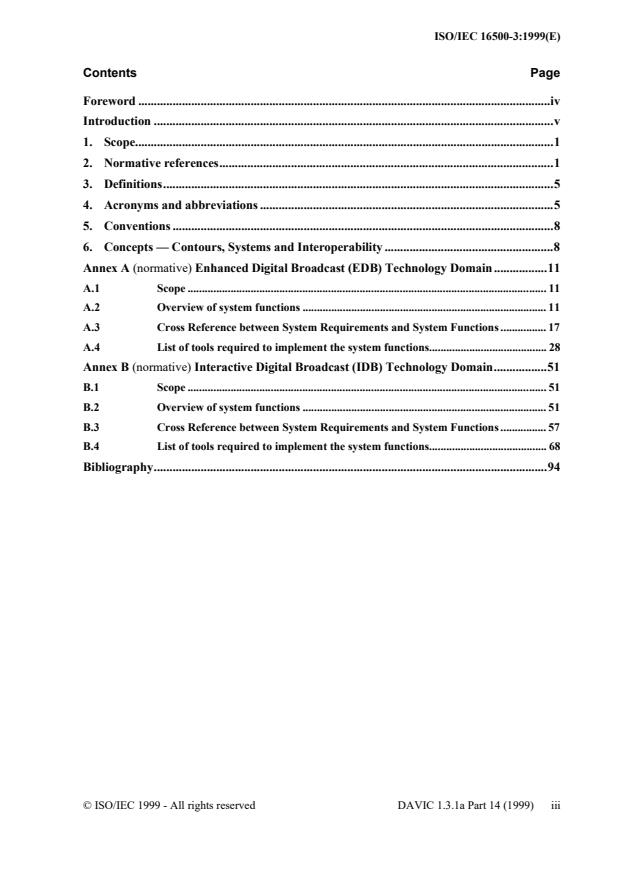
Contents Page
Foreword .iv
Introduction .v
1. Scope.1
2. Normative references.1
3. Definitions.5
4. Acronyms and abbreviations .5
5. Conventions .8
6. Concepts — Contours, Systems and Interoperability .8
Annex A (normative) Enhanced Digital Broadcast (EDB) Technology Domain .11
A.1 Scope . 11
A.2 Overview of system functions . 11
A.3 Cross Reference between System Requirements and System Functions . 17
A.4 List of tools required to implement the system functions. 28
Annex B (normative) Interactive Digital Broadcast (IDB) Technology Domain.51
B.1 Scope . 51
B.2 Overview of system functions . 51
B.3 Cross Reference between System Requirements and System Functions . 57
B.4 List of tools required to implement the system functions. 68
Bibliography.94
© ISO/IEC 1999 - All rights reserved DAVIC 1.3.1a Part 14 (1999) iii
Foreword
ISO (the International Organization for Standardization) and IEC (the International Electrotechnical Commission)
form the specialized system for worldwide standardization. National bodies that are members of ISO or IEC
participate in the development of International Standards through technical committees established by the
respective organization to deal with particular fields of technical activity. ISO and IEC technical committees
collaborate in fields of mutual interest. Other international organizations, governmental and non-governmental, in
liaison with ISO and IEC, also take part in the work.
International Standards are drafted in accordance with the rules given in the ISO/IEC Directives, Part 3.
In the field of information technology, ISO and IEC have established a joint technical committee, ISO/IEC JTC 1.
Draft International Standards adopted by the joint technical committee are circulated to national bodies for voting.
Publication as an International Standard requires approval by at least 75 % of the national bodies casting a vote.
Attention is drawn to the possibility that some of the elements of this part of ISO/IEC 16500 may be the subject of
patent rights. ISO and IEC shall not be held responsible for identifying any or all such patent rights.
International Standard ISO/IEC 16500-3 was prepared by DAVIC (Digital Audio-Visual Council) and was adopted,
under the PAS procedure, by Joint Technical Committee ISO/IEC JTC 1, Information technology, in parallel with its
approval by national bodies of ISO and IEC.
ISO/IEC 16500 consists of the following parts, under the general title Information technology — Generic digital
audio-visual systems:
� Part 1: System reference models and scenarios
� Part 2: System dynamics, scenarios and protocol requirements
� Part 3: Contours: Technology domain
� Part 4: Lower-layer protocols and physical interfaces
� Part 5: High and mid-layer protocols
� Part 6: Information representation
� Part 7: Basic security tools
� Part 8: Management architecture and protocols
� Part 9: Usage information protocols
Annexes A and B form a normative part of this part of ISO/IEC 16500.
iv DAVIC 1.3.1a Part 14 (1999) © ISO/IEC 1999 - All rights reserved
Introduction
ISO/IEC 16500 defines the minimum tools and dynamic behavior required by digital audio-visual systems for
end-to-end interoperability across countries, applications and services. To achieve this interoperability, it defines
the technologies and information flows to be used within and between the major components of generic digital
audio-visual systems. Interoperability between these components and between individual sub-systems is assured
through specification of tools and specification of dynamic systems behavior at defined reference points. A
reference point can comprise one or more logical (non-physical) information-transfer interfaces, and one or more
physical signal-transfer interfaces. A logical interface is defined by a set of information flows and associated
protocol stacks. A physical interface is an external interface and is fully defined by its physical and electrical
characteristics. Accessible reference points are used to determine and demonstrate compliance of a digital audio-
visual subsystem with this international standard.
A summary of each part follows.
ISO/IEC 16500-1 (DAVIC 1.3.1a Part 2) defines the normative digital audio-visual systems technical framework.
It provides a vocabulary and a Systems Reference Model, which identifies specific functional blocks and
information flows, interfaces and reference points.
ISO/IEC 16500-2 (DAVIC 1.3.1a Part 12) defines system dynamic behavior and physical scenarios. It details the
locations of the control functional entities along with the normative protocols needed to support the systems
behavior. It is structured as a set of protocol walk-throughs, or “Application Notes”, that rehearse both the steady
state and dynamic operation of the system at relevant reference points using specified protocols. Detailed
dynamics are given for the following scenarios: video on demand, switched video broadcast, interactive
broadcast, and internet access.
ISO/IEC 16500-3 (DAVIC 1.3.1a Part 14) provides the normative definition of DAVIC Technology Contours.
These are strict sets of Applications, Functionalities and Technologies which allow compliance and conformance
criteria to be easily specified and assessed. This part of ISO/IEC 16500 contains the full details of two contours.
These are the Enhanced Digital Broadcast (EDB) and Interactive Digital Broadcast (IDB). ISO/IEC 16500-3
specifies required technologies and is a mandatory compliance document for contour implementations.
ISO/IEC 16500-4 (DAVIC 1.3.1a Part 8) defines the toolbox of technologies used for lower layer protocols and
physical interfaces. The tools specified are those required to digitize signals and information in the Core Network
and in the Access Network. Each tool is applicable at one or more of the reference points specified within the
Delivery System. In addition a detailed specification is provided of the physical interfaces between the Network
Interface Unit and the Set Top Unit and of the physical interfaces used to connect Set Top Boxes to various
peripheral devices (digital video recorder, PC, printer). The physical Delivery System mechanisms included are
copper pairs, coaxial cable, fiber, HFC, MMDS, LMDS, satellite and terrestrial broadcasting.
ISO/IEC 16500-5 (DAVIC 1.3.1a Part 7) defines the technologies used for high and mid-layer protocols for
ISO/IEC 16500 digital audio-visual systems. In particular, this part defines the specific protocol stacks and
requirements on protocols at specific interfaces for the content, control and management information flows.
ISO/IEC 16500-6 (DAVIC 1.3.1a Part 9) defines what the user will eventually see and hear and with what
quality. It specifies the way in which monomedia and multimedia information types are coded and exchanged.
This includes the definition of a virtual machine and a set of APIs to support interoperable exchange of program
code. Interoperability of applications is achieved, without specifying the internal design of a set top unit, by a
normative Reference Decoder Model which defines specific memory and behavior constraints for content
decoding. Separate profiles are defined for different sets of multimedia components.
ISO/IEC 16500-7 (DAVIC 1.3.1a Part 10) defines the interfaces and the security tools required for an
ISO/IEC 16500 system implementing security profiles. These tools include security protocols which operate
across one or both of the defined conditional access interfaces CA0 and CA1. The interface CA0 is to all security
and conditional access functions, including the high speed descrambling functions. The interface CA1 is to a
tamper resistant device used for low speed cryptographic processing. This cryptographic processing function is
implemented in a smart card.
ISO/IEC 16500-8 (DAVIC 1.3.1a Part 6) specifies the information model used for managing ISO/IEC 16500
systems. In particular, this part defines the managed object classes and their associated characteristics for
managing the access network and service-related data in the Delivery System. Where these definitions are taken
from existing standards, full reference to the required standards is provided. Otherwise a full description is
integrated in the text of this part. Usage-related information model is defined in ISO/IEC 16500-9.
© ISO/IEC 1999 - All rights reserved DAVIC 1.3.1a Part 14 (1999) v
ISO/IEC 16500-9 (DAVIC 1.3.1a Part 11) specifies the interface requirements and defines the formats for the
collection of usage data used for billing, and other business-related operations such as customer profile
maintenance. It also specifies the protocols for the transfer of Usage Information into and out of the
ISO/IEC 16500 digital audio-visual system. In summary, flows of audio, video and audio-visual works are
monitored at defined usage data collection elements (e.g., servers, elements of the Delivery System, set-top
boxes). Information concerning these flows is then collected, processed and passed to external systems such as
billing or a rights administration society via a standardised usage data transfer interface.
Additional Information
ISO/IEC TR 16501 is an accompanying Technical Report. Further architectural and conformance information is
provided in other non-normative parts of DAVIC 1.3.1a (1999). A summary of these documents is included here
for information.
ISO/IEC TR 16501 (DAVIC 1.3.1a Part 1) provides a detailed listing of the functionalities required by users and
providers of digital audio-visual applications and systems. It introduces the concept of a contour and defines the
IDB (Interactive Digital Broadcast) and EDB (Enhanced Digital Broadcast) functionality requirements which are
used to define the normative contour technology toolsets provided in ISO/IEC 16500-3.
DAVIC 1.3.1a Parts 3, 4 and 5 are DAVIC technical reports. They provide additional architectural and other
information for the server, the delivery-system, and the Service Consumer systems respectively. Part 3 defines
how to load an application, once created, onto a server and gives information and guidance on the protocols
transmitted from the set-top user to the server, and those used to control the set-up and execution of a selected
application. Part 4 provides an overview of Delivery Systems and describes instances of specific DAVIC
networked service architectures. These include physical and wireless networks. Non-networked delivery (e.g.,
local storage physical media like discs, tapes and CD-ROMs) are not specified. Part 5 provides a Service
Consumer systems architecture and a description of the DAVIC Set Top reference points defined elsewhere in the
normative parts of the specification.
DAVIC 1.3.1a Part 13 is a DAVIC technical report, which provides guidelines on how to validate the systems,
technology tools and protocols through conformance and / or interoperability testing.
vi DAVIC 1.3.1a Part 14 (1999) © ISO/IEC 1999 - All rights reserved
INTERNATIONAL STANDARD ©ISO/IEC ISO/IEC 16500-3:1999(E)
Information technology — Generic digital audio-visual systems — Part 3:
Contours: Technology domain
1. Scope
This part of ISO/IEC 16500 on “Contours: Technology Domain” describes the system functions and DAVIC
tools relevant to the Contours defined in ISO/IEC TR 165001. A goal of this part of ISO/IEC 16500 is to guide
implementers to those parts of ISO/IEC 16500 which are relevant for the implementation of the systems in each
Contour and to show the relation between the various tools. Another goal of this specification is to state which
specific DAVIC tools have to be implemented to realize interoperable system components.
As the underlying trade-off between system component cost and service revenue may vary considerably, e.g., by
geographical location and time, this trade-off is deemed to be outside of the scope of DAVIC and hence a more
detailed “micro profiling” of the tool set needs to be agreed upon between the various parties involved with the
realization of a system. An STB that is fully interoperable with, for example, Enhanced Broadcast Services within
a certain geographical area, can be designed by implementing all defined DAVIC tools used by the Enhanced
Broadcast Services in that area.
In order to assist the above mentioned micro-profiling activity the DAVIC tools relevant to a specific Contour
have been structured in the following way. A collection of DAVIC tools (sub/clauses of ISO/IEC 16500) which
together realize a complete system function (e.g., the reliable transmission of synchronized multimedia
information) are grouped together. The group is identified as “system function”. For each of these groups an
overall informative description is given and a table listing in detail the included DAVIC tools. For the tools
dependencies are indicated if applicable. The functional requirements derived from the User & Market Domain of
a contour (see ISO/IEC TR 16501) are fully mapped to the above list of system functions.
2. Normative references
The following normative documents contain provisions which, through reference in this text, constitute
provisions of this part of ISO/IEC 16500. For dated references, subsequent amendments to, or revisions of, any of
these publications do not apply. However, parties to agreements based on this part of ISO/IEC 16500 are
encouraged to investigate the possibility of applying the most recent editions of the standards indicated below.
For undated references, the latest edition of the normative document referred to applies. Members of ISO and IEC
maintain registers of currently valid International Standards. The Telecommunication Standardization Bureau
(TSB) maintains a list of currently valid ITU-T Recommendations.
2.1 Identical Recommendations | International Standards
1. ITU-T Recommendation H.222.0 (1995) | ISO/IEC 13818–1: 1996, Information technology—Generic
coding of moving pictures and associated audio information: Systems (Note: known as MPEG-2).
� ISO/IEC 13818-1/Amendment 1: 1997, Registration procedure for “copyright identifier”.
� ISO/IEC 13818-1/Amendment 2: 1997, Registration procedure for “format identifier”.
� ISO/IEC 13818-1/Amendment 3: 1998, Private data identifier.
2. ITU-T Recommendation H.262 | ISO/IEC 13818–2:1996, Information technology—Generic coding of
moving pictures and associated audio information: Video (Note: known as MPEG-2).
� ISO/IEC 13818–2 /Amendment 1: Registration procedure for "copyright identifier".
2.2 Similar Recommendations | International Standards
The following Recommendations or International standards have equivalent technical content:
© ISO/IEC 1999 - All rights reserved DAVIC 1.3.1a Part 14 (1999) 1
1. ITU-T (CCITT) Recommendation X.208 (1988), Specification of Abstract Syntax Notation One (ASN.1)
| ISO/IEC 8824: 1990, Information technology — Open Systems Interconnection — Specification of
Abstract Syntax Notation One (ASN.1).
2. ITU-T (CCITT) Recommendation X.209 (1988) Specification of Basic Encoding rules for abstract
syntax notation one (ASN.1) | ISO/IEC 8825: 1990, Information technology — Open Systems
Interconnection — Specification of basic encoding rules for Abstract Syntax Notation One (ASN.1).
3. ITU-T Recommendation X.218 (1995), Reliable transfer: model and service definition |
ISO/IEC 9066-1: 1989, Information Processing Systems — Text Communication — Reliable Transfer —
Model and service definition for the Association Control Service Element.
4. ITU-T (CCITT) Recommendation X.219 (1988) Remote operations: Model, notation and service
definition | ISO/IEC 9072–1: 1989, Information processing systems—Text communication—Remote
Operations: Model, notation and service definition.
2.3 Additional References
1394 Trade Association
1. AV/DICS Specification for AV/C Digital Interface Command Set, September 13, 1996.
available at http://firewire.org/abouttech/specifications/1394_AVC.pdf
Apple Computer Inc.
1. AIFF-C Audio Interchange File Format, version C, A revision allowing for Compression.
(Note: Required specification is provided in ISO/IEC 16500-6 Annex B. AIFF is also available at
http://www.apple.com/quicktime/developers/ffda.html.)
ATM (Asynchronous Transfer Mode) Forum
1. af-phy-0017.000 - UTOPIA: an ATM-PHY Interface Specification, Level 1, Version 2.01, March 21,
1994. available at ftp://ftp.atmforum.com/pub/approved-specs/ af-phy-0017.000.pdf
ATSC (Advanced Television Systems Committee)
1. ATSC A/52: Digital Audio Compression Standard (AC-3).
available at ftp://ftp.atsc.org/pub/Standards/A52
CENELEC (Comité Européen de Normalisation Electrotechnique)
1. CENELEC EN 50221, Common Interface for Conditional Access and other Digital Video Decoder
Applications.
DVB (Digital Video Broadcasting)
1. DVB A007 see ETSI ETR 289
2. DVB Document A010 see CENELEC EN 50083-9
3. DVB Blue Book A017 see CENELEC EN 50221
ETSI (European Telecommunications Standards Institute)
1. ETR 162 (October 1995): Digital broadcasting systems for television, sound and data services:
Allocation of Service Information (SI) codes for Digital Broadcasting (DVB) systems.
2. ETR 211: Digital broadcasting systems for television, sound, and data services; Guidelines for the
usage of Service Information (SI) in Digital Video Broadcasting (DVB) systems.
3. ETR 289 (October 1996): Support for use of Scrambling and Conditional Access (CA) within Digital
Broadcasting Systems.
2 DAVIC 1.3.1a Part 14 (1999) © ISO/IEC 1999 - All rights reserved
4. ETS 300 421 (December 1994): Digital broadcasting systems for television, sound and data services;
Framing structure, channel coding and modulation for 11/12 GHz satellite services.
5. ETS 300 468 (January 1997): Specification for Service Information (SI) in DVB Systems.
� Informative Annex C: Conversion Between Time and Date Conventions
6. ETS 300 472 (October 1996), Digital broadcasting systems for television, sound, and data services;
Specification for conveying ITU-R System B Teletext in Digital Video Broadcasting (DVB) bitstreams.
7. ETS 300 743, Digital Video Broadcasting (DVB), DVB subtitling.
8. ETS 300 777-2, Use of Digital Storage Media Command and Control (DSM-CC) for basic multimedia
applications.
IEC (International Electrotechnical Commission)
1. IEC 61883-1:1997, Digital Interface for Consumer Electronics Audio/Video Equipment – General.
2. IEC 61883-4:1997, Digital Interface for Consumer Electronics Audio/Video Equipment – MPEG-2 TS
Data Transmission.
IEEE (Institute of Electrical and Electronics Engineers)
1. IEEE 1394-1995 Standard for a High Performance Serial Bus, August 1996.
Internet Society
1. RFC 768, J. Postel, User Datagram Protocol (UDP), 08/28/1980 (STD-6).
2. RFC 791, J. Postel, Internet Protocol (IP Addressing), 09/01/1981 (STD-5).
3. RFC 793, J. Postel, Transmission Control Protocol (TCP), 09/01/1981 (STD-7).
4. RFC 1662, W. Simpson, PPP in HDLC-like Framing, 07/21/1994 (STD-51).
5. RFC 1700, J. Reynolds, J. Postel, Assigned Numbers, 10/20/1994 (STD-2).
ISO (International Organization for Standardization)
1. ISO 639, Codes for the representation of names of languages.
2. ISO 3166, Codes for the representation of names of countries.
3. ISO 8859-1:1987, Information technology - 8-bit single-byte coded graphic character sets – Part 1:
Latin alphabet No. 1.
ISO/IEC
1. ISO/IEC 7816-1:1987, Identification cards - Integrated circuit(s) cards with contacts - Part 1: Physical
characteristics.
2. ISO/IEC 7816-2:1988, Identification cards - Integrated circuit(s) cards with contacts - Part 2:
Dimensions and location of the contacts.
3. ISO/IEC 7816-3:1989, Identification cards - Integrated circuit(s) cards with contacts - Part 3:
Electronic signals and transmission protocols.
4. ISO/IEC 7816-4:1995, Identification cards - Integrated circuit(s) cards with contacts - Part 4:
Interindustry commands for interchange.
5. ISO/IEC 7816-5:1994, Identification cards - Integrated circuit(s) cards with contacts - Part 5:
Numbering system and registration procedure for application identifiers.
6. ISO/IEC 7816-6:1996, Identification cards - Integrated circuit(s) cards with contacts - Part 6:
Interindustry data elements.
7. ISO/IEC 10646-1, Information technology - Universal Multiple-Octet Coded Character Set (UCS), Part
1: Architecture and Basic Multilingual Plane” (also known as Unicode).
8. ISO/IEC 11172–2:1993, Information technology—Coding of moving pictures and associated audio for
digital storage media at up to about 1,5 Mbit/s—Part 2: Video (Note: known as MPEG-1).
9. ISO/IEC 11172–3:1993, Information technology—Coding of moving pictures and associated audio for
digital storage media at up to about 1,5 Mbit/s—Part 3: Audio (Note: known as MPEG-1).
© ISO/IEC 1999 - All rights reserved DAVIC 1.3.1a Part 14 (1999) 3
10. ISO/IEC 13522–5:1997, Information technology—Coding of Multimedia and Hypermedia Information—
Part 5: Support for Base-Level Interactive Applications (Note: known as MHEG-5).
11. ISO/IEC 13522-6, Information technology - Coding of multimedia and hypermedia information (MHEG)
- Part 6: Support for Enhanced Interactive Applications.
12. ISO/IEC 13818–6, Information technology—Generic coding of moving pictures and associated audio
information—Part 6: Extensions for DSM-CC.
13. ISO/IEC 13818–9:1996, Information technology—Generic coding of moving pictures and associated
audio information—Part 9: Extension for real-time interface for systems decoders.
14. ISO/IEC 14750, Information technology -- Open Distributed Processing - Interface Definition
Language.
ITU-R (International Telecommunications Union - Radiocommunication Sector)
1. ITU-R BT.601-4, Encoding parameters of digital television for studios.
2. ITU-R BT.709-1, Basic parameter values for the HDTV standard for the studio and for international
program exchange.
3. ITU-R BT.1208, Video coding for digital terrestrial television broadcasting.
ITU-T (International Telecommunication Union - Telecommunication Standardization Sector)
1. ITU-T Recommendation E.164 / I.331 (1991) Numbering plan for the ISDN era.
2. ITU-T Recommendation I.361 (1995) B-ISDN ATM layer specification.
3. ITU-T recommendation V.22 (1988), 1200 bits per second duplex modem standardized for use on the
general switched telephone network and on point-to-point 2-wire leased telephone-type circuits.
4. ITU-T Recommendation V.22 bis (1988), 2400 bits per second duplex modem using the frequency
division technique standardized for use on the general switched telephone network and on point-to-point
2-wire leased telephone-type circuits.
5. ITU-T Recommendation V.32 (1993), A family of 2-wire, duplex modems operating at data signaling
rates of up to 9600 bit/s for use on the general switched telephone network and on leased telephone-type
circuits.
6. ITU-T Recommendation V.32 bis (1991), A duplex modem operating at data signaling rates of up to
14400 bit/s for use on a general switched telephone network and on leased point-to-point 2-wire
telephone-type circuits.
7. ITU-T Recommendation V.34 (1994), A modem operating at data signaling rates of up to 28800 bit/s
for use on the general switched telephone network and on leased point-to-point 2-wire telephone-type
circuits, version September 1994, published December 1994.
OMG (Object Management Group)
1. Common Object Request Broker: Architecture and Specification, version 2.1 August 1997. (Note: known
as OMG CORBA 2.1).
PCMCIA (Personal Computer Memory Card International Association)
1. Personal Computer Memory Card International Association, PC Card Standard, Volume 2 - Electrical
Specification, February 1995.
2. Personal Computer Memory Card International Association, PC Card Standard, Volume 3 - Physical
Specification, February 1995.
3. Personal Computer Memory Card International Association, PC Card Standard, Volume 4 - Metaformat
Specification, February 1995.
Philips Semiconductor B.V.
1. Philips Semiconductor Specification, The I C-bus and How to Use It (Including Specifications), 1995.
Update, released April 1995, by Philips Semiconductor, Document number 9398-393-40011
4 DAVIC 1.3.1a Part 14 (1999) © ISO/IEC 1999 - All rights reserved
SMPTE (Society of Motion Picture & Television Engineers)
1. SMPTE 274M see ANSI SMPTE 274M-1995
2. SMPTE S17.392 see ANSI SMPTE 296M-1997
W3C (WorldWide Web Consortium)
1. HTML 3.2, HyperText Mark-up Language reference specification, 14-Jan-1997
3. Definitions
For the purposes of this part of ISO/IEC 16500, the definitions given in other parts of ISO/IEC 16500 apply.
4. Acronyms and abbreviations
This clause defines the acronyms and abbreviations used in this part of ISO/IEC 16500. Annex B of ISO/IEC
16500-1 defines acronyms and abbreviations used within ISO/IEC 16500.
AAL ATM Adaptation Layer
AC-3 ATSC A52 Audio
AFI Authority and Format Identifier
AIFF Audio Interchange File Format
ANSI American National Standards Institute
API Application Programming Interface
ASCII American Standard Code for Information Exchange
ASN.1 Abstract Syntax Notation 1
ATM Asynchronous Transfer Mode
ATSC Advanced Television Systems Committee
AWG American Wire Gauge
B-ISDN Broadband Integrated Services Digital Network
BER Bit Error Ratio
BNF Backus-Naur Format
bslbf bit string left bit first
BW Bandwidth
CA Conditional Access
CATV Community Antenna TeleVision
CBD Connection Block Descriptor
CI Content Item
CIE Content Item Element
CLUT Color LookUp Table
CMB CRC Message Block
CMIP Common Management Information Protocol
CMISE Common Management Information Service Element
CMSL Content Metadata Specification Language
CORBA Common Object Request Broker Architecture
CPS Content Provider System
CRC Cyclic Redundancy Check
CW Control Word
DFP Downstream Frame Period
DIS Draft International Standard
DLL Data Link Layer
DS Downstream
DSM-CC Digital Storage Media - Command and Control
DSM-CC U-N Digital Storage Media - Command and Control User-to-Network
DSM-CC U-U Digital Storage Media - Command and Control User-to-User
DTS Decoding Time Stamp
DVB Digital Video Broadcasting
DVB-SI DVB - Service Information
ECM Entitlement Control Message
EMM Entitlement Management Message
© ISO/IEC 1999 - All rights reserved DAVIC 1.3.1a Part 14 (1999) 5
EPG Electronic Program Guide
ESC End Service Consumer
ESCS End-Service Consumer System
ESF Extended SuperFrame
ESP End Service Provider
ESPS End-Service Provider System
ETR European Telecommunications Recommendation
ETS European Telecommunications Standard
ETSI European Telecommunications Standards Institute
FEC Forward Error Correction
FIFO First In First Out
fpvsbf floating point value sign bit first
GIOP Generic Inter-ORB Protocol
GSM Global System for Mobile communications
HDTV High Definition TeleVision
HFC Hybrid Fiber Coax
HRM High Reliability Marker
HTML HyperText Markup Language
ID Identification
IDL Interface Definition Language
IEC International Electrotechnical Commission
IETF Internet Engineering Task Force
IIOP Internet Inter-ORB Protocol
IP Internet Protocol
IPR Intellectual Property Rights
ISDN Integrated Services Digital Network
ISO International Organization for Standardization
ITU International Telecommunications Union
ITU-T International Telecommunication Union - Telecommunications sector
IWU InterWorking Unit Functionality
LAPB Link Access Procedure Balanced
LAPD Link Access Procedure D-channel
LFSR Linear Feedback Shift Register
LSB Least Significant Bit
MAC Medium Access control
MAC Media Access Control
Mbps Megabits per second
MHEG Multimedia and Hypermedia information coding Experts Group
MIB Management Information Base
MPEG Moving Pictures Experts Group
MPEG-TS MPEG-2 Transport Stream
MSB Most Significant Bit
MUX Multiplex
N-ISDN Narrowband Integrated Services Digital Network
NIU Network Interface Unit
NMS Network Management System
NPT Normal Play Time
NRZ Non-Return-to-Zero
NSAP Network Service Access Point
NTSC National Television Systems Committee
OAM Operation and Maintenance
OMG Object Management Group
OMG-CDR Object Management Group - Common Data Representation
OS Operating System
OSI Open Systems Interconnection (Reference Model)
PC Personal Computer
PCR Program Clock Reference
PDU Protocol Data Unit
PDU Packet Data Unit
6 DAVIC 1.3.1a Part 14 (1999) © ISO/IEC 1999 - All rights reserved
PES Packetized Elementary Stream
PHY Physical Layer Interface
PID Packet Identifier
PLMN Public Land Mobile Network
PM Phase Modulation
PMD Physical Medium Dependent
PMT Program Map Table
PN Program Number (MPEG-2)
POTS Plain Old Telephone System
PPM Pulses Per Million
PRBS Pseudo Random Binary Sequence
PSI Program Specific Information (MPEG-2)
PSK Phase Shift Keying
PSTN Public Switched Telephone Network
PTS Presentation Time Stamp
PVC Permanent Virtual Connection
QAM Quadrature Amplitude Modulation
QoS Quality of Service
QPSK Quaternary Phase Shift Keying
RDM Reference Decoder Model
RF Radio Frequency
RGB Red Green Blue
RL Return Loss
ROSE Remote Operation Service Element
RPC Remote Procedure Call
RS Reed-Solomon
RTE RunTime Engine
SAAL Signaling ATM Adaptation Layer
SAR Segmentation and Re-assembly
SCS Service Consumer System
SDL Syntax Description Language
SDU Service Data Unit
SFP SuperFrame Period
SFSC SuperFrame Synchronization Control
SGML Standard Generalized Markup Language
SI Service Information
SL-ESF Signaling Link - Extended Superframe
SMATV Satellite Master Antenna Television
SNMP Simple Network Management Protocol
SONET Synchronous Optical Network
SPS Service Provider System
SPV Service Provider
SRC Service Related Control
SSCOP Service Specific Connection Oriented Protocol
STS Satellite Transmission System
STU Set Top Unit
T-STD Transport System Target Decoder
TBD To be defined
TC Transmission Convergence
TCP Transmission Control Protocol
TDM Time Division Multiplex
TDMA Time Division Multiple Access
TE Terminal Equipment
TS Transport Stream
TV Television
UD User Data
UDP User Datagram Protocol
uimsbf unsigned integer most significant bit first
UNI User Network Interface
© ISO/IEC 1999 - All rights reserved DAVIC 1.3.1a Part 14 (1999) 7
UPI User Premises Interface
US Upstream
UTC Universal Coordinated Time
UTP Unshielded Twisted Pair
VASP Value Added Service Provider
VCI Virtual Channel Identifier
VCR Video Cassette Recorder
VM Virtual Machine
VP Virtual Path
VPCI Virtual Path Connection Identifier
VPI Virtual Path Identifier
5. Conventions
The style of this part of ISO/IEC 16500 follows the general guidelines of the Guide for ITU-T and ISO/IEC JTC 1
cooperation. Appendix II: Rules for presentation of ITU-T | ISO/IEC Common Text (March 1993).
6. Concepts — Contours, Systems and Interoperability
This clause describes the underlining concepts of Contours within this this part of ISO/IEC 16500.
Figure 6-1 illustrates the definition of “Technology Domain” in the concept of “DAVIC Contours”. The detailed
definition of “DAVIC Contours” is provided in ISO/IEC TR 16501.
Market Domain
Requirements
Function Domain
Capabilities
Technology Domain
Capabilities
Requirements
Figure 6-1 — Contour Definition and Technology Domain
The systems based on DAVIC specifications will be built upon a set of “technical tools” specified in the DAVIC
contour, plus some of additional tools which may or may not specified by DAVIC. These relationships are
illustrated in Figure 6-2.
8 DAVIC 1.3.1a Part 14 (1999) © ISO/IEC 1999 - All rights reserved
DAVIC Tools
Contour X
a set of DAVIC
tools defined in a
contour
System#2
System#1
System#3
Figure 6-2 — Concept of a Contour and Systems
The goal of the contour concept is to achieve the maximum interoperability between systems implemented based
on a specific contour definition and, at the same time, between systems built upon different defined contours.
The latter is important for easy migration (or elaboration) of the systems from one contour to another.
Contour:
Interactive Multimedia
tools common to
Contour:
the two
Enhanced Broadcast
contours
tools common to
tools unique to
all the contours
the specific
contour
Migration path of the system
from one contour to another
Contour:
Internet Access
Figure 6-3 — Interoperability between Contours
“Interoperability”, “Conformance” and “Compliance” and in the context of technical description of Contours are
defined as:
Interoperability
is the ability between two or more implementations to interact with each other as required by the contour
specification. Interoperability can only be determined between sub-systems which are part of an end-to-end
system that encompasses the entire contour. Sub-systems are separated by DAVIC reference points.
Interoperability can only be tested between sub-systems connected to the same reference point or to different
reference points connected via a transparent link for the protocol peers be tested.
© ISO/IEC 1999 - All rights reserved DAVIC 1.3.1a Part 14 (1999) 9
Conformance
means providing system functions, as defined in a particular contour, used by the services in a system for which
conformance is declared. These functions have to be implemented according to the tool definition as described in
the contour’s list of tools. The set of system functions used needs to be agreed upon by the parties involved with
the realization of the system. Conformance can only be declared to a Contour listing those system functions
which are provided in the system.
Compliance
means providing all of the system functions specified in a Contour according to the mapping to DAVIC
technologies specified in the corresponding annex of this part of ISO/IEC 16500. DAVIC systems compliant to a
particular Contour are characterized as follows:
� The system must be built from the set of tools defined in ISO/IEC 16500 and referred in the annex of this
part of ISO/IEC 16500 for the particular Contour
� The system must illustrate DAVIC conformance at reference points defined in ISO/IEC 16500-1 and
referred in the annex of this part of ISO/IEC 16500 for the particular Contour
� The system must perform functional requirements defined in ISO/IEC TR 16501 and referred in the annex
of this part of ISO/IEC 16500 Part 14 for the particular Contour.
Appropriate reference points must be accessible to allow effective interoperability testing throughout the system.
10 DAVIC 1.3.1a Part 14 (1999) © ISO/IEC 1999 - All rights reserved
Annex A
(normative)
Enhanced Digital Broadcast (EDB) Technology Domain
A.1 Scope
This Appendix specifies the Technology Domain of the Enhanced Digital Broadcast (EDB) contour.
Figure A-1 shows a system configuration implementing the EDB contour.
End-Service Core Network Unidirectional End-Service
A9 A4 A1
Provider Access Network Consumer System
System
S1 S1
Broad-
AN NT
cast
S1
Server
STB
Inter-
active
Service
Provider
Figure A-1 — Configuration of Enhanced Digital Broadcast System
A.2 Overview of system functions
Table A2-1, Table A2-2, Table A2-3, and Table A2-4 list the system functions relevant to the Enhanced
Digital Broadcast Contour. As described above, system functions are a collection of DAVIC clauses
which together realize a complete system function. For each of the system functions it is indicated
which DAVIC Clause implements the function, the Reference Point to which the function applies, the
system location where the function is implemented and other system functions which shall be
implemented if the function is implemented. An acronym is assigned to each function for further
reference. This acronym is used in subclause A.4 of this Annex where detailed lists of DAVIC tools
belonging to each function are given.
Note that these system functions have been defined on the basis of DAVIC 1.2 tools. Revisions of this
technology contour may include new functions when suitable tools are identified according to the
DAVIC Rules for technical procedure.
© ISO/IEC 1999 - All rights reserved DAVIC 1.3.1a Part 14 (1999) 11
Table A2-1 Overview of System Functions for Enhanced Digital Broadcast - High and Mid layer protocols
Acronym Description Standard DAVIC Relevant System Requires
Referenced Clause Function
Reference Location
Point
P7URTS High and Mid layer ISO/IEC Part 7, A9,A1 SPS, P8PBUCX or
Protocols for 13818-1 Sec 6
DS, P8PBUSL or
unidirectional Real-
P8PBUMD or
SCS
Time Streams -
P8PBULM
MPEG-2 Transport
Stream for Audio,
Video and data
Transmission
P7URTSE Extension to ISO/IEC Part 7, A9, A1 SPS, P7URTS
P7URTS for Stream 13818-1 Sec 7 DS,SCS
Events etc.
P7UNRT Mid- and High-layer ISO/IEC Part 7 SPS, P8PBUCX or
protocols for 13818-6 Sec 6,7
DS,SCS P8PBUSL or
unidirectional Non ISO/IEC
P8PBUMD or
Real-Time 13818-1
P8PBULM
Transmission
P7CNLD High and Mid Layer ISO/IEC Part 7 A10 SPS,DS
Protocols for 13818-6 Sec 7
Content Loading
P7A0 Protocols for ISO/IEC Part 7 A0 SCS P8A0EXT or
interfacing a 13818-1 Sec 12 P8A0INT
Network-Interface- ITU-T
Unit to a Set-Top- I.363.5
Unit (AAL5)
P7MPMMDP Protocols for MPEG ISO/IEC Part 7 A20 SCS P8MMDP
based services on the 13818-1
Sec 13
STU Multimedia
IEC 61883
Dataport
12 DAVIC 1.3.1a Part 14 (1999) © ISO/IEC 1999 - All rights reserved
Table A2-2 Overview of System Functions for Enhanced Digital Broadcast - Lower Layer Protocols and
Physical Interfaces
Acronym Description Standard DAVIC Relevant System Requires Function
Referenced Clause
Reference Location
Point
P8PBUCX Passband Part 8 A9, A1 DS
Unidirectional
Sec 7.7
PHY on coax
P8PBUSL Passband ETS 300 Part 8 A9, A1 DS
Unidirectional 421
Sec 7.9
PHY on
Satellite
P8PBUMD Passband Part 8 A9, A1 DS
Unidirectional
Sec 7.10
PHY on MMDS
P8PBULM Passband Part 8 A9, A1 DS
Unidirectional
Sec 7.11
PHY on LMDS
P8A0INT Interface of Set- UTOPIA Part 8 A0 SCS
Top-Unit to Level 1 Section 8
Internal I C
Network-
Interface-Unit
P8A0EXT Interface of Set- IEEE 1394- Part 8 A0 SCS
Top-Unit to 1995 Section 8
External
Network-
Interface-Unit
P8MMDP STU IEEE 1394- Part 8 Sec A20 SCS
Multimedia 1995 9.2
Dataport
Table A2-3 Overview of System Functions for Enhanced Digital Broadcast - Information Representation
Acronym Description Standard DAVIC Relevant System Requires Function
Referenced Clause
Reference Location
Point
P9VIDMR Information ISO/IEC Part 9 A9,A1 SPS,SCS P7URTS
Representatio 13818-2
Sec 6, 7, 8
n for Real-
Time
compressed
Video streams
with a
resolution up
to ITU-R 601
© ISO/IEC 1999 - All rights reserved DAVIC 1.3.1a Part 14 (1999) 13
P9VIDHR Information ISO/IEC Part 9 A9,A1 SPS,SCS P7URTS
Representatio 13818-2
Sec 6, 7, 8
n for Real-
Time
compressed
Video streams
with a
resolution
beyond ITU-R
P9VIDMS Information ISO/IEC Part 9 A9,A1 SPS,SCS P9RDM and
Representatio 13818-2 P7UNRT
Sec 6, 7, 8
n for Stored
compressed
Video streams
with a
resolution up
to ITU-R 601
P9VIDHS Information ISO/IEC Part 9 A9,A1 SPS,SCS P9RDM and
Representatio 13818-2 P7UNRT
Sec 6, 7, 8
n for Stored
compressed
Video streams
with a
resolution
beyond ITU-R
P9AUDMP1 Information ISO/IEC Part 9 A9,A1 SPS,SCS P7URTS
R Representatio 11172-3
Sec 6, 7, 8
n for Real-
Time
compressed
Audio streams
using MPEG-
P9AUDATR Information ATSC A/52 Part 9 A9,A1 SPS,SCS P7URTS
Representatio
Sec 6, 7, 8
n for Real-
Time
compressed
Audio streams
using ATSC
A/52 Audio
P9AUDMP1S Information ISO/IEC Part 9 A9,A1 SPS,SCS P9RDM and
Representatio 11172-3 P7UNRT
Sec 6, 7, 8
n for stored
compressed
Audio streams
using MPEG-
14 DAVIC 1.3.1a Part 14 (1999) © ISO/IEC 1999 - All rights reserved
P9AUDATS Information ATSC A/52 Part 9 A9,A1 SPS,SCS P9RDM and
Representatio P7UNRT
Sec 6, 7, 8
n for stored
compressed
Audio streams
using ATSC
A/52 Audio
����� Information ETS 300 743 Part 9 A9,A1 SPS,SCS P7URTS
Representatio
Sec 6,7,8
n for
Compressed
Graphics
Real-Time
streams
����� Information ETS 300 743 Part 9 A9,A1 SPS,SCS P9RDM and
Representatio P7UNRT
Sec 6,7,8
n for
Compressed
Graphics
Stored streams
����� Information ETS 300 743 Part 9 A9,A1 SPS,SCS P9RDM and
Representatio P7UNRT
Sec 6,7,8
n for Graphics
Bitmaps
P9SPICR Information ISO/IEC Part 9 A9,A1 SPS,SCS P7URTS
Repres
...