

ISO 13533:2001
(Main)Petroleum and natural gas industries — Drilling and production equipment — Drill-through equipment
General Information
- Abstract
This International Standard specifies requirements for performance, design, materials, testing and inspection, welding, marking, handling, storing and shipping of drill-through equipment used for drilling for oil and gas. It also defines service conditions in terms of pressure, temperature and wellbore fluids for which the equipment will be designed. This International Standard is applicable to and establishes requirements for the following specific equipment: a) ram blowout preventers; b) ram blocks, packers and top seals; c) annular blowout preventers; d) annular packing units; e) hydraulic connectors; f) drilling spools; g) adapters; h) loose connections; i) clamps. Dimensional interchangeability is limited to end and outlet connections. This International Standard does not apply to field use or field testing of drill-through equipment.
- Status
- Published
- Publication Date
- 05-Dec-2001
- Technical Committee
- ISO/TC 67/SC 4 - Drilling and production equipment
- Drafting Committee
- ISO/TC 67/SC 4/WG 2 - Drilling well control equipment
- Current Stage
- 9093 - International Standard confirmed
- Start Date
- 13-Nov-2023
- Completion Date
- 29-Aug-2026
Buy Documents

ISO 13533:2001 - Petroleum and natural gas industries — Drilling and production equipment — Drill-through equipment Released:12/6/2001


ISO 13533:2001 - Petroleum and natural gas industries — Drilling and production equipment — Drill-through equipment Released:12/15/2010
Overview
ISO 13533:2001 - "Petroleum and natural gas industries - Drilling and production equipment - Drill-through equipment" - specifies requirements for the design, performance, materials, testing, inspection, welding, marking, handling, storing and shipping of drill-through equipment used in oil and gas drilling. The standard defines service conditions (pressure, temperature, wellbore fluids) for which equipment is to be designed and applies to components such as ram and annular blowout preventers (BOPs), ram blocks and top seals, annular packing units, hydraulic connectors, drilling spools, adapters, loose connections and clamps. ISO 13533 is intended to ensure safe, functionally interchangeable drill-through equipment for surface and subsea drilling assemblies. It does not cover field use or field testing.
Key topics and technical requirements
- Design requirements: size designation, service-condition definitions, equipment-specific design methods and verification testing, and documentation (clauses on design and verification).
- Materials: written material specifications, requirements for pressure-containing members and compatibility with wellbore fluids.
- Welding: weldment design, welding controls, procedure and performance qualifications, plus repair/remanufacture guidance (normative annexes).
- Testing & inspection: requirements for operational characteristic tests, non-destructive testing, hardness and tensile testing, and design temperature verification for non-metallic seals.
- Quality control: inspection plans, measuring and testing equipment, personnel qualification and record keeping.
- Marking, handling & logistics: product identification (Product Description Code), stamping, storage for periods >30 days, and shipping instructions.
- Annexes: normative Annex A (heat-treating equipment qualification) and Annex B (repair/remanufacture); informative annexes cover test procedures, purchasing guidelines and failure reporting.
Practical applications and users
ISO 13533 is used by:
- Manufacturers and OEMs of BOPs, annular units, hydraulic connectors, and drilling spools to design and certify equipment.
- Purchasing and procurement teams to specify compliant drill-through components and acceptance criteria.
- Quality, inspection and NDT personnel for production testing, marking and documentation.
- Design and mechanical engineers responsible for pressure-containing components and material selection.
- Operators and rig contractors for selecting interoperable drilling equipment (note: the standard does not govern field testing procedures).
Keywords: ISO 13533, drill-through equipment, blowout preventer, BOP, annular BOP, ram BOP, hydraulic connectors, drilling spools, oil and gas standards, design requirements, materials, welding, testing, inspection.
Related standards
- ISO 10423 (Wellhead and christmas tree equipment)
- API Spec 16A (basis for this ISO edition)
- ASME, ASTM and NACE references for testing, welding and materials (listed in normative references of ISO 13533).
Relations
- Effective Date
- 25-Aug-2026
- Effective Date
- 25-Aug-2026
- Effective Date
- 25-Aug-2026
- Effective Date
- 25-Aug-2026
- Effective Date
- 12-Feb-2026
- Effective Date
- 16-Jul-2022
Buy Documents
ISO 13533:2001 - Petroleum and natural gas industries — Drilling and production equipment — Drill-through equipment Released:12/6/2001
ISO 13533:2001 - Petroleum and natural gas industries — Drilling and production equipment — Drill-through equipment Released:12/15/2010
Get Certified
Connect with accredited certification bodies for this standard

Element Materials Technology
Materials testing and product certification.

ABS Group Brazil
ABS Group certification services in Brazil.

ABS Quality Evaluations Inc.
American Bureau of Shipping quality certification.
Sponsored listings
Frequently Asked Questions
ISO 13533:2001 is a standard published by the International Organization for Standardization (ISO). Its full title is "Petroleum and natural gas industries — Drilling and production equipment — Drill-through equipment". This standard covers: This International Standard specifies requirements for performance, design, materials, testing and inspection, welding, marking, handling, storing and shipping of drill-through equipment used for drilling for oil and gas. It also defines service conditions in terms of pressure, temperature and wellbore fluids for which the equipment will be designed. This International Standard is applicable to and establishes requirements for the following specific equipment: a) ram blowout preventers; b) ram blocks, packers and top seals; c) annular blowout preventers; d) annular packing units; e) hydraulic connectors; f) drilling spools; g) adapters; h) loose connections; i) clamps. Dimensional interchangeability is limited to end and outlet connections. This International Standard does not apply to field use or field testing of drill-through equipment.
This International Standard specifies requirements for performance, design, materials, testing and inspection, welding, marking, handling, storing and shipping of drill-through equipment used for drilling for oil and gas. It also defines service conditions in terms of pressure, temperature and wellbore fluids for which the equipment will be designed. This International Standard is applicable to and establishes requirements for the following specific equipment: a) ram blowout preventers; b) ram blocks, packers and top seals; c) annular blowout preventers; d) annular packing units; e) hydraulic connectors; f) drilling spools; g) adapters; h) loose connections; i) clamps. Dimensional interchangeability is limited to end and outlet connections. This International Standard does not apply to field use or field testing of drill-through equipment.
ISO 13533:2001 is classified under the following ICS (International Classification for Standards) categories: 75.180.10 - Exploratory, drilling and extraction equipment. The ICS classification helps identify the subject area and facilitates finding related standards.
ISO 13533:2001 has the following relationships with other standards: It is inter standard links to EN ISO 13628-7:2006, EN ISO 13354:2014, EN ISO 10423:2009, EN ISO 13628-4:2010, EN ISO 13533:2001, ISO/R 60:1958. Understanding these relationships helps ensure you are using the most current and applicable version of the standard.
ISO 13533:2001 is available in PDF format for immediate download after purchase. The document can be added to your cart and obtained through the secure checkout process. Digital delivery ensures instant access to the complete standard document.
Standards Content (Sample)
INTERNATIONAL ISO
STANDARD 13533
First edition
2001-12-01
Petroleum and natural gas industries —
Drilling and production equipment — Drill-
through equipment
Industries du pétrole et du gas naturel — Équipements de forage et de
production — Équipements à travers lesquels s'effectue le forage
Reference number
©
ISO 2001
PDF disclaimer
This PDF file may contain embedded typefaces. In accordance with Adobe's licensing policy, this file may be printed or viewed but shall not
be edited unless the typefaces which are embedded are licensed to and installed on the computer performing the editing. In downloading this
file, parties accept therein the responsibility of not infringing Adobe's licensing policy. The ISO Central Secretariat accepts no liability in this
area.
Adobe is a trademark of Adobe Systems Incorporated.
Details of the software products used to create this PDF file can be found in the General Info relative to the file; the PDF-creation parameters
were optimized for printing. Every care has been taken to ensure that the file is suitable for use by ISO member bodies. In the unlikely event
that a problem relating to it is found, please inform the Central Secretariat at the address given below.
© ISO 2001
All rights reserved. Unless otherwise specified, no part of this publication may be reproduced or utilized in any form or by any means, electronic
or mechanical, including photocopying and microfilm, without permission in writing from either ISO at the address below or ISO's member body
in the country of the requester.
ISO copyright office
Case postale 56 • CH-1211 Geneva 20
Tel. + 41 22 749 01 11
Fax + 41 22 749 09 47
E-mail copyright@iso.ch
Web www.iso.ch
Printed in Switzerland
ii © ISO 2001 – All rights reserved
Contents Page
Foreword.v
Introduction.vi
1 Scope .1
2 Normative references.4
3 Terms and definitions .5
4 Abbreviated terms .12
5 Design requirements.13
5.1 Size designation .13
5.2 Service conditions.13
5.3 Equipment-specific design requirements.14
5.4 Design methods.31
5.5 Design verification testing.33
5.6 Documentation.33
5.7 Tests for BOP and hydraulic connector operational characteristics.34
5.8 Design temperature verification testing for non-metallic sealing materials and moulded
sealing assemblies.38
5.9 Operating manual requirements .39
6 Material requirements .40
6.1 General.40
6.2 Written specifications .40
6.3 Pressure-containing members.41
7 Welding requirements.47
7.1 General.47
7.2 Weldment design and configuration .47
7.3 Welding controls.51
7.4 Welding procedure and performance qualifications .52
7.5 Other requirements .53
8 Quality control requirements .56
8.1 General.56
8.2 Measuring and testing equipment .57
8.3 Quality control personnel qualifications.57
8.4 Quality control requirements for equipment and parts .57
8.5 Quality control requirements for specific equipment and parts .58
8.6 Requirements for quality control records.70
9 Marking requirements .72
9.1 General.72
9.2 Types of identification stamping .72
9.3 Specific codification requirements of equipment .72
9.4 Product description code (PDC) .75
10 Storing and shipping.77
10.1 Storing for periods greater than 30 days .77
10.2 Shipping.77
Annex A (normative) Qualification of heat-treating equipment.78
Annex B (normative) Requirements for repair and remanufacture.81
Annex C (informative) Operational characteristics test procedure .86
Annex D (informative) Procedure for design temperature verification testing.94
Annex E (informative) Purchasing guidelines .98
Annex F (informative) Failure reporting .100
Annex G (informative) Conversion of US Customary units to the SI system (metric) .101
Annex H (informative) List of national/regional standards applicable in context.105
Bibliography .106
iv © ISO 2001 – All rights reserved
Foreword
ISO (the International Organization for Standardization) is a worldwide federation of national standards bodies (ISO
member bodies). The work of preparing International Standards is normally carried out through ISO technical
committees. Each member body interested in a subject for which a technical committee has been established has
the right to be represented on that committee. International organizations, governmental and non-governmental, in
liaison with ISO, also take part in the work. ISO collaborates closely with the International Electrotechnical
Commission (IEC) on all matters of electrotechnical standardization.
International Standards are drafted in accordance with the rules given in the ISO/IEC Directives, Part 3.
The main task of technical committees is to prepare International Standards. Draft International Standards adopted
by the technical committees are circulated to the member bodies for voting. Publication as an International
Standard requires approval by at least 75 % of the member bodies casting a vote.
Attention is drawn to the possibility that some of the elements of this International Standard may be the subject of
patent rights. ISO shall not be held responsible for identifying any or all such patent rights.
ISO 13533 was prepared by Technical Committee ISO/TC 67, Materials, equipment and offshore structures for
petroleum and natural gas industries, Subcommittee SC 4, Drilling and production equipment.
Annexes A and B form a normative part of this International Standard. Annexes C, D, E, F, G and H are for
information only.
Introduction
This International Standard is based on API Specification 16A, second edition, 1 June 1998.
This International Standard is intended to provide for the availability of safe and functionally interchangeable drill-
through equipment utilized in the petroleum and natural gas industry.
Users of this International Standard should be aware that further or differing requirements may be needed for
individual applications. This International Standard is not intended to inhibit a vendor from offering, or the purchaser
from accepting, alternative equipment or engineering solutions for the individual application. This may be
particularly applicable where there is innovative or developing technology. Where an alternative is offered, the
vendor should identify any variations from this International Standard and provide details.
For the convenience of users of this International Standard, annex H provides a list of those normative International
Standards cited in clause 2 with national or regional standards which have been found mutually applicable in the
context of the requirements in the text. The user may optionally apply the national or regional standard in the
context of the requirement for which the International Standard is cited.
vi © ISO 2001 – All rights reserved
INTERNATIONAL STANDARD ISO 13533:2001(E)
Petroleum and natural gas industries — Drilling and production
equipment — Drill-through equipment
1 Scope
This International Standard specifies requirements for performance, design, materials, testing and inspection,
welding, marking, handling, storing and shipping of drill-through equipment used for drilling for oil and gas. It also
defines service conditions in terms of pressure, temperature and wellbore fluids for which the equipment will be
designed.
This International Standard is applicable to and establishes requirements for the following specific equipment:
a) ram blowout preventers;
b) ram blocks, packers and top seals;
c) annular blowout preventers;
d) annular packing units;
e) hydraulic connectors;
f) drilling spools;
g) adapters;
h) loose connections;
i) clamps.
Dimensional interchangeability is limited to end and outlet connections.
Typical equipment defined by this International Standard is shown in Figures 1 and 2; recommendations for failure
reporting are outlined in annex F.
This International Standard does not apply to field use or field testing of drill-through equipment.
Key
1 Ring gaskets ISO 10423 7 Wellhead
2 Annular BOP 8 Casing
3 Clamp 9 End and outlet connections
4 Ram BOP 10 Drill-through equipment ISO 13533
5 Drilling spool 11 Wellhead equipment ISO 10423
6 Valve ISO 10423
Figure 1 — Typical surface drill-through equipment
2 © ISO 2001 – All rights reserved
Key
1 Riser connector
2 Flex/ball joint
3 Annular BOP
4 Hydraulic connector
5 Adapter
6 Ram BOP
7 Valve ISO 10423
8 Hydraulic connector
9 Wellhead
10 Riser equipment
11 Drill-through equipment ISO 13533
12 Wellhead equipment ISO 10423
Figure 2 — Typical subsea drill-through equipment
2 Normative references
The following normative documents contain provisions, which, through reference in this text, constitute provisions
of this International Standard. For dated references, subsequent amendments to, or revisions of, any of these
publications do not apply. However, parties to agreements based on this International Standard are encouraged to
investigate the possibility of applying the most recent editions of the normative documents indicated below. For
undated references, the latest edition of the normative document referred to applies. Members of IEC and
ISO maintain registers of currently valid International Standards.
ISO 2859-1:1989, Sampling procedures for inspection by attributes — Part 1: Sampling plans indexed by
acceptable quality level (AQL) for lot-by-lot inspection
ISO 6506-1, Metallic materials — Brinell hardness test — Part 1: Test method
ISO 6507-1, Metallic materials — Vickers hardness test — Part 1: Test method
ISO 6508-1, Metallic materials — Rockwell hardness test — Part 1: Test method (scales A, B, C, D, E, F, G, H, K,
N, T)
ISO 6892, Metallic materials — Tensile testing at ambient temperature
ISO 10423:2001, Petroleum and natural gas industries — Drilling and production equipment — Wellhead and
christmas tree equipment
ISO 11961:1996, Petroleum and natural gas industries — Steel pipes for use as drill pipe — Specification
ISO 13665, Seamless and welded steel tubes for pressure purposes — Magnetic particle inspection of the tube
body for the detection of surface imperfections
API Bulletin 6AF, Capabilities of API flanges under combinations of load
ASME Boiler and Pressure Vessel Code Section V, Article 5, UT Examination Methods for Materials and
Fabrication
ASME Boiler and Pressure Vessel Code Section VIII, Division 1, Appendix 4, Rounded Indication Charts
Acceptance Standard for Radiographically Determined Rounded Indications in Welds
ASME Boiler and Pressure Vessel Code Section VIII, Division 2, Pressure Vessel — Alternate Rules, Appendix 4,
Design Based on Stress Analysis
ASME Boiler and Pressure Vessel Code Section VIII, Division 2, Pressure Vessel — Alternate Rules, Appendix 6,
Experimental Stress Analysis
ASME Boiler and Pressure Vessel Code Section IX, Articles I, II, III and IV
ASTM A 193:1999, Specification for Alloy Steel and Stainless Steel Bolting Materials for High Temperature Service
ASTM A 320:1999, Specification for Alloy Steel Bolting Materials for Low Temperature Service
ASTM A 370:1997, Test Methods and Definitions for Mechanical Testing of Steel Products
ASTM A 453:1999, Specification for Bolting Materials, High Temperature, 50 to 120 ksi Yield Strength, with
Expansion Coefficients Comparable to Austenitic Steels
ASTM D 395:1998, Standard Test Methods for Rubber Property — Compression Set
ASTM D 412:1998, Test Methods for Vulcanized Rubber, Thermoplastic Rubbers and Thermoplastic Elastomers
ASTM D 471:1998, Standard Test Method for Rubber Property — Effect of Liquids
4 © ISO 2001 – All rights reserved
ASTM D 1414:1994, Standard Test Methods for Rubber O-Rings
ASTM D 1415:1994, Standard Test Method for Rubber Property — International Hardness
ASTM D 1418:1999, Standard Practice for Rubber and Rubber Lattices — Nomenclature
ASTM D 2240:1997, Test Method for Rubber Property — Durometer Hardness
ASTM E 94:1993, Standard Guide for Radiographic Testing
ASTM E 140:1999, Hardness Conversion Tables for Metals
ASTM E 165:1995, Standard Test Method for Liquid Penetrant Examination
ASTM E 569:1997, Standard Practice for Acoustic Emission Monitoring of Structures During Controlled Simulation
ASTM E 747:1997, Standard Practice for Design, Manufacture, and Material Grouping Classification of Wire Image
Quality Indicators (IQI) used for Radiography
ASNT-SNT-TC-1A:1992, Recommended Practice for Personnel Qualification and Certification in Nondestructive
Testing
NACE MR0175–2000, Sulfide Stress Cracking Resistant Metallic Materials for Oilfield Equipment
SAE AMS-H-6875A:1998, Heat Treatment of Steel Raw Materials
3 Terms and definitions
For the purpose of this International Standard, the following terms and definitions apply.
3.1
acceptance criteria
defined limits placed on characteristics of materials, products or service
3.2
adapter
pressure-containing piece of equipment having end connections of different nominal size designation and/or
pressure rating
3.3
annular blowout preventer
blowout preventer that uses a shaped elastomeric sealing element to seal the space between the tubular and the
wellbore or an open hole
3.4
blind connection
end or outlet connection with no centre bore, used to completely close off a connection
3.5
blind-shear ram
closing and sealing component in a ram blowout preventer that first shears the tubular in the wellbore and then
seals off the bore or acts as a blind ram if there is no tubular in the wellbore
3.6
blind ram
closing and sealing component in a ram blowout preventer that seals the open wellbore
3.7
blowout preventer
BOP
equipment (or valve) installed at the wellhead to contain wellbore pressure either in the annular space between the
casing and the tubulars or in an open hole during drilling, completion, testing or workover operations
3.8
body
any portion of equipment between end connections, with or without internal parts, which contains wellbore pressure
3.9
bolting
threaded fasteners used to join end or outlet connections
3.10
calibration
comparison and adjustment to a standard of known accuracy
3.11
cast, verb
pour molten metal into a mould to produce an object of desired shape
3.12
casting, noun
object at or near finished shape obtained by solidification of a substance in a mould
3.13
chemical analysis
determination of the chemical composition of material
3.14
clamp, noun
device with internal angled shoulders used to fasten mating hubs
3.15
clamping load
axial load applied to clamp hubs by the clamp due to bolt tightening
3.16
closure bolting
threaded fasteners used to assemble pressure-containing parts other than end and outlet connections
3.17
conformance
compliance with specified requirements in every detail
3.18
corrosion-resistant ring groove
ring groove lined with metal resistant to metal-loss corrosion
3.19
critical component
part having requirements specified in this International Standard
3.20
data acquisition system
system for storing and/or providing permanent copies of test information
EXAMPLES Strip chart recorders, circular chart recorders or computer systems.
6 © ISO 2001 – All rights reserved
3.21
date of manufacture
date of the manufacturer's final acceptance of finished equipment
3.22
drilling spool
pressure-containing piece of equipment having end connections, used below or between drill-through equipment
NOTE When outlet connections are provided, they shall be manufactured in accordance with this International Standard.
3.23
end connection
flange (studded or open-face), hub connection or other end connection (3.47) used to join together equipment
and integral to that equipment
3.24
equipment
any single completed unit that can be used for its intended purpose without further processing or assembly
3.25
fabrication weld
weld joining two or more parts
3.26
flange
protruding rim, with holes to accept bolts and having a sealing mechanism, used to join pressure-containing
equipment together by bolting to another flange
3.27
forge, verb
plastically deform metal, usually hot, into desired shapes with compressive force, with open or closed dies
3.28
forging, noun
shaped metal part formed by the forging method
3.29
full-penetration weld
weld that extends throughout the complete wall section of the parts joined
3.30
gasket-seating load
that portion of the clamping load required to seat the gasket and bring the hub faces into contact
3.31
gasket-retaining load
that portion of the clamping load required to offset the separating force the gasket exerts on the hubs when
pressurized
3.32
heat-affected zone
HAZ
that portion of the base metal which has not been melted, but whose mechanical properties or microstructure has
been altered by the heat of welding or cutting
3.33
heat
cast lot
material originating from a final melt
NOTE For remelted alloys, a heat is defined as the raw material originating from a single remelted ingot.
3.34
heat treatment
heat treating
alternate steps of controlled heating and cooling of materials for the purpose of changing physical or mechanical
properties
3.35
heat treatment load
that material moved as a batch through one heat treatment cycle
3.36
hot-work, verb
deform metal plastically at a temperature above the recrystallization temperature
3.37
hub
protruding rim with an external angled shoulder and a sealing mechanism used to join pressure-containing
equipment
3.38
hydraulic connector
hydraulically actuated drill-through equipment that locks and seals on end connections
3.39
indication
visual sign of cracks, pits or other abnormalities found during liquid penetrant and magnetic particle examinations
3.40
integral, adj
〈parts〉 joined by the forging, casting or welding process
3.41
job-lot traceability
ability for parts to be traced as originating from a job lot which identifies the included heat(s)
3.42
leakage
visible passage of pressurized fluid from the inside to the outside of the pressure-containment area of the
equipment being tested
3.43
linear indication
〈liquid penetrant or magnetic particle examination〉 indication whose length is equal to or greater than three times its
width
3.44
loose connection
flange (studded or open-face), hub connection or other end connection (3.47) used to join together equipment,
but not integral to the equipment
3.45
major repair weld
weld whose depth is greater than 25 % of the original wall thickness or 25 mm, whichever is less
3.46
non-pressure-containing weld
weld whose failure will not reduce the pressure-containing integrity of the component
8 © ISO 2001 – All rights reserved
3.47
other end connection
OEC
connection which is not specified in an ISO standard
NOTE This includes ISO flanges and hubs with non-ISO gasket preparations and manufacturer's proprietary connections.
3.48
part
individual piece used in the assembly of a single unit of equipment
3.49
pipe ram
closing and sealing component in a ram blowout preventer that seals around tubulars in the wellbore
3.50
post-weld heat treatment
PWHT
any heat treatment subsequent to welding, including stress relief
3.51
pressure-containing part
pressure-containing member
part exposed to wellbore fluids whose failure to function as intended would result in a release of wellbore fluid to
the environment
EXAMPLES Bodies, bonnets and connecting rods.
3.52
pressure-containing weld
weld whose failure will reduce the pressure-containing integrity of the component
3.53
pressure-controlling part
pressure-controlling member
part intended to control or regulate the movement of wellbore fluids
EXAMPLES Packing elements, rams, replaceable seats within a pressure-containing member or part.
3.54
pressure end load
axial load resulting from internal pressure applied to the area defined by the maximum seal diameter
3.55
pressure-retaining part
pressure-retaining member
part not exposed to wellbore fluids whose failure to function as intended will result in a release of wellbore fluid to
the environment
EXAMPLES Closure bolts and clamps.
3.56
product family
model or type of specific equipment listed in clause 1 of this International Standard
3.57
qualified personnel
individual with characteristics or abilities gained through training, experience or both, as measured against the
manufacturer's established requirements
3.58
ram blowout preventer
blowout preventer that uses metal blocks with integral elastomer seals to seal off pressure on a wellbore with or
without tubulars in the bore
3.59
rated working pressure
maximum internal pressure that the equipment is designed to contain and/or control
3.60
record, noun
retrievable information
3.61
relevant indication
〈liquid penetrant or magnetic particle examination〉 any indication with a major dimension over 1,6 mm (0,062 in)
3.62
remanufacture
process of disassembly, reassembly and testing of drill-through equipment, with or without the replacement of
parts, in which machining, welding, heat treatment or other manufacturing operation is employed
3.63
repair
process disassembly, reassembly and testing of drill-through equipment, with or without the replacement of parts
NOTE Repair does not include machining, welding, heat treating, or other manufacturing operation of component parts and
does not include the replacement of pressure-containing part(s) or member(s). Repair may include replacement of parts other
than pressure-containing part(s) or member(s).
3.64
rounded indication
〈liquid penetrant or magnetic particle examination〉 any indication that is approximately circular or elliptical and
whose length is less than three times its width
3.65
serialization
assignment of a unique code to individual parts and/or pieces of equipment to maintain records
3.66
special process
operation which converts or affects material properties
3.67
stabilized
〈pressure testing〉 in a state in which the initial pressure-decline rate has decreased to within the manufacturer's
specified rate
NOTE Pressure decline can be caused by such things as changes in temperature, setting of elastomer seals or
compression of air trapped in the equipment being tested.
3.68
stabilized
〈temperature testing〉 in a state in which the initial temperature fluctuations have decreased to within the
manufacturer's specified range
NOTE Temperature fluctuation can be caused by such things as mixing of different-temperature fluids, convection or
conduction.
10 © ISO 2001 – All rights reserved
3.69
standard connection
flange, hub or studded connection manufactured in accordance with an ISO standard, including dimensional
requirements
3.70
stress relief
controlled heating of material to a predetermined temperature for the purpose of reducing any residual stresses
3.71
studded connection
connection in which thread-anchored studs are screwed into tapped holes
3.72
surface finish
Ra
measurement of the average roughness of a surface
NOTE 1 It is expressed in micrometres (µm).
NOTE 2 All of the surface finishes given in this International Standard are to be considered maxima.
3.73
trepan, verb
produce a hole through a part by boring a narrow band or groove around the circumference of the hole and
removing the solid central core of material
3.74
variable-bore ram
VBR
closing and sealing component in a ram blowout preventer that is capable of sealing on a range of tubular sizes
3.75
visual examination
examination of parts and equipment for visible defects in material and workmanship
3.76
volumetric non-destructive examination
examination for internal material defects by radiography, acoustic emission or ultrasonic testing
3.77
weld groove
area between two metals to be joined that has been prepared to receive weld filler metal
3.78
weld, verb
act of fusing materials, with or without the addition of filler materials
3.79
weld joint
fitting together of components in order to facilitate their joining by welding
3.80
wrought structure
structure that contains no cast dendritic structure
3.81
yield strength
stress level, measured at room temperature, at which material plastically deforms and will not return to its original
dimensions when the stress is released
NOTE 1 It is expressed in newtons per square millimetre (pounds per square inch) of loaded area.
NOTE 2 All yield strengths specified in this International Standard are considered as being the 0,2 % yield offset strength in
accordance with ISO 6892.
4 Abbreviated terms
ANSI American National Standards Institute
API American Petroleum Institute
AQL acceptance quality level
ASME American Society of Mechanical Engineers
ASNT American Society for Nondestructive Testing
ASTM American Society for Testing and Materials
AWS American Welding Society
BOP blowout preventer
HAZ heat-affected zone
ID inside diameter
LP liquid penetrant
MP magnetic particle
NACE National Association of Corrosion Engineers
NDE non-destructive examination
OD outside diameter
OEC other end connection
OEM original equipment manufacturer
OS operating system
PQR procedure qualification record
VBR variable-bore ram
WPS welding procedure specification
12 © ISO 2001 – All rights reserved
5 Design requirements
5.1 Size designation
Equipment to which this International Standard is applicable shall have a vertical through-bore dimension (drift
diameter) corresponding with the size designation as shown in Table 1.
Table 1 — Equipment size
Nominal size designation Drift diameter
mm (in) mm (in)
179 7 1/16 178,61 7,032
228 9 227,84 8,970
279 11 278,64 10,970
346 13 5/8 345,31 13,595
425 16 3/4 424,69 16,720
476 18 3/4 475,49 18,720
527 20 3/4 526,29 20,720
540 21 1/4 538,99 21,220
680 26 3/4 678,69 26,720
762 30 761,24 29,970
5.2 Service conditions
5.2.1 Rated working pressure
Equipment to which this International Standard is applicable shall be rated in only the rated working pressures
shown in Table 2.
Table 2 — Equipment rated working pressures
MPa (psi)
13,8 2 000
20,7 3 000
34,5 5 000
69,0 10 000
103,5 15 000
138,0 20 000
5.2.2 Temperature ratings
Minimum temperature is the lowest ambient temperature to which the equipment may be subjected. Maximum
temperature is the highest temperature of the fluid that may flow through the equipment.
Equipment shall be designed for metallic parts to operate within the temperature ranges shown in Table 3.
Equipment shall be designed for wellbore elastomeric materials to operate within the temperature classifications of
Table 4.
All other elastomeric seals shall be designed to operate within the temperatures of the manufacturer's written
specifications.
Table 3 — Temperature ratings for metallic materials
Operating range
Classification
°C °F
T-75 − 59 to 121 − 75 to 250
T-20
− 29 to 121 − 20 to 250
T-0 0 to 250
− 18 to 121
Table 4 — Temperature ratings for non-metallic sealing materials
Lower limit Upper limit
(first digit) (second digit)
Temperature Temperature
Code Code
°C (°F) °C (°F)
A − 26 − 15 A 82 180
B 0 B 93 200
− 18
C 10 C 104 220
− 12
D 20 D 121 250
− 7
E − 1 30 E 149 300
F 4 40 F 177 350
G Other Other G Other Other
X See note See note X See note See note
NOTE These components may carry a temperature class of 4 °C to 82 °C (40 °F to 180 °F) without performing temperature verification
testing provided they are marked as temperature class “XX”.
EXAMPLE Material “EB” has a temperature rating of − 1 °C to 93 °C (30 °F to 200 °F).
5.2.3 Retained fluid ratings
All metallic materials which come in contact with well fluids shall meet the requirements of NACE MR0175 for sour
service.
5.3 Equipment-specific design requirements
5.3.1 Flanged end and outlet connections
5.3.1.1 General
Flanged end and outlet connections shall conform to the dimensional requirements of ISO 10423.
Type 6B and API 6BX flange connections may be used as integral connections.
14 © ISO 2001 – All rights reserved
Type 6B and API 6BX flanges integral to drill-through equipment shall not contain test connections.
Type 6B and API 6BX flange connections shall be designed for use in the combination of size designation and
pressure ratings shown in Table 5.
Table 5 — Pressure rating and size ranges of ISO 10423 flange connectors
Pressure rating
Type 6B Type 6BX
MPa (psi)
13,8 2 000 2 1/6 to 21 1/4 26 3/4 to 30
20,7 3 000 2 1/16 to 20 3/4 26 3/4 to 30
34,5 5 000 2 1/16 to 11 13 5/8 to 21 1/4
69,0 10 000 1 13/16 to 21 1/4
103,5 15 000 1 13/16 to 18 3/4
138,0 20 000 1 13/16 to 13 5/8
5.3.1.2 API type 6B flange connections
Type 6B flange connections are of the ring joint type and are not designed for face-to-face make-up. The
connection make-up bolting force reacts on the metallic gasket. The type 6B flange shall be of the through-bolted
or studded design.
Dimensions for type 6B integral flanges shall conform to ISO 10423.
Dimensions for all ring grooves shall conform to ISO 10423.
5.3.1.3 API type 6BX flange connections
Type 6BX flanges are of the ring joint type and are designed with a raised face. Depending on tolerances, the
connection make-up bolting force may react on the raised face of the flange when the gasket has been properly
seated. This support prevents damage to the flange or gasket from excessive bolt torque. Therefore, one of the
flanges in a 6BX connection shall have a raised face. The type 6BX flange shall be of the through-bolted or
studded design.
Dimensions for type 6BX integral flanges shall conform to ISO 10423.
Dimensions for all ring grooves shall conform to ISO 10423.
Other weld preparations may be employed when the strength of the overlay alloy equals or exceeds the strength of
the base material.
5.3.2 Studded end and outlet connections
5.3.2.1 General
The two types of studded end and outlet connections (6B and 6BX) referred to in this International Standard shall
conform to ISO 10423.
6B and 6BX studded connections may be used as integral connections.
The design for studded end and outlet connections shall be the same as specified in 5.3.1.1, except as required in
5.3.2.2 and 5.3.2.3.
5.3.2.2 Type 6B studded connections
Dimensions for type 6B studded connections shall conform to ISO 10423 as it relates to the bore size, diameter of
the bolt circle, and flange OD.
The studded connection shall be fully machined in accordance with ISO 10423.
Stud bolt holes shall be sized and located to conform to ISO 10423. The thread form of the tapped hole shall
conform to the requirements of 5.3.3. The minimum depth of the full threads in the hole shall be equal to the
diameter of the stud, and the maximum depth shall be in accordance with the manufacturer's written specification.
5.3.2.3 Type 6BX studded connections
Dimensions for Type 6BX studded connections shall conform to ISO 10423 concerning bore size, diameter of the
bolt circle and flange OD.
The studded connection shall be fully machined in accordance with ISO 10423.
Stud bolt holes shall be sized and located in accordance with ISO 10423. The thread form of the tapped hole shall
conform to the requirements of 5.3.3. The minimum depth of the full threads in the hole shall be equal to the
diameter of the stud, and the maximum depth shall be in accordance with the manufacturer's written specification.
5.3.3 Studs, nuts and tapped stud holes (bolting)
Bolting for end and outlet connections, both studded and flanged, shall meet the requirements of ISO 10423.
5.3.4 Hubbed end and outlet connections
5.3.4.1 General
End and outlet hubs (16B and 16BX) shall be in accordance with this International Standard.
16B and 16BX hubs may be used as integral connections.
16B and 16BX hubs integral to drill-through equipment shall not contain test connections.
Type 16B and type 16BX hubs are designed for use in the combination of designated sizes and pressure ranges
shown in Table 6.
Table 6 — Pressure ratings and size ranges of type 16B and 16BX hubs
Pressure rating
Type 16B Type 16BX
MPa (psi)
13,8 2 000 7 1/6, 16 3/4, 21 1/4
20,7 3 000 11, 13 5/8, 16 3/4
34,5 5 000 2 1/16 to 21 1/4
69,0 10 000 1 13/16 to 21 1/4
103,5 15 000 1 13/16 to 18 3/4
138,0 20 000 1 13/16 to 11
16 © ISO 2001 – All rights reserved
5.3.4.2 Type 16B hubs
Type 16B hubs are of the ring joint type and are designed for face-to-face make-up. The type RX ring gasket is
used for these connections. In order to accomplish a face-to-face make-up, the special type SR ring grooves shall
be used as listed in Table 7 and Table 8.
Dimensions for type 16B integral hubs shall conform to Table 7 or Table 8 and to Figure 3.
Dimensions for type 16B blind hubs shall conform to Table 7 or Table 8 and to Figure 4.
Dimensions for ring grooves shall conform to Table 9 and Figure 5. All 23° surfaces of ring grooves shall have a
surface finish no rougher than Ra = 1,6 µm [63 µin (micro-inch) RMS].
Type 16B hubs shall use type RX gaskets in accordance with 5.3.7.
Type 16B hub connections may be manufactured with corrosion-resistant overlays in the ring grooves. Prior to
overlay, the ring groove shall be prepared as specified in Table 10 and Figure 6.
Other weld preparations may be employed when the strength of the overlay alloy equals or exceeds the strength of
the base metal.
The counterbore in a type 16B hub is optional. If the counterbore is used, the depth of the counterbore shall not
exceed the dimension and tolerance of the ring groove depth (E or C), as shown in the appropriate ring groove
dimension table.
Dimensions in millimetres (inches)
Surface roughness in micrometres
Figure 3 — Type 16B and 16BX integral hub connections
Dimensions in millimetres (inches)
Surface roughness in micrometres
NOTE 1 For 13,8 MPa (2 000 psi) and 20,7 MPa (3 000 psi) type 16B blind hubs, refer to Table 7 and Table 8 for hub
dimensions, ring groove dimensions and tolerances. If corrosion-resistant inlay is used in ring grooves, refer to Table 9 for rough
machining detail.
NOTE 2 For 34,5 MPa (5 000 psi), 69,00 MPa (10 000 psi), 103,5 MPa (15 000 psi) and 138,00 MPa (200 000 psi) type
16BX blind hubs, refer to Table 11, Table 12, Table 13 or Table 14 for hub dimensions, ring groove dimensions and tolerances.
If corrosion-resistant inlay is used in ring grooves, refer to ISO 10423 for rough machining details.
a
The counterbore of a type 16B or 16BX hub is optional. If the counterbore is used, the depth of the counterbore shall not
exceed the dimension and tolerance of E or C, as shown on the appropriate ring groove dimension table.
Figure 4 — Type 16B and 16BX blind hubs
Table 7 — Type 16B integral hub connections for 13,8 MPa (2 000 psi) rated working pressure
Large
Nominal Outside Total Minimum Ring groove Clamp
Bore diameter of
size diameter thickness neck length number number
neck
B OD T J L
mm mm mm mm mm mm
(in) (in) (in) (in) (in) (in)
179 179,40 263,52 36,64 225,40 63,5
SR-45 25
(7 1/16) (7,062) (10,375) (1,443) (8,875) (2,50)
425 425,45 517,52 32,22 482,60 79,5
SR-65 12
(16 3/4) (16,750) (20,375) (1,269) (19,000) (3,13)
540 539,75 669,92 47,54 622,30 127,0
SR-73 18
(21 1/4) (21,250) (26,375) (1,872) (24,500) (5,00)
Tolerance
0,10 0 0
0,75
0 −0,10 −0,22 −0,70 −1,4
mm
0,031 0,005 0 0
(in)
() ( ) ( ) ( ) ( )
0 −0,005 −0,010 −0,031 −0,06
18 © ISO 2001 – All rights reserved
Table 8 — Type 16B integral hub connections for 20,7 MPa (3 000 psi) rated working pressure
Large
Nominal Outside Total Minimum Ring groove Clamp
Bore diameter of
Size diameter thickness neck length number number
neck
B OD T J L
mm mm mm mm mm mm
(in) (in) (in) (in) (in) (in)
279 279,40 396,88 35,52 355,60 84,0
SR-53 9
(11) (11,000) (15,626) (1,399) (14,000) (3,13)
346 346,10 466,72 33,92 425,45 81,0
SR-57 11
(13 5/8) (13,625) (18,375) (1,336) (16,750) (3,19)
425 425,45 539,76 37,04 498,45 93,4
SR-65 14
(16 3/4) (16,750) (21,250) (1,459) (19,625) (3,68)
Tolerance
0,10 0 0
0,75
0 −0,10 −0,22 −0,72 −1,4
mm
0,031 0,005 0 0
(in)
() ( ) ( ) ( ) ( )
0 −0,005 −0,010 −0,031 −0,06
Dimensions in millimetres (inches)
Surface roughness in micrometres
a
The counterbore of a type 16B or 16BX hub is optional. If the counterbore is used, the depth of the counterbore shall not
exceed the dimension and tolerance of E or C, as shown on the appropriate ring groove dimension table.
Figure 5 — Rough machining of type SR ring grooves
Table 9 — Rough machining of type SR ring grooves
Outside diameter of groove Width of groove Depth of groove
Ring groove
A B C
number
mm (in) mm (in) mm (in)
SR-45 236,62 9,316 23,98 0,944 17,75 0,699
SR-53 349,08 13,743 23,98 0,944 17,75 0,699
SR-57 405,48 15,964 23,98 0,944 17,75 0,699
SR-65 494,38
...
МЕЖДУНАРОДНЫЙ ISO
СТАНДАРТ 13533
Первое издание
2001-12-01
Нефтяная и газовая промышленность.
Буровое и эксплуатационное
оборудование. Оборудование со
стволовым проходом
Petroleum and natural gas industries — Drilling and production equipment —
Drill-through equipment
Ответственность за подготовку русской версии несет GOST R
(Российская Федерация) в соответствии со статьей 18.1 Устава ISO
Ссылочный номер
©
ISO 2001
13533:2001(R)
Отказ от ответственности при работе в PDF
Настоящий файл PDF может содержать интегрированные шрифты. В соответствии с условиями лицензирования, принятыми
фирмой Adobe, этот файл можно распечатать или смотреть на экране, но он не должен измениться, пока не будет получена
лицензия на установку интегрированных шрифтов в компьютере, на котором ведется редактирование. В случае загрузки
настоящего файла заинтересованные стороны принимают на себя ответственность за соблюдение лицензионных условий фирмы
Adobe. Центральный секретариат ISO не несет никакой ответственности в этом отношении.
Adobe - торговый знак фирмы Adobe Systems Incorporated.
Подробности, относящиеся к программным продуктам, использованным для создания настоящего файла PDF, можно найти в
рубрике General Info файла; параметры создания PDF были оптимизированы для печати. Были приняты во внимание все меры
предосторожности с тем, чтобы обеспечить пригодность настоящего файла для использования комитетами-членами ISO. В редких
случаях возникновения проблемы, связанной со сказанным выше, просьба проинформировать Центральный секретариат по
адресу, приведенному ниже.
ДОКУМЕНТ ЗАЩИЩЕН АВТОРСКИМ ПРАВОМ
© ISO 2001
Все права сохраняются. Если не указано иное, никакую часть настоящей публикации нельзя копировать или использовать в какой-
либо форме или каким-либо электронным или механическим способом, включая фотокопии и микрофильмы, без предварительного
письменного согласия ISO, которое должно быть получено после запроса о разрешении, направленного по адресу, приведенному
ниже, или в комитет-член ISO в стране запрашивающей стороны.
ISO copyright office
Case postale 56 • CH-1211 Geneva 20
Tel. + 41 22 749 01 11
Fax + 41 22 749 09 47
E-mail copyright@iso.ch
Web www.iso.ch
Опубликовано в Швейцарии
ii © ISO 2001 – Все права сохраняются
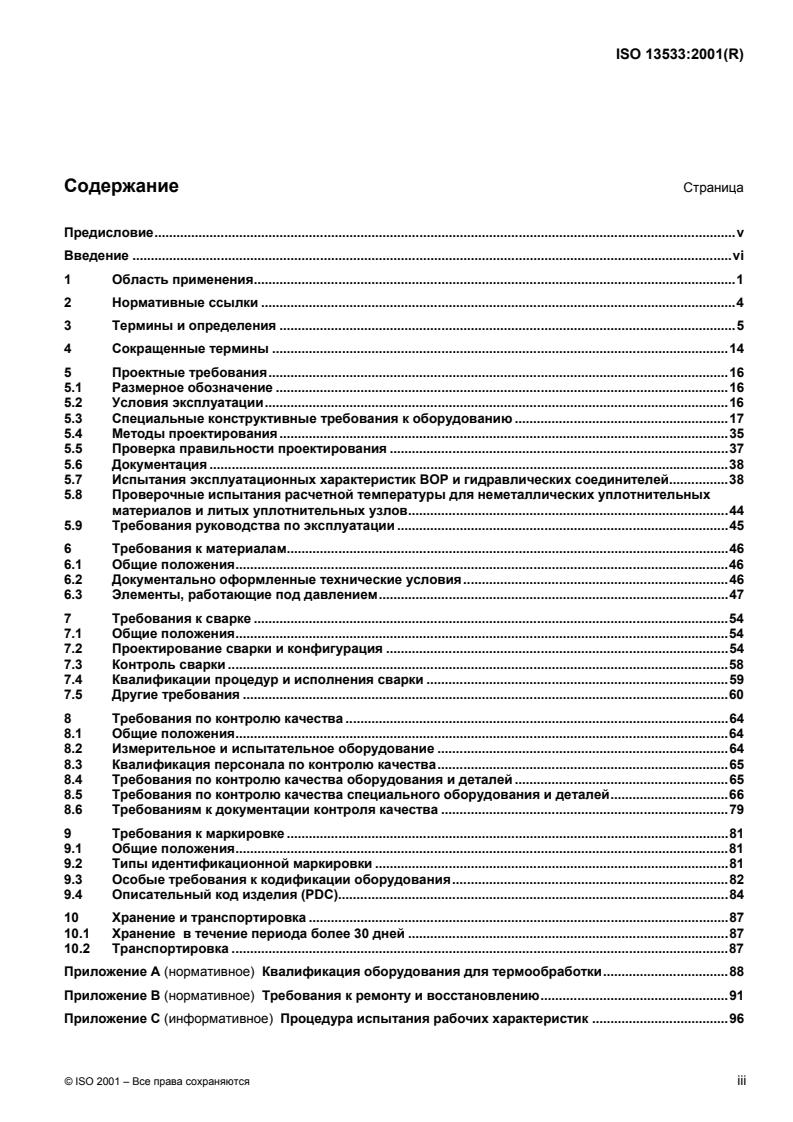
Содержание Страница
Предисловие.v
Введение .vi
1 Область применения.1
2 Нормативные ссылки .4
3 Термины и определения .5
4 Сокращенные термины .14
5 Проектные требования.16
5.1 Размерное обозначение .16
5.2 Условия эксплуатации.16
5.3 Специальные конструктивные требования к оборудованию .17
5.4 Методы проектирования.35
5.5 Проверка правильности проектирования .37
5.6 Документация .38
5.7 Испытания эксплуатационных характеристик ВОР и гидравлических соединителей.38
5.8 Проверочные испытания расчетной температуры для неметаллических уплотнительных
материалов и литых уплотнительных узлов.44
5.9 Требования руководства по эксплуатации .45
6 Требования к материалам.46
6.1 Общие положения.46
6.2 Документально оформленные технические условия.46
6.3 Элементы, работающие под давлением.47
7 Требования к сварке .54
7.1 Общие положения.54
7.2 Проектирование сварки и конфигурация .54
7.3 Контроль сварки .58
7.4 Квалификации процедур и исполнения сварки .59
7.5 Другие требования .60
8 Требования по контролю качества .64
8.1 Общие положения.64
8.2 Измерительное и испытательное оборудование .64
8.3 Квалификация персонала по контролю качества.65
8.4 Требования по контролю качества оборудования и деталей .65
8.5 Требования по контролю качества специального оборудования и деталей.66
8.6 Требованиям к документации контроля качества .79
9 Требования к маркировке .81
9.1 Общие положения.81
9.2 Типы идентификационной маркировки .81
9.3 Особые требования к кодификации оборудования.82
9.4 Описательный код изделия (PDC).84
10 Хранение и транспортировка .87
10.1 Хранение в течение периода более 30 дней .87
10.2 Транспортировка .87
Приложение А (нормативное) Квалификация оборудования для термообработки.88
Приложение B (нормативное) Требования к ремонту и восстановлению.91
Приложение C (информативное) Процедура испытания рабочих характеристик .96
Приложение D (информативное) Процедура проверочных испытаний расчетной температуры .104
Приложение E (информативное) Руководство по закупкам .108
Приложение F (информативное) Отчетность по отказам .110
Приложение G (информативное) Перевод единиц измерения США в систему СИ (метрическую) .111
Приложение H (информативное) Список национальных/региональных стандартов, применимых
в контексте .115
Библиография .116
iv © ISO 2001 – Все права сохраняются
Предисловие
Международная организация по стандартизации (ISO) является всемирной федерацией национальных
организаций по стандартизации (стандартизующих органов членов ISO). Подготовка международных
стандартов обычно проводится в технических комитетах ISO. Каждый стандартизующий орган, являющийся
членом ISO, и заинтересованный в области, для которой был создан технический комитет, имеет право
участвовать в деятельности этого комитета. В этой работе также участвуют международные,
правительственные и неправительственные организации, имеющие соответствующие соглашения о
сотрудничестве с ISO. ISO тесно сотрудничает с Международной электротехнической комиссией (IEC) по
всем вопросам стандартизации в электротехнике.
Международные стандарты разрабатываются в соответствии с правилами, приведенными в Директивах
ISO/IEC, Часть 3.
Основной задачей технических комитетов является подготовка международных стандартов. Проекты
международных стандартов, принятые техническими комитетами, рассылаются стандартизующим органам
членам ISO для голосования. Публикация в качестве международного стандарта требует его утверждения
не менее 75 % стандартизующих органов членов ISO, участвующих в голосовании.
Необходимо иметь в виду, что некоторые элементы настоящей части ISO 13628 могут быть объектом
патентного права. ISO не берет на себя ответственность за идентификацию какого-либо отдельного или
всех таких патентных прав.
Международный стандарт ISO 13533 был подготовлен Техническим комитетом ISO/TC 67, Материалы,
оборудование и морские конструкции для нефтяной и газовой промышленности, Подкомитетом SC 4,
Буровое и эксплуатационное оборудование.
Приложения А и B составляют нормативную часть настоящего международного стандарта. Приложения С,
D, E, F, G и H являются только информативными.
Введение
Настоящий международный стандарт разработан на основе API Specification 16А, второе издание, 1 июня
1998.
Настоящий международный стандарт предназначен для обеспечения возможности безопасной и
функциональной взаимозаменяемости оборудования со стволовым проходом, используемого в
нефтегазовой промышленности.
Пользователи настоящего международного стандарта должны знать, что в конкретных условиях
применения могут возникать дополнительные или отличающиеся требования. Данный международный
стандарт не ставит целью установление ограничений для потребителей по использованию альтернативного
оборудования, технологий или инженерных решений для конкретных условий применения. Это имеет
особое значение в случае совершенствования или применения инновационных технологий. В случае
предложения альтернативного решения продавец должен указать все отличия от настоящего
международного стандарта и дать их подробное описание.
Для удобства пользователей настоящего международного стандарта в приложении Н указаны нормативные
международные стандарты, из приведенных в разделе 2, которые могут быть заменены соответствующими
национальными или региональными стандартами в контексте требований настоящего стандарта.
Пользователь может по усмотрению применять национальный или региональный стандарт в контексте
требования, по которому имеется ссылка на международный стандарт.
vi © ISO 2001 – Все права сохраняются
МЕЖДУНАРОДНЫЙ СТАНДАРТ ISO 13533:2001(R)
Нефтяная и газовая промышленность. Буровое и
эксплуатационное оборудование. Оборудование со
стволовым проходом
1 Область применения
Данный международный стандарт устанавливает требования к техническим характеристикам,
проектированию, материалам, испытаниям и контролю, сварке, маркировке, погрузочно-разгрузочным
работам, хранению и перевозке оборудования со стволовым проходом, используемого при бурении
нефтегазовых скважин. Он также определяет условия эксплуатации, для которых проектируется
оборудование в отношении давления, температуры и скважинных флюидов.
Данный международный стандарт применяется и устанавливает требования для следующего специального
оборудования:
a) плашечные превенторы;
b) плашечные блоки, пакеры и верхние уплотнения;
c) кольцевые превенторы;
d) кольцевые уплотнительные узлы;
e) гидравлические соединители;
f) буровые катушки;
g) адаптеры;
h) свободные соединения;
i) зажимные хомуты.
Взаимозаменяемость по размерам ограничивается концевыми и выходными соединениями.
На Рисунках 1 и 2 показано типовое оборудование, определяемое настоящим международным стандартом;
рекомендации по отчетам при отказах приведены в приложении F.
Настоящий международный стандарт не распространяется на эксплуатацию или испытания оборудования
со стволовым проходом в полевых условиях.
Обозначение
1 Кольцевые прокладки по ISO 10423 7 Устье скважины
2 Кольцевой ВОР 8 Обсадная колонна
3 Зажимной хомут 9 Концевые и выходные соединения
4 Плашечный ВОР 10 Оборудование со стволовым проходом по ISO 13533
5 Буровая катушка 11 Устьевое оборудование по ISO 10423
6 Трубопроводная арматура по ISO 10423
Рисунок 1 — Типовое наземное оборудование со стволовым проходом
2 © ISO 2001 – Все права сохраняются
Обозначение
1 Соединитель райзера
2 Гибкое/шаровое соединение
3 Кольцевой ВОР
4 Гидравлический соединитель
5 Адаптер
6 Плашечный ВОР
7 Арматура по ISO 10423
8 Гидравлический соединитель
9 Устье скважины
10 Оборудование райзера
11 Оборудование со стволовым
проходом по ISO 13533
12 Устьевое оборудование по ISO 10423
Рисунок 2 — Типовое подводное оборудование со стволовым проходом
2 Нормативные ссылки
Перечисленные ниже нормативные документы содержат положения, которые также являются положениями
настоящего международного стандарта при наличии на них ссылок в тексте данного документа. Для ссылок
с твердой идентификацией последующие поправки к ним или редакции любой из приведенных публикаций
не применяются. Однако, сторонам, заключающим соглашения на основании данного международного
стандарта, следует оценивать возможность применения самой последней редакции указанных ниже
нормативных документов. Для ссылок со скользящей идентификацией должна применяться самая
последняя редакция указанного нормативного документа. Организации-члены ISO и IEC ведут реестры
действующих в настоящее время международных стандартов.
ISO 6506-1, Металлические материалы. Измерение твердости по Бринеллю. Часть 1. Метод измерения
ISO 6507-1, Металлические материалы. Измерение твердости по Виккерсу. Часть 1. Метод измерения
ISO 6508-1, Металлические материалы. Измерение твердости по Роквеллу. Часть 1. Метод измерения
(шкалы A, B, C, D, E, F, G, H, K, N, T)
ISO 6892, Металлические материалы. Испытания на растяжение при температуре окружающей среды
ISO 10423:2001, Нефтяная и газовая промышленность. Буровое и эксплуатационное оборудование.
Устьевое оборудование и оборудование устьевой елки
ISO 11961:1996, Нефтяная и газовая промышленность. Стальные трубы для использования в качестве
бурильных труб. Технические условия
ISO 13665, Бесшовные и сварные стальные трубы для работы под давлением. Контроль тела трубы
магнитопорошковым методом для определения поверхностных несовершенств
API Bulletin 6AF, Несущая способность фланцев API при комбинированном нагружении
ASME Правила для котлов и сосудов под давлением Секция V, Статья 5, Ультразвуковые неразрушающие
методы контроля для материалов и изделий
ASME Правила для котлов и сосудов под давлением Секция VIII, Раздел 1, Приложение 4, Диаграммы
закругленных индикаций Приемочный стандарт для закругленных индикаций сварных швов,
определенных радиографическим методом
ASME Правила для котлов и сосудов под давлением Секция VIII, Раздел 2, Сосуды под давлением.
Альтернативные правила, Приложение 4, Конструкция, основанная на анализе напряжений
ASME Правила для котлов и сосудов под давлением Секция VIII, Раздел 2, Сосуды под давлением.
Альтернативные правила, Приложение 6, Экспериментальное исследование напряжений
ASME Правила для котлов и сосудов под давлением Секция IX, Статьи I, II, III и IV
ASTM A 193:1999, Технические условия для материалов болтов из легированных и нержавеющих сталей,
предназначенные для эксплуатации при высоких температурах
ASTM A 320:1999, Технические условия для материалов болтов из легированной стали,
предназначенные для эксплуатации при низких температурах
ASTM A 370:1997, Методы испытаний и определения для механических испытаний изделий из стали
ASTM A 453:1999, Технические условия для материалов болтов для эксплуатации при высоких
температурах, с пределом текучести от 50 до 120 килофунты на дюйм , с коэффициентами теплового
расширения, сопоставимыми с аустенитными сталями
4 © ISO 2001 – Все права сохраняются
ASTM D 395:1998, Стандартные методы испытаний свойств резины. Остаточная деформация при
сжатии
ASTM D 412:1998, Методы испытаний вулканизованной резины, термопластичной резина и
термоэластопластов
ASTM D 471:1998, Стандартные методы испытаний свойств резины. Влияние жидкостей
ASTM D 1414:1994, Стандартные методы испытаний для резиновых уплотнительных колец
ASTM D 1415:1994, Стандартные методы испытаний свойств резины. Международные единицы
твердости
ASTM D 1418:1999, Общепринятая практика для резины и резиновых форм. Терминология
ASTM D 2240:1997, Метод испытания свойств резины. Твёрдость по твердомеру
ASTM E 94:1993, Стандартное руководство по радиографическому контролю
ASTM E 140:1999, Таблицы перевода твердости для металлов
ASTM E 165:1995, Стандартный метод неразрушающего контроля проникающей жидкостью
ASTM E 569:1997, Стандартная практика для контроля методом акустической эмиссии конструкций в
процессе имитационного моделирования
ASTM E 747:1997, Стандартная практика при проектировании, изготовлении и классификация групп
материалов проволочных индикаторов качества изображения (IQL), используемых при радиографии
ASNT-SNT-TC-1A:1992, Практические рекомендации по квалификации и сертификации персонала по
неразрушающему контролю
NACE MR0175–2000, Металлические материалы, устойчивые к растрескиванию под действием
напряжений в сульфидсодержащей среде, предназначенные для нефтепромыслового оборудования
SAE AMS-H-6875A:1998, Термообработка стальных заготовок
3 Термины и определения
В настоящем международном стандарте используются следующие термины и определения.
3.1
критерии приёмки
acceptance criteria
определенные ограничения на характеристики материалов, изделий или условий эксплуатации
3.2
адаптер
adapter
элемент оборудования, работающего под давлением, с концевыми соединениями различного номинального
размера и/или номинального давления
3.3
кольцевой превентор
annular blowout preventer
превентор, в котором используется фасонный упругий уплотнительный элемент для герметизации
пространства между трубой и стволовым проходом или открытым стволом
3.4
глухое соединение
blind connection
концевое или выходное соединение без центрального отверстия, используемое для полного закрытия
соединения
3.5
глухая срезающая плашка
blind-shear ram
запирающий и герметизирующий элемент плашечного превентора, который вначале срезает трубу в
стволовом проходе, а затем герметизирует ствол, или работает как глухая плашка, если отсутствует труба
в стволовом проходе
3.6
глухая плашка
blind ram
запирающий и герметизирующий элемент плашечного превентора, который герметично перекрывает
открытый стволовой проход
3.7
превентор
blowout preventer
BOP
оборудование (или трубопроводная арматура), устанавливаемое на устье скважины для удержания
давления в кольцевом пространстве между обсадной колонной и трубами или в открытом стволе в
процессе бурения, заканчивания скважины, испытания или работ по капитальному ремонту скважины
3.8
корпус
body
любая часть оборудования между концевыми соединениями, с внутренними деталями или без них, которая
находится под действием давления в скважине
3.9
болтовое крепление
bolting
резьбовые крепежные детали, используемые для соединения концевых или выходных соединений
3.10
калибровка
calibration
сравнение и регулировка по эталоны известной точности
3.11
отливать, глагол
cast, verb
заливать расплавленный металл в форму для изготовления детали заданной формы
3.12
отливка, имя существительное
casting, noun
деталь конечной или близкой к конечной формы, полученная в результате отверждения материала в
литейной форм
3.13
химический анализ
chemical analysis
определение химического состава материала
6 © ISO 2001 – Все права сохраняются
3.14
зажимной хомут, имя существительное
clamp, noun
устройство с внутренними наклонными упорными торцами, используемое для зажима сопрягаемых бугелей
3.15
хомутовая нагрузка
clamping load
осевая нагрузка, прикладываемая к бугелям зажимным хомутом при затягивании болтов
3.16
запорное болтовое крепление
closure bolting
резьбовые крепежные элементы, используемые для соединения находящихся под давлением деталей,
отличных от концевых или выпускных соединений
3.17
соответствие
conformance
полное соблюдение указанных требований
3.18
коррозионно-стойкая кольцевая канавка
corrosion-resistant ring groove
кольцевая канавка с металлическим покрытием, стойким к потере металла при коррозии
3.19
критический элемент
critical component
деталь, к которой относятся требования настоящего международного стандарта
3.20
система сбора данных
data acquisition system
система для хранения и/или создания постоянных копий сведений о проведенных испытаниях
ПРИМЕРЫ Ленточные самописцы, самописцы с круговой диаграммой или компьютерные системы.
3.21
дата изготовления
date of manufacture
дата окончательного приемки изготовителем готового оборудования
3.22
буровая катушка
drilling spool
элемент оборудования, находящийся под давлением, имеющий концевые соединения и установленный
ниже или между отдельными единицами оборудования со стволовым проходом
ПРИМЕЧАНИЕ В случае, если предусматриваются концевые соединения, то они должны изготавливаться в
соответствии с настоящим международным стандартом.
3.23
концевое соединение
end connection
фланец (со шпильками или со свободной поверхностью), бугельное соединение или другое концевое
соединение (3.47), предназначенное для соединения отдельных единиц оборудования и являющееся
неотъемлемой частью этого оборудования
3.24
оборудование
equipment
любая отдельная укомплектованная установка, которая может использоваться в соответствии со своим
назначением без дальнейшей подготовки или сборки
3.25
соединительный сварной шов
fabrication weld
сварной шов, соединяющий две или более детали
3.26
фланец
flange
выступающее опорное кольцо с отверстиями для болтов и имеющее уплотнительный механизм,
предназначенное для соединения отдельных единиц работающего под давлением оборудования с
помощью болтового крепления к другому фланцу
3.27
ковать, глагол
forge, verb
пластическая деформация обычно разогретого металла для придания ему заданных форм с
использованием сжимающих нагрузок, открытых или закрытых пресс-форм
3.28
поковка, имя существительное
forging, noun
фасонная металлическая деталь, изготовленная способом ковки
3.29
сварной шов с полным проплавлением
full-penetration weld
сварной шов, который проходит через всю толщину соединяемых деталей
3.30
нагрузка посадки прокладки
gasket-seating load
часть хомутовой нагрузки, необходимая для посадки прокладки и обеспечения контакта между
сопрягаемыми поверхностями бугелей
3.31
нагрузка удержания прокладки
gasket-retaining load
часть хомутовой нагрузки, необходимая для компенсации разъединяющего усилия, которое прокладка под
давлением оказывает на бугели
3.32
зона термического влияния
heat-affected zone
HAZ
та часть основного металла, которая не расплавлялась, но его механические характеристики или
микроструктура были изменены при нагреве в процессе сварки или резания
8 © ISO 2001 – Все права сохраняются
3.33
плавка
партия плавки
heat
cast lot
материал, получаемый из законченной плавки
ПРИМЕЧАНИЕ Плавка для переплавляемых сплавов определяется как исходный материал, получаемый от
отдельного переплавляемого слитка.
3.34
термообработка
heat treatment
heat treating
чередующиеся этапы контролируемого нагрева и охлаждения материалов с целью изменения физических и
механических свойств
3.35
садка
heat treatment load
материал, который проходит один цикл термообработки как отдельная партия
3.36
обрабатывать в горячем состоянии, глагол
hot-work, verb
подвергать металл пластической деформации при температуре выше температуры рекристаллизации
3.37
бугель
hub
выступающее опорное кольцо с внешними наклонными упорными торцами и уплотнительным механизмом,
предназначенное для соединения оборудования работающего под давлением
3.38
гидравлический соединитель
hydraulic connector
оборудование со стволовым проходом с гидравлическим приводом, который закрывает и герметически
изолирует концевые соединения
3.39
индикация
indication
видимый признак трещин, раковин или других аномалий, который обнаруживается в процессе контроля
магнитопорошковым методом и методом проникающей жидкости
3.40
цельные, прил.
integral, adj
〈детали〉 соединенные ковкой, литьем или сваркой
3.41
прослеживаемость партии изделий
job-lot traceability
возможность отслеживания деталей как отдельной партии изделий, с идентификацией соответствующей
плавки (плавок)
3.42
утечка
leakage
видимый выход флюида под давлением из внутренней части на наружную поверхность оборудования,
находящегося под давлением, при его испытании
3.43
линейная индикация
linear indication
〈контроль магнитопорошковым методом и методом проникающей жидкости〉 индикация, длина которой
равна или больше, чем три ее ширины
3.44
свободное соединение
loose connection
фланец (со шпильками или со свободной поверхностью), бугельное соединение или другое концевое
соединение (3.47), предназначенное для соединения оборудования, но не являющееся цельной частью
этого оборудования
3.45
сварной шов при капительном ремонте
major repair weld
сварной шов, глубина которого больше, чем 25 % первоначальной толщины стенки или 25 мм, смотря по
тому, какое из них меньше
3.46
сварной шов, не находящийся под давлением
non-pressure-containing weld
сварной шов, разрушение которого не уменьшает целостность элемента, находящегося под давлением
3.47
другое концевое соединение
other end connection
OEC
соединение, которое не регламентировано стандартом ISO
ПРИМЕЧАНИЕ Это понятие включает фланцы ISO и бугели с прокладками, выполненные без соблюдения
требований стандартов ISO, и фирменные соединения изготовителей.
3.48
деталь
part
индивидуальный элемент, который используется при сборке отдельного узла оборудования
3.49
трубная плашка
pipe ram
запирающий и герметизирующий элемент плашечного превентора, который герметизирует трубы в
стволовом проходе
3.50
термообработка после сварки
post-weld heat treatment
PWHT
любая термообработка после сварки, включая снятие напряжений
10 © ISO 2001 – Все права сохраняются
3.51
деталь, работающая под давлением
элемент, работающий под давлением
pressure-containing part
pressure-containing member
деталь, находящаяся под воздействием скважинных флюидов, отказ которой может привести к выходу
скважинного флюида в окружающую среду
ПРИМЕРЫ Корпуса, крышки и соединительные штоки.
3.52
сварной шов, находящийся под давлением
pressure-containing weld
сварной шов, разрушение которого уменьшает целостность элемента, находящегося под давлением
3.53
деталь, регулирующая давление
элемент, регулирующий давление
pressure-controlling part
pressure-controlling member
деталь, предназначенная для контроля или регулирования перемещения скважинных флюидов
ПРИМЕРЫ Уплотнительные элементы, плашки, съёмные сёдла деталей или элементов, находящихся под
давлением.
3.54
концевая нагрузка давления
pressure end load
осевая нагрузка от внутреннего давления, приложенного к сечению, которое определяется максимальным
диаметром уплотнителя
3.55
деталь, удерживающая давление
элемент, удерживающий давление
pressure-retaining part
pressure-retaining member
деталь, которая не находится под воздействием скважинных флюидов, но отказ которой может привести к
выходу скважинного флюида в окружающую среду
ПРИМЕРЫ Запорные болты или зажимные хомуты.
3.56
серия продукции
product family
модель или тип специфического оборудования, перечисленного в разделе 1 настоящего международного
стандарта
3.57
квалифицированный персонал
qualified personnel
индивидуум, обладающий характеристиками или способностями, полученными в процессе обучения, на
практике или в обоих случаях, и оцененными в соответствии с установленными требованиями изготовителя
3.58
плашечный превентор
ram blowout preventer
превентор, который использует металлические блоки с цельными уплотнениями из эластомера для
герметизации давления в стволовом проходе при наличии или отсутствии труб в стволе
3.59
номинальное рабочее давление
rated working pressure
максимальное внутреннее давление, на действие и/или управление которым было рассчитано
оборудование
3.60
протокол, имя существительное
record, noun
повторно используемая информация
3.61
существенная индикация
relevant indication
〈контроль магнитопорошковым методом и методом проникающей жидкости〉 любая индикация, наибольший
размер которой превышает 1,6 мм (0,062 дюйма)
3.62
восстановление
remanufacture
процесс разборки, повторной сборки и испытания оборудования со стволовым проходом с заменой деталей
или без, при котором выполняется машинная обработка, сварка, термообработка или другие
производственные операции
3.63
ремонт
repair
процесс разборки, повторной сборки и испытания оборудования со стволовым проходом с заменой или без
замены деталей
ПРИМЕЧАНИЕ Ремонт не включает выполнение машинной обработки, сварки, термообработки или других операций
по изготовлению деталей и узлов, а также не предусматривает замену деталей или элементов, работающих под
давлением. Ремонт может включать в себя замену деталей, отличных от деталей или элементов, работающих под
давлением.
3.64
закругленная индикация
rounded indication
〈контроль магнитопорошковым методом и методом проникающей жидкости〉 любая индикация, имеющая
приблизительно круглую или эллиптическую форму длиной меньше чем три ее ширины
3.65
идентификация
serialization
присвоение индивидуального кода отдельным деталям и/или частям оборудования для ведения протоколов
3.66
специальный технологический процесс
special process
технологическая операция, изменяющая или оказывающая влияние на свойства материала
3.67
стабилизированный
stabilized
〈испытание под давлением〉 режим, при котором первоначальная интенсивность снижения давления
уменьшена до величины, указанной изготовителем
ПРИМЕЧАНИЕ Снижение давления может быть следствием таких явлений, как изменение температуры, усадка
эластомерных уплотнений или сжатие воздуха, попавшего в оборудование при испытании.
12 © ISO 2001 – Все права сохраняются
3.68
стабилизированный
stabilized
〈термическое испытание〉 режим, при котором первоначальные колебания температуры уменьшены до
диапазона, указанного изготовителем
ПРИМЕЧАНИЕ Колебание температуры может быть следствием таких явлений, как смешивание флюидов с
различной температурой, конвекция или теплопроводность.
3.69
стандартное соединение
standard connection
фланец, бугель или шпилечное соединение, изготовленные в соответствии со стандартом ISO, включая
требования к размерам
3.70
снятие напряжений
stress relief
контролируемый нагрев материала до определенной температуры с целью снижения остаточных
напряжений
3.71
соединение на шпильках
studded connection
соединение, у которого резьбовые удерживающие шпильки завинчиваются в резьбовые отверстия
3.72
чистота обработки поверхности
surface finish
Ra
значение измерения средней шероховатости поверхности
ПРИМЕЧАНИЕ 1 Выражается в микрометрах (мкм).
ПРИМЕЧАНИЕ 2 Все значения чистоты обработки поверхности, указанные в настоящем международном стандарте,
должны рассматриваться как максимальные значения.
3.73
вырезать круглое отверстие, глагол
trepan, verb
выполнять отверстие в детали путем высверливания узкой полосы или канавки по окружности отверстия и
извлечения сплошного центрального стержня
3.74
универсальная трубная плашка
variable-bore ram
VBR
запирающий и герметизирующий элемент в плашечном превенторе, который способен герметизировать
трубы различного размера
3.75
визуальный контроль
visual examination
контроль деталей и оборудования на наличие визуальных дефектов в материале и качества изготовления
3.76
объемный неразрушающий контроль
volumetric non-destructive examination
контроль на наличие внутренних дефектов материала радиографическим методом, методом акустической
эмиссии или ультразвуковым методом
3.77
разделка кромок под сварку
weld groove
зона между двумя свариваемыми металлами, которая была подготовлена для заполнения сварочным
металлом
3.78
сваривать, глагол
weld, verb
соединять материалы путём сплавления с добавлением или без добавления сварочных материалов
3.79
соединение под сварку
weld joint
фиксация взаимного расположения элементов для облегчения их соединения сваркой
3.80
деформированная структура
wrought structure
структура, которая не является литой дендритной структурой
3.81
предел текучести
yield strength
уровень напряжения, измеренный при комнатной температуре, при котором материал пластически
деформируется и при снятии напряжения не возвращается к своим исходным размерам
ПРИМЕЧАНИЕ 1 Выражается в ньютонах на квадратный миллиметр (фунты на квадратный дюйм) нагружаемой
площади.
ПРИМЕЧАНИЕ 2 Все пределы текучести, указанные в настоящем международном стандарте, рассматриваются как
условные пределы текучести (0,2 % смещение) в соответствии с ISO 6892.
4 Сокращенные термины
ANSI Американский национальный институт по стандартизации
American National Standards Institute
API Американский нефтяной институт
American Petroleum Institute
AQL приёмочный уровень качества
acceptance quality level
ASME Американский институт инженеров-механиков
American Society of Mechanical Engineers
ASNT Американская общество по неразрушающему контролю
American Society for Nondestructive Testing
ASTM Американская общество по испытанию и материалам
American Society for Testing and Materials
AWS Американская общество по сварке
American Welding Society
BOP превентор
blowout preventer
14 © ISO 2001 – Все права сохраняются
HAZ зона термического влияния
heat-affected zone
ID внутренний диаметр
inside diameter
LP проникающая жидкость
liquid penetrant
MP магнитный порошок
magnetic particle
NACE Национальная ассоциация инженеров-специалистов по коррозии
National Association of Corrosion Engineers
NDE неразрушающий контроль
non-destructive examination
OD наружный диаметр
outside diameter
OEC другое концевое соединение
other end connection
OEM первичное предприятие-изготовитель
original equipment manufacturer
OS рабочая система
operating system
PQR протокол квалификации процедуры
procedure qualification record
VBR универсальная трубная плашка
variable-bore ram
WPS операционная карта сварки
welding procedure specification
5 Проектные требования
5.1 Размерное обозначение
Оборудование, к которому применим настоящий международный стандарт, должно иметь размер
вертикального стволового прохода (проходной диаметр) соответствующий размеру, приведенному в
Таблице 1.
Таблица 1 — Размеры оборудования
Обозначение номинального Проходной диаметр
размера
мм (дюйм) мм (дюйм)
179 7 1/16 178,61 7,032
228 9 227,84 8,970
279 11 278,64 10,970
346 13 5/8 345,31 13,595
425 16 3/4 424,69 16,720
476 18 3/4 475,49 18,720
527 20 3/4 526,29 20,720
540 21 1/4 538,99 21,220
680 26 3/4 678,69 26,720
762 30 761,24 29,970
5.2 Условия эксплуатации
5.2.1 Номинальное рабочее давление
Оборудование, к которому применяется настоящий международный стандарт, должно быть отнесено
только к номинальным рабочим давлениям, указанным в Таблице 2.
Таблица 2 — Номинальное рабочее давление оборудования
МПа (фунт/дюйм )
13,8 2 000
20,7 3 000
34,5 5 000
69,0 10 000
103,5 15 000
138,0 20 000
5.2.2 Номинальные значения температуры
Минимальной температурой является наиболее низкая температура окружающей среды, воздействию
которой может подвергаться оборудование. Максимальной температурой является наиболее высокая
температура флюида, который может проходить через оборудование.
16 © ISO 2001 – Все права сохраняются
Металлические детали оборудования должны быть рассчитаны для диапазонов температур, указанных в
Таблице 3.
Оборудование должно быть рассчитано для скважинных эластомерных материалов для работы в пределах
температурных классов, указанных в Таблице 4.
Все другие эластомерные уплотнения должны быть рассчитаны для работы при температурах в
соответствии с документально оформленными техническими условиями изготовителя.
Таблица 3 — Диапазоны температур для металлических материалов
Рабочий диапазон
Классификация
°C °F
T-75
от − 59 до 121 от − 75 до 250
T-20
от − 29 до 121 от − 20 до 250
T-0 от 0 до 250
от − 18 до 121
Таблица 4 — Диапазоны температур для неметаллических материалов
Нижний предел Верхний предел
(первое число) (второе число)
Температура Температура
Код Код
°C (°F) °C (°F)
A − 26 − 15 A 82 180
B 0 B 93 200
− 18
C 10 C 104 220
− 12
D 20 D 121 250
− 7
E − 1 30 E 149 300
F 4 40 F 177 350
G Другие Другие G Другие Другие
X См. примечание См. примечание X См. примечание См. примечание
ПРИМЕЧАНИЕ Эти элементы могут выдерживать класс температур от 4 °С до 82 °С (от 40 °F до 180 °F) без проведения
подтверждающего температурного испытания, обеспечивая при этом их маркировку как температурный класс “XX”.
ПРИМЕР Диапазон температур для материала “EB” от − 1 °C до 93 °C (от 30 °F до 200 °F).
5.2.3 Характеристики удерживаемых флюидов
Все металлические материалы, которые находятся в контакте со скважинными флюидами, должны
отвечать требованиям NACE MR0175 для работы в присутствии сернистых соединений.
5.3 Специальные конструктивные требования к оборудованию
5.3.1 Фланцевые концевые и выходные соединения
5.3.1.1 Общие положения
Фланцевые концевые и выходные соединения должны отвечать требованиям к размерам по ISO 10423.
Фланцевые соединения типа 6В и API 6ВХ могут использоваться как цельные соединения.
Фланцы типа 6В и API 6ВХ, как цельные части оборудования со стволовым проходом, не должны иметь
соединений для испытаний.
Фланцевые соединения типа 6В и API 6ВХ должны проектироваться для использования в комбинации с
размерными обозначениями и номинальными давлениями, показанными в Таблице 5.
Таблица 5 — Номинальные давления и диапазоны размеров фланцевых соединений по ISO 10423
Номинальное давление
Тип 6B Тип 6BX
МПа (фунт/дюйм )
13,8 2 000 от 2 1/6 до 21 1/4 от 26 3/4 до 30
20,7 3 000 от 2 1/16 до 20 3/4 от 26 3/4 до 30
34,5 5 000 от 2 1/16 до 11 от 13 5/8 до 21 1/4
69,0 10 000 от 1 13/16 до 21 1/4
103,5 15 000 от 1 13/16 до 18 3/4
138,0 20 000 от 1 13/16 до 13 5/8
5.3.1.2 Фланцевые соединения типа API 6В
Фланцевые соединения типа 6В являются соединениями кольцевого типа и не предназначены для
соединения торец к торцу. Болтовая нагрузка при свинчивании соединения воздействует на металлическую
прокладку. Фланцы типа 6В должны иметь болтовую или шпилечную конструкцию.
Размеры для цельных фланцев типа 6В должны соответствовать ISO 10423.
Размеры для всех кольцевых канавок должны соответствовать ISO 10423.
5.3.1.3 Фланцевые соединения типа API 6ВХ
Фланцевые соединения типа 6ВХ являются соединениями кольцевого типа и спроектированы с
привалочным торцем. В зависимости от допусков, болтовая нагрузка при свинчивании соединения может
воздействовать на привалочную поверхность фланца в случае, когда прокладка была правильно
установлена. Этот упор предупреждает повреждение фланца или прокладки при чрезмерном крутящем
моменте свинчивания болтовых соединений. Поэтому, один из фланцев соединения 6ВХ должен иметь
привалочную поверхность. Фланцы типа 6ВХ должны иметь болтовую или шпилечную конструкцию.
Размеры для цельных фланцев типа 6ВХ должны соответствовать ISO 10423.
Размеры для всех кольцевых канавок должны соответствовать ISO 10423.
Если прочность наплавляемого сплава равна или превышает прочность основного металла, могут
использоваться другие подготовительные операции под сварку.
5.3.2 Концевые и выходные соединения на шпильках
5.3.2.1 Общие положения
Два типа концевых и выходных соединений на шпильках (6В и 6ВХ), указываемые в настоящем
международном стандарте, должны соответствовать ISO 10423.
Шпилечные соединения 6В и 6ВХ могут использоваться как цельные соединения.
18 © ISO 2001 – Все права сохраняются
Конструкция шпилечных соединений должна соответствовать требованиями, указанными в 5.3.1.1, за
исключением тех, которые указаны в 5.3.2.2 и 5.3.2.3.
5.3.2.2 Соединения на шпильках типа 6В
Размеры соединений на шпильках типа 6В должны соответствовать требованиям ISO 10423 по размеру
проходного отверстия, диаметру делительной окружности центров отверстий под шпильки и OD фланца.
Соединение на шпильках должно быть изготовлено в полном соответствии с ISO 10423.
Размеры отверстий п
...