

ISO 8278:2016
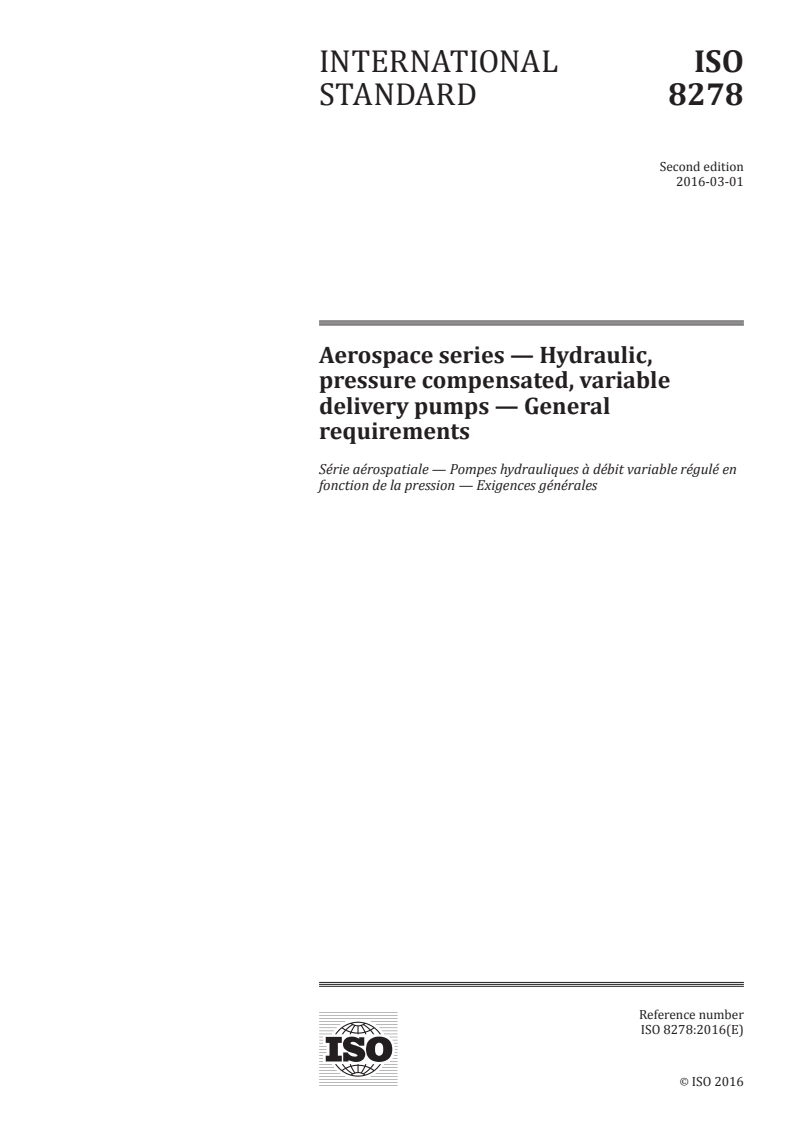
(Main)Aerospace series — Hydraulic, pressure compensated, variable delivery pumps — General requirements
General Information
- Abstract
ISO 8278:2016 establishes the general requirements for pressure compensated, variable delivery hydraulic pumps, suitable for use in aircraft hydraulic systems at pressures up to 35 000 kPa (5 000 psi). It is to be used in conjunction with detail specifications that is particular to each application.
- Status
- Published
- Publication Date
- 02-Mar-2016
- Technical Committee
- ISO/TC 20/SC 10 - Aerospace fluid systems and components
- Drafting Committee
- ISO/TC 20/SC 10/WG 9 - Hydraulic power and actuation equipment
- Current Stage
- 9093 - International Standard confirmed
- Start Date
- 19-Nov-2021
- Completion Date
- 29-Aug-2026
Buy Documents
ISO 8278:2016 - Aerospace series -- Hydraulic, pressure compensated, variable delivery pumps -- General requirements
ISO 8278:2016 - Aerospace series — Hydraulic, pressure compensated, variable delivery pumps — General requirements/3/2016
Overview
ISO 8278:2016 - Aerospace series - Hydraulic, pressure compensated, variable delivery pumps - General requirements - defines the baseline requirements for pressure‑compensated, variable‑delivery hydraulic pumps intended for use in aircraft hydraulic systems at pressures up to 35 000 kPa (5 000 psi). Published as the second edition (2016), this standard provides general requirements to be applied together with application‑specific detail specifications.
Key topics and technical requirements
The standard organizes requirements across design, performance, testing and lifecycle aspects. Major topics include:
- Scope and definitions
- Terms and normative references that establish common language for aerospace hydraulic pumps.
- Functional requirements
- Hydraulic fluid compatibility, rated discharge pressure, maximum full‑flow and transient pressures, pressure pulsations, inlet and case drain pressures.
- Flow characteristics: rated discharge flow, case flow, shaft seal leakage and external leakage.
- Rotational and mechanical limits: rated speed, overspeed, direction of rotation, torque and overall pump efficiency.
- Variable delivery control: adjustment, response time, stability and maximum transient pressures.
- Environmental, temperature and acoustic noise limits, endurance and qualification/airworthiness provisions.
- Detail design and construction
- Dimensionally critical components, seals, lubrication, balance, corrosion protection, materials and castings.
- Marking, ports, mounting and maintainability features.
- Strength and structural requirements
- Proof and ultimate pressure conditions for pump case and ports, pressure impulse (fatigue) and port strength.
- Installation, maintenance and reliability
- Dimensions, mass, orientation, drive coupling, service life limits, storage, maintenance concept and self‑contained failure modes.
- Quality assurance and testing
- Classification of tests, test‑stand requirements and acceptance tests including product examination and test programmes.
Applications
ISO 8278:2016 is used to:
- Specify baseline performance and safety for aircraft hydraulic pumps in design and procurement documents.
- Guide manufacturers in design, material selection, sealing and corrosion protection for aerospace pumps.
- Support qualification, acceptance testing and airworthiness compliance for hydraulic power systems on fixed‑wing and rotary aircraft.
- Provide engineering teams and test laboratories with a structured test and inspection framework.
Who should use this standard
- Aerospace pump manufacturers and suppliers
- Aircraft systems engineers and integrators
- Certification authorities and airworthiness organisations
- MRO, procurement and quality assurance teams
- Test houses performing pump qualification and acceptance
Related standards
ISO 8278:2016 is intended to be used in conjunction with application‑specific detail specifications and other aerospace hydraulic and airworthiness standards that govern system‑level integration, materials and testing.
Relations
- Effective Date
- 04-Nov-2015
- Effective Date
- 10-Mar-2012
Buy Documents
ISO 8278:2016 - Aerospace series -- Hydraulic, pressure compensated, variable delivery pumps -- General requirements
ISO 8278:2016 - Aerospace series — Hydraulic, pressure compensated, variable delivery pumps — General requirements/3/2016
Get Certified
Connect with accredited certification bodies for this standard

BUREAU VERITAS Certification Germany
Bureau Veritas certification in Germany.

Element Materials Technology
Materials testing and product certification.

AQMS Ltd.
AQMS provides ISO certification to SMEs across the UK.
Sponsored listings
Frequently Asked Questions
ISO 8278:2016 is a standard published by the International Organization for Standardization (ISO). Its full title is "Aerospace series — Hydraulic, pressure compensated, variable delivery pumps — General requirements". This standard covers: ISO 8278:2016 establishes the general requirements for pressure compensated, variable delivery hydraulic pumps, suitable for use in aircraft hydraulic systems at pressures up to 35 000 kPa (5 000 psi). It is to be used in conjunction with detail specifications that is particular to each application.
ISO 8278:2016 establishes the general requirements for pressure compensated, variable delivery hydraulic pumps, suitable for use in aircraft hydraulic systems at pressures up to 35 000 kPa (5 000 psi). It is to be used in conjunction with detail specifications that is particular to each application.
ISO 8278:2016 is classified under the following ICS (International Classification for Standards) categories: 49.080 - Aerospace fluid systems and components. The ICS classification helps identify the subject area and facilitates finding related standards.
ISO 8278:2016 has the following relationships with other standards: It is inter standard links to ISO 12334:2000, ISO 8278:1986. Understanding these relationships helps ensure you are using the most current and applicable version of the standard.
ISO 8278:2016 is available in PDF format for immediate download after purchase. The document can be added to your cart and obtained through the secure checkout process. Digital delivery ensures instant access to the complete standard document.
Standards Content (Sample)
INTERNATIONAL ISO
STANDARD 8278
Second edition
2016-03-01
Aerospace series — Hydraulic,
pressure compensated, variable
delivery pumps — General
requirements
Série aérospatiale — Pompes hydrauliques à débit variable régulé en
fonction de la pression — Exigences générales
Reference number
©
ISO 2016
© ISO 2016, Published in Switzerland
All rights reserved. Unless otherwise specified, no part of this publication may be reproduced or utilized otherwise in any form
or by any means, electronic or mechanical, including photocopying, or posting on the internet or an intranet, without prior
written permission. Permission can be requested from either ISO at the address below or ISO’s member body in the country of
the requester.
ISO copyright office
Ch. de Blandonnet 8 • CP 401
CH-1214 Vernier, Geneva, Switzerland
Tel. +41 22 749 01 11
Fax +41 22 749 09 47
copyright@iso.org
www.iso.org
ii © ISO 2016 – All rights reserved
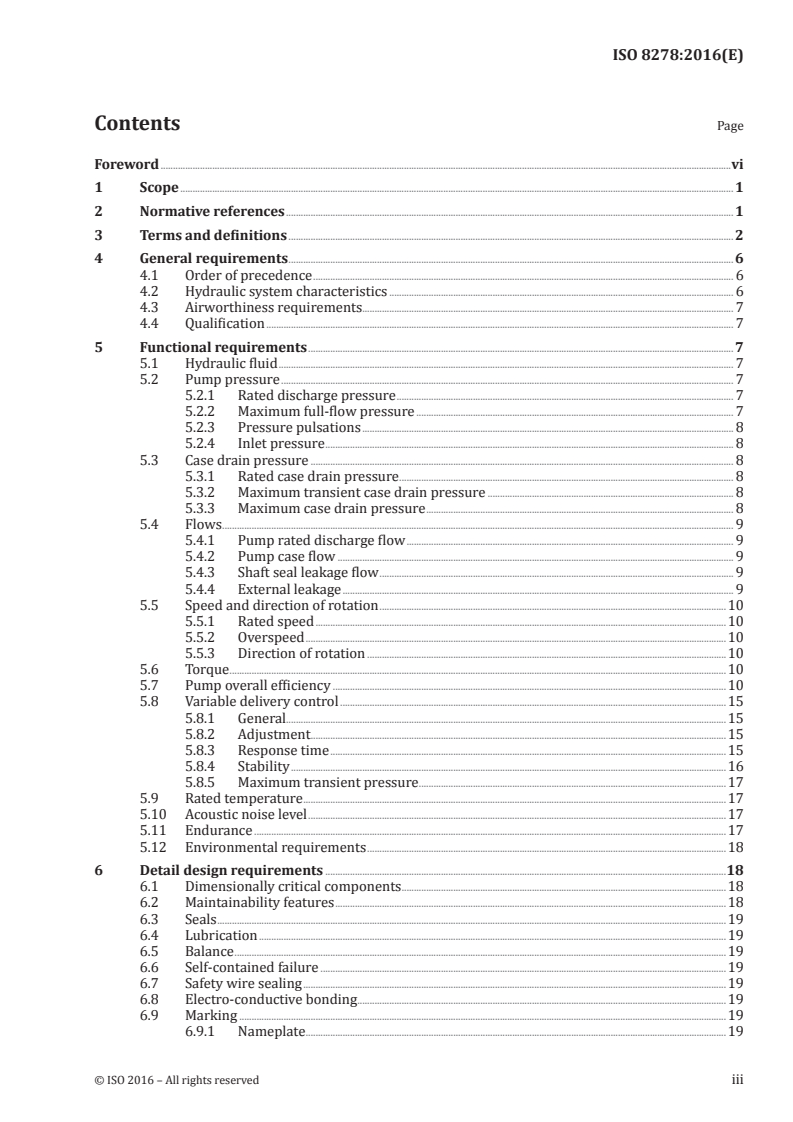
Contents Page
Foreword .vi
1 Scope . 1
2 Normative references . 1
3 Terms and definitions . 2
4 General requirements . 6
4.1 Order of precedence . 6
4.2 Hydraulic system characteristics . 6
4.3 Airworthiness requirements. 7
4.4 Qualification . 7
5 Functional requirements . 7
5.1 Hydraulic fluid . 7
5.2 Pump pressure . 7
5.2.1 Rated discharge pressure . 7
5.2.2 Maximum full-flow pressure . 7
5.2.3 Pressure pulsations . 8
5.2.4 Inlet pressure . 8
5.3 Case drain pressure . 8
5.3.1 Rated case drain pressure . 8
5.3.2 Maximum transient case drain pressure . 8
5.3.3 Maximum case drain pressure . 8
5.4 Flows . 9
5.4.1 Pump rated discharge flow . 9
5.4.2 Pump case flow . 9
5.4.3 Shaft seal leakage flow . 9
5.4.4 External leakage . 9
5.5 Speed and direction of rotation .10
5.5.1 Rated speed .10
5.5.2 Overspeed .10
5.5.3 Direction of rotation .10
5.6 Torque .10
5.7 Pump overall efficiency .10
5.8 Variable delivery control .15
5.8.1 General.15
5.8.2 Adjustment . . .15
5.8.3 Response time .15
5.8.4 Stability .16
5.8.5 Maximum transient pressure .17
5.9 Rated temperature .17
5.10 Acoustic noise level .17
5.11 Endurance .17
5.12 Environmental requirements .18
6 Detail design requirements .18
6.1 Dimensionally critical components .18
6.2 Maintainability features .18
6.3 Seals .19
6.4 Lubrication .19
6.5 Balance .19
6.6 Self-contained failure .19
6.7 Safety wire sealing .19
6.8 Electro-conductive bonding .19
6.9 Marking .19
6.9.1 Nameplate .19
6.9.2 Fluid identification .20
6.9.3 Ports .20
7 Strength requirements .20
7.1 General .20
7.2 Pressure loads .20
7.3 Proof pressure .20
7.3.1 Pump case .20
7.3.2 Pump inlet port .20
7.3.3 Pump discharge port .20
7.4 Ultimate pressure .21
7.4.1 Pump case .21
7.4.2 Pump inlet port .21
7.4.3 Pump discharge port .21
7.5 Pressure impulse (fatigue) .21
7.6 Port strength .21
8 Construction requirements .21
8.1 Materials .21
8.1.1 General.21
8.1.2 Metals .22
8.2 Corrosion protection .22
8.2.1 General.22
8.2.2 Ferrous and copper alloys .23
8.2.3 Aluminium alloys .23
8.3 Castings .23
9 Installation requirements.23
9.1 Dimensions .23
9.2 Mass .23
9.3 Mounting .23
9.4 Orientation .24
9.5 Drive coupling .24
9.6 Ports .24
10 Maintenance requirements .24
10.1 Maintenance concept .24
10.2 Service life limitations and storage specifications .25
11 Reliability requirements .25
11.1 Equipment compliance .25
11.2 Requirements .25
12 Quality assurance provisions .25
12.1 Responsibility for inspection .25
12.2 Classification of tests .25
12.3 Test stand requirements .26
13 Acceptance tests .26
13.1 General .26
13.2 Examination of the product .26
13.3 Test programme .26
13.3.1 General.26
13.3.2 External leakage requirements .27
13.3.3 Break-in run .27
13.3.4 Proof pressure test .27
13.3.5 Load cycles .27
13.3.6 Teardown inspection examination .27
13.3.7 Run-in .28
13.3.8 Functional tests .28
13.3.9 Pressure control test .28
13.3.10 Calibration .28
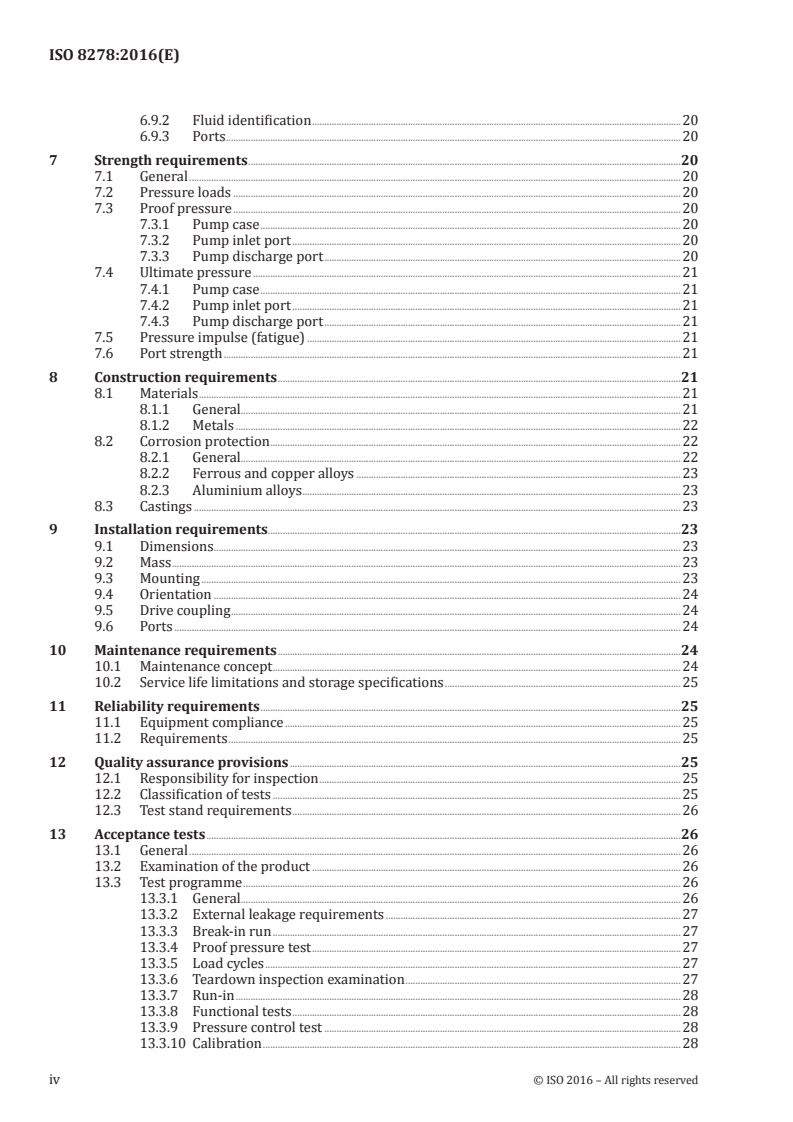
iv © ISO 2016 – All rights reserved
13.3.11 Fluid contamination test .29
13.3.12 Electro-conductive bonding .30
13.4 Storage and packaging .30
14 Qualification tests .30
14.1 Purpose .30
14.2 Qualification procedure .30
14.2.1 Qualification by analogy .30
14.2.2 Pump qualification test report .30
14.2.3 Samples and program of qualification tests .31
14.3 Qualification testing .31
14.3.1 Dimensional check .31
14.3.2 Expanded envelope acceptance tests .32
14.3.3 Calibration .32
14.3.4 Maximum pressure and response time tests .32
14.3.5 Pressure pulsation test .34
14.3.6 Heat rejection test .34
14.3.7 Endurance test .35
14.3.8 Minimum inlet pressure test .40
14.3.9 Environmental tests .41
14.3.10 Structural tests .41
14.3.11 Supplementary tests .43
Bibliography .44
Foreword
ISO (the International Organization for Standardization) is a worldwide federation of national standards
bodies (ISO member bodies). The work of preparing International Standards is normally carried out
through ISO technical committees. Each member body interested in a subject for which a technical
committee has been established has the right to be represented on that committee. International
organizations, governmental and non-governmental, in liaison with ISO, also take part in the work.
ISO collaborates closely with the International Electrotechnical Commission (IEC) on all matters of
electrotechnical standardization.
The procedures used to develop this document and those intended for its further maintenance are
described in the ISO/IEC Directives, Part 1. In particular the different approval criteria needed for the
different types of ISO documents should be noted. This document was drafted in accordance with the
editorial rules of the ISO/IEC Directives, Part 2 (see www.iso.org/directives).
Attention is drawn to the possibility that some of the elements of this document may be the subject of
patent rights. ISO shall not be held responsible for identifying any or all such patent rights. Details of
any patent rights identified during the development of the document will be in the Introduction and/or
on the ISO list of patent declarations received (see www.iso.org/patents).
Any trade name used in this document is information given for the convenience of users and does not
constitute an endorsement.
For an explanation on the meaning of ISO specific terms and expressions related to conformity
assessment, as well as information about ISO’s adherence to the WTO principles in the Technical
Barriers to Trade (TBT) see the following URL: Foreword - Supplementary information
The committee responsible for this document is ISO/TC 20, Aircraft and space vehicles, Subcommittee
SC 10, Aerospace fluid systems and components.
This second edition cancels and replaces the first edition (ISO 8278:1986) and ISO 12334:2000, which
have been technically revised.
vi © ISO 2016 – All rights reserved
INTERNATIONAL STANDARD ISO 8278:2016(E)
Aerospace series — Hydraulic, pressure compensated,
variable delivery pumps — General requirements
1 Scope
This International Standard establishes the general requirements for pressure compensated, variable
delivery hydraulic pumps, suitable for use in aircraft hydraulic systems at pressures up to 35 000 kPa
(5 000 psi).
This International Standard is to be used in conjunction with detail specifications that is particular to
each application.
2 Normative references
The following documents, in whole or in part, are normatively referenced in this document and are
indispensable for its application. For dated references, only the edition cited applies. For undated
references, the latest edition of the referenced document (including any amendments) applies.
ISO 2093, Electroplated coatings of tin — Specification and test methods
ISO 2669, Environmental tests for aircraft equipment — Steady-state acceleration
ISO 2671, Environmental tests for aircraft equipment — Part 3.4 : Acoustic vibration
ISO 2685, Aircraft — Environmental test procedure for airborne equipment — Resistance to fire in
designated fire zones
ISO 3323, Aircraft — Hydraulic components — Marking to indicate fluid for which component is approved
ISO 3601-1:2012, Fluid power systems — O-rings — Part 1: Inside diameters, cross-sections, tolerances and
designation codes
ISO 7137, Aircraft — Environmental conditions and test procedures for airborne equipment
ISO 7320, Aerospace — Couplings, threaded and sealed, for fluid systems — Dimensions
ISO 8078, Aerospace process — Anodic treatment of aluminium alloys — Sulfuric acid process, undyed coating
ISO 8079, Aerospace process — Anodic treatment of aluminium alloys — Sulfuric acid process, dyed coating
ISO 8081, Aerospace process — Chemical conversion coating for aluminium alloys — General purpose
ISO 8399-1, Aerospace — Accessory drives and mounting flanges (Metric series) — Part 1: Design criteria
ISO 8399-2, Aerospace — Accessory drives and mounting flanges (Metric series) — Part 2: Dimensions
ISO 8625-1, Aerospace — Fluid systems — Vocabulary — Part 1: General terms and definitions related to
pressure
ISO 8625-2, Aerospace — Fluid systems — Vocabulary — Part 2: General terms and definitions relating to
flow
ISO 8625-3, Aerospace — Fluid systems — Vocabulary — Part 3: General terms and definitions relating to
temperature
1)
ISO 11218:— , Aerospace — Cleanliness classification for hydraulic fluids
3 Terms and definitions
For the purposes of this document, the terms and definitions given in ISO 8625-1, ISO 8625-2, ISO 8625-3,
and the following apply.
3.1
variable delivery hydraulic pump
self-regulating hydraulic pump that supplies hydraulic power to the hydraulic system (or subsystem) at
a nominal constant pressure
Note 1 to entry: The pump can be driven by a variety of power sources, including the following:
— by an engine via an accessory gearbox;
— electric motor;
— pneumatic power drive.
3.2
purchaser
organization that has the engineering responsibility for the hydraulic system that includes the pump
Note 1 to entry: Typically, the purchaser is an aircraft manufacturer, an equipment manufacturer that has
hydraulic system responsibility or a modification centre.
Note 2 to entry: The purchaser is responsible for the compilation of the detail specification.
3.3
detail specification
document compiled by the purchaser that specifies the following:
a) technical requirements;
b) acceptance and qualification test requirements;
c) reliability requirements;
d) quality requirements;
e) packaging requirements;
f) other requirements
3.4
supplier
organization that provides the pump
Note 1 to entry: Typically, the supplier is the manufacturer of the pump who will be responsible for the design,
production and qualification of the pump.
3.5 Ports of the hydraulic pump
3.5.1
pump inlet port
port that receives flow from the hydraulic reservoir to supply the pump
1) To be published. (Revision of ISO 11218:1993)
2 © ISO 2016 – All rights reserved
3.5.2
pump discharge port
port that supplies pressurized flow to the system
3.5.3
pump case drain port
port that drains internal leakage flow to the reservoir
3.5.4
shaft seal port
port that routes any shaft seal leakage from the pump to an overboard drain, collector tank, etc.
3.6 Temperature terms
3.6.1
rated temperature
maximum continuous temperature of the fluid to be supplied at the supply port of the pump
Note 1 to entry: The rated temperature is expressed in degrees centigrade.
3.6.2
minimum continuous temperature
minimum continuous temperature of the fluid to be supplied at the supply port of the pump
Note 1 to entry: The minimum continuous temperature is expressed in degrees centigrade.
3.7 Pressure terms
3.7.1
design operating pressure
normal maximum steady pressure
Note 1 to entry: Excluded are reasonable tolerances, transient pressure effects such as may arise from
— pressure ripple,
— reactions to system functioning, and
— demands that may affect fatigue.
3.7.2 Inlet pressure
3.7.2.1
rated inlet pressure
minimum pressure measured at the inlet port of the pump at which the pump is required to provide
performance without any degradation, with all other parameters at their rated values, except for the
fluid temperature, which is the minimum continuous temperature
3.7.2.2
maximum inlet pressure
maximum steady-state inlet pressure at which the pump may be required to operate
3.7.2.3
minimum inlet pressure
lowest pump inlet port pressure, specified by the purchaser, for which the supplier ensures that the
pump might be required to operate without cavitation during a system failure or when the pump is
delivering the maximum flow
Note 1 to entry: For the purposes of this International Standard, cavitation is assumed to occur when there is a
2 % reduction in discharge flow with reducing inlet pressure.
3.7.3
discharge pressure
maximum pressure against which the pump is required to operate continuously at rated temperature,
at rated speed and at zero flow
Note 1 to entry: See Figure 1.
Note 2 to entry: This diagram is given as an indication. It may be presented in a different way, for example, the
axes may be reversed.
q
q 2
A
q
N
Key
1 actual discharge/pressure characteristic curve
2 at p , q > q
M A N
p pressure
p maximum full-flow pressure (3.7.3.1)
M
p rated discharge pressure
N
a
tolerance range
p
N
q discharge flow
q maximum rated discharge flow (3.8)
A
q minimum rated discharge flow
N
Figure 1 — Delivery/pressure characteristic curve of pumps
3.7.3.1
maximum full-flow pressure
maximum discharge pressure at which the pump control will not be acting to reduce pump discharge,
at rated temperature, rated speed, rated inlet and case drain pressure
3.7.3.2
maximum pump discharge transient pressure
peak value of the discharge pressure recorded during a discrete transient event (normally found whilst
cycling from full-flow pressure to rated pressure (zero flow))
3.7.3.3
pressure pulsations
oscillations of the pump discharge pressure, occurring during nominally steady operating conditions,
at a frequency equal to the number of pistons times the drive shaft speed or a multiple thereof
Note 1 to entry: The amplitude of the oscillations is the difference between the average minimum and the average
maximum oscillations recorded during a one-second trace.
4 © ISO 2016 – All rights reserved
3.7.4 Case drain pressure
3.7.4.1
maximum case drain pressure
maximum continuous pressure developed by the pump to enable case drain fluid to return to the
reservoir
3.7.4.2
rated case drain pressure
nominal pressure at which the pump case is required to operate continuously in the system
3.7.4.3
maximum transient case pressure
maximum pressure peak that may be imposed by the hydraulic system on the pump case drain port
3.8
rated discharge flow
flow rate measured at the pump delivery port under conditions of
— rated fluid temperature,
— rated inlet pressure,
— rated case drain pressure,
— maximum full-flow pressure, and
— using the hydraulic fluid specified in the detail specification
Note 1 to entry: The flow shall be measured in the compressed state.
3.9
rated displacement
maximum theoretical volume of fluid generated by one revolution of the pump drive shaft at full stroke
Note 1 to entry: The rated displacement shall be calculated from the geometrical configuration of the pump,
without allowing for the effects of the following:
— permissible manufacturing tolerances;
— distortions of the pump structure;
— the compressibility of the hydraulic fluid;
— internal leakage;
— temperature.
Note 2 to entry: The rated displacement is used to indicate the size of the pump rather than its performance.
3.10
rated speed
maximum speed at which the pump will operate
Note 1 to entry: The rated speed is expressed as a number of revolutions of the pump drive shaft per minute.
3.11
response time
time interval between the moment when an increase (or decrease) of the pump delivery pressure
begins and the subsequent time when the delivery pressure reaches its first maximum (or minimum)
value, when connected to a specified circuit
3.12
stability
freedom from persistent or quasi-persistent oscillation or “hunting” of the pump (cyclic variations in
speed) at any frequency that can be traced to the delivery control mechanism, within stated limits in
the detail specification
3.13
pump overall efficiency
pump overall efficiency (including volumetric efficiency) is obtained from the formula:
pump overall efficiency (%) = (output fluid power/input shaft power) × 100
where
input shaft power is shaft torque × RPM;
output fluid power is (full-flow pressure – inlet pressure) × rated flow
Note 1 to entry: This formula ignores compressibility effects. If this formula is to be used, the flow rate
measurement should be made on the compressed flow stream.
3.14
rated endurance
total number of hours and cycles of operation to be included in the endurance phase of its
qualification testing
3.15
first article inspection
FAI
process that conducts the following:
— verifies that the parts of a component complies with the drawings;
— verifies that the manufacturing processes have been compiled and are adhered to;
— verifies that the assembly processes have been compiled and are adhered to;
— verifies that the acceptance test of the component is in accordance with the test procedure and that
the results of the test are in agreement with the test requirements
4 General requirements
4.1 Order of precedence
The detail specification shall take precedence in the case of a conflict between the requirements of this
International Standard and the detail specification.
4.2 Hydraulic system characteristics
The hydraulic pump shall be designed to supply the hydraulic system as defined in the detail
specification.
The detail specification shall include the characteristics of the hydraulic system in which the pump is to
be used. This shall include the flow versus pressure curves for the inlet, discharge and case drain lines
for the following hydraulic fluid temperatures:
— normal operating temperature (for example, +20 °C);
— rated temperature;
6 © ISO 2016 – All rights reserved
— minimum continuous temperature.
4.3 Airworthiness requirements
The hydraulic pump shall comply with the applicable airworthiness requirements.
4.4 Qualification
Hydraulic pumps furnished under this International Standard shall be products that have passed the
qualification tests specified in the detail specification.
5 Functional requirements
5.1 Hydraulic fluid
The detail specification shall state the applicable hydraulic fluid.
5.2 Pump pressure
5.2.1 Rated discharge pressure
The design of the pump shall be such as to maintain rated discharge pressure at the following
combination and range of conditions:
— from 30 °C to rated temperature;
— from 50 % to 125 % of rated speed;
— at rated inlet pressure.
The value of the rated discharge pressure shall be stated in the detail specification and shall be one of
the following values of rated discharge pressure listed in Table 1 (derived from ISO 6771):
Table 1 — Rated discharge pressure
Pressure Metric system Imperial system
class kPa basic psi basic
A 4 000 600
B 10 500 1 500
C 16 000 2 500
D 21 000 3 000
E 28 000 4 000
J 35 000 5 000
The maximum and minimum tolerance of the rated discharge pressure shall be specified in the detail
specification. The permissible tolerance range shall be doubled in each direction for fluid temperatures
below 30 °C or pump speeds from 25 % to 50 % of rated speed.
5.2.2 Maximum full-flow pressure
The maximum full-flow pressure of the pump shall be defined as the maximum discharge pressure at
which the pump control will not be acting to reduce pump delivery at rated temperature, speed and
inlet pressure.
The detail specification shall specify the minimum value of the maximum full-flow pressure (see
Figure 1).
5.2.3 Pressure pulsations
The detail specification shall state the maximum permitted amplitude of the discharge pressure
pulsations.
The amplitude of pressure pulsations shall be determined by the test procedure of 14.3.5.
5.2.4 Inlet pressure
5.2.4.1 General
The inlet pressure shall be measured at the inlet port of the pump in a manner that indicates the
static head.
5.2.4.2 Rated inlet pressure
The detail specification shall state the value of rated inlet pressure, which shall be in kPa (or psi)
absolute.
5.2.4.3 Minimum inlet pressure
The detail specification shall state the following:
— the value of the minimum inlet pressure, which shall be in kPa (or psi) absolute and whether it
applies during a short term high flow condition or during a steady-state failure case;
— the associated minimum hydraulic fluid temperature;
— any allowable performance degradation when the pump is operating at the minimum inlet pressure.
The purchaser shall specify the inlet conditions that will exist at the pump inlet including the provision
of the circuit impedance for the pump inlet and discharge piping system and/or a complete physical
description of the circuit. This is to enable the supplier to conduct a dynamic flow analysis to determine
the pump operation at the minimum inlet pressure.
5.2.4.4 Maximum inlet pressure
The detail specification shall state the value of the maximum steady-state inlet pressure, which shall be
in kPa (or psi) absolute.
5.3 Case drain pressure
5.3.1 Rated case drain pressure
The detail specification shall state the value of the rated case drain pressure for the pump case, which
shall be in kPa (or psi).
5.3.2 Maximum transient case drain pressure
The detail specification shall state the value, duration and frequency of occurrence of the maximum
transient case drain pressure for the pump case, which shall be in kPa (or psi).
5.3.3 Maximum case drain pressure
The detail specification shall state the value of the maximum case drain pressure for the pump case,
which shall be in kPa (or psi).
8 © ISO 2016 – All rights reserved
5.4 Flows
5.4.1 Pump rated discharge flow
The detail specification shall state the value of the rated pump discharge flow, which shall be in l/min
(or gpm). The minimum and maximum rated discharge flow (see Figure 1) shall be specified.
5.4.2 Pump case flow
The detail specification shall state that the pump shall be capable of producing at least a minimum
case drain flow to limit the differential temperature between the inlet port and the case drain port to a
stated maximum value.
The pump case flow rate [which shall be in l/min (or gpm)] shall be specified under the following
conditions:
— rated discharge pressure (minimum attainable steady-state flow);
— rated temperature;
— any discharge flow demand between 5 % to 100 % of rated flow;
— a given maximum differential pressure between case pressure
...
INTERNATIONAL ISO
STANDARD 8278
Second edition
2016-03-01
Aerospace series — Hydraulic,
pressure compensated, variable
delivery pumps — General
requirements
Série aérospatiale — Pompes hydrauliques à débit variable régulé en
fonction de la pression — Exigences générales
Reference number
©
ISO 2016
© ISO 2016, Published in Switzerland
All rights reserved. Unless otherwise specified, no part of this publication may be reproduced or utilized otherwise in any form
or by any means, electronic or mechanical, including photocopying, or posting on the internet or an intranet, without prior
written permission. Permission can be requested from either ISO at the address below or ISO’s member body in the country of
the requester.
ISO copyright office
Ch. de Blandonnet 8 • CP 401
CH-1214 Vernier, Geneva, Switzerland
Tel. +41 22 749 01 11
Fax +41 22 749 09 47
copyright@iso.org
www.iso.org
ii © ISO 2016 – All rights reserved
Contents Page
Foreword .vi
1 Scope . 1
2 Normative references . 1
3 Terms and definitions . 2
4 General requirements . 6
4.1 Order of precedence . 6
4.2 Hydraulic system characteristics . 6
4.3 Airworthiness requirements. 7
4.4 Qualification . 7
5 Functional requirements . 7
5.1 Hydraulic fluid . 7
5.2 Pump pressure . 7
5.2.1 Rated discharge pressure . 7
5.2.2 Maximum full-flow pressure . 7
5.2.3 Pressure pulsations . 8
5.2.4 Inlet pressure . 8
5.3 Case drain pressure . 8
5.3.1 Rated case drain pressure . 8
5.3.2 Maximum transient case drain pressure . 8
5.3.3 Maximum case drain pressure . 8
5.4 Flows . 9
5.4.1 Pump rated discharge flow . 9
5.4.2 Pump case flow . 9
5.4.3 Shaft seal leakage flow . 9
5.4.4 External leakage . 9
5.5 Speed and direction of rotation .10
5.5.1 Rated speed .10
5.5.2 Overspeed .10
5.5.3 Direction of rotation .10
5.6 Torque .10
5.7 Pump overall efficiency .10
5.8 Variable delivery control .15
5.8.1 General.15
5.8.2 Adjustment . . .15
5.8.3 Response time .15
5.8.4 Stability .16
5.8.5 Maximum transient pressure .17
5.9 Rated temperature .17
5.10 Acoustic noise level .17
5.11 Endurance .17
5.12 Environmental requirements .18
6 Detail design requirements .18
6.1 Dimensionally critical components .18
6.2 Maintainability features .18
6.3 Seals .19
6.4 Lubrication .19
6.5 Balance .19
6.6 Self-contained failure .19
6.7 Safety wire sealing .19
6.8 Electro-conductive bonding .19
6.9 Marking .19
6.9.1 Nameplate .19
6.9.2 Fluid identification .20
6.9.3 Ports .20
7 Strength requirements .20
7.1 General .20
7.2 Pressure loads .20
7.3 Proof pressure .20
7.3.1 Pump case .20
7.3.2 Pump inlet port .20
7.3.3 Pump discharge port .20
7.4 Ultimate pressure .21
7.4.1 Pump case .21
7.4.2 Pump inlet port .21
7.4.3 Pump discharge port .21
7.5 Pressure impulse (fatigue) .21
7.6 Port strength .21
8 Construction requirements .21
8.1 Materials .21
8.1.1 General.21
8.1.2 Metals .22
8.2 Corrosion protection .22
8.2.1 General.22
8.2.2 Ferrous and copper alloys .23
8.2.3 Aluminium alloys .23
8.3 Castings .23
9 Installation requirements.23
9.1 Dimensions .23
9.2 Mass .23
9.3 Mounting .23
9.4 Orientation .24
9.5 Drive coupling .24
9.6 Ports .24
10 Maintenance requirements .24
10.1 Maintenance concept .24
10.2 Service life limitations and storage specifications .25
11 Reliability requirements .25
11.1 Equipment compliance .25
11.2 Requirements .25
12 Quality assurance provisions .25
12.1 Responsibility for inspection .25
12.2 Classification of tests .25
12.3 Test stand requirements .26
13 Acceptance tests .26
13.1 General .26
13.2 Examination of the product .26
13.3 Test programme .26
13.3.1 General.26
13.3.2 External leakage requirements .27
13.3.3 Break-in run .27
13.3.4 Proof pressure test .27
13.3.5 Load cycles .27
13.3.6 Teardown inspection examination .27
13.3.7 Run-in .28
13.3.8 Functional tests .28
13.3.9 Pressure control test .28
13.3.10 Calibration .28
iv © ISO 2016 – All rights reserved
13.3.11 Fluid contamination test .29
13.3.12 Electro-conductive bonding .30
13.4 Storage and packaging .30
14 Qualification tests .30
14.1 Purpose .30
14.2 Qualification procedure .30
14.2.1 Qualification by analogy .30
14.2.2 Pump qualification test report .30
14.2.3 Samples and program of qualification tests .31
14.3 Qualification testing .31
14.3.1 Dimensional check .31
14.3.2 Expanded envelope acceptance tests .32
14.3.3 Calibration .32
14.3.4 Maximum pressure and response time tests .32
14.3.5 Pressure pulsation test .34
14.3.6 Heat rejection test .34
14.3.7 Endurance test .35
14.3.8 Minimum inlet pressure test .40
14.3.9 Environmental tests .41
14.3.10 Structural tests .41
14.3.11 Supplementary tests .43
Bibliography .44
Foreword
ISO (the International Organization for Standardization) is a worldwide federation of national standards
bodies (ISO member bodies). The work of preparing International Standards is normally carried out
through ISO technical committees. Each member body interested in a subject for which a technical
committee has been established has the right to be represented on that committee. International
organizations, governmental and non-governmental, in liaison with ISO, also take part in the work.
ISO collaborates closely with the International Electrotechnical Commission (IEC) on all matters of
electrotechnical standardization.
The procedures used to develop this document and those intended for its further maintenance are
described in the ISO/IEC Directives, Part 1. In particular the different approval criteria needed for the
different types of ISO documents should be noted. This document was drafted in accordance with the
editorial rules of the ISO/IEC Directives, Part 2 (see www.iso.org/directives).
Attention is drawn to the possibility that some of the elements of this document may be the subject of
patent rights. ISO shall not be held responsible for identifying any or all such patent rights. Details of
any patent rights identified during the development of the document will be in the Introduction and/or
on the ISO list of patent declarations received (see www.iso.org/patents).
Any trade name used in this document is information given for the convenience of users and does not
constitute an endorsement.
For an explanation on the meaning of ISO specific terms and expressions related to conformity
assessment, as well as information about ISO’s adherence to the WTO principles in the Technical
Barriers to Trade (TBT) see the following URL: Foreword - Supplementary information
The committee responsible for this document is ISO/TC 20, Aircraft and space vehicles, Subcommittee
SC 10, Aerospace fluid systems and components.
This second edition cancels and replaces the first edition (ISO 8278:1986) and ISO 12334:2000, which
have been technically revised.
vi © ISO 2016 – All rights reserved
INTERNATIONAL STANDARD ISO 8278:2016(E)
Aerospace series — Hydraulic, pressure compensated,
variable delivery pumps — General requirements
1 Scope
This International Standard establishes the general requirements for pressure compensated, variable
delivery hydraulic pumps, suitable for use in aircraft hydraulic systems at pressures up to 35 000 kPa
(5 000 psi).
This International Standard is to be used in conjunction with detail specifications that is particular to
each application.
2 Normative references
The following documents, in whole or in part, are normatively referenced in this document and are
indispensable for its application. For dated references, only the edition cited applies. For undated
references, the latest edition of the referenced document (including any amendments) applies.
ISO 2093, Electroplated coatings of tin — Specification and test methods
ISO 2669, Environmental tests for aircraft equipment — Steady-state acceleration
ISO 2671, Environmental tests for aircraft equipment — Part 3.4 : Acoustic vibration
ISO 2685, Aircraft — Environmental test procedure for airborne equipment — Resistance to fire in
designated fire zones
ISO 3323, Aircraft — Hydraulic components — Marking to indicate fluid for which component is approved
ISO 3601-1:2012, Fluid power systems — O-rings — Part 1: Inside diameters, cross-sections, tolerances and
designation codes
ISO 7137, Aircraft — Environmental conditions and test procedures for airborne equipment
ISO 7320, Aerospace — Couplings, threaded and sealed, for fluid systems — Dimensions
ISO 8078, Aerospace process — Anodic treatment of aluminium alloys — Sulfuric acid process, undyed coating
ISO 8079, Aerospace process — Anodic treatment of aluminium alloys — Sulfuric acid process, dyed coating
ISO 8081, Aerospace process — Chemical conversion coating for aluminium alloys — General purpose
ISO 8399-1, Aerospace — Accessory drives and mounting flanges (Metric series) — Part 1: Design criteria
ISO 8399-2, Aerospace — Accessory drives and mounting flanges (Metric series) — Part 2: Dimensions
ISO 8625-1, Aerospace — Fluid systems — Vocabulary — Part 1: General terms and definitions related to
pressure
ISO 8625-2, Aerospace — Fluid systems — Vocabulary — Part 2: General terms and definitions relating to
flow
ISO 8625-3, Aerospace — Fluid systems — Vocabulary — Part 3: General terms and definitions relating to
temperature
1)
ISO 11218:— , Aerospace — Cleanliness classification for hydraulic fluids
3 Terms and definitions
For the purposes of this document, the terms and definitions given in ISO 8625-1, ISO 8625-2, ISO 8625-3,
and the following apply.
3.1
variable delivery hydraulic pump
self-regulating hydraulic pump that supplies hydraulic power to the hydraulic system (or subsystem) at
a nominal constant pressure
Note 1 to entry: The pump can be driven by a variety of power sources, including the following:
— by an engine via an accessory gearbox;
— electric motor;
— pneumatic power drive.
3.2
purchaser
organization that has the engineering responsibility for the hydraulic system that includes the pump
Note 1 to entry: Typically, the purchaser is an aircraft manufacturer, an equipment manufacturer that has
hydraulic system responsibility or a modification centre.
Note 2 to entry: The purchaser is responsible for the compilation of the detail specification.
3.3
detail specification
document compiled by the purchaser that specifies the following:
a) technical requirements;
b) acceptance and qualification test requirements;
c) reliability requirements;
d) quality requirements;
e) packaging requirements;
f) other requirements
3.4
supplier
organization that provides the pump
Note 1 to entry: Typically, the supplier is the manufacturer of the pump who will be responsible for the design,
production and qualification of the pump.
3.5 Ports of the hydraulic pump
3.5.1
pump inlet port
port that receives flow from the hydraulic reservoir to supply the pump
1) To be published. (Revision of ISO 11218:1993)
2 © ISO 2016 – All rights reserved
3.5.2
pump discharge port
port that supplies pressurized flow to the system
3.5.3
pump case drain port
port that drains internal leakage flow to the reservoir
3.5.4
shaft seal port
port that routes any shaft seal leakage from the pump to an overboard drain, collector tank, etc.
3.6 Temperature terms
3.6.1
rated temperature
maximum continuous temperature of the fluid to be supplied at the supply port of the pump
Note 1 to entry: The rated temperature is expressed in degrees centigrade.
3.6.2
minimum continuous temperature
minimum continuous temperature of the fluid to be supplied at the supply port of the pump
Note 1 to entry: The minimum continuous temperature is expressed in degrees centigrade.
3.7 Pressure terms
3.7.1
design operating pressure
normal maximum steady pressure
Note 1 to entry: Excluded are reasonable tolerances, transient pressure effects such as may arise from
— pressure ripple,
— reactions to system functioning, and
— demands that may affect fatigue.
3.7.2 Inlet pressure
3.7.2.1
rated inlet pressure
minimum pressure measured at the inlet port of the pump at which the pump is required to provide
performance without any degradation, with all other parameters at their rated values, except for the
fluid temperature, which is the minimum continuous temperature
3.7.2.2
maximum inlet pressure
maximum steady-state inlet pressure at which the pump may be required to operate
3.7.2.3
minimum inlet pressure
lowest pump inlet port pressure, specified by the purchaser, for which the supplier ensures that the
pump might be required to operate without cavitation during a system failure or when the pump is
delivering the maximum flow
Note 1 to entry: For the purposes of this International Standard, cavitation is assumed to occur when there is a
2 % reduction in discharge flow with reducing inlet pressure.
3.7.3
discharge pressure
maximum pressure against which the pump is required to operate continuously at rated temperature,
at rated speed and at zero flow
Note 1 to entry: See Figure 1.
Note 2 to entry: This diagram is given as an indication. It may be presented in a different way, for example, the
axes may be reversed.
q
q 2
A
q
N
Key
1 actual discharge/pressure characteristic curve
2 at p , q > q
M A N
p pressure
p maximum full-flow pressure (3.7.3.1)
M
p rated discharge pressure
N
a
tolerance range
p
N
q discharge flow
q maximum rated discharge flow (3.8)
A
q minimum rated discharge flow
N
Figure 1 — Delivery/pressure characteristic curve of pumps
3.7.3.1
maximum full-flow pressure
maximum discharge pressure at which the pump control will not be acting to reduce pump discharge,
at rated temperature, rated speed, rated inlet and case drain pressure
3.7.3.2
maximum pump discharge transient pressure
peak value of the discharge pressure recorded during a discrete transient event (normally found whilst
cycling from full-flow pressure to rated pressure (zero flow))
3.7.3.3
pressure pulsations
oscillations of the pump discharge pressure, occurring during nominally steady operating conditions,
at a frequency equal to the number of pistons times the drive shaft speed or a multiple thereof
Note 1 to entry: The amplitude of the oscillations is the difference between the average minimum and the average
maximum oscillations recorded during a one-second trace.
4 © ISO 2016 – All rights reserved
3.7.4 Case drain pressure
3.7.4.1
maximum case drain pressure
maximum continuous pressure developed by the pump to enable case drain fluid to return to the
reservoir
3.7.4.2
rated case drain pressure
nominal pressure at which the pump case is required to operate continuously in the system
3.7.4.3
maximum transient case pressure
maximum pressure peak that may be imposed by the hydraulic system on the pump case drain port
3.8
rated discharge flow
flow rate measured at the pump delivery port under conditions of
— rated fluid temperature,
— rated inlet pressure,
— rated case drain pressure,
— maximum full-flow pressure, and
— using the hydraulic fluid specified in the detail specification
Note 1 to entry: The flow shall be measured in the compressed state.
3.9
rated displacement
maximum theoretical volume of fluid generated by one revolution of the pump drive shaft at full stroke
Note 1 to entry: The rated displacement shall be calculated from the geometrical configuration of the pump,
without allowing for the effects of the following:
— permissible manufacturing tolerances;
— distortions of the pump structure;
— the compressibility of the hydraulic fluid;
— internal leakage;
— temperature.
Note 2 to entry: The rated displacement is used to indicate the size of the pump rather than its performance.
3.10
rated speed
maximum speed at which the pump will operate
Note 1 to entry: The rated speed is expressed as a number of revolutions of the pump drive shaft per minute.
3.11
response time
time interval between the moment when an increase (or decrease) of the pump delivery pressure
begins and the subsequent time when the delivery pressure reaches its first maximum (or minimum)
value, when connected to a specified circuit
3.12
stability
freedom from persistent or quasi-persistent oscillation or “hunting” of the pump (cyclic variations in
speed) at any frequency that can be traced to the delivery control mechanism, within stated limits in
the detail specification
3.13
pump overall efficiency
pump overall efficiency (including volumetric efficiency) is obtained from the formula:
pump overall efficiency (%) = (output fluid power/input shaft power) × 100
where
input shaft power is shaft torque × RPM;
output fluid power is (full-flow pressure – inlet pressure) × rated flow
Note 1 to entry: This formula ignores compressibility effects. If this formula is to be used, the flow rate
measurement should be made on the compressed flow stream.
3.14
rated endurance
total number of hours and cycles of operation to be included in the endurance phase of its
qualification testing
3.15
first article inspection
FAI
process that conducts the following:
— verifies that the parts of a component complies with the drawings;
— verifies that the manufacturing processes have been compiled and are adhered to;
— verifies that the assembly processes have been compiled and are adhered to;
— verifies that the acceptance test of the component is in accordance with the test procedure and that
the results of the test are in agreement with the test requirements
4 General requirements
4.1 Order of precedence
The detail specification shall take precedence in the case of a conflict between the requirements of this
International Standard and the detail specification.
4.2 Hydraulic system characteristics
The hydraulic pump shall be designed to supply the hydraulic system as defined in the detail
specification.
The detail specification shall include the characteristics of the hydraulic system in which the pump is to
be used. This shall include the flow versus pressure curves for the inlet, discharge and case drain lines
for the following hydraulic fluid temperatures:
— normal operating temperature (for example, +20 °C);
— rated temperature;
6 © ISO 2016 – All rights reserved
— minimum continuous temperature.
4.3 Airworthiness requirements
The hydraulic pump shall comply with the applicable airworthiness requirements.
4.4 Qualification
Hydraulic pumps furnished under this International Standard shall be products that have passed the
qualification tests specified in the detail specification.
5 Functional requirements
5.1 Hydraulic fluid
The detail specification shall state the applicable hydraulic fluid.
5.2 Pump pressure
5.2.1 Rated discharge pressure
The design of the pump shall be such as to maintain rated discharge pressure at the following
combination and range of conditions:
— from 30 °C to rated temperature;
— from 50 % to 125 % of rated speed;
— at rated inlet pressure.
The value of the rated discharge pressure shall be stated in the detail specification and shall be one of
the following values of rated discharge pressure listed in Table 1 (derived from ISO 6771):
Table 1 — Rated discharge pressure
Pressure Metric system Imperial system
class kPa basic psi basic
A 4 000 600
B 10 500 1 500
C 16 000 2 500
D 21 000 3 000
E 28 000 4 000
J 35 000 5 000
The maximum and minimum tolerance of the rated discharge pressure shall be specified in the detail
specification. The permissible tolerance range shall be doubled in each direction for fluid temperatures
below 30 °C or pump speeds from 25 % to 50 % of rated speed.
5.2.2 Maximum full-flow pressure
The maximum full-flow pressure of the pump shall be defined as the maximum discharge pressure at
which the pump control will not be acting to reduce pump delivery at rated temperature, speed and
inlet pressure.
The detail specification shall specify the minimum value of the maximum full-flow pressure (see
Figure 1).
5.2.3 Pressure pulsations
The detail specification shall state the maximum permitted amplitude of the discharge pressure
pulsations.
The amplitude of pressure pulsations shall be determined by the test procedure of 14.3.5.
5.2.4 Inlet pressure
5.2.4.1 General
The inlet pressure shall be measured at the inlet port of the pump in a manner that indicates the
static head.
5.2.4.2 Rated inlet pressure
The detail specification shall state the value of rated inlet pressure, which shall be in kPa (or psi)
absolute.
5.2.4.3 Minimum inlet pressure
The detail specification shall state the following:
— the value of the minimum inlet pressure, which shall be in kPa (or psi) absolute and whether it
applies during a short term high flow condition or during a steady-state failure case;
— the associated minimum hydraulic fluid temperature;
— any allowable performance degradation when the pump is operating at the minimum inlet pressure.
The purchaser shall specify the inlet conditions that will exist at the pump inlet including the provision
of the circuit impedance for the pump inlet and discharge piping system and/or a complete physical
description of the circuit. This is to enable the supplier to conduct a dynamic flow analysis to determine
the pump operation at the minimum inlet pressure.
5.2.4.4 Maximum inlet pressure
The detail specification shall state the value of the maximum steady-state inlet pressure, which shall be
in kPa (or psi) absolute.
5.3 Case drain pressure
5.3.1 Rated case drain pressure
The detail specification shall state the value of the rated case drain pressure for the pump case, which
shall be in kPa (or psi).
5.3.2 Maximum transient case drain pressure
The detail specification shall state the value, duration and frequency of occurrence of the maximum
transient case drain pressure for the pump case, which shall be in kPa (or psi).
5.3.3 Maximum case drain pressure
The detail specification shall state the value of the maximum case drain pressure for the pump case,
which shall be in kPa (or psi).
8 © ISO 2016 – All rights reserved
5.4 Flows
5.4.1 Pump rated discharge flow
The detail specification shall state the value of the rated pump discharge flow, which shall be in l/min
(or gpm). The minimum and maximum rated discharge flow (see Figure 1) shall be specified.
5.4.2 Pump case flow
The detail specification shall state that the pump shall be capable of producing at least a minimum
case drain flow to limit the differential temperature between the inlet port and the case drain port to a
stated maximum value.
The pump case flow rate [which shall be in l/min (or gpm)] shall be specified under the following
conditions:
— rated discharge pressure (minimum attainable steady-state flow);
— rated temperature;
— any discharge flow demand between 5 % to 100 % of rated flow;
— a given maximum differential pressure between case pressure
...