

ISO/IEC TR 29110-5-2-1:2016
(Main)Systems and software engineering — Lifecycle profiles for Very Small Entities (VSEs) — Part 5-2-1: Organizational management guidelines
General Information
- Abstract
ISO/IEC 29110-5-2-1:2016 is applicable to Very Small Entities (VSEs). VSEs are enterprises, organizations, departments or projects having up to 25 people. The lifecycle processes described in the ISO/IEC 29110:2016 series are not intended to preclude or discourage their use by organizations bigger than VSEs. ISO/IEC 29110-5-2-1:2016 is the Organizational management guidance for profiles described in ISO/IEC 29110-4-1 through Organizational Management, Project Portfolio Management, Resource Management and Process Management Processes. It is not intended for a VSE to use the standardized profile to implement ISO/IEC 29110-5-2-1:2016. Using ISO/IEC 29110-5-2-1:2016, a VSE can obtain benefits in the following aspects: ? multiple project execution and supervision of its performance, making sure all processes are executed according to the organizational strategy; ? continuous monitoring of the customer satisfaction; ? deployment and improvement of the organizational standard processes in all projects; ? controlled provision of required resources.
- Status
- Withdrawn
- Publication Date
- 05-Jun-2016
- Technical Committee
- ISO/IEC JTC 1/SC 7 - Software and systems engineering
- Current Stage
- 9599 - Withdrawal of International Standard
- Start Date
- 14-Nov-2025
- Completion Date
- 29-Aug-2026
Buy Documents

ISO/IEC TR 29110-5-2-1:2016 - Systems and software engineering — Lifecycle profiles for Very Small Entities (VSEs) — Part 5-2-1: Organizational management guidelines/6/2016

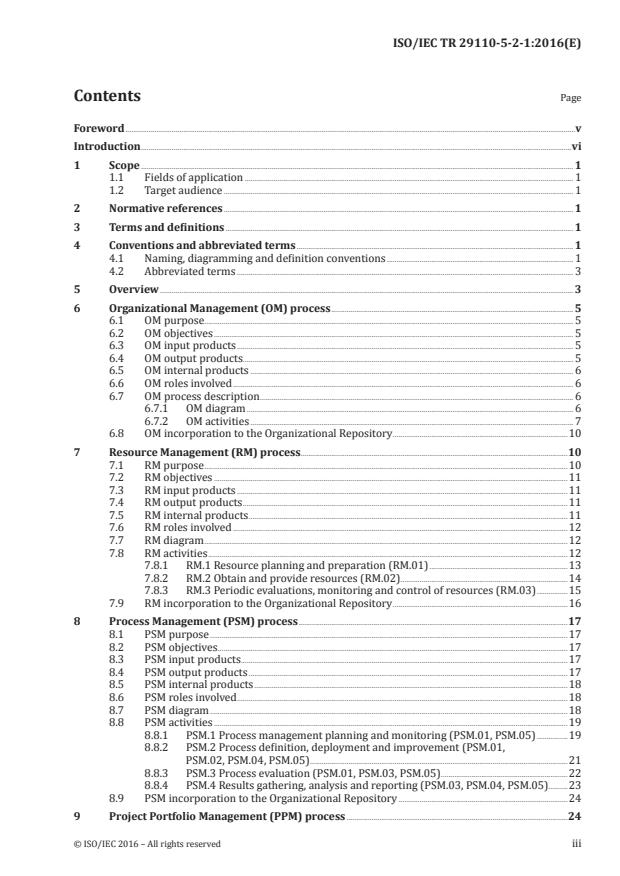
ISO/IEC TR 29110-5-2-1:2016 - Systems and software engineering -- Lifecycle profiles for Very Small Entities (VSEs)
Overview
ISO/IEC TR 29110-5-2-1:2016 - "Systems and software engineering - Lifecycle profiles for Very Small Entities (VSEs) - Part 5-2-1: Organizational management guidelines" is a Technical Report providing organizational management guidance for Very Small Entities (VSEs - up to 25 people). Part of the ISO/IEC 29110 series, it complements lifecycle profiles by describing Organizational Management (OM), Resource Management (RM), Process Management (PSM) and Project Portfolio Management (PPM) practices tailored for VSEs. This guidance is practical and scalable, aimed at simplifying standards adoption for small teams without imposing heavy overhead.
Key topics and requirements
- Scope & target audience: Guidance specifically for VSEs (≤25 people), but applicable as good practice for larger organizations seeking lightweight approaches.
- Organizational Management (OM): Purpose, objectives, inputs/outputs, roles and process description for aligning projects to organizational strategy and tracking customer satisfaction.
- Resource Management (RM): Resource planning and preparation (RM.01), obtaining and providing resources (RM.02), and periodic evaluation/monitoring (RM.03).
- Process Management (PSM): Planning, deployment and improvement of organizational processes (PSM.01–PSM.05), process evaluation, and results reporting.
- Project Portfolio Management (PPM): Preparation and scheduling (PPM.01), project generation and activation (PPM.02), project and account control (PPM.03), and project closure.
- Organizational Repository: Advice on incorporating OM/ RM/ PSM/ PPM outputs into a central repository for reuse and continuous improvement.
- Roles, product descriptions and software tool requirements: Guidance on roles involved, required organizational products, and minimal tooling to support processes.
- Practical deliverables: Checklists, input/output templates and activity mappings to help VSEs operationalize lifecycle profiles.
Practical applications - who should use it
- Startup founders, VSE managers and project leads looking to standardize lightweight organizational processes without heavy bureaucracy.
- Quality managers and process engineers in small software/systems organizations seeking alignments with ISO/IEC lifecycle profiles.
- Consultants and auditors advising VSEs on process improvement, project portfolio control, resource allocation and customer satisfaction monitoring.
- Tool vendors building simple process support or organizational repository solutions for small teams.
Practical benefits include improved multi-project coordination, consistent process deployment across projects, controlled resource provisioning and continuous customer satisfaction monitoring.
Related standards
- ISO/IEC 29110 series (Basic and Organizational profiles)
- ISO/IEC/IEEE 15288, 12207 and 15289 (referenced for lifecycle and documentation foundations)
Keywords: ISO/IEC 29110-5-2-1:2016, VSEs, organizational management, resource management, process management, project portfolio management, lifecycle profiles, small software organizations.
Relations
- Effective Date
- 24-Dec-2022
Buy Documents
ISO/IEC TR 29110-5-2-1:2016 - Systems and software engineering — Lifecycle profiles for Very Small Entities (VSEs) — Part 5-2-1: Organizational management guidelines/6/2016
ISO/IEC TR 29110-5-2-1:2016 - Systems and software engineering -- Lifecycle profiles for Very Small Entities (VSEs)
Get Certified
Connect with accredited certification bodies for this standard

BSI Group
BSI (British Standards Institution) is the business standards company that helps organizations make excellence a habit.
BSCIC Certifications Pvt. Ltd.
Established 2006, accredited by NABCB, JAS-ANZ, EIAC, IAS. CDSCO Notified Body.

Intertek India Pvt. Ltd.
Delivers Assurance, Testing, Inspection & Certification since 1993 with 26 labs and 32 offices.
Sponsored listings
Frequently Asked Questions
ISO/IEC TR 29110-5-2-1:2016 is a technical report published by the International Organization for Standardization (ISO). Its full title is "Systems and software engineering — Lifecycle profiles for Very Small Entities (VSEs) — Part 5-2-1: Organizational management guidelines". This standard covers: ISO/IEC 29110-5-2-1:2016 is applicable to Very Small Entities (VSEs). VSEs are enterprises, organizations, departments or projects having up to 25 people. The lifecycle processes described in the ISO/IEC 29110:2016 series are not intended to preclude or discourage their use by organizations bigger than VSEs. ISO/IEC 29110-5-2-1:2016 is the Organizational management guidance for profiles described in ISO/IEC 29110-4-1 through Organizational Management, Project Portfolio Management, Resource Management and Process Management Processes. It is not intended for a VSE to use the standardized profile to implement ISO/IEC 29110-5-2-1:2016. Using ISO/IEC 29110-5-2-1:2016, a VSE can obtain benefits in the following aspects: ? multiple project execution and supervision of its performance, making sure all processes are executed according to the organizational strategy; ? continuous monitoring of the customer satisfaction; ? deployment and improvement of the organizational standard processes in all projects; ? controlled provision of required resources.
ISO/IEC 29110-5-2-1:2016 is applicable to Very Small Entities (VSEs). VSEs are enterprises, organizations, departments or projects having up to 25 people. The lifecycle processes described in the ISO/IEC 29110:2016 series are not intended to preclude or discourage their use by organizations bigger than VSEs. ISO/IEC 29110-5-2-1:2016 is the Organizational management guidance for profiles described in ISO/IEC 29110-4-1 through Organizational Management, Project Portfolio Management, Resource Management and Process Management Processes. It is not intended for a VSE to use the standardized profile to implement ISO/IEC 29110-5-2-1:2016. Using ISO/IEC 29110-5-2-1:2016, a VSE can obtain benefits in the following aspects: ? multiple project execution and supervision of its performance, making sure all processes are executed according to the organizational strategy; ? continuous monitoring of the customer satisfaction; ? deployment and improvement of the organizational standard processes in all projects; ? controlled provision of required resources.
ISO/IEC TR 29110-5-2-1:2016 is classified under the following ICS (International Classification for Standards) categories: 35.080 - Software. The ICS classification helps identify the subject area and facilitates finding related standards.
ISO/IEC TR 29110-5-2-1:2016 has the following relationships with other standards: It is inter standard links to ISO/IEC 29110-5-2-1:2025. Understanding these relationships helps ensure you are using the most current and applicable version of the standard.
ISO/IEC TR 29110-5-2-1:2016 is available in PDF format for immediate download after purchase. The document can be added to your cart and obtained through the secure checkout process. Digital delivery ensures instant access to the complete standard document.
Standards Content (Sample)
TECHNICAL ISO/IEC TR
REPORT 29110-5-2-1
First edition
2016-06-15
Systems and software engineering —
Lifecycle profiles for Very Small
Entities (VSEs) —
Part 5-2-1:
Organizational management
guidelines
Ingénierie des systèmes et du logiciel — Profils de cycle de vie pour
très petits organismes (TPO) —
Partie 5-2-1: Guide à la gestion organisationnelle
Reference number
©
ISO/IEC 2016
© ISO/IEC 2016, Published in Switzerland
All rights reserved. Unless otherwise specified, no part of this publication may be reproduced or utilized otherwise in any form
or by any means, electronic or mechanical, including photocopying, or posting on the internet or an intranet, without prior
written permission. Permission can be requested from either ISO at the address below or ISO’s member body in the country of
the requester.
ISO copyright office
Ch. de Blandonnet 8 • CP 401
CH-1214 Vernier, Geneva, Switzerland
Tel. +41 22 749 01 11
Fax +41 22 749 09 47
copyright@iso.org
www.iso.org
ii © ISO/IEC 2016 – All rights reserved
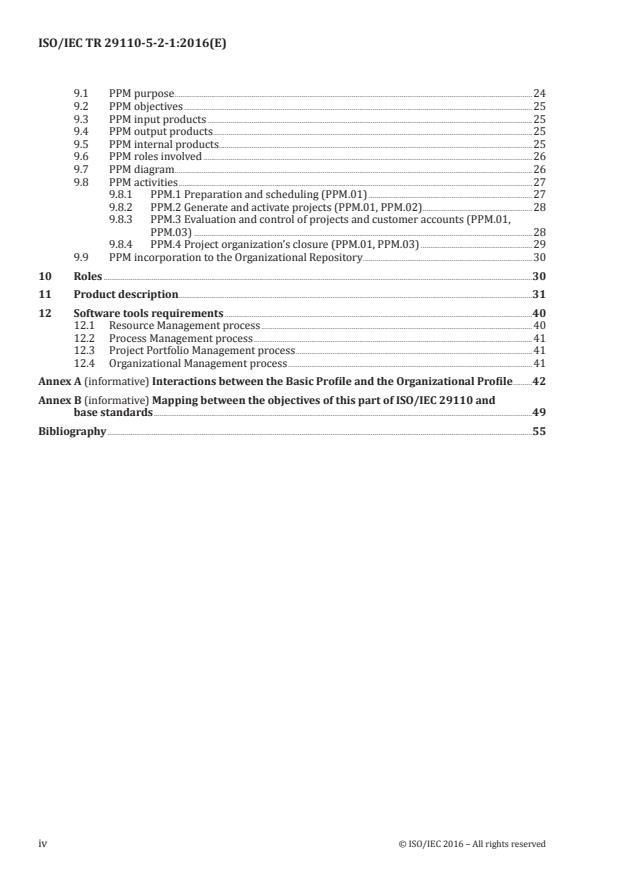
Contents Page
Foreword .v
Introduction .vi
1 Scope . 1
1.1 Fields of application . 1
1.2 Target audience . 1
2 Normative references . 1
3 Terms and definitions . 1
4 Conventions and abbreviated terms . 1
4.1 Naming, diagramming and definition conventions . 1
4.2 Abbreviated terms . 3
5 Overview . 3
6 Organizational Management (OM) process . 5
6.1 OM purpose . 5
6.2 OM objectives . 5
6.3 OM input products . 5
6.4 OM output products . 5
6.5 OM internal products . 6
6.6 OM roles involved . 6
6.7 OM process description . 6
6.7.1 OM diagram . 6
6.7.2 OM activities . 7
6.8 OM incorporation to the Organizational Repository .10
7 Resource Management (RM) process.10
7.1 RM purpose .10
7.2 RM objectives .11
7.3 RM input products .11
7.4 RM output products .11
7.5 RM internal products .11
7.6 RM roles involved .12
7.7 RM diagram .12
7.8 RM activities .12
7.8.1 RM.1 Resource planning and preparation (RM.01) .13
7.8.2 RM.2 Obtain and provide resources (RM.02) .14
7.8.3 RM.3 Periodic evaluations, monitoring and control of resources (RM.03) .15
7.9 RM incorporation to the Organizational Repository .16
8 Process Management (PSM) process .17
8.1 PSM purpose .17
8.2 PSM objectives .17
8.3 PSM input products .17
8.4 PSM output products .17
8.5 PSM internal products .18
8.6 PSM roles involved .18
8.7 PSM diagram .18
8.8 PSM activities .19
8.8.1 PSM.1 Process management planning and monitoring (PSM.01, PSM.05) .19
8.8.2 PSM.2 Process definition, deployment and improvement (PSM.01,
PSM.02, PSM.04, PSM.05) .21
8.8.3 PSM.3 Process evaluation (PSM.01, PSM.03, PSM.05) .22
8.8.4 PSM.4 Results gathering, analysis and reporting (PSM.03, PSM.04, PSM.05) .23
8.9 PSM incorporation to the Organizational Repository .24
9 Project Portfolio Management (PPM) process .24
© ISO/IEC 2016 – All rights reserved iii
9.1 PPM purpose .24
9.2 PPM objectives .25
9.3 PPM input products .25
9.4 PPM output products .25
9.5 PPM internal products .25
9.6 PPM roles involved .26
9.7 PPM diagram .26
9.8 PPM activities .27
9.8.1 PPM.1 Preparation and scheduling (PPM.01) .27
9.8.2 PPM.2 Generate and activate projects (PPM.01, PPM.02) .28
9.8.3 PPM.3 Evaluation and control of projects and customer accounts (PPM.01,
PPM.03) .28
9.8.4 PPM.4 Project organization’s closure (PPM.01, PPM.03) .29
9.9 PPM incorporation to the Organizational Repository .30
10 Roles .30
11 Product description.31
12 Software tools requirements .40
12.1 Resource Management process .40
12.2 Process Management process .41
12.3 Project Portfolio Management process .41
12.4 Organizational Management process .41
Annex A (informative) Interactions between the Basic Profile and the Organizational Profile .42
Annex B (informative) Mapping between the objectives of this part of ISO/IEC 29110 and
base standards .49
Bibliography .55
iv © ISO/IEC 2016 – All rights reserved
Foreword
ISO (the International Organization for Standardization) and IEC (the International Electrotechnical
Commission) form the specialized system for worldwide standardization. National bodies that are
members of ISO or IEC participate in the development of International Standards through technical
committees established by the respective organization to deal with particular fields of technical
activity. ISO and IEC technical committees collaborate in fields of mutual interest. Other international
organizations, governmental and non-governmental, in liaison with ISO and IEC, also take part in the
work. In the field of information technology, ISO and IEC have established a joint technical committee,
ISO/IEC JTC 1.
The procedures used to develop this document and those intended for its further maintenance are
described in the ISO/IEC Directives, Part 1. In particular the different approval criteria needed for
the different types of document should be noted. This document was drafted in accordance with the
editorial rules of the ISO/IEC Directives, Part 2 (see www.iso.org/directives).
Attention is drawn to the possibility that some of the elements of this document may be the subject
of patent rights. ISO and IEC shall not be held responsible for identifying any or all such patent
rights. Details of any patent rights identified during the development of the document will be in the
Introduction and/or on the ISO list of patent declarations received (see www.iso.org/patents).
Any trade name used in this document is information given for the convenience of users and does not
constitute an endorsement.
For an explanation on the meaning of ISO specific terms and expressions related to conformity assessment,
as well as information about ISO’s adherence to the World Trade Organization (WTO) principles in the
Technical Barriers to Trade (TBT) see the following URL: www.iso.org/iso/foreword.html.
The committee responsible for this document is ISO/IEC JTC 1, Information technology, Subcommittee
SC 7, Software and systems engineering.
The full list of parts of ISO/IEC 29110 is available here.
© ISO/IEC 2016 – All rights reserved v
Introduction
Very Small Entities (VSEs) around the world are creating valuable products and services. For the
purpose of ISO/IEC 29110, a Very Small Entity (VSE) is an enterprise, an organization, a department
or a project having up to 25 people. Since many VSEs develop and/or maintain system and software
components used in systems, either as independent products or incorporated in larger systems, a
recognition of VSEs as suppliers of high quality products is required.
According to the Organization for Economic Co-operation and Development (OECD) SME and
Entrepreneurship Outlook report (2005), “Small and Medium Enterprises (SMEs) constitute the
dominant form of business organization in all countries worldwide, accounting for over 95 % and
up to 99 % of the business population depending on country”. The challenge facing governments
and economies is to provide a business environment that supports the competitiveness of this large
heterogeneous business population and that promotes a vibrant entrepreneurial culture.
From studies and surveys conducted, it is clear that the majority of International Standards do not
address the needs of VSEs. Implementation of and conformance with these International Standards
is difficult, if not impossible. Consequently, VSEs have no, or very limited, ways to be recognized as
entities that produce quality systems/system elements including software in their domain. Therefore,
VSEs are excluded from some economic activities.
It has been found that VSEs find it difficult to relate International Standards to their business needs and
to justify the effort required to apply International Standards to their business practices. Most VSEs can
neither afford the resources, in terms of number of employees, expertise, budget and time, nor do they
see a net benefit in establishing over-complex systems or software lifecycle processes. To address some
of these difficulties, a set of guides has been developed based on a set of VSE characteristics. The guides
are based on subsets of appropriate standards processes, activities, tasks and outcomes, referred to as
“profiles”. The purpose of a profile is to define a subset of International Standards relevant to the VSEs’
context; for example, processes, activities, tasks and outcomes of ISO/IEC/IEEE 12207 for software; and
processes, activities, tasks and outcomes of ISO/IEC/IEEE 15288 for systems; and information products
(documentation) of ISO/IEC/IEEE 15289 for software and systems.
VSEs can achieve recognition through implementing a profile and by being audited against
ISO/IEC 29110 specifications.
The ISO/IEC 29110 series can be applied at any phase of system or software development within
a life cycle. The ISO/IEC 29110 series is intended to be used by VSEs that do not have experience or
expertise in adapting/tailoring ISO/IEC/IEEE 12207 or ISO/IEC/IEEE 15288 to the needs of a specific
project. VSEs that have expertise in adapting/tailoring ISO/IEC/IEEE 12207 or ISO/IEC/IEEE 15288 are
encouraged to use those International Standards instead of ISO/IEC 29110.
ISO/IEC 29110 is intended to be used with any lifecycle such as waterfall, iterative, incremental,
evolutionary or agile. In the context of ISO/IEC 29110, systems are composed of hardware and software
components.
The ISO/IEC 29110 series, targeted by audience, has been developed to improve system or software
and/or service quality and process performance (see Table 1).
vi © ISO/IEC 2016 – All rights reserved
Table 1 — ISO/IEC 29110 target audience
ISO/IEC 29110 Title Target audience
Part 1 Overview VSEs and their customers, assessors,
standards producers, tool vendors and
methodology vendors
Part 2 Framework for profile Profile producers, tool vendors and
preparation methodology vendors
Not intended for VSEs
Part 3 Certification and assessment VSEs and their customers, assessors,
guidance accreditation bodies
Part 4 Profile specifications VSEs, customers, standards producers,
tool vendors and methodology vendors
Part 5 Management, engineering and VSEs and their customers
service delivery guides
Part 6 Management and engineering VSEs and their customers
guides not tied to a specific
profile
If a new profile is needed, ISO/IEC 29110-4 and ISO/IEC TR 29110-5 can be developed with minimal
impact to existing documents.
ISO/IEC 29110-1 defines the terms common to the ISO/IEC 29110 series. It introduces processes,
lifecycle and standardization concepts, the taxonomy (catalogue) of ISO/IEC 29110 profiles and the
ISO/IEC 29110 series. It also introduces the characteristics and needs of a VSE and clarifies the rationale
for specific profiles, documents, standards and guides.
ISO/IEC 29110-2-1 introduces the concepts for systems and software engineering profiles for VSEs.
It establishes the logic behind the definition and application of profiles. For standardized profiles, it
specifies the elements common to all profiles (structure, requirements, conformance, assessment). For
domain-specific profiles (profiles that are not standardized and developed outside of the ISO process),
it provides general guidance adapted from the definition of standardized profiles.
ISO/IEC 29110-3 defines certification schemes, assessment guidelines and compliance requirements
for process capability assessment (ISO/IEC 33020), conformity assessments (ISO/IEC 17021-1) and self-
assessments for process improvements. ISO/IEC 29110-3 also contains information that can be useful
to developers of certification and assessment methods and developers of certification and assessment
tools. ISO/IEC 29110-3 is addressed to people who have direct involvement with the assessment
process, e.g. the auditor, certification and accreditation bodies and the sponsor of the audit, who need
guidance on ensuring that the requirements for performing an audit have been met.
ISO/IEC 29110-4-m provides the specification for all profiles in one profile group that are based on
subsets of appropriate standards elements.
ISO/IEC TR 29110-5-m-n provides management, engineering and service delivery guides for the profiles
in a profile group.
The future ISO/IEC TR 29110-6-x provides management and engineering guides not tied to a specific
profile.
This part of ISO/IEC 29110 provides organizational management processes to VSEs which have already
implemented the processes of the system engineering and/or the software engineering Basic profile.
Figure 1 describes the ISO/IEC 29110 International Standards (IS) and Technical Reports (TR) and
positions the parts within the framework of reference. Overview, assessment guide, management and
engineering guide are available from ISO as freely available Technical Reports (TR). The Framework
document, profile specifications and certification schemes are published as International Standards (IS).
© ISO/IEC 2016 – All rights reserved vii
Figure 1 — ISO/IEC 29110 series
viii © ISO/IEC 2016 – All rights reserved
TECHNICAL REPORT ISO/IEC TR 29110-5-2-1:2016(E)
Systems and software engineering — Lifecycle profiles for
Very Small Entities (VSEs) —
Part 5-2-1:
Organizational management guidelines
1 Scope
1.1 Fields of application
This part of ISO/IEC 29110 is applicable to Very Small Entities (VSEs). VSEs are enterprises, organizations,
departments or projects having up to 25 people. The lifecycle processes described in the ISO/IEC 29110
series are not intended to preclude or discourage their use by organizations bigger than VSEs.
This part of ISO/IEC 29110 is the Organizational management guidance for profiles described in
ISO/IEC 29110-4-1 through Organizational Management, Project Portfolio Management, Resource
Management and Process Management Processes. It is not intended for a VSE to use the standardized
profile to implement this part of ISO/IEC 29110.
Using this part of ISO/IEC 29110, a VSE can obtain benefits in the following aspects:
— multiple project execution and supervision of its performance, making sure all processes are
executed according to the organizational strategy;
— continuous monitoring of the customer satisfaction;
— deployment and improvement of the organizational standard processes in all projects;
— controlled provision of required resources.
1.2 Target audience
This part of ISO/IEC 29110 is targeted at VSEs which already use at least ISO/IEC TR 29110-5-6-2
and/or ISO/IEC TR 29110-5-1-2 for their software projects.
This part of ISO/IEC 29110 is intended to be used with any processes, techniques and methods that
enhance the VSEs’ customer satisfaction, quality and productivity.
2 Normative references
There are no normative references in this document.
3 Terms and definitions
For the purposes of this document, the terms and definitions given in ISO/IEC 29110-2-1 apply.
4 Conventions and abbreviated terms
4.1 Naming, diagramming and definition conventions
The following process structure description and notation are used to describe the processes.
© ISO/IEC 2016 – All rights reserved 1
Name — process identifier, followed by its abbreviation in parentheses “()”.
Purpose — general goals and results expected of the effective implementation of the process. The
implementation of the process should provide tangible benefits to the stakeholders. The purpose is
identified by the abbreviation of the process name.
Objectives — specific goals to ensure the accomplishment of the process purpose. The objectives are
identified by the abbreviation of the process name, followed by a consecutive number, for example
RM.01, PSM.02, etc. Each objective is followed by the square box which includes a list of the chosen
processes for the Basic profile from ISO/IEC/IEEE 15288 or ISO/IEC/IEEE 12207 and its outcomes
related to the objective.
Input Products — products required to perform the process and its corresponding source, which can
be another process or an external entity to the process, such as the Customer. Input products identified
by the abbreviation of the process name and showed as two-column table of product names and sources.
Output Products — products generated by the process and its corresponding destination, which can be
another process or an external entity to the project, such as Customer or Organizational Management.
Output products identified by the abbreviation of the process name and showed as two-column table of
product names and destinations.
Internal Products — products generated and consumed by the process. Internal products identified
by the abbreviation of the process name and showed as one-column table of the product names.
All products’ names are printed in cursive and initiate with capital letters. Some products have one
or more statuses attached to the product name surrounded by square brackets “[ ]” and separated by
“,”. The product status may change during the process execution. See Clause 9 for the alphabetical list
of the products, its descriptions, possible statuses and the source of the product. The source can be
another process or an external entity to the project, such as the Customer.
Roles involved — names and abbreviation of the functions to be performed by project team members.
Several roles may be played by a single person and one role may be assumed by several persons.
Roles are assigned to project participants based on the characteristics of the project. The role list is
identified by the abbreviation of the process name and showed as two-column table. See Clause 11 for
the alphabetical list of the roles, its abbreviations and required competencies description.
Diagram — graphical representation of the processes. The large round-edged rectangles indicate
process or activities and the smaller square-edged rectangles indicate the products. The directional or
bidirectional thick arrows indicate the major flow of information between processes or activities. The
thin directional or bidirectional arrows indicate the input or output products. The notation used in the
diagrams does not imply the use of any specific process lifecycle.
Activity — a set of cohesive tasks. Task is a requirement, recommendation, or permissible action,
intended to contribute to the achievement of one or more objectives of a process. A process activity is
the first level of process workflow decomposition and the second one is a task. Activities are identified
by process name abbreviation followed by consecutive number and the activity name.
Activity Description — each activity description is identified by the activity name and the list of
related objectives surrounded by parentheses “()”. For example, PSM.1 Process Management Planning
and Monitoring (PSM.01, PSM.05) means that the activity PSM.1 contributes to the achievement of the
listed objectives: PSM.01 and PSM.05. The activity description begins with the task summary and is
followed by the task descriptions table. The task description does not impose any technique or method
to perform it. The selection of the techniques or methods is left to the VSE or project team.
Tasks description table contain four columns corresponding to the following.
— Role — the abbreviation of roles involved in the task execution.
— Task List — description of the tasks to be performed. Each task is identified by activity ID and
consecutive number, for example PSM.1.1, PSM.1.2, and so on.
2 © ISO/IEC 2016 – All rights reserved
— Input Products — products needed to execute the task.
— Output Products — products created or modified by the execution of the task.
Incorporation to the Organizational Repository — list of products to be saved in Organizational
Repository; the Organizational Repository Strategy has to be applied to some of them.
NOTE Tables used in process description are for presentation purpose only.
4.2 Abbreviated terms
The following abbreviations are used in this document:
AS Assessor
CUS Customer
OM Organizational Management
PG Planning group
PSMG Process Manager
PPMG Project Portfolio Manager
PSM Process Management
PPM Project Portfolio Management
PJM Project Manager
PO Process Owner
RM Resource Management
RRM Resource Manager
VSE Very Small Entity
5 Overview
The Organizational Management Profile Guide applies to a Very Small Entity (VSE) (enterprise,
organization, department or project having up to 25 people) which already follows at least
ISO/IEC TR 29110-5-1-2 for their software projects or ISO/IEC TR 29110-5-6-2 for their systems
engineering projects or any other profiles in the ISO/IEC 29110 series.
This part of ISO/IEC 29110 provides Organizational Management, Resource Management, Process
Management, and Project Portfolio Management processes which integrate practices based on the
selection of ISO/IEC/IEEE 15288, ISO/IEC/IEEE 12207 and ISO/IEC/IEEE 15289.
Using this part of ISO/IEC 29110, VSE can obtain benefits in the following aspects:
— multiple project execution and supervision of its performance, making sure all activities are
executed according to the organizational strategy;
— continuous monitoring of the customer satisfaction;
— deployment and improvement of the organizational standard processes in all projects;
— controlled provision of required resources.
© ISO/IEC 2016 – All rights reserved 3
To use this part of ISO/IEC 29110, a VSE needs to fulfil the following entry conditions:
— VSE already uses the ISO/IEC TR 29110-5-6-2 or ISO/IEC TR 29110-5-1-2 or any other Basic Profile
in the ISO/IEC 29110 series;
— VSE identifies the external or internal Best Practices sources (standards, models, methods and
techniques) and uses them as a basis for the process definition and improvement.
The purpose of the Organizational Management Process is to make sure that value is delivered by the
VSE to the customer through planning, organizing, monitoring and controlling organizational activities.
The purpose of the Resource Management process is to obtain and provide the organization with the
necessary resources. The purpose of the Process Management process is to establish and improve the
organizational processes. The purpose of the Project Portfolio Management process is to generate
projects for the organization, provide technical content to establish the projects Formal Agreement,
and supervise its performance while monitoring the customer satisfaction.
The four processes are interrelated (see Figure 2).
NOTE Diagram notation is explained in 4.1.
Figure 2 — Organizational Management guide processes
The Organizational Management process will generate the Strategic Plan that will guide the activities
of the VSE.
The Resource Management process, the Process Management process and the Project Portfolio
Management process receive the Strategic Plan as an input that will guide the activities of the VSE.
The Resource Management process receives the Resource Request from all the processes and projects,
analyses them and assigns resources to the processes and projects according to the Resource Policies
and/or Mechanisms.
The Process Management process receives the Process Improvement Suggestions from all the processes,
analyses them and applies suggestions to the processes in order to improve them. The Process
Evaluation activity evaluates the processes implementation, finding strengths and weakness, and
coordinates the resolution of the weakness.
4 © ISO/IEC 2016 – All rights reserved
The Project Portfolio Management process receives the Request for Proposal from the Customers,
activates the accepted projects and supervises the correct execution of these projects.
6 Organizational Management (OM) process
6.1 OM purpose
The purpose of the Organizational Management process is to make sure that value is delivered by the
VSE to the customer through planning, organizing, monitoring and controlling organizational activities.
6.2 OM objectives
OM.01. Establish or refine an appropriate value proposition and its corresponding business model.
OM.02. Develop or revise objectives for the organization, based on the business model, and establish
the strategies and resources necessary to support those objectives.
OM.03. Measure the achievement of the objectives, identify deviations and control actions.
6.3 OM input products
Table 2 — OM input products
Name Source
Resource Report Resource Management
Process Progress Report Process Management
Project Portfolio Report Project Portfolio Management
Market Information External
Technology Trends External
Competitors Information External
Financial Information Financial/Controlling area within the VSE
6.4 OM output products
Table 3 — OM output products
Name Destination
Strategic Plan Resource Management
— Budget
Strategic Plan Process Management
— Required processes
Strategic Plan Project Portfolio Management
— Projects and customer strategy
Strategic Plan Resource Management
— Mission, vision, values, objectives Process Management
— Required functional areas Project Portfolio Management
— Objectives relationship table
— Customer strategy
© ISO/IEC 2016 – All rights reserved 5
6.5 OM internal products
Table 4 — OM internal products
Name
Planning Agenda
Budget Restrictions
Environmental Information Report
— Market Information
— Technology trends
— Competitors information
VSE risk management plan
Business Model
Correction Register
6.6 OM roles involved
Table 5 — OM roles involved
Role Abbreviation
Organizational Manager OM
Planning Group PG
6.7 OM process description
6.7.1 OM diagram
Figure 3 shows the flow of information between the Organizational Management process activities
including the most relevant work products and their relationships.
6 © ISO/IEC 2016 – All rights reserved
Figure 3 — Organizational Management process diagram
6.7.2 OM activities
The Organizational Management process has the following activities:
— OM.1 Collect Environmental Information;
— OM.2 Develop the Business Model and Plan Objectives and Strategies;
— OM.3 Measure Organizational Results and Control.
6.7.2.1 OM.1 Collect environmental information (OM.01)
The Collect Environmental Information activity is established to make sure the VSE has the necessary
environmental information to plan with a solid basis. The activity provides a report with market
information, technology trends and competitors information.
© ISO/IEC 2016 – All rights reserved 7
Table 6 — OM.1 task list
Role Task List Input Products Output Products
OM OM.1.1 Collect information about market changes. Market Information Environmental
[external] information report
• Review changes of consumer needs and habits
— Market information
[identified]
OM OM.1.2 Collect information about technology Technology Trends Environmental
trends. information report
[external]
• Review latest trends in information technology — Technology trends
solutions and other related technologies
[identified]
OM.1.3 Collect information about competitors. Competitors Information Environmental
information report
• Review important actions, market strategies [external]
and product improvements — Competitors
information
[identified]
6.7.2.2 OM.2 Develop business model and plan (OM.02)
This activity is where the Business model and the Strategic plan are generated based on environmental
information and budget restrictions. A risk analysis is realized in order to prevent possible risks and
registered in the VSE risk management plan.
Table 7 — OM.2 task list
Role Task List Input Products Output Products
OM OM.2.1 Identify participants to the planning Process Definition Strategic Plan
group.
— Process Owner — Planning group
• The first time the group is formed with the
[created or updated]
main actors of the VSE
• In subsequent times, the group is formed with
each process responsible, including operational
processes
OM OM.2.2 Schedule planning sessions. Strategic Plan Planning agenda
PG • Schedule planning sessions — Planning Group — Date
• Identify resources and or services needed [created or updated] — Location
• Acquire resources and services needed for the — Participants
sessions
— Resources and/or
services
[created or updated]
OM OM.2.3 Establish budget restrictions. Financial Information Budget restrictions
8 © ISO/IEC 2016 – All rights reserved
Table 7 (continued)
Role Task List Input Products Output Products
OM OM.2.4 Develop or revise the business model. Planning Agenda Business model
PG • Identify target customer segments based on [generated] — Target customer
market information and technology trends
— Value proposition
• Establish a value proposition identifying
Environmental — Customer channels
problems, needs and desires of customers
information Report
— Partners and suppliers
• Identify the customer relationship type(s)
and channel(s) to be established, including sales
— Key processes
channel(s)
— Key projects
• Identify key partners and suppliers needed to
— Key resources
provide value to customers and the type of
relationship to be established with them
— Key functional areas
• Identify key processes, projects, activities and — Organizational
resources needed to provide value to customers, structure
including those needed to establish and maintain
[generated or updated]
customer and partners relationship
• Identify key functional areas and
organizational structure
OM OM.2.5 Develop or revise objectives for the VSE. Business Model Strategic Plan
PG • Develop or revise the VSE’s Mission, Vision Budget Restrictions — Mission
and Values
— Vision
• Establish middle and short-term objectives
— Values
for the VSE, with indicators and goals for each
indicator, including sales and quality objectives, — Objectives
based on the business model.
[generated or updated]
OM OM.2.6 Establish the Strategic Plan for the VSE. Business Model Strategic Plan
PG • Establish processes, internal projects and Budget Restrictions — Required processes
functional areas needed for the achievement of
Strategic Plan — Required internal
the objectives of the VSE
projects
— Vision
• Establish purpose, objectives, indicators and
— Required functional
goals for each process, project and functional
— Objectives
areas
area, aligned with the objectives of the VSE
— Objectives
• Establish resources needed for each process,
relationship table
project and functional area
— Customer strategy
• Establish customer strategy
— Budget
• Establish budget
[generated or updated]
OM OM.2.7 Analyse business risks. Business Model VSE risk management
plan
PG • Identify risks that could interfere in the Strategic Plan
achievement of the objectives of the VSE [generated or updated]
• Assign probability and impact for each risk
• Establish mitigation actions and contingency
plans for each risk
• Assign responsibility for each risk
6.7.2.3 OM.3 Measure organizational results and control (OM.03)
The Measure Organizational Results and Control activity contains tasks to review reports from
Resource Management, Process Management and Project Portfolio Management processes, and to
© ISO/IEC 2016 – All rights reserved 9
establish Corrective actions. If is necessary, adjust the Strategic Plan base on the VSE improvements
proposals.
Table 8 — OM.3 task list
Role Task List Input Products Output Products
OM OM.3.1 Review the Resource Report. Resource Report Correction Register
[generated or updated]
RRM • Periodically evaluate the achievement of
objectives related to resources. If needed,
establish actions to correct deviations or
Strategic Plan [updated]
problems. Generate or update Correction Register
Strategic Plan
and track them to closure
• If necessary, adjust the Strategic Plan based on
the Resource Report results
OM OM.3.2 Review the Process Progress Report. Process Progress Report Correction Register
PSMG • Evaluate periodically the achievement of [generated or updated]
objectives of the VSE related to processes. If
Strategic Plan Strategic Plan [adjusted]
needed, establish actions to correct deviations or
problems. Generate or update Correction Register
and track them to closure
• If necessary, adjust the Strategic Plan of the VSE
based on the Process Progress Report results
OM OM.3.2 Review the Project Portfolio Report. Project Portfolio Report Correction Register
PPMG • Evaluate periodically the achievement of [generated or updated]
objectives related to projects. If needed, establish
Strategic Plan Strategic Plan
...
TECHNICAL ISO/IEC TR
REPORT 29110-5-2-1
First edition
2016-06-15
Systems and software engineering —
Lifecycle profiles for Very Small
Entities (VSEs) —
Part 5-2-1:
Organizational management
guidelines
Ingénierie des systèmes et du logiciel — Profils de cycle de vie pour
très petits organismes (TPO) —
Partie 5-2-1: Guide à la gestion organisationnelle
Reference number
©
ISO/IEC 2016
© ISO/IEC 2016, Published in Switzerland
All rights reserved. Unless otherwise specified, no part of this publication may be reproduced or utilized otherwise in any form
or by any means, electronic or mechanical, including photocopying, or posting on the internet or an intranet, without prior
written permission. Permission can be requested from either ISO at the address below or ISO’s member body in the country of
the requester.
ISO copyright office
Ch. de Blandonnet 8 • CP 401
CH-1214 Vernier, Geneva, Switzerland
Tel. +41 22 749 01 11
Fax +41 22 749 09 47
copyright@iso.org
www.iso.org
ii © ISO/IEC 2016 – All rights reserved
Contents Page
Foreword .v
Introduction .vi
1 Scope . 1
1.1 Fields of application . 1
1.2 Target audience . 1
2 Normative references . 1
3 Terms and definitions . 1
4 Conventions and abbreviated terms . 1
4.1 Naming, diagramming and definition conventions . 1
4.2 Abbreviated terms . 3
5 Overview . 3
6 Organizational Management (OM) process . 5
6.1 OM purpose . 5
6.2 OM objectives . 5
6.3 OM input products . 5
6.4 OM output products . 5
6.5 OM internal products . 6
6.6 OM roles involved . 6
6.7 OM process description . 6
6.7.1 OM diagram . 6
6.7.2 OM activities . 7
6.8 OM incorporation to the Organizational Repository .10
7 Resource Management (RM) process.10
7.1 RM purpose .10
7.2 RM objectives .11
7.3 RM input products .11
7.4 RM output products .11
7.5 RM internal products .11
7.6 RM roles involved .12
7.7 RM diagram .12
7.8 RM activities .12
7.8.1 RM.1 Resource planning and preparation (RM.01) .13
7.8.2 RM.2 Obtain and provide resources (RM.02) .14
7.8.3 RM.3 Periodic evaluations, monitoring and control of resources (RM.03) .15
7.9 RM incorporation to the Organizational Repository .16
8 Process Management (PSM) process .17
8.1 PSM purpose .17
8.2 PSM objectives .17
8.3 PSM input products .17
8.4 PSM output products .17
8.5 PSM internal products .18
8.6 PSM roles involved .18
8.7 PSM diagram .18
8.8 PSM activities .19
8.8.1 PSM.1 Process management planning and monitoring (PSM.01, PSM.05) .19
8.8.2 PSM.2 Process definition, deployment and improvement (PSM.01,
PSM.02, PSM.04, PSM.05) .21
8.8.3 PSM.3 Process evaluation (PSM.01, PSM.03, PSM.05) .22
8.8.4 PSM.4 Results gathering, analysis and reporting (PSM.03, PSM.04, PSM.05) .23
8.9 PSM incorporation to the Organizational Repository .24
9 Project Portfolio Management (PPM) process .24
© ISO/IEC 2016 – All rights reserved iii
9.1 PPM purpose .24
9.2 PPM objectives .25
9.3 PPM input products .25
9.4 PPM output products .25
9.5 PPM internal products .25
9.6 PPM roles involved .26
9.7 PPM diagram .26
9.8 PPM activities .27
9.8.1 PPM.1 Preparation and scheduling (PPM.01) .27
9.8.2 PPM.2 Generate and activate projects (PPM.01, PPM.02) .28
9.8.3 PPM.3 Evaluation and control of projects and customer accounts (PPM.01,
PPM.03) .28
9.8.4 PPM.4 Project organization’s closure (PPM.01, PPM.03) .29
9.9 PPM incorporation to the Organizational Repository .30
10 Roles .30
11 Product description.31
12 Software tools requirements .40
12.1 Resource Management process .40
12.2 Process Management process .41
12.3 Project Portfolio Management process .41
12.4 Organizational Management process .41
Annex A (informative) Interactions between the Basic Profile and the Organizational Profile .42
Annex B (informative) Mapping between the objectives of this part of ISO/IEC 29110 and
base standards .49
Bibliography .55
iv © ISO/IEC 2016 – All rights reserved
Foreword
ISO (the International Organization for Standardization) and IEC (the International Electrotechnical
Commission) form the specialized system for worldwide standardization. National bodies that are
members of ISO or IEC participate in the development of International Standards through technical
committees established by the respective organization to deal with particular fields of technical
activity. ISO and IEC technical committees collaborate in fields of mutual interest. Other international
organizations, governmental and non-governmental, in liaison with ISO and IEC, also take part in the
work. In the field of information technology, ISO and IEC have established a joint technical committee,
ISO/IEC JTC 1.
The procedures used to develop this document and those intended for its further maintenance are
described in the ISO/IEC Directives, Part 1. In particular the different approval criteria needed for
the different types of document should be noted. This document was drafted in accordance with the
editorial rules of the ISO/IEC Directives, Part 2 (see www.iso.org/directives).
Attention is drawn to the possibility that some of the elements of this document may be the subject
of patent rights. ISO and IEC shall not be held responsible for identifying any or all such patent
rights. Details of any patent rights identified during the development of the document will be in the
Introduction and/or on the ISO list of patent declarations received (see www.iso.org/patents).
Any trade name used in this document is information given for the convenience of users and does not
constitute an endorsement.
For an explanation on the meaning of ISO specific terms and expressions related to conformity assessment,
as well as information about ISO’s adherence to the World Trade Organization (WTO) principles in the
Technical Barriers to Trade (TBT) see the following URL: www.iso.org/iso/foreword.html.
The committee responsible for this document is ISO/IEC JTC 1, Information technology, Subcommittee
SC 7, Software and systems engineering.
The full list of parts of ISO/IEC 29110 is available here.
© ISO/IEC 2016 – All rights reserved v
Introduction
Very Small Entities (VSEs) around the world are creating valuable products and services. For the
purpose of ISO/IEC 29110, a Very Small Entity (VSE) is an enterprise, an organization, a department
or a project having up to 25 people. Since many VSEs develop and/or maintain system and software
components used in systems, either as independent products or incorporated in larger systems, a
recognition of VSEs as suppliers of high quality products is required.
According to the Organization for Economic Co-operation and Development (OECD) SME and
Entrepreneurship Outlook report (2005), “Small and Medium Enterprises (SMEs) constitute the
dominant form of business organization in all countries worldwide, accounting for over 95 % and
up to 99 % of the business population depending on country”. The challenge facing governments
and economies is to provide a business environment that supports the competitiveness of this large
heterogeneous business population and that promotes a vibrant entrepreneurial culture.
From studies and surveys conducted, it is clear that the majority of International Standards do not
address the needs of VSEs. Implementation of and conformance with these International Standards
is difficult, if not impossible. Consequently, VSEs have no, or very limited, ways to be recognized as
entities that produce quality systems/system elements including software in their domain. Therefore,
VSEs are excluded from some economic activities.
It has been found that VSEs find it difficult to relate International Standards to their business needs and
to justify the effort required to apply International Standards to their business practices. Most VSEs can
neither afford the resources, in terms of number of employees, expertise, budget and time, nor do they
see a net benefit in establishing over-complex systems or software lifecycle processes. To address some
of these difficulties, a set of guides has been developed based on a set of VSE characteristics. The guides
are based on subsets of appropriate standards processes, activities, tasks and outcomes, referred to as
“profiles”. The purpose of a profile is to define a subset of International Standards relevant to the VSEs’
context; for example, processes, activities, tasks and outcomes of ISO/IEC/IEEE 12207 for software; and
processes, activities, tasks and outcomes of ISO/IEC/IEEE 15288 for systems; and information products
(documentation) of ISO/IEC/IEEE 15289 for software and systems.
VSEs can achieve recognition through implementing a profile and by being audited against
ISO/IEC 29110 specifications.
The ISO/IEC 29110 series can be applied at any phase of system or software development within
a life cycle. The ISO/IEC 29110 series is intended to be used by VSEs that do not have experience or
expertise in adapting/tailoring ISO/IEC/IEEE 12207 or ISO/IEC/IEEE 15288 to the needs of a specific
project. VSEs that have expertise in adapting/tailoring ISO/IEC/IEEE 12207 or ISO/IEC/IEEE 15288 are
encouraged to use those International Standards instead of ISO/IEC 29110.
ISO/IEC 29110 is intended to be used with any lifecycle such as waterfall, iterative, incremental,
evolutionary or agile. In the context of ISO/IEC 29110, systems are composed of hardware and software
components.
The ISO/IEC 29110 series, targeted by audience, has been developed to improve system or software
and/or service quality and process performance (see Table 1).
vi © ISO/IEC 2016 – All rights reserved
Table 1 — ISO/IEC 29110 target audience
ISO/IEC 29110 Title Target audience
Part 1 Overview VSEs and their customers, assessors,
standards producers, tool vendors and
methodology vendors
Part 2 Framework for profile Profile producers, tool vendors and
preparation methodology vendors
Not intended for VSEs
Part 3 Certification and assessment VSEs and their customers, assessors,
guidance accreditation bodies
Part 4 Profile specifications VSEs, customers, standards producers,
tool vendors and methodology vendors
Part 5 Management, engineering and VSEs and their customers
service delivery guides
Part 6 Management and engineering VSEs and their customers
guides not tied to a specific
profile
If a new profile is needed, ISO/IEC 29110-4 and ISO/IEC TR 29110-5 can be developed with minimal
impact to existing documents.
ISO/IEC 29110-1 defines the terms common to the ISO/IEC 29110 series. It introduces processes,
lifecycle and standardization concepts, the taxonomy (catalogue) of ISO/IEC 29110 profiles and the
ISO/IEC 29110 series. It also introduces the characteristics and needs of a VSE and clarifies the rationale
for specific profiles, documents, standards and guides.
ISO/IEC 29110-2-1 introduces the concepts for systems and software engineering profiles for VSEs.
It establishes the logic behind the definition and application of profiles. For standardized profiles, it
specifies the elements common to all profiles (structure, requirements, conformance, assessment). For
domain-specific profiles (profiles that are not standardized and developed outside of the ISO process),
it provides general guidance adapted from the definition of standardized profiles.
ISO/IEC 29110-3 defines certification schemes, assessment guidelines and compliance requirements
for process capability assessment (ISO/IEC 33020), conformity assessments (ISO/IEC 17021-1) and self-
assessments for process improvements. ISO/IEC 29110-3 also contains information that can be useful
to developers of certification and assessment methods and developers of certification and assessment
tools. ISO/IEC 29110-3 is addressed to people who have direct involvement with the assessment
process, e.g. the auditor, certification and accreditation bodies and the sponsor of the audit, who need
guidance on ensuring that the requirements for performing an audit have been met.
ISO/IEC 29110-4-m provides the specification for all profiles in one profile group that are based on
subsets of appropriate standards elements.
ISO/IEC TR 29110-5-m-n provides management, engineering and service delivery guides for the profiles
in a profile group.
The future ISO/IEC TR 29110-6-x provides management and engineering guides not tied to a specific
profile.
This part of ISO/IEC 29110 provides organizational management processes to VSEs which have already
implemented the processes of the system engineering and/or the software engineering Basic profile.
Figure 1 describes the ISO/IEC 29110 International Standards (IS) and Technical Reports (TR) and
positions the parts within the framework of reference. Overview, assessment guide, management and
engineering guide are available from ISO as freely available Technical Reports (TR). The Framework
document, profile specifications and certification schemes are published as International Standards (IS).
© ISO/IEC 2016 – All rights reserved vii
Figure 1 — ISO/IEC 29110 series
viii © ISO/IEC 2016 – All rights reserved
TECHNICAL REPORT ISO/IEC TR 29110-5-2-1:2016(E)
Systems and software engineering — Lifecycle profiles for
Very Small Entities (VSEs) —
Part 5-2-1:
Organizational management guidelines
1 Scope
1.1 Fields of application
This part of ISO/IEC 29110 is applicable to Very Small Entities (VSEs). VSEs are enterprises, organizations,
departments or projects having up to 25 people. The lifecycle processes described in the ISO/IEC 29110
series are not intended to preclude or discourage their use by organizations bigger than VSEs.
This part of ISO/IEC 29110 is the Organizational management guidance for profiles described in
ISO/IEC 29110-4-1 through Organizational Management, Project Portfolio Management, Resource
Management and Process Management Processes. It is not intended for a VSE to use the standardized
profile to implement this part of ISO/IEC 29110.
Using this part of ISO/IEC 29110, a VSE can obtain benefits in the following aspects:
— multiple project execution and supervision of its performance, making sure all processes are
executed according to the organizational strategy;
— continuous monitoring of the customer satisfaction;
— deployment and improvement of the organizational standard processes in all projects;
— controlled provision of required resources.
1.2 Target audience
This part of ISO/IEC 29110 is targeted at VSEs which already use at least ISO/IEC TR 29110-5-6-2
and/or ISO/IEC TR 29110-5-1-2 for their software projects.
This part of ISO/IEC 29110 is intended to be used with any processes, techniques and methods that
enhance the VSEs’ customer satisfaction, quality and productivity.
2 Normative references
There are no normative references in this document.
3 Terms and definitions
For the purposes of this document, the terms and definitions given in ISO/IEC 29110-2-1 apply.
4 Conventions and abbreviated terms
4.1 Naming, diagramming and definition conventions
The following process structure description and notation are used to describe the processes.
© ISO/IEC 2016 – All rights reserved 1
Name — process identifier, followed by its abbreviation in parentheses “()”.
Purpose — general goals and results expected of the effective implementation of the process. The
implementation of the process should provide tangible benefits to the stakeholders. The purpose is
identified by the abbreviation of the process name.
Objectives — specific goals to ensure the accomplishment of the process purpose. The objectives are
identified by the abbreviation of the process name, followed by a consecutive number, for example
RM.01, PSM.02, etc. Each objective is followed by the square box which includes a list of the chosen
processes for the Basic profile from ISO/IEC/IEEE 15288 or ISO/IEC/IEEE 12207 and its outcomes
related to the objective.
Input Products — products required to perform the process and its corresponding source, which can
be another process or an external entity to the process, such as the Customer. Input products identified
by the abbreviation of the process name and showed as two-column table of product names and sources.
Output Products — products generated by the process and its corresponding destination, which can be
another process or an external entity to the project, such as Customer or Organizational Management.
Output products identified by the abbreviation of the process name and showed as two-column table of
product names and destinations.
Internal Products — products generated and consumed by the process. Internal products identified
by the abbreviation of the process name and showed as one-column table of the product names.
All products’ names are printed in cursive and initiate with capital letters. Some products have one
or more statuses attached to the product name surrounded by square brackets “[ ]” and separated by
“,”. The product status may change during the process execution. See Clause 9 for the alphabetical list
of the products, its descriptions, possible statuses and the source of the product. The source can be
another process or an external entity to the project, such as the Customer.
Roles involved — names and abbreviation of the functions to be performed by project team members.
Several roles may be played by a single person and one role may be assumed by several persons.
Roles are assigned to project participants based on the characteristics of the project. The role list is
identified by the abbreviation of the process name and showed as two-column table. See Clause 11 for
the alphabetical list of the roles, its abbreviations and required competencies description.
Diagram — graphical representation of the processes. The large round-edged rectangles indicate
process or activities and the smaller square-edged rectangles indicate the products. The directional or
bidirectional thick arrows indicate the major flow of information between processes or activities. The
thin directional or bidirectional arrows indicate the input or output products. The notation used in the
diagrams does not imply the use of any specific process lifecycle.
Activity — a set of cohesive tasks. Task is a requirement, recommendation, or permissible action,
intended to contribute to the achievement of one or more objectives of a process. A process activity is
the first level of process workflow decomposition and the second one is a task. Activities are identified
by process name abbreviation followed by consecutive number and the activity name.
Activity Description — each activity description is identified by the activity name and the list of
related objectives surrounded by parentheses “()”. For example, PSM.1 Process Management Planning
and Monitoring (PSM.01, PSM.05) means that the activity PSM.1 contributes to the achievement of the
listed objectives: PSM.01 and PSM.05. The activity description begins with the task summary and is
followed by the task descriptions table. The task description does not impose any technique or method
to perform it. The selection of the techniques or methods is left to the VSE or project team.
Tasks description table contain four columns corresponding to the following.
— Role — the abbreviation of roles involved in the task execution.
— Task List — description of the tasks to be performed. Each task is identified by activity ID and
consecutive number, for example PSM.1.1, PSM.1.2, and so on.
2 © ISO/IEC 2016 – All rights reserved
— Input Products — products needed to execute the task.
— Output Products — products created or modified by the execution of the task.
Incorporation to the Organizational Repository — list of products to be saved in Organizational
Repository; the Organizational Repository Strategy has to be applied to some of them.
NOTE Tables used in process description are for presentation purpose only.
4.2 Abbreviated terms
The following abbreviations are used in this document:
AS Assessor
CUS Customer
OM Organizational Management
PG Planning group
PSMG Process Manager
PPMG Project Portfolio Manager
PSM Process Management
PPM Project Portfolio Management
PJM Project Manager
PO Process Owner
RM Resource Management
RRM Resource Manager
VSE Very Small Entity
5 Overview
The Organizational Management Profile Guide applies to a Very Small Entity (VSE) (enterprise,
organization, department or project having up to 25 people) which already follows at least
ISO/IEC TR 29110-5-1-2 for their software projects or ISO/IEC TR 29110-5-6-2 for their systems
engineering projects or any other profiles in the ISO/IEC 29110 series.
This part of ISO/IEC 29110 provides Organizational Management, Resource Management, Process
Management, and Project Portfolio Management processes which integrate practices based on the
selection of ISO/IEC/IEEE 15288, ISO/IEC/IEEE 12207 and ISO/IEC/IEEE 15289.
Using this part of ISO/IEC 29110, VSE can obtain benefits in the following aspects:
— multiple project execution and supervision of its performance, making sure all activities are
executed according to the organizational strategy;
— continuous monitoring of the customer satisfaction;
— deployment and improvement of the organizational standard processes in all projects;
— controlled provision of required resources.
© ISO/IEC 2016 – All rights reserved 3
To use this part of ISO/IEC 29110, a VSE needs to fulfil the following entry conditions:
— VSE already uses the ISO/IEC TR 29110-5-6-2 or ISO/IEC TR 29110-5-1-2 or any other Basic Profile
in the ISO/IEC 29110 series;
— VSE identifies the external or internal Best Practices sources (standards, models, methods and
techniques) and uses them as a basis for the process definition and improvement.
The purpose of the Organizational Management Process is to make sure that value is delivered by the
VSE to the customer through planning, organizing, monitoring and controlling organizational activities.
The purpose of the Resource Management process is to obtain and provide the organization with the
necessary resources. The purpose of the Process Management process is to establish and improve the
organizational processes. The purpose of the Project Portfolio Management process is to generate
projects for the organization, provide technical content to establish the projects Formal Agreement,
and supervise its performance while monitoring the customer satisfaction.
The four processes are interrelated (see Figure 2).
NOTE Diagram notation is explained in 4.1.
Figure 2 — Organizational Management guide processes
The Organizational Management process will generate the Strategic Plan that will guide the activities
of the VSE.
The Resource Management process, the Process Management process and the Project Portfolio
Management process receive the Strategic Plan as an input that will guide the activities of the VSE.
The Resource Management process receives the Resource Request from all the processes and projects,
analyses them and assigns resources to the processes and projects according to the Resource Policies
and/or Mechanisms.
The Process Management process receives the Process Improvement Suggestions from all the processes,
analyses them and applies suggestions to the processes in order to improve them. The Process
Evaluation activity evaluates the processes implementation, finding strengths and weakness, and
coordinates the resolution of the weakness.
4 © ISO/IEC 2016 – All rights reserved
The Project Portfolio Management process receives the Request for Proposal from the Customers,
activates the accepted projects and supervises the correct execution of these projects.
6 Organizational Management (OM) process
6.1 OM purpose
The purpose of the Organizational Management process is to make sure that value is delivered by the
VSE to the customer through planning, organizing, monitoring and controlling organizational activities.
6.2 OM objectives
OM.01. Establish or refine an appropriate value proposition and its corresponding business model.
OM.02. Develop or revise objectives for the organization, based on the business model, and establish
the strategies and resources necessary to support those objectives.
OM.03. Measure the achievement of the objectives, identify deviations and control actions.
6.3 OM input products
Table 2 — OM input products
Name Source
Resource Report Resource Management
Process Progress Report Process Management
Project Portfolio Report Project Portfolio Management
Market Information External
Technology Trends External
Competitors Information External
Financial Information Financial/Controlling area within the VSE
6.4 OM output products
Table 3 — OM output products
Name Destination
Strategic Plan Resource Management
— Budget
Strategic Plan Process Management
— Required processes
Strategic Plan Project Portfolio Management
— Projects and customer strategy
Strategic Plan Resource Management
— Mission, vision, values, objectives Process Management
— Required functional areas Project Portfolio Management
— Objectives relationship table
— Customer strategy
© ISO/IEC 2016 – All rights reserved 5
6.5 OM internal products
Table 4 — OM internal products
Name
Planning Agenda
Budget Restrictions
Environmental Information Report
— Market Information
— Technology trends
— Competitors information
VSE risk management plan
Business Model
Correction Register
6.6 OM roles involved
Table 5 — OM roles involved
Role Abbreviation
Organizational Manager OM
Planning Group PG
6.7 OM process description
6.7.1 OM diagram
Figure 3 shows the flow of information between the Organizational Management process activities
including the most relevant work products and their relationships.
6 © ISO/IEC 2016 – All rights reserved
Figure 3 — Organizational Management process diagram
6.7.2 OM activities
The Organizational Management process has the following activities:
— OM.1 Collect Environmental Information;
— OM.2 Develop the Business Model and Plan Objectives and Strategies;
— OM.3 Measure Organizational Results and Control.
6.7.2.1 OM.1 Collect environmental information (OM.01)
The Collect Environmental Information activity is established to make sure the VSE has the necessary
environmental information to plan with a solid basis. The activity provides a report with market
information, technology trends and competitors information.
© ISO/IEC 2016 – All rights reserved 7
Table 6 — OM.1 task list
Role Task List Input Products Output Products
OM OM.1.1 Collect information about market changes. Market Information Environmental
[external] information report
• Review changes of consumer needs and habits
— Market information
[identified]
OM OM.1.2 Collect information about technology Technology Trends Environmental
trends. information report
[external]
• Review latest trends in information technology — Technology trends
solutions and other related technologies
[identified]
OM.1.3 Collect information about competitors. Competitors Information Environmental
information report
• Review important actions, market strategies [external]
and product improvements — Competitors
information
[identified]
6.7.2.2 OM.2 Develop business model and plan (OM.02)
This activity is where the Business model and the Strategic plan are generated based on environmental
information and budget restrictions. A risk analysis is realized in order to prevent possible risks and
registered in the VSE risk management plan.
Table 7 — OM.2 task list
Role Task List Input Products Output Products
OM OM.2.1 Identify participants to the planning Process Definition Strategic Plan
group.
— Process Owner — Planning group
• The first time the group is formed with the
[created or updated]
main actors of the VSE
• In subsequent times, the group is formed with
each process responsible, including operational
processes
OM OM.2.2 Schedule planning sessions. Strategic Plan Planning agenda
PG • Schedule planning sessions — Planning Group — Date
• Identify resources and or services needed [created or updated] — Location
• Acquire resources and services needed for the — Participants
sessions
— Resources and/or
services
[created or updated]
OM OM.2.3 Establish budget restrictions. Financial Information Budget restrictions
8 © ISO/IEC 2016 – All rights reserved
Table 7 (continued)
Role Task List Input Products Output Products
OM OM.2.4 Develop or revise the business model. Planning Agenda Business model
PG • Identify target customer segments based on [generated] — Target customer
market information and technology trends
— Value proposition
• Establish a value proposition identifying
Environmental — Customer channels
problems, needs and desires of customers
information Report
— Partners and suppliers
• Identify the customer relationship type(s)
and channel(s) to be established, including sales
— Key processes
channel(s)
— Key projects
• Identify key partners and suppliers needed to
— Key resources
provide value to customers and the type of
relationship to be established with them
— Key functional areas
• Identify key processes, projects, activities and — Organizational
resources needed to provide value to customers, structure
including those needed to establish and maintain
[generated or updated]
customer and partners relationship
• Identify key functional areas and
organizational structure
OM OM.2.5 Develop or revise objectives for the VSE. Business Model Strategic Plan
PG • Develop or revise the VSE’s Mission, Vision Budget Restrictions — Mission
and Values
— Vision
• Establish middle and short-term objectives
— Values
for the VSE, with indicators and goals for each
indicator, including sales and quality objectives, — Objectives
based on the business model.
[generated or updated]
OM OM.2.6 Establish the Strategic Plan for the VSE. Business Model Strategic Plan
PG • Establish processes, internal projects and Budget Restrictions — Required processes
functional areas needed for the achievement of
Strategic Plan — Required internal
the objectives of the VSE
projects
— Vision
• Establish purpose, objectives, indicators and
— Required functional
goals for each process, project and functional
— Objectives
areas
area, aligned with the objectives of the VSE
— Objectives
• Establish resources needed for each process,
relationship table
project and functional area
— Customer strategy
• Establish customer strategy
— Budget
• Establish budget
[generated or updated]
OM OM.2.7 Analyse business risks. Business Model VSE risk management
plan
PG • Identify risks that could interfere in the Strategic Plan
achievement of the objectives of the VSE [generated or updated]
• Assign probability and impact for each risk
• Establish mitigation actions and contingency
plans for each risk
• Assign responsibility for each risk
6.7.2.3 OM.3 Measure organizational results and control (OM.03)
The Measure Organizational Results and Control activity contains tasks to review reports from
Resource Management, Process Management and Project Portfolio Management processes, and to
© ISO/IEC 2016 – All rights reserved 9
establish Corrective actions. If is necessary, adjust the Strategic Plan base on the VSE improvements
proposals.
Table 8 — OM.3 task list
Role Task List Input Products Output Products
OM OM.3.1 Review the Resource Report. Resource Report Correction Register
[generated or updated]
RRM • Periodically evaluate the achievement of
objectives related to resources. If needed,
establish actions to correct deviations or
Strategic Plan [updated]
problems. Generate or update Correction Register
Strategic Plan
and track them to closure
• If necessary, adjust the Strategic Plan based on
the Resource Report results
OM OM.3.2 Review the Process Progress Report. Process Progress Report Correction Register
PSMG • Evaluate periodically the achievement of [generated or updated]
objectives of the VSE related to processes. If
Strategic Plan Strategic Plan [adjusted]
needed, establish actions to correct deviations or
problems. Generate or update Correction Register
and track them to closure
• If necessary, adjust the Strategic Plan of the VSE
based on the Process Progress Report results
OM OM.3.2 Review the Project Portfolio Report. Project Portfolio Report Correction Register
PPMG • Evaluate periodically the achievement of [generated or updated]
objectives related to projects. If needed, establish
Strategic Plan Strategic Plan
...