

ISO 17401:2023
(Main)Space systems — Spacecraft interface requirements document for launch vehicle services
General Information
- Abstract
This document provides spacecraft (SC) organizations with the general format for presenting the interface requirement document (IRD) for launch vehicle services. The IRD provides a list of the major technical requirements spacecraft agencies provide to launch vehicle (LV) agencies when submitting an application for launch services. The IRD addresses the definition of the SC mission, the mechanical and electrical interfaces, the overall environment requirements (mechanical, thermal, cleanliness, radio-electrical), the SC development and test programme and, finally, launch range facilities and support requirements. This document is applicable to all existing commercial LV and related launch facilities so as to permit SC contractors to prepare a single interface requirement document for a given SC mission, independently of the LV contractor to be selected. The IRD, as defined in this document, includes the basic SC input data needed by LV agencies to prepare the interface control document defined in ISO 15863.
- Status
- Published
- Publication Date
- 04-May-2023
- Technical Committee
- ISO/TC 20/SC 14 - Space systems and operations
- Current Stage
- 6060 - International Standard published
- Start Date
- 05-May-2023
- Due Date
- 08-Jul-2022
- Completion Date
- 05-May-2023
Overview
ISO 17401:2023 - Space systems: Spacecraft interface requirements document for launch vehicle services defines the recommended format and content for a spacecraft Interface Requirement Document (IRD) submitted by spacecraft (SC) organizations to launch vehicle (LV) service providers. The IRD lists the major technical inputs a spacecraft agency must provide when applying for launch services: mission definition, mechanical and electrical interfaces, environmental limits (mechanical, thermal, cleanliness, radio‑electrical), test and development programs, and launch‑range facilities and support requirements. ISO 17401:2023 is applicable to commercial launch vehicles and related launch facilities and enables spacecraft contractors to prepare a single, LV‑agnostic IRD. The IRD is the source data LV agencies use to prepare the Interface Control Document (ICD) defined in ISO 15863.
Key topics and technical requirements
ISO 17401:2023 organizes the IRD content into practical technical areas, including:
- Spacecraft mission description: mission objectives, orbit parameters, launch window and pointing/separation criteria.
- Mechanical interfaces: configuration, usable volume, fundamental frequencies, mechanical interface fittings, adapters, access and purge/fluids interfaces.
- Electrical interfaces: umbilical wiring diagrams, connector pin assignments, power supply needs, pyrotechnic and dry‑loop commands, telemetry and separation status signals.
- Radio‑frequency (RF) and electromagnetic compatibility: RF link definitions for ground operations, antenna coordinates, link budgets and baseband characteristics.
- Environment requirements: mechanical vibration, shock, thermal environment, static pressure, contamination/cleanliness, RF/EM environments and monitoring.
- SC development and test programme: mechanical qualification testing and LV/SC compatibility tests.
- Launch range facilities and support: logistics, ground support equipment envelopes, handling, power, gas/fluid lines, cleanrooms, hazardous operations and safety requirements.
Practical applications
- Standardizes the IRD content so spacecraft teams can produce a single, comprehensive interface package usable across multiple LV providers.
- Accelerates LV selection and integration by supplying consistent, complete input data to LV agencies for ICD preparation.
- Reduces integration risk by clarifying mechanical, electrical, RF and environmental requirements early in mission procurement.
- Guides launch‑range planners and test engineers on required facilities, GSE, and safety/cleanroom procedures.
Who should use this standard
- Spacecraft systems engineers and payload integrators preparing an IRD.
- Launch vehicle integration teams and LV contractors consuming IRD inputs.
- Launch‑range operators, test engineers, and procurement teams managing pre‑launch activities and facility readiness.
- Project managers seeking consistent interface control between spacecraft and launch services.
Related standards
- ISO 15863 - Interface control document (ICD) for launch vehicle services (used by LV agencies to convert IRD inputs into ICD requirements).
Relations
- Effective Date
- 18-Nov-2023
- Effective Date
- 23-Apr-2020
Get Certified
Connect with accredited certification bodies for this standard

BUREAU VERITAS Certification Germany
Bureau Veritas certification in Germany.

Element Materials Technology
Materials testing and product certification.

AQMS Ltd.
AQMS provides ISO certification to SMEs across the UK.
Sponsored listings
Frequently Asked Questions
ISO 17401:2023 is a standard published by the International Organization for Standardization (ISO). Its full title is "Space systems — Spacecraft interface requirements document for launch vehicle services". This standard covers: This document provides spacecraft (SC) organizations with the general format for presenting the interface requirement document (IRD) for launch vehicle services. The IRD provides a list of the major technical requirements spacecraft agencies provide to launch vehicle (LV) agencies when submitting an application for launch services. The IRD addresses the definition of the SC mission, the mechanical and electrical interfaces, the overall environment requirements (mechanical, thermal, cleanliness, radio-electrical), the SC development and test programme and, finally, launch range facilities and support requirements. This document is applicable to all existing commercial LV and related launch facilities so as to permit SC contractors to prepare a single interface requirement document for a given SC mission, independently of the LV contractor to be selected. The IRD, as defined in this document, includes the basic SC input data needed by LV agencies to prepare the interface control document defined in ISO 15863.
This document provides spacecraft (SC) organizations with the general format for presenting the interface requirement document (IRD) for launch vehicle services. The IRD provides a list of the major technical requirements spacecraft agencies provide to launch vehicle (LV) agencies when submitting an application for launch services. The IRD addresses the definition of the SC mission, the mechanical and electrical interfaces, the overall environment requirements (mechanical, thermal, cleanliness, radio-electrical), the SC development and test programme and, finally, launch range facilities and support requirements. This document is applicable to all existing commercial LV and related launch facilities so as to permit SC contractors to prepare a single interface requirement document for a given SC mission, independently of the LV contractor to be selected. The IRD, as defined in this document, includes the basic SC input data needed by LV agencies to prepare the interface control document defined in ISO 15863.
ISO 17401:2023 is classified under the following ICS (International Classification for Standards) categories: 49.140 - Space systems and operations. The ICS classification helps identify the subject area and facilitates finding related standards.
ISO 17401:2023 has the following relationships with other standards: It is inter standard links to ISO 10427-1:2024, ISO 17401:2004. Understanding these relationships helps ensure you are using the most current and applicable version of the standard.
ISO 17401:2023 is available in PDF format for immediate download after purchase. The document can be added to your cart and obtained through the secure checkout process. Digital delivery ensures instant access to the complete standard document.
Standards Content (Sample)
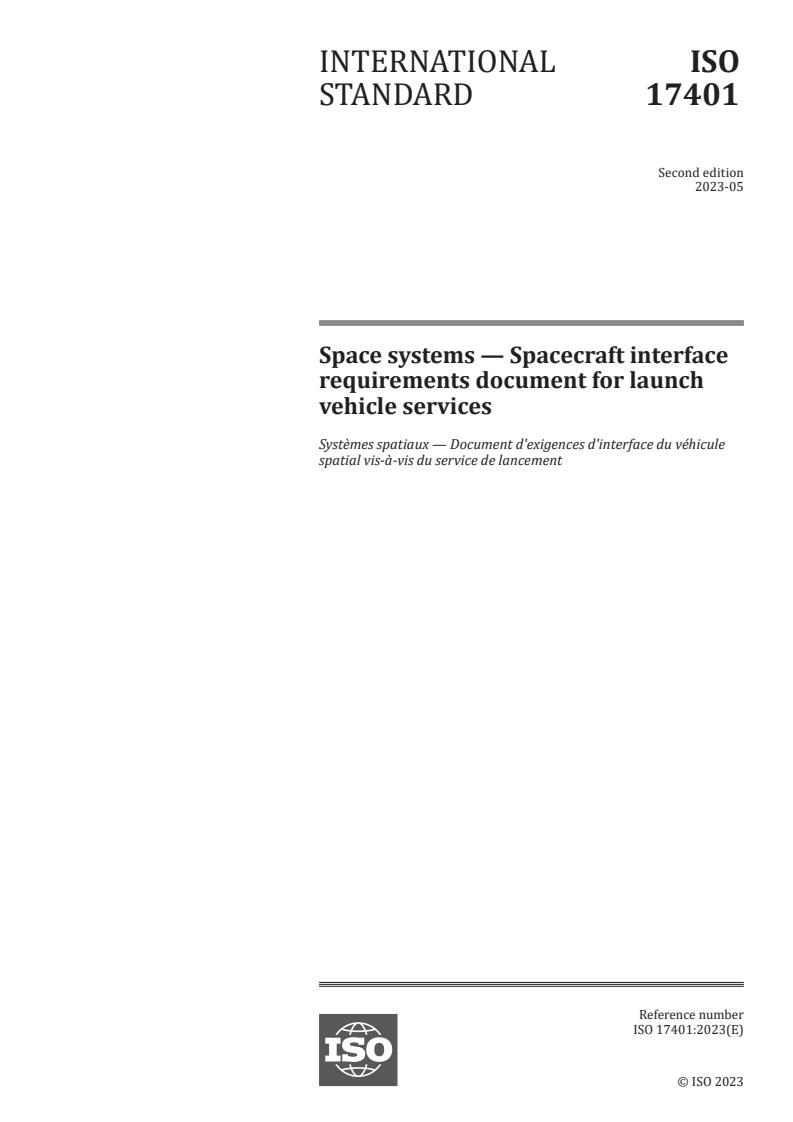
INTERNATIONAL ISO
STANDARD 17401
Second edition
2023-05
Space systems — Spacecraft interface
requirements document for launch
vehicle services
Systèmes spatiaux — Document d'exigences d'interface du véhicule
spatial vis-à-vis du service de lancement
Reference number
© ISO 2023
All rights reserved. Unless otherwise specified, or required in the context of its implementation, no part of this publication may
be reproduced or utilized otherwise in any form or by any means, electronic or mechanical, including photocopying, or posting on
the internet or an intranet, without prior written permission. Permission can be requested from either ISO at the address below
or ISO’s member body in the country of the requester.
ISO copyright office
CP 401 • Ch. de Blandonnet 8
CH-1214 Vernier, Geneva
Phone: +41 22 749 01 11
Email: copyright@iso.org
Website: www.iso.org
Published in Switzerland
ii
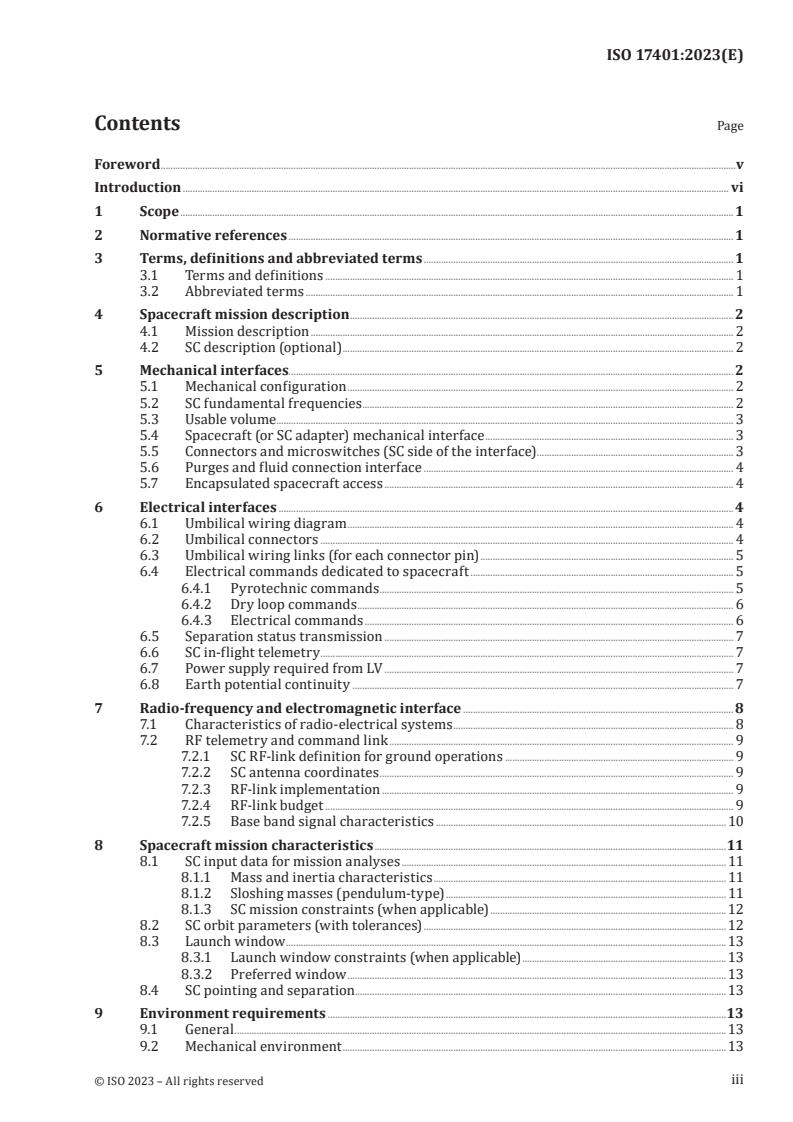
Contents Page
Foreword .v
Introduction . vi
1 Scope . 1
2 Normative references . 1
3 Terms, definitions and abbreviated terms . 1
3.1 Terms and definitions . 1
3.2 Abbreviated terms . 1
4 Spacecraft mission description .2
4.1 Mission description . 2
4.2 SC description (optional) . 2
5 Mechanical interfaces. 2
5.1 Mechanical configuration . 2
5.2 SC fundamental frequencies . 2
5.3 Usable volume. 3
5.4 Spacecraft (or SC adapter) mechanical interface . 3
5.5 Connectors and microswitches (SC side of the interface) . 3
5.6 Purges and fluid connection interface . 4
5.7 Encapsulated spacecraft access . 4
6 Electrical interfaces .4
6.1 Umbilical wiring diagram . 4
6.2 Umbilical connectors . 4
6.3 Umbilical wiring links (for each connector pin) . 5
6.4 Electrical commands dedicated to spacecraft . 5
6.4.1 Pyrotechnic commands . . 5
6.4.2 Dry loop commands . 6
6.4.3 Electrical commands . 6
6.5 Separation status transmission . 7
6.6 SC in-flight telemetry . 7
6.7 Power supply required from LV . 7
6.8 Earth potential continuity . 7
7 Radio-frequency and electromagnetic interface . 8
7.1 Characteristics of radio-electrical systems . 8
7.2 RF telemetry and command link . 9
7.2.1 SC RF-link definition for ground operations . 9
7.2.2 SC antenna coordinates . 9
7.2.3 RF-link implementation . 9
7.2.4 RF-link budget . 9
7.2.5 Base band signal characteristics . 10
8 Spacecraft mission characteristics .11
8.1 SC input data for mission analyses . 11
8.1.1 Mass and inertia characteristics . 11
8.1.2 Sloshing masses (pendulum-type) . 11
8.1.3 SC mission constraints (when applicable) .12
8.2 SC orbit parameters (with tolerances) .12
8.3 Launch window .13
8.3.1 Launch window constraints (when applicable) .13
8.3.2 Preferred window .13
8.4 SC pointing and separation . . .13
9 Environment requirements .13
9.1 General .13
9.2 Mechanical environment .13
iii
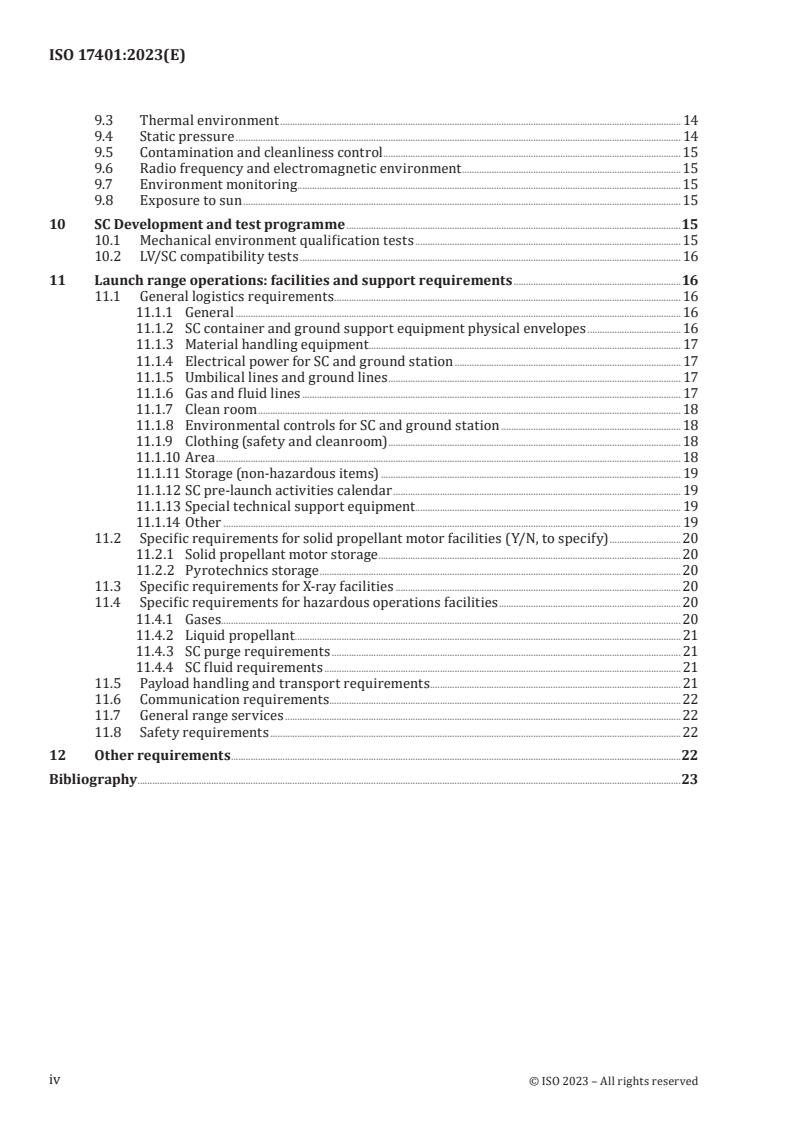
9.3 Thermal environment . 14
9.4 Static pressure . 14
9.5 Contamination and cleanliness control . 15
9.6 Radio frequency and electromagnetic environment . 15
9.7 Environment monitoring . 15
9.8 Exposure to sun . 15
10 SC Development and test programme .15
10.1 Mechanical environment qualification tests . 15
10.2 LV/SC compatibility tests . 16
11 Launch range operations: facilities and support requirements .16
11.1 General logistics requirements . 16
11.1.1 General . 16
11.1.2 SC container and ground support equipment physical envelopes . 16
11.1.3 Material handling equipment . . 17
11.1.4 Electrical power for SC and ground station . 17
11.1.5 Umbilical lines and ground lines . 17
11.1.6 Gas and fluid lines . 17
11.1.7 Clean room . 18
11.1.8 Environmental controls for SC and ground station . 18
11.1.9 Clothing (safety and cleanroom) . 18
11.1.10 Area . 18
11.1.11 Storage (non-hazardous items) . 19
11.1.12 SC pre-launch activities calendar . 19
11.1.13 Special technical support equipment . 19
11.1.14 Other . 19
11.2 Specific requirements for solid propellant motor facilities (Y/N, to specify) .20
11.2.1 Solid propellant motor storage . 20
11.2.2 Pyrotechnics storage .20
11.3 Specific requirements for X-ray facilities . 20
11.4 Specific requirements for hazardous operations facilities . 20
11.4.1 Gases. 20
11.4.2 Liquid propellant . 21
11.4.3 SC purge requirements . 21
11.4.4 SC fluid requirements . 21
11.5 Payload handling and transport requirements . 21
11.6 Communication requirements.22
11.7 General range services .22
11.8 Safety requirements .22
12 Other requirements . .22
Bibliography .23
iv
Foreword
ISO (the International Organization for Standardization) is a worldwide federation of national standards
bodies (ISO member bodies). The work of preparing International Standards is normally carried out
through ISO technical committees. Each member body interested in a subject for which a technical
committee has been established has the right to be represented on that committee. International
organizations, governmental and non-governmental, in liaison with ISO, also take part in the work.
ISO collaborates closely with the International Electrotechnical Commission (IEC) on all matters of
electrotechnical standardization.
The procedures used to develop this document and those intended for its further maintenance are
described in the ISO/IEC Directives, Part 1. In particular, the different approval criteria needed for the
different types of ISO documents should be noted. This document was drafted in accordance with the
editorial rules of the ISO/IEC Directives, Part 2 (see www.iso.org/directives).
Attention is drawn to the possibility that some of the elements of this document may be the subject of
patent rights. ISO shall not be held responsible for identifying any or all such patent rights. Details of
any patent rights identified during the development of the document will be in the Introduction and/or
on the ISO list of patent declarations received (see www.iso.org/patents).
Any trade name used in this document is information given for the convenience of users and does not
constitute an endorsement.
For an explanation of the voluntary nature of standards, the meaning of ISO specific terms and
expressions related to conformity assessment, as well as information about ISO's adherence to
the World Trade Organization (WTO) principles in the Technical Barriers to Trade (TBT), see
www.iso.org/iso/foreword.html.
This document was prepared by Technical Committee ISO/TC 20, Aircraft and space vehicles,
Subcommittee SC 14, Space systems and operations.
This second edition cancels and replaces the first edition (ISO 17401:2004), which has been technically
revised.
The main changes are as follows:
— upgrade orbit definition parameters;
— upgrade SC environment description;
— upgrade SC description (interface, thermal aspects, EMC).
Any feedback or questions on this document should be directed to the user’s national standards body. A
complete listing of these bodies can be found at www.iso.org/members.html.
v
Introduction
This document gives guidelines for writing an interface requirements document (IRD) for launch
vehicle (LV) services. The application of this document is intended to facilitate the technical exchanges
between spacecraft (SC) and launch vehicle agencies. By reducing the amount of work necessary for
requesting launch services, this document will minimize spacecraft contractor's and spacecraft
manufacturer's costs.
In some cases, drawings are explicitly requested in order to provide comprehensive information.
Explicit international system units are specified for all items. The corresponding scale may be adjusted
if not appropriate.
SC organizations may include additional topics if required. Some sections of the IRD may refer to
specificities that are not applicable to the launch services of interest, in which case they should be
ignored.
vi
INTERNATIONAL STANDARD ISO 17401:2023(E)
Space systems — Spacecraft interface requirements
document for launch vehicle services
1 Scope
This document provides spacecraft (SC) organizations with the general format for presenting the
interface requirement document (IRD) for launch vehicle services. The IRD provides a list of the major
technical requirements spacecraft agencies provide to launch vehicle (LV) agencies when submitting an
application for launch services.
The IRD addresses the definition of the SC mission, the mechanical and electrical interfaces, the overall
environment requirements (mechanical, thermal, cleanliness, radio-electrical), the SC development and
test programme and, finally, launch range facilities and support requirements.
This document is applicable to all existing commercial LV and related launch facilities so as to permit SC
contractors to prepare a single interface requirement document for a given SC mission, independently
of the LV contractor to be selected.
The IRD, as defined in this document, includes the basic SC input data needed by LV agencies to prepare
the interface control document defined in ISO 15863.
2 Normative references
There are no normative references in this document.
3 Terms, definitions and abbreviated terms
3.1 Terms and definitions
For the purposes of this document, the following terms and definitions apply.
ISO and IEC maintain terminology databases for use in standardization at the following addresses:
— ISO Online browsing platform: available at https:// www .iso .org/ obp
— IEC Electropedia: available at https:// www .electropedia .org/
3.1.1
usable volume
volume available to the payload within the LV fairing or carrying structure that the static envelope of
the SC may not exceed in order to ensure that there is no physical contact between the SC and the LV in
a dynamic environment
3.1.2
spacecraft adapter
SC adapter
structure that mates the SC to the LV and includes the separation system for SC/LV separation
Note 1 to entry: The SC adapter is a part of the LV and does not separate with the SC.
3.2 Abbreviated terms
EIRP equivalent isotropic radiated power
EMC electromagnetic compatibility
IRD interface requirement document
LV launch vehicle
RF radio frequency
SC spacecraft
Y/N yes/no response
4 Spacecraft mission description
4.1 Mission description
The IRD shall describe the following items:
a) purpose of the mission;
b) orbital characteristics;
c) in orbit view of SC, with drawing
4.2 SC description (optional)
The IRD may describe the following items:
a) SC platform
b) SC payload
5 Mechanical interfaces
5.1 Mechanical configuration
The IRD shall provide the following information:
a) SC mechanical drawing (launch configuration);
b) SC coordinate system, with drawing;
c) maximum height above interface plane, in metres;
d) SC overall dimensions (maximum diameter, maximum height, …), in metres;
e) SC/LV interface diameter, in metres. SC/LV interface geometrical definition.
f) available volumes of SC, in cubic meters
g) SC mass center position – relative to the reference frame which is centered in the adapter plane;
h) mean-square deviation of SC mass center position along SC axis
5.2 SC fundamental frequencies
The IRD shall provide the fundamental natural frequencies of SC (specify boundary conditions):
a) axial frequencies, in hertz;
b) lateral frequencies, in hertz.
5.3 Usable volume
The IRD shall provide the following information:
a) static envelope, with drawing;
b) SC protrusions below interface plane, with dimensioned drawings;
c) SC volumetric displacement, in cubic metres;
d) SC free air volume, in cubic metres;
e) special clearance requirements, with drawing.
5.4 Spacecraft (or SC adapter) mechanical interface
The IRD shall provide the following information:
a) mechanical interface, with drawing;
b) diameter, in metres;
c) attachments at SC interface;
d) material;
e) Young's modulus, in newtons per square metre;
f) coating:
1) surfaces in contact,
2) other surfaces;
g) roughness, in micrometers of surfaces in contact;
h) flatness/perpendicularity of surfaces in contact;
i) stiffness (for clampband mating system):
1) applicable length (height), in meters,
2) section area, in square millimeters,
3) inertia (with respect to centre of gravity of section), in millimeters to the power of 4 (mm );
j) stiffness (except for clampband mating systems):
1) radial direction, in newtons per metre,
2) tangent di
...