

ISO 14084-2:2015
(Main)Process diagrams for power plants — Part 2: Graphical symbols
General Information
- Abstract
ISO 14084-2:2015 specifies graphical symbols for process diagrams for power plants and guidelines for creation of new graphical symbol examples. ISO 14084-2:2015 is a collective application standard of the ISO 14617‑series. Graphical symbols for fluid power diagrams can be found in ISO 1219‑1. Graphical symbols for electrotechnical diagrams can be found in IEC 60617.
- Status
- Published
- Publication Date
- 07-Apr-2015
- Technical Committee
- ISO/TC 10/SC 10 - Process plant documentation
- Drafting Committee
- ISO/TC 10/SC 10 - Process plant documentation
- Current Stage
- 9093 - International Standard confirmed
- Start Date
- 11-Dec-2025
- Completion Date
- 29-Aug-2026
Overview
ISO 14084-2:2015 - Process diagrams for power plants: Part 2: Graphical symbols specifies standardized graphical symbols and guidance for creating new symbol examples used in process diagrams for power plants. Published April 2015, this part is a collective application of the ISO 14617 series and clarifies representation rules (symbol size, registration numbers, table representation and legends) so engineers and technical authors can produce consistent, unambiguous diagrams for design, construction, operation and maintenance.
Key topics and technical requirements
ISO 14084-2:2015 covers the visual language and structuring rules for power plant process diagrams, including:
- General rules: symbol size, representation styles, and guidelines for creating new symbols.
- Structuring: overall diagram structure, registration numbers, and legend/table conventions.
- Connections: fluid and mechanical connections, direction, branching, crossings, pipeline joints and accessories.
- Fluid flow control: valves (on-off, non‑return, control, safety), dampers, and related safety devices.
- Actuators: manual, mechanical and automatic actuators plus supplementary symbols.
- Fluid transport and energy transfer: pumps, fans, compressors, heat exchangers, cooling towers and mixing devices.
- Fluid processing & storage: separation devices, adsorption/catalysis, mixing, storage tanks and energy storage.
- Material handling and processing: conveyors, feeders, crushers, mills and handling equipment.
- Thermal energy systems and machines: boilers, combustion systems, turbines, engines and electrical machines.
- Mechanical components: shafts, bearings, gears, couplings and brakes.
The standard also indicates where domain‑specific symbol sets apply-fluid power symbols are covered by ISO 1219‑1 and electrotechnical symbols by IEC 60617.
Practical applications
ISO 14084-2:2015 is used to:
- Create consistent process diagrams for power plant design packages and technical documentation.
- Build CAD and symbol libraries for engineering software and drawing templates.
- Standardize handover documents for construction, commissioning and maintenance.
- Support regulatory submissions, safety reviews and operator training with unambiguous diagrams.
Who should use it
- Power plant process, mechanical and control systems engineers
- Piping and instrumentation diagram (process diagram) authors and CAD librarians
- Technical illustrators, documentation specialists and training developers
- Vendors supplying equipment data sheets or CAD blocks for power plant projects
- Regulators and safety auditors reviewing documentation consistency
Related standards
- ISO 14617 series - graphical symbols for diagrams (base application)
- ISO 1219‑1 - graphical symbols for fluid power systems
- IEC 60617 - graphical symbols for electrotechnical diagrams
Using ISO 14084-2:2015 helps ensure clear, interoperable process diagrams across engineering teams and software tools, improving communication, safety and lifecycle efficiency in power plant projects.
Get Certified
Connect with accredited certification bodies for this standard

DNV
DNV is an independent assurance and risk management provider.

Lloyd's Register
Lloyd's Register is a global professional services organisation specialising in engineering and technology.
DNV Energy Systems
Energy and renewable energy certification.
Sponsored listings
Frequently Asked Questions
ISO 14084-2:2015 is a standard published by the International Organization for Standardization (ISO). Its full title is "Process diagrams for power plants — Part 2: Graphical symbols". This standard covers: ISO 14084-2:2015 specifies graphical symbols for process diagrams for power plants and guidelines for creation of new graphical symbol examples. ISO 14084-2:2015 is a collective application standard of the ISO 14617‑series. Graphical symbols for fluid power diagrams can be found in ISO 1219‑1. Graphical symbols for electrotechnical diagrams can be found in IEC 60617.
ISO 14084-2:2015 specifies graphical symbols for process diagrams for power plants and guidelines for creation of new graphical symbol examples. ISO 14084-2:2015 is a collective application standard of the ISO 14617‑series. Graphical symbols for fluid power diagrams can be found in ISO 1219‑1. Graphical symbols for electrotechnical diagrams can be found in IEC 60617.
ISO 14084-2:2015 is classified under the following ICS (International Classification for Standards) categories: 01.080.30 - Graphical symbols for use on mechanical engineering and construction drawings, diagrams, plans, maps and in relevant technical product documentation; 27.100 - Power stations in general. The ICS classification helps identify the subject area and facilitates finding related standards.
ISO 14084-2:2015 is available in PDF format for immediate download after purchase. The document can be added to your cart and obtained through the secure checkout process. Digital delivery ensures instant access to the complete standard document.
Standards Content (Sample)
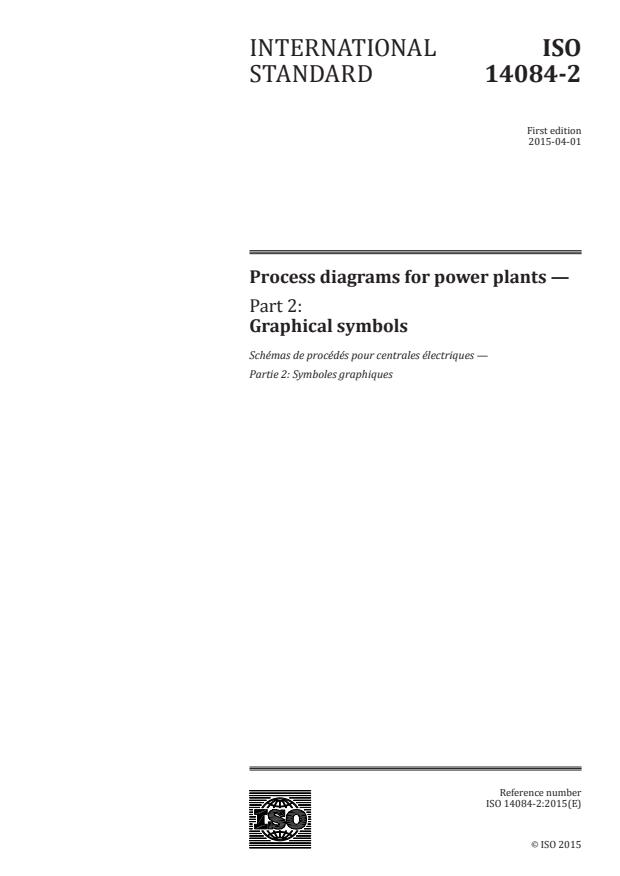
INTERNATIONAL ISO
STANDARD 14084-2
First edition
2015-04-01
Process diagrams for power plants —
Part 2:
Graphical symbols
Schémas de procédés pour centrales électriques —
Partie 2: Symboles graphiques
Reference number
©
ISO 2015
© ISO 2015
All rights reserved. Unless otherwise specified, no part of this publication may be reproduced or utilized otherwise in any form
or by any means, electronic or mechanical, including photocopying, or posting on the internet or an intranet, without prior
written permission. Permission can be requested from either ISO at the address below or ISO’s member body in the country of
the requester.
ISO copyright office
Case postale 56 • CH-1211 Geneva 20
Tel. + 41 22 749 01 11
Fax + 41 22 749 09 47
E-mail copyright@iso.org
Web www.iso.org
Published in Switzerland
ii © ISO 2015 – All rights reserved
Contents Page
Foreword .vi
Introduction .vii
1 Scope . 1
2 Normative references . 1
3 Terms and definitions . 1
4 Graphical symbols . 1
4.1 General . 1
4.2 Size of graphical symbols . 1
4.3 Creation of new symbol examples . 2
4.4 Symbols for large/complex objects . 2
5 Structuring and representation . 2
5.1 Overall structure . 2
5.2 Registration numbers . 2
5.3 Representation of graphical symbols in the standard . 3
5.4 Legend to table representation . . 3
6 Connections and related devices . 4
6.1 Fluid connections . 4
6.1.1 Functional connections . 4
6.1.2 Connections with indication of process media . 4
6.1.3 Simplified representation . 5
6.1.4 Symbols for direction, branching, crossing, etc. 5
6.1.5 Pipeline joints, couplings, etc. 6
6.1.6 Accessories for connections . 6
6.1.7 Pipeline components . 7
6.1.8 Pipeline insulation, tracing, etc. . 8
6.2 Mechanical connections . 9
7 Fluid flow control . 9
7.1 Valves . 9
7.1.1 On-off valves . 9
7.1.2 Non-return valves .10
7.1.3 Control valves .11
7.1.4 Safety and relief valves .12
7.1.5 Special valves .13
7.1.6 Supplementary valve symbols .13
7.1.7 Specific valve features .14
7.2 Dampers .14
7.2.1 On-off dampers .14
7.2.2 Non-return dampers.15
7.2.3 Control dampers .15
7.2.4 Safety dampers .16
7.3 Safety devices other than valves .16
8 Actuators .16
8.1 Manual actuators . .16
8.2 Mechanical actuators .16
8.3 Automatic actuators .17
8.4 Supplementary symbols .17
9 Fluid transport .18
9.1 Pumps .18
9.2 Fans, ventilators, blowers, compressors, etc. .19
9.3 Vacuum pumps, etc. .20
10 Fluid energy transfer .21
10.1 Heat exchangers .21
10.2 Energy transfer by mixing .23
10.3 Cooling towers .23
11 Fluid processing .24
11.1 Separation .24
11.1.1 Separation, general .24
11.1.2 Separation of suspended substances in liquids .25
11.1.3 Separation of suspended substances in gasses .27
11.2 Processing of fluids by adsorption, catalysis, conversion, thermic, etc. .28
11.2.1 Liquids .28
11.2.2 Gasses .29
11.3 Mixing .30
11.3.1 General.30
11.3.2 Devices for mixing .30
12 Storage .31
12.1 Permanent storage .31
12.2 Storage devices, surface indications, etc. .32
12.3 Mobile storage devices .33
12.4 Energy storage, expansion devices .33
13 Material transport .34
13.1 Conveyors, elevators, unloaders, etc. .34
13.2 Material flow control .36
13.3 Feeders .37
13.4 Handling equipment .38
13.5 Mobile transport equipment .39
14 Material processing .40
14.1 Separation .40
14.2 Processing, size reduction .42
14.2.1 Size reduction .42
14.2.2 Coarse size reduction, crushers .42
14.2.3 Fine size reduction, mills .42
14.2.4 Biomass processing .43
14.3 Humidifieing .43
15 Thermal energy generators .44
15.1 Conventional energy generators.44
15.2 Boiler combustion / heating systems .45
15.3 Boiler devices .45
15.4 Non-conventional energy generators .46
15.5 Thermal energy consumers .47
16 Machines, engines .47
16.1 Steam turbines, steam engines .47
16.2 Combustion engines, gas turbines .47
16.3 Electrical engines, motors, generators, converters .48
17 Mechanical transmission, shafts, bearings, couplings, etc. .48
17.1 Shafts .48
17.2 Bearings .48
17.3 Gears .49
17.4 Couplings .49
17.5 Brakes .50
17.6 Transmissions devices.50
18 Instrumentation, measurement and control .50
18.1 Process control information (PCI) .50
18.2 Measurement devices, sensors, etc. .51
iv © ISO 2015 – All rights reserved
18.2.1 Sensors general, etc. .51
18.2.2 Temperature .51
18.2.3 Level .52
18.2.4 Weight .52
18.2.5 Flow . .52
18.2.6 Speed, vibrations, etc. .53
18.2.7 Length, position displacement, etc. .54
18.3 Signals .54
18.4 Miscellaneous .54
18.5 Control processing elements .55
Annex A (informative) Creation of new symbol examples .57
Annex B (informative) Examples of large and complex symbols .59
Bibliography .60
Foreword
ISO (the International Organization for Standardization) is a worldwide federation of national standards
bodies (ISO member bodies). The work of preparing International Standards is normally carried out
through ISO technical committees. Each member body interested in a subject for which a technical
committee has been established has the right to be represented on that committee. International
organizations, governmental and non-governmental, in liaison with ISO, also take part in the work.
ISO collaborates closely with the International Electrotechnical Commission (IEC) on all matters of
electrotechnical standardization.
The procedures used to develop this document and those intended for its further maintenance are
described in the ISO/IEC Directives, Part 1. In particular the different approval criteria needed for the
different types of ISO documents should be noted. This document was drafted in accordance with the
editorial rules of the ISO/IEC Directives, Part 2 (see www.iso.org/directives).
Attention is drawn to the possibility that some of the elements of this document may be the subject of
patent rights. ISO shall not be held responsible for identifying any or all such patent rights. Details of any
patent rights identified during the development of the document will be in the Introduction and/or on
the ISO list of patent declarations received (see www.iso.org/patents).
Any trade name used in this document is information given for the convenience of users and does not
constitute an endorsement.
For an explanation on the meaning of ISO specific terms and expressions related to conformity
assessment, as well as information about ISO’s adherence to the WTO principles in the Technical Barriers
to Trade (TBT), see the following URL: Foreword — Supplementary information.
The committee responsible for this document is ISO/TC 10, Technical product documentation,
Subcommittee SC 10, Process plant documentation.
ISO 14084 consists of the following parts, under the general title Process diagrams for power plants:
— Part 1: Specification for diagrams
— Part 2: Graphical symbols
vi © ISO 2015 – All rights reserved
Introduction
General
This part of ISO 14084 deals with preparation of process diagrams for power plants.
ISO/TC 10/SC 10 prepares standards for diagrams including graphical symbols which together with
standards prepared by other ISO committees and IEC constitute the basis for preparation of diagrams
for process industry.
The interrelations between these standards are illustrated in Figure 1. Standards in bold are
ISO/TC 10/SC 10 standards
NOTE Standards marked * are collective application standards.
Figure 1 — Interrelations between ISO and IEC standards for diagrams for power plants
Collective application standard
ISO/TC 10/SC 10 standards:
— ISO 15519-series: Specifications for diagrams for process industry;
— ISO 14617-series: Graphical symbols for diagrams;
are basic standards, which are general and apply to all fields of applications. Technical committees
working in a specific application field are allowed to make extracts and publish them as collective
application standards of ISO 15519-series, ISO 14617-series or both.
Application fields
This International Standard applies to the power plant field, which include conventional fossil and
biomass fired power plants, hydro power plants, sea wave power plants, wind power plants, nuclear
power plants, geothermal power plants, solar power plants, osmosis power plants, incineration plants,
and industrial power plants.
INTERNATIONAL STANDARD ISO 14084-2:2015(E)
Process diagrams for power plants —
Part 2:
Graphical symbols
1 Scope
This part of ISO 14084 specifies graphical symbols for process diagrams for power plants and guidelines
for creation of new graphical symbol examples.
This part of ISO 14084 is a collective application standard of the ISO 14617-series.
Graphical symbols for fluid power diagrams can be found in ISO 1219-1.
Graphical symbols for electrotechnical diagrams can be found in IEC 60617.
2 Normative references
The following documents, in whole or in part, are normatively referenced in this document and are
indispensable for its application. For dated references, only the edition cited applies. For undated
references, the latest edition of the referenced document (including any amendments) applies.
ISO 10209, Technical product documentation — Vocabulary — Terms relating to technical drawings,
product definition and related documentation
ISO 14617 (all parts), Graphical symbols for diagrams
3 Terms and definitions
For the purposes of this document, the terms and definitions given in the ISO 15519-series and ISO 10209
and the following apply.
3.1
symbol example
graphical symbol created of basic and supplementary graphical symbols
4 Graphical symbols
4.1 General
Graphical symbols shall comply with ISO 14617-series.
General rules for graphical symbols are given in ISO 81714-1. Rules for CAx application of graphical
symbols are given in IEC 81714-2.
Specific rules and guidelines for graphical symbols for use in diagrams are given in ISO 15519-1.
4.2 Size of graphical symbols
Graphical symbols in this part of ISO 14084 are shown in a grid system with module M = 2,5 mm.
4.3 Creation of new symbol examples
This International Standard includes the most common used graphical symbols for diagrams for power
plants. In case a needed symbol cannot be found in this International Standard or in ISO 14617-series
then, the needed graphical symbol example should be created on basis of basic and supplementary
graphical symbols in ISO 14617 as illustrated in Annex A.
In case the needed graphical symbol neither exists in ISO 14617 nor can be created on basis of basic
and supplementary symbols in ISO 14617 then, a new graphical symbol shall be requested according to
ISO/IEC Directives, Part 1, Consolidated ISO Supplement, 2014, Annex SH.
4.4 Symbols for large/complex objects
Graphical symbols for large and complex objects like boilers, turbines, flue gas treatment plants, boiler
feed pumps, etc. are not standardized in this International Standard.
In diagrams, large and complex objects should be represented with a silhouette which allow for correct
placement of graphical symbols for equipment, connections, PCI (Process Control Information; see 18.1)
symbols for measurement, etc. of which the large and complex object consists of.
Annex B gives examples of symbols for large and complex objects.
5 Structuring and representation
5.1 Overall structure
This part of ISO 14084 is divided in following groups:
— Clause 6 — Connections and related devices;
— Clause 7 — Fluid flow control, valves, dampers, safety devices;
— Clause 8 — Actuators;
— Clause 9 — Fluid transport, pumps, fans compressors;
— Clause 10 — Fluid energy transfer, heat exchangers, condensers, cooling towers, etc.;
— Clause 11 — Fluid processing, filtration, separation, mixing, etc.;
— Clause 12 — Storage, tanks, vessels, accumulators, etc.;
— Clause 13 — Material transport and flow control, conveyors, feeders, transport devices, etc.;
— Clause 14 — Material processing, screens, size reduction, mixing, etc.;
— Clause 15 — Thermal energy generators, boilers, boiler devices, etc.;
— Clause 16 — Engines, turbines, generators, motors, etc.;
— Clause 17 — Mechanical transmission, shafts, bearings, couplings, etc.;
— Clause 18 — Instrumentation, measurement and control, etc.
5.2 Registration numbers
Graphical symbols, symbol examples, and application rules in ISO 14617 are assigned unique registration
numbers, see ISO 14617−1.
2 © ISO 2015 – All rights reserved
Symbol examples developed for this International Standard are assigned registration numbers in the
6000-7999 series, see Table 1.
NOTE New graphical symbols developed for this International Standard and which shall be implemented in
ISO 14617 are assigned preliminary “P” registration numbers (P = power plants) in the development phase of this
part of ISO 14084. In case of, that the preliminary registration numbers are not approved by ISO 14617 before
publication of this part of ISO 14084 then the standard will be published with preliminary registration numbers
which will be replaced with final ISO 14617 registration numbers at first periodical review.
Table 1 — Overview of types of ISO 14617 and ISO 14084 registration numbers
Subject ISO 14617 ISO 14084
Graphical symbols nnn nnn Registration number from ISO 14617
Pnnn Preliminary registration number for new ISO 14617 symbols
Symbol Xnnn Xnnn Registration number from ISO 14617
examples X6nnn Registration number for ISO 14084 symbol example
5.3 Representation of graphical symbols in the standard
In this part of ISO 14084 graphical symbols are represented in a 2,5 M dotted grid and imaginary
connections as illustrated in Figure 2. The imaginary connections and the dotted grid are not part of the
graphical symbol.
In case of mandatory flow direction, the imaginary connections are equipped with arrows as illustrated
in Figure 2b.
a) Heat exchanger b) Spring loaded safety valve
Key
1 graphical symbol
2 imaginary connections
3 2,5 M dotted grid
Figure 2 — Representation of graphical symbols in the standard
5.4 Legend to table representation
Graphical symbols in this part of ISO 14084 are represented in tables with column headings
according to Table 2.
Table 2 — Column headings
Column Description
Entry number Consecutive numbering within each clause/sub-clause
Graphics Graphical symbol represented with solid lines on a dotted grid
Description The preferred descriptors for the graphical symbol
Table 2 (continued)
Column Description
Reference number Registration number for the actual symbol
Code 2-digit letter code according to IEC 81346–2
6 Connections and related devices
6.1 Fluid connections
6.1.1 Functional connections
Entry no. Symbol Symbol name Ref no. Code
6.1.1.1 Pipeline, duct, X6001 WP
Line width 0,5
6.1.1.2 Instrument connection, control connection X6002 WP
in Process Control Diagrams (PCD)
WG
Line width 0,25
6.1.1.3 Pilot line, control connection in Process 422 WG
Flow Diagrams (PFD)
Line width 0,25, ISO 128-20 line 02
6.1.1.4 Representation of pipeline in adjacent dia- X6017 WG
gram
Representation of adjacent pipeline in same
diagram
Line width 0,5, ISO 128-20 line 12
6.1.2 Connections with indication of process media
Entry no. Symbol Symbol name Ref no. Code
6.1.2.1 Steam X6005 WP
Line width 1,0
6.1.2.2 Condensate, cooling water, feed water X6006 WP
Line width 0,5
6.1.2.3 Water, oil contaminated X6007 WP
Line width 0,25. Circles: line width 0,25,
D = 2,0. Spacing 7,5
6.1.2.4 Vapour, oil contaminated X6008 WP
Line width 0,7. Circles: line width 0,25,
D = 2,0. Spacing 7,5
6.1.2.5 Raw water, untreated water X6009 WP
Line width 0,25. Segments: line width 1,0
length 9 and 3. Spacing 3
6.1.2.6 Sludge water, waste water X6010 WP
Line width 0,25. Dots: D = 2,0. Spacing 7,5
4 © ISO 2015 – All rights reserved
Entry no. Symbol Symbol name Ref no. Code
6.1.2.7 Air X6011 WP
Line width solid 0,5. Dashed line = 422.
Line gap 1,0
6.1.2.8 Solvents, chemical X6012 WP
Line width 0,25. Segments: line width 1,0,
length 5. Spacing 5
6.1.2.9 Solid fuels, bulk fuels X6013 WP
Line width 0,25. Line gap 1,0. Segments/
spacing 4,0
6.1.2.10 Combustible waste X6014 WP
Line width 0,25. Line gap 1,0. Dots D = 2,0.
Spacing. 7,5
6.1.2.11 Oil X6015 WP
Line width 0,25. Line gap 1,0
6.1.2.12 Combustible gases X6016 WP
Line width 0,25 + 0,7. Line gap 1,0
6.1.2.13 Non-combustible gas, flue gas, inert gas X6018 WP
Line width centre line 0,7. Outside lines
width 0,25. Line gaps 1,0
6.1.2.14 Ash, slag X6019 WP
Line width 0,25. Vertical lines: spacing 4,0
6.1.2.15 Fly ash X6020 WP
Line width 0,25. Line gap 1,0. Segments/
spacing 2,0
6.1.3 Simplified representation
Entry no. Symbol Symbol name Ref no. Code
6.1.3.1 Transition between multi-line and X6030 WP
single-line representation
6.1.4 Symbols for direction, branching, crossing, etc.
Entry no. Symbol Symbol name Ref no. Code
6.1.4.1 Direction in general 241
6.1.4.2 Direction in general 242
6.1.4.3 Energy or signal flow 249
6.1.4.4 T-branch, form 1 X504
6.1.4.5 T-branch, form 2 X505
6.1.4.6 Crossing with connection X506
Entry no. Symbol Symbol name Ref no. Code
6.1.4.7 Crossing without connection X6031
6.1.4.8 Interruption of connection line P078
6.1.5 Pipeline joints, couplings, etc.
Entry no. Symbol Symbol name Ref no. Code
6.1.5.1 Flange joint 511 XL
6.1.5.2 Flange coupling, clamped 513 XL
6.1.5.3 Threaded joint 514 XL
6.1.5.4 Welded joint 515 XQ
6.1.5.5 Quick-release coupling, showed uncoupled P032 XM
6.1.5.6 Quick-release coupling with automatic clos- P033 XM
ing when uncoupled, showed uncoupled
6.1.6 Accessories for connections
Entry no. Symbol Symbol name Ref no. Code
6.1.6.1 Drain, funnel 2040
6.1.6.2 Drain pan X6035
6.1.6.3 Vent, outlet to atmosphere 2039
6.1.6.4 Vent, outlet outside enclosure or building X6040
6.1.6.5 Siphon 2038
6 © ISO 2015 – All rights reserved
Entry no. Symbol Symbol name Ref no. Code
6.1.6.6 Slope 3061
6.1.6.7 Wall or roof penetration, general P009
6.1.6.8 Penetration through wall, etc., general 3001
6.1.6.9 Penetration through wall, etc. sealed 3002
The * should be replaced with a designation
for the type of seal, e.g. fire.
6.1.7 Pipeline components
Entry no. Symbol Symbol name Ref no. Code
6.1.7.1 Change of pipe dimension, pipe reducer, P069 XL
6.1.7.2 Flange, single P023 XL
6.1.7.3 Blind flange P029 XL
6.1.7.4 End cap, threaded 518 XL
6.1.7.5 End cap P028 XL
6.1.7.6 Compensator 533 XM
Form 1
6.1.7.7 Compensator P052 XM
Form 2
6.1.7.8 Flexible pipe, hose 444 XM
6.1.7.9 Restrictor, multistage type X6032 RN
6.1.7.10 Orifice encapsulated P087 RN
6.1.7.11 Orifice plate between flanges 772 RN
Form 1
6.1.7.12 Orifice plate between flanges P053 RN
Form 2
Entry no. Symbol Symbol name Ref no. Code
6.1.7.13 Swing blind closed 2044 RN
6.1.7.14 Swing blind open 2045 RN
6.1.7.15 Flow straightener 2032 W_
6.1.7.16 Silencer 2033 RP
6.1.7.17 Viewing glass 2034
6.1.7.18 Hose reel P031 WN
6.1.7.19 Rupture disc 2035 FL
6.1.7.20 Air inlet or outlet grill P030 HQ
6.1.8 Pipeline insulation, tracing, etc.
Entry no. Symbol Symbol name Ref no. Code
6.1.8.1 Pipe, insulated X322 RQ
6.1.8.2 Jacketed pipe X409 EP
6.1.8.3 Heating or cooling P068 EB
X8174
6.1.8.4 Electrical tracing X6050 EB
8 © ISO 2015 – All rights reserved
6.2 Mechanical connections
Entry no. Symbol Symbol name Ref no. Code
6.2.1 Mechanical link, shaft 402 WQ
Form 1
Line width 0,5, line gap 1,0
6.2.2 Mechanical link, shaft 403 WQ
Form 2
Line width 0,5
6.2.3 Electrically insulated mechanical link, 404 WQ
shaft wire
Line width 0,5, dashes 4,0, gaps 2,0
7 Fluid flow control
7.1 Valves
7.1.1 On-off valves
Entry no. Symbol Symbol name Ref no. Code
7.1.1.1 2-way on-off valve, straight type, general 2101 QM
7.1.1.2 2-way valve, angle type, general 2102 QM
7.1.1.3 3-way valve, general 2103 QM
7.1.1.4 4-way valve, general 2104 QM
7.1.1.5 2-way on-off valve with diaphragm actua- X2101 QM
tor, fail to close
7.1.1.6 2-way on-off valve with cylinder actuator X6101 QM
Entry no. Symbol Symbol name Ref no. Code
7.1.1.7 2-way on-off valve with cylinder actuator X6102 QM
and quick closing – fail to close
7.1.1.8 2-way on-off valve with electric motor X2104 QM
actuator
7.1.1.9 2-way on-off valve and integrated bypass X6103 QM
valve both with electric motor actuators
7.1.2 Non-return valves
Entry no. Symbol Symbol name Ref no. Code
7.1.2.1 Non-return valve, general X6105 RM
Form 1
7.1.2.2 Non-return valve, general P090 RM
Form 2
7.1.2.3 Non-return valve and manually actuated X2112 RM
stop valve – combined
7.1.2.4 Non-return valve with quick closing assist- X6107 RM
ing cylinder actuator – fail to close
7.1.2.5 Non-return valve with closing assisting X6104 RM
cylinder actuator
7.1.2.6 Pump combined non-return and recircula- X6108 RM
tion valve
7.1.2.7 Pump combined non-return and recircula- X6126 RM
tion valve, non-return valve in the recircu-
lation outlet
7.1.2.8 Breather valve X6109 RM
10 © ISO 2015 – All rights reserved
7.1.3 Control valves
Entry no. Symbol Symbol name Ref no. Code
7.1.3.1 Control valve, general X6110 QN
7.1.3.2 Control valve, angle type, general X6111 QN
7.1.3.3 Control valve, 3-way distributing mode, X6112 QN
general
7.1.3.4 Control valve, 3-way mixing mode, general X6113 QN
7.1.3.5 Control valve, double diaphragm actuator, X6118 QN
fail freeze
7.1.3.6 Steam conditioning valve – pressure and X6114 QN
temperature reduction – with integrated
water injection
7.1.3.7 Steam conditioning valve – pressure and X6115 QN
temperature reduction – with downstream
water injection
7.1.3.8 Combined steam conditioning valve and X6116 QN
safety valve with downstream de-super-
heater. Separate actuators, control valve
actuator fail to close, safety valve actuator
quick fail quick close
7.1.3.9 Temperature control valve, self-acting, with X6117 QN
separate sensor
7.1.3.10 Self-operating back-pressure control valve X2132 QN
Entry no. Symbol Symbol name Ref no. Code
7.1.3.11 Self-operating pressure reducing control X2133 QN
valve
7.1.3.12 Pre-set control valve, e.g. flow balancing X6119 QN
valve
7.1.4 Safety and relief valves
Entry no. Symbol Symbol name Ref no. Code
7.1.4.1 Safety valve, general X6120 FL
7.1.4.2 Safety valve, spring loaded, straight type, X6121 FL
general
7.1.4.3 Safety valve, spring loaded, angle type, X6122 FL
general
7.1.4.4 Steam bypass valve with quick fail safe X6123 FL
open cylinder actuator and downstream
de-superheater
7.1.4.5 Breather valve with safety function, e.g. X6124 FL
tank overpressure and vacuum protection
7.1.4.6 Relief valve, spring loaded X6125 FL
12 © ISO 2015 – All rights reserved
7.1.5 Special valves
Entry no. Symbol Symbol name Ref no. Code
7.1.5.1 Steam trap X6130 QN
7.1.5.2 Air release valve X6131 QN
7.1.6 Supplementary valve symbols
Entry no. Symbol Symbol name Ref no. Code
7.1.6.1 Valve, needle type 2125 QM
7.1.6.2 Valve, globe type 2121 QM
7.1.6.3 Valve, piston or plunger type 2127 QM
7.1.6.4 Valve, gate type 2124 QM
7.1.6.5 Valve, butterfly type 2126 QM
Form 1
7.1.6.6 Valve, butterfly type P089 QM
Form 2
7.1.6.7 Valve, ball type 2122 QM
7.1.6.8 Valve, plug type 2123 QM
7.1.6.9 Valve, diaphragm type 2128 QM
7.1.6.10 Valve, hose type 2129 QM
7.1.6.11 Valve, L-bore in 3-way or 4-way valves 2113 QM
7.1.6.12 Valve, T-bore in 3-way or 4-way valves 2114 QM
Entry no. Symbol Symbol name Ref no. Code
7.1.6.13 Valve, Double L-bore in 4-way valve 2115 QM
7.1.7 Specific valve features
Entry no. Symbol Symbol name Ref no. Code
7.1.7.1 Valve, connection for injection of sealing P058 WP
fluid
7.1.7.2 Valve, connection for suction P059 WP
7.1.7.3 Valve, cavity overpressure relief valve, X6140 QM
upstream connected
7.1.7.4 Valve, cavity overpressure relief valve, X6141 QM
downstream connected
7.1.7.5 Valve, opposite flow direction installation X6142 QM
7.1.7.6 Indication of valve normally closed X6143 QM
7.1.7.7 Indication of valve normally opened X6144 QM
7.2 Dampers
7.2.1 On-off dampers
Entry no. Symbol Symbol name Ref no. Code
7.2.1.1 2-way on-off damper, general X6150 QM
7.2.1.2 Multi-leaf damper, louvre damper X2151 QM
7.2.1.3 3-way on-off damper, general X6151 QM
14 © ISO 2015 – All rights reserved
Entry no. Symbol Symbol name Ref no. Code
7.2.1.4 2-way on-off damper, knife gate type with X6153 QM
cylinder actuator
7.2.2 Non-return dampers
Entry no. Symbol Symbol name Ref no. Code
7.2.2.1 Non-return damper, general X6160 RM
7.2.2.2 Non-return safety damper, cylinder actua- X6161 RM
tor fail safe close
7.2.3 Control dampers
Entry no. Symbol Symbol name Ref no. Code
7.2.3.1 Control damper with electrical actuator X6165 QN
7.2.3.2 Control damper, diverter or mixing type, X6166 QN
electrical actuator
Form 1
7.2.3.3 Control damper, diverter or mixing type, X
...