

ISO 937:2023
(Main)Meat and meat products — Determination of nitrogen content — Reference method
General Information
- Abstract
This document specifies a reference method for the determination of the nitrogen content of meat and meat products by the Kjeldahl principle.
- Status
- Published
- Publication Date
- 27-Aug-2023
- Technical Committee
- ISO/TC 34/SC 6 - Meat, poultry, fish, eggs and their products
- Drafting Committee
- ISO/TC 34/SC 6 - Meat, poultry, fish, eggs and their products
- Current Stage
- 6060 - International Standard published
- Start Date
- 28-Aug-2023
- Due Date
- 08-Jun-2024
- Completion Date
- 28-Aug-2023


Overview
ISO 937:2023 - "Meat and meat products - Determination of nitrogen content - Reference method" specifies a reference Kjeldahl-based method for measuring nitrogen content in meat and meat products. The standard defines the principle, required reagents and apparatus, sample preparation, digestion, distillation and titration steps, and quality checks needed for accurate and traceable results. The second edition (2023) updates the original 1978 method and adds procedures for automatic Kjeldahl meters in addition to traditional apparatus.
Key Topics and Requirements
- Scope and principle: Conversion of organic nitrogen to ammonium ions by sulfuric acid digestion with a copper(II) sulfate catalyst, followed by alkalization, distillation of ammonia into boric acid and titration to quantify nitrogen.
- Sampling & sample prep: Start from a representative laboratory sample (recommended ≥200 g), homogenize without exceeding 25 °C, analyze homogenate within 24 h.
- Reagents: Specified analytical-grade chemicals (e.g., CuSO4·5H2O, K2SO4, concentrated H2SO4, boric acid 40 g·L‑1, NaOH solution ≈33 g/100 g), drying and purity notes for standards and controls.
- Apparatus: Mechanical homogenizer, Kjeldahl flasks, digestion and distillation systems (traditional steam or ordinary distillation), analytical balance (0.001 g), Class A burette.
- Procedure variants: Detailed steps for both traditional Kjeldahl apparatus and automatic Kjeldahl meters, including digestion conditions, distillate volumes (minimum 150 ml), indicators (methyl red/methylene blue or methyl red/bromocresol green) and titration with accurately known HCl or H2SO4 solutions.
- Quality control: Blank and recovery tests, duplicate determinations from the same sample, precision data and reporting requirements are included.
- Safety & handling: Emphasis on preventing sample loss, controlling foaming for high-fat samples, and avoiding contamination from nitrogen-containing preservatives.
Applications and Users
ISO 937:2023 is intended for:
- Food testing laboratories performing nitrogen analysis of fresh, processed or cured meat products.
- Meat processors and quality assurance teams monitoring raw material and product composition.
- Regulatory and inspection bodies verifying compliance with labeling or regulatory requirements.
- Research institutions studying meat composition or validating analytical methods.
The method provides a traceable reference for laboratories implementing routine nitrogen or protein-related analyses (protein estimation using appropriate conversion factors where applicable).
Related Standards
- ISO 385 - Laboratory glassware - Burettes (referenced for titration equipment)
- CAC/GL 50-2004 - Recommended sampling methods for foods (sampling guidance)
- Prepared by ISO/TC 34 (Food products), Subcommittee SC 6 (Meat, poultry, fish, eggs)
Keywords: ISO 937:2023, Kjeldahl, nitrogen determination, meat and meat products, reference method, nitrogen content, automatic Kjeldahl, digestion and distillation.
Relations
- Effective Date
- 06-Jun-2022
Get Certified
Connect with accredited certification bodies for this standard

BSI Group
BSI (British Standards Institution) is the business standards company that helps organizations make excellence a habit.

Bureau Veritas
Bureau Veritas is a world leader in laboratory testing, inspection and certification services.

DNV
DNV is an independent assurance and risk management provider.
Sponsored listings
Frequently Asked Questions
ISO 937:2023 is a standard published by the International Organization for Standardization (ISO). Its full title is "Meat and meat products — Determination of nitrogen content — Reference method". This standard covers: This document specifies a reference method for the determination of the nitrogen content of meat and meat products by the Kjeldahl principle.
This document specifies a reference method for the determination of the nitrogen content of meat and meat products by the Kjeldahl principle.
ISO 937:2023 is classified under the following ICS (International Classification for Standards) categories: 67.120.10 - Meat and meat products. The ICS classification helps identify the subject area and facilitates finding related standards.
ISO 937:2023 has the following relationships with other standards: It is inter standard links to ISO 937:1978. Understanding these relationships helps ensure you are using the most current and applicable version of the standard.
ISO 937:2023 is available in PDF format for immediate download after purchase. The document can be added to your cart and obtained through the secure checkout process. Digital delivery ensures instant access to the complete standard document.
Standards Content (Sample)
SLOVENSKI STANDARD
01-julij-2024
Nadomešča:
SIST ISO 937:1995
Meso in mesni izdelki - Določanje vsebnosti dušika - Referenčna metoda (ISO
937:2023)
Meat and meat products — Determination of nitrogen content — Reference method (ISO
937:2023)
Viandes et produits à base de viande — Détermination de la teneur en azote — Méthode
de référence (ISO 937:2023)
Ta slovenski standard je istoveten z: ISO 937:2023
ICS:
67.120.10 Meso in mesni proizvodi Meat and meat products
2003-01.Slovenski inštitut za standardizacijo. Razmnoževanje celote ali delov tega standarda ni dovoljeno.
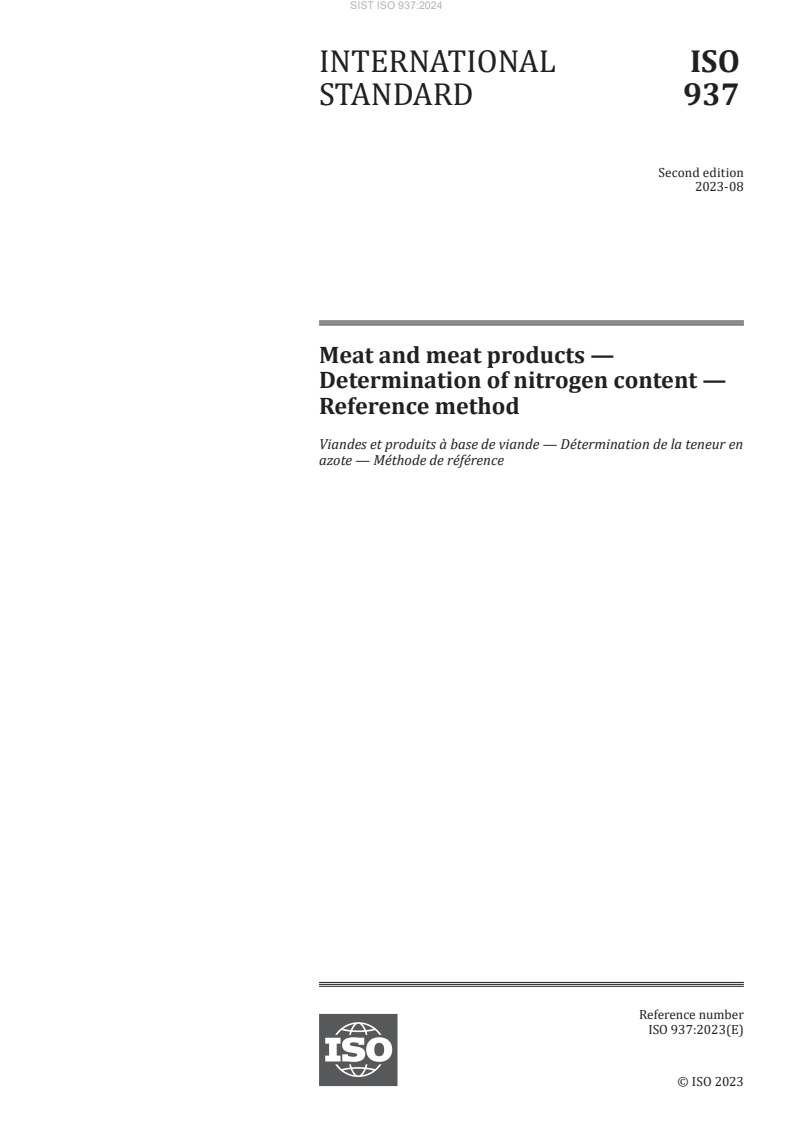
INTERNATIONAL ISO
STANDARD 937
Second edition
2023-08
Meat and meat products —
Determination of nitrogen content —
Reference method
Viandes et produits à base de viande — Détermination de la teneur en
azote — Méthode de référence
Reference number
© ISO 2023
All rights reserved. Unless otherwise specified, or required in the context of its implementation, no part of this publication may
be reproduced or utilized otherwise in any form or by any means, electronic or mechanical, including photocopying, or posting on
the internet or an intranet, without prior written permission. Permission can be requested from either ISO at the address below
or ISO’s member body in the country of the requester.
ISO copyright office
CP 401 • Ch. de Blandonnet 8
CH-1214 Vernier, Geneva
Phone: +41 22 749 01 11
Email: copyright@iso.org
Website: www.iso.org
Published in Switzerland
ii
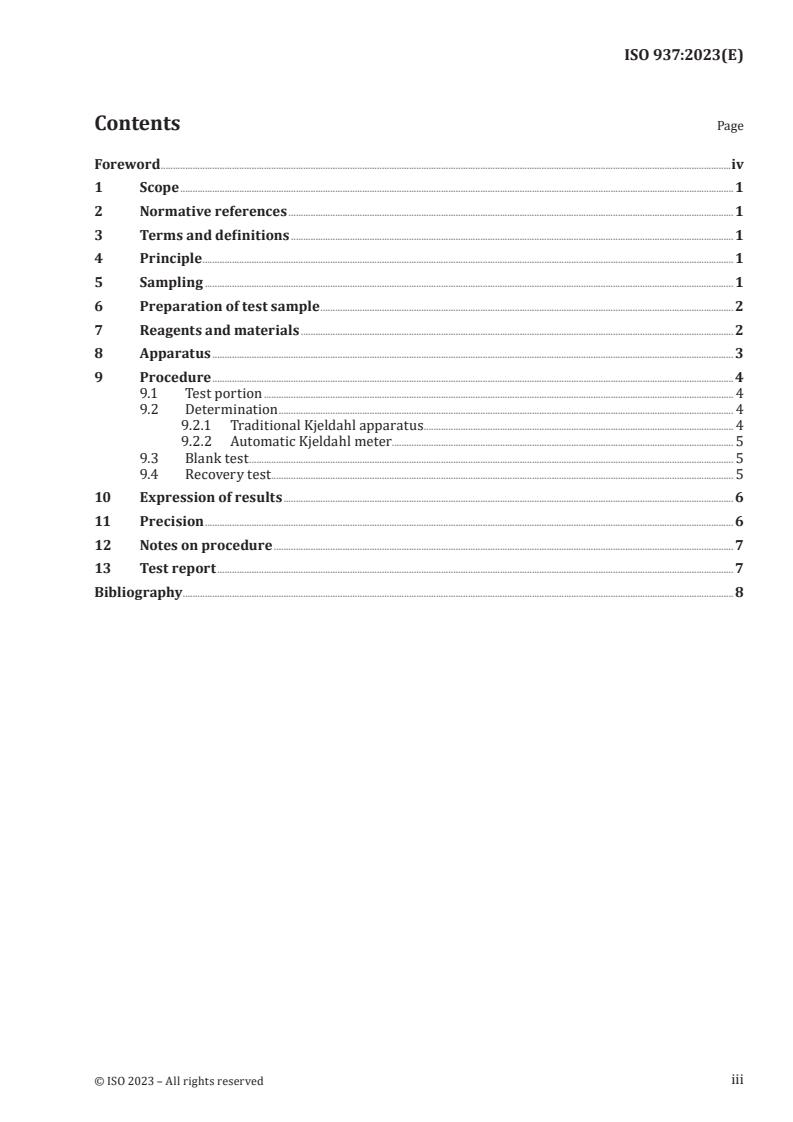
Contents Page
Foreword .iv
1 Scope . 1
2 Normative references . 1
3 Terms and definitions . 1
4 Principle . 1
5 Sampling . 1
6 Preparation of test sample . 2
7 Reagents and materials . 2
8 Apparatus . 3
9 Procedure .4
9.1 Test portion . 4
9.2 Determination . 4
9.2.1 Traditional Kjeldahl apparatus . 4
9.2.2 Automatic Kjeldahl meter. 5
9.3 Blank test . 5
9.4 Recovery test . 5
10 Expression of results . 6
11 Precision . 6
12 Notes on procedure . 7
13 Test report . 7
Bibliography . 8
iii
Foreword
ISO (the International Organization for Standardization) is a worldwide federation of national standards
bodies (ISO member bodies). The work of preparing International Standards is normally carried out
through ISO technical committees. Each member body interested in a subject for which a technical
committee has been established has the right to be represented on that committee. International
organizations, governmental and non-governmental, in liaison with ISO, also take part in the work.
ISO collaborates closely with the International Electrotechnical Commission (IEC) on all matters of
electrotechnical standardization.
The procedures used to develop this document and those intended for its further maintenance are
described in the ISO/IEC Directives, Part 1. In particular, the different approval criteria needed for the
different types of ISO document should be noted. This document was drafted in accordance with the
editorial rules of the ISO/IEC Directives, Part 2 (see www.iso.org/directives).
ISO draws attention to the possibility that the implementation of this document may involve the use
of (a) patent(s). ISO takes no position concerning the evidence, validity or applicability of any claimed
patent rights in respect thereof. As of the date of publication of this document, ISO had not received
notice of (a) patent(s) which may be required to implement this document. However, implementers are
cautioned that this may not represent the latest information, which may be obtained from the patent
database available at www.iso.org/patents. ISO shall not be held responsible for identifying any or all
such patent rights.
Any trade name used in this document is information given for the convenience of users and does not
constitute an endorsement.
For an explanation of the voluntary nature of standards, the meaning of ISO specific terms and
expressions related to conformity assessment, as well as information about ISO’s adherence to
the World Trade Organization (WTO) principles in the Technical Barriers to Trade (TBT), see
www.iso.org/iso/foreword.html.
This document was prepared by Technical Committee ISO/TC 34, Food products, Subcommittee SC 6,
Meat, poultry, fish, eggs and their products.
This second edition cancels and replaces the first edition (ISO 937:1978), which has been technically
revised.
The main changes are as follows:
— the automatic Kjeldahl method has been added;
— the order of the clauses of the document has been rearranged.
Any feedback or questions on this document should be directed to the user's national standards body. A
complete listing of these bodies can be found at www.iso.org/members.html.
iv
INTERNATIONAL STANDARD ISO 937:2023(E)
Meat and meat products — Determination of nitrogen
content — Reference method
1 Scope
This document specifies a reference method for the determination of the nitrogen content of meat and
meat products by the Kjeldahl principle.
2 Normative references
The following documents are referred to in the text in such a way that some or all of their content
constitutes requirements of this document. For dated references, only the edition cited applies. For
undated references, the latest edition of the referenced document (including any amendments) applies.
ISO 385, Laboratory glassware — Burettes
3 Terms and definitions
For the purposes of this document, the following terms and definitions apply.
ISO and IEC maintain terminology databases for use in standardization at the following addresses:
— ISO Online browsing platform: available at https:// www .iso .org/ obp
— IEC Electropedia: available at https:// www .electropedia .org/
3.1
nitrogen content
quantity of nitrogen corresponding to the ammonia produced
Note 1 to entry: As determined using the conditions specified in this document.
4 Principle
Digestion of a test portion with concentrated sulfuric acid, using copper(II) sulfate as a catalyst, to
convert organic nitrogen to ammonium ions; alkalization, distillation of the liberated ammonia into an
excess of boric acid solution, titration with hydrochloric acid or sulfuric acid to determine the ammonia
bound by the boric acid, and calculation of the nitrogen content of the sample from the amount of
ammonia produced.
5 Sampling
Sampling is not part of the method specified in this document. A recommended sampling method is
given in CAC/GL 50-2004.
It is important that the laboratory receive a sample which is truly representative and has not been
damaged or changed during transport or storage.
Start from a representative sample of at least 200 g.
Store the sample in such a way that deterioration and change in composition are prevented.
Preservatives, if any, should not contain nitrogen compounds in measurable amounts.
6 Preparation of test sample
Homogenize the laboratory sample with the appropriate equipment (8.1). Take care that the
temperature of the sample material does not rise above 25 °C. If a mincer is used, pass the sample at
least twice through the equipment.
Fill a suitable airtight container with the prepared test sample, close the container and store in such
a way that deterioration and change in composition are prevented. Analyse the test sample as soon as
practicable, but always within 24 h after homogenization.
7 Reagents and materials
All reagents shall be of recognized analytical quality. The water used shall be distilled water or water of
at least equivalent purity.
7.1 Copper(II) sulfate pentahydrate (CuSO ·5H O).
4 2
7.2 Potassium sulfate (K SO ), anhydrous.
2 4
7.3 Sulfuric acid (H SO ), ρ 1,84 g/ml.
2 4 20
7.4 Ethanol (C H OH), 95 % (volume fraction).
2 5
7.5 Ammonium sulfate [(NH ) SO ], minimum purity 99,9 % (mass fraction) on dried material.
4 2 4
Immediately before use, dry the ammonium sulfate at 104 °C ± 4 °C for at least 2 h.
Allow it to cool at ambient temperature in a desiccator.
7.6 Tryptophan (C H N O ) or lysine hydrochloride (C H ClN O ) or acetanilide (C H NO),
11 12 2 2 6 15 2 2 8 9
minimum purity 99,9 % (mass fraction).
These reagents should be kept away from humidity.
WARNING — Do not dry these reagents in an oven before use.
7.7 Sucrose, with nitrogen content less than a mass fraction of 0,002 %.
WARNING — Do not dry sucrose in an oven before use.
7.8 Sodium hydroxide (NaOH) solution, carbonate-free, containing approximately 33 g of sodium
hydroxide per 100 g of solution.
Dissolve 500 g of sodium hydroxide in 1 000 ml of water.
7.9 Boric acid solution, c(H BO ) = 40,0 g/l.
3 3
Dissolve 40 g of boric acid in water and dilute to 1 000 ml.
7.10 Standard hydrochloric acid, c(HCl) = (0,1 ± 0,000 5) mol/l or sulfuric acid,
c(H SO ) = (0,05 ± 0,000 3) mol/l, the normality being known to four decimal places.
2 4
7.11 Indicator solution, either 7.11.1 or 7.11.2.
7.11.1 Indicator solution A: mixed indicator (methyl red-methylene blue), prepared by dissolving
2 g of methyl red and 1 g of methylene blue in 1 000 ml of ethanol (7.4).
The colour change of this indicator solution occurs at a pH of 5,4.
7.11.2 Indicator solution B: mixed indicator (methyl red-bromocresol green), prepared by
dissolving 1 g of methyl red and 5 g of bromocresol green in 1 000 ml of ethanol (7.4).
The colour change of this indicator solution occurs at a pH of 5,2.
Store the indicator solution in a
...
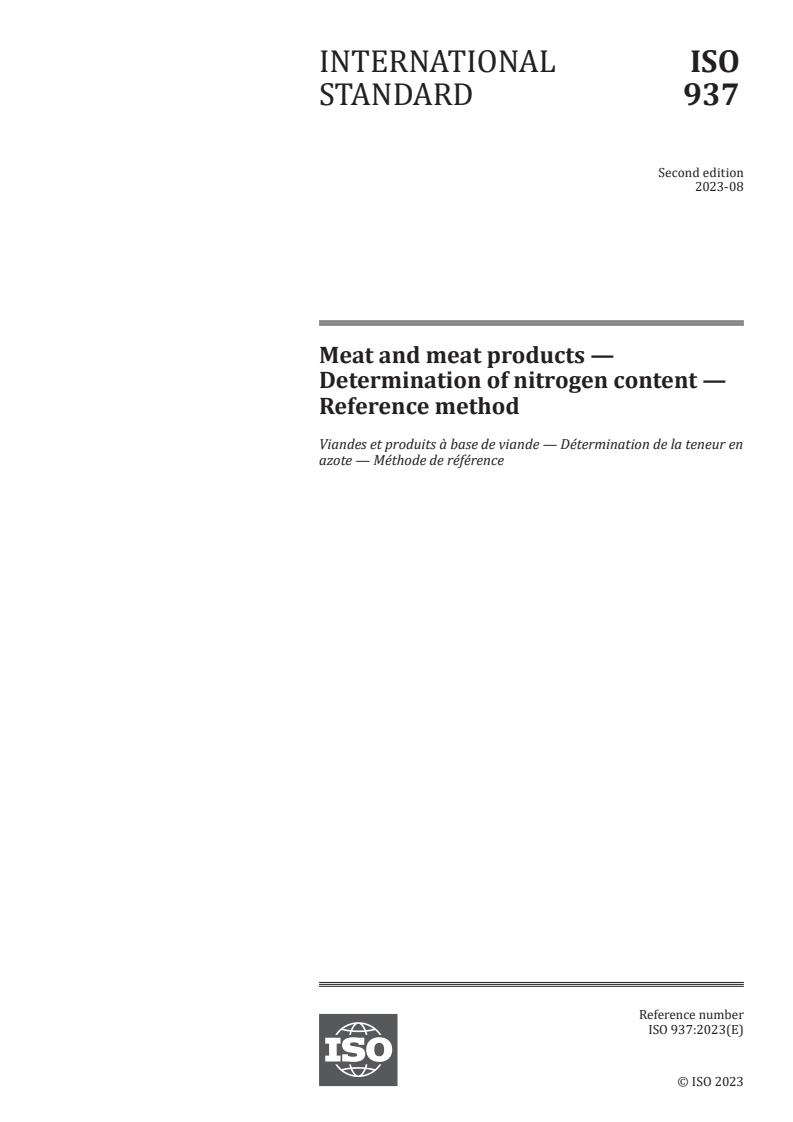
INTERNATIONAL ISO
STANDARD 937
Second edition
2023-08
Meat and meat products —
Determination of nitrogen content —
Reference method
Viandes et produits à base de viande — Détermination de la teneur en
azote — Méthode de référence
Reference number
© ISO 2023
All rights reserved. Unless otherwise specified, or required in the context of its implementation, no part of this publication may
be reproduced or utilized otherwise in any form or by any means, electronic or mechanical, including photocopying, or posting on
the internet or an intranet, without prior written permission. Permission can be requested from either ISO at the address below
or ISO’s member body in the country of the requester.
ISO copyright office
CP 401 • Ch. de Blandonnet 8
CH-1214 Vernier, Geneva
Phone: +41 22 749 01 11
Email: copyright@iso.org
Website: www.iso.org
Published in Switzerland
ii
Contents Page
Foreword .iv
1 Scope . 1
2 Normative references . 1
3 Terms and definitions . 1
4 Principle . 1
5 Sampling . 1
6 Preparation of test sample . 2
7 Reagents and materials . 2
8 Apparatus . 3
9 Procedure .4
9.1 Test portion . 4
9.2 Determination . 4
9.2.1 Traditional Kjeldahl apparatus . 4
9.2.2 Automatic Kjeldahl meter. 5
9.3 Blank test . 5
9.4 Recovery test . 5
10 Expression of results . 6
11 Precision . 6
12 Notes on procedure . 7
13 Test report . 7
Bibliography . 8
iii
Foreword
ISO (the International Organization for Standardization) is a worldwide federation of national standards
bodies (ISO member bodies). The work of preparing International Standards is normally carried out
through ISO technical committees. Each member body interested in a subject for which a technical
committee has been established has the right to be represented on that committee. International
organizations, governmental and non-governmental, in liaison with ISO, also take part in the work.
ISO collaborates closely with the International Electrotechnical Commission (IEC) on all matters of
electrotechnical standardization.
The procedures used to develop this document and those intended for its further maintenance are
described in the ISO/IEC Directives, Part 1. In particular, the different approval criteria needed for the
different types of ISO document should be noted. This document was drafted in accordance with the
editorial rules of the ISO/IEC Directives, Part 2 (see www.iso.org/directives).
ISO draws attention to the possibility that the implementation of this document may involve the use
of (a) patent(s). ISO takes no position concerning the evidence, validity or applicability of any claimed
patent rights in respect thereof. As of the date of publication of this document, ISO had not received
notice of (a) patent(s) which may be required to implement this document. However, implementers are
cautioned that this may not represent the latest information, which may be obtained from the patent
database available at www.iso.org/patents. ISO shall not be held responsible for identifying any or all
such patent rights.
Any trade name used in this document is information given for the convenience of users and does not
constitute an endorsement.
For an explanation of the voluntary nature of standards, the meaning of ISO specific terms and
expressions related to conformity assessment, as well as information about ISO’s adherence to
the World Trade Organization (WTO) principles in the Technical Barriers to Trade (TBT), see
www.iso.org/iso/foreword.html.
This document was prepared by Technical Committee ISO/TC 34, Food products, Subcommittee SC 6,
Meat, poultry, fish, eggs and their products.
This second edition cancels and replaces the first edition (ISO 937:1978), which has been technically
revised.
The main changes are as follows:
— the automatic Kjeldahl method has been added;
— the order of the clauses of the document has been rearranged.
Any feedback or questions on this document should be directed to the user's national standards body. A
complete listing of these bodies can be found at www.iso.org/members.html.
iv
INTERNATIONAL STANDARD ISO 937:2023(E)
Meat and meat products — Determination of nitrogen
content — Reference method
1 Scope
This document specifies a reference method for the determination of the nitrogen content of meat and
meat products by the Kjeldahl principle.
2 Normative references
The following documents are referred to in the text in such a way that some or all of their content
constitutes requirements of this document. For dated references, only the edition cited applies. For
undated references, the latest edition of the referenced document (including any amendments) applies.
ISO 385, Laboratory glassware — Burettes
3 Terms and definitions
For the purposes of this document, the following terms and definitions apply.
ISO and IEC maintain terminology databases for use in standardization at the following addresses:
— ISO Online browsing platform: available at https:// www .iso .org/ obp
— IEC Electropedia: available at https:// www .electropedia .org/
3.1
nitrogen content
quantity of nitrogen corresponding to the ammonia produced
Note 1 to entry: As determined using the conditions specified in this document.
4 Principle
Digestion of a test portion with concentrated sulfuric acid, using copper(II) sulfate as a catalyst, to
convert organic nitrogen to ammonium ions; alkalization, distillation of the liberated ammonia into an
excess of boric acid solution, titration with hydrochloric acid or sulfuric acid to determine the ammonia
bound by the boric acid, and calculation of the nitrogen content of the sample from the amount of
ammonia produced.
5 Sampling
Sampling is not part of the method specified in this document. A recommended sampling method is
given in CAC/GL 50-2004.
It is important that the laboratory receive a sample which is truly representative and has not been
damaged or changed during transport or storage.
Start from a representative sample of at least 200 g.
Store the sample in such a way that deterioration and change in composition are prevented.
Preservatives, if any, should not contain nitrogen compounds in measurable amounts.
6 Preparation of test sample
Homogenize the laboratory sample with the appropriate equipment (8.1). Take care that the
temperature of the sample material does not rise above 25 °C. If a mincer is used, pass the sample at
least twice through the equipment.
Fill a suitable airtight container with the prepared test sample, close the container and store in such
a way that deterioration and change in composition are prevented. Analyse the test sample as soon as
practicable, but always within 24 h after homogenization.
7 Reagents and materials
All reagents shall be of recognized analytical quality. The water used shall be distilled water or water of
at least equivalent purity.
7.1 Copper(II) sulfate pentahydrate (CuSO ·5H O).
4 2
7.2 Potassium sulfate (K SO ), anhydrous.
2 4
7.3 Sulfuric acid (H SO ), ρ 1,84 g/ml.
2 4 20
7.4 Ethanol (C H OH), 95 % (volume fraction).
2 5
7.5 Ammonium sulfate [(NH ) SO ], minimum purity 99,9 % (mass fraction) on dried material.
4 2 4
Immediately before use, dry the ammonium sulfate at 104 °C ± 4 °C for at least 2 h.
Allow it to cool at ambient temperature in a desiccator.
7.6 Tryptophan (C H N O ) or lysine hydrochloride (C H ClN O ) or acetanilide (C H NO),
11 12 2 2 6 15 2 2 8 9
minimum purity 99,9 % (mass fraction).
These reagents should be kept away from humidity.
WARNING — Do not dry these reagents in an oven before use.
7.7 Sucrose, with nitrogen content less than a mass fraction of 0,002 %.
WARNING — Do not dry sucrose in an oven before use.
7.8 Sodium hydroxide (NaOH) solution, carbonate-free, containing approximately 33 g of sodium
hydroxide per 100 g of solution.
Dissolve 500 g of sodium hydroxide in 1 000 ml of water.
7.9 Boric acid solution, c(H BO ) = 40,0 g/l.
3 3
Dissolve 40 g of boric acid in water and dilute to 1 000 ml.
7.10 Standard hydrochloric acid, c(HCl) = (0,1 ± 0,000 5) mol/l or sulfuric acid,
c(H SO ) = (0,05 ± 0,000 3) mol/l, the normality being known to four decimal places.
2 4
7.11 Indicator solution, either 7.11.1 or 7.11.2.
7.11.1 Indicator solution A: mixed indicator (methyl red-methylene blue), prepared by dissolving
2 g of methyl red and 1 g of methylene blue in 1 000 ml of ethanol (7.4).
The colour change of this indicator solution occurs at a pH of 5,4.
7.11.2 Indicator solution B: mixed indicator (methyl red-bromocresol green), prepared by
dissolving 1 g of methyl red and 5 g of bromocresol green in 1 000 ml of ethanol (7.4).
The colour change of this indicator solution occurs at a pH of 5,2.
Store the indicator solution in a brown bottle in a dark and cool place.
7.12 Boiling regulators, either 7.12.1 or 7.12.2.
7.12.1 For the digestion: glass beads, silicon carbide or splinters of hard porcelain.
7.12.2 For the distillation: silicon carbide or freshly ignited pieces of pumice stone.
8 Apparatus
The usual laboratory apparatus and, in particular, the following shall be used.
8.1 Mechanical or electrical equipment capable of homogenizing the laboratory sample,
including a high-speed ro
...