

ISO 17577:2016
(Main)Steel — Ultrasonic testing of steel flat products of thickness equal to or greater than 6 mm
General Information
- Abstract
ISO 17577:2016 specifies a method for the automated and/or manual ultrasonic testing of uncoated steel flat products for internal discontinuities by the pulse echo technique. It is applicable to non-alloyed or alloyed steel flat products, in a nominal thickness range of 6 mm to 200 mm. However, this International Standard may be applied to austenitic and austenitic-ferritic steels, provided that the difference between the amplitude of the noise signal and that of the echo detection threshold is sufficient for the limit fixed. Unless otherwise agreed, for testing of steel flat products for welded steel tubes, ISO 10893‑9 applies. Other techniques of testing (e.g. by transmission) or other test equipment may be used at the manufacturer's discretion, provided that they give identical results to those obtained under the conditions of this International Standard. In the event of a dispute, only the method defined in this International Standard will prevail. Testing of flat products, of thickness less than 6 mm and over 200 mm, may be the subject of special agreements between the parties concerned. Testing is normally carried out in the place of production or on the premises of the supplier.
- Status
- Published
- Publication Date
- 03-Jan-2016
- Current Stage
- 9020 - International Standard under periodical review
- Start Date
- 15-Jul-2026
- Completion Date
- 15-Jul-2026
Buy Documents


ISO 17577:2016 - Steel -- Ultrasonic testing of steel flat products of thickness equal to or greater than 6 mm


ISO 17577:2016 - Steel — Ultrasonic testing of steel flat products of thickness equal to or greater than 6 mm/18/2016


ISO 17577:2016 - Aciers -- Contrôle ultrasonore des produits plats en acier d'épaisseur égale ou supérieure à 6 mm
ISO 17577:2016 - Aciers — Contrôle ultrasonore des produits plats en acier d'épaisseur égale ou supérieure à 6 mm/4/2016
Overview
ISO 17577:2016 defines a standardized method for ultrasonic testing (UT) of uncoated steel flat products with nominal thicknesses from 6 mm to 200 mm. Using the pulse-echo technique, the standard covers both manual and automated inspection for internal discontinuities (planar/laminar imperfections, inclusion bands, clusters). It sets out test principles, equipment and probe requirements, calibration and sensitivity rules, scanning plans, acceptance criteria and reporting - ensuring consistent, reproducible non‑destructive testing (NDT) of steel plate and strip.
Key topics and technical requirements
- Scope & applicability: Non‑alloyed and alloyed steels; can be applied to austenitic and duplex steels only if signal‑to‑noise allows. For welded tube plate used in welded steel tubes, ISO 10893‑9 applies unless agreed otherwise.
- Testing principle: Pulse‑echo inspection with normal incidence; defect sizing by the DGS (distance‑gain‑size) method and area contouring by the 6 dB drop technique. Examination normally from one side only.
- Personnel qualifications: Operators must be qualified (minimum Level 1 for manual work; Level 2/3 responsible for automated testing) per ISO 9712 / ISO 11484 or equivalent.
- Equipment & performance:
- Instruments with gain calibrated in decibels, time‑base control, A‑scan display for manual testing, gating and output for recording/mapping.
- Linearity limits for amplifiers (vertical/horizontal) and recommended annual checks.
- Dead zone limits: single‑element probe dead zone ≤ 15% of thickness or 15 mm (whichever smaller); ≤ 1.5 mm for products < 10 mm.
- Probes: Guidance (from table) recommends dual‑element probes for 6–60 mm and single or dual for 60–200 mm; nominal frequency typically 2–5 MHz; transducer dimension ≤ 30 mm.
- Automated systems: Requirements for mechanical scanning, probe holders following contour, data acquisition, DAC/DGS capability, PRF control tied to scan speed, and mapping/location output.
- Calibration & evaluation: Use reference blocks, DAC/DGS, alarm gates, and documented sensitivity/range settings. In disputes, the standard’s prescribed methods prevail.
Practical applications & who uses it
- Manufacturers and suppliers of steel plate, strip and flat products for quality control and acceptance testing.
- NDT service providers performing production inspection, incoming material testing, or supplier verification.
- Fabricators and purchasers specifying acceptance criteria for internal defects in structural, pressure‑containing or formed steel components.
Related standards
- ISO 9712 - Qualification and certification of NDT personnel
- ISO 10893‑9 - Automated UT for strip/plate used in welded steel tubes
- ISO 11484 - Employer’s qualification system for NDT personnel
ISO 17577 supports reliable ultrasonic inspection practices, helping organizations achieve consistent detection, sizing and documentation of internal discontinuities in steel flat products.
Relations
- Effective Date
- 25-Aug-2026
- Effective Date
- 24-Nov-2012
Buy Documents
ISO 17577:2016 - Steel -- Ultrasonic testing of steel flat products of thickness equal to or greater than 6 mm
ISO 17577:2016 - Steel — Ultrasonic testing of steel flat products of thickness equal to or greater than 6 mm/18/2016
ISO 17577:2016 - Aciers -- Contrôle ultrasonore des produits plats en acier d'épaisseur égale ou supérieure à 6 mm
ISO 17577:2016 - Aciers — Contrôle ultrasonore des produits plats en acier d'épaisseur égale ou supérieure à 6 mm/4/2016
Get Certified
Connect with accredited certification bodies for this standard

Element Materials Technology
Materials testing and product certification.

Inštitut za kovinske materiale in tehnologije
Institute of Metals and Technology. Materials testing, metallurgical analysis, NDT.
Sponsored listings
Frequently Asked Questions
ISO 17577:2016 is a standard published by the International Organization for Standardization (ISO). Its full title is "Steel — Ultrasonic testing of steel flat products of thickness equal to or greater than 6 mm". This standard covers: ISO 17577:2016 specifies a method for the automated and/or manual ultrasonic testing of uncoated steel flat products for internal discontinuities by the pulse echo technique. It is applicable to non-alloyed or alloyed steel flat products, in a nominal thickness range of 6 mm to 200 mm. However, this International Standard may be applied to austenitic and austenitic-ferritic steels, provided that the difference between the amplitude of the noise signal and that of the echo detection threshold is sufficient for the limit fixed. Unless otherwise agreed, for testing of steel flat products for welded steel tubes, ISO 10893‑9 applies. Other techniques of testing (e.g. by transmission) or other test equipment may be used at the manufacturer's discretion, provided that they give identical results to those obtained under the conditions of this International Standard. In the event of a dispute, only the method defined in this International Standard will prevail. Testing of flat products, of thickness less than 6 mm and over 200 mm, may be the subject of special agreements between the parties concerned. Testing is normally carried out in the place of production or on the premises of the supplier.
ISO 17577:2016 specifies a method for the automated and/or manual ultrasonic testing of uncoated steel flat products for internal discontinuities by the pulse echo technique. It is applicable to non-alloyed or alloyed steel flat products, in a nominal thickness range of 6 mm to 200 mm. However, this International Standard may be applied to austenitic and austenitic-ferritic steels, provided that the difference between the amplitude of the noise signal and that of the echo detection threshold is sufficient for the limit fixed. Unless otherwise agreed, for testing of steel flat products for welded steel tubes, ISO 10893‑9 applies. Other techniques of testing (e.g. by transmission) or other test equipment may be used at the manufacturer's discretion, provided that they give identical results to those obtained under the conditions of this International Standard. In the event of a dispute, only the method defined in this International Standard will prevail. Testing of flat products, of thickness less than 6 mm and over 200 mm, may be the subject of special agreements between the parties concerned. Testing is normally carried out in the place of production or on the premises of the supplier.
ISO 17577:2016 is classified under the following ICS (International Classification for Standards) categories: 77.040.20 - Non-destructive testing of metals; 77.140.50 - Flat steel products and semi-products. The ICS classification helps identify the subject area and facilitates finding related standards.
ISO 17577:2016 has the following relationships with other standards: It is inter standard links to EN ISO 4957:2018, ISO 17577:2006. Understanding these relationships helps ensure you are using the most current and applicable version of the standard.
ISO 17577:2016 is available in PDF format for immediate download after purchase. The document can be added to your cart and obtained through the secure checkout process. Digital delivery ensures instant access to the complete standard document.
Standards Content (Sample)
INTERNATIONAL ISO
STANDARD 17577
Second edition
2016-01-15
Corrected version
2016-03-01
Steel — Ultrasonic testing of steel
flat products of thickness equal to or
greater than 6 mm
Aciers — Contrôle ultrasonore des produits plats en acier d’épaisseur
égale ou supérieure à 6 mm
Reference number
©
ISO 2016
© ISO 2016, Published in Switzerland
All rights reserved. Unless otherwise specified, no part of this publication may be reproduced or utilized otherwise in any form
or by any means, electronic or mechanical, including photocopying, or posting on the internet or an intranet, without prior
written permission. Permission can be requested from either ISO at the address below or ISO’s member body in the country of
the requester.
ISO copyright office
Ch. de Blandonnet 8 • CP 401
CH-1214 Vernier, Geneva, Switzerland
Tel. +41 22 749 01 11
Fax +41 22 749 09 47
copyright@iso.org
www.iso.org
ii © ISO 2016 – All rights reserved
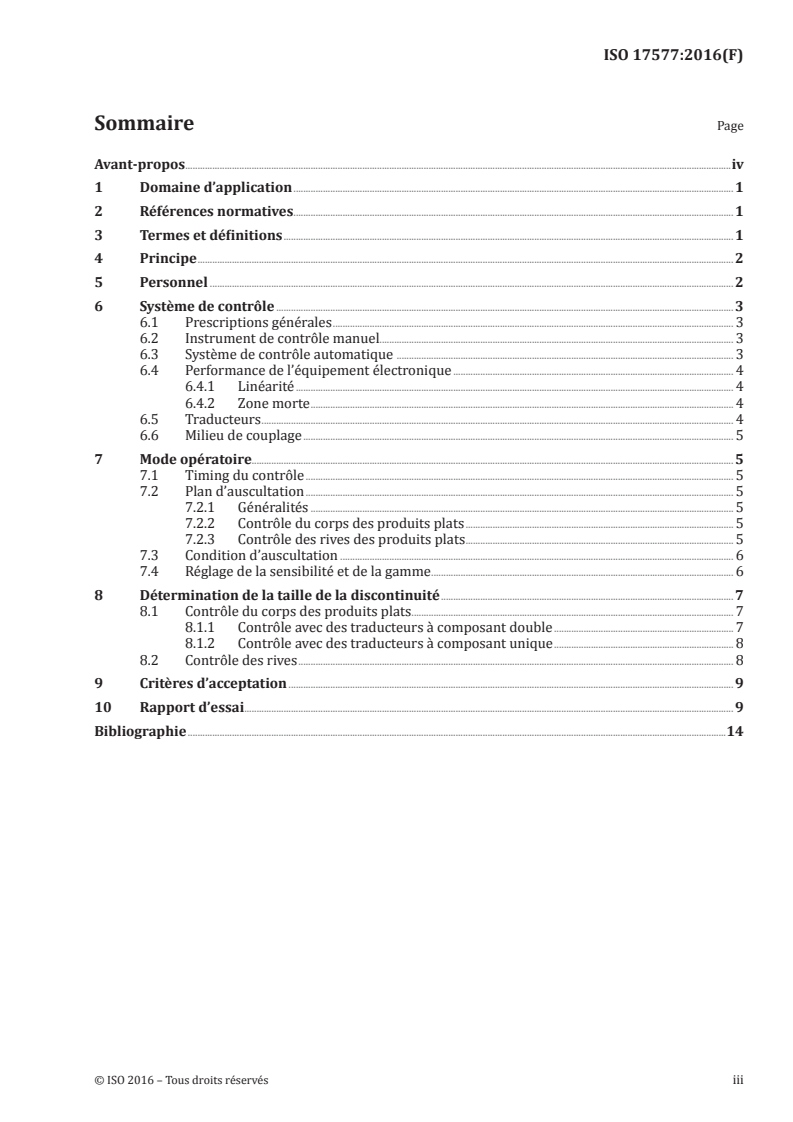
Contents Page
Foreword .iv
1 Scope . 1
2 Normative references . 1
3 Terms and definitions . 1
4 Principle . 2
5 Personnel . 2
6 Testing system . 3
6.1 General requirements . 3
6.2 Manual testing instrument . 3
6.3 Automated testing system . 3
6.4 Performance of electronic equipment . 3
6.4.1 Linearity . 3
6.4.2 Dead zone . 4
6.5 Probes . 4
6.6 Coupling medium . 4
7 Test procedure . 4
7.1 Time of testing . 4
7.2 Scanning plan . 5
7.2.1 General. 5
7.2.2 Testing of the flat-product body . 5
7.2.3 Testing of the edges of the flat products. 5
7.3 Scanning condition . 5
7.4 Sensitivity and range setting . 6
8 Determination of the discontinuity size . 7
8.1 Testing the flat-product body . 7
8.1.1 Testing with dual-element probes . 7
8.1.2 Testing with single-element probes . 7
8.2 Testing the edges . 8
9 Acceptance criteria . 8
10 Test report . 8
Bibliography .13
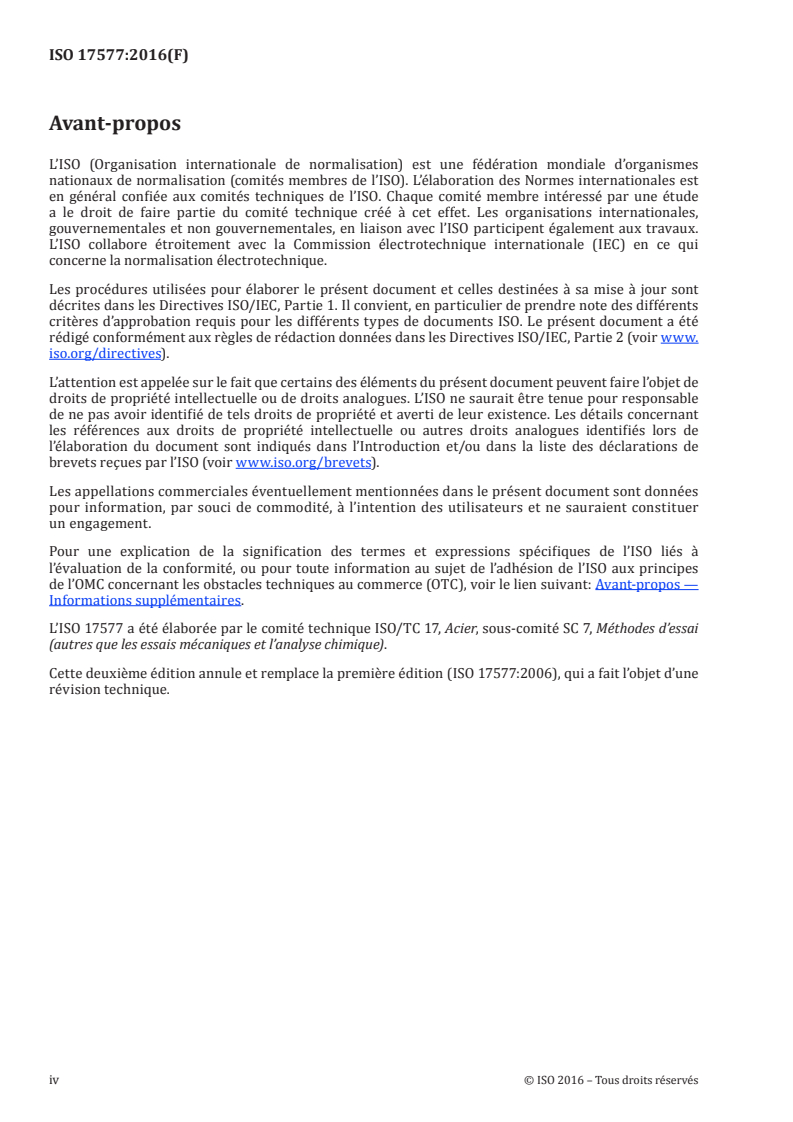
Foreword
ISO (the International Organization for Standardization) is a worldwide federation of national standards
bodies (ISO member bodies). The work of preparing International Standards is normally carried out
through ISO technical committees. Each member body interested in a subject for which a technical
committee has been established has the right to be represented on that committee. International
organizations, governmental and non-governmental, in liaison with ISO, also take part in the work.
ISO collaborates closely with the International Electrotechnical Commission (IEC) on all matters of
electrotechnical standardization.
The procedures used to develop this document and those intended for its further maintenance are
described in the ISO/IEC Directives, Part 1. In particular the different approval criteria needed for the
different types of ISO documents should be noted. This document was drafted in accordance with the
editorial rules of the ISO/IEC Directives, Part 2 (see www.iso.org/directives).
Attention is drawn to the possibility that some of the elements of this document may be the subject of
patent rights. ISO shall not be held responsible for identifying any or all such patent rights. Details of
any patent rights identified during the development of the document will be in the Introduction and/or
on the ISO list of patent declarations received (see www.iso.org/patents).
Any trade name used in this document is information given for the convenience of users and does not
constitute an endorsement.
For an explanation on the meaning of ISO specific terms and expressions related to conformity
assessment, as well as information about ISO’s adherence to the WTO principles in the Technical
Barriers to Trade (TBT) see the following URL: Foreword - Supplementary information
The committee responsible for this document is ISO/TC 17, Steel, Subcommittee SC 7, Methods of testing
(other than mechanical tests and chemical analysis).
This second edition cancels and replaces the first edition (ISO 17577:2006), which has been
technically revised.
This corrected version of ISO 17577:2016 incorporates the following corrections.
b b
Table 4 (third column, third row) “100 < S ≤ 5000” was changed to “100 < S ≤ 500”.
iv © ISO 2016 – All rights reserved
INTERNATIONAL STANDARD ISO 17577:2016(E)
Steel — Ultrasonic testing of steel flat products of thickness
equal to or greater than 6 mm
1 Scope
This International Standard specifies a method for the automated and/or manual ultrasonic testing of
uncoated steel flat products for internal discontinuities by the pulse echo technique.
It is applicable to non-alloyed or alloyed steel flat products, in a nominal thickness range of 6 mm to
200 mm. However, this International Standard may be applied to austenitic and austenitic-ferritic steels,
provided that the difference between the amplitude of the noise signal and that of the echo detection
threshold is sufficient for the limit fixed. Unless otherwise agreed, for testing of steel flat products for
welded steel tubes, ISO 10893-9 applies.
Other techniques of testing (e.g. by transmission) or other test equipment may be used at the
manufacturer’s discretion, provided that they give identical results to those obtained under the
conditions of this International Standard. In the event of a dispute, only the method defined in this
International Standard will prevail.
Testing of flat products, of thickness less than 6 mm and over 200 mm, may be the subject of special
agreements between the parties concerned.
Testing is normally carried out in the place of production or on the premises of the supplier.
2 Normative references
The following documents, in whole or in part, are normatively referenced in this document and are
indispensable for its application. For dated references, only the edition cited applies. For undated
references, the latest edition of the referenced document (including any amendments) applies.
ISO 9712, Non-destructive testing — Qualification and certification of NDT personnel
ISO 10893-9, Non-destructive testing of steel tubes — Part 9: Automated ultrasonic testing for the detection
of laminar imperfections in strip/plate used for the manufacture of welded steel tubes
ISO 11484, Steel products — Employer’s qualification system for non-destructive testing (NDT) personnel
3 Terms and definitions
For the purposes of this document, the following terms and definitions apply.
3.1
internal discontinuity
any imperfection lying within the thickness of the flat products, e.g. planar or laminar imperfection,
single-plane or multi-plane inclusion bands or clusters
3.2
defect
unacceptable internal discontinuities, i.e. exceeding the specified maximum size or population
density limits
3.3
population density
number of individual internal discontinuities of a size greater than a specified minimum size and less
than a specified maximum size per specified area of body or length of edge zone
3.4
manual and assisted manual testing
testing by an operator applying an ultrasonic probe to the flat-product surface, manually executing
the appropriate scanning pattern on the flat-product surface and visually assessing ultrasonic signal
indications on the electronic equipment screen either by direct viewing or by built-in signal amplitude
alarm devices
3.5
automated and semi-automated testing
testing using a mechanized means of applying the ultrasonic probe or probes to the flat-product
surface and executing the appropriate scanning pattern, together with ultrasonic signal evaluation by
electronic means
Note 1 to entry: Such testing can be either fully automated with no operator involvement or semi-automated
when the operator performs basic equipment operation functions.
3.6
dead zone
zone adjacent to the scanning surface within which reflectors of interest are not revealed
4 Principle
The method used is based on the reflection of ultrasonic waves (generally longitudinal waves), the
mean direction of which is perpendicular to the main surface of the flat products.
The examination consists of the following:
a) locating any discontinuity by comparing the amplitude of the discontinuity echo with the
amplitude of the echo of a flat-bottomed hole of a given diameter and located at the same depth as
the discontinuity (DGS-method);
NOTE Only those discontinuities giving an echo height exceeding in amplitude that of the echo obtained
with the reference flat-bottomed hole are taken into consideration.
b) Then determining its area, the contour of the discontinuity being defined by the positions of the
centre of the probe corresponding to an echo amplitude of half the maximum amplitude of the
discontinuity under consideration (6 dB drop technique).
The examination shall be carried out from one side only.
In the case of automated testing, the location of a discontinuity and the determination of its area can
be realized using different algorithms together with high scanning density. In case of dispute, the 6 dB
drop technique in 8.1.1 should be used.
5 Personnel
Automated testing shall be carried out only by qualified personnel under the responsibility of Level
2 or Level 3 qualified person. Qualification shall include regular training, success in examination,
experience and satisfactory vision test according to the standards mentioned below. Manual testing
shall be carried out only by personnel qualified at minimum Level 1 and under the responsibility of
Level 2 or Level 3 qualified person.
Qualification of the responsible person shall be in accordance with ISO 9712, ISO 11484 or an
appropriate national/ regional standard.
NOTE Examples of appropriate standards are listed in the Bibliography.
2 © ISO 2016 – All rights reserved
6 Testing system
6.1 General requirements
The pulse echo technique with normal incidence to the scanning surface shall be used for the
ultrasonic testing.
The instrument shall be equipped with time-base regulation and the gain control shall be calibrated in
decibels. The electronic equipment shall be appropriate for the ultrasonic probes and frequencies used.
The transmitted pulse repetition frequency shall be appropriate for the applied scanning speed.
The instrument shall detect the ultrasonic signals of internal discontinuities by using a gate function.
The output signal shall be provided for devices like display monitor or recording equipment.
The coupling medium shall ensure an adequate contact between the probe and the surface of the flat
products and maintain sufficient coupling during scanning.
6.2 Manual testing instrument
The instrument shall be equipped with an A-scan display monitor that allows the assessment of the path
of ultrasonic waves in the flat products. The A-scan shall be clearly visible, the peaks corresponding to
the successive echoes being sharp and very clear.
6.3 Automated testing system
The automated testing system shall be equipped with the following:
a) a suitable mechanical means for scanning the surface of flat products with a defined density;
b) probe holders that are capable of following the surface contour of a flat product to be tested, in
order to maintain normal incidence;
c) appropriate electronics including, for example, transmitters, receivers, multiplexer, gates, display
monitor, as well as a means for data collection;
d) appropriate means for signal evaluation, recording (e.g. mapping) and storing;
e) means for setting of equipment (i.e. test sensitivity, range and gate position), for example, by the
use of reference blocks, input of artificial signals, downloading distance-amplitude curves (DAC) or
downloading stored calibration files;
f) means for control of pulse repetition frequency related to the scanning speed;
g) means for coupling and function check (e.g. by surveillance of back-wall echo);
h) function to indicate the location of discontinuities with reference to an edge of the flat product
(printer, recorder or display).
6.4 Performance of electronic equipment
6.4.1 Linearity
a) Linear amplifiers: the deviation of the vertical linearity shall not exceed ± 1 dB in any part of a 20
dB span.
b) Logarithmic amplifiers:
...
INTERNATIONAL ISO
STANDARD 17577
Second edition
2016-01-15
Corrected version
2016-03-01
Steel — Ultrasonic testing of steel
flat products of thickness equal to or
greater than 6 mm
Aciers — Contrôle ultrasonore des produits plats en acier d’épaisseur
égale ou supérieure à 6 mm
Reference number
©
ISO 2016
© ISO 2016, Published in Switzerland
All rights reserved. Unless otherwise specified, no part of this publication may be reproduced or utilized otherwise in any form
or by any means, electronic or mechanical, including photocopying, or posting on the internet or an intranet, without prior
written permission. Permission can be requested from either ISO at the address below or ISO’s member body in the country of
the requester.
ISO copyright office
Ch. de Blandonnet 8 • CP 401
CH-1214 Vernier, Geneva, Switzerland
Tel. +41 22 749 01 11
Fax +41 22 749 09 47
copyright@iso.org
www.iso.org
ii © ISO 2016 – All rights reserved
Contents Page
Foreword .iv
1 Scope . 1
2 Normative references . 1
3 Terms and definitions . 1
4 Principle . 2
5 Personnel . 2
6 Testing system . 3
6.1 General requirements . 3
6.2 Manual testing instrument . 3
6.3 Automated testing system . 3
6.4 Performance of electronic equipment . 3
6.4.1 Linearity . 3
6.4.2 Dead zone . 4
6.5 Probes . 4
6.6 Coupling medium . 4
7 Test procedure . 4
7.1 Time of testing . 4
7.2 Scanning plan . 5
7.2.1 General. 5
7.2.2 Testing of the flat-product body . 5
7.2.3 Testing of the edges of the flat products. 5
7.3 Scanning condition . 5
7.4 Sensitivity and range setting . 6
8 Determination of the discontinuity size . 7
8.1 Testing the flat-product body . 7
8.1.1 Testing with dual-element probes . 7
8.1.2 Testing with single-element probes . 7
8.2 Testing the edges . 8
9 Acceptance criteria . 8
10 Test report . 8
Bibliography .13
Foreword
ISO (the International Organization for Standardization) is a worldwide federation of national standards
bodies (ISO member bodies). The work of preparing International Standards is normally carried out
through ISO technical committees. Each member body interested in a subject for which a technical
committee has been established has the right to be represented on that committee. International
organizations, governmental and non-governmental, in liaison with ISO, also take part in the work.
ISO collaborates closely with the International Electrotechnical Commission (IEC) on all matters of
electrotechnical standardization.
The procedures used to develop this document and those intended for its further maintenance are
described in the ISO/IEC Directives, Part 1. In particular the different approval criteria needed for the
different types of ISO documents should be noted. This document was drafted in accordance with the
editorial rules of the ISO/IEC Directives, Part 2 (see www.iso.org/directives).
Attention is drawn to the possibility that some of the elements of this document may be the subject of
patent rights. ISO shall not be held responsible for identifying any or all such patent rights. Details of
any patent rights identified during the development of the document will be in the Introduction and/or
on the ISO list of patent declarations received (see www.iso.org/patents).
Any trade name used in this document is information given for the convenience of users and does not
constitute an endorsement.
For an explanation on the meaning of ISO specific terms and expressions related to conformity
assessment, as well as information about ISO’s adherence to the WTO principles in the Technical
Barriers to Trade (TBT) see the following URL: Foreword - Supplementary information
The committee responsible for this document is ISO/TC 17, Steel, Subcommittee SC 7, Methods of testing
(other than mechanical tests and chemical analysis).
This second edition cancels and replaces the first edition (ISO 17577:2006), which has been
technically revised.
This corrected version of ISO 17577:2016 incorporates the following corrections.
b b
Table 4 (third column, third row) “100 < S ≤ 5000” was changed to “100 < S ≤ 500”.
iv © ISO 2016 – All rights reserved
INTERNATIONAL STANDARD ISO 17577:2016(E)
Steel — Ultrasonic testing of steel flat products of thickness
equal to or greater than 6 mm
1 Scope
This International Standard specifies a method for the automated and/or manual ultrasonic testing of
uncoated steel flat products for internal discontinuities by the pulse echo technique.
It is applicable to non-alloyed or alloyed steel flat products, in a nominal thickness range of 6 mm to
200 mm. However, this International Standard may be applied to austenitic and austenitic-ferritic steels,
provided that the difference between the amplitude of the noise signal and that of the echo detection
threshold is sufficient for the limit fixed. Unless otherwise agreed, for testing of steel flat products for
welded steel tubes, ISO 10893-9 applies.
Other techniques of testing (e.g. by transmission) or other test equipment may be used at the
manufacturer’s discretion, provided that they give identical results to those obtained under the
conditions of this International Standard. In the event of a dispute, only the method defined in this
International Standard will prevail.
Testing of flat products, of thickness less than 6 mm and over 200 mm, may be the subject of special
agreements between the parties concerned.
Testing is normally carried out in the place of production or on the premises of the supplier.
2 Normative references
The following documents, in whole or in part, are normatively referenced in this document and are
indispensable for its application. For dated references, only the edition cited applies. For undated
references, the latest edition of the referenced document (including any amendments) applies.
ISO 9712, Non-destructive testing — Qualification and certification of NDT personnel
ISO 10893-9, Non-destructive testing of steel tubes — Part 9: Automated ultrasonic testing for the detection
of laminar imperfections in strip/plate used for the manufacture of welded steel tubes
ISO 11484, Steel products — Employer’s qualification system for non-destructive testing (NDT) personnel
3 Terms and definitions
For the purposes of this document, the following terms and definitions apply.
3.1
internal discontinuity
any imperfection lying within the thickness of the flat products, e.g. planar or laminar imperfection,
single-plane or multi-plane inclusion bands or clusters
3.2
defect
unacceptable internal discontinuities, i.e. exceeding the specified maximum size or population
density limits
3.3
population density
number of individual internal discontinuities of a size greater than a specified minimum size and less
than a specified maximum size per specified area of body or length of edge zone
3.4
manual and assisted manual testing
testing by an operator applying an ultrasonic probe to the flat-product surface, manually executing
the appropriate scanning pattern on the flat-product surface and visually assessing ultrasonic signal
indications on the electronic equipment screen either by direct viewing or by built-in signal amplitude
alarm devices
3.5
automated and semi-automated testing
testing using a mechanized means of applying the ultrasonic probe or probes to the flat-product
surface and executing the appropriate scanning pattern, together with ultrasonic signal evaluation by
electronic means
Note 1 to entry: Such testing can be either fully automated with no operator involvement or semi-automated
when the operator performs basic equipment operation functions.
3.6
dead zone
zone adjacent to the scanning surface within which reflectors of interest are not revealed
4 Principle
The method used is based on the reflection of ultrasonic waves (generally longitudinal waves), the
mean direction of which is perpendicular to the main surface of the flat products.
The examination consists of the following:
a) locating any discontinuity by comparing the amplitude of the discontinuity echo with the
amplitude of the echo of a flat-bottomed hole of a given diameter and located at the same depth as
the discontinuity (DGS-method);
NOTE Only those discontinuities giving an echo height exceeding in amplitude that of the echo obtained
with the reference flat-bottomed hole are taken into consideration.
b) Then determining its area, the contour of the discontinuity being defined by the positions of the
centre of the probe corresponding to an echo amplitude of half the maximum amplitude of the
discontinuity under consideration (6 dB drop technique).
The examination shall be carried out from one side only.
In the case of automated testing, the location of a discontinuity and the determination of its area can
be realized using different algorithms together with high scanning density. In case of dispute, the 6 dB
drop technique in 8.1.1 should be used.
5 Personnel
Automated testing shall be carried out only by qualified personnel under the responsibility of Level
2 or Level 3 qualified person. Qualification shall include regular training, success in examination,
experience and satisfactory vision test according to the standards mentioned below. Manual testing
shall be carried out only by personnel qualified at minimum Level 1 and under the responsibility of
Level 2 or Level 3 qualified person.
Qualification of the responsible person shall be in accordance with ISO 9712, ISO 11484 or an
appropriate national/ regional standard.
NOTE Examples of appropriate standards are listed in the Bibliography.
2 © ISO 2016 – All rights reserved
6 Testing system
6.1 General requirements
The pulse echo technique with normal incidence to the scanning surface shall be used for the
ultrasonic testing.
The instrument shall be equipped with time-base regulation and the gain control shall be calibrated in
decibels. The electronic equipment shall be appropriate for the ultrasonic probes and frequencies used.
The transmitted pulse repetition frequency shall be appropriate for the applied scanning speed.
The instrument shall detect the ultrasonic signals of internal discontinuities by using a gate function.
The output signal shall be provided for devices like display monitor or recording equipment.
The coupling medium shall ensure an adequate contact between the probe and the surface of the flat
products and maintain sufficient coupling during scanning.
6.2 Manual testing instrument
The instrument shall be equipped with an A-scan display monitor that allows the assessment of the path
of ultrasonic waves in the flat products. The A-scan shall be clearly visible, the peaks corresponding to
the successive echoes being sharp and very clear.
6.3 Automated testing system
The automated testing system shall be equipped with the following:
a) a suitable mechanical means for scanning the surface of flat products with a defined density;
b) probe holders that are capable of following the surface contour of a flat product to be tested, in
order to maintain normal incidence;
c) appropriate electronics including, for example, transmitters, receivers, multiplexer, gates, display
monitor, as well as a means for data collection;
d) appropriate means for signal evaluation, recording (e.g. mapping) and storing;
e) means for setting of equipment (i.e. test sensitivity, range and gate position), for example, by the
use of reference blocks, input of artificial signals, downloading distance-amplitude curves (DAC) or
downloading stored calibration files;
f) means for control of pulse repetition frequency related to the scanning speed;
g) means for coupling and function check (e.g. by surveillance of back-wall echo);
h) function to indicate the location of discontinuities with reference to an edge of the flat product
(printer, recorder or display).
6.4 Performance of electronic equipment
6.4.1 Linearity
a) Linear amplifiers: the deviation of the vertical linearity shall not exceed ± 1 dB in any part of a 20
dB span.
b) Logarithmic amplifiers:
...
NORME ISO
INTERNATIONALE 17577
Deuxième édition
2016-01-15
Aciers — Contrôle ultrasonore des
produits plats en acier d’épaisseur
égale ou supérieure à 6 mm
Steel — Ultrasonic testing of steel flat products of thickness equal to
or greater than 6 mm
Numéro de référence
©
ISO 2016
DOCUMENT PROTÉGÉ PAR COPYRIGHT
© ISO 2016, Publié en Suisse
Droits de reproduction réservés. Sauf indication contraire, aucune partie de cette publication ne peut être reproduite ni utilisée
sous quelque forme que ce soit et par aucun procédé, électronique ou mécanique, y compris la photocopie, l’affichage sur
l’internet ou sur un Intranet, sans autorisation écrite préalable. Les demandes d’autorisation peuvent être adressées à l’ISO à
l’adresse ci-après ou au comité membre de l’ISO dans le pays du demandeur.
ISO copyright office
Ch. de Blandonnet 8 • CP 401
CH-1214 Vernier, Geneva, Switzerland
Tel. +41 22 749 01 11
Fax +41 22 749 09 47
copyright@iso.org
www.iso.org
ii © ISO 2016 – Tous droits réservés
Sommaire Page
Avant-propos .iv
1 Domaine d’application . 1
2 Références normatives . 1
3 Termes et définitions . 1
4 Principe . 2
5 Personnel . 2
6 Système de contrôle . 3
6.1 Prescriptions générales . 3
6.2 Instrument de contrôle manuel. 3
6.3 Système de contrôle automatique . 3
6.4 Performance de l’équipement électronique . 4
6.4.1 Linéarité . 4
6.4.2 Zone morte . 4
6.5 Traducteurs . 4
6.6 Milieu de couplage . 5
7 Mode opératoire. 5
7.1 Timing du contrôle . 5
7.2 Plan d’auscultation . 5
7.2.1 Généralités . 5
7.2.2 Contrôle du corps des produits plats . 5
7.2.3 Contrôle des rives des produits plats . 5
7.3 Condition d’auscultation . 6
7.4 Réglage de la sensibilité et de la gamme . 6
8 Détermination de la taille de la discontinuité . 7
8.1 Contrôle du corps des produits plats . 7
8.1.1 Contrôle avec des traducteurs à composant double . 7
8.1.2 Contrôle avec des traducteurs à composant unique . 8
8.2 Contrôle des rives . 8
9 Critères d’acceptation . 9
10 Rapport d’essai . 9
Bibliographie .14
Avant-propos
L’ISO (Organisation internationale de normalisation) est une fédération mondiale d’organismes
nationaux de normalisation (comités membres de l’ISO). L’élaboration des Normes internationales est
en général confiée aux comités techniques de l’ISO. Chaque comité membre intéressé par une étude
a le droit de faire partie du comité technique créé à cet effet. Les organisations internationales,
gouvernementales et non gouvernementales, en liaison avec l’ISO participent également aux travaux.
L’ISO collabore étroitement avec la Commission électrotechnique internationale (IEC) en ce qui
concerne la normalisation électrotechnique.
Les procédures utilisées pour élaborer le présent document et celles destinées à sa mise à jour sont
décrites dans les Directives ISO/IEC, Partie 1. Il convient, en particulier de prendre note des différents
critères d’approbation requis pour les différents types de documents ISO. Le présent document a été
rédigé conformément aux règles de rédaction données dans les Directives ISO/IEC, Partie 2 (voir www.
iso.org/directives).
L’attention est appelée sur le fait que certains des éléments du présent document peuvent faire l’objet de
droits de propriété intellectuelle ou de droits analogues. L’ISO ne saurait être tenue pour responsable
de ne pas avoir identifié de tels droits de propriété et averti de leur existence. Les détails concernant
les références aux droits de propriété intellectuelle ou autres droits analogues identifiés lors de
l’élaboration du document sont indiqués dans l’Introduction et/ou dans la liste des déclarations de
brevets reçues par l’ISO (voir www.iso.org/brevets).
Les appellations commerciales éventuellement mentionnées dans le présent document sont données
pour information, par souci de commodité, à l’intention des utilisateurs et ne sauraient constituer
un engagement.
Pour une explication de la signification des termes et expressions spécifiques de l’ISO liés à
l’évaluation de la conformité, ou pour toute information au sujet de l’adhésion de l’ISO aux principes
de l’OMC concernant les obstacles techniques au commerce (OTC), voir le lien suivant: Avant-propos —
Informations supplémentaires.
L’ISO 17577 a été élaborée par le comité technique ISO/TC 17, Acier, sous-comité SC 7, Méthodes d’essai
(autres que les essais mécaniques et l’analyse chimique).
Cette deuxième édition annule et remplace la première édition (ISO 17577:2006), qui a fait l’objet d’une
révision technique.
iv © ISO 2016 – Tous droits réservés
NORME INTERNATIONALE ISO 17577:2016(F)
Aciers — Contrôle ultrasonore des produits plats en acier
d’épaisseur égale ou supérieure à 6 mm
1 Domaine d’application
La présente Norme internationale spécifie une méthode pour le contrôle ultrasonore automatique
et/ou manuel des produits plats en acier non revêtu pour les discontinuités internes, par la technique
de l’écho d’impulsion.
Elle est applicable aux produits plats en aciers non alliés et alliés, d’épaisseur nominale dans la gamme
de 6 mm à 200 mm. Cependant, la présente norme internationale peut être appliquée aux aciers
austénitiques et austéno-ferritiques, pour autant que la différence entre l’amplitude du signal bruit et
celle du seuil de détection de l’écho soit suffisante pour la limite fixée. Sauf accord contraire, pour le
contrôle des produits plats en acier pour tubes soudés en acier, l’ISO 10893-9 s’applique.
D’autres méthodes de contrôle (par exemple par transmission) ou d’autres équipements d’essai peuvent
être utilisés au choix du producteur, pour autant qu’ils donnent des résultats identiques à ceux obtenus
dans les conditions de la présente norme internationale. En cas de litige, seule la méthode définie dans
la présente norme internationale prévaut.
Le contrôle des produits plats, d’épaisseur inférieure à 6 mm et supérieure à 200 mm, peut faire l’objet
d’accords spécifiques entre les parties concernées.
Le contrôle est normalement réalisé sur le lieu de production ou dans les ateliers du fournisseur.
2 Références normatives
Les documents suivants, en tout ou partie, sont référencés de façon normative dans le présent document
et sont indispensables à son application. Pour les références datées, seule l’édition citée s’applique.
Pour les références non datées, la dernière édition du document de référence s’applique (y compris les
éventuels amendements).
ISO 9712, Essais non destructifs — Qualification et certification du personnel END
ISO 10893-9, Essais non destructifs des tubes en acier — Partie 9: Contrôle automatisé par ultrasons pour la
détection des dédoublures dans les bandes/tôles fortes utilisées pour la fabrication des tubes en acier soudés
ISO 11484, Produits en acier — Système de qualification, par l’employeur, du personnel pour essais non
destructifs (END)
3 Termes et définitions
Pour les besoins du présent document, les termes et définitions suivants s’appliquent.
3.1
discontinuité interne
toute imperfection présente dans l’épaisseur des produits plats, par exemple imperfection plane ou en
lamelles, bandes d’inclusions dans un seul plan ou dans plusieurs plans ou amas
3.2
défaut
discontinuité interne non acceptable, c’est-à-dire dépassant la dimension maximale spécifiée ou les
limites de densité de discontinuités spécifiées
3.3
densité de population
nombre de discontinuités internes individuelles de dimension supérieure à la dimension minimale
spécifiée ou inférieure à la dimension maximale spécifiée pour la surface spécifiée du corps ou
longueur de rive
3.4
contrôle manuel et contrôle manuel instrumenté
contrôle effectué manuellement par un opérateur par application d’un traducteur sur la surface
du produit plat selon le plan d’auscultation approprié et jugement visuel des indications du signal
ultrasonore sur l’écran de l’équipement électronique par observation directe ou grâce à des dispositifs
intégrés d’alarme sur l’amplitude du signal
3.5
contrôle semi-automatique ou automatique
contrôle au moyen de dispositifs mécaniques appliquant un ou plusieurs traducteurs sur la surface du
produit plat et exécution du plan d’auscultation approprié avec l’évaluation du signal ultrasonore par
des moyens électroniques
Note 1 à l’article: De tels contrôles peuvent être complètement automatiques sans intervention de l’opérateur ou
semi-automatiques lorsque l’opérateur agit sur les fonctions de base de l’équipement.
3.6
zone morte
zone adjacente à la surface auscultée à l’intérieur de laquelle les réflecteurs concernés ne sont pas révélés
4 Principe
La méthode utilisée est basée sur la réflexion d’ondes ultrasonores (généralement des ondes
longitudinales), dont la direction moyenne est perpendiculaire à la surface principale des produits plats.
L’examen consiste en ce qui suit:
a) Localisation de toute discontinuité en comparant l’amplitude de l’écho de la discontinuité avec
l’amplitude de l’écho d’un trou à fond plat d’un diamètre donné et situé à la même profondeur que la
discontinuité (méthode DGS).
NOTE Seules les discontinuités donnant une hauteur d’écho dépassant en amplitude celle de l’écho
obtenu avec le trou à fond plat de référence sont prises en considération.
b) Alors, détermination de son aire, le contour de la discontinuité étant défini par les positions du
centre du traducteur correspondant à une amplitude d’écho égale à la moitié de l’amplitude
maximale de la discontinuité considérée (technique du saut de 6 dB).
L’examen doit être réalisé sur un côté seulement.
Dans le cas d’un contrôle automatique, la localisation d’une discontinuité et la détermination de son
aire peuvent être réalisées au moyen de différents algorithmes avec une densité élevée d’auscultation.
En cas de litige, il convient d’utiliser la technique du saut de 6 dB en 8.1.1.
5 Personnel
Le contrôle automatique doit être réalisé seulement par du personnel qualifié sous la responsabilité d’un
niveau 2 ou d’un niveau 3. La qualification doit inclure une formation régulière, le succès dans l’examen,
l’expérience et test de vision satisfaisant selon les normes mentionnées ci-dessous. Le test manuel doit
être effectué uniquement par du personnel qualifié au niveau minimum 1 et sous la responsabilité de
personne qualifiée de niveau 2 ou 3.
2 © ISO 2016 – Tous droits réservés
La qualification du responsable doivent être conformes aux ISO 9712, ISO 11484 ou à une norme
nationale/régionale appropriée.
NOTE Des exemples de normes appropriées sont listées dans la Bibliographie.
6 Système de contrôle
6.1 Prescriptions générales
La technique de l’écho d’impulsion avec incidence normale à la surface auscultée doit être utilisée pour
le contrôle ultrasonore.
L’instrument doit être équipé avec une régulation de la base de temps et le contrôle de gain doit être
étalonné en décibels. L’équipement électronique doit être approprié pour les traducteurs ultrasonores
et les fréquences utilisés.
La fréquence de répétition de l’impulsion transmise doit être appropriée pour la vitesse
d’auscultation appliquée.
L’instrument doit détecter les signaux ultrasonores des discontinuités internes au moyen d’une fonction
de seuil. Le signal de sortie doit être fourni pour des dispositifs tels que moniteur de visualisation ou
enregistreur.
Le milieu de couplage doit assurer un contact adéquat entre le traducteur et la surface des produits
plats et maintenir un couplage suffisant pendant l’auscultation.
6.2 Instrument de contrôle manuel
L’instrument doit être équipé avec un moniteur de visualisation à balayage qui permet l’évaluation du
chemin des ondes ultrasonores dans les produits plats. Les oscillogrammes doivent être clairement
visibles, les pics correspondant aux échos successifs étant pointus et très nets.
6.3 Système de contrôle automatique
Le système de contrôle automatique doit être équipé avec ce qui suit:
a) un dispositif mécanique adapté pour l’auscultation de la surface des produits plats avec une
densité définie;
b) des porte-traducteurs qui sont capables de suivre le contour de la surface d’un produit plat à
contrôler, afin de maintenir une incidence normale;
c) une électronique appropriée incluant, par exemple, émetteurs, récepteurs, multiplexeur, seuils,
moniteur de visualisation, de même qu’un dispositif pour la collecte des données;
d) un moyen approprié pour l’évaluation du signal, l’enregistrement (par exemple cartographie) et le
stockage;
e) un moyen pour régler l’équipement (c’est-à-dire sensibilité du contrôle, gamme et position du seuil),
par exemple, par l’utilisation de blocs de référence, entrer des signaux artificiels, télécharger les
courbes distance-amplitude (DAC) ou télécharger des fichiers d’étalonnage stockés;
f) un moyen pour contrôler la fréquence de répétition de l’impulsion en relation avec la vitesse
d’auscultation;
g) un moyen pour le couplage et la vérification de la fonction (par exemple par surveillance de
l’écho de fond);
h) une fonction pour indiquer l’emplacement des discontinuités à partir du bord des produits plats
(imprimante, enregistreur ou visualisation).
6.4 Performance de l’équipement électronique
6.4.1 Linéarité
a) Amplificateurs linéaires: l’écart de linéarité verticale ne doit pas dépasser +/- 1 dB dans toute
partie d’étendue 20 dB.
b) Amplificateurs logarithmiques: l’écart de linéarité verticale ne doit pas dépasser +/- 1 dB dans
toute partie d’étendue 20 dB et +/- 2 dB dans toute partie d’étendue 60 dB.
c) Linéarité horizontale: l’écart de linéarité horizontale ne doit pas dépasser +/- 2 % de l’étendue de
contrôle.
La linéarité verticale doit être vérifiée au moins une fois par an, à moins que les conditions ne dictent une
fréquence plus élevée de vérification. Les résultats de toutes les vérifications doivent être enregistrés.
6.4.2 Zone morte
Les résultats de la zone morte obtenus à partir d’une combinaison de caractéristiques de traducteurs
avec le réglage actuel de l’instrument
...
NORME ISO
INTERNATIONALE 17577
Deuxième édition
2016-01-15
Aciers — Contrôle ultrasonore des
produits plats en acier d’épaisseur
égale ou supérieure à 6 mm
Steel — Ultrasonic testing of steel flat products of thickness equal to
or greater than 6 mm
Numéro de référence
©
ISO 2016
DOCUMENT PROTÉGÉ PAR COPYRIGHT
© ISO 2016, Publié en Suisse
Droits de reproduction réservés. Sauf indication contraire, aucune partie de cette publication ne peut être reproduite ni utilisée
sous quelque forme que ce soit et par aucun procédé, électronique ou mécanique, y compris la photocopie, l’affichage sur
l’internet ou sur un Intranet, sans autorisation écrite préalable. Les demandes d’autorisation peuvent être adressées à l’ISO à
l’adresse ci-après ou au comité membre de l’ISO dans le pays du demandeur.
ISO copyright office
Ch. de Blandonnet 8 • CP 401
CH-1214 Vernier, Geneva, Switzerland
Tel. +41 22 749 01 11
Fax +41 22 749 09 47
copyright@iso.org
www.iso.org
ii © ISO 2016 – Tous droits réservés
Sommaire Page
Avant-propos .iv
1 Domaine d’application . 1
2 Références normatives . 1
3 Termes et définitions . 1
4 Principe . 2
5 Personnel . 2
6 Système de contrôle . 3
6.1 Prescriptions générales . 3
6.2 Instrument de contrôle manuel. 3
6.3 Système de contrôle automatique . 3
6.4 Performance de l’équipement électronique . 4
6.4.1 Linéarité . 4
6.4.2 Zone morte . 4
6.5 Traducteurs . 4
6.6 Milieu de couplage . 5
7 Mode opératoire. 5
7.1 Timing du contrôle . 5
7.2 Plan d’auscultation . 5
7.2.1 Généralités . 5
7.2.2 Contrôle du corps des produits plats . 5
7.2.3 Contrôle des rives des produits plats . 5
7.3 Condition d’auscultation . 6
7.4 Réglage de la sensibilité et de la gamme . 6
8 Détermination de la taille de la discontinuité . 7
8.1 Contrôle du corps des produits plats . 7
8.1.1 Contrôle avec des traducteurs à composant double . 7
8.1.2 Contrôle avec des traducteurs à composant unique . 8
8.2 Contrôle des rives . 8
9 Critères d’acceptation . 9
10 Rapport d’essai . 9
Bibliographie .14
Avant-propos
L’ISO (Organisation internationale de normalisation) est une fédération mondiale d’organismes
nationaux de normalisation (comités membres de l’ISO). L’élaboration des Normes internationales est
en général confiée aux comités techniques de l’ISO. Chaque comité membre intéressé par une étude
a le droit de faire partie du comité technique créé à cet effet. Les organisations internationales,
gouvernementales et non gouvernementales, en liaison avec l’ISO participent également aux travaux.
L’ISO collabore étroitement avec la Commission électrotechnique internationale (IEC) en ce qui
concerne la normalisation électrotechnique.
Les procédures utilisées pour élaborer le présent document et celles destinées à sa mise à jour sont
décrites dans les Directives ISO/IEC, Partie 1. Il convient, en particulier de prendre note des différents
critères d’approbation requis pour les différents types de documents ISO. Le présent document a été
rédigé conformément aux règles de rédaction données dans les Directives ISO/IEC, Partie 2 (voir www.
iso.org/directives).
L’attention est appelée sur le fait que certains des éléments du présent document peuvent faire l’objet de
droits de propriété intellectuelle ou de droits analogues. L’ISO ne saurait être tenue pour responsable
de ne pas avoir identifié de tels droits de propriété et averti de leur existence. Les détails concernant
les références aux droits de propriété intellectuelle ou autres droits analogues identifiés lors de
l’élaboration du document sont indiqués dans l’Introduction et/ou dans la liste des déclarations de
brevets reçues par l’ISO (voir www.iso.org/brevets).
Les appellations commerciales éventuellement mentionnées dans le présent document sont données
pour information, par souci de commodité, à l’intention des utilisateurs et ne sauraient constituer
un engagement.
Pour une explication de la signification des termes et expressions spécifiques de l’ISO liés à
l’évaluation de la conformité, ou pour toute information au sujet de l’adhésion de l’ISO aux principes
de l’OMC concernant les obstacles techniques au commerce (OTC), voir le lien suivant: Avant-propos —
Informations supplémentaires.
L’ISO 17577 a été élaborée par le comité technique ISO/TC 17, Acier, sous-comité SC 7, Méthodes d’essai
(autres que les essais mécaniques et l’analyse chimique).
Cette deuxième édition annule et remplace la première édition (ISO 17577:2006), qui a fait l’objet d’une
révision technique.
iv © ISO 2016 – Tous droits réservés
NORME INTERNATIONALE ISO 17577:2016(F)
Aciers — Contrôle ultrasonore des produits plats en acier
d’épaisseur égale ou supérieure à 6 mm
1 Domaine d’application
La présente Norme internationale spécifie une méthode pour le contrôle ultrasonore automatique
et/ou manuel des produits plats en acier non revêtu pour les discontinuités internes, par la technique
de l’écho d’impulsion.
Elle est applicable aux produits plats en aciers non alliés et alliés, d’épaisseur nominale dans la gamme
de 6 mm à 200 mm. Cependant, la présente norme internationale peut être appliquée aux aciers
austénitiques et austéno-ferritiques, pour autant que la différence entre l’amplitude du signal bruit et
celle du seuil de détection de l’écho soit suffisante pour la limite fixée. Sauf accord contraire, pour le
contrôle des produits plats en acier pour tubes soudés en acier, l’ISO 10893-9 s’applique.
D’autres méthodes de contrôle (par exemple par transmission) ou d’autres équipements d’essai peuvent
être utilisés au choix du producteur, pour autant qu’ils donnent des résultats identiques à ceux obtenus
dans les conditions de la présente norme internationale. En cas de litige, seule la méthode définie dans
la présente norme internationale prévaut.
Le contrôle des produits plats, d’épaisseur inférieure à 6 mm et supérieure à 200 mm, peut faire l’objet
d’accords spécifiques entre les parties concernées.
Le contrôle est normalement réalisé sur le lieu de production ou dans les ateliers du fournisseur.
2 Références normatives
Les documents suivants, en tout ou partie, sont référencés de façon normative dans le présent document
et sont indispensables à son application. Pour les références datées, seule l’édition citée s’applique.
Pour les références non datées, la dernière édition du document de référence s’applique (y compris les
éventuels amendements).
ISO 9712, Essais non destructifs — Qualification et certification du personnel END
ISO 10893-9, Essais non destructifs des tubes en acier — Partie 9: Contrôle automatisé par ultrasons pour la
détection des dédoublures dans les bandes/tôles fortes utilisées pour la fabrication des tubes en acier soudés
ISO 11484, Produits en acier — Système de qualification, par l’employeur, du personnel pour essais non
destructifs (END)
3 Termes et définitions
Pour les besoins du présent document, les termes et définitions suivants s’appliquent.
3.1
discontinuité interne
toute imperfection présente dans l’épaisseur des produits plats, par exemple imperfection plane ou en
lamelles, bandes d’inclusions dans un seul plan ou dans plusieurs plans ou amas
3.2
défaut
discontinuité interne non acceptable, c’est-à-dire dépassant la dimension maximale spécifiée ou les
limites de densité de discontinuités spécifiées
3.3
densité de population
nombre de discontinuités internes individuelles de dimension supérieure à la dimension minimale
spécifiée ou inférieure à la dimension maximale spécifiée pour la surface spécifiée du corps ou
longueur de rive
3.4
contrôle manuel et contrôle manuel instrumenté
contrôle effectué manuellement par un opérateur par application d’un traducteur sur la surface
du produit plat selon le plan d’auscultation approprié et jugement visuel des indications du signal
ultrasonore sur l’écran de l’équipement électronique par observation directe ou grâce à des dispositifs
intégrés d’alarme sur l’amplitude du signal
3.5
contrôle semi-automatique ou automatique
contrôle au moyen de dispositifs mécaniques appliquant un ou plusieurs traducteurs sur la surface du
produit plat et exécution du plan d’auscultation approprié avec l’évaluation du signal ultrasonore par
des moyens électroniques
Note 1 à l’article: De tels contrôles peuvent être complètement automatiques sans intervention de l’opérateur ou
semi-automatiques lorsque l’opérateur agit sur les fonctions de base de l’équipement.
3.6
zone morte
zone adjacente à la surface auscultée à l’intérieur de laquelle les réflecteurs concernés ne sont pas révélés
4 Principe
La méthode utilisée est basée sur la réflexion d’ondes ultrasonores (généralement des ondes
longitudinales), dont la direction moyenne est perpendiculaire à la surface principale des produits plats.
L’examen consiste en ce qui suit:
a) Localisation de toute discontinuité en comparant l’amplitude de l’écho de la discontinuité avec
l’amplitude de l’écho d’un trou à fond plat d’un diamètre donné et situé à la même profondeur que la
discontinuité (méthode DGS).
NOTE Seules les discontinuités donnant une hauteur d’écho dépassant en amplitude celle de l’écho
obtenu avec le trou à fond plat de référence sont prises en considération.
b) Alors, détermination de son aire, le contour de la discontinuité étant défini par les positions du
centre du traducteur correspondant à une amplitude d’écho égale à la moitié de l’amplitude
maximale de la discontinuité considérée (technique du saut de 6 dB).
L’examen doit être réalisé sur un côté seulement.
Dans le cas d’un contrôle automatique, la localisation d’une discontinuité et la détermination de son
aire peuvent être réalisées au moyen de différents algorithmes avec une densité élevée d’auscultation.
En cas de litige, il convient d’utiliser la technique du saut de 6 dB en 8.1.1.
5 Personnel
Le contrôle automatique doit être réalisé seulement par du personnel qualifié sous la responsabilité d’un
niveau 2 ou d’un niveau 3. La qualification doit inclure une formation régulière, le succès dans l’examen,
l’expérience et test de vision satisfaisant selon les normes mentionnées ci-dessous. Le test manuel doit
être effectué uniquement par du personnel qualifié au niveau minimum 1 et sous la responsabilité de
personne qualifiée de niveau 2 ou 3.
2 © ISO 2016 – Tous droits réservés
La qualification du responsable doivent être conformes aux ISO 9712, ISO 11484 ou à une norme
nationale/régionale appropriée.
NOTE Des exemples de normes appropriées sont listées dans la Bibliographie.
6 Système de contrôle
6.1 Prescriptions générales
La technique de l’écho d’impulsion avec incidence normale à la surface auscultée doit être utilisée pour
le contrôle ultrasonore.
L’instrument doit être équipé avec une régulation de la base de temps et le contrôle de gain doit être
étalonné en décibels. L’équipement électronique doit être approprié pour les traducteurs ultrasonores
et les fréquences utilisés.
La fréquence de répétition de l’impulsion transmise doit être appropriée pour la vitesse
d’auscultation appliquée.
L’instrument doit détecter les signaux ultrasonores des discontinuités internes au moyen d’une fonction
de seuil. Le signal de sortie doit être fourni pour des dispositifs tels que moniteur de visualisation ou
enregistreur.
Le milieu de couplage doit assurer un contact adéquat entre le traducteur et la surface des produits
plats et maintenir un couplage suffisant pendant l’auscultation.
6.2 Instrument de contrôle manuel
L’instrument doit être équipé avec un moniteur de visualisation à balayage qui permet l’évaluation du
chemin des ondes ultrasonores dans les produits plats. Les oscillogrammes doivent être clairement
visibles, les pics correspondant aux échos successifs étant pointus et très nets.
6.3 Système de contrôle automatique
Le système de contrôle automatique doit être équipé avec ce qui suit:
a) un dispositif mécanique adapté pour l’auscultation de la surface des produits plats avec une
densité définie;
b) des porte-traducteurs qui sont capables de suivre le contour de la surface d’un produit plat à
contrôler, afin de maintenir une incidence normale;
c) une électronique appropriée incluant, par exemple, émetteurs, récepteurs, multiplexeur, seuils,
moniteur de visualisation, de même qu’un dispositif pour la collecte des données;
d) un moyen approprié pour l’évaluation du signal, l’enregistrement (par exemple cartographie) et le
stockage;
e) un moyen pour régler l’équipement (c’est-à-dire sensibilité du contrôle, gamme et position du seuil),
par exemple, par l’utilisation de blocs de référence, entrer des signaux artificiels, télécharger les
courbes distance-amplitude (DAC) ou télécharger des fichiers d’étalonnage stockés;
f) un moyen pour contrôler la fréquence de répétition de l’impulsion en relation avec la vitesse
d’auscultation;
g) un moyen pour le couplage et la vérification de la fonction (par exemple par surveillance de
l’écho de fond);
h) une fonction pour indiquer l’emplacement des discontinuités à partir du bord des produits plats
(imprimante, enregistreur ou visualisation).
6.4 Performance de l’équipement électronique
6.4.1 Linéarité
a) Amplificateurs linéaires: l’écart de linéarité verticale ne doit pas dépasser +/- 1 dB dans toute
partie d’étendue 20 dB.
b) Amplificateurs logarithmiques: l’écart de linéarité verticale ne doit pas dépasser +/- 1 dB dans
toute partie d’étendue 20 dB et +/- 2 dB dans toute partie d’étendue 60 dB.
c) Linéarité horizontale: l’écart de linéarité horizontale ne doit pas dépasser +/- 2 % de l’étendue de
contrôle.
La linéarité verticale doit être vérifiée au moins une fois par an, à moins que les conditions ne dictent une
fréquence plus élevée de vérification. Les résultats de toutes les vérifications doivent être enregistrés.
6.4.2 Zone morte
Les résultats de la zone morte obtenus à partir d’une combinaison de caractéristiques de traducteurs
avec le réglage actuel de l’instrument
...