

ISO 7778:2014
(Main)Through-thickness characteristics for steel products
General Information
- Abstract
ISO 7778:2014 specifies the criteria for through-thickness reduction of area properties specified in the direction of thickness perpendicular to the surface. It also specifies the test conditions by which conformance to the specified criteria is evaluated. ISO 7778:2014 applies to fully killed steel with a specified minimum yield strength or proof strength ≤960 MPa and supplied as plates, wide flats, or sections of thickness from 15 mm to 400 mm.
- Status
- Published
- Publication Date
- 10-Feb-2014
- Technical Committee
- ISO/TC 17/SC 3 - Steels for structural purposes
- Drafting Committee
- ISO/TC 17/SC 3 - Steels for structural purposes
- Current Stage
- 9060 - Close of review
- Completion Date
- 04-Jun-2030
Overview
ISO 7778:2014 - "Through-thickness characteristics for steel products" - defines criteria and test procedures for measuring through-thickness ductility of steel by reduction of area (Z) in the thickness direction (perpendicular to the surface). It applies to fully killed steels supplied as plates, wide flats, or sections with thicknesses from 15 mm to 400 mm and with specified minimum yield or proof strength ≤ 960 MPa. The standard supplements product delivery standards by providing acceptance criteria, sampling and test-piece requirements, tensile-test procedures and assessment rules.
Key topics and requirements
- Through-thickness classes: Z15, Z25, Z35 with minimum average and minimum individual reduction-of-area values:
- Z15 - average ≥ 15%, individual ≥ 10%
- Z25 - average ≥ 25%, individual ≥ 15%
- Z35 - average ≥ 35%, individual ≥ 25%
- Scope limits: applies to fully killed steel, thickness 15–400 mm; application outside these limits is by agreement when ordering.
- Sampling and test units:
- Three tensile test pieces are taken from the thickest product of the test unit (centre or 1/4 width for continuous cast material).
- Test-unit definitions vary with sulfur content and manufacturer options (rolled unit, heat unit, mass-limited unit).
- Ultrasonic testing (ISO 17577) may be mandatory for test units in certain cases.
- Test-piece geometry:
- Cylindrical pieces; diameter depends on product thickness (e.g., d = 6 mm or 10 mm for thinner products, 10 mm for thicker).
- Effective gauge length L ≥ 1.5 × diameter; welding of extension pieces permitted if heat-affected zones are excluded from the effective length.
- Tensile testing and assessment:
- Tensile tests performed per ISO 6892-1.
- Assessment uses sets of three tests: average must meet class minimum; one individual may fall below average if above the individual minimum.
- Retest and rejection rules are specified when initial results fail.
Applications and users
ISO 7778 is used by:
- Steel manufacturers and mills for specifying and certifying through-thickness ductility of plates and sections.
- Quality, inspection, and testing laboratories performing tensile and ultrasonic tests.
- Structural engineers, fabricators and welders who need assurance of through-thickness properties where components are loaded perpendicular to plate surfaces (e.g., heavy structural members and welded assemblies).
- Procurement and compliance teams specifying material acceptance criteria in contracts and technical data sheets.
Related standards
- ISO 377 - sampling and preparation of test pieces
- ISO 404 - general technical delivery and sequential assessment methods
- ISO 6892-1 - tensile testing at room temperature
- ISO 17577 - ultrasonic testing for flat steel products
- Bibliography references noted: ASTM, EN, JIS ultrasonic testing standards
Keywords: ISO 7778, through-thickness, reduction of area, steel products, tensile test, fully killed steel, plates, sections, ultrasonic testing.
Relations
- Effective Date
- 23-Apr-2011
Get Certified
Connect with accredited certification bodies for this standard

Element Materials Technology
Materials testing and product certification.

Inštitut za kovinske materiale in tehnologije
Institute of Metals and Technology. Materials testing, metallurgical analysis, NDT.
Sponsored listings
Frequently Asked Questions
ISO 7778:2014 is a standard published by the International Organization for Standardization (ISO). Its full title is "Through-thickness characteristics for steel products". This standard covers: ISO 7778:2014 specifies the criteria for through-thickness reduction of area properties specified in the direction of thickness perpendicular to the surface. It also specifies the test conditions by which conformance to the specified criteria is evaluated. ISO 7778:2014 applies to fully killed steel with a specified minimum yield strength or proof strength ≤960 MPa and supplied as plates, wide flats, or sections of thickness from 15 mm to 400 mm.
ISO 7778:2014 specifies the criteria for through-thickness reduction of area properties specified in the direction of thickness perpendicular to the surface. It also specifies the test conditions by which conformance to the specified criteria is evaluated. ISO 7778:2014 applies to fully killed steel with a specified minimum yield strength or proof strength ≤960 MPa and supplied as plates, wide flats, or sections of thickness from 15 mm to 400 mm.
ISO 7778:2014 is classified under the following ICS (International Classification for Standards) categories: 77.140.50 - Flat steel products and semi-products. The ICS classification helps identify the subject area and facilitates finding related standards.
ISO 7778:2014 has the following relationships with other standards: It is inter standard links to ISO 7778:1983. Understanding these relationships helps ensure you are using the most current and applicable version of the standard.
ISO 7778:2014 is available in PDF format for immediate download after purchase. The document can be added to your cart and obtained through the secure checkout process. Digital delivery ensures instant access to the complete standard document.
Standards Content (Sample)
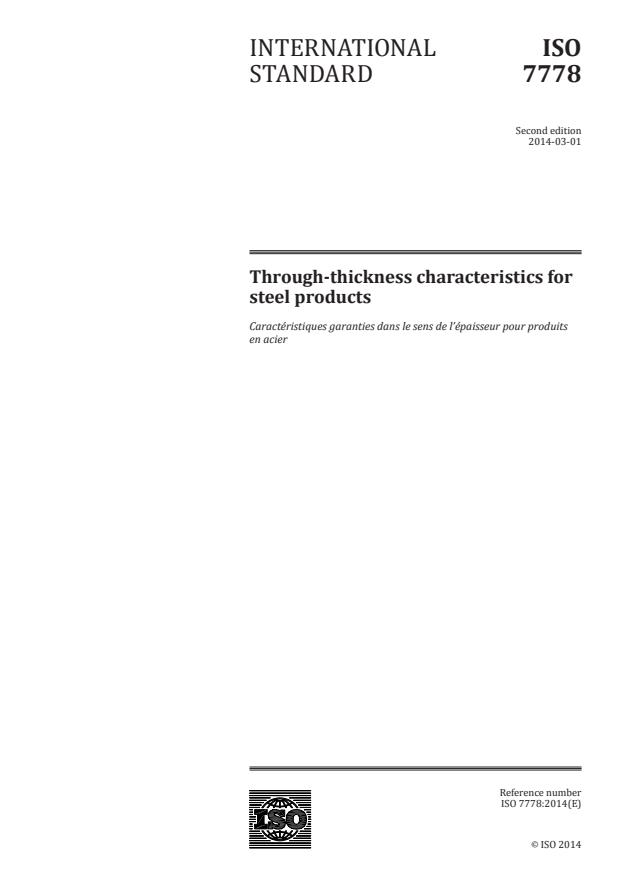
INTERNATIONAL ISO
STANDARD 7778
Second edition
2014-03-01
Through-thickness characteristics for
steel products
Caractéristiques garanties dans le sens de l’épaisseur pour produits
en acier
Reference number
©
ISO 2014
© ISO 2014
All rights reserved. Unless otherwise specified, no part of this publication may be reproduced or utilized otherwise in any form
or by any means, electronic or mechanical, including photocopying, or posting on the internet or an intranet, without prior
written permission. Permission can be requested from either ISO at the address below or ISO’s member body in the country of
the requester.
ISO copyright office
Case postale 56 • CH-1211 Geneva 20
Tel. + 41 22 749 01 11
Fax + 41 22 749 09 47
E-mail copyright@iso.org
Web www.iso.org
Published in Switzerland
ii © ISO 2014 – All rights reserved
Contents Page
Foreword .iv
Introduction .v
1 Scope . 1
2 Normative references . 1
3 Requirements . 1
4 Designation . 2
5 Number and selection of test pieces . 2
5.1 Test unit for flat products . 2
5.2 Test unit for sections . 2
5.3 Sampling . 2
6 Test methods . 3
6.1 Test pieces . 3
6.2 Tensile test . 3
Bibliography . 7
Foreword
ISO (the International Organization for Standardization) is a worldwide federation of national standards
bodies (ISO member bodies). The work of preparing International Standards is normally carried out
through ISO technical committees. Each member body interested in a subject for which a technical
committee has been established has the right to be represented on that committee. International
organizations, governmental and non-governmental, in liaison with ISO, also take part in the work.
ISO collaborates closely with the International Electrotechnical Commission (IEC) on all matters of
electrotechnical standardization.
The procedures used to develop this document and those intended for its further maintenance are
described in the ISO/IEC Directives, Part 1. In particular the different approval criteria needed for the
different types of ISO documents should be noted. This document was drafted in accordance with the
editorial rules of the ISO/IEC Directives, Part 2 (see www.iso.org/directives).
Attention is drawn to the possibility that some of the elements of this document may be the subject of
patent rights. ISO shall not be held responsible for identifying any or all such patent rights. Details of
any patent rights identified during the development of the document will be in the Introduction and/or
on the ISO list of patent declarations received (see www.iso.org/patents).
Any trade name used in this document is information given for the convenience of users and does not
constitute an endorsement.
For an explanation on the meaning of ISO specific terms and expressions related to conformity
assessment, as well as information about ISO’s adherence to the WTO principles in the Technical Barriers
to Trade (TBT) see the following URL: Foreword - Supplementary information
The committee responsible for this document is ISO/TC 17, Steel, Subcommittee SC 3, Steels for structural
purposes.
This second edition cancels and replaces the first edition (ISO 7778:1983), which has been technically
revised.
iv © ISO 2014 – All rights reserved
Introduction
Steel products as normally manufactured generally exhibit deformation properties in the direction
perpendicular to the surface of the product, which are different from those obtained in the direction
of the surface. It is, however, possible to improve these deformation properties by taking particular
precautions when the steel is manufactured. Experience has shown that measurement of the value for
reduction of area, measured by means of a tensile test piece sampled in the direction of thickness of the
product perpendicular to its surface, is the best way to characterize these properties.
However, the choice of one quality of steel exhibiting properties of this nature does not necessarily
ensure the safety of a structure of which certain components are stressed perpendicular to their
surface. Precautions should be taken both at the design and fabrication stage, and more particularly
during welding, so as to minimize stresses in the through-thickness direction.
INTERNATIONAL STANDARD ISO 7778:2014(E)
Through-thickness characteristics for steel products
1 Scope
This International Standard specifies the criteria for through-thickness reduction of area properties
specified in the direction of thickness perpendicular to the surface. This International Standard also
specifies the test conditions by which conformance to the specified criteria is evaluated.
This International Standard applies to fully killed steel with a specified minimum yield strength or proof
strength ≤960 MPa and supplied as plates, wide flats, or sections of thickness from 15 mm to 400 mm.
The application of this International Standard to products <15 mm or >400 mm or having minimum
specified yield strengths or proof strengths >960 MPa will be the subject of agreement when ordering.
The requirements of this International Standard supplement other International Standards that specify
the qualities of products (plate, wide flats, and sections).
2 Normative references
The following documents, in whole or in part, are normatively referenced in this document and are
indispensable for its application. For dated references, only the edition cited applies. For undated
references, the latest edition of the referenced document (including any amendments) applies.
ISO 377, Steel and steel products — Location and preparation of samples and test pieces for mechanical
testing
ISO 404, Steel and steel products — General technical delivery requirements
ISO 6892-1, Metallic materials — Tensile testing — Part 1: Method of test at room temperature
ISO 17577:2006, Steel — Ultrasonic testing for steel flat products of thickness equal to or greater than 6
mm
3 Requirements
Table 1 gives the minimum average values and the minimum individual values for the reduction of area,
whic
...