


ISO 21308-2:2006
(Main)Road vehicles — Product data exchange between chassis and bodywork manufacturers (BEP) — Part 2: Dimensional bodywork exchange parameters
Road vehicles — Product data exchange between chassis and bodywork manufacturers (BEP) — Part 2: Dimensional bodywork exchange parameters
ISO 21308-2:2006 provides a set of codes for the exchange of dimensional data between truck chassis manufacturers and bodywork manufacturers. It applies to commercial vehicles as defined in ISO 3833, having a maximum gross vehicle mass above 3 500 kg. The process of exchanging the above information can involve: chassis manufacturer; chassis importer; chassis dealer; one or more bodywork manufacturers; bodywork component suppliers, e.g. manufacturers of demountable bodies, cranes and loading equipment, tipping equipment.
Véhicules routiers — Échange de données de produit entre les fabricants de châssis et de carrosseries (BEP) — Partie 2: Paramètres dimensionnels d'échange de carrosserie
General Information
- Status
- Withdrawn
- Publication Date
- 27-Aug-2006
- Withdrawal Date
- 27-Aug-2006
- Current Stage
- 9599 - Withdrawal of International Standard
- Start Date
- 25-Sep-2020
- Completion Date
- 12-Feb-2026
Relations
- Effective Date
- 06-Jun-2022
- Effective Date
- 05-Dec-2015
Get Certified
Connect with accredited certification bodies for this standard

TÜV Rheinland
TÜV Rheinland is a leading international provider of technical services.

TÜV SÜD
TÜV SÜD is a trusted partner of choice for safety, security and sustainability solutions.

AIAG (Automotive Industry Action Group)
American automotive industry standards and training.
Sponsored listings
Frequently Asked Questions
ISO 21308-2:2006 is a standard published by the International Organization for Standardization (ISO). Its full title is "Road vehicles — Product data exchange between chassis and bodywork manufacturers (BEP) — Part 2: Dimensional bodywork exchange parameters". This standard covers: ISO 21308-2:2006 provides a set of codes for the exchange of dimensional data between truck chassis manufacturers and bodywork manufacturers. It applies to commercial vehicles as defined in ISO 3833, having a maximum gross vehicle mass above 3 500 kg. The process of exchanging the above information can involve: chassis manufacturer; chassis importer; chassis dealer; one or more bodywork manufacturers; bodywork component suppliers, e.g. manufacturers of demountable bodies, cranes and loading equipment, tipping equipment.
ISO 21308-2:2006 provides a set of codes for the exchange of dimensional data between truck chassis manufacturers and bodywork manufacturers. It applies to commercial vehicles as defined in ISO 3833, having a maximum gross vehicle mass above 3 500 kg. The process of exchanging the above information can involve: chassis manufacturer; chassis importer; chassis dealer; one or more bodywork manufacturers; bodywork component suppliers, e.g. manufacturers of demountable bodies, cranes and loading equipment, tipping equipment.
ISO 21308-2:2006 is classified under the following ICS (International Classification for Standards) categories: 43.080.01 - Commercial vehicles in general. The ICS classification helps identify the subject area and facilitates finding related standards.
ISO 21308-2:2006 has the following relationships with other standards: It is inter standard links to ISO 28927-2:2009/Amd 1:2017, ISO 21308-2:2020. Understanding these relationships helps ensure you are using the most current and applicable version of the standard.
ISO 21308-2:2006 is available in PDF format for immediate download after purchase. The document can be added to your cart and obtained through the secure checkout process. Digital delivery ensures instant access to the complete standard document.
Standards Content (Sample)
INTERNATIONAL ISO
STANDARD 21308-2
First edition
2006-09-01
Road vehicles — Product data exchange
between chassis and bodywork
manufacturers (BEP) —
Part 2:
Dimensional bodywork exchange
parameters
Véhicules routiers — Échange de données de produit entre les
fabricants de châssis et de carrosseries (BEP) —
Partie 2: Paramètres dimensionnels d'échange de carrosserie
Reference number
©
ISO 2006
PDF disclaimer
This PDF file may contain embedded typefaces. In accordance with Adobe's licensing policy, this file may be printed or viewed but
shall not be edited unless the typefaces which are embedded are licensed to and installed on the computer performing the editing. In
downloading this file, parties accept therein the responsibility of not infringing Adobe's licensing policy. The ISO Central Secretariat
accepts no liability in this area.
Adobe is a trademark of Adobe Systems Incorporated.
Details of the software products used to create this PDF file can be found in the General Info relative to the file; the PDF-creation
parameters were optimized for printing. Every care has been taken to ensure that the file is suitable for use by ISO member bodies. In
the unlikely event that a problem relating to it is found, please inform the Central Secretariat at the address given below.
© ISO 2006
All rights reserved. Unless otherwise specified, no part of this publication may be reproduced or utilized in any form or by any means,
electronic or mechanical, including photocopying and microfilm, without permission in writing from either ISO at the address below or
ISO's member body in the country of the requester.
ISO copyright office
Case postale 56 • CH-1211 Geneva 20
Tel. + 41 22 749 01 11
Fax + 41 22 749 09 47
E-mail copyright@iso.org
Web www.iso.org
Published in Switzerland
ii © ISO 2006 – All rights reserved
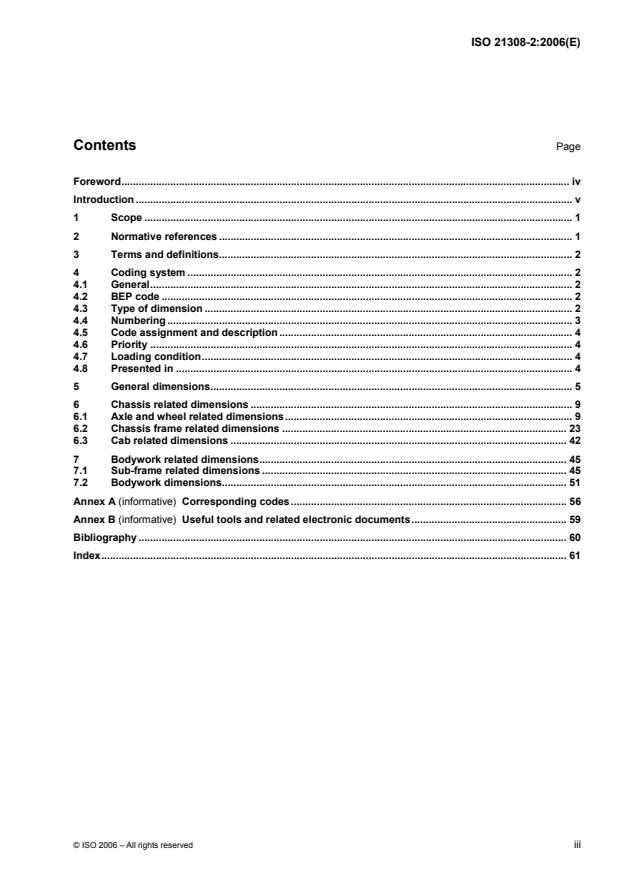
Contents Page
Foreword. iv
Introduction . v
1 Scope . 1
2 Normative references . 1
3 Terms and definitions. 2
4 Coding system . 2
4.1 General. 2
4.2 BEP code . 2
4.3 Type of dimension . 2
4.4 Numbering . 3
4.5 Code assignment and description . 4
4.6 Priority . 4
4.7 Loading condition. 4
4.8 Presented in . 4
5 General dimensions. 5
6 Chassis related dimensions . 9
6.1 Axle and wheel related dimensions. 9
6.2 Chassis frame related dimensions . 23
6.3 Cab related dimensions . 42
7 Bodywork related dimensions. 45
7.1 Sub-frame related dimensions . 45
7.2 Bodywork dimensions. 51
Annex A (informative) Corresponding codes. 56
Annex B (informative) Useful tools and related electronic documents. 59
Bibliography . 60
Index. 61
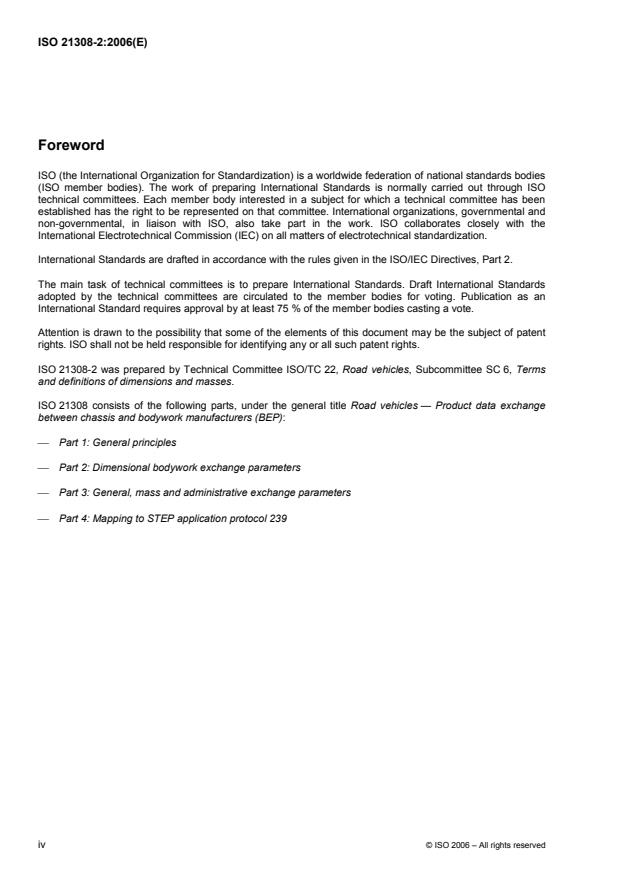
Foreword
ISO (the International Organization for Standardization) is a worldwide federation of national standards bodies
(ISO member bodies). The work of preparing International Standards is normally carried out through ISO
technical committees. Each member body interested in a subject for which a technical committee has been
established has the right to be represented on that committee. International organizations, governmental and
non-governmental, in liaison with ISO, also take part in the work. ISO collaborates closely with the
International Electrotechnical Commission (IEC) on all matters of electrotechnical standardization.
International Standards are drafted in accordance with the rules given in the ISO/IEC Directives, Part 2.
The main task of technical committees is to prepare International Standards. Draft International Standards
adopted by the technical committees are circulated to the member bodies for voting. Publication as an
International Standard requires approval by at least 75 % of the member bodies casting a vote.
Attention is drawn to the possibility that some of the elements of this document may be the subject of patent
rights. ISO shall not be held responsible for identifying any or all such patent rights.
ISO 21308-2 was prepared by Technical Committee ISO/TC 22, Road vehicles, Subcommittee SC 6, Terms
and definitions of dimensions and masses.
ISO 21308 consists of the following parts, under the general title Road vehicles — Product data exchange
between chassis and bodywork manufacturers (BEP):
⎯ Part 1: General principles
⎯ Part 2: Dimensional bodywork exchange parameters
⎯ Part 3: General, mass and administrative exchange parameters
⎯ Part 4: Mapping to STEP application protocol 239
iv © ISO 2006 – All rights reserved
Introduction
Truck chassis manufacturers deal with configurations of chassis in infinite numbers of possible combinations,
and bodywork manufacturers produce highly customized superstructures on these chassis. Bodywork
manufacturers build their superstructures on chassis of several different truck brands.
The production efficiency of a specific truck chassis and its body combinations can be greatly improved by
achieving the correct technical and commercial information about the specific chassis communicated with the
bodywork manufacturer in advance. The information has to be reliable and give the bodywork manufacturer
confidence to prefabricate the body or the superstructure before the chassis is delivered. With uniform
conditions, unambiguous dimensions and supplementary information can be established, transferred and
correctly interpreted by the receiver. Increased information efficiency will improve the quality and reduce the
lead times.
ISO 21308 specifies a system of codes to exchange specific data between chassis and bodywork
manufacturers, providing a platform for efficient communication between the parties. The process of
exchanging data in accordance with this part of ISO 21308 is irrelevant of IT sophistication degree. Any
medium can be used, from fax or e-mail to a STEP protocol.
Exchanging codes in accordance with the ISO 21308 series of International Standards is useful in various
situations, e.g. for design and manufacturing, technical specifications, technical drawings and leaflets.
This part of ISO 21308 uses the applicable definitions from the related ISO 612 and ISO 7656 and adds a
number of dimensional codes, together with general, mass and administrative codes.
The codes provide the basic information level, and are also the basic input parameters for a data exchange
system based on the STEP protocol.
INTERNATIONAL STANDARD ISO 21308-2:2006(E)
Road vehicles — Product data exchange between chassis and
bodywork manufacturers (BEP) —
Part 2:
Dimensional bodywork exchange parameters
1 Scope
This part of ISO 21308 provides a set of codes for the exchange of dimensional data between truck chassis
manufacturers and bodywork manufacturers. It applies to commercial vehicles as defined in ISO 3833, having
a maximum gross vehicle mass above 3 500 kg.
The process of exchanging the above information can involve:
⎯ chassis manufacturer;
⎯ chassis importer;
⎯ chassis dealer;
⎯ one or more bodywork manufacturers;
⎯ bodywork component suppliers, e.g. manufacturers of demountable bodies, cranes and loading
equipment, tipping equipment.
2 Normative references
The following referenced documents are indispensable for the application of this document. For dated
references, only the edition cited applies. For undated references, the latest edition of the referenced
document (including any amendments) applies.
ISO 612:1978, Road vehicles — Dimensions of motor vehicles and towed vehicles — Terms and definitions
ISO 1176, Road vehicles — Masses — Vocabulary and codes
ISO 3833, Road vehicles — Types — Terms and definitions
ISO 4130, Road vehicles — Three-dimensional reference system and fiducial marks — Definitions
ISO 7656:1993, Commercial road vehicles — Dimensional codes
1)
ISO 21308-3 , Road vehicles — Product data exchange between chassis and bodywork manufacturers
(BEP) — Part 3: General, mass and administrative parameters
1) To be published.
3 Terms and definitions
For the purposes of this document, the terms and definitions given in ISO 612, ISO 1176, ISO 7656,
ISO 21308-3, and the following definitions apply.
3.1
BEP-code
code to identify a unique measurement on the truck, to make the information exchange between chassis
manufacturers and bodywork manufacturers easier without any confusion with other systems
NOTE BEP is an abbreviation of Bodywork Exchange Parameter.
3.2
left and right side
left side in the driving direction and right side in the driving direction
3.3
driven axle
driven axle marked with an X in the drawings
3.4
non-driven axle
axle, such as steered or tag axle, marked with an O in the drawings
3.5
front edge
most forward point of the truck as delivered from the chassis manufacturer
NOTE Usually, the front edge is the bumper.
3.6
gross vehicle mass
GVM
gross vehicle weight
GVW
technical or legal gross vehicle mass (weight) according to the legislation or regulations for the applicable
region
NOTE See also ISO 21308-3 and ISO 1176.
4 Coding system
4.1 General
Each dimension given in this part of ISO 21308 is assigned a code, composed of the items given below.
4.2 BEP code
A prefix “BEP”, followed by a dash (-), shall be used to avoid confusion with other coding systems.
4.3 Type of dimension
Dimension codes are used to denote length, width and height measurements along the zero X-, Y- or Z-
planes respectively, as defined in ISO 4130. They are also used to denote angle measurements.
2 © ISO 2006 – All rights reserved
A capital letter, which denotes the type of dimension, shall be given as follows:
⎯ L – Length;
⎯ W – Width;
⎯ H – Height.
NOTE 1 The centre of the first front axle is chosen as a reference zero point for the length measurements. In some
cases where it is convenient to use the rear axle as a reference, the first driven rear axle is used.
NOTE 2 The top of the chassis frame is chosen as the reference zero point for height measurements for objects
connected to the chassis frame.
NOTE 3 The centre-line of the chassis is chosen as the reference zero point for width measurements.
NOTE 4 The height information, if dependent on the tyres, refers to the actual tyre equipment as described according
to ISO 21308-3, if not otherwise stated.
If there is a need to differ between the dimension(s) on the right or left side, the BEP-code should be
supplemented by R or L.
4.4 Numbering
4.4.1 General
Each item has a unique BEP-code consisting of the dimension type letter (see 4.3) and a three-digit
sequential number, starting from 001.
The dimension codes for repeated vehicle items of the same kind on one vehicle, e.g. axles, cross-members,
frame-mounted objects, etc., are differed by an added sequential number beginning with .1 counted from the
front of the vehicle and rearwards.
For L codes, a positive value indicates that the item is located behind the axle. A negative value indicates that
the item is located in front of the axle.
For H codes, a positive value indicates that the item is located above the top of the chassis frame. A negative
value indicates that the item is located below the top of the chassis frame.
4.4.2 Numbering and type designation of frame-mounted objects
The same .n number shall be applied to a specific frame-mounted object in terms of L, H and W dimensions.
EXAMPLE Frame-mounted objects may be a fuel tank, referred to as BEP-L030.4, BEP-H030.4, and BEP-W.030.4,
and a battery box, referred to as BEP-L030.5, BEP-H030.5, and BEP-W030.5.
For the frame-mounted objects, an optional coding (.t) may be added to describe the object type. The
following abbreviation letters are reserved for the object types below:
⎯ A – Air tank;
⎯ B – Battery box;
⎯ F – Fuel tank;
⎯ H – Hydraulic tank;
⎯ M – Exhaust muffler;
⎯ S – Spare wheel;
⎯ T – Tool box;
⎯ U – Urea tank.
4.5 Code assignment and description
Clauses 5, 6, and 7 of this part of ISO 21308 show the assignment of each BEP-code together with a
description of its applicability and limitations.
4.6 Priority
The column “Priority” shows the priority of the measurements, as follows:
⎯ A – Essential;
⎯ B – Useful.
4.7 Loading condition
The column “Loading” shows the load situation of the chassis, as follows:
⎯ 1 – Unladen;
⎯ 2 – Laden (design mass).
NOTE A dash (-) means that the field is not applicable.
4.8 Presented in
The column “Presented in” describes in which type of document the items can be presented, as follows:
⎯ 2D – 2D drawing;
⎯ 3D – 3D model;
⎯ TD – Technical data sheet.
NOTE An empty field means that there is no specific recommendation for the presentation. It can be covered by any
kind of document. A dash (-) means that the field is not applicable.
4 © ISO 2006 – All rights reserved
5 General dimensions
BEP-code Assignment Description Priority Loading Presented in
BEP-L001 Overall length Distance from front edge of vehicle to rear edge of A - 2D, 3D, TD
vehicle, including accessories in both front and rear
ends.
NOTE See also ISO 612.
BEP-code Assignment Description Priority Loading Presented in
BEP-L002
Front Distance from the centre of the first front axle to the A - 2D, 3D, TD
reference front reference point for measuring.
point for
NOTE 1 Front reference point(s) for measuring is (are)
measuring
defined by the chassis manufacturer.
NOTE 2 If the reference points for right and left side
member differ, then mark with .R or .L.
NOTE 3 If the position of the reference point is in front of
the axle, the value is negative.
BEP-L003 Rear Distance from the first driven rear axle to the rear A - 2D, 3D, TD
reference reference point for measuring.
point for
NOTE 1 Rear reference point(s) for measuring is (are)
measuring
defined by the chassis manufacturer.
NOTE 2 If the reference points for right and left side
member differ, then mark with .R or .L.
NOTE 3 If the position of the reference point is in front of
the axle, the value is negative.
6 © ISO 2006 – All rights reserved
BEP-code Assignment Description Priority Loading Presented in
BEP-H001
Maximum Distance from ground to top of cab, including cab A 1 2D, 3D,TD
external mounted parts, with the chassis unladen but in
height, operating order.
unladen
NOTE The roof hatch, if present, should be closed. All
axles should be down. For pneumatic suspension, the
highest driving position is assumed.
BEP-H002 Maximum Distance from ground to top of cab, including cab A 2 2D, 3D, TD
external mounted parts, in laden condition.
height, laden
NOTE The chassis is laden up to "Technical gross
vehicle mass". The roof hatch, if present, should be closed.
All axles should be down. For pneumatic suspension, the
highest driving position is assumed.
BEP-H003 Maximum Distance from ground to the highest point of the A 1 2D, 3D, TD
overall height vehicle including bodywork.
of vehicle,
NOTE For pneumatic suspension, the highest driving
unladen
position is assumed.
BEP-code Assignment Description Priority Loading Presented in
BEP-W001
Overall width Maximum external width of the vehicle chassis. A - 2D, 3D, TD
of chassis with
NOTE Rear-view mirrors in outermost position, lights,
cab
elastic mud flaps, tyre bulges in the road area and snow
chains are included in the width stated. The bodywork is not
taken into account.
BEP-W002 Width across External width of cab. A - 2D, 3D, TD
cab
NOTE Mudguards and rear-view mirrors are
disregarded.
BEP-W003.n Width across External width across the wheels on the n-th axle. A - 2D, 3D, TD
wheels on n-th
NOTE Projecting axle hubs and tyre bulges are
axle
disregarded.
8 © ISO 2006 – All rights reserved
6 Chassis related dimensions
6.1 Axle and wheel related dimensions
BEP-code Assignment Description Priority Loading Presented in
BEP-L010 Total wheel Distance between centre of first front axle to the A - 2D, 3D, TD
base centre of the last axle.
BEP-code Assignment Description Priority Loading Presented in
BEP-L011
Configuration Distance between centre of first front axle to the A - 2D, 3D, TD
wheel base centre of first driven rear axle.
NOTE If the vehicle is not symmetrical, different values
for right and left hand side apply. Then mark with .R or .L,
e.g. BEP-L011.L.
10 © ISO 2006 – All rights reserved
BEP-code Assignment Description Priority Loading Presented in
BEP-L012.n Distance between centre of wheels on n-th and
Wheel space A - 2D, 3D, TD
from n to n+1 (n+1)-th axles.
axle
BEP-code Assignment Description Priority Loading Presented in
BEP-L013
Theoretical Distance between first front axle to calculated mass A 2 2D, TD
wheel base of line of front axle combination.
front axle
combination
BEP-L014 Theoretical Distance between first driven rear axle to calculated A 2 2D, TD
wheel base of mass line of rear axle combination.
rear axle
combination
BEP-L015 Theoretical Distance between the calculated mass lines of front A 2 2D, TD
wheel base and rear axle combinations.
NOTE 1 For a single axle, either in the front or in the rear,
the calculated mass line is identical to the axle centre line.
NOTE 2 If there is an axle combination either in the front
or rear, the calculated mass line is the calculated line
between the axles where the load from the axles is focused.
NOTE 3 For air suspension systems with electronic
control, the calculated mass line is variable while driving.
EXAMPLE A, B, C, D may have the following
distribution, shown in the figures below:
A = 50 %, B = 50 %, C = 60 %, D = 40 %
12 © ISO 2006 – All rights reserved
BEP-code Assignment Description Priority Loading Presented in
BEP-code Assignment Description Priority Loading Presented in
BEP-L016
Front vehicle Distance between front edge of vehicle and centre of A - 2D, 3D, TD
overhang wheel on first axle.
BEP-L017 Rear vehicle Distance between centre of last axle and rearmost A - 2D, 3D, TD
overhang part of vehicle.
BEP-L018 Front frame Distance from foremost edge of front frame to centre A - 2D, 3D, TD
overhang of first front axle.
BEP-L019 Rear frame Distance between the centre of last axle to rearmost A - 2D, 3D, TD
overhang edge of frame side member.
BEP-L020
Rear frame Distance between the centre of first driven rear axle A - 2D, 3D, TD
overhang from to rearmost edge of frame side member.
first driven
rear axle
BEP-L021 Technical Distance between calculated mass lines of rear axle B 2 2D, 3D, TD
overhang combination and rearmost edge of vehicle or
length bodywork.
EXAMPLE A and B may have the following
distribution: A = 60 %, B = 40 %
14 © ISO 2006 – All rights reserved
BEP-code Assignment Description Priority Loading Presented in
BEP-H010
Approach Angle between the tangent of the rolling radius of the B 2 2D, 3D, TD
angle tyres and the lowest fixed point of the vehicle in front
of the axle, for technical front axle mass.
NOTE Chassis loaded to permitted axle masses. For
pneumatic suspension, the drive position is assumed.
Additional tyre springing should be taken into account.
BEP-H011 Departure Angle between the tangent of the rolling radius of the B 2 2D, 3D, TD
angle tyres and the lowest fixed point of the vehicle behind
the axle, for technical rear axle mass.
NOTE Chassis loaded to permitted axle masses. For
pneumatic suspension, the drive position is assumed.
Additional tyre springing should be taken into account.
BEP-H012 Ramp angle See ISO 612 and ISO 7656. B 2 2D, 3D, TD
BEP-H013 Ground Distance between the ground and the lowest fixed A 2 2D, 3D, TD
clearance, point between the centre of the last front axle and the
rear part rearmost part of the chassis.
NOTE Chassis loaded to permitted axle masses. For
pneumatic suspension, the drive position is assumed.
Additional tyre springing should be taken into account.
BEP-code Assignment Description Priority Loading Presented in
BEP-H014
Ground Distance between the ground and the lowest fixed A 2 2D, 3D, TD
clearance, point between the front part of the chassis and the
front part centre of the last front axle.
NOTE Chassis loaded to permitted axle masses. For
pneumatic suspension, the drive position is assumed.
Additional tyre springing should be taken into account.
BEP-H015.n Ground Smallest vertical dimension between vehicle front A 2 2D, 3D, TD
clearance, axle(s) and ground level.
front axle(s)
NOTE Chassis loaded to permitted axle masses. For
pneumatic suspension, the drive position is assumed.
Additional tyre springing should be taken into account.
16 © ISO 2006 – All rights reserved
BEP-code Assignment Description Priority Loading Presented in
BEP-H016.n
Ground Smallest vertical dimension between vehicle rear A 2 2D, 3D, TD
clearance, axle(s) and ground level.
rear axle(s)
NOTE Chassis loaded to permitted axle masses. For
pneumatic suspension, the drive position is assumed.
Additional tyre springing should be taken into account.
BEP-code Assignment Description Priority Loading Presented in
BEP-H017
Front under- Distance between the ground and the uppermost part A 1 2D, 3D, TD
run protection, of the front under-run protection.
upper
BEP-H018 Front under- Distance between the ground and the lowest part of A 1 2D, 3D, TD
run protection, the front under-run protection.
lower
BEP-H019.n Side under- Distance between the ground and the uppermost part A 1 2D, 3D, TD
run of the side under-run protection.
protection(s),
NOTE The distance is measured at the centreline of the
upper
side under-run protection.
BEP-H020.n Side under- Distance between the ground and the lowest part of A 1 2D, 3D, TD
run the side under-run protection.
protection(s),
NOTE The distance is measured at the centreline of the
lower
side under-run protection.
BEP-H021 Rear under- Distance between the ground and the uppermost part A 1 2D, 3D, TD
run protection, of the rear under-run protection.
upper
BEP-H022 Rear under- Distance between the ground and the lowest part of A 1 2D, 3D, TD
run protection, the rear under-run protection.
lower
18 © ISO 2006 – All rights reserved
BEP-code Assignment Description Priority Loading Presented in
BEP-W010.n
Steering angle Maximum steering angle of wheels. B 1 2D, 3D, TD
NOTE L/R for left or right side, n for n-th steerable axle,
lt/rt for left or right turn.
EXAMPLE BEP-W010.R.2.rt means right side,
second steerable axle, right turn.
BEP-code Assignment Description Priority Loading Presented in
BEP-W011
Turning circle The diameter of the circle described by the 'centre' of A 2 TD
diameter the tyre of the outer steered wheel at the first front
axle at maximum steering angle.
NOTE If there is a difference between left hand and
right hand turning circle, it is marked with .R or .L - e.g.
BEP-W011.L.
BEP-W012 Clearance The diameter of the circle described by the outer A 2 TD
circle diameter edge of the vehicle at maximum steering angle.
NOTE The outer edge includes external equipment,
e.g. mirrors. If there is a difference between left hand and
right hand turning circle, it is marked with .R or .L - e.g.
BEP-W012.L.
20 © ISO 2006 – All rights reserved
BEP-code Assignment Description Priority Loading Presented in
BEP-W013.n Distance between centres of the tyres of the n-th axle.
Track A 1 2D, 3D, TD
NOTE In case of twin tyres, the centre between the two
centres of the tyres on the same side is used.
BEP-W014.n
Twin tyre Distance between the centres of the two tyres of the B 1 2D, 3D, TD
distance n-th axle on one side.
BEP-code Assignment Description Priority Loading Presented in
BEP-W015.n Distance between the centreline of springs at the n-th
Spring track B 1 2D, 3D, TD
distance axle.
22 © ISO 2006 – All rights reserved
6.2 Chassis frame related dimensions
BEP-code Assignment Description Priority Loading Presented in
BEP- Start of Distance between the centre of the first front axle and A - 2D, 3D, TD
L030.n.t the foremost part of the n-th object mounted on the
chassis-
mounted chassis.
object, length
NOTE 1 Add .R or .L (if applicable) to specify the
mounting side, related to the centreline of the chassis.
NOTE 2 It is applicable to objects both inside and outside
the chassis frame.
NOTE 3 Optional object type coding (.t), see 4.4.2.
EXAMPLE Air tank, fuel tank, battery box, electrical
and electronic interface, pneumatic interface, exhaust parts,
side under-run protection, etc.
BEP- End of Distance between the centre of the first front axle and A - 2D, 3D, TD
L031.n.t chassis- the rearmost end of the n-th object mounted on the
mounted chassis.
object, length
NOTE 1 Add .R or .L (if applicable) to specify the
mounting side, related to the centreline of the chassis.
NOTE 2 It is applicable to objects both inside and outside
the chassis frame.
NOTE 3 Optional object type coding (.t), see 4.4.2.
EXAMPLE Air tank, fuel tank, battery box, electrical
and electronic interface, pneumatic interface, exhaust parts,
side under-run protection, etc.
BEP-
Start of Distance from the top of chassis frame to the highest A - 2D, 3D, TD
H030.n.t chassis- part of the n-th object mounted on the chassis.
mounted
NOTE 1 Add .R or .L (if applicable) to specify the
object, height
mounting side, related to the centreline of the chassis.
NOTE 2 It is applicable to objects both inside and outside
the chassis frame.
NOTE 3 Optional object type coding (.t), see 4.4.2.
NOTE 4 Positive values indicate above top of chassis,
and negative values indicate below top of chassis.
EXAMPLE Air tank, fuel tank, battery box, electrical
and electronic interface, pneumatic interface, exhaust parts,
side under-run protection, etc.
BEP- End of Distance from the top of chassis frame to the lowest A - 2D, 3D, TD
H031.n.t chassis- part of the n-th object mounted on the chassis.
mounted
NOTE 1 Add .R or .L (if applicable) to specify the
object, height
mounting side, related to the centreline of the chassis.
NOTE 2 It is applicable to objects both inside and outside
the chassis frame.
NOTE 3 Optional object type coding (.t), see 4.4.2.
NOTE 4 Positive values indicate above top of chassis,
and negative values indicate below top of chassis.
EXAMPLE Air tank, fuel tank, battery box, electrical
and electronic interface, pneumatic interface, exhaust parts,
side under-run protection, etc.
BEP- Start of Distance from the centreline of chassis frame to the A - 2D, 3D, TD
W030.n.t nearest part of the n-th object mounted on the
chassis-
mounted chassis.
object, width
NOTE 1 Add .R or .L (if applicable) to specify the
mounting side, related to the centreline of the chassis.
NOTE 2 It is applicable to objects both inside and outside
the chassis frame.
NOTE 3 Optional object type coding (.t), see 4.4.2.
EXAMPLE Air tank, fuel tank, battery box, electrical
and electronic interface, pneumatic interface, exhaust parts,
side under-run protection, etc.
BEP-code Assignment Description Priority Loading Presented in
BEP-
End of Distance from the centreline of chassis frame to the A - 2D, 3D, TD
W031.n.t chassis- furthest part of the n-th object mounted on the
mounted chassis.
object, width
NOTE 1 Add .R or .L (if applicable) to specify the
mounting side, related to the centreline of the chassis.
NOTE 2 It is applicable to objects both inside and outside
the chassis frame.
NOTE 3 Optional object type coding (.t), see 4.4.2.
EXAMPLE Air tank, fuel tank, battery box electrical
and electronic interface, pneumatic interface, exhaust parts,
side under-run protection, etc.
24 © ISO 2006 – All rights reserved
BEP-code Assignment Description Priority Loading Presented in
BEP-L032
Length of Distance between the centre of the first front axle and B - TD
frame from the rear end of the chassis.
centre of first
front axle
BEP-L033 Minimum Minimum distance between the centre of the first front B - TD
length of axle and the rear end of the chassis.
frame from
NOTE The shortest possible chassis frame overhang
centre of first
on the rear end recommended by the chassis manufacturer.
front axle
This is to enable bodywork designers to establish the
chassis cut off-point whilst allowing sufficient space for
cleating at the rear of the chassis frame.
EXAMPLE Cutting the overhang behind the spring
hanger bracket.
BEP-code Assignment Description Priority Loading Presented in
BEP-L034
Front edge of Distance from front edge of front cross-member to A - 2D, 3D, TD
front cross- centre of first front axle.
member
BEP-L035 Towing Distance from centre of the first driven rear axle to A - 2D, 3D, TD
member rear cross-member mounting surface for trailer
reference couplings.
position
NOTE In case of several rear cross-members, they can
be marked BEP-L035.1, BEP-L035.2.
26 © ISO 2006 – All rights reserved
BEP-code Assignment Description Priority Loading Presented in
BEP-H032.n Frame side Height of the n-th frame side member profile. A - 2D, 3D, TD
member
profile height
BEP-H033.n Frame side Thickness of the n-th frame side member profile A - 2D, 3D, TD
member bottom.
profile bottom
thickness
BEP-H034.n Frame side Thickness of the n-th frame side member profile top. A - 2D, 3D, TD
member
profile top
thickness
BEP-W032.n Frame side Width of the n-th frame side member profile bottom. A - 2D, 3D, TD
member
profile bottom
width
BEP-W033.n Frame side Width of the n-th frame side member profile top. A - 2D, 3D, TD
member
profile top
width
BEP-W034.n Frame side Thickness of the n-th frame side member profile A - 2D, 3D, TD
member waist.
profile waist
thickness
NOTE 1 Some common profiles are shown below. Further profile alternatives can be defined by the chassis and bodywork manufacturers.
NOTE 2 For positioning of frame profile members, see BEP-L048 and related codes.
NOTE 3 Frame re-inforcements can be communicated as stand-alone objects, see BEP-H052 and related codes.
BEP-code Assignment Description Priority Loading Presented in
BEP-L036.n.t
Distance to Distance from the centre of the first front axle to the A - 2D, 3D, TD
the front edge front edge of the n-th intermediate cross-member on
of the the centre-line of the chassis.
n-th front
NOTE 1 Each cross-member is identified by a number (n).
intermediate
cross-member NOTE 2 When the value is negative, the position of the
cross-member is in front of the axle. If it is positive, the
position is behind the axle.
NOTE 3 The cross-members are defined in different
types (t), specified with e.g. A, B, C, etc. Each definition of
type includes the description of the exact position and profile
of each cross-member.
EXAMPLE BEP-L036.2.A means second cross-
member, type A.
BEP-L037.n.t Distance to Distance from the centre of the first driven rear axle to A - 2D, 3D, TD
the front edge the front edge of the n-th intermediate cross-member
of the on the centre-line of the chassis.
n-th rear
NOTE 1 Each cross-member is identified by a number (n).
intermediate
cross-member NOTE 2 When the value is negative, the position of the
cross-member is in front of the axle. If it is positive, the
position is behind the axle.
NOTE 3 The cross-members are defined in different
types (t), specified with e.g. A, B, C, etc. Each definition of
type includes the description of the exact position and profile
of each cross-member.
EXAMPLE BEP-L037.5.C means fifth cross-member,
type C.
28 © ISO 2006 – All rights reserved
BEP-code Assignment Description Priority Loading Presented in
BEP-L038.n.t
Distance to Distance from the centre of the first front axle to the A - 2D, 3D, TD
the hole index point for positioning, of the n-th hole pattern in
pattern in the frame.
front part of
NOTE 1 If the values for right and left side member differ,
frame
then mark with .R or .L.
NOTE 2 A negative value indicates that the hole-pattern
is in front of the axle. A positive value indicates that it is
behind the axle.
NOTE 3 A unique number (n) identifies each hole pattern.
NOTE 4 The hole patterns are defined in different types
(t), specified e.g. with A, B, C, etc. Each definition of type
includes the description of:
⎯ index point for positioning;
⎯ hole dimension;
⎯ hole shape (cylindrical, oblong, etc.);
⎯ hole type (drilled, punched, etc.);
⎯ relative positions including transformation information;
⎯ x, y, z-position relative to the given value and
their tolerance.
EXAMPLE BEP-038.L.2.A means left side-member,
hole pattern 2, type A.
BEP-L039.n.t Distance to Distance from the centre of the first driven rear axle to A - 2D, 3D, TD
the hole the index point for positioning, of the n-th hole pattern
pattern in the in frame.
rear part of
NOTE 1 If the frame side members are not symmetrical,
frame
different values for right and left hand side apply, marked
with .R or .L.
NOTE 2 If the value is negative, the position of the hole-
pattern is in front of the axle. If it is positive, the position is
behind the axle.
NOTE 3 A unique number (n) identifies each hole pattern.
NOTE 4 The hole patterns are defined in different types
(t), specified e.g. with A, B, C, etc. Each definition of type
includes the description of:
⎯ index point for positioning;
⎯ hole dimension;
⎯ hole shape (cylindrical, oblong, etc.);
⎯ hole type (drilled, punched, etc.);
⎯ relative positions including transformation
information;
⎯ x, y, z-position relative to the given value and
their tolerance.
EXAMPLE BEP-L039.L.4.C means left side-
member, hole pattern 4 on the rear part of the frame, type C.
BEP-code Assignment Description Priority Loading Presented in
BEP-L040.n Start of Distance between the centre of the first front axle and A - TD
restricted area the beginning of the n-th restricted area within the
within frame chassis frame.
NOTE This is to avoid conflict with sensitive equipment.
BEP-L041.n End of Distance between the centre of the first front axle and A - TD
the end of the n-th restricted area within the chassis
restricted area
within frame frame.
NOTE To avoid conflict with sensitive equipment.
30 © ISO 2006 – All rights reserved
BEP-code Assignment Description Priority Loading Presented in
BEP-L042.n
First front axle Distance between centre of wheel on first front axle A - 2D, 3D, TD
centre to n-th and n-th bend in frame (if behind the cab).
bend in frame
BEP-W035 Width of frame External width of frame in front area of the vehicle. A - 2D, 3D, TD
at front area
BEP-W036 Width of frame External width of frame in rear area of the vehicle. A - 2D, 3D, TD
at rear area
BEP-code Assignment Description Priority Loading Presented in
BEP-H035
Height of Distance from top edge of frame to ground measured A 1 2D, 3D, TD
frame, at the first front axle, unladen condition.
unladen, front
NOTE Any sub-frame fitted is disregarded. Loading
corresponds to unladen mass. For pneumatic suspension,
the highest driving position is assumed.
BEP-H036 Height of Distance from top edge of frame to ground measured A 2 2D, 3D, TD
frame, laden, at the first front axle, laden condition.
front
NOTE Any sub-frame fitted is disregarded. The chassis
is loaded up to "technical gross vehicle mass". For
pneumatic suspension, the highest driving position is
assumed. Additional tyre springing from the nearest axle
should be taken into account.
32 © ISO 2006 – All rights reserved
BEP-code Assignment Description Priority Loading Presented in
BEP-H037
Height of Distance from top edge of frame to ground measured A 1 2D, 3D, TD
frame over at the first driven axle, unladen conditions.
first driven
NOTE Any sub-frame fitted is disregarded. Loading
rear axle,
corresponds to unladen mass. For pneumatic suspension,
unladen
the highest driving position is assumed.
BEP-H038 Height of Distance from top edge of frame to ground measured A 2 2D, 3D, TD
frame over at the first driven axle, laden conditions.
first driven
NOTE Any sub-frame fitted is disregarded. The chassis
rear axle,
is loaded up to "technical gross vehicle mass". For
laden
pneumatic suspension, the highest driving position is
assumed. Additional tyre springing should be taken into
account.
BEP-H039 Height of Distance from top edge of frame to ground measured A 1 2D, 3D, TD
frame at at the theoretical wheelbase, unladen conditions.
theoretical
NOTE Any sub-frame fitted is disregarded. Loading
rear wheel
corresponds to unladen mass. For pneumatic suspension,
base, unladen
the highest driving position is assumed.
BEP-H040 Height of Distance from top edge of frame to ground measured A 2 2D, 3D, TD
frame at at the theoretical wheel base, laden conditions.
theoretical
NOTE Any sub-frame fitted is disregarded. The chassis
rear wheel
is loaded up to "technical gross vehicle mass". For
base, laden
pneumatic suspension, the highest driving position is
assumed. Additional tyre springing should be taken into
account.
BEP-code Assignment Description Priority Loading Presented in
BEP-H041.n
Wheel centre Height of wheel centre to top of chassis frame for the A 2 2D, 3D, TD
to top of frame n-th axle.
NOTE The chassis is loaded up to "technical gross
vehicle mass". For pneumatic suspension, the highest
driving position is assumed. Additional tyre springing from
the nearest axle should be taken into account.
BEP-H042.n Top of wheel Highest wheel position relative to top of chassis frame A - 2D, 3D, TD
to top of frame for the n-th axle, taking into account maximum
bounce.
NOTE 1 This code is used to specify the clearance
needed in a worst case condition.
NOTE 2 Positive values indicate above top of chassis,
and negative values indicate below top of chassis.
NOTE 3 If different for right and left side, then mark
with .R or .L.
34 © ISO 2006 – All rights reserved
BEP-code Assignment Description Priority Loading Presented in
BEP-L043.n
PTO Distance between the centre of the first front axle an
...
Questions, Comments and Discussion
Ask us and Technical Secretary will try to provide an answer. You can facilitate discussion about the standard in here.
Loading comments...