

ISO 24183:2024
(Main)Technical communication — Vocabulary
General Information
- Abstract
This document defines terms for the theory and application of technical communication. It prepares the terminological background for all other standards in the field of technical communication by providing precise definitions and standardized terms for basic concepts in this domain. This document is applicable to persons creating information products in the field of technical communication or using these information products professionally.
- Status
- Published
- Publication Date
- 14-Jan-2024
- Technical Committee
- ISO/TC 37 - Language and terminology
- Drafting Committee
- ISO/TC 37/WG 10 - Technical communication
- Current Stage
- 6060 - International Standard published
- Start Date
- 15-Jan-2024
- Due Date
- 10-May-2023
- Completion Date
- 15-Jan-2024



Overview
ISO 24183:2024 - Technical communication - Vocabulary defines standardized terms and definitions for the theory and application of technical communication. The standard establishes a common terminological foundation for other standards in the field and is applicable to anyone creating or professionally using information products (manuals, online help, tutorials, safety instructions) that support a product throughout its life cycle.
Key topics and contents
ISO 24183 organizes vocabulary across concept groups to ensure clarity and interoperability in technical communication:
- Core concepts: technical communication, information for use, information product, supported product, content, technical documentation, single source publishing, terminology, translatability.
- User-related concepts: user, target audience, skilled person.
- Product and life cycle: product life cycle, life cycle phases (installation, operation, maintenance, disposal).
- Information for use: conceptual, instructional and reference information types.
- Information creators and processes: roles (technical communicator), research and analysis, content development, translation and localization, and risk management.
- Information quality and tools: principles and criteria for information quality (completeness, consistency) and information product quality (usability, readability); style guides and content-structuring methods.
- Information product elements: safety-related information, lists, tables, directories, pointers, status indicators.
- Information delivery and formats: printed, audio, video, online, and runtime-generated content.
- Annex A provides concept models illustrating relationships between key concepts.
Practical applications
ISO 24183 is designed to improve consistency, reduce misunderstandings, and support contract clarity and product safety by supplying a shared vocabulary. Typical uses:
- Preparing and specifying technical documentation and information products for hardware, software, medical devices, vehicles, industrial systems and services.
- Producing or procuring user manuals, installation guides, maintenance procedures, and safety instructions.
- Guiding translation and localization efforts by clarifying terms like translatability and terminology work.
- Developing style guides, single-source publishing strategies, and content-structuring methods to improve information quality and reuse.
- Teaching, researching, and harmonizing terminology in technical communication and language services.
Who should use this standard
- Technical communicators, content strategists, and documentation managers
- Manufacturers, suppliers and acquirers of information products
- Localization and language service providers
- Safety, regulatory and quality assurance teams
- Educators and researchers in technical communication
Related standards
ISO 24183 references and aligns with existing terminology and standards such as:
- ISO 1087 (Terminology)
- ISO 20539 (Content-related concepts)
- IEC/IEEE 82079-1:2019 (Information for use)
- ISO 15226 (Product life cycle concepts)
Keywords: ISO 24183, technical communication, vocabulary, information product, technical documentation, information for use, terminology, single source publishing, translation and localization, information quality.
Relations
- Effective Date
- 13-May-2023
Frequently Asked Questions
ISO 24183:2024 is a standard published by the International Organization for Standardization (ISO). Its full title is "Technical communication — Vocabulary". This standard covers: This document defines terms for the theory and application of technical communication. It prepares the terminological background for all other standards in the field of technical communication by providing precise definitions and standardized terms for basic concepts in this domain. This document is applicable to persons creating information products in the field of technical communication or using these information products professionally.
This document defines terms for the theory and application of technical communication. It prepares the terminological background for all other standards in the field of technical communication by providing precise definitions and standardized terms for basic concepts in this domain. This document is applicable to persons creating information products in the field of technical communication or using these information products professionally.
ISO 24183:2024 is classified under the following ICS (International Classification for Standards) categories: 01.040.01 - Generalities. Terminology. Standardization. Documentation (Vocabularies); 01.110 - Technical product documentation. The ICS classification helps identify the subject area and facilitates finding related standards.
ISO 24183:2024 has the following relationships with other standards: It is inter standard links to ISO 14505-3. Understanding these relationships helps ensure you are using the most current and applicable version of the standard.
ISO 24183:2024 is available in PDF format for immediate download after purchase. The document can be added to your cart and obtained through the secure checkout process. Digital delivery ensures instant access to the complete standard document.
Standards Content (Sample)
SLOVENSKI STANDARD
01-november-2024
Tehnična komunikacija - Slovar
Technical communication — Vocabulary
Communication technique — Vocabulaire
Ta slovenski standard je istoveten z: ISO 24183:2024
ICS:
01.040.01 Splošno. Terminologija. Generalities. Terminology.
Standardizacija. Standardization.
Dokumentacija (Slovarji) Documentation
(Vocabularies)
01.110 Tehnična dokumentacija za Technical product
izdelke documentation
2003-01.Slovenski inštitut za standardizacijo. Razmnoževanje celote ali delov tega standarda ni dovoljeno.
International
Standard
ISO 24183
First edition
Technical communication —
2024-01
Vocabulary
Communication technique — Vocabulaire
Reference number
© ISO 2024
All rights reserved. Unless otherwise specified, or required in the context of its implementation, no part of this publication may
be reproduced or utilized otherwise in any form or by any means, electronic or mechanical, including photocopying, or posting on
the internet or an intranet, without prior written permission. Permission can be requested from either ISO at the address below
or ISO’s member body in the country of the requester.
ISO copyright office
CP 401 • Ch. de Blandonnet 8
CH-1214 Vernier, Geneva
Phone: +41 22 749 01 11
Email: copyright@iso.org
Website: www.iso.org
Published in Switzerland
ii
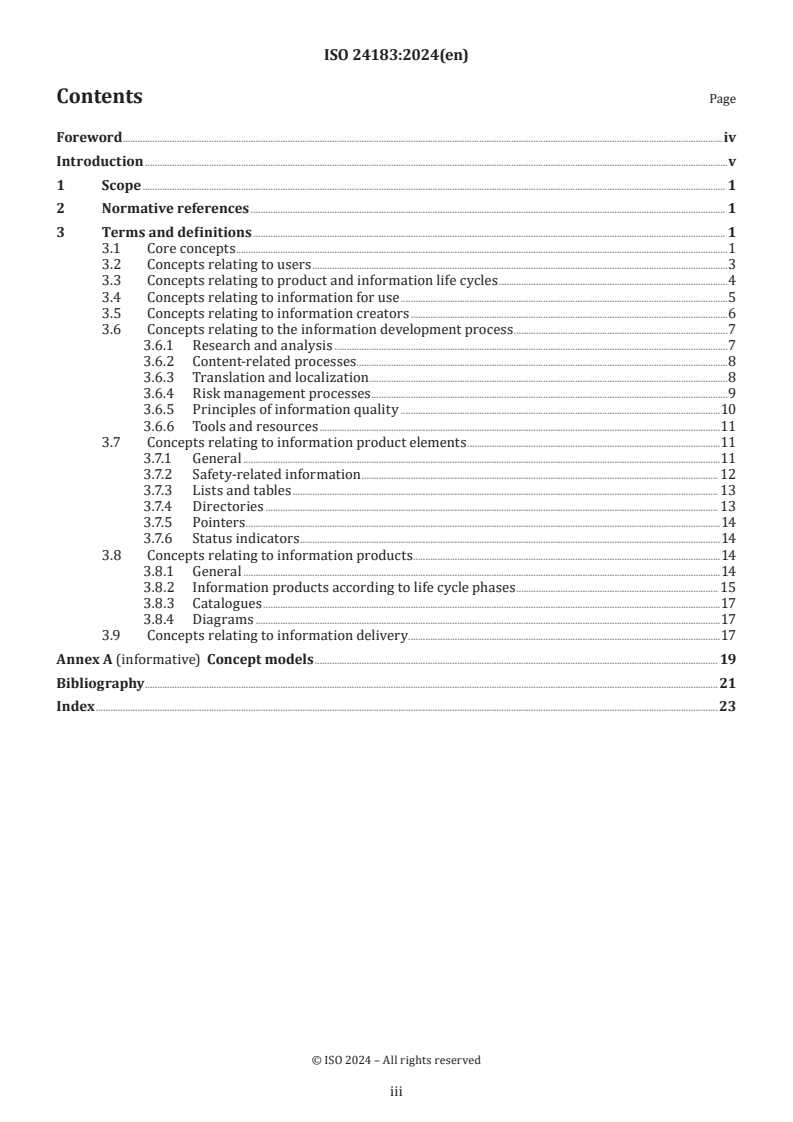
Contents Page
Foreword .iv
Introduction .v
1 Scope . 1
2 Normative references . 1
3 Terms and definitions . 1
3.1 Core concepts .1
3.2 Concepts relating to users .3
3.3 Concepts relating to product and information life cycles .4
3.4 Concepts relating to information for use .5
3.5 Concepts relating to information creators .6
3.6 Concepts relating to the information development process .7
3.6.1 Research and analysis .7
3.6.2 Content-related processes . .8
3.6.3 Translation and localization.8
3.6.4 Risk management processes .9
3.6.5 Principles of information quality .10
3.6.6 Tools and resources .11
3.7 Concepts relating to information product elements .11
3.7.1 General .11
3.7.2 Safety-related information . 12
3.7.3 Lists and tables . 13
3.7.4 Directories . 13
3.7.5 Pointers .14
3.7.6 Status indicators .14
3.8 Concepts relating to information products.14
3.8.1 General .14
3.8.2 Information products according to life cycle phases . 15
3.8.3 Catalogues .17
3.8.4 Diagrams .17
3.9 Concepts relating to information delivery .17
Annex A (informative) Concept models . 19
Bibliography .21
Index .23
iii
Foreword
ISO (the International Organization for Standardization) is a worldwide federation of national standards
bodies (ISO member bodies). The work of preparing International Standards is normally carried out through
ISO technical committees. Each member body interested in a subject for which a technical committee
has been established has the right to be represented on that committee. International organizations,
governmental and non-governmental, in liaison with ISO, also take part in the work. ISO collaborates closely
with the International Electrotechnical Commission (IEC) on all matters of electrotechnical standardization.
The procedures used to develop this document and those intended for its further maintenance are described
in the ISO/IEC Directives, Part 1. In particular, the different approval criteria needed for the different types
of ISO document should be noted. This document was drafted in accordance with the editorial rules of the
ISO/IEC Directives, Part 2 (see www.iso.org/directives).
ISO draws attention to the possibility that the implementation of this document may involve the use of (a)
patent(s). ISO takes no position concerning the evidence, validity or applicability of any claimed patent
rights in respect thereof. As of the date of publication of this document, ISO had not received notice of (a)
patent(s) which may be required to implement this document. However, implementers are cautioned that
this may not represent the latest information, which may be obtained from the patent database available at
www.iso.org/patents. ISO shall not be held responsible for identifying any or all such patent rights.
Any trade name used in this document is information given for the convenience of users and does not
constitute an endorsement.
For an explanation of the voluntary nature of standards, the meaning of ISO specific terms and expressions
related to conformity assessment, as well as information about ISO's adherence to the World Trade
Organization (WTO) principles in the Technical Barriers to Trade (TBT), see www.iso.org/iso/foreword.html.
This document was prepared by Technical Committee ISO/TC 37, Language and terminology.
Any feedback or questions on this document should be directed to the user’s national standards body. A
complete listing of these bodies can be found at www.iso.org/members.html.
iv
Introduction
Suppliers of goods and services provide information for the use of their products, such as instructions,
manuals, service information, information for assembly or troubleshooting information. Technical
communication is the process of defining, creating and delivering these information products for the safe,
effective and efficient use of supported products.
A standardized common terminology as provided in this document helps to prevent misunderstandings
and disputes between acquirers and suppliers of information products as well as between manufacturers
and customers. A standardized terminology for technical communication will support both acquirers and
suppliers of information products. Organizations that provide information products can formulate more
precise requirements, and providers can deliver information products according to specifications.
A standardized common terminology also helps to foster mutual understanding, both within the technical
communication community and in contact with other relevant communities, such as the language services
industry. Furthermore, this document can be used as a basis for researching and teaching technical
communication in various settings.
Annex A contains two concept models that illustrate the interrelations between some key concepts in
technical communication.
v
International Standard ISO 24183:2024(en)
Technical communication — Vocabulary
1 Scope
This document defines terms for the theory and application of technical communication. It prepares the
terminological background for all other standards in the field of technical communication by providing
precise definitions and standardized terms for basic concepts in this domain.
This document is applicable to persons creating information products in the field of technical communication
or using these information products professionally.
2 Normative references
There are no normative references in this document.
3 Terms and definitions
ISO and IEC maintain terminology databases for use in standardization at the following addresses:
— ISO Online browsing platform: available at https:// www .iso .org/ obp
— IEC Electropedia: available at https:// www .electropedia .org/
3.1 Core concepts
3.1.1
technical communication
DEPRECATED: technical writing
process of defining and creating information for use (3.1.2) to be delivered as information products (3.1.4) for
the safe, effective and efficient use of a supported product (3.1.5) throughout its life cycle
Note 1 to entry: Technical communication includes all modes, such as text (3.7.1.2), image, audio (3.7.1.3) and all media,
e.g. printed manuals, tutorial videos, online help (3.8.1.2).
Note 2 to entry: The term "technical writing" should not be used as a synonym for "technical communication" as it is
considered a part of a technical communication.
Note 3 to entry: In some contexts, the term "technical communication" can refer to more general communicative acts
concerning products, such as e-mail communication between engineers.
3.1.2
information for use
information identified and collected during the information development process
3.1.3
product
result of an action or process
Note 1 to entry: Products can be physical products, technical systems, software and services.
3.1.4
information product
product (3.1.3) consisting of information for use (3.1.2) that is delivered for the safe, effective and efficient
use of a supported product (3.1.5)
Note 1 to entry: Information products can also be generated during runtime of a content delivery system.
Note 2 to entry: Information products can contain conceptual information (3.4.2), instructional information (3.4.3) or
reference information (3.4.4).
Note 3 to entry: Information products come in various forms, such as manuals (3.8.1.1) or online help (3.8.1.2).
3.1.5
supported product
product (3.1.3) to which an information product (3.1.4) relates
EXAMPLE
— industrial products (e.g. machinery, components, devices, equipment);
— consumer products (e.g. household appliances, audio-visual devices, communication devices, do-it-
yourself products);
— medical devices, equipment and systems;
— complex systems of systems (e.g. industrial plants, refineries, production sites, data centres);
— means of transport (e.g. cars, trucks, ships, airplanes);
— application software (e.g. office software, web applications);
— software for operation and automatic control of systems;
— technical services.
Note 1 to entry: An information product is an essential component of a supported product.
[SOURCE: IEC/IEEE 82079-1:2019, 3.40, modified — "the information for use" has been replaced by "an
information product" in the definition. The EXAMPLE and Note 1 to entry have been added.]
3.1.6
content
information in any form
EXAMPLE Text (3.7.1.2), audio (3.7.1.3), video.
[SOURCE: ISO 20539:2023, 3.1.2]
3.1.7
technical documentation
set of information products (3.1.4) provided by the supplier of a supported product (3.1.5)
3.1.8
technical communicator
DEPRECATED: technical writer
person who develops information for use (3.1.2)
Note 1 to entry: The role of a technical communicator can include researching product information, defining target
audience information needs, ensuring that legal and normative requirements are met, authoring texts (3.7.1.2),
creating safety instructions and coordinating translations (3.6.3.1).
Note 2 to entry: The term "technical writer" should not be used because it no longer reflects the variety of modes and
media in current use.
3.1.9
information structure
organization of information for use (3.1.2) in order to optimize presentation and understanding
3.1.10
structuring method
content organization according to semantic or functional criteria in order to ensure consistency (3.6.5.1.6)
and interchangeability of information
3.1.11
style guide
set of specifications designed to ensure information quality (3.6.5.1) and information product quality (3.6.5.2)
Note 1 to entry: Style guides should take into account information quality principles such as completeness (3.6.5.1.1)
and consistency (3.6.5.1.5) as well as information product quality criteria such as usability (3.6.5.2.2) and readability
(3.6.5.2.4).
3.1.12
single source publishing
content management approach which allows the same source content (3.1.6) to be delivered across different
forms of media and more than once
3.1.13
terminology
set of designations and concepts belonging to one domain or subject
[SOURCE: ISO 1087:2019, 3.1.11]
3.1.14
terminology work
work concerned with the systematic collection, description, processing and presentation of concepts and
their designations
[SOURCE: ISO 1087:2019, 3.5.1, modified — admitted term "terminology management" and Notes 1 and 2 to
entry have been removed.]
3.1.15
translatability
ease of rendering content (3.1.6) from one language or culture to another
3.2 Concepts relating to users
3.2.1
user
person who interacts with a supported product (3.1.5)
Note 1 to entry: Users can be part of a specific target audience (3.2.2).
Note 2 to entry: "User" can include persons who install, operate, service, maintain or dispose of the product (3.1.3).
[SOURCE: IEC/IEEE 82079-1:2019, 3.47, modified — "product" has been replaced by "a supported product"
in the definition. A new Note 1 to entry has been added. The former Note 1 to entry has been renumbered as
Note 2 to entry.]
3.2.2
target audience
audience
group of persons for whom an information product (3.1.4) is intended
Note 1 to entry: A target audience can consist of specific users (3.2.1) or other persons.
[SOURCE: IEC/IEEE 82079-1:2019, 3.42, modified — "information for use" has been replaced by "an
information product" and "by the supplier" has been deleted in the definition. The admitted term "audience"
and Note 1 to entry have been added.]
3.2.3
skilled person
person with relevant technical education, training and/or experience
[SOURCE: IEC/IEEE 82079-1:2019, 3.36, modified — "individual" has been replaced by "person", "or" has
been replaced by "and/or" and "to enable perceiving risks and avoiding hazards occurring during use of a
product" has been deleted in the definition.]
3.3 Concepts relating to product and information life cycles
3.3.1
put into service
prepare a system for its intended use (3.6.4.1)
3.3.2
put out of service, verb
change a system from an operational status to a non-operational status
3.3.3
product life cycle
period of time from the first idea to the ultimate disposal (3.3.4.10) or recycling (3.3.4.11) of a product (3.1.3)
Note 1 to entry: The product life cycle is divided into defined periods called phases in which activities that belong
together are grouped, e.g. product concept, design, production. The beginning and end of phases require definite
decisions.
[SOURCE: ISO 15226:1999, 3.7, modified — "or recycling" has been added in the definition. "(e.g. releases)"
has been deleted.]
3.3.4
product life cycle phase
stage in the product life cycle (3.3.3)
EXAMPLE Design, development, storage (3.3.4.8), transport, installation (3.3.4.1), commissioning (3.3.4.2),
operation (3.3.4.4), troubleshooting, maintenance (3.3.4.5), repair (3.3.4.6), decommissioning (3.3.4.9), dismounting,
disposal (3.3.4.10).
3.3.4.1
installation
product life cycle phase (3.3.4) in which a product (3.1.3) is prepared such that it fulfils its intended use
(3.6.4.1)
3.3.4.2
commissioning
procedures prior, or related, to the handing over of a physical product (3.1.3) ready to be placed into service
Note 1 to entry: Commissioning can include final acceptance testing, the handing over of relevant documentation for
the supported product (3.1.5) or instructing personnel.
[SOURCE: IEC/IEEE 82079-1:2019, 3.2, modified — "physical" added before "product" in the definition.]
3.3.4.3
setup
process by which a system or component is prepared for operation (3.3.4.4)
3.3.4.4
operation
product life cycle phase (3.3.4) comprising all technical, administrative and managerial actions, other than
maintenance (3.3.4.5) actions, that result in the supported product (3.1.5) functioning according to its
intended use (3.6.4.1)
3.3.4.5
maintenance
set of actions intended to retain a product (3.1.3) in, or restore it to, a useful and safe condition, in which it
can perform the intended use (3.6.4.1)
3.3.4.6
repair
corrective maintenance (3.3.4.5) of defective or damaged parts or functions of a product (3.1.3)
[SOURCE: IEC/IEEE 82079-1:2019, 3.31]
3.3.4.7
emergency operation
set of actions and functions intended to end or avert an emergency situation
[SOURCE: ISO 12100:2010, 3.39, modified — "all" has been replaced by "set of" at the beginning of the
definition.]
3.3.4.7.1
emergency stop
emergency operation (3.3.4.7) by means of a single human action
3.3.4.8
storage
life cycle phase of a physical product (3.1.3) being kept available in an adequate environment
3.3.4.9
decommissioning
life cycle phase of a physical product (3.1.3) being put out of service (3.3.2) permanently
3.3.4.10
disposal
life cycle phase of a physical product (3.1.3) describing its elimination or repurposing
3.3.4.11
recycling
life cycle phase involving the repurposing of a material or component which has previously been processed
for inclusion in a product (3.1.3)
[SOURCE: ISO 10209:2022, 3.13.5, modified — "action of reprocessing" has been replaced by "life cycle phase
involving the repurposing" at the beginning of the definition.]
3.4 Concepts relating to information for use
3.4.1
information type
class of information determined according to structural principles
3.4.2
conceptual information
information for use (3.1.2) which explains and describes the relevant operating principles of the supported
product (3.1.5)
EXAMPLE Functional description (3.4.2.1).
Note 1 to entry: In analysing information for use, it is possible to differentiate between conceptual information,
instructional information (3.4.3) and reference information (3.4.4).
3.4.2.1
functional description
overall description that explains how each part of a product (3.1.3) is expected to operate, interact and be
interacted with
[SOURCE: ISO 16484-1:2010, 3.10, modified — "the system/plant" has been replaced by "a product" and Note
1 to entry has been removed.]
3.4.3
instructional information
information for use (3.1.2) which states procedures and task-oriented steps to be followed or considered
EXAMPLE Step-by-step instructions.
3.4.4
reference information
information for use (3.1.2) which comprises additional details that need to be retrieved on occasion
EXAMPLE Troubleshooting information (3.8.2.3.5), commands, codes.
3.4.5
document type
class of a document defined with respect to its specified purpose, function and form of presentation
3.5 Concepts relating to information creators
3.5.1
terminology manager
expert responsible for the planning, organization and coordination of all terminological activities in the
information development process
3.5.2
terminologist
expert who performs terminology work (3.1.14) as a main function of a professional activity
[SOURCE: ISO 12616-1:2021, 3.30]
3.5.3
terminology worker
person whose role is to perform terminology work (3.1.14) as an ancillary function of other professional
activities
[SOURCE: ISO 12616-1:2021, 3.29]
3.5.4
information architect
person who collects target audience requirements and develops an information strategy
Note 1 to entry: Other terms that are used in some contexts are "content strategist", "indexer" or "taxonomy architect",
who carry out similar tasks.
3.5.5
information developer
person responsible for designing, creating, collecting or implementing a range of information product (3.1.4)
aspects, such as text (3.7.1.2), video, photos or other media
Note 1 to entry: Information product aspects include modes, such as text, image, audio (3.7.1.3) and media, for example
printed manuals, tutorial videos, online help (3.8.1.2).
3.5.6
expert reviewer
subject matter expert or information product design expert responsible for examination of an information
product (3.1.4) according to defined criteria
3.5.7
translator
person who renders source language (3.6.3.2) content into target language (3.6.3.3) content in written or
other recorded form
[SOURCE: ISO 20539:2023, 3.1.12, modified — "translates" has been replaced with "renders source language
content into target language content in written or other recorded form" at the beginning of the definition.]
3.6 Concepts relating to the information development process
3.6.1 Research and analysis
3.6.1.1
product design analysis
process of evaluating product requirements and specifications for the creation of an information product
(3.1.4)
3.6.1.2
information research
set of actions that are necessary to find information on a specific subject
3.6.1.3
information retrieval
IR
set of techniques and processes used to identify resources relevant to an information need, from a collection
or network of information resources
[SOURCE: ISO 25964-1:2011, 2.28, modified — "all the" has been replaced by "set of" at the beginning of the
definition, and "documents" is replaced by "resources".]
3.6.1.4
use case
description of behavioural requirements of a system and its interaction with a user (3.2.1)
[SOURCE: ISO/IEC/IEEE 26515:2018, 3.15, modified — Note 1 to entry has been removed.]
3.6.1.5
persona
model of a fictitious user (3.2.1) with defined properties, based on information research (3.6.1.2)
3.6.1.6
target audience analysis
analysis and classification of the intended types of target audiences (3.2.2) of an information product (3.1.4)
3.6.1.7
task analysis
analysis on how a task is accomplished, including a description of both manual and mental activities
performed by intended user(s) (3.2.1)
3.6.1.8
research interview
questioning technique which results in a transfer of information from a person or group being interviewed
to an interviewer or researcher
3.6.2 Content-related processes
3.6.2.1
content creation
contribution of information to any media, targeting a specific user (3.2.1), target audience (3.2.2) or system
in specific contexts
Note 1 to entry: The receiver of the content (3.1.6) can be a system or, in industrial internet of things environments, a
digital asset (data representation of a physical object) that uses it, for example, for self-maintenance.
3.6.2.2
content delivery
distribution of an information product (3.1.4) via an application
3.6.2.3
content management
set of processes involved in the creation, production, distribution, manipulation, storage (3.3.4.8) and use of
content (3.1.6)
[SOURCE: ISO 20294:2018, 3.5.5, modified — "set of" has been added at the beginning of the definition, and
"digital" has been deleted before "content".]
3.6.2.4
document management
database-driven administration of electronic or electronically collected documents
Note 1 to entry: Document management includes finding documents via metadata, managing of text modules and their
versions and variants, storage, approval and production and delivery of information products (3.1.4).
3.6.2.5
content mapping
process of delivering appropriate content (3.1.6) to the target audience (3.2.2) or system for a specific
situation in the life cycle of the supported product (3.1.5)
Note 1 to entry: The receiver of the content can be a system or, in industrial internet of things (IIoT) environments, a
digital asset (data representation of a physical object) that uses the content, for example, for self-maintenance.
3.6.2.6
content reuse
use of existing content (3.1.6) in order to create a new information product (3.1.4)
3.6.2.7
editing
modification of content (3.1.6) or layout of text (3.7.1.2)
Note 1 to entry: Editing processes include insertion, deletion and re-arrangement of text.
3.6.2.8
formatting
process of creating a layout of an information product (3.1.4)
3.6.3 Translation and localization
3.6.3.1
translation
rendering source language (3.6.3.2) content into target language (3.6.3.3) content in written form or signed
language
[SOURCE: ISO 20539:2023, 3.1.9]
ISO 241
...
International
Standard
ISO 24183
First edition
Technical communication —
2024-01
Vocabulary
Communication technique — Vocabulaire
Reference number
© ISO 2024
All rights reserved. Unless otherwise specified, or required in the context of its implementation, no part of this publication may
be reproduced or utilized otherwise in any form or by any means, electronic or mechanical, including photocopying, or posting on
the internet or an intranet, without prior written permission. Permission can be requested from either ISO at the address below
or ISO’s member body in the country of the requester.
ISO copyright office
CP 401 • Ch. de Blandonnet 8
CH-1214 Vernier, Geneva
Phone: +41 22 749 01 11
Email: copyright@iso.org
Website: www.iso.org
Published in Switzerland
ii
Contents Page
Foreword .iv
Introduction .v
1 Scope . 1
2 Normative references . 1
3 Terms and definitions . 1
3.1 Core concepts .1
3.2 Concepts relating to users .3
3.3 Concepts relating to product and information life cycles .4
3.4 Concepts relating to information for use .5
3.5 Concepts relating to information creators .6
3.6 Concepts relating to the information development process .7
3.6.1 Research and analysis .7
3.6.2 Content-related processes . .8
3.6.3 Translation and localization.8
3.6.4 Risk management processes .9
3.6.5 Principles of information quality .10
3.6.6 Tools and resources .11
3.7 Concepts relating to information product elements .11
3.7.1 General .11
3.7.2 Safety-related information . 12
3.7.3 Lists and tables . 13
3.7.4 Directories . 13
3.7.5 Pointers .14
3.7.6 Status indicators .14
3.8 Concepts relating to information products.14
3.8.1 General .14
3.8.2 Information products according to life cycle phases . 15
3.8.3 Catalogues .17
3.8.4 Diagrams .17
3.9 Concepts relating to information delivery .17
Annex A (informative) Concept models . 19
Bibliography .21
Index .23
iii
Foreword
ISO (the International Organization for Standardization) is a worldwide federation of national standards
bodies (ISO member bodies). The work of preparing International Standards is normally carried out through
ISO technical committees. Each member body interested in a subject for which a technical committee
has been established has the right to be represented on that committee. International organizations,
governmental and non-governmental, in liaison with ISO, also take part in the work. ISO collaborates closely
with the International Electrotechnical Commission (IEC) on all matters of electrotechnical standardization.
The procedures used to develop this document and those intended for its further maintenance are described
in the ISO/IEC Directives, Part 1. In particular, the different approval criteria needed for the different types
of ISO document should be noted. This document was drafted in accordance with the editorial rules of the
ISO/IEC Directives, Part 2 (see www.iso.org/directives).
ISO draws attention to the possibility that the implementation of this document may involve the use of (a)
patent(s). ISO takes no position concerning the evidence, validity or applicability of any claimed patent
rights in respect thereof. As of the date of publication of this document, ISO had not received notice of (a)
patent(s) which may be required to implement this document. However, implementers are cautioned that
this may not represent the latest information, which may be obtained from the patent database available at
www.iso.org/patents. ISO shall not be held responsible for identifying any or all such patent rights.
Any trade name used in this document is information given for the convenience of users and does not
constitute an endorsement.
For an explanation of the voluntary nature of standards, the meaning of ISO specific terms and expressions
related to conformity assessment, as well as information about ISO's adherence to the World Trade
Organization (WTO) principles in the Technical Barriers to Trade (TBT), see www.iso.org/iso/foreword.html.
This document was prepared by Technical Committee ISO/TC 37, Language and terminology.
Any feedback or questions on this document should be directed to the user’s national standards body. A
complete listing of these bodies can be found at www.iso.org/members.html.
iv
Introduction
Suppliers of goods and services provide information for the use of their products, such as instructions,
manuals, service information, information for assembly or troubleshooting information. Technical
communication is the process of defining, creating and delivering these information products for the safe,
effective and efficient use of supported products.
A standardized common terminology as provided in this document helps to prevent misunderstandings
and disputes between acquirers and suppliers of information products as well as between manufacturers
and customers. A standardized terminology for technical communication will support both acquirers and
suppliers of information products. Organizations that provide information products can formulate more
precise requirements, and providers can deliver information products according to specifications.
A standardized common terminology also helps to foster mutual understanding, both within the technical
communication community and in contact with other relevant communities, such as the language services
industry. Furthermore, this document can be used as a basis for researching and teaching technical
communication in various settings.
Annex A contains two concept models that illustrate the interrelations between some key concepts in
technical communication.
v
International Standard ISO 24183:2024(en)
Technical communication — Vocabulary
1 Scope
This document defines terms for the theory and application of technical communication. It prepares the
terminological background for all other standards in the field of technical communication by providing
precise definitions and standardized terms for basic concepts in this domain.
This document is applicable to persons creating information products in the field of technical communication
or using these information products professionally.
2 Normative references
There are no normative references in this document.
3 Terms and definitions
ISO and IEC maintain terminology databases for use in standardization at the following addresses:
— ISO Online browsing platform: available at https:// www .iso .org/ obp
— IEC Electropedia: available at https:// www .electropedia .org/
3.1 Core concepts
3.1.1
technical communication
DEPRECATED: technical writing
process of defining and creating information for use (3.1.2) to be delivered as information products (3.1.4) for
the safe, effective and efficient use of a supported product (3.1.5) throughout its life cycle
Note 1 to entry: Technical communication includes all modes, such as text (3.7.1.2), image, audio (3.7.1.3) and all media,
e.g. printed manuals, tutorial videos, online help (3.8.1.2).
Note 2 to entry: The term "technical writing" should not be used as a synonym for "technical communication" as it is
considered a part of a technical communication.
Note 3 to entry: In some contexts, the term "technical communication" can refer to more general communicative acts
concerning products, such as e-mail communication between engineers.
3.1.2
information for use
information identified and collected during the information development process
3.1.3
product
result of an action or process
Note 1 to entry: Products can be physical products, technical systems, software and services.
3.1.4
information product
product (3.1.3) consisting of information for use (3.1.2) that is delivered for the safe, effective and efficient
use of a supported product (3.1.5)
Note 1 to entry: Information products can also be generated during runtime of a content delivery system.
Note 2 to entry: Information products can contain conceptual information (3.4.2), instructional information (3.4.3) or
reference information (3.4.4).
Note 3 to entry: Information products come in various forms, such as manuals (3.8.1.1) or online help (3.8.1.2).
3.1.5
supported product
product (3.1.3) to which an information product (3.1.4) relates
EXAMPLE
— industrial products (e.g. machinery, components, devices, equipment);
— consumer products (e.g. household appliances, audio-visual devices, communication devices, do-it-
yourself products);
— medical devices, equipment and systems;
— complex systems of systems (e.g. industrial plants, refineries, production sites, data centres);
— means of transport (e.g. cars, trucks, ships, airplanes);
— application software (e.g. office software, web applications);
— software for operation and automatic control of systems;
— technical services.
Note 1 to entry: An information product is an essential component of a supported product.
[SOURCE: IEC/IEEE 82079-1:2019, 3.40, modified — "the information for use" has been replaced by "an
information product" in the definition. The EXAMPLE and Note 1 to entry have been added.]
3.1.6
content
information in any form
EXAMPLE Text (3.7.1.2), audio (3.7.1.3), video.
[SOURCE: ISO 20539:2023, 3.1.2]
3.1.7
technical documentation
set of information products (3.1.4) provided by the supplier of a supported product (3.1.5)
3.1.8
technical communicator
DEPRECATED: technical writer
person who develops information for use (3.1.2)
Note 1 to entry: The role of a technical communicator can include researching product information, defining target
audience information needs, ensuring that legal and normative requirements are met, authoring texts (3.7.1.2),
creating safety instructions and coordinating translations (3.6.3.1).
Note 2 to entry: The term "technical writer" should not be used because it no longer reflects the variety of modes and
media in current use.
3.1.9
information structure
organization of information for use (3.1.2) in order to optimize presentation and understanding
3.1.10
structuring method
content organization according to semantic or functional criteria in order to ensure consistency (3.6.5.1.6)
and interchangeability of information
3.1.11
style guide
set of specifications designed to ensure information quality (3.6.5.1) and information product quality (3.6.5.2)
Note 1 to entry: Style guides should take into account information quality principles such as completeness (3.6.5.1.1)
and consistency (3.6.5.1.5) as well as information product quality criteria such as usability (3.6.5.2.2) and readability
(3.6.5.2.4).
3.1.12
single source publishing
content management approach which allows the same source content (3.1.6) to be delivered across different
forms of media and more than once
3.1.13
terminology
set of designations and concepts belonging to one domain or subject
[SOURCE: ISO 1087:2019, 3.1.11]
3.1.14
terminology work
work concerned with the systematic collection, description, processing and presentation of concepts and
their designations
[SOURCE: ISO 1087:2019, 3.5.1, modified — admitted term "terminology management" and Notes 1 and 2 to
entry have been removed.]
3.1.15
translatability
ease of rendering content (3.1.6) from one language or culture to another
3.2 Concepts relating to users
3.2.1
user
person who interacts with a supported product (3.1.5)
Note 1 to entry: Users can be part of a specific target audience (3.2.2).
Note 2 to entry: "User" can include persons who install, operate, service, maintain or dispose of the product (3.1.3).
[SOURCE: IEC/IEEE 82079-1:2019, 3.47, modified — "product" has been replaced by "a supported product"
in the definition. A new Note 1 to entry has been added. The former Note 1 to entry has been renumbered as
Note 2 to entry.]
3.2.2
target audience
audience
group of persons for whom an information product (3.1.4) is intended
Note 1 to entry: A target audience can consist of specific users (3.2.1) or other persons.
[SOURCE: IEC/IEEE 82079-1:2019, 3.42, modified — "information for use" has been replaced by "an
information product" and "by the supplier" has been deleted in the definition. The admitted term "audience"
and Note 1 to entry have been added.]
3.2.3
skilled person
person with relevant technical education, training and/or experience
[SOURCE: IEC/IEEE 82079-1:2019, 3.36, modified — "individual" has been replaced by "person", "or" has
been replaced by "and/or" and "to enable perceiving risks and avoiding hazards occurring during use of a
product" has been deleted in the definition.]
3.3 Concepts relating to product and information life cycles
3.3.1
put into service
prepare a system for its intended use (3.6.4.1)
3.3.2
put out of service, verb
change a system from an operational status to a non-operational status
3.3.3
product life cycle
period of time from the first idea to the ultimate disposal (3.3.4.10) or recycling (3.3.4.11) of a product (3.1.3)
Note 1 to entry: The product life cycle is divided into defined periods called phases in which activities that belong
together are grouped, e.g. product concept, design, production. The beginning and end of phases require definite
decisions.
[SOURCE: ISO 15226:1999, 3.7, modified — "or recycling" has been added in the definition. "(e.g. releases)"
has been deleted.]
3.3.4
product life cycle phase
stage in the product life cycle (3.3.3)
EXAMPLE Design, development, storage (3.3.4.8), transport, installation (3.3.4.1), commissioning (3.3.4.2),
operation (3.3.4.4), troubleshooting, maintenance (3.3.4.5), repair (3.3.4.6), decommissioning (3.3.4.9), dismounting,
disposal (3.3.4.10).
3.3.4.1
installation
product life cycle phase (3.3.4) in which a product (3.1.3) is prepared such that it fulfils its intended use
(3.6.4.1)
3.3.4.2
commissioning
procedures prior, or related, to the handing over of a physical product (3.1.3) ready to be placed into service
Note 1 to entry: Commissioning can include final acceptance testing, the handing over of relevant documentation for
the supported product (3.1.5) or instructing personnel.
[SOURCE: IEC/IEEE 82079-1:2019, 3.2, modified — "physical" added before "product" in the definition.]
3.3.4.3
setup
process by which a system or component is prepared for operation (3.3.4.4)
3.3.4.4
operation
product life cycle phase (3.3.4) comprising all technical, administrative and managerial actions, other than
maintenance (3.3.4.5) actions, that result in the supported product (3.1.5) functioning according to its
intended use (3.6.4.1)
3.3.4.5
maintenance
set of actions intended to retain a product (3.1.3) in, or restore it to, a useful and safe condition, in which it
can perform the intended use (3.6.4.1)
3.3.4.6
repair
corrective maintenance (3.3.4.5) of defective or damaged parts or functions of a product (3.1.3)
[SOURCE: IEC/IEEE 82079-1:2019, 3.31]
3.3.4.7
emergency operation
set of actions and functions intended to end or avert an emergency situation
[SOURCE: ISO 12100:2010, 3.39, modified — "all" has been replaced by "set of" at the beginning of the
definition.]
3.3.4.7.1
emergency stop
emergency operation (3.3.4.7) by means of a single human action
3.3.4.8
storage
life cycle phase of a physical product (3.1.3) being kept available in an adequate environment
3.3.4.9
decommissioning
life cycle phase of a physical product (3.1.3) being put out of service (3.3.2) permanently
3.3.4.10
disposal
life cycle phase of a physical product (3.1.3) describing its elimination or repurposing
3.3.4.11
recycling
life cycle phase involving the repurposing of a material or component which has previously been processed
for inclusion in a product (3.1.3)
[SOURCE: ISO 10209:2022, 3.13.5, modified — "action of reprocessing" has been replaced by "life cycle phase
involving the repurposing" at the beginning of the definition.]
3.4 Concepts relating to information for use
3.4.1
information type
class of information determined according to structural principles
3.4.2
conceptual information
information for use (3.1.2) which explains and describes the relevant operating principles of the supported
product (3.1.5)
EXAMPLE Functional description (3.4.2.1).
Note 1 to entry: In analysing information for use, it is possible to differentiate between conceptual information,
instructional information (3.4.3) and reference information (3.4.4).
3.4.2.1
functional description
overall description that explains how each part of a product (3.1.3) is expected to operate, interact and be
interacted with
[SOURCE: ISO 16484-1:2010, 3.10, modified — "the system/plant" has been replaced by "a product" and Note
1 to entry has been removed.]
3.4.3
instructional information
information for use (3.1.2) which states procedures and task-oriented steps to be followed or considered
EXAMPLE Step-by-step instructions.
3.4.4
reference information
information for use (3.1.2) which comprises additional details that need to be retrieved on occasion
EXAMPLE Troubleshooting information (3.8.2.3.5), commands, codes.
3.4.5
document type
class of a document defined with respect to its specified purpose, function and form of presentation
3.5 Concepts relating to information creators
3.5.1
terminology manager
expert responsible for the planning, organization and coordination of all terminological activities in the
information development process
3.5.2
terminologist
expert who performs terminology work (3.1.14) as a main function of a professional activity
[SOURCE: ISO 12616-1:2021, 3.30]
3.5.3
terminology worker
person whose role is to perform terminology work (3.1.14) as an ancillary function of other professional
activities
[SOURCE: ISO 12616-1:2021, 3.29]
3.5.4
information architect
person who collects target audience requirements and develops an information strategy
Note 1 to entry: Other terms that are used in some contexts are "content strategist", "indexer" or "taxonomy architect",
who carry out similar tasks.
3.5.5
information developer
person responsible for designing, creating, collecting or implementing a range of information product (3.1.4)
aspects, such as text (3.7.1.2), video, photos or other media
Note 1 to entry: Information product aspects include modes, such as text, image, audio (3.7.1.3) and media, for example
printed manuals, tutorial videos, online help (3.8.1.2).
3.5.6
expert reviewer
subject matter expert or information product design expert responsible for examination of an information
product (3.1.4) according to defined criteria
3.5.7
translator
person who renders source language (3.6.3.2) content into target language (3.6.3.3) content in written or
other recorded form
[SOURCE: ISO 20539:2023, 3.1.12, modified — "translates" has been replaced with "renders source language
content into target language content in written or other recorded form" at the beginning of the definition.]
3.6 Concepts relating to the information development process
3.6.1 Research and analysis
3.6.1.1
product design analysis
process of evaluating product requirements and specifications for the creation of an information product
(3.1.4)
3.6.1.2
information research
set of actions that are necessary to find information on a specific subject
3.6.1.3
information retrieval
IR
set of techniques and processes used to identify resources relevant to an information need, from a collection
or network of information resources
[SOURCE: ISO 25964-1:2011, 2.28, modified — "all the" has been replaced by "set of" at the beginning of the
definition, and "documents" is replaced by "resources".]
3.6.1.4
use case
description of behavioural requirements of a system and its interaction with a user (3.2.1)
[SOURCE: ISO/IEC/IEEE 26515:2018, 3.15, modified — Note 1 to entry has been removed.]
3.6.1.5
persona
model of a fictitious user (3.2.1) with defined properties, based on information research (3.6.1.2)
3.6.1.6
target audience analysis
analysis and classification of the intended types of target audiences (3.2.2) of an information product (3.1.4)
3.6.1.7
task analysis
analysis on how a task is accomplished, including a description of both manual and mental activities
performed by intended user(s) (3.2.1)
3.6.1.8
research interview
questioning technique which results in a transfer of information from a person or group being interviewed
to an interviewer or researcher
3.6.2 Content-related processes
3.6.2.1
content creation
contribution of information to any media, targeting a specific user (3.2.1), target audience (3.2.2) or system
in specific contexts
Note 1 to entry: The receiver of the content (3.1.6) can be a system or, in industrial internet of things environments, a
digital asset (data representation of a physical object) that uses it, for example, for self-maintenance.
3.6.2.2
content delivery
distribution of an information product (3.1.4) via an application
3.6.2.3
content management
set of processes involved in the creation, production, distribution, manipulation, storage (3.3.4.8) and use of
content (3.1.6)
[SOURCE: ISO 20294:2018, 3.5.5, modified — "set of" has been added at the beginning of the definition, and
"digital" has been deleted before "content".]
3.6.2.4
document management
database-driven administration of electronic or electronically collected documents
Note 1 to entry: Document management includes finding documents via metadata, managing of text modules and their
versions and variants, storage, approval and production and delivery of information products (3.1.4).
3.6.2.5
content mapping
process of delivering appropriate content (3.1.6) to the target audience (3.2.2) or system for a specific
situation in the life cycle of the supported product (3.1.5)
Note 1 to entry: The receiver of the content can be a system or, in industrial internet of things (IIoT) environments, a
digital asset (data representation of a physical object) that uses the content, for example, for self-maintenance.
3.6.2.6
content reuse
use of existing content (3.1.6) in order to create a new information product (3.1.4)
3.6.2.7
editing
modification of content (3.1.6) or layout of text (3.7.1.2)
Note 1 to entry: Editing processes include insertion, deletion and re-arrangement of text.
3.6.2.8
formatting
process of creating a layout of an information product (3.1.4)
3.6.3 Translation and localization
3.6.3.1
translation
rendering source language (3.6.3.2) content into target language (3.6.3.3) content in written form or signed
language
[SOURCE: ISO 20539:2023, 3.1.9]
3.6.3.2
source language
language from which content (3.1.6) is translated or interpreted
Note 1 to entry: In technical communication (3.1.1), translation (3.6.3.1) is more relevant than interpretation.
[SOURCE: ISO 20539:2023, 3.1.3, modified — Note 1 to entry has been added.]
3.6.3.3
target language
language into which content (3.1.6) is translated or interpreted
Note 1 to entry: In technical communication (3.1.1), translati
...