

ISO 23420:2021
(Main)Microbeam analysis — Analytical electron microscopy — Method for the determination of energy resolution for electron energy loss spectrum analysis
- Abstract
This document specifies a determination procedure of energy resolution in the scanning transmission electron microscope or the transmission electron microscope equipped with the electron energy loss (EEL) spectrometer. This document is applicable to both in-column type EEL spectrometer and post-column type EEL spectrometer. These EEL signal detecting systems are applicable to a parallel detecting system and a serial detecting system.
- Status
- Published
- Publication Date
- 22-Apr-2021
- Technical Committee
- ISO/TC 202/SC 3 - Analytical electron microscopy
- Drafting Committee
- ISO/TC 202/SC 3 - Analytical electron microscopy
- Current Stage
- 9092 - International Standard to be revised
- Start Date
- 24-Sep-2026
- Completion Date
- 10-Oct-2026
Buy Documents



ISO 23420:2021 - Microbeam analysis -- Analytical electron microscopy -- Method for the determination of energy resolution for electron energy loss spectrum analysis

ISO 23420:2021 - Microbeam analysis — Analytical electron microscopy — Method for the determination of energy resolution for electron energy loss spectrum analysis/23/2021
Overview
ISO 23420:2021 defines a standardized procedure to determine the energy resolution of electron energy loss spectroscopy (EELS) systems installed on scanning/transmission electron microscopes (S/TEM or TEM). It applies to both in‑column and post‑column EEL spectrometers and to parallel and serial detection systems. The standard establishes how to calibrate energy steps, measure the zero‑loss peak (ZLP), and calculate the spectrometer energy resolution (ΔE) for reliable EELS analysis.
Key Topics and Requirements
- Scope & applicability: Measurement method for energy resolution in S/TEMs equipped with EEL spectrometers (in‑column and post‑column; parallel and serial detection).
- Definitions & symbols: Clarifies terms such as zero‑loss peak (ZLP), energy step (δE), energy dispersion, FWHM, collection angle, and channels used in parallel detection.
- Reference materials & calibration:
- Use of graphite reference and measurement of the graphite C1s binding energy by XPS (X‑ray photoelectron spectroscopy) to align energy scales.
- Selection of reference materials for energy‑scale calibration and correspondence between XPS C1s and EELS carbon K edge (covered in informative Annex B).
- Measurement procedure:
- Predetermination of binding energies, setup of S/TEM and EELS, and sample mounting.
- First and second energy step (δE) calibrations using graphite/plasmon and other reference peaks.
- Acquisition of carbon K‑edge and low‑loss spectra, locating peaks close to ZLP, and measuring channel distances (CH) on calibrated δE.
- Determination of ΔE from the FWHM of the zero‑loss peak on the calibrated energy scale.
- Uncertainty: Guidance on evaluating measurement uncertainty (reference to GUM principles).
- Supporting material: Annex A provides an example measurement procedure.
Applications and Who Uses It
- Materials scientists and microscopists performing quantitative EELS for composition, bonding and electronic-structure analysis.
- Electron microscopy facilities and core labs implementing quality control and routine instrument characterization.
- Instrument manufacturers validating EELS performance and delivering calibrated systems.
- Calibration and testing labs, and standards bodies seeking repeatable, comparable ΔE measurements across instruments.
- Practical use cases include plasmon and core‑loss peak decomposition, energy-shift studies, and any EELS workflow where accurate energy resolution is critical.
Related Standards
- ISO 15932 (referenced for zero‑loss definition)
- GUM (Guide to the Expression of Uncertainty in Measurement) principles for uncertainty evaluation
Keywords: ISO 23420:2021, energy resolution, EELS, electron energy loss spectroscopy, S/TEM, zero‑loss peak, δE calibration, graphite C1s, XPS calibration, ΔE determination.
Relations
- Effective Date
- 06-Jun-2022
Buy Documents
ISO 23420:2021 - Microbeam analysis -- Analytical electron microscopy -- Method for the determination of energy resolution for electron energy loss spectrum analysis
ISO 23420:2021 - Microbeam analysis — Analytical electron microscopy — Method for the determination of energy resolution for electron energy loss spectrum analysis/23/2021
Get Certified
Connect with accredited certification bodies for this standard

ECOCERT
Organic and sustainability certification.

Eurofins Food Testing Global
Global leader in food, environment, and pharmaceutical product testing.

Intertek Bangladesh
Intertek certification and testing services in Bangladesh.
Sponsored listings
Frequently Asked Questions
ISO 23420:2021 is a standard published by the International Organization for Standardization (ISO). Its full title is "Microbeam analysis — Analytical electron microscopy — Method for the determination of energy resolution for electron energy loss spectrum analysis". This standard covers: This document specifies a determination procedure of energy resolution in the scanning transmission electron microscope or the transmission electron microscope equipped with the electron energy loss (EEL) spectrometer. This document is applicable to both in-column type EEL spectrometer and post-column type EEL spectrometer. These EEL signal detecting systems are applicable to a parallel detecting system and a serial detecting system.
This document specifies a determination procedure of energy resolution in the scanning transmission electron microscope or the transmission electron microscope equipped with the electron energy loss (EEL) spectrometer. This document is applicable to both in-column type EEL spectrometer and post-column type EEL spectrometer. These EEL signal detecting systems are applicable to a parallel detecting system and a serial detecting system.
ISO 23420:2021 is classified under the following ICS (International Classification for Standards) categories: 71.040.50 - Physicochemical methods of analysis. The ICS classification helps identify the subject area and facilitates finding related standards.
ISO 23420:2021 has the following relationships with other standards: It is inter standard links to ISO 19076:2023. Understanding these relationships helps ensure you are using the most current and applicable version of the standard.
ISO 23420:2021 is available in PDF format for immediate download after purchase. The document can be added to your cart and obtained through the secure checkout process. Digital delivery ensures instant access to the complete standard document.
Standards Content (Sample)
INTERNATIONAL ISO
STANDARD 23420
First edition
2021-04
Microbeam analysis — Analytical
electron microscopy — Method for the
determination of energy resolution
for electron energy loss spectrum
analysis
Analyse par microfaisceaux — Microscopie électronique analytique
— Méthode de détermination de la résolution énergétique pour
l'analyse spectrale de la perte d'énergie des électrons
Reference number
©
ISO 2021
© ISO 2021
All rights reserved. Unless otherwise specified, or required in the context of its implementation, no part of this publication may
be reproduced or utilized otherwise in any form or by any means, electronic or mechanical, including photocopying, or posting
on the internet or an intranet, without prior written permission. Permission can be requested from either ISO at the address
below or ISO’s member body in the country of the requester.
ISO copyright office
CP 401 • Ch. de Blandonnet 8
CH-1214 Vernier, Geneva
Phone: +41 22 749 01 11
Email: copyright@iso.org
Website: www.iso.org
Published in Switzerland
ii © ISO 2021 – All rights reserved
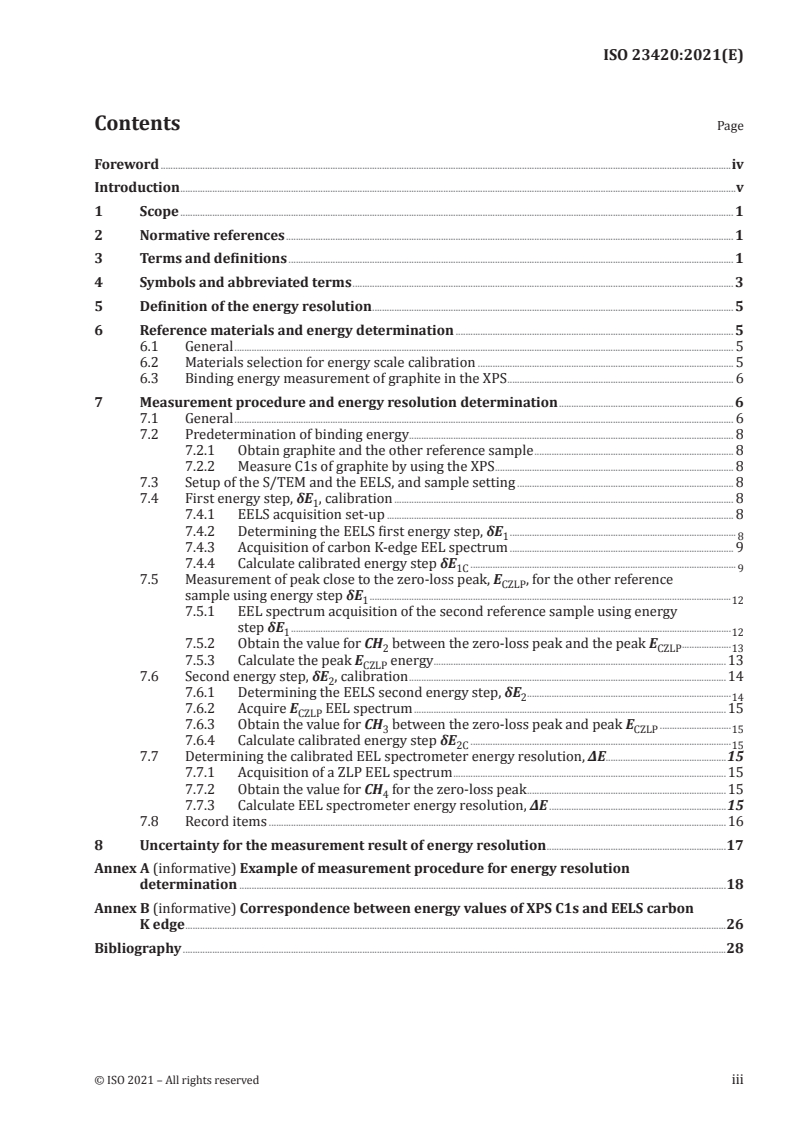
Contents Page
Foreword .iv
Introduction .v
1 Scope . 1
2 Normative references . 1
3 Terms and definitions . 1
4 Symbols and abbreviated terms . 3
5 Definition of the energy resolution . 5
6 Reference materials and energy determination . 5
6.1 General . 5
6.2 Materials selection for energy scale calibration . 5
6.3 Binding energy measurement of graphite in the XPS . 6
7 Measurement procedure and energy resolution determination . 6
7.1 General . 6
7.2 Predetermination of binding energy . 8
7.2.1 Obtain graphite and the other reference sample . 8
7.2.2 Measure C1s of graphite by using the XPS . 8
7.3 Setup of the S/TEM and the EELS, and sample setting . 8
7.4 First energy step, δE , calibration . 8
7.4.1 EELS acquisition set-up . 8
7.4.2 Determining the EELS first energy step, δE .
1 8
7.4.3 Acquisition of carbon K-edge EEL spectrum . 9
7.4.4 Calculate calibrated energy step δE .
1C 9
7.5 Measurement of peak close to the zero-loss peak, E , for the other reference
CZLP
sample using energy step δE .
1 12
7.5.1 EEL spectrum acquisition of the second reference sample using energy
step δE .
1 12
7.5.2 Obtain the value for CH between the zero-loss peak and the peak E .
2 CZLP 13
7.5.3 Calculate the peak E energy . .13
CZLP
7.6 Second energy step, δE , calibration .14
7.6.1 Determining the EELS second energy step, δE .
2 14
7.6.2 Acquire E EEL spectrum .15
CZLP
7.6.3 Obtain the value for CH between the zero-loss peak and peak E .
3 CZLP 15
7.6.4 Calculate calibrated energy step δE .
2C 15
7.7 Determining the calibrated EEL spectrometer energy resolution, ΔE .15
7.7.1 Acquisition of a ZLP EEL spectrum .15
7.7.2 Obtain the value for CH for the zero-loss peak .15
7.7.3 Calculate EEL spectrometer energy resolution, ΔE .15
7.8 Record items .16
8 Uncertainty for the measurement result of energy resolution .17
Annex A (informative) Example of measurement procedure for energy resolution
determination .18
Annex B (informative) Correspondence between energy values of XPS C1s and EELS carbon
K edge .26
Bibliography .28
Foreword
ISO (the International Organization for Standardization) is a worldwide federation of national standards
bodies (ISO member bodies). The work of preparing International Standards is normally carried out
through ISO technical committees. Each member body interested in a subject for which a technical
committee has been established has the right to be represented on that committee. International
organizations, governmental and non-governmental, in liaison with ISO, also take part in the work.
ISO collaborates closely with the International Electrotechnical Commission (IEC) on all matters of
electrotechnical standardization.
The procedures used to develop this document and those intended for its further maintenance are
described in the ISO/IEC Directives, Part 1. In particular, the different approval criteria needed for the
different types of ISO documents should be noted. This document was drafted in accordance with the
editorial rules of the ISO/IEC Directives, Part 2 (see www .iso .org/ directives).
Attention is drawn to the possibility that some of the elements of this document may be the subject of
patent rights. ISO shall not be held responsible for identifying any or all such patent rights. Details of
any patent rights identified during the development of the document will be in the Introduction and/or
on the ISO list of patent declarations received (see www .iso .org/ patents).
Any trade name used in this document is information given for the convenience of users and does not
constitute an endorsement.
For an explanation of the voluntary nature of standards, the meaning of ISO specific terms and
expressions related to conformity assessment, as well as information about ISO's adherence to the
World Trade Organization (WTO) principles in the Technical Barriers to Trade (TBT), see www .iso .org/
iso/ foreword .html.
This document was prepared by Technical Committee ISO/TC 202, Microbeam analysis, Subcommittee
SC 3, Analytical electron microscopy.
A list of all parts in the ISO 23420 series can be found on the ISO website.
Any feedback or questions on this document should be directed to the user’s national standards body. A
complete listing of these bodies can be found at www .iso .org/ members .html.
iv © ISO 2021 – All rights reserved
Introduction
In order to understand the chemical composition, the atomic bonding and the electronic structure,
electron energy loss analysis is often performed with the scanning transmission electron microscope
or the transmission electron microscope (S/TEM) equipped with the electron energy loss (EEL)
spectrometer.
In the analysis using EEL spectrometer system, the energy loss of incident electrons by the inelastic
interaction via phonon and plasmon excitations, intra- and inter-band transitions and the inner shell
ionization can be measured. The inner shell ionization is particularly useful and important as it gives
the information on chemical composition of materials. For the precise analysis based on the energy loss
peak decomposition and its energy shifts, it is vitally important to understand the energy resolution
of the EEL spectrometer system. However, the determination method of the energy resolution is not
standardized yet.
This document provides the procedures for energy step calibration and energy resolution determination
useful for the electron energy loss spectrum analysis in the S/TEM equipped with the EEL spectrometer.
INTERNATIONAL STANDARD ISO 23420:2021(E)
Microbeam analysis — Analytical electron microscopy —
Method for the determination of energy resolution for
electron energy loss spectrum analysis
1 Scope
This document specifies a determination procedure of energy resolution in the scanning transmission
electron microscope or the transmission electron microscope equipped with the electron energy loss
(EEL) spectrometer.
This document is applicable to both in-column type EEL spectrometer and post-column type EEL
spectrometer. These EEL signal detecting systems are applicable to a parallel detecting system and a
serial detecting system.
2 Normative references
There are no normative references in this document.
3 Terms and definitions
For the purposes of this document, the following terms and definitions apply.
ISO and IEC maintain terminological databases for use in standardization at the following addresses:
— IEC Electropedia: available at http:// www .electropedia .org/
— ISO Online browsing platform: available at https:// www .iso .org/ obp
3.1
beam diameter
full width at half maximum (FWHM) of the electron beam intensity profile for the STEM observation
3.2
Boersch effect
energy spread of electron beam due to Coulomb interaction (3.5) between electrons in the beam
3.3
channel
range of one pixel of the detector in the parallel detection (3.17) EELS
3.4
collection angle
EELS entrance aperture diameter divided by a camera length and a geometric factor (3.13) for the
STEM or the TEM diffraction mode, or EELS entrance aperture diameter divided by the distance from
crossover of the lens in front of the EEL spectrometer to the EELS entrance aperture for imaging mode
of the energy-filtering TEM
3.5
Coulomb interaction
repulsion of electrons by electric charge
3.6
detection plane
plane where energy dispersed electron focus
3.7
electron energy loss
energy shift of the electron kinetic energy due to the inelastic scattering in solids
3.8
energy dispersion
degree of change in position of the dispersed electrons at the detection plane (3.6) per unit energy change
3.9
energy resolution
FWHM of the zero-loss (3.21) peak
3.10
energy step
energy selecting window (3.11) per channel (3.3) in the parallel detection (3.17) EELS, or energy range
limited by the width of energy selecting slit in the serial detection (3.20) EELS
3.11
energy selecting window
energy range for selection of a specific energy loss value
3.12
entrance aperture
aperture for limiting the collection angle (3.4) of the EEL spectrometer
3.13
geometric factor
ratio of distance from a projector lens to an EELS entrance aperture to distance from the projector lens
to an image detection device
3.14
in-column type EELS
EELS system with the EEL spectrometer located in the imaging system of the TEM
3.15
irradiation diameter
diameter of the electron beam irradiation region for the TEM observation
3.16
K edge
energy loss related to K shell electron transition to the lowest empty state
3.17
parallel detection
simultaneous EELS signal detection for all energy-dispersed electrons focused on the detection plane (3.6)
3.18
plasmon-loss
energy loss of electron due to excitation of the quantized plasma oscillations of electrons
3.19
post-column type EELS
EELS system with the EEL spectrometer located behind the imaging/detecting system of the TEM
3.20
serial detection
EEL spectrum detection by scanning the dispersed electrons across the energy selecting slit in front of
the detector
2 © ISO 2021 – All rights reserved
3.21
zero-loss
unscattered and elastically scattered electrons (with only minimal loss of energy due to phonon
excitation), giving rise to an intensity peak or the position of which defines zero in the electron energy
loss spectrum
[SOURCE: ISO15932: 2013, 2.2.1.1]
4 Symbols and abbreviated terms
B spatial width of energy selecting window in the serial detection of the EELS
CCD charge coupled device
CFE cold field emission
CH sum of Ch (G, P) and the Ch (G, C-K). In the parallel detection system, CH is the number
1 1 1 1
of channels between the zero-loss peak and carbon K edge of graphite. In the serial detec-
tion system, CH is distance between the zero-loss peak and carbon K edge of graphite.
CH number of channels between the zero-loss peak [Figure 5, key 1] and the peak E
2 CZLP
[Figure 5, key 2] on the calibrated energy step δE in the parallel detection EELS. In
1C
the serial detection EELS, CH is distance between the zero-loss peak [Figure 5, key 1]
and the peak E [Figure 5, key 2] on the calibrated energy step δE .
CZLP 1C
CH number of channels between the zero-loss peak and the peak E on the energy step
3 CZLP
δE in the parallel detection EELS. In the serial detection EELS, CH is distance between
2 3
the zero-loss peak and the peak E on the energy step δE .
CZLP 2
CH number of channels corresponding to FWHM of the zero-loss peak on the calibrated
energy step δE in the parallel detection EELS. In the serial detection EELS, CH is dis-
2C 4
tance between the zero-loss peak and the peak E on the calibrated energy step δE .
CZLP 2C
Ch (G, C-K) number of channels of the range from the graphite plasmon-loss (π + σ) peak [Figure 3,
key 1] to carbon K edge E [Figure 3, key 2] on the energy step δE in the parallel
C-K 1
detection system. In the serial detection system, Ch (G, C-K) is distance between the
graphite plasmon-loss (π + σ) peak [Figure 3, key 1] and carbon K edge E [Figure 3,
C-K
key 2] on the energy step δE .
Ch (G, P) number of channels of the range from the zero-loss peak [Figure 2, key 1] to the graphite
plasmon-loss (π + σ) peak E [Figure 2, key 2] on the energy step δE in the parallel
CZLP 1
detection system. In the serial detection system, Ch (G, P) is distance between the ze-
ro-loss peak [Figure 2, key 1] and the graphite plasmon-loss (π + σ) peak E [Figure 2,
CZLP
key 2] on the energy step δE .
CMOS complementary metal oxide semiconductor
CRM certified reference material
C1s carbon K shell binding energy of graphite measured by the XPS
D energy dispersion on the recording device of the EEL spectrometer
d sample thickness of the electron beam irradiated area
E value of electron energy loss such as plasmon-loss and ionization-loss
E measured plasmon-loss (π - π*) peak energy of boron-nitride under the condition of
BN-P
calibrated energy step δE
1C
E position of noticed low-loss peak close to the zero-loss peak
CZLP
E carbon K edge energy in the EELS
C-K
EEL electron energy loss
EELS electron energy loss spectroscope/spectroscopy
FWHM full width at half maximum
GUM guide to the expression of uncertainty in measurement
m total number of available channels in the parallel detection of the EELS
n iteration number in acquisition of electron energy loss spectrum
RM reference material
STEM scanning transmission electron microscope/microscopy
S/TEM scanning transmission electron microscope/microscopy or transmission electron mi-
croscope/microscopy
s detector spatial resolution for the parallel detection. For the serial detection, s is slit
width of energy selecting window
TEM transmission electron microscope/microscopy
t acquisition time in acquisition of electron energy loss spectrum
XPS X-ray photoelectron spectroscope/spectroscopy
ZLP zero-loss peak
ΔE energy resolution
ΔE theoretical energy resolution
r
ΔE energy broadening
SO
δE selected energy step in the first energy calibration. In the parallel detection system, δE
1 1
is selected from the preset value. In the serial detection system, δE is derived from the
energy width and its spatial width in the energy selection window
δE calibrated value of energy step δE
1C 1
δE selected energy step in the second energy calibration. In the parallel detection system,
δE is selected from the preset value. In the serial detection system, δE is derived from
2 2
the energy width and its spatial width in the energy selection window.
δE calibrated energy step of energy step δE by the second energy calibration step
2C 2
δE energy width of the energy-selecting window in the serial detection system of the EELS
S
λ mean free path of electron inelastic scattering
π π-bonding state
π* π-antibonding state
4 © ISO 2021 – All rights reserved
σ σ-bonding state
(π - π*) resonant oscillation of the π-bonding state and the π-antibonding state
(π + σ) resonant oscillation of the π-bonding state and the σ-bonding state
5 Definition of the energy resolution
The theoretical energy resolution ΔE is given from a convolution of an electron beam energy spread
r
[2]
and a spectrometer resolution. The theoretical energy resolution is shown as Formula (1) .
2 2 2 2
(ΔE ) ≈ (ΔE ) + (ΔE ) + (s / D) (1)
r 0 SO
where
ΔE is theoretical energy resolution
r
ΔE is energy spread of the primary electron beam
NOTE ΔE is affected by energy width of electron source and the Boersch effect.
O
ΔE is broadening of energy
SO
NOTE ΔE is affected both the spectrometer focusing and the angular width of inelastic
SO
scattering.
s is a detector spatial resolution for the parallel detection. For the serial detection, s is a slit
width of energy selecting window.
D is an energy dispersion of the spectrometer
In addition, acquisition time t and acquisition iteration number n influence the energy resolution ΔE .
r
Measurement of energy resolution ΔE is not easy because of the complicated formation of the EELS
r
system. It is well known that the full width at half maximum of the zero-loss peak is proportional
to the energy resolution ΔE . Actually, FWHM of the zero-loss peak is very often used as the energy
r
[3]
resolution . The energy resolution ΔE is also defined as FWHM of the zero-loss peak in this document.
6 Reference materials and energy determination
6.1 General
In order to determine the energy resolution of the EELS equipped in the S/TEM, it is indispensable to
calibrate the energy scale in advance. In this section, material selection for the energy scale calibration
and the procedure for determining the energy scale are described.
6.2 Materials selection for energy scale calibration
For the energy resolution determination, calibration of the energy scale is necessary. As an EEL
spectrometer cannot calibrate energy scale by itself, the reference material is necessary for the
calibration. Since the energy calibrated certified reference materials (CRMs) and/or reference materials
(RMs) are not available, it is necessary to select appropriate materials aiming to energy scale calibration,
as (internal) reference materials. The following characteristics are required for the material.
— Easy to obtain
— Easy to handle,
— Homogeneous,
— Stable,
— Having loss peaks at a low-loss energy region,
NOTE 1 For measuring the energy resolution, energy scale calibration is needed to perform within loss
energy region such as zero to several hundred electronvolt.
— Non-chargeable.
NOTE 2 In the first step of energy scale calibration on the EELS, loss energy known sample is needed. The
loss energy value is obtained by the XPS analysis of the sample. Non-chargeable material is needed for XPS
measurements.
In this document, graphite is recommended and used as a reference sample for the coarse energy
scale calibration. The other reference sample for the following fine energy scale calibration should be
selected from the materials, which has low-loss EELS peak, such as boron-nitride.
6.3 Binding energy measurement of graphite in the XPS
XPS C1s (carbon K shell binding energy) peak and EELS carbon K edge E are equivalent. The
C-K
correspondence of the energy values between XPS C1s and EELS carbon K-edge is described in Annex B.
XPS measurement of C1s peak shall be done about graphite standard sample with calibrated XPS
spectrometer.
[4]
The XPS shall be calibrated by ISO 15472:2010 .
7 Measurement procedure and energy resolution determination
7.1 General
In this subclause, the energy scale calibration of EELS and the procedure for determining energy
resolution are described. Annex A shows an example of actual measurement using this procedure.
A flowchart of measurement procedure is shown in Figure 1.
6 © ISO 2021 – All rights reserved
NOTE Numbers given in Figure 1 indicate corresponding clauses in this document.
Figure 1 — Flow chart of measurement procedure
7.2 Predetermination of binding energy
7.2.1 Obtain graphite and the other reference sample
Obtain a graphite and a second reference samp
...
INTERNATIONAL ISO
STANDARD 23420
First edition
2021-04
Microbeam analysis — Analytical
electron microscopy — Method for the
determination of energy resolution
for electron energy loss spectrum
analysis
Analyse par microfaisceaux — Microscopie électronique analytique
— Méthode de détermination de la résolution énergétique pour
l'analyse spectrale de la perte d'énergie des électrons
Reference number
©
ISO 2021
© ISO 2021
All rights reserved. Unless otherwise specified, or required in the context of its implementation, no part of this publication may
be reproduced or utilized otherwise in any form or by any means, electronic or mechanical, including photocopying, or posting
on the internet or an intranet, without prior written permission. Permission can be requested from either ISO at the address
below or ISO’s member body in the country of the requester.
ISO copyright office
CP 401 • Ch. de Blandonnet 8
CH-1214 Vernier, Geneva
Phone: +41 22 749 01 11
Email: copyright@iso.org
Website: www.iso.org
Published in Switzerland
ii © ISO 2021 – All rights reserved
Contents Page
Foreword .iv
Introduction .v
1 Scope . 1
2 Normative references . 1
3 Terms and definitions . 1
4 Symbols and abbreviated terms . 3
5 Definition of the energy resolution . 5
6 Reference materials and energy determination . 5
6.1 General . 5
6.2 Materials selection for energy scale calibration . 5
6.3 Binding energy measurement of graphite in the XPS . 6
7 Measurement procedure and energy resolution determination . 6
7.1 General . 6
7.2 Predetermination of binding energy . 8
7.2.1 Obtain graphite and the other reference sample . 8
7.2.2 Measure C1s of graphite by using the XPS . 8
7.3 Setup of the S/TEM and the EELS, and sample setting . 8
7.4 First energy step, δE , calibration . 8
7.4.1 EELS acquisition set-up . 8
7.4.2 Determining the EELS first energy step, δE .
1 8
7.4.3 Acquisition of carbon K-edge EEL spectrum . 9
7.4.4 Calculate calibrated energy step δE .
1C 9
7.5 Measurement of peak close to the zero-loss peak, E , for the other reference
CZLP
sample using energy step δE .
1 12
7.5.1 EEL spectrum acquisition of the second reference sample using energy
step δE .
1 12
7.5.2 Obtain the value for CH between the zero-loss peak and the peak E .
2 CZLP 13
7.5.3 Calculate the peak E energy . .13
CZLP
7.6 Second energy step, δE , calibration .14
7.6.1 Determining the EELS second energy step, δE .
2 14
7.6.2 Acquire E EEL spectrum .15
CZLP
7.6.3 Obtain the value for CH between the zero-loss peak and peak E .
3 CZLP 15
7.6.4 Calculate calibrated energy step δE .
2C 15
7.7 Determining the calibrated EEL spectrometer energy resolution, ΔE .15
7.7.1 Acquisition of a ZLP EEL spectrum .15
7.7.2 Obtain the value for CH for the zero-loss peak .15
7.7.3 Calculate EEL spectrometer energy resolution, ΔE .15
7.8 Record items .16
8 Uncertainty for the measurement result of energy resolution .17
Annex A (informative) Example of measurement procedure for energy resolution
determination .18
Annex B (informative) Correspondence between energy values of XPS C1s and EELS carbon
K edge .26
Bibliography .28
Foreword
ISO (the International Organization for Standardization) is a worldwide federation of national standards
bodies (ISO member bodies). The work of preparing International Standards is normally carried out
through ISO technical committees. Each member body interested in a subject for which a technical
committee has been established has the right to be represented on that committee. International
organizations, governmental and non-governmental, in liaison with ISO, also take part in the work.
ISO collaborates closely with the International Electrotechnical Commission (IEC) on all matters of
electrotechnical standardization.
The procedures used to develop this document and those intended for its further maintenance are
described in the ISO/IEC Directives, Part 1. In particular, the different approval criteria needed for the
different types of ISO documents should be noted. This document was drafted in accordance with the
editorial rules of the ISO/IEC Directives, Part 2 (see www .iso .org/ directives).
Attention is drawn to the possibility that some of the elements of this document may be the subject of
patent rights. ISO shall not be held responsible for identifying any or all such patent rights. Details of
any patent rights identified during the development of the document will be in the Introduction and/or
on the ISO list of patent declarations received (see www .iso .org/ patents).
Any trade name used in this document is information given for the convenience of users and does not
constitute an endorsement.
For an explanation of the voluntary nature of standards, the meaning of ISO specific terms and
expressions related to conformity assessment, as well as information about ISO's adherence to the
World Trade Organization (WTO) principles in the Technical Barriers to Trade (TBT), see www .iso .org/
iso/ foreword .html.
This document was prepared by Technical Committee ISO/TC 202, Microbeam analysis, Subcommittee
SC 3, Analytical electron microscopy.
A list of all parts in the ISO 23420 series can be found on the ISO website.
Any feedback or questions on this document should be directed to the user’s national standards body. A
complete listing of these bodies can be found at www .iso .org/ members .html.
iv © ISO 2021 – All rights reserved
Introduction
In order to understand the chemical composition, the atomic bonding and the electronic structure,
electron energy loss analysis is often performed with the scanning transmission electron microscope
or the transmission electron microscope (S/TEM) equipped with the electron energy loss (EEL)
spectrometer.
In the analysis using EEL spectrometer system, the energy loss of incident electrons by the inelastic
interaction via phonon and plasmon excitations, intra- and inter-band transitions and the inner shell
ionization can be measured. The inner shell ionization is particularly useful and important as it gives
the information on chemical composition of materials. For the precise analysis based on the energy loss
peak decomposition and its energy shifts, it is vitally important to understand the energy resolution
of the EEL spectrometer system. However, the determination method of the energy resolution is not
standardized yet.
This document provides the procedures for energy step calibration and energy resolution determination
useful for the electron energy loss spectrum analysis in the S/TEM equipped with the EEL spectrometer.
INTERNATIONAL STANDARD ISO 23420:2021(E)
Microbeam analysis — Analytical electron microscopy —
Method for the determination of energy resolution for
electron energy loss spectrum analysis
1 Scope
This document specifies a determination procedure of energy resolution in the scanning transmission
electron microscope or the transmission electron microscope equipped with the electron energy loss
(EEL) spectrometer.
This document is applicable to both in-column type EEL spectrometer and post-column type EEL
spectrometer. These EEL signal detecting systems are applicable to a parallel detecting system and a
serial detecting system.
2 Normative references
There are no normative references in this document.
3 Terms and definitions
For the purposes of this document, the following terms and definitions apply.
ISO and IEC maintain terminological databases for use in standardization at the following addresses:
— IEC Electropedia: available at http:// www .electropedia .org/
— ISO Online browsing platform: available at https:// www .iso .org/ obp
3.1
beam diameter
full width at half maximum (FWHM) of the electron beam intensity profile for the STEM observation
3.2
Boersch effect
energy spread of electron beam due to Coulomb interaction (3.5) between electrons in the beam
3.3
channel
range of one pixel of the detector in the parallel detection (3.17) EELS
3.4
collection angle
EELS entrance aperture diameter divided by a camera length and a geometric factor (3.13) for the
STEM or the TEM diffraction mode, or EELS entrance aperture diameter divided by the distance from
crossover of the lens in front of the EEL spectrometer to the EELS entrance aperture for imaging mode
of the energy-filtering TEM
3.5
Coulomb interaction
repulsion of electrons by electric charge
3.6
detection plane
plane where energy dispersed electron focus
3.7
electron energy loss
energy shift of the electron kinetic energy due to the inelastic scattering in solids
3.8
energy dispersion
degree of change in position of the dispersed electrons at the detection plane (3.6) per unit energy change
3.9
energy resolution
FWHM of the zero-loss (3.21) peak
3.10
energy step
energy selecting window (3.11) per channel (3.3) in the parallel detection (3.17) EELS, or energy range
limited by the width of energy selecting slit in the serial detection (3.20) EELS
3.11
energy selecting window
energy range for selection of a specific energy loss value
3.12
entrance aperture
aperture for limiting the collection angle (3.4) of the EEL spectrometer
3.13
geometric factor
ratio of distance from a projector lens to an EELS entrance aperture to distance from the projector lens
to an image detection device
3.14
in-column type EELS
EELS system with the EEL spectrometer located in the imaging system of the TEM
3.15
irradiation diameter
diameter of the electron beam irradiation region for the TEM observation
3.16
K edge
energy loss related to K shell electron transition to the lowest empty state
3.17
parallel detection
simultaneous EELS signal detection for all energy-dispersed electrons focused on the detection plane (3.6)
3.18
plasmon-loss
energy loss of electron due to excitation of the quantized plasma oscillations of electrons
3.19
post-column type EELS
EELS system with the EEL spectrometer located behind the imaging/detecting system of the TEM
3.20
serial detection
EEL spectrum detection by scanning the dispersed electrons across the energy selecting slit in front of
the detector
2 © ISO 2021 – All rights reserved
3.21
zero-loss
unscattered and elastically scattered electrons (with only minimal loss of energy due to phonon
excitation), giving rise to an intensity peak or the position of which defines zero in the electron energy
loss spectrum
[SOURCE: ISO15932: 2013, 2.2.1.1]
4 Symbols and abbreviated terms
B spatial width of energy selecting window in the serial detection of the EELS
CCD charge coupled device
CFE cold field emission
CH sum of Ch (G, P) and the Ch (G, C-K). In the parallel detection system, CH is the number
1 1 1 1
of channels between the zero-loss peak and carbon K edge of graphite. In the serial detec-
tion system, CH is distance between the zero-loss peak and carbon K edge of graphite.
CH number of channels between the zero-loss peak [Figure 5, key 1] and the peak E
2 CZLP
[Figure 5, key 2] on the calibrated energy step δE in the parallel detection EELS. In
1C
the serial detection EELS, CH is distance between the zero-loss peak [Figure 5, key 1]
and the peak E [Figure 5, key 2] on the calibrated energy step δE .
CZLP 1C
CH number of channels between the zero-loss peak and the peak E on the energy step
3 CZLP
δE in the parallel detection EELS. In the serial detection EELS, CH is distance between
2 3
the zero-loss peak and the peak E on the energy step δE .
CZLP 2
CH number of channels corresponding to FWHM of the zero-loss peak on the calibrated
energy step δE in the parallel detection EELS. In the serial detection EELS, CH is dis-
2C 4
tance between the zero-loss peak and the peak E on the calibrated energy step δE .
CZLP 2C
Ch (G, C-K) number of channels of the range from the graphite plasmon-loss (π + σ) peak [Figure 3,
key 1] to carbon K edge E [Figure 3, key 2] on the energy step δE in the parallel
C-K 1
detection system. In the serial detection system, Ch (G, C-K) is distance between the
graphite plasmon-loss (π + σ) peak [Figure 3, key 1] and carbon K edge E [Figure 3,
C-K
key 2] on the energy step δE .
Ch (G, P) number of channels of the range from the zero-loss peak [Figure 2, key 1] to the graphite
plasmon-loss (π + σ) peak E [Figure 2, key 2] on the energy step δE in the parallel
CZLP 1
detection system. In the serial detection system, Ch (G, P) is distance between the ze-
ro-loss peak [Figure 2, key 1] and the graphite plasmon-loss (π + σ) peak E [Figure 2,
CZLP
key 2] on the energy step δE .
CMOS complementary metal oxide semiconductor
CRM certified reference material
C1s carbon K shell binding energy of graphite measured by the XPS
D energy dispersion on the recording device of the EEL spectrometer
d sample thickness of the electron beam irradiated area
E value of electron energy loss such as plasmon-loss and ionization-loss
E measured plasmon-loss (π - π*) peak energy of boron-nitride under the condition of
BN-P
calibrated energy step δE
1C
E position of noticed low-loss peak close to the zero-loss peak
CZLP
E carbon K edge energy in the EELS
C-K
EEL electron energy loss
EELS electron energy loss spectroscope/spectroscopy
FWHM full width at half maximum
GUM guide to the expression of uncertainty in measurement
m total number of available channels in the parallel detection of the EELS
n iteration number in acquisition of electron energy loss spectrum
RM reference material
STEM scanning transmission electron microscope/microscopy
S/TEM scanning transmission electron microscope/microscopy or transmission electron mi-
croscope/microscopy
s detector spatial resolution for the parallel detection. For the serial detection, s is slit
width of energy selecting window
TEM transmission electron microscope/microscopy
t acquisition time in acquisition of electron energy loss spectrum
XPS X-ray photoelectron spectroscope/spectroscopy
ZLP zero-loss peak
ΔE energy resolution
ΔE theoretical energy resolution
r
ΔE energy broadening
SO
δE selected energy step in the first energy calibration. In the parallel detection system, δE
1 1
is selected from the preset value. In the serial detection system, δE is derived from the
energy width and its spatial width in the energy selection window
δE calibrated value of energy step δE
1C 1
δE selected energy step in the second energy calibration. In the parallel detection system,
δE is selected from the preset value. In the serial detection system, δE is derived from
2 2
the energy width and its spatial width in the energy selection window.
δE calibrated energy step of energy step δE by the second energy calibration step
2C 2
δE energy width of the energy-selecting window in the serial detection system of the EELS
S
λ mean free path of electron inelastic scattering
π π-bonding state
π* π-antibonding state
4 © ISO 2021 – All rights reserved
σ σ-bonding state
(π - π*) resonant oscillation of the π-bonding state and the π-antibonding state
(π + σ) resonant oscillation of the π-bonding state and the σ-bonding state
5 Definition of the energy resolution
The theoretical energy resolution ΔE is given from a convolution of an electron beam energy spread
r
[2]
and a spectrometer resolution. The theoretical energy resolution is shown as Formula (1) .
2 2 2 2
(ΔE ) ≈ (ΔE ) + (ΔE ) + (s / D) (1)
r 0 SO
where
ΔE is theoretical energy resolution
r
ΔE is energy spread of the primary electron beam
NOTE ΔE is affected by energy width of electron source and the Boersch effect.
O
ΔE is broadening of energy
SO
NOTE ΔE is affected both the spectrometer focusing and the angular width of inelastic
SO
scattering.
s is a detector spatial resolution for the parallel detection. For the serial detection, s is a slit
width of energy selecting window.
D is an energy dispersion of the spectrometer
In addition, acquisition time t and acquisition iteration number n influence the energy resolution ΔE .
r
Measurement of energy resolution ΔE is not easy because of the complicated formation of the EELS
r
system. It is well known that the full width at half maximum of the zero-loss peak is proportional
to the energy resolution ΔE . Actually, FWHM of the zero-loss peak is very often used as the energy
r
[3]
resolution . The energy resolution ΔE is also defined as FWHM of the zero-loss peak in this document.
6 Reference materials and energy determination
6.1 General
In order to determine the energy resolution of the EELS equipped in the S/TEM, it is indispensable to
calibrate the energy scale in advance. In this section, material selection for the energy scale calibration
and the procedure for determining the energy scale are described.
6.2 Materials selection for energy scale calibration
For the energy resolution determination, calibration of the energy scale is necessary. As an EEL
spectrometer cannot calibrate energy scale by itself, the reference material is necessary for the
calibration. Since the energy calibrated certified reference materials (CRMs) and/or reference materials
(RMs) are not available, it is necessary to select appropriate materials aiming to energy scale calibration,
as (internal) reference materials. The following characteristics are required for the material.
— Easy to obtain
— Easy to handle,
— Homogeneous,
— Stable,
— Having loss peaks at a low-loss energy region,
NOTE 1 For measuring the energy resolution, energy scale calibration is needed to perform within loss
energy region such as zero to several hundred electronvolt.
— Non-chargeable.
NOTE 2 In the first step of energy scale calibration on the EELS, loss energy known sample is needed. The
loss energy value is obtained by the XPS analysis of the sample. Non-chargeable material is needed for XPS
measurements.
In this document, graphite is recommended and used as a reference sample for the coarse energy
scale calibration. The other reference sample for the following fine energy scale calibration should be
selected from the materials, which has low-loss EELS peak, such as boron-nitride.
6.3 Binding energy measurement of graphite in the XPS
XPS C1s (carbon K shell binding energy) peak and EELS carbon K edge E are equivalent. The
C-K
correspondence of the energy values between XPS C1s and EELS carbon K-edge is described in Annex B.
XPS measurement of C1s peak shall be done about graphite standard sample with calibrated XPS
spectrometer.
[4]
The XPS shall be calibrated by ISO 15472:2010 .
7 Measurement procedure and energy resolution determination
7.1 General
In this subclause, the energy scale calibration of EELS and the procedure for determining energy
resolution are described. Annex A shows an example of actual measurement using this procedure.
A flowchart of measurement procedure is shown in Figure 1.
6 © ISO 2021 – All rights reserved
NOTE Numbers given in Figure 1 indicate corresponding clauses in this document.
Figure 1 — Flow chart of measurement procedure
7.2 Predetermination of binding energy
7.2.1 Obtain graphite and the other reference sample
Obtain a graphite and a second reference samp
...