

ISO 19372:2015
(Main)Microturbines applications — Safety
General Information
- Abstract
ISO 19372:2015 covers the safety requirements for industrial, commercial, and residential automated stationary microturbine (micro gas turbine) engine generator assemblies with an individual system or subsystem output rating with nominal supply voltages not exceeding 1 000 V for alternating current (A.C.) and not exceeding 1 500 V for direct current (D.C.), 500 kW per individual unit/subsystem or less that are intended for installation and use in ordinary and hazardous location using liquid or gaseous fuels and the safety related control and detection systems and essential auxiliaries for all types of open cycles, closed-cycle, and semi-closed (simple, combined, regenerative, reheat, etc.) used in onshore and offshore applications including floating production platforms.
- Status
- Published
- Publication Date
- 12-Feb-2015
- Technical Committee
- ISO/TC 192 - Gas turbines
- Drafting Committee
- ISO/TC 192 - Gas turbines
- Current Stage
- 9093 - International Standard confirmed
- Start Date
- 04-Mar-2024
- Completion Date
- 29-Aug-2026

Overview
ISO 19372:2015 - Microturbines applications - Safety provides safety requirements for stationary automated microturbine (micro gas turbine) engine-generator assemblies. The standard applies to individual units or subsystems with nominal supply voltages up to 1 000 V AC and 1 500 V DC, and ratings up to 500 kW per unit. It covers installation and use in industrial, commercial and residential settings, including ordinary and hazardous locations, as well as onshore and offshore sites (including floating production platforms). ISO 19372:2015 addresses safety for all cycle types (open, closed, semi-closed) and includes safety-related control, detection systems and essential auxiliaries.
Key Topics and Requirements
ISO 19372:2015 organizes safety guidance across system design, installation and operation. Key technical topics include:
- Risk assessment and lifecycle: hazard identification, foreseeable misuse, modifications, replacement parts and lifetime considerations.
- Mechanical safety: guarding, maintenance access, casing design, rotor/shaft loads, vibration, bearings, gearboxes, foreign object damage (FOD) protection and handling/stability.
- Air inlet and compressor: inlet contamination, icing prevention/monitoring, implosion/explosion protection, inlet ducting and recirculation concerns.
- Fuel systems: requirements for gas and liquid fuel supply, fuel quality and conditioning, pressure testing, heating, multi-fuel systems, purging and drainage.
- Combustion supervision: ignition safety, extinction safety time, combustion control and status indication.
- Exhaust and enclosure safety: exhaust stack design, flexible joint placement, enclosure structure, fire precautions, explosion prevention and area classification.
- Fire protection & detection: structural and hydrocarbon fire risk reduction, fire detection, extinguishing systems (including water-mist considerations), escape routes and extinguishant release protocols.
- Hazardous area management: area classification, ignition-source control, reduction of explosion effects and ventilation strategies.
- Environmental & operational controls: ventilation, cooling/heating, noise, hot surfaces and ambient storage/operating temperature limits.
Practical Applications & Who Uses This Standard
ISO 19372:2015 is intended for stakeholders involved with microturbine systems, including:
- Microturbine designers and manufacturers - to design compliant equipment and safety systems.
- System integrators and EPC contractors - for safe installation, enclosure and exhaust design.
- Safety, electrical and mechanical engineers - for risk assessments, guarding, ventilation and fire protection planning.
- Facility managers and operators - for operation, maintenance procedures and emergency preparedness.
- Certifiers, inspection bodies and regulatory authorities - as a reference for compliance in ordinary and hazardous locations, including offshore installations.
Using ISO 19372:2015 helps reduce operational risk, support regulatory compliance and guide safe selection of fuel systems, protections and controls for micro gas turbine installations.
Related Standards (applicable areas)
Complementary documents typically referenced alongside ISO 19372:2015 include standards for electrical safety and grounding, hazardous area/ATEX or IECEx guidance, fire protection codes and general machinery risk-assessment guidance. These allied standards inform implementation details such as electrical wiring, area classification and fire suppression system selection.
Get Certified
Connect with accredited certification bodies for this standard

DNV
DNV is an independent assurance and risk management provider.

Lloyd's Register
Lloyd's Register is a global professional services organisation specialising in engineering and technology.
DNV Energy Systems
Energy and renewable energy certification.
Sponsored listings
Frequently Asked Questions
ISO 19372:2015 is a standard published by the International Organization for Standardization (ISO). Its full title is "Microturbines applications — Safety". This standard covers: ISO 19372:2015 covers the safety requirements for industrial, commercial, and residential automated stationary microturbine (micro gas turbine) engine generator assemblies with an individual system or subsystem output rating with nominal supply voltages not exceeding 1 000 V for alternating current (A.C.) and not exceeding 1 500 V for direct current (D.C.), 500 kW per individual unit/subsystem or less that are intended for installation and use in ordinary and hazardous location using liquid or gaseous fuels and the safety related control and detection systems and essential auxiliaries for all types of open cycles, closed-cycle, and semi-closed (simple, combined, regenerative, reheat, etc.) used in onshore and offshore applications including floating production platforms.
ISO 19372:2015 covers the safety requirements for industrial, commercial, and residential automated stationary microturbine (micro gas turbine) engine generator assemblies with an individual system or subsystem output rating with nominal supply voltages not exceeding 1 000 V for alternating current (A.C.) and not exceeding 1 500 V for direct current (D.C.), 500 kW per individual unit/subsystem or less that are intended for installation and use in ordinary and hazardous location using liquid or gaseous fuels and the safety related control and detection systems and essential auxiliaries for all types of open cycles, closed-cycle, and semi-closed (simple, combined, regenerative, reheat, etc.) used in onshore and offshore applications including floating production platforms.
ISO 19372:2015 is classified under the following ICS (International Classification for Standards) categories: 27.040 - Gas and steam turbines. Steam engines. The ICS classification helps identify the subject area and facilitates finding related standards.
ISO 19372:2015 is available in PDF format for immediate download after purchase. The document can be added to your cart and obtained through the secure checkout process. Digital delivery ensures instant access to the complete standard document.
Standards Content (Sample)
INTERNATIONAL ISO
STANDARD 19372
First edition
2015-02-15
Microturbines applications — Safety
Microturbines — Sécurité
Reference number
©
ISO 2015
© ISO 2015
All rights reserved. Unless otherwise specified, no part of this publication may be reproduced or utilized otherwise in any form
or by any means, electronic or mechanical, including photocopying, or posting on the internet or an intranet, without prior
written permission. Permission can be requested from either ISO at the address below or ISO’s member body in the country of
the requester.
ISO copyright office
Case postale 56 • CH-1211 Geneva 20
Tel. + 41 22 749 01 11
Fax + 41 22 749 09 47
E-mail copyright@iso.org
Web www.iso.org
Published in Switzerland
ii © ISO 2015 – All rights reserved
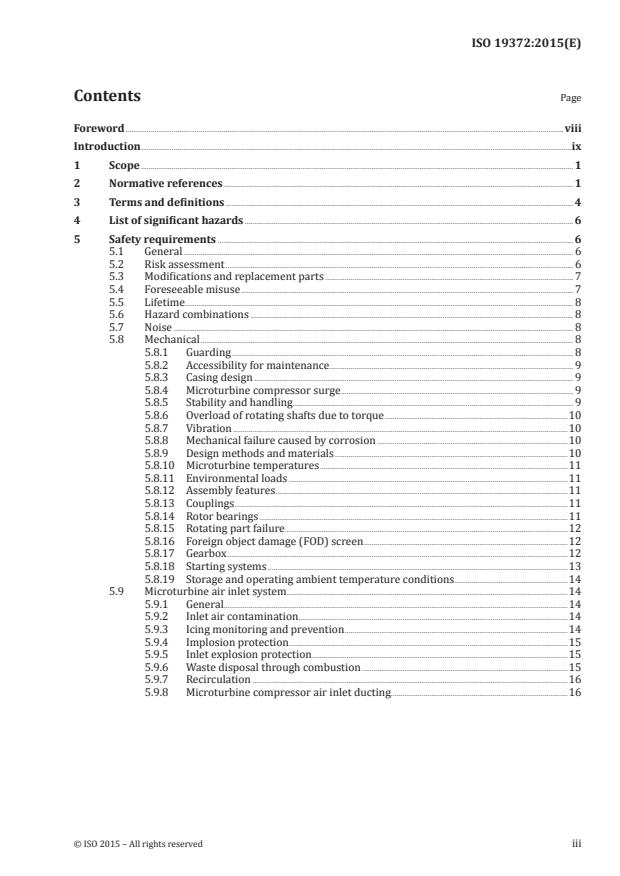
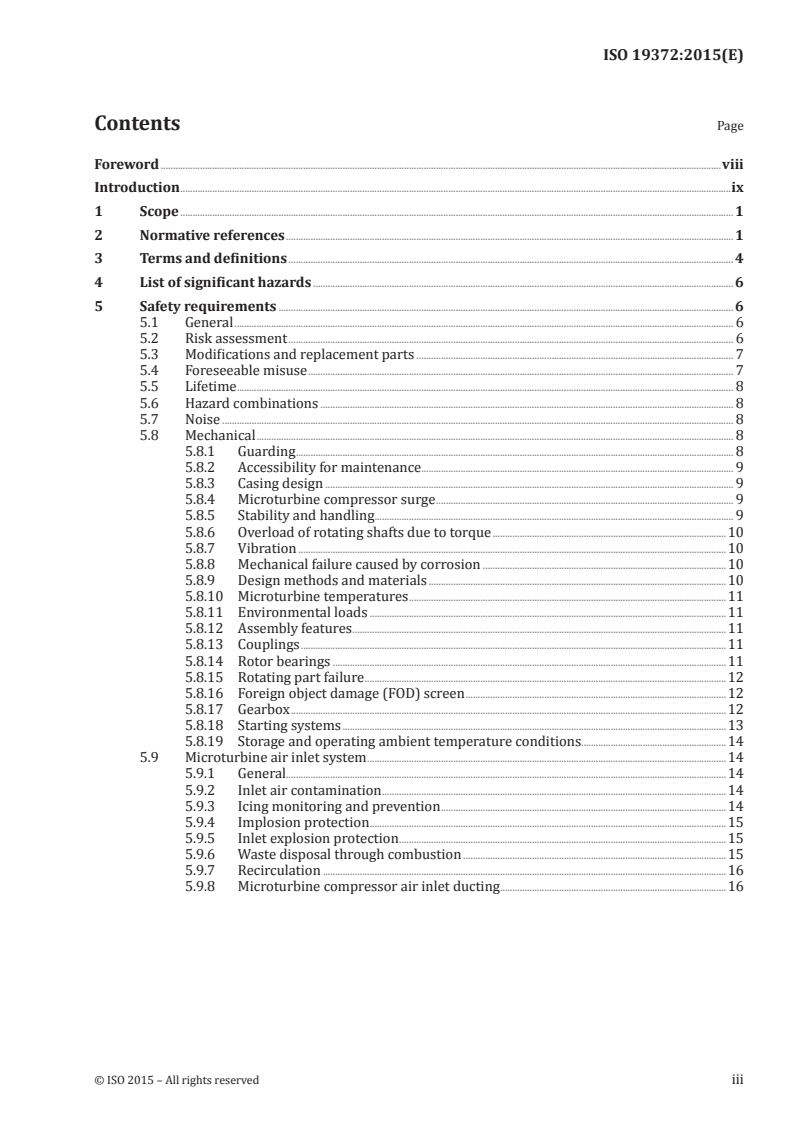
Contents Page
Foreword .viii
Introduction .ix
1 Scope . 1
2 Normative references . 1
3 Terms and definitions . 4
4 List of significant hazards . 6
5 Safety requirements . 6
5.1 General . 6
5.2 Risk assessment . 6
5.3 Modifications and replacement parts . 7
5.4 Foreseeable misuse . 7
5.5 Lifetime . 8
5.6 Hazard combinations . 8
5.7 Noise . 8
5.8 Mechanical . 8
5.8.1 Guarding . 8
5.8.2 Accessibility for maintenance . 9
5.8.3 Casing design . 9
5.8.4 Microturbine compressor surge . 9
5.8.5 Stability and handling . . . 9
5.8.6 Overload of rotating shafts due to torque .10
5.8.7 Vibration .10
5.8.8 Mechanical failure caused by corrosion .10
5.8.9 Design methods and materials .10
5.8.10 Microturbine temperatures .11
5.8.11 Environmental loads .11
5.8.12 Assembly features .11
5.8.13 Couplings .11
5.8.14 Rotor bearings .11
5.8.15 Rotating part failure .12
5.8.16 Foreign object damage (FOD) screen .12
5.8.17 Gearbox .12
5.8.18 Starting systems .13
5.8.19 Storage and operating ambient temperature conditions.14
5.9 Microturbine air inlet system .14
5.9.1 General.14
5.9.2 Inlet air contamination .14
5.9.3 Icing monitoring and prevention .14
5.9.4 Implosion protection .15
5.9.5 Inlet explosion protection .15
5.9.6 Waste disposal through combustion .15
5.9.7 Recirculation .16
5.9.8 Microturbine compressor air inlet ducting.16
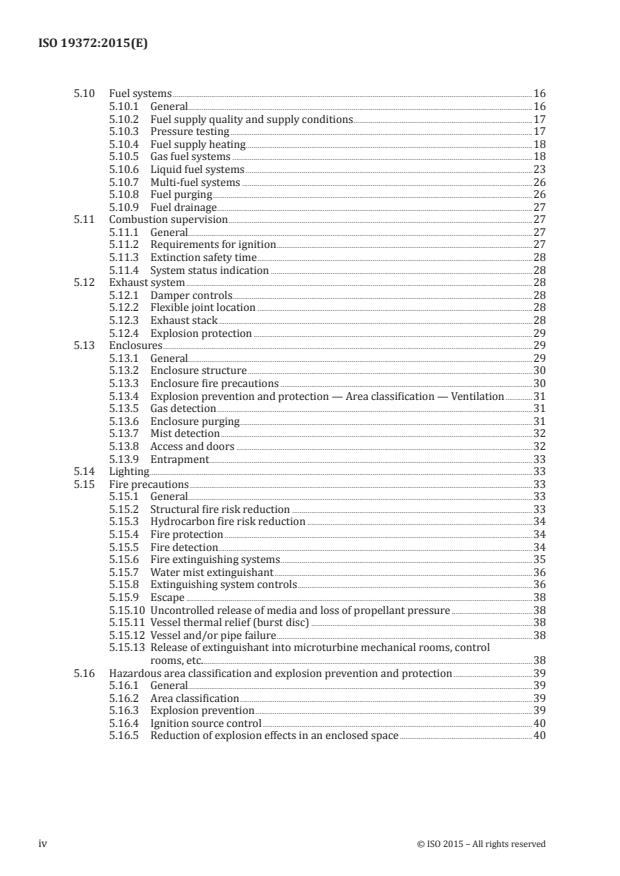
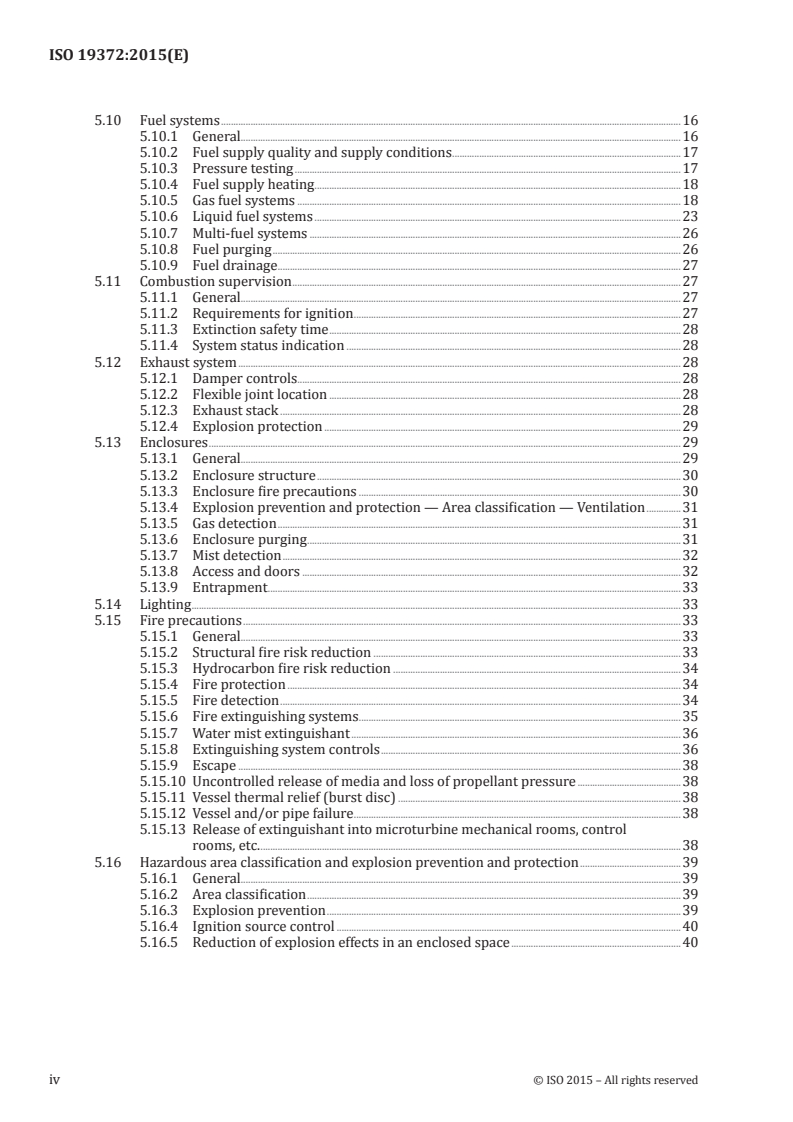
5.10 Fuel systems .16
5.10.1 General.16
5.10.2 Fuel supply quality and supply conditions .17
5.10.3 Pressure testing .17
5.10.4 Fuel supply heating . .18
5.10.5 Gas fuel systems .18
5.10.6 Liquid fuel systems .23
5.10.7 Multi-fuel systems .26
5.10.8 Fuel purging .26
5.10.9 Fuel drainage .27
5.11 Combustion supervision .27
5.11.1 General.27
5.11.2 Requirements for ignition .27
5.11.3 Extinction safety time .28
5.11.4 System status indication .28
5.12 Exhaust system .28
5.12.1 Damper controls.28
5.12.2 Flexible joint location .28
5.12.3 Exhaust stack .28
5.12.4 Explosion protection .29
5.13 Enclosures .29
5.13.1 General.29
5.13.2 Enclosure structure .30
5.13.3 Enclosure fire precautions .30
5.13.4 Explosion prevention and protection — Area classification — Ventilation .31
5.13.5 Gas detection .31
5.13.6 Enclosure purging .31
5.13.7 Mist detection .32
5.13.8 Access and doors .32
5.13.9 Entrapment .33
5.14 Lighting .33
5.15 Fire precautions .33
5.15.1 General.33
5.15.2 Structural fire risk reduction .33
5.15.3 Hydrocarbon fire risk reduction .34
5.15.4 Fire protection .34
5.15.5 Fire detection .34
5.15.6 Fire extinguishing systems .35
5.15.7 Water mist extinguishant .36
5.15.8 Extinguishing system controls .36
5.15.9 Escape .38
5.15.10 Uncontrolled release of media and loss of propellant pressure .38
5.15.11 Vessel thermal relief (burst disc) .38
5.15.12 Vessel and/or pipe failure .38
5.15.13 Release of extinguishant into microturbine mechanical rooms, control
rooms, etc. .38
5.16 Hazardous area classification and explosion prevention and protection .39
5.16.1 General.39
5.16.2 Area classification .39
5.16.3 Explosion prevention .39
5.16.4 Ignition source control .40
5.16.5 Reduction of explosion effects in an enclosed space .40
iv © ISO 2015 – All rights reserved
5.17 Ventilation .42
5.17.1 General.42
5.17.2 Cooling .42
5.17.3 Heating .43
5.17.4 Hazardous area control .43
5.17.5 Hot surfaces.43
5.17.6 Ventilation inlet location .43
5.17.7 Ventilation inlet filtration .44
5.17.8 Ventilation inlet ducting .44
5.17.9 Ventilation outlet location .44
5.17.10 Flow monitoring — Artificial ventilation .44
5.18 Fans .44
5.18.1 Fan guards and structural failure .44
5.18.2 Air blast oil coolers .45
5.19 Flammable gas detection .45
5.19.1 General.45
5.19.2 Type/selection principles .45
5.19.3 Location principles .45
5.19.4 Settings .45
5.19.5 Enclosures containing hot surfaces — Screening tool .45
5.19.6 Maintenance and calibration .46
5.20 Control and automatic protection systems .46
5.20.1 General.46
5.20.2 Environmental suitability .46
5.20.3 Ergonomics .46
5.20.4 Failure .47
5.20.5 Calibration .47
5.20.6 Testing .47
5.20.7 Speed control .47
5.20.8 Microturbine emergency shut-down system .48
5.20.9 Interlocks . .48
5.21 Electrical .48
5.21.1 Design/Installation .48
5.21.2 Isolation and stored energy .49
5.21.3 Electrostatic energy and bonding .49
5.21.4 Water ingress .50
5.21.5 Lightning .50
5.21.6 Electromagnetic compatibility (EMC) .50
5.21.7 Battery installations . .51
5.21.8 Electrical overload .51
5.21.9 Electrical power failure .51
5.22 Drains, vents, and bleeds .51
5.22.1 General.51
5.22.2 Vents for flammable gases .52
5.22.3 Toxic and hazardous emissions . .52
5.22.4 Microturbine compressor bleeds .52
5.23 Pressure equipment .52
5.23.1 General.52
5.23.2 Design .53
5.23.3 Hazards .53
5.23.4 Misuse .53
5.23.5 Safe handling and operation .53
5.23.6 Isolation, draining, and venting .53
5.23.7 Fluid injection.54
5.23.8 Assemblies .54
5.23.9 Safety accessories .56
5.23.10 Flexible piping (and metal hoses) .56
5.23.11 External fire .57
5.23.12 Material embrittlement and corrosion .57
5.23.13 Ultraviolet (UV) resistant pipework .57
5.24 Auxiliary systems .57
5.24.1 Lubrication systems .57
5.24.2 Water systems .58
5.24.3 Hydraulic and pneumatic systems.58
5.24.4 Utility supplies .58
5.25 Installation in a hazardous area .58
5.26 Unenclosed microturbines in a mechanical room .59
5.27 Decommissioning and disposal .59
6 Compliance verification .60
6.1 Quality assurance.60
6.2 Verification of safety requirements .60
6.3 Certification markings .60
6.4 Electrical output ratings verification .60
6.4.1 Voltage and freqency .60
6.4.2 Harmonic Distortion Requirements .60
6.5 Electrical ratings for microturbine system .60
6.6 Marking of microturbine system .61
7 Information for use .61
7.1 General .61
7.2 Language .62
7.3 Packaging .62
7.4 Commissioning .62
7.5 Operation .63
7.5.1 General.63
7.5.2 Safety instructions and emergency procedures .64
7.6 Enclosure access .65
7.6.1 General.65
7.6.2 Risk assessment for accessing enclosures .65
7.6.3 Limitations under operational conditions .65
7.6.4 Limitations under non-operational conditions .66
7.6.5 Access during commissioning and re-commissioning .66
7.6.6 Installations in a hazardous area .66
7.7 Maintenance .66
7.7.1 General.66
7.7.2 General maintenance hazards .67
7.7.3 Accessibility, isolation, and energy dissipation .67
7.7.4 Pressure equipment .67
7.7.5 Fire protection systems.68
7.7.6 Gas detectors .68
7.7.7 Control systems: maintenance, calibration, and testing .68
7.7.8 Hazardous materials . .68
7.8 Warning signs and notices .69
7.9 Permit to work (PTW) .69
vi © ISO 2015 – All rights reserved
7.10 Training .70
7.11 Decommissioning and disposal .70
Annex A (informative) List of significant hazards .71
Annex B (normative) Verification of safety requirements and/or measures .82
Annex C (informative) Quantitative and qualitative risk assessments and determining SIL levels 87
Bibliography .88
Foreword
ISO (the International Organization for Standardization) is a worldwide federation of national standards
bodies (ISO member bodies). The work of preparing International Standards is normally carried out
through ISO technical committees. Each member body interested in a subject for which a technical
committee has been established has the right to be represented on that committee. International
organizations, governmental and non-governmental, in liaison with ISO, also take part in the work.
ISO collaborates closely with the International Electrotechnical Commission (IEC) on all matters of
electrotechnical standardization.
The procedures used to develop this document and those intended for its further maintenance are
described in the ISO/IEC Directives, Part 1. In particular the different approval criteria needed for the
different types of ISO documents should be noted. This document was drafted in accordance with the
editorial rules of the ISO/IEC Directives, Part 2 (see www.iso.org/directives).
Attention is drawn to the possibility that some of the elements of this document may be the subject of
patent rights. ISO shall not be held responsible for identifying any or all such patent rights. Details of any
patent rights identified during the development of the document will be in the Introduction and/or on
the ISO list of patent declarations received (see www.iso.org/patents).
Any trade name used in this document is information given for the convenience of users and does not
constitute an endorsement.
For an explanation on the meaning of ISO specific terms and expressions related to conformity
assessment, as well as information about ISO’s adherence to the WTO principles in the Technical Barriers
to Trade (TBT), see the following URL: Foreword — Supplementary information.
The committee responsible for this document is ISO/TC 192, Gas turbines.
viii © ISO 2015 – All rights reserved
Introduction
This International Standard is a type C standard as stated in ISO 12100. A type C standard is “a standard
dealing with the detailed safety requirements for a particular machine or group of machines”.
The machinery concerned and the extent to which hazards, hazardous situations, and hazardous events
are covered are indicated in the scope of this International Standard.
When provisions of this type C standard are different from those that are stated in type A or B standards,
the provisions of this type C standard take precedence over the provisions of the other standards for
machines that have been designed and built according to the provisions of this type C standard.
The extent of the applicability of the references can be limited by the context of the text within this
International Standard. Where a dated standard is specified, this does not preclude the use of later
versions provided that the requirements continue to meet the safety issues and identified hazards
detailed in this International Standard. Where a reference is made to a specific clause in a standard,
only the text of that clause and references therein apply. References within notes are provisions but not
normative provisions of this International Standard and are listed in the bibliography.
In addition to covering the relevant safety requirements, this International Standard has also been
produced to assist designers, manufacturers, and others by providing methods of compliance with
the relevant, essential safety requirements of the following New Appoach European Directives for
microturbine applications without prejudicing compliance with this International Standard outside the
European Union:
— Machinery Directive (2006/42/EC);
— ATEX (Equipment) Directive (94/9/EC);
— Pressure Equipment Directive (97/23/EC).
— Low Voltage Directive (2006/95/EC);
— Electromagnetic Compatibility Directives (2004/108/EC).
Methods are also provided as far as practical and where relevant for compliance with the relevant,
essential safety requirements of the following European Directives:
— Integrated Pollution Prevention and Control Directive (96/61/EC);
— Environmental Noise Directive (2002/49/EC);
— Chemical Agents Directive (98/24/EC);
— Classification, Packaging, and Labelling of Dangerous Substances Directive (1999/45/EC);
— Exposure of workers to the risks arising from physical agents (noise) (2003/10/EC).
NOTE When this International Standard was issued, the currently quoted European directives were in force
but are subject to updates which may add additional essential safety requirements and users of this standard
should check, where applicable, if a later version of a directive is in force or has been released. A later released
version of the directives can be used as an alternative before the listed directives are superseded.
INTERNATIONAL STANDARD ISO 19372:2015(E)
Microturbines applications — Safety
1 Scope
This International Standard covers the safety requirements for industrial, commercial, and residential
automated stationary microturbine (micro gas turbine) engine generator assemblies with an individual
system or subsystem output rating with nominal supply voltages not exceeding 1 000 V for alternating
current (A.C.) and not exceeding 1 500 V for direct current (D.C.), 500 kW per individual unit/subsystem
or less that are intended for installation and use in ordinary and hazardous location using liquid or
gaseous fuels and the safety related control and detection systems and essential auxiliaries for all
types of open cycles, closed-cycle, and semi-closed (simple, combined, regenerative, reheat, etc.) used in
onshore and offshore applications including floating production platforms.
This International Standard applies to driven machinery only where it is an integral part of the
microturbine (e.g. a gearbox integral to the microturbine), or is located within the microturbine
enclosure and forms part of the enclosure hazardous area classification (e.g. a generator within the
microturbine enclosure), or where the driven machinery has a direct effect on the operational safety of
the microturbine.
This International Standard details the anticipated significant hazards associated with microturbines
and specifies the appropriate preventative measures and processes for reduction or elimination of these
hazards. This International Standard addresses the risks of injury or death to humans and risks to the
environment. Equipment damage without risk to humans or the environment is not covered.
Microturbine packages are generally specified using International Standards and national standards.
Achieving safety is promoted by using additional safety codes and standards, which are shared by
microtu
...
INTERNATIONAL ISO
STANDARD 19372
First edition
2015-02-15
Microturbines applications — Safety
Microturbines — Sécurité
Reference number
©
ISO 2015
© ISO 2015
All rights reserved. Unless otherwise specified, no part of this publication may be reproduced or utilized otherwise in any form
or by any means, electronic or mechanical, including photocopying, or posting on the internet or an intranet, without prior
written permission. Permission can be requested from either ISO at the address below or ISO’s member body in the country of
the requester.
ISO copyright office
Case postale 56 • CH-1211 Geneva 20
Tel. + 41 22 749 01 11
Fax + 41 22 749 09 47
E-mail copyright@iso.org
Web www.iso.org
Published in Switzerland
ii © ISO 2015 – All rights reserved
Contents Page
Foreword .viii
Introduction .ix
1 Scope . 1
2 Normative references . 1
3 Terms and definitions . 4
4 List of significant hazards . 6
5 Safety requirements . 6
5.1 General . 6
5.2 Risk assessment . 6
5.3 Modifications and replacement parts . 7
5.4 Foreseeable misuse . 7
5.5 Lifetime . 8
5.6 Hazard combinations . 8
5.7 Noise . 8
5.8 Mechanical . 8
5.8.1 Guarding . 8
5.8.2 Accessibility for maintenance . 9
5.8.3 Casing design . 9
5.8.4 Microturbine compressor surge . 9
5.8.5 Stability and handling . . . 9
5.8.6 Overload of rotating shafts due to torque .10
5.8.7 Vibration .10
5.8.8 Mechanical failure caused by corrosion .10
5.8.9 Design methods and materials .10
5.8.10 Microturbine temperatures .11
5.8.11 Environmental loads .11
5.8.12 Assembly features .11
5.8.13 Couplings .11
5.8.14 Rotor bearings .11
5.8.15 Rotating part failure .12
5.8.16 Foreign object damage (FOD) screen .12
5.8.17 Gearbox .12
5.8.18 Starting systems .13
5.8.19 Storage and operating ambient temperature conditions.14
5.9 Microturbine air inlet system .14
5.9.1 General.14
5.9.2 Inlet air contamination .14
5.9.3 Icing monitoring and prevention .14
5.9.4 Implosion protection .15
5.9.5 Inlet explosion protection .15
5.9.6 Waste disposal through combustion .15
5.9.7 Recirculation .16
5.9.8 Microturbine compressor air inlet ducting.16
5.10 Fuel systems .16
5.10.1 General.16
5.10.2 Fuel supply quality and supply conditions .17
5.10.3 Pressure testing .17
5.10.4 Fuel supply heating . .18
5.10.5 Gas fuel systems .18
5.10.6 Liquid fuel systems .23
5.10.7 Multi-fuel systems .26
5.10.8 Fuel purging .26
5.10.9 Fuel drainage .27
5.11 Combustion supervision .27
5.11.1 General.27
5.11.2 Requirements for ignition .27
5.11.3 Extinction safety time .28
5.11.4 System status indication .28
5.12 Exhaust system .28
5.12.1 Damper controls.28
5.12.2 Flexible joint location .28
5.12.3 Exhaust stack .28
5.12.4 Explosion protection .29
5.13 Enclosures .29
5.13.1 General.29
5.13.2 Enclosure structure .30
5.13.3 Enclosure fire precautions .30
5.13.4 Explosion prevention and protection — Area classification — Ventilation .31
5.13.5 Gas detection .31
5.13.6 Enclosure purging .31
5.13.7 Mist detection .32
5.13.8 Access and doors .32
5.13.9 Entrapment .33
5.14 Lighting .33
5.15 Fire precautions .33
5.15.1 General.33
5.15.2 Structural fire risk reduction .33
5.15.3 Hydrocarbon fire risk reduction .34
5.15.4 Fire protection .34
5.15.5 Fire detection .34
5.15.6 Fire extinguishing systems .35
5.15.7 Water mist extinguishant .36
5.15.8 Extinguishing system controls .36
5.15.9 Escape .38
5.15.10 Uncontrolled release of media and loss of propellant pressure .38
5.15.11 Vessel thermal relief (burst disc) .38
5.15.12 Vessel and/or pipe failure .38
5.15.13 Release of extinguishant into microturbine mechanical rooms, control
rooms, etc. .38
5.16 Hazardous area classification and explosion prevention and protection .39
5.16.1 General.39
5.16.2 Area classification .39
5.16.3 Explosion prevention .39
5.16.4 Ignition source control .40
5.16.5 Reduction of explosion effects in an enclosed space .40
iv © ISO 2015 – All rights reserved
5.17 Ventilation .42
5.17.1 General.42
5.17.2 Cooling .42
5.17.3 Heating .43
5.17.4 Hazardous area control .43
5.17.5 Hot surfaces.43
5.17.6 Ventilation inlet location .43
5.17.7 Ventilation inlet filtration .44
5.17.8 Ventilation inlet ducting .44
5.17.9 Ventilation outlet location .44
5.17.10 Flow monitoring — Artificial ventilation .44
5.18 Fans .44
5.18.1 Fan guards and structural failure .44
5.18.2 Air blast oil coolers .45
5.19 Flammable gas detection .45
5.19.1 General.45
5.19.2 Type/selection principles .45
5.19.3 Location principles .45
5.19.4 Settings .45
5.19.5 Enclosures containing hot surfaces — Screening tool .45
5.19.6 Maintenance and calibration .46
5.20 Control and automatic protection systems .46
5.20.1 General.46
5.20.2 Environmental suitability .46
5.20.3 Ergonomics .46
5.20.4 Failure .47
5.20.5 Calibration .47
5.20.6 Testing .47
5.20.7 Speed control .47
5.20.8 Microturbine emergency shut-down system .48
5.20.9 Interlocks . .48
5.21 Electrical .48
5.21.1 Design/Installation .48
5.21.2 Isolation and stored energy .49
5.21.3 Electrostatic energy and bonding .49
5.21.4 Water ingress .50
5.21.5 Lightning .50
5.21.6 Electromagnetic compatibility (EMC) .50
5.21.7 Battery installations . .51
5.21.8 Electrical overload .51
5.21.9 Electrical power failure .51
5.22 Drains, vents, and bleeds .51
5.22.1 General.51
5.22.2 Vents for flammable gases .52
5.22.3 Toxic and hazardous emissions . .52
5.22.4 Microturbine compressor bleeds .52
5.23 Pressure equipment .52
5.23.1 General.52
5.23.2 Design .53
5.23.3 Hazards .53
5.23.4 Misuse .53
5.23.5 Safe handling and operation .53
5.23.6 Isolation, draining, and venting .53
5.23.7 Fluid injection.54
5.23.8 Assemblies .54
5.23.9 Safety accessories .56
5.23.10 Flexible piping (and metal hoses) .56
5.23.11 External fire .57
5.23.12 Material embrittlement and corrosion .57
5.23.13 Ultraviolet (UV) resistant pipework .57
5.24 Auxiliary systems .57
5.24.1 Lubrication systems .57
5.24.2 Water systems .58
5.24.3 Hydraulic and pneumatic systems.58
5.24.4 Utility supplies .58
5.25 Installation in a hazardous area .58
5.26 Unenclosed microturbines in a mechanical room .59
5.27 Decommissioning and disposal .59
6 Compliance verification .60
6.1 Quality assurance.60
6.2 Verification of safety requirements .60
6.3 Certification markings .60
6.4 Electrical output ratings verification .60
6.4.1 Voltage and freqency .60
6.4.2 Harmonic Distortion Requirements .60
6.5 Electrical ratings for microturbine system .60
6.6 Marking of microturbine system .61
7 Information for use .61
7.1 General .61
7.2 Language .62
7.3 Packaging .62
7.4 Commissioning .62
7.5 Operation .63
7.5.1 General.63
7.5.2 Safety instructions and emergency procedures .64
7.6 Enclosure access .65
7.6.1 General.65
7.6.2 Risk assessment for accessing enclosures .65
7.6.3 Limitations under operational conditions .65
7.6.4 Limitations under non-operational conditions .66
7.6.5 Access during commissioning and re-commissioning .66
7.6.6 Installations in a hazardous area .66
7.7 Maintenance .66
7.7.1 General.66
7.7.2 General maintenance hazards .67
7.7.3 Accessibility, isolation, and energy dissipation .67
7.7.4 Pressure equipment .67
7.7.5 Fire protection systems.68
7.7.6 Gas detectors .68
7.7.7 Control systems: maintenance, calibration, and testing .68
7.7.8 Hazardous materials . .68
7.8 Warning signs and notices .69
7.9 Permit to work (PTW) .69
vi © ISO 2015 – All rights reserved
7.10 Training .70
7.11 Decommissioning and disposal .70
Annex A (informative) List of significant hazards .71
Annex B (normative) Verification of safety requirements and/or measures .82
Annex C (informative) Quantitative and qualitative risk assessments and determining SIL levels 87
Bibliography .88
Foreword
ISO (the International Organization for Standardization) is a worldwide federation of national standards
bodies (ISO member bodies). The work of preparing International Standards is normally carried out
through ISO technical committees. Each member body interested in a subject for which a technical
committee has been established has the right to be represented on that committee. International
organizations, governmental and non-governmental, in liaison with ISO, also take part in the work.
ISO collaborates closely with the International Electrotechnical Commission (IEC) on all matters of
electrotechnical standardization.
The procedures used to develop this document and those intended for its further maintenance are
described in the ISO/IEC Directives, Part 1. In particular the different approval criteria needed for the
different types of ISO documents should be noted. This document was drafted in accordance with the
editorial rules of the ISO/IEC Directives, Part 2 (see www.iso.org/directives).
Attention is drawn to the possibility that some of the elements of this document may be the subject of
patent rights. ISO shall not be held responsible for identifying any or all such patent rights. Details of any
patent rights identified during the development of the document will be in the Introduction and/or on
the ISO list of patent declarations received (see www.iso.org/patents).
Any trade name used in this document is information given for the convenience of users and does not
constitute an endorsement.
For an explanation on the meaning of ISO specific terms and expressions related to conformity
assessment, as well as information about ISO’s adherence to the WTO principles in the Technical Barriers
to Trade (TBT), see the following URL: Foreword — Supplementary information.
The committee responsible for this document is ISO/TC 192, Gas turbines.
viii © ISO 2015 – All rights reserved
Introduction
This International Standard is a type C standard as stated in ISO 12100. A type C standard is “a standard
dealing with the detailed safety requirements for a particular machine or group of machines”.
The machinery concerned and the extent to which hazards, hazardous situations, and hazardous events
are covered are indicated in the scope of this International Standard.
When provisions of this type C standard are different from those that are stated in type A or B standards,
the provisions of this type C standard take precedence over the provisions of the other standards for
machines that have been designed and built according to the provisions of this type C standard.
The extent of the applicability of the references can be limited by the context of the text within this
International Standard. Where a dated standard is specified, this does not preclude the use of later
versions provided that the requirements continue to meet the safety issues and identified hazards
detailed in this International Standard. Where a reference is made to a specific clause in a standard,
only the text of that clause and references therein apply. References within notes are provisions but not
normative provisions of this International Standard and are listed in the bibliography.
In addition to covering the relevant safety requirements, this International Standard has also been
produced to assist designers, manufacturers, and others by providing methods of compliance with
the relevant, essential safety requirements of the following New Appoach European Directives for
microturbine applications without prejudicing compliance with this International Standard outside the
European Union:
— Machinery Directive (2006/42/EC);
— ATEX (Equipment) Directive (94/9/EC);
— Pressure Equipment Directive (97/23/EC).
— Low Voltage Directive (2006/95/EC);
— Electromagnetic Compatibility Directives (2004/108/EC).
Methods are also provided as far as practical and where relevant for compliance with the relevant,
essential safety requirements of the following European Directives:
— Integrated Pollution Prevention and Control Directive (96/61/EC);
— Environmental Noise Directive (2002/49/EC);
— Chemical Agents Directive (98/24/EC);
— Classification, Packaging, and Labelling of Dangerous Substances Directive (1999/45/EC);
— Exposure of workers to the risks arising from physical agents (noise) (2003/10/EC).
NOTE When this International Standard was issued, the currently quoted European directives were in force
but are subject to updates which may add additional essential safety requirements and users of this standard
should check, where applicable, if a later version of a directive is in force or has been released. A later released
version of the directives can be used as an alternative before the listed directives are superseded.
INTERNATIONAL STANDARD ISO 19372:2015(E)
Microturbines applications — Safety
1 Scope
This International Standard covers the safety requirements for industrial, commercial, and residential
automated stationary microturbine (micro gas turbine) engine generator assemblies with an individual
system or subsystem output rating with nominal supply voltages not exceeding 1 000 V for alternating
current (A.C.) and not exceeding 1 500 V for direct current (D.C.), 500 kW per individual unit/subsystem
or less that are intended for installation and use in ordinary and hazardous location using liquid or
gaseous fuels and the safety related control and detection systems and essential auxiliaries for all
types of open cycles, closed-cycle, and semi-closed (simple, combined, regenerative, reheat, etc.) used in
onshore and offshore applications including floating production platforms.
This International Standard applies to driven machinery only where it is an integral part of the
microturbine (e.g. a gearbox integral to the microturbine), or is located within the microturbine
enclosure and forms part of the enclosure hazardous area classification (e.g. a generator within the
microturbine enclosure), or where the driven machinery has a direct effect on the operational safety of
the microturbine.
This International Standard details the anticipated significant hazards associated with microturbines
and specifies the appropriate preventative measures and processes for reduction or elimination of these
hazards. This International Standard addresses the risks of injury or death to humans and risks to the
environment. Equipment damage without risk to humans or the environment is not covered.
Microturbine packages are generally specified using International Standards and national standards.
Achieving safety is promoted by using additional safety codes and standards, which are shared by
microtu
...