

ISO/IEC 5392:2024
(Main)Information technology — Artificial intelligence — Reference architecture of knowledge engineering
General Information
- Abstract
This document defines a reference architecture of knowledge engineering (KE) in artificial intelligence (AI). The reference architecture describes KE roles, activities, constructional layers, components and their relationships amongst themselves and other systems from systemic user and functional views. This document also provides a common KE vocabulary by defining KE terms.
- Status
- Published
- Publication Date
- 14-Mar-2024
- Technical Committee
- ISO/IEC JTC 1/SC 42 - Artificial intelligence
- Drafting Committee
- ISO/IEC JTC 1/SC 42 - Artificial intelligence
- Current Stage
- 6060 - International Standard published
- Start Date
- 15-Mar-2024
- Due Date
- 24-May-2024
- Completion Date
- 15-Mar-2024

Overview - ISO/IEC 5392:2024 (Information technology - Artificial intelligence - Reference architecture of knowledge engineering)
ISO/IEC 5392:2024 defines a reference architecture for knowledge engineering (KE) in artificial intelligence. The standard standardizes KE roles, stakeholder activities, constructional layers, components and their relationships from both systemic user and functional views. It also provides a common KE vocabulary and organizes KE concerns such as safety, reliability, availability, bias reduction and responsibility. ISO/IEC 5392 is intended to guide the design, integration and governance of knowledge-driven AI systems.
Key topics and technical coverage
The standard addresses practical architectural and technical themes, including:
- KE stakeholder roles - data supplier, fundamental technology supplier, algorithm supplier, system coordinator, knowledge service provider, knowledge applier and ecosystem partners.
- User and functional views - clear separation of user concerns and functional architecture to support interoperability and integration.
- Constructional layers and components - KE infrastructure, construction, platform and application layers, plus multi-layer functions.
- KE distribution architecture - support for distributed systems and semantic web services-based deployment.
- Core KE technologies - knowledge representation, knowledge modelling, acquisition, storage, fusion, computing, visualization, maintenance and exchange.
- Enabling technologies & infrastructure - machine learning, natural language processing, speech processing, big data and cloud computing.
- Quality and governance concerns - safety, security, reliability, availability, construction quality, responsibility and bias mitigation.
- Informative annexes with examples: fundamental KE tools, specifications related to KE, typical KE application characteristics, KE life cycle and guidance on solution architectures (including integration with ISO/IEC/IEEE 42010).
The standard does not prescribe proprietary implementation details but provides a reference architecture and vocabulary to align implementations.
Practical applications and who should use it
ISO/IEC 5392 is useful for organizations building or integrating knowledge-driven AI systems across industries such as finance, healthcare, transportation, manufacturing, legal services and media. Typical applications include fraud detection, intelligent diagnostics, recommendation engines, case-based prediction, remote equipment maintenance and knowledge service platforms.
Primary users:
- KE system architects and solution architects
- AI/knowledge engineers and data scientists
- Platform and tool vendors (KE platforms, semantic web services)
- System integrators and DevOps/cloud teams
- Compliance, risk and governance professionals
- Procurement teams specifying KE requirements
Related standards and keywords
Related standards and technologies cited include semantic web standards (RDF, RDFS, OWL, SPARQL) and systems engineering guidance such as ISO/IEC/IEEE 42010. Keywords for SEO: ISO/IEC 5392:2024, knowledge engineering, reference architecture, AI, knowledge representation, semantic web, RDF, OWL, SPARQL, machine learning, NLP, cloud computing, big data.
Get Certified
Connect with accredited certification bodies for this standard

BSI Group
BSI (British Standards Institution) is the business standards company that helps organizations make excellence a habit.

NYCE
Mexican standards and certification body.
Sponsored listings
Frequently Asked Questions
ISO/IEC 5392:2024 is a standard published by the International Organization for Standardization (ISO). Its full title is "Information technology — Artificial intelligence — Reference architecture of knowledge engineering". This standard covers: This document defines a reference architecture of knowledge engineering (KE) in artificial intelligence (AI). The reference architecture describes KE roles, activities, constructional layers, components and their relationships amongst themselves and other systems from systemic user and functional views. This document also provides a common KE vocabulary by defining KE terms.
This document defines a reference architecture of knowledge engineering (KE) in artificial intelligence (AI). The reference architecture describes KE roles, activities, constructional layers, components and their relationships amongst themselves and other systems from systemic user and functional views. This document also provides a common KE vocabulary by defining KE terms.
ISO/IEC 5392:2024 is classified under the following ICS (International Classification for Standards) categories: 35.020 - Information technology (IT) in general. The ICS classification helps identify the subject area and facilitates finding related standards.
ISO/IEC 5392:2024 is available in PDF format for immediate download after purchase. The document can be added to your cart and obtained through the secure checkout process. Digital delivery ensures instant access to the complete standard document.
Standards Content (Sample)
International
Standard
ISO/IEC 5392
First edition
Information technology —
2024-03
Artificial intelligence — Reference
architecture of knowledge
engineering
Reference number
© ISO/IEC 2024
All rights reserved. Unless otherwise specified, or required in the context of its implementation, no part of this publication may
be reproduced or utilized otherwise in any form or by any means, electronic or mechanical, including photocopying, or posting on
the internet or an intranet, without prior written permission. Permission can be requested from either ISO at the address below
or ISO’s member body in the country of the requester.
ISO copyright office
CP 401 • Ch. de Blandonnet 8
CH-1214 Vernier, Geneva
Phone: +41 22 749 01 11
Email: copyright@iso.org
Website: www.iso.org
Published in Switzerland
© ISO/IEC 2024 – All rights reserved
ii
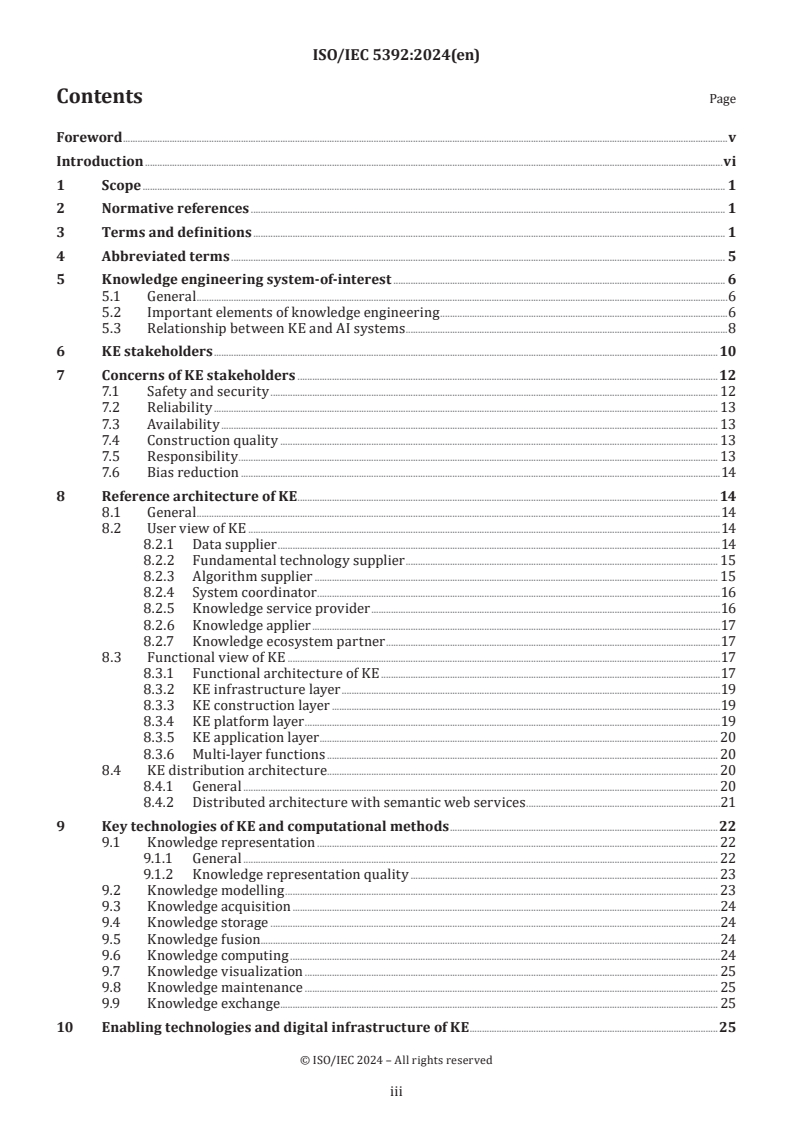
Contents Page
Foreword .v
Introduction .vi
1 Scope . 1
2 Normative references . 1
3 Terms and definitions . 1
4 Abbreviated terms . 5
5 Knowledge engineering system-of-interest . 6
5.1 General .6
5.2 Important elements of knowledge engineering .6
5.3 Relationship between KE and AI systems .8
6 KE stakeholders . 10
7 Concerns of KE stakeholders .12
7.1 Safety and security . 12
7.2 Reliability . 13
7.3 Availability . 13
7.4 Construction quality . 13
7.5 Responsibility . 13
7.6 Bias reduction .14
8 Reference architecture of KE . . 14
8.1 General .14
8.2 User view of KE .14
8.2.1 Data supplier .14
8.2.2 Fundamental technology supplier . 15
8.2.3 Algorithm supplier . 15
8.2.4 System coordinator .16
8.2.5 Knowledge service provider .16
8.2.6 Knowledge applier .17
8.2.7 Knowledge ecosystem partner .17
8.3 Functional view of KE .17
8.3.1 Functional architecture of KE .17
8.3.2 KE infrastructure layer .19
8.3.3 KE construction layer .19
8.3.4 KE platform layer .19
8.3.5 KE application layer . 20
8.3.6 Multi-layer functions . 20
8.4 KE distribution architecture. 20
8.4.1 General . 20
8.4.2 Distributed architecture with semantic web services .21
9 Key technologies of KE and computational methods .22
9.1 Knowledge representation . 22
9.1.1 General . 22
9.1.2 Knowledge representation quality . 23
9.2 Knowledge modelling . 23
9.3 Knowledge acquisition .24
9.4 Knowledge storage .24
9.5 Knowledge fusion .24
9.6 Knowledge computing .24
9.7 Knowledge visualization . 25
9.8 Knowledge maintenance . 25
9.9 Knowledge exchange . . 25
10 Enabling technologies and digital infrastructure of KE .25
© ISO/IEC 2024 – All rights reserved
iii
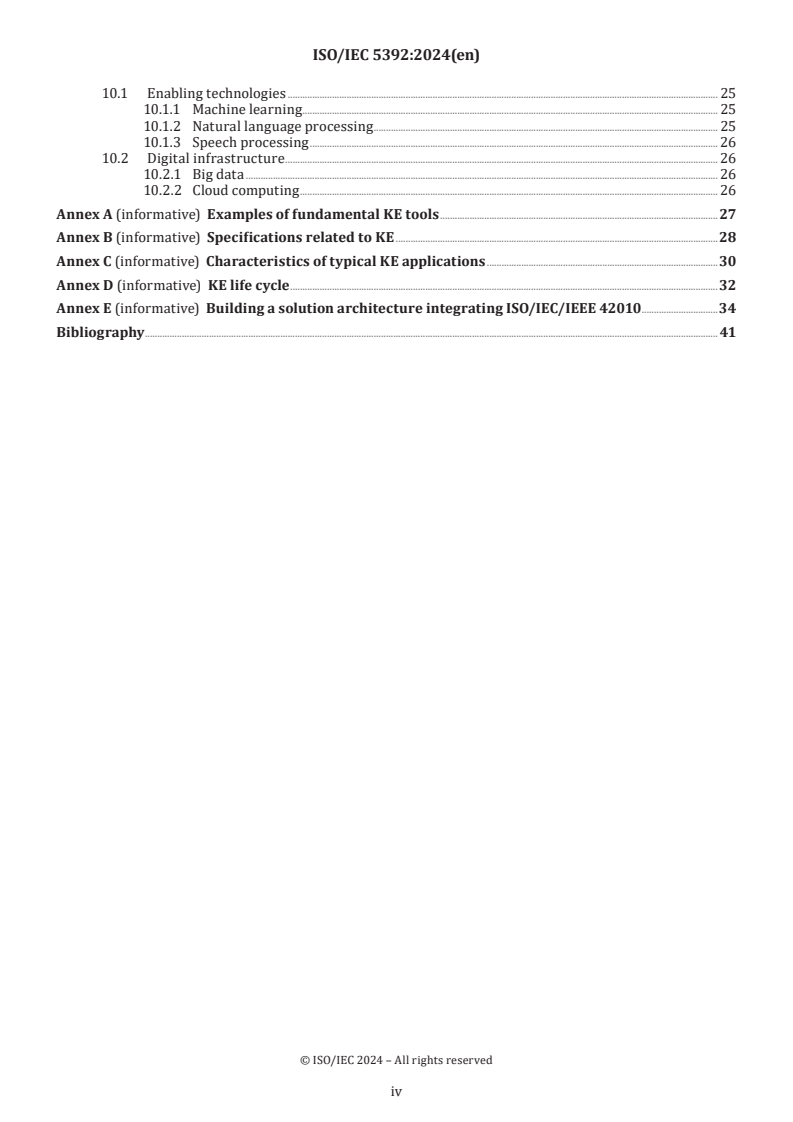
10.1 Enabling technologies . 25
10.1.1 Machine learning . 25
10.1.2 Natural language processing . 25
10.1.3 Speech processing . 26
10.2 Digital infrastructure . 26
10.2.1 Big data . 26
10.2.2 Cloud computing . 26
Annex A (informative) Examples of fundamental KE tools .27
Annex B (informative) Specifications related to KE .28
Annex C (informative) Characteristics of typical KE applications .30
Annex D (informative) KE life cycle .32
Annex E (informative) Building a solution architecture integrating ISO/IEC/IEEE 42010 .34
Bibliography . 41
© ISO/IEC 2024 – All rights reserved
iv
Foreword
ISO (the International Organization for Standardization) and IEC (the International Electrotechnical
Commission) form the specialized system for worldwide standardization. National bodies that are
members of ISO or IEC participate in the development of International Standards through technical
committees established by the respective organization to deal with particular fields of technical activity.
ISO and IEC technical committees collaborate in fields of mutual interest. Other international organizations,
governmental and non-governmental, in liaison with ISO and IEC, also take part in the work.
The procedures used to develop this document and those intended for its further maintenance are described
in the ISO/IEC Directives, Part 1. In particular, the different approval criteria needed for the different types
of document should be noted. This document was drafted in accordance with the editorial rules of the ISO/
IEC Directives, Part 2 (see www.iso.org/directives or www.iec.ch/members_experts/refdocs).
ISO and IEC draw attention to the possibility that the implementation of this document may involve the
use of (a) patent(s). ISO and IEC take no position concerning the evidence, validity or applicability of any
claimed patent rights in respect thereof. As of the date of publication of this document, ISO and IEC had not
received notice of (a) patent(s) which may be required to implement this document. However, implementers
are cautioned that this may not represent the latest information, which may be obtained from the patent
database available at www.iso.org/patents and https://patents.iec.ch. ISO and IEC shall not be held
responsible for identifying any or all such patent rights.
Any trade name used in this document is information given for the convenience of users and does not
constitute an endorsement.
For an explanation of the voluntary nature of standards, the meaning of ISO specific terms and expressions
related to conformity assessment, as well as information about ISO's adherence to the World Trade
Organization (WTO) principles in the Technical Barriers to Trade (TBT) see www.iso.org/iso/foreword.html.
In the IEC, see www.iec.ch/understanding-standards.
This document was prepared by Joint Technical Committee ISO/IEC JTC 1, Information technology,
Subcommittee SC 42, Artificial intelligence.
Any feedback or questions on this document should be directed to the user’s national standards
body. A complete listing of these bodies can be found at www.iso.org/members.html and
www.iec.ch/national-committees.
© ISO/IEC 2024 – All rights reserved
v
Introduction
Knowledge-driven AI applications have gradually gained attention. In knowledge engineering (KE),
knowledge is automatically or semi-automatically acquired from information sources, which in turn are
generated by processing huge-scale multi-source heterogeneous data. The knowledge is integrated into
knowledge-based systems and used to provide intelligent knowledge-driven services. One of the objectives
of KE is to represent and transfer human knowledge within industries such as finance, medical care,
transportation and manufacturing to machine knowledge with representations understandable by both
humans and AI systems. Now, KE, along with big data, deep learning, natural language processing etc., has
become one of the core driving forces of AI development.
Key technologies of KE include knowledge representation, knowledge modelling, knowledge acquisition,
knowledge storage, knowledge fusion, knowledge calculation, knowledge maintenance, knowledge
visualization, etc. In addition, many knowledge service platform products and solutions have been
developed to permit KE implementations to be more agile in organizations. The distributed KE systems can
be integrated and deployed through knowledge exchange and knowledge maintenance among the systems.
The distributed, autonomous agent systems and their collaboration across system of systems can further
generate the necessary intelligence and knowledge driven behaviours for collaboration and cooperation.
[1] [2]
Resource description framework (RDF), resource description framework schema (RDFS), RDFS-PLUS,
[3] [4]
ontology web language (OWL), SPARQL protocol and RDF query language (SPARQL) and ontology-related
[5-7]
theories and standards provide a solid foundation of tools and theories in the aspects of knowledge
representation and knowledge modelling. Other related KE standards have been developed.
KE has been successfully applied to many industries including financial fraud identification, remote operation
and maintenance of equipment, user profile and product recommendations, research focus tracking and
forecasting, smart credit analysis, legal dispute and case prediction based on similar cases, intelligent
distribution of news, intelligent computer-aided diagnosis and treatment, etc. Many organizations regard
platforms or systems based on KE as important knowledge infrastructures. However, KE vocabularies, basic
KE constructional components, KE processes and their relationships are not yet clearly defined. This causes
misunderstandings and unnecessary communication and deployment costs amongst the data supplier,
fundamental technology supplier, algorithm supplier, system coordinator and other stakeholders of KE
systems.
To facilitate collaboration amongst KE stakeholders, KE characteristics and applications can be
comprehensively described and categorized. Expected use of the document is to guide the construction of
KE systems.
© ISO/IEC 2024 – All rights reserved
vi
International Standard ISO/IEC 5392:2024(en)
Information technology — Artificial intelligence — Reference
architecture of knowledge engineering
1 Scope
This document defines a reference architecture of knowledge engineering (KE) in artificial intelligence
(AI). The reference architecture describes KE roles, activities, constructional layers, components and
their relationships amongst themselves and other systems from systemic user and functional views. This
document also provides a common KE vocabulary by defining KE terms.
2 Normative references
The following documents are referred to in the text in such a way that some or all of their content constitutes
requirements of this document. For dated references, only the edition cited applies. For undated references,
the latest edition of the referenced document (including any amendments) applies.
ISO/IEC 22989:2022, Information technology — Artificial intelligence — Artificial intelligence concepts and
terminology
3 Terms and definitions
For the purposes of this document, the terms and definitions given in ISO/IEC 22989 and the following apply.
ISO and IEC maintain terminology databases for use in standardization at the following addresses:
— ISO Online browsing platform: available at https:// www .iso .org/ obp
— IEC Electropedia: available at https:// www .electropedia .org/
3.1
architecture
fundamental concepts or properties of an entity in its environment and governing principles for the
realization and evolution of this entity and its related life cycle processes
[SOURCE: ISO/IEC/IEEE 42010:2022, 3.2]
3.2
architecture view
information part comprising portion of an architecture description
EXAMPLE An Information or Data View addresses information-relevant concerns framed by an Information
viewpoint. It contains as view components, a conceptual data model, a data management model and a data access
model and correspondences linking those components together.
[SOURCE: ISO/IEC/IEEE 42010:2022, 3.7]
3.3
data
reinterpretable representation of information in a formalized manner suitable for communication,
interpretation, or processing
Note 1 to entry: Data can be processed by humans or by automatic means.
[SOURCE: ISO/IEC 20546:2019, 3.1.5]
© ISO/IEC 2024 – All rights reserved
3.4
information
data that are processed, organized and correlated to produce meaning
Note 1 to entry: Information concerns facts, concepts, objects, events, ideas, processes, etc.
[SOURCE: ISO/IEC 20547-3:2020, 3.3]
3.5
knowledge engineering
KE
discipline concerned with acquiring knowledge from domain experts and other knowledge sources and
incorporating it into a knowledge base
Note 1 to entry: The term "knowledge engineering" sometimes refers particularly to the art of designing, building,
and maintaining knowledge-based systems.
[SOURCE: ISO/IEC 2382:2015, 28.01.07, modified — replaced notes to entry.]
3.6
concept
unit of thought differentiated by a unique combination of characteristics
Note 1 to entry: Concepts are not necessarily bound to particular languages. They are, however, influenced by the
social or cultural background which often leads to different categorizations of concepts.
[SOURCE: ISO 1087:2019, 3.2.7, modified — replaced "knowledge" with "thought".]
3.7
entity
object of the environment or domain (real-world objects and events, abstract concepts, documents, etc.)
EXAMPLE In the case of a knowledge graph, entity descriptions forming a network and provides context for each
other entity interpretation.
3.8
attribute
property of an entity with respect to a defined characteristic
EXAMPLE "Entity X has 5 kg mass" is an attribute, but "having mass" is a characteristic and "5 kg mass" is a
property, and neither individually are attributes.
3.9
ontology
collection of terms, relational expressions, and associated natural-language definitions together with one or
more formal theories designed to capture the intended interpretations of these definitions
Note 1 to entry: Background materials on the sources, rationale and interpretation of this definition are provided in
ISO/IEC 21838-1:2021, Annex B.
[SOURCE: ISO/IEC 21838-1:2021, 3.14]
3.10
schema
formal description of a model
[SOURCE: ISO 19101-1:2014, 4.1.34]
3.11
relation
association amongst entities
[SOURCE: ISO/IEC 15938-5:2003, 3.3.2.29]
© ISO/IEC 2024 – All rights reserved
3.12
rule
statement in the form of a condition- action sentence that describe the logical inferences that can be drawn
from an assertion in a particular form
EXAMPLE A rule can be constructed in the form of "IF-THEN" statements where the IF portion defines a context,
and the THEN portion states a provision (which is applicable if the context is true or present).
3.13
structured knowledge
knowledge that are organized based on a pre-defined (applicable) set of rules
3.14
knowledge graph
graph representation of structured knowledge on concepts and relationships between them
Note 1 to entry: A knowledge graph can comprise an ontology and data related to the ontology.
Note 2 to entry: A knowledge graph can be represented as a collection of triples, with each triple (head, tail, relation)
denoting the fact that relation exists between head entity and tail entity.
3.15
activity
specified pursuit or set of tasks
[SOURCE: ISO/IEC 22123-1:2023, 3.3.8]
3.16
conceptual model
description of common concepts and their relationships, particularly in order to facilitate exchange of
information between parties within a specific domain
[SOURCE: ISO/TS 18864:2017, 3.6, modified — deleted "healthcare".]
3.17
knowledge representation
KR
process or result of encoding knowledge for communication or storage in a knowledge base
Note 1 to entry: As an analogy: data IS-TO code sets IS-TO data engineering AS knowledge IS-TO knowledge
representation IS-TO knowledge engineering.
[SOURCE: ISO/IEC 2382:2015, 2123776, modified — replaced "and storing knowledge" with "knowledge for
communication or storage"; replaced notes to entry.]
3.18
knowledge modelling
process that establishes and maintains the conceptual model for a knowledge base
3.19
knowledge acquisition
process of locating, collecting, and refining knowledge and converting it into a form that can be further
processed by a knowledge-based system
Note 1 to entry: Knowledge acquisition via human learning involves a human learner participating in a learning
experience. Knowledge acquisition within knowledge engineering typically implies the intervention of a knowledge
engineer. Knowledge acquisition is also an important component of machine learning, both with and without human
intervention.
[SOURCE: adapted from ISO/IEC 2382:2015, 28.01.09; replace notes]
© ISO/IEC 2024 – All rights reserved
3.20
knowledge fusion
process that merges, combines and integrates knowledge from different resources into a coherent form
3.21
knowledge storage
process that designs underlying storage methods based on the types of knowledge representation, utilizes
hardware and software infrastructure to store, code and make indexes of the knowledge
3.22
knowledge computing
process that obtains new knowledge based on existing knowledge and their relationships
3.23
knowledge exchange
process that transfers, shares and fuses knowledge amongst multiple knowledge bases
3.24
knowledge visualization
process that visually represents knowledge to support human understanding
3.25
safety
freedom from risk which is not tolerable
[SOURCE: ISO/IEC Guide 51:2014, 3.14]
3.26
reliability
property of consistent intended behaviour and results
[SOURCE: ISO/IEC 27000:2018, 3.55]
3.27
availability
property of being accessible and usable on demand by an authorized entity
[SOURCE: ISO/IEC 27000:2018, 3.7]
3.28
accountable
answerable for actions, decisions and performance
[SOURCE: ISO/IEC 38500:2015, 2.2]
3.29
accountability
state of being accountable
[SOURCE: ISO/IEC 38500:2015, 2.3]
3.30
life cycle
evolution of a system, product, service, project or other human-made entity, from conception through
retirement
[SOURCE: ISO/IEC/IEEE 15288:2023, 4.1.23]
© ISO/IEC 2024 – All rights reserved
3.31
data processing
DP
automated data processing
ADP
systematic performance of operations upon data
EXAMPLE Arithmetic or logic operations upon data, merging or sorting of data, assembling or compiling of
programs, or operations on text, such as editing, sorting, merging, storing, retrieving, displaying, or printing.
Note 1 to entry: The term data processing is not a synonym for information processing. Information processing
includes data communication (e.g. computer networks) and office automation (e.g. satisfying the business needs of an
entity), whereas data processing does not include data communication and office automation.
[SOURCE: ISO/IEC 2382:2015, 01.01.06]
3.32
knowledge engineering system
KE system
system that acquires knowledge from domain experts and other knowledge sources and incorporates it into
a knowledge base
3.33
knowledge engineering process
KE process
set of activities that acquires knowledge from domain experts and other knowledge sources and incorporates
it into a knowledge base
4 Abbreviated terms
AI artificial intelligence
IoT internet of things
KE knowledge engineering
KERA knowledge engineering reference architecture
RDF resource description framework
RDFS resource description framework schema
OWL web ontology language
SPARQL SPARQL protocol and RDF query language
ML machine learning
NLP natural language processing
SHACL shapes constraint language
SKOS simple knowledge organization system
URL uniform resource locator
URI uniform resource identifier
© ISO/IEC 2024 – All rights reserved
5 Knowledge engineering system-of-interest
5.1 General
KE attempts to emulate the judgment and behaviour of a human expert in a given field. With the growing
popularity of knowledge-based systems in recent years, there is a need for a systematic approach for building
such systems, similar to methodologies used in software engineering. KE involves acquiring knowledge from
domain experts, available data and other knowledge sources and incorporating it into a knowledge base.
In addition, the rapid development of big data, cloud computing, natural language processing, computer
vison among others have improved the capability of collecting and processing data, which also encourages
enterprises and people to put more effort into knowledge-intensive applications based on the discipline of
[21]
KE. KE began in the late 1980s and has a substantial history, including: knowledge interchange format,
[22]
knowledge query and manipulation language (Knowledge Sharing Effort, early 1990s), knowledge
[23]
acquisition data system (KADS) or COMMON KADS (mid 1990s), Cyc (on-going).
5.2 Important elements of knowledge engineering
Important elements of KE involve concepts of:
— deployment;
— infrastructure;
— system;
— system operation restriction;
— demand;
— data;
— knowledge;
— construction;
— knowledge operating.
Figure 1 shows how these element concepts can be structured, decomposed and inter-related:
— The AI system associated with the KE process or KE system is supported through a construction process,
which is based on data and information, a knowledge operating process and fundamental infrastructures
under system operating restrictions.
— System operating restrictions are extracted from the KE system, such as application scenarios,
performance requirements.
— After the KE system is developed, the deployment process is triggered, including integration, deployment
and promotion of the KE system.
— During construction and knowledge operating, knowledge is acquired through extracted information
from original data, including structured data, semi-structured data and unstructured data.
© ISO/IEC 2024 – All rights reserved
Figure 1 — Important elements of knowledge engineering
© ISO/IEC 2024 – All rights reserved
5.3 Relationship between KE and AI systems
According to the AI system functional view given in ISO/IEC 22989:2022, reproduced on the left of Figure 2,
AI systems leverage existing information, or learning from the past, to build a model that approximates the
behaviour of an environment to make recommendations on future behaviours of that environment. Through
training data and continuous learning with the help of human in the loop, the machine learning model can be
curated and regularly evaluated, updated and approved. The relationship of KE with respect to AI systems
is depicted on the right of Figure 2. KE provides the further capability to acquire data, process the data to
extract information, and store and exchange data, information or knowledge.
The AI system with KE can acquire knowledge directly from the information extracted from the data
and further construct the knowledge base. During the process of data processing, the knowledge in the
knowledge base can be applied to inspect and assist the process. At the same time, the knowledge base can
maintain, update and verify itself as follows:
— by computing and reasoning new knowledge based on existing knowledge;
— through revisions and updates approved through the curation and synthesis into existing knowledge by
an engineer;
— through discovering new knowledge during the data and information processing.
In addition, the knowledge in the knowledge base can be used to:
— govern the input data, such as transferring the data format, cleaning the error in data, supplementing
relations among data;
— supervise and explain the learning process or the learning result;
— participate in the learning process as training set.
In the constructed knowledge base of the AI system, there are two types of knowledge.
— Knowledge of methods: for example, machine learning models and other models driven by approaches
that include data driven and subject expertise captured from an expert.
— Knowledge of contents: the knowledge about subject area in the form of concepts, relationships, entities
drawn from texts, videos, and so on, which is acquired from the input data or information and from first
principles like physics-based models or biology-based models. The knowledge of contents can be used
to supervise and explain the learning process and results as well as to assist to improve the quality
of input data and information. At the same time, the knowledge of contents can be used to improve
understanding, human knowledge and insight and can be transferred to or have an impact on other AI
systems.
© ISO/IEC 2024 – All rights reserved
a) AI system functional view
b) AI system with KE functional view
Key
impact of knowledge engineering
NOTE 1 Revised from Al system functional view of ISO/IEC 22989:2022, Figure 5. The knowledge base is added
into the Al system, and the model is set as a type of knowledge of methods. The process of acquiring, updating and
maintain knowledge is added. The human knowledge is added into the input. The acquired knowledge can also have
influence on the human knowledge. In addition, the output is curated by an expert and added into the knowledge
which can be further transferred.
NOTE 2 Dashed lines as shown in the legend represent impacts of KE on Al system.
NOTE 3 The line of continuous learning is a trigger condition to the learning process.
Figure 2 — Relationship between KE and AI systems
Elements of AI systems and KE impact is shown in Table 1. Impact of KE on AI systems is shown in Table 2.
© ISO/IEC 2024 – All rights reserved
Table 1 — Elements of AI systems and KE impact
KE im-
Elements of AI system AI system
pact
Learning (optional) X
Knowledge X
Building
blocking AI Part of Knowledge Knowledge of content X
system
Part of knowledge Knowledge of methods X
Processing X
Human knowledge, design choices, engineering and oversight X
Training data (optional) X
Interaction
with AI sys- Input (production data, information) X
tem
Output (prediction, actions) X
Output (knowledge which can be transferred, actionable insights) X
Table 2 — Impact of KE on AI systems
KE Activity Description Building blocks involved
Supervise and explain Knowledge is collected and used as an input Knowledge, Learning
to learning
Update, verify and manage Knowledge is updated, verified and managed Knowledge of content, knowledge of
methods
Acquire Knowledge is acquired from input data Input data, Knowledge
Govern Knowledge is used to govern input Knowledge
Maintain Knowledge is maintained Processing, Knowledge
Apply and inspect Knowledge is used (inspected) and applied Knowledge, processing
Impact methods Knowledge of content impacts knowledge of Knowledge of content, knowledge of
methods methods
Impact contents Knowledge of methods impact knowledge of Knowledge of content, knowledge of
content methods
NOTE Each entry in the table corresponds to an impact arrow in Figure 2.
6 KE stakeholders
Distributed services and their delivery can be at the core of KE. KE stakeholder roles can be categorized as
follows:
— data suppliers collect and provide data that can be used to acquire knowledge (see 8.2.1);
— fundamental technology suppliers provide fundamental systems or tools and technologies to support
construction of KE (see 8.2.2);
— algorithm suppliers provide necessary algorithms to support construction of KE (see 8.2.3);
— system coordinators integrate tools, technologies, algorithms, data to achieve the construction of KE
(see 8.2.4);
— knowledge service providers provide knowledge services based on constructed KE or bases (see 8.2.5);
— knowledge appliers apply KE and knowledge services (see 8.2.6);
— knowledge ecosystem partners support KE development and application (see 8.2.7).
A party can play more than one KE stakeholder role at any given point in time. When playing a KE stakeholder
role, the party can restrict itself to playing one or more subroles. Subroles are a subset of the KE activities of
a given role. Figure 3 represents the relationships between KE stakeholder roles.
© ISO/IEC 2024 – All rights reserved
Figure 3 — KE stakeholder roles
KE stakeholder roles can be mapped to AI stakeholder roles from ISO/IEC 22989:2022 as shown in Table 3.
Table 3 — Relationship between AI stakeholder roles and the KE roles
AI stakeholder roles KE stakeholder roles Relationship
AI platform provider
Knowledge service pro- Knowledge service platform provider will provide
AI provider vider - Knowledge service the knowledge services or products based on the
AI service or product
platform provider KE system through a platform.
provider
Knowledge applier uses the services from the KE
system. This role is similar as the AI customer in AI
AI customer Knowledge applier
stakeholder roles, which uses an AI product or ser-
vice either directly or by its provision to AI users.
System coordinator The system coordinator, algorithm supplier and
fundamental technology supplier are responsible
Algorithm supplier
to develop the KE system through their cooper-
AI producer
ation. These roles are similar to the AI producer
Fundamental technology
role, which is concerned with the development of AI
supplier
services and products.
NOTE Safety and security service, operation and maintenance service, evaluation and certification service also have impact on
KE application. Thus, by comparing with AI stakeholder roles, Knowledge Ecosystem Partner includes another three subroles:
safety and security service provider, operation and maintenance service provider, evaluation and certification service provider.
© ISO/IEC 2024 – All rights reserved
TTaabblle 3 e 3 ((ccoonnttiinnueuedd))
AI stakeholder roles KE stakeholder roles Relationship
The knowledge service integrator is responsible
for integrating tools, technologies, algorithms and
Knowledge service pro- data to achieve the construction of KE. This role is
AI system integrator vider - Knowledge service similar as the AI system integrator, which is con-
integrator cerned with the integration of AI components into
larger systems, potentially also including non-AI
components.
The data supplier role is responsible for collecting
and providing data. This role is similar as the AI
AI partner AI data provider Data supplier
data provider, which is concerned providing data
used by AI products or services.
KE supervisor is responsible for supervising
process of construction and application of knowl-
edge bases. This role is similar as the AI auditor,
Knowledge ecosystem part-
AI auditor which is concerned with the audit of organizations
ner - KE supervisor
producing, providing or using AI systems, to assess
conformance to standards, policies or legal require-
ments.
NOTE Safety and security service, operation and maintenance service, evaluation and certification service also have impact on
KE application. Thus, by comparing with AI stakeholder roles, Knowledge Ecosystem Partner includes another three subroles:
safety and security service provider, operation and maintenance service provider, evaluation and certification service provider.
7 Concerns of KE stakeholders
7.1 Safety and security
KE systems should ensure that knowledge models and acquired knowledge cannot be tampered with or
revealed. Such systems can also ensure that private knowledge and data are secured and protected. The
safety and security of KE can be divided into subcharacteristics, such as integrity, transparency, privacy,
confidentiality, controllability, correctability and fairness.
Integrity: The KE system has several aspects of integrity, including conceptual integrity, data integrity,
compliance of information with all explicitly specified rules, and prevention of knowledge from being altered
or destroyed in an unauthorized manner.
NOTE During data integrity, the records include some core elements, such as reality of what happened, consistent
according to predefined acceptance criteria, chronological information, i.e. a date and time stamp that is in the
expected sequence, the original data without editing.
Transparency: A KE system makes knowledge, models or ontologies, algorithms, computational methods,
quality assurance processes and training data available for inspection.
Privacy: A KE system can guarantee the rights of individuals to control the collection, recording,
systematization, accumulation, storage, clarification (updating, changing), processing, extraction, use,
transfer (distribution, provision, access), depersonalization, blocking, deletion, destruction, and disclosure
of their information.
Confidentiality: A KE system can guarantee that the knowledge will not be leaked to unauthorized people at
any stage of the knowledge life cycle, including confidentiality of acquired knowledge, computed knowledge
and KE system behaviour.
Controllability: Based on a provided, reliable mechanism, an agent can control a KE system, including the
verifiability and the predictability of the knowledge in the KE system and the KE system behaviour.
Correctability: A KE system can have the capability to be free from errors and to correct knowledge errors
which are acquired and stored in the knowledge base.
© ISO/IEC 2024 – All rights reserved
7.2 Reliability
A KE system should resist specified interferences, recover from given failures, and so on. The reliability of
KE can be divided into subcharacteristics, such as fault-tolerance and portability.
Fault-tolerance: When facing abnormal interference or input data, such as loss of communication and
connectivity among the distributed subsystems, failure of the infrastructure, the KE system can maintain
its suitably degraded performance level in the event of external interference or harsh environmental
conditions. Fault-tolerance requires the KE system or its distributed subsystems to take reliable preventive
measures to avoid risk, i.e. to minimize unintentional and accidental injuries and to prevent unacceptable
injuries.
Portability: The KE system can be transferred from one or distributed hardware or software environments
to another. Knowledge in the system should be retained and merged with knowledge that exists in the new
environm
...