

ISO 10300-1:2023
(Main)Calculation of load capacity of bevel gears — Part 1: Introduction and general influence factors
General Information
- Abstract
This document specifies the methods of calculation of the load capacity of bevel gears, the formulae and symbols used for calculation, and the general factors influencing load conditions. The formulae in this document are intended to establish uniformly acceptable methods for calculating the load-carrying capacity of straight, helical (skew), spiral bevel, Zerol and hypoid gears. They are applicable equally to tapered depth and uniform depth teeth. Hereinafter, the term “bevel gear” refers to all of the gear types; if not, the specific forms are identified. The formulae in this document take into account the known major factors influencing load-carrying capacity. The rating formulae are only applicable to types of gear tooth deterioration, that are specifically addressed in the individual parts of the ISO 10300 series. Rating systems for a particular type of bevel gears can be established by selecting proper values for the factors used in the general formulae. NOTE This document is not applicable to bevel gears which have an inadequate contact pattern under load (see Annex D). The rating system of this document is based on virtual cylindrical gears and restricted to bevel gears whose virtual cylindrical gears have transverse contact ratios of εvα The user is cautioned that when the formulae are used for large average mean spiral angles (βm1 + βm2)/2 > 45°, for effective pressure angles αe > 30° and/or for large facewidths b > 13 mmn, the calculated results of this document should be confirmed by experience.
- Status
- Published
- Publication Date
- 23-Aug-2023
- Technical Committee
- ISO/TC 60/SC 2 - Gear capacity calculation
- Drafting Committee
- ISO/TC 60/SC 2/WG 13 - Bevel gears
- Current Stage
- 6060 - International Standard published
- Start Date
- 24-Aug-2023
- Due Date
- 27-Aug-2023
- Completion Date
- 24-Aug-2023



Overview
ISO 10300-1:2023 specifies internationally recognized methods for the calculation of load capacity for bevel gears. Developed by the International Organization for Standardization (ISO), this standard provides the foundational approach, definitions, and formulae for calculating the load-carrying capacity of various bevel gear types, including straight, helical (skew), spiral bevel, Zerol, and hypoid gears. It establishes a unified framework for gear designers and engineers to evaluate key influence factors that affect gear load conditions and durability. The guidance targets both tapered depth and uniform depth teeth, ensuring broad applicability across different gear designs.
Key Topics
- Calculation Methods: The standard presents a hierarchy of calculation methods (A, B, C), each with decreasing levels of complexity and accuracy. Method A relies on extensive field data and testing, Method B employs comprehensive formulae suitable for design calculation, and Method C provides simplified estimates when detailed data are not available.
- Symbols & Formulae: ISO 10300-1 defines a consistent set of symbols and formulae used in bevel gear load capacity calculations, contributing to standardized understanding and communication.
- Influence Factors: The document details general factors influencing load capacity, such as geometry, materials, manufacturing tolerances, lubrication, misalignment, deflection, residual stresses, system dynamics, and corrosion.
- Application & Dynamic Factors: Key sections address the calculation and application of dynamic factors, face load factors, and transverse load factors, critical in determining real-world performance.
- Safety and Rating Factors: Guidance is provided for determining appropriate safety margins and rating factors, considering deviations in manufacturing, alignment, material, and lubrication.
- Exclusions: The standard is not applicable to bevel gears with inadequate load contact patterns or gears with specific extreme geometries unless validated by practical experience.
Applications
ISO 10300-1:2023 is vital in sectors where reliable power transmission is required. Practical applications include:
- Industrial Machinery: Gearboxes, conveyors, and other equipment utilizing bevel or hypoid gears for efficient torque transfer.
- Automotive: Differential gear sets and axle transmissions, where precise calculation of load limits reduces failure risk and optimizes design.
- Aerospace: Propulsion and actuator systems needing proven standards to assure reliability under fluctuating loads.
- Wind Power and Energy: Gear-driven systems demanding predictable performance over long service lives.
By standardizing the calculation methods and defining relevant factors, ISO 10300-1 supports enhanced gear quality, safety, and predictable service life, leading to lower maintenance costs and minimized downtime.
Related Standards
To ensure comprehensive gear system evaluation, ISO 10300-1:2023 should be used in conjunction with related ISO standards, including:
- ISO 10300-2: Calculation of surface durability (macropitting) for bevel gears.
- ISO 10300-3: Tooth root strength assessment of bevel gears.
- ISO 6336-5 and ISO 6336-6: Load capacity, material strength, and service life for spur and helical gears.
- ISO 701: Gear notation and symbols for geometric data.
- ISO 1122-1: Vocabulary for gear geometry.
- ISO 17485: Accuracy analysis for bevel gears.
- ISO 23509: Detailed geometry for bevel and hypoid gears.
ISO 10300-1:2023 forms the foundation of a consistent and reliable approach to bevel gear load capacity calculation, promoting quality, comparability, and international acceptance in gear engineering projects.
Relations
- Effective Date
- 23-Apr-2020
Frequently Asked Questions
ISO 10300-1:2023 is a standard published by the International Organization for Standardization (ISO). Its full title is "Calculation of load capacity of bevel gears — Part 1: Introduction and general influence factors". This standard covers: This document specifies the methods of calculation of the load capacity of bevel gears, the formulae and symbols used for calculation, and the general factors influencing load conditions. The formulae in this document are intended to establish uniformly acceptable methods for calculating the load-carrying capacity of straight, helical (skew), spiral bevel, Zerol and hypoid gears. They are applicable equally to tapered depth and uniform depth teeth. Hereinafter, the term “bevel gear” refers to all of the gear types; if not, the specific forms are identified. The formulae in this document take into account the known major factors influencing load-carrying capacity. The rating formulae are only applicable to types of gear tooth deterioration, that are specifically addressed in the individual parts of the ISO 10300 series. Rating systems for a particular type of bevel gears can be established by selecting proper values for the factors used in the general formulae. NOTE This document is not applicable to bevel gears which have an inadequate contact pattern under load (see Annex D). The rating system of this document is based on virtual cylindrical gears and restricted to bevel gears whose virtual cylindrical gears have transverse contact ratios of εvα The user is cautioned that when the formulae are used for large average mean spiral angles (βm1 + βm2)/2 > 45°, for effective pressure angles αe > 30° and/or for large facewidths b > 13 mmn, the calculated results of this document should be confirmed by experience.
This document specifies the methods of calculation of the load capacity of bevel gears, the formulae and symbols used for calculation, and the general factors influencing load conditions. The formulae in this document are intended to establish uniformly acceptable methods for calculating the load-carrying capacity of straight, helical (skew), spiral bevel, Zerol and hypoid gears. They are applicable equally to tapered depth and uniform depth teeth. Hereinafter, the term “bevel gear” refers to all of the gear types; if not, the specific forms are identified. The formulae in this document take into account the known major factors influencing load-carrying capacity. The rating formulae are only applicable to types of gear tooth deterioration, that are specifically addressed in the individual parts of the ISO 10300 series. Rating systems for a particular type of bevel gears can be established by selecting proper values for the factors used in the general formulae. NOTE This document is not applicable to bevel gears which have an inadequate contact pattern under load (see Annex D). The rating system of this document is based on virtual cylindrical gears and restricted to bevel gears whose virtual cylindrical gears have transverse contact ratios of εvα The user is cautioned that when the formulae are used for large average mean spiral angles (βm1 + βm2)/2 > 45°, for effective pressure angles αe > 30° and/or for large facewidths b > 13 mmn, the calculated results of this document should be confirmed by experience.
ISO 10300-1:2023 is classified under the following ICS (International Classification for Standards) categories: 21.200 - Gears. The ICS classification helps identify the subject area and facilitates finding related standards.
ISO 10300-1:2023 has the following relationships with other standards: It is inter standard links to ISO 10300-1:2014. Understanding these relationships helps ensure you are using the most current and applicable version of the standard.
ISO 10300-1:2023 is available in PDF format for immediate download after purchase. The document can be added to your cart and obtained through the secure checkout process. Digital delivery ensures instant access to the complete standard document.
Standards Content (Sample)
INTERNATIONAL ISO
STANDARD 10300-1
Third edition
2023-08
Calculation of load capacity of bevel
gears —
Part 1:
Introduction and general influence
factors
Calcul de la capacité de charge des engrenages coniques —
Partie 1: Introduction et facteurs généraux d'influence
Reference number
© ISO 2023
All rights reserved. Unless otherwise specified, or required in the context of its implementation, no part of this publication may
be reproduced or utilized otherwise in any form or by any means, electronic or mechanical, including photocopying, or posting on
the internet or an intranet, without prior written permission. Permission can be requested from either ISO at the address below
or ISO’s member body in the country of the requester.
ISO copyright office
CP 401 • Ch. de Blandonnet 8
CH-1214 Vernier, Geneva
Phone: +41 22 749 01 11
Email: copyright@iso.org
Website: www.iso.org
Published in Switzerland
ii
Contents Page
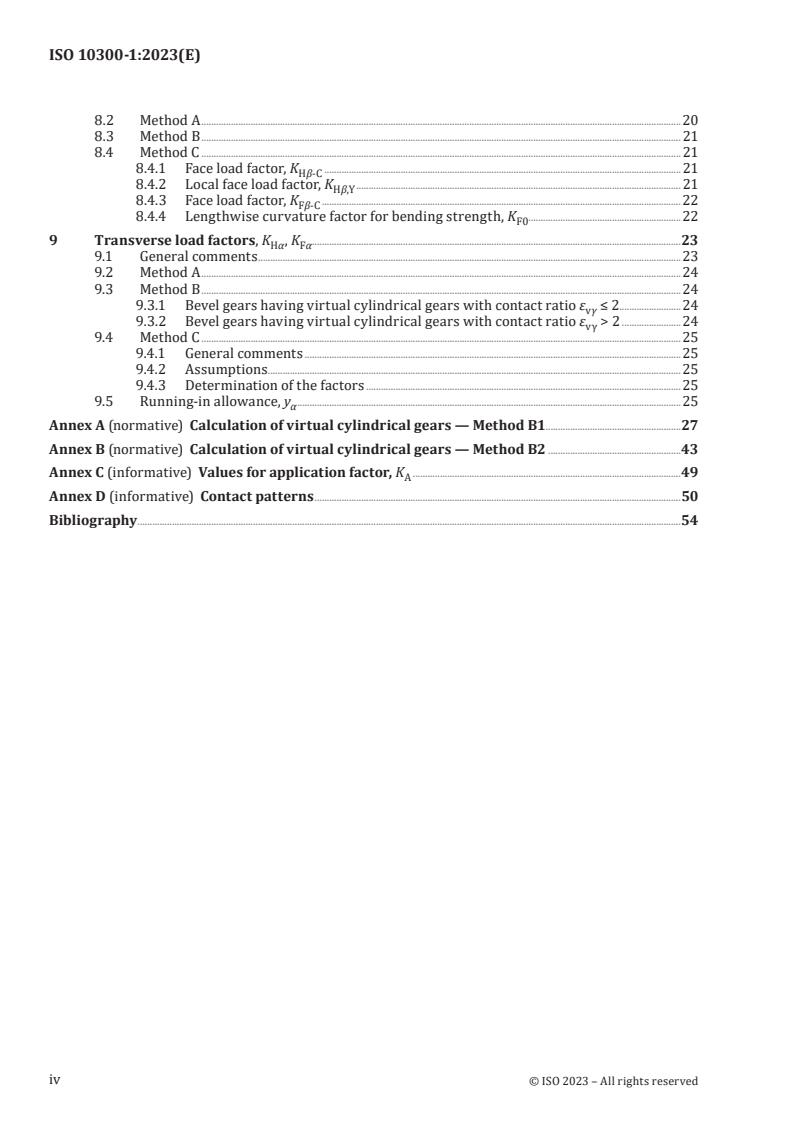
Foreword .v
Introduction .vii
1 Scope . 1
2 Normative references . 1
3 Terms and definitions . 2
4 Symbols and general subscripts . .2
5 Application .6
5.1 Calculation methods . 6
5.1.1 General . 6
5.1.2 Method A . . . 6
5.1.3 Method B . . 6
5.1.4 Method C . 6
5.2 Safety factors . 7
5.3 Rating factors . 7
5.3.1 Testing . 7
5.3.2 Manufacturing tolerances . 7
5.3.3 Implied accuracy . 8
5.4 Further factors to be considered . 8
5.4.1 General . 8
5.4.2 Lubrication . 8
5.4.3 Misalignment . 8
5.4.4 Deflection . . 8
5.4.5 Materials and metallurgy . 8
5.4.6 Residual stress . 8
5.4.7 System dynamics . 9
5.4.8 Contact pattern . 9
5.4.9 Corrosion . 9
5.5 Further influence factors in the basic formulae . 9
6 External force and application factor, K .10
A
6.1 Nominal tangential force, torque, power . 10
6.2 Variable load conditions . 10
6.3 Application factor, K . 10
A
6.3.1 Application factor — General . . 10
6.3.2 Influences affecting external dynamic loads . 11
6.3.3 Establishment of application factors . 11
7 Dynamic factor, K .11
v
7.1 General . 11
7.2 Design . 11
7.3 Manufacturing .12
7.4 Transmission error .12
7.5 Dynamic response . 12
7.6 Resonance . 13
7.6.1 General .13
7.6.2 Gear blank resonance . . .13
7.7 Calculation methods for K .13
v
7.7.1 General comments .13
7.7.2 Method A, K . 14
v-A
7.7.3 Method B, K . 14
v-B
7.7.4 Method C, K . 18
v-C
8 Face load factors, K , K .20
Hβ Fβ
8.1 General comments .20
iii
8.2 Method A . 20
8.3 Method B . 21
8.4 Method C . 21
8.4.1 Face load factor, K . 21
Hβ-C
8.4.2 Local face load factor, K . 21
Hβ,Y
8.4.3 Face load factor, K . 22
Fβ-C
8.4.4 Lengthwise curvature factor for bending strength, K . .22
F0
9 Transverse load factors, K , K .23
Hα Fα
9.1 General comments .23
9.2 Method A . 24
9.3 Method B . 24
9.3.1 Bevel gears having virtual cylindrical gears with contact ratio ε ≤ 2. 24
vγ
9.3.2 Bevel gears having virtual cylindrical gears with contact ratio ε > 2 . 24
vγ
9.4 Method C . 25
9.4.1 General comments .25
9.4.2 Assumptions . 25
9.4.3 Determination of the factors . 25
9.5 Running-in allowance, y .25
α
Annex A (normative) Calculation of virtual cylindrical gears — Method B1.27
Annex B (normative) Calculation of virtual cylindrical gears — Method B2 .43
Annex C (informative) Values for application factor, K .49
A
Annex D (informative) Contact patterns .50
Bibliography .54
iv
Foreword
ISO (the International Organization for Standardization) is a worldwide federation of national standards
bodies (ISO member bodies). The work of preparing International Standards is normally carried out
through ISO technical committees. Each member body interested in a subject for which a technical
committee has been established has the right to be represented on that committee. International
organizations, governmental and non-governmental, in liaison with ISO, also take part in the work.
ISO collaborates closely with the International Electrotechnical Commission (IEC) on all matters of
electrotechnical standardization.
The procedures used to develop this document and those intended for its further maintenance are
described in the ISO/IEC Directives, Part 1. In particular, the different approval criteria needed for the
different types of ISO document should be noted. This document was drafted in accordance with the
editorial rules of the ISO/IEC Directives, Part 2 (see www.iso.org/directives).
ISO draws attention to the possibility that the implementation of this document may involve the use
of (a) patent(s). ISO takes no position concerning the evidence, validity or applicability of any claimed
patent rights in respect thereof. As of the date of publication of this document, ISO had not received
notice of (a) patent(s) which may be required to implement this document. However, implementers are
cautioned that this may not represent the latest information, which may be obtained from the patent
database available at www.iso.org/patents. ISO shall not be held responsible for identifying any or all
such patent rights.
Any trade name used in this document is information given for the convenience of users and does not
constitute an endorsement.
For an explanation of the voluntary nature of standards, the meaning of ISO specific terms and
expressions related to conformity assessment, as well as information about ISO's adherence to
the World Trade Organization (WTO) principles in the Technical Barriers to Trade (TBT), see
www.iso.org/iso/foreword.html.
This document was prepared by Technical Committee ISO/TC 60, Gears, Subcommittee SC 2, Gear
capacity calculation.
This third edition cancels and replaces the second edition (ISO 10300-1:2014), which has been
technically revised.
The main changes are as follows:
— Table 1 has been inserted in which only symbols and units used in this document are provided;
— Table 2 has been inserted;
— subclause 9.1 — boundary conditions for the calculation of the transverse load factors method B
have been rearranged;
— Figure 3 — nomogram for the determination of the resonance speed, n , for the mating solid steel
E1
pinion/solid wheel, with c = 20 N/(mm · μm) (for bevel gears without offset only) has been removed;
γ
— Figure 4 — dynamic factor, K , has been removed;
v-C
— Figure 5 — transverse load factors, K and K has been removed;
Hα-B Fα-B
— Figure 6 — running-in allowance, y , of gear pairs with a tangential speed of v > 10 m/s has been
α mt2
removed;
— Figure 7 — running-in allowance, y , of gear pairs with a tangential speed of v ≤ 10 m/s has been
α mt2
removed;
— Figure A.6 — transverse path of contact has been newly inserted;
v
— Figure A.7 — general definition of length of contact lines for local geometry data has been newly
inserted.
A list of all parts in the ISO 10300 series can be found on the ISO website.
Any feedback or questions on this document should be directed to the user’s national standards body. A
complete listing of these bodies can be found at www.iso.org/members.html.
vi
Introduction
When ISO 10300:2001 (all parts) became due for its first revision, the opportunity was taken to include
hypoid gears, since previously the series only allowed for calculating the load capacity of bevel gears
without offset axes. The former structure is retained, i.e. three parts of the ISO 10300 series, together
with ISO 6336-5, and it is intended to establish general principles and procedures for rating of bevel
gears. Moreover, ISO 10300 (all parts) is designed to facilitate the application of future knowledge and
developments, as well as the exchange of information gained from experience.
Several calculation methods, i.e. A, B and C, are specified, which stand for decreasing accuracy and
reliability from A to C because of simplifications implemented in formulae and factors. The approximate
methods in ISO 10300 (all parts) are used for preliminary estimates of gear capacity where the final
details of the gear design are not yet known. More detailed methods are intended for the recalculation
of the load capacity limits when all important gear data are given.
ISO 10300 (all parts) does not provide an upgraded calculation procedure as a method A, although it
would be available, such as finite element or boundary element methods combined with sophisticated
tooth contact analyses.
On the other hand, by means of such a computer program, a new calculation procedure for bevel and
hypoid gears on the level of method B was developed and checked. It is part of the ISO 10300 series as
submethod B1. Besides, if the hypoid offset, a, is zero, method B1 becomes identical to the set of proven
formulae of the former version of ISO 10300:2001 (all parts).
In view of the decision for ISO 10300 (all parts) to cover hypoid gears also, Annex B has been included
in this document. Additionally, ISO 10300-2 is supplemented by a separate clause: “Gear flank rating
formulae — Method B2”; as for ISO 10300-3, the former method B2, which uses the Lewis parabola to
determine the critical section in the root and not the 30° tangent at the tooth fillet as method B1 does,
is now extended by the AGMA methods for rating the strength of bevel gears and hypoid gears. It was
necessary to present a new, clearer structure of the three parts, which is illustrated in Figure 1.
NOTE ISO 10300 (all parts) gives no preferences in terms of when to use method B1 and when to use
method B2.
The procedures covered by ISO 10300 (all parts) are based on both testing and theoretical studies.
ISO 10300 (all parts) provides calculation procedures by which different gear designs can be compared.
It is not meant to ensure the performance of assembled gear drive systems. It is intended for use by
the experienced gear designer capable of selecting reasonable values for the factors in these formulae,
based on knowledge of similar designs and on awareness of the effects of the items discussed.
NOTE Contrary to cylindrical gears, where the contact is usually linear, bevel gears are generally
manufactured with profile and lengthwise crowning, i.e. the tooth flanks are curved on all sides and the contact
develops an elliptical pressure surface. This is taken into consideration when determining the load factors by
the fact that the rectangular zone of action (in the case of spur and helical gears) is replaced by an inscribed
parallelogram for method B1 and an inscribed ellipse for method B2 (see Annex A for method B1 and Annex B for
method B2). The conditions for bevel gears, different from cylindrical gears in their contact, are thus taken into
consideration by the face and transverse load distribution factors.
vii
a
One set of formulae for both, bevel and hypoid gears.
b
Separate sets of formulae for bevel and for hypoid gears.
Figure 1 — Structure of calculation methods in ISO 10300 (all parts)
viii
INTERNATIONAL STANDARD ISO 10300-1:2023(E)
Calculation of load capacity of bevel gears —
Part 1:
Introduction and general influence factors
1 Scope
This document specifies the methods of calculation of the load capacity of bevel gears, the formulae and
symbols used for calculation, and the general factors influencing load conditions.
The formulae in this document are intended to establish uniformly acceptable methods for calculating
the load-carrying capacity of straight, helical (skew), spiral bevel, Zerol and hypoid gears. They are
applicable equally to tapered depth and uniform depth teeth. Hereinafter, the term “bevel gear” refers
to all of the gear types; if not, the specific forms are identified.
The formulae in this document take into account the known major factors influencing load-carrying
capacity. The rating formulae are only applicable to types of gear tooth deterioration, that are
specifically addressed in the individual parts of the ISO 10300 series. Rating systems for a particular
type of bevel gears can be established by selecting proper values for the factors used in the general
formulae.
NOTE This document is not applicable to bevel gears which have an inadequate contact pattern under load
(see Annex D).
The rating system of this document is based on virtual cylindrical gears and restricted to bevel gears
whose virtual cylindrical gears have transverse contact ratios of ε < 2. Additionally, for bevel gears
vα
the sum of profile shift coefficients of pinion and wheel is zero (see ISO 23509).
The user is cautioned that when the formulae are used for large average mean spiral angles
(β + β )/2 > 45°, for effective pressure angles α > 30° and/or for large facewidths b > 13 m , the
m1 m2 e mn
calculated results of this document should be confirmed by experience.
2 Normative references
The following documents are referred to in the text in such a way that some or all of their content
constitutes requirements of this document. For dated references, only the edition cited applies. For
undated references, the latest edition of the referenced document (including any amendments) applies.
ISO 701, International gear notation — Symbols for geometrical data
ISO 1122-1, Vocabulary of gear terms — Part 1: Definitions related to geometry
ISO 6336-5, Calculation of load capacity of spur and helical gears — Part 5: Strength and quality of
materials
ISO 6336-6, Calculation of load capacity of spur and helical gears — Part 6: Calculation of service life under
variable load
ISO 10300-2, Calculation of load capacity of bevel gears — Part 2: Calculation of surface durability
(macropitting)
ISO 10300-3, Calculation of load capacity of bevel gears — Part 3: Calculation of tooth root strength
ISO 17485, Bevel gears — ISO system of accuracy
ISO 23509:2016, Bevel and hypoid gear geometry
3 Terms and definitions
For the purposes of this document, the terms and definitions given in ISO 1122-1 and ISO 23509 apply.
ISO and IEC maintain terminology databases for use in standardization at the following addresses:
— ISO Online browsing platform: available at https:// www .iso .org/ obp
— IEC Electropedia: available at https:// www .electropedia .org/
4 Symbols and general subscripts
For the purposes of this document, the symbols given in ISO 701, ISO 17485, ISO 23509, and the following
shall apply. See Tables 1 and 2.
Table 1 — Symbols
Symbol Description or term Unit
A Auxiliary factor for calculating the dynamic factor K —
v-C
A* Related area for calculating the load sharing factor Z mm
LS
a Hypoid offset mm
a Relative hypoid offset —
rel
a Centre distance of virtual cylindrical gear pair mm
v
a Relative centre distance of virtual cylindrical gear pair in normal section —
vn
B Accuracy grade according to ISO 17485 —
b Facewidth mm
b Calculated effective facewidth mm
ce
b Effective facewidth (e.g. measured length of contact pattern) mm
eff
b Facewidth of virtual cylindrical gears mm
v
b Effective facewidth of virtual cylindrical gears mm
v,eff
b Relative facewidth of virtual cylindrical gear —
v,rel
C Correction factor of tooth stiffness for non-average conditions —
F
C Correction factor for the length of contact lines —
lb
c Empirical parameter to determine the dynamic factor —
v
c Mean value of mesh stiffness per unit facewidth N/(mm⋅μm)
γ
c Mesh stiffness for average conditions N/(mm⋅μm)
γ0
c' Single stiffness N/(mm⋅μm)
c ' Single stiffness for average conditions N/(mm⋅μm)
d Outer pitch diameter mm
e
d Mean pitch diameter mm
m
d Tolerance diameter according to ISO 17485 mm
T
d Reference diameter of virtual cylindrical gear mm
v
d Tip diameter of virtual cylindrical gear mm
va
d Tip diameter of virtual cylindrical gear in normal section mm
van
d Base diameter of virtual cylindrical gear mm
vb
d Base diameter of virtual cylindrical gear in normal section mm
vbn
d Root diameter of virtual cylindrical gear mm
vf
d Reference diameter of virtual cylindrical gear in normal section mm
vn
TTabablele 1 1 ((ccoonnttiinnueuedd))
Symbol Description or term Unit
E Modulus of elasticity, Young’s modulus N/mm
e Exponent for the load distribution along the lines of contact —
LS
F Nominal tangential force at mid-facewidth of the reference cone N
mt
F Determinant tangential force at mid-facewidth of the reference cone N
mtH
F Nominal tangential force of virtual cylindrical gears N
vmt
f Distance from the centre of the zone of action to a contact line mm
f Distance of the middle contact line in the zone of action mm
m
f Distance of the middle contact line in the zone of action for a contact point Y mm
m,Y
f Maximum distance to middle contact line mm
max
f Maximum distance to middle contact line at right side of contact pattern mm
maxB
f Maximum distance to middle contact line at left side of contact pattern mm
max0
f Single pitch deviation μm
pt
f Effective pitch deviation μm
p,eff
f Distance of the root contact line in the zone of action mm
r
f Distance of the root contact line in the zone of action for a contact point Y mm
r,Y
f Distance of the tip contact line in the zone of action mm
t
f Distance of the tip contact line in the zone of action for a contact point Y mm
t,Y
g Length of path of contact mm
va
g Length of path of contact of virtual cylindrical gear in transverse section mm
vα
g Relative length of action in normal section —
vαn
g Relative length of action from pinion tip to pitch circle in the normal section —
vαna
g Relative length of action from wheel tip to pitch circle in the normal section —
vαnr
g Relative length of action within the contact ellipse —
η
h Mean addendum mm
am
h Mean dedendum mm
fm
h Relative mean virtual dedendum —
vfm
i Run variable —
K Constant; factor for calculating the dynamic factor K —
v-B
K Dynamic factor —
v
*
K Preliminary dynamic factor for non-hypoid gears —
v
K Application factor —
A
K Lengthwise curvature factor for bending stress —
F0
K Transverse load factor for bending stress —
Fα
K Face load factor for bending stress —
Fβ
K Transverse load factor for contact stress —
Hα
*
K Preliminary transverse load factor for contact stress for non-hypoid gears —
Hα
K Face load factor for contact stress —
Hβ
K Mounting factor —
Hβ-be
k Correction factor —
S
k' Contact shift factor —
l Length of contact line (method B1) mm
b
l Theoretical length of contact line mm
b0
m Outer transverse module mm
et
m Mean normal module mm
mn
TTabablele 1 1 ((ccoonnttiinnueuedd))
Symbol Description or term Unit
m Mass per unit facewidth reduced to the line of action of dynamically equivalent kg/mm
red
cylindrical gear pairs
m Transverse module mm
vt
m* Relative individual gear mass per unit facewidth referred to line of action kg/mm
N Reference speed related to resonance speed n —
E1
-1
n Rotational speed min
-1
n Resonance speed of pinion min
E1
P Nominal power kW
p Peak load N/mm
p* Relative peak load for calculating the load sharing factor (method B1) —
p Relative mean normal pitch —
mn
p Transverse base pitch of virtual cylindrical gear (method B1) mm
vet
q Exponent in the Formula for lengthwise curvature factor —
R Mean cone distance mm
m
R Relative mean back cone distance —
mpt
r Cutter radius mm
c0
r Relative mean virtual tip radius —
va
r Relative mean virtual base radius —
vbn
r Relative mean virtual pitch radius —
vn
s Mean normal circular thickness mm
mn
s Relative virtual tooth thickness —
vmn
T Nominal torque of pinion and wheel Nm
1,2
u Gear ratio of bevel gear —
u Gear ratio of virtual cylindrical gear —
v
v Tangential speed at outer end (heel) of the reference cone m/s
et
v Maximum pitch line velocity at operating pitch diameter m/s
et,max
v Tangential speed at mid-facewidth of the reference cone m/s
mt
X Curvature factor —
Y
x Coordinates of the ends of the contact line mm
Y Combined tooth form factor for generated gears —
FS
Y Load sharing factor (bending) —
LS
y Running-in allowance for pitch deviation related to the polished test piece μm
p
y Running-in allowance for pitch deviation μm
α
Z Load sharing factor (method B1) —
LS
z Number of teeth —
z Number of teeth of virtual cylindrical gear —
v
z Number of teeth of virtual cylindrical gear in normal section —
vn
z Auxiliary value mm
Y
z Number of blade groups of the cutter —
α Adjusted pressure angle (method B2) °
a
α Effective pressure angle for drive side/coast side °
eD,C
α Effective pressure angle in transverse section °
et
α Limit pressure angle °
lim
α Generated pressure angle for drive side/coast side °
nD,C
TTabablele 1 1 ((ccoonnttiinnueuedd))
Symbol Description or term Unit
α Effective pressure angle of virtual cylindrical gears calculated for the active flank °
vet
β Inclination angle of contact line °
B
β Mean spiral angle °
m
β Helix angle of virtual gear (method B1), virtual spiral angle (method B2) °
v
β Helix angle at base circle of virtual cylindrical gear °
vb
γ Auxiliary angle for length of contact line calculation (method B1) °
γ' Projected auxiliary angle for length of contact line °
δ Pitch angle of bevel gear °
δ Face angle °
a
δ Root angle °
f
ε Load sharing ratio for bending (method B2) —
N
ε Transverse contact ratio of virtual cylindrical gears —
vα
ε Transverse contact ratio of virtual cylindrical gears in normal section —
vαn
ε Face contact ratio of virtual cylindrical gears —
vβ
ε Virtual contact ratio (method B1), modified contact ratio (method B2) —
vγ
η Auxiliary angle °
ζ Pinion offset angle in root plane °
R
ζ Pinion offset angle in axial plane °
m
ζ Pinion offset angle in pitch plane °
mp
θ Angular pitch of virtual cylindrical wheel rad
v2
ϑ Auxiliary angle for virtual facewidth (method B1) °
mp
λ Adjustment angle for contact angle of hypoid gears (method B2) °
λ Adjustment angle for virtual spiral angle of hypoid gears (method B2) °
r
ρ Density of gear material kg/mm
ρ Cutter edge radius mm
a0
ρ Lengthwise tooth mean radius of curvature mm
mβ
ρ Local equivalent radius of curvature vertical to the contact line mm
rel
ρ Relative radius of profile curvature between pinion and wheel (method B2) —
t
ρ Relative edge radius of tool —
va0
ρ' Slip layer thickness mm
σ Allowable stress number for contact stress N/mm
H,lim
v Lead angle of face hobbing cutter °
φ Auxiliary angle to determine the position of the pitch point °
ω Angular velocity rad/s
Σ Shaft angle °
Table 2 — General subscripts
Subscripts Description
0 Tool
1 Pinion
2 Wheel
A, B, B1, B2, C Value according to method A, B, B1, B2 or C
D Drive flank
C Coast flank
T Relative to standardized test gear dimensions
(1), (2) Trials of interpolation
5 Application
5.1 Calculation methods
5.1.1 General
ISO 10300 (all parts) provides the procedures to predict load capacity of bevel gears. The most valid
method is full-scale and full-load testing of a specific gear set design. However, at the design stage or in
certain fields of application, some calculation methods are needed to predict load capacity. Therefore,
methods A, B and C are used in this document, while method A, if its accuracy and reliability are proven,
is preferred over method B, which in turn is preferred over method C.
ISO 10300 (all parts) allows the use of mixed factor rating methods within method B1 or method B2.
For example, method B for dynamic factor K may be used with method C face load factor K .
v-B Hβ-C
For the calculation of the virtual cylindrical gear geometry, Annex A shall apply for method B1 and
Annex B shall apply for method B2.
5.1.2 Method A
Where sufficient experience from the operation of other, similar designs is available, satisfactory
guidance can be obtained by the extrapolation of the associated test results or field data. The factors
involved in this extrapolation may be evaluated by the precise measurement and comprehensive
mathematical analysis of the transmission system under consideration, or from field experience. All gear
and load data shall be known for the use of this method, which shall be clearly described and presented
with all mathematical and test premises, boundary conditions and any specific characteristics of the
method that influence the result. The accuracy and the reliability of the method shall be demonstrated.
Precision, for example, shall be demonstrated through comparison with other, acknowledged gear
measurements. The method should be approved by both the customer and the supplier.
5.1.3 Method B
Method B provides the calculation formulae to predict load capacity of bevel gears for which the
essential data are known. However, sufficient experience from the operation of other, similar designs is
needed in the evaluation of certain factors even in this method. The validity of these evaluations for the
given operating conditions shall be checked.
5.1.4 Method C
Where suitable test results or field experience from similar designs are unavailable for use in the
evaluation of certain factors, a further simplified calculation method, method C, should be used.
5.2 Safety factors
The allowable probability of failure shall be carefully weighed when choosing a safety factor, in
balancing reliability against cost. If the performance of the gears can be accurately appraised by testing
the unit itself under actual load conditions, lower safety factors are allowed. The safety factors shall be
determined by dividing the calculated permissible stress by the specific evaluated operating stress.
In addition to this general requirement and the special requirements relating to surface durability
(macropitting) and tooth root strength (see ISO 10300-2 and ISO 10300-3, respectively), safety factors
shall be determined only after careful consideration of the reliability of the material data and of the
load values used for calculation. The allowable stress numbers used for calculation are valid for a given
probability of failure, or damage (the material values in ISO 6336-5, for example, are valid for a 1 %
probability of damage), the risk of damage being reduced as the safety factors are increased, and vice
versa. If loads, or the response of the system to vibration, are estimated rather than measured, a larger
factor of safety should be used.
The following deviations shall also be taken into consideration in the determination of a safety factor:
— deviations in gear geometry due to manufacturing;
— deviations in alignment of gear members;
— variations in material due to process variations in chemistry, cleanliness and microstructure
(material quality and heat treatment);
— variations in lubrication and its maintenance over the service life of the gears.
The appropriateness of the safety factors will thus depend on the reliability of the assumptions, such
as those related to load, on which the calculations are based, as well as on the reliability required of the
gears themselves, in respect of the possible consequences of any damage that can occur in the case of
failure.
Supplied gears or assembled gear drives should have a minimum safety factor for contact stress S
H,min
of 1,0. The minimum bending stress value S should be 1,3 for spiral bevel including hypoid gears,
F,min
and 1,5 for straight bevel gears or those with β ≤ 5°.
m
The minimum safety factors against macropitting damage and tooth breakage should be agreed
between the supplier and customer.
5.3 Rating factors
5.3.1 Testing
The most effective overall approach to gear system performance management is through the full-scale,
full-load testing of a proposed new design. Alternatively, where sufficient experience of similar designs
exists and results are available, a satisfactory solution may be obtained through extrapolation from
such data. On the other hand, where suitable test results or field data are not available, rating factor
values should be chosen conservatively.
5.3.2 Manufacturing tolerances
Rating factors should be evaluated based on the acceptable quality limits of the expected variation of
parts in the manufacturing process. The accuracy grade, B, shall be determined, preferably as specified
in ISO 17485, e.g. single pitch deviation for calculating the dynamic factor K .
v-B
5.3.3 Implied accuracy
Where the empirical values for rating factors are given by curves, this document provides curve fitting
equations to facilitate computer programming.
NOTE The constants and coefficients used in curve fitting often have significant digits in excess of those
implied by the reliability of the empirical data.
5.4 Further factors to be considered
5.4.1 General
In addition to the factors considered that influence macropitting resistance and bending strength,
other interrelated system factors can have an important effect on overall transmission performance.
Their possible effect on the calculations should be considered.
5.4.2 Lubrication
The ratings determined by the formulae of ISO 10300-2 and ISO 10300-3 shall be valid only if the gear
teeth are operated with a lubricant of proper viscosity and additive package for the load, speed and
surface finish, and if there is a sufficient quantity of lubricant on the gear teeth and bearings to lubricate
and maintain an acceptable operating temperature.
5.4.3 Misalignment
Many gear systems depend on external supports such as machinery foundations to maintain alignment
of the gear mesh. If these supports are poorly designed, initially misaligned or become misaligned
during operation due to elastic or thermal deflections or other influences, overall gear system
performance will be adversely affected.
5.4.4 Deflection
Deflection of gear supporting housings, shafts and bearings due to external overhung, transverse and
thrust loads affects tooth contact across the mesh. Since deflection varies with load, it is difficult to
obtain good tooth contact at different loads. Generally, deflection due to external loads from driven and
driving equipment reduces capacity, and this, as well as deflection caused by internal forces, should be
taken into account when determining the actual gear tooth contact.
5.4.5 Materials and metallurgy
Most bevel gears are made from case-hardened steel. Allowable stress numbers for this and other
materials shall be taken from gear tests, from special tests or, if the material is similar, from ISO 6336-5.
Additionally, different modes of steel making and heat treatment are considered in ISO 6336-5. Hardness
and tensile strength as well as the quality grade shall also be criteria for choosing permissible stress
numbers.
NOTE Higher quality steel grades indicate higher allowable stress numbers, while lower quality grades
indicate lower allowable stress numbers (see ISO 6336-5).
5.4.6 Residual stress
Any ferrous material having a case core relationship is likely to have residual stress. If properly
managed, such stress will be compressive at the tooth surface, thereby enhancing the bending fatigue
strength of the gear tooth. Shot peening, case carburizing and induction hardening, if properly
performed, are common methods of inducing compressive pre-stress in the surface of the gear teeth.
Improper grinding techniques after heat treatment can reduce the residual compressive stresses or
even introduce residual tensile stresses in the root fillets of the teeth, thereby lowering the allowable
stress numbers.
5.4.7 System dynamics
The method of analysis used in this document includes a dynamic factor, K , which derates the gears for
v
increased loads caused by gear tooth inaccuracies. Generally speaking, this provides simplified values
for easy application.
The dynamic response of the system results in additional gear tooth loads, due to the relative motions of
the connected masses of the driver and the driven equipment. The application factor, K , is in
...