

ISO 17607-3:2023
(Main)Steel structures — Execution of structural steelwork — Part 3: Fabrication
General Information
- Abstract
This document defines the general requirements for fabrication in the execution of structural steelwork as structures or as fabricated components in conjunction with ISO 17607-1. Additional requirements to be addressed in the execution of structural steelwork, as structures or as fabricated components, can be found in other parts of the ISO 17607 series.
- Status
- Published
- Publication Date
- 07-Dec-2023
- Technical Committee
- ISO/TC 167 - Steel and aluminium structures
- Drafting Committee
- ISO/TC 167/WG 3 - Execution of steel structures
- Current Stage
- 6060 - International Standard published
- Start Date
- 08-Dec-2023
- Due Date
- 11-Feb-2023
- Completion Date
- 08-Dec-2023


Overview
ISO 17607-3:2023 - "Steel structures - Execution of structural steelwork - Part 3: Fabrication" defines general fabrication requirements for structural steelwork and fabricated components when used with ISO 17607-1 (General requirements and vocabulary). It replaces earlier national guidance and provides a harmonized set of fabrication principles for projects without a governing national standard, helping reduce trade barriers and improve consistency in fabrication quality.
Key topics and technical requirements
The standard addresses practical fabrication controls and documentation, including:
- Execution specification: Information and technical requirements (identification, traceability, geometrical tolerances, execution levels) must be agreed before fabrication starts. Procedures for alterations are required.
- Identification and traceability: Methods for marking and traceability through fabrication, transport and erection; retention of identification records; special rules for hard stamped/punched marks (permitted only for steels up to 500 MPa and only where fatigue life is not affected).
- Handling and storage: Manufacturer recommendations and shelf-life considerations for constituent products.
- Cutting: Requirements for cutting methods (shearing, nibbling, thermal cutting) and quality controls, including automated thermal cutting capability checks (see Annex B).
- Shaping and forming: Hot forming (forging), cold forming, flame straightening, cambering and curving - with controls to avoid unacceptable material changes.
- Holing for structural bolting: Execution of holes, tolerances on hole diameter, surface roughness and fit for bolts and pins.
- Assembly and temporary attachments: Fit-up, temporary fixtures and assembly checks to ensure conformity with geometrical tolerances.
- Geometrical tolerances: Types, tolerancing criteria and alternative acceptance methods (Clauses 6, Annex C–E provide building, bridge and crane runway tolerance guidance).
- Inspection, testing and correction: Shop inspections, acceptance criteria, procedures for shop corrections and actions on nonconformity.
- Architecturally exposed structural steel (AESS): Additional requirements where appearance is critical.
- Conformity documentation: Declaration of conformity and the documents required to claim compliance.
Practical applications and who uses it
ISO 17607-3 is aimed at parties involved in the fabrication and quality assurance of structural steelwork:
- Steel fabricators and workshop managers
- Structural engineers and detailers
- Contractors and erection teams
- Quality and compliance officers
- Project owners and specifiers seeking a recognized international fabrication standard
Use cases include specifying fabrication tolerances for building frames, bridge components, crane runways, and other structural steel elements where consistent fabrication practice and traceability are required.
Related standards
- ISO 17607-1 - General requirements and vocabulary
- ISO 17607-2 - Steels
- ISO 17607-4 - Erection
- ISO 17607-5 - Welding
- ISO 17607-6 - Bolting
Keywords: ISO 17607-3:2023, fabrication, structural steelwork, fabrication tolerances, execution specification, identification and traceability, thermal cutting, holing, geometrical tolerances.
Relations
- Effective Date
- 16-Oct-2025
- Effective Date
- 24-Dec-2022
Get Certified
Connect with accredited certification bodies for this standard

DIBt (Deutsches Institut für Bautechnik)
German Institute for Building Technology.
DIN CERTCO
DIN Group product certification.

Aboma Certification B.V.
Specialized in construction, metal, and transport sectors.
Sponsored listings
Frequently Asked Questions
ISO 17607-3:2023 is a standard published by the International Organization for Standardization (ISO). Its full title is "Steel structures — Execution of structural steelwork — Part 3: Fabrication". This standard covers: This document defines the general requirements for fabrication in the execution of structural steelwork as structures or as fabricated components in conjunction with ISO 17607-1. Additional requirements to be addressed in the execution of structural steelwork, as structures or as fabricated components, can be found in other parts of the ISO 17607 series.
This document defines the general requirements for fabrication in the execution of structural steelwork as structures or as fabricated components in conjunction with ISO 17607-1. Additional requirements to be addressed in the execution of structural steelwork, as structures or as fabricated components, can be found in other parts of the ISO 17607 series.
ISO 17607-3:2023 is classified under the following ICS (International Classification for Standards) categories: 91.080.13 - Steel structures. The ICS classification helps identify the subject area and facilitates finding related standards.
ISO 17607-3:2023 has the following relationships with other standards: It is inter standard links to ISO 10721-2:1999/Cor 1:1999, ISO 10721-2:1999. Understanding these relationships helps ensure you are using the most current and applicable version of the standard.
ISO 17607-3:2023 is available in PDF format for immediate download after purchase. The document can be added to your cart and obtained through the secure checkout process. Digital delivery ensures instant access to the complete standard document.
Standards Content (Sample)
INTERNATIONAL ISO
STANDARD 17607-3
First edition
2023-12
Steel structures — Execution of
structural steelwork —
Part 3:
Fabrication
Structures en acier – Exécution des charpentes et ossatures en
acier —
Partie 3: Fabrication
Reference number
© ISO 2023
All rights reserved. Unless otherwise specified, or required in the context of its implementation, no part of this publication may
be reproduced or utilized otherwise in any form or by any means, electronic or mechanical, including photocopying, or posting on
the internet or an intranet, without prior written permission. Permission can be requested from either ISO at the address below
or ISO’s member body in the country of the requester.
ISO copyright office
CP 401 • Ch. de Blandonnet 8
CH-1214 Vernier, Geneva
Phone: +41 22 749 01 11
Email: copyright@iso.org
Website: www.iso.org
Published in Switzerland
ii
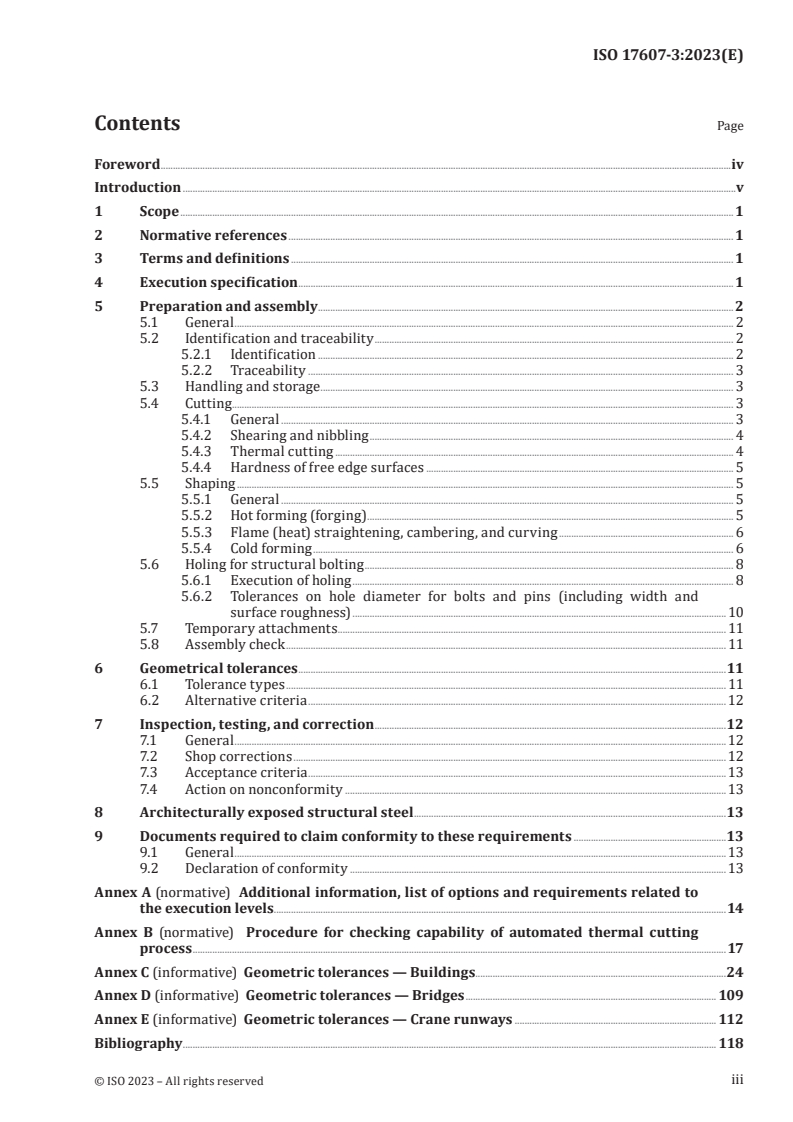
Contents Page
Foreword .iv
Introduction .v
1 Scope . 1
2 Normative references . 1
3 Terms and definitions . 1
4 Execution specification .1
5 Preparation and assembly . .2
5.1 General . 2
5.2 Identification and traceability . 2
5.2.1 Identification . 2
5.2.2 Traceability . 3
5.3 Handling and storage . 3
5.4 Cutting . . 3
5.4.1 General . 3
5.4.2 Shearing and nibbling . 4
5.4.3 Thermal cutting . 4
5.4.4 Hardness of free edge surfaces . 5
5.5 Shaping . 5
5.5.1 General . 5
5.5.2 Hot forming (forging) . 5
5.5.3 Flame (heat) straightening, cambering, and curving . 6
5.5.4 Cold forming . 6
5.6 Holing for structural bolting . 8
5.6.1 Execution of holing . 8
5.6.2 Tolerances on hole diameter for bolts and pins (including width and
surface roughness) . 10
5.7 Temporary attachments . 11
5.8 Assembly check . 11
6 Geometrical tolerances .11
6.1 Tolerance types . 11
6.2 Alternative criteria .12
7 Inspection, testing, and correction .12
7.1 General .12
7.2 Shop corrections .12
7.3 Acceptance criteria .13
7.4 Action on nonconformity .13
8 Architecturally exposed structural steel .13
9 Documents required to claim conformity to these requirements .13
9.1 General .13
9.2 Declaration of conformity . 13
Annex A (normative) Additional information, list of options and requirements related to
the execution levels.14
Annex B (normative) Procedure for checking capability of automated thermal cutting
process .17
Annex C (informative) Geometric tolerances — Buildings .24
Annex D (informative) Geometric tolerances — Bridges . 109
Annex E (informative) Geometric tolerances — Crane runways . 112
Bibliography . 118
iii
Foreword
ISO (the International Organization for Standardization) is a worldwide federation of national standards
bodies (ISO member bodies). The work of preparing International Standards is normally carried out
through ISO technical committees. Each member body interested in a subject for which a technical
committee has been established has the right to be represented on that committee. International
organizations, governmental and non-governmental, in liaison with ISO, also take part in the work.
ISO collaborates closely with the International Electrotechnical Commission (IEC) on all matters of
electrotechnical standardization.
The procedures used to develop this document and those intended for its further maintenance are
described in the ISO/IEC Directives, Part 1. In particular, the different approval criteria needed for the
different types of ISO document should be noted. This document was drafted in accordance with the
editorial rules of the ISO/IEC Directives, Part 2 (see www.iso.org/directives).
ISO draws attention to the possibility that the implementation of this document may involve the use
of (a) patent(s). ISO takes no position concerning the evidence, validity or applicability of any claimed
patent rights in respect thereof. As of the date of publication of this document, ISO had not received
notice of (a) patent(s) which may be required to implement this document. However, implementers are
cautioned that this may not represent the latest information, which may be obtained from the patent
database available at www.iso.org/patents. ISO shall not be held responsible for identifying any or all
such patent rights.
Any trade name used in this document is information given for the convenience of users and does not
constitute an endorsement.
For an explanation of the voluntary nature of standards, the meaning of ISO specific terms and
expressions related to conformity assessment, as well as information about ISO's adherence to
the World Trade Organization (WTO) principles in the Technical Barriers to Trade (TBT), see
www.iso.org/iso/foreword.html.
This document was prepared by Technical Committee ISO/TC 167, Steel and aluminium structures.
This first edition cancels and replaces ISO 10721-2:1999, which has been technically revised.
A list of all parts in the ISO 17607 series can be found on the ISO website.
Any feedback or questions on this document should be directed to the user’s national standards body. A
complete listing of these bodies can be found at www.iso.org/members.html.
iv
Introduction
Specific requirements for the achievement of structures that are optimal with respect to safety, the
state of the economy, development and general values of a nation are given in the appropriate regional
or national standards, if they exist.
Many nations do not have their own standards for structural steelwork. Some reference other national
or regional standards. Some permit the project’s standard to be selected by the owner, designer or
constructor of the structure. Some do not require any standards to be followed.
The ISO 17607 series of standards on the execution of structural steelwork was developed to serve
as a means to provide a set of requirements and guidance for projects that are constructed without a
governing regional or national standard. The ISO 17607 series can also serve to reduce trade barriers.
Additional requirements to be addressed in the execution of structural steelwork, as structures or as
fabricated components, can be found in the other parts of the series:
— ISO 17607-1 (General requirements and terms and definitions)
— ISO 17607-2 (Steels);
— ISO 17607-4 (Erection);
— ISO 17607-5 (Welding);
— ISO 17607-6 (Bolting).
v
INTERNATIONAL STANDARD ISO 17607-3:2023(E)
Steel structures — Execution of structural steelwork —
Part 3:
Fabrication
1 Scope
This document defines the general requirements for fabrication in the execution of structural steelwork
as structures or as fabricated components in conjunction with ISO 17607-1.
Additional requirements to be addressed in the execution of structural steelwork, as structures or as
fabricated components, can be found in other parts of the ISO 17607 series.
2 Normative references
The following documents are referred to in the text in such a way that some or all of their content
constitutes requirements of this document. For dated references, only the edition cited applies. For
undated references, the latest edition of the referenced document (including any amendments) applies.
ISO 286-2, Geometrical product specifications (GPS) — ISO code system for tolerances on linear sizes —
Part 2: Tables of standard tolerance classes and limit deviations for holes and shafts
ISO 6506-1, Metallic materials — Brinell hardness test — Part 1: Test method
ISO 6507-1, Metallic materials — Vickers hardness test — Part 1: Test method
ISO 9013, Thermal cutting — Classification of thermal cuts — Geometrical product specification and
quality tolerances
ISO 13920, Welding — General tolerances for welded constructions — Dimensions for lengths and angles
— Shape and position
ISO/TR 15608, Welding — Guidelines for a metallic materials grouping system
ISO 17607-1, Steel structures — Execution of structural steelwork — Part 1: General requirements and
vocabulary
3 Terms and definitions
For the purposes of this document, the terms and definitions given in ISO 17607-1 apply.
ISO and IEC maintain terminology databases for use in standardization at the following addresses:
— ISO Online browsing platform: available at https:// www .iso .org/ obp
— IEC Electropedia: available at https:// www .electropedia .org/
4 Execution specification
See ISO 17607-1.
National standards and documents that provide technically equivalent conditions may be used, in
whole or in part, in place of referenced ISO standards or requirements of this document. In these cases,
the technically equivalent national standards and documents, and deviations from the requirements of
this document shall be referenced in the execution specification.
The necessary information and technical requirements for execution of fabrication shall be agreed on
and complete before commencement.
The execution specification shall include the following items as relevant:
a) for additional information, see A.1;
b) for additional information, see A.2;
c) requirements related to execution levels, see A.3;
d) identification and traceability requirements, see ISO 17607-1;
e) geometrical tolerances, see Clause 6.
There shall be procedures for making alterations to a previously agreed on execution specification.
5 Preparation and assembly
5.1 General
This clause specifies the requirements for identification and traceability, handling and storage, cutting,
shaping, holing for structural bolting, temporary attachments, and assembly of steel products and sub-
components for inclusion into components.
NOTE Provisions for welding and structural bolting are given in ISO 17607-5 and ISO 17607-6.
Structural steelwork shall be fabricated within the tolerances specified in Clause 6.
Equipment used in the fabrication process shall be maintained to ensure that use, wear and failure do
not cause nonconformity in the fabrication process.
5.2 Identification and traceability
5.2.1 Identification
For identification, see ISO 17607-1.
Identification is required for execution levels 1 to 4 (EXL1, EXL2, EXL3, and EXL4) or as specified in the
execution specification.
At all stages of fabrication, unassembled single items and constituent products shall be identifiable by a
suitable method of identification for the purposes of proper assembly.
NOTE Examples of fabrication stages include storage, cutting, holing, fit-up, welding and painting or coating.
Depending on the execution class, identification can vary from a visual marking or tag on each piece to designated
locations for similar products.
The following requirements apply to hard stamped, punched or drilled marks used for marking single
components or packages of similar components, unless otherwise specified:
a) They shall only be used for steel grades up to and including 500 MPa;
b) They shall only be used in areas, as specified in the execution specification, where the marking
method would not affect the fatigue life.
If the use of hard stamps, punched or drilled marks is not permitted, it shall be specified whether soft
or low stress stamps may be used.
Any zones where identification marks are not permitted or shall not be visible after completion shall be
specified in the execution specification.
The assembled component as it moves through the production, shipping and erection processes shall
also be identifiable by suitable methods.
Identification documents shall be retained for all constituent products. The retention period shall be
specified in the execution specification.
5.2.2 Traceability
For traceability see ISO 17607-1.
5.3 Handling and storage
Constituent products shall be handled and stored in conditions that are in accordance with the product
manufacturer's recommendations.
Constituent products shall not be used beyond the shelf life specified by their manufacturer. Products
that have been handled or stored in a way or for a length of time that could have led to significant
deterioration shall be checked before use to ensure that they still conform with the relevant product
standard and execution specification.
Structural steel components shall be packed, handled, and transported safely so that permanent
deformation does not occur, and surface damage is minimised. Handling and storage preventive
measures specified in Table 1 shall be applied as appropriate.
Table 1 — List of handling and storage preventive measures
Lifting
Protection of components from damage at the lifting points
Avoidance of single point lifting of long components by use of spreader beams
Bundling together lightweight components particularly prone to edge damage, twisting and distortion if handled
as individual items. Care taken to avoid localized damage where components touch each other, to unstiffened
edges at lifting points or other zones where a significant proportion of the weight of the bundle is imposed on a
single unreinforced edge
Storage
Stacking of fabricated components stored before transportation or erection clear of the ground to be kept clean
Necessary supports to avoid permanent deformations
Storage of materials supplied with pre-finished decorative surfaces in accordance with relevant standards
Protection against corrosion
Avoidance of accumulation of water
Transport
Special measures needed for protecting fabricated components in transit
5.4 Cutting
5.4.1 General
Cutting shall be carried out in such a way that the requirements for geometrical tolerances, maximum
hardness and smoothness of free edges as specified in this document are met.
NOTE Recognised cutting processes are sawing, shearing, nibbling, disc cutting, water jet techniques and
thermal cutting.
Hand thermal cutting shall be used only if it is not practical to use mechanically guided thermal cutting.
For some cutting methods, precautions shall be taken if the cut edges are to be free edges (i.e. not to be
subsequently welded) for components subject to fatigue, as specified in the execution specification.
If a process does not conform, it shall not be used until corrected and checked again. It may be used on a
restricted range of constituent products that do produce conforming results.
If coated materials are to be cut, the method of cutting shall be selected to minimize any damage to the
coating.
Burrs that can cause injury or prevent the proper alignment or bedding of sections shall be removed.
5.4.2 Shearing and nibbling
The free edge surfaces shall be checked and smoothed as necessary to remove nonconformities.
If grinding or machining is required after shearing or nibbling, the minimum depth of grinding or
machining shall be 0,5 mm. The restrictions on punching in 5.6.1.2 also apply to shearing and nibbling.
5.4.3 Thermal cutting
The capability of automated thermal cutting processes shall be checked annually as set out below.
Four samples shall be produced from the constituent product to be cut by the process:
a) a straight cut from the thickest constituent product;
b) a straight cut from the thinnest constituent product;
c) a re-entrant corner from a representative thickness;
d) a curved arc from a representative thickness.
Measurements shall be taken on each straight sample over at least a 200 mm length and checked against
the required quality of the cut surface. The corner and curved samples shall be visually inspected to
establish that they produce edges of equivalent quality to the straight cuts.
Alternatively, the capability of automated thermal cutting processes may be checked as given in
Annex B.
The quality requirements for cut surfaces to be left as free edges (i.e. not to be subsequently incorporated
into a weld) shall be according to Table 2 when assessed in accordance with ISO 9013, unless otherwise
specified.
Alternatively, the reference for evaluation of cut surfaces may be the surface roughness gauge
included in the AWS C4.1-77 set. When used, the roughness of thermal cut surfaces shall be evaluated
by visually comparing the cut surface to the roughness represented on the roughness gauge. Surface
roughness shall be no greater than that represented by Sample 3, except that for the ends of members
not subject to calculated stress, copes in beams with the flange thickness not exceeding 50 mm (2 in),
and for materials over 100 mm to 200 mm (4 in to 8 in) thick, surface roughness shall not exceed that
represented by Sample 2.
When required by the execution specification, free edges that are to have surface preparation before
paint coating shall have the hardened surface removed.
When required by the execution specification, free edges that are to be hot dip galvanized shall have
the hardened surface removed.
NOTE Liquid metal assisted cracking (LMAC), or liquid metal embrittlement (LME) can occur where surfaces
[17]
are thermally cut and receive hot dip galvanizing. See ISO 14713-2 and DASt-Richtlinie 022 for guidance.
a
Table 2 — Quality of the cut surfaces
Perpendicularity or Mean height of the
Execution
angularity tolerance profile
level
u R
z5
EXL1 Cut edges to be free from significant irregularities and dross shall be removed
EXL2 Range 5 Range 4
EXL3 Range 4 Range 4
EXL4 Range 4 Range 4
a
Ranges are specified in ISO 9013
5.4.4 Hardness of free edge surfaces
The hardness of free edge surfaces of carbon steel groups 2.2 and 3, as listed in ISO/TR 15608, shall
be no more than 450 (HV10) or 420 Brinell (HB). In this case, processes that are likely to produce
local hardness (thermal cutting, shearing, nibbling and punching) shall have their capability checked.
To achieve the required hardness of free edge surfaces, preheating of material shall be applied as
necessary.
Unless otherwise specified in the execution specification, the check of the capability of the processes
shall be as follows:
a) four samples shall be produced from procedure tests on constituent products encompassing the
range of constituent products processed that are most susceptible to local hardening;
b) four local hardness tests shall be performed on each sample in locations likely to be affected. The
tests shall be in accordance with ISO 6506-1 or ISO 6507-1.
NOTE The requirements for checking hardness after welding are included in procedure testing (see
ISO 17607-5).
5.5 Shaping
5.5.1 General
Steel may be bent, pressed or forged to the required shape either by the hot or by the cold forming
processes, provided the properties are not reduced below those specified for the material to be worked.
Requirements and recommendations for hot forming, cold forming and flame straightening of steels
shall be as given in the relevant product standards or the recommendations of the steel manufacturer.
Cooling rates should be selected to prevent hardening and excessive grain coarsening
NOTE See CEN/TR 10347 for guidance.
If the relevant product standards or steel manufacturer's recommendations are not followed, then the
process shall be qualified by procedure testing established in execution specification.
Cambering, straightening or shaping by controlled application of heat may be used under the conditions
specified in 5.5.2 and 5.5.3.
Cambered, straightened or shaped components that exhibit cracking, lamellar tearing, or damage to
surface coatings shall be treated as non-conforming products.
5.5.2 Hot forming (forging)
Shaping by hot forming (forging) shall conform to the requirements relating to hot forming of the
relevant product standard and to the recommendations of the steel manufacturer.
Hot forming of thermo-mechanically rolled or quenched and tempered steels shall not be used.
In the absence of recommendations from the steel manufacturer:
— For steel grades up to and including 360 MPa yield, the hot forming process shall take place in
the range 600 °C to 650 °C. The temperature, timing and cooling rate shall be appropriate to the
particular type of steel. During cooling, bending and forming in the range of 250 °C to 380 °C is not
permitted.
— For steel grades above 360 MPa yield, the hot forming process shall take place in the temperature
range 750 °C to 960 °C with subsequent cooling at air temperature. The cooling rate should be such
as to prevent hardening as well as excessive grain coarsening. If this is not practicable, a subsequent
normalizing treatment shall be carried out.
5.5.3 Flame (heat) straightening, cambering, and curving
If flame (heat) straightening, cambering, or curving is used it shall be performed by the local application
of heat, ensuring that the maximum steel temperature recommended by the steel manufacturer is not
exceeded.
In the absence of recommendations from the steel manufacturer:
— For steel grades up to and including 420 MPa yield, the maximum temperature for flame straightening
shall not exceed 700 °C.
— For steel grades above 420 MPa yield, the maximum temperature for flame straightening shall not
exceed 650 °C.
For fine grain and thermo-mechanically controlled processed (TMCP) steels, a documented procedure
shall include requirements for:
a) maximum steel temperature and procedure of cooling allowed;
b) method of heating;
c) method used for temperature measurements;
d) results of mechanical tests carried out for the process qualification;
e) identification of workers entitled to apply the process.
NOTE See ISO/TR 15608 for guidance.
For fine grain and the TMCP steels, the procedure shall be qualified based on the results of tensile,
impact and hardness tests. With respect to the thermally heated zone, the location used for temperature
measurement and the locations and orientation for the test samples shall be specified.
5.5.4 Cold forming
5.5.4.1 General
Shaping by cold forming, produced either by roll forming, pressing or folding shall conform to the
requirements for cold formability given in the relevant product standard. Hammering shall not be used.
Unless permitted by the steel manufacturer's recommendations, cold forming shall not be performed
when the steel temperature is lower than 15 °C.
NOTE Cold forming leads to a reduction in the ductility. Information on cold forming prior to hot dip
galvanizing is given in ISO 14713-2.
5.5.4.2 Steel plates
For steel plates, unless otherwise specified in the execution specification, the minimum inside bend
radii to be cold-formed shall be in accordance with Table 3.
a
Table 3 — Minimum inside bend radii for thickness and grade
Bend lines perpendicular to direction of Bend lines parallel to direction of final
Specified min-
final rolling rolling
imum yield
Material thickness
strength of
t (mm)
steel
15 < 25 < 15 < 25 <
MPa
≤ 15 50 < ≤ 15 50 <
≤ 25 ≤ 50 ≤ 25 ≤ 50
< 345 1,5t 2t 2,3t 3t
345 ≤
2t 2,5t 3t 4t
< 460 1,5t 1,5t 2,3t 2,3t
460 ≤
3t 3,5t 4,5t 5t
< 690
690 ≤ 1,8t 2,3t 4,5t 5,5t 2,7t 3,5t 7t 8t
a
At locations where plastic deformation capacity is required, the inside bending radius shall be minimum:
— 8t where the direction of the stress is parallel to bend line;
— 4t where the direction of stress is perpendicular to bend line.
5.5.4.3 Steel grades higher than 360 MPa yield
In the absence of recommendations from the steel manufacturer, for steel grades higher than 360 MPa
yield, if a stress relief treatment is carried out after cold forming, the following two conditions shall be
satisfied:
a) temperature range: 530 °C to 580 °C;
b) holding time: 2 min/mm of material thickness, but with a minimum time of 30 min.
NOTE Stress relief treatment at more than 580 °C, or for over an hour, can lead to deterioration of the
mechanical properties.
If it is required to stress relieve steel grades higher than 360 MPa at higher temperatures or for longer
times, the required minimum values of the mechanical properties shall be agreed on in advance with
the steel manufacturer.
5.5.4.4 Cold-formed components
For cold-formed components, shaping by further cold forming shall conform with the following two
conditions:
a) the surface coatings and the accuracy of profile shall not be impaired;
b) it shall be specified if constituent products require protective membranes to be applied before
forming.
NOTE 1 Some coatings and finishes are particularly prone to abrasive damage, both during forming and
subsequently during erection.
Bending by cold forming of hollow section components may be used provided that hardness and
geometry of the as-bent constituent product are checked.
NOTE 2 Bending by cold forming can cause alteration of section properties (e.g. concavity, ovality and wall
thinning) and increased hardness.
5.5.4.5 Circular hollow sections
For circular hollow sections, unless process specific capability can be demonstrated in terms of
maintaining cross sectional geometry, bending by cold forming shall conform with the following three
conditions:
a) the ratio of the overall diameter of the tube to the wall thickness does not exceed 15;
b) the bend radius (at the centreline of the tube) is not less than 1,5d or d+100 mm, whichever is the
larger, in which d is the overall diameter of the tube;
c) the longitudinal seam weld in the cross-section is positioned no further than d/5 from the centreline
of the bend, measured in the direction of the plane of the bend.
5.6 Holing for structural bolting
5.6.1 Execution of holing
5.6.1.1 Methods
Holes for bolts or pins may be formed by any process (e.g. drilling, punching, water jet, laser, plasma, or
other thermal cutting) provided that this leaves a finished hole such that:
— cutting requirements relating to local hardness and quality of cut surface are fulfilled;
— all matching holes for bolts or pins register with each other such that the bolts or pins can be inserted
freely through the assembled members in a direction at right angles to the faces in contact.
A round hole for a bolt or pin shall be cut with mechanical guidance, drilled full size, sub-punched 3 mm
undersize and reamed to size, or punched full size.
A slotted hole shall be either cut with mechanical guidance, punched in one operation, or formed by
punching or drilling two adjacent holes and completed by cutting.
5.6.1.2 Punching
Unless otherwise specified in the execution specification, bolt holes may be formed by punching without
reaming except in
— quenched and tempered steel of 690 MPa tensile strength or greater with a thickness greater than
13 mm;
— plastic hinge locations in materials with a thickness greater than 13 mm;
— areas subject to fatigue;
— lap joints where the bolts are above Grade 8.8;
— joints designed to be slip resistant.
The execution specification shall identify areas subject to fatigue, plastic hinge rotation, or with slip-
resistant joints.
Where untreated punched bolt holes are not permitted, holes may be punched at least 2 mm less than
full size and then reamed or drilled until all trace of the original punched surface has been removed.
At splices, the bolt holes in mating surfaces shall be punched in one direction in all components.
5.6.1.3 Thermal cutting (laser, plasma, oxyfuel)
Thermally cut bolt holes produced by mechanically guided means are permitted in statically loaded
bolted joints. If permitted by the execution specification, bolt holes may be thermally cut in slip-
resistant joints subject to fatigue loading.
Thermal cutting shall not be used in plastic hinging regions, where fatigue loading relies on shear/
bearing transfer, or for open bolt holes.
Hand thermal cutting shall not be used for a bolt hole except as a site rectification measure for holes
in column base plates. For other bolt holes, thermally cut holes may be produced freehand in statically
loaded joints if permitted by the execution specification.
Thermal cutting may be used for other bolt holes 30 mm or larger in diameter, for foundation bolts,
form separators and equipment piping, and for bolt holes for metal attachments, interior and exterior
finish work, concrete placement, etc. The roughness of these bolt holes made by thermal cutting shall
not exceed 100 μm Rz, and the accuracy of the bolt hole diameter shall be within ±2 mm. Occasional
gouges not more than 1,5 mm in depth are permitted.
5.6.1.4 Water jet cutting
Unless otherwise specified in the execution specification, water jet cut holes shall satisfy the
requirement of 5.4.3 and Figure 1.
5.6.1.5 Verification of method
The capability of holing processes shall be checked at least annually as follows:
— a representative number of samples shall be produced from procedure tests on constituent product
encompassing the range of bolt hole diameters, constituent product thickness and grades processed;
— bolt hole sizes shall be checked at both ends of each hole using go/no-go gauges. Holes shall conform
with the tolerance as specified in 5.6.2.
If the process does not conform, it shall not be used until corrected. It may be used on a restricted range
of constituent products and bolt hole sizes that do produce conforming results.
5.6.1.6 Countersinking
When countersinking through more than one ply, the plies shall be held firmly together during
countersinking.
5.6.1.7 Burrs
Burrs shall be removed from bolt holes before assembly.
For slip-resistant joints, when a grinder is used on the periphery of bolt holes for the removal or
reduction of burrs after blasting, either:
a) the ground area adjacent to the bolt hole(s) shall be re-blasted, or
b) the as-ground surface shall be exposed until red rust generation has occurred.
If specified in the execution specification, burrs less than or equal to 1,5 mm in height are permitted to
remain on faying surfaces of all joints. Burrs larger than 1,5 mm in height shall be removed or reduced
to 1,5 mm or less from the faying surfaces of all joints.
If bolt holes are drilled in one operation through parts clamped together which would not otherwise
be separated after drilling, removing or reduction of burrs is necessary only from the outside surfaces.
5.6.1.8 Hole alignment
All matching holes for bolting assemblies or pins shall align with each other so that a gauge or drift,
equal in diameter to that of the bolts, or the bolts or pins can be inserted freely through the assembled
members in a direction perpendicular to the faces in contact.
Bolt holes for which elongation is not permitted shall be identified and not be used for alignment.
Except for oversize or slotted holes, when bolt holes on overlapping plates are out of alignment by 2 mm
or less, holes may be enlarged to admit bolts by a moderate amount of reaming. The limitations on
maximum allowable extent of reaming in any one direction shall be:
a) 0,5 mm for M16 and smaller where the connection is predominantly in shear;
b) 1,0 mm for larger than M16 where the connection is predominantly in shear;
c) 1,0 mm for M24 and smaller where the connection is predominantly in tension. Where a hardened
washer is used, the extent of reaming may be increased to 2,0 mm;
d) 2,0 mm for larger than M24 where the connection is predominantly in tension. Where a thick
hardened washer or plate washer is used, the extent of reaming may be increased to 3,0 mm.
NOTE 1 Correction of misalignment by reaming or using a hollow milling cutter is preferred.
When bolt holes on overlapping plates are out of alignment by more than the reaming limitations noted
above, the corrective measure shall be as specified in the execution specification.
When correction of misalignment by cutting methods other than reaming or using a hollow milling
cutter is unavoidable, the internal finish of all bolt holes formed by these other methods shall be
specifically checked for consistency with 5.6.2.
Realigned bolt holes are acceptable with the oversize or slotted hole requirements, provided the load
path has been verified to conform with the execution specification.
NOTE 2 Generally, bolt holes enlarged to oversize dimensions are acceptable only for slip-resistant joints.
Slotted holes in shear-bearing joints are acceptable only when loaded in the direction normal to the load. Slotted
holes in slip-resistant joints are acceptable without regard for loading direction. In many cases, corrections for
misalignment can result in a reduction of strength.
5.6.2 Tolerances on hole diameter for bolts and pins (including width and surface roughness)
Unless otherwise specified in the execution specification, punched or drilled bolt holes shall conform
with the following:
— holes: ±0,5 mm for bolt holes made to SI units (+ 1/32, - 0 inch for bolt holes made to US customary
units);
— bolt holes for fit bolts and fitted pins: class H11 in accordance with ISO 286-2.
Unless otherwise specified in the execution specification, thermal cut and waterjet cut bolt holes shall
conform with the following:
a) for circular bolt holes, the actual hole size shall not exceed the nominal hole size by more than
1 mm;
b) for slotted bolt holes, the width of the slot shall not exceed the nominal width by more than 1 mm;
c) gouges not exceeding 1,5 mm deep are permitted about the perimeter of the bolt hole;
d) the surface roughness profile of the bolt hole shall not exceed 25 μmRq.
The bolt hole diameter shall be taken as the average of entry and exit diameters. The taper angle (α) and
the deviation from flat surface (Δ , Δ ) shall not exceed that given in Figure 1.
1 2
Key
d , d measured hole diameter at entry and exit points
in out
α taper angle ≤ 4° (i.e. 7 %)
Δ , Δ deviation from flat surface
1 2
D = (d + d )/2
in out
Max (Δ or Δ ) ≤ max (D/10; 2 mm)
1 2
Figure 1 — Permitted distortions of gouged, punched, thermally cut, or water jet cut holes
5.7 Temporary attachments
All connections for temporary attachments provided for fabrication or erection purposes shall meet the
requirements of this document and any special requirements in the execution specification, including
those related to fatigue, which shall be specified.
5.8 Assembly check
The fit between fabricated components that are inter-connected at multiple connection interfaces
shall be checked using dimensional templates, accurate three-dimensional measurements or by trial
assembly. Trial assembly, if required, shall be as specified in the execution specification.
6 Geometrical tolerances
6.1 Tolerance types
Geometrical tolerances shall be specified in the execution specification.
NOTE Information provided in Annexes C, D and E can be used to specify the geometrical tolerances in the
execution specification.
The types and requirements for geometrical deviations and the quantitative values for different types
of permitted deviations are given per country in Annexes C, D, and E for:
— buildings;
— bridges;
— crane runways.
The permitted deviations given do not include elastic deformations induced by the self-weight of the
components.
Special tolerances may be specified either for geometrical deviations already defined with quantitative
values or for other types of geometrical deviations. If special tolerances are required in the execution
specification, the following information shall be given as appropriate:
— amended values for tolerances already defined;
— defined parameters and permitted values for the geometrical deviations to be controlled;
— whether these special tolerances apply to all relevant components or only to particular components
that are specified.
In each case, the requirements shall apply for final acceptance testing. If fabricated components are
to form parts of a structure to be erected on site, the tolerances specified for the final checking of the
erected structure shall be met in addition to those for the fabricated components.
6.2 Alternative criteria
If required by the execution specification:
a) for welded components, the following classes in accordance with ISO 13920 apply:
1) class C for length and angular dimensions;
2) class G for straightness, flatness and parallelism;
b) for non-welded components the same criteria as in (a) apply;
c) in other
...