

ISO 6426-2:2002
(Main)Horological vocabulary — Part 2: Technical and commercial definitions
General Information
- Abstract
ISO 6426-2:2002 defines the principal technical and commercial terms used in the horological industry. The terms and definitions apply to time-measuring instruments and related devices.
- Status
- Withdrawn
- Publication Date
- 02-Oct-2002
- Technical Committee
- ISO/TC 114/SC 9 - Technical definitions
- Drafting Committee
- ISO/TC 114/SC 9 - Technical definitions
- Current Stage
- 9599 - Withdrawal of International Standard
- Start Date
- 20-Feb-2026
- Completion Date
- 29-Aug-2026
Overview
ISO 6426-2:2002 - "Horological vocabulary - Part 2: Technical and commercial definitions" is an ISO international standard that defines the principal technical and commercial terms used in the horological industry. It applies to time‑measuring instruments and related devices (watches, clocks and associated components) and provides simplified, consumer‑oriented definitions of terms used in manufacturing, sales and documentation. This is the second edition (2002) prepared by ISO/TC 114 (Horology), Subcommittee SC 9.
Key topics
ISO 6426-2 structures its vocabulary into concise clauses that cover:
- General terms (time, date, duration, period, frequency, oscillation, alternation)
- Time measurements (terms used for expressing time and periodic phenomena)
- Rate of a time‑measuring instrument (simplified treatment of rate; cross‑reference to ISO 6426‑1 for detailed scientific definitions)
- Essential devices and parts (nomenclature for key watch/clock mechanisms)
- Functions, indications and additional devices (display and functional terminology)
- Components and miscellaneous terms
- Normative references, bibliography and alphabetical index for lookup
The standard intentionally simplifies some definitions for general use, while advising readers to consult ISO 6426‑1 for more technical and scientific definitions-especially where the instrument rate and precision are concerned.
Applications
ISO 6426-2 is practical for:
- Manufacturers and suppliers establishing consistent product descriptions and commercial documentation
- Retailers and product managers preparing technical sheets, user manuals and marketing copy
- Technical writers and educators creating training materials or instructional booklets
- Test labs and quality teams needing consistent terminology when reporting results
- Regulators, import/export teams and procurement professionals specifying requirements or contracts
Benefits include improved clarity in product specs, reduced ambiguity in commercial communications, and easier interoperability of documentation across international markets.
Related standards
ISO 6426-2 references and complements other horology standards, including:
- ISO 6426‑1 (Part 1: technical and scientific definitions)
- ISO 764 (magnetic‑resistant watches)
- ISO 1413 (shock‑resistant watches)
- ISO 2281 (water‑resistant watches)
- ISO 3159 (wrist‑chronometers with spring balance oscillator)
- ISO 6425 (divers’ watches)
Practical note
Reproduction of the terms and definitions for educational or implementation purposes is permitted under the conditions in the standard; however, commercial reproduction (e.g., dictionaries for sale) is restricted and the source must be referenced. For precise metrological definitions and measurement methods, consult ISO 6426‑1 and the normative references listed above.
Relations
- Consolidated By
ISO 25178-70:2014 - Geometrical product specification (GPS) — Surface texture: Areal — Part 70: Material measures - Effective Date
- 06-Jun-2022
- Effective Date
- 11-Dec-2021
- Effective Date
- 25-Nov-2023
- Effective Date
- 15-Apr-2008
Frequently Asked Questions
ISO 6426-2:2002 is a standard published by the International Organization for Standardization (ISO). Its full title is "Horological vocabulary — Part 2: Technical and commercial definitions". This standard covers: ISO 6426-2:2002 defines the principal technical and commercial terms used in the horological industry. The terms and definitions apply to time-measuring instruments and related devices.
ISO 6426-2:2002 defines the principal technical and commercial terms used in the horological industry. The terms and definitions apply to time-measuring instruments and related devices.
ISO 6426-2:2002 is classified under the following ICS (International Classification for Standards) categories: 01.040.39 - Precision mechanics. Jewellery (Vocabularies); 39.040.01 - Horology in general. The ICS classification helps identify the subject area and facilitates finding related standards.
ISO 6426-2:2002 has the following relationships with other standards: It is inter standard links to ISO 25178-70:2014, ISO 6426-2:2002/Amd 1:2012, ISO 6426-2:2026, ISO 6426-2:1984. Understanding these relationships helps ensure you are using the most current and applicable version of the standard.
ISO 6426-2:2002 is available in PDF format for immediate download after purchase. The document can be added to your cart and obtained through the secure checkout process. Digital delivery ensures instant access to the complete standard document.
Standards Content (Sample)
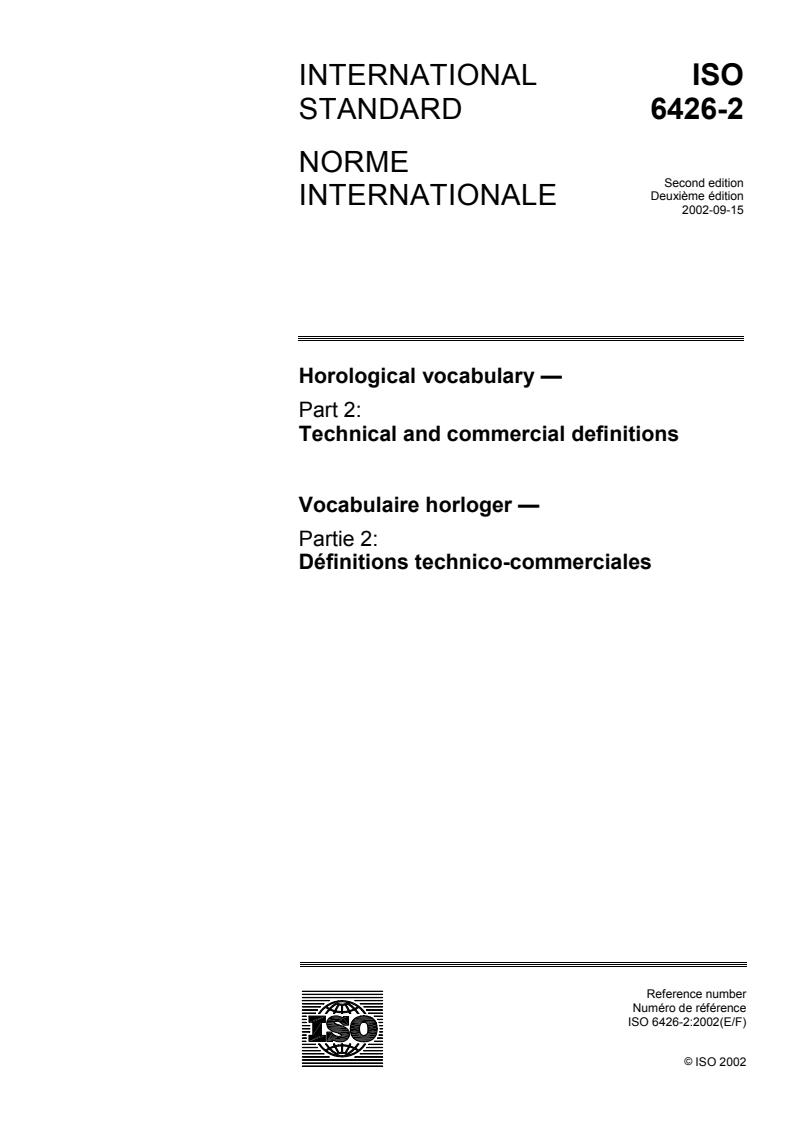
INTERNATIONAL ISO
STANDARD 6426-2
NORME
Second edition
Deuxième édition
INTERNATIONALE
2002-09-15
Horological vocabulary —
Part 2:
Technical and commercial definitions
Vocabulaire horloger —
Partie 2:
Définitions technico-commerciales
Reference number
Numéro de référence
©
ISO 2002
PDF disclaimer
This PDF file may contain embedded typefaces. In accordance with Adobe's licensing policy, this file may be printed or viewed but shall not
be edited unless the typefaces which are embedded are licensed to and installed on the computer performing the editing. In downloading this
file, parties accept therein the responsibility of not infringing Adobe's licensing policy. The ISO Central Secretariat accepts no liability in this
area.
Adobe is a trademark of Adobe Systems Incorporated.
Details of the software products used to create this PDF file can be found in the General Info relative to the file; the PDF-creation parameters
were optimized for printing. Every care has been taken to ensure that the file is suitable for use by ISO member bodies. In the unlikely event
that a problem relating to it is found, please inform the Central Secretariat at the address given below.
PDF – Exonération de responsabilité
Le présent fichier PDF peut contenir des polices de caractères intégrées. Conformément aux conditions de licence d'Adobe, ce fichier peut
être imprimé ou visualisé, mais ne doit pas être modifié à moins que l'ordinateur employé à cet effet ne bénéficie d'une licence autorisant
l'utilisation de ces polices et que celles-ci y soient installées. Lors du téléchargement de ce fichier, les parties concernées acceptent de fait la
responsabilité de ne pas enfreindre les conditions de licence d'Adobe. Le Secrétariat central de l'ISO décline toute responsabilité en la
matière.
Adobe est une marque déposée d'Adobe Systems Incorporated.
Les détails relatifs aux produits logiciels utilisés pour la création du présent fichier PDF sont disponibles dans la rubrique General Info du
fichier; les paramètres de création PDF ont été optimisés pour l'impression. Toutes les mesures ont été prises pour garantir l'exploitation de
ce fichier par les comités membres de l'ISO. Dans le cas peu probable où surviendrait un problème d'utilisation, veuillez en informer le
Secrétariat central à l'adresse donnée ci-dessous.
© ISO 2002
The reproduction of the terms and definitions contained in this International Standard is permitted in teaching manuals, instruction booklets,
technical publications and journals for strictly educational or implementation purposes. The conditions for such reproduction are: that no modifi-
cations are made to the terms and definitions; that such reproduction is not permitted for dictionaries or similar publications offered for sale; and
that this International Standard is referenced as the source document.
With the sole exceptions noted above, no other part of this publication may be reproduced or utilized in any form or by any means, electronic or
mechanical, including photocopying and microfilm, without permission in writing from either ISO at the address below or ISO's member body in
the country of the requester.
La reproduction des termes et des définitions contenus dans la présente Norme internationale est autorisée dans les manuels d'enseignement,
les modes d'emploi, les publications et revues techniques destinés exclusivement à l'enseignement ou à la mise en application. Les conditions
d'une telle reproduction sont les suivantes: aucune modification n'est apportée aux termes et définitions; la reproduction n'est pas autorisée
dans des dictionnaires ou publications similaires destinés à la vente; la présente Norme internationale est citée comme document source.
À la seule exception mentionnée ci-dessus, aucune partie de cette publication ne peut être reproduite ni utilisée sous quelque forme que ce soit
et par aucun procédé, électronique ou mécanique, y compris la photocopie et les microfilms, sans l'accord écrit de l'ISO à l'adresse ci-après ou
du comité membre de l'ISO dans le pays du demandeur.
ISO copyright office
Case postale 56 • CH-1211 Geneva 20
Tel. + 41 22 749 01 11
Fax + 41 22 749 09 47
E-mail copyright@iso.ch
Web www.iso.ch
Printed in Switzerland/Imprimé en Suisse
ii © ISO 2002 – All rights reserved/Tous droits réservés
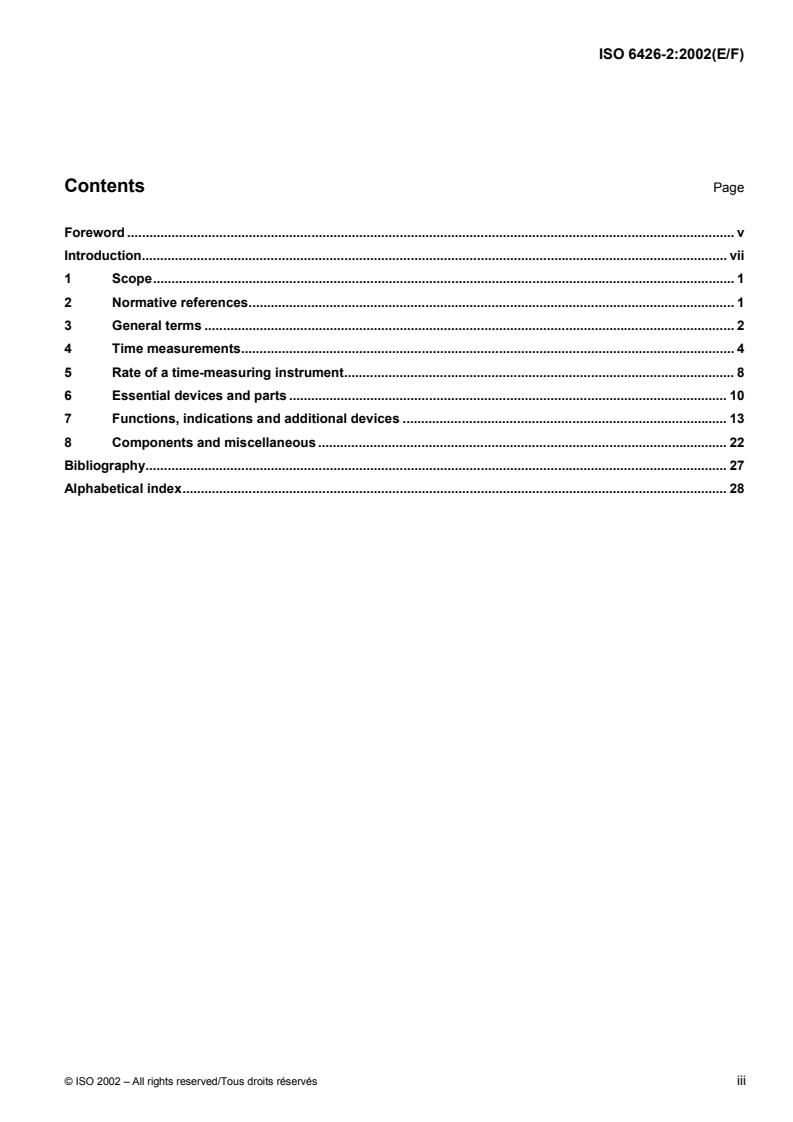
Contents Page
Foreword . v
Introduction. vii
1 Scope. 1
2 Normative references. 1
3 General terms . 2
4 Time measurements. 4
5 Rate of a time-measuring instrument. 8
6 Essential devices and parts . 10
7 Functions, indications and additional devices . 13
8 Components and miscellaneous . 22
Bibliography. 27
Alphabetical index. 28
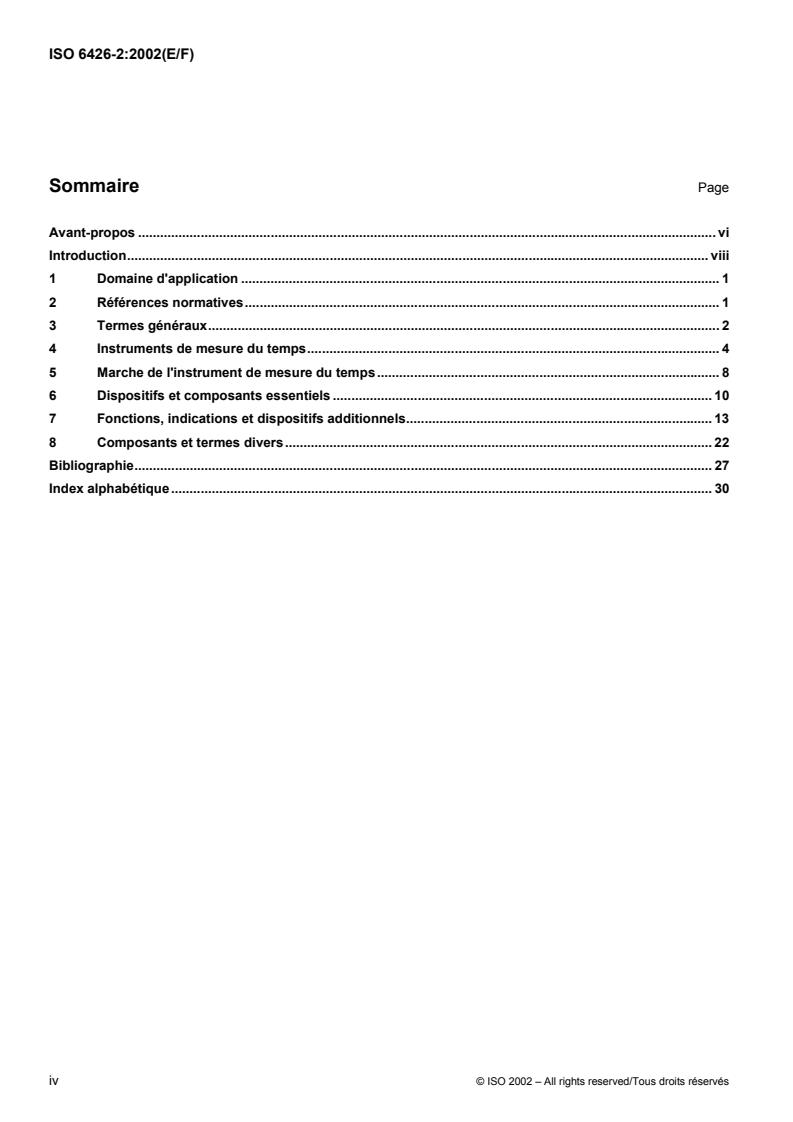
Sommaire Page
Avant-propos . vi
Introduction. viii
1 Domaine d'application . 1
2 Références normatives. 1
3 Termes généraux. 2
4 Instruments de mesure du temps. 4
5 Marche de l'instrument de mesure du temps. 8
6 Dispositifs et composants essentiels . 10
7 Fonctions, indications et dispositifs additionnels. 13
8 Composants et termes divers. 22
Bibliographie. 27
Index alphabétique. 30
iv © ISO 2002 – All rights reserved/Tous droits réservés
Foreword
ISO (the International Organization for Standardization) is a worldwide federation of national standards bodies (ISO
member bodies). The work of preparing International Standards is normally carried out through ISO technical
committees. Each member body interested in a subject for which a technical committee has been established has
the right to be represented on that committee. International organizations, governmental and non-governmental, in
liaison with ISO, also take part in the work. ISO collaborates closely with the International Electrotechnical
Commission (IEC) on all matters of electrotechnical standardization.
International Standards are drafted in accordance with the rules given in the ISO/IEC Directives, Part 3.
The main task of technical committees is to prepare International Standards. Draft International Standards adopted
by the technical committees are circulated to the member bodies for voting. Publication as an International
Standard requires approval by at least 75 % of the member bodies casting a vote.
Attention is drawn to the possibility that some of the elements of this part of ISO 6426 may be the subject of patent
rights. ISO shall not be held responsible for identifying any or all such patent rights.
ISO 6426-2 was prepared by Technical Committee ISO/TC 114, Horology, Subcommittee SC 9, Technical
definitions.
This second edition cancels and replaces the first edition (ISO 6426-2:1984), which has been technically revised.
ISO 6426 consists of the following parts, under the general title Horological vocabulary :
— Part 1: Technical and scientific definitions
— Part 2: Technical and commercial definitions
Avant-propos
L'ISO (Organisation internationale de normalisation) est une fédération mondiale d'organismes nationaux de
normalisation (comités membres de l'ISO). L'élaboration des Normes internationales est en général confiée aux
comités techniques de l'ISO. Chaque comité membre intéressé par une étude a le droit de faire partie du comité
technique créé à cet effet. Les organisations internationales, gouvernementales et non gouvernementales, en
liaison avec l'ISO participent également aux travaux. L'ISO collabore étroitement avec la Commission
électrotechnique internationale (CEI) en ce qui concerne la normalisation électrotechnique.
Les Normes internationales sont rédigées conformément aux règles données dans les Directives ISO/CEI,
Partie 3.
La tâche principale des comités techniques est d'élaborer les Normes internationales. Les projets de Normes
internationales adoptés par les comités techniques sont soumis aux comités membres pour vote. Leur publication
comme Normes internationales requiert l'approbation de 75 % au moins des comités membres votants.
L'attention est appelée sur le fait que certains des éléments de la présente Norme internationale peuvent faire
l'objet de droits de propriété intellectuelle ou de droits analogues. L'ISO ne saurait être tenue pour responsable de
ne pas avoir identifié de tels droits de propriété et averti de leur existence.
L'ISO 6426-2 a été élaborée par le comité technique ISO/TC 114, Horlogerie, sous-comité SC 9, Définitions
techniques.
Cette deuxième édition annule et remplace la première édition (ISO 6426-2:1984), qui a fait l'objet d'une révision
technique.
L'ISO 6426 comprend les parties suivantes, présentées sous le titre général Vocabulaire horloger :
— Partie 1: Définitions technico-scientifiques
— Partie 2: Définitions technico-commerciales
vi © ISO 2002 – All rights reserved/Tous droits réservés
Introduction
This part of ISO 6426 gives technical and commercial definitions; ISO 6426-1 gives technical and scientific
definitions, mainly relating to the rate of the time-measuring instrument.
The definitions given in this part of ISO 6426, intended more particularly for the general public, have been
simplified, especially with regard to clause 5 concerning the rate of a time-measuring instrument.
Where there is ambiguity, it is advisable to refer to the definitions of the corresponding terms in ISO 6426-1, which
are more detailed.
Some commons terms, the definitions of which do not give rise to any confusion and which occur in other
specialized documents, have not been included in this part of ISO 6426.
Introduction
La présente partie de l'ISO 6426 définit les termes technico-commerciaux, tandis que les définitions technico-
scientifiques, relatives principalement à la marche des instruments de mesure du temps, sont données dans
l'ISO 6426-1.
Les termes et définitions donnés dans la présente partie de l'ISO 6426, destinés plus particulièrement au grand
public, sont intentionnellement simplifiés, notamment en ce qui concerne l'article 5 relatif à la marche de l'instru-
ment de mesure du temps.
En cas d'ambiguïté, il convient de se reporter aux définitions des termes correspondants de l'ISO 6426-1, qui sont
plus détaillées.
Un certain nombre de termes usuels, dont les définitions ne prêtent pas à confusion et qui figurent dans d'autres
documents spécialisés, n'ont pas été repris dans la présente partie de l'ISO 6426.
viii © ISO 2002 – All rights reserved/Tous droits réservés
INTERNATIONAL STANDARD
NORME INTERNATIONALE
Horological vocabulary — Vocabulaire horloger —
Part 2: Partie 2:
Technical and commercial Définitions technico-
definitions commerciales
1 Scope 1 Domaine d'application
This part of ISO 6426 defines the principal technical La présente partie de l'ISO 6426 définit les principaux
and commercial terms used in the horological indus- termes technico-commerciaux utilisés dans l'industrie
try. horlogère.
The terms and definitions apply to time-measuring in- Les termes et définitions s'appliquent aux instruments
struments and related devices. de mesure du temps et aux dispositifs qui s'y rappor-
tent.
2 Normative references 2 Références normatives
The following normative documents contain provisions Les documents normatifs suivants contiennent des
which, through reference in this text, constitute provi- dispositions qui, par suite de la référence qui y est
sions of this part of ISO 6426. For dated references, faite, constituent des dispositions valables pour la
subsequent amendments to, or revisions of, any of présente partie de l'ISO 6426. Pour les références da-
these publications do not apply. However, parties to tées, les amendements ultérieurs ou les révisions de
agreements based on this part of ISO 6426 are en- ces publications ne s'appliquent pas. Toutefois, les
couraged to investigate the possibility of applying the parties prenantes aux accords fondés sur la présente
most recent editions of the normative documents indi- partie de l'ISO 6426 sont invitées à rechercher la pos-
cated below. For undated references, the latest edi- sibilité d'appliquer les éditions les plus récentes des
tion of the normative document referred to applies. documents normatifs indiqués ci-après. Pour les réfé-
Members of ISO and IEC maintain registers of cur- rences non datées, la dernière édition du document
rently valid International Standards. normatif en référence s'applique. Les membres de
l'ISO et de la CEI possèdent le registre des Normes
internationales en vigueur.
ISO 764:2002, Horology — Magnetic resistant ISO 764:2002, Horlogerie — Montres antimagnéti-
watches ques
ISO 1413:1984, Horology — Shock-resistant watches ISO 1413:1984, Horlogerie — Montres résistant aux
chocs
ISO 2281:1990, Horology — Water-resistant watches
ISO 2281:1990, Horlogerie — Montres étanches
ISO 3159:1976, Timekeeping instruments — Wrist-
chronometers with spring balance oscillator ISO 3159:1976, Instruments horaires — Chronomè-
tres-bracelets à oscillateur balancier-spiral
ISO 6425:1996, Divers' watches
ISO 6425:1996, Montres de plongée
3 General terms 3 Termes généraux
3.1 3.1
time temps
undefined medium in which existing objects appear to milieu indéfini où paraissent se dérouler irréversible-
develop irreversibly in the changes which they un- ment les exigences dans leur changement, les évé-
dergo, and in which events and phenomena appear to nements et les phénomènes dans leur succession
occur in their succession
NOTE À ce milieu correspond une grandeur, t, permet-
tant, dans une échelle de temps, le classement chronologi-
NOTE To this medium corresponds a quantity, t, allow-
que des événements.
ing, in a time scale, the chronological filing of events.
3.2 3.2
date date
notation of an instant in a time scale notation d'un instant dans une échelle de temps
NOTE In current use, this term stands for the indication NOTE Dans l'usage courant, ce terme recouvre l'indi-
of the year, month, day and day of the month. cation de l'année, du mois, du jour et du quantième.
3.3 3.3
duration durée
time which elapses between two determined dates temps qui s'écoule entre deux dates déterminées
3.4 3.4
period période
duration characterized by a repetitive phenomenon durée marquée par un certain phénomène à caractère
répétitif
3.5 3.5
frequency fréquence
number of periods per second nombre de périodes par seconde
NOTE Frequency is expressed in hertz (Hz), e.g. NOTE La fréquence s'exprime en hertz (Hz) (exem-
32,768 kHz = 32 768 Hz, 8 MHz = 8 000 000 Hz. For pendu- ples: 32,768 kHz = 32 768 Hz; 8 MHz = 8 000 000 Hz). Pour
lum and spring balance oscillators, the number of alternations le pendule et l'oscillateur balancier-spiral, on peut indiquer
per hour can be given, e.g. 2,5 Hz = 18 000 alternations per le nombre d'alternances par heure (exemple: 2,5 Hz =
hour. 18 000 alternances par heure).
3.6 3.6
alternation alternance
displacement of an oscillating body between two ex- déplacement, entre deux positions extrêmes, d'un or-
treme positions gane oscillant
NOTE 1 This concept also applies to the representation NOTE 1 Cette notion s'applique également à la repré-
of any periodic phenomenon. sentation d'un phénomène périodique quelconque.
NOTE 2 The beating frequency of a balance wheel is NOTE 2 La fréquence du battement du balancier se
currently given in “alternations per hour”. For an oscillator of donne couramment en «alternances par heure». Pour un
2,5 Hz (beating every fifth of a second), five alternations per oscillateur de 2,5 Hz (battant le cinquième de seconde),
second correspond to 18 000 alternations per hour. cinq alternances par seconde correspondent à 18 000 alter-
nances par heure.
3.7 3.7
oscillation oscillation
complete cycle of a periodic phenomenon (twice an cycle complet d'un phénomène périodique (double
alternation) d'une alternance)
2 © ISO 2002 – All rights reserved/Tous droits réservés
3.8 3.8
amplitude amplitude
value of the displacement, angular or linear, between valeur du déplacement, angulaire ou linéaire, entre la
the rest position and an extreme position of an oscil- position de repos et la position extrême de l'organe
lating part oscillant
NOTE This concept also applies to the representation NOTE Cette notion s'applique également à la repré-
of any periodic phenomenon. sentation d'un phénomène périodique quelconque.
3.9 3.9
isochronism isochronisme
aptitude possessed by a phenomenon to reproduce aptitude que possède un phénomène à se reproduire
itself in equal periods of time whatever the external dans des temps égaux, quelles que soient les influen-
influences ces extérieures
EXAMPLE Period of an oscillation independent of its EXEMPLE Période d'une oscillation indépendante de
amplitude. son amplitude.
3.10 3.10
thermal compensation compensation thermique
device intended to compensate the effect of tempera- dispositif destiné à compenser les effets des varia-
ture variation on the chronometric characteristics of a tions de température sur les caractéristiques chrono-
time-measuring instrument métriques d'un instrument de mesure du temps
3.11 3.11
automatic automatique
functioning by itself qui fonctionne de soi-même
NOTE This term used for mechanical time-measuring NOTE Ce terme s'emploie pour qualifier les instru-
instruments which operate without the need for manual re- ments de mesure du temps mécaniques qui fonctionnent
winding. Also used as a noun: an “automatic” (for an “auto- sans remontage manuel. S'emploie aussi comme substantif:
matic watch”). une «automatique» (pour une «montre automatique»).
3.12 3.12
movement fitting encageage du mouvement
lateral dimensions of the plate serving as a reference dimensions latérales de la platine servant de réfé-
for the assembly with the case of the time-measuring rence pour l'assemblage avec la boîte de l'instrument
instrument de mesure du temps
NOTE On traditional ebauches, these dimensions are NOTE Dans les ébauches traditionnelles, ces dimen-
generally smaller than the largest dimension of the move- sions sont généralement inférieures à la grande dimension
ment. du mouvement.
3.13 3.13
ligne ligne
line ancienne unité de longueur utilisée commercialement
old unit of length used commercially to designate ap- pour désigner approximativement la dimension des
proximately the dimensions of a movement mouvements
NOTE One line is equal to 2,256 mm. NOTE Une ligne est égale à 2,256 mm.
3.14 3.14
regulation réglage
operation permitting improvement of the accuracy of a opération permettant d'améliorer l'exactitude d'un ins-
time-measuring instrument trument de mesure du temps
3.15 3.15
consumption consommation
electrical current generally required in normal use for dans les instruments de mesure du temps, générale-
time-measuring instruments ment, intensité de courant électrique utilisé en fonc-
tionnement normal
NOTE For watches, the consumption is most often ex-
pressed in microamperes.
NOTE Pour les montres, la consommation est donnée
le plus souvent en microampères.
3.16 3.16
power reserve réserve de marche
duration for which a time-measuring instrument can durée de fonctionnement d'un instrument de mesure
operate on its own power reserves without further ex- du temps sur ses propres réserves d'énergie, sans
ternal power apport extérieur
3.17 3.17
autonomy autonomie
ability of a time-measuring instrument to function on aptitude d'un instrument de mesure du temps à fonc-
its own reserves, with any external energy supplied to tionner sur ses propres réserves, compte tenu d'un
it by its normal environment but independently of any éventuel apport extérieur d'énergie par son environ-
conscious intervention on the part of the user nement usuel, mais indépendamment de toute inter-
vention consciente de l'utilisateur
NOTE This term is also used to designate the duration
for which this ability is maintained.
NOTE Ce terme désigne aussi la durée pendant la-
quelle cette aptitude est conservée.
3.18 3.18
water-resistance étanchéité
ability of a time-measuring instrument to resist water aptitude d'un instrument de mesure du temps à résis-
penetration, as specified in ISO 2281 ter à la pénétration de l'eau, dans les conditions défi-
nies dans l'ISO 2281
3.19 3.19
antimagnetism antimagnétisme
ability of a time-measuring instrument to withstand a aptitude d'un instrument de mesure du temps à sup-
magnetic field, as specified in ISO 764 porter un champ magnétique, dans les conditions dé-
finies dans l'ISO 764
3.20 3.20
practical battery life autonomie pratique
life of a timekeeping instrument without a new energy période de fonctionnement réel d'un instrument ho-
supply raire sans nouvel apport d'énergie
3.21 3.21
theoretical running time autonomie théorique
estimate of the duration of running of a timekeeping estimation d'une période de fonctionnement d'un ins-
instrument resulting from a calculation that does not trument horaire résultant d'un calcul qui ne tient pas
include factors that influence its working compte de facteurs influant sur le fonctionnement
4 Time measurements 4 Instruments de mesure du temps
The definitions in this clause relate, on the one hand, Les définitions du présent article concernent, d'une
to different products or designations resulting from part, des produits distincts ou des appellations nées
their main function and, on the other, to particular de leur vocation fondamentale et, d'autre part, des ca-
characteristics associated with the nature of certain ractéristiques liées à la nature de certaines parties
constituent parts or a recognized name. constitutives ou d'un label reconnu.
4 © ISO 2002 – All rights reserved/Tous droits réservés
4.1 4.1
time-measuring instrument instrument de mesure de temps
instrument indicating the time of day or measuring instrument indiquant l'heure ou mesurant la durée,
duration, separately or simultaneously séparément ou simultanément
4.2 4.2
timekeeping instrument instrument horaire
time-measuring instrument, indicating the time of day instrument de mesure du temps indiquant l'heure
4.3 4.3
time counter compteur de temps
time-measuring instrument, measuring durations instrument de mesure du temps mesurant des durées
NOTE It does not indicate the time of day (see 4.9). NOTE Il n'indique pas l'heure (voir 4.9).
4.4 4.4
programmable time counter programmateur
time-measuring instrument fitted with one or more de- instrument de mesure du temps muni d'un ou de plu-
vices permitting control of operations at predeter- sieurs dispositifs permettant la commande d'opéra-
mined intervals of time tions à des intervalles de temps prédéterminés
4.5 4.5
programmable timekeeping instrument programmateur horaire
programmable time counter which incorporates the programmateur incluant les fonctions d'un instrument
functions of a timekeeping instrument horaire
4.6 4.6
watch montre
timekeeping instrument designed to be worn and to instrument horaire conçu pour être porté et pour fonc-
function in all positions tionner dans toutes les positions
4.7 4.7
chronometer chronomètre
official name given to a precision timekeeping instru- label donné à un instrument horaire de précision réglé
ment regulated for various conditions of use specified, pour diverses conditions d'emploi définies, par exem-
for example, in ISO 3159 for mechanical wrist- ple, dans l'ISO 3159 pour le chronomètre-bracelet
chronometers mécanique
NOTE Conformity with the definition of chronometer is NOTE La conformité à la définition du chronomètre est
approved by an impartial official body which carries out the homologuée par une instance officielle neutre qui procède
inspection on the timekeeping instrument or, if necessary, au contrôle, sur l'instrument horaire ou, au besoin, sur le
on the movement, and grants an individual official attesta- mouvement, et qui délivre une attestation officielle indivi-
tion (rating certificate). duelle (bulletin de marche).
4.8 4.8
chronograph chronographe
timekeeping instrument comprising a time counter al- instrument horaire comportant un compteur de temps
lowing measurement and display of time intervals in- permettant de mesurer et d'afficher des intervalles de
dependently of keeping and, possibly, indicating the temps indépendamment de la conservation et, éven-
time of day tuellement, de l'indication de l'heure
NOTE It can also incorporate a recording device. NOTE Il peut également comporter un dispositif d'en-
registrement.
4.9 4.9
stopwatch .
portable time counter compteur de temps portatif
4.10 4.10
..... montre stop
watch allowing measurement of durations montre permettant la mesure des durées
NOTE When this measurement is carried out, there NOTE Lorsque cette mesure est effectuée, il peut y
may be partial or total loss of display of the time of day until avoir perte partielle ou totale de l'affichage de l'heure jus-
a reset occurs. qu'à une nouvelle mise à l'heure.
4.11 4.11
clock horloge
timekeeping instrument designed to operate in a fixed pendule
position pendulette
régulateur
instrument horaire conçu pour fonctionner dans une
position fixe
4.12 4.12
mechanical timekeeping instrument instrument horaire mécanique
timekeeping instrument of which the following main instrument horaire dont les composants essentiels
components are exclusively mechanical: driving en- suivants sont exclusivement mécaniques: énergie mo-
ergy, oscillating device and its maintenance, time dis- trice, résonateur et son entretien, affichage de l'heure
play
4.13 4.13
electric timekeeping instrument instrument horaire électrique
[electromechanical] [électromécanique]
timekeeping instrument having a source of electrical instrument horaire comprenant une source d'énergie
energy and a system for electromechanical mainte- électrique et un système d'entretien électromécanique
nance of the oscillating device (having a mechanical du résonateur (comportant un contacteur mécanique,
contactor, that is, complete absence of any electronic c'est-à-dire excluant toute commande électronique du
control of the oscillating device) résonateur)
4.14 4.14
1) 1)
electronic timekeeping instrument instrument horaire électronique
timekeeping instrument having a source of electrical instrument horaire comprenant une source d'énergie
energy and essentially an oscillating device main- électrique, essentiellement un résonateur entretenu
tained by electronic control par commande électronique
4.15 4.15
1) 1)
solid state timekeeping instrument instrument horaire tout électronique
electronic timekeeping instrument having no func- instrument horaire électronique ne comportant aucun
tional mechanical component, not even in its display composant mécanique fonctionnel, même au niveau
de l'affichage
NOTE However, adjusting systems such as display
control, resetting, etc., may be mechanical.
NOTE Toutefois, les systèmes de manœuvre tels que
commande d'affichage, remise à l'heure, etc., peuvent être
mécaniques.
4.16 4.16
spring balance timekeeping instrument instrument horaire à balancier-spiral
timekeeping instrument whose time base comprises a instrument horaire dont la base de temps comporte un
spring balance oscillating device résonateur à balancier-spiral
1) As regards the marking of timekeeping instruments and 1) Pour le marquage des instruments horaires et dans la
commercial advertising, the use of expressions “quartz”, publicité commerciale, l'emploi des expressions «à quartz»,
“tuning fork”, “electronic”, “solid state”, etc. are to exactly «à diapason», «tout électronique», etc., devrait répondre
comply with the corresponding definitions. exactement aux définitions correspondantes.
6 © ISO 2002 – All rights reserved/Tous droits réservés
4.17 4.17
1) 1)
quartz timekeeping instrument instrument horaire à quartz
timekeeping instrument whose time base comprises a instrument horaire dont la base de temps comporte un
quartz oscillating device résonateur à quartz
4.18 4.18
1) 1)
tuning fork timekeeping instrument instrument horaire à diapason
timekeeping instrument whose time base comprises a instrument horaire dont la base de temps comporte un
metal tuning fork oscillating device maintained elec- résonateur à diapason métallique entretenu électro-
tromagnetically magnétiquement
4.19 4.19
skeleton watch montre squelette
watch in which it is possible to observe the movement montre dont l'habillage permet d'observer par transpa-
through a transparent exterior, the movement having rence le mouvement, ce dernier comportant des par-
hollowed parts allowing the mechanism to be viewed ties ajourées laissant apparaître les mécanismes
4.20 4.20
tourbillon watch montre à tourbillon
watch including a turning cage which carries all the montre comportant une cage tournante qui porte tous
parts of the escapement and, in its centre, the regu- les organes de l'échappement et, en son centre, l'or-
lator element (balance with hair spring) gane régulateur (balancier-spiral)
NOTE The escapement pinion is carried around the NOTE Le pignon d'échappement tourne autour de la
fixed fourth wheel, which in this case is the seconds wheel. roue des secondes qui est fixe. La cage fait généralement
The cage generally turns one revolution per minute and it un tour par minute et elle minimise en tournant les écarts de
minimizes the vertical positional timing errors whilst it turns. marche dans les positions verticales.
4.21 4.21
carrousel watch montre à carrousel
watch including a device similar to a tourbillon but in montre comprenant un dispositif similaire au tourbil-
which the cage is driven by the third wheel lon, mais dont la cage est commandée par la roue de
moyenne
4.22 4.22
non-water-resistant non étanche
term used to indicate a watch in which the casing terme utilisé pour désigner une montre dont la
construction does not allow its use in water conception de l'habillage ne permet pas une utilisation
dans l'eau
NOTE It does not fulfil the test criteria specified in
ISO 2281.
NOTE Elle ne répond pas aux critères d'essai définis
par l'ISO 2281.
4.23 4.23
shock-resistant watch montre antichoc
watch that is able to resist mechanical shock in ac- montre apte à résister à un choc mécanique confor-
cordance with ISO 1413 mément à l'ISO 1413
4.24 4.24
diver's watch montre de plongée
watch with a casing designed for diving in water meet- montre avec un habillage conçu pour la pratique de la
ing the requirements of the test method defined in plongée sous-marine, satisfaisant à la méthode d'es-
ISO 6425 sai définie par l'ISO 6425.
4.25 4.25
diver's watch for mixed gas diving montre de plongée avec un mélange de gaz
watch required to be resistant during diving in water to montre-bracelet devant résister à une plongée dans
a depth of at least 100 m and to be unaffected by the l'eau à une profondeur d'au moins 100 m et ne devant
overpressure of the mixed gas used for breathing pas être influencée par la surpression du mélange
gazeux utilisé pour la respiration
[ISO 6425:1996, annex A]
[ISO 6425:1996, annexe A]
4.26 4.26
timekeeping instrument with small seconds instrument horaire à petite aiguille
hand des secondes
timekeeping instrument having a seconds hand offset instrument horaire équipé d'une aiguille des secondes
from the hour and minute axis séparée de l'axe des heures et des minutes
4.27 4.27
digital quartz timekeeping instrument instrument horaire numérique à quartz
timekeeping instrument having a quartz time base in instrument horaire équipé d'une base de temps à
which the display is digital quartz dont l'affichage est assuré de façon numérique
4.28 4.28
analogue quartz timekeeping instrument instrument horaire analogique à quartz
timekeeping instrument having a quartz time base in instrument horaire équipé d'une base de temps à
which the display is by a dial and hands quartz dont l'affichage est assuré par des aiguilles
4.29 4.29
multifunction timekeeping instrument instrument horaire multifonction
timekeeping instrument having other functions in addi- instrument horaire équipé de fonctions complémen-
tion to those indicating hour, minute, second, date and taires à celles indiquant les heures, les minutes, les
day secondes, la date et le jour
4.30 4.30
solar cell timekeeping instrument instrument horaire à cellule solaire
timekeeping instrument that utilizes light energy as a instrument horaire qui utilise l'énergie lumineuse
source of electrical power comme source d'énergie électrique
4.31 4.31
analogue and digital quartz timekeeping instrument horaire analogique
instrument et numérique à quartz
quartz based timekeeping instrument having a combi- instrument horaire possédant une base de temps
nation of analogue (hands) and digital (numerals) dis- à quartz et combinant un affichage analogique (ai-
plays guilles) et un affichage numérique (chiffres)
5 Rate of a time-measuring instrument 5 Marche de l'instrument de mesure
du temps
5.1 5.1
state état
difference, at a precise instant, between the time of différence, à un instant précis, entre l'heure indiquée
day indicated by a timekeeping instrument and the par un instrument horaire et l'heure de référence
reference time
NOTE L'état est positif ou négatif, suivant que l'instru-
ment horaire est en avance ou en retard par rapport à cette
NOTE The state is positive or negative according to
heure de référence.
whether the timekeeping instrument is running fast or slow
in comparison with the reference time.
8 © ISO 2002 – All rights reserved/Tous droits réservés
5.2 5.2
rate marche
expression of the difference, per unit of time, between expression de la différence, par unité de temps, entre
two states of a timekeeping instrument, separated by deux états d'un instrument horaire, séparés par un in-
a given interval of time (duration) tervalle de temps (durée) donné
NOTE If it is positive, the instrument is fast and vice NOTE Si la marche est positive, l'instrument avance,
versa. et inversement.
5.3 5.3
daily rate marche diurne
expression of the difference between two states sepa- expression de la différence entre deux états séparés
rated by a time interval of 24 h par un intervalle de temps de 24 h
EXAMPLE ± 1 s per day. EXEMPLE ± 1 s par jour.
5.4 5.4
monthly rate marche mensuelle
expression of the difference between two states sepa- expression de la différence entre deux états séparés
rated by a time interval of one month par un intervalle de temps de 1 mois
EXAMPLE ± 20 s per month. EXEMPLE ± 20 s par mois.
5.5 5.5
annual rate marche annuelle
expression of the difference between two states sepa- expression de la différence entre deux états séparés
rated by a time interval of one year par un intervalle de temps de 1 an
EXAMPLE ± 2 min per year. EXAMPLE ± 2 min par an.
5.6 5.6
instantaneous rate marche instantanée
expression of the difference between two states sepa- expression de la différence entre deux états séparés
rated by a very short interval of time par un intervalle de temps très court
NOTE It is generally expressed in seconds per day be- NOTE Elle est généralement exprimée en secondes
cause, in practice, extrapolation makes it correspond to the par jour car, dans la pratique, son extrapolation la fait
probable daily rate. correspondre à la marche diurne probable.
5.7 5.7
probable rate marche probable
formulation of the value of the rate which a time- formulation de la valeur de la marche que l'instrument
measuring instrument would probably have if it were de mesure du temps aurait probablement s'il était pla-
placed or used in specified conditions similar to the cé ou utilisé dans des conditions définies et apparen-
conditions of use for which the instrument is intended tées à celles de l'usage prévu
NOTE It may be related, for example, to a duration of: NOTE Elle peut être liée, par exemple, à une durée:
24 h (probable daily rate); de 24 h (marche diurne probable);
one month (probable monthly rate); de 1 mois (marche mensuelle probable);
one year (probable annual rate). de 1 an (marche annuelle probable).
5.8 5.8
variation of daily rate variation de marche diurne
difference between two daily rates separated by a différence entre deux marches diurnes relevées à un
specified time interval intervalle de temps déterminé
NOTE Generally, two consecutive daily rates are con- NOTE Généralement, deux marches diurnes consécu-
sidered, in which case this variation is the daily variation of tives sont prises en considération; dans ce cas, il s'agit de
daily rate. la variation diurne de marche diurne.
5.9 5.9
deviation déviation
progressive and natural change in the rate as a func- changement progressif et naturel de la marche en
tion of time fonction du temps
NOTE If the rate of an instrument increases, the devia- NOTE Si la marche de l'instrument croît, la déviation
tion is positive and vice versa. est positive, et inversement.
5.10 5.10
drift dérive
mean value of the deviation during a specified interval valeur moyenne de la déviation pendant un intervalle
of time de temps précisé
5.11 5.11
chronometric stability stabilité chronométrique
ability of a time-measuring instrument to maintain its aptitude d'un instrument de mesure du temps à
rate within certain fixed limits conserver sa marche au cours du temps, dans certai-
nes limites fixées
5.12 5.12
mode mode
working state which the multifunction timekeeping in- état de fonctionnement dans lequel se trouve l'instru-
strument is in ment horaire multifonction
EXAMPLES Alarm mode, chronograph mode. EXEMPLES Mode réveil, mode alarme, mode chrono-
graphe.
6 Essential devices and parts 6 Dispositifs et composants essentiels
6.1 Power supply 6.1 Alimentation
6.1.1 6.1.1
power supply device dispositif d'alimentation en énergie
device supplying the energy necessary for the opera- dispositif fournissant l'énergie nécessaire au fonction-
tion of a time-measuring instrument nement d'un instrument de mesure du temps
NOTE This energy may be mechanical, electrical, lu- NOTE Cette énergie peut être mécanique, électrique,
minous, thermal or other. lumineuse, thermique ou autre.
6.2 Time base 6.2 Base de temps
6.2.1 6.2.1
time base base de temps
device having the function of determining equal inter- dispositif dont la fonction est de déterminer des inter-
vals of time valles de temps égaux
6.2.2 6.2.2
resonator résonateur
oscillating device with a sufficiently stable period to dispositif oscillant dont la période suffisamment stable
permit its use as a time base in time-measuring in- permet l'utilisation, comme base de temps, dans les
struments instruments de mesure du temps
EXAMPLES Mass-gravity: pendulum, etc.; inertia- EXEMPLES Masse-gravité: pendule, etc.; inertie-
elasticity: spring balance system, vibrating blade, tuning élasticité: système balancier-spiral, lame vibrante, diapason,
fork, flexural mode quartz, lenticular quartz, lithium tanta- quartz de flexion, quartz lenticulaire, tantalate de lithium,
late, etc.; atomic or molecular resonator: caesium, maser, etc.; résonateur atomique ou moléculaire: césium, maser,
etc.; optical: laser, etc. etc.; optique: laser, etc.
10 © ISO 2002 – All rights reserved/Tous droits réservés
NOTE Associated with a maintaining part, a resonator NOTE Associé à un organe d'entretien, le résonateur
constitutes an oscillator. constitue un oscillateur.
6.2.3 6.2.3
oscillator oscillateur
device (comprising or not a resonator) supplying a dispositif (comprenant ou non un résonateur) délivrant
sufficiently stable frequency (or period) une fréquence (ou une période) suffisamment stable
6.3 Display 6.3 Affichage
6.3.1 6.3.1
display affichage
indicating device
...