


ISO 5053-1:2015
(Main)Industrial trucks — Terminology and classification — Part 1: Types of industrial trucks
Industrial trucks — Terminology and classification — Part 1: Types of industrial trucks
ISO 5053-1:2015 establishes the terminology and classification of industrial trucks: wheeled vehicles having at least three wheels with a powered or non-powered driving mechanism ? except those running on rails ? which are designed either to carry, tow, push, lift, stack or tier in racks any kind of load, and which are controlled either by an operator or by driverless automation. In addition to terms used in English and French, ISO 5053-1:2015 gives the equivalent terms in German, Chinese, and Italian.
Chariots de manutention — Terminologie et classification — Partie 1: Types de chariots de manutention
ISO 5053-1:2015 établit la terminologie et la classification des chariots de manutention. Pour les besoins de la présente Norme internationale, les chariots de manutention sont des véhicules à roues ayant au moins trois roues avec un mécanisme d'entraînement motorisé ou non ? excepté les véhicules fonctionnant sur des rails ? qui sont conçus soit pour porter, tirer, pousser, lever, empiler ou disposer dans les rayons tout type de charge et qui sont commandés soit par un opérateur, soit par un automate sans conducteur. NOTE En complément des termes utilisés en anglais et en français, deux des trois langues officielles de l'ISO, cette Norme internationale donne les termes équivalents en allemand, chinois et italien; celles-ci sont publiées sous la responsabilité des comités membres de l'Allemagne (DIN), de la Chine (SAC) et de l'Italie (UNI). Toutefois, seuls les termes et les définitions donnés dans les langues officielles peuvent être considérés comme des termes et définitions ISO.
General Information
- Status
- Withdrawn
- Publication Date
- 15-Oct-2015
- Withdrawal Date
- 15-Oct-2015
- Technical Committee
- ISO/TC 110/SC 1 - General terminology
- Drafting Committee
- ISO/TC 110/SC 1 - General terminology
- Current Stage
- 9599 - Withdrawal of International Standard
- Start Date
- 04-Jun-2020
- Completion Date
- 14-Feb-2026
Relations
- Effective Date
- 09-Feb-2026
- Effective Date
- 09-Feb-2026
- Effective Date
- 09-Feb-2026
- Effective Date
- 09-Feb-2026
- Effective Date
- 09-Feb-2026
- Effective Date
- 09-Feb-2026
- Referred By
EN 16796-1:2016 - Energy efficiency of Industrial trucks - Test methods - Part 1: General - Effective Date
- 09-Feb-2026
- Effective Date
- 09-Feb-2026
- Effective Date
- 09-Feb-2026
- Effective Date
- 09-Feb-2026
- Effective Date
- 09-Feb-2026
- Effective Date
- 09-Feb-2026
- Effective Date
- 09-Feb-2026
- Effective Date
- 09-Feb-2026
- Effective Date
- 09-Feb-2026
Frequently Asked Questions
ISO 5053-1:2015 is a standard published by the International Organization for Standardization (ISO). Its full title is "Industrial trucks — Terminology and classification — Part 1: Types of industrial trucks". This standard covers: ISO 5053-1:2015 establishes the terminology and classification of industrial trucks: wheeled vehicles having at least three wheels with a powered or non-powered driving mechanism ? except those running on rails ? which are designed either to carry, tow, push, lift, stack or tier in racks any kind of load, and which are controlled either by an operator or by driverless automation. In addition to terms used in English and French, ISO 5053-1:2015 gives the equivalent terms in German, Chinese, and Italian.
ISO 5053-1:2015 establishes the terminology and classification of industrial trucks: wheeled vehicles having at least three wheels with a powered or non-powered driving mechanism ? except those running on rails ? which are designed either to carry, tow, push, lift, stack or tier in racks any kind of load, and which are controlled either by an operator or by driverless automation. In addition to terms used in English and French, ISO 5053-1:2015 gives the equivalent terms in German, Chinese, and Italian.
ISO 5053-1:2015 is classified under the following ICS (International Classification for Standards) categories: 01.040.53 - Materials handling equipment (Vocabularies); 53.060 - Industrial trucks. The ICS classification helps identify the subject area and facilitates finding related standards.
ISO 5053-1:2015 has the following relationships with other standards: It is inter standard links to EN 16842-6:2018, EN 16842-9:2019, EN ISO 3691-4:2020, EN 1459-2:2015+A1:2018, EN 16796-4:2019, EN 16842-7:2018, EN 16796-1:2016, EN 1459-1:2017, CEN/TS 1459-8:2018, EN 1459-1:2017+A1:2020, EN 12895:2015+A1:2019, EN ISO 3691-2:2016, EN 1459-2:2015, EN 16842-4:2019, EN 17314:2020. Understanding these relationships helps ensure you are using the most current and applicable version of the standard.
ISO 5053-1:2015 is available in PDF format for immediate download after purchase. The document can be added to your cart and obtained through the secure checkout process. Digital delivery ensures instant access to the complete standard document.
Standards Content (Sample)
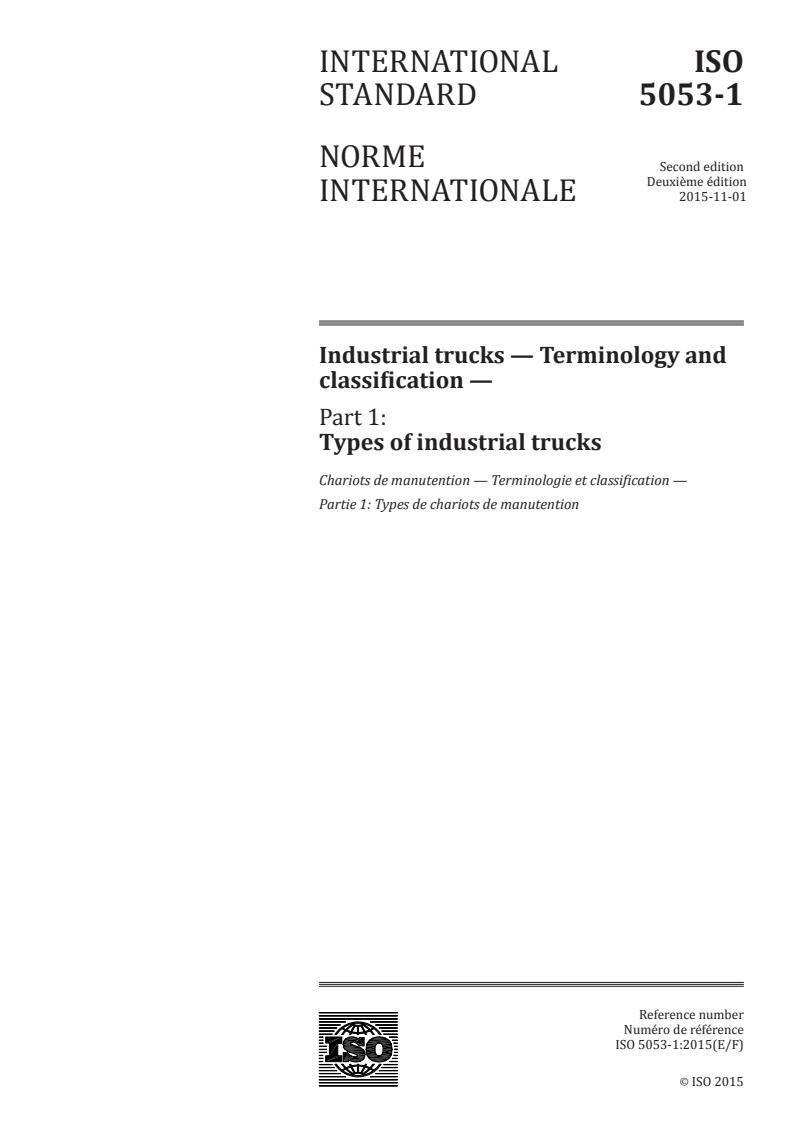
INTERNATIONAL ISO
STANDARD 5053-1
NORME
Second edition
Deuxième édition
INTERNATIONALE 2015-11-01
Industrial trucks — Terminology and
classification —
Part 1:
Types of industrial trucks
Chariots de manutention — Terminologie et classification —
Partie 1: Types de chariots de manutention
Reference number
Numéro de référence
©
ISO 2015
DOCUMENT PROTÉGÉ PAR COPYRIGHT
© ISO 2015
All rights reserved. Unless otherwise specified, no part of this publication may be reproduced or utilized otherwise in any form
or by any means, electronic or mechanical, including photocopying, or posting on the internet or an intranet, without prior
written permission. Permission can be requested from either ISO at the address below or ISO’s member body in the country of
the requester.
Droits de reproduction réservés. Sauf indication contraire, aucune partie de cette publication ne peut être reproduite ni utilisée
sous quelque forme que ce soit et par aucun procédé, électronique ou mécanique, y compris la photocopie, l’affichage sur
l’internet ou sur un Intranet, sans autorisation écrite préalable. Les demandes d’autorisation peuvent être adressées à l’ISO à
l’adresse ci-après ou au comité membre de l’ISO dans le pays du demandeur.
ISO copyright office
Ch. de Blandonnet 8 • CP 401
CH-1214 Vernier, Geneva, Switzerland
Tel. +41 22 749 01 11
Fax +41 22 749 09 47
copyright@iso.org
www.iso.org
Published in Switzerland/Publié en Suisse
iiii © ISO 2015 – All rig© ISO 2015 – All rights rhts reserveserved/Ted/Tous drous droits roits réservéservésés
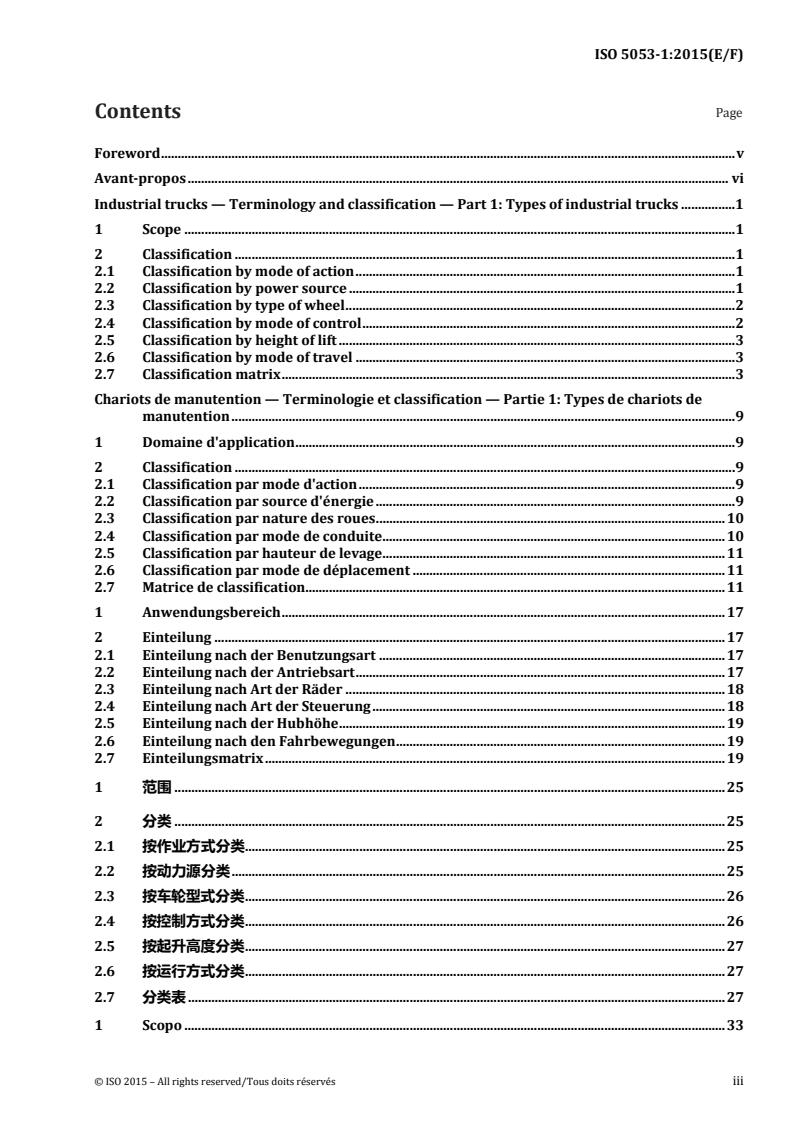
Page
Contents
Foreword . v
Avant-propos . vi
Industrial trucks — Terminology and classification — Part 1: Types of industrial trucks . 1
1 Scope . 1
2 Classification . 1
2.1 Classification by mode of action . 1
2.2 Classification by power source . 1
2.3 Classification by type of wheel . 2
2.4 Classification by mode of control . 2
2.5 Classification by height of lift . 3
2.6 Classification by mode of travel . 3
2.7 Classification matrix . 3
Chariots de manutention — Terminologie et classification — Partie 1: Types de chariots de
manutention . 9
1 Domaine d'application . 9
2 Classification . 9
2.1 Classification par mode d'action . 9
2.2 Classification par source d'énergie . 9
2.3 Classification par nature des roues . 10
2.4 Classification par mode de conduite . 10
2.5 Classification par hauteur de levage . 11
2.6 Classification par mode de déplacement . 11
2.7 Matrice de classificati on . 11
1 Anwendungsbereich . 17
2 Einteilung . 17
2.1 Einteilung nach der Benutzungsart . 17
2.2 Einteilung nach der Antriebsart . 17
2.3 Einteilung nach Art der Räder . 18
2.4 Einteilung nach Art der Steuerung . 18
2.5 Einteilung nach der Hubhöhe . 19
2.6 Einteilung nach den Fahrbewegungen . 19
2.7 Einteilungsmatrix . 19
1 范围 . 25
2 分类 . 25
2.1 按作业方式分类 . 25
2.2 按动力源分类 . 25
2.3 按车轮型式分类 . 26
2.4 按控制方式分类 . 26
2.5 按起升高度分类 . 27
2.6 按运行方式分类 . 27
2.7 分类表 . 27
1 Scopo . 33
© ISO 2015 – All rights reserved/Tous doits réservés iii
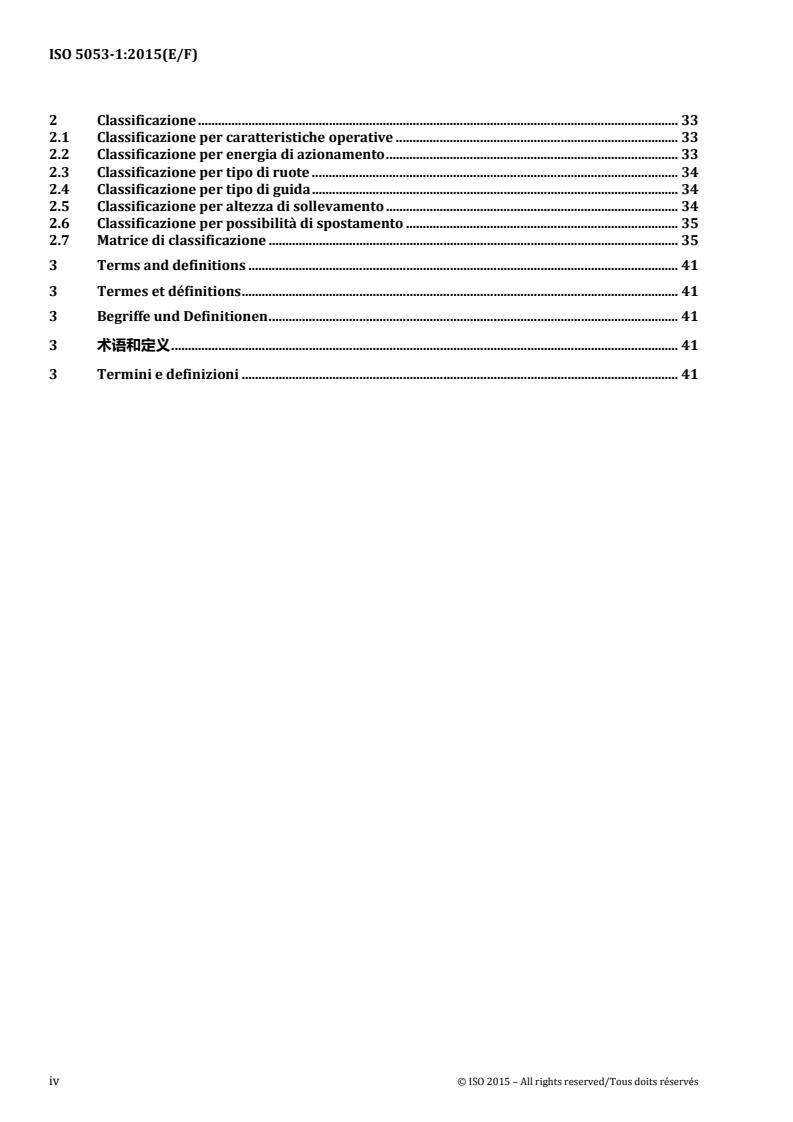
2 Classificazione . 33
2.1 Classificazione per caratteristiche operative . 33
2.2 Classificazione per energia di azionamento . 33
2.3 Classificazione per tipo di ruote . 34
2.4 Classificazione per tipo di guida . 34
2.5 Classificazione per altezza di sollevamento . 34
2.6 Classificazione per possibilità di spostamento . 35
2.7 Matrice di classificazione . 35
3 Terms and definitions . 41
3 Termes et définitions . 41
3 Begriffe und Definitionen . 41
3 术语和定义 . 41
3 Termini e definizioni . 41
iv © ISO 2015 – All rights reserved/Tous doits réservés
Foreword
ISO (the International Organization for Standardization) is a worldwide federation of national
standards bodies (ISO member bodies). The work of preparing International Standards is normally
carried out through ISO technical committees. Each member body interested in a subject for which a
technical committee has been established has the right to be represented on that committee.
International organizations, governmental and non‐governmental, in liaison with ISO, also take part in
the work. ISO collaborates closely with the International Electrotechnical Commission (IEC) on all
matters of electrotechnical standardization.
The procedures used to develop this document and those intended for its further maintenance are
described in the ISO/IEC Directives, Part 1. In particular the different approval criteria needed for the
different types of ISO documents should be noted. This document was drafted in accordance with the
editorial rules of the ISO/IEC Directives, Part 2 (see www.iso.org/directives).
Attention is drawn to the possibility that some of the elements of this document may be the subject of
patent rights. ISO shall not be held responsible for identifying any or all such patent rights. Details of
any patent rights identified during the development of the document will be in the Introduction and/or
on the ISO list of patent declarations received (see www.iso.org/patents).
Any trade name used in this document is information given for the convenience of users and does not
constitute an endorsement.
For an explanation on the meaning of ISO specific terms and expressions related to conformity
assessment, as well as information about ISO's adherence to the WTO principles in the Technical
Barriers to Trade (TBT) see the following URL: Foreword ‐ Supplementary information
The committee responsible for this document is ISO/TC 110, Industrial trucks, Subcommittee SC 1,
General terminology.
This second edition, together with the planned ISO 5053‐2, ISO 5053‐3 and ISO 5053‐4, cancels and
replaces ISO 5053:1987.
ISO 5053 consists of the following parts, under the general title Industrial trucks — Terminology and
classification:
— Part 1: Types of industrial trucks
Fork arms and attachments, accessories and components, and operating and descriptive terms are to
form the subjects of future parts 2, 3 and 4.
© ISO 2015 – All rights reserved/Tous doits réservés v
Avant-propos
L'ISO (Organisation internationale de normalisation) est une fédération mondiale d'organismes
nationaux de normalisation (comités membres de l'ISO). L'élaboration des Normes internationales est
en général confiée aux comités techniques de l'ISO. Chaque comité membre intéressé par une étude a le
droit de faire partie du comité technique créé à cet effet. Les organisations internationales,
gouvernementales et non gouvernementales, en liaison avec l'ISO participent également aux travaux.
L'ISO collabore étroitement avec la Commission électrotechnique internationale (CEI) en ce qui
concerne la normalisation électrotechnique.
Les procédures utilisées pour élaborer le présent document et celles destinées à sa mise à jour sont
décrites dans les Directives ISO/CEI, Partie 1. Il convient, en particulier de prendre note des différents
critères d'approbation requis pour les différents types de documents ISO. Le présent document a été
rédigé conformément aux règles de rédaction données dans les Directives ISO/CEI, Partie 2
(voir www.iso.org/directives).
L'attention est appelée sur le fait que certains des éléments du présent document peuvent faire l'objet
de droits de propriété intellectuelle ou de droits analogues. L'ISO ne saurait être tenue pour
responsable de ne pas avoir identifié de tels droits de propriété et averti de leur existence. Les détails
concernant les références aux droits de propriété intellectuelle ou autres droits analogues identifiés
lors de l'élaboration du document sont indiqués dans l'Introduction et/ou dans la liste des déclarations
de brevets reçues par l'ISO (voir www.iso.org/brevets).
Les appellations commerciales éventuellement mentionnées dans le présent document sont données
pour information, par souci de commodité, à l’intention des utilisateurs et ne sauraient constituer un
engagement.
Pour une explication de la signification des termes et expressions spécifiques de l'ISO liés à l'évaluation
de la conformité, ou pour toute information au sujet de l'adhésion de l'ISO aux principes de l'OMC
concernant les obstacles techniques au commerce (OTC), voir le lien suivant: Avant‐propos —
Informations supplémentaires.
Le comité chargé de l'élaboration du présent document est l'ISO/TC 110, Chariots de manutention,
sous‐comité SC 1, Terminologie générale.
Cette deuxième édition, conjointement avec les ISO 5053‐2, ISO 5053‐3 et ISO 5053‐4 prévues, annule
et remplace l'ISO 5053:1997.
L'ISO 5053 comprend les parties suivantes, présentées sous le titre général Chariots de manutention —
Terminologie et classification:
Partie 1: Types de chariots de manutention
Les bras de fourche et équipements, les accessoires et composants, et les termes de service et
descriptifs constitueront les sujets des futures parties 2, 3 et 4.
vi © ISO 2015 – All rights reserved/Tous doits réservés
INTERNATIONAL STANDARD ISO 5053-1:2015(E/F)
Industrial trucks — Terminology and classification — Part 1:
Types of industrial trucks
1 Scope
This International Standard establishes the terminology and classification of industrial trucks.
For the purposes of this International Standard, industrial trucks are wheeled vehicles having at least
three wheels with a powered or non‐powered driving mechanism — except those running on rails —
which are designed either to carry, tow, push, lift, stack or tier in racks any kind of load, and which are
controlled either by an operator or by driverless automation.
NOTE In addition to terms used in English and French, two of the three official ISO languages, this
International Standard gives the equivalent terms in German, Chinese, and Italian; these are published under the
responsibility of the member bodies for Germany (DIN), China (SAC), and Italy (UNI). However, only the terms and
definitions given in the official languages can be considered as ISO terms and definitions.
2 Classification
2.1 Classification by mode of action
See Table 1.
2.2 Classification by power source
See Table 1.
2.2.1 Pedestrian-propelled truck
2.2.2 Internal combustion truck
2.2.2.1 Petrol (gasoline) truck
2.2.2.2 Liquefied petroleum gas (LPG) truck
2.2.2.3 Natural gas truck
2.2.2.4 Diesel truck
2.2.2.5 Hydrogen truck
2.2.2.6 Internal combustion, electric truck
2.2.2.7 Hybrid truck
Truck that uses two or more power sources destined to move the truck.
© ISO 2015 – All rights reserved/Tous doits réservés 1
2.2.3 Electric truck
2.2.3.1 Traction battery powered truck
2.2.3.2 Electric truck with mains supply
2.2.3.3 Fuel cell powered electric truck
2.3 Classification by type of wheel
2.3.1 Wheels with pneumatic tyres
2.3.2 Wheels with super elastic tyres
NOTE Also known as pneumatic‐shaped cushion tyres or puncture‐proof tyres.
2.3.3 Wheels with cushion tyres
2.3.4 Wheels with metal rims
2.4 Classification by mode of control
See Table 1.
2.4.1 Rider-controlled truck
2.4.1.1 Sit-on truck
2.4.1.1.1 Facing forward
2.4.1.1.2 Other than direction of travel
2.4.1.2 Stand-on truck
2.4.1.2.1 Facing forward
2.4.1.2.2 Other than direction of travel
2.4.2 Pedestrian controlled truck
2.4.3 Driverless truck
2 © ISO 2015 – All rights reserved/Tous doits réservés
2.5 Classification by height of lift
See Table 1.
2.5.1 Non-lifting
2.5.2 Low-lift non-stacking
2.5.3 Lifting
2.6 Classification by mode of travel
2.6.1 Free travel
2.6.2 Uni-directional
Movement in either direction on a path parallel with the longitudinal axis.
2.6.3 Bi-directional
Movement in either direction on a path parallel with the longitudinal axis or perpendicular to this axis.
2.6.4 Multi-directional
Movement in any direction relative to longitudinal axis.
2.6.5 Guided travel
Movement on a path defined by external means.
2.6.6 Dual-purpose
Movement in any direction and optional guided travel.
2.7 Classification matrix
Table 1 presents the truck types as defined in Clause 3 and according to the classifications given in 2.1
and 2.2, and 2.4 and 2.5.
© ISO 2015 – All rights reserved/Tous doits réservés 3
Table 1 — Classification by mode of action and, correspondingly, by power source/mode of control/lift height
Side-loading
Counterbalance Rough-terrain
Towing tractor Pushing tractor Reach truck Platform truck truck (one side
lift truck truck
only)
Industrial truck type
Fixed height load‐carrying
— — — — — — —
truck
Towing and pushing tractor 3.1 3.2 — — — — —
2.1
Stacking high‐lift truck — — 3.3 3.4 3.5 3.6 3.7
Mode of
action
Variable‐reach truck — — — — — — —
Lift
truck
Non‐stacking low‐lift‐truck — — — — — — —
Order‐picking truck — — — — — — —
2.2.1 Pedestrian‐propelled — — — — — — —
2.2
2.2.2 IC engine 3.1 3.2 3.3 — — 3.6 3.7
Power
source
2.2.3 Electric 3.1 3.2 3.3 3.4 3.5 3.6 —
2.4.1.1. Sit‐on truck 3.1 3.2 3.3 3.4 3.5 3.6 3.7
2.4
2.4.1.2 Stand‐on truck 3.1 3.2 3.3 3.4 3.5 — —
Mode of
control
2.4.2 Pedestrian‐controlled truck 3.1 3.2 3.3 3.4 — — —
2.5.1 Non‐lifting 3.1 3.2 — — — — —
2.5
2.5.2 Low‐lift non‐stacking — — — — — — —
Height of
lift
2.5.3 Lifting — — 3.3 3.4 3.5 3.6 3.7
4 © ISO 2015 – All rights reserved/Tous doits réservés
Table 1 (continued)
Lateral- and
Lateral-stacking front-stacking Order-picking Pallet-stacking Platform and
Straddle truck Pallet truck
truck (both sides) truck (three truck truck stillage truck
sides)
Industrial truck type
Fixed‐height load‐carrying
— — — — — — —
truck
Towing and pushing tractor — — — — — — —
2.1
Stacking high‐lift truck 3.8 3.9 — 3.11 3.12 — —
Mode of
action
Variable‐reach truck — — — — — — —
Lift
truck
Non‐stacking low‐lift‐truck — — — — — 3.13 3.14
Order‐picking truck — — 3.10 — — — —
2.2.1 Pedestrian‐propelled — — — — — — —
2.2
2.2.2 IC engine 3.8 — — — — — —
Power
source
2.2.3 Electric 3.8 3.9 3.10 3.11 3.12 3.13 3.14
2.4.1.1. Sit‐on truck 3.8 3.9 — — 3.12 3.13 3.14
2.4
2.4.1.2 Stand‐on truck 3.8 3.9 3.10 3.11 3.12 3.13 3.14
Mode of
control
2.4.2 Pedestrian‐controlled truck — — — 3.11 3.12 3.13 3.14
2.5.1 Non‐lifting — — — — — — —
2.5
2.5.2 Low‐lift non‐stacking — — — — — 3.13 3.14
Height of
lift
2.5.3 Lifting 3.8 3.9 3.10 3.11 3.12 — —
© ISO 2015 – All rights reserved/Tous doits réservés 5
Table 1 (continued)
Centre-controlled Non-stacking low- Rough-terrain
End-controlled Stacking high-lift Variable-reach
order-picking Double-stacker lift straddle variable-reach
pallet truck straddle carrier truck
truck/pallet truck carrier truck
Industrial truck type
Fixed‐height load‐carrying
— — — — — — —
truck
Towing and pushing tractor — — — — — — —
2.1
Stacking high‐lift truck — — 3.17 — 3.19 — —
Mode of
action Variable‐reach truck — — — — — 3.20 3.21
Lift
truck
Non‐stacking low‐lift‐truck 3.15 3.16 — 3.18 — — —
Order‐picking truck — — — — — — —
2.2.1 Pedestrian‐propelled — — — — — — —
2.2
2.2.2 IC engine — — — 3.18 3.19 3.20 3.21
Power
source
2.2.3 Electric 3.15 3.16 3.17 — — 3.20 —
2.4.1.1. Sit‐on truck — — 3.17 3.18 3.19 3.20 3.21
2.4
2.4.1.2 Stand‐on truck 3.15 3.16 3.17 — — — —
Mode of
control
2.4.2 Pedestrian‐controlled truck — — 3.17 — — — —
2.5.1 Non‐lifting 3.15 3.16 — — — — —
2.5
2.5.2 Low‐lift non‐stacking 3.15 3.16 — 3.18 — — —
Height of
lift
2.5.3 Lifting — — 3.17 — 3.19 3.20 3.21
6 © ISO 2015 – All rights reserved/Tous doits réservés
Table 1 (continued)
Slewing rough- Pedestrian- Pedestrian-
Variable-reach Counterbalance Burden and Lorry-mounted
terrain variable- propelled stacker propelled pallet
container handler container handler personnel carrier truck
reach truck truck stacker
Industrial truck type
Fixed‐height load‐carrying
— — — 3.25 — — —
truck
Towing and pushing tractor — — — — — — —
2.1
Stacking high‐lift truck — — 3.24 — 3.26 3.27 3.28
Mode of
action Variable‐reach truck 3.22 3.23 — — — — —
Lift
truck
Non‐stacking low‐lift‐truck — — — — — — —
Order‐picking truck — — — — — — —
2.2.1 Pedestrian‐propelled — — — — — 3.27 3.28
2.2
2.2.2 IC engine 3.22 3.23 3.24 3.25 3.26 — —
Power
source
2.2.3 Electric — — 3.24 3.25 3.26 — —
2.4.1.1. Sit‐on truck 3.22 3.23 3.24 3.25 3.26 — —
2.4
2.4.1.2 Stand‐on truck — — — — — — —
Mode of
control
2.4.2 Pedestrian‐controlled truck — — — — — 3.27 3.28
2.5.1 Non‐lifting — — — 3.25 — — —
2.5
2.5.2 Low‐lift non‐stacking — — — — — — —
Height of
lift
2.5.3 Lifting 3.22 3.23 3.24 — 3.26 3.27 3.28
© ISO 2015 – All rights reserved/Tous doits réservés 7
Table 1 (continued)
Pedestrian- Pedestrian- Articulated
Towing and Multi-directional lift
propelled pallet propelled scissorlift Driverless truck counterbalance lift
stacking tractor truck
truck pallet truck truck
Industrial truck type
Fixed‐height load‐carrying truck — — — 3.32 — —
Towing and pushing tractor — — 3.31 3.32 — —
2.1
Stacking high‐lift truck — — 3.31 3.32 3.33 3.34
Mode of
Variable‐reach truck — — — 3.32 — —
Lift
action
truck
Non‐stacking low‐lift‐truck 3.29 — — 3.32 — —
Order‐picking truck — 3.30 — — — —
2.2.1 Pedestrian‐propelled 3.29 3.30 — — — —
2.2
2.2.2 IC engine — — — 3.32 3.33 3.34
Power
source
2.2.3 Electric — — 3.31 3.32 3.33 3.34
2.4.1.1. Sit‐on truck — — — — 3.33 3.34
2.4
2.4.1.2 Stand‐on truck — — 3.31 — 3.33 3.34
Mode of
control
2.4.2 Pedestrian‐controlled truck 3.29 3.30 — — 3.33 3.34
2.5.1 Non‐lifting — — — 3.32 — —
2.5
2.5.2 Low‐lift non‐stacking 3.29 — — 3.32 — —
Height of lift
2.5.3 Lifting — 3.30 3.31 3.32 3.33 3.34
NOTE Most of the truck types are available as driverless trucks.
8 © ISO 2015 – All rights reserved/Tous doits réservés
NORME INTERNATIONALE ISO 5053-1:2015(E/F)
Chariots de manutention — Terminologie et classification —
Partie 1: Types de chariots de manutention
1 Domaine d'application
La présente Norme internationale établit la terminologie et la classification des chariots de
manutention.
Pour les besoins de la présente Norme internationale, les chariots de manutention sont des véhicules à
roues ayant au moins trois roues avec un mécanisme d'entraînement motorisé ou non — excepté les
véhicules fonctionnant sur des rails — qui sont conçus soit pour porter, tirer, pousser, lever, empiler ou
disposer dans les rayons tout type de charge et qui sont commandés soit par un opérateur, soit par un
automate sans conducteur.
NOTE En complément des termes utilisés en anglais et en français, deux des trois langues officielles de l'ISO,
cette Norme internationale donne les termes équivalents en allemand, chinois et italien; celles‐ci sont publiées
sous la responsabilité des comités membres de l'Allemagne (DIN), de la Chine (SAC) et de l’Italie (UNI). Toutefois,
seuls les termes et les définitions donnés dans les langues officielles peuvent être considérés comme des termes et
définitions ISO.
2 Classification
2.1 Classification par mode d'action
Voir Tableau 1.
2.2 Classification par source d'énergie
Voir Tableau 1.
2.2.1 Chariot à propulsion manuelle
2.2.2 Chariot à moteur à combustion interne
2.2.2.1 Chariot à essence
2.2.2.2 Chariot à gaz de pétrole liquéfié (GPL)
2.2.2.3 Chariot à gaz naturel
2.2.2.4 Chariot diesel
2.2.2.5 Chariot à hydrogène
2.2.2.6 Chariot thermique électrique
© ISO 2015 – All rights reserved/Tous doits réservés 9
2.2.2.7 Chariot hybride
Chariot qui utilise au moins deux sources d'énergie pour se mouvoir.
2.2.3 Chariot électrique
2.2.3.1 Chariot à batterie de traction
2.2.3.2 Chariot à courant de ligne
2.2.3.3 Chariot à pile à combustible
2.3 Classification par nature des roues
2.3.1 Roues à pneumatique gonflable
2.3.2 Roues à pneumatique super élastique
NOTE: Egalement connues sous le nom de pneumatiques à bande de roulement pleine ou pneumatiques
increvables.
2.3.3 Roues à bande de roulement pleine
2.3.4 Roues à bandage métallique
2.4 Classification par mode de conduite
Voir Tableau 1.
2.4.1 Chariot à conducteur porté
2.4.1.1 Chariot à conducteur assis
2.4.1.1.1 Dans le sens de la marche
2.4.1.1.2 Autre que le sens de la marche
2.4.1.2 Chariot à conducteur debout
2.4.1.2.1 Dans le sens de la marche
2.4.1.2.2 Autre que le sens de la marche
2.4.2 Chariot à conducteur accompagnant
2.4.3 Chariot sans conducteur
10 © ISO 2015 – All rights reserved/Tous doits réservés
2.5 Classification par hauteur de levage
Voir Tableau 1.
2.5.1 Plate-forme fixe
2.5.2 Petite levée non gerbeur
2.5.3 Levage
2.6 Classification par mode de déplacement
2.6.1 Déplacement libre
2.6.2 Unidirectionnel
Déplacement dans n’importe quel sens suivant un parcours parallèle à l’axe longitudinal de la machine.
2.6.3 Bidirectionnel
Déplacement dans n’importe quel sens suivant un parcours parallèle à l’axe longitudinal de la machine
ou perpendiculaire à cet axe.
2.6.4 Multidirectionnel
Déplacement quelconque par rapport à l'axe longitudinal.
2.6.5 Déplacement guidé
Déplacement suivant un parcours délimité par des moyens extérieurs.
2.6.6 Double fonction
Déplacement quelconque et, éventuellement, déplacement guidé.
2.7 Matrice de classification
Le Tableau 1 présente les types de chariots tels que définis à l'Article 3 et conformément aux
classifications données en 2.1, 2.2, 2.4 et 2.5.
© ISO 2015 – All rights reserved/Tous doits réservés 11
Tableau 1 — Classification par mode d'action et correspondant à la source d'énergie/le mode de conduite/la hauteur de levage
Chariot à plate- Chariot à prise
Chariot élévateur Chariot tout-
Tracteur Pousseur Chariot rétract forme à latérale (d'un
en porte-à-faux terrain
conducteur porté seul côté)
Type de chariot de manutention
Porteur — — — — — — —
Tracteur et pousseur 3.1 3.2 — — — — —
Chariot élévateur gerbeur — — 3.3 3.4 3.5 3.6 3.7
2.1
Chariot à portée variable — — — — — — —
Mode
Elévateur non gerbeur à
Elé‐
d'action
— — — — — — —
petite levée
vateur
Chariot à poste de conduite
élevable sans dispositif de — — — — — — —
chargement
2.2.1 A propulsion manuelle — — — — — — —
2.2
2.2.2 A moteur à combustion interne 3.1 3.2 3.3 — — 3.6 3.7
Source
d'énergie
2.2.3 Electrique 3.1 3.2 3.3 3.4 3.5 3.6 —
2.4.1.1. Chariot à conducteur assis 3.1 3.2 3.3 3.4 3.5 3.6 3.7
2.4
2.4.1.2 Chariot à conducteur debout 3.1 3.2 3.3 3.4 3.5 — —
Mode de
2.4.2 Chariot à conducteur
conduite
3.1 3.2 3.3 3.4 — — —
accompagnant
2.5.1 Plate‐forme fixe 3.1 3.2 — — — — —
2.5
2.5.2 Petite levée non gerbeur — — — — — — —
Hauteur
de levage
2.5.3 Levage — — 3.3 3.4 3.5 3.6 3.7
12 © ISO 2015 – All rights reserved/Tous doits réservés
Tableau 1 (suite)
Chariot à prise
Chariot à prise
latérale et Préparateur de Chariot à fourche Chariot à fourche Chariot à plate-
latérale (des Transpalette
frontale (des commande entre longerons recouvrante forme
deux côtés)
trois côtés)
Type de chariot de manutention
Porteur — — — — — — —
Tracteur et pousseur — — — — — — —
Chariot élévateur gerbeur 3.8 3.9 — 3.11 3.12 — —
2.1
Chariot à portée variable — — — — — — —
Mode
Elévateur non gerbeur à petite
Elé‐
d'action
— — — — — 3.13 3.14
levée
vateur
Chariot à poste de conduite
élevable sans dispositif de — — 3.10 — — — —
chargement
2.2.1 A propulsion manuelle — — — — — — —
2.2
2.2.2 A moteur à combustion interne 3.8 — — — — — —
Source
d'énergie
2.2.3 Electrique 3.8 3.9 3.10 3.11 3.12 3.13 3.14
2.4.1.1. Chariot à conducteur assis 3.8 3.9 — — 3.12 3.13 3.14
2.4
2.4.1.2 Chariot à conducteur debout 3.8 3.9 3.10 3.11 3.12 3.13 3.14
Mode de
conduite
2.4.2 Chariot à conducteur accompagnant — — — 3.11 3.12 3.13 3.14
2.5.1 Plate‐forme fixe — — — — — — —
2.5
2.5.2 Petite levée non gerbeur — — — — — 3.13 3.14
Hauteur
de levage
2.5.3 Levage 3.8 3.9 3.10 3.11 3.12 — —
© ISO 2015 – All rights reserved/Tous doits réservés 13
Tableau 1 (suite)
Préparateur de
Transpalette à commande à
Chariot cavalier Chariot cavalier Chariot tout-
poste de poste de Chariot à portée
Double-gerbeur élévateur non élévateur terrain à portée
commande à conduite au variable
gerbeur gerbeur variable
l'extrémité centre/
transpalette
Type de chariot de manutention
Porteur — — — — — — —
Tracteur et pousseur — — — — — — —
2.1 Chariot élévateur gerbeur — — 3.17 — 3.19 — —
Mode Chariot à portée variable — — — — — 3.20 3.21
Elé‐
d'action
Elévateur non gerbeur à petite levée 3.15 3.16 — 3.18 — — —
vateur
Chariot à poste de conduite élevable
— — — — — — —
sans dispositif de chargement
2.2.1 A propulsion manuelle — — — — — — —
2.2
2.2.2 A moteur à combustion interne — — — 3.18 3.19 3.20 3.21
Source
d'énergie
2.2.3 Electrique 3.15 3.16 3.17 — 3.20 —
2.4.1.1 Chariot à conducteur assis — — 3.17 3.18 3.19 3.20 3.21
2.4
2.4.1.2 Chariot à conducteur debout 3.15 3.16 3.17 — — — —
Mode de
conduite
2.4.2 Chariot à conducteur accompagnant — — 3.17 — — — —
2.5.1 Plate‐forme fixe 3.15 3.16 — — — — —
2.5
2.5.2 Petite levée non gerbeur 3.15 3.16 — 3.18 — — —
Hauteur de
levage
2.5.3 Levage — — 3.17 — 3.19 3.20 3.21
14 © ISO 2015 – All rights reserved/Tous doits réservés
Tableau 1 (suite)
Transpalette
Chariot tout- Chariot porte Chariot porte- Transporteur de Chariot embarqué Gerbeur à
gerbeur à
terrain rotatif à conteneur à conteneur en charge et de sur porteur propulsion
propulsion
portée variable portée variable porte-à-faux personnel routier manuelle
manuelle
Type de chariot de manutention
Porteur — — — 3.25 — — —
Tracteur et pousseur — — — — — — —
Chariot élévateur gerbeur — — 3.24 — 3.26 3.27 3.28
2.1
Chariot à portée variable 3.22 3.23 — — — — —
Mode
Elévateur non gerbeur à
Elé‐
d'action
— — — — — — —
petite levée
vateur
Chariot à poste de conduite
élevable sans dispositif de — — — — — — —
chargement
2.2.1 A propulsion manuelle ‐ — — — — 3.27 3.28
2.2
2.2.2 A moteur à combustion interne 3.22 3.23 3.24 3.25 3.26 — —
Source
d'énergie
2.2.3 Electrique — — 3.24 3.25 3.26 — —
2.4.1.1. Chariot à conducteur assis 3.22 3.23 3.24 3.25 3.26 — —
2.4
2.4.1.2 Chariot à conducteur debout — — — — — — —
Mode de
2.4.2 Chariot à conducteur
conduite
— — — — — 3.27 3.28
accompagnant
2.5.1 Plate‐forme fixe — — — 3.25 — — —
2.5
2.5.2 Petite levée non gerbeur — — — — — — —
Hauteur de
levage
2.5.3 Levage 3.22 3.23 3.24 — 3.26 3.27 3.28
© ISO 2015 – All rights reserved/Tous doits réservés 15
Tableau 1 (suite)
Plate-forme
Transpalette à Chariot élévateur
élévatrice à Chariot sans Chariot élévateur
propulsion Tracteur-gerbeur articulé en porte-à-
propulsion conducteur multidirectionnel
manuelle faux
manuelle
Type de chariot de manutention
Porteur — — — 3.32 — —
Tracteur et pousseur — — 3.31 3.32 — —
2.1 Chariot élévateur gerbeur — — 3.31 3.32 3.33 3.34
Mode Chariot à portée variable — — — 3.32 — —
Elé‐
d'action
Elévateur non gerbeur à petite levée 3.29 — — 3.32 — —
vateur
Chariot à poste de conduite élevable
— 3.30 — — — —
sans dispositif de chargement
2.2.1 A propulsion manuelle 3.29 3.30 — — — —
2.2
2.2.2 A moteur à combustion interne — — — 3.32 3.33 3.34
Source
d'énergie
2.2.3 Electrique — — 3.31 3.32 3.33 3.34
2.4.1.1. Chariot à conducteur assis — — — — 3.33 3.34
2.4
2.4.1.2 Chariot à conducteur debout — — 3.31 — 3.33 3.34
Mode de
conduite
2.4.2 Chariot à conducteur accompagnant 3.29 3.30 — — 3.33 3.34
2.5.1 Plate‐forme fixe — — — 3.32 — —
2.5
2.5.2 Petite levée non gerbeur 3.29 — — 3.32 — —
Hauteur de
levage
2.5.3 Levage — 3.30 3.31 3.32 3.33 3.34
NOTE La plupart des types de chariots sont disponibles en tant que des chariots sans conducteur.
16 © ISO 2015 – All rights reserved/Tous doits réservés
1 Anwendungsbereich
Diese Internationale Norm legt die Terminologie und Klassifikation von Flurförderzeugen fest.
Im Sinne dieser internationalen Norm sind Flurförderzeuge Radfahrzeuge mit mindestens drei Rädern
bei angetriebenem oder nicht angetriebenem Fahrbetrieb – mit Ausnahme von schienengeführten – die
entweder dazu bestimmt sind Lasten zu tragen, zu ziehen, zu schieben, zu heben, zu stapeln oder in
Regale einzulagern und welche entweder von einem Bediener oder einer fahrerlosen Automatisierung
gesteuert werden.
ANMERKUNG Zusätzlich zu den im Englischen und Französischen angewendeten Begriffen, zwei der drei
offiziellen ISO‐Sprachen,beinhaltet dieses Dokument die entsprechenden Begriffe in Deutsch, Chinesisch und
Italienisch. Diese werden unter der Verantwortung der Mitgliedsländer Deutschland (DIN), China (SAC) und
Italien (UNI) veröffentlicht und werden nur zur Information gegeben. Nur die in den offiziellen Sprachen
angegebenen Begriffe und Definitionen gelten als ISO‐Begriffe und ‐Definitionen.
2 Einteilung
2.1 Einteilung nach der Benutzungsart
Siehe Tabelle 1.
2.2 Einteilung nach der Antriebsart
Siehe Tabelle 1.
2.2.1 Mitgängerbetriebenes Flurförderzeug
2.2.2 Flurförderzeug mit Verbrennungsmotor
2.2.2.1 Flurförderzeug mit Benzinmotor
2.2.2.2 Flurförderzeug mit Flüssiggasmotor (LPG)
2.2.2.3 Flurförderzeug mit Erdgasmotor
2.2.2.4 Flurförderzeug mit Dieselmotor
2.2.2.5 Flurförderzeug mit Wasserstoffmotor
2.2.2.6 Elektromotorisch betriebenes Flurförderzeug mit Verbrennungsmotor
2.2.2.7 Hybrid Flurförderzeug
Flurförderzeug, das zwei oder mehrere bestimmte Energiequellen nutzt, um das Flurförderzeug zu
bewegen.
© ISO 2015 – All rights reserved/Tous doits réservés 17
2.2.3 Elektroflurförderzeug
2.2.3.1 Batteriebetriebenes Flurförderzeug
2.2.3.2 Flurförderzeug mit Netzstromantrieb
2.2.3.3 Elektroflurförderzeug mit Brennstoffzelle
2.3 Einteilung nach Art der Räder
2.3.1 Räder mit Luftbereifung
2.3.2 Räder mit Superelastikbereifung
ANMERKUNG Werden auch als Superelastikreifen oder pannensichere Reifen bezeichnet.
2.3.3 Räder mit Vollgummibereifung
2.3.4 Räder mit Metallfelgen
2.4 Einteilung nach Art der Steuerung
Siehe Tabelle 1.
2.4.1 Flurförderzeug mit Mitfahrer
2.4.1.1 Flurförderzeug mit Fahrersitz
2.4.1.1.1 Blickrichtung vorwärts
2.4.1.1.2 Andere Blickrichtung als Fahrtrichtung
2.4.1.2 Flurförderzeug mit Fahrerstand
2.4.1.2.1 Blickrichtung vorwärts
2.4.1.2.2 Blickrichtung als Fahrtrichtung
2.4.2 Flurförderzeug mit Steuerung durch einen gehenden Bediener
2.4.3 Fahrerloses Flurförderzeug
18 © ISO 2015 – All rights reserved/Tous doits réservés
2.5 Einteilung nach der Hubhöhe
Siehe Tabelle 1.
2.5.1 Nichthebendes Flurförderzeug
2.5.2 Nichtstapelnder Hubwagen
2.5.3 Hebend
2.6 Einteilung nach den Fahrbewegungen
2.6.1 Freie Fahrbewegungen
2.6.2 In einer Richtung
Fahrbewegung in einer Richtung auf einer Linie parallel zur Längsachse.
2.6.3 In zwei Richtungen
Fahrbewegung in einer Richtung auf einer Linie parallel zur Längsachse oder rechtwinklig zu dieser
Achse.
2.6.4 Mehrseitig gerichtete Fahrbewegung
Fahrbewegung in jede Richtung im Bezug auf die Längsachse.
2.6.5 Geführte Fahrbewegung
Bewegung auf einer durch äußere Mittel festgelegten Linie.
2.6.6 Doppelzweck
Bewegung in jeder Richtung und wahlweise geführte Bewegung.
2.7 Einteilungsmatrix
Tabelle 1 zeigt die Fahrzeugarten, wie in Abschnitt 3 definiert entsprechend den Klassifikationen in 2.1
und 2.2, sowie 2.4 und 2.5.
© ISO 2015 – All rights reserved/Tous doits réservés 19
Tabelle 1 — Einteilung nach der Benutzungsart mit entsprechenden Einteilungen nach der Antriebsart, der Art der Steuerung und der Hubhöhe
Gabelstapler Schubstapler
Seitenstapler Geländegängiger
Schlepper Schubschlepper (Gegengewicht- (mit Schubmast Hochhubwagen
(nur eine Seite) Stapler
stapler) oder Schubgabel)
Flurförderzeugart
Wagen — — — — — — —
Schlepper und
3.1 3.2 — — — — —
Schubschlepper
2.1
Stapler — — 3.3 3.4 3.5 3.6 3.7
Flur‐
Benutzungs-
Teleskopstapler — — — — — — —
förder‐
art
zeug
Nichtstaplender Hubwagen — — — — — — —
mit
Hub Kommissionier
— — — — — — —
Flurförderzeug
2.2.1 Mitgängerbetriebenes
— — — — — — —
Flurförderzeug
2.2
2.2.2 Verbrennungsmotor 3.1 3.2 3.3 — — 3.6 3.7
Antriebsart
2.2.3 Elektromotor 3.1 3.2 3.3 3.4 3.5 3.6 —
2.4.1.1 Fahrersitz‐Flurförderzeug 3.1 3.2 3.3 3.4 3.5 3.6 3.7
2.4
2.4.1.2 Fahrerstand‐Flurförderzeug 3.1 3.2 3.3 3.4 3.5 — —
Art der
2.4.2 Mitgängerbetriebenes
Steuerung
3.1 3.2 3.3 3.4 — — —
Flurförderzeug
2.5.1 Nichthebendes Flurförderzeug 3.1 3.2 — — — — —
2.5
2.5.2 Nichtstapelnder Hubwagen — — — — — — —
Hubhöhe
2.5.3 Hebend — — 3.3 3.4 3.5 3.6 3.7
20 © ISO 2015 – All rights reserved/Tous doits réservés
Tabelle 1 (fortgesetzt)
Seitenstapler Dreiseiten- Kommissionier- Gabelhochhub- Niederhub- Plattformhub-
Spreizenstapler
(beidseitig) stapler Flurförderzeug wagen wagen wagen
Flurförderzeugart
Wagen — — — — — — —
Schlepper und
— — — — — — —
Schubschlepper
2.1
Stapler 3.8 3.9 — 3.11 3.12 — —
Benutzungs-
Flur‐
Teleskopstapler — — — — — — —
art
förder‐
Nichtstaplender Hubwagen — — — — — 3.13 3.14
zeug mit
Hub
Kommissionier
— — 3.10 — — — —
Flurförderzeug
2.2.1 Mitgängerbetriebenes
— — — — — — —
Flurförderzeug
2.2
2.2.2 Verbrennungsmotor 3.8 — — — — — —
Antriebsart
2.2.3 Elektromotor 3.8 3.9 3.10 3.11 3.12 3.13 3.14
2.4.1.1 Fahrersitz‐Flurförderzeug 3.8 3.9 — — 3.12 3.13 3.14
2.4
2.4.1.2 Fahrerstand‐Flurförderzeug 3.8 3.9 3.10 3.11 3.12 3.13 3.14
Art der
2.4.2 Mitgängerbetriebenes
Steuerung
— — — 3.11 3.12 3.13 3.14
Flurförderzeug
2.5.1 Nichthebendes Flurförderzeug — — — — — — —
2.5
2.5.2 Nichtstapelnder Hubwagen — — — — — 3.13 3.14
Hubhöhe
2.5.3 Hebend 3.8 3.9 3.10 3.11 3.12 — —
© ISO 2015 – All rights reserved/Tous doits réservés 21
Tabelle 1 (fortgesetzt)
Gelände-
Flurförderzeug gängiges
Stand – Paletten- Niederhub-
Doppelstock- Portalhub- mit veränder- Flurförderzeug
Niederhub- kommissionier- Portalwagen
Hochhubwagen wagen licher Reich- mit veränder-
wagen Flurförderzeug
weite licher Reich-
weite
Flurförderzeugart
Wagen — — — — — — —
Schlepper und Schubschlepper — — — — — — —
2.1
Stapler — — 3.17 — 3.19 — —
Flur‐
Benutzungs-
Teleskopstapler — — — — — 3.20 3.21
förder‐
art
zeug mit
Nichtstaplender Hubwagen 3.15 3.16 — 3.18 — — —
Hub
Kommissionier Flurförderzeug — — — — — — —
2.2.1 Mitgängerbetriebenes
— — — — — —
Flurförderzeug
2.2
2.2.2 Verbrennungsmotor — — 3.18 3.19 3.20 3.21
Antriebsart
2.2.3 Elektromotor 3.15 3.16 3.17 — 3.20 —
2.4.1.1 Fahrersitz‐Flurförderzeug — 3.17 3.18 3.19 3.20 3.21
2.4
2.4.1.2 Fahrerstand‐Flurförderzeug 3.15 3.16 3.17 — — — —
Art der
2.4.2 Mitgängerbetriebenes
Steuerung
— 3.17 — — — —
Flurförderzeug
2.5.1 Nichthebendes Flurförderzeug 3.15 3.16 — — — — —
2.5
2.5.2 Nichtstapelnder Hubwagen 3.15 3.16 — 3.18 — — —
Hubhöhe
2.5.3 Hebend — — 3.17 — 3.19 3.20 3.21
22 © ISO 2015 – All rights reserved/Tous doits réservés
ISO 5053-
...
Questions, Comments and Discussion
Ask us and Technical Secretary will try to provide an answer. You can facilitate discussion about the standard in here.
Loading comments...