

ISO 19628:2024
(Main)Fine ceramics (advanced ceramics, advanced technical ceramics) — Thermophysical properties of ceramic composites — Determination of specific heat capacity
General Information
- Abstract
This document specifies two methods for the determination of the specific heat capacity of ceramic matrix composites with continuous reinforcements (1D, 2D, 3D). Unidirectional (1D), bi-directional (2D) and tridirectional (XD, with 2 X ≤ 3). The two methods are: — method A: drop calorimetry; — method B: differential scanning calorimetry. The two methods are applicable from ambient temperature up to a maximum temperature that is method dependent: method A can be used up to 3 000 K, while method B is limited to 1 900 K.
- Status
- Published
- Publication Date
- 06-Nov-2024
- Technical Committee
- ISO/TC 206 - Fine ceramics
- Drafting Committee
- ISO/TC 206 - Fine ceramics
- Current Stage
- 6060 - International Standard published
- Start Date
- 07-Nov-2024
- Due Date
- 14-Jun-2025
- Completion Date
- 07-Nov-2024
Buy Documents

ISO 19628:2024 - Fine ceramics (advanced ceramics, advanced technical ceramics) — Thermophysical properties of ceramic composites — Determination of specific heat capacity Released:11/7/2024

ISO 19628:2024 - Céramiques techniques — Propriétés thermophysiques des composites céramiques — Détermination de la capacité thermique massique Released:11/22/2024
Overview
ISO 19628:2024 - titled Fine ceramics (advanced ceramics, advanced technical ceramics) - Thermophysical properties of ceramic composites - Determination of specific heat capacity - specifies standardized methods to measure the specific heat capacity of ceramic matrix composites with continuous reinforcements (unidirectional 1D, bidirectional 2D, tridirectional 3D/XD). The standard defines two accepted test methods: Method A: drop calorimetry (usable up to 3 000 K) and Method B: differential scanning calorimetry (DSC) (limited to 1 900 K). It covers measurement principles, required apparatus, calibration procedures, specimen requirements and reporting.
Key technical topics and requirements
- Scope and material types: Applies to ceramic matrix composites with continuous reinforcements (1D, 2D, 3D/XD) and requires specimens representative of the material’s representative volume element (RVE).
- Two standardized methods:
- Drop calorimetry (Method A) - conventional and inverse modes; measures heat released or absorbed when transferring a specimen between controlled-temperature chambers. Applicable up to 3 000 K.
- Differential scanning calorimetry (Method B) - stepwise and continuous heating modes. Applicable up to 1 900 K.
- Instrumentation & measurement controls:
- Drop calorimeters with conditioning and measuring chambers, controlled atmospheres and specified temperature stability.
- DSC apparatus for precise heating rates and baseline control.
- Temperature detectors: thermocouples (IEC 60584-1) and pyrometers for high temperatures; periodic calibration and in-situ checks recommended.
- Precision balances (accuracy requirements given) and data acquisition (sampling period < 0.5 s).
- Calibration and standards:
- Electrical and SRM-based calibrations, in-situ calibration guidance for pyrometers and thermocouples.
- Reference to Standard Reference Materials listed in annexes for calibration.
- Test procedures and calculations: Detailed procedures for specimen handling (containers allowed with guidance), heat exchange minimization, calculation of mean specific heat capacity and point-specific values, and required test reporting.
Practical applications and who uses this standard
ISO 19628:2024 is intended for:
- Materials scientists and ceramic engineers characterizing thermophysical properties of advanced ceramic composites.
- R&D and quality laboratories in aerospace, automotive, energy, defense and electronics sectors where accurate specific heat capacity data at elevated temperatures are critical for thermal design, simulation and safety analyses.
- Manufacturers and test houses performing standardized calorimetric measurements for material certification and comparison.
Benefits include reproducible data for thermal modeling, compliance with international testing practice, and improved comparability of high-temperature heat-capacity data for advanced ceramics.
Related standards
- ISO 19634 - Fine ceramics - Ceramic composites - Notations and symbols (terminology referenced).
- IEC 60584-1 - Thermocouples - EMF specifications and tolerances (thermocouple requirements and calibration).
- Annexes in ISO 19628 list SRMs and calibration materials to support implementation.
Relations
- Effective Date
- 12-Feb-2026
- Effective Date
- 24-Jun-2023
- Effective Date
- 18-Mar-2023
Buy Documents
ISO 19628:2024 - Fine ceramics (advanced ceramics, advanced technical ceramics) — Thermophysical properties of ceramic composites — Determination of specific heat capacity Released:11/7/2024
ISO 19628:2024 - Céramiques techniques — Propriétés thermophysiques des composites céramiques — Détermination de la capacité thermique massique Released:11/22/2024
Frequently Asked Questions
ISO 19628:2024 is a standard published by the International Organization for Standardization (ISO). Its full title is "Fine ceramics (advanced ceramics, advanced technical ceramics) — Thermophysical properties of ceramic composites — Determination of specific heat capacity". This standard covers: This document specifies two methods for the determination of the specific heat capacity of ceramic matrix composites with continuous reinforcements (1D, 2D, 3D). Unidirectional (1D), bi-directional (2D) and tridirectional (XD, with 2 X ≤ 3). The two methods are: — method A: drop calorimetry; — method B: differential scanning calorimetry. The two methods are applicable from ambient temperature up to a maximum temperature that is method dependent: method A can be used up to 3 000 K, while method B is limited to 1 900 K.
This document specifies two methods for the determination of the specific heat capacity of ceramic matrix composites with continuous reinforcements (1D, 2D, 3D). Unidirectional (1D), bi-directional (2D) and tridirectional (XD, with 2 X ≤ 3). The two methods are: — method A: drop calorimetry; — method B: differential scanning calorimetry. The two methods are applicable from ambient temperature up to a maximum temperature that is method dependent: method A can be used up to 3 000 K, while method B is limited to 1 900 K.
ISO 19628:2024 is classified under the following ICS (International Classification for Standards) categories: 81.060.30 - Advanced ceramics. The ICS classification helps identify the subject area and facilitates finding related standards.
ISO 19628:2024 has the following relationships with other standards: It is inter standard links to EN ISO 19628:2024, ISO 7432:2021, ISO 19628:2017. Understanding these relationships helps ensure you are using the most current and applicable version of the standard.
ISO 19628:2024 is available in PDF format for immediate download after purchase. The document can be added to your cart and obtained through the secure checkout process. Digital delivery ensures instant access to the complete standard document.
Standards Content (Sample)
International
Standard
ISO 19628
Second edition
Fine ceramics (advanced
2024-11
ceramics, advanced technical
ceramics) — Thermophysical
properties of ceramic composites
— Determination of specific heat
capacity
Céramiques techniques — Propriétés thermophysiques des
composites céramiques — Détermination de la capacité
thermique massique
Reference number
© ISO 2024
All rights reserved. Unless otherwise specified, or required in the context of its implementation, no part of this publication may
be reproduced or utilized otherwise in any form or by any means, electronic or mechanical, including photocopying, or posting on
the internet or an intranet, without prior written permission. Permission can be requested from either ISO at the address below
or ISO’s member body in the country of the requester.
ISO copyright office
CP 401 • Ch. de Blandonnet 8
CH-1214 Vernier, Geneva
Phone: +41 22 749 01 11
Email: copyright@iso.org
Website: www.iso.org
Published in Switzerland
ii
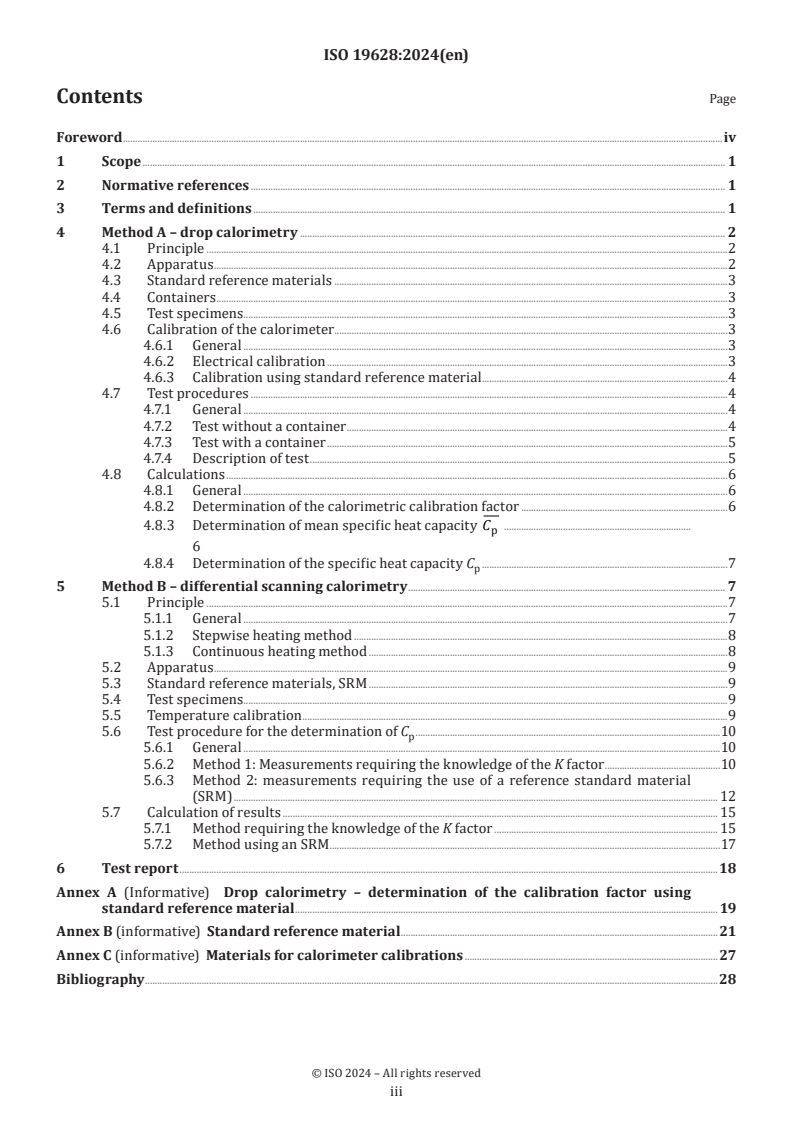
Contents Page
Foreword .iv
1 Scope . 1
2 Normative references . 1
3 Terms and definitions . 1
4 Method A – drop calorimetry . 2
4.1 Principle .2
4.2 Apparatus .2
4.3 Standard reference materials .3
4.4 Containers .3
4.5 Test specimens.3
4.6 Calibration of the calorimeter . .3
4.6.1 General .3
4.6.2 Electrical calibration .3
4.6.3 Calibration using standard reference material .4
4.7 Test procedures .4
4.7.1 General .4
4.7.2 Test without a container .4
4.7.3 Test with a container .5
4.7.4 Description of test .5
4.8 Calculations .6
4.8.1 General .6
4.8.2 Determination of the calorimetric calibration factor .6
4.8.3 Determination of mean specific heat capacity C .
p
4.8.4 Determination of the specific heat capacity C .7
p
5 Method B – differential scanning calorimetry . 7
5.1 Principle .7
5.1.1 General .7
5.1.2 Stepwise heating method .8
5.1.3 Continuous heating method .8
5.2 Apparatus .9
5.3 Standard reference materials, SRM .9
5.4 Test specimens.9
5.5 Temperature calibration .9
5.6 Test procedure for the determination of C .10
p
5.6.1 General .10
5.6.2 Method 1: Measurements requiring the knowledge of the K factor .10
5.6.3 Method 2: measurements requiring the use of a reference standard material
(SRM) . 12
5.7 Calculation of results . 15
5.7.1 Method requiring the knowledge of the K factor . 15
5.7.2 Method using an SRM.17
6 Test report .18
Annex A (Informative) Drop calorimetry – determination of the calibration factor using
standard reference material . 19
Annex B (informative) Standard reference material .21
Annex C (informative) Materials for calorimeter calibrations .27
Bibliography .28
iii
Foreword
ISO (the International Organization for Standardization) is a worldwide federation of national standards
bodies (ISO member bodies). The work of preparing International Standards is normally carried out through
ISO technical committees. Each member body interested in a subject for which a technical committee
has been established has the right to be represented on that committee. International organizations,
governmental and non-governmental, in liaison with ISO, also take part in the work. ISO collaborates closely
with the International Electrotechnical Commission (IEC) on all matters of electrotechnical standardization.
The procedures used to develop this document and those intended for its further maintenance are described
in the ISO/IEC Directives, Part 1. In particular, the different approval criteria needed for the different types
of ISO document should be noted. This document was drafted in accordance with the editorial rules of the
ISO/IEC Directives, Part 2 (see www.iso.org/directives).
ISO draws attention to the possibility that the implementation of this document may involve the use of (a)
patent(s). ISO takes no position concerning the evidence, validity or applicability of any claimed patent
rights in respect thereof. As of the date of publication of this document, ISO had not received notice of (a)
patent(s) which may be required to implement this document. However, implementers are cautioned that
this may not represent the latest information, which may be obtained from the patent database available at
www.iso.org/patents. ISO shall not be held responsible for identifying any or all such patent rights.
Any trade name used in this document is information given for the convenience of users and does not
constitute an endorsement.
For an explanation of the voluntary nature of standards, the meaning of ISO specific terms and expressions
related to conformity assessment, as well as information about ISO's adherence to the World Trade
Organization (WTO) principles in the Technical Barriers to Trade (TBT), see www.iso.org/iso/foreword.html.
This document was prepared by Technical Committee ISO/TC 206, Fine ceramics, in collaboration with
the European Committee for Standardization (CEN) Technical Committee CEN/TC 184, Advanced technical
ceramics, in accordance with the Agreement on technical cooperation between ISO and CEN (Vienna
Agreement).
This second edition cancels and replaces the first edition (ISO 19268:2017), which has been technically
revised.
The main changes are as follows:
— revised scope to extend the maximum temperature of use of Method A to 3 000 K;
— revised Clause 4 by introducing the possibility to apply the drop calorimetry method for temperatures
T1 > T2 (conventional drop calorimetry);
— relevant specifications added concerning the containers and thermometers to be used;
— description of in-situ calibration methods of the calorimeter and thermometers;
— addition of a paragraph dealing with the determination of specific heat capacity at given temperatures
from measurements performed by drop calorimetry;
— updated list of references in the Bibliography.
Any feedback or questions on this document should be directed to the user’s national standards body. A
complete listing of these bodies can be found at www.iso.org/members.html.
iv
International Standard ISO 19628:2024(en)
Fine ceramics (advanced ceramics, advanced technical
ceramics) — Thermophysical properties of ceramic
composites — Determination of specific heat capacity
1 Scope
This document specifies two methods for the determination of the specific heat capacity of ceramic matrix
composites with continuous reinforcements (1D, 2D, 3D).
Unidirectional (1D), bi-directional (2D) and tridirectional (XD, with 2 < X ≤ 3).
The two methods are:
— method A: drop calorimetry;
— method B: differential scanning calorimetry.
The two methods are applicable from ambient temperature up to a maximum temperature that is method
dependent: method A can be used up to 3 000 K, while method B is limited to 1 900 K.
2 Normative references
The following documents are referred to in the text in such a way that some or all of their content constitutes
requirements of this document. For dated references, only the edition cited applies. For undated references,
the latest edition of the referenced document (including any amendments) applies.
ISO 19634, Fine ceramics (advanced ceramics, advanced technical ceramics) — Ceramic composites — Notations
and symbols
IEC 60584-1, Thermocouples — Part 1: EMF specifications and tolerances
3 Terms and definitions
For the purposes of this document, the terms and definitions given in ISO 19634 and the following apply.
ISO and IEC maintain terminology databases for use in standardization at the following addresses:
— ISO Online browsing platform: available at https:// www .iso .org/ obp
— IEC Electropedia: available at https:// www .electropedia .org/
3.1
specific heat capacity
C
p
amount of heat required to raise the temperature of a mass unit of material by 1 K at constant temperature
and pressure
1 dQ
C = (1)
p
mdT
where Q is the heat required for a test-piece of mass m.
3.2
mean specific heat capacity
CT(,T )
p 12
amount of heat required to raise the temperature of a mass unit of a material from temperature T to
temperature T at a constant pressure, divided by the temperature increase (T – T ) expressed in K
2 2 1
3.3
representative volume element
RVE
minimum volume which is representative of the material considered
4 Method A – drop calorimetry
4.1 Principle
In “conventional” drop calorimetry, the test piece is heated in a furnace at a constant temperature T then
dropped in a calorimeter at a constant temperature T . The quantity measured is the amount of heat Q
released in cooling the test piece to the calorimeter temperature T .
In “inverse” drop calorimetry, the test piece is maintained in a conditioning chamber at a constant
temperature T near to room temperature and then dropped in a calorimeter heated at a constant
temperature T . The quantity measured is the amount of heat Q absorbed in heating the test piece to the
calorimeter temperature T .
Whatever the method, “conventional” drop calorimetry or “inverse” drop calorimetry, T > T .
2 1
In both methods, the tested material must not undergo a phase transition in the temperature increment (T – T ).
2 1
Transfer of the test piece shall be done under conditions as close as possible to adiabatic conditions.
Specific heat capacity and mean specific heat capacity are determined from the amount of heat absorbed or
released by the test piece in the calorimeter depending on the drop calorimetry mode applied.
4.2 Apparatus
4.2.1 Drop calorimeter, there are several types of drop calorimeters. They include one (or more)
conditioning chambers and measuring chambers, which can be operated under controlled atmosphere and
which are all equipped with a temperature control system. It is recommended that these control systems
enable a temperature stability better than 1 K below 1 300 K, better than 2 K from 1 300 K to 2 300 K and
better than 4 K above 2 300 K.
The conditioning chamber shall have a homogeneous temperature zone size greater than the test specimen
size. The measuring chamber shall have a homogeneous temperature zone of a sufficient length to accept
several specimens and a sufficient thermal inertia to limit the temperature disturbance, due to the drop.
Heat transfer by radiation during the drop shall be avoided as far as possible.
4.2.2 Balance, with an accuracy of 0,1 mg for test pieces over 10 mg and an accuracy of 0,01 mg for test
pieces below 10 mg.
4.2.3 Temperature detectors, thermocouples in accordance with IEC 60584-1 shall be used for the
measurement of temperature up to 1 920 K.
For temperatures higher than 1 273 K, radiation thermometers (also named pyrometers) can be used.
Thermocouples and radiation thermometers shall be periodically calibrated in their operating temperature
ranges as they can be subjected to drift over time.
Thermocouples may be calibrated by measurement either at a series of fixed-point temperatures (e.g.
melting/freezing points) or by comparison with reference thermometers in thermally stabilised baths or
furnaces.
[2]
NOTE 1 Guidelines on the Calibration of Thermocouples are available at the following address: https:// www
.euramet .org/ publications -media -centre/ calibration -guidelines/ .
Pyrometers are usually calibrated in radiance temperature using reference blackbodies. In addition to
these calibrations performed outside the drop calorimeter facility, it is recommended to perform in-situ
[3]
calibrations of the pyrometers by using fixed-point temperatures .
4.2.4 Data acquisition system, the sampling period during the test shall be less than 0,5 s.
4.3 Standard reference materials
Standard reference materials which can be used for calibration purposes are listed in Annex B.
4.4 Containers
When containers are used, care shall be taken to choose suitable containers to avoid any chemical reaction
or contamination of the specimen from the container material, in particular at high temperature.
4.5 Test specimens
The test specimens shall be representative of the material.
This criterion is generally met by test specimens containing the maximum number of representative volume
elements compatible with the volume of the crucible. If this number is less than five, several solutions are
possible:
a) the test specimens should have an exact number of representative volume elements;
b) the material should be cut into specimens; a number of similar test specimens should be tested and an
average value determined.
4.6 Calibration of the calorimeter
4.6.1 General
Calibration of calorimeters may be done according to two different methods. The first consists of dissipating
a known amount of thermal power using a calibrated resistor introduced in the second chamber of the
calorimeter. In the second method, a reference specimen with known specific heat capacity is dropped
according to the procedure described in 4.7.
4.6.2 Electrical calibration
The calibration factor is the ratio of a known amount of thermal power dissipated in the resistor to the
steady-state calorimetric output signal, and is measured at temperature T . It is recommended to let the
calibrated resistor in the calorimeter during the electrical calibration and the tests, so that the experimental
[4,5]
conditions during both steps remain strictly unchanged .
NOTE 1 For the “inverse” drop calorimetry, the method using power dissipation in a resistor is limited to 1 350 K to
avoid damaging the resistor at high temperature.
NOTE 2 This method can only be used if the sensitivity of the calorimeter is not affected by the filling of the
measuring chamber.
4.6.3 Calibration using standard reference material
This calibration is called “drop calibration”. A specimen made of a standard reference material with a known
specific heat capacity is dropped according to the test procedures described in 4.7. (See Annex B for standard
reference material). The calibration factor is determined according to Annex A.
4.7 Test procedures
4.7.1 General
The test procedures described in sub-clauses 4.7.2 to 4.7.4 shall be applied depending on the experimental
configuration (test performed with or without a container) and the calibration method (electrical calibration
or calibration with standard reference material).
In the case of determination of the mean specific heat capacity CT(,T ) (cf. sub-clause 4.8.3), the tests are
p 12
performed for one couple of temperatures T and T .
1 2
For performing specific heat capacity C measurement (cf. sub-clause 4.8.4), the tests shall be carried out for
p
different couples of temperatures T and T covering the temperature range of investigation.
1 2
— In “conventional” drop calorimetry, the tests are repeated by varying the temperature of the furnace T ,
the temperature of the calorimeter T being kept constant.
— In “inverse” drop calorimetry, the tests are repeated by varying the temperature of the calorimeter T ,
the temperature of the conditioning chamber T being kept constant.
4.7.2 Test without a container
4.7.2.1 Test with drop calibration
The test without a container and with drop calibration is done in the following order:
R, T, R, T, R, T, R
where
R is the test of standard reference material;
T is the test of test specimen.
Carry out each test as described in 4.7.4.
4.7.2.2 Test with electrical calibration
The test without a container and with calibration using power dissipation in a resistor is done in the
following order:
— calibration of calorimeter;
— test on three test specimens.
Carry out each test as described in 4.7.4.
NOTE The avoidance of interaction between the test specimen and the calorimetric conditioning and measuring
chambers can require the use of a sealed container.
4.7.3 Test with a container
4.7.3.1 General
The mass of all empty containers used for the test shall not differ by more than 5 %.
4.7.3.2 Test with drop calibration
The test with a container and with drop calibration is carried out in the following order:
C, C + R, C + T, C, C + R, C + T, C, C + R, C + T, C
where
C is the test with the empty container;
C + R is the test of container plus standard reference material;
C + T is the test of container plus test specimen.
Carry out each test as described in 4.7.4.
4.7.3.3 Test with electrical calibration
The test with a container and with calibration using power dissipation in a resistor is done in the following order:
— calibration of calorimeter;
— carry out the following sequence:
C, C + T, C, C + T, C, C + T, C
where
C is the test with the empty container;
C + T is the test with container plus test specimen.
Carry out each test as described in 4.7.4.
4.7.4 Description of test
The test piece (test specimen, standard material or empty container) and reference material shall be dried
at (110 ± 5) °C until the difference in weight of two successive weighings is lower than 0,2 mg:
— measure the mass when a container is not used with an accuracy of ±0,1 mg or ±0,1 %, whichever is the
smaller;
— when a container is used, measure the mass of each assembly dropped (empty container, container and
standard reference material, container and test specimen);
— place the test piece (test specimen, standard material or empty container) in the conditioning chamber
at temperature T and wait for a sufficient period to reach thermal equilibrium of the test piece with its
environment;
— measure T and T ;
1 2
— start recording the calorimetric signal before the test piece is dropped;
— drop the test piece;
— stop the recording when the steady-state output signal is reached.
4.8 Calculations
4.8.1 General
The change in heat Q corresponding to the drop of the test piece is related to the area A under the calorimetric
output signal by Formula (2).
QK=⋅A (2)
where K is the calorimeter calibration factor.
4.8.2 Determination of the calorimetric calibration factor
4.8.2.1 Electrical calibration
The calibration factor K at a temperature T is determined by dividing the amount of heat Q dissipated by the
calibrated resistor inside the calorimeter maintained at temperature T by the area A under the calorimetric
output signal.
Q
K = (3)
A
where
Q is the amount of heat dissipated;
A is the area under the calorimetric output signal.
4.8.2.2 With standard reference material
See Annexes A and B.
4.8.3 Determination of mean specific heat capacity C
p
The mean specific heat capacity is determined using Formula (4):
1 QT(,T )
i 12
CT(,T )= (4)
p 12
m ()TT−
i 21
where
T is the calorimeter temperature when using “conventional” drop calorimetry, or the initial
temperature at which test pieces are conditioned in case of “inverse” drop calorimetry;
T is the initial temperature at which test pieces are conditioned when using “conventional”
drop calorimetry, or the calorimeter temperature in case of “inverse” drop calorimetry;
Q (T ,T ) is the amount of heat to increase the temperature of the test specimen from T to T ;
i 1 2 1 2
m is the mass of the test piece, determined by weighing;
i
is the mean specific heat capacity at temperature TT=+()T /2 .
CT(,T )
p 12
The subscript i has a different meaning depending on the type of test piece:
— i = c for an empty container;
— i = t for a test piece;
— i = t + c for a test piece and container.
without container
KA⋅
t
C = (5)
pt
mT()−T
t 21
with container
KA()−A
c+tc
C = (6)
pt
mT()−T
t 21
where
A is the value of integration of calorimetric output signal of test specimen;
t
A is the value of integration of calorimetric output signal of container;
c
A is the value of integration of calorimetric output signal of test specimen plus container.
c+t
4.8.4 Determination of the specific heat capacity C
p
The specific heat capacity is determined by applying the following procedure:
— Plot the amounts of heat Q(T ,T ) obtained for different couples of temperatures T and T as a function of T ;
1 2 1 2 2
In “conventional” drop calorimetry, the amounts of heat Q(T ,T ) are equal to K(T )·(A - A ) with a
1 2 1 c+t c
container or to K(T )·A without container;
1 t
In “inverse” drop calorimetry, the amounts of heat Q(T ,T ) are equal to K(T )·(A - A ) with a container
1 2 2 c+t c
or to K(T )·A without container.
2 t
— Determine the mathematical model giving the amounts of heat Q(T ,T ) versus T , which best fits the
1 2 2
obtained experimental data;
— Differentiating this mathematical model with respect to temperature and dividing the result by the mass
of the test piece leads to the following relationship giving the specific heat capacity C (T) as a function of
p
temperature T.
1 dQ
C = (7)
p
mdT
5 Method B – differential
...
Norme
internationale
ISO 19628
Deuxième édition
Céramiques techniques —
2024-11
Propriétés thermophysiques
des composites céramiques —
Détermination de la capacité
thermique massique
Fine ceramics (advanced ceramics, advanced technical
ceramics) — Thermophysical properties of ceramic composites
— Determination of specific heat capacity
Numéro de référence
DOCUMENT PROTÉGÉ PAR COPYRIGHT
© ISO 2024
Tous droits réservés. Sauf prescription différente ou nécessité dans le contexte de sa mise en œuvre, aucune partie de cette
publication ne peut être reproduite ni utilisée sous quelque forme que ce soit et par aucun procédé, électronique ou mécanique,
y compris la photocopie, ou la diffusion sur l’internet ou sur un intranet, sans autorisation écrite préalable. Une autorisation peut
être demandée à l’ISO à l’adresse ci-après ou au comité membre de l’ISO dans le pays du demandeur.
ISO copyright office
Case postale 401 • Ch. de Blandonnet 8
CH-1214 Vernier, Genève
Tél.: +41 22 749 01 11
E-mail: copyright@iso.org
Web: www.iso.org
Publié en Suisse
ii
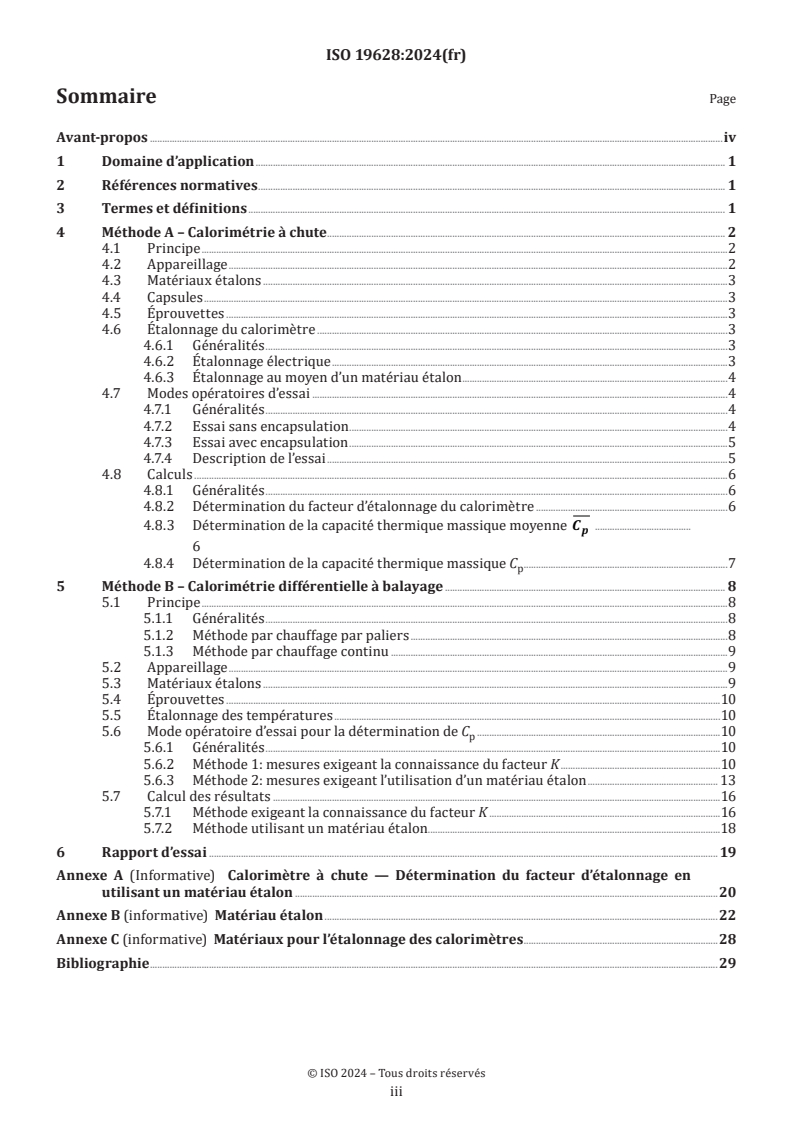
Sommaire Page
Avant-propos .iv
1 Domaine d’application . 1
2 Références normatives . 1
3 Termes et définitions . 1
4 Méthode A – Calorimétrie à chute. 2
4.1 Principe .2
4.2 Appareillage .2
4.3 Matériaux étalons .3
4.4 Capsules .3
4.5 Éprouvettes .3
4.6 Étalonnage du calorimètre .3
4.6.1 Généralités .3
4.6.2 Étalonnage électrique .3
4.6.3 Étalonnage au moyen d’un matériau étalon .4
4.7 Modes opératoires d’essai .4
4.7.1 Généralités .4
4.7.2 Essai sans encapsulation .4
4.7.3 Essai avec encapsulation .5
4.7.4 Description de l’essai .5
4.8 Calculs .6
4.8.1 Généralités .6
4.8.2 Détermination du facteur d’étalonnage du calorimètre .6
4.8.3 Détermination de la capacité thermique massique moyenne C .
p
4.8.4 Détermination de la capacité thermique massique C .7
p
5 Méthode B – Calorimétrie différentielle à balayage . 8
5.1 Principe .8
5.1.1 Généralités .8
5.1.2 Méthode par chauffage par paliers .8
5.1.3 Méthode par chauffage continu .9
5.2 Appareillage .9
5.3 Matériaux étalons .9
5.4 Éprouvettes .10
5.5 Étalonnage des températures .10
5.6 Mode opératoire d’essai pour la détermination de C .10
p
5.6.1 Généralités .10
5.6.2 Méthode 1: mesures exigeant la connaissance du facteur K .10
5.6.3 Méthode 2: mesures exigeant l’utilisation d’un matériau étalon . 13
5.7 Calcul des résultats .16
5.7.1 Méthode exigeant la connaissance du facteur K .16
5.7.2 Méthode utilisant un matériau étalon.18
6 Rapport d’essai . 19
Annexe A (Informative) Calorimètre à chute — Détermination du facteur d’étalonnage en
utilisant un matériau étalon .20
Annexe B (informative) Matériau étalon .22
Annexe C (informative) Matériaux pour l’étalonnage des calorimètres .28
Bibliographie .29
iii
Avant-propos
L’ISO (Organisation internationale de normalisation) est une fédération mondiale d’organismes nationaux
de normalisation (comités membres de l’ISO). L’élaboration des Normes internationales est en général
confiée aux comités techniques de l’ISO. Chaque comité membre intéressé par une étude a le droit de faire
partie du comité technique créé à cet effet. Les organisations internationales, gouvernementales et non
gouvernementales, en liaison avec l’ISO participent également aux travaux. L’ISO collabore étroitement avec
la Commission électrotechnique internationale (IEC) en ce qui concerne la normalisation électrotechnique.
Les procédures utilisées pour élaborer le présent document et celles destinées à sa mise à jour sont
décrites dans les Directives ISO/IEC, Partie 1. Il convient, en particulier, de prendre note des différents
critères d’approbation requis pour les différents types de documents ISO. Le présent document
a été rédigé conformément aux règles de rédaction données dans les Directives ISO/IEC, Partie 2
(voir www.iso.org/directives).
L’ISO attire l’attention sur le fait que la mise en application du présent document peut entraîner l’utilisation
d’un ou de plusieurs brevets. L’ISO ne prend pas position quant à la preuve, à la validité et à l’applicabilité de tout
droit de propriété revendiqué à cet égard. À la date de publication du présent document, l’ISO n’avait pas reçu
notification qu’un ou plusieurs brevets pouvaient être nécessaires à sa mise en application. Toutefois, il y a lieu
d’avertir les responsables de la mise en application du présent document que des informations plus récentes
sont susceptibles de figurer dans la base de données de brevets, disponible à l’adresse www.iso.org/brevets.
L’ISO ne saurait être tenue pour responsable de ne pas avoir identifié de tels droits de brevet.
Les appellations commerciales éventuellement mentionnées dans le présent document sont données pour
information, par souci de commodité, à l’intention des utilisateurs et ne sauraient constituer un engagement.
Pour une explication de la nature volontaire des normes, la signification des termes et expressions
spécifiques de l’ISO liés à l’évaluation de la conformité, ou pour toute information au sujet de l’adhésion de
l’ISO aux principes de l’Organisation mondiale du commerce (OMC) concernant les obstacles techniques au
commerce (OTC), voir www.iso.org/avant-propos.
Le présent document a été élaboré par le Comité technique ISO/TC 206, Céramiques techniques,
en collaboration avec le Comité technique CEN/TC 184, Céramiques techniques avancées, du Comité européen
de normalisation (CEN), conformément à l’Accord de coopération technique entre l’ISO et le CEN (Accord de
Vienne).
Cette deuxième édition annule et remplace la première édition (ISO 19268:2017), qui a fait l’objet d’une
révision technique.
Les principales modifications sont les suivantes:
— révision du domaine d’application pour étendre la température maximale d’utilisation de la méthode A à
3 000 K;
— révision de l’Article 4 en introduisant la possibilité d’appliquer la méthode de calorimétrie à chute pour
les températures T1 > T2 (calorimétrie à chute «conventionnelle»);
— ajout de spécifications pertinentes concernant les récipients et les thermomètres à utiliser;
— description des méthodes d’étalonnage in situ du calorimètre et des thermomètres;
— ajout d’un alinéa traitant de la détermination de la capacité thermique massique à des températures
données à partir de mesures effectuées par calorimétrie à chute;
— mise à jour de la liste de références dans la Bibliographie.
Il convient que l’utilisateur adresse tout retour d’information ou toute question concernant le présent
document à l’organisme national de normalisation de son pays. Une liste exhaustive desdits organismes se
trouve à l’adresse www.iso.org/fr/members.html.
iv
Norme internationale ISO 19628:2024(fr)
Céramiques techniques — Propriétés thermophysiques des
composites céramiques — Détermination de la capacité
thermique massique
1 Domaine d’application
Le présent document spécifie deux méthodes pour la détermination de la capacité thermique massique des
composites à matrice céramique à renforts continus (1D, 2D, 3D).
Les matrices sont à renforts unidirectionnels (1D), bidirectionnels (2D) et tridirectionnels (XD, avec 2 < X ≤ 3).
Les deux méthodes sont:
— méthode A: calorimétrie à chute;
— méthode B: calorimétrie différentielle à balayage.
Elles sont applicables depuis la température ambiante jusqu’à une température maximale qui dépend de la
méthode: la méthode A peut être utilisée jusqu’à 3 000 K, tandis que la méthode B est limitée à 1 900 K.
2 Références normatives
Les documents suivants sont cités dans le texte de sorte qu’ils constituent, pour tout ou partie de leur
contenu, des exigences du présent document. Pour les références datées, seule l’édition citée s’applique. Pour
les références non datées, la dernière édition du document de référence s’applique (y compris les éventuels
amendements).
ISO 19634, Céramiques techniques — Céramiques composites — Notations et symboles
IEC 60584-1, Couples thermoélectriques — Partie 1: Spécifications et tolérances en matière de FEM
3 Termes et définitions
Pour les besoins du présent document, les termes et les définitions de l’ISO 19634 ainsi que les suivants
s’appliquent.
L’ISO et l’IEC tiennent à jour des bases de données terminologiques destinées à être utilisées en normalisation,
consultables aux adresses suivantes:
— ISO Online browsing platform: disponible à l’adresse https:// www .iso .org/ obp
— IEC Electropedia: disponible à l’adresse https:// www .electropedia .org/
3.1
capacité thermique massique
C
p
quantité de chaleur nécessaire pour élever la température de l’unité de masse d’un matériau de 1 K,
à température et pression constantes
1 dQ
C = (1)
p
mdT
où Q est la chaleur nécessaire pour une éprouvette de masse m
3.2
capacité thermique massique moyenne
C ()T ,T
p1 2
quantité de chaleur nécessaire pour élever la température de l’unité de masse d’un matériau de la
température T à la température T à pression constante, divisée par l’intervalle de température (T – T )
1 2 2 1
exprimé en K
3.3
volume élémentaire représentatif
VER
plus petit volume représentatif du matériau considéré
4 Méthode A – Calorimétrie à chute
4.1 Principe
En calorimétrie à chute «conventionnelle», l’éprouvette est chauffée dans un four à une température constante
T , puis chute dans un calorimètre à une température constante T . La quantité mesurée correspond à la
2 1
quantité de chaleur Q libérée lors du refroidissement de l’éprouvette à la température calorimétrique T .
En calorimétrie à chute «inverse», l’éprouvette est maintenue dans une chambre de conditionnement à une
température constante T avoisinant la température ambiante, puis chute dans un calorimètre chauffé à une
température constante T . La quantité mesurée correspond à la quantité de chaleur Q absorbée en chauffant
l’éprouvette à la température calorimétrique T .
Quelle que soit la méthode, calorimétrie à chute «conventionnelle» ou «inverse», la température T est
supérieure à la température T .
Dans les deux méthodes, le matériau soumis à essai ne doit pas subir de transition de phase dans l’incrément
de température (T – T ).
2 1
Le transfert de l’éprouvette doit se faire dans des conditions aussi proches que possible des conditions
adiabatiques.
La capacité thermique massique et la capacité thermique massique moyenne sont déterminées à partir
de la quantité de chaleur absorbée ou libérée par l’éprouvette dans le calorimètre en fonction du mode
calorimétrique appliqué.
4.2 Appareillage
4.2.1 Calorimètre à chute, dont il existe plusieurs types. Ils comportent une (ou plusieurs) chambre de
conditionnement et de mesure capable de travailler sous atmosphère contrôlée, équipée d’un système de
régulation en température. Il est recommandé que ces systèmes de régulation permettent d’obtenir une
stabilité en température meilleure que 1 K en dessous de 1 300 K, meilleure que 2 K de 1 300 K à 2 300 K et
meilleure que 4 K au-dessus de 2 300 K.
La chambre de conditionnement doit avoir une zone de température homogène d’une taille supérieure à la
taille de l’éprouvette. La chambre de mesure doit avoir une zone de température homogène d’une longueur
suffisante pour recevoir plusieurs éprouvettes et une inertie thermique suffisante pour limiter la variation
de température due à la chute.
Les transferts de chaleur par rayonnement pendant la chute doivent être évités autant que possible.
4.2.2 Balance, ayant une précision de 0,1 mg pour des éprouvettes de plus de 10 mg, et une précision
de 0,01 mg pour des éprouvettes de moins de 10 mg.
4.2.3 Détecteurs de température, des thermocouples conformes à l’IEC 60584-1 doivent être utilisés
pour la mesure des températures jusqu’à 1 920 K.
Il est possible d’utiliser des pyromètres pour les températures supérieures à 1 273 K.
Les thermocouples et les pyromètres doivent être régulièrement étalonnés dans leurs plages de températures
de fonctionnement, car ils risquent de dériver au cours du temps.
Les thermocouples peuvent être étalonnés soit en mesurant une série de points fixes de température (par
exemple points de fusion/congélation), soit par comparaison avec des thermomètres de référence dans des
bains ou des fours thermiquement stabilisés.
[2]
NOTE 1 Des guides techniques sur l’étalonnage des thermocouples sont disponibles à l’adresse suivante: https://
www .euramet .org/ publications -media -centre/ calibration -guidelines/ .
Les pyromètres sont généralement étalonnés en température de luminance en utilisant des corps noirs de
référence. En plus de ces étalonnages réalisés à l’extérieur de l’installation calorimétrique, il est recommandé
[3]
d’effectuer des étalonnages in situ des pyromètres en utilisant des points fixes de température .
4.2.4 Système d’acquisition de données, dont la période d’échantillonnage pendant l’essai doit être
inférieure à 0,5 s.
4.3 Matériaux étalons
Les matériaux étalons qui peuvent être utilisés pour l’étalonnage sont listés dans l’Annexe B.
4.4 Capsules
Le cas échéant, il est nécessaire de choisir des capsules adaptées afin d’éviter toute réaction chimique ou
contamination de l’éprouvette par le matériau de la capsule, en particulier à haute température.
4.5 Éprouvettes
Les éprouvettes doivent être représentatives du matériau.
Ce critère est généralement satisfait pour des éprouvettes contenant le nombre maximal de volumes
élémentaires représentatifs (VER) compatible avec la taille de la capsule. Si ce nombre est inférieur à cinq,
plusieurs solutions sont possibles:
a) il convient que les éprouvettes aient un nombre exact de volumes élémentaires représentatifs;
b) il convient que le matériau soit découpé en éprouvettes: il convient que plusieurs éprouvettes identiques
soient soumises à l’essai et qu’une valeur moyenne soit déterminée.
4.6 Étalonnage du calorimètre
4.6.1 Généralités
L’étalonnage du calorimètre peut se faire selon deux méthodes différentes. La première consiste à dissiper
une puissance thermique connue à l’aide d’une résistance étalonnée placée dans la deuxième chambre du
calorimètre. Dans la seconde méthode, un étalon de capacité thermique massique connue est soumis au
mode opératoire décrit en 4.7.
4.6.2 Étalonnage électrique
Le facteur d’étalonnage est le rapport entre une puissance thermique connue dissipée dans la résistance et
le signal de sortie stabilisé du calorimètre. Il est mesuré à la température T . Il est recommandé de laisser
la résistance étalonnée dans le calorimètre pendant l’étalonnage électrique et les essais, de sorte que les
[4,5]
conditions expérimentales pendant les deux étapes restent strictement inchangées .
NOTE 1 Pour la calorimétrie à chute «inverse», la méthode par dissipation de puissance dans une résistance est
limitée à 1 350 K pour éviter d’endommager la résistance à haute température.
NOTE 2 Cette méthode ne peut être utilisée que si la sensibilité du calorimètre n’est pas affectée par le remplissage
de la chambre de mesure.
4.6.3 Étalonnage au moyen d’un matériau étalon
Cet étalonnage est appelé «étalonnage par chute». Une éprouvette de matériau étalon de capacité thermique
massique connue est soumise au mode opératoire d’essai décrit en 4.7. (Voir l’Annexe B pour les matériaux
étalons.) Le facteur d’étalonnage est déterminé selon l’Annexe A.
4.7 Modes opératoires d’essai
4.7.1 Généralités
Les modes opératoires d’essai décrits dans les paragraphes 4.7.2 à 4.7.4 doivent être appliqués en fonction de
la configuration expérimentale (essai avec ou sans encapsulation) et de la méthode d’étalonnage (étalonnage
électrique ou étalonnage au moyen d’un matériau étalon).
Dans le cas de la détermination de la capacité thermique massique moyenne CT(),T
p 12
(voir le paragraphe 4.8.3), les essais sont effectués pour un couple de températures T et T .
1 2
Pour mesurer la capacité thermique massique C (voir le paragraphe 4.8.4), les essais doivent être effectués
p
pour différents couples de températures T et T couvrant la plage de températures d’investigation:
1 2
— En calorimétrie à chute «conventionnelle», les essais sont répétés en faisant varier la température du
four T , la température du calorimètre T étant maintenue constante.
2 1
— En calorimétrie à chute «inverse», les essais sont répétés en faisant varier la température du calorimètre
T , la température de la chambre de conditionnement T étant maintenue constante.
2 1
4.7.2 Essai sans encapsulation
4.7.2.1 Essai avec étalonnage par chute
L’essai sans encapsulation et avec étalonnage par chute est effectué dans l’ordre suivant:
R, T, R, T, R, T, R
où
R est l’essai avec le matériau étalon; et
T est l’essai avec l’éprouvette.
Chaque essai est effectué comme indiqué en 4.7.4.
4.7.2.2 Essai avec étalonnage électrique
L’essai sans encapsulation et avec étalonnage par dissipation d’une puissance électrique dans une résistance
est effectué dans l’ordre suivant:
— étalonnage du calorimètre;
— essai sur trois éprouvettes.
Chaque essai est effectué comme indiqué en 4.7.4.
NOTE Il peut être nécessaire d’encapsuler les éprouvettes pour éviter les interactions avec les chambres de
conditionnement et de mesure calorimétriques.
4.7.3 Essai avec encapsulation
4.7.3.1 Généralités
La masse de toutes les capsules vides utilisées pour l’essai ne doit pas différer de plus de 5 %.
4.7.3.2 Essai avec étalonnage par chute
L’essai avec encapsulation et avec étalonnage par chute est effectué dans l’ordre suivant:
C, C + R, C + T, C, C + R, C + T, C, C + R, C + T, C
où
C est l’essai avec la capsule vide;
C + R est l’essai avec la capsule contenant le matériau étalon;
C + T est l’essai avec la capsule contenant l’éprouvette.
Chaque essai est effectué comme indiqué en 4.7.4.
4.7.3.3 Essai avec étalonnage électrique
L’essai avec encapsulation et avec étalonnage par dissipation d’une puissance électrique dans une résistance
est effectué dans l’ordre suivant:
— étalonnage du calorimètre;
— réalisation de la séquence d’essais suivante:
C, C + T, C, C + T, C, C + T, C
où
C est l’essai avec la capsule vide;
C + T est l’essai avec la capsule contenant l’éprouvette.
Chaque essai est effectué comme indiqué en 4.7.4.
4.7.4 Description de l’essai
L’éprouvette (ou l’étalon ou la capsule vide) et l’étalon doivent être séchés à (110 ± 5) °C jusqu’à obtenir une
différence de masse entre deux pesées successives inférieure à 0,2 mg:
— lorsqu’aucune capsule n’est utilisée, mesurer la masse avec une précision de ±0,1 mg ou de ±0,1 %, en
retenant la plus petite des deux valeurs;
— lorsqu’une capsule est utilisée, mesurer la masse de chaque ensemble soumis à l’essai (capsule vide,
capsule contenant l’étalon, capsule contenant l’éprouvette);
— placer l’éprouvette (ou l’étalon ou la capsule vide) dans la chambre de conditionnement à la température
T et attendre un temps suffisant pour que l’éprouvette atteigne l’équilibre thermique avec son
environnement;
— mesurer les températures T et T ;
1 2
— démarrer l’enregistrement du signal calorimétrique avant la chute de l’éprouvette;
— faire chuter l’éprouvette;
— arrêter l’enregistrement lorsque le signal de sortie est stabilisé.
4.8 Calculs
4.8.1 Généralités
La variation de quantité de chaleur Q correspondant à la chute de l’éprouvette est exprimée en fonction de
l’aire A située sous le signal délivré par le calorimètre par la Formule (2):
QK=⋅A (2)
où K est le facteur d’étalonnage du calorimètre.
4.8.2 Détermination du facteur d’étalonnage du calorimètre
4.8.2.1 Étalonnage électrique
Le facteur d’étalonnage K à une température T est déterminé en divisant la quantité de chaleur Q dissipée
par la résistance étalonnée à l’intérieur du calorimètre maintenu à la température T par l’aire A sous le signal
calorimétrique:
Q
K = (3)
A
où
Q est la quantité de chaleur dissipée;
A est l’aire située sous le signal de sortie du calorimètre.
4.8.2.2 Avec un matériau étalon
Voir les Annexes A et B.
4.8.3 Détermination de la capacité thermique massique moyenne C
p
La capacité thermique massique moyenne est calculée à l’aide de la Formule (4):
QT ,T
1 ()
i 12
CT ,T = (4)
()
p 12
m ()TT−
i 21
où
T est la température du calorimètre en cas d’utilisation de la calorimétrie à chute «conven-
tionnelle» ou la température initiale à laquelle les éprouvettes sont conditionnées en
cas de calorimétrie à chute «inverse»;
T est la température initiale à laquelle les éprouvettes sont conditionnées en cas de
calorimétrie à chute «conventionnelle» ou la température du calorimètre en cas de
calorimétrie à chute «inverse»;
Q (T ,T ) est la quantité de chaleur nécessaire pour augmenter la température de l’éprouvette
i 1 2
de T à T ;
1 2
m est la masse de l’éprouvette, déterminée par pesage;
i
est la capacité thermique massique moyenne à la température TT=+()T /2 .
CT(),T
p 12
L’indice i a une signification différente suivant le type d’éprouvette:
— i = c pour une capsule vide;
— i = t pour une éprouvette;
— i = t + c pour une éprouvette et sa capsule.
sans encapsulation:
KA⋅
t
C = (5)
pt
mT()−T
t 21
avec encapsulation:
KA()−A
ct+ c
C = (6)
pt
mT −T
()
t 21
où
A est la valeur donnée par l’intégration du signal de sortie du calorimètre pour l’éprouvette;
t
A est la valeur donnée par l’intégration du signal de sortie du calorimètre pour la capsule;
c
A est la valeur donnée par l’intégration du signal de sortie du calorimètre pour l’éprouvette et sa
c+t
capsule.
4.8.4 Détermination de la capacité thermique massique C
p
La capacité thermique massique est calculée à l’aide du mode opératoire suivant:
— tracer les quantités de chaleur Q(T ,T ) obtenues pour différents couples de températures T et T en
1 2 1 2
fonction de T .
En calorimétrie à chute «conventionnelle», les quantités de chaleur Q(T ,T ) sont égales à K(T )·(A -
1 2 1 c+t
A ) avec encapsulation ou à K(T )·A sans encapsulation.
c 1 t
En calorimétrie à chute «inverse», les quantités de chaleur Q(T ,T ) sont égales à K(T )·(A - A ) avec
1 2 2 c+t c
encapsulation ou à K(T )·A sans encapsulation;
2 t
— déterminer le modèle mathématique donnant les quantités de chaleur Q(T ,T ) en fonction de T , qui
1 2 2
correspond le mieux aux données expérimentales obtenues;
— la dérivée de ce modèle mathématique par rapport à la température et la division du résultat par la
masse de l’éprouvette conduisent à la relation suivante donnant la capacité thermique massique C (T) en
p
fonction de la température T.
1 dQ
C = (7)
p
mdT
5 Méthode B – Calorimétrie différentielle à balayage
5.1 Principe
5.1.1 Généralités
La méthode consiste à mesurer la différence de puissance nécessaire pour élever la température de
l’éprouvette et de sa capsule et celle d’une capsule identique vide suivant le même programme de température
qui peut être continu ou par paliers.
Un chauffage par paliers permet uniqueme
...