

ISO 13402:2025
(Main)Surgical and dental hand instruments — Determination of resistance against autoclaving, corrosion and thermal exposure
General Information
- Abstract
This document describes test methods to determine the resistance of stainless steel surgical and dental hand instruments against autoclaving, corrosion and thermal exposure.
- Status
- Published
- Publication Date
- 06-Mar-2025
- Technical Committee
- ISO/TC 170 - Surgical instruments
- Drafting Committee
- ISO/TC 170 - Surgical instruments
- Current Stage
- 6060 - International Standard published
- Start Date
- 07-Mar-2025
- Due Date
- 06-Sep-2025
- Completion Date
- 07-Mar-2025
Buy Documents
ISO 13402:2025 - Surgical and dental hand instruments — Determination of resistance against autoclaving, corrosion and thermal exposure Released:7. 03. 2025
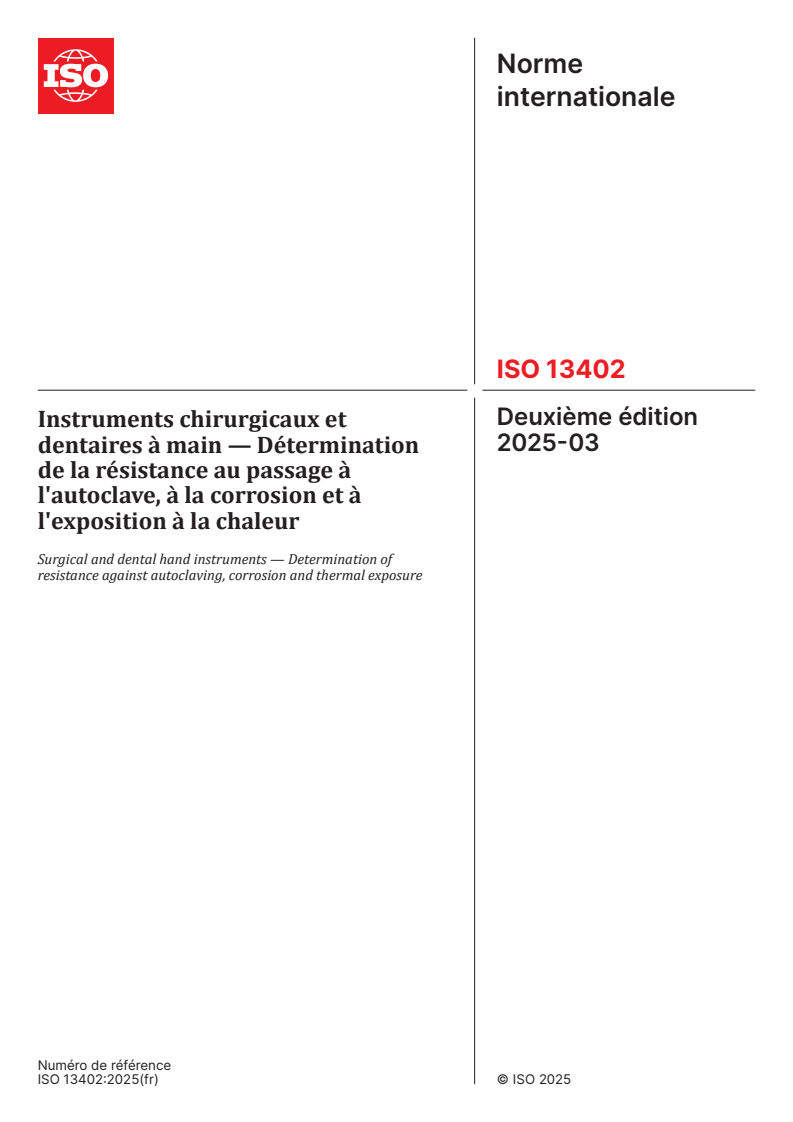
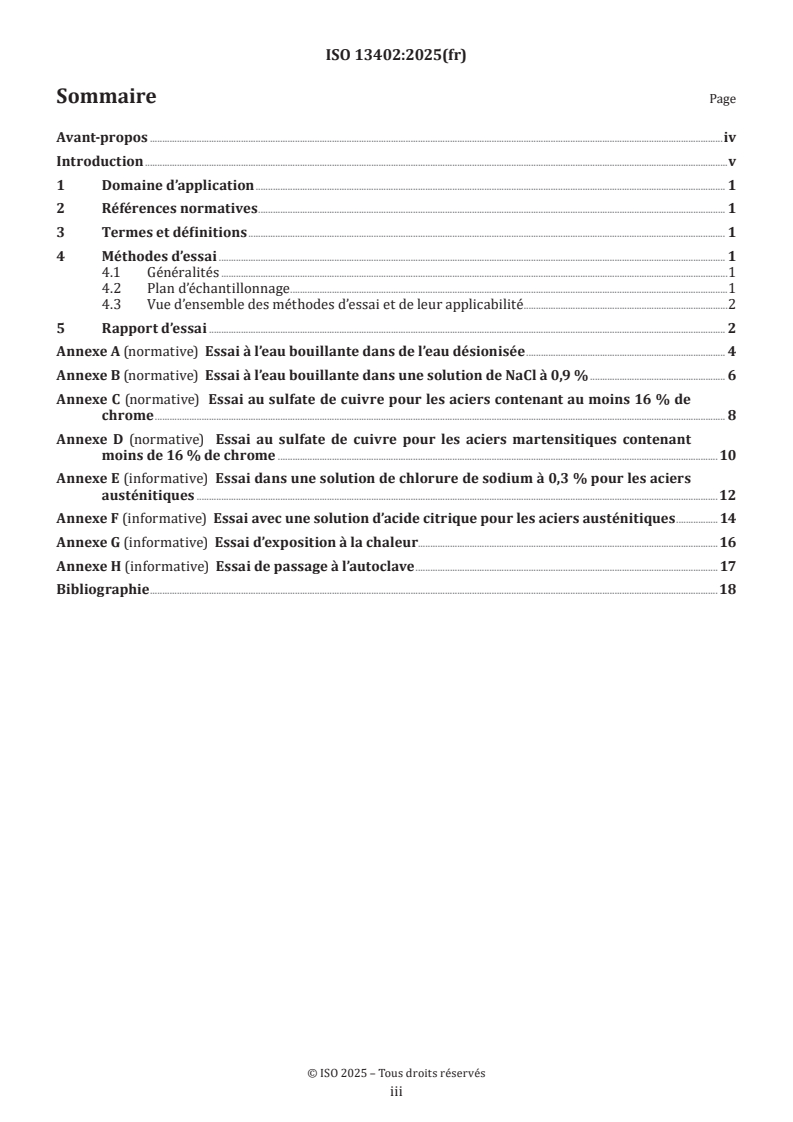
ISO 13402:2025 - Instruments chirurgicaux et dentaires a main — Détermination de la résistance au passage a l'autoclave, a la corrosion et a l'exposition a la chaleur Released:7. 03. 2025
Overview
ISO 13402:2025 - "Surgical and dental hand instruments - Determination of resistance against autoclaving, corrosion and thermal exposure" defines a harmonized set of type test methods to assess the durability of stainless steel surgical and dental hand instruments under sterilization, corrosive and thermal conditions. The second edition updates and consolidates procedures (Annexes A–H) to align test practice across product standards and to help manufacturers, testing laboratories and purchasers verify instrument resistance to autoclaving, corrosion and thermal stress.
Key topics and requirements
- Scope: Test methods for stainless steel surgical and dental hand instruments to determine resistance to autoclaving, corrosion and thermal exposure.
- Sampling: Manufacturers shall define sampling plans in accordance with ISO 7554-3.
- Test catalogue: Annexes provide specific procedures:
- Boiling test in deionized water (Annex A, normative) - detects surface defects, free iron or anodic contaminants.
- Boiling test in 0.9% NaCl (Annex B, informative) - corrosion resistance check for higher-chromium steels.
- Copper sulfate tests (Annex C normative for ≥16% Cr; Annex D normative for martensitic <16% Cr) - assess material selection, heat treatment and workmanship.
- Additional informative tests: 0.3% NaCl (Annex E), citric acid solution (Annex F), thermal test (Annex G) and autoclave (sterilization) test (Annex H).
- Evaluation: Visual inspection according to EN 13018 with ×10 magnification; surfaces should show no corrosion without magnification. Specific exceptions (e.g., rust in serrations, brazed joints, laser marks) are allowed.
- Test report: Minimum information includes sample identification, reference to ISO 13402:2025, method used, deviations, dates, laboratory ID and authorized signatures.
Applications and who uses the standard
- Instrument manufacturers: For product development, QC and type-testing to demonstrate corrosion resistance and thermal stability of surgical and dental hand instruments.
- Testing laboratories: To perform standardized boiling, copper sulfate, autoclave and thermal tests and to produce compliant test reports.
- Procurement and regulatory bodies: To specify acceptance testing or contractual test requirements for suppliers.
- Hospitals and sterilization departments: To understand expected performance of instruments under autoclave cycles and to select compliant products.
Keywords: ISO 13402:2025, surgical and dental hand instruments, autoclaving, corrosion resistance, thermal exposure, stainless steel testing, boiling test, copper sulfate test, austenitic, martensitic, ferritic.
Related standards
- ISO 3696 (water quality for tests)
- ISO 7554-3 (sampling and test planning)
- EN 13018 (visual testing principles)
- Relevant product standards referenced for specific instruments (e.g., ISO 7151, ISO 9173-1)
Relations
- Effective Date
- 12-Feb-2026
- Effective Date
- 01-Oct-2022
- Effective Date
- 17-Sep-2022
Buy Documents
ISO 13402:2025 - Surgical and dental hand instruments — Determination of resistance against autoclaving, corrosion and thermal exposure Released:7. 03. 2025
ISO 13402:2025 - Instruments chirurgicaux et dentaires a main — Détermination de la résistance au passage a l'autoclave, a la corrosion et a l'exposition a la chaleur Released:7. 03. 2025
Get Certified
Connect with accredited certification bodies for this standard

BSI Group
BSI (British Standards Institution) is the business standards company that helps organizations make excellence a habit.

TÜV Rheinland
TÜV Rheinland is a leading international provider of technical services.

TÜV SÜD
TÜV SÜD is a trusted partner of choice for safety, security and sustainability solutions.
Sponsored listings
Frequently Asked Questions
ISO 13402:2025 is a standard published by the International Organization for Standardization (ISO). Its full title is "Surgical and dental hand instruments — Determination of resistance against autoclaving, corrosion and thermal exposure". This standard covers: This document describes test methods to determine the resistance of stainless steel surgical and dental hand instruments against autoclaving, corrosion and thermal exposure.
This document describes test methods to determine the resistance of stainless steel surgical and dental hand instruments against autoclaving, corrosion and thermal exposure.
ISO 13402:2025 is classified under the following ICS (International Classification for Standards) categories: 11.040.30 - Surgical instruments and materials; 11.060.20 - Dental equipment. The ICS classification helps identify the subject area and facilitates finding related standards.
ISO 13402:2025 has the following relationships with other standards: It is inter standard links to EN ISO 13402:2025, ISO 12140-2:2020, ISO 13402:1995. Understanding these relationships helps ensure you are using the most current and applicable version of the standard.
ISO 13402:2025 is available in PDF format for immediate download after purchase. The document can be added to your cart and obtained through the secure checkout process. Digital delivery ensures instant access to the complete standard document.
Standards Content (Sample)
International
Standard
ISO 13402
Second edition
Surgical and dental hand
2025-03
instruments — Determination of
resistance against autoclaving,
corrosion and thermal exposure
Instruments chirurgicaux et dentaires à main — Détermination
de la résistance au passage à l'autoclave, à la corrosion et à
l'exposition à la chaleur
Reference number
© ISO 2025
All rights reserved. Unless otherwise specified, or required in the context of its implementation, no part of this publication may
be reproduced or utilized otherwise in any form or by any means, electronic or mechanical, including photocopying, or posting on
the internet or an intranet, without prior written permission. Permission can be requested from either ISO at the address below
or ISO’s member body in the country of the requester.
ISO copyright office
CP 401 • Ch. de Blandonnet 8
CH-1214 Vernier, Geneva
Phone: +41 22 749 01 11
Email: copyright@iso.org
Website: www.iso.org
Published in Switzerland
ii
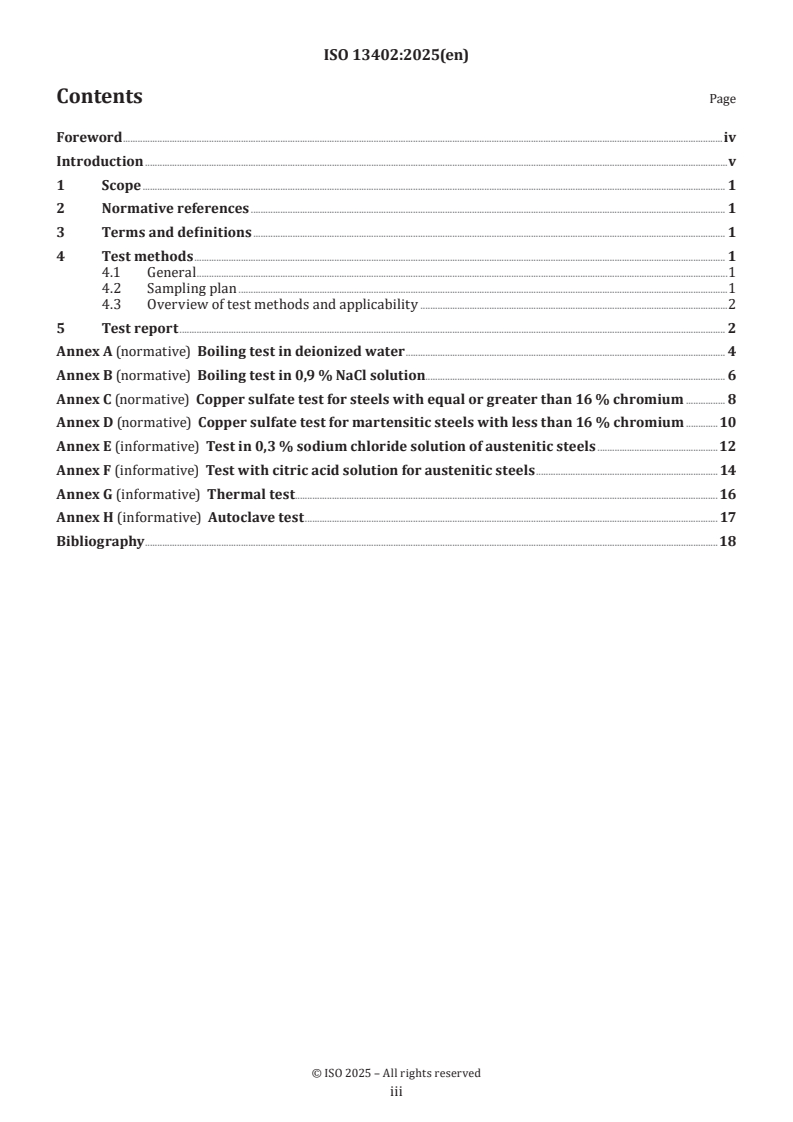
Contents Page
Foreword .iv
Introduction .v
1 Scope . 1
2 Normative references . 1
3 Terms and definitions . 1
4 Test methods . 1
4.1 General .1
4.2 Sampling plan .1
4.3 Overview of test methods and applicability .2
5 Test report . 2
Annex A (normative) Boiling test in deionized water . 4
Annex B (normative) Boiling test in 0,9 % NaCl solution. 6
Annex C (normative) Copper sulfate test for steels with equal or greater than 16 % chromium . 8
Annex D (normative) Copper sulfate test for martensitic steels with less than 16 % chromium .10
Annex E (informative) Test in 0,3 % sodium chloride solution of austenitic steels .12
Annex F (informative) Test with citric acid solution for austenitic steels . 14
Annex G (informative) Thermal test . 16
Annex H (informative) Autoclave test . 17
Bibliography .18
iii
Foreword
ISO (the International Organization for Standardization) is a worldwide federation of national standards
bodies (ISO member bodies). The work of preparing International Standards is normally carried out through
ISO technical committees. Each member body interested in a subject for which a technical committee
has been established has the right to be represented on that committee. International organizations,
governmental and non-governmental, in liaison with ISO, also take part in the work. ISO collaborates closely
with the International Electrotechnical Commission (IEC) on all matters of electrotechnical standardization.
The procedures used to develop this document and those intended for its further maintenance are described
in the ISO/IEC Directives, Part 1. In particular, the different approval criteria needed for the different types
of ISO document should be noted. This document was drafted in accordance with the editorial rules of the
ISO/IEC Directives, Part 2 (see www.iso.org/directives).
ISO draws attention to the possibility that the implementation of this document may involve the use of (a)
patent(s). ISO takes no position concerning the evidence, validity or applicability of any claimed patent
rights in respect thereof. As of the date of publication of this document, ISO had not received notice of (a)
patent(s) which may be required to implement this document. However, implementers are cautioned that
this may not represent the latest information, which may be obtained from the patent database available at
www.iso.org/patents. ISO shall not be held responsible for identifying any or all such patent rights.
Any trade name used in this document is information given for the convenience of users and does not
constitute an endorsement.
For an explanation of the voluntary nature of standards, the meaning of ISO specific terms and expressions
related to conformity assessment, as well as information about ISO's adherence to the World Trade
Organization (WTO) principles in the Technical Barriers to Trade (TBT), see www.iso.org/iso/foreword.html.
This document was prepared by Technical Committee ISO/TC 170, Surgical instruments, in collaboration
with the European Committee for Standardization (CEN) Technical Committee CEN/TC 55, Dentistry, in
accordance with the Agreement on technical cooperation between ISO and CEN (Vienna Agreement).
This second edition cancels and replaces the first edition (ISO 13402:1995), which has been technically
revised.
The main changes are as follows:
— restructuring of the document;
— update of Clause 2;
— addition of Clause 3;
— addition of Clause 4 including a table with an overview of test methods;
— addition of Clause 5;
— addition of Annexes A to H including test methods.
Any feedback or questions on this document should be directed to the user’s national standards body. A
complete listing of these bodies can be found at www.iso.org/members.html.
iv
Introduction
The procedures described in this document form a harmonized series of tests that can be referred to,
individually or in combination, in other separate product standards. The requirements for such tests are
defined and stated within the body of the product standard along with the number of cycles for each test
procedure. The tests apply to dental and surgical instruments and are already standardized in relevant
product standards (e.g. ISO 7151, ISO 9173-1). However, the test procedures as stated in the product
standards differ in minor details. An alignment and a compilation were established.
The most important test methods for dental and surgical instruments have been compiled in this document.
v
International Standard ISO 13402:2025(en)
Surgical and dental hand instruments — Determination
of resistance against autoclaving, corrosion and thermal
exposure
1 Scope
This document describes test methods to determine the resistance of stainless steel surgical and dental
hand instruments against autoclaving, corrosion and thermal exposure.
2 Normative references
The following documents are referred to in the text in such a way that some or all of their content constitutes
requirements of this document. For dated references, only the edition cited applies. For undated references,
the latest edition of the referenced document (including any amendments) applies.
ISO 3696, Water for analytical laboratory use — Specification and test methods
1)
ISO 7554-3, Surgical instruments — Terms, measuring methods and tests — Part 3: Test methods
EN 13018, Non-destructive testing — Visual testing — General principles
3 Terms and definitions
No terms and definitions are listed in this document.
ISO and IEC maintain terminology databases for use in standardization at the following addresses:
— ISO Online browsing platform: available at https:// www .iso .org/ obp
— IEC Electropedia: available at https:// www .electropedia .org/
4 Test methods
4.1 General
All tests are type tests.
4.2 Sampling plan
a) Each instrument manufacturer shall define an appropriate sampling plan for ensuring instrument
safety and quality. The sampling shall be done according to ISO 7554-3.
b) Rejected lots are often re-passivated and re-tested, typically using an increased sample size of
instruments. If the lot is rejected a second time, the cause of the repeat failure should be evaluated
before proceeding.
1) Under preparation. Stage at the time of publication: ISO/DIS 7664-3.
4.3 Overview of test methods and applicability
Table 1 enlists several methods for testing. The tests applicable should be chosen according to the materials
of the instrument and be performed using the procedure described in respective annex.
When placing an order, the purchaser states whether both tests are to be carried out or which of the two
tests. If the purchaser does not so indicate, the choice is left to the discretion of the manufacturer.
Table 1 — Overview of test methods and applicability
Test method Applicability Annex
Boiling test in Martensitic, austenitic, ferritic material with less than 16 % chromium, and precip- Annex A
deionized water itation hardening materials shall use the boiling test.
(normative)
Instruments containing stainless steel materials that are exclusively to the following
shall use the boil test and copper sulfate test: austenitic materials, precipitation
hardening materials, and ferritic materials containing equal or greater than 16 %
chromium.
The boiling test allows to detect surface imperfections, free iron, or other anodic
surface contaminations on stainless steel.
Boiling test in Instruments made from stainless steel materials such as austenitic materials, Annex B
0,9 % NaCl solu- precipitation hardening materials and ferritic materials with a chromium content
(informative)
tion of 16 % or more should be tested with the boiling test in 0,9 % NaCl.
Copper sulfate Instruments containing stainless steel materials that are exclusively to the fol- Annex C
test for steels lowing shall use the copper sulfate test and boiling test: austenitic materials, pre-
(normative)
with equal or cipitation hardening materials, and ferritic materials containing equal or greater
greater than than 16 % chromium.
16 % chromium.
Copper sulfate Instruments made from martensitic materials with less than 16 % chromium, Annex D
test for steels and precipitation hardening materials to detect improper heat treatment shall be
(normative)
with less than tested with this copper sulfate test.
16 % chromium
Test in 0,3 % NaCl Instruments made from austenitic steel should be tested with 0,3 % NaCl solu- Annex E
solution tion. (informative)
Corrosion test exclusively for austenitic steels.
Test with Citric Instruments made from austenitic steel should be tested with citric acid solution. Annex F
acid (informative)
Corrosion test exclusively for austenitic steels.
solution
Thermal test The resistance to thermal stress of instruments made from martensitic or auste- Annex G
nitic steel should be tested with the thermal test (informative)
Autoclave test Instruments made from martensitic or austenitic steel should be tested with the Annex H
autoclave test. (informative)
The sterilization test should simulate normal operating conditions.
5 Test report
The test report for each determination shall include at least the following information:
a) identification of the sample including description;
b) a reference to this document, i.e. ISO 13402:2025;
c) identification of used method;
d) any unusual features observed during evaluation;
e) any deviations from the procedure;
f) starting and completion dates of test;
g) identification of laboratory carrying out the analysis;
h) signature and name of (an) authorized person(s).
Annex A
(normative)
Boiling test in deionized water
A.1 General
The boiling test is suitable for martensitic, austenitic, ferritic materials with less than 16 % chromium and
precipitation hardening materials to detect surface defects, free iron or other anodic surface impurities on
stainless steel.
Instruments containing stainless steel materials that are exclusively to the following shall use both the
boiling test and copper sulfate test: austenitic materials, precipitation hardening materials, and ferritic
materials containing equal or greater than 16 % chromium.
A.2 Reagents
A.2.1 Deionized water according to ISO 3696, quality 3.
A.3 Apparatus
A.3.1 Chemically non-reacting vessel, e.g. made of glass or ceramic, or corrosion resistant stainless steel.
A.3.2 Energy source to emit heat (e.g. hob).
A.3.3 Lint-free disposable cloth.
A.3.4 Magnifying lens (×10).
A.4 Preparation
Instruments shall be free of oil before test. If necessary, scrub the instrument using soap and warm water.
Rinse thoroughly in water (A.2.1) and dry with compressed air or a lint-free disposable cloth.
A.5 Procedure
Fill vessel (A.3.1) with the required amount of ≥ 2 000 ml of deionized water (A.2.1) for the test and heat to
boiling point.
The volume of the saline solution may be adjusted, if more or less solution is needed to fully immerse the
instrument.
Place the instrument in the vessel with boiling water for 30 min ± 1 min. The instrument shall be completely
covered with water.
Remove the vessel with the instrument from the heat source and allow to cool for 60 min ± 2 min.
Remove the instrument and allow it to react in room air for at least 120 min.
Remove residual moisture with dried compressed air or nitrogen.
A.6 Evaluation
Direct visual testing shall be done according to EN 13018. Use a magnifying lens (×10) to check for any signs
of corrosion on the surface.
Surfaces shall show no signs of corrosion (without magnification). The following exceptions shall not be
cau
...
Norme
internationale
ISO 13402
Deuxième édition
Instruments chirurgicaux et
2025-03
dentaires à main — Détermination
de la résistance au passage à
l'autoclave, à la corrosion et à
l'exposition à la chaleur
Surgical and dental hand instruments — Determination of
resistance against autoclaving, corrosion and thermal exposure
Numéro de référence
DOCUMENT PROTÉGÉ PAR COPYRIGHT
© ISO 2025
Tous droits réservés. Sauf prescription différente ou nécessité dans le contexte de sa mise en œuvre, aucune partie de cette
publication ne peut être reproduite ni utilisée sous quelque forme que ce soit et par aucun procédé, électronique ou mécanique,
y compris la photocopie, ou la diffusion sur l’internet ou sur un intranet, sans autorisation écrite préalable. Une autorisation peut
être demandée à l’ISO à l’adresse ci-après ou au comité membre de l’ISO dans le pays du demandeur.
ISO copyright office
Case postale 401 • Ch. de Blandonnet 8
CH-1214 Vernier, Genève
Tél.: +41 22 749 01 11
E-mail: copyright@iso.org
Web: www.iso.org
Publié en Suisse
ii
Sommaire Page
Avant-propos .iv
Introduction .v
1 Domaine d’application . 1
2 Références normatives . 1
3 Termes et définitions . 1
4 Méthodes d’essai . 1
4.1 Généralités .1
4.2 Plan d’échantillonnage .1
4.3 Vue d’ensemble des méthodes d’essai et de leur applicabilité .2
5 Rapport d’essai . 2
Annexe A (normative) Essai à l’eau bouillante dans de l’eau désionisée . 4
Annexe B (normative) Essai à l’eau bouillante dans une solution de NaCl à 0,9 % . 6
Annexe C (normative) Essai au sulfate de cuivre pour les aciers contenant au moins 16 % de
chrome . 8
Annexe D (normative) Essai au sulfate de cuivre pour les aciers martensitiques contenant
moins de 16 % de chrome . 10
Annexe E (informative) Essai dans une solution de chlorure de sodium à 0,3 % pour les aciers
austénitiques .12
Annexe F (informative) Essai avec une solution d’acide citrique pour les aciers austénitiques . 14
Annexe G (informative) Essai d’exposition à la chaleur.16
Annexe H (informative) Essai de passage à l’autoclave . 17
Bibliographie .18
iii
Avant-propos
L'ISO (Organisation internationale de normalisation) est une fédération mondiale d'organismes nationaux
de normalisation (comités membres de l'ISO). L'élaboration des Normes internationales est en général
confiée aux comités techniques de l'ISO. Chaque comité membre intéressé par une étude a le droit de faire
partie du comité technique créé à cet effet. Les organisations internationales, gouvernementales et non
gouvernementales, en liaison avec l'ISO participent également aux travaux. L'ISO collabore étroitement avec
la Commission électrotechnique internationale (IEC) en ce qui concerne la normalisation électrotechnique.
Les procédures utilisées pour élaborer le présent document et celles destinées à sa mise à jour sont
décrites dans les Directives ISO/IEC, Partie 1. Il convient, en particulier, de prendre note des différents
critères d'approbation requis pour les différents types de documents ISO. Le présent document a
été rédigé conformément aux règles de rédaction données dans les Directives ISO/IEC, Partie 2 (voir
www.iso.org/directives).
L’ISO attire l’attention sur le fait que la mise en application du présent document peut entraîner l’utilisation
d’un ou de plusieurs brevets. L’ISO ne prend pas position quant à la preuve, à la validité et à l’applicabilité de
tout droit de brevet revendiqué à cet égard. À la date de publication du présent document, l’ISO n’avait pas
reçu notification qu’un ou plusieurs brevets pouvaient être nécessaires à sa mise en application. Toutefois,
il y a lieu d’avertir les responsables de la mise en application du présent document que des informations
plus récentes sont susceptibles de figurer dans la base de données de brevets, disponible à l'adresse
www.iso.org/brevets. L’ISO ne saurait être tenue pour responsable de ne pas avoir identifié tout ou partie de
tels droits de propriété.
Les appellations commerciales éventuellement mentionnées dans le présent document sont données pour
information, par souci de commodité, à l’intention des utilisateurs et ne sauraient constituer un engagement.
Pour une explication de la nature volontaire des normes, la signification des termes et expressions
spécifiques de l'ISO liés à l'évaluation de la conformité, ou pour toute information au sujet de l'adhésion de
l'ISO aux principes de l’Organisation mondiale du commerce (OMC) concernant les obstacles techniques au
commerce (OTC), voir www.iso.org/avant-propos.
Le présent document a été élaboré par le comité technique ISO/TC 170, Instruments chirurgicaux, en
collaboration avec le comité technique CEN/TC 55, Médecine bucco-dentaire, du Comité européen de
normalisation (CEN) conformément à l’Accord de coopération technique entre l’ISO et le CEN (Accord de
Vienne).
Cette seconde édition annule et remplace la première édition (ISO 13402:1995), qui a fait l’objet d’une
révision technique.
Les principales modifications sont les suivantes:
— restructuration du document;
— mise à jour de l’Article 2;
— ajout de l’Article 3;
— ajout de l’Article 4 incluant un tableau avec une vue d’ensemble des méthodes d’essai;
— ajout de l’Article 5;
— ajout des Annexes A à H incluant des méthodes d’essai.
Il convient que l’utilisateur adresse tout retour d’information ou toute question concernant le présent
document à l’organisme national de normalisation de son pays. Une liste exhaustive desdits organismes se
trouve à l’adresse www.iso.org/fr/members.html.
iv
Introduction
Les méthodes décrites dans le présent document constituent une série harmonisée d’essais auxquels il est
possible de se référer, isolément ou non, dans les autres normes de produits. Les exigences relatives à ces
essais sont définies et indiquées dans le corps de la norme de produit, avec le nombre de cycles requis pour
chaque mode opératoire d’essai. Ces essais s’appliquent aux instruments dentaires et chirurgicaux et sont
déjà normalisés dans les normes de produits concernées (par exemple ISO 7151, ISO 9173-1). Cependant,
les modes opératoires d’essai indiqués dans les normes de produits étant quelque peu différents, il a été
procédé à un alignement et à une compilation.
Les méthodes d’essai applicables aux instruments dentaires et chirurgicaux, les plus importantes ont été
compilées dans le présent document.
v
Norme internationale ISO 13402:2025(fr)
Instruments chirurgicaux et dentaires à main —
Détermination de la résistance au passage à l'autoclave, à la
corrosion et à l'exposition à la chaleur
1 Domaine d’application
Le présent document décrit des méthodes d’essai qui permettent de déterminer la résistance des instruments
chirurgicaux et dentaires à main en acier inoxydable au passage à l’autoclave, à la corrosion et à l’exposition
à la chaleur.
2 Références normatives
Les documents suivants sont cités dans le texte de sorte qu’ils constituent, pour tout ou partie de leur
contenu, des exigences du présent document. Pour les références datées, seule l’édition citée s’applique. Pour
les références non datées, la dernière édition du document de référence s'applique (y compris les éventuels
amendements).
ISO 3696, Eau pour laboratoire à usage analytique — Spécification et méthodes d'essai
1)
ISO 7554-3, Instruments chirurgicaux — Termes, méthodes de mesurage et essais — Partie 3: Méthodes d’essai
EN 13018, Essais non destructifs — Examen visuel — Principes généraux
3 Termes et définitions
Aucun terme n’est défini dans le présent document.
L’ISO et l’IEC tiennent à jour des bases de données terminologiques destinées à être utilisées en normalisation,
consultables aux adresses suivantes:
— ISO Online browsing platform: disponible à l’adresse https:// www .iso .org/ obp
— IEC Electropedia: disponible à l’adresse https:// www .electropedia .org/
4 Méthodes d’essai
4.1 Généralités
Tous les essais sont des essais de type.
4.2 Plan d’échantillonnage
a) Chaque fabricant d’instruments doit définir un plan d’échantillonnage approprié pour assurer la sécurité
et la qualité des instruments. L’échantillonnage doit être réalisé conformément à l’ISO 7554-3.
b) Les lots rejetés sont souvent soumis à une nouvelle passivation et à de nouveaux essais, en utilisant
généralement un effectif d’échantillon d’instruments plus important. Si le lot est rejeté une deuxième
fois, il convient d’évaluer la cause de l’échec répété avant de poursuivre.
1) En cours d'élaboration. Stade au moment de la publication: ISO/DIS 7554-3.
4.3 Vue d’ensemble des méthodes d’essai et de leur applicabilité
Le Tableau 1 énumère plusieurs méthodes d’essai. Il convient de choisir les essais applicables en fonction
des matériaux de l’instrument et de les effectuer en utilisant le mode opératoire décrit dans l’annexe
correspondante.
Lorsqu’un acheteur passe une commande, il indique s’il faut effectuer les deux essais ou un seul, et dans ce
cas lequel. Si l’acheteur ne donne aucune indication, le choix est laissé à la discrétion du fabricant.
Tableau 1 — Vue d’ensemble des méthodes d’essai et de leur applicabilité
Méthode d’essai Applicabilité Annexe
Essai à l’eau bouil- Les matériaux martensitiques, austénitiques, ferritiques contenant moins Annexe A
lante dans de l’eau de 16 % de chrome, ainsi que les matériaux durcis par précipitation
(normative)
désionisée doivent être soumis à l’essai à l’eau bouillante.
Seuls les instruments contenant les matériaux à base d’acier inoxydable
suivants doivent être soumis à l’essai à l’eau bouillante et à l’essai au sul-
fate de cuivre: matériaux austénitiques, matériaux durcis par précipitation
et matériaux ferritiques contenant un pourcentage de chrome supérieur ou
égal à 16 %.
L’essai à l’eau bouillante permet de détecter les défauts de surface, le fer
libre, ou toute autre contamination de surface de l’anode sur l’acier inoxy-
dable.
Essai à l’eau bouil- Il convient que les instruments fabriqués à partir de matériaux à base Annexe B
lante dans une solu- d’acier inoxydable tels que les matériaux austénitiques, les matériaux
(informative)
tion de NaCl à 0,9 % durcis par précipitation et les matériaux ferritiques avec une teneur en
chrome de 16 % ou plus soient soumis à l’essai à l’eau bouillante dans une
solution de NaCl à 0,9 %.
Essai au sulfate Seuls les instruments contenant les matériaux à base d’acier inoxydable Annexe C
de cuivre pour les suivants doivent être soumis à l’essai au sulfate de cuivre et à l’essai à l’eau
(normative)
aciers contenant bouillante: matériaux austénitiques, matériaux durcis par précipitation et
au moins 16 % de matériaux ferritiques contenant un pourcentage de chrome supérieur ou
chrome égal à 16 %.
Essai au sulfate Les instruments fabriqués à partir de matériaux martensitiques contenant Annexe D
de cuivre pour les moins de 16 % de chrome et de matériaux durcis par précipitation pour
(normative)
aciers contenant détecter tout traitement d’exposition à la chaleur inapproprié doivent être
moins de 16 % de soumis à cet essai au sulfate de cuivre.
chrome
Essai dans une solu- Il convient que les instruments fabriqués en acier austénitique soient sou- Annexe E
tion de NaCl à 0,3 % mis à l’essai dans une solution de NaCl à 0,3 %. (informative)
Essai de corrosion exclusivement pour les aciers austénitiques.
Essai dans une solu- Il convient que les instruments fabriqués à partir d’acier austénitique Annexe F
tion d’acide citrique soient soumis à essai dans une solution d’acide citrique. (informative)
Essai de corrosion exclusivement pour les aciers austénitiques.
Essai d’exposition à Il convient que la résistance aux contraintes thermiques des instruments Annexe G
la chaleur fabriqués à partir d’acier martensitique ou d’acier austénitique soit évaluée (informative)
avec l’essai d’exposition à la chaleur.
Essai de passage à Il convient que les instruments fabriqués à partir d’acier martensitique ou Annexe H
l’autoclave d’acier austénitique soient soumis à l’essai de passage à l’autoclave. (informative)
Il convient que l’essai de stérilisation simule les conditions normales d’uti-
lisation.
5 Rapport d’essai
Le rapport d’essai réalisé pour chaque détermination doit inclure au moins les informations suivantes:
a) l’identification de l’échantillon, y compris sa description;
b) une référence au présent document, c’est-à-dire ISO 13402:2025;
c) l’identification de la méthode utilisée;
d) toute caractéristique inhabituelle relevée au cours de l'évaluation;
e) tout écart par rapport au mode opératoire;
f) les dates de début et de fin de l’essai;
g) l’identification du laboratoire ayant effectué l’analyse;
h) la signature et le nom d’une ou de plusieurs personnes autorisées.
Annexe A
(normative)
Essai à l’eau bouillante dans de l’eau désionisée
A.1 Généralités
L’essai à l’eau bouillante est adapté aux matériaux martensitiques, austénitiques, ferritiques contenant
moins de 16 % de chrome, ainsi qu’aux matériaux durcis par précipitation, afin de détecter les défauts de
surface, le fer libre, ou toute autre contamination de surface de l’anode sur l’acier inoxydable.
Seuls les instruments contenant les matériaux à base d’acier inoxydable suivants doivent être à la fois soumis
à l’essai à l’eau bouillante et à l’essai au sulfate de cuivre: matériaux austénitiques, matériaux durcis par
précipitation et matériaux ferritiques contenant un pourcentage de chrome supérieur ou égal à 16 %.
A.2 Réactifs
A.2.1 Eau désionisée conformément à l’ISO 3696, de qualité 3.
A.3 Appareillage
A.3.1 Récipient chimiquement inerte, par exemple en verre ou en céramique, ou en acier inoxydable
résistant à la corrosion.
A.3.2 Source d’énergie pour émettre de la chaleur (par exemple plaque de cuisson).
A.3.3 Chiffon jetable non pelucheux.
A.3.4 Loupe grossissante (×10).
A.4 Préparation
Les instruments doivent être exempts d’huile avant l’essai. Si nécessaire, frotter l’instrument avec de l’eau
chaude et du savon. Rincer soigneusement à l’eau (A.2.1) et sécher avec de l’air comprimé ou un chiffon
jetable non pelucheux.
A.5 Mode opératoire
Remplir le récipient (A.3.1) avec la quantité requise d’au moins 2 000 ml d’eau désionisée (A.2.1) pour l’essai
et chauffer jusqu’à ébullition.
Le volume de la solution saline peut être ajusté si une quantité plus ou moins importante de solution est
nécessaire pour immerger complètement l’instrument.
Placer l’instrument dans le récipient avec de l’eau bouillante pendant 30 min ± 1 min. L’instrument doit être
complètement immergé.
Retirer le récipient contenant l’instrument de la source de chaleur et laisser refroidir pendant 60 min ± 2 min.
Sortir l’instrument et le laisser réagir à l’air ambiant pendant au moins 120 min.
Éliminer l’humidité résiduelle avec de l’air comprimé séché ou de l’azote.
A.6 Évaluation
Un contrôle visuel direct doit être réalisé conformément à l’EN 13018. Utiliser une loupe grossissante (×10)
pour vérifier l’absence de signes de corrosion sur la surface.
Les surfaces ne doivent présenter aucun signe de corrosion (sans grossissement). Les exceptions suivantes
ne doivent
...