

ISO 24120-3:2025
(Main)Agricultural irrigation equipment — Guidelines on the implementation of pressurized irrigation systems — Part 3: Sprinkler irrigation
General Information
- Abstract
This document provides guidelines for the implementation of pressurized sprinkler, micro-sprinkler and sprayer irrigation systems [hereinafter: system(s)]. It is applicable to both small-scale family agriculture and large-scale commercial agriculture, in open field or within protected crops structure (e.g., greenhouse, net-house or tunnel). This document is intended for the use of agriculture ministries, agronomists, irrigation planners, farmers and end-users. This document is not applicable to centre pivots, linear systems, travellers, and side roll sprinkler irrigation systems.
- Status
- Published
- Publication Date
- 30-Nov-2025
- Technical Committee
- ISO/TC 23/SC 18 - Irrigation and drainage equipment and systems
- Drafting Committee
- ISO/TC 23/SC 18 - Irrigation and drainage equipment and systems
- Current Stage
- 6060 - International Standard published
- Start Date
- 01-Dec-2025
- Due Date
- 29-Aug-2026
- Completion Date
- 01-Dec-2025
Overview
ISO 24120-3:2025 - Agricultural irrigation equipment - Guidelines on the implementation of pressurized irrigation systems - Part 3: Sprinkler irrigation provides practical, non-prescriptive guidance for planning, installing, operating and maintaining pressurized sprinkler, micro‑sprinkler and sprayer irrigation systems. Applicable to both small‑scale family farms and large‑scale commercial agriculture, it covers systems used in open fields and protected structures (greenhouses, net‑houses, tunnels). The standard explicitly excludes centre pivots, linear systems, travellers and side‑roll sprinkler systems.
Key technical topics and requirements
The document organizes requirements and guidance across system components and design stages, including:
- System application and component selection
- Micro‑sprinkler, sprayer and mister selection principles for different crops and climates
- Control head components: water meters, valves and monitoring points
- Pumps and power
- Pump types, selection criteria, capacity and performance curve considerations
- Guidance on power sources and pump constraints
- System design principles
- Water application rate and water distribution uniformity
- Head loss and system head pressure calculations (informative Annex A on head‑loss vs pressure)
- Maximum lateral lengths, pressure reduction in risers, and head loss in tubes and accessories
- Filtration system requirements and placement to protect emitters
- Installation, testing and commissioning
- Lateral and riser installation, connecting sprinklers/micro‑sprinklers to laterals
- Field checks: pressure verification, comparison of design vs as‑installed performance
- Operation, fertigation and chemigation
- Safe and effective implementation of fertigation and chemigation, dosing unit considerations and benefits
- Maintenance and troubleshooting
- Filtration cleaning, chemical treatment of emitters, and routine maintenance schedules
Practical applications and users
ISO 24120-3:2025 is intended for stakeholders involved in irrigation planning, delivery and regulation:
- Agriculture ministries and extension services drafting guidelines and subsidies
- Irrigation planners and agronomists designing systems for water‑efficient production
- Farm managers and contractors installing and operating sprinkler and micro‑sprinkler systems
- Equipment manufacturers and suppliers targeting compliant designs and documentation
Useful for projects focused on water‑use efficiency, precision irrigation, crop yield optimization and protected‑crop production where pressurized sprinkler systems are appropriate.
Related standards
- Part of the ISO 24120 series on agricultural pressurized irrigation systems. Consult other parts of ISO 24120 for complementary guidance across irrigation technologies and implementation topics.
Keywords: ISO 24120-3, sprinkler irrigation guidelines, micro‑sprinkler, pressurized irrigation systems, fertigation, chemigation, irrigation system design, water distribution uniformity, filtration, pumps and valves.
Get Certified
Connect with accredited certification bodies for this standard

Control Union Certifications
Global certification for agriculture and sustainability.

ECOCERT
Organic and sustainability certification.

FSC International
Forest Stewardship Council certification.
Sponsored listings
Frequently Asked Questions
ISO 24120-3:2025 is a standard published by the International Organization for Standardization (ISO). Its full title is "Agricultural irrigation equipment — Guidelines on the implementation of pressurized irrigation systems — Part 3: Sprinkler irrigation". This standard covers: This document provides guidelines for the implementation of pressurized sprinkler, micro-sprinkler and sprayer irrigation systems [hereinafter: system(s)]. It is applicable to both small-scale family agriculture and large-scale commercial agriculture, in open field or within protected crops structure (e.g., greenhouse, net-house or tunnel). This document is intended for the use of agriculture ministries, agronomists, irrigation planners, farmers and end-users. This document is not applicable to centre pivots, linear systems, travellers, and side roll sprinkler irrigation systems.
This document provides guidelines for the implementation of pressurized sprinkler, micro-sprinkler and sprayer irrigation systems [hereinafter: system(s)]. It is applicable to both small-scale family agriculture and large-scale commercial agriculture, in open field or within protected crops structure (e.g., greenhouse, net-house or tunnel). This document is intended for the use of agriculture ministries, agronomists, irrigation planners, farmers and end-users. This document is not applicable to centre pivots, linear systems, travellers, and side roll sprinkler irrigation systems.
ISO 24120-3:2025 is classified under the following ICS (International Classification for Standards) categories: 65.060.35 - Irrigation and drainage equipment. The ICS classification helps identify the subject area and facilitates finding related standards.
ISO 24120-3:2025 is available in PDF format for immediate download after purchase. The document can be added to your cart and obtained through the secure checkout process. Digital delivery ensures instant access to the complete standard document.
Standards Content (Sample)
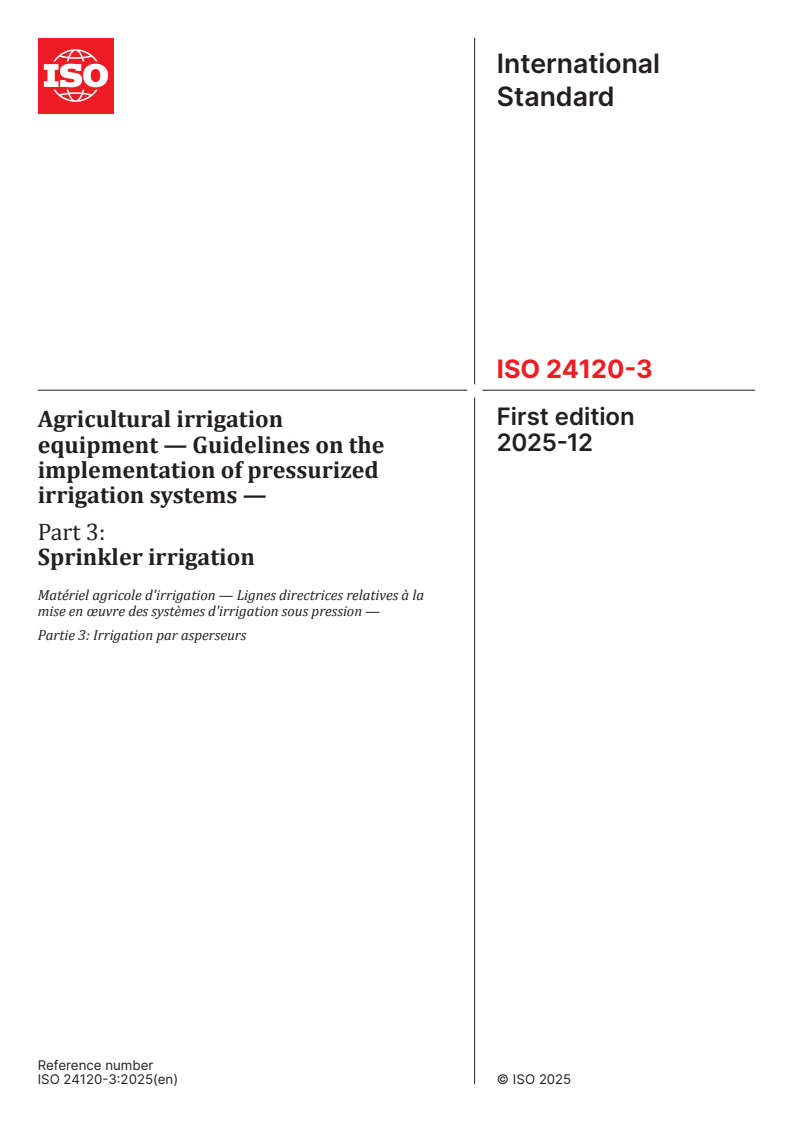
International
Standard
ISO 24120-3
First edition
Agricultural irrigation
2025-12
equipment — Guidelines on the
implementation of pressurized
irrigation systems —
Part 3:
Sprinkler irrigation
Matériel agricole d'irrigation — Lignes directrices relatives à la
mise en œuvre des systèmes d'irrigation sous pression —
Partie 3: Irrigation par asperseurs
Reference number
© ISO 2025
All rights reserved. Unless otherwise specified, or required in the context of its implementation, no part of this publication may
be reproduced or utilized otherwise in any form or by any means, electronic or mechanical, including photocopying, or posting on
the internet or an intranet, without prior written permission. Permission can be requested from either ISO at the address below
or ISO’s member body in the country of the requester.
ISO copyright office
CP 401 • Ch. de Blandonnet 8
CH-1214 Vernier, Geneva
Phone: +41 22 749 01 11
Email: copyright@iso.org
Website: www.iso.org
Published in Switzerland
ii
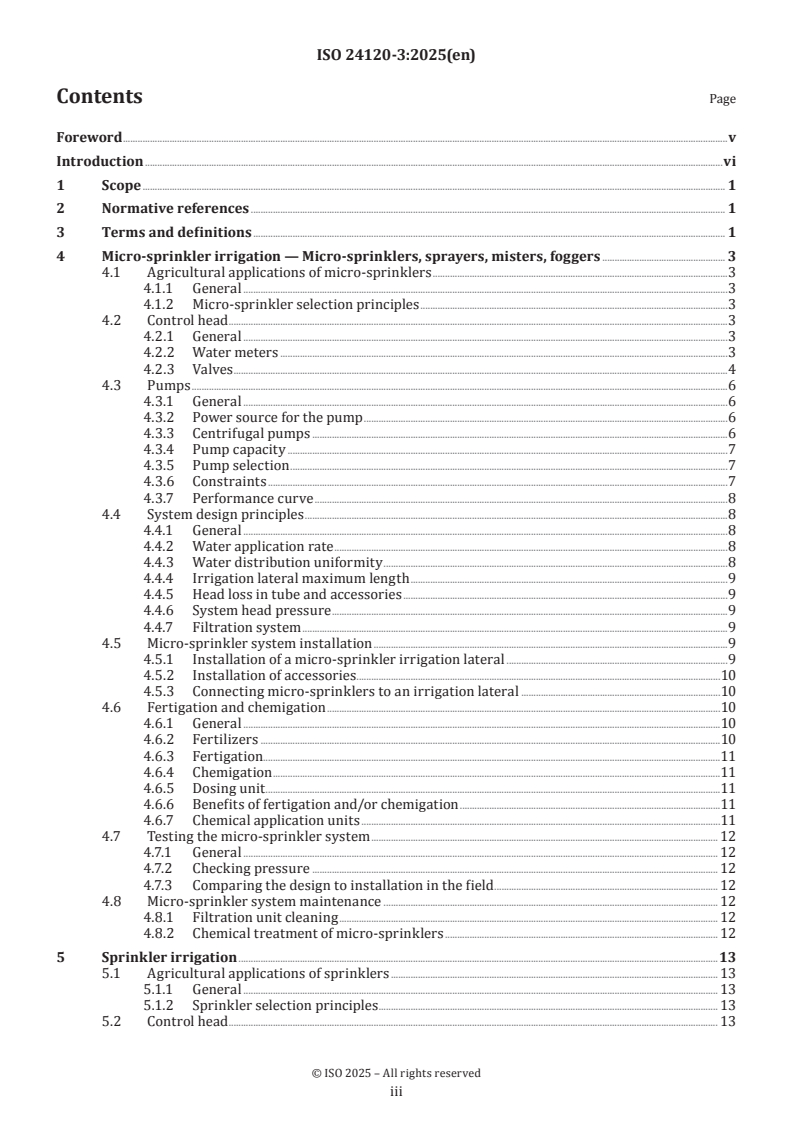
Contents Page
Foreword .v
Introduction .vi
1 Scope . 1
2 Normative references . 1
3 Terms and definitions . 1
4 Micro-sprinkler irrigation — Micro-sprinklers, sprayers, misters, foggers . 3
4.1 Agricultural applications of micro-sprinklers .3
4.1.1 General .3
4.1.2 Micro-sprinkler selection principles .3
4.2 Control head .3
4.2.1 General .3
4.2.2 Water meters .3
4.2.3 Valves .4
4.3 Pumps .6
4.3.1 General .6
4.3.2 Power source for the pump .6
4.3.3 Centrifugal pumps .6
4.3.4 Pump capacity .7
4.3.5 Pump selection .7
4.3.6 Constraints .7
4.3.7 Performance curve .8
4.4 System design principles .8
4.4.1 General .8
4.4.2 Water application rate .8
4.4.3 Water distribution uniformity .8
4.4.4 Irrigation lateral maximum length .9
4.4.5 Head loss in tube and accessories .9
4.4.6 System head pressure .9
4.4.7 Filtration system .9
4.5 Micro-sprinkler system installation .9
4.5.1 Installation of a micro-sprinkler irrigation lateral .9
4.5.2 Installation of accessories .10
4.5.3 Connecting micro-sprinklers to an irrigation lateral .10
4.6 Fertigation and chemigation .10
4.6.1 General .10
4.6.2 Fertilizers .10
4.6.3 Fertigation.11
4.6.4 Chemigation .11
4.6.5 Dosing unit .11
4.6.6 Benefits of fertigation and/or chemigation .11
4.6.7 Chemical application units .11
4.7 Testing the micro-sprinkler system . 12
4.7.1 General . 12
4.7.2 Checking pressure . 12
4.7.3 Comparing the design to installation in the field . 12
4.8 Micro-sprinkler system maintenance . 12
4.8.1 Filtration unit cleaning . 12
4.8.2 Chemical treatment of micro-sprinklers . 12
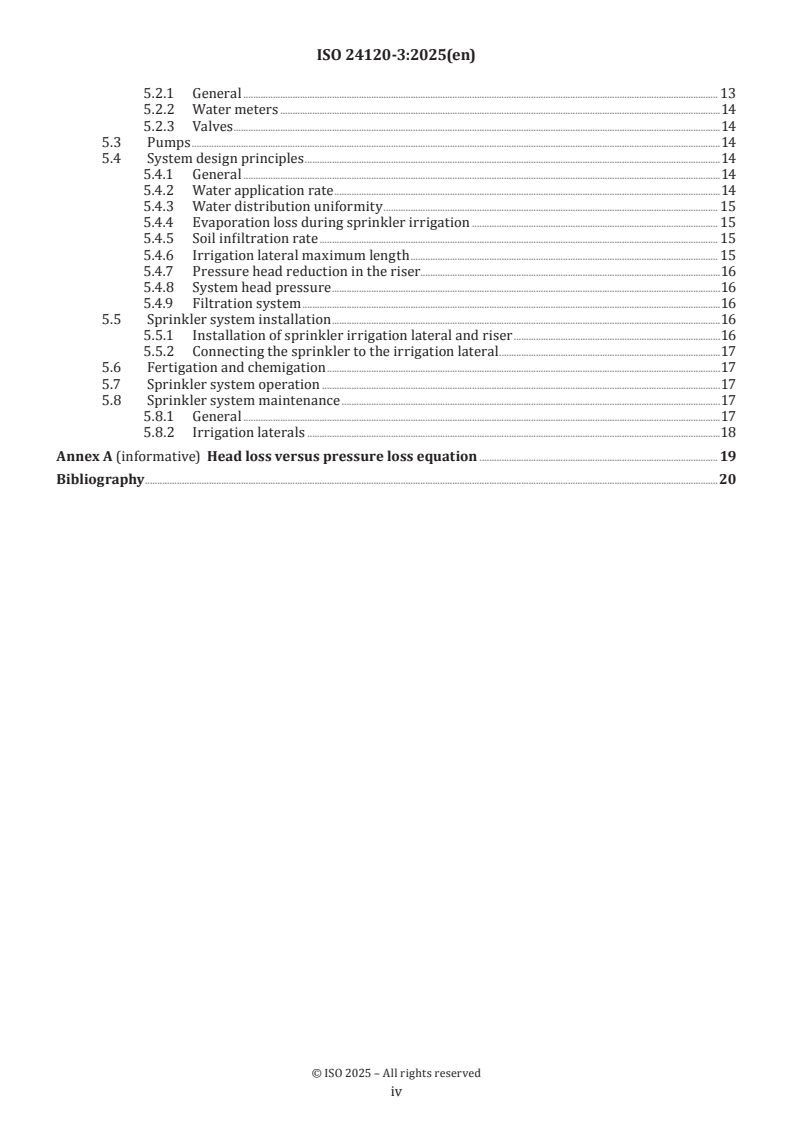
5 Sprinkler irrigation .13
5.1 Agricultural applications of sprinklers . 13
5.1.1 General . 13
5.1.2 Sprinkler selection principles . 13
5.2 Control head . 13
iii
5.2.1 General . 13
5.2.2 Water meters .14
5.2.3 Valves .14
5.3 Pumps .14
5.4 System design principles .14
5.4.1 General .14
5.4.2 Water application rate .14
5.4.3 Water distribution uniformity . 15
5.4.4 Evaporation loss during sprinkler irrigation . 15
5.4.5 Soil infiltration rate . 15
5.4.6 Irrigation lateral maximum length . 15
5.4.7 Pressure head reduction in the riser.16
5.4.8 System head pressure .16
5.4.9 Filtration system .16
5.5 Sprinkler system installation .16
5.5.1 Installation of sprinkler irrigation lateral and riser .16
5.5.2 Connecting the sprinkler to the irrigation lateral .17
5.6 Fertigation and chemigation .17
5.7 Sprinkler system operation .17
5.8 Sprinkler system maintenance .17
5.8.1 General .17
5.8.2 Irrigation laterals .18
Annex A (informative) Head loss versus pressure loss equation . 19
Bibliography .20
iv
Foreword
ISO (the International Organization for Standardization) is a worldwide federation of national standards
bodies (ISO member bodies). The work of preparing International Standards is normally carried out through
ISO technical committees. Each member body interested in a subject for which a technical committee
has been established has the right to be represented on that committee. International organizations,
governmental and non-governmental, in liaison with ISO, also take part in the work. ISO collaborates closely
with the International Electrotechnical Commission (IEC) on all matters of electrotechnical standardization.
The procedures used to develop this document and those intended for its further maintenance are described
in the ISO/IEC Directives, Part 1. In particular, the different approval criteria needed for the different types
of ISO documents should be noted. This document was drafted in accordance with the editorial rules of the
ISO/IEC Directives, Part 2 (see www.iso.org/directives).
ISO draws attention to the possibility that the implementation of this document may involve the use of (a)
patent(s). ISO takes no position concerning the evidence, validity or applicability of any claimed patent
rights in respect thereof. As of the date of publication of this document, ISO had not received notice of (a)
patent(s) which may be required to implement this document. However, implementers are cautioned that
this may not represent the latest information, which may be obtained from the patent database available at
www.iso.org/patents. ISO shall not be held responsible for identifying any or all such patent rights.
Any trade name used in this document is information given for the convenience of users and does not
constitute an endorsement.
For an explanation of the voluntary nature of standards, the meaning of ISO specific terms and expressions
related to conformity assessment, as well as information about ISO's adherence to the World Trade
Organization (WTO) principles in the Technical Barriers to Trade (TBT), see www.iso.org/iso/foreword.html.
This document was prepared by Technical Committee ISO/TC 23, Tractors and machinery for agriculture and
forestry, Subcommittee SC 18, Irrigation and drainage equipment and systems.
A list of all parts in the ISO 24120 series can be found on the ISO website.
Any feedback or questions on this document should be directed to the user’s national standards body.
A complete listing of these bodies can be found at www.iso.org/members.html.
v
Introduction
The dwindling vital natural resources, such as land and water, as well as the rising world population, pose a
constant threat that can develop into a future food and water crisis. Despite the limited availability of water
and land resources, the amount of food grown today needs to be increased to meet the demands of tomorrow.
Reduction of available water for human consumption needs to be addressed. As direct consumption of fresh
water by the population cannot be decreased, the amount of water consumed for agricultural purposes
needs to be reduced, and allocated for domestic or industrial use.
Sprinkler irrigation addresses water scarcity and other environmental considerations. It can significantly
conserve water, compared to flood or furrow irrigation systems. Sprinkler systems allow for precise control
over the amount and timing of water delivery to crops, thereby enhancing application efficiency and crop
yield.
Sprinkler irrigation not only addresses the need to reduce water consumption and increase yield, but also
requires less labour and energy for operation, leading to lower costs to farmers, due to reduced usage of
labour, fertilizers and other chemicals.
Sprinkler irrigation relates to sustainable agriculture issues, and can be used in dry areas, in saline soil with
saline water, and in steep-sloped topographies, where other irrigation methods cannot be practiced without
using pressure compensated units.
Sprinkler irrigation is easy to manage and operate once installed. It is suitable for automation and remote
operation by computer or mobile phone. The system’s simplicity makes it easy to install, operate, maintain
and repair.
Other than irrigation, the sprinkler irrigation method is used also as a delivery system for fertilizers and
other agrochemicals. The sprinkler irrigation’s advantage as a delivery system is its ability to optimize
fertilizer usage, and distribute it just where it is needed - in the root zone, while minimizing its release to the
environment.
Adoption of sprinkler irrigation can help achieve sufficient fresh water availability for domestic use and
sufficient food quantity and quality for reasonable pricing, while increasing farmers’ income through yield
increase and cost reduction, and ensuring food security.
Sprinkler irrigation systems have limitations as well, mainly related to investment costs, runoff, and the
following risks: soil erosion from high water application rates, soil sealing from excessively large droplets,
canopy interception of water droplets, water evaporation, and wind drift of small droplets under severe
weather conditions. Nevertheless, with proper design and operation, these potential drawbacks can be
substantially minimized.
Although information and best practices in irrigation are already available, this document is beneficial, as
it collects, in one single document, all relevant information for the entire system, and does not refer only to
one specific aspect of the system, for example, the product itself.
vi
International Standard ISO 24120-3:2025(en)
Agricultural irrigation equipment — Guidelines on the
implementation of pressurized irrigation systems —
Part 3:
Sprinkler irrigation
1 Scope
This document provides guidelines for the implementation of pressurized sprinkler, micro-sprinkler and
sprayer irrigation systems [hereinafter: system(s)]. It is applicable to both small-scale family agriculture
and large-scale commercial agriculture, in open field or within protected crops structure (e.g., greenhouse,
net-house or tunnel).
This document is intended for the use of agriculture ministries, agronomists, irrigation planners, farmers
and end-users.
This document is not applicable to centre pivots, linear systems, travellers, and side roll sprinkler
irrigation systems.
2 Normative references
There are no normative references in this document.
3 Terms and definitions
For the purposes of this document, the following terms and definitions apply.
ISO and IEC maintain terminology databases for use in standardization at the following addresses:
— ISO Online browsing platform: available at https:// www .iso .org/ obp
— IEC Electropedia: available at https:// www .electropedia .org/
3.1
sprinkler
water distribution device of a variety of sizes and types, for example, impact sprinklers, fixed nozzle,
sprayers and irrigation guns
3.2
micro-sprinkler
sprinkler that distributes water in a dynamic or static way, either in circular area or part circular area, with
a flow rate not exceeding 200 l/h
3.3
sprayer
device that discharges water in the form of fine jets or in a fan shape, with or without rotational movement
of its parts
3.4
riser
upright pipe, which is either rigid or flexible
3.5
irrigation lateral
branch supply line in an irrigation system, on which distribution devices are mounted directly or by means
of fittings, riser, or tubes
[1]
[SOURCE: ISO 15886-3:2021 ]
3.6
riser base
structure that connects a riser and an irrigation lateral
3.7
tube
pipe that connects an irrigation lateral to a sprinkler or a micro-sprinkler
3.8
water application rate
mean depth of water applied per unit time
[SOURCE: ISO 15886-3:2021]
3.9
water distribution uniformity
calculation that expresses the distribution of water in a field
3.9.1
distribution uniformity
DU
coefficient using the lowest 25 % of water application depths to characterize the uniformity of field-measured
or simulated water application from a grid of sprinklers
[2]
[SOURCE: ISO 15886-4:2019 ]
3.9.2
Christiansen's uniformity coefficient
UCC
coefficient using deviations from the mean, to characterize the uniformity of field-measured or simulated
water application from a grid of sprinklers
[SOURCE: ISO 15886-3:2021]
3.9.3
scheduling coefficient
SC
coefficient used to characterize the water application uniformity of sprinklers, employing an analysis of
full-grid test data based on a definition of critical dry area
3.10
soil infiltration rate
rate at which soil absorbs rainfall or irrigation water
3.11
head loss
reduction in total energy of fluid as it flows through a pipeline or any other hydraulic system
Note 1 to entry: See also Annex A.
3.12
pressure loss
difference in pressure, due to water flow, between two specified points in a system or in part of a system
Note 1 to entry: See also Annex A.
[3]
[SOURCE: ISO 9644:2018 ]
3.13
evaporation
process by which water droplets change from liquid state to vapour state
3.14
flow rate
volume of water flowing through a device per unit time
[SOURCE: ISO 15886-3:2021]
4 Micro-sprinkler irrigation — Micro-sprinklers, sprayers, misters, foggers
4.1 Agricultural applications of micro-sprinklers
4.1.1 General
Micro-sprinklers are used for the following applications:
— Applications in orchards – Irrigation, frost mitigation, cooling, crop protection.
— Applications in protected crops, such as greenhouse crops, tunnel crops and net-house crops – Irrigation,
germination, rooting, cooling, humidification, soil preparation, cleaning roof and side nets.
For each application, the adequate device which provides the appropriate performance should be selected
according to the manufacturer's recommendations.
— Micro-sprinklers with relatively small droplet size are used for germination.
— Misters and foggers are used for cooling, humidification and rooting.
4.1.2 Micro-sprinkler selection principles
When selecting a micro-sprinkler, the following should be considered:
— crops' needs;
— soil types;
— farmer's objectives;
— layout of the field;
— topography of the field;
— required field application.
4.2 Control head
4.2.1 General
The control head should include: manual valve, air relief valve, hydraulic valve, water meter, pressure gauge,
pressure regulator, filters, controller, fittings and other components, according to their main function. See
[4]
also ISO 11738 .
4.2.2 Water meters
Water meters provide information on water flow rate, which is essential for irrigation scheduling, and
monitoring micro-sprinkler clogging.
[5]
To detect clogging or leaks in the system, the flow rate should be checked often. See also ISO 16399 .
4.2.3 Valves
4.2.3.1 General
Water flow rate and pressure throughout the system should be precisely controlled to ensure efficient and
timely water application. Therefore, valves should be properly selected and installed.
Valves play key roles in controlling pressure and flow under different conditions, in optimizing performance,
facilitating management, and reducing maintenance requirements.
It is not recommended to use oversized valves – due to reduction in flow velocity, or to use undersized valves
– due to restriction of flow rate and resulting excessive pressure loss.
4.2.3.2 Types of valves used in the system
4.2.3.2.1 Manual control valve
The following common types of manual control valves are used in the system.
a) Ball valve
A ball valve is a quarter-turn valve. In a ball valve, the closing mechanism is a sphere (ball) with a port
through the middle, connected to a lever in line with it that shows the valve's position. Rotating the lever
turns the ball so that when the port is in line with the pipe, flow will occur, and when perpendicular to the
pipe, flow is blocked.
b) Butterfly valve
A butterfly valve is a quarter-turn valve. Its operation is similar to that of a ball valve. The closing mechanism
takes the form of a disc positioned in the centre of the valve. A rod, connected to a lever or a wheel, passes
through the middle of the disc, rotates the lever, turning the disc either parallel or perpendicular to the flow.
Unlike a ball valve, the disc in a butterfly valve is always present within the flow, therefore a slight pressure
drop is always induced in the flow, regardless of valve position.
c) Gate valve
Gate (sluice) valve opens by lifting a gate (wedge) out of the path of the fluid. When the gate valve is fully
open, there is no obstruction in the flow path, resulting in very low friction loss.
The gate valve is designed to be fully opened or closed and may not be used to regulate the flow.
d) Globe valve
The globe valve is operated by screw action using a handwheel, and may be used to regulate the flow or the
pressure with minimum friction loss.
It consists of a movable disc plug aligned with a fixed ring located in the stream.
4.2.3.2.2 Check valve (non-return valve)
4.2.3.2.2.1 General
The function of a check valve is to prevent water flow in the opposite direction to that desired.
It serves various purposes.
— When installed at the outlet of a pump that pumps water to a field at a higher elevation, it protects the
pump from the back wave of water hammer.
— When installed at the outlet of a filter, which conveys water to a higher field, it prevents water from
flowing back through the system's head components.
— In irrigation systems, when installed upstream from a dosing unit, it prevents fertilizers and chemicals
infiltration into the water source.
— When installed on the inlet pipe of a pump, as a foot valve, it enables priming of the inlet pipe.
4.2.3.2.2.2 Backflow prevention valve
Backflow is the undesirable reversal of flow of a liquid into the drinking water supply system. A backflow
preventer is designed to keep this from happening.
Reduced pressure zone backflow preventer (RPZ) is used to prevent water with fertilizers or any other
chemicals from flowing back into the drinking water supply system.
4.2.3.2.3 Hydraulically operated, diaphragm-actuated control valves
Hydraulically operated, diaphragm-actuated control valves may serve different purposes, according to the
layout of the valve's control loop.
The following common types of hydraulically operated, diaphragm-actuated control valves are used in the
system.
a) Hydraulic control valve
Hydraulic control valve opens and shuts off in response to a local or remote pressure command.
b) Pressure reducing valve (PRV)
PRV reduces higher upstream pressure to lower preset downstream pressure, regardless of fluctuating
demand, and opens fully upon line pressure drop. For optimal operation, the pressure ratio across a PRV
should not be higher than 1:4.
c) Pressure sustaining valve
Pressure sustaining valve can fulfil either of two separate functions:
— When installed in-line, it sustains minimum preset upstream pressure, regardless of fluctuating flow or
varying downstream pressure.
— When installed as a circulation valve, it relieves line pressure in excess of preset.
d) Pressure reducing and sustaining valve
Pressure reducing and sustaining valve can fulfil two independent functions at the same time.
It sustains minimum preset upstream pressure, regardless of fluctuating flow or varying downstream
pressure, and it prevents downstream pressure from rising above maximum preset, regardless of fluctuating
flow or excessive upstream pressure.
e) Pressure relief valve
Pressure relief valve relieves excessive line pressure when it rises above the preset maximum. It responds to
a rise in system pressure immediately, accurately and with high repeatability, by opening fully.
f) Surge anticipating valve
Surge anticipating valve is an off-line valve, sensing line pressure. It opens in response to pressure drop
associated with abrupt pump stoppage. The pre-opened valve dissipates the returning high pressure wave,
eliminating surge. This valve also relieves excessive system pressure.
4.2.3.2.4 Booster pump control valve
Booster pump control valve is a double chambered, active check valve, that opens fully or shuts off in
...