

ISO 18250-1:2018
(Main)Medical devices — Connectors for reservoir delivery systems for healthcare applications — Part 1: General requirements and common test methods
General Information
- Abstract
This document specifies general requirements for reservoir connectors, which convey fluids in healthcare applications. These reservoir connectors are used in medical devices or accessories intended for use with a patient. This document also specifies the healthcare fields in which these reservoir connectors are intended to be used. These healthcare fields of use include, but are not limited to, applications for — respiratory, — enteral, — neural, — intravascular, — citrate-based anticoagulant solution, and — irrigation. Reservoir connectors as specified in this document are non-interconnectable with: — the reservoir connectors of every other application specified in the ISO 18250 series; — removable temperature sensor port specified in Annex EE of ISO 80601-2-74:2017; — the nipples specified in Annex B of ISO 17256[1]; unless otherwise specified in the ISO 18250 series. Application parts of the ISO 18250 series can specify additional connectors with which reservoir connectors (as specified in those application parts) are to be non-interconnectable. This document provides the methodology to assess non-interconnectable characteristics of reservoir connectors based on their inherent design and dimensions in order to reduce the risk of misconnections between medical devices or between accessories for different applications. This document does not specify requirements for the medical devices or accessories that use these reservoir connectors. Such requirements are given in particular International Standards for specific medical devices or accessories. NOTE 1 Manufacturers are encouraged to incorporate the reservoir connectors specified in the ISO 18250 series into medical devices, medical systems or accessories, even if currently not required by the relevant particular medical device standards. It is expected that when the relevant particular medical device standards are revised, requirements for reservoir connectors as specified in the series of standards will be included. NOTE 2 The ISO 18250 series does not apply to screw and crown cork caps and necks as they are not connectors specific for medical devices. Examples of screw caps and necks are defined in DIN 55525, ASTM D2911/D2911M, DIN 6063-1, DIN 6063-2, DIN 168-1. Examples of crown cork caps and necks are defined in DIN 6094, ISO 12821, EN 14635. This document also specifies the test methods to verify the common performance requirements for reservoir connectors. The performance requirements for these common test methods are specified in the application parts and not in the general part. [1] Under preparation. Stage at the time of publication: ISO/DIS 17256:2017.
- Status
- Published
- Publication Date
- 02-Dec-2018
- Technical Committee
- ISO/TC 210 - Quality management and corresponding general aspects for medical devices
- Drafting Committee
- ISO/TC 210/WG 5 - Connectors for reservoir delivery systems
- Current Stage
- 9093 - International Standard confirmed
- Start Date
- 25-Jul-2024
- Completion Date
- 29-Aug-2026
Buy Documents


ISO 18250-1:2018 - Medical devices -- Connectors for reservoir delivery systems for healthcare applications

ISO 18250-1:2018 - Medical devices — Connectors for reservoir delivery systems for healthcare applications — Part 1: General requirements and common test methods/3/2018
Overview
ISO 18250-1:2018 - Medical devices - Connectors for reservoir delivery systems for healthcare applications - Part 1: General requirements and common test methods - defines general requirements and common test methods for reservoir connectors that convey fluids in healthcare settings. The standard establishes a methodology to assess non-interconnectable characteristics (by design and dimensions) to reduce the risk of misconnections between medical devices or accessories used with patients. It covers intended fields such as respiratory, enteral, neural, intravascular, citrate-based anticoagulant solution and irrigation.
Key topics and technical requirements
- Non-interconnectability: Reservoir connectors specified here are required to be non-interconnectable with connectors of other application categories in the ISO 18250 series, and with certain other connector types referenced in related standards, unless otherwise stated in application parts.
- Materials and testing: General guidance on materials for reservoir connectors and alternative test methods; materials must support intended use and safety.
- Common performance tests: The standard defines test methods (in normative annexes) for verifying performance characteristics, while the specific pass/fail performance criteria are provided in the relevant application parts. Common mechanical and leakage tests include:
- Positive-pressure liquid leakage
- Sub-atmospheric-pressure air leakage
- Stress-cracking
- Resistance to separation from axial load
- Resistance to separation from unscrewing
- Resistance to overriding
- Disconnection by unscrewing for certain screw-thread locking designs
- Test method documentation: Annexes B–I provide normative test procedures; Annexes A, J–L provide rationale, statistical modifications, examples and alternative methods.
Practical applications
- Reduces risk of wrong-route administration and misconnections between infusion reservoirs, giving sets, bag ports, and accessories.
- Applied in design and validation of reservoir connectors for:
- Respiratory humidifiers and circuits
- Enteral feeding systems
- Neural delivery reservoirs
- Intravascular infusion/tubing sets
- Apheresis systems (citrate anticoagulant reservoirs)
- Irrigation fluid reservoirs
- Useful for manufacturers when designing or retrofitting reservoir connectors to meet recognized safety and interoperability expectations.
Who should use this standard
- Medical device and accessory manufacturers (design, validation and regulatory submissions)
- Test laboratories performing connector conformity testing
- Regulatory bodies and standards committees
- Healthcare procurement and clinical engineering teams concerned with patient safety and device compatibility
Related standards and references
- ISO 18250 application parts (e.g., Part 3 enteral, Part 6 neural, Part 7 intravascular, Part 8 citrate-based anticoagulant)
- ISO 14971 (risk management), IEC 62366-1 (usability)
- ISO 80601-2-74 (respiratory equipment references)
Adopting ISO 18250-1:2018 supports safer connector design and helps minimize misconnections across healthcare fluid delivery systems.
Buy Documents
ISO 18250-1:2018 - Medical devices -- Connectors for reservoir delivery systems for healthcare applications
ISO 18250-1:2018 - Medical devices — Connectors for reservoir delivery systems for healthcare applications — Part 1: General requirements and common test methods/3/2018
Get Certified
Connect with accredited certification bodies for this standard

BSI Group
BSI (British Standards Institution) is the business standards company that helps organizations make excellence a habit.

TÜV Rheinland
TÜV Rheinland is a leading international provider of technical services.

TÜV SÜD
TÜV SÜD is a trusted partner of choice for safety, security and sustainability solutions.
Sponsored listings
Frequently Asked Questions
ISO 18250-1:2018 is a standard published by the International Organization for Standardization (ISO). Its full title is "Medical devices — Connectors for reservoir delivery systems for healthcare applications — Part 1: General requirements and common test methods". This standard covers: This document specifies general requirements for reservoir connectors, which convey fluids in healthcare applications. These reservoir connectors are used in medical devices or accessories intended for use with a patient. This document also specifies the healthcare fields in which these reservoir connectors are intended to be used. These healthcare fields of use include, but are not limited to, applications for — respiratory, — enteral, — neural, — intravascular, — citrate-based anticoagulant solution, and — irrigation. Reservoir connectors as specified in this document are non-interconnectable with: — the reservoir connectors of every other application specified in the ISO 18250 series; — removable temperature sensor port specified in Annex EE of ISO 80601-2-74:2017; — the nipples specified in Annex B of ISO 17256[1]; unless otherwise specified in the ISO 18250 series. Application parts of the ISO 18250 series can specify additional connectors with which reservoir connectors (as specified in those application parts) are to be non-interconnectable. This document provides the methodology to assess non-interconnectable characteristics of reservoir connectors based on their inherent design and dimensions in order to reduce the risk of misconnections between medical devices or between accessories for different applications. This document does not specify requirements for the medical devices or accessories that use these reservoir connectors. Such requirements are given in particular International Standards for specific medical devices or accessories. NOTE 1 Manufacturers are encouraged to incorporate the reservoir connectors specified in the ISO 18250 series into medical devices, medical systems or accessories, even if currently not required by the relevant particular medical device standards. It is expected that when the relevant particular medical device standards are revised, requirements for reservoir connectors as specified in the series of standards will be included. NOTE 2 The ISO 18250 series does not apply to screw and crown cork caps and necks as they are not connectors specific for medical devices. Examples of screw caps and necks are defined in DIN 55525, ASTM D2911/D2911M, DIN 6063-1, DIN 6063-2, DIN 168-1. Examples of crown cork caps and necks are defined in DIN 6094, ISO 12821, EN 14635. This document also specifies the test methods to verify the common performance requirements for reservoir connectors. The performance requirements for these common test methods are specified in the application parts and not in the general part. [1] Under preparation. Stage at the time of publication: ISO/DIS 17256:2017.
This document specifies general requirements for reservoir connectors, which convey fluids in healthcare applications. These reservoir connectors are used in medical devices or accessories intended for use with a patient. This document also specifies the healthcare fields in which these reservoir connectors are intended to be used. These healthcare fields of use include, but are not limited to, applications for — respiratory, — enteral, — neural, — intravascular, — citrate-based anticoagulant solution, and — irrigation. Reservoir connectors as specified in this document are non-interconnectable with: — the reservoir connectors of every other application specified in the ISO 18250 series; — removable temperature sensor port specified in Annex EE of ISO 80601-2-74:2017; — the nipples specified in Annex B of ISO 17256[1]; unless otherwise specified in the ISO 18250 series. Application parts of the ISO 18250 series can specify additional connectors with which reservoir connectors (as specified in those application parts) are to be non-interconnectable. This document provides the methodology to assess non-interconnectable characteristics of reservoir connectors based on their inherent design and dimensions in order to reduce the risk of misconnections between medical devices or between accessories for different applications. This document does not specify requirements for the medical devices or accessories that use these reservoir connectors. Such requirements are given in particular International Standards for specific medical devices or accessories. NOTE 1 Manufacturers are encouraged to incorporate the reservoir connectors specified in the ISO 18250 series into medical devices, medical systems or accessories, even if currently not required by the relevant particular medical device standards. It is expected that when the relevant particular medical device standards are revised, requirements for reservoir connectors as specified in the series of standards will be included. NOTE 2 The ISO 18250 series does not apply to screw and crown cork caps and necks as they are not connectors specific for medical devices. Examples of screw caps and necks are defined in DIN 55525, ASTM D2911/D2911M, DIN 6063-1, DIN 6063-2, DIN 168-1. Examples of crown cork caps and necks are defined in DIN 6094, ISO 12821, EN 14635. This document also specifies the test methods to verify the common performance requirements for reservoir connectors. The performance requirements for these common test methods are specified in the application parts and not in the general part. [1] Under preparation. Stage at the time of publication: ISO/DIS 17256:2017.
ISO 18250-1:2018 is classified under the following ICS (International Classification for Standards) categories: 11.040.25 - Syringes, needles an catheters. The ICS classification helps identify the subject area and facilitates finding related standards.
ISO 18250-1:2018 is available in PDF format for immediate download after purchase. The document can be added to your cart and obtained through the secure checkout process. Digital delivery ensures instant access to the complete standard document.
Standards Content (Sample)
INTERNATIONAL ISO
STANDARD 18250-1
First edition
2018-12
Medical devices — Connectors
for reservoir delivery systems for
healthcare applications —
Part 1:
General requirements and common
test methods
Dispositifs médicaux — Connecteurs pour systèmes de livraison de
réservoir pour des applications de soins de santé —
Partie 1: Exigences générales et méthodes d'essai courantes
Reference number
©
ISO 2018
© ISO 2018
All rights reserved. Unless otherwise specified, or required in the context of its implementation, no part of this publication may
be reproduced or utilized otherwise in any form or by any means, electronic or mechanical, including photocopying, or posting
on the internet or an intranet, without prior written permission. Permission can be requested from either ISO at the address
below or ISO’s member body in the country of the requester.
ISO copyright office
CP 401 • Ch. de Blandonnet 8
CH-1214 Vernier, Geneva
Phone: +41 22 749 01 11
Fax: +41 22 749 09 47
Email: copyright@iso.org
Website: www.iso.org
Published in Switzerland
ii © ISO 2018 – All rights reserved
Contents Page
Foreword .iv
Introduction .vi
1 *Scope . 1
2 Normative references . 2
3 Terms and definitions . 2
4 Materials used for reservoir connectors . 4
4.1 *General . 4
4.2 Alternative test methods . 4
5 *Requirements for reservoir connectors for specific applications .4
5.1 *Reservoir connector incompatibility . 4
5.2 Enteral applications . 5
5.3 Neural applications . 5
5.4 Intravascular applications . 5
5.5 Citrate-based anticoagulant solution for apheresis applications . 5
6 *reservoir connectors for applications not already covered in the ISO 18250 series .5
7 *Performance requirements . 5
7.1 Leakage . 5
7.1.1 Positive-pressure liquid leakage . 5
7.1.2 Sub atmospheric pressure air leakage . 6
7.2 Stress-cracking . 6
7.3 Resistance to separation from axial load. 6
7.4 Resistance to separation from unscrewing . 6
7.5 Resistance to overriding . 6
7.6 Disconnection by unscrewing for floating or rotating screw-thread locking
connectors and locking connectors with fixed threads . 6
Annex A (informative) Rationale and guidance . 7
Annex B (normative) test methods for demonstrating non-interconnectable characteristics .14
Annex C (normative) *Positive pressure liquid leakage test method .28
Annex D (normative) *Sub-atmospheric-pressure air leakage test method .31
Annex E (normative) *Stress cracking test method .35
Annex F (normative) *Resistance to separation from axial load test method .37
Annex G (normative) *Resistance to separation from unscrewing test method .39
Annex H (normative) *Resistance to overriding test method .41
Annex I (normative) *Disconnection by unscrewing test method for floating or rotating
screw-thread locking connectors and locking connectors with fixed threads .43
Annex J (informative) *Modification of the test methods to generate variable data for
statistical analysis .45
Annex K (informative) Examples of medical devices on which reservoir connectors may
be used for each application category .48
Annex L (informative) Alternative mechanical test methods .49
Bibliography .50
Terminology — Alphabetical index of defined terms .52
Foreword
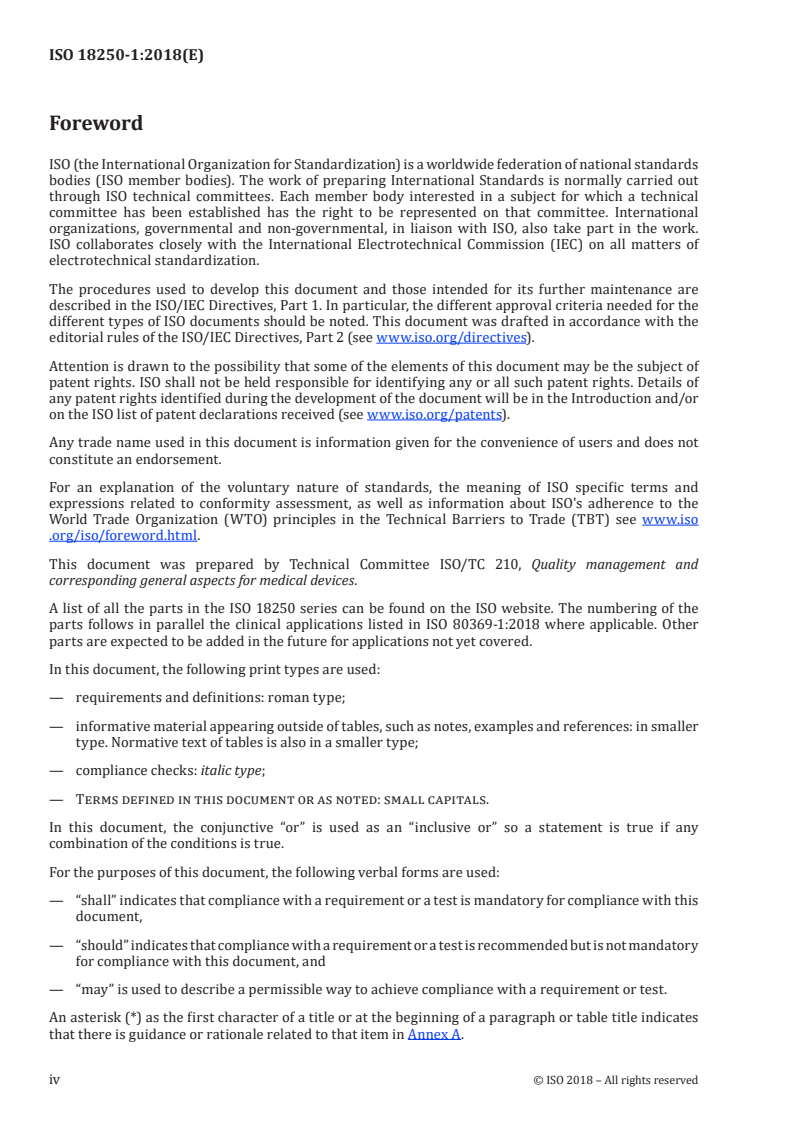
ISO (the International Organization for Standardization) is a worldwide federation of national standards
bodies (ISO member bodies). The work of preparing International Standards is normally carried out
through ISO technical committees. Each member body interested in a subject for which a technical
committee has been established has the right to be represented on that committee. International
organizations, governmental and non-governmental, in liaison with ISO, also take part in the work.
ISO collaborates closely with the International Electrotechnical Commission (IEC) on all matters of
electrotechnical standardization.
The procedures used to develop this document and those intended for its further maintenance are
described in the ISO/IEC Directives, Part 1. In particular, the different approval criteria needed for the
different types of ISO documents should be noted. This document was drafted in accordance with the
editorial rules of the ISO/IEC Directives, Part 2 (see www .iso .org/directives).
Attention is drawn to the possibility that some of the elements of this document may be the subject of
patent rights. ISO shall not be held responsible for identifying any or all such patent rights. Details of
any patent rights identified during the development of the document will be in the Introduction and/or
on the ISO list of patent declarations received (see www .iso .org/patents).
Any trade name used in this document is information given for the convenience of users and does not
constitute an endorsement.
For an explanation of the voluntary nature of standards, the meaning of ISO specific terms and
expressions related to conformity assessment, as well as information about ISO's adherence to the
World Trade Organization (WTO) principles in the Technical Barriers to Trade (TBT) see www .iso
.org/iso/foreword .html.
This document was prepared by Technical Committee ISO/TC 210, Quality management and
corresponding general aspects for medical devices.
A list of all the parts in the ISO 18250 series can be found on the ISO website. The numbering of the
parts follows in parallel the clinical applications listed in ISO 80369-1:2018 where applicable. Other
parts are expected to be added in the future for applications not yet covered.
In this document, the following print types are used:
— requirements and definitions: roman type;
— informative material appearing outside of tables, such as notes, examples and references: in smaller
type. Normative text of tables is also in a smaller type;
— compliance checks: italic type;
— Terms defined in this document or as noted: small capitals.
In this document, the conjunctive “or” is used as an “inclusive or” so a statement is true if any
combination of the conditions is true.
For the purposes of this document, the following verbal forms are used:
— “shall” indicates that compliance with a requirement or a test is mandatory for compliance with this
document,
— “should” indicates that compliance with a requirement or a test is recommended but is not mandatory
for compliance with this document, and
— “may” is used to describe a permissible way to achieve compliance with a requirement or test.
An asterisk (*) as the first character of a title or at the beginning of a paragraph or table title indicates
that there is guidance or rationale related to that item in Annex A.
iv © ISO 2018 – All rights reserved
Any feedback or questions on this document should be directed to the user’s national standards body. A
complete listing of these bodies can be found at www .iso .org/members .html.
Introduction
During the development of the ISO 80369 series of standards for small-bore connectors, it became
evident that equally important were the connections between medical devices and fluid reservoirs.
It was agreed that such connectors should be developed in parallel with the small-bore connectors
specified in the ISO 80369 series of standards and comply with analogous safety and interoperability
requirements.
ISO 16142-1:2016, Clause 4 addresses this type of problem.
The solutions adopted by the manufacturer for the design and manufacture of the medical device
should conform to safety principles, taking into account the generally acknowledged state of the
art. When risk reduction is required, the manufacturer should control the risks so that the residual
risk associated with each hazard is judged acceptable. The manufacturer should apply the following
principles in the priority order listed:
a) identify known or foreseeable hazards and estimate the associated risks arising from the
intended use and foreseeable misuse;
b) eliminate risks as far as reasonably practicable through inherently safe design and manufacture;
c) reduce as far as reasonably practicable the remaining risks by taking adequate protection
measures, including alarms or information for safety;
d) inform users of any residual risk.
It was soon realized that many of the reservoirs that contain liquids for administering to patients for
different applications all utilized the same ubiquitous spike as the connector between the giving set
and the reservoir leading to wrong drug administration. The ISO 18250 series endeavours to provide
unique designs for each of the applications specified to reduce the risk of administering the wrong
drug. It is understood that reservoir connector systems cannot be designed to overcome all chances
of misconnection or to eliminate deliberate misuse. However, a number of steps that would improve the
current situation and lead to greater patient safety can be taken. This will only be achieved through
a long-term commitment involving industry, healthcare professionals, medical device purchasers and
medical device regulatory authorities.
The ISO 18250 series specifies the requirements to prevent misconnection between reservoir
connectors used in different applications. This document specifies the general requirements and
test methods common to all reservoir connectors in this series. Test methods that are specific
to a particular reservoir connector will be included in that application part. The ISO 18250 series
specifies the requirements to prevent misconnections or reduce their occurrence to acceptable levels
between reservoir connectors used in different applications.
vi © ISO 2018 – All rights reserved
INTERNATIONAL STANDARD ISO 18250-1:2018(E)
Medical devices — Connectors for reservoir delivery
systems for healthcare applications —
Part 1:
General requirements and common test methods
1 *Scope
This document specifies general requirements for reservoir connectors, which convey fluids in
healthcare applications. These reservoir connectors are used in medical devices or accessories
intended for use with a patient.
This document also specifies the healthcare fields in which these reservoir connectors are intended
to be used.
These healthcare fields of use include, but are not limited to, applications for
— respiratory,
— enteral,
— neural,
— intravascular,
— citrate-based anticoagulant solution, and
— irrigation.
Reservoir connectors as specified in this document are non-interconnectable with:
— the reservoir connectors of every other application specified in the ISO 18250 series;
— removable temperature sensor port specified in Annex EE of ISO 80601-2-74:2017;
1)
— the nipples specified in Annex B of ISO 17256 ;
unless otherwise specified in the ISO 18250 series.
Application parts of the ISO 18250 series can specify additional connectors with which reservoir
connectors (as specified in those application parts) are to be non-interconnectable.
This document provides the methodology to assess non-interconnectable characteristics of
reservoir connectors based on their inherent design and dimensions in order to reduce the risk of
misconnections between medical devices or between accessories for different applications.
This document does not specify requirements for the medical devices or accessories that use these
reservoir connectors. Such requirements are given in particular International Standards for specific
medical devices or accessories.
NOTE 1 Manufacturers are encouraged to incorporate the reservoir connectors specified in the
ISO 18250 series into medical devices, medical systems or accessories, even if currently not required by the
relevant particular medical device standards. It is expected that when the relevant particular medical device
standards are revised, requirements for reservoir connectors as specified in the series of standards will be
included.
1) Under preparation. Stage at the time of publication: ISO/DIS 17256:2017.
NOTE 2 The ISO 18250 series does not apply to screw and crown cork caps and necks as they are not
connectors specific for medical devices. Examples of screw caps and necks are defined in DIN 55525,
ASTM D2911/D2911M, DIN 6063-1, DIN 6063-2, DIN 168-1. Examples of crown cork caps and necks are defined
in DIN 6094, ISO 12821, EN 14635.
This document also specifies the test methods to verify the common performance requirements for
reservoir connectors. The performance requirements for these common test methods are specified
in the application parts and not in the general part.
2 Normative references
The following documents are referred to in the text in such a way that some or all of their content
constitutes requirements of this document. For dated references, only the edition cited applies. For
undated references, the latest edition of the referenced document (including any amendments) applies.
ISO 527-1, Plastics — Determination of tensile properties — Part 1: General principles
ISO 527-2, Plastics — Determination of tensile properties — Part 2: Test conditions for moulding and
extrusion plastics
ISO 178, Plastics — Determination of flexural properties
ISO 14971:2007, Medical devices — Application of risk management to medical devices
2)
ISO 17256 , Anaesthetic and respiratory equipment — Respiratory therapy tubing and connectors
ISO 18250-3, Medical devices — Connectors for reservoir delivery systems for healthcare applications —
Part 3: Enteral applications
3)
ISO 18250-6 , Medical devices — Connectors for reservoir delivery systems for healthcare applications —
Part 6: Neural applications
4)
ISO 18250-7 , Medical devices — Connectors for reservoir delivery systems for healthcare applications —
Part 7: Intravascular applications
ISO 18250-8, Medical devices — Connectors for reservoir delivery systems for healthcare applications —
Part 8: Citrate-based anticoagulant solution for apheresis applications
ISO 80601-2-74:2017, Medical electrical equipment — Part 2-74: Particular requirements for basic safety
and essential performance of respiratory humidifying equipment
IEC 62366-1, Medical devices — Part 1: Application of usability engineering to medical devices
3 Terms and definitions
For the purposes of this document, the terms and definitions given in ISO 14971, IEC 62366-1, and the
following apply.
ISO and IEC maintain terminological databases for use in standardization at the following addresses:
— ISO Online browsing platform: available at https: //www .iso .org/obp
— IEC Electropedia: available at http: //www .electropedia .org/
2) Under preparation. Stage at the time of publication: ISO/DIS 17256:2017.
3) Under preparation. Stage at the time of publication: ISO/DIS 18250-6:2018.
4) Under preparation. Stage at the time of publication: ISO/FDIS 18250-7:2018.
2 © ISO 2018 – All rights reserved
3.1
accessory
additional part(s) for use with medical device in order to:
— achieve the intended use,
— adapt it to some special use,
— facilitate its use,
— enhance its performance, or
— enable its functions to be integrated with those of other medical devices
[SOURCE: IEC 60601-1:2005, definition 3.3, modified — “equipment” has been replaced with
medical device]
3.2
application
specific healthcare field in which a reservoir connector is intended to be used
[SOURCE: ISO 80369-1:2018, 3.2, modified — “small-bore connector” has been replaced with
“reservoir connector”]
Note 1 to entry: Annex K lists reservoir connector applications and gives examples of the medical devices
used within that healthcare field.
3.3
connection
union or joining of mating halves of a connector
[SOURCE: ISO 80369-1:2018, 3.3]
3.4
connector
mechanical device, consisting of one of two mating halves and designed to join a conduit to convey
liquids or gases
[SOURCE: ISO 80369-1:2018, 3.4]
Note 1 to entry: This term refers to both mating halves of the connection and applies to both the mechanical
devices on the reservoir side and patient side.
3.5
misconnection
connection between connectors intended for different applications or from different designs within
the same application and not intended to connect
3.6
non-interconnectable
having characteristics which incorporate geometries or other characteristics that prevent different
connectors from making a connection
[SOURCE: ISO 80369-1:2018, 3.10]
3.7
patient
person undergoing a medical, surgical or dental procedure
[SOURCE: IEC 60601-1:2005, definition 3.76, modified — “person or animal” has been replaced by
“person”]
3.8
reservoir
fluid container within medical device field
3.9
test method
procedure that produces a test result
4 Materials used for reservoir connectors
4.1 *General
To verify the misconnection requirements specified in this document, reservoir connectors shall be
made of materials with a modulus of elasticity either in tension or in flexure of at least 700 MPa, unless
otherwise specified in specific application parts of the ISO 18250 series.
Check compliance in accordance with ISO 527-1 and ISO 527-2 or ISO 178 at (23 ± 2) °C temperature and
(50 ± 5) % relative humidity.
Non-rigid materials are allowed in order to provide sealing surfaces or other performance
characteristics whereas they do not affect non-interconnectable characteristics, or unless otherwise
specified in specific application parts of the ISO 18250 series.
Manufacturers shall demonstrate that, when non-rigid materials are introduced in the design, the
non-interconnectable characteristics are not affected.
NOTE The test methods listed in Annex L are considered acceptable alternatives to ISO 527-1 and ISO 527-2,
and ISO 178.
4.2 Alternative test methods
Manufacturers may use alternative test methods to those listed in Annex L if it can be demonstrated
that they are technically equivalent to ISO 527-1 and ISO 527-2 or ISO 178 within the typical uncertainty
range of the mechanical properties of the plastics used.
In cases of dispute, the test methods listed in this document shall be identified as the reference test
methods.
Check compliance by inspection of the technical file.
5 *Requirements for reservoir connectors for specific applications
5.1 *Reservoir connector incompatibility
Reservoir connectors for applications specified in this document shall be non-
interconnectable with:
— the reservoir connectors of every other application specified in the ISO 18250 series;
— the defined surfaces of nipples of ISO 17256;
— the defined surfaces of temperature sensors and mating ports made in compliance with Annex EE
of ISO 80601-2-74:2017;
unless otherwise indicated in this document or the application parts of the ISO 18250 series.
Check compliance by confirming that objective evidence verifies that risks have been reduced to
acceptable levels for the acceptability criteria specified in Annex B.
4 © ISO 2018 – All rights reserved
5.2 Enteral applications
Reservoir connectors intended to be used for connections in enteral applications shall comply
with ISO 18250-3, unless the use of these connectors creates an unacceptable risk for a specific
medical device.
5.3 Neural applications
Reservoir connectors intended to be used for connections in neural applications shall comply
with ISO 18250-6, unless the use of these connectors creates an unacceptable risk for a specific
medical device.
5.4 Intravascular applications
Reservoir connectors intended to be used for connections in intravascular applications shall
comply with ISO 18250-7, unless the use of these connectors creates an unacceptable risk for a
specific medical device.
5.5 Citrate-based anticoagulant solution for apheresis applications
Reservoir connectors intended to be used for connections in citrate-based anticoagulant solution
for apheresis applications shall comply with ISO 18250-8, unless the use of these connectors creates
an unacceptable risk for a specific medical device.
6 *reservoir connectors for applications not already covered in the
ISO 18250 series
reservoir connectors for applications other than those specified in 5.2, 5.3, 5.4 and 5.5 shall:
a) comply with Clause 4, 5.1 and Clause 7;
b) not create an unacceptable risk for a specific medical device or accessory; and
c) be evaluated in accordance with Annex B.
Check compliance by confirming that objective evidence verifies that risks have been reduced to acceptable
levels for the acceptability criteria specified in Annex B and other acceptability criteria established by the
manufacturer for non-interconnectable characteristics.
Connectors that satisfy the requirements of this clause are identified as compliant with “Clause 6 of
any of the application parts of the ISO 18250 series.
7 *Performance requirements
7.1 Leakage
7.1.1 Positive-pressure liquid leakage
There shall be no leakage from the reservoir connector sufficient to form a falling drop when
subjected to a pressure of (50 ± 10) kPa within a period of 30 s.
Check compliance using the test method specified in Annex C.
7.1.2 Sub atmospheric pressure air leakage
There shall be no leakage of air through the reservoir connector at a sub-atmospheric pressure of
(40 ± 0,1) kPa.
Check compliance using the test method specified in Annex D.
7.2 Stress-cracking
Reservoir connectors shall show no signs of stress-cracking when subjected to an axial connection
force of (27,5 ± 1) N at a torque of (0,12 ± 0,02) N·m, an axial disconnection force of (35 ± 1) N and an
internal pressure of (50 ± 1) kPa.
Check compliance using the test method specified in Annex E.
7.3 Resistance to separation from axial load
Reservoir connectors shall not separate when subjected to an axial disconnection force of less
than 35 N.
Check compliance using the test method specified in Annex F.
7.4 Resistance to separation from unscrewing
Reservoir connectors shall not separate when subjected to a disconnection torque of less than
0,12 N·m.
Check compliance using the test method specified in Annex G.
7.5 Resistance to overriding
Reservoir connectors shall not override any threads or locking features when subjected to an applied
torque of 35 N·m.
Check compliance using the test method specified in Annex H.
7.6 Disconnection by unscrewing for floating or rotating screw-thread locking
connectors and locking connectors with fixed threads
Reservoir connectors shall become detached when an unscrewing torque of 0,25 N·m is applied.
Check compliance using the test method specified in Annex I.
The test methods may be referenced fully, in part, or not at all in the individual application parts of
the ISO 18250 series.
6 © ISO 2018 – All rights reserved
Annex A
(informative)
Rationale and guidance
A.1 General
This annex provides rationale for the important requirements of this document and is intended for those
who are familiar with the subject of this document but who have not participated in its development.
An understanding of the reasons for the main requirements is considered to be essential for its proper
application. Furthermore, as clinical practice and technology change, it is believed that rationale for the
present requirements will facilitate any revision of this document necessitated by those developments.
A.2 Rationale for particular clauses and subclauses
The clauses and subclauses in this annex have been numbered to correspond to the numbering of
the clauses and subclauses of this document to which they refer. The numbering is, therefore, not
consecutive.
Clause 1 Scope
Advances in modern medicine have led to a significant rise in the number of medical devices attached
to patients. Many of these medical devices fall into the categories of monitoring devices, diagnostic
devices and drug delivery devices.
Such medical devices perform a variety of similar, but not interchangeable, functions. Examples
include: intravenous and neural fluid delivery, and enteral feeding. Despite the varied nature of the
functions performed, many of these medical devices use a universal system of reservoir connectors
based on the closure-piercing device defined in ISO 1135-4 and ISO 8536-4.
The universal nature of the connectors used, and the proximity of several different connectors
around a single patient, makes accidental misconnections inevitable. The consequences of such
misconnections vary but a significant number is actually or potentially fatal.
Serious and usually fatal misconnections include intravenous injection of enteral feeds and intrathecal
administration of e.g. vincristine. Less disastrous misconnections such as enteral administration of
intravenous fluids might not directly harm the patient but cause a failure of the intended treatment.
Introducing the ISO 18250 series of standards for reservoir connectors alongside the ISO 80369
series of small bore connectors will help to reduce the likelihood of misconnections and incorrect
administration of fluids leading to a direct improvement in patient safety.
Subclause 4.1 General
The modulus of elasticity (MoE) of 700 MPa was chosen as the minimum as this is considered to be
the worst-case scenario for the sort of materials likely to be used for reservoir connectors. If the
connectors comply with the misconnection and the performance requirements specified in this
document using material with this MoE, then devices made from more rigid materials are also expected
to comply with the requirements and reduce the possibility of forcing, beyond a reasonable detection
threshold, a fit between reservoir connectors from different applications made from flexible
materials.
Non-rigid materials can be used for components such as gaskets as long as they do not affect the
non-interconnectability characteristics of the reservoir connector. In addition, it provides the
possibility for rubber portions in connectors like the closures for intravascular infusion bottles in
case these connectors will be included in the framework of the ISO 18250 series.
The definition of material stiffness is based upon the value of the Young’s modulus. As many standard
and non-standard test methods have been developed in order to estimate this value, it was decided to
refer to the mechanical test methods given in ISO 527-1, ISO 527-2 and ISO 178, while allowing the use
of different methods considered to be technically equivalent. Annex L provides a list of these equivalent
test methods that may be used providing results applicable for the purpose of this document within
the typical uncertainties on the mechanical properties of plastics.
The different values obtained from these various tests are considered to fall within acceptable limits
for the model approximations and raw material variability. Since the standard test methods refer
to standard specimen that cannot represent the effective behaviour of the material after processing,
4.2 allows the manufacturers to set specific test methods for the estimate of the effective Young’s
modulus, provided that manufacturers can produce objective evidence of the reliability of the
methods.
The adoption of rigid materials is regarded as a minimal necessary condition for reduction of
misconnections. First, because it is not sufficient for a final assessment as it cannot univocally describe
the mechanical behaviour of plastic materials even in a rough approximation of the linear elastic range.
Second, because the model approximations that underlie the standard test methods are often not
accurate, neglecting phenomena like plastic and viscoelastic behaviour that may occur in reality during
a misconnection attempt.
Different test methods can be used to estimate the Young's modulus of these materials and may
produce slightly different values. Thus materials whose modulus is close to 700 MPa may be reported
as above or below that threshold depending on the method used. For the purposes of this document,
as long as one of the referenced methods provides a result above the threshold, that will be taken as
sufficient evidence to assess compliance with the appropriate clause. This can be considered acceptable
provided that the adoption of rigid materials is regarded as a minimal necessary condition for reduction
of misconnections.
Clause 5 Requirements for reservoir connectors for specific applications
National regulatory bodies, hospital accreditation organizations, and independent public health
organizations recognize misconnections as a persistent problem with potentially fatal consequences.
Warnings have been issued and strategies offered for healthcare organizations to reduce risks and
manufacturers to redesign connectors to prevent misconnections. The ability of connectors used
to interconnect is identified as a root cause of misconnections.
Reference [5] identifies the problem of unintended connection, with sometimes fatal consequences,
when using the same connector on devices used for different applications and recommended
restricting the use of Luer connectors to hypodermic and vascular applications. The ISO 80369 series
has addressed this problem. Reservoir connectors have a similar issue in that the spike has become
ubiquitous and has led to unintended connections to the wrong reservoir with fatal consequences
for the patient. This document, by developing unique reservoir connectors for each of the identified
applications, attempts to address this problem.
Clause 5 provides the requirements for reservoir connectors based upon the application categories
specified in 5.2 to 5.5. Minimal requirements including verifiable acceptability criteria are established
to reduce the risk of misconnection. The purpose is to make the risk of misconnection acceptably low
by ensuring that halves of incompatible connectors are non-interconnectable. Objective evidence
is required that the criteria are met for the risk of misconnection for these criteria to be acceptable.
The requirements are not comprehensive. Additional requirements and criteria for other non-
interconnectable characteristics may be needed to reduce the risk of incompatible misconnections
to acceptable levels. This circumstance is acknowledged in this document by requiring that all risk
acceptability criteria applicable to non-interconnectable characteristics be met.
8 © ISO 2018 – All rights reserved
The adoption of connectors different from the ones defined by the application parts of the ISO 18250
series for applications already covered by this series of standards is not allowed within the conceptual
framework of the ISO 18250 series of standards.
Subclause 5.1 Reservoir connector incompatibility
The respiratory therapy tubing connectors specified in ISO 17256 are restricted to an elastomeric funnel
inlet that is compatible with the fir-tree/nipple and an outlet that complies with the dimensions of an R2
respiratory small-bore connector to be included in the future ISO 80369-2. Previously this tubing had
elastomeric funnel connectors at both ends. As these are still of common use, allowing connection of a
reservoir to a gas supply device such as a flow meter, oxygen concentrator or nebulizer air compressor,
it was therefore considered to be a risk that needed to be addressed, hence the inclusion of the nipple
as a connector that should be considered when assessing possible misconnections.
The temperature sensor ports used on humidifiers specified in ISO 80601-2-74 were also considered to
be a risk of misconnection that should be avoided.
Clause 6 reservoir connectors for applications not already covered in the ISO 18250 series
Clause 6 provides the requirements for reservoir connectors for applications not yet identified
within the application parts of the ISO 18250 series to be added to the ISO 18250 series.
Clause 6 has purposely been restricted to reservoir connectors for applications that are not already
specified. Manufacturers of proprietary connectors cannot therefore claim compliance with this
document.
manufacturers may wish to design a proprietary connector for their devices but, as the details of
these would be unknown to the committee, there is no guarantee that proprietary connectors from
different manufacturers, for different applications, will not interconnect thereby putting patients’
lives at risk.
Clause 7 Performance requirements
These performance requirements and compliance test methods have been adopted from the
ISO 80369 series as they are considered to be synonymous, with the exception of the high-pressure
requirements which are not needed. Many of the test methods in this document were extracted from
5)
ISO 80369-20:2015 which used the ISO 594 series as a basis for test method development. Minimal
changes were made to these test methods, except when the test methods contained subjective
acceptance criteria.
Due to the specific design characteristics of some of the connectors, some test method steps will
specify alternate methods or processes. When this occurs, the method will reference the changes for
the connector test method in question. If a connector is not mentioned in the body of the method,
then it can be presumed that the test method applies to the unnamed connector.
The assembly procedure in each annex mimics the assembly procedure that was extracted from
the ISO 594 series. Test sample preconditioning and environmental test condition requirements were
added to each annex.
The ease of assembly test method that was part of the ISO 594 series has been removed as a
requirement from the application parts of the ISO 18250 series and is not present in this document.
The acceptance criterion of the ISO 594 series for ease of assembly was subjective. It was underdefined
for a standardized test method, i.e. “a satisfactory fit” is not repeatable. Furthermore, the intent of
the ease of assembly test was to ensure that the user can complete the connection using the mating
halves of the connector. This requirement is satisfied by the requirement for usability validation for
all new connectors being added to the ISO 18250 series. Therefore, the ease of assembly test method
has been omitted from this document.
5) ISO 594-1 and ISO 594-2, now withdrawn and superseded by ISO 80369-7.
Any modifications to these common test methods or reservoir connector specific test methods
will be included in the application part.
Subclause B.2.3 Identification of potential connectable or contactable surface diameters and
features
In addition to designs defined in the ISO 18250 series, the non-interconnectable requirements
listed in Clause 5 refer to the defined surfaces of several connectors not included in the ISO 18250
series, but whose presence in the same clinical environment may cause a potential unacceptable risk if
misconnections are not prevented.
Usually the connectors whose standards were initially intended for interoperability and performance
purposes, not including non-interconnectable characteristics, result in geometrically underdefined
connectors or allow a broad, although defined, variation range for particular dimensions. See e.g. the
ISO 5356 series.
During dimensional analysis test methods, the potential for misconnection, involving undefined or
partially defined dimensions, may be evaluated if deemed necessary.
Misconnections of this kind should be avoided in principle by changing the connectors’ dimensions
where possible when the overall risk, considering probability of inadvertent occurrence and potential
consequences, is manifestly unacceptable. Intentional tampering or misuse are outside the scope of this
document and cannot in principle be managed.
Subclause B.2.5 Calculation of clearances (gaps), overlaps and interferences
Interference may also be defined in the following operational way.
When attempting a misconnection between a male connector bigger than the compared female
connector, the insertion of the male connector in the female port is not possible. The interference
between profiles may also be defined as the hypothetical reduction in male component transverse
dimension that may allow the male component to be inserted into the female one. The interference
is measured referring to the radius of the circle that circumscribes the male profile or the one that
inscribes the female port.
In Figure A.1, the interference is defined as: I = (ØA - ØB)/2.
a) misconnection prevented by interference b) If ØA is reduced by 2∙I, it equals ØB and the
misconnection is possible
Figure A.1 — Prevention of misconnection by interference
Clearance (gap) may also be defined in the following operational way.
When attempting a misconnection between a male connector smaller than the compared female
connector, the contact of the male connector surface with the female port surface is not possible
because the male feature is slack into the female port. The gap between profiles may also be defined as
the hypothetical increase in male component transverse dimension that may allow the male component
10 © ISO 2018 – All rights reserved
surface to come in contact with the female one. The gap is measured referring to the radius of the circle
that circumscribes the male profile.
In Figure A.2, the gap is defined as: G = (ØB - ØA)/2.
a) misconnection prevented by gap: male b) If ØA is increased by 2∙G, it equals ØB and
component is slack in female port the misconnection is possible
Figure A.2 — Prevention of misconnection by gap
Subclause B.2.6 Analysis of the mathematical results of clearances (gaps), overlaps and
interferences
In case of small interference values, i.e. when the value of relationship B as derived from the dimensional
analysis is less than the values listed in Table B.2, a misconnection may still be possible depending on
the level of interference and the material properties of the two connectors. Such very close profiles
are therefore readdressed to physical test methods in order to assess non-interconnectable
characteristics because there may occur some extraordinary situations like the following examples:
— either or both connectors are intended to deliver heavy fluids that may leave dried incrustations
able to fill a small gap, or lubricant fluids able to ease the insertion for small interferences;
— two connectors intended for different purposes show interference but very strong and unskilled
users may not detect it and try to force the connection attempt beyond the reasonable force
threshold assumed herein for physical testing.
Subclause B.3.5.3 Procedure
The assembly force of 70 N is intended to simulate the haptic force applied by a typica
...
INTERNATIONAL ISO
STANDARD 18250-1
First edition
2018-12
Medical devices — Connectors
for reservoir delivery systems for
healthcare applications —
Part 1:
General requirements and common
test methods
Dispositifs médicaux — Connecteurs pour systèmes de livraison de
réservoir pour des applications de soins de santé —
Partie 1: Exigences générales et méthodes d'essai courantes
Reference number
©
ISO 2018
© ISO 2018
All rights reserved. Unless otherwise specified, or required in the context of its implementation, no part of this publication may
be reproduced or utilized otherwise in any form or by any means, electronic or mechanical, including photocopying, or posting
on the internet or an intranet, without prior written permission. Permission can be requested from either ISO at the address
below or ISO’s member body in the country of the requester.
ISO copyright office
CP 401 • Ch. de Blandonnet 8
CH-1214 Vernier, Geneva
Phone: +41 22 749 01 11
Fax: +41 22 749 09 47
Email: copyright@iso.org
Website: www.iso.org
Published in Switzerland
ii © ISO 2018 – All rights reserved
Contents Page
Foreword .iv
Introduction .vi
1 *Scope . 1
2 Normative references . 2
3 Terms and definitions . 2
4 Materials used for reservoir connectors . 4
4.1 *General . 4
4.2 Alternative test methods . 4
5 *Requirements for reservoir connectors for specific applications .4
5.1 *Reservoir connector incompatibility . 4
5.2 Enteral applications . 5
5.3 Neural applications . 5
5.4 Intravascular applications . 5
5.5 Citrate-based anticoagulant solution for apheresis applications . 5
6 *reservoir connectors for applications not already covered in the ISO 18250 series .5
7 *Performance requirements . 5
7.1 Leakage . 5
7.1.1 Positive-pressure liquid leakage . 5
7.1.2 Sub atmospheric pressure air leakage . 6
7.2 Stress-cracking . 6
7.3 Resistance to separation from axial load. 6
7.4 Resistance to separation from unscrewing . 6
7.5 Resistance to overriding . 6
7.6 Disconnection by unscrewing for floating or rotating screw-thread locking
connectors and locking connectors with fixed threads . 6
Annex A (informative) Rationale and guidance . 7
Annex B (normative) test methods for demonstrating non-interconnectable characteristics .14
Annex C (normative) *Positive pressure liquid leakage test method .28
Annex D (normative) *Sub-atmospheric-pressure air leakage test method .31
Annex E (normative) *Stress cracking test method .35
Annex F (normative) *Resistance to separation from axial load test method .37
Annex G (normative) *Resistance to separation from unscrewing test method .39
Annex H (normative) *Resistance to overriding test method .41
Annex I (normative) *Disconnection by unscrewing test method for floating or rotating
screw-thread locking connectors and locking connectors with fixed threads .43
Annex J (informative) *Modification of the test methods to generate variable data for
statistical analysis .45
Annex K (informative) Examples of medical devices on which reservoir connectors may
be used for each application category .48
Annex L (informative) Alternative mechanical test methods .49
Bibliography .50
Terminology — Alphabetical index of defined terms .52
Foreword
ISO (the International Organization for Standardization) is a worldwide federation of national standards
bodies (ISO member bodies). The work of preparing International Standards is normally carried out
through ISO technical committees. Each member body interested in a subject for which a technical
committee has been established has the right to be represented on that committee. International
organizations, governmental and non-governmental, in liaison with ISO, also take part in the work.
ISO collaborates closely with the International Electrotechnical Commission (IEC) on all matters of
electrotechnical standardization.
The procedures used to develop this document and those intended for its further maintenance are
described in the ISO/IEC Directives, Part 1. In particular, the different approval criteria needed for the
different types of ISO documents should be noted. This document was drafted in accordance with the
editorial rules of the ISO/IEC Directives, Part 2 (see www .iso .org/directives).
Attention is drawn to the possibility that some of the elements of this document may be the subject of
patent rights. ISO shall not be held responsible for identifying any or all such patent rights. Details of
any patent rights identified during the development of the document will be in the Introduction and/or
on the ISO list of patent declarations received (see www .iso .org/patents).
Any trade name used in this document is information given for the convenience of users and does not
constitute an endorsement.
For an explanation of the voluntary nature of standards, the meaning of ISO specific terms and
expressions related to conformity assessment, as well as information about ISO's adherence to the
World Trade Organization (WTO) principles in the Technical Barriers to Trade (TBT) see www .iso
.org/iso/foreword .html.
This document was prepared by Technical Committee ISO/TC 210, Quality management and
corresponding general aspects for medical devices.
A list of all the parts in the ISO 18250 series can be found on the ISO website. The numbering of the
parts follows in parallel the clinical applications listed in ISO 80369-1:2018 where applicable. Other
parts are expected to be added in the future for applications not yet covered.
In this document, the following print types are used:
— requirements and definitions: roman type;
— informative material appearing outside of tables, such as notes, examples and references: in smaller
type. Normative text of tables is also in a smaller type;
— compliance checks: italic type;
— Terms defined in this document or as noted: small capitals.
In this document, the conjunctive “or” is used as an “inclusive or” so a statement is true if any
combination of the conditions is true.
For the purposes of this document, the following verbal forms are used:
— “shall” indicates that compliance with a requirement or a test is mandatory for compliance with this
document,
— “should” indicates that compliance with a requirement or a test is recommended but is not mandatory
for compliance with this document, and
— “may” is used to describe a permissible way to achieve compliance with a requirement or test.
An asterisk (*) as the first character of a title or at the beginning of a paragraph or table title indicates
that there is guidance or rationale related to that item in Annex A.
iv © ISO 2018 – All rights reserved
Any feedback or questions on this document should be directed to the user’s national standards body. A
complete listing of these bodies can be found at www .iso .org/members .html.
Introduction
During the development of the ISO 80369 series of standards for small-bore connectors, it became
evident that equally important were the connections between medical devices and fluid reservoirs.
It was agreed that such connectors should be developed in parallel with the small-bore connectors
specified in the ISO 80369 series of standards and comply with analogous safety and interoperability
requirements.
ISO 16142-1:2016, Clause 4 addresses this type of problem.
The solutions adopted by the manufacturer for the design and manufacture of the medical device
should conform to safety principles, taking into account the generally acknowledged state of the
art. When risk reduction is required, the manufacturer should control the risks so that the residual
risk associated with each hazard is judged acceptable. The manufacturer should apply the following
principles in the priority order listed:
a) identify known or foreseeable hazards and estimate the associated risks arising from the
intended use and foreseeable misuse;
b) eliminate risks as far as reasonably practicable through inherently safe design and manufacture;
c) reduce as far as reasonably practicable the remaining risks by taking adequate protection
measures, including alarms or information for safety;
d) inform users of any residual risk.
It was soon realized that many of the reservoirs that contain liquids for administering to patients for
different applications all utilized the same ubiquitous spike as the connector between the giving set
and the reservoir leading to wrong drug administration. The ISO 18250 series endeavours to provide
unique designs for each of the applications specified to reduce the risk of administering the wrong
drug. It is understood that reservoir connector systems cannot be designed to overcome all chances
of misconnection or to eliminate deliberate misuse. However, a number of steps that would improve the
current situation and lead to greater patient safety can be taken. This will only be achieved through
a long-term commitment involving industry, healthcare professionals, medical device purchasers and
medical device regulatory authorities.
The ISO 18250 series specifies the requirements to prevent misconnection between reservoir
connectors used in different applications. This document specifies the general requirements and
test methods common to all reservoir connectors in this series. Test methods that are specific
to a particular reservoir connector will be included in that application part. The ISO 18250 series
specifies the requirements to prevent misconnections or reduce their occurrence to acceptable levels
between reservoir connectors used in different applications.
vi © ISO 2018 – All rights reserved
INTERNATIONAL STANDARD ISO 18250-1:2018(E)
Medical devices — Connectors for reservoir delivery
systems for healthcare applications —
Part 1:
General requirements and common test methods
1 *Scope
This document specifies general requirements for reservoir connectors, which convey fluids in
healthcare applications. These reservoir connectors are used in medical devices or accessories
intended for use with a patient.
This document also specifies the healthcare fields in which these reservoir connectors are intended
to be used.
These healthcare fields of use include, but are not limited to, applications for
— respiratory,
— enteral,
— neural,
— intravascular,
— citrate-based anticoagulant solution, and
— irrigation.
Reservoir connectors as specified in this document are non-interconnectable with:
— the reservoir connectors of every other application specified in the ISO 18250 series;
— removable temperature sensor port specified in Annex EE of ISO 80601-2-74:2017;
1)
— the nipples specified in Annex B of ISO 17256 ;
unless otherwise specified in the ISO 18250 series.
Application parts of the ISO 18250 series can specify additional connectors with which reservoir
connectors (as specified in those application parts) are to be non-interconnectable.
This document provides the methodology to assess non-interconnectable characteristics of
reservoir connectors based on their inherent design and dimensions in order to reduce the risk of
misconnections between medical devices or between accessories for different applications.
This document does not specify requirements for the medical devices or accessories that use these
reservoir connectors. Such requirements are given in particular International Standards for specific
medical devices or accessories.
NOTE 1 Manufacturers are encouraged to incorporate the reservoir connectors specified in the
ISO 18250 series into medical devices, medical systems or accessories, even if currently not required by the
relevant particular medical device standards. It is expected that when the relevant particular medical device
standards are revised, requirements for reservoir connectors as specified in the series of standards will be
included.
1) Under preparation. Stage at the time of publication: ISO/DIS 17256:2017.
NOTE 2 The ISO 18250 series does not apply to screw and crown cork caps and necks as they are not
connectors specific for medical devices. Examples of screw caps and necks are defined in DIN 55525,
ASTM D2911/D2911M, DIN 6063-1, DIN 6063-2, DIN 168-1. Examples of crown cork caps and necks are defined
in DIN 6094, ISO 12821, EN 14635.
This document also specifies the test methods to verify the common performance requirements for
reservoir connectors. The performance requirements for these common test methods are specified
in the application parts and not in the general part.
2 Normative references
The following documents are referred to in the text in such a way that some or all of their content
constitutes requirements of this document. For dated references, only the edition cited applies. For
undated references, the latest edition of the referenced document (including any amendments) applies.
ISO 527-1, Plastics — Determination of tensile properties — Part 1: General principles
ISO 527-2, Plastics — Determination of tensile properties — Part 2: Test conditions for moulding and
extrusion plastics
ISO 178, Plastics — Determination of flexural properties
ISO 14971:2007, Medical devices — Application of risk management to medical devices
2)
ISO 17256 , Anaesthetic and respiratory equipment — Respiratory therapy tubing and connectors
ISO 18250-3, Medical devices — Connectors for reservoir delivery systems for healthcare applications —
Part 3: Enteral applications
3)
ISO 18250-6 , Medical devices — Connectors for reservoir delivery systems for healthcare applications —
Part 6: Neural applications
4)
ISO 18250-7 , Medical devices — Connectors for reservoir delivery systems for healthcare applications —
Part 7: Intravascular applications
ISO 18250-8, Medical devices — Connectors for reservoir delivery systems for healthcare applications —
Part 8: Citrate-based anticoagulant solution for apheresis applications
ISO 80601-2-74:2017, Medical electrical equipment — Part 2-74: Particular requirements for basic safety
and essential performance of respiratory humidifying equipment
IEC 62366-1, Medical devices — Part 1: Application of usability engineering to medical devices
3 Terms and definitions
For the purposes of this document, the terms and definitions given in ISO 14971, IEC 62366-1, and the
following apply.
ISO and IEC maintain terminological databases for use in standardization at the following addresses:
— ISO Online browsing platform: available at https: //www .iso .org/obp
— IEC Electropedia: available at http: //www .electropedia .org/
2) Under preparation. Stage at the time of publication: ISO/DIS 17256:2017.
3) Under preparation. Stage at the time of publication: ISO/DIS 18250-6:2018.
4) Under preparation. Stage at the time of publication: ISO/FDIS 18250-7:2018.
2 © ISO 2018 – All rights reserved
3.1
accessory
additional part(s) for use with medical device in order to:
— achieve the intended use,
— adapt it to some special use,
— facilitate its use,
— enhance its performance, or
— enable its functions to be integrated with those of other medical devices
[SOURCE: IEC 60601-1:2005, definition 3.3, modified — “equipment” has been replaced with
medical device]
3.2
application
specific healthcare field in which a reservoir connector is intended to be used
[SOURCE: ISO 80369-1:2018, 3.2, modified — “small-bore connector” has been replaced with
“reservoir connector”]
Note 1 to entry: Annex K lists reservoir connector applications and gives examples of the medical devices
used within that healthcare field.
3.3
connection
union or joining of mating halves of a connector
[SOURCE: ISO 80369-1:2018, 3.3]
3.4
connector
mechanical device, consisting of one of two mating halves and designed to join a conduit to convey
liquids or gases
[SOURCE: ISO 80369-1:2018, 3.4]
Note 1 to entry: This term refers to both mating halves of the connection and applies to both the mechanical
devices on the reservoir side and patient side.
3.5
misconnection
connection between connectors intended for different applications or from different designs within
the same application and not intended to connect
3.6
non-interconnectable
having characteristics which incorporate geometries or other characteristics that prevent different
connectors from making a connection
[SOURCE: ISO 80369-1:2018, 3.10]
3.7
patient
person undergoing a medical, surgical or dental procedure
[SOURCE: IEC 60601-1:2005, definition 3.76, modified — “person or animal” has been replaced by
“person”]
3.8
reservoir
fluid container within medical device field
3.9
test method
procedure that produces a test result
4 Materials used for reservoir connectors
4.1 *General
To verify the misconnection requirements specified in this document, reservoir connectors shall be
made of materials with a modulus of elasticity either in tension or in flexure of at least 700 MPa, unless
otherwise specified in specific application parts of the ISO 18250 series.
Check compliance in accordance with ISO 527-1 and ISO 527-2 or ISO 178 at (23 ± 2) °C temperature and
(50 ± 5) % relative humidity.
Non-rigid materials are allowed in order to provide sealing surfaces or other performance
characteristics whereas they do not affect non-interconnectable characteristics, or unless otherwise
specified in specific application parts of the ISO 18250 series.
Manufacturers shall demonstrate that, when non-rigid materials are introduced in the design, the
non-interconnectable characteristics are not affected.
NOTE The test methods listed in Annex L are considered acceptable alternatives to ISO 527-1 and ISO 527-2,
and ISO 178.
4.2 Alternative test methods
Manufacturers may use alternative test methods to those listed in Annex L if it can be demonstrated
that they are technically equivalent to ISO 527-1 and ISO 527-2 or ISO 178 within the typical uncertainty
range of the mechanical properties of the plastics used.
In cases of dispute, the test methods listed in this document shall be identified as the reference test
methods.
Check compliance by inspection of the technical file.
5 *Requirements for reservoir connectors for specific applications
5.1 *Reservoir connector incompatibility
Reservoir connectors for applications specified in this document shall be non-
interconnectable with:
— the reservoir connectors of every other application specified in the ISO 18250 series;
— the defined surfaces of nipples of ISO 17256;
— the defined surfaces of temperature sensors and mating ports made in compliance with Annex EE
of ISO 80601-2-74:2017;
unless otherwise indicated in this document or the application parts of the ISO 18250 series.
Check compliance by confirming that objective evidence verifies that risks have been reduced to
acceptable levels for the acceptability criteria specified in Annex B.
4 © ISO 2018 – All rights reserved
5.2 Enteral applications
Reservoir connectors intended to be used for connections in enteral applications shall comply
with ISO 18250-3, unless the use of these connectors creates an unacceptable risk for a specific
medical device.
5.3 Neural applications
Reservoir connectors intended to be used for connections in neural applications shall comply
with ISO 18250-6, unless the use of these connectors creates an unacceptable risk for a specific
medical device.
5.4 Intravascular applications
Reservoir connectors intended to be used for connections in intravascular applications shall
comply with ISO 18250-7, unless the use of these connectors creates an unacceptable risk for a
specific medical device.
5.5 Citrate-based anticoagulant solution for apheresis applications
Reservoir connectors intended to be used for connections in citrate-based anticoagulant solution
for apheresis applications shall comply with ISO 18250-8, unless the use of these connectors creates
an unacceptable risk for a specific medical device.
6 *reservoir connectors for applications not already covered in the
ISO 18250 series
reservoir connectors for applications other than those specified in 5.2, 5.3, 5.4 and 5.5 shall:
a) comply with Clause 4, 5.1 and Clause 7;
b) not create an unacceptable risk for a specific medical device or accessory; and
c) be evaluated in accordance with Annex B.
Check compliance by confirming that objective evidence verifies that risks have been reduced to acceptable
levels for the acceptability criteria specified in Annex B and other acceptability criteria established by the
manufacturer for non-interconnectable characteristics.
Connectors that satisfy the requirements of this clause are identified as compliant with “Clause 6 of
any of the application parts of the ISO 18250 series.
7 *Performance requirements
7.1 Leakage
7.1.1 Positive-pressure liquid leakage
There shall be no leakage from the reservoir connector sufficient to form a falling drop when
subjected to a pressure of (50 ± 10) kPa within a period of 30 s.
Check compliance using the test method specified in Annex C.
7.1.2 Sub atmospheric pressure air leakage
There shall be no leakage of air through the reservoir connector at a sub-atmospheric pressure of
(40 ± 0,1) kPa.
Check compliance using the test method specified in Annex D.
7.2 Stress-cracking
Reservoir connectors shall show no signs of stress-cracking when subjected to an axial connection
force of (27,5 ± 1) N at a torque of (0,12 ± 0,02) N·m, an axial disconnection force of (35 ± 1) N and an
internal pressure of (50 ± 1) kPa.
Check compliance using the test method specified in Annex E.
7.3 Resistance to separation from axial load
Reservoir connectors shall not separate when subjected to an axial disconnection force of less
than 35 N.
Check compliance using the test method specified in Annex F.
7.4 Resistance to separation from unscrewing
Reservoir connectors shall not separate when subjected to a disconnection torque of less than
0,12 N·m.
Check compliance using the test method specified in Annex G.
7.5 Resistance to overriding
Reservoir connectors shall not override any threads or locking features when subjected to an applied
torque of 35 N·m.
Check compliance using the test method specified in Annex H.
7.6 Disconnection by unscrewing for floating or rotating screw-thread locking
connectors and locking connectors with fixed threads
Reservoir connectors shall become detached when an unscrewing torque of 0,25 N·m is applied.
Check compliance using the test method specified in Annex I.
The test methods may be referenced fully, in part, or not at all in the individual application parts of
the ISO 18250 series.
6 © ISO 2018 – All rights reserved
Annex A
(informative)
Rationale and guidance
A.1 General
This annex provides rationale for the important requirements of this document and is intended for those
who are familiar with the subject of this document but who have not participated in its development.
An understanding of the reasons for the main requirements is considered to be essential for its proper
application. Furthermore, as clinical practice and technology change, it is believed that rationale for the
present requirements will facilitate any revision of this document necessitated by those developments.
A.2 Rationale for particular clauses and subclauses
The clauses and subclauses in this annex have been numbered to correspond to the numbering of
the clauses and subclauses of this document to which they refer. The numbering is, therefore, not
consecutive.
Clause 1 Scope
Advances in modern medicine have led to a significant rise in the number of medical devices attached
to patients. Many of these medical devices fall into the categories of monitoring devices, diagnostic
devices and drug delivery devices.
Such medical devices perform a variety of similar, but not interchangeable, functions. Examples
include: intravenous and neural fluid delivery, and enteral feeding. Despite the varied nature of the
functions performed, many of these medical devices use a universal system of reservoir connectors
based on the closure-piercing device defined in ISO 1135-4 and ISO 8536-4.
The universal nature of the connectors used, and the proximity of several different connectors
around a single patient, makes accidental misconnections inevitable. The consequences of such
misconnections vary but a significant number is actually or potentially fatal.
Serious and usually fatal misconnections include intravenous injection of enteral feeds and intrathecal
administration of e.g. vincristine. Less disastrous misconnections such as enteral administration of
intravenous fluids might not directly harm the patient but cause a failure of the intended treatment.
Introducing the ISO 18250 series of standards for reservoir connectors alongside the ISO 80369
series of small bore connectors will help to reduce the likelihood of misconnections and incorrect
administration of fluids leading to a direct improvement in patient safety.
Subclause 4.1 General
The modulus of elasticity (MoE) of 700 MPa was chosen as the minimum as this is considered to be
the worst-case scenario for the sort of materials likely to be used for reservoir connectors. If the
connectors comply with the misconnection and the performance requirements specified in this
document using material with this MoE, then devices made from more rigid materials are also expected
to comply with the requirements and reduce the possibility of forcing, beyond a reasonable detection
threshold, a fit between reservoir connectors from different applications made from flexible
materials.
Non-rigid materials can be used for components such as gaskets as long as they do not affect the
non-interconnectability characteristics of the reservoir connector. In addition, it provides the
possibility for rubber portions in connectors like the closures for intravascular infusion bottles in
case these connectors will be included in the framework of the ISO 18250 series.
The definition of material stiffness is based upon the value of the Young’s modulus. As many standard
and non-standard test methods have been developed in order to estimate this value, it was decided to
refer to the mechanical test methods given in ISO 527-1, ISO 527-2 and ISO 178, while allowing the use
of different methods considered to be technically equivalent. Annex L provides a list of these equivalent
test methods that may be used providing results applicable for the purpose of this document within
the typical uncertainties on the mechanical properties of plastics.
The different values obtained from these various tests are considered to fall within acceptable limits
for the model approximations and raw material variability. Since the standard test methods refer
to standard specimen that cannot represent the effective behaviour of the material after processing,
4.2 allows the manufacturers to set specific test methods for the estimate of the effective Young’s
modulus, provided that manufacturers can produce objective evidence of the reliability of the
methods.
The adoption of rigid materials is regarded as a minimal necessary condition for reduction of
misconnections. First, because it is not sufficient for a final assessment as it cannot univocally describe
the mechanical behaviour of plastic materials even in a rough approximation of the linear elastic range.
Second, because the model approximations that underlie the standard test methods are often not
accurate, neglecting phenomena like plastic and viscoelastic behaviour that may occur in reality during
a misconnection attempt.
Different test methods can be used to estimate the Young's modulus of these materials and may
produce slightly different values. Thus materials whose modulus is close to 700 MPa may be reported
as above or below that threshold depending on the method used. For the purposes of this document,
as long as one of the referenced methods provides a result above the threshold, that will be taken as
sufficient evidence to assess compliance with the appropriate clause. This can be considered acceptable
provided that the adoption of rigid materials is regarded as a minimal necessary condition for reduction
of misconnections.
Clause 5 Requirements for reservoir connectors for specific applications
National regulatory bodies, hospital accreditation organizations, and independent public health
organizations recognize misconnections as a persistent problem with potentially fatal consequences.
Warnings have been issued and strategies offered for healthcare organizations to reduce risks and
manufacturers to redesign connectors to prevent misconnections. The ability of connectors used
to interconnect is identified as a root cause of misconnections.
Reference [5] identifies the problem of unintended connection, with sometimes fatal consequences,
when using the same connector on devices used for different applications and recommended
restricting the use of Luer connectors to hypodermic and vascular applications. The ISO 80369 series
has addressed this problem. Reservoir connectors have a similar issue in that the spike has become
ubiquitous and has led to unintended connections to the wrong reservoir with fatal consequences
for the patient. This document, by developing unique reservoir connectors for each of the identified
applications, attempts to address this problem.
Clause 5 provides the requirements for reservoir connectors based upon the application categories
specified in 5.2 to 5.5. Minimal requirements including verifiable acceptability criteria are established
to reduce the risk of misconnection. The purpose is to make the risk of misconnection acceptably low
by ensuring that halves of incompatible connectors are non-interconnectable. Objective evidence
is required that the criteria are met for the risk of misconnection for these criteria to be acceptable.
The requirements are not comprehensive. Additional requirements and criteria for other non-
interconnectable characteristics may be needed to reduce the risk of incompatible misconnections
to acceptable levels. This circumstance is acknowledged in this document by requiring that all risk
acceptability criteria applicable to non-interconnectable characteristics be met.
8 © ISO 2018 – All rights reserved
The adoption of connectors different from the ones defined by the application parts of the ISO 18250
series for applications already covered by this series of standards is not allowed within the conceptual
framework of the ISO 18250 series of standards.
Subclause 5.1 Reservoir connector incompatibility
The respiratory therapy tubing connectors specified in ISO 17256 are restricted to an elastomeric funnel
inlet that is compatible with the fir-tree/nipple and an outlet that complies with the dimensions of an R2
respiratory small-bore connector to be included in the future ISO 80369-2. Previously this tubing had
elastomeric funnel connectors at both ends. As these are still of common use, allowing connection of a
reservoir to a gas supply device such as a flow meter, oxygen concentrator or nebulizer air compressor,
it was therefore considered to be a risk that needed to be addressed, hence the inclusion of the nipple
as a connector that should be considered when assessing possible misconnections.
The temperature sensor ports used on humidifiers specified in ISO 80601-2-74 were also considered to
be a risk of misconnection that should be avoided.
Clause 6 reservoir connectors for applications not already covered in the ISO 18250 series
Clause 6 provides the requirements for reservoir connectors for applications not yet identified
within the application parts of the ISO 18250 series to be added to the ISO 18250 series.
Clause 6 has purposely been restricted to reservoir connectors for applications that are not already
specified. Manufacturers of proprietary connectors cannot therefore claim compliance with this
document.
manufacturers may wish to design a proprietary connector for their devices but, as the details of
these would be unknown to the committee, there is no guarantee that proprietary connectors from
different manufacturers, for different applications, will not interconnect thereby putting patients’
lives at risk.
Clause 7 Performance requirements
These performance requirements and compliance test methods have been adopted from the
ISO 80369 series as they are considered to be synonymous, with the exception of the high-pressure
requirements which are not needed. Many of the test methods in this document were extracted from
5)
ISO 80369-20:2015 which used the ISO 594 series as a basis for test method development. Minimal
changes were made to these test methods, except when the test methods contained subjective
acceptance criteria.
Due to the specific design characteristics of some of the connectors, some test method steps will
specify alternate methods or processes. When this occurs, the method will reference the changes for
the connector test method in question. If a connector is not mentioned in the body of the method,
then it can be presumed that the test method applies to the unnamed connector.
The assembly procedure in each annex mimics the assembly procedure that was extracted from
the ISO 594 series. Test sample preconditioning and environmental test condition requirements were
added to each annex.
The ease of assembly test method that was part of the ISO 594 series has been removed as a
requirement from the application parts of the ISO 18250 series and is not present in this document.
The acceptance criterion of the ISO 594 series for ease of assembly was subjective. It was underdefined
for a standardized test method, i.e. “a satisfactory fit” is not repeatable. Furthermore, the intent of
the ease of assembly test was to ensure that the user can complete the connection using the mating
halves of the connector. This requirement is satisfied by the requirement for usability validation for
all new connectors being added to the ISO 18250 series. Therefore, the ease of assembly test method
has been omitted from this document.
5) ISO 594-1 and ISO 594-2, now withdrawn and superseded by ISO 80369-7.
Any modifications to these common test methods or reservoir connector specific test methods
will be included in the application part.
Subclause B.2.3 Identification of potential connectable or contactable surface diameters and
features
In addition to designs defined in the ISO 18250 series, the non-interconnectable requirements
listed in Clause 5 refer to the defined surfaces of several connectors not included in the ISO 18250
series, but whose presence in the same clinical environment may cause a potential unacceptable risk if
misconnections are not prevented.
Usually the connectors whose standards were initially intended for interoperability and performance
purposes, not including non-interconnectable characteristics, result in geometrically underdefined
connectors or allow a broad, although defined, variation range for particular dimensions. See e.g. the
ISO 5356 series.
During dimensional analysis test methods, the potential for misconnection, involving undefined or
partially defined dimensions, may be evaluated if deemed necessary.
Misconnections of this kind should be avoided in principle by changing the connectors’ dimensions
where possible when the overall risk, considering probability of inadvertent occurrence and potential
consequences, is manifestly unacceptable. Intentional tampering or misuse are outside the scope of this
document and cannot in principle be managed.
Subclause B.2.5 Calculation of clearances (gaps), overlaps and interferences
Interference may also be defined in the following operational way.
When attempting a misconnection between a male connector bigger than the compared female
connector, the insertion of the male connector in the female port is not possible. The interference
between profiles may also be defined as the hypothetical reduction in male component transverse
dimension that may allow the male component to be inserted into the female one. The interference
is measured referring to the radius of the circle that circumscribes the male profile or the one that
inscribes the female port.
In Figure A.1, the interference is defined as: I = (ØA - ØB)/2.
a) misconnection prevented by interference b) If ØA is reduced by 2∙I, it equals ØB and the
misconnection is possible
Figure A.1 — Prevention of misconnection by interference
Clearance (gap) may also be defined in the following operational way.
When attempting a misconnection between a male connector smaller than the compared female
connector, the contact of the male connector surface with the female port surface is not possible
because the male feature is slack into the female port. The gap between profiles may also be defined as
the hypothetical increase in male component transverse dimension that may allow the male component
10 © ISO 2018 – All rights reserved
surface to come in contact with the female one. The gap is measured referring to the radius of the circle
that circumscribes the male profile.
In Figure A.2, the gap is defined as: G = (ØB - ØA)/2.
a) misconnection prevented by gap: male b) If ØA is increased by 2∙G, it equals ØB and
component is slack in female port the misconnection is possible
Figure A.2 — Prevention of misconnection by gap
Subclause B.2.6 Analysis of the mathematical results of clearances (gaps), overlaps and
interferences
In case of small interference values, i.e. when the value of relationship B as derived from the dimensional
analysis is less than the values listed in Table B.2, a misconnection may still be possible depending on
the level of interference and the material properties of the two connectors. Such very close profiles
are therefore readdressed to physical test methods in order to assess non-interconnectable
characteristics because there may occur some extraordinary situations like the following examples:
— either or both connectors are intended to deliver heavy fluids that may leave dried incrustations
able to fill a small gap, or lubricant fluids able to ease the insertion for small interferences;
— two connectors intended for different purposes show interference but very strong and unskilled
users may not detect it and try to force the connection attempt beyond the reasonable force
threshold assumed herein for physical testing.
Subclause B.3.5.3 Procedure
The assembly force of 70 N is intended to simulate the haptic force applied by a typica
...