

ISO 9059:2025
(Main)Solar energy — Calibration of pyrheliometers by comparison to a reference pyrheliometer
General Information
- Abstract
This document specifies methods for calibration of pyrheliometers using reference pyrheliometers and specifies the calibration procedures for the transfer of the calibration. This document is applicable for use by calibration service providers and test laboratories to enable a uniform quality of accurate calibration sensitivities to be achieved.
- Status
- Published
- Publication Date
- 06-Aug-2025
- Technical Committee
- ISO/TC 180/SC 1 - Climate - Measurement and data
- Drafting Committee
- ISO/TC 180/SC 1 - Climate - Measurement and data
- Current Stage
- 6060 - International Standard published
- Start Date
- 07-Aug-2025
- Due Date
- 17-Aug-2025
- Completion Date
- 07-Aug-2025


Overview
ISO 9059:2025 - "Solar energy - Calibration of pyrheliometers by comparison to a reference pyrheliometer" specifies standardized methods for calibrating pyrheliometers (instruments that measure direct solar irradiance in W·m‑2) by comparison to a reference pyrheliometer. It is intended for calibration service providers and test laboratories to ensure uniform, traceable, high‑accuracy calibration sensitivities. The standard aligns calibration results with the SI through traceability to the World Radiometric Reference (WRR) and references ISO 9060 for instrument classification.
Key topics and technical requirements
- Scope and applicability: Procedures for transfer calibrations using a reference pyrheliometer; applicable to calibration labs and service providers.
- Reference pyrheliometers: Requirements for selection, use and traceability of the reference instrument.
- Pyrheliometer sensitivity & measurand: Definition of the measurement equation and how to determine instrument sensitivity.
- Outdoor vs indoor calibration: Detailed, separate procedures for outdoor (solar) and indoor (artificial source) calibrations, including when each method is appropriate.
- Meteorological variables: Control and monitoring of wind speed/direction, ambient air temperature and sky conditions during outdoor calibration.
- Measuring equipment: Requirements for solar trackers, data acquisition systems, and installation/adjustment of test and reference instruments.
- Data sampling & mathematical treatment: Guidance on sampling, initial data rejection, filtering, calculation of individual and combined sensitivity values, and statistical processing.
- Uncertainty evaluation: Procedures for estimating calibration uncertainty (expanded uncertainties typically quoted at k = 2), with specific guidance for indoor and outdoor cases and references to ISO/IEC Guide 98‑3 (GUM).
- Quality documentation: Format and content of calibration certificates and traceability statements.
- Informative annexes: Practical guidance on circumsolar radiation effects, introducing new sensitivity values, uncertainty worked examples, correction-term examples, and selection of calibration days.
Practical applications and users
ISO 9059:2025 is directly applicable to:
- Calibration laboratories and national metrology institutes seeking consistent, SI‑traceable pyrheliometer calibrations.
- Solar test facilities and PV/solar‑thermal system operators requiring accurate direct irradiance data for performance assessment.
- Instrument manufacturers and service providers implementing calibration procedures and quality systems.
- Researchers and resource mappers needing low‑uncertainty direct normal irradiance (DNI) measurements for climate studies, agricultural planning, material testing, or building energy models.
Benefits include improved measurement accuracy, reduced measurement uncertainty, consistent calibration transfer, and better comparability of solar irradiance datasets.
Related standards and references
- ISO 9060 - Specification and classification of solar radiometers
- ISO/IEC Guide 98‑3 (GUM) - Guide to the expression of uncertainty in measurement
- World Meteorological Organization (WMO) guidelines and World Radiometric Reference (WRR)
- Relevant industry guidance such as ASTM G213 (referenced for uncertainty commentary)
Keywords: ISO 9059:2025, pyrheliometer calibration, calibration of pyrheliometers, solar irradiance, reference pyrheliometer, calibration uncertainty, outdoor calibration, indoor calibration, WRR, ISO 9060.
Relations
- Effective Date
- 06-Jun-2022
Get Certified
Connect with accredited certification bodies for this standard

DNV
DNV is an independent assurance and risk management provider.

Lloyd's Register
Lloyd's Register is a global professional services organisation specialising in engineering and technology.
DNV Energy Systems
Energy and renewable energy certification.
Sponsored listings
Frequently Asked Questions
ISO 9059:2025 is a standard published by the International Organization for Standardization (ISO). Its full title is "Solar energy — Calibration of pyrheliometers by comparison to a reference pyrheliometer". This standard covers: This document specifies methods for calibration of pyrheliometers using reference pyrheliometers and specifies the calibration procedures for the transfer of the calibration. This document is applicable for use by calibration service providers and test laboratories to enable a uniform quality of accurate calibration sensitivities to be achieved.
This document specifies methods for calibration of pyrheliometers using reference pyrheliometers and specifies the calibration procedures for the transfer of the calibration. This document is applicable for use by calibration service providers and test laboratories to enable a uniform quality of accurate calibration sensitivities to be achieved.
ISO 9059:2025 is classified under the following ICS (International Classification for Standards) categories: 27.160 - Solar energy engineering. The ICS classification helps identify the subject area and facilitates finding related standards.
ISO 9059:2025 has the following relationships with other standards: It is inter standard links to ISO 9059:1990. Understanding these relationships helps ensure you are using the most current and applicable version of the standard.
ISO 9059:2025 is available in PDF format for immediate download after purchase. The document can be added to your cart and obtained through the secure checkout process. Digital delivery ensures instant access to the complete standard document.
Standards Content (Sample)
International
Standard
ISO 9059
Second edition
Solar energy — Calibration of
2025-08
pyrheliometers by comparison to a
reference pyrheliometer
Énergie solaire — Étalonnage des pyrhéliomètres par
comparaison à un pyrhéliomètre de référence
Reference number
© ISO 2025
All rights reserved. Unless otherwise specified, or required in the context of its implementation, no part of this publication may
be reproduced or utilized otherwise in any form or by any means, electronic or mechanical, including photocopying, or posting on
the internet or an intranet, without prior written permission. Permission can be requested from either ISO at the address below
or ISO’s member body in the country of the requester.
ISO copyright office
CP 401 • Ch. de Blandonnet 8
CH-1214 Vernier, Geneva
Phone: +41 22 749 01 11
Email: copyright@iso.org
Website: www.iso.org
Published in Switzerland
ii
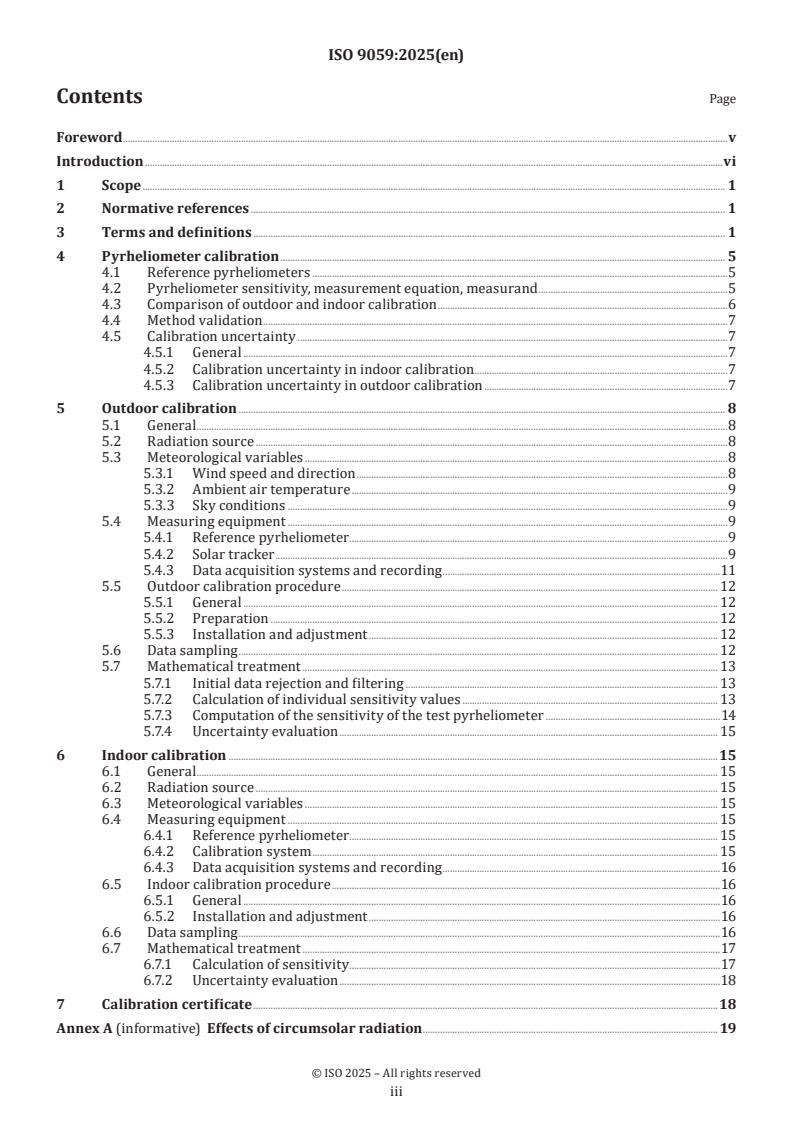
Contents Page
Foreword .v
Introduction .vi
1 Scope . 1
2 Normative references . 1
3 Terms and definitions . 1
4 Pyrheliometer calibration . 5
4.1 Reference pyrheliometers .5
4.2 Pyrheliometer sensitivity, measurement equation, measurand .5
4.3 Comparison of outdoor and indoor calibration .6
4.4 Method validation .7
4.5 Calibration uncertainty .7
4.5.1 General .7
4.5.2 Calibration uncertainty in indoor calibration .7
4.5.3 Calibration uncertainty in outdoor calibration .7
5 Outdoor calibration . 8
5.1 General .8
5.2 Radiation source .8
5.3 Meteorological variables .8
5.3.1 Wind speed and direction .8
5.3.2 Ambient air temperature .9
5.3.3 Sky conditions .9
5.4 Measuring equipment .9
5.4.1 Reference pyrheliometer.9
5.4.2 Solar tracker .9
5.4.3 Data acquisition systems and recording .11
5.5 Outdoor calibration procedure . 12
5.5.1 General . 12
5.5.2 Preparation . 12
5.5.3 Installation and adjustment . 12
5.6 Data sampling . 12
5.7 Mathematical treatment . 13
5.7.1 Initial data rejection and filtering . 13
5.7.2 Calculation of individual sensitivity values . 13
5.7.3 Computation of the sensitivity of the test pyrheliometer .14
5.7.4 Uncertainty evaluation . 15
6 Indoor calibration .15
6.1 General . 15
6.2 Radiation source . 15
6.3 Meteorological variables . 15
6.4 Measuring equipment . 15
6.4.1 Reference pyrheliometer. 15
6.4.2 Calibration system . 15
6.4.3 Data acquisition systems and recording .16
6.5 Indoor calibration procedure .16
6.5.1 General .16
6.5.2 Installation and adjustment .16
6.6 Data sampling .16
6.7 Mathematical treatment .17
6.7.1 Calculation of sensitivity.17
6.7.2 Uncertainty evaluation .18
7 Calibration certificate .18
Annex A (informative) Effects of circumsolar radiation . 19
iii
Annex B (informative) Introduction of a new Pyrheliometer sensitivity .22
Annex C (informative) Uncertainty evaluation for pyrheliometer calibration .24
Annex D (informative) Example of correction terms for an improved sensitivity value .26
Annex E (informative) Determination of number of days for calibration .28
Bibliography .30
iv
Foreword
ISO (the International Organization for Standardization) is a worldwide federation of national standards
bodies (ISO member bodies). The work of preparing International Standards is normally carried out through
ISO technical committees. Each member body interested in a subject for which a technical committee
has been established has the right to be represented on that committee. International organizations,
governmental and non-governmental, in liaison with ISO, also take part in the work. ISO collaborates closely
with the International Electrotechnical Commission (IEC) on all matters of electrotechnical standardization.
The procedures used to develop this document and those intended for its further maintenance are described
in the ISO/IEC Directives, Part 1. In particular, the different approval criteria needed for the different types
of ISO document should be noted. This document was drafted in accordance with the editorial rules of the
ISO/IEC Directives, Part 2 (see www.iso.org/directives).
ISO draws attention to the possibility that the implementation of this document may involve the use of (a)
patent(s). ISO takes no position concerning the evidence, validity or applicability of any claimed patent
rights in respect thereof. As of the date of publication of this document, ISO had not received notice of (a)
patent(s) which may be required to implement this document. However, implementers are cautioned that
this may not represent the latest information, which may be obtained from the patent database available at
www.iso.org/patents. ISO shall not be held responsible for identifying any or all such patent rights.
Any trade name used in this document is information given for the convenience of users and does not
constitute an endorsement.
For an explanation of the voluntary nature of standards, the meaning of ISO specific terms and expressions
related to conformity assessment, as well as information about ISO's adherence to the World Trade
Organization (WTO) principles in the Technical Barriers to Trade (TBT), see www.iso.org/iso/foreword.html.
This document was prepared by Technical Committee ISO/TC 180, Solar energy, Sub-Committee SC 1, Climate
– Measurement and data.
This second edition cancels and replaces the first edition (ISO 9059:1990) which has been technically
revised.
The main changes are as follows:
— focus on current calibration practices;
— adapted recommendations for mathematical treatment of data;
[2]
— revised terminology in line with ISO 9060, ISO 9488, ISO Guide 99 and BIPM VIM ;
[3]
— added comments on uncertainty evaluation of the calibration with reference to ASTM G213 and ISO/
IEC GUIDE 98-3.
Any feedback or questions on this document should be directed to the user’s national standards body. A
complete listing of these bodies can be found at www.iso.org/members.html.
v
Introduction
–2
Pyrheliometers measure the direct solar irradiance, expressed in Watts per square meter (W·m ), received
from the sun when the instrument is pointed directly at it.
Accurate measurements of the direct solar irradiance are required for:
a) determination of the energy input to solar energy systems such as photovoltaic (PV), and solar thermal
systems, as a basis for performance assessment;
b) testing and assessment of solar technologies;
c) geographic mapping of solar energy resources;
d) understanding climate change and extreme weather through the surface radiation budget;
e) other applications such as agriculture, building efficiency, material degradation and reliability, health.
Current solar energy performance assessment demands high-accuracy measurements and low measurement
uncertainties. To meet this demand, reliable and accurate solar irradiance measurements with synchronized
time stamps (see Reference [4]) and a correct uncertainty evaluation are required.
Calibration of measurement instrumentation is an essential part of the uncertainty evaluation and part of
any quality management system. Regular instrument recalibration according to this document helps attain
the required low measurement uncertainties. Consistent calibration results indicate instrument stability
combined with best measurement practices confirm that the measurement data collected over the time
interval from the previous to the present calibration are reliable.
Unless otherwise specified, uncertainties mentioned in this document are expanded uncertainties with a
coverage factor k = 2.
The calibration of pyrheliometers specified in this document is traceable to the international system of units
(SI) through the world radiometric reference (WRR) according to the world meteorological organization
[5]
(WMO) guidelines. The classification and specification used are given in ISO 9060.
vi
International Standard ISO 9059:2025(en)
Solar energy — Calibration of pyrheliometers by comparison
to a reference pyrheliometer
1 Scope
This document specifies methods for calibration of pyrheliometers using reference pyrheliometers and
specifies the calibration procedures for the transfer of the calibration.
This document is applicable for use by calibration service providers and test laboratories to enable a uniform
quality of accurate calibration sensitivities to be achieved.
2 Normative references
The following documents are referred to in the text in such a way that some or all of their content constitutes
requirements of this document. For dated references, only the edition cited applies. For undated references,
the latest edition of the referenced document (including any amendments) applies.
ISO 9060, Solar energy — Specification and classification of instruments for measuring hemispherical solar and
direct solar radiation
ISO/IEC GUIDE 98-3, Uncertainty of measurement - Part 3: Guide to the expression of uncertainty in measurement
(GUM:1995)
3 Terms and definitions
For the purposes of this document, the following terms and definitions apply.
ISO and IEC maintain terminology databases for use in standardization at the following addresses:
— ISO Online browsing platform: available at https:// www .iso .org/ obp
— IEC Electropedia: available at https:// www .electropedia .org/
3.1
pyrheliometer
radiometer using a collimated detector for measuring the direct solar irradiance under normal incidence
Note 1 to entry: Typical opening half angles of common and historical pyrheliometers range from 2,5° to 7,5°.
–3
Reference [5] recommends that the opening half-angle (half field-of -view-angle) is 2,5° (6 × 10 sr) (see 5.4.2 and
Figure 2) and the slope angle 1° for all new designs of direct solar radiation instruments. The slope angle is the angle
defined by the edges of the apertures at the ends of the collimating tube (see Figure 2). For mathematical definitions
of the angles, see ISO 9060:2018, 5.1 b) and Figure 2 of this document. For a detailed description of the influence of
circumsolar radiation on the pyrheliometers refer to References [6-8] and Annex A.
Note 2 to entry: The spectral responsivity of pyrheliometers is often limited by the use of a glass window to the range
of approximately 0,3 µm to near 3 µm, depending on the window transmittance properties. The spectral range (50 %
points) given is only nominal. Depending on the radiometer design, the spectral limits of its responsivity can be
different from the limits mentioned above.
[SOURCE: ISO 9488:2022, 3.3.5, modified — Notes 1 and 2 to entry added.]
3.2
pyrheliometer classification
pyrheliometers are classified on the basis of the measuring specifications of the instruments
Note 1 to entry: Additional information can be found in ISO 9060:2018, 4.3.1
3.3
test pyrheliometer
pyrheliometer being calibrated
[SOURCE: ISO 9847:2023, 3.7, modified — term changed from "field pyranometer".]
3.4
reference pyrheliometer
pyrheliometer that is well-characterized and well-maintained, to be used to measure the (input) irradiance
when calibrating a test pyrheliometer (3.3)
Note 1 to entry: It is recommended that an instrument used as reference is selected based on quality, stability and
accuracy, and it is specifically tested for better characterization of all its properties.
Note 2 to entry: Use of the reference pyrheliometer should be restricted to comparisons and calibration activities. The
instrument should be stored carefully in a laboratory under moderate ambient conditions when not used.
Note 3 to entry: The reference pyrheliometer should be of equal, or preferably, higher classification than the test
pyrheliometer
Note 4 to entry: An absolute cavity pyrheliometer (3.5) is recommended.
3.5
absolute cavity pyrheliometer
absolute radiometer
pyrheliometer that offers a primary reference measurement procedure for irradiance, i.e., traceable to other
physical quantities, in this case electrical power and surface area
Note 1 to entry: Additional information on absolute cavity pyrheliometers is given in ISO 9060:2018, 5.2.1.
3.6
field-of-view angle
FOV
opening angle
full angle of the geometrical cone which is defined by the centre of the pyrheliometer receiver surface and
the edge of its view-limiting optical aperture
[SOURCE: ISO 9488:2022, 3.3.6, modified — opening angle has been added as an accepted term and the
abbreviation “FOV” has been added.]
3.7
solar tracker
sun tracker
mechanical device capable of following the arc or path of the sun across the sky
3.8
direct solar irradiance
G
b
beam solar irradiance
radiation received from a small solid angle centred on the sun's disc, on a given plane.
-2
Note 1 to entry: The SI units are W∙m
Note 2 to entry: Approximately 97 % to 99 % of the direct normal solar irradiance received at the ground is contained
within the wavelength range from 0,3 μm to 3 μm Reference [9] (see 3.1, Note 2 to entry).
[SOURCE: ISO 9060:2018, 3.3]
3.9
direct normal incidence solar irradiance
G
bn
direct normal irradiance
direct solar radiation received by a plane at normal incidence
-2
Note 1 to entry: The SI units are W∙m
Note 2 to entry: In general, direct normal solar irradiance is measured by instruments with field-of-view angles (3.6)
of up to 6°. Therefore, a part of the scattered radiation around the sun’s disc (circumsolar radiation or aureole) is
also included (see 5.2). For a more detailed definition of circumsolar radiation and related parameters refer to
References [6-8] and see Annex A.
3.10
sensitivity
S
responsivity
quotient of the change in an indication of a measuring system and the corresponding change in a value of a
quantity being measured
Note 1 to entry: In the particular case of pyrheliometers, the input quantity is solar irradiance and the indication can,
for example, be an output voltage or current signal.
Note 2 to entry: This term is often used interchangeably with responsivity denoted by R.
[SOURCE: ISO 9847:2023, 3.4]
3.11
calibration
determination of the sensitivity of the test pyrheliometer to irradiance, with associated measurement
uncertainties, under well-defined calibration conditions (3.12)
Note 1 to entry: For most pyrheliometers, the output varies linearly with the irradiance and the calibration result is
expressed as a single sensitivity value.
Note 2 to entry: Additional information on calibration is given in References [2-4, 10, 11].
3.12
calibration conditions
conditions, ambient or instrument, during the calibration process
[SOURCE: ISO 9847:2023, 3.8.]
3.13
reference operating condition
operating conditions prescribed for evaluating the performance of a measuring instrument or measuring
system or for comparison of measurement results
Note 1 to entry: For practical purposes these typically are the conditions specified for the reported sensitivity.
[SOURCE: ISO 9847:2023, 3.9, modified — Note 2 to entry deleted.]
3.14
world radiometric reference
WRR
primary measurement standard representing the SI unit of solar irradiance
Note 1 to entry: The reference was adopted by the World Meteorological Organization (WMO) and has been in effect
since 1 July 1980. One of the distinguishing features of the WRR is that reference operating conditions (3.13) include the
full spectrum of direct solar radiation. This is achieved using open cavity radiometers that do not have glass windows
that can introduce a spectral response attenuation (see 3.1, Note 2 to entry). Currently, the uncertainty of the WRR is
0,3 % (coverage factor k = 3) References [5, 12, 13].
[SOURCE: ISO 9488:2022, 3.3.1, modified — Notes to entry 1 to 3 to entry of the original term were edited
and combined in to Note 1 to entry.]
3.15
sample
data acquired from a sensor or measuring device at a given time
[SOURCE: ISO 9847:2023, 3.11, modified — Note 1 to entry removed.]
3.16
sampling interval
time interval between sequential samples (3.15)
[SOURCE: ISO 9847:2023, 3.12, modified — Note 1 to entry removed.]
3.17
record
data recorded with the same timestamp and stored in data log, based on acquired samples (3.15)
[SOURCE: ISO 9847:2023, 3.13, modified — Note 1 to entry removed and "with the same timestamp" added
to definition.]
3.18
data series
set of consecutive records (3.17) measured over a limited period of time
3.19
data set
collection of all data recorded during calibration period
3.20
offset correction
value added algebraically to a reading (voltage, current, irradiance, etc.) to compensate for a deviation from
zero (in respective units) in the meter when input excitation is null
Note 1 to entry: The offset correction is equal to the negative of the deviation found. Offsets are usually considered as
systematic errors generated by different sources.
3.21
correction factor
numerical factor by which the uncorrected result of a measurement is multiplied to compensate for each
systematic error
Note 1 to entry: Since all systematic errors cannot be known perfectly, the compensation cannot be complete.
[SOURCE: ISO/IEC GUIDE 98-3:2008, B.2.24, modified — added "each" to the definition and modified Note 1
to entry.]
3.22
tilt angle
angle between the horizontal plane and the plane of the pyrheliometer (3.1) sensor surface
Note 1 to entry: For an aligned pyrheliometer, the tilt angle equals the zenith angle (3.23).
[SOURCE: ISO 9847:2023, 3.19, modified — changed pyranometer to pyrheliometer and added a note 1 to entry]
3.23
zenith angle
angle of incidence of radiation, relative to zenith
Note 1 to entry: The zenith is the angle between the earth’s surface normal and the line to the sun.
[SOURCE: ISO 9847:2023, 3.21, modified — part of the definition was moved to Note 1 to entry.]
3.24
solar azimuth angle
angle between a reference direction (north or south) and the projection of the direct solar irradiance (3.8) on
the horizontal plane
Note 1 to entry: Duffie and Beckman Reference [14] define the reference direction (zero solar azimuth angle) as south
for both the northern and southern hemisphere. In the Duffie and Beckman definition the azimuth angle ranges from
−180° to +180°, where angles east of south are negative and west of south positive. Other references and models use
north as reference direction.
[SOURCE: ISO 9847:2023, 3.22, modified — changed beam radiation to direct solar irradiance.]
3.25
response time
measure of the stabilization period of the pyrheliometer output signal
Note 1 to entry: The stabilization time of the pyrheliometer signal output is at least three times the radiometer’s 95 %
response time.
Note 2 to entry: Definition based on ISO 9060:2018, 4.3.2.
3.26
non-linearity
−2
percentage deviation from the responsivity at 500 W·m due to the change in irradiance within the range of
−2 −2
100 W·m to 1 000 W·m
Note 1 to entry: Definition based on ISO 9060:2018, 4.3.2.
3.27
temperature response
relative change in instrument sensitivity due to a change in ambient temperature
Note 1 to entry: Definition based on ISO 9060:2018, 4.3.2.
3.28
signal processing errors
additional errors that can be caused by internal electronics (digital instruments) or electronic noise in the
cables and data acquisition system
Note 1 to entry: Definition based on ISO 9060:2018, 4.3.2.
4 Pyrheliometer calibration
4.1 Reference pyrheliometers
Calibrations according to the specified methods will be traceable to the international system of units (SI),
through the WRR, provided that traceable reference instruments are used.
For indoor calibration, the reference pyrheliometer and the test pyrheliometer shall be the same model.
NOTE The same model refers to pyrheliometers that have the same optics, thermal properties, detector design, etc.
For outdoor calibration, the reference pyrheliometer shall be of at least an equal class (in accordance with
ISO 9060) to the test pyrheliometer. It is preferred to use a higher class or an absolute cavity pyrheliometer
as the reference. It is advisable to utilize multiple reference instruments (see 5.4.1).
4.2 Pyrheliometer sensitivity, measurement equation, measurand
Pyrheliometer calibration consists of a test to determine the relationship between pyrheliometer output
and input irradiance and an uncertainty analysis. The result is the instrument sensitivity, with associated
uncertainty, valid under well-defined conditions. This standard provides outdoor and indoor methods to
calibrate pyrheliometers by comparison to a reference pyrheliometer.
The relationship between pyrheliometer sensitivity, output and measurand (solar irradiance) for
pyrheliometers is:
V
S= (1)
G
bn,ref
where
–2
S is the sensitivity in units of output signal per W·m of the test pyrheliometer;
–2
G is the direct normal incidence solar irradiance measured by the reference pyrheliometer in W·m ;
bn,ref
V is the output signal from the test pyrheliometer in corresponding units (e.g. Volts, Amperes).
NOTE V refers to a generic electrical output, interchangeably a voltage or current signal, for the any of the test
and reference instruments.
For digital sensors, the signal reading V can be substituted by the irradiance measurement. In that case, the
result of Formula (1) would be a correction multiplier instead of a sensitivity.
Traditionally pyrheliometers and pyranometers are passive instruments with an analogue output in
the millivolt range. Nowadays, pyrheliometers and pyranometers can also have other outputs such as an
amplified voltage, a current loop or a digital signal.
When instruments with digital outputs and internal processor are used, the user can directly use the
raw detector signal for the calibration (or the signal that has undergone corrections for temperature,
linearity offsets, or signal processing errors) to compare to the reference irradiance readings and obtain
the instrument sensitivity according to Formula (1). Digital instruments may include an adjustment by
programming a new sensitivity into the firmware after calibration. However, adjusting the internal settings
of a digital instrument to the new sensitivity is not always possible for the user. In that case, the irradiance
–2
output in W·m of the test pyrheliometer can be used and the result of the calibration can be a correction
factor to the instruments' output irradiance.
-2
The sensitivity of digital instruments is nevertheless expressed in output signal per W·m because this
gives a clear indication of the stability of the pyrheliometer.
In special cases, laboratories and users may choose to use alternative measurement equations. They may
use a correction factor acting on S, for example, accounting for temperature dependence, correcting for an
electrical offset (see Annex D).
4.3 Comparison of outdoor and indoor calibration
Under this document, there are two options for pyrheliometer calibration: outdoors under natural sunlight
and indoors in a laboratory, using lamps as a source. These are the following fundamental differences.
a) Outdoor calibration — The reference pyrheliometer shall be of at least an equal class to the test
pyrheliometer. It is preferred to use a higher class or an absolute cavity pyrheliometer as the reference.
Reference operating conditions are the outdoor conditions during this calibration.
b) Indoor calibration — The test pyrheliometer is compared to a reference pyrheliometer of the same
model, i.e., that has the same optics, thermal properties, and detector design. The environmental and
atmospheric conditions for which the calibration of the test instrument is valid, are the conditions under
which the reference pyrheliometer was calibrated outdoors (See 6.4.1), with an additional uncertainty
contribution. An indoor calibration is the transfer of the calibration of the reference instrument to a test
instrument.
For both outdoor and indoor calibration, the operating conditions for which the calibration results are valid
may later, in the calibration report, be adapted to other conditions than those to which the calibration is
initially traceable, with an additional uncertainty contribution. This then leads to an adapted sensitivity and
increases the calibration uncertainty.
Calibration laboratories may report multiple sensitivities and uncertainties valid for different ranges of
operating conditions, so that users may work with a sensitivity valid for reference conditions as close as
possible to actual operating conditions.
4.4 Method validation
The methods described in this document have been validated for pyrheliometers that comply with the
requirements of Spectrally Flat pyrheliometers as defined in ISO 9060 (indoor and outdoor) and for absolute
cavity radiometers (outdoor only).
For other instrument designs, possibly working according to different measurement principles, the methods
can equally be applicable, but this shall be proven by testing the individual instrument design.
4.5 Calibration uncertainty
4.5.1 General
Laboratories shall perform an uncertainty evaluation of all their calibrations, and supply this evaluation in
the calibration report. Uncertainty evaluations shall be made according to ISO/IEC GUIDE 98-3, and express
uncertainties as expanded measurement uncertainties with a coverage factor of k = 2 (confidence that
approximately 95 % of the data points lie within two standard deviations for a normal distribution).
4.5.2 Calibration uncertainty in indoor calibration
The calibration uncertainty for indoor calibration depends on:
— calibration method;
— test pyrheliometer model;
— uncertainty of the sensitivity of the reference pyrheliometer;
— instrument temperature;
— stability of the lamp;
— positioning and alignment of the test and reference pyrheliometer (position accuracy and repeatability
relative to the light source).
The uncertainty of indoor calibration may be based on a limited set of tests involving the pyrheliometer
model and the method, and calculations according to ISO/IEC GUIDE 98-3. Typically, calibration conditions
can be the same from one calibration to the other and the uncertainty may then be treated as a “constant”
percentage of the sensitivity.
4.5.3 Calibration uncertainty in outdoor calibration
The uncertainty of outdoor calibrations depends on:
— tilt angle;
— instrument temperature;
— wind velocity and direction, relative to instrument orientation;
— atmospheric stability;
— differences between slope and opening angles of reference and test pyrheliometer;
— circumsolar radiation (see Annex A);
— spectral error;
— response time;
— non-linearity;
— positioning of the test and reference pyrheliometer (pointing accuracy relative to the sun).
NOTE 1 When the reference and test pyrheliometers are the same model (i.e., same optics, thermal and detector
design), then some of the uncertainties are expected to be cancelled out.
The uncertainty of outdoor calibration may not be based on a limited set of tests involving the pyrheliometer
type. Because of the variability of the environmental factors, the uncertainty shall be analysed separately
for every individual calibration. Typically, calibration conditions and uncertainty will not be the same from
one calibration to the other.
When optional corrections of reference conditions are made (e.g., accounting for temperature dependence
or electrical offset), they shall be accounted for in the calibration uncertainty and be reported on the
calibration certificate (see Annex C and Annex D).
For spectrally non-flat pyrheliometers, the influence of the calibration conditions on the measurement
uncertainty is high compared to spectrally flat pyrheliometers. This shall be considered when selecting
the calibration duration, the number of days used, and the conditions observed during the calibration. The
closer the calibration conditions match with the conditions during the operation of the test pyrheliometer,
the lower the measurement uncertainty during normal use. For example, an instrument calibrated under
a clear sky with low aerosol load may be used under skies with high aerosol content, using a correction
applied on the sensitivity. This correction will have its own uncertainty.
The sources of uncertainty listed in 4.5.2 and 4.5.3 are not exhaustive but examples for both indoor and
outdoor calibration uncertainties. Moreover, users can consider these lists for the uncertainty evaluation
of the measurements and include proper corrections and terms. A more general approach for uncertainty
evaluation is suggested in Annex C.
5 Outdoor calibration
5.1 General
The calibration of a test pyrheliometer by means of a reference pyrheliometer is accomplished by exposing
the two instruments to the direct solar radiation and comparing the output signal of the test pyrheliometer to
the reference irradiance. The calibration shall meet the requirements for acceptable limits of meteorological
variables and for the choice of measuring equipment.
5.2 Radiation source
Pyrheliometers are exposed to the direct solar radiation including parts of the circumsolar radiation. The
−2 −2
irradiance should be not less than 500 W·m . Irradiance values exceeding 700 W·m are preferred. The
calibration conditions, in terms of, e.g., the circumsolar contribution, shall be as close as possible to the
routine measuring conditions in which the test pyrheliometer will be used (see 5.3.3 and Table A.1).
5.3 Meteorological variables
5.3.1 Wind speed and direction
For non-windowed pyrheliometers, the wind speed during the calibration should be low, particularly
when the wind is blowing from the direction of the sun's azimuth angle ±30°. An upper limit for the wind
–1
speed of 5 m·s should be used if the wind direction matches the solar azimuth angle within ±30° (see
Reference [12]).
NOTE Pyrheliometers with open tubes can show disturbed output signals due to wind cooling. This will lead to
increased standard deviation. The magnitude of this effect depends on the type of pyrheliometer, and especially on
the design of the diaphragms in the tube.
The wind-cooling effect can be reduced by installing wind screens. For instance, it can be beneficial to carry
out the measurement from a balcony or an open window.
–1
For windowed pyrheliometers, the wind speed should be less than 10 m·s .
5.3.2 Ambient air temperature
In order to determine the temperature dependence of the sensitivity, if it is not already known from
laboratory tests, the calibrations should be carried out over a range of ambient air temperatures covering a
large part of the temperature range which is typical for the application.
5.3.3 Sky conditions
–2
Clear sky conditions with direct normal irradiance (G ) exceeding 700 W·m are recommended (see 5.2).
bn
Moreover, to ensure that clouds are not affecting the calibration, data should only be used when there
are no clouds within an angular distance of 15° from the sun. This can be checked by means of additional
instrumentation (e.g. sky cameras) or even by a periodic visual observation.
NOTE 1 Atmospheric water vapour in the pre-condensation phase occasionally causes variable atmospheric
transmission. Generally, the scattering of measuring data which is produced by these clusters is acceptable.
The atmospheric turbidity during calibration should be close to values typical for the field measuring
[15]
conditions. The turbidity should be confined to conditions with Linke turbidity factors lower than 6 .
NOTE 2 Atmospheric turbidity is produced by scattering and absorption of direct solar radiation by aerosol
particles and gases including water vapour.
Circumsolar radiation (aureole) originates from forward scattering of direct solar radiation. It decreases
from the limb of the sun to an angular distance of about 15° by some orders of magnitude, depending on the
type and concentration of aerosols (see, for example, References [16-18]). The typical amount of circumsolar
radiation for common aerosol loads in the middle latitudes within an angular distance of 5° from the sun
represents only a few percent of the direct solar radiation if no clouds mask the sun. If reference and test
pyrheliometers have different field-of-view angles, the aerosol may strongly influence the accuracy of
calibration. Calculated percentages of circumsolar contained in direct solar radiation, for different aerosol
[8]
types and solar elevation angles , are given in Table A.1.
5.4 Measuring equipment
5.4.1 Reference pyrheliometer
The reference pyrheliometer should preferably have a field-of-view angle and a slope angle (see 5.4.2) equal
to those of the test pyrheliometer.
To maintain and validate the calibration process, more than one reference pyrheliometer should be used
during each calibration.
5.4.2 Solar tracker
In outdoor calibration, pyrheliometers should be accurately pointed at the sun. This is done using a solar
tracker (see Figure 1).
Figure 1 — Test and reference pyrheliometers mounted on a solar tracker with arrows indicating
the azimuth rotation as well as the zenith rotation.
Solar trackers delivering separate movements in elevation and azimuth (altazimuth mount) as well as
trackers turning the pyrheliometer in parallel with the solar equatorial plane (equatorial or parallactic
mount) may be used.
The admissible misalignment of the sun tracker shall be less than the slope angle of the pyrheliometer minus
0,27° of the apparent sun radius (Figure 2). The slope angle of a pyrheliometer is typically 1° so this results
in pointing margin of <±0,73° from the sun centre using the pyrheliometer sight as a reference. However, a
misalignment greater than 0,2° should be avoided as it can increase diffraction and circumsolar radiation
[5]
effects of the solar beam, which will lead to increased uncertainty (see Reference WMO CIMO Guide,
section 7.2.2).
Key
1 apparent sun radius ≈ 0,27° 7 detector radius
2 aperture radius 8 detector surface
3 field stop 9 field-of-view
4 tube length 10 slope angle
5 limit angle 11 pointing margin
6 aperture stop
Figure 2 — diagram demonstrating geometric angles of the pyrheliometer.
Before any calibration measurements are carried out, the levelling and alignment of the solar tracker(s)
should be checked. This is to ensure trackers without active control can maintain the alignment over the
course of a day. During the cal
...