

ISO 6331:2024
(Main)Chromium ores and concentrates — Determination of chromium content — Titrimetric method
General Information
- Abstract
This document specifies a titrimetric method for the determination of the chromium content of chromium ores and concentrates having a chromium content greater than a mass fraction of 7,00 %.
- Status
- Published
- Publication Date
- 24-Nov-2024
- Technical Committee
- ISO/TC 132 - Ferroalloys
- Drafting Committee
- ISO/TC 132 - Ferroalloys
- Current Stage
- 6060 - International Standard published
- Start Date
- 25-Nov-2024
- Due Date
- 12-May-2025
- Completion Date
- 25-Nov-2024
Overview
ISO 6331:2024 - "Chromium ores and concentrates - Determination of chromium content - Titrimetric method" - is the second edition international standard that specifies a laboratory titrimetric procedure for determining chromium in chromium ores and concentrates with a chromium mass fraction greater than 7.00%. The method covers sample decomposition by sodium peroxide fusion, oxidation of Cr(III) to chromate, and quantification of chromium(VI) by titration (visual or potentiometric).
Key technical topics and requirements
- Scope: Applicable to chromium ores and concentrates containing > 7.00% chromium.
- Principle: Fuse the test portion with sodium peroxide, leach and acidify the melt, oxidize Cr(III) to chromate using ammonium peroxodisulfate (with silver nitrate catalyst), then titrate chromium(VI) with ammonium iron(II) sulfate. End‑point determination may be by visual back‑titration with potassium permanganate or by potentiometric titration.
- Reagents: Specifies analytical grades and includes preparations for reagents such as sulfuric and orthophosphoric acids, manganese(II) sulfate, silver nitrate, ammonium peroxodisulfate, ammonium iron(II) sulfate (standard volumetric solution), and potassium permanganate.
- Apparatus: Ordinary lab glassware (Class A volumetrics per ISO 385/648/1042), porcelain/corundum crucibles, and potentiometric titration equipment: indicator and reference electrodes, burette, magnetic stirrer and millivoltmeter/pH‑meter.
- Sampling and sample prep: References ISO 6153 (increment sampling) and ISO 6154 (sample preparation) for representative analytical samples.
- Results and reporting: Includes procedures for calculation of chromium content, conversion to Cr2O3 when required, precision treatment, between‑laboratory precision, trueness checks and required test report content.
Note: ISO 6331:2024 contains technical updates from the 1983 edition, including revised potentiometric apparatus descriptions, crucible specifications, decomposition conditions, and added guidance on result acceptance and reporting.
Practical applications and who uses it
- Mining and concentrator laboratories for incoming ore characterization and batch quality control.
- Ferroalloy and metallurgical quality control labs to verify feedstock chromium content.
- Trading and inspection bodies for contract testing and material certification.
- Research and academic laboratories conducting geochemical or metallurgical studies on chromium ores.
- Regulatory agencies that require standardized test methods for material specification and compliance.
This standard ensures reproducible chromium assays for process control, product specification and trade settlement.
Related standards
- ISO 6153 - Chromium ores - Increment sampling
- ISO 6154 - Chromium ores - Preparation of samples
- ISO 385, ISO 648, ISO 1042 - Laboratory glassware specifications
- ISO 3696 - Water for analytical laboratory use
- ISO 6129 - Determination of hygroscopic moisture content
- ISO 80000‑1 - Quantities and units
For full procedural detail and official wording, obtain ISO 6331:2024 from ISO or your national standards body.
Keywords: ISO 6331:2024, chromium ores, titrimetric method, chromium determination, potentiometric titration, sodium peroxide fusion, ammonium iron(II) sulfate, potassium permanganate.
Relations
- Effective Date
- 06-Jun-2022
Get Certified
Connect with accredited certification bodies for this standard

Bureau Veritas Chile
Bureau Veritas certification services in Chile.
Bureau Veritas Peru
Bureau Veritas certification services in Peru.
BVQI Peru
Bureau Veritas certification in Peru.
Sponsored listings
Frequently Asked Questions
ISO 6331:2024 is a standard published by the International Organization for Standardization (ISO). Its full title is "Chromium ores and concentrates — Determination of chromium content — Titrimetric method". This standard covers: This document specifies a titrimetric method for the determination of the chromium content of chromium ores and concentrates having a chromium content greater than a mass fraction of 7,00 %.
This document specifies a titrimetric method for the determination of the chromium content of chromium ores and concentrates having a chromium content greater than a mass fraction of 7,00 %.
ISO 6331:2024 is classified under the following ICS (International Classification for Standards) categories: 73.060.30 - Chromium ores. The ICS classification helps identify the subject area and facilitates finding related standards.
ISO 6331:2024 has the following relationships with other standards: It is inter standard links to ISO 6331:1983. Understanding these relationships helps ensure you are using the most current and applicable version of the standard.
ISO 6331:2024 is available in PDF format for immediate download after purchase. The document can be added to your cart and obtained through the secure checkout process. Digital delivery ensures instant access to the complete standard document.
Standards Content (Sample)
International
Standard
ISO 6331
Second edition
Chromium ores and concentrates —
2024-11
Determination of chromium content
— Titrimetric method
Minerais et concentrés de chrome — Dosage du chrome —
Méthode titrimétrique
Reference number
© ISO 2024
All rights reserved. Unless otherwise specified, or required in the context of its implementation, no part of this publication may
be reproduced or utilized otherwise in any form or by any means, electronic or mechanical, including photocopying, or posting on
the internet or an intranet, without prior written permission. Permission can be requested from either ISO at the address below
or ISO’s member body in the country of the requester.
ISO copyright office
CP 401 • Ch. de Blandonnet 8
CH-1214 Vernier, Geneva
Phone: +41 22 749 01 11
Email: copyright@iso.org
Website: www.iso.org
Published in Switzerland
ii
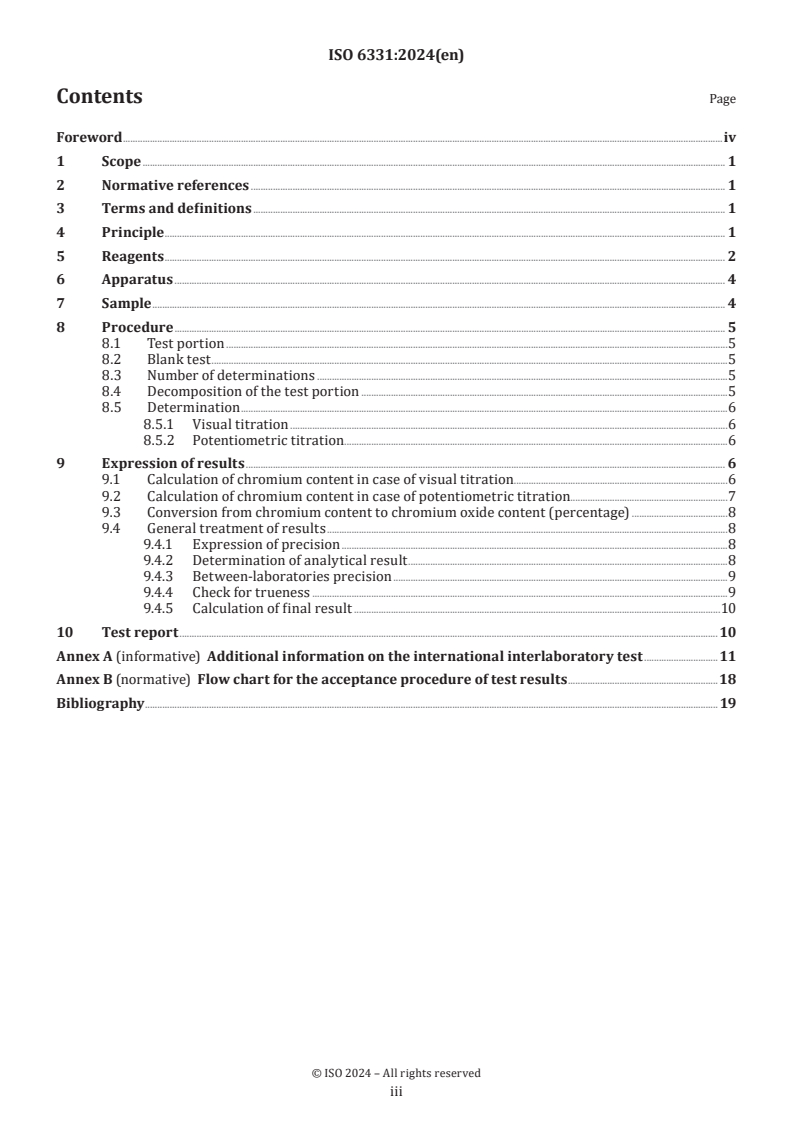
Contents Page
Foreword .iv
1 Scope . 1
2 Normative references . 1
3 Terms and definitions . 1
4 Principle . 1
5 Reagents . 2
6 Apparatus . 4
7 Sample . 4
8 Procedure . 5
8.1 Test portion .5
8.2 Blank test .5
8.3 Number of determinations .5
8.4 Decomposition of the test portion .5
8.5 Determination .6
8.5.1 Visual titration .6
8.5.2 Potentiometric titration.6
9 Expression of results . 6
9.1 Calculation of chromium content in case of visual titration .6
9.2 Calculation of chromium content in case of potentiometric titration.7
9.3 Conversion from chromium content to chromium oxide content (percentage) .8
9.4 General treatment of results .8
9.4.1 Expression of precision .8
9.4.2 Determination of analytical result .8
9.4.3 Between-laboratories precision .9
9.4.4 Check for trueness .9
9.4.5 Calculation of final result .10
10 Test report . 10
Annex A (informative) Additional information on the international interlaboratory test .11
Annex B (normative) Flow chart for the acceptance procedure of test results .18
Bibliography . 19
iii
Foreword
ISO (the International Organization for Standardization) is a worldwide federation of national standards
bodies (ISO member bodies). The work of preparing International Standards is normally carried out through
ISO technical committees. Each member body interested in a subject for which a technical committee
has been established has the right to be represented on that committee. International organizations,
governmental and non-governmental, in liaison with ISO, also take part in the work. ISO collaborates closely
with the International Electrotechnical Commission (IEC) on all matters of electrotechnical standardization.
The procedures used to develop this document and those intended for its further maintenance are described
in the ISO/IEC Directives, Part 1. In particular, the different approval criteria needed for the different types
of ISO document should be noted. This document was drafted in accordance with the editorial rules of the
ISO/IEC Directives, Part 2 (see www.iso.org/directives).
ISO draws attention to the possibility that the implementation of this document may involve the use of (a)
patent(s). ISO takes no position concerning the evidence, validity or applicability of any claimed patent
rights in respect thereof. As of the date of publication of this document, ISO had not received notice of (a)
patent(s) which may be required to implement this document. However, implementers are cautioned that
this may not represent the latest information, which may be obtained from the patent database available at
www.iso.org/patents. ISO shall not be held responsible for identifying any or all such patent rights.
Any trade name used in this document is information given for the convenience of users and does not
constitute an endorsement.
For an explanation of the voluntary nature of standards, the meaning of ISO specific terms and expressions
related to conformity assessment, as well as information about ISO's adherence to the World Trade
Organization (WTO) principles in the Technical Barriers to Trade (TBT), see www.iso.org/iso/foreword.html.
This document was prepared by Technical Committee ISO/TC 132, Ferroalloys.
This second edition cancels and replaces the first edition (ISO 6331:1983), which has been technically
revised.
The main changes are as follows:
— in 6.1 (previously in 5.1), the description for the potentiometric titration apparatus has been changed
to be in line with the current status of the development of the instrument, including the description of
electrodes pairs in 6.1.1, titration assembly in 6.1.2 and millivoltmeter in 6.1.3;
— in 6.2, the specifications of crucibles have been added;
— in 8.1, the pre-treatment of test portion and the recommended test portion masses have been adjusted;
— in 8.4 (previously in 6.2), the decomposition conditions of the test portion have been changed including
the specification of beaker, the detailed use of crucibles, the diluted concentration of sulfuric acid, and
the option of whether to filter residues or not;
— in 8.5.2 (previously in 6.3.2), the 60 ml of the sulfuric acid solution has been omitted;
— in 9.4 (previously in 7.4), the paragraph of the "permissible tolerances on results" has been replaced with
the "general treatment of results";
— Clause 10, the test report has been added;
— Annex A (informative), "Additional information on the international interlaboratory test" has been added;
— Annex B (normative), "Flow sheet of the procedure for the acceptance of test results" has been added.
Any feedback or questions on this document should be directed to the user’s national standards body. A
complete listing of these bodies can be found at www.iso.org/members.html.
iv
International Standard ISO 6331:2024(en)
Chromium ores and concentrates — Determination of
chromium content — Titrimetric method
1 Scope
This document specifies a titrimetric method for the determination of the chromium content of chromium
ores and concentrates having a chromium content greater than a mass fraction of 7,00 %.
2 Normative references
The following documents are referred to in the text in such a way that some or all of their content constitutes
requirements of this document. For dated references, only the edition cited applies. For undated references,
the latest edition of the referenced document (including any amendments) applies.
ISO 385, Laboratory glassware — Burettes
ISO 648, Laboratory glassware — Single-volume pipettes
ISO 1042, Laboratory glassware — One-mark volumetric flasks
ISO 3696, Water for analytical laboratory use — Specification and test methods
ISO 6129, Chromium ores — Determination of hygroscopic moisture content in analytical samples —
Gravimetric method
ISO 6153, Chromium ores — Increment sampling
ISO 6154, Chromium ores — Preparation of samples
ISO 80000-1:2022, Quantities and units — Part 1: General
3 Terms and definitions
No terms and definitions are listed in this document.
ISO and IEC maintain terminology databases for use in standardization at the following addresses:
— ISO Online browsing platform: available at https:// www .iso .org/ obp
— IEC Electropedia: available at https:// www .electropedia .org/
4 Principle
Decompose a test portion by fusing with sodium peroxide. Leach the melt with water, acidify it with sulfuric
acid, and remove the excess of hydrogen peroxide by boiling.
Oxidize chromium (III) ions to chromate with ammonium peroxodisulphate in the presence of silver nitrate
as catalyst.
Titrate chromium (VI) with ammonium iron (II) sulfate, the end-point is obtained either visually, by adding
an excess of ammonium iron (II) sulfate and back-titrating with potassium permanganate, or directly by
potentiometric titration.
5 Reagents
During the analysis, unless otherwise stated, use only reagents of recognized analytical grade and only
grade 3 water as specified in ISO 3696.
5.1 Sodium peroxide, in powdered and granulated forms.
5.2 Sulfuric acid, ρ 1,84 g/ml.
5.3 Orthophosphoric acid, ρ 1,70 g/ml.
5.4 Urea.
5.5 Sulfuric acid, diluted 1 + 1.
5.6 Sulfuric acid, diluted 1 + 4.
5.7 Manganese (ll) sulfate, 100 g/l solution.
Dissolve 100 g of manganese (II) sulfate heptahydrate (MnSO ·7H O) in 1 l of water.
4 2
5.8 Manganese (II) sulfate, 1 g/l solution.
Dilute 10 ml of the manganese (II) sulfate solution (see 5.7) to 1 l with water.
5.9 Silver nitrate, 1 g/l solution.
Dissolve 1 g of silver nitrate in 1 l of water. To ensure greater stability of the silver nitrate, add 0,5 ml of
nitric acid for each 1 l of solution. Store the solution in a brown glass bottle.
5.10 Ammonium peroxodisulfate, 250 g/l solution.
Dissolve 250 g of ammonium peroxodisulfate in 1 l of water. Prepare the solution immediately before use.
5.11 Sodium chloride, 50 g/l solution.
Dissolve 50 g of sodium chloride in 1 l of water.
5.12 Potassium permanganate, standard volumetric solution, c(1/5 KMnO ) ≈ 0,1 mol/l.
5.12.1 Preparation of the solution
Dissolve 32 g of potassium permanganate in 1 000 ml of water, transfer to a 10 l brown glass bottle, add 9 l
of water, mix and allow to stand for 7 days to 10 days. Transfer the solution, using a siphon to another brown
glass bottle (insert the siphon pipe in the bottle so that its end is 15 mm above the bottom). Alternatively,
the solution can be filtered through calcined asbestos.
5.12.2 Standardization of the solution
Place 0,2 g of anhydrous sodium oxalate, previously dried at 105 °C to 110 °C into a 250 ml conical flask and
dissolve with slight heating in 75 ml of water, add 15 ml of the sulfuric acid solution (see 5.5) and heat to
70 °C to 80 °C. Titrate the solution thus obtained with the potassium permanganate solution (see 5.12) until
the pink coloration persists for 1 min to 2 min.
Carry out a blank test, omitting anhydrous sodium oxalate.
The titre of the potassium permanganate solution (see 5.12), T , is given by Formula (1):
m ×0,2587
T = (1)
VV−
where
T is the titre of the potassium permanganate solution (see 5.12), in grams of chromium per mil-
lilitre of the solution;
m is the mass, in grams, of the test portion of sodium oxalate;
V is the volume, in millilitres, of potassium permanganate solution (see 5.12) used for titrating
sodium oxalate;
V is the volume, in millilitres, of potassium permanganate solution (see 5.12) used for titrating
the blank test solution;
0,258 7 is the conversion factor from sodium oxalate to chromium.
5.13 Ammonium iron (II) sulfate, standard volumetric solution, c[(NH ) Fe(SO ) ·6H O] ≈ 0,1 mol/l.
4 2 4 2 2
5.13.1 Preparation of the solution
Dissolve 39,5 g of ammonium iron (II) sulfate hexahydrate in 200 ml of the sulfuric acid solution (see 5.6),
filter off the solution into a 1 000 ml one-mark volumetric flask, dilute with water to the mark and mix.
5.13.2 Standardization of the solution
Place 0,2 g of potassium dichromate, recrystallized and dried at 180 °C to 200 °C to constant mass, in a
600 ml beaker, dissolve in 200 ml of water, add 50 ml of the sulfuric acid solution (see 5.6), mix and allow
to cool. Place the electrodes (see 6.1.1) into the beaker, switch on the magnetic stirrer (see 6.1.2) and titrate
with the ammonium iron (II) sulfate solution (see 5.13), until the maximum peak deflection on the voltmeter
(see 6.1) is observed.
Carry out a blank test, omitting potassium dichromate.
The titre of the ammonium iron (II) sulfate solution (see 5.13), T , is given by Formula (2):
m ×0,3535
T = (2)
VV−
where
T is the titre of the ammonium iron (II) sulfate solution (see 5.13), in grams of chromium per
millilitre of the solution;
m is the mass, in grams, of the test portion of potassium dichromate;
V is the volume, in millilitres, of ammonium iron (II) sulfate solution (see 5.13) used for titrating
potassium dichromat;
V is the volume, in millilitres, of ammonium iron (II) sulfate solution (see 5.13) used for titrating
the blank test solution;
0,353 5 is the conversion factor from potassium dichromate to chromium.
The titre of the ammonium sulfate solution is variable and shall be checked in each series of determinations.
5.13.3 Calculation of the factor of ammonium iron (II) sulfate solution (to be carried out just before use).
Measure with a pipette 20 ml of ammonium iron (II) sulfate solution (see 5.13) into a 250 ml conical flask
and dissolve with 50 ml to 60 ml of water. Titrate with the potassium permanganate solution (see 5.12) till
the slight pink coloration persists for 1 min to 2 min.
The factor of ammonium iron (II) sulfate solution (see 5.13), f, is given by Formula (3):
V
f = (3)
V
where
V is the volume, in millilitres, of potassium permanganate solution (see 5.12) used for the titration;
V is the volume, in millilitres, of ammonium iron (II) sulfate solution (see 5.13) taken for the titration.
5.14 Potassium nitrite, 10 g/l solution.
Dissolve 10 g of potassium nitrite in 1 l of water.
6 Apparatus
Ordinary laboratory apparatus and the following shall be used.
6.1 Potentiometric titration apparatus
6.1.1 Pair of electrodes, indicator electrode (of platinum) with reference electrode (of tungsten, platinum,
calomel or silver/silver chloride) or combined electrode of equivalent performance.
The manufacturer's instructions on the care and maintenance of these electrodes shall be followed.
6.1.2 Titration assembly, consisting of a 500 ml beaker, a burette and a magnetic stirrer.
6.1.3 Millivoltmeter, normally, a pH-meter can be used as a voltmeter. Commercial automatic titrators
or potentiographs have an advantage over manual systems in that the titration curve is plotted and the
end-point can be evaluated by interpolation of the curve rather than by calculation from the first or second
derivative.
6.2 Crucible, Porcelain crucible, capacity 50 ml and having a lid. Corundum crucible, capacity 20 ml.
6.3 Glass boiling beads.
6.4 Volumetric glassware.
All volumetric glassware shall be class A in accordance with either ISO 385, ISO 648 or ISO 1042.
7 Sample
The sampling of chromium ores shall be in accordance with ISO 6153. The preparation of chromium ores
shall be in accordance with ISO 6154.
8 Procedure
8.1 Test portion
Take a test portion from the sample dried at 105 °C to 110 °C, or an air-equilibrated sample as specified in
Table 1, and weigh to the nearest 0,000 2 g.
When using the sample dried at 105 °C to 110 °C, the test portion should be taken and weighed quickly
in order to avoid reabsorption of moisture. Alternatively, when using an air-dried sample, determine the
hygroscopic moisture content in accordance with ISO 6129, simultaneously with the taking of the test
portion for the determination of chromium content.
Table 1 — Recommended test portion masses
Chromium content (presumed) Mass of test
% in mass fraction portion
g
≥ <
7,00 30,00 0,25
30,00 / 0,20
8.2 Blank test
Carry out a blank test in parallel with the analysis using the same quantities of all reagents but omitting the
test portion. The purpose of the blank test in this method is to check the quality of reagents. If a significant
blank titration value is obtained as a result of the blank test, check all reagents and rectify the problem.
8.3 Number of determinations
Carry out the determinations at least in duplicate, as far as possible under repeatability conditions, on each
test sample.
NOTE Repeatability conditions exist where mutually independent test results are obtained with the same
method on identical test material in the same laboratory by the same operator using the same equipment, within short
intervals of time.
8.4 Decomposition of the test portion
Transfer the test portion (see 8.1) to a corundum crucible (see 6.2) and add 3 g to 4 g of the sodium peroxide
(see 5.1). Rotate gently to mix the contents of the crucible, then cover the contents with a layer of the sodium
peroxide (see 5.1) (1 g to 2 g). Place the corundum crucible (see 6.2) into a porcelain crucible with a lid (see
6.2). Heat gently at 400 °C to 500 °C, then at 800 °C to 850 °C and maintaining the temperature constant
until a homogenous mass is obtained (5 min to 7 min).
Allow the crucible (see 6.2) to cool, place the corundum crucible (see 6.2) in a 500 ml beaker. If particles of
the melt stick to the lid of the crucible (see 6.2), add 7 drops to 8 drops of the sulfuric acid solution (see 5.5)
and 2 ml to 3 ml of warm water. After dissolution of the particles of the melt, combine the solution into the
beaker. Add few glass boiling beads (see 6.3) into the beaker. Leach the melt with 100 ml to 150 ml of hot
water. Add the sulfuric acid solution (see 5.5) until the precipitate of hydroxides dissolves, dilute the solution
with water to 200 ml to 250 ml, add 20 ml of the sulfuric acid (see 5.5) and 5 ml of the orthophosphoric acid
(see 5.3). Cover the beaker with a watch-glass and boil for 20 min to 25 min to decompose the main mass of
hydrogen peroxide. Remove the crucible (see 6.2), wash the crucible (see 6.2) with warm water and add the
washings to the solution.
If insoluble residue is formed, filter through a rapid filter paper or lavsan wool and collect the filtrate in a
600 ml beaker. Wash the filter with residue 6 times to 8 times with hot water and discard.
Add 10 ml of the silver nitrate solution (see 5.9) and 1 ml of the manganese (II) sulfate solution (see 5.8) in
cases where the ore contains less than 0,1 (in mass fraction) of manganese. Add 25 ml of the ammonium
peroxodisulfate solution (see 5.10) and heat until the crimson colour appears as a result of the complete
oxidation of chromium. Boil the solution for 12 min to 15 min to decompose the ammonium peroxodisulfate,
add 10 ml of the sodium chloride solution (see 5.11) and boil again for 8 min to 10 min until decomposition of
permanganic acid and coagulation of the silver chloride precipitate. Add 5 ml of the manganese (II) sulfate
solution (see 5.8) and boil for about 3 min.
If the pink coloration persists, proceed with the determination as follows.
Boil the solution for 12 min to 15 min to decompose the ammonium peroxodisulfate, add 10 ml of the sodium
chloride solution (see 5.11) and boil again for 8 min to 10 min until decomposition of permanganic acid and
coagulation of the silver chloride precipitate. Add 5 ml of the manganese (II) sulfate solution (see 5.8) and
boil for about 3 min.
Cool the solution in cold water to room temperature.
8.5 Determination
8.5.1 Visual titration
Add the ammonium iron (II) sulfate solution (see 5.13) from a burette
...