

ISO 4629-2:2016
(Main)Binders for paints and varnishes — Determination of hydroxyl value — Part 2: Titrimetric method using a catalyst
General Information
- Abstract
ISO 4629-2:2016 specifies a titrimetric method for determining the hydroxyl value of resins, binders for paints and varnishes, primary alcohols, glycols and fats. Whether it can be applied for hydro carboxylic acids, phenolic hydroxyl groups, polyols such as trimethyl propane and substances containing aromatic groups have been activated for Friedel-Crafts acylation shall be decided on case-to-case basis. Under the right conditions, the method is also applicable for determining the hydroxyl value of castor oil and its derivatives.
- Status
- Published
- Publication Date
- 01-Jun-2016
- Technical Committee
- ISO/TC 35 - Paints and varnishes
- Drafting Committee
- ISO/TC 35 - Paints and varnishes
- Current Stage
- 9093 - International Standard confirmed
- Start Date
- 17-Feb-2024
- Completion Date
- 29-Aug-2026
Buy Documents
ISO 4629-2:2016 - Binders for paints and varnishes -- Determination of hydroxyl value
ISO 4629-2:2016 - Binders for paints and varnishes — Determination of hydroxyl value — Part 2: Titrimetric method using a catalyst/2/2016
ISO 4629-2:2016 - Liants pour peintures et vernis -- Détermination de l'indice d'hydroxyle
ISO 4629-2:2016 - Liants pour peintures et vernis — Détermination de l'indice d'hydroxyle — Partie 2: Méthode titrimétrique utilisant un catalyseur/2/2016
Overview
ISO 4629-2:2016 specifies a titrimetric method using a catalyst to determine the hydroxyl value (hydroxyl number) of resins and binders for paints and varnishes. The method measures milligrams of KOH equivalent per gram of sample by acetylating hydroxyl groups with acetic anhydride and titrating the excess reagent with alcoholic KOH. It applies to resins, paint and varnish binders, primary alcohols, glycols and fats; applicability to certain polyols, phenolic OH, hydroxycarboxylic acids or aromatics is decided case-by-case. Under suitable conditions the method can be used for castor oil and derivatives.
Key topics and technical requirements
- Principle: Acetylation of OH groups with acetic anhydride; titration of excess anhydride with alcoholic KOH; hydroxyl value calculated from titrant volumes and concentration, corrected for acid value.
- Catalyst and solvents: Uses a catalyst solution of 4‑N‑dimethylaminopyridine (DMAP, 1% in NMP) and acylating reagent as 10% acetic anhydride in N‑methylpyrrolidone (NMP). NMP improves solubility and reduces hazardous solvent use versus pyridine methods.
- Reagents and quality: Analytical-grade reagents; water meeting ISO 3696 quality. Methanolic (or ethanolic) KOH standard (~0.5 mol/L) is prepared and calibrated against potassium hydrogen phthalate.
- Apparatus: Standard laboratory glassware plus titrimeter or automatic burette, analytical balance, magnetic stirrer and heating plate.
- Procedure highlights:
- Sample mass calculated from expected hydroxyl value.
- Reaction times: typically ≥15 min at 23 ± 2 °C; products with secondary OH require longer acetylation (≥60 min) and hydrolysis times (≥30 min).
- Endpoint detection potentiometrically or with indicators (thymolphthalein or phenolphthalein).
- Daily blank determination required.
- Results & precision: Hydroxyl value reported in mg KOH/g (individual values and mean, rounded to 1 mg KOH/g). Repeatability and reproducibility limits are specified (examples: repeatability ≤0.84 mg KOH/g for HV <20).
Applications and users
- Who uses it: Quality control and analytical laboratories, paint and varnish manufacturers, binder and resin producers, raw material suppliers, R&D chemists and regulatory testing labs.
- Practical uses:
- Characterizing polyols, binders and resins for formulation control.
- Verifying raw-material specifications and batch consistency.
- Supporting process control and R&D when selecting or modifying binders.
- Benefits: Faster reaction times, lower solvent hazards and clearer titration endpoints compared with non‑catalyzed pyridine methods (ISO 4629-1), and improved solubility for many polyols.
Related standards
- ISO 4629-1:2016 - Titrimetric method without catalyst
- ISO 2114:2000 - Acid value determination (used to correct HV)
- ISO 660 - Acid value for fats and oils
- ISO 3696 - Laboratory water quality
- ISO 15528 - Sampling of paints and varnishes
- ISO 4618 - Terms and definitions for paints and varnishes
Keywords: ISO 4629-2, hydroxyl value, hydroxyl number, binders for paints and varnishes, titrimetric method, DMAP catalyst, NMP solvent, quality control, paint binder analysis.
Relations
- Effective Date
- 12-Feb-2026
- Effective Date
- 06-Jun-2022
- Effective Date
- 06-Jun-2022
Buy Documents
ISO 4629-2:2016 - Binders for paints and varnishes -- Determination of hydroxyl value
ISO 4629-2:2016 - Binders for paints and varnishes — Determination of hydroxyl value — Part 2: Titrimetric method using a catalyst/2/2016
ISO 4629-2:2016 - Liants pour peintures et vernis -- Détermination de l'indice d'hydroxyle
ISO 4629-2:2016 - Liants pour peintures et vernis — Détermination de l'indice d'hydroxyle — Partie 2: Méthode titrimétrique utilisant un catalyseur/2/2016
Frequently Asked Questions
ISO 4629-2:2016 is a standard published by the International Organization for Standardization (ISO). Its full title is "Binders for paints and varnishes — Determination of hydroxyl value — Part 2: Titrimetric method using a catalyst". This standard covers: ISO 4629-2:2016 specifies a titrimetric method for determining the hydroxyl value of resins, binders for paints and varnishes, primary alcohols, glycols and fats. Whether it can be applied for hydro carboxylic acids, phenolic hydroxyl groups, polyols such as trimethyl propane and substances containing aromatic groups have been activated for Friedel-Crafts acylation shall be decided on case-to-case basis. Under the right conditions, the method is also applicable for determining the hydroxyl value of castor oil and its derivatives.
ISO 4629-2:2016 specifies a titrimetric method for determining the hydroxyl value of resins, binders for paints and varnishes, primary alcohols, glycols and fats. Whether it can be applied for hydro carboxylic acids, phenolic hydroxyl groups, polyols such as trimethyl propane and substances containing aromatic groups have been activated for Friedel-Crafts acylation shall be decided on case-to-case basis. Under the right conditions, the method is also applicable for determining the hydroxyl value of castor oil and its derivatives.
ISO 4629-2:2016 is classified under the following ICS (International Classification for Standards) categories: 87.060.20 - Binders. The ICS classification helps identify the subject area and facilitates finding related standards.
ISO 4629-2:2016 has the following relationships with other standards: It is inter standard links to EN ISO 4629-2:2016, ISO 12402-6:2006, ISO 5815-1:2019. Understanding these relationships helps ensure you are using the most current and applicable version of the standard.
ISO 4629-2:2016 is available in PDF format for immediate download after purchase. The document can be added to your cart and obtained through the secure checkout process. Digital delivery ensures instant access to the complete standard document.
Standards Content (Sample)
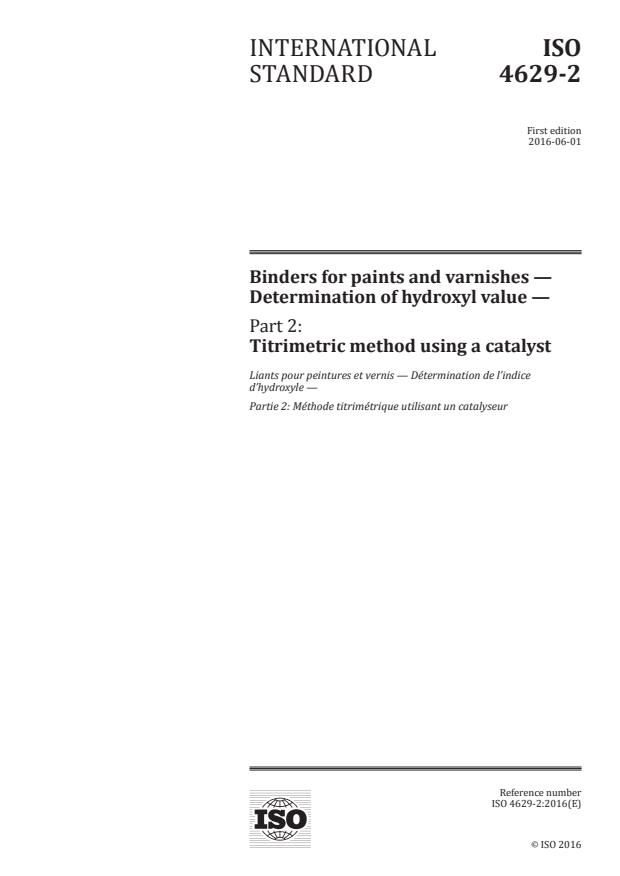
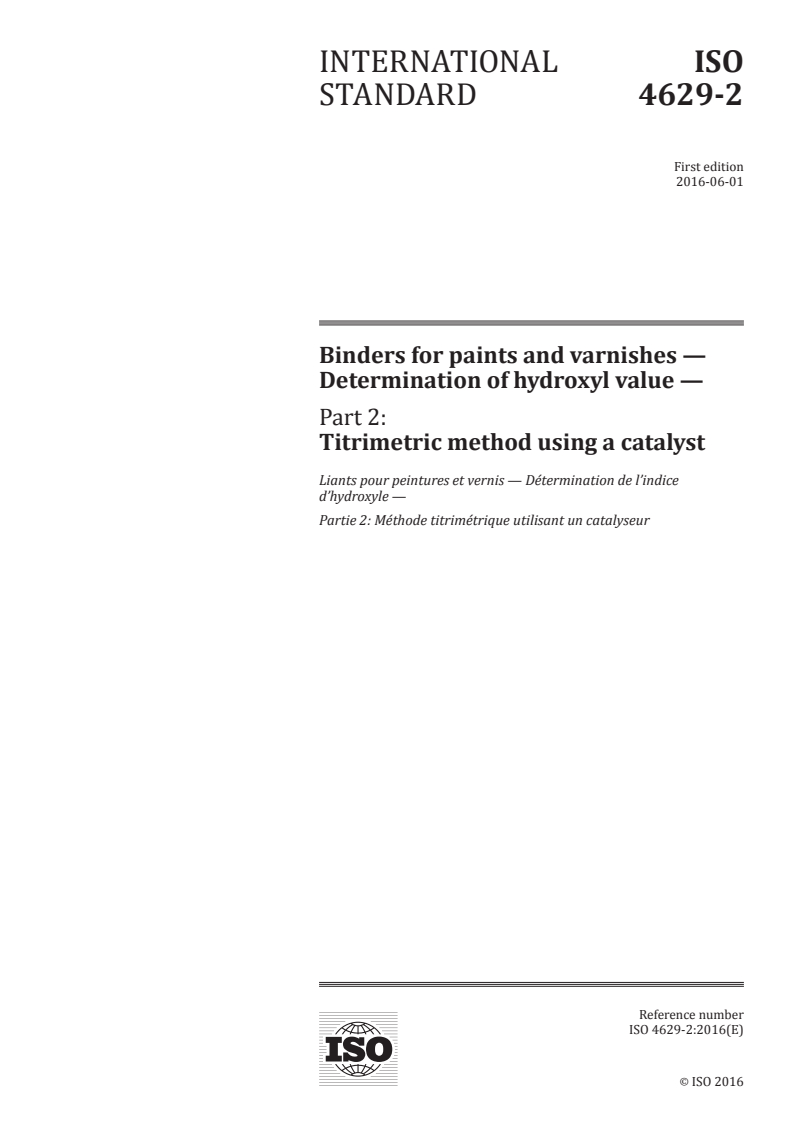
INTERNATIONAL ISO
STANDARD 4629-2
First edition
2016-06-01
Binders for paints and varnishes —
Determination of hydroxyl value —
Part 2:
Titrimetric method using a catalyst
Liants pour peintures et vernis — Détermination de l’indice
d’hydroxyle —
Partie 2: Méthode titrimétrique utilisant un catalyseur
Reference number
©
ISO 2016
© ISO 2016, Published in Switzerland
All rights reserved. Unless otherwise specified, no part of this publication may be reproduced or utilized otherwise in any form
or by any means, electronic or mechanical, including photocopying, or posting on the internet or an intranet, without prior
written permission. Permission can be requested from either ISO at the address below or ISO’s member body in the country of
the requester.
ISO copyright office
Ch. de Blandonnet 8 • CP 401
CH-1214 Vernier, Geneva, Switzerland
Tel. +41 22 749 01 11
Fax +41 22 749 09 47
copyright@iso.org
www.iso.org
ii © ISO 2016 – All rights reserved
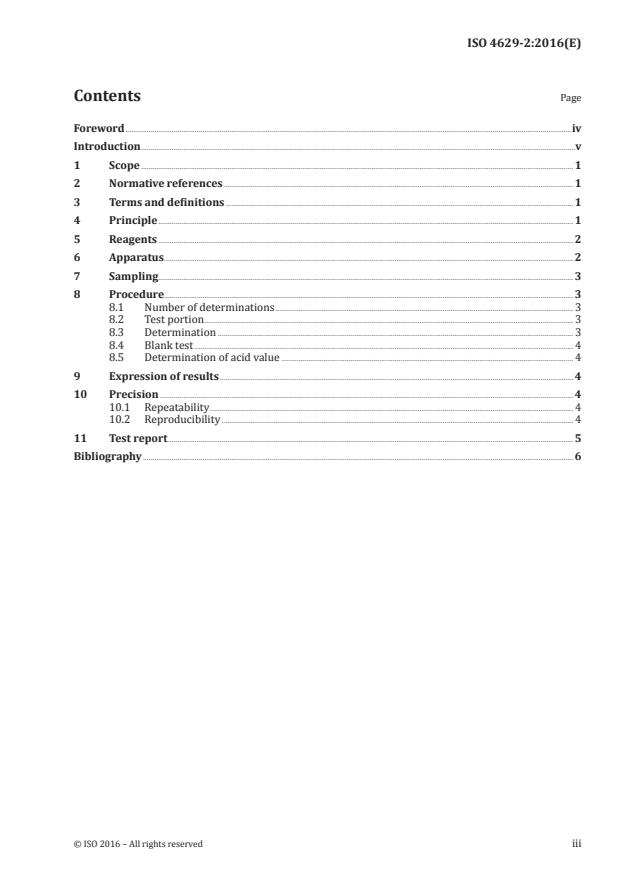
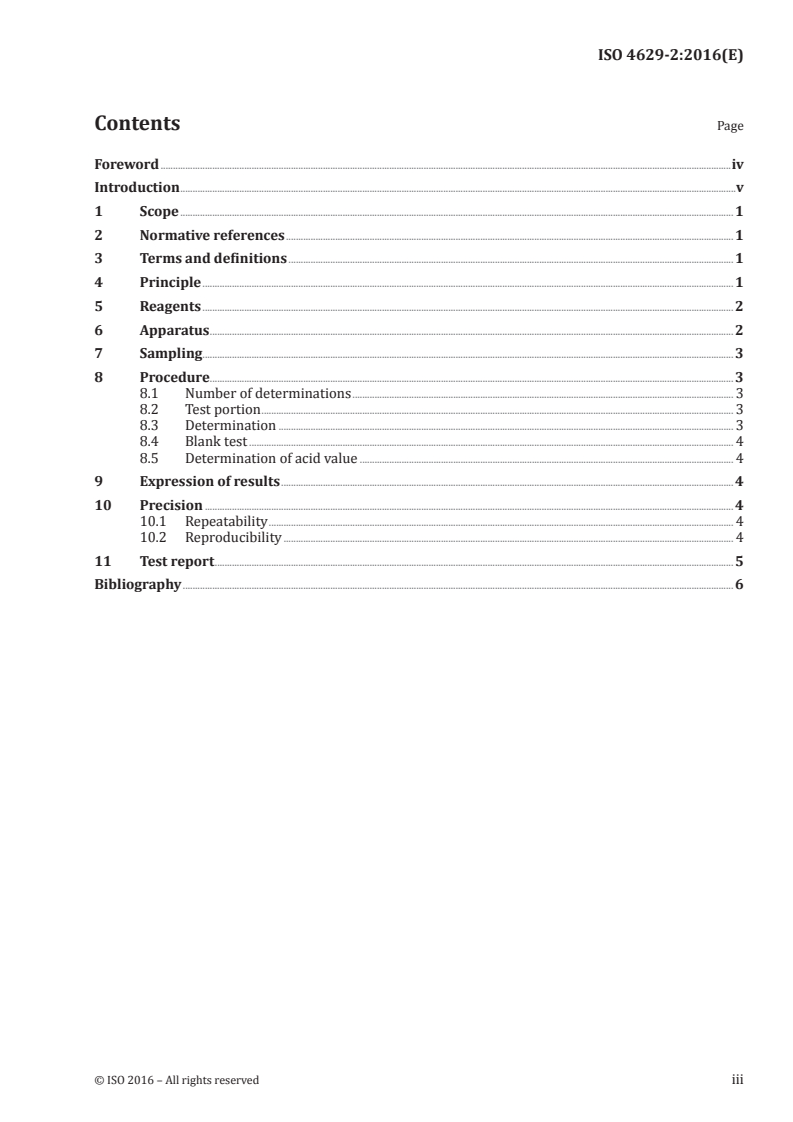
Contents Page
Foreword .iv
Introduction .v
1 Scope . 1
2 Normative references . 1
3 Terms and definitions . 1
4 Principle . 1
5 Reagents . 2
6 Apparatus . 2
7 Sampling . 3
8 Procedure. 3
8.1 Number of determinations . 3
8.2 Test portion . 3
8.3 Determination . 3
8.4 Blank test . 4
8.5 Determination of acid value . 4
9 Expression of results . 4
10 Precision . 4
10.1 Repeatability . 4
10.2 Reproducibility . 4
11 Test report . 5
Bibliography . 6
Foreword
ISO (the International Organization for Standardization) is a worldwide federation of national standards
bodies (ISO member bodies). The work of preparing International Standards is normally carried out
through ISO technical committees. Each member body interested in a subject for which a technical
committee has been established has the right to be represented on that committee. International
organizations, governmental and non-governmental, in liaison with ISO, also take part in the work.
ISO collaborates closely with the International Electrotechnical Commission (IEC) on all matters of
electrotechnical standardization.
The procedures used to develop this document and those intended for its further maintenance are
described in the ISO/IEC Directives, Part 1. In particular the different approval criteria needed for the
different types of ISO documents should be noted. This document was drafted in accordance with the
editorial rules of the ISO/IEC Directives, Part 2 (see www.iso.org/directives).
Attention is drawn to the possibility that some of the elements of this document may be the subject of
patent rights. ISO shall not be held responsible for identifying any or all such patent rights. Details of
any patent rights identified during the development of the document will be in the Introduction and/or
on the ISO list of patent declarations received (see www.iso.org/patents).
Any trade name used in this document is information given for the convenience of users and does not
constitute an endorsement.
For an explanation on the meaning of ISO specific terms and expressions related to conformity
assessment, as well as information about ISO’s adherence to the WTO principles in the Technical
Barriers to Trade (TBT) see the following URL: Foreword - Supplementary information
The committee responsible for this document is ISO/TC 35, Paints and varnishes, Subcommittee SC 10,
Test methods for binders for paints and varnishes.
ISO 4629 consists of the following parts, under the general title Binders for paints and varnishes —
Determination of hydroxyl value:
— Part 1: Titrimetric method without using a catalyst
— Part 2: Titrimetric method using a catalyst
iv © ISO 2016 – All rights reserved
Introduction
There are several different methods standardized for determining the hydroxyl value of resins. The
classic method using pyridine without a catalyst is specified in ISO 4629-1. The advantages of the
method using a catalyst are the following:
— the solvents used are less hazardous to health;
— the solvent consumption is lower;
— the method is faster due to shorter reaction times;
— the end point of the titration is easier to see;
— polyols are more readily soluble.
INTERNATIONAL STANDARD ISO 4629-2:2016(E)
Binders for paints and varnishes — Determination of
hydroxyl value —
Part 2:
Titrimetric met
...
INTERNATIONAL ISO
STANDARD 4629-2
First edition
2016-06-01
Binders for paints and varnishes —
Determination of hydroxyl value —
Part 2:
Titrimetric method using a catalyst
Liants pour peintures et vernis — Détermination de l’indice
d’hydroxyle —
Partie 2: Méthode titrimétrique utilisant un catalyseur
Reference number
©
ISO 2016
© ISO 2016, Published in Switzerland
All rights reserved. Unless otherwise specified, no part of this publication may be reproduced or utilized otherwise in any form
or by any means, electronic or mechanical, including photocopying, or posting on the internet or an intranet, without prior
written permission. Permission can be requested from either ISO at the address below or ISO’s member body in the country of
the requester.
ISO copyright office
Ch. de Blandonnet 8 • CP 401
CH-1214 Vernier, Geneva, Switzerland
Tel. +41 22 749 01 11
Fax +41 22 749 09 47
copyright@iso.org
www.iso.org
ii © ISO 2016 – All rights reserved
Contents Page
Foreword .iv
Introduction .v
1 Scope . 1
2 Normative references . 1
3 Terms and definitions . 1
4 Principle . 1
5 Reagents . 2
6 Apparatus . 2
7 Sampling . 3
8 Procedure. 3
8.1 Number of determinations . 3
8.2 Test portion . 3
8.3 Determination . 3
8.4 Blank test . 4
8.5 Determination of acid value . 4
9 Expression of results . 4
10 Precision . 4
10.1 Repeatability . 4
10.2 Reproducibility . 4
11 Test report . 5
Bibliography . 6
Foreword
ISO (the International Organization for Standardization) is a worldwide federation of national standards
bodies (ISO member bodies). The work of preparing International Standards is normally carried out
through ISO technical committees. Each member body interested in a subject for which a technical
committee has been established has the right to be represented on that committee. International
organizations, governmental and non-governmental, in liaison with ISO, also take part in the work.
ISO collaborates closely with the International Electrotechnical Commission (IEC) on all matters of
electrotechnical standardization.
The procedures used to develop this document and those intended for its further maintenance are
described in the ISO/IEC Directives, Part 1. In particular the different approval criteria needed for the
different types of ISO documents should be noted. This document was drafted in accordance with the
editorial rules of the ISO/IEC Directives, Part 2 (see www.iso.org/directives).
Attention is drawn to the possibility that some of the elements of this document may be the subject of
patent rights. ISO shall not be held responsible for identifying any or all such patent rights. Details of
any patent rights identified during the development of the document will be in the Introduction and/or
on the ISO list of patent declarations received (see www.iso.org/patents).
Any trade name used in this document is information given for the convenience of users and does not
constitute an endorsement.
For an explanation on the meaning of ISO specific terms and expressions related to conformity
assessment, as well as information about ISO’s adherence to the WTO principles in the Technical
Barriers to Trade (TBT) see the following URL: Foreword - Supplementary information
The committee responsible for this document is ISO/TC 35, Paints and varnishes, Subcommittee SC 10,
Test methods for binders for paints and varnishes.
ISO 4629 consists of the following parts, under the general title Binders for paints and varnishes —
Determination of hydroxyl value:
— Part 1: Titrimetric method without using a catalyst
— Part 2: Titrimetric method using a catalyst
iv © ISO 2016 – All rights reserved
Introduction
There are several different methods standardized for determining the hydroxyl value of resins. The
classic method using pyridine without a catalyst is specified in ISO 4629-1. The advantages of the
method using a catalyst are the following:
— the solvents used are less hazardous to health;
— the solvent consumption is lower;
— the method is faster due to shorter reaction times;
— the end point of the titration is easier to see;
— polyols are more readily soluble.
INTERNATIONAL STANDARD ISO 4629-2:2016(E)
Binders for paints and varnishes — Determination of
hydroxyl value —
Part 2:
Titrimetric met
...
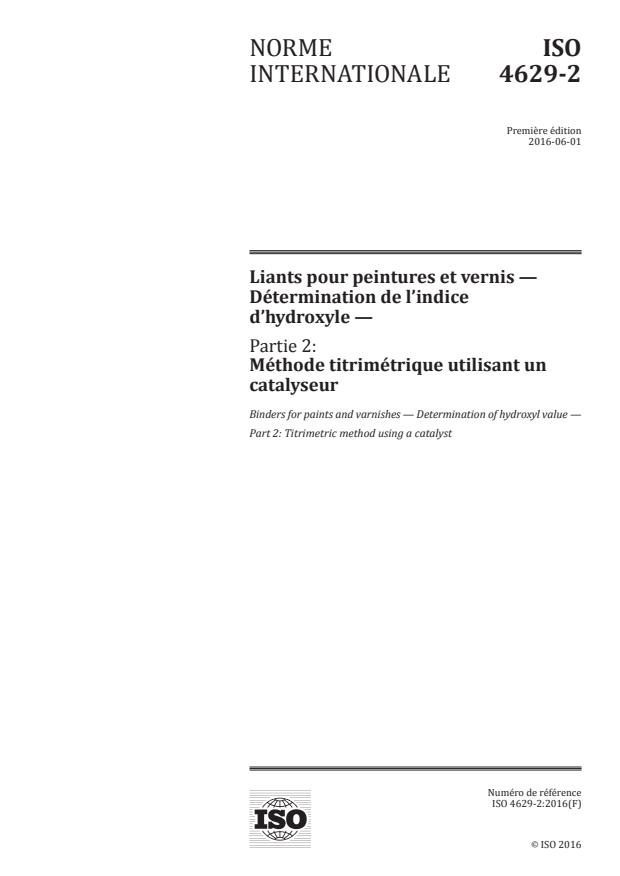
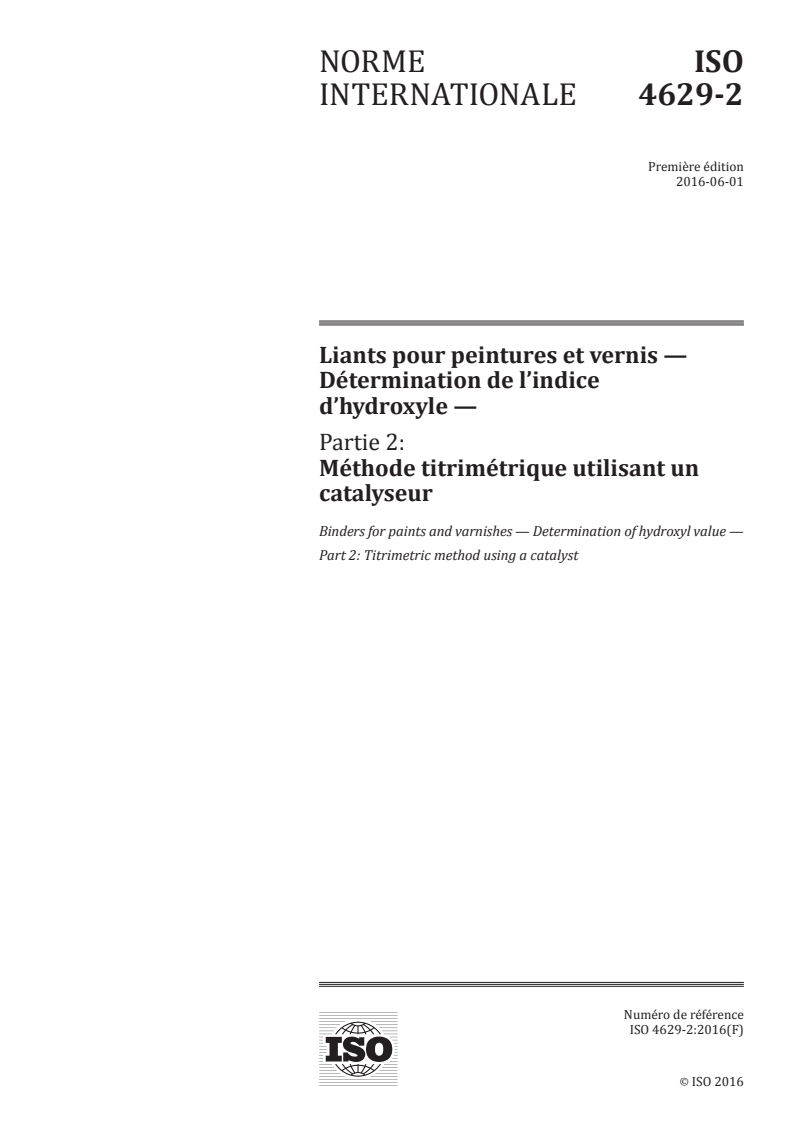
NORME ISO
INTERNATIONALE 4629-2
Première édition
2016-06-01
Liants pour peintures et vernis —
Détermination de l’indice
d’hydroxyle —
Partie 2:
Méthode titrimétrique utilisant un
catalyseur
Binders for paints and varnishes — Determination of hydroxyl value —
Part 2: Titrimetric method using a catalyst
Numéro de référence
©
ISO 2016
DOCUMENT PROTÉGÉ PAR COPYRIGHT
© ISO 2016, Publié en Suisse
Droits de reproduction réservés. Sauf indication contraire, aucune partie de cette publication ne peut être reproduite ni utilisée
sous quelque forme que ce soit et par aucun procédé, électronique ou mécanique, y compris la photocopie, l’affichage sur
l’internet ou sur un Intranet, sans autorisation écrite préalable. Les demandes d’autorisation peuvent être adressées à l’ISO à
l’adresse ci-après ou au comité membre de l’ISO dans le pays du demandeur.
ISO copyright office
Ch. de Blandonnet 8 • CP 401
CH-1214 Vernier, Geneva, Switzerland
Tel. +41 22 749 01 11
Fax +41 22 749 09 47
copyright@iso.org
www.iso.org
ii © ISO 2016 – Tous droits réservés
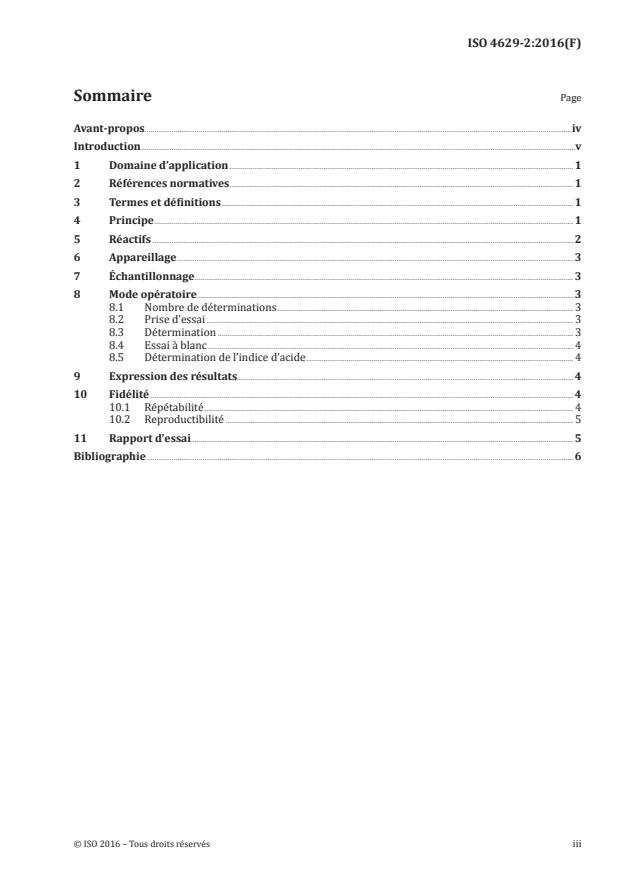
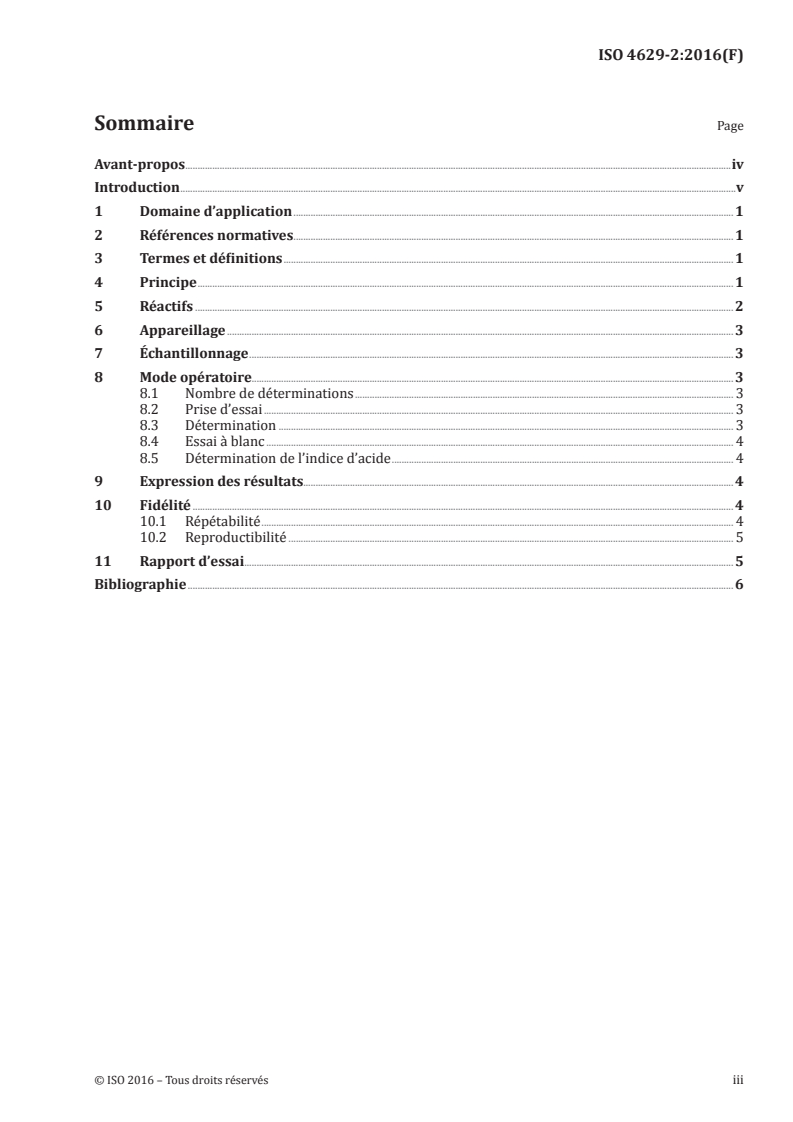
Sommaire Page
Avant-propos .iv
Introduction .v
1 Domaine d’application . 1
2 Références normatives . 1
3 Termes et définitions . 1
4 Principe . 1
5 Réactifs . 2
6 Appareillage . 3
7 Échantillonnage . 3
8 Mode opératoire. 3
8.1 Nombre de déterminations . 3
8.2 Prise d’essai . 3
8.3 Détermination . 3
8.4 Essai à blanc . 4
8.5 Détermination de l’indice d’acide . 4
9 Expression des résultats. 4
10 Fidélité . 4
10.1 Répétabilité . 4
10.2 Reproductibilité . 5
11 Rapport d’essai . 5
Bibliographie . 6
Avant-propos
L’ISO (Organisation internationale de normalisation) est une fédération mondiale d’organismes
nationaux de normalisation (comités membres de l’ISO). L’élaboration des Normes internationales est
en général confiée aux comités techniques de l’ISO. Chaque comité membre intéressé par une étude
a le droit de faire partie du comité technique créé à cet effet. Les organisations internationales,
gouvernementales et non gouvernementales, en liaison avec l’ISO participent également aux travaux.
L’ISO collabore étroitement avec la Commission électrotechnique internationale (IEC) en ce qui
concerne la normalisation électrotechnique.
Les procédures utilisées pour élaborer le présent document et celles destinées à sa mise à jour sont
décrites dans les Directives ISO/IEC, Partie 1. Il convient, en particulier de prendre note des différents
critères d’approbation requis pour les différents types de documents ISO. Le présent document a été
rédigé conformément aux règles de rédaction données dans les Directives ISO/IEC, Partie 2 (voir www.
iso.org/directives).
L’attention est appelée sur le fait que certains des éléments du présent document peuvent faire l’objet de
droits de propriété intellectuelle ou de droits analogues. L’ISO ne saurait être tenue pour responsable
de ne pas avoir identifié de tels droits de propriété et averti de leur existence. Les détails concernant
les références aux droits de propriété intellectuelle ou autres droits analogues identifiés lors de
l’élaboration du document sont indiqués dans l’Introduction et/ou dans la liste des déclarations de
brevets reçues par l’ISO (voir www.iso.org/brevets).
Les appellations commerciales éventuellement mentionnées dans le présent document sont données
pour information, par souci de commodité, à l’intention des utilisateurs et ne sauraient constituer un
engagement.
Pour une explication de la signification des termes et expressions spécifiques de l’ISO liés à
l’évaluation de la conformité, ou pour toute information au sujet de l’adhésion de l’ISO aux principes
de l’OMC concernant les obstacles techniques au commerce (OTC), voir le lien suivant: Avant-propos —
Informations supplémentaires.
Le comité chargé de l’élaboration du présent document est l’ISO/TC 35, Peintures et vernis, sous-
comité SC 10, Méthodes d’essai des liants pour peintures et vernis.
L’ISO 4629 comprend les parties suivantes, présentées sous le titre général Liants pour peintures et
vernis — Détermination de l’indice d’hydroxyle:
— Partie 1: Méthode titrimétrique sans catalyseur
— Partie 2: Méthode titrimétrique utilisant un catalyseur
iv © ISO 2016 – Tous droits réservés
Introduction
Il existe différentes méthodes normalisées permettant de déterminer l’indice d’hydroxyle des résines.
La méthode classique utilisant la pyridine sans catalyseur est spécifiée dans l’ISO 4629-1. Les avantages
de la méthode utilisant un catalyseur sont les suivants:
— les solvants utilisés sont moins dangereux pour la santé;
— la consommation de solvant est plus faible;
— la méthode est plus rapide en raison des temps de réaction plus courts;
— le point final du titrage est plus facile à observer;
— les polyols sont plus faciles à dissoudre.
NORME INTERNATIONALE ISO 4629-2:2016(F)
Liants pour peintures et vernis — Détermination de
l’indice d’hydroxyle —
Partie 2:
Méthode titrimétrique utilisant un catalyseur
1 Domaine d’application
La présente partie de l’ISO 4629 spécifie une méthode titrimétrique permettant de déterminer
l’indice d’hydroxyle des résines, des liants pour peintures
...
NORME ISO
INTERNATIONALE 4629-2
Première édition
2016-06-01
Liants pour peintures et vernis —
Détermination de l’indice
d’hydroxyle —
Partie 2:
Méthode titrimétrique utilisant un
catalyseur
Binders for paints and varnishes — Determination of hydroxyl value —
Part 2: Titrimetric method using a catalyst
Numéro de référence
©
ISO 2016
DOCUMENT PROTÉGÉ PAR COPYRIGHT
© ISO 2016, Publié en Suisse
Droits de reproduction réservés. Sauf indication contraire, aucune partie de cette publication ne peut être reproduite ni utilisée
sous quelque forme que ce soit et par aucun procédé, électronique ou mécanique, y compris la photocopie, l’affichage sur
l’internet ou sur un Intranet, sans autorisation écrite préalable. Les demandes d’autorisation peuvent être adressées à l’ISO à
l’adresse ci-après ou au comité membre de l’ISO dans le pays du demandeur.
ISO copyright office
Ch. de Blandonnet 8 • CP 401
CH-1214 Vernier, Geneva, Switzerland
Tel. +41 22 749 01 11
Fax +41 22 749 09 47
copyright@iso.org
www.iso.org
ii © ISO 2016 – Tous droits réservés
Sommaire Page
Avant-propos .iv
Introduction .v
1 Domaine d’application . 1
2 Références normatives . 1
3 Termes et définitions . 1
4 Principe . 1
5 Réactifs . 2
6 Appareillage . 3
7 Échantillonnage . 3
8 Mode opératoire. 3
8.1 Nombre de déterminations . 3
8.2 Prise d’essai . 3
8.3 Détermination . 3
8.4 Essai à blanc . 4
8.5 Détermination de l’indice d’acide . 4
9 Expression des résultats. 4
10 Fidélité . 4
10.1 Répétabilité . 4
10.2 Reproductibilité . 5
11 Rapport d’essai . 5
Bibliographie . 6
Avant-propos
L’ISO (Organisation internationale de normalisation) est une fédération mondiale d’organismes
nationaux de normalisation (comités membres de l’ISO). L’élaboration des Normes internationales est
en général confiée aux comités techniques de l’ISO. Chaque comité membre intéressé par une étude
a le droit de faire partie du comité technique créé à cet effet. Les organisations internationales,
gouvernementales et non gouvernementales, en liaison avec l’ISO participent également aux travaux.
L’ISO collabore étroitement avec la Commission électrotechnique internationale (IEC) en ce qui
concerne la normalisation électrotechnique.
Les procédures utilisées pour élaborer le présent document et celles destinées à sa mise à jour sont
décrites dans les Directives ISO/IEC, Partie 1. Il convient, en particulier de prendre note des différents
critères d’approbation requis pour les différents types de documents ISO. Le présent document a été
rédigé conformément aux règles de rédaction données dans les Directives ISO/IEC, Partie 2 (voir www.
iso.org/directives).
L’attention est appelée sur le fait que certains des éléments du présent document peuvent faire l’objet de
droits de propriété intellectuelle ou de droits analogues. L’ISO ne saurait être tenue pour responsable
de ne pas avoir identifié de tels droits de propriété et averti de leur existence. Les détails concernant
les références aux droits de propriété intellectuelle ou autres droits analogues identifiés lors de
l’élaboration du document sont indiqués dans l’Introduction et/ou dans la liste des déclarations de
brevets reçues par l’ISO (voir www.iso.org/brevets).
Les appellations commerciales éventuellement mentionnées dans le présent document sont données
pour information, par souci de commodité, à l’intention des utilisateurs et ne sauraient constituer un
engagement.
Pour une explication de la signification des termes et expressions spécifiques de l’ISO liés à
l’évaluation de la conformité, ou pour toute information au sujet de l’adhésion de l’ISO aux principes
de l’OMC concernant les obstacles techniques au commerce (OTC), voir le lien suivant: Avant-propos —
Informations supplémentaires.
Le comité chargé de l’élaboration du présent document est l’ISO/TC 35, Peintures et vernis, sous-
comité SC 10, Méthodes d’essai des liants pour peintures et vernis.
L’ISO 4629 comprend les parties suivantes, présentées sous le titre général Liants pour peintures et
vernis — Détermination de l’indice d’hydroxyle:
— Partie 1: Méthode titrimétrique sans catalyseur
— Partie 2: Méthode titrimétrique utilisant un catalyseur
iv © ISO 2016 – Tous droits réservés
Introduction
Il existe différentes méthodes normalisées permettant de déterminer l’indice d’hydroxyle des résines.
La méthode classique utilisant la pyridine sans catalyseur est spécifiée dans l’ISO 4629-1. Les avantages
de la méthode utilisant un catalyseur sont les suivants:
— les solvants utilisés sont moins dangereux pour la santé;
— la consommation de solvant est plus faible;
— la méthode est plus rapide en raison des temps de réaction plus courts;
— le point final du titrage est plus facile à observer;
— les polyols sont plus faciles à dissoudre.
NORME INTERNATIONALE ISO 4629-2:2016(F)
Liants pour peintures et vernis — Détermination de
l’indice d’hydroxyle —
Partie 2:
Méthode titrimétrique utilisant un catalyseur
1 Domaine d’application
La présente partie de l’ISO 4629 spécifie une méthode titrimétrique permettant de déterminer
l’indice d’hydroxyle des résines, des liants pour peintures
...