


ISO 8124-1:2018
(Main)Safety of toys — Part 1: Safety aspects related to mechanical and physical properties
Safety of toys — Part 1: Safety aspects related to mechanical and physical properties
The requirements in ISO 8124-1:2018 apply to all toys, i.e. any product or material designed or clearly intended for use in play by children under 14 years of age. They are applicable to a toy as it is initially received by the consumer and, in addition, they apply after a toy is subjected to reasonably foreseeable conditions of normal use and abuse unless specifically noted otherwise. The requirements of this document specify acceptable criteria for structural characteristics of toys, such as shape, size, contour, spacing (e.g. rattles, small parts, sharp points and edges, and hinge-line clearances) as well as acceptable criteria for properties peculiar to certain categories of toy (e.g. maximum kinetic energy values for non-resilient-tipped projectiles and minimum tip angles for certain ride-on toys). ISO 8124-1:2018 specifies requirements and test methods for toys intended for use by children in various age groups from birth to 14 years. The requirements vary according to the age group for which a particular toy is intended. The requirements for a particular age group reflect the nature of the hazards and the expected mental and/or physical abilities of a child to cope with them. ISO 8124-1:2018 also requires that appropriate warnings and/or instructions for use be given on certain toys or their packaging. Due to linguistic problems which may occur in different countries, the wording of these warnings and instructions is not specified but given as general information in Annex B. It should be noted that different legal requirements exist in many countries with regard to such marking. ISO 8124-1:2018 does not purport to cover or include every conceivable potential hazard of a particular toy or toy category. Except for labelling requirements indicating the functional hazards and the age range for which the toy is intended, this document has no requirements for those characteristics of toys which represent an inherent and recognized hazard which is integral to the function of the toy. EXAMPLE 1 An example of such a hazard is the sharp point necessary for the proper function of a needle. The needle is a hazard which is well understood by the purchaser of a toy sewing kit, and the functional sharp-point hazard is communicated to the user as part of the normal educational process of learning to sew as well as at the point of purchase by means of cautionary labelling on the product's packaging. EXAMPLE 2 As a further example, a two-wheeled toy scooter has inherent and recognized hazards associated with its use (e.g. instability during use, especially while learning). The potential hazards associated with its structural characteristics (sharp edges, pinch hazards, etc.) will be minimized by compliance with the requirements of this document.
Sécurité des jouets — Partie 1: Aspects de sécurité relatifs aux propriétés mécaniques et physiques
General Information
- Status
- Withdrawn
- Publication Date
- 06-Mar-2018
- Technical Committee
- ISO/TC 181 - Safety of toys
- Drafting Committee
- ISO/TC 181/WG 1 - Mechanical and physical properties
- Current Stage
- 9599 - Withdrawal of International Standard
- Start Date
- 15-Sep-2022
- Completion Date
- 12-Feb-2026
Relations
- Effective Date
- 07-Oct-2017
- Effective Date
- 07-Oct-2017
- Effective Date
- 07-Oct-2017
- Effective Date
- 07-Oct-2017
- Effective Date
- 06-Jun-2022
- Effective Date
- 06-Jun-2022
- Effective Date
- 06-Jun-2022
- Effective Date
- 23-Apr-2020
- Effective Date
- 09-Sep-2017


Frequently Asked Questions
ISO 8124-1:2018 is a standard published by the International Organization for Standardization (ISO). Its full title is "Safety of toys — Part 1: Safety aspects related to mechanical and physical properties". This standard covers: The requirements in ISO 8124-1:2018 apply to all toys, i.e. any product or material designed or clearly intended for use in play by children under 14 years of age. They are applicable to a toy as it is initially received by the consumer and, in addition, they apply after a toy is subjected to reasonably foreseeable conditions of normal use and abuse unless specifically noted otherwise. The requirements of this document specify acceptable criteria for structural characteristics of toys, such as shape, size, contour, spacing (e.g. rattles, small parts, sharp points and edges, and hinge-line clearances) as well as acceptable criteria for properties peculiar to certain categories of toy (e.g. maximum kinetic energy values for non-resilient-tipped projectiles and minimum tip angles for certain ride-on toys). ISO 8124-1:2018 specifies requirements and test methods for toys intended for use by children in various age groups from birth to 14 years. The requirements vary according to the age group for which a particular toy is intended. The requirements for a particular age group reflect the nature of the hazards and the expected mental and/or physical abilities of a child to cope with them. ISO 8124-1:2018 also requires that appropriate warnings and/or instructions for use be given on certain toys or their packaging. Due to linguistic problems which may occur in different countries, the wording of these warnings and instructions is not specified but given as general information in Annex B. It should be noted that different legal requirements exist in many countries with regard to such marking. ISO 8124-1:2018 does not purport to cover or include every conceivable potential hazard of a particular toy or toy category. Except for labelling requirements indicating the functional hazards and the age range for which the toy is intended, this document has no requirements for those characteristics of toys which represent an inherent and recognized hazard which is integral to the function of the toy. EXAMPLE 1 An example of such a hazard is the sharp point necessary for the proper function of a needle. The needle is a hazard which is well understood by the purchaser of a toy sewing kit, and the functional sharp-point hazard is communicated to the user as part of the normal educational process of learning to sew as well as at the point of purchase by means of cautionary labelling on the product's packaging. EXAMPLE 2 As a further example, a two-wheeled toy scooter has inherent and recognized hazards associated with its use (e.g. instability during use, especially while learning). The potential hazards associated with its structural characteristics (sharp edges, pinch hazards, etc.) will be minimized by compliance with the requirements of this document.
The requirements in ISO 8124-1:2018 apply to all toys, i.e. any product or material designed or clearly intended for use in play by children under 14 years of age. They are applicable to a toy as it is initially received by the consumer and, in addition, they apply after a toy is subjected to reasonably foreseeable conditions of normal use and abuse unless specifically noted otherwise. The requirements of this document specify acceptable criteria for structural characteristics of toys, such as shape, size, contour, spacing (e.g. rattles, small parts, sharp points and edges, and hinge-line clearances) as well as acceptable criteria for properties peculiar to certain categories of toy (e.g. maximum kinetic energy values for non-resilient-tipped projectiles and minimum tip angles for certain ride-on toys). ISO 8124-1:2018 specifies requirements and test methods for toys intended for use by children in various age groups from birth to 14 years. The requirements vary according to the age group for which a particular toy is intended. The requirements for a particular age group reflect the nature of the hazards and the expected mental and/or physical abilities of a child to cope with them. ISO 8124-1:2018 also requires that appropriate warnings and/or instructions for use be given on certain toys or their packaging. Due to linguistic problems which may occur in different countries, the wording of these warnings and instructions is not specified but given as general information in Annex B. It should be noted that different legal requirements exist in many countries with regard to such marking. ISO 8124-1:2018 does not purport to cover or include every conceivable potential hazard of a particular toy or toy category. Except for labelling requirements indicating the functional hazards and the age range for which the toy is intended, this document has no requirements for those characteristics of toys which represent an inherent and recognized hazard which is integral to the function of the toy. EXAMPLE 1 An example of such a hazard is the sharp point necessary for the proper function of a needle. The needle is a hazard which is well understood by the purchaser of a toy sewing kit, and the functional sharp-point hazard is communicated to the user as part of the normal educational process of learning to sew as well as at the point of purchase by means of cautionary labelling on the product's packaging. EXAMPLE 2 As a further example, a two-wheeled toy scooter has inherent and recognized hazards associated with its use (e.g. instability during use, especially while learning). The potential hazards associated with its structural characteristics (sharp edges, pinch hazards, etc.) will be minimized by compliance with the requirements of this document.
ISO 8124-1:2018 is classified under the following ICS (International Classification for Standards) categories: 97.200.50 - Toys. The ICS classification helps identify the subject area and facilitates finding related standards.
ISO 8124-1:2018 has the following relationships with other standards: It is inter standard links to ISO 8124-1:2014/FDAmd 4, ISO 8124-1:2014/FDAmd 2, ISO 8124-1:2014/FDAmd 3, ISO 8124-1:2014/FDAmd 1, ISO 18674-8:2023, ISO 8124-1:2018/Amd 1:2020, ISO 8124-1:2018/Amd 2:2020, ISO 8124-1:2022, ISO 8124-1:2014. Understanding these relationships helps ensure you are using the most current and applicable version of the standard.
ISO 8124-1:2018 is available in PDF format for immediate download after purchase. The document can be added to your cart and obtained through the secure checkout process. Digital delivery ensures instant access to the complete standard document.
Standards Content (Sample)
INTERNATIONAL ISO
STANDARD 8124-1
Fifth edition
2018-03
Safety of toys —
Part 1:
Safety aspects related to mechanical
and physical properties
Sécurité des jouets —
Partie 1: Aspects de sécurité relatifs aux propriétés mécaniques et
physiques
Reference number
©
ISO 2018
© ISO 2018
All rights reserved. Unless otherwise specified, or required in the context of its implementation, no part of this publication may
be reproduced or utilized otherwise in any form or by any means, electronic or mechanical, including photocopying, or posting
on the internet or an intranet, without prior written permission. Permission can be requested from either ISO at the address
below or ISO’s member body in the country of the requester.
ISO copyright office
CP 401 • Ch. de Blandonnet 8
CH-1214 Vernier, Geneva
Phone: +41 22 749 01 11
Fax: +41 22 749 09 47
Email: copyright@iso.org
Website: www.iso.org
Published in Switzerland
ii © ISO 2018 – All rights reserved
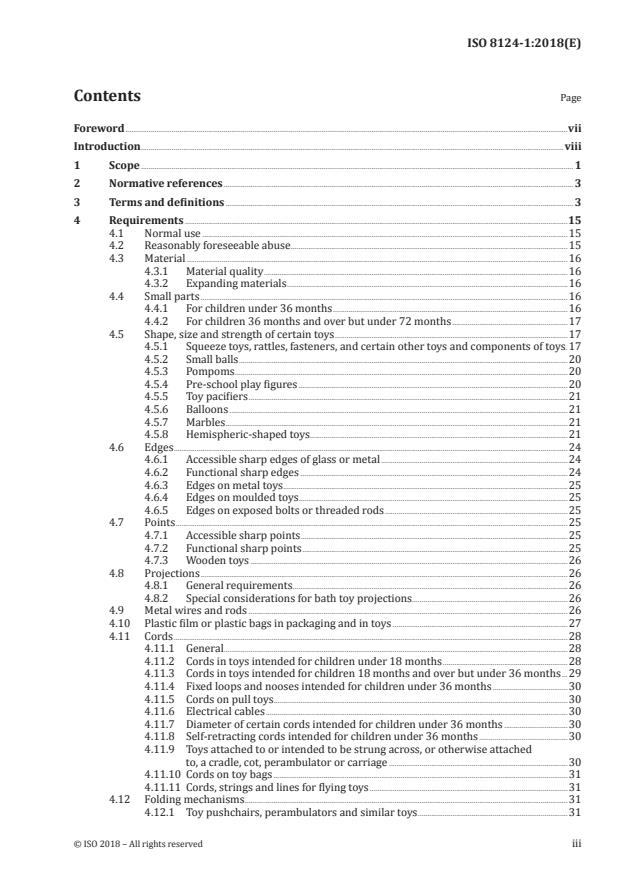
Contents Page
Foreword .vii
Introduction .viii
1 Scope . 1
2 Normative references . 3
3 Terms and definitions . 3
4 Requirements .15
4.1 Normal use .15
4.2 Reasonably foreseeable abuse .15
4.3 Material .16
4.3.1 Material quality .16
4.3.2 Expanding materials .16
4.4 Small parts .16
4.4.1 For children under 36 months .16
4.4.2 For children 36 months and over but under 72 months .17
4.5 Shape, size and strength of certain toys .17
4.5.1 Squeeze toys, rattles, fasteners, and certain other toys and components of toys .17
4.5.2 Small balls .20
4.5.3 Pompoms .20
4.5.4 Pre-school play figures .20
4.5.5 Toy pacifiers .21
4.5.6 Balloons .21
4.5.7 Marbles .21
4.5.8 Hemispheric-shaped toys .21
4.6 Edges .24
4.6.1 Accessible sharp edges of glass or metal .24
4.6.2 Functional sharp edges .24
4.6.3 Edges on metal toys .25
4.6.4 Edges on moulded toys . . .25
4.6.5 Edges on exposed bolts or threaded rods .25
4.7 Points .25
4.7.1 Accessible sharp points .25
4.7.2 Functional sharp points .25
4.7.3 Wooden toys .26
4.8 Projections .26
4.8.1 General requirements .26
4.8.2 Special considerations for bath toy projections.26
4.9 Metal wires and rods .26
4.10 Plastic film or plastic bags in packaging and in toys .27
4.11 Cords .28
4.11.1 General.28
4.11.2 Cords in toys intended for children under 18 months .28
4.11.3 Cords in toys intended for children 18 months and over but under 36 months .29
4.11.4 Fixed loops and nooses intended for children under 36 months .30
4.11.5 Cords on pull toys .30
4.11.6 Electrical cables .30
4.11.7 Diameter of certain cords intended for children under 36 months .30
4.11.8 Self-retracting cords intended for children under 36 months .30
4.11.9 Toys attached to or intended to be strung across, or otherwise attached
to, a cradle, cot, perambulator or carriage .30
4.11.10 Cords on toy bags .31
4.11.11 Cords, strings and lines for flying toys .31
4.12 Folding mechanisms .31
4.12.1 Toy pushchairs, perambulators and similar toys .31
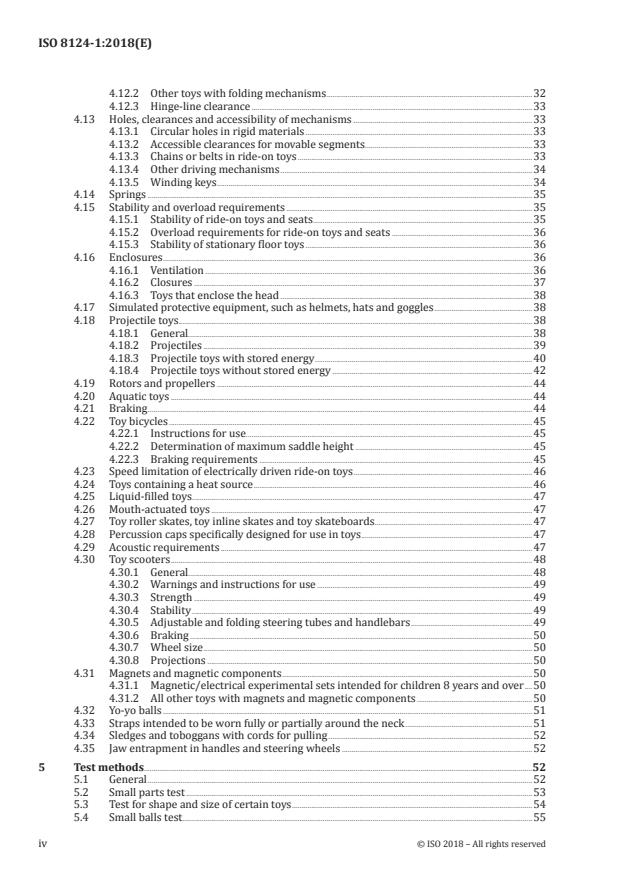
4.12.2 Other toys with folding mechanisms .32
4.12.3 Hinge-line clearance .33
4.13 Holes, clearances and accessibility of mechanisms .33
4.13.1 Circular holes in rigid materials .33
4.13.2 Accessible clearances for movable segments .33
4.13.3 Chains or belts in ride-on toys .33
4.13.4 Other driving mechanisms .34
4.13.5 Winding keys .34
4.14 Springs .35
4.15 Stability and overload requirements .35
4.15.1 Stability of ride-on toys and seats .35
4.15.2 Overload requirements for ride-on toys and seats .36
4.15.3 Stability of stationary floor toys .36
4.16 Enclosures .36
4.16.1 Ventilation .36
4.16.2 Closures .37
4.16.3 Toys that enclose the head .38
4.17 Simulated protective equipment, such as helmets, hats and goggles .38
4.18 Projectile toys .38
4.18.1 General.38
4.18.2 Projectiles .39
4.18.3 Projectile toys with stored energy .40
4.18.4 Projectile toys without stored energy .42
4.19 Rotors and propellers .44
4.20 Aquatic toys .44
4.21 Braking .44
4.22 Toy bicycles .45
4.22.1 Instructions for use.45
4.22.2 Determination of maximum saddle height .45
4.22.3 Braking requirements .45
4.23 Speed limitation of electrically driven ride-on toys .46
4.24 Toys containing a heat source .46
4.25 Liquid-filled toys .47
4.26 Mouth-actuated toys .47
4.27 Toy roller skates, toy inline skates and toy skateboards .47
4.28 Percussion caps specifically designed for use in toys .47
4.29 Acoustic requirements .47
4.30 Toy scooters .48
4.30.1 General.48
4.30.2 Warnings and instructions for use .49
4.30.3 Strength .49
4.30.4 Stability .49
4.30.5 Adjustable and folding steering tubes and handlebars .49
4.30.6 Braking .50
4.30.7 Wheel size .50
4.30.8 Projections .50
4.31 Magnets and magnetic components .50
4.31.1 Magnetic/electrical experimental sets intended for children 8 years and over .50
4.31.2 All other toys with magnets and magnetic components .50
4.32 Yo-yo balls .51
4.33 Straps intended to be worn fully or partially around the neck .51
4.34 Sledges and toboggans with cords for pulling .52
4.35 Jaw entrapment in handles and steering wheels .52
5 Test methods .52
5.1 General .52
5.2 Small parts test .53
5.3 Test for shape and size of certain toys .54
5.4 Small balls test .55
iv © ISO 2018 – All rights reserved
5.5 Test for pompoms .55
5.6 Test for pre-school play figures .56
5.7 Accessibility of a part or component .56
5.7.1 Principle .56
5.7.2 Apparatus .56
5.7.3 Procedure .57
5.8 Sharp-edge test .58
5.8.1 Principle .58
5.8.2 Apparatus .58
5.8.3 Procedure .59
5.9 Sharp-point test.60
5.9.1 Principle .60
5.9.2 Apparatus .60
5.9.3 Procedure .61
5.10 Determination of thickness of plastic film and sheeting .61
5.10.1 General.61
5.10.2 Apparatus .61
5.10.3 Procedure .61
5.11 Test for cords .62
5.11.1 Cord cross-sectional dimension .62
5.11.2 Length of cords and electrical cables .62
5.11.3 Breakaway feature separation test .63
5.11.4 Test for fixed loops and nooses .63
5.11.5 Self-retracting cords .67
5.11.6 Electrical resistance of cords.68
5.12 Stability and overload tests .68
5.12.1 General.68
5.12.2 Sideways stability test, feet available for stabilization .68
5.12.3 Sideways stability test, feet unavailable for stabilization .68
5.12.4 Fore and aft stability test .69
5.12.5 Overload test for ride-on toys and seats.69
5.12.6 Stability test of stationary floor toys .69
5.13 Test for closures and toy chest lids .69
5.13.1 Closures .70
5.13.2 Toy chest lids .70
5.14 Impact test for toys that cover the face .70
5.15 Kinetic energy and wall impact test.70
5.15.1 Kinetic energy of projectiles .71
5.15.2 Wall impact test for projectiles.73
5.16 Free-wheeling facility and brake performance test .74
5.16.1 Determination of free-wheeling facility .74
5.16.2 Brake performance for mechanically or electrically powered ride-on toys
other than toy bicycles .74
5.16.3 Brake performance for toy bicycles .75
5.17 Determination of speed of electrically driven ride-on toys .75
5.18 Determination of temperature increases .75
5.19 Leakage of liquid-filled toys .75
5.20 Durability of mouth-actuated toys .76
5.21 Expanding materials .76
5.22 Folding or sliding mechanisms .76
5.22.1 Loads .76
5.22.2 Toy pushchairs and perambulators .76
5.22.3 Other toys with folding mechanisms .77
5.23 Washable toys .77
5.24 Reasonably foreseeable abuse tests .78
5.24.1 General.78
5.24.2 Drop test .78
5.24.3 Tip-over test for large and bulky toys.79
5.24.4 Dynamic strength test for wheeled ride-on toys other than toy scooters .80
5.24.5 Torque test .81
5.24.6 Tension test .81
5.24.7 Compression test .84
5.24.8 Flexure test .85
5.25 Determination of sound pressure levels .85
5.25.1 General test conditions .85
5.25.2 Specific test methods .87
5.26 Static strength for toy scooters .91
5.27 Dynamic strength for toy scooters .93
5.27.1 Principle .93
5.27.2 Load . .93
5.27.3 Procedure .95
5.28 Brake performance for toy scooters .95
5.28.1 Toy scooters with handbrake .95
5.28.2 Toy scooters with foot brake .95
5.29 Strength of toy scooter steering tubes .96
5.29.1 Resistance to downward forces .96
5.29.2 Resistance to upward forces .97
5.30 Resistance to separation of handlebar .97
5.31 Tension test for magnets .98
5.31.1 Principle .98
5.31.2 Toys with magnets or magnetic components .98
5.31.3 Toys that contain one magnet only and a mating metal component .99
5.31.4 Toys that contain one magnet only and no mating metal component .99
5.32 Magnetic flux index .99
5.32.1 General.99
5.32.2 Principle .99
5.32.3 Apparatus .99
5.32.4 Procedure .99
5.32.5 Calculation of magnetic flux index.100
5.33 Impact test for magnets .100
5.34 Soaking test for magnets .100
5.35 Determination of projectile range .101
5.36 Tip assessment of rigid projectiles .102
5.37 Length of suction cup projectiles .102
5.38 Yo-yo ball measurements .103
5.38.1 Measurement of elastic constant, k .103
5.38.2 Measurement of initial length, l .104
Annex A (informative) Age-grading guidelines .107
Annex B (informative) Safety-labelling guidelines and manufacturer's markings.111
Annex C (informative) Design guidelines for toys attached to cribs or playpens .119
Annex D (informative) Toy gun marking .120
Annex E (informative) Rationale .121
Annex F (informative) Bath toy projection design guidelines .147
Annex G (informative) Significant technical changes between this document and the
previous version .148
Bibliography .150
vi © ISO 2018 – All rights reserved
Foreword
ISO (the International Organization for Standardization) is a worldwide federation of national standards
bodies (ISO member bodies). The work of preparing International Standards is normally carried out
through ISO technical committees. Each member body interested in a subject for which a technical
committee has been established has the right to be represented on that committee. International
organizations, governmental and non-governmental, in liaison with ISO, also take part in the work.
ISO collaborates closely with the International Electrotechnical Commission (IEC) on all matters of
electrotechnical standardization.
The procedures used to develop this document and those intended for its further maintenance are
described in the ISO/IEC Directives, Part 1. In particular the different approval criteria needed for the
different types of ISO documents should be noted. This document was drafted in accordance with the
editorial rules of the ISO/IEC Directives, Part 2 (see www .iso .org/ directives).
Attention is drawn to the possibility that some of the elements of this document may be the subject of
patent rights. ISO shall not be held responsible for identifying any or all such patent rights. Details of
any patent rights identified during the development of the document will be in the Introduction and/or
on the ISO list of patent declarations received (see www .iso .org/ patents).
Any trade name used in this document is information given for the convenience of users and does not
constitute an endorsement.
For an explanation on the voluntary nature of standards, the meaning of ISO specific terms and
expressions related to conformity assessment, as well as information about ISO's adherence to the
World Trade Organization (WTO) principles in the Technical Barriers to Trade (TBT) see the following
URL: www .iso .org/ iso/ foreword .html.
This document was prepared by Technical Committee ISO/TC 181, Safety of toys.
This fifth edition cancels and replaces the fourth edition (ISO 8124-1:2014). A list of the main technical
changes made to the previous edition is given in Annex G.
A list of all parts in the ISO 8124 series can be found on the ISO website.
Introduction
This document is largely based upon existing standards in the European Union (EN 71-1) and in the
United States of America (ASTM F963).
Compliance with the requirements of this document will minimize potential hazards associated with
toys resulting from their use in their intended play modes (normal use) as well as unintended play
modes (reasonably foreseeable abuse).
This document will not, nor is it intended to, eliminate parental responsibility in the appropriate
selection of toys. In addition, this document will not eliminate the need for parental supervision in
situations where children of various ages may have access to the same toy(s).
Although Annexes A, B, C, D, E and F are for information purposes only, they are crucial for the correct
interpretation of this document.
The safety of electric toys is described in IEC 62115.
When age indications are required for safety labelling purposes, they may be given in either months
or years.
viii © ISO 2018 – All rights reserved
INTERNATIONAL STANDARD ISO 8124-1:2018(E)
Safety of toys —
Part 1:
Safety aspects related to mechanical and physical
properties
1 Scope
The requirements in this document apply to all toys, i.e. any product or material designed or clearly
intended for use in play by children under 14 years of age. They are applicable to a toy as it is initially
received by the consumer and, in addition, they apply after a toy is subjected to reasonably foreseeable
conditions of normal use and abuse unless specifically noted otherwise.
The requirements of this document specify acceptable criteria for structural characteristics of toys,
such as shape, size, contour, spacing (e.g. rattles, small parts, sharp points and edges, and hinge-line
clearances) as well as acceptable criteria for properties peculiar to certain categories of toy (e.g.
maximum kinetic energy values for non-resilient-tipped projectiles and minimum tip angles for certain
ride-on toys).
This document specifies requirements and test methods for toys intended for use by children in various
age groups from birth to 14 years. The requirements vary according to the age group for which a
particular toy is intended. The requirements for a particular age group reflect the nature of the hazards
and the expected mental and/or physical abilities of a child to cope with them.
This document also requires that appropriate warnings and/or instructions for use be given on certain
toys or their packaging. Due to linguistic problems which may occur in different countries, the wording
of these warnings and instructions is not specified but given as general information in Annex B. It
should be noted that different legal requirements exist in many countries with regard to such marking.
This document does not purport to cover or include every conceivable potential hazard of a particular
toy or toy category. Except for labelling requirements indicating the functional hazards and the age
range for which the toy is intended, this document has no requirements for those characteristics of toys
which represent an inherent and recognized hazard which is integral to the function of t
...
Questions, Comments and Discussion
Ask us and Technical Secretary will try to provide an answer. You can facilitate discussion about the standard in here.
Loading comments...