

ISO/IEC 21031:2024
(Main)Information technology — Software Carbon Intensity (SCI) specification
General Information
- Abstract
This document describes a methodology for calculating the rate of carbon emissions for a software system; that is, its SCI score. The purpose of this score is to increase awareness and transparency of an application's sustainability credentials. The score will help software practitioners make better, evidence-based decisions during system design, development, and deployment, that will ultimately minimize carbon emissions. A reliable, consistent, fair and comparable measure allows targets to be defined during development and progress to be tracked.
- Status
- Published
- Publication Date
- 21-Mar-2024
- Technical Committee
- ISO/IEC JTC 1 - Information technology
- Drafting Committee
- ISO/IEC JTC 1 - Information technology
- Current Stage
- 6060 - International Standard published
- Start Date
- 22-Mar-2024
- Due Date
- 23-Aug-2024
- Completion Date
- 22-Mar-2024

Overview
ISO/IEC 21031:2024 - Software Carbon Intensity (SCI) specification - defines a consistent, evidence-based methodology to calculate the rate of carbon emissions caused by a software system (its SCI score). The standard frames SCI as a rate (carbon per functional unit) to increase transparency of an application’s sustainability credentials and to support measurable reduction strategies. It covers both operational emissions (energy use × marginal carbon intensity) and embodied emissions (hardware manufacturing and disposal allocated to the software).
Key topics and technical requirements
- SCI as a rate: SCI = (O + M) per R, where O = operational emissions, M = embodied emissions, and R = functional unit.
- Operational emissions calculation: O = E × I
- E = energy consumed (kWh) for the defined functional unit.
- I = location-based marginal carbon intensity (gCO2eq/kWh) - use consequential/marginal rates, not market-based measures.
- Embodied emissions: allocate a time- and resource-share of device lifecycle emissions (manufacture, disposal) to software (M).
- Procedure for reporting: Bound (define software boundary), Scale (choose functional unit), Define (select quantification method - telemetry or models), Quantify (calculate per-component SCI), Report (disclose score, boundary, and methodology).
- Exclusions and principles: Offsets or market-based renewable claims do not reduce SCI; SCI focuses on elimination of emissions and uses location-based marginal rates.
- Units and granularity: Energy in kWh; carbon intensity in gCO2eq/kWh; supports diverse scales from single functions to distributed cloud systems.
Applications and who should use it
ISO/IEC 21031:2024 is practical for organizations and practitioners aiming to design, develop, operate, or procure lower-carbon software:
- Software developers and engineers - optimize code and runtime efficiency.
- AI/ML teams - reduce training emissions via model optimization and hardware choices.
- Architects and DevOps - choose architectures (serverless, event-driven), schedule workloads, and implement carbon-aware pipelines.
- QA and SRE - measure energy use in testing and production.
- Sustainability officers and product managers - set targets, compare baselines, and report SCI scores across products or services.
- Cloud providers and vendors - supply granular telemetry or modelled data to support accurate SCI calculations.
Related standards
ISO/IEC 21031:2024 complements broader sustainability and GHG accounting practices. Organizations should consider linking SCI reporting with corporate environmental management frameworks (e.g., ISO environmental standards) and established GHG reporting protocols when aligning software-level metrics with enterprise climate goals.
Get Certified
Connect with accredited certification bodies for this standard

BSI Group
BSI (British Standards Institution) is the business standards company that helps organizations make excellence a habit.

Bureau Veritas
Bureau Veritas is a world leader in laboratory testing, inspection and certification services.

DNV
DNV is an independent assurance and risk management provider.
Sponsored listings
Frequently Asked Questions
ISO/IEC 21031:2024 is a standard published by the International Organization for Standardization (ISO). Its full title is "Information technology — Software Carbon Intensity (SCI) specification". This standard covers: This document describes a methodology for calculating the rate of carbon emissions for a software system; that is, its SCI score. The purpose of this score is to increase awareness and transparency of an application's sustainability credentials. The score will help software practitioners make better, evidence-based decisions during system design, development, and deployment, that will ultimately minimize carbon emissions. A reliable, consistent, fair and comparable measure allows targets to be defined during development and progress to be tracked.
This document describes a methodology for calculating the rate of carbon emissions for a software system; that is, its SCI score. The purpose of this score is to increase awareness and transparency of an application's sustainability credentials. The score will help software practitioners make better, evidence-based decisions during system design, development, and deployment, that will ultimately minimize carbon emissions. A reliable, consistent, fair and comparable measure allows targets to be defined during development and progress to be tracked.
ISO/IEC 21031:2024 is classified under the following ICS (International Classification for Standards) categories: 13.020.40 - Pollution, pollution control and conservation; 35.080 - Software. The ICS classification helps identify the subject area and facilitates finding related standards.
ISO/IEC 21031:2024 is available in PDF format for immediate download after purchase. The document can be added to your cart and obtained through the secure checkout process. Digital delivery ensures instant access to the complete standard document.
Standards Content (Sample)
International
Standard
ISO/IEC 21031
First
Information technology — Software
edition
Carbon Intensity (SCI) specification
2024-03
Technologies de l’information — Spécification relative à
l’intensité carbone logicielle
Reference number
© ISO/IEC 2024
All rights reserved. Unless otherwise specified, or required in the context of its implementation, no part of this publication may
be reproduced or utilized otherwise in any form or by any means, electronic or mechanical, including photocopying, or posting on
the internet or an intranet, without prior written permission. Permission can be requested from either ISO at the address below
or ISO’s member body in the country of the requester.
ISO copyright office
CP 401 • Ch. de Blandonnet 8
CH-1214 Vernier, Geneva
Phone: +41 22 749 01 11
Email: copyright@iso.org
Website: www.iso.org
Published in Switzerland
© ISO/IEC 2024 – All rights reserved
ii
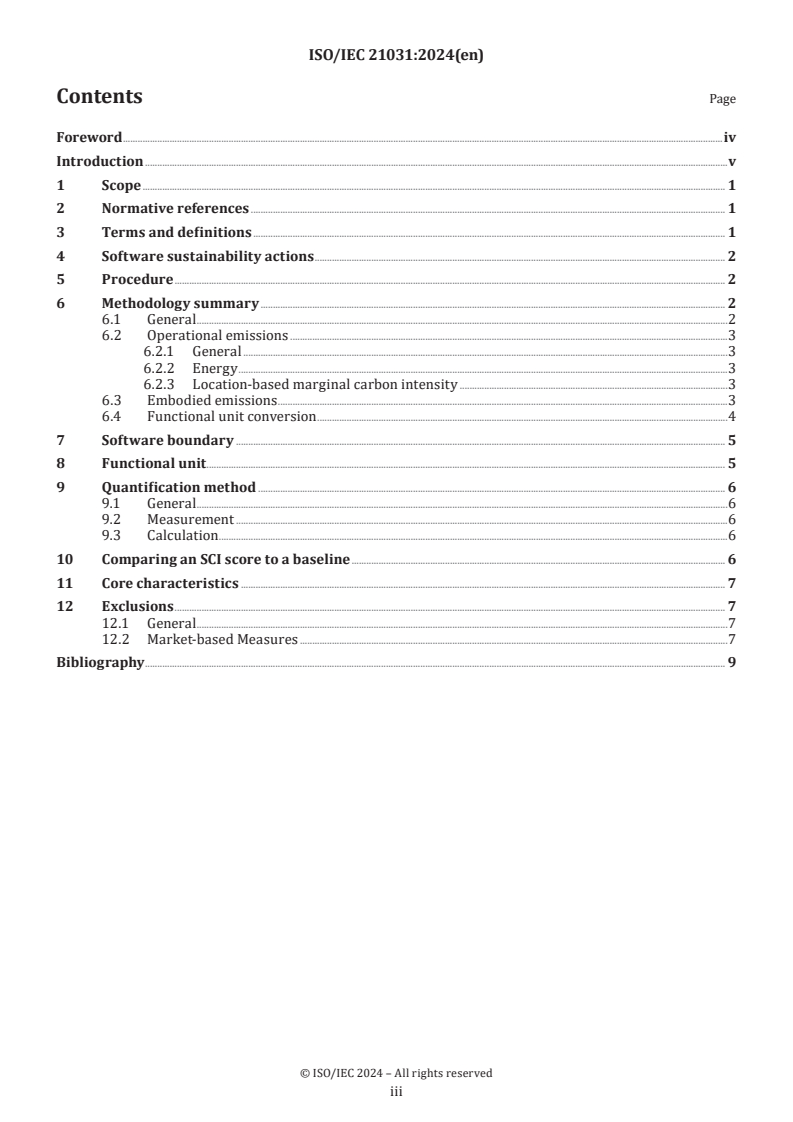
Contents Page
Foreword .iv
Introduction .v
1 Scope . 1
2 Normative references . 1
3 Terms and definitions . 1
4 Software sustainability actions . 2
5 Procedure . 2
6 Methodology summary . 2
6.1 General .2
6.2 Operational emissions .3
6.2.1 General .3
6.2.2 Energy .3
6.2.3 Location-based marginal carbon intensity .3
6.3 Embodied emissions .3
6.4 Functional unit conversion .4
7 Software boundary . 5
8 Functional unit . 5
9 Quantification method . 6
9.1 General .6
9.2 Measurement .6
9.3 Calculation .6
10 Comparing an SCI score to a baseline . 6
11 Core characteristics . 7
12 Exclusions . 7
12.1 General .7
12.2 Market-based Measures .7
Bibliography . 9
© ISO/IEC 2024 – All rights reserved
iii
Foreword
ISO (the International Organization for Standardization) and IEC (the International Electrotechnical
Commission) form the specialized system for worldwide standardization. National bodies that are
members of ISO or IEC participate in the development of International Standards through technical
committees established by the respective organization to deal with particular fields of technical activity.
ISO and IEC technical committees collaborate in fields of mutual interest. Other international organizations,
governmental and non-governmental, in liaison with ISO and IEC, also take part in the work.
The procedures used to develop this document and those intended for its further maintenance are described
in the ISO/IEC Directives, Part 1. In particular, the different approval criteria needed for the different types
of document should be noted (see www.iso.org/directives or www.iec.ch/members_experts/refdocs).
ISO and IEC draw attention to the possibility that the implementation of this document may involve the
use of (a) patent(s). ISO and IEC take no position concerning the evidence, validity or applicability of any
claimed patent rights in respect thereof. As of the date of publication of this document, ISO and IEC had not
received notice of (a) patent(s) which may be required to implement this document. However, implementers
are cautioned that this may not represent the latest information, which may be obtained from the patent
database available at www.iso.org/patents and https://patents.iec.ch. ISO and IEC shall not be held
responsible for identifying any or all such patent rights.
Any trade name used in this document is information given for the convenience of users and does not
constitute an endorsement.
For an explanation of the voluntary nature of standards, the meaning of ISO specific terms and expressions
related to conformity assessment, as well as information about ISO's adherence to the World Trade
Organization (WTO) principles in the Technical Barriers to Trade (TBT), see www.iso.org/iso/foreword.html.
In the IEC, see www.iec.ch/understanding-standards.
This document was prepared by the Linux Foundation (as Software Carbon Intensity (SCI) Specification,
v.1.0) and drafted in accordance with its editorial rules. It was adopted, under the JTC 1 PAS procedure, by
Joint Technical Committee ISO/IEC JTC 1, Information technology.
Any feedback or questions on this document should be directed to the user’s national standards
body. A complete listing of these bodies can be found at www.iso.org/members.html and
www.iec.ch/national-committees.
© ISO/IEC 2024 – All rights reserved
iv
Introduction
“If you can't measure it, you can't improve it.” – Peter Drucker
Software systems cause emissions through the hardware that they operate on, both through the energy
that the physical hardware consumes, and the emissions associated with manufacturing the hardware. This
specification defines a methodology for calculating the rate of carbon emissions for a software system. The
purpose is to help users and developers make informed choices about which tools, approaches, architectures,
and services they use in the future. It is a score rather than a total; lower numbers are better than higher
numbers, and reaching 0 is impossible. This specification is focused on helping users and developers
understand how to improve software to reduce or avoid the creation of emissions.
Reducing an SCI score is only possible through the elimination of emissions. That can be achieved by
modifying a software system to use less physical hardware, less energy, or consume lower-carbon energy
sources. Neutralization or avoidance offsets do not reduce an SCI score (Clause 12). This makes the SCI an
ideal strategy that organizations can adopt to meet climate targets focused on eliminating emissions, such
[ ]
as those specified by 1 .
The SCI is for everyone. It is possible to calculate an SCI score for any software application, from a large,
distributed cloud system to a small monolithic open source library, any on-premise application, or even
a serverless function. The environment the product or service is running in can also vary; from personal
computers, private data centers or a hyperscale cloud.
Software practitioners have a significant role to play in collectively reducing the SCI score during the design,
development, and delivery of software applications. The following list provides some strategies that can be
used to do this across different software roles:
— For a software programmer, this implies writing energy efficient code.
— For an AI/ML developer, it implies model optimization, using pre-trained models or leveraging optimized
hardware for training.
— For a database engineer, this comprises choices like schema design, choice of storage, and query
optimizations.
— For a DevOps practitioner, this requires creating a carbon-aware pipeline and considering when to
schedule builds and leverage clean energy.
— For QA engineers, it involves creating energy efficient test automation and performance testing scripts
across browsers and devices.
— For an architect, this implies choices like serverless or event driven architectures, infrastructure
optimization, and design for carbon-aware systems.
The SCI encourages calculation using granular real-world data, which is challenging to obtain in some
environments, particularly the public cloud. Access to the data needed for higher resolution calculations
might not always be available.
Where this is the case, users of this specification are strongly advised to request such data from their
suppliers (be they hardware, hosting, or other).
In situations where there is a lack of access, capability, or rights to the necessary real-world data, the SCI
allows for data generated through modelling, using best estimates instead.
© ISO/IEC 2024 – All rights reserved
v
International Standard ISO/IEC 21031:2024(en)
Information technology — Software Carbon Intensity (SCI)
specification
1 Scope
This specification describes a methodology for calculating the rate of carbon emissions for a software
system; that is, its SCI score. The purpose of this score is to increase awareness and transparency of an
application's sustainability credentials. The score will help software practitioners make better, evidence-
based decisions during system design, development, and deployment, that will ultimately minimize
carbon emissions. A reliable, consistent, fair and comparable measure allows targets to be defined during
development and progress to be tracked.
2 Normative references
There are no normative references in this document.
3 Terms and definitions
For the purposes of this document, the following terms and definitions apply.
ISO and IEC maintain terminological databases for use in standardization at the following addresses:
— ISO Online browsing platform: available at https:// www .iso .org/ obp
— IEC Electropedia: available at http:// www .electropedia .org/
2.1
action
explicit outcome taken, or change avoided, depending on the quantifiable emissions measured by this
specification
Note 1 to entry: Note to entry: Actions generally relate to using less electricity, using electricity more intelligently,
or using less hardware.
2.2
carbon-aware
attribute of software or hardware that adjusts its behavior (consumption of inputs, processing, or production
of outputs) in response to the carbon intensity of the energy it consumesThe following abbreviations are
used throughout this specification:
— E – Energy consumed by a software system
— I – Location-based marginal carbon intensity
— M – Embodied emissions of the hardware needed to operate a software system
— O – Operational emissions based on the emissions caused by energy consumption
— R – Functional unit
© ISO/IEC 2024 – All rights reserved
----------------------
...