


ISO 6182-13:2017
(Main)Fire protection — Automatic sprinkler systems — Part 13: Requirements and test methods for extended-coverage sprinklers
Fire protection — Automatic sprinkler systems — Part 13: Requirements and test methods for extended-coverage sprinklers
ISO 6182-13:2017 specifies performance and marking requirements and test methods for extended coverage sprinklers. These sprinklers are intended to provide control of fires in occupancies or portions of occupancies where quantity and/or combustibility of contents is low such as office spaces.
Protection contre l'incendie — Systèmes d'extinction automatiques du type sprinkler — Partie 13: Prescriptions et méthodes d'essai des sprinklers couvrant une surface plus étendue que la normale
General Information
- Status
- Withdrawn
- Publication Date
- 23-Feb-2017
- Technical Committee
- ISO/TC 21/SC 5 - Fixed firefighting systems using water
- Drafting Committee
- ISO/TC 21/SC 5/WG 9 - Sprinklers and nozzles
- Current Stage
- 9599 - Withdrawal of International Standard
- Start Date
- 17-Feb-2023
- Completion Date
- 14-Feb-2026
Get Certified
Connect with accredited certification bodies for this standard

NSF International
Global independent organization facilitating standards development and certification.

CIS Institut d.o.o.
Personal Protective Equipment (PPE) certification body. Notified Body NB-2890 for EU Regulation 2016/425 PPE.

Kiwa BDA Testing
Building and construction product certification.
Sponsored listings
Frequently Asked Questions
ISO 6182-13:2017 is a standard published by the International Organization for Standardization (ISO). Its full title is "Fire protection — Automatic sprinkler systems — Part 13: Requirements and test methods for extended-coverage sprinklers". This standard covers: ISO 6182-13:2017 specifies performance and marking requirements and test methods for extended coverage sprinklers. These sprinklers are intended to provide control of fires in occupancies or portions of occupancies where quantity and/or combustibility of contents is low such as office spaces.
ISO 6182-13:2017 specifies performance and marking requirements and test methods for extended coverage sprinklers. These sprinklers are intended to provide control of fires in occupancies or portions of occupancies where quantity and/or combustibility of contents is low such as office spaces.
ISO 6182-13:2017 is classified under the following ICS (International Classification for Standards) categories: 13.220.20 - Fire protection. The ICS classification helps identify the subject area and facilitates finding related standards.
ISO 6182-13:2017 is available in PDF format for immediate download after purchase. The document can be added to your cart and obtained through the secure checkout process. Digital delivery ensures instant access to the complete standard document.
Standards Content (Sample)
INTERNATIONAL ISO
STANDARD 6182-13
First edition
2017-02
Fire protection — Automatic sprinkler
systems —
Part 13:
Requirements and test methods for
extended-coverage sprinklers
Protection contre l’incendie — Systèmes d’extinction automatiques du
type sprinkler —
Partie 13: Prescriptions et méthodes d’essai des sprinklers couvrant
une surface plus étendue que la normale
Reference number
©
ISO 2017
© ISO 2017, Published in Switzerland
All rights reserved. Unless otherwise specified, no part of this publication may be reproduced or utilized otherwise in any form
or by any means, electronic or mechanical, including photocopying, or posting on the internet or an intranet, without prior
written permission. Permission can be requested from either ISO at the address below or ISO’s member body in the country of
the requester.
ISO copyright office
Ch. de Blandonnet 8 • CP 401
CH-1214 Vernier, Geneva, Switzerland
Tel. +41 22 749 01 11
Fax +41 22 749 09 47
copyright@iso.org
www.iso.org
ii © ISO 2017 – All rights reserved
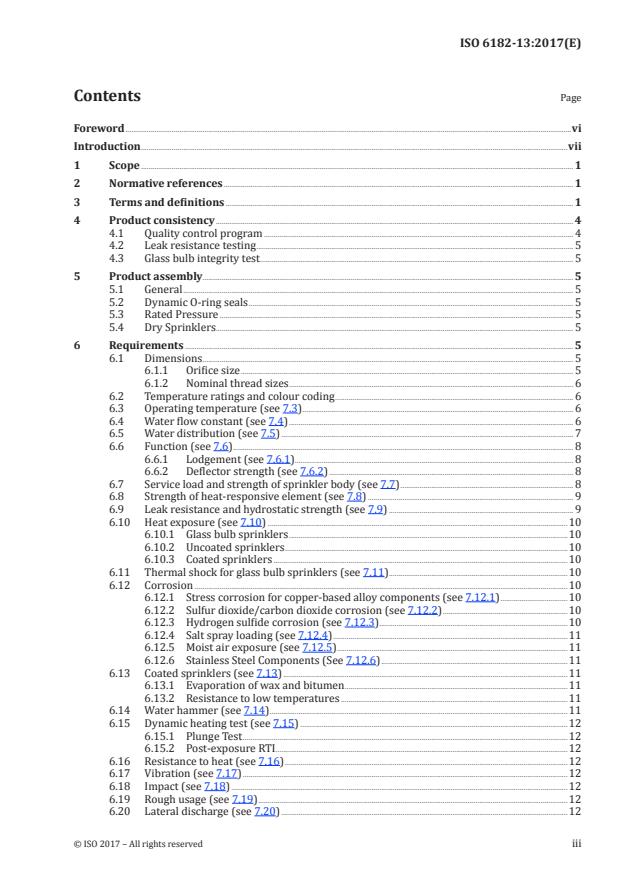
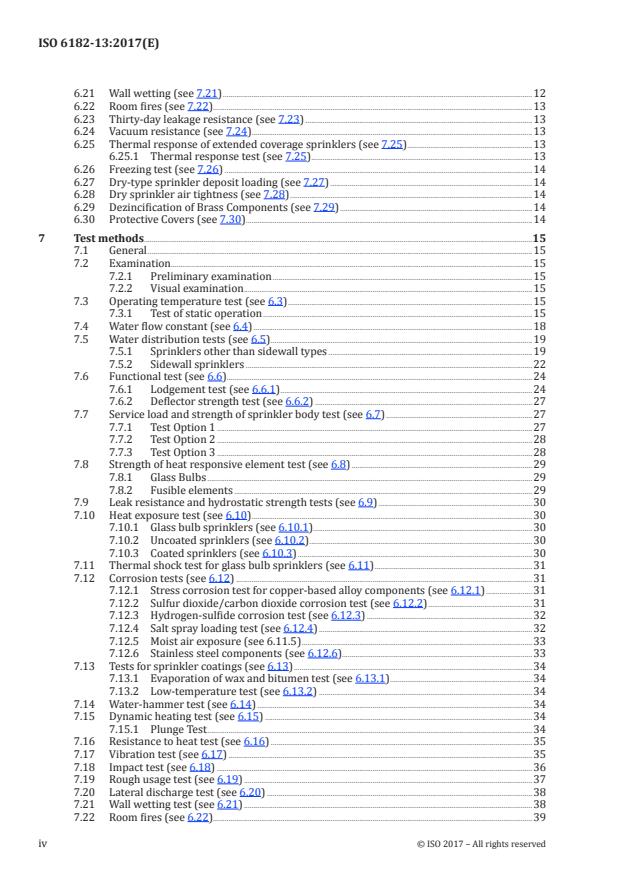
Contents Page
Foreword .vi
Introduction .vii
1 Scope . 1
2 Normative references . 1
3 Terms and definitions . 1
4 Product consistency . 4
4.1 Quality control program . 4
4.2 Leak resistance testing . 5
4.3 Glass bulb integrity test . 5
5 Product assembly. 5
5.1 General . 5
5.2 Dynamic O-ring seals . 5
5.3 Rated Pressure . 5
5.4 Dry Sprinklers . 5
6 Requirements . 5
6.1 Dimensions . 5
6.1.1 Orifice size . 5
6.1.2 Nominal thread sizes . 6
6.2 Temperature ratings and colour coding . 6
6.3 Operating temperature (see 7.3) . 6
6.4 Water flow constant (see 7.4) . 6
6.5 Water distribution (see 7.5) . 7
6.6 Function (see 7.6) . 8
6.6.1 Lodgement (see 7.6.1) . . 8
6.6.2 Deflector strength (see 7.6.2) . 8
6.7 Service load and strength of sprinkler body (see 7.7) . 8
6.8 Strength of heat-responsive element (see 7.8) . 9
6.9 Leak resistance and hydrostatic strength (see 7.9) . 9
6.10 Heat exposure (see 7.10) .10
6.10.1 Glass bulb sprinklers .10
6.10.2 Uncoated sprinklers .10
6.10.3 Coated sprinklers .10
6.11 Thermal shock for glass bulb sprinklers (see 7.11) .10
6.12 Corrosion .10
6.12.1 Stress corrosion for copper-based alloy components (see 7.12.1) .10
6.12.2 Sulfur dioxide/carbon dioxide corrosion (see 7.12.2) .10
6.12.3 Hydrogen sulfide corrosion (see 7.12.3) .10
6.12.4 Salt spray loading (see 7.12.4) .11
6.12.5 Moist air exposure (see 7.12.5) .11
6.12.6 Stainless Steel Components (See 7.12.6) .11
6.13 Coated sprinklers (see 7.13) .11
6.13.1 Evaporation of wax and bitumen .11
6.13.2 Resistance to low temperatures .11
6.14 Water hammer (see 7.14) .11
6.15 Dynamic heating test (see 7.15) .12
6.15.1 Plunge Test .12
6.15.2 Post-exposure RTI . .12
6.16 Resistance to heat (see 7.16) .12
6.17 Vibration (see 7.17) .12
6.18 Impact (see 7.18) .12
6.19 Rough usage (see 7.19) .12
6.20 Lateral discharge (see 7.20) .12
6.21 Wall wetting (see 7.21) .12
6.22 Room fires (see 7.22).13
6.23 Thirty-day leakage resistance (see 7.23) .13
6.24 Vacuum resistance (see 7.24).13
6.25 Thermal response of extended coverage sprinklers (see 7.25) .13
6.25.1 Thermal response test (see 7.25) .13
6.26 Freezing test (see 7.26) .14
6.27 Dry-type sprinkler deposit loading (see 7.27) .14
6.28 Dry sprinkler air tightness (see 7.28) .14
6.29 Dezincification of Brass Components (see 7.29) .14
6.30 Protective Covers (see 7.30) .14
7 Test methods .15
7.1 General .15
7.2 Examination.15
7.2.1 Preliminary examination .15
7.2.2 Visual examination .15
7.3 Operating temperature test (see 6.3) .15
7.3.1 Test of static operation .15
7.4 Water flow constant (see 6.4) .18
7.5 Water distribution tests (see 6.5) .19
7.5.1 Sprinklers other than sidewall types .19
7.5.2 Sidewall sprinklers .22
7.6 Functional test (see 6.6).24
7.6.1 Lodgement test (see 6.6.1) .24
7.6.2 Deflector strength test (see 6.6.2) .27
7.7 Service load and strength of sprinkler body test (see 6.7) .27
7.7.1 Test Option 1 .27
7.7.2 Test Option 2 .28
7.7.3 Test Option 3 .28
7.8 Strength of heat responsive element test (see 6.8) .29
7.8.1 Glass Bulbs .29
7.8.2 Fusible elements .29
7.9 Leak resistance and hydrostatic strength tests (see 6.9) .30
7.10 Heat exposure test (see 6.10) .30
7.10.1 Glass bulb sprinklers (see 6.10.1) .30
7.10.2 Uncoated sprinklers (see 6.10.2) .30
7.10.3 Coated sprinklers (see 6.10.3) .30
7.11 Thermal shock test for glass bulb sprinklers (see 6.11) .31
7.12 Corrosion tests (see 6.12) .31
7.12.1 Stress corrosion test for copper-based alloy components (see 6.12.1) .31
7.12.2 Sulfur dioxide/carbon dioxide corrosion test (see 6.12.2) .31
7.12.3 Hydrogen-sulfide corrosion test (see 6.12.3) .32
7.12.4 Salt spray loading test (see 6.12.4) .32
7.12.5 Moist air exposure (see 6.11.5) .33
7.12.6 Stainless steel components (see 6.12.6).33
7.13 Tests for sprinkler coatings (see 6.13) .34
7.13.1 Evaporation of wax and bitumen test (see 6.13.1) .34
7.13.2 Low-temperature test (see 6.13.2) .34
7.14 Water-hammer test (see 6.14) .34
7.15 Dynamic heating test (see 6.15) .34
7.15.1 Plunge Test .34
7.16 Resistance to heat test (see 6.16) .35
7.17 Vibration test (see 6.17) .35
7.18 Impact test (see 6.18) .36
7.19 Rough usage test (see 6.19) .37
7.20 Lateral discharge test (see 6.20) .38
7.21 Wall wetting test (see 6.21) .38
7.22 Room fires (see 6.22).39
iv © ISO 2017 – All rights reserved
7.23 Thirty-day leakage test (see 6.23) .42
7.24 Vacuum test (see 6.24) .42
7.25 Thermal response of extended coverage sprinklers (see 6.25) .42
7.26 Freezing test (see 6.26) .47
7.27 Dry-type sprinkler deposit loading test (see 6.27) .48
7.28 Dry sprinkler air tightness test (see 6.28) .48
7.29 Dezincification of brass components (see 6.29) .49
7.30 Protective cover impact test for glass bulb sprinklers (see 6.30) .50
8 Marking .52
8.1 Sprinklers .52
8.2 Sprinkler housings and concealed sprinkler cover plates .53
8.3 Protective covers .53
9 Manufacturer’s installation instructions .53
Annex A (informative) Analysis of the strength test for release elements .54
Annex B (normative) Tolerances .55
Annex C (normative) Tolerance limit calculation methods .56
Bibliography .58
Foreword
ISO (the International Organization for Standardization) is a worldwide federation of national standards
bodies (ISO member bodies). The work of preparing International Standards is normally carried out
through ISO technical committees. Each member body interested in a subject for which a technical
committee has been established has the right to be represented on that committee. International
organizations, governmental and non-governmental, in liaison with ISO, also take part in the work.
ISO collaborates closely with the International Electrotechnical Commission (IEC) on all matters of
electrotechnical standardization.
The procedures used to develop this document and those intended for its further maintenance are
described in the ISO/IEC Directives, Part 1. In particular the different approval criteria needed for the
different types of ISO documents should be noted. This document was drafted in accordance with the
editorial rules of the ISO/IEC Directives, Part 2 (see www .iso .org/ directives).
Attention is drawn to the possibility that some of the elements of this document may be the subject of
patent rights. ISO shall not be held responsible for identifying any or all such patent rights. Details of
any patent rights identified during the development of the document will be in the Introduction and/or
on the ISO list of patent declarations received (see www .iso .org/ patents).
Any trade name used in this document is information given for the convenience of users and does not
constitute an endorsement.
For an explanation on the meaning of ISO specific terms and expressions related to conformity assessment,
as well as information about ISO’s adherence to the World Trade Organization (WTO) principles in the
Technical Barriers to Trade (TBT) see the following URL: www . i so .org/ iso/ foreword .html.
This document was prepared by ISO/TC 21, Equipment for fire protection and fire fighting, Subcommittee
SC 5, Fixed firefighting systems using water.
A list of all parts in the ISO 6182 series can be found on the ISO website.
vi © ISO 2017 – All rights reserved
Introduction
Extended coverage sprinklers are intended provide fire control in occupancies or portions of
occupancies where the quantity and/or combustibility of contents is low and fires with relatively low
rates of heat release are expected. Examples of occupancies where these sprinklers may be installed
include offices, restaurant seating areas, educational facilities and other areas having similar fire
challenges.
These sprinklers have a relatively flat spray pattern compared to the sprinklers described in ISO 6182-1.
This allows the sprinklers to effectively distribute water over a larger area; thus permitting the
sprinklers to be spaced greater distances from each other, as well as from the walls of the compartment.
Obstructions can pose a greater challenge to extended coverage sprinklers because of the flat spray
pattern. Extended coverage sprinkler installation guidelines need to account for the flat spray pattern
when considering the distances between obstructions and the sprinkler.
Product standards, such as this one, can provide a minimum level of safety in the built environment, as
well as a level of quality to the products on the market.
INTERNATIONAL STANDARD ISO 6182-13:2017(E)
Fire protection — Automatic sprinkler systems —
Part 13:
Requirements and test methods for extended-coverage
sprinklers
1 Scope
This document specifies performance and marking requirements and test methods for extended
coverage sprinklers.
These sprinklers are intended to provide control of fires in occupancies or portions of occupancies
where quantity and/or combustibility of contents is low such as office spaces.
2 Normative references
The following documents are referred to in the text in such a way that some or all of their content
constitutes requirements of this document. For dated references, only the edition cited applies. For
undated references, the latest edition of the referenced document (including any amendments) applies.
ISO 7-1, Pipe threads where pressure-tight points are made on the threads — Part 1: Dimensions, tolerances
and designation
ASTM G36, Standard Practice for Evaluating Stress-Corrosion-Cracking Resistance of Metals and Alloys in
a Boiling Magnesium Chloride Solution
3 Terms and definitions
For the purposes of this document, the following terms and definitions apply.
ISO and IEC maintain terminological databases for use in standardization at the following addresses:
— IEC Electropedia: available at http:// www .electropedia .org/
— ISO Online browsing platform: available at http:// www .iso .org/ obp
3.1 General
3.1.1
assembly load
force exerted on the sprinkler body excluding hydrostatic pressure
3.1.2
average design strength
glass bulb supplier’s specified lowest average axial design strength of any batch of 50 bulbs
3.1.3
design load
force exerted on the release element at the service load of the sprinkler
3.1.4
housing assembly/escutcheon
ornamental or protective component(s) around the hole from which the sprinkler penetrates the plane
of the ceiling or the wall
Note 1 to entry: See Figure 1.
Note 2 to entry: For the purposes of this document, housing applies to recessed and concealed sprinklers.
a) Flush
b) Concealed
c) Recessed
Key
1 ceiling
2 housing assembly
3 cover plate
4 escutcheon
Figure 1 — Concealed, recessed, flush
3.1.5
protective covering
protective caps or straps intended to provide temporary protection for sprinklers during shipping,
handling and installation
3.1.6
response time index, RTI
measure of sprinkler sensitivity
RTI= tu
2 © ISO 2017 – All rights reserved
where
t is equal to the time constant, expressed in seconds, of the heat-responsive element;
u is the gas velocity, expressed in meters per second.
0,5
Note 1 to entry: The response time index is expressed in units of (m·s) .
3.1.7
service load
combined force exerted on the sprinkler body by the assembly load of the sprinkler and the equivalent
force of the rated pressure on the inlet
3.1.8
sprinkler
thermosensitive device designed to react at a predetermined temperature by automatically releasing a
stream of water and distributing it in a specified pattern and quantity over a designated area
3.1.8.1
extended coverage sprinkler
sprinkler having a specified area of coverage larger than 21 m
Note 1 to entry: See 3.3 for additional detail.
Note 2 to entry: For the purposes of this document, sprinkler is intended to refer to extended coverage sprinklers.
3.1.9
standard orientation
orientation that produces the shortest response time with the axis of the sprinkler inlet perpendicular
to the air flow
Note 1 to entry: In the case of symmetrical heat-responsive elements, standard orientation is with the air flow
perpendicular to both the axis of the waterway and the plane of the frame arms. In the case of non-symmetrical
heat-responsive elements, it is with the air flow perpendicular to both the waterway axis and the plane of the
frame arms which produces the shortest response time.
3.2 Types of sprinkler according to type of heat-responsive element
3.2.1
fusible element sprinkler
sprinkler that opens under the influence of heat by the melting of a component
3.2.2
glass bulb sprinkler
sprinkler that opens under the influence of heat by the bursting of the glass bulb through pressure
resulting from expansion of the fluid enclosed therein
3.3 Types of sprinkler according to position
3.3.1
pendent extended coverage sprinkler
extended coverage sprinkler that is arranged in such a way that the water stream is directed initially
downwards against the deflector
Note 1 to entry: This sprinkler has a square area of coverage not exceeding 36 m with sprinkler spacings in
0,5 m increments. The maximum spacing between sprinklers is 6,0 m.
3.3.2
sidewall extended coverage sprinkler
extended coverage sprinkler giving a one-sided (half-paraboloid) water distribution over a definite
protection area
Note 1 to entry: The axis of the sprinkler waterway may be either horizontal or vertical. This sprinkler has an area
of coverage not exceeding 36 m , with sprinkler spacings in 0,5 m increments, with no dimension exceeding 7 m.
3.3.3
upright extended coverage sprinkler
extended coverage sprinkler that is arranged in such a way that the water stream is directed initially
upwards against the deflector
Note 1 to entry: This sprinkler has a square area of coverage not exceeding 36 m with sprinkler spacings in
0,5 m increments. The maximum spacing between sprinklers is 6,0 m.
3.4 Special types of extended coverage sprinklers
3.4.1
coated sprinkler
sprinkler that has a factory-applied coating for corrosion protection
Note 1 to entry: For this document, coated sprinkler does not include coatings intended for aesthetic purposes.
3.4.2
concealed sprinkler
recessed sprinkler having a cover plate
Note 1 to entry: See Figure 1.
3.4.3
dry sprinkler
assembly comprising of a sprinkler mounted at the outlet of a special extension with a seal at the inlet
that prevents water from entering the extension until it is released by operation of the sprinkler
Note 1 to entry: These sprinklers may consist of pendent, sidewall or other types.
3.4.4
flush sprinkler
for pendent sprinklers, all or part of the body is mounted above the lower plane of the ceiling, but all of
the heat-responsive collector is below the lower plane of the ceiling
Note 1 to entry: See Figure 1.
Note 2 to entry: For sidewall sprinklers, the sprinkler is within the wall, but the heat-responsive collector
projects into the room beyond the plane of the wall.
Note 3 to entry: These are not typically frame arm sprinklers.
3.4.5
recessed sprinkler
sprinkler of which all or part of the body, other than the thread, is mounted within a recessed housing
Note 1 to entry: See Figure 1.
4 Product consistency
4.1 Quality control program
It shall be the responsibility of the manufacturer to implement a quality control program to ensure that
production continuously meets the requirements of this document.
4 © ISO 2017 – All rights reserved
4.2 Leak resistance testing
Every manufactured sprinkler shall pass a leak resistance test equivalent to a hydrostatic pressure of
at least twice the rated pressure for at least 2 s.
4.3 Glass bulb integrity test
Each glass bulb sprinkler assembly shall be evaluated for glass bulb cracking, breaking, or other damage
as indicated by the loss of fluid. The test shall be conducted after the leakage test.
The bubble in each glass bulb shall be examined at room ambient temperature. The sprinkler shall then
be heated in a circulating air oven or liquid bath to 5 °C below the minimum operating temperature
range of the sprinkler. The bubble shall then be examined to determine the bubble size has been reduced
in accordance with the glass bulb manufacturer’s specifications. After cooling, the bubble size shall
again be examined to determine the bubble returned to the original size within the tolerance allowed
by the glass bulb manufacturer.
5 Product assembly
5.1 General
All sprinklers shall be designed and manufactured such that they cannot be readily adjusted, dismantled
or reassembled.
This requirement does not apply to units intended for assembly/adjustment on site, e.g. combinations
of sprinkler and housing assemblies/escutcheons or the assembly of the cover plate to concealed
sprinklers.
5.2 Dynamic O-ring seals
The closure of the water way shall not be achieved by the use of a dynamic O-ring or similar seal. (An
O-ring or similar seal that moves during operation or is in contact with a component that moves during
operation.)
5.3 Rated Pressure
Sprinklers shall have a rated pressure of not less than 1,2 MPa (12 bar).
5.4 Dry Sprinklers
When installed with the intended fittings specified in the manufacturer’s installation instructions,
dry sprinklers installed in dry systems shall be constructed to minimize the potential to accumulate
water, scale, and sediment on the sprinkler inlet. The sprinkler inlet shall also be constructed not to
substantially impact the sprinkler k-factor or pressure loss through the fitting.
6 Requirements
6.1 Dimensions
6.1.1 Orifice size
All sprinklers shall be constructed so that a sphere of diameter 8 mm can pass through each water
passage in the sprinkler.
6.1.2 Nominal thread sizes
Nominal thread sizes shall be suitable for fittings threaded in accordance with ISO 7-1. The dimensions
of all threaded connections should conform to International Standards where applied or shall conform
to national standards where International Standards are not applicable.
6.2 Temperature ratings and colour coding
The marked nominal temperature rating and colour coding of sprinkler shall be in accordance with
Table 1.
Table 1 — Nominal temperature rating and colour coding
Glass bulb sprinklers Fusible element sprinklers
Marked nominal
Marked nominal temperature rating,
temperature rating, Liquid colour code
°C
°C
57 orange 57 to 77
68 red
79 yellow 80 to 107
93, 107 green
121, 141 blue 121 to 149
6.3 Operating temperature (see 7.3)
Sprinklers shall be verified to operate within a temperature range given in Formula (1):
tx=± 0,,035x+062 (1)
()
where
t is the temperature range, rounded to the nearest 0,1 °C;
x is the marked nominal temperature rating (see Table 1).
6.4 Water flow constant (see 7.4)
The flow constant, K, for sprinklers is given in Formula (2):
q
K = (2)
10p
where
p is the pressure, expressed in megapascals (MPa);
q is the flow rate, expressed in litres per minute.
K-factor for sprinklers according to this document shall be in accordance with Table 2 when determined
by the test method given in 7.4.
6 © ISO 2017 – All rights reserved
Table 2 — Flow constant requirements
Flow constant Flow constant
K K for dry sprinklers
1/2 1/2
(l/min)/(bar ) (l/min)/(bar )
80 ± 4 80 ± 6
115 ± 6 115 ± 9
160 ± 8 160 ± 12
202 ± 10 200 ± 15
1/2 3 1/2
NOTE 1 (l/min)/(bar ) = 0,003 2 (m /min)/(MPa ).
6.5 Water distribution (see 7.5)
6.5.1 When tested as described in 7.5, extended coverage sprinklers shall meet the requirements of
6.5.2 to 6.5.4.
6.5.2 For each test, not more than one pan shall have a collection less than 0,6 mm/min and the pan
shall not have a collection less than 0,2 mm/min.
6.5.3 For each test, the average collection of all pans shall be a minimum of 1,6 mm/min.
6.5.4 Coated sprinklers shall be subjected to additional distribution tests if the coating is observed to
deform or deteriorate during the dynamic heating test of 6.15.
Table 3 — Distribution testing parameters for upright and pendent sprinklers
Nominal flow constant, Nominal room dimensions Deflector to ceiling distance Nominal flow rate
K (width × length) (mm) (l/min)
0,5
[l/m/(bar) ] (m × m)
80 5,0 × 5,0 100 102
80 5,5 × 5,5 100 123
80 6,0 × 6,0 100 147
115 5,0 × 5,0 100 102
115 5,5 × 5,5 100 123
115 6,0 × 6,0 100 147
160 5,0 × 5,0 100 111
160 5,5 × 5,5 100 123
160 6,0 × 6,0 100 147
202 5,0 × 5,0 100 139
202 5,5 × 5,5 100 139
202 6,0 × 6,0 100 147
Table 4 — Distribution testing parameters for sidewall sprinklers
Nominal flow Nominal room Deflector to ceiling Nominal flow rate
constant, dimensions distance (l/min)
K [width × length]
(mm)
0,5
[l/m/(bar] ) (m × m)
80 5,0 × 5,0 100 102
80 5,0 × 5,0 300 102
80 5,0 × 5,5 100 112
80 5,0 × 5,5 300 112
80 5,0 × 6,0 100 122
80 5,0 × 6,0 300 122
115 5,0 × 5,0 100 127
115 5,0 × 5,0 300 127
115 5,0 × 5,5 100 140
115 5,0 × 5,5 300 140
115 5,0 × 6,0 100 153
115 5,0 × 6,0 300 153
115 5,0 × 6,5 100 165
115 5,0 × 6,5 300 165
115 5,0 × 7,0 100 178
115 5,0 × 7,0 300 178
6.6 Function (see 7.6)
6.6.1 Lodgement (see 7.6.1)
When tested in accordance with 7.6.1, the sprinkler shall open and, any lodgement of released parts
shall be cleared within 10 s of release of the heat-responsive element.
6.6.2 Deflector strength (see 7.6.2)
The deflector and its supporting parts shall not sustain significant damage as a result of the deflector
strength test specified in 7.6.2.
If minor damage is noted, testing in accordance with 6.5 can be done to demonstrate compliance.
NOTE In most instances, visual examination of the sprinkler will be sufficient to establish conformance
with 6.6.2
6.7 Service load and strength of sprinkler body (see 7.7)
6.7.1 The sprinkler body shall comply with the requirements of 6.7.1.1 or 6.7.1.2.
6.7.1.1 The sprinkler body shall not show permanent elongation of more than 0,2 % between the
load-bearing points of the sprinkler body after being subjected to twice the service load as measured
according to 7.7.1 or 7.7.2.
6.7.1.2 The sprinkler body shall not show permanent elongation of more than 50 % of the sprinkler
body with the design load being applied after being subjected to twice the assembly load as measured
according to 7.7.3.
6.7.2 The manufacturer shall specify the average and upper limit of the service or assembly load.
8 © ISO 2017 – All rights reserved
6.8 Strength of heat-responsive element (see 7.8)
6.8.1 When tested in accordance with 7.8.1, glass bulb elements shall have a design strength lower
tolerance limit (LTL) on the strength distribution curve of at least twice the upper tolerance limit (UTL)
of the service load distribution curve, based on calculations with a degree of confidence (γ) of 0,99 for
99 % of samples (P), based on normal or Gaussian distribution except where other distribution can be
shown to be more applicable due to manufacturing or design factors (see Figure 2).
Key
1 average service load
2 service load curve
3 UTL
4 LTL
5 average design strength
6 design strength curve
Figure 2 — Strength curve
6.8.2 A fusible heat-responsive element in the ordinary temperature range shall be designed to:
a) sustain a load of 15 times its design load corresponding to the maximum service load measured
according to 7.8 for a period of 100 h when tested in accordance with 7.8.2.1, or
b) demonstrate the ability to sustain the design load when tested in accordance with 7.8.2.2 (see
Annex A).
6.9 Leak resistance and hydrostatic strength (see 7.9)
6.9.1 A sprinkler shall not show any sign of leakage when tested according to 7.9.1.
6.9.2 A sprinkler shall not rupture, operate or release any parts when tested according to 7.9.2.
6.10 Heat exposure (see 7.10)
6.10.1 Glass bulb sprinklers
There shall be no damage to the glass bulb element when the sprinkler is tested according to 7.10.1.
6.10.2 Uncoated sprinklers
Sprinklers shall withstand exposure to increased ambient temperature without evidence of weakness
or failure when tested according to 7.10.2.
6.10.3 Coated sprinklers
In addition to meeting the requirement of 6.10.2 in an uncoated version, coated sprinklers shall
withstand exposure to increased ambient temperatures without evidence of weakness or failure of the
coating when tested according to 7.10.3.
6.11 Thermal shock for glass bulb sprinklers (see 7.11)
Glass bulb sprinklers shall not be damaged when tested according to 7.11. Following the thermal
shock exposure, the sprinkler shall comply with 6.6.1 when tested with an inlet pressure of 0,035 MPa
(0,35 bar).
6.12 Corrosion
6.12.1 Stress corrosion for copper-based alloy components (see 7.12.1)
When tested in accordance with 7.12.1, each sprinkler shall not show any cracks, signs of delamination
or failure that can affect its ability to function as intended.
6.12.2 Sulfur dioxide/carbon dioxide corrosion (see 7.12.2)
NOTE In some countries, this test is not mandatory.
Coated and uncoated sprinklers shall be resistant to sulfur dioxide/carbon dioxide saturated with
water vapo
...
Questions, Comments and Discussion
Ask us and Technical Secretary will try to provide an answer. You can facilitate discussion about the standard in here.
Loading comments...