


ISO 3183:2012
(Main)Petroleum and natural gas industries — Steel pipe for pipeline transportation systems
Petroleum and natural gas industries — Steel pipe for pipeline transportation systems
ISO 3183:2012 specifies requirements for the manufacture of two product specification levels (PSL 1 and PSL 2) of seamless and welded steel pipes for use in pipeline transportation systems in the petroleum and natural gas industries. ISO 3183:2012 is not applicable to cast pipe.
Industries du pétrole et du gaz naturel — Tubes en acier pour les systèmes de transport par conduites
L'ISO 3183:2012 spécifie les prescriptions relatives à la fabrication de tubes en acier sans soudure et soudés utilisés dans des systèmes de transport par conduites dans les industries du pétrole et du gaz naturel et répondant à deux niveaux de spécifications de produit (PSL 1 et PSL 2). L'ISO 3183:2012 ne s'applique pas aux tubes moulés.
General Information
- Status
- Withdrawn
- Publication Date
- 04-Nov-2012
- Withdrawal Date
- 04-Nov-2012
- Technical Committee
- ISO/TC 67/SC 2 - Pipeline transportation systems
- Drafting Committee
- ISO/TC 67/SC 2/WG 16 - Line pipe
- Current Stage
- 9599 - Withdrawal of International Standard
- Start Date
- 07-Oct-2019
- Completion Date
- 14-Feb-2026
Relations
- Effective Date
- 09-Feb-2026
- Effective Date
- 09-Feb-2026
- Effective Date
- 09-Feb-2026
- Effective Date
- 09-Feb-2026
- Effective Date
- 12-Feb-2026
- Consolidates
ISO 21128:2006 - Cork stoppers — Determination of oxidizing residues — Iodometric titration method - Effective Date
- 06-Jun-2022
- Effective Date
- 24-Jul-2021
- Effective Date
- 23-Apr-2020
- Effective Date
- 26-Jun-2010
Buy Documents


ISO 3183:2012 - Petroleum and natural gas industries -- Steel pipe for pipeline transportation systems


ISO 3183:2012 - Industries du pétrole et du gaz naturel -- Tubes en acier pour les systemes de transport par conduites
Get Certified
Connect with accredited certification bodies for this standard

Element Materials Technology
Materials testing and product certification.

ABS Quality Evaluations Inc.
American Bureau of Shipping quality certification.

ABS Group Brazil
ABS Group certification services in Brazil.
Sponsored listings
Frequently Asked Questions
ISO 3183:2012 is a standard published by the International Organization for Standardization (ISO). Its full title is "Petroleum and natural gas industries — Steel pipe for pipeline transportation systems". This standard covers: ISO 3183:2012 specifies requirements for the manufacture of two product specification levels (PSL 1 and PSL 2) of seamless and welded steel pipes for use in pipeline transportation systems in the petroleum and natural gas industries. ISO 3183:2012 is not applicable to cast pipe.
ISO 3183:2012 specifies requirements for the manufacture of two product specification levels (PSL 1 and PSL 2) of seamless and welded steel pipes for use in pipeline transportation systems in the petroleum and natural gas industries. ISO 3183:2012 is not applicable to cast pipe.
ISO 3183:2012 is classified under the following ICS (International Classification for Standards) categories: 75.200 - Petroleum products and natural gas handling equipment; 77.140.75 - Steel pipes and tubes for specific use. The ICS classification helps identify the subject area and facilitates finding related standards.
ISO 3183:2012 has the following relationships with other standards: It is inter standard links to EN 14870-4:2023, EN 14870-1:2023, EN ISO 13679:2019, EN ISO 21809-1:2018, EN ISO 3183:2012, ISO 21128:2006, ISO 3183:2012/Amd 1:2017, ISO 3183:2019, ISO 3183:2007. Understanding these relationships helps ensure you are using the most current and applicable version of the standard.
ISO 3183:2012 is available in PDF format for immediate download after purchase. The document can be added to your cart and obtained through the secure checkout process. Digital delivery ensures instant access to the complete standard document.
Standards Content (Sample)
INTERNATIONAL ISO
STANDARD 3183
Third edition
2012-11-01
Petroleum and natural gas industries —
Steel pipe for pipeline transportation
systems
Industries du pétrole et du gaz naturel — Tubes en acier pour les
systèmes de transport par conduites
Reference number
©
ISO 2012
All rights reserved. Unless otherwise specified, no part of this publication may be reproduced or utilized in any form or by any means,
electronic or mechanical, including photocopying and microfilm, without permission in writing from either ISO at the address below or ISO’s
member body in the country of the requester.
ISO copyright office
Case postale 56 • CH-1211 Geneva 20
Tel. + 41 22 749 01 11
Fax + 41 22 749 09 47
E-mail copyright@iso.org
Web www.iso.org
Published in Switzerland
ii © ISO 2012 – All rights reserved
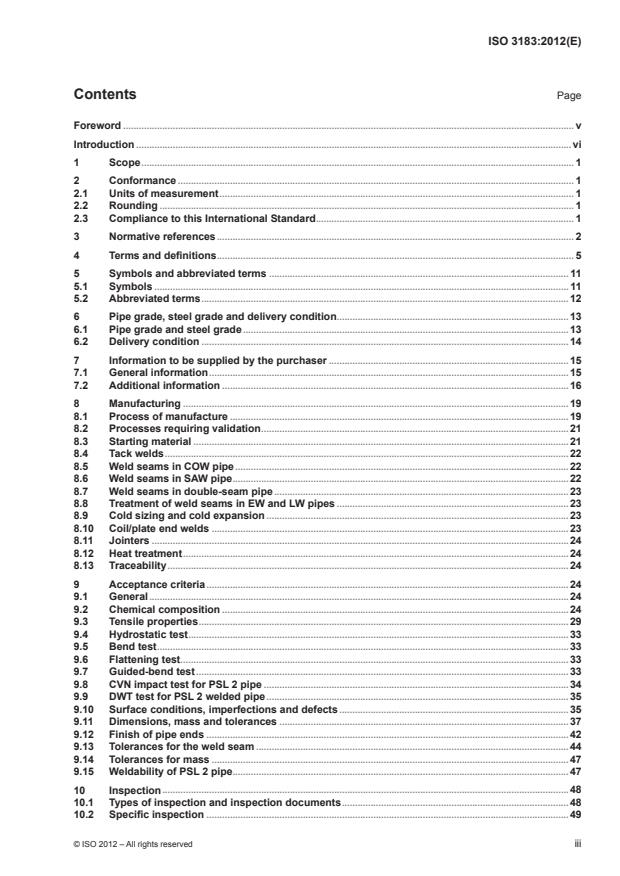
Contents Page
Foreword . v
Introduction .vi
1 Scope . 1
2 Conformance . 1
2.1 Units of measurement . 1
2.2 Rounding . 1
2.3 Compliance to this International Standard . 1
3 Normative references . 2
4 Terms and definitions . 5
5 Symbols and abbreviated terms . 11
5.1 Symbols . 11
5.2 Abbreviated terms .12
6 Pipe grade, steel grade and delivery condition .13
6.1 Pipe grade and steel grade .13
6.2 Delivery condition .14
7 Information to be supplied by the purchaser .15
7.1 General information .15
7.2 Additional information .16
8 Manufacturing .19
8.1 Process of manufacture .19
8.2 Processes requiring validation .21
8.3 Starting material .21
8.4 Tack welds .22
8.5 Weld seams in COW pipe .22
8.6 Weld seams in SAW pipe .22
8.7 Weld seams in double-seam pipe .23
8.8 Treatment of weld seams in EW and LW pipes .23
8.9 Cold sizing and cold expansion .23
8.10 Coil/plate end welds .23
8.11 Jointers .24
8.12 Heat treatment .24
8.13 Traceability .24
9 Acceptance criteria .24
9.1 General .24
9.2 Chemical composition .24
9.3 Tensile properties .29
9.4 Hydrostatic test .33
9.5 Bend test .33
9.6 Flattening test .33
9.7 Guided-bend test .33
9.8 CVN impact test for PSL 2 pipe .34
9.9 DWT test for PSL 2 welded pipe .35
9.10 Surface conditions, imperfections and defects .35
9.11 Dimensions, mass and tolerances .37
9.12 Finish of pipe ends .42
9.13 Tolerances for the weld seam .44
9.14 Tolerances for mass .47
9.15 Weldability of PSL 2 pipe.47
10 Inspection .48
10.1 Types of inspection and inspection documents .48
10.2 Specific inspection .49
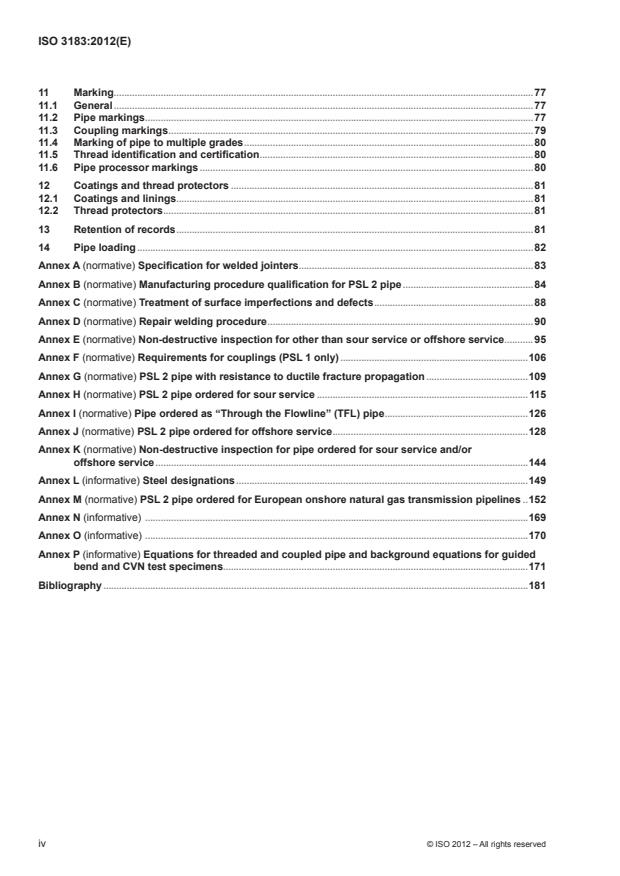
11 Marking .77
11.1 General .77
11.2 Pipe markings .77
11.3 Coupling markings .79
11.4 Marking of pipe to multiple grades .80
11.5 Thread identification and certification .80
11.6 Pipe processor markings .80
12 Coatings and thread protectors .81
12.1 Coatings and linings .81
12.2 Thread protectors .81
13 Retention of records .81
14 Pipe loading .82
Annex A (normative) Specification for welded jointers .83
Annex B (normative) Manufacturing procedure qualification for PSL 2 pipe .84
Annex C (normative) Treatment of surface imperfections and defects .88
Annex D (normative) Repair welding procedure .90
Annex E (normative) Non-destructive inspection for other than sour service or offshore service .95
Annex F (normative) Requirements for couplings (PSL 1 only) .106
Annex G (normative) PSL 2 pipe with resistance to ductile fracture propagation .109
Annex H (normative) PSL 2 pipe ordered for sour service .115
Annex I (normative) Pipe ordered as “Through the Flowline” (TFL) pipe .126
Annex J (normative) PSL 2 pipe ordered for offshore service .128
Annex K (normative) Non-destructive inspection for pipe ordered for sour service and/or
offshore service .144
Annex L (informative) Steel designations .149
Annex M (normative) PSL 2 pipe ordered for European onshore natural gas transmission pipelines .152
Annex N (informative) .169
Annex O (informative) .170
Annex P (informative) Equations for threaded and coupled pipe and background equations for guided
bend and CVN test specimens .171
Bibliography .181
iv © ISO 2012 – All rights reserved
Foreword
ISO (the International Organization for Standardization) is a worldwide federation of national standards bodies
(ISO member bodies). The work of preparing International Standards is normally carried out through ISO
technical committees. Each member body interested in a subject for which a technical committee has been
established has the right to be represented on that committee. International organizations, governmental and
non-governmental, in liaison with ISO, also take part in the work. ISO collaborates closely with the International
Electrotechnical Commission (IEC) on all matters of electrotechnical standardization.
International Standards are drafted in accordance with the rules given in the ISO/IEC Directives, Part 2.
The main task of technical committees is to prepare International Standards. Draft International Standards
adopted by the technical committees are circulated to the member bodies for voting. Publication as an
International Standard requires approval by at least 75 % of the member bodies casting a vote.
Attention is drawn to the possibility that some of the elements of this document may be the subject of patent
rights. ISO shall not be held responsible for identifying any or all such patent rights.
ISO 3183 was prepared by Technical Committee ISO/TC 67, Materials, equipment and offshore structures for
petroleum, petrochemical and natural gas industries, Subcommittee SC 2, Pipeline transportation systems.
Working Group 16 of ISO/TC 67/SC 2 meets jointly with the Line Pipe Working Group (currently WG 4210) of
the American Petroleum Institute (API) to ensure the harmonization of ISO 3183 with API Specification 5L.
This third edition of ISO 3183 cancels and replaces the second edition (ISO 3183:2007), on which it is based
but with revisions to incorporate updating, clarification and additional technical requirements.
The second edition of ISO 3183 was harmonized to a great extent with the 44th edition of API 5L, published on
1 October 2007, and the revisions produced by the joint ISO and API Working Groups are intended to extend
or complete harmonization with the new 45th edition of API 5L.
It is the intent of ISO/TC 67 that the second and third editions of ISO 3183 shall both be applicable, at the
option of the purchaser (as defined in 4.49), for a period of six months from the first day of the calendar
quarter immediately following the date of publication of this third edition, after which period, the second edition
(ISO 3183:2007) will no longer be applicable.
Introduction
This International Standard is the result of harmonizing the requirements of the following standards:
— API Spec 5L; 44th edition published 1 October 2007;
— ISO 3183:2007; second edition published 15 March 2007.
In the preparation of this third edition of ISO 3183, the technical committee has maintained the concept of two
basic levels of standard technical requirements for line pipe expressed as two product specification levels
(PSL 1 and PSL 2). Level PSL 1 provides a standard quality level for line pipe. Level PSL 2 has additional
mandatory requirements for chemical composition, notch toughness and strength properties and additional
non-destructive testing (NDT). Requirements that apply only to PSL 1 or only to PSL 2 are so designated.
Requirements that are not designated to a specific PSL designation apply to both PSL 1 and PSL 2 pipe.
The technical committee also recognized that the petroleum and natural gas industry often specifies additional
requirements for particular applications. In order to accommodate such needs, optional additional requirements
for special applications are available, as follows:
— PSL 2 pipe ordered with a qualified manufacturing procedure (Annex B), the requirements of which have
been enhanced to include verification detail of critical processes in the production of feedstock material,
line pipe manufacture and product testing and inspection;
— PSL 2 pipe ordered with resistance to ductile fracture propagation in gas pipelines (Annex G);
— PSL 2 pipe ordered for sour service (Annex H);
— pipe ordered as “Through the Flowline” (TFL) pipe (Annex I);
— PSL 2 pipe ordered for offshore service (Annex J);
The following two new annexes are added to the third edition of this International Standard.
— PSL 2 pipe ordered for European onshore natural gas transmission pipelines (Annex M).
— Equations for threaded and coupled pipe and background equations for guided bend and CVN test (Annex P).
The requirements of the annex(es) apply only when specified on the purchase order.
When pipe is ordered for dual or multiple applications, the requirements of more than one annex for special
applications can be invoked. In such instances, if a technical conflict arises due to applying the requirements
of more than one annex for special applications, the most stringent requirement applicable to the intended
service applies.
This International Standard does not provide guidance on when it is necessary to specify the above
supplementary requirements. Instead, it is the responsibility of the purchaser to specify, based upon the
intended use and design requirements, which, if any, of the supplementary requirements apply for a particular
purchase order.
This third edition of ISO 3183 is the result of a continuing process of harmonizing documents of different heritage.
It has been necessary to give consideration to traditional symbols (denoting mechanical or physical properties
or their values, dimensions or test parameters) and the format of equations that have been widely used and
which (in their traditional format) maintain strong links with other widely used standards and specifications, and
with the original scientific work that led to their derivation. Accordingly, although in some instances changes
to established symbols and equations have been made to optimize alignment with the ISO/IEC Directives,
Part 2, in other instances, some symbols and equations, most specifically those in 9.2, Table F.1 and Annex P,
have been retained in their traditional form to avoid causing confusion in this post-harmonization stage. Where
changes have been made, care has been taken to ensure that the new symbol replacing the traditional one
has been fully and clearly defined.
vi © ISO 2012 – All rights reserved
INTERNATIONAL STANDARD ISO 3183:2012(E)
Petroleum and natural gas industries — Steel pipe for pipeline
transportation systems
1 Scope
This International Standard specifies requirements for the manufacture of two product specification levels
(PSL 1 and PSL 2) of seamless and welded steel pipes for use in pipeline transportation systems in the
petroleum and natural gas industries.
This International Standard is not applicable to cast pipe.
2 Conformance
2.1 Units of measurement
In this International Standard, data are expressed in both International System (SI) units and United States
Customary (USC) units. For a specific order item, only one system of units shall be used, without combining
data expressed in the other system. Data values expressed in SI and USC units shall not be combined on the
same inspection document or in the same required pipe marking sequence.
Where product is tested and verified against requirements using one measurement system (USC or SI), and an
inspection document is issued, with data reported in the alternate measurement system units, a statement shall
appear on the inspection document indicating that the data presented was converted from the measurement
system used for the original inspection.
The purchaser shall specify whether data, drawings, and maintenance dimensions of pipes shall be in
the International System (SI) or US Customary (USC) system of measurements. Use of an SI data sheet
indicates that the SI measurements shall be used. Use of a USC data sheet indicates that the USC system of
measurements shall be used.
For data expressed in SI units, a comma is used as the decimal separator and a space is used as the thousands
separator. For data expressed in USC units, a dot (on the line) is used as the decimal separator and a space is
used as the thousands separator.
2.2 Rounding
Unless otherwise stated in this International Standard, to determine conformance with the specified
requirements, observed or calculated values shall be rounded to the nearest unit in the last right-hand place of
figures used in expressing the limiting value, in accordance with ISO 80000-1:2009, Annex B, Rule A.
[1]
NOTE For the purposes of this provision, the rounding method of ASTM E29-08 is equivalent to ISO 80000-1:2009,
Annex B, Rule A.
2.3 Compliance to this International Standard
A documented quality system shall be applied to assist compliance with the requirements of this
International Standard.
NOTE Documentation of a quality system does not require certification by a third party certification body. Only the
creation or adoption of a written quality system is necessary to meet the requirement of this International Standard. ISO
defers to the expertise of responsible quality management personnel to create or adopt the system which best reflects the
need of each company. There are many existing quality management systems to which personnel can refer for guidance in
[2] [3]
the development of an appropriate quality system, including ISO/TS 29001 and API Spec Q1 , which contain provisions
[4]
specific to the oil and gas industry, or ISO 9001 , which contains general requirements for quality management systems
that are auditable. This list is not exhaustive and is provided for information only.
A contract may specify that the manufacturer shall be responsible for complying with all of the applicable requirements
of this International Standard. It shall be permissible for the purchaser to make any investigation necessary in order
to be assured of compliance by the manufacturer and to reject any material that does not comply.
3 Normative references
The following referenced documents are indispensable for the application of this document. For dated
references, only the edition cited applies. For undated references, the latest edition of the referenced document
(including any amendments) applies.
ISO 148-1, Metallic materials — Charpy pendulum impact test — Part 1: Test method
ISO 404, Steel and steel products — General technical delivery requirements
ISO 2566-1, Steel — Conversion of elongation values — Part 1: Carbon and low alloy steels
ISO 4885, Ferrous products — Heat treatments — Vocabulary
ISO 5173, Destructive tests on welds in metallic materials – Bend tests
ISO 6506 (all parts), Metallic materials — Brinell hardness test
ISO 6507 (all parts), Metallic materials — Vickers hardness test
ISO 6508 (all parts), Metallic materials — Rockwell hardness test
ISO 6892-1, Metallic materials — Tensile testing — Part 1: Method of test at room temperature
ISO 6929, Steel products — Vocabulary
ISO 7438, Metallic materials — Bend test
ISO 7539-2, Corrosion of metals and alloys — Stress corrosion testing — Part 2: Preparation and use of bent-
beam specimens
ISO 8491, Metallic materials — Tube (in full section) — Bend test
ISO 8492, Metallic materials — Tube — Flattening test
ISO 8501-1:2007, Preparation of steel substrates before application of paints and related products — Visual
assessment of surface cleanliness — Part 1: Rust grades and preparation grades of uncoated steel substrates
and of steel substrates after overall removal of previous coatings
ISO 9712, Non-destructive testing — Qualification and certification of NDT personnel
ISO/TR 9769, Steel and iron — Review of available methods of analysis
ISO 10474:1991, Steel and steel products — Inspection documents
ISO 10893-2:2011, Non-destructive testing of steel tubes — Part 2: Automated eddy current testing of seamless
and welded (except submerged arc-welded) steel tubes for the detection of imperfections
ISO 10893-3:2011, Non-destructive testing of steel tubes — Part 3: Automated full peripheral flux leakage
testing of seamless and welded (except submerged arc-welded) ferromagnetic steel tubes for the detection of
longitudinal and/or transverse imperfections
ISO 10893-4, Non-destructive testing of steel tubes — Part 4: Liquid penetrant inspection of seamless and
welded steel tubes for the detection of surface imperfections
ISO 10893-5, Non-destructive testing of steel tubes — Part 5: Magnetic particle inspection of seamless and
welded ferromagnetic steel tubes for the detection of surface imperfections
2 © ISO 2012 – All rights reserved
ISO 10893-6, Non-destructive testing of steel tubes — Part 6: Radiographic testing of the weld seam of welded
steel tubes for the detection of imperfections
ISO 10893-7:2011, Non-destructive testing of steel tubes — Part 7: Digital radiographic testing of the weld
seam of welded steel tubes for the detection of imperfections
ISO 10893-8:2011, Non-destructive testing of steel tubes — Part 8: Automated ultrasonic testing of seamless
and welded steel tubes for the detection of laminar imperfections
ISO 10893-9:2011, Non-destructive testing of steel tubes — Part 9: Automated ultrasonic testing for the
detection of laminar imperfections in strip/plate used for manufacture of welded steel tubes
ISO 10893-10:2011, Non-destructive testing of steel tubes — Part 10: Automated full peripheral ultrasonic
testing of seamless and welded (except submerged arc-welded) steel tubes for the detection of longitudinal
and/or transverse imperfections
ISO 10893-11:2011, Non-destructive testing of steel tubes — Part 11: Automated ultrasonic testing of the weld
seam of welded steel tubes for the detection of longitudinal and/or transverse imperfections
ISO 10893-12, Non-destructive testing of steel tubes — Part 12: Automated full peripheral ultrasonic thickness
testing of seamless and welded (except submerged arc-welded) steel tubes
ISO 11484, Steel products — Employer’s qualification system for non-destructive testing (NDT) personnel
ISO 11699-1:2008, Non-destructive testing — Industrial radiographic film — Part 1: Classification of film
systems for industrial radiography
ISO 12135, Metallic materials — Unified method of test for the determination of quasistatic fracture toughness
ISO 13678, Petroleum and natural gas industries — Evaluation and testing of thread compounds for use with
casing, tubing, line pipe and drill stem elements
ISO 14284, Steel and iron — Sampling and preparation of samples for the determination of chemical composition
ISO 19232-1:2004, Non-destructive testing — Image quality of radiographs — Part 1: Image quality indicators
(wire type) — Determination of image quality value
ISO 80000-1:2009, Quantities and units — Part 1: General
1)
API Spec 5B , Specification for Threading, Gauging, and Thread Inspection of Casing, Tubing, and Line Pipe
Threads
API RP 5A3, Recommended Practice on Thread Compounds for Casing, Tubing, Line Pipe, and Drill Stem Elements
API RP 5L3, Recommended Practice for Conducting Drop-Weight Tear Tests on Line Pipe
API Std 5T1, Standard on Imperfection Terminology
2)
ASNT SNT-TC-1A , Recommended Practice No. SNT-TC-1A — Non-Destructive Testing
3)
ASTM A370 , Standard Test Methods and Definitions for Mechanical Testing of Steel Products
ASTM A435, Standard Specification for Straight-Beam Ultrasonic Examination of Steel Plates
ASTM A578/A578M, Standard Specification for Straight-Beam Ultrasonic Examination of Rolled Steel Plates
for Special Applications
ASTM A751, Standard Test Methods, Practices, and Terminology for Chemical Analysis of Steel Products
1) American Petroleum Institute, 1220 L Street, N.W., Washington, DC 20005, USA.
2) American Society for Nondestructive Testing, 1711 Arlingate Lane, Columbus, OH 43228-0518, USA.
3) ASTM International, 100 Barr Harbor Drive, West Conshohocken, PA 19428-2959, USA.
ASTM A941, Standard Terminology Relating to Steel, Stainless Steel, Related Alloys, and Ferroalloys
ASTM A956, Standard Test Method for Leeb Hardness Testing of Steel Products
ASTM A1038, Standard Test Method for Portable Hardness Testing by the Ultrasonic Contact Impedance Method
ASTM E18, Standard Test Methods for Rockwell Hardness of Metallic Materials
ASTM E94, Standard Guide for Radiographic Examination
ASTM E110, Standard Test Method for Indentation Hardness of Metallic Materials by Portable Hardness Testers
ASTM E114, Standard Practice for Ultrasonic Pulse-Echo Straight-Beam Contact Testing
ASTM E164, Standard Practice for Contact Ultrasonic Testing of Weldments
ASTM E165, Standard Practice for Liquid Penetrant Examination for General Industry
ASTM E213, Standard Practice for Ultrasonic Examination of Metal Pipe and Tubing
ASTM E273, Standard Practice for Ultrasonic Testing of the Weld Zone of Welded Pipe and Tubing
ASTM E309, Standard Practice for Eddy-Current Examination of Steel Tubular Products Using Magnetic Saturation
ASTM E384, Standard Test Method for Knoop and Vickers Hardness of Materials
ASTM E570, Standard Practice for Flux Leakage Examination of Ferromagnetic Steel Tubular Products
ASTM E587, Standard Practice for Ultrasonic Angle-Beam Contact Testing
ASTM E709, Standard Guide for Magnetic Particle Testing
ASTM E747, Standard Practice for Design, Manufacture and Material Grouping Classification of Wire Image
Quality Indicators (IQI) Used for Radiology
ASTM E1290, Standard Test Method for Crack-Tip Opening Displacement (CTOD) Fracture Toughness Measurement
ASTM E1806, Standard Practice for Sampling Steel and Iron for Determination of Chemical Composition
ASTM E1815-08, Standard Test Method for Classification of Film Systems for Industrial Radiography
ASTM E2033, Standard Practice for Computed Radiology (Photostimulable Luminescence Method)
ASTM E2698, Standard Practice for Radiological Examination Using Digital Detector Arrays
ASTM G39, Standard Practice for Preparation and Use of Bent-Beam Stress-Corrosion Test Specimens
BS 7448-1, Fracture mechanics toughness tests — Method for determination of KIc, critical CTOD and critical
J values of metallic materials
4)
EN 10168 , Steel products — Inspection documents — List of information and description
EN 10204:2004, Metallic products — Types of inspection documents
5)
NACE TM0177:2005 , Laboratory Testing of Metals for Resistance to Sulfide Stress Cracking and Stress
Corrosion Cracking in H S Environments
NACE TM0284:2011, Standard Test Method — Evaluation of Pipeline and Pressure Vessel Steels for Resistance
to Hydrogen-Induced Cracking
4) CEN, European Committee for Standardization, Management Centre, Avenue Marnix 17, B-1000 Brussels, Belgium.
5) NACE International, P.O. Box 201009, Houston, Texas 77216-1009, USA.
4 © ISO 2012 – All rights reserved
4 Terms and definitions
For the purposes of this document, the following terms and definitions apply, as well as those given in
— ISO 6929 or ASTM A941 for steel products,
— ISO 4885 or ASTM A941 for heat treatment,
— API Std 5T1 for imperfection terminology,
— ISO 404, ISO 10474 or ASTM A370, whichever is applicable, for the types of sampling procedures,
inspection and inspection documents,
4.1
as agreed
required to be as agreed upon by the manufacturer and the purchaser, and specified in the purchase order
NOTE Associated, for example, with items covered by 7.2 a).
4.2
as-rolled
delivery condition without any special rolling and/or heat-treatment
4.3
coil/plate end weld
weld that joins coil or plate ends together
4.4
cold-expanded pipe
pipe that, while at ambient mill temperature, has received a permanent increase in outside diameter or
circumference throughout its length, by internal hydrostatic pressure in closed dies or by an internal expanding
mechanical device
4.5
cold-sized pipe
pipe that, after forming (including sizing on electric welding) and while at ambient mill temperature, has received
a permanent increase in outside diameter or circumference for all or part of its length, or a permanent decrease
in outside diameter or circumference for all or part of its length
4.6
cold finishing
cold-working operation (normally cold drawing) with a permanent strain greater than 1,5 %
NOTE The amount of permanent strain generally differentiates it from cold expansion and cold sizing.
4.7
cold forming
process in which a strip or plate is formed into a pipe without heating
4.8
continuous welding
CW
process of forming a seam by heating the strip in a furnace and mechanically pressing the formed edges together,
wherein successive coils of strip had been joined together to provide a continuous flow of strip for the welding mill
4.9
combination welded pipe
COW pipe
tubular product having one or two longitudinal seams or one helical seam, produced by a combination of gas
metal-arc and submerged-arc welding wherein the gas-metal arc weld bead is not completely removed by the
submerged-arc welding passes
4.10
COWH pipe
tubular product having one helical seam produced by a combination of gas metal-arc and submerged-arc
welding wherein the gas-metal arc weld bead is not completely removed by the submerged-arc welding passes
4.11
COWL pipe
tubular product having one or two longitudinal seams produced by a combination of gas metal-arc and
submerged-arc welding wherein the gas-metal arc weld bead is not completely removed by the submerged-
arc welding passes
4.12
COW seam
longitudinal or helical seam produced by a combination of gas metal-arc and submerged-arc welding wherein
the gas-metal arc weld bead is not completely removed by the submerged-arc welding passes
4.13
CW pipe
tubular product having one longitudinal seam produced by continuous welding
4.14
daughter coil
portion of steel removed via slitting, cutting or shearing from the mother coil, which is used to produce one or
more pieces of pipe
4.15
daughter plate
portion of steel removed via slitting, cutting or shearing from the mother plate, which is used to produce one
or more pieces of pipe
4.16
defect
imperfection of a size and/or population density greater than the acceptance criteria specified in this
International Standard
4.17
electric welding
EW
process of forming a seam by electric-resistance welding, wherein the edges to be welded are mechanically
pressed together and the heat for welding is generated by the resistance to flow of electric current applied by
induction or conduction
4.18
EW pipe
tubular product having one longitudinal seam produced by low- or high-frequency electric welding
4.19
EW seam
longitudinal seam produced by electric welding
4.20
flux core arc welding
welding process that produces melting and coalescence of metals by heating them with an arc between a
continuous filler metal electrode and the workpiece, wherein the arc and molten metal are shielded by a flux
contained within the tubular electrode
NOTE In some cases, additional shielding is obtained from an externally supplied gas or gas mixture.
6 © ISO 2012 – All rights reserved
4.21
gas metal-arc welding
welding process that produces melting and coalescence of metals by heating them with an arc or arcs between
a continuous consumable electrode and the work, wherein the arc and molten metal are shielded by an
externally supplied gas or gas mixture
NOTE Contact pressure is not used and the filler metal is obtained from the electrode.
4.22
heat
metal produced by a single cycle of a batch melting process
4.23
HFW pipe
high-frequency electric welded pipe
EW pipe produced with a welding current frequency equal to or greater than 70 kHz
4.24
if agreed
required to be as prescribed, or more stringent than is prescribed, if agreed upon by the manufacturer and the
purchaser and specified in the purchase order
NOTE Associated, for example, with items covered by 7.2 c).
4.25
imperfection
discontinuity or irregularity in the product wall or on the product surface that is detectable by inspection methods
outlined in this International Standard
4.26
indication
evidence obtained by non-destructive inspection
4.27
informative elements
elements that
a) identify the document, introduce its content and explain its background, development, and relationship
with other documents, or
b) provide additional information intended to assist with the understanding or use of the document
NOTE See the ISO/IEC Directives, Part 2.
4.28
inspection
activities, such as measuring, examining, testing, weighing or gauging one or more characteristics of a product,
and comparing the results of such activities with the specified requirements in order to determine conformity
NOTE Adapted from ISO 404.
4.29
instrument standardization
adjustment of a non-destructive inspection instrument to an arbitrary reference value
4.30
jointer
two or three lengths of pipe coupled or welded together by the manufacturer
4.31
ladle refining
post steelmaking secondary process, performed prior to casting to improve the steel quality, of which some
examples may include degassing, desulfurization and various methods for the removal of non-metallic
inclusions and for inclusion shape control
4.32
lamination
internal metal separation that creates layers, generally parallel to the pipe surface
4.33
laser welding
LW
process of forming a seam by using a laser-beam keyhole welding technique to produce melting and
coalescence of the edges being welded, with or without preheating of the edges, wherein shielding is obtained
from an externally supplied gas or gas mixture
4.34
low-frequency electric welded pipe
LFW pipe
EW pipe produced with a welding current frequency of less than 70 kHz
4.35
LW pipe
tubular product having one longitudinal seam produced by laser welding
4.36
manufacturer
firm, company or corporation responsible for making and marking the product in accordance with the
requirements of this International Standard
NOTE 1 The manufacturer is, as applicable, a pipe mill, processor, maker of couplings or threader.
[5]
NOTE 2 Adapted from ISO 11961 .
4.37
mother coil
hot-rolled coil of steel processed from a single reheated slab that is used to produce one or more pieces of pipe
4.38
mother plate
hot-rolled plate of steel processed from a single reheated slab that is used to produce one or more pieces of pipe
4.39
non-destructive inspection
non-destructive testing
NDT
inspection of pipe to reveal imperfections, using radiographic, ultrasonic or other methods specified in this
International Standard that do not involve disturbance, stressing or breaking of the materials
4.40
normalizing formed
pipe delivery condition resulting from the forming process in which the final deformation is carried out within a
certain temperature range, leading to a material condition equivalent to that obtained after normalizing, such
that the specified mechanical properties would still be met in the event of any subsequent normalizing
4.41
normalizing rolled
pipe delivery condition resulting from the rolling process in which the final deformation is carried out within a
certain temperature range, leading to a material condition equivalent to that obtained after normalizing, such
that the specified mechanical properties would still be met in the event of any subsequent normalizing
8 © ISO 2012 – All rights reserved
4.42
normative elements
elements that describe the scope of the document, and which set out provisions that are required in order to
implement the standard
NOTE See the ISO/IEC Directives, Part 2.
4.43
pipe body
〈SMLS pipe〉 entire pipe
4.44
pipe body
〈welded pipe〉 entire pipe, excluding the weld(s) and heat-affected zone (HAZ)
4.45
pipe grade
designation of pipe strength level
NOTE Chemical composition and/or heat treatment condition of a pipe grade can differ.
4.46
pipe mill
firm, company or corporation that operates pipe-making facilities
[6]
NOTE Adapted from ISO 11960 .
4.47
processor
firm, company or corporation that operates facilities capable of heat treating pipe made by a pipe mill
[6]
NOTE Adapted from ISO 11960 .
4.48
product analysis
chemical analysis of the pipe, plate or coil
4.49
purchaser
party responsible for both the definition of requirements for a product order and for payment of that order
4.50
quenching and tempering
heat treatment consisting of quench hardening followed by tempering
4.51
sample
quantity of material taken from the product to be tested for the purpose of producing one or more test pieces
4.52
submerged-arc welding
SAW
welding process that produces melting and coalescence of metals by heating them with an arc or arcs between
a bare metal consumable electrode or electrodes and the workpiece, wherein the arc and molten metal are
shielded by a blanket of granular flux
NOTE Contact pressure is not used and part or all of the filler metal is obtained from the electrodes.
4.53
SAW pipe
tubular product having one or two longitudinal seams, or one helical seam, produced by the submerged-arc
welding process
4.54
SAWH pipe
tubular product having one helical seam produced by the submerged-arc welding process
4.55
SAWL pipe
tubular product having one or two longitudinal seams produced by submerged-arc welding
4.56
SAW seam
longitudinal or helical seam produced by submerged-arc welding
4.57
seamless pipe
SMLS pipe
pipe without a welded seam, produced by a hot-forming process, which can be followed by cold sizing or cold
finishing to produce the desired shape, dimensions and properties
4.58
service condition
condition of use that is specified by the purchaser in the purchase order
NOTE In this International Standard, the terms “sour service” and “offshore service” are service conditions.
4.59
shielded metal arc welding
welding process that produces melting and coalescence of metals by heating them with an arc between a
covered metal electrode and the work, wherein the arc and molten metal
...
NORME ISO
INTERNATIONALE 3183
Troisième édition
2012-11-01
Industries du pétrole et du gaz naturel —
Tubes en acier pour les systèmes de
transport par conduites
Petroleum and natural gas industries — Steel pipe for pipeline
transportation systems
Numéro de référence
©
ISO 2012
DOCUMENT PROTÉGÉ PAR COPYRIGHT
© ISO 2012
Droits de reproduction réservés. Sauf prescription différente, aucune partie de cette publication ne peut être reproduite ni utilisée sous
quelque forme que ce soit et par aucun procédé, électronique ou mécanique, y compris la photocopie et les microfilms, sans l'accord écrit
de l'ISO à l'adresse ci-après ou du comité membre de l'ISO dans le pays du demandeur.
ISO copyright office
Case postale 56 CH-1211 Geneva 20
Tel. + 41 22 749 01 11
Fax + 41 22 749 09 47
E-mail copyright@iso.org
Web www.iso.org
Version française parue en 2013
Publié en Suisse
ii © ISO 2012 – Tous droits réservés
Sommaire Page
Avant-propos . v
Introduction . vi
1 Domaine d'application . 1
2 Conformité . 1
2.1 Unités de mesure . 1
2.2 Arrondi . 1
2.3 Conformité à la présente Norme internationale . 2
3 Références normatives . 2
4 Termes et définitions . 5
5 Symboles et abréviations . 12
5.1 Symboles . 12
5.2 Abréviations . 14
6 Désignation des tubes et état de livraison . 15
6.1 Désignation des tubes . 15
6.2 État de livraison . 16
7 Informations à fournir par l’acheteur . 17
7.1 Informations générales . 17
7.2 Informations complémentaires . 18
8 Fabrication . 22
8.1 Procédé de fabrication . 22
8.2 Procédés nécessitant une validation . 24
8.3 Matériau initial . 24
8.4 Soudures de pointage . 25
8.5 Cordons de soudure dans le tube COW . 26
8.6 Cordons de soudure dans le tube SAW . 26
8.7 Cordons de soudure dans un tube à double soudure . 26
8.8 Traitement des cordons de soudure dans les tubes EW et LW . 26
8.9 Calibrage à froid et expansion à froid . 26
8.10 Soudures de raboutage des bobines/tôles . 27
8.11 Jointers . 27
8.12 Traitement thermique . 27
8.13 Traçabilité . 27
9 Critères de réception . 28
9.1 Généralités . 28
9.2 Composition chimique . 28
9.3 Caractéristiques de traction . 32
9.4 Essai hydrostatique . 37
9.5 Essai de pliage . 37
9.6 Essai d’aplatissement . 37
9.7 Essai de pliage guidé . 38
9.8 Essai de flexion par choc CVN pour le tube PSL 2 . 38
9.9 Essai DWT pour le tube soudé PSL 2 . 39
9.10 États de surface, imperfections et défauts . 40
9.11 Dimensions, masses et tolérances . 41
9.12 Finition des extrémités des tubes . 46
9.13 Tolérances sur le cordon de soudure . 48
9.14 Tolérances sur les masses . 51
9.15 Soudabilité du tube PSL 2 . 51
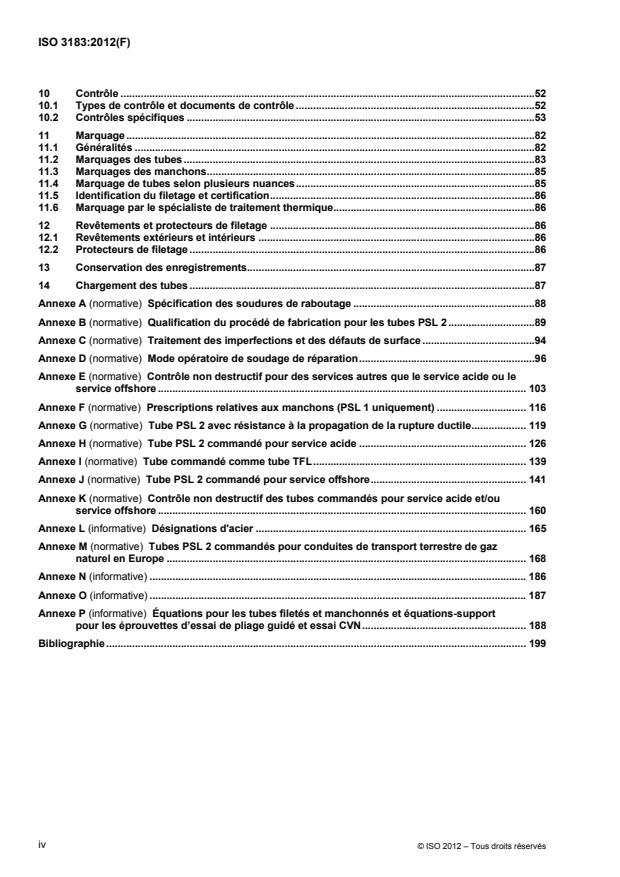
10 Contrôle .52
10.1 Types de contrôle et documents de contrôle .52
10.2 Contrôles spécifiques .53
11 Marquage .82
11.1 Généralités .82
11.2 Marquages des tubes .83
11.3 Marquages des manchons .85
11.4 Marquage de tubes selon plusieurs nuances .85
11.5 Identification du filetage et certification .86
11.6 Marquage par le spécialiste de traitement thermique.86
12 Revêtements et protecteurs de filetage .86
12.1 Revêtements extérieurs et intérieurs .86
12.2 Protecteurs de filetage .86
13 Conservation des enregistrements.87
14 Chargement des tubes .87
Annexe A (normative) Spécification des soudures de raboutage .88
Annexe B (normative) Qualification du procédé de fabrication pour les tubes PSL 2 .89
Annexe C (normative) Traitement des imperfections et des défauts de surface .94
Annexe D (normative) Mode opératoire de soudage de réparation .96
Annexe E (normative) Contrôle non destructif pour des services autres que le service acide ou le
service offshore . 103
Annexe F (normative) Prescriptions relatives aux manchons (PSL 1 uniquement) . 116
Annexe G (normative) Tube PSL 2 avec résistance à la propagation de la rupture ductile . 119
Annexe H (normative) Tube PSL 2 commandé pour service acide . 126
Annexe I (normative) Tube commandé comme tube TFL . 139
Annexe J (normative) Tube PSL 2 commandé pour service offshore . 141
Annexe K (normative) Contrôle non destructif des tubes commandés pour service acide et/ou
service offshore . 160
Annexe L (informative) Désignations d'acier . 165
Annexe M (normative) Tubes PSL 2 commandés pour conduites de transport terrestre de gaz
naturel en Europe . 168
Annexe N (informative) . 186
Annexe O (informative) . 187
Annexe P (informative) Équations pour les tubes filetés et manchonnés et équations-support
pour les éprouvettes d’essai de pliage guidé et essai CVN . 188
Bibliographie . 199
iv © ISO 2012 – Tous droits réservés
Avant-propos
L'ISO (Organisation internationale de normalisation) est une fédération mondiale d'organismes nationaux de
normalisation (comités membres de l'ISO). L'élaboration des Normes internationales est en général confiée
aux comités techniques de l'ISO. Chaque comité membre intéressé par une étude a le droit de faire partie du
comité technique créé à cet effet. Les organisations internationales, gouvernementales et non
gouvernementales, en liaison avec l'ISO participent également aux travaux. L'ISO collabore étroitement avec
la Commission électrotechnique internationale (CEI) en ce qui concerne la normalisation électrotechnique.
Les Normes internationales sont rédigées conformément aux règles données dans les Directives ISO/CEI,
Partie 2.
La tâche principale des comités techniques est d'élaborer les Normes internationales. Les projets de Normes
internationales adoptés par les comités techniques sont soumis aux comités membres pour vote. Leur
publication comme Normes internationales requiert l'approbation de 75 % au moins des comités membres
votants.
L'attention est appelée sur le fait que certains des éléments du présent document peuvent faire l'objet de
droits de propriété intellectuelle ou de droits analogues. L'ISO ne saurait être tenue pour responsable de ne
pas avoir identifié de tels droits de propriété et averti de leur existence.
L'ISO 3183 a été élaborée par le comité technique ISO/TC 67, Matériel, équipement et structures en mer pour
les industries pétrolières, pétrochimiques et du gaz naturel, sous-comité SC 2, Systèmes de transport par
conduites.
Le groupe de travail 16 de l’ISO/TC 67/SC 2 s’est réuni conjointement avec le groupe de travail tubes pour
conduites (actuellement WG 4210) de l’institut américain du pétrole (API) pour assurer l’harmonisation de
l’ISO 3183 avec la spécification API 5L.
La troisième édition de l’ISO 3183 annule et remplace la deuxième édition (ISO 3183:2007) sur laquelle elle
est basée mais avec des révisions pour incorporer une mise à jour, des clarifications et des exigences
techniques supplémentaires.
ème
La deuxième édition de l’ISO 3183 avait été largement harmonisée avec la 44 édition de l’API 5L, publiée
er
le 1 octobre 2007, et les révisions produites par les groupes de travail joints ISO et API sont destinées à
ème
étendre et terminer l’harmonisation avec la nouvelle 45 édition de l’API 5L.
L’intention de l’ISO/TC 67 est que les deuxième et troisième éditions de l’ISO 3183 soient toutes les deux
applicables, au choix de l’acheteur (comme défini en 4.49), pendant une période de 6 mois suivant le premier
jour du trimestre calendaire suivant immédiatement la date de publication de la troisième édition; après cette
période, la deuxième édition (ISO 3183:2007) ne sera plus applicable.
Introduction
La présente Norme internationale résulte de l’harmonisation des prescriptions des normes suivantes:
ème er
— Spécification API 5L; 44 édition publiée le 1 octobre 2007;
— ISO 3183:2007; deuxième édition publiée le 15 mars 2007.
Lors de la préparation de la troisième édition de l’ISO 3183, le comité technique a conservé le concept de
deux niveaux de base de prescriptions techniques normalisées pour les tubes pour conduites, exprimés sous
forme de deux niveaux de spécifications de produits (PSL 1 et PSL 2). Le niveau PSL 1 fournit un niveau de
qualité normalisé pour les tubes pour conduites. Le niveau PSL 2 a des prescriptions obligatoires
supplémentaires pour la composition chimique, la résistance à l’effet d’entaille et les caractéristiques de
résistance et des exigences supplémentaires en contrôle non destructif (CND). Les prescriptions qui ne
s’appliquent qu’au niveau PSL 1 ou qui ne s’appliquent qu’au niveau PSL 2 sont ainsi désignées. Les
prescriptions qui ne sont pas désignées selon une désignation PSL spécifique s’appliquent tant à PSL 1 qu’à
PSL 2.
Le comité technique a reconnu également que l’industrie du pétrole et du gaz naturel spécifie souvent des
prescriptions supplémentaires pour des applications particulières. Afin de s’adapter à de tels besoins, des
prescriptions supplémentaires facultatives sont disponibles pour des applications spécifiques comme suit:
— Tube PSL 2 commandé avec un procédé de fabrication qualifié (Annexe B), dont les prescriptions ont été
renforcées pour inclure le détail des vérifications des processus critiques dans la production du matériau
de base, la fabrication du tube et les essais et contrôles du produit;
— Tube PSL 2 commandé avec la résistance à la propagation de rupture ductile dans des canalisations de
gaz (Annexe G);
— Tube PSL 2 commandé pour le service acide (Annexe H);
— Tube commandé comme tube TFL (Annexe I);
— Tube PSL 2 commandé pour le service offshore ou service en mer (Annexe J).
Les deux annexes suivantes sont ajoutées à la troisième édition de la présente Norme internationale:
— Tube PSL 2 commandé pour les conduites de transport terrestre de gaz naturel en Europe (Annexe M);
— Équations pour les tubes filetés manchonnés et les équations de base pour les essais de pliage guidé et
les essais CVN (Annexe P).
Les prescriptions des annexes ne s’appliquent que si cela est spécifié dans le bon de commande.
Lorsqu’un tube est commandé pour deux ou de multiples applications, les prescriptions de plus d’une annexe
relative à des applications spécifiques peuvent être invoquées. Dans de telles circonstances, si un conflit
technique est soulevé du fait de l’application de plus d’une annexe pour des applications spécifiques, la
prescription la plus contraignante applicable au service envisagé s’applique.
La présente Norme internationale ne fournit pas de lignes directrices concernant les circonstances où il
convient de spécifier les prescriptions supplémentaires susmentionnées Par contre, il est de la responsabilité
de l’acheteur de spécifier, en fonction de l’utilisation prévue et des prescriptions relatives à la conception, si
une (des) prescription(s) supplémentaire(s) s’applique(nt) pour un bon de commande particulier.
vi © ISO 2012 – Tous droits réservés
La présente troisième édition de l’ISO 3183 est le résultat d’un processus continu d’harmonisation de
documents provenant d’héritages différents. Il a fallu tenir compte des symboles traditionnels (dénotant les
caractéristiques mécaniques ou physiques ou leurs valeurs, les dimensions ou les paramètres d’essai) et le
format des équations qui ont été largement utilisées et qui (dans leur format traditionnel) maintiennent des
liens forts avec d’autres normes et spécifications largement utilisées et avec le travail scientifique initial qui a
mené à les établir. De même, bien que, dans certains cas, des modifications ont été apportées à des
symboles et équations établis pour optimiser l’alignement avec les Directives ISO/CEI, Partie 2, dans d’autres
cas, certains symboles et équations, plus spécifiquement ceux de 9.2, du Tableau F.1 et de l'Annexe P, ont
été conservés dans leur forme traditionnelle pour éviter de causer la confusion à ce stade de post-
harmonisation. Lorsque des modifications ont été apportées, il a été pris soin de s’assurer que le nouveau
symbole remplaçant le traditionnel a été complètement et clairement défini.
NORME INTERNATIONALE ISO 3183:2012(F)
Industries du pétrole et du gaz naturel — Tubes en acier pour
les systèmes de transport par conduites
1 Domaine d'application
La présente Norme internationale spécifie les prescriptions relatives à la fabrication de tubes en acier sans
soudure et soudés utilisés dans des systèmes de transport par conduites dans les industries du pétrole et du
gaz naturel et répondant à deux niveaux de spécifications de produit (PSL 1 et PSL 2).
La présente Norme internationale ne s’applique pas aux tubes moulés.
2 Conformité
2.1 Unités de mesure
Dans la présente Norme internationale, les données sont exprimées en unités SI (système international) et
USC (système américain). Pour un poste de commande spécifique, un seul système d’unités doit être utilisé,
sans combiner avec des données exprimées dans l’autre système. Des valeurs exprimées en unités SI et en
unités USC ne doivent pas être combinées dans le même certificat ou dans une séquence obligatoire de
marquage.
Lorsque les caractéristiques d’un produit sont testées et vérifiées en utilisant un système d’unités et qu’un
certificat est émis avec des données dans l’autre système d’unités, une phrase doit être ajoutés sur le
certificat indiquant que les données incrites ont été converties à partir des valeurs du système utilisé pour le
certificat original.
L’acheteur doit spécifier si les données, les plans et les dimensions de maintenance des tubes doivent être en
unités SI ou en unités US habituelles (USC). L'utilisation d'une feuille de données SI indique que des unités
de mesure SI doivent être employées. L'utilisation d'une feuille de données USC indique que des unités de
mesure USC doivent être employées.
Pour les données exprimées en unités SI, une virgule doit être utilisée comme séparateur décimal et un
espace est utilisé comme séparateur des milliers. Pour les données exprimées en unités USC, une virgule
doit être utilisée comme séparateur décimal et un espace est utilisé comme séparateur des milliers.
2.2 Arrondi
Sauf convention contraire indiquée dans la présente Norme internationale, pour déterminer la conformité aux
prescriptions spécifiées, les valeurs observées ou calculées doivent être arrondies à l’unité la plus proche à
l’emplacement correspondant au dernier chiffre de droite parmi les chiffres utilisés pour exprimer la valeur
limite, conformément à l’ISO 80000-1:2009, Annexe B, Règle A.
[1]
NOTE Pour les besoins de cette disposition, la méthode d'arrondi de l'ASTM E29-08 équivaut à
l'ISO 80000-1:2009, Annexe B, Règle A.
2.3 Conformité à la présente Norme internationale
Un système qualité documenté doit être appliqué pour aider à la conformité aux exigences de la présente
Norme internationale.
NOTE Documenter un système qualité ne requiert pas qu’il soit certifié par un organisme tierce partie. Pour remplir
l’exigence de la présente Norme internationale, seule la création ou l’adoption d’un système qualité est nécessaire. L’ISO
s’en remet à l’expertise du personnel responsable de la gestion de la qualité pour créer ou adopter le système qui reflète
le mieux les besoins de chaque société. Il existe de nombreux systèmes de gestion de la qualité auxquels le personnel
[2]
peut se référer comme assistance dans le développement d’un système qualité approprié, y compris l’ISO/ TS 29001 et
[3] [4]
l’API Q1 , qui contiennent des clauses spécifiques à l’industrie du pétrole et du gaz, ou l’ISO 9001 qui contient des
exigences générales pour les systèmes qualités auditables. Cette liste n’est pas exhaustive et elle est donnée uniquement
pour information.
Un contrat peut spécifier que le fabricant est tenu de respecter toutes les exigences applicables de la
présente Norme internationale. Le fabricant doit permettre à l'acheteur d'effectuer toutes les recherches
nécessaires pour s'assurer de la conformité du produit et de refuser tout matériau non conforme.
3 Références normatives
Les documents suivants cités en référence sont indispensables à l’application du présent document. Pour les
références datées, seule l'édition citée s'applique. Pour les références non datées, la dernière édition du
document de référence (y compris les éventuels amendements) s'applique.
ISO 148-1, Matériaux métalliques — Essai de flexion par choc sur éprouvette Charpy — Partie 1: Méthode
d'essai
ISO 404, Acier et produits sidérurgiques — Conditions générales techniques de livraison
ISO 2566-1, Acier — Conversion des valeurs d'allongement — Partie 1: Aciers au carbone et aciers
faiblement alliés
ISO 4885, Produits ferreux — Traitements thermiques — Vocabulaire
ISO 5173, Essais destructifs des soudures sur matériaux métalliques — Essais de pliage
ISO 6506 (toutes les parties), Matériaux métalliques — Essai de dureté Brinell
ISO 6507 (toutes les parties), Matériaux métalliques — Essai de dureté Vickers
ISO 6508 (toutes les parties), Matériaux métalliques — Essai de dureté Rockwell
ISO 6892-1, Matériaux métalliques — Essai de traction — Partie 1: Méthode d'essai à température ambiante
ISO 6929, Produits en acier — Vocabulaire
ISO 7438, Matériaux métalliques — Essai de pliage
ISO 7539-2, Corrosion des métaux et alliages — Essais de corrosion sous contrainte — Partie 2: Préparation
et utilisation des éprouvettes pour essais en flexion
ISO 8491, Matériaux métalliques — Tubes — Essai de cintrage sur tronçon
ISO 8492, Matériaux métalliques — Tubes — Essai d'aplatissement
ISO 8501-1:2007, Préparation des subjectiles d'acier avant application de peintures et de produits
assimilés — Évaluation visuelle de la propreté d'un subjectile — Partie 1: Degrés de rouille et degrés de
préparation des subjectiles d'acier non recouverts et des subjectiles d'acier après décapage sur toute la
surface des revêtements précédents
ISO 9712, Essais non destructifs — Qualification et certification du personnel END
ISO/TR 9769, Aciers et fontes — Vue d'ensemble des méthodes d'analyse disponibles
ISO 10474:1991, Aciers et produits sidérurgiques — Documents de contrôle
ISO 10893-2:2011, Essais non destructifs des tubes en acier — Partie 2: Contrôle automatisé par courants de
Foucault pour la détection des imperfections des tubes en acier sans soudure ou soudés (sauf à l'arc
immergé sous flux en poudre)
ISO 10893-3:2011, Essais non destructifs des tubes en acier — Partie 3: Contrôle automatisé par flux de fuite
sur toute la circonférence des tubes en aciers ferromagnétique sans soudure ou soudés (sauf à l'arc immergé
sous flux en poudre) pour la détection des imperfections longitudinales et/ou transversales
ISO 10893-4, Essais non destructifs des tubes en acier — Partie 4: Contrôle par ressuage des tubes en acier
sans soudure et soudés pour la détection des imperfections de surface
ISO 10893-5, Essais non destructifs des tubes en acier — Partie 5: Contrôle par magnétoscopie des tubes en
acier ferromagnétique sans soudure et soudés pour la détection des imperfections de surface
ISO 10893-6, Essais non destructifs des tubes en acier — Partie 6: Contrôle radiographique du cordon de
soudure des tubes en acier soudés pour la détection des imperfections
ISO 10893-7:2011, Essais non destructifs des tubes en acier — Partie 7: Contrôle radiographique numérique
du cordon de soudure des tubes en acier soudés pour la détection des imperfections
ISO 10893-8:2011, Essais non destructifs des tubes en acier — Partie 8: Contrôle automatisé par ultrasons
pour la détection des dédoublures des tubes en acier sans soudure et soudés
ISO 10893-9:2011, Essais non destructifs des tubes en acier — Partie 9: Contrôle automatisé par ultrasons
pour la détection des dédoublures dans les bandes/tôles fortes utilisées pour la fabrication des tubes en acier
soudés
ISO 10893-10:2011, Essais non destructifs des tubes en acier — Partie 10: Contrôle automatisé par ultrasons
sur toute la circonférence des tubes en acier sans soudure et soudés (sauf à l'arc immergé sous flux en
poudre) pour la détection des imperfections longitudinales et/ou transversales
ISO 10893-11:2011, Essais non destructifs des tubes en acier — Partie 11: Contrôle automatisé par ultrasons
du cordon de soudure des tubes en acier soudés pour la détection des imperfections longitudinales et/ou
transversales
ISO 10893-12, Essais non destructifs des tubes en acier — Partie 12: Contrôle automatisé de l'épaisseur par
ultrasons sur toute la circonférence des tubes en acier sans soudure et soudés (sauf à l'arc immergé sous flux
en poudre)
ISO 11484, Produits en acier — Système de qualification, par l'employeur, du personnel pour essais non
destructifs (END)
ISO 11699-1:2008, Essais non destructifs — Film pour radiographie industrielle — Partie 1: Classification des
systèmes films pour radiographie industrielle
ISO 12135, Matériaux métalliques — Méthode unifiée d'essai pour la détermination de la ténacité quasi
statique
ISO 13678, Industries du pétrole et du gaz naturel — Évaluation et essais des graisses pour filetage utilisées
pour les tubes de cuvelage, les tubes de production, les tubes de conduites et les éléments de garnitures de
forage
ISO 14284, Fontes et aciers — Prélèvement et préparation des échantillons pour la détermination de la
composition chimique
ISO 19232-1:2004, Essais non destructifs — Qualité d'image des radiogrammes — Partie 1: Indicateurs de
qualité d'image (à fils) — Détermination de l'indice de qualité d'image
ISO 80000-1:2009, Grandeurs et unités — Partie 1: Généralités
1)
API Spec 5B , Specification for Threading, Gauging, and Thread Inspection of Casing, Tubing, and Line Pipe
Threads
API RP 5A3, Recommended Practice on Thread Compounds for Casing, Tubing, Line Pipe, and Drill Stem
Elements
API RP 5L3, Recommended Practice for Conducting Drop-Weight Tear Tests on Line Pipe
API Std 5T1, Standard on Imperfection Terminology
2)
ASNT SNT-TC-1A , Recommended Practice No. SNT-TC-1A — Non-Destructive Testing
3)
ASTM A370 , Standard Test Methods and Definitions for Mechanical Testing of Steel Products
ASTM A435, Standard Specification for Straight-Beam Ultrasonic Examination of Steel Plates
ASTM A578/A578M, Standard Specification for Straight-Beam Ultrasonic Examination of Rolled Steel Plates
for Special Applications
ASTM A751, Standard Test Methods, Practices, and Terminology for Chemical Analysis of Steel Products
ASTM A941, Standard Terminology Relating to Steel, Stainless Steel, Related Alloys, and Ferroalloys
ASTM A956, Standard Test Method for Leeb Hardness Testing of Steel Products
ASTM A1038, Standard Test Method for Portable Hardness Testing by the Ultrasonic Contact Impedance
Method
ASTM E18, Standard Test Methods for Rockwell Hardness of Metallic Materials
ASTM E94, Standard Guide for Radiographic Examination
ASTM E110, Standard Test Method for Indentation Hardness of Metallic Materials by Portable Hardness
Testers
ASTM E114, Standard Practice for Ultrasonic Pulse-Echo Straight-Beam Contact Testing
ASTM E164, Standard Practice for Contact Ultrasonic Testing of Weldments
ASTM E165, Standard Practice for Liquid Penetrant Examination for General Industry
ASTM E213, Standard Practice for Ultrasonic Examination of Metal Pipe and Tubing
ASTM E273, Standard Practice for Ultrasonic Testing of the Weld Zone of Welded Pipe and Tubing
1) American Petroleum Institute, 1220 L Street, N.W., Washington, DC 20005, USA.
2) American Society for Nondestructive Testing, 1711 Arlingate Lane, Columbus, OH 43228-0518, USA.
3) ASTM International, 100 Barr Harbor Drive, West Conshohocken, PA 19428-2959, USA.
ASTM E309, Standard Practice for Eddy-Current Examination of Steel Tubular Products Using Magnetic
Saturation
ASTM E384, Standard Test Method for Knoop and Vickers Hardness of Materials
ASTM E570, Standard Practice for Flux Leakage Examination of Ferromagnetic Steel Tubular Products
ASTM E587, Standard Practice for Ultrasonic Angle-Beam Contact Testing
ASTM E709, Standard Guide for Magnetic Particle Testing
ASTM E747, Standard Practice for Design, Manufacture and Material Grouping Classification of Wire Image
Quality Indicators (IQI) Used for Radiology
ASTM E1290, Standard Test Method for Crack-Tip Opening Displacement (CTOD) Fracture Toughness
Measurement
ASTM E1806, Standard Practice for Sampling Steel and Iron for Determination of Chemical Composition
ASTM E1815-08, Standard Test Method for Classification of Film Systems for Industrial Radiography
ASTM E2033, Standard Practice for Computed Radiology (Photostimulable Luminescence Method)
ASTM E2698, Standard Practice for Radiological Examination Using Digital Detector Arrays
ASTM G39, Standard Practice for Preparation and Use of Bent-Beam Stress-Corrosion Test Specimens
BS 7448-1, Mécanique de la rupture — Essais de ténacité — Méthode de détermination des valeurs de KIc,
de l'écartement a fond de fissure (CTOD critique) et des valeurs critiques de J pour les matériaux métalliques
4)
EN 10168 , Produits en acier — Documents de contrôle — Liste et description des informations
EN 10204:2004, Produits métalliques — Types de documents de contrôle
5)
NACE TM0177:2005 , Laboratory Testing of Metals for Resistance to Sulfide Stress Cracking and Stress
Corrosion Cracking in H S Environments
NACE TM0284:2011, Standard Test Method — Evaluation of Pipeline and Pressure Vessel Steels for
Resistance to Hydrogen-Induced Cracking
4 Termes et définitions
Pour les besoins du présent document, les termes et définitions suivants s’appliquent, ainsi que ceux donnés
dans:
— l’ISO 6929 ou l’ASTM A941, pour les produits en acier,
— l’ISO 4885 ou l’ASTM A941 pour le traitement thermique,
— l'API Std 5T1 pour la terminologie relative aux imperfections,
— l’ISO 404 ou l’ISO 10474 ou l’ASTM A370, celle qui s’applique, pour les types de modes opératoires
d’échantillonnage, le contrôle et les documents de contrôle.
4) CEN, European Committee for Standardization, Management Centre, Avenue Marnix 17, B 1000, Brussels, Belgium.
5) NACE International, P.O. Box 201009, Houston, Texas 77216-1009, USA.
4.1
comme convenu
devant être comme convenu par le fabricant et l’acheteur et spécifié dans le bon de commande
NOTE En association, par exemple, avec les éléments couverts par 7.2 a).
4.2
brut de laminage
état de livraison sans aucun laminage spécial et/ou traitement thermique
4.3
soudure de raboutage des bobines/tôles
soudure qui joint deux bobines ou tôles ensemble
4.4
tube expansé à froid
tube qui, à la température ambiante, a subi une augmentation permanente du diamètre extérieur ou de la
circonférence sur toute sa longueur
4.5
tube calibré à froid
tube qui, après formage (y compris le calibrage sur tubes soudés électriquement) et à la température
ambiante, a subi une augmentation ou une réduction permanente du diamètre extérieur ou de la
circonférence sur tout ou partie de sa longueur
4.6
finition à froid
opération de parachèvement à froid (normalement un étirage à froid) avec un taux de déformation
permanente supérieur à 1,5 %
NOTE Le niveau de déformation permanente distingue généralement ce procédé de l’opération d’expansion à froid
et de l’opération de calibrage à froid.
4.7
formage à froid
procédé permettant de transformer un feuillard ou une tôle en tube sans apport de chaleur
4.8
soudage continu
CW
procédé consistant à réaliser une soudure en chauffant le feuillard dans un four et en pressant
mécaniquement les rives l’une contre l’autre, après avoir joint bout à bout des bobines successives de
feuillards de façon à former un flux continu de feuillards pour l’atelier de soudage
4.9
tube à soudage combiné
tube COW
tube ayant une ou deux soudures longitudinales, ou une soudure hélicoïdale, produite(s) par la combinaison
du soudage à l’arc avec protection gazeuse et du soudage à l’arc immergé pour lequel le cordon de soudure à
l’arc avec protection gazeuse n’est pas complètement supprimé par les passes de soudage à l’arc immergé
4.10
tube COWH
tube ayant une soudure hélicoïdale, produite par la combinaison du soudage à l’arc avec protection gazeuse
et du soudage à l’arc immergé pour lequel le cordon de soudure à l’arc avec protection gazeuse n’est pas
complètement supprimé par les passes de soudage à l’arc immergé
4.11
tube COWL
tube ayant une ou deux soudures longitudinales, produite(s) par la combinaison du soudage à l’arc avec
protection gazeuse et du soudage à l’arc immergé pour lequel le cordon de soudure à l’arc avec protection
gazeuse n’est pas complètement supprimé par les passes de soudage à l’arc immergé
4.12
soudure COW
soudure longitudinale ou hélicoïdale, produite par la combinaison du soudage à l’arc avec protection gazeuse
et du soudage à l’arc immergé pour laquelle le cordon de soudure à l’arc avec protection gazeuse n’est pas
complètement supprimé par les passes de soudage à l’arc immergé
4.13
tube CW
tube ayant une soudure longitudinale produite par le procédé de soudage continu
4.14
bobine-fille
quantité d’acier obtenue par re-fendage, découpage ou cisaillage à partir de la bobine-mère et utilisée pour
produire un ou plusieurs tubes
4.15
tôle-fille
quantité d’acier obtenue par re-fendage, découpage ou cisaillage à partir de la tôle-mère et utilisée pour
produire un ou plusieurs tubes
4.16
défaut
imperfection d’une taille et/ou d’une densité de population supérieure aux critères d’acceptation spécifiés dans
la présente Norme internationale
4.17
soudage électrique
EW
procédé consistant à réaliser une soudure par le procédé de soudage par résistance électrique, dans lequel
les rives devant être soudées sont pressées mécaniquement l’une contre l’autre et la chaleur nécessaire au
soudage est produite par la résistance au passage du courant électrique appliqué par induction ou par
conduction
4.18
tube EW
tube ayant une soudure longitudinale produite par le procédé de soudage électrique à basse ou haute
fréquence
4.19
soudure EW
soudure longitudinale produite par le procédé de soudage électrique
4.20
soudage à l’arc sous flux intégré
procédé de soudure qui produit la fusion et la coalescence de métaux en les chauffant par un arc produit
entre un fil continu faisant office de métal d’apport continu et la pièce à souder alors que l’arc et le métal fondu
sont protégés par un flux contenu dans le fil d’apport
NOTE Dans certains cas une protection complémentaire est obtenue à l’aide d’un gaz ou mélange de gaz provenant
d’une source extérieure.
4.21
soudage à l’arc avec protection gazeuse
procédé de soudage engendrant une fusion et une coalescence des métaux par chauffage grâce à un ou
plusieurs arcs passant entre une électrode consommable continue et la pièce, l’arc et le métal fondu y étant
protégés par un gaz ou mélange de gaz fourni extérieurement
NOTE La pression de contact n’est pas utilisée et le métal d’apport est obtenu par la fusion de l’électrode.
4.22
coulée
quantité de métal produite lors d’un cycle unique d’un procédé de fusion par lot
4.23
tube HFW
tube soudé électriquement à haute fréquence
tube EW produit avec une fréquence du courant de soudage supérieure ou égale à 70 kHz
4.24
si convenu
devant être conforme à la prescription ou à une prescription plus stricte que celle prescrite, si cela est
convenu par le fabricant et l’acheteur et spécifié dans le bon de commande
NOTE En association, par exemple, avec les éléments couverts par 7.2 c).
4.25
imperfection
discontinuité ou irrégularité de la paroi ou de la surface du produit qui peuvent être détectées par des
méthodes de contrôle décrites dans la présente Norme internationale
4.26
indication
preuve obtenue par un contrôle non destructif
4.27
éléments informatifs
éléments qui
a) identifient le document, introduisent son contenu et expliquent son origine, son développement et ses
relations avec d’autres documents, ou
b) fournissent des informations complémentaires destinées à faciliter la compréhension ou l’utilisation du
document
NOTE Voir les Directives ISO/CEI, Partie 2.
4.28
contrôle
activités telles que le mesurage, l’examen, l’essai, la pesée ou le calibrage d’une ou plusieurs caractéristiques
d’un produit et la comparaison des résultats de telles activités aux prescriptions spécifiées afin de déterminer
la conformité
NOTE Définition adaptée de l’ISO 404.
4.29
étalonnage d’appareil
réglage d’un appareil de contrôle non destructif sur une valeur de référence arbitraire
4.30
jointer
deux ou trois tronçons de tube couplés ou soudés ensemble par le fabricant
4.31
affinage en poche
procédé secondaire intervenant après l’élaboration de l’acier et mis en œuvre avant la coulée de façon à
améliorer la qualité de l’acier; quelques exemples possibles sont le dégazage, la désulfuration et différentes
méthodes permettant l’élimination des inclusions non-métalliques et le contrôle de la forme des inclusions
4.32
dédoublure
séparation interne de métal qui crée des couches, généralement parallèle à la surface du tube
4.33
soudage au laser
LW
procédé consistant à réaliser une soudure par le procédé de soudage en trou de serrure par rayon laser pour
produire la fusion et la coalescence des rives à souder, préchauffées ou non, dans lequel la protection est
assurée par un gaz ou mélange de gaz fourni extérieurement
4.34
tube soudé électriquement à basse fréquence
tube LFW
tube EW produit avec une fréquence du courant de soudage inférieure à 70 kHz
4.35
tube LW
tube ayant une soudure longitudinale produite par le procédé de soudage au laser
4.36
fabricant
entreprise, compagnie ou organisme responsable de la fabrication et du marquage du produit conformément
aux prescriptions de la présente Norme internationale
NOTE 1 Le fabricant peut, selon les cas, être une tuberie, un spécialiste de traitement thermique, un fabricant de
manchons ou un fileteur.
[5]
NOTE 2 Définition adaptée de l’ISO 11961 .
4.37
bobine-mère
bobine d’acier laminée à chaud à partir d’une seule brame réchauffée et qui est utilisée pour fabriquer un ou
plusieurs tubes
4.38
tôle-mère
tôle d’acier laminée à chaud à partir d’une seule brame réchauffée et qui est utilisée pour fabriquer un ou
plusieurs tubes
4.39
contrôle non destructif
essai non destructif
CND
contrôle d’un tube pour révéler les imperfections, à l’aide de méthodes radiographiques, ultrasonores ou
autres méthodes spécifiées dans la présente Norme internationale qui n’impliquent ni perturbation ni mise
sous contrainte ni rupture des matériaux
4.40
formage normalisant
conditions de livraison de tube résultant du procédé de formage dans lequel la déformation finale est
effectuée dans une certaine plage de température, permettant de donner au matériau une condition de
livraison équivalente à celle obtenue après normalisation, de sorte que les valeurs spécifiées des
caractéristiques mécaniques seront c
...
Questions, Comments and Discussion
Ask us and Technical Secretary will try to provide an answer. You can facilitate discussion about the standard in here.
Loading comments...