


ISO/FDIS 3994
(Main)Plastics hoses - Helical-thermoplastic-reinforced thermoplastics hoses for suction and discharge of aqueous materials - Specification
Plastics hoses - Helical-thermoplastic-reinforced thermoplastics hoses for suction and discharge of aqueous materials - Specification
ISO 3994:2014 specifies the requirements for three types of helical-thermoplastic-reinforced thermoplastics hoses for suction and discharge of water, weak aqueous chemical solutions and abrasive solids and slurries, for use in the ambient temperature range from −10 °C to 55 °C. The three types of hose are for light-, medium- and heavy-duty applications.
Tuyaux en plastiques — Tuyaux thermoplastiques à renforcement thermoplastique en spirale pour aspiration et refoulement de matières aqueuses — Spécifications
L'ISO 3994:2014 spécifie les exigences pour trois types de tuyaux thermoplastiques à renforcement thermoplastique en spirale pour aspiration et refoulement pour une utilisation dans la plage de température de − 10 °C à + 55 °C. Les trois types de tuyaux sont prévus pour des applications légères, moyennes et lourdes.
General Information
- Status
- Not Published
- Technical Committee
- ISO/TC 45/SC 1 - Rubber and plastics hoses and hose assemblies
- Drafting Committee
- ISO/TC 45/SC 1/WG 1 - Industrial, chemical and oil hoses
- Current Stage
- 5020 - FDIS ballot initiated: 2 months. Proof sent to secretariat
- Start Date
- 08-Dec-2025
- Completion Date
- 08-Dec-2025
Relations
- Consolidates
ISO/IEC 24775-4:2021 - Information technology - Storage management - Part 4: Block devices - Effective Date
- 07-Jan-2025
- Effective Date
- 07-Jan-2025
Overview
ISO/FDIS 3994 (ISO 3994:2025) specifies requirements for helical‑thermoplastic‑reinforced thermoplastic hoses intended for the suction and discharge of aqueous materials, including water, weak aqueous chemical solutions and abrasive solids/slurries. The standard covers three duty classes - type 1 (light), type 2 (medium) and type 3 (heavy) - and applies to ambient service temperatures from −10 °C to 55 °C. It excludes use with flammable/combustible materials and aromatic solvents.
Key topics and technical requirements
- Classification and scope
- Three hose types by maximum working and suction pressures (light, medium, heavy).
- Ambient temperature operation −10 °C to 55 °C.
- Materials and construction
- Flexible thermoplastic hose wall reinforced by a fused thermoplastic helix; uniform colour and free from visible defects.
- Dimensions and tolerances
- Nominal sizes and inside‑diameter tolerances specified (includes newly added 19 mm nominal size).
- Length tolerances reference ISO 1307.
- Pressure ratings
- Maximum working pressures and temperature‑dependent values given (tables for 23 °C and 55 °C).
- Hydrostatic testing (proof and minimum burst pressures) at 23 °C and 55 °C per ISO 1402.
- Mechanical and durability tests
- Tensile test (Annex A): test pieces must retain ≥50% of the flexible material’s tensile strength (ISO 37 basis).
- Vacuum test (Annex B): absolute pressure limits per hose type; failure criteria for collapse/fracture.
- Reinforcement fracture test (Annex C): helix must bend back without cracking after specified ageing (336 h over extension blocks listed in Table 6).
- Flexibility tests at ambient and low temperatures (ISO 10619‑1 and ‑2).
- Additional assessments: loss in mass on heating, xenon‑arc lamp exposure (ageing), frequency of testing, marking, packing and storage guidance.
- Quality documentation
- Test reports and certificates required; type and routine tests defined (Annex D).
Applications and users
Practical uses include:
- Water transfer, pumping and discharge systems
- Dewatering, dredging, mining slurries and abrasive solids handling
- Agricultural and construction site suction/discharge lines
- Industrial wastewater and non‑hazardous chemical transfer
Primary users:
- Hose manufacturers and fabricators
- Product engineers, OEMs and system integrators
- Quality & test laboratories and certification bodies
- Procurement/specification teams and facility managers
Related standards
Standards referenced for test methods and terminology include:
- ISO 1402 (hydrostatic testing)
- ISO 4671 (dimensional measurement)
- ISO 1307 (hose sizes and length tolerances)
- ISO 37 (tensile properties)
- ISO 10619‑1/‑2 (flexibility)
- ISO 30013 (light source exposure)
- ISO 8330 / ISO 8331 (vocabulary and guidance)
Using ISO/FDIS 3994 helps ensure thermoplastic suction/discharge hoses meet consistent safety, performance and durability expectations for aqueous service.
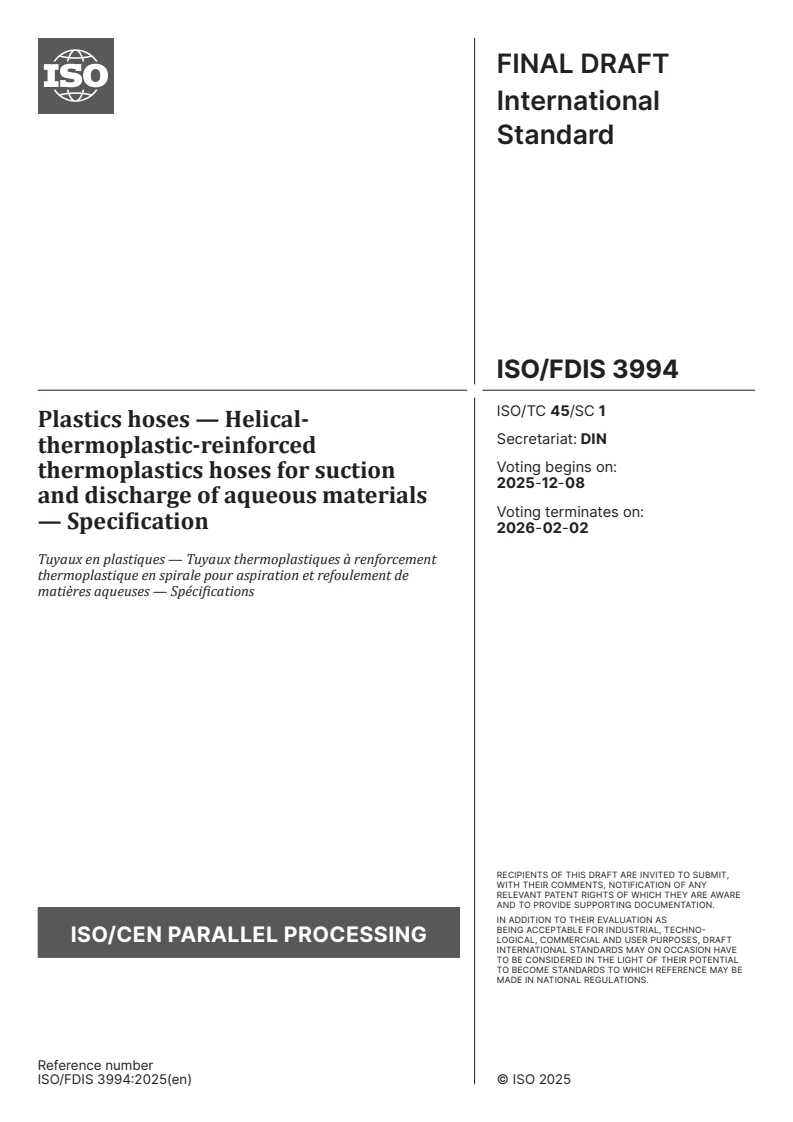

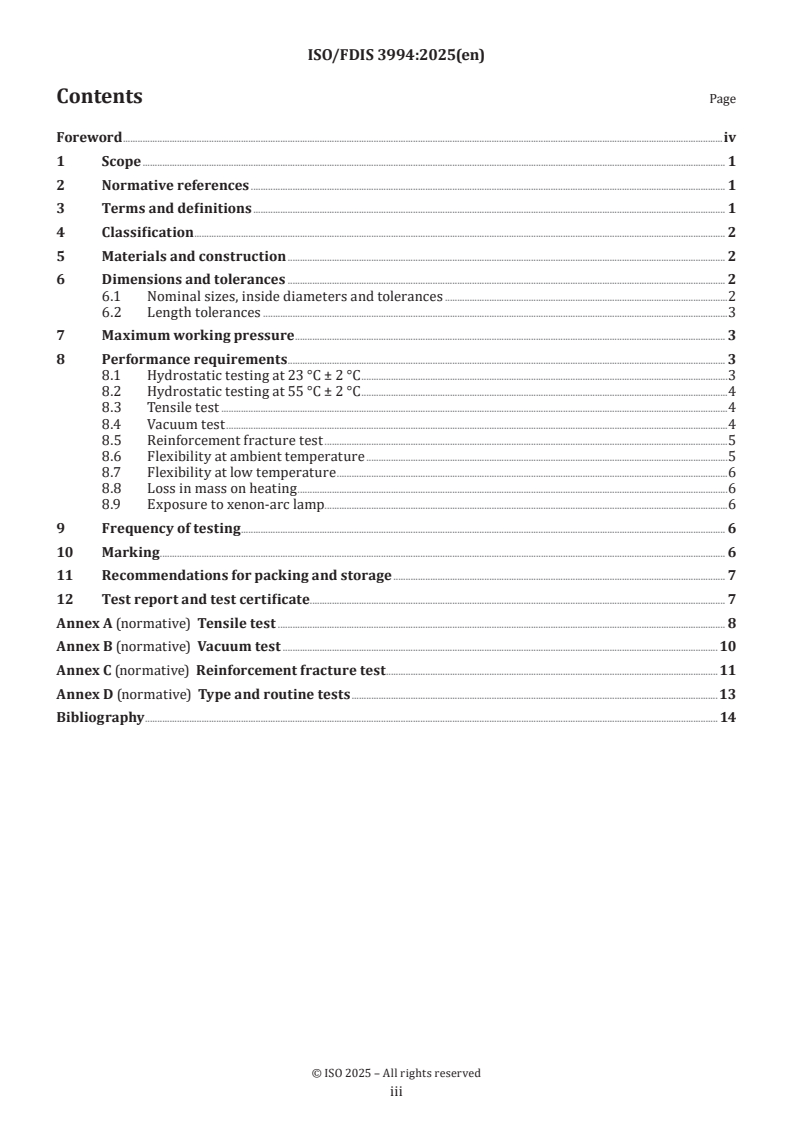
ISO/FDIS 3994 - Plastics hoses — Helical-thermoplastic-reinforced thermoplastics hoses for suction and discharge of aqueous materials — Specification Released:11/24/2025
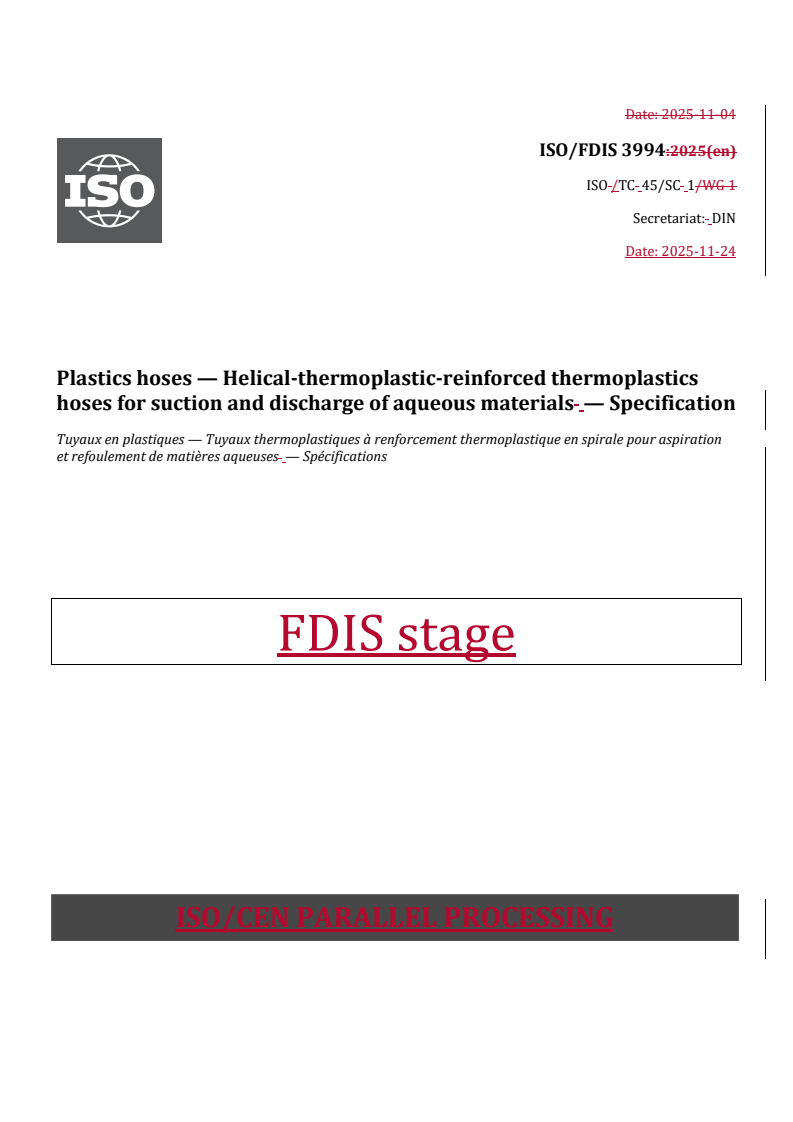
REDLINE ISO/FDIS 3994 - Plastics hoses — Helical-thermoplastic-reinforced thermoplastics hoses for suction and discharge of aqueous materials — Specification Released:11/24/2025


ISO/FDIS 3994 - Tuyaux en plastiques — Tuyaux thermoplastiques à renforcement thermoplastique en spirale pour aspiration et refoulement de matières aqueuses — Spécifications Released:8. 12. 2025
Frequently Asked Questions
ISO/FDIS 3994 is a draft published by the International Organization for Standardization (ISO). Its full title is "Plastics hoses - Helical-thermoplastic-reinforced thermoplastics hoses for suction and discharge of aqueous materials - Specification". This standard covers: ISO 3994:2014 specifies the requirements for three types of helical-thermoplastic-reinforced thermoplastics hoses for suction and discharge of water, weak aqueous chemical solutions and abrasive solids and slurries, for use in the ambient temperature range from −10 °C to 55 °C. The three types of hose are for light-, medium- and heavy-duty applications.
ISO 3994:2014 specifies the requirements for three types of helical-thermoplastic-reinforced thermoplastics hoses for suction and discharge of water, weak aqueous chemical solutions and abrasive solids and slurries, for use in the ambient temperature range from −10 °C to 55 °C. The three types of hose are for light-, medium- and heavy-duty applications.
ISO/FDIS 3994 is classified under the following ICS (International Classification for Standards) categories: 23.040.70 - Hoses and hose assemblies. The ICS classification helps identify the subject area and facilitates finding related standards.
ISO/FDIS 3994 has the following relationships with other standards: It is inter standard links to ISO/IEC 24775-4:2021, ISO 3994:2014. Understanding these relationships helps ensure you are using the most current and applicable version of the standard.
ISO/FDIS 3994 is available in PDF format for immediate download after purchase. The document can be added to your cart and obtained through the secure checkout process. Digital delivery ensures instant access to the complete standard document.
Standards Content (Sample)
FINAL DRAFT
International
Standard
ISO/TC 45/SC 1
Plastics hoses — Helical-
Secretariat: DIN
thermoplastic-reinforced
Voting begins on:
thermoplastics hoses for suction
2025-12-08
and discharge of aqueous materials
Voting terminates on:
— Specification
2026-02-02
Tuyaux en plastiques — Tuyaux thermoplastiques à renforcement
thermoplastique en spirale pour aspiration et refoulement de
matières aqueuses — Spécifications
RECIPIENTS OF THIS DRAFT ARE INVITED TO SUBMIT,
WITH THEIR COMMENTS, NOTIFICATION OF ANY
RELEVANT PATENT RIGHTS OF WHICH THEY ARE AWARE
AND TO PROVIDE SUPPOR TING DOCUMENTATION.
IN ADDITION TO THEIR EVALUATION AS
BEING ACCEPTABLE FOR INDUSTRIAL, TECHNO
ISO/CEN PARALLEL PROCESSING LOGICAL, COMMERCIAL AND USER PURPOSES, DRAFT
INTERNATIONAL STANDARDS MAY ON OCCASION HAVE
TO BE CONSIDERED IN THE LIGHT OF THEIR POTENTIAL
TO BECOME STAN DARDS TO WHICH REFERENCE MAY BE
MADE IN NATIONAL REGULATIONS.
Reference number
FINAL DRAFT
International
Standard
ISO/TC 45/SC 1
Plastics hoses — Helical-
Secretariat: DIN
thermoplastic-reinforced
Voting begins on:
thermoplastics hoses for suction
and discharge of aqueous materials
Voting terminates on:
— Specification
Tuyaux en plastiques — Tuyaux thermoplastiques à renforcement
thermoplastique en spirale pour aspiration et refoulement de
matières aqueuses — Spécifications
RECIPIENTS OF THIS DRAFT ARE INVITED TO SUBMIT,
WITH THEIR COMMENTS, NOTIFICATION OF ANY
RELEVANT PATENT RIGHTS OF WHICH THEY ARE AWARE
AND TO PROVIDE SUPPOR TING DOCUMENTATION.
© ISO 2025
IN ADDITION TO THEIR EVALUATION AS
All rights reserved. Unless otherwise specified, or required in the context of its implementation, no part of this publication may
BEING ACCEPTABLE FOR INDUSTRIAL, TECHNO
ISO/CEN PARALLEL PROCESSING
LOGICAL, COMMERCIAL AND USER PURPOSES, DRAFT
be reproduced or utilized otherwise in any form or by any means, electronic or mechanical, including photocopying, or posting on
INTERNATIONAL STANDARDS MAY ON OCCASION HAVE
the internet or an intranet, without prior written permission. Permission can be requested from either ISO at the address below
TO BE CONSIDERED IN THE LIGHT OF THEIR POTENTIAL
or ISO’s member body in the country of the requester.
TO BECOME STAN DARDS TO WHICH REFERENCE MAY BE
MADE IN NATIONAL REGULATIONS.
ISO copyright office
CP 401 • Ch. de Blandonnet 8
CH-1214 Vernier, Geneva
Phone: +41 22 749 01 11
Email: copyright@iso.org
Website: www.iso.org
Published in Switzerland Reference number
ii
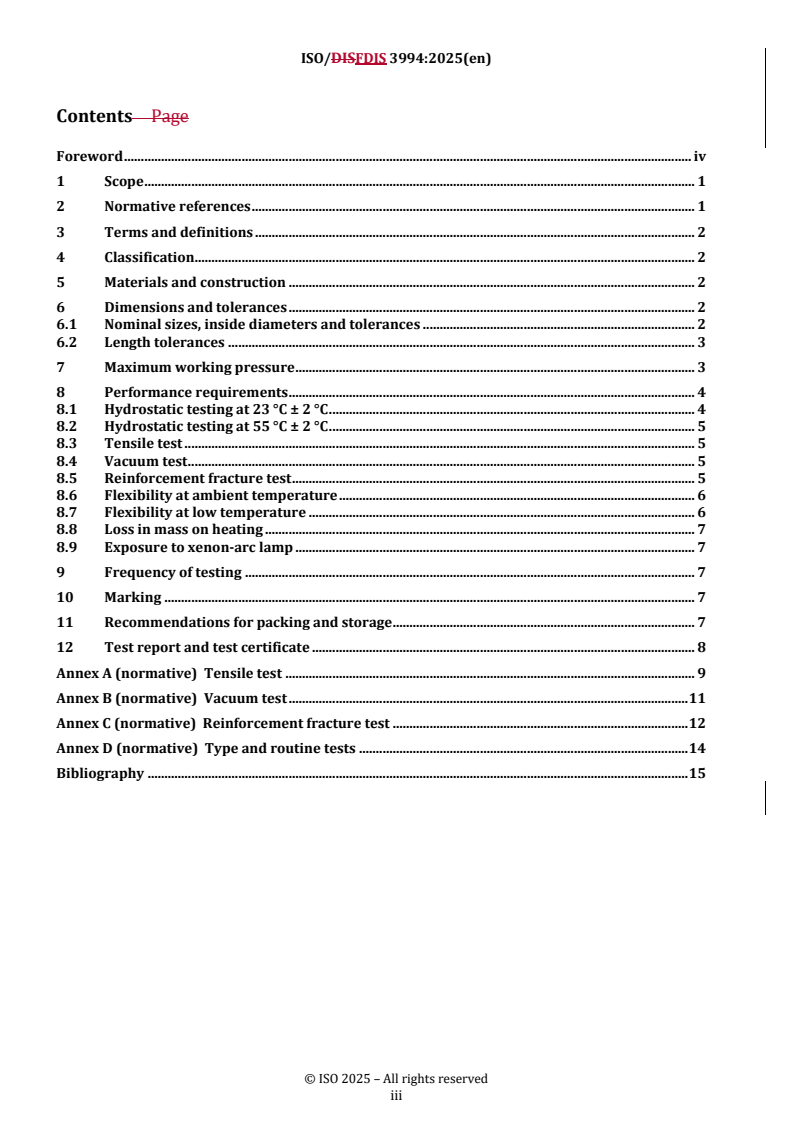
Contents Page
Foreword .iv
1 Scope . 1
2 Normative references . 1
3 Terms and definitions . 1
4 Classification . 2
5 Materials and construction . 2
6 Dimensions and tolerances . 2
6.1 Nominal sizes, inside diameters and tolerances .2
6.2 Length tolerances .3
7 Maximum working pressure . 3
8 Performance requirements . . 3
8.1 Hydrostatic testing at 23 °C ± 2 °C .3
8.2 Hydrostatic testing at 55 °C ± 2 °C .4
8.3 Tensile test .4
8.4 Vacuum test .4
8.5 Reinforcement fracture test .5
8.6 Flexibility at ambient temperature .5
8.7 Flexibility at low temperature .6
8.8 Loss in mass on heating .6
8.9 Exposure to xenon-arc lamp.6
9 Frequency of testing . . 6
10 Marking . . 6
11 Recommendations for packing and storage . 7
12 Test report and test certificate. 7
Annex A (normative) Tensile test . 8
Annex B (normative) Vacuum test . 10
Annex C (normative) Reinforcement fracture test .11
Annex D (normative) Type and routine tests .13
Bibliography . 14
iii
Foreword
ISO (the International Organization for Standardization) is a worldwide federation of national standards
bodies (ISO member bodies). The work of preparing International Standards is normally carried out through
ISO technical committees. Each member body interested in a subject for which a technical committee
has been established has the right to be represented on that committee. International organizations,
governmental and non-governmental, in liaison with ISO, also take part in the work. ISO collaborates closely
with the International Electrotechnical Commission (IEC) on all matters of electrotechnical standardization.
The procedures used to develop this document and those intended for its further maintenance are described
in the ISO/IEC Directives, Part 1. In particular, the different approval criteria needed for the different types
of ISO document should be noted. This document was drafted in accordance with the editorial rules of the
ISO/IEC Directives, Part 2 (see www.iso.org/directives).
ISO draws attention to the possibility that the implementation of this document may involve the use of (a)
patent(s). ISO takes no position concerning the evidence, validity or applicability of any claimed patent
rights in respect thereof. As of the date of publication of this document, ISO had not received notice of (a)
patent(s) which may be required to implement this document. However, implementers are cautioned that
this may not represent the latest information, which may be obtained from the patent database available at
www.iso.org/patents. ISO shall not be held responsible for identifying any or all such patent rights.
Any trade name used in this document is information given for the convenience of users and does not
constitute an endorsement.
For an explanation of the voluntary nature of standards, the meaning of ISO specific terms and expressions
related to conformity assessment, as well as information about ISO's adherence to the World Trade
Organization (WTO) principles in the Technical Barriers to Trade (TBT), see www.iso.org/iso/foreword.html.
This document was prepared by Technical Committee ISO/TC 45, Rubber and rubber products,
Subcommittee SC 1, Rubber and plastics hoses and hose assemblies, in collaboration with the European
Committee for Standardization (CEN) Technical Committee CEN/TC 218, Rubber and plastics hoses and
hose assemblies, in accordance with the Agreement on technical cooperation between ISO and CEN (Vienna
Agreement).
This fifth edition cancels and replaces the fourth edition (ISO 3994:2014), which has been technically
revised.
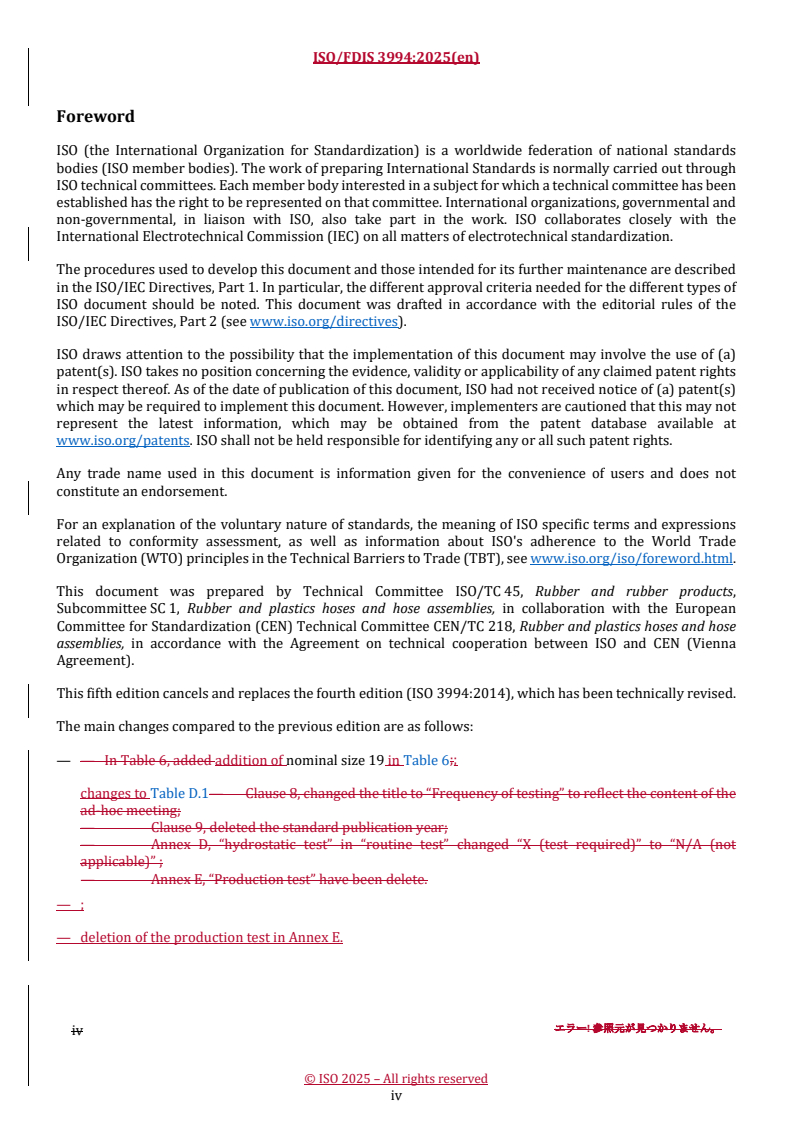
The main changes compared to the previous edition are as follows:
— addition of nominal size 19 in Table 6;
— changes to Table D.1;
— deletion of the production test in Annex E.
Any feedback or questions on this document should be directed to the user’s national standards body. A
complete listing of these bodies can be found at www.iso.org/members.html.
iv
FINAL DRAFT International Standard ISO/FDIS 3994:2025(en)
Plastics hoses — Helical-thermoplastic-reinforced
thermoplastics hoses for suction and discharge of aqueous
materials — Specification
WARNING — Persons using this document should be familiar with normal laboratory practice. This
document does not purport to address all of the safety problems, if any, associated with its use. It is
the responsibility of the user of this document to establish appropriate health and safety practices
and to determine the applicability of regulatory conditions prior to use.
1 Scope
This document specifies requirements for three types of helical-thermoplastic-reinforced thermoplastics
hoses for suction and discharge of water, weak aqueous chemical solutions and abrasive solids and slurries,
for use in the ambient temperature range from −10 °C to 55 °C.
This document does not specify requirements for use with flammable or combustible materials, nor with
aromatic solvents.
2 Normative references
The following documents are referred to in the text in such a way that some or all of their content constitutes
requirements of this document. For dated references, only the edition cited applies. For undated references,
the latest edition of the referenced document (including any amendments) applies.
ISO 37, Rubber, vulcanized or thermoplastic — Determination of tensile stress-strain properties
ISO 176:2005, Plastics — Determination of loss of plasticizers — Activated carbon method
ISO 1307, Rubber and plastics hoses — Hose sizes, minimum and maximum inside diameters, and tolerances on
cut-to-length hoses
ISO 1402, Rubber and plastics hoses and hose assemblies — Hydrostatic testing
ISO 4671, Rubber and plastics hoses and hose assemblies — Methods of measurement of the dimensions of hoses
and the lengths of hose assemblies
ISO 8330, Rubber and plastics hoses and hose assemblies — Vocabulary
ISO 10619-1, Rubber and plastics hoses and tubing — Measurement of flexibility and stiffness — Part 1: Bending
tests at ambient temperature
ISO 10619-2, Rubber and plastics hoses and tubing — Measurement of flexibility and stiffness — Part 2: Bending
tests at sub-ambient temperatures
ISO 30013:2011, Rubber and plastics hoses — Methods of exposure to laboratory light sources — Determination
of changes in colour, appearance and other physical properties
ISO 23529, Rubber — General procedures for preparing and conditioning test pieces for physical test methods
3 Terms and definitions
For the purposes of this document, the terms and definitions given in ISO 8330 apply.
ISO and IEC maintain terminology databases for use in standardization at the following addresses:
— ISO Online browsing platform: available at https:// www .iso .org/ obp
— IEC Electropedia: available at https:// www .electropedia .org/
4 Classification
Three types of hoses are specified, related to the maximum working pressure and suction pressure (see
Tables 2 and 5):
— type 1: light-duty service;
— type 2: medium-duty service;
— type 3: heavy-duty service.
All types are designed to operate in the ambient temperature range −10 °C to 55 °C.
5 Materials and construction
The hoses shall be as uniform as commercially practicable in colour and other physical properties. They
shall consist of a flexible thermoplastics material supported within the material by a helix of thermoplastic
material of a similar compatible property. The reinforcing and flexible components of the wall shall be fused
together and free from visible cracks, porosity, foreign inclusions or other defects such as are liable to cause
...
Date: 2025-11-04
ISO /TC 45/SC 1/WG 1
Secretariat: DIN
Date: 2025-11-24
Plastics hoses — Helical-thermoplastic-reinforced thermoplastics
hoses for suction and discharge of aqueous materials — Specification
Tuyaux en plastiques — Tuyaux thermoplastiques à renforcement thermoplastique en spirale pour aspiration
et refoulement de matières aqueuses — Spécifications
FDIS stage
ISOISO/C/CEEN PARN PARALLALLEEL L PRPROOCECESSINGSSING
All rights reserved. Unless otherwise specified, or required in the context of its implementation, no part of this publication
may be reproduced or utilized otherwise in any form or by any means, electronic or mechanical, including photocopying,
or posting on the internet or an intranet, without prior written permission. Permission can be requested from either ISO
at the address below or ISO'sISO’s member body in the country of the requester.
ISO Copyright Officecopyright office
CP 401 • Ch. de Blandonnet 8
CH-1214 Vernier, Geneva
Phone: + 41 22 749 01 11
Email:
E-mail: copyright@iso.org
Website: www.iso.org
Published in Switzerland.
エラー! 参照元が見つかりません。
ii
ii
ISO/DISFDIS 3994:2025(en)
Contents Page
Foreword . iv
1 Scope . 1
2 Normative references . 1
3 Terms and definitions . 2
4 Classification. 2
5 Materials and construction . 2
6 Dimensions and tolerances . 2
6.1 Nominal sizes, inside diameters and tolerances . 2
6.2 Length tolerances . 3
7 Maximum working pressure . 3
8 Performance requirements . 4
8.1 Hydrostatic testing at 23 °C ± 2 °C . 4
8.2 Hydrostatic testing at 55 °C ± 2 °C . 5
8.3 Tensile test . 5
8.4 Vacuum test . 5
8.5 Reinforcement fracture test . 5
8.6 Flexibility at ambient temperature . 6
8.7 Flexibility at low temperature . 6
8.8 Loss in mass on heating . 7
8.9 Exposure to xenon-arc lamp . 7
9 Frequency of testing . 7
10 Marking . 7
11 Recommendations for packing and storage . 7
12 Test report and test certificate . 8
Annex A (normative) Tensile test . 9
Annex B (normative) Vacuum test . 11
Annex C (normative) Reinforcement fracture test . 12
Annex D (normative) Type and routine tests . 14
Bibliography . 15
iii
Foreword
ISO (the International Organization for Standardization) is a worldwide federation of national standards
bodies (ISO member bodies). The work of preparing International Standards is normally carried out through
ISO technical committees. Each member body interested in a subject for which a technical committee has been
established has the right to be represented on that committee. International organizations, governmental and
non-governmental, in liaison with ISO, also take part in the work. ISO collaborates closely with the
International Electrotechnical Commission (IEC) on all matters of electrotechnical standardization.
The procedures used to develop this document and those intended for its further maintenance are described
in the ISO/IEC Directives, Part 1. In particular, the different approval criteria needed for the different types of
ISO document should be noted. This document was drafted in accordance with the editorial rules of the
ISO/IEC Directives, Part 2 (see www.iso.org/directives).
ISO draws attention to the possibility that the implementation of this document may involve the use of (a)
patent(s). ISO takes no position concerning the evidence, validity or applicability of any claimed patent rights
in respect thereof. As of the date of publication of this document, ISO had not received notice of (a) patent(s)
which may be required to implement this document. However, implementers are cautioned that this may not
represent the latest information, which may be obtained from the patent database available at
www.iso.org/patents. ISO shall not be held responsible for identifying any or all such patent rights.
Any trade name used in this document is information given for the convenience of users and does not
constitute an endorsement.
For an explanation of the voluntary nature of standards, the meaning of ISO specific terms and expressions
related to conformity assessment, as well as information about ISO's adherence to the World Trade
Organization (WTO) principles in the Technical Barriers to Trade (TBT), see www.iso.org/iso/foreword.html.
This document was prepared by Technical Committee ISO/TC 45, Rubber and rubber products,
Subcommittee SC 1, Rubber and plastics hoses and hose assemblies, in collaboration with the European
Committee for Standardization (CEN) Technical Committee CEN/TC 218, Rubber and plastics hoses and hose
assemblies, in accordance with the Agreement on technical cooperation between ISO and CEN (Vienna
Agreement).
This fifth edition cancels and replaces the fourth edition (ISO 3994:2014), which has been technically revised.
The main changes compared to the previous edition are as follows:
— — In Table 6, added addition of nominal size 19 in Table 6;;
changes to Table D.1— Clause 8, changed the title to “Frequency of testing” to reflect the content of the
ad-hoc meeting;
— Clause 9, deleted the standard publication year;
— Annex D, “hydrostatic test” in “routine test” changed “X (test required)” to “N/A (not
applicable)” ;
— Annex E, “Production test” have been delete.
— ;
— deletion of the production test in Annex E.
エラー! 参照元が見つかりません。
iv
iv
ISO/DISFDIS 3994:2025(en)
Any feedback or questions on this document should be directed to the user’s national standards body. A
complete listing of these bodies can be found at www.iso.org/members.html.
v
DRAFT International Standard ISO/FDIS 3994:2025(en)
Plastics hoses — Helical-thermoplastic-reinforced thermoplastics
hoses for suction and discharge of aqueous materials — Specification
WARNING — Persons using this document should be familiar with normal laboratory practice. This
document does not purport to address all of the safety problems, if any, associated with its use. It is
the responsibility of the user of this document to establish appropriate health and safety practices and
to determine the applicability of regulatory conditions prior to use.
1 Scope
This document specifies requirements for three types of helical-thermoplastic-reinforced thermoplastics
hoses for suction and discharge of water, weak aqueous chemical solutions and abrasive solids and slurries,
for use in the ambient temperature range from −10 °C to 55 °C.
This document dosedoes not specify requirements for use with flammable or combustible materials, nor with
aromatic solvents.
2 Normative references
The following documents are referred to in the text in such a way that some or all of their content constitutes
requirements of this document. For dated references, only the edition cited applies. For undated references,
the latest edition of the referenced document (including any amendments) applies.
ISO 37, Rubber, vulcanized or thermoplastic — Determination of tensile stress-strain properties
ISO 176:2005, Plastics — Determination of loss of plasticizers — Activated carbon method
ISO 1307, Rubber and plastics hoses — Hose sizes, minimum and maximum inside diameters, and tolerances on
cut-to-length hoses
ISO 1402, Rubber and plastics hoses and hose assemblies — Hydrostatic testing
ISO 4671, Rubber and plastics hoses and hose assemblies — Methods of measurement of the dimensions of hoses
and the lengths of hose assemblies
ISO 8330, Rubber and plastics hoses and hose assemblies — Vocabulary
ISO 8331, Rubber and plastics hoses and hose assemblies — Guidelines for selection, storage, use and
maintenance
ISO 10619--1, Rubber and plastics hoses and tubing — Measurement of flexibility and stiffness — Part 1: Bending
tests at ambient temperature
ISO 10619--2, Rubber and plastics hoses and tubing — Measurement of flexibility and stiffness — Part 2: Bending
tests at sub-ambient temperatures
ISO 30013:2011, Rubber and plastics hoses — Methods of exposure to laboratory light sources — Determination
of changes in colour, appearance and other physical properties
ISO 23529, Rubber — General procedures for preparing and conditioning test pieces for physical test methods
3 Terms and definitions
For the purposes of this document, the terms and definitions given in ISO 8330 apply.
ISO and IEC maintain terminology databases for use in standardization at the following addresses:
— — ISO Online browsing platform: available at https://www.iso.org/obp
— — IEC Electropedia: available at https://www.electropedia.org/
4 Classification
Three types of hoses are specified, related to the maximum working pressure and suction pressure (see
Tables 2Tables 2 and 55):):
— — type 1: light-duty service;
— — type 2: medium-duty service;
— — type 3: heavy-duty service.
All types are designed to operate in the ambient temperature range −10 °C to 55 °C.
5 Materials and construction
The hoses shall be as uniform as commercially practicable in colour and other physical properties. They shall
consist of a flexible thermoplastics material supported within the material by a helix of thermoplastic material
of a similar compatible property. The reinforcing and flexible components of the wall shall be fused together
and free from visible cracks, porosity, foreign inclusions or other defects such as are liable to cause failure of
the hose in service.
NOTE Hoses of a similar construction for suction and discharge for fire-fighting are specified in ISO 14557.
6 Dimensions and tolerances
6.1 Nominal sizes, inside diameters and tolerances
The test shall be carried in accordance with ISO 4671. The inside diameters and tolerances of hoses of different
nominal sizes shall meet the requirements given in Table 1Table 1.
Table 1 — Nominal sizes, inside diameters and tolerances
Nominal size Inside diameter Tolerances for Tolerances for
types 1 and 2 type 3
mm mm mm
12,5 12,5 ±0,75 N/A
16 16 ±0,75 N/A
19 19 ±0,75 N/A
エラー! 参照元が見つかりません。
Nominal size Inside diameter Tolerances for Tolerances for
types 1 and 2 type 3
mm mm mm
20 20 ±0,75 N/A
25 25 ±1,25 ±1,25
32 32 ±1,25 ±1,25
38 38 ±1,25 ±1,50
40 40 ±1,25 ±1,50
50 50 ±1,50 ±1,50
63 63 ±1,50 ±1,50
76 76 ±1,50 ±2,00
80 80 ±1,50 ±2,00
90 90 ±2,00 ±2,00
100 100 ±2,00 ±2,00
102 102 ±2,00 ±2,00
125 125 ±2,00 ±2,00
127 127 ±2,00 ±2,00
152 152 ±2,00 ±2,00
160 160 ±2,00 ±2,00
200 200 N/A ±2,00
250 250 N/A ±3,00
300 300 N/A ±3,00
315 315 N/A ±3,00
6.2 Length tolerances
The tolerances on cut lengths shall be in accordance with ISO 1307.
7 Maximum working pressure
The maximum working pressure shall be as specified in Table 2Table 2.
Table 2 — Maximum working pressures
Maximum working pressure
Nominal size 23 °C ± 2 °C 55 °C ± 2 °C
Type 1 Type 2 Type 3 Type 1 Type 2 Type 3
MPa Bar MPa bar MPa bar MPa bar MPa bar MPa bar
12,5 up to and including
...
PROJET FINAL
Norme
internationale
ISO/TC 45/SC 1
Tuyaux en plastiques — Tuyaux
Secrétariat: DIN
thermoplastiques à renforcement
Début de vote:
thermoplastique en spirale pour
2025-12-08
aspiration et refoulement de
Vote clos le:
matières aqueuses — Spécifications
2026-02-02
Plastics hoses — Helical-thermoplastic-reinforced thermoplastics
hoses for suction and discharge of aqueous materials —
Specification
LES DESTINATAIRES DU PRÉSENT PROJET SONT
INVITÉS À PRÉSENTER, AVEC LEURS OBSERVATIONS,
NOTIFICATION DES DROITS DE PROPRIÉTÉ DONT ILS
AURAIENT ÉVENTUELLEMENT CONNAISSANCE ET À
FOURNIR UNE DOCUMENTATION EXPLICATIVE.
OUTRE LE FAIT D’ÊTRE EXAMINÉS POUR
ÉTABLIR S’ILS SONT ACCEPTABLES À DES FINS
INDUSTRIELLES, TECHNOLOGIQUES ET COM-MERCIALES,
AINSI QUE DU POINT DE VUE DES UTILISATEURS, LES
PROJETS DE NORMES
TRAITEMENT PARALLÈLE ISO/CEN
INTERNATIONALES DOIVENT PARFOIS ÊTRE CONSIDÉRÉS
DU POINT DE VUE DE LEUR POSSI BILITÉ DE DEVENIR DES
NORMES POUVANT
SERVIR DE RÉFÉRENCE DANS LA RÉGLEMENTATION
NATIONALE.
Numéro de référence
PROJET FINAL
Norme
internationale
ISO/TC 45/SC 1
Tuyaux en plastiques — Tuyaux
Secrétariat: DIN
thermoplastiques à renforcement
Début de vote:
thermoplastique en spirale pour
2025-12-08
aspiration et refoulement de
Vote clos le:
matières aqueuses — Spécifications
2026-02-02
Plastics hoses — Helical-thermoplastic-reinforced thermoplastics
hoses for suction and discharge of aqueous materials —
Specification
LES DESTINATAIRES DU PRÉSENT PROJET SONT
INVITÉS À PRÉSENTER, AVEC LEURS OBSERVATIONS,
NOTIFICATION DES DROITS DE PROPRIÉTÉ DONT ILS
AURAIENT ÉVENTUELLEMENT CONNAISSANCE ET À
FOURNIR UNE DOCUMENTATION EXPLICATIVE.
DOCUMENT PROTÉGÉ PAR COPYRIGHT
OUTRE LE FAIT D’ÊTRE EXAMINÉS POUR
ÉTABLIR S’ILS SONT ACCEPTABLES À DES FINS
© ISO 2025 INDUSTRIELLES, TECHNOLOGIQUES ET COM-MERCIALES,
AINSI QUE DU POINT DE VUE DES UTILISATEURS, LES
Tous droits réservés. Sauf prescription différente ou nécessité dans le contexte de sa mise en œuvre, aucune partie de cette
PROJETS DE NORMES
TRAITEMENT PARALLÈLE ISO/CEN
INTERNATIONALES DOIVENT PARFOIS ÊTRE CONSIDÉRÉS
publication ne peut être reproduite ni utilisée sous quelque forme que ce soit et par aucun procédé, électronique ou mécanique,
DU POINT DE VUE DE LEUR POSSI BILITÉ DE DEVENIR DES
y compris la photocopie, ou la diffusion sur l’internet ou sur un intranet, sans autorisation écrite préalable. Une autorisation peut
NORMES POUVANT
être demandée à l’ISO à l’adresse ci-après ou au comité membre de l’ISO dans le pays du demandeur.
SERVIR DE RÉFÉRENCE DANS LA RÉGLEMENTATION
NATIONALE.
ISO copyright office
Case postale 401 • Ch. de Blandonnet 8
CH-1214 Vernier, Genève
Tél.: +41 22 749 01 11
E-mail: copyright@iso.org
Web: www.iso.org
Publié en Suisse Numéro de référence
ii
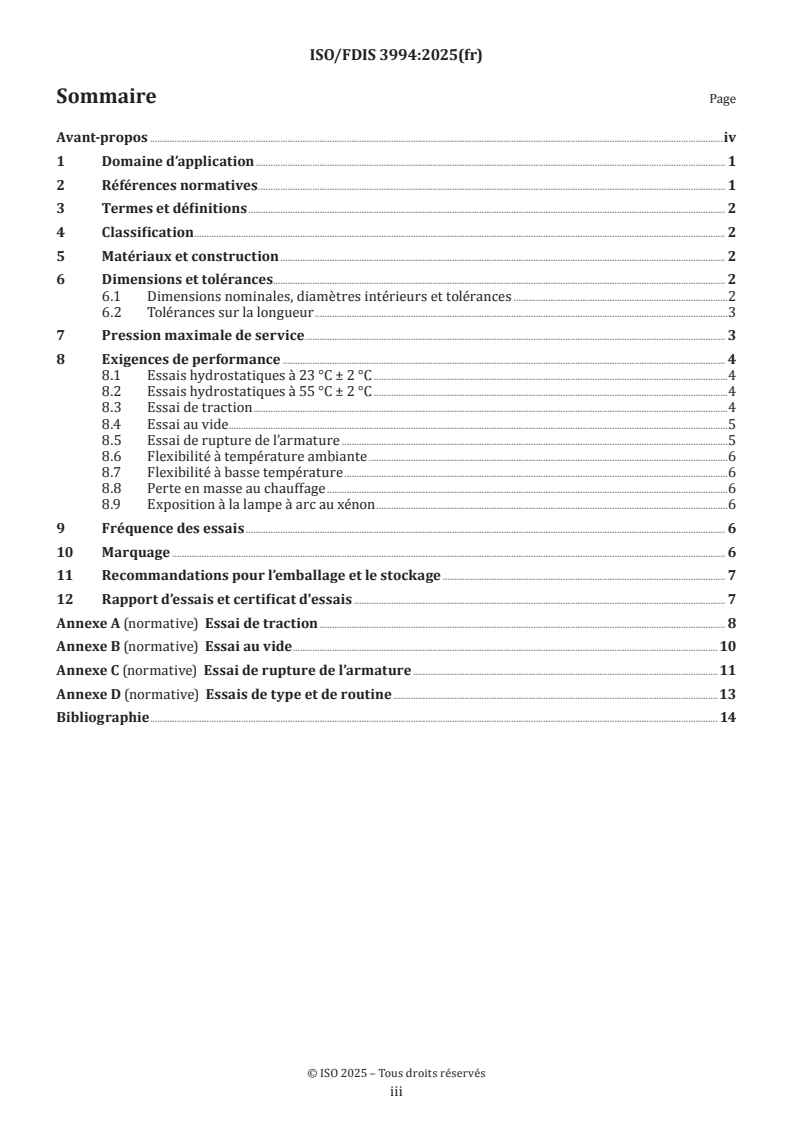
Sommaire Page
Avant-propos .iv
1 Domaine d’application . 1
2 Références normatives . 1
3 Termes et définitions . 2
4 Classification . 2
5 Matériaux et construction . 2
6 Dimensions et tolérances. 2
6.1 Dimensions nominales, diamètres intérieurs et tolérances .2
6.2 Tolérances sur la longueur .3
7 Pression maximale de service . 3
8 Exigences de performance . 4
8.1 Essais hydrostatiques à 23 °C ± 2 °C .4
8.2 Essais hydrostatiques à 55 °C ± 2 °C .4
8.3 Essai de traction .4
8.4 Essai au vide . .5
8.5 Essai de rupture de l’armature .5
8.6 Flexibilité à température ambiante .6
8.7 Flexibilité à basse température .6
8.8 Perte en masse au chauffage .6
8.9 Exposition à la lampe à arc au xénon .6
9 Fréquence des essais . 6
10 Marquage . 6
11 Recommandations pour l’emballage et le stockage . 7
12 Rapport d’essais et certificat d'essais . 7
Annexe A (normative) Essai de traction . 8
Annexe B (normative) Essai au vide . 10
Annexe C (normative) Essai de rupture de l’armature .11
Annexe D (normative) Essais de type et de routine .13
Bibliographie . 14
iii
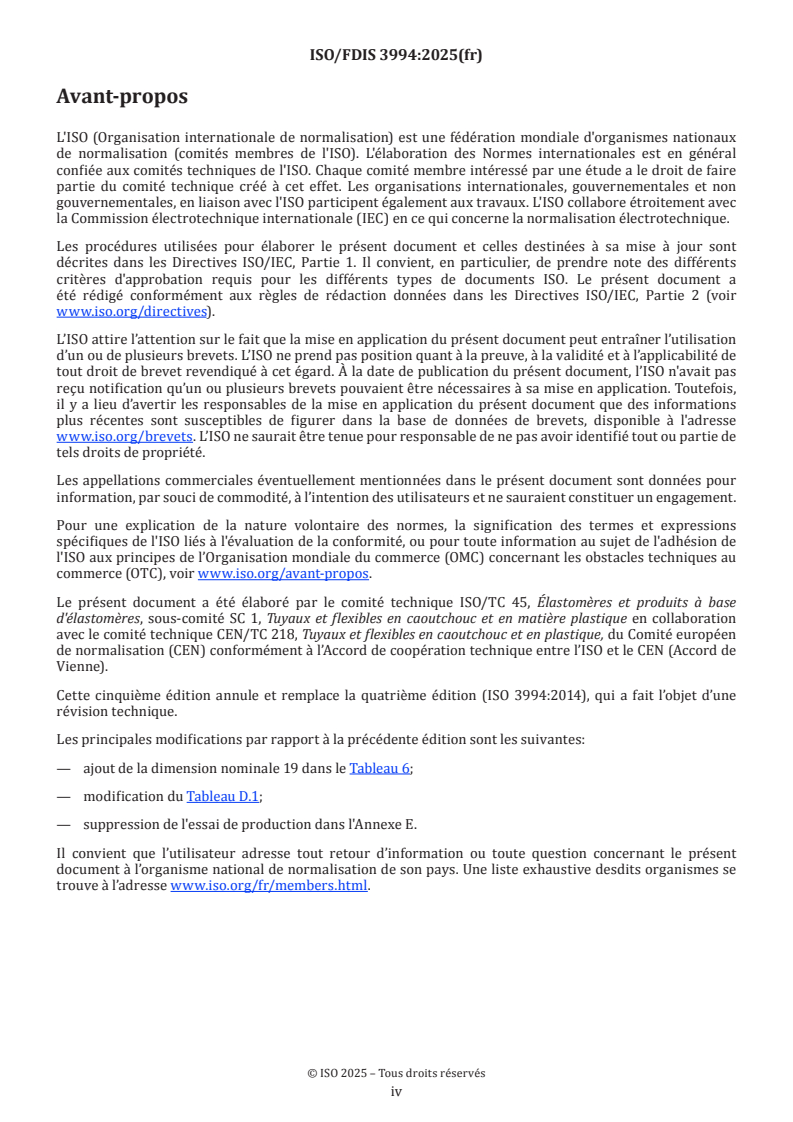
Avant-propos
L'ISO (Organisation internationale de normalisation) est une fédération mondiale d'organismes nationaux
de normalisation (comités membres de l'ISO). L'élaboration des Normes internationales est en général
confiée aux comités techniques de l'ISO. Chaque comité membre intéressé par une étude a le droit de faire
partie du comité technique créé à cet effet. Les organisations internationales, gouvernementales et non
gouvernementales, en liaison avec l'ISO participent également aux travaux. L'ISO collabore étroitement avec
la Commission électrotechnique internationale (IEC) en ce qui concerne la normalisation électrotechnique.
Les procédures utilisées pour élaborer le présent document et celles destinées à sa mise à jour sont
décrites dans les Directives ISO/IEC, Partie 1. Il convient, en particulier, de prendre note des différents
critères d'approbation requis pour les différents types de documents ISO. Le présent document a
été rédigé conformément aux règles de rédaction données dans les Directives ISO/IEC, Partie 2 (voir
www.iso.org/directives).
L’ISO attire l’attention sur le fait que la mise en application du présent document peut entraîner l’utilisation
d’un ou de plusieurs brevets. L’ISO ne prend pas position quant à la preuve, à la validité et à l’applicabilité de
tout droit de brevet revendiqué à cet égard. À la date de publication du présent document, l’ISO n'avait pas
reçu notification qu’un ou plusieurs brevets pouvaient être nécessaires à sa mise en application. Toutefois,
il y a lieu d’avertir les responsables de la mise en application du présent document que des informations
plus récentes sont susceptibles de figurer dans la base de données de brevets, disponible à l'adresse
www.iso.org/brevets. L’ISO ne saurait être tenue pour responsable de ne pas avoir identifié tout ou partie de
tels droits de propriété.
Les appellations commerciales éventuellement mentionnées dans le présent document sont données pour
information, par souci de commodité, à l’intention des utilisateurs et ne sauraient constituer un engagement.
Pour une explication de la nature volontaire des normes, la signification des termes et expressions
spécifiques de l'ISO liés à l'évaluation de la conformité, ou pour toute information au sujet de l'adhésion de
l'ISO aux principes de l’Organisation mondiale du commerce (OMC) concernant les obstacles techniques au
commerce (OTC), voir www.iso.org/avant-propos.
Le présent document a été élaboré par le comité technique ISO/TC 45, Élastomères et produits à base
d'élastomères, sous-comité SC 1, Tuyaux et flexibles en caoutchouc et en matière plastique en collaboration
avec le comité technique CEN/TC 218, Tuyaux et flexibles en caoutchouc et en plastique, du Comité européen
de normalisation (CEN) conformément à l’Accord de coopération technique entre l’ISO et le CEN (Accord de
Vienne).
Cette cinquième édition annule et remplace la quatrième édition (ISO 3994:2014), qui a fait l’objet d’une
révision technique.
Les principales modifications par rapport à la précédente édition sont les suivantes:
— ajout de la dimension nominale 19 dans le Tableau 6;
— modification du Tableau D.1;
— suppression de l'essai de production dans l'Annexe E.
Il convient que l’utilisateur adresse tout retour d’information ou toute question concernant le présent
document à l’organisme national de normalisation de son pays. Une liste exhaustive desdits organismes se
trouve à l’adresse www.iso.org/fr/members.html.
iv
PROJET FINAL Norme internationale ISO/FDIS 3994:2025(fr)
Tuyaux en plastiques — Tuyaux thermoplastiques à
renforcement thermoplastique en spirale pour aspiration et
refoulement de matières aqueuses — Spécifications
AVERTISSEMENT — Il convient que l’utilisateur du présent document connaisse bien les pratiques
courantes de laboratoire. Le présent document n’a pas pour but de traiter tous les problèmes
de sécurité qui sont, le cas échéant, liés à son utilisation. Il incombe à l’utilisateur du présent
document d’établir des pratiques appropriées en matière d’hygiène et de sécurité et de déterminer
l'applicabilité des conditions réglementaires avant toute utilisation.
1 Domaine d’application
Le présent document spécifie les exigences pour trois types de tuyaux thermoplastiques à renforcement
thermoplastique en spirale pour aspiration et refoulement d’eau, de solutions chimiques aqueuses peu
concentrées et de matières solides et boues abrasives pour utilisation dans la plage de températures
comprises entre −10 °C et +55 °C.
Le présent document ne spécifie pas les exigences pour les tuyaux pour utilisation avec des matériaux
inflammables ou combustibles, ni avec des solvants aromatiques.
2 Références normatives
Les documents suivants sont cités dans le texte de sorte qu’ils constituent, pour tout ou partie de leur
contenu, des exigences du présent document. Pour les références datées, seule l’édition citée s’applique. Pour
les références non datées, la dernière édition du document de référence s'applique (y compris les éventuels
amendements).
ISO 37, Caoutchouc vulcanisé ou thermoplastique — Détermination des caractéristiques de contrainte-
déformation en traction
ISO 176:2005, Matières plastiques — Détermination des pertes en plastifiants — Méthode au charbon actif
ISO 1307, Tuyaux en caoutchouc et en plastique — Dimensions des tuyaux, diamètres intérieurs minimaux et
maximaux, et tolérances sur la longueur de coupe
ISO 1402, Tuyaux et flexibles en caoutchouc et en plastique — Essais hydrostatiques
ISO 4671, Tuyaux et flexibles en caoutchouc et en plastique — Méthodes de mesurage des dimensions des tuyaux
et de la longueur des flexibles
ISO 8330, Tuyaux et flexibles en caoutchouc et en plastiques — Vocabulaire
ISO 10619-1, Tuyaux et tubes en caoutchouc et en plastique — Mesurage de la flexibilité et de la rigidité —
Partie 1: Essais de courbure à température ambiante
ISO 10619-2, Tuyaux et tubes en caoutchouc et en plastique — Mesurage de la flexibilité et de la rigidité —
Partie 2: Essais de courbure à des températures inférieures à l'ambiante
ISO 23529, Caoutchouc — Procédures générales pour la préparation et le conditionnement des éprouvettes pour
les méthodes d'essais physiques
ISO 30013:2011, Tuyaux en caoutchouc et en plastique — Méthodes d'exposition à des sources lumineuses de
laboratoire — Détermination du changement de coloration, d'aspect et d'autres propriétés physiques
3 Termes et définitions
Pour les besoins du présent document, les termes et définitions de l’ISO 8330 s’appliquent.
L’ISO et l’IEC tiennent à jour des bases de données terminologiques destinées à être utilisées en normalisation,
consultables aux adresses suivantes:
— ISO Online browsing platform: disponible à l’adresse https:// www .iso .org/ obp
— IEC Electropedia: disponible à l’adresse https:// www .electropedia .org/
4 Classification
Trois types de tuyaux sont spécifiés, en fonction de la pression maximale de service et de la pression
d’aspiration (voir les Tableaux 2 et 5).
— type 1: service léger;
— type 2: service normal;
— type 3: service lourd.
Tous les types sont conçus pour fonctionner dans la plage de températures ambiantes de −10 °C à 55 °C.
5 Matériaux et construction
Les tuyaux doivent être aussi uniformes que commercialement réalisables au niveau de la couleur et des
autres caractéristiques physiques. Ils doivent être constitués d’un matériau thermoplastique souple, soutenu
dans le matériau par une hélice en matériau thermoplastique de caractéristique de compatibilité similaire.
Les composants flexibles et de renforcement de la paroi doivent être fusionnés ensembles et être exempts
de craquelures visibles, de porosité, d’inclusions étrangères ou d’autres défauts susceptibles de causer une
défaillance des tuyaux en service.
NOTE Les tuyaux de construction similaire destinés à l'aspiration et au refoulement dans le
...
Questions, Comments and Discussion
Ask us and Technical Secretary will try to provide an answer. You can facilitate discussion about the standard in here.
Loading comments...