


ISO/IEC FDIS 15408-1
(Main)Information security, cybersecurity and privacy protection — Evaluation criteria for IT security — Part 1: Introduction and general model
Information security, cybersecurity and privacy protection — Evaluation criteria for IT security — Part 1: Introduction and general model
This document establishes the general concepts and principles of IT security evaluation and specifies the general model of evaluation given by various parts of the standard which in its entirety is meant to be used as the basis for evaluation of security properties of IT products. This document provides an overview of all parts of the ISO/IEC 15408 series. It describes the various parts of the ISO/IEC 15408 series; defines the terms and abbreviations to be used in all parts of the standard; establishes the core concept of a Target of Evaluation (TOE); describes the evaluation context and describes the audience to which the evaluation criteria is addressed. An introduction to the basic security concepts necessary for evaluation of IT products is given. This document introduces: — the key concepts of Protection Profiles (PP), PP-Modules, PP-Configurations, packages, Security Targets (ST), and conformance types; — a description of the organization of security components throughout the model; — the various operations by which the functional and assurance components given in ISO/IEC 15408‑2 and ISO/IEC 15408‑3 can be tailored through the use of permitted operations; — general information about the evaluation methods given in ISO/IEC 18045; — guidance for the application of ISO/IEC 15408‑4 in order to develop evaluation methods (EM) and evaluation activities (EA) derived from ISO/IEC 18045; — general information about the pre-defined Evaluation Assurance Levels (EALs) defined in ISO/IEC 15408‑5; — information in regard to the scope of evaluation schemes.
Sécurité de l'information, cybersécurité et protection de la vie privée — Critères d'évaluation pour la sécurité des technologies de l'information — Partie 1: Introduction et modèle général
General Information
- Status
- Not Published
- Current Stage
- 5020 - FDIS ballot initiated: 2 months. Proof sent to secretariat
- Start Date
- 19-Dec-2025
- Completion Date
- 19-Dec-2025
Relations
- Effective Date
- 09-Feb-2026
- Effective Date
- 12-Feb-2026
- Effective Date
- 28-Oct-2023
Overview
ISO/IEC FDIS 15408-1 (Part 1 of the ISO/IEC 15408 series) - commonly referenced in the Common Criteria ecosystem - defines the introduction and general model for IT security evaluation. It establishes core concepts, terminology and the evaluation paradigm used across the ISO/IEC 15408 family to assess the security properties of IT products and systems. Part 1 describes the Target of Evaluation (TOE), the evaluation context and the intended audience, and provides an overview of the other parts of the standard and related evaluation guidance.
Key topics and requirements
- Core concepts and terminology: definitions for TOE, assets, security controls, assurance and functional components used throughout the series.
- Protection Profiles (PP), PP‑Modules and PP‑Configurations: how reusable, modular PP artifacts are structured and combined.
- Security Targets (ST): the document format and expectations for claiming conformance to PPs or to parts of the standard.
- Conformance types: explanations of conformance claims (e.g., strict, demonstrable, exact) and how they affect evaluations.
- Security requirements specification: the Security Problem Definition (SPD), security objectives and security requirements derivation process.
- Security components and tailoring operations: organization of functional and assurance components and permitted operations for tailoring components from ISO/IEC 15408‑2 and ISO/IEC 15408‑3.
- Evaluation methods and activities: high‑level guidance on evaluation methods (EM) and evaluation activities (EA), with reference to ISO/IEC 18045 and ISO/IEC 15408‑4 for EM development.
- Evaluation Assurance Levels (EALs): overview of pre‑defined EALs (see ISO/IEC 15408‑5) and their role in assurance composition.
- Composition and multi‑assurance: models and techniques for composing assurance across components, packages and multi‑assurance contexts.
- Scope of evaluation schemes: roles, audience and evaluation context considerations.
Practical applications and users
Who benefits from ISO/IEC FDIS 15408-1:
- Product developers preparing Security Targets or designing products to meet Protection Profiles.
- Evaluators and certification bodies applying a consistent model for testing and assessment.
- Procurement officers and consumers (risk owners) specifying security requirements and interpreting conformance claims.
- Standards writers and technical working groups creating PPs, PP‑Modules or evaluation methods.
Practical uses:
- Structuring STs and PPs to support product certification.
- Choosing appropriate assurance levels and composition approaches for complex systems.
- Aligning evaluation activities with ISO/IEC 18045 guidance.
Related standards
- ISO/IEC 15408‑2 (functional components) and ISO/IEC 15408‑3 (assurance components)
- ISO/IEC 15408‑4 (evaluation methods development) and ISO/IEC 15408‑5 (EAL definitions)
- ISO/IEC 18045 (evaluation methods and evaluation activities)
ISO/IEC FDIS 15408-1 is foundational for IT security evaluation, helping stakeholders consistently define, claim and assess security and privacy properties in a standardized evaluation framework.

ISO/IEC FDIS 15408-1 - Information security, cybersecurity and privacy protection — Evaluation criteria for IT security — Part 1: Introduction and general model Released:12/5/2025

REDLINE ISO/IEC FDIS 15408-1 - Information security, cybersecurity and privacy protection — Evaluation criteria for IT security — Part 1: Introduction and general model Released:12/5/2025
ISO/IEC FDIS 15408-1 - Sécurité de l'information, cybersécurité et protection de la vie privée — Critères d'évaluation pour la sécurité des technologies de l'information — Partie 1: Introduction et modèle général Released:19. 01. 2026
Get Certified
Connect with accredited certification bodies for this standard

BSI Group
BSI (British Standards Institution) is the business standards company that helps organizations make excellence a habit.

Bureau Veritas
Bureau Veritas is a world leader in laboratory testing, inspection and certification services.

DNV
DNV is an independent assurance and risk management provider.
Sponsored listings
Frequently Asked Questions
ISO/IEC FDIS 15408-1 is a draft published by the International Organization for Standardization (ISO). Its full title is "Information security, cybersecurity and privacy protection — Evaluation criteria for IT security — Part 1: Introduction and general model". This standard covers: This document establishes the general concepts and principles of IT security evaluation and specifies the general model of evaluation given by various parts of the standard which in its entirety is meant to be used as the basis for evaluation of security properties of IT products. This document provides an overview of all parts of the ISO/IEC 15408 series. It describes the various parts of the ISO/IEC 15408 series; defines the terms and abbreviations to be used in all parts of the standard; establishes the core concept of a Target of Evaluation (TOE); describes the evaluation context and describes the audience to which the evaluation criteria is addressed. An introduction to the basic security concepts necessary for evaluation of IT products is given. This document introduces: — the key concepts of Protection Profiles (PP), PP-Modules, PP-Configurations, packages, Security Targets (ST), and conformance types; — a description of the organization of security components throughout the model; — the various operations by which the functional and assurance components given in ISO/IEC 15408‑2 and ISO/IEC 15408‑3 can be tailored through the use of permitted operations; — general information about the evaluation methods given in ISO/IEC 18045; — guidance for the application of ISO/IEC 15408‑4 in order to develop evaluation methods (EM) and evaluation activities (EA) derived from ISO/IEC 18045; — general information about the pre-defined Evaluation Assurance Levels (EALs) defined in ISO/IEC 15408‑5; — information in regard to the scope of evaluation schemes.
This document establishes the general concepts and principles of IT security evaluation and specifies the general model of evaluation given by various parts of the standard which in its entirety is meant to be used as the basis for evaluation of security properties of IT products. This document provides an overview of all parts of the ISO/IEC 15408 series. It describes the various parts of the ISO/IEC 15408 series; defines the terms and abbreviations to be used in all parts of the standard; establishes the core concept of a Target of Evaluation (TOE); describes the evaluation context and describes the audience to which the evaluation criteria is addressed. An introduction to the basic security concepts necessary for evaluation of IT products is given. This document introduces: — the key concepts of Protection Profiles (PP), PP-Modules, PP-Configurations, packages, Security Targets (ST), and conformance types; — a description of the organization of security components throughout the model; — the various operations by which the functional and assurance components given in ISO/IEC 15408‑2 and ISO/IEC 15408‑3 can be tailored through the use of permitted operations; — general information about the evaluation methods given in ISO/IEC 18045; — guidance for the application of ISO/IEC 15408‑4 in order to develop evaluation methods (EM) and evaluation activities (EA) derived from ISO/IEC 18045; — general information about the pre-defined Evaluation Assurance Levels (EALs) defined in ISO/IEC 15408‑5; — information in regard to the scope of evaluation schemes.
ISO/IEC FDIS 15408-1 is classified under the following ICS (International Classification for Standards) categories: 35.030 - IT Security. The ICS classification helps identify the subject area and facilitates finding related standards.
ISO/IEC FDIS 15408-1 has the following relationships with other standards: It is inter standard links to EN ISO/IEC 19896-3:2025, FprEN ISO/IEC 15408-1, ISO/IEC 15408-1:2022. Understanding these relationships helps ensure you are using the most current and applicable version of the standard.
ISO/IEC FDIS 15408-1 is available in PDF format for immediate download after purchase. The document can be added to your cart and obtained through the secure checkout process. Digital delivery ensures instant access to the complete standard document.
Standards Content (Sample)
FINAL DRAFT
International
Standard
ISO/IEC
FDIS
15408-1
ISO/IEC JTC 1/SC 27
Information security, cybersecurity
Secretariat: DIN
and privacy protection —
Voting begins on:
Evaluation criteria for IT security —
2025-12-19
Part 1:
Voting terminates on:
2026-02-13
Introduction and general model
Sécurité de l'information, cybersécurité et protection de la vie
privée — Critères d'évaluation pour la sécurité des technologies
de l'information —
Partie 1: Introduction et modèle général
RECIPIENTS OF THIS DRAFT ARE INVITED TO SUBMIT,
WITH THEIR COMMENTS, NOTIFICATION OF ANY
RELEVANT PATENT RIGHTS OF WHICH THEY ARE AWARE
AND TO PROVIDE SUPPOR TING DOCUMENTATION.
IN ADDITION TO THEIR EVALUATION AS
BEING ACCEPTABLE FOR INDUSTRIAL, TECHNO
ISO/CEN PARALLEL PROCESSING LOGICAL, COMMERCIAL AND USER PURPOSES, DRAFT
INTERNATIONAL STANDARDS MAY ON OCCASION HAVE
TO BE CONSIDERED IN THE LIGHT OF THEIR POTENTIAL
TO BECOME STAN DARDS TO WHICH REFERENCE MAY BE
MADE IN NATIONAL REGULATIONS.
Reference number
ISO/IEC FDIS 154081:2025(en) © ISO/IEC 2025
FINAL DRAFT
International
Standard
ISO/IEC
FDIS
15408-1
ISO/IEC JTC 1/SC 27
Information security, cybersecurity
Secretariat: DIN
and privacy protection —
Voting begins on:
Evaluation criteria for IT security —
Part 1:
Voting terminates on:
Introduction and general model
Sécurité de l'information, cybersécurité et protection de la vie
privée — Critères d'évaluation pour la sécurité des technologies
de l'information —
Partie 1: Introduction et modèle général
RECIPIENTS OF THIS DRAFT ARE INVITED TO SUBMIT,
WITH THEIR COMMENTS, NOTIFICATION OF ANY
RELEVANT PATENT RIGHTS OF WHICH THEY ARE AWARE
AND TO PROVIDE SUPPOR TING DOCUMENTATION.
© ISO/IEC 2025
IN ADDITION TO THEIR EVALUATION AS
All rights reserved. Unless otherwise specified, or required in the context of its implementation, no part of this publication may
BEING ACCEPTABLE FOR INDUSTRIAL, TECHNO
ISO/CEN PARALLEL PROCESSING
LOGICAL, COMMERCIAL AND USER PURPOSES, DRAFT
be reproduced or utilized otherwise in any form or by any means, electronic or mechanical, including photocopying, or posting on
INTERNATIONAL STANDARDS MAY ON OCCASION HAVE
the internet or an intranet, without prior written permission. Permission can be requested from either ISO at the address below
TO BE CONSIDERED IN THE LIGHT OF THEIR POTENTIAL
or ISO’s member body in the country of the requester.
TO BECOME STAN DARDS TO WHICH REFERENCE MAY BE
MADE IN NATIONAL REGULATIONS.
ISO copyright office
CP 401 • Ch. de Blandonnet 8
CH-1214 Vernier, Geneva
Phone: +41 22 749 01 11
Email: copyright@iso.org
Website: www.iso.org
Published in Switzerland Reference number
ISO/IEC FDIS 154081:2025(en) © ISO/IEC 2025
© ISO/IEC 2025 – All rights reserved
ii
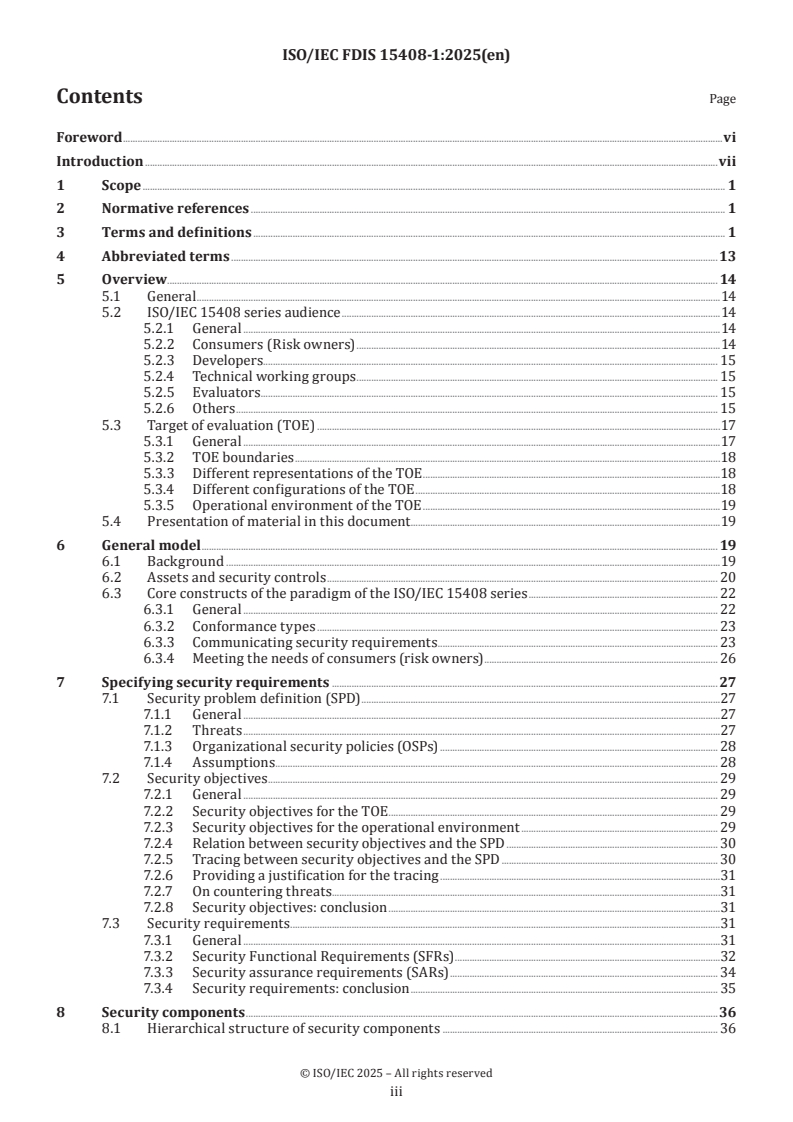
Contents Page
Foreword .vi
Introduction .vii
1 Scope . 1
2 Normative references . 1
3 Terms and definitions . 1
4 Abbreviated terms .13
5 Overview . 14
5.1 General .14
5.2 ISO/IEC 15408 series audience .14
5.2.1 General .14
5.2.2 Consumers (Risk owners) .14
5.2.3 Developers. 15
5.2.4 Technical working groups . 15
5.2.5 Evaluators. 15
5.2.6 Others . 15
5.3 Target of evaluation (TOE) .17
5.3.1 General .17
5.3.2 TOE boundaries .18
5.3.3 Different representations of the TOE .18
5.3.4 Different configurations of the TOE .18
5.3.5 Operational environment of the TOE .19
5.4 Presentation of material in this document .19
6 General model . 19
6.1 Background .19
6.2 Assets and security controls . 20
6.3 Core constructs of the paradigm of the ISO/IEC 15408 series . 22
6.3.1 General . 22
6.3.2 Conformance types . 23
6.3.3 Communicating security requirements. 23
6.3.4 Meeting the needs of consumers (risk owners) . 26
7 Specifying security requirements .27
7.1 Security problem definition (SPD) .27
7.1.1 General .27
7.1.2 Threats .27
7.1.3 Organizational security policies (OSPs) . 28
7.1.4 Assumptions . 28
7.2 Security objectives . 29
7.2.1 General . 29
7.2.2 Security objectives for the TOE . 29
7.2.3 Security objectives for the operational environment . 29
7.2.4 Relation between security objectives and the SPD . 30
7.2.5 Tracing between security objectives and the SPD . 30
7.2.6 Providing a justification for the tracing .31
7.2.7 On countering threats.31
7.2.8 Security objectives: conclusion .31
7.3 Security requirements . .31
7.3.1 General .31
7.3.2 Security Functional Requirements (SFRs) .32
7.3.3 Security assurance requirements (SARs) . 34
7.3.4 Security requirements: conclusion . 35
8 Security components .36
8.1 Hierarchical structure of security components . 36
© ISO/IEC 2025 – All rights reserved
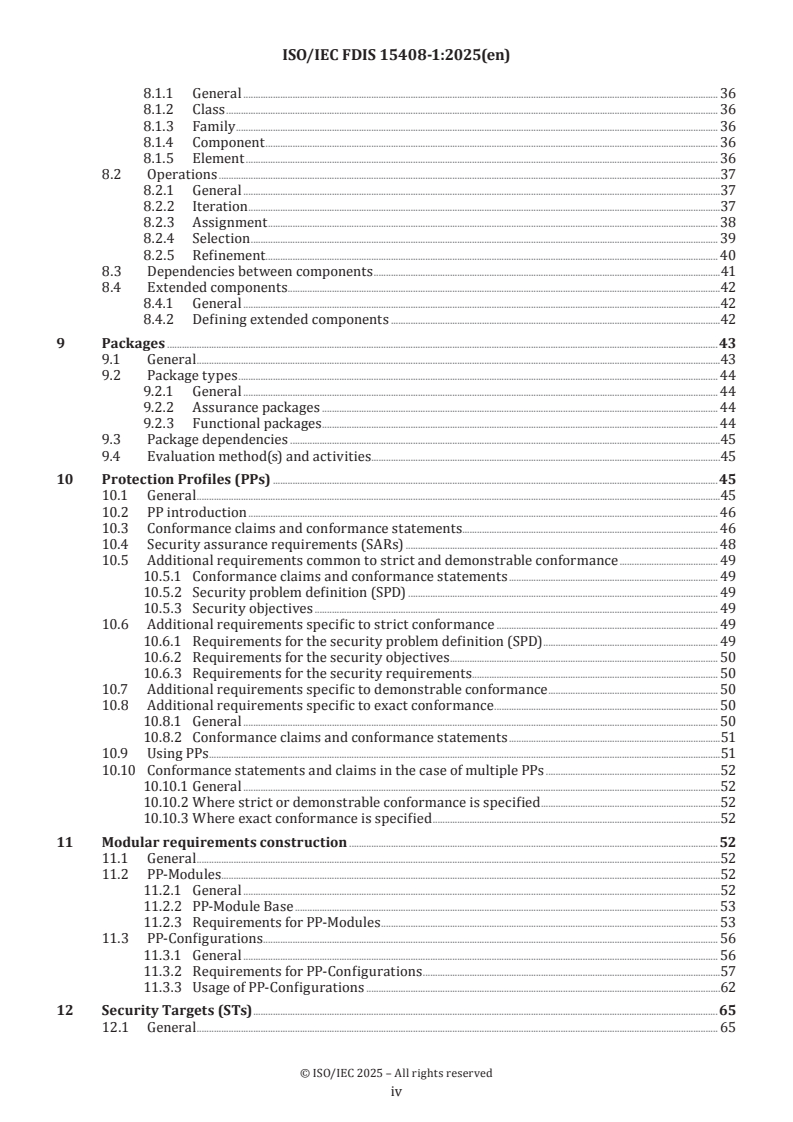
iii
8.1.1 General . 36
8.1.2 Class . 36
8.1.3 Family . 36
8.1.4 Component . 36
8.1.5 Element . 36
8.2 Operations .37
8.2.1 General .37
8.2.2 Iteration .37
8.2.3 Assignment . 38
8.2.4 Selection . 39
8.2.5 Refinement . . 40
8.3 Dependencies between components .41
8.4 Extended components.42
8.4.1 General .42
8.4.2 Defining extended components .42
9 Packages .43
9.1 General .43
9.2 Package types . 44
9.2.1 General . 44
9.2.2 Assurance packages . 44
9.2.3 Functional packages . 44
9.3 Package dependencies .45
9.4 Evaluation method(s) and activities.45
10 Protection Profiles (PPs) .45
10.1 General .45
10.2 PP introduction . 46
10.3 Conformance claims and conformance statements. 46
10.4 Security assurance requirements (SARs) . 48
10.5 Additional requirements common to strict and demonstrable conformance . 49
10.5.1 Conformance claims and conformance statements . 49
10.5.2 Security problem definition (SPD) . 49
10.5.3 Security objectives . 49
10.6 Additional requirements specific to strict conformance . 49
10.6.1 Requirements for the security problem definition (SPD) . 49
10.6.2 Requirements for the security objectives . 50
10.6.3 Requirements for the security requirements . . 50
10.7 Additional requirements specific to demonstrable conformance . 50
10.8 Additional requirements specific to exact conformance . 50
10.8.1 General . 50
10.8.2 Conformance claims and conformance statements .51
10.9 Using PPs .51
10.10 Conformance statements and claims in the case of multiple PPs .52
10.10.1 General .52
10.10.2 Where strict or demonstrable conformance is specified .52
10.10.3 Where exact conformance is specified .52
11 Modular requirements construction .52
11.1 General .52
11.2 PP-Modules.52
11.2.1 General .52
11.2.2 PP-Module Base . 53
11.2.3 Requirements for PP-Modules . 53
11.3 PP-Configurations . . 56
11.3.1 General . 56
11.3.2 Requirements for PP-Configurations .57
11.3.3 Usage of PP-Configurations .62
12 Security Targets (STs) .65
12.1 General . 65
© ISO/IEC 2025 – All rights reserved
iv
12.2 Conformance claims and conformance statements. 66
12.3 Assurance requirements . 68
12.4 Additional requirements in the exact conformance case . 69
12.4.1 Additional requirements for the conformance claim . 69
12.4.2 Additional requirements for the SPD . 69
12.4.3 Additional requirements for the security objectives. 69
12.4.4 Additional requirements for the security requirements . 69
12.5 Additional requirements in the multi-assurance case .70
13 Evaluation and evaluation results .71
13.1 General .71
13.2 Evaluation context . 73
13.3 Evaluation of PPs and PP-Configurations .74
13.4 Evaluation of STs .74
13.5 Evaluation of TOEs .74
13.6 Evaluation methods and evaluation activities . 75
13.7 Evaluation results . 75
13.7.1 Results of a PP evaluation . 75
13.7.2 Results of a PP-Configuration evaluation . 75
13.7.3 Results of an ST/TOE evaluation. 75
13.8 Multi-assurance evaluation .76
14 Composition of assurance .77
14.1 General . 77
14.2 Composition models . 77
14.2.1 Layered composition model . 77
14.2.2 Network or bi-directional composition model . 78
14.2.3 Embedded composition model . 79
14.3 Evaluation techniques for providing assurance in composition models . 80
14.3.1 General . 80
14.3.2 ACO class for composed TOEs . 80
14.3.3 Composite evaluation for composite products . 81
14.4 Requirements for evaluations using composition techniques .91
14.4.1 Re-use of evaluation results .91
14.4.2 Composition evaluation issues . 92
14.5 Evaluation by composition and multi-assurance. 93
Annex A (normative) Specification of packages .94
Annex B (normative) Specification of Protection Profiles (PPs) .98
Annex C (normative) Specification of PP-Modules and PP-Configurations .108
Annex D (normative) Specification of Security Targets (STs) and direct rationale STs .122
Annex E (normative) PP/PP-Configuration conformance .133
Bibliography .138
© ISO/IEC 2025 – All rights reserved
v
Foreword
ISO (the International Organization for Standardization) and IEC (the International Electrotechnical
Commission) form the specialized system for worldwide standardization. National bodies that are
members of ISO or IEC participate in the development of International Standards through technical
committees established by the respective organization to deal with particular fields of technical activity.
ISO and IEC technical committees collaborate in fields of mutual interest. Other international organizations,
governmental and non-governmental, in liaison with ISO and IEC, also take part in the work.
The procedures used to develop this document and those intended for its further maintenance are described
in the ISO/IEC Directives, Part 1. In particular, the different approval criteria needed for the different types
of document should be noted. This document was drafted in accordance with the editorial rules of the ISO/
IEC Directives, Part 2 (see www.iso.org/directives or www.iec.ch/members_experts/refdocs).
ISO and IEC draw attention to the possibility that the implementation of this document may involve the
use of (a) patent(s). ISO and IEC take no position concerning the evidence, validity or applicability of any
claimed patent rights in respect thereof. As of the date of publication of this document, ISO and IEC had not
received notice of (a) patent(s) which may be required to implement this document. However, implementers
are cautioned that this may not represent the latest information, which may be obtained from the patent
database available at www.iso.org/patents and https://patents.iec.ch. ISO and IEC shall not be held
responsible for identifying any or all such patent rights.
Any trade name used in this document is information given for the convenience of users and does not
constitute an endorsement.
For an explanation of the voluntary nature of standards, the meaning of ISO specific terms and expressions
related to conformity assessment, as well as information about ISO's adherence to the World Trade
Organization (WTO) principles in the Technical Barriers to Trade (TBT) see www.iso.org/iso/foreword.html.
In the IEC, see www.iec.ch/understanding-standards.
This document was prepared by Joint Technical Committee ISO/IEC JTC 1, Information technology,
Subcommittee SC 27, Information security, cybersecurity and privacy protection, in collaboration with the
European Committee for Standardization (CEN) Technical Committee CEN/CLC/JTC 13, Cybersecurity and
data protection, in accordance with the Agreement on technical cooperation between ISO and CEN (Vienna
Agreement).
This fifth edition cancels and replaces the fourth edition (ISO/IEC 15408-1:2022), which has been technically
revised.
The main changes are as follows:
— the terminology has been reviewed and updated;
— the package conformance claim for Security Targets, Protection Profiles and PP-Modules, respectively,
has been reviewed and aligned with ISO/IEC 18045;
— the specification of multiple PP-Modules Bases has been improved for accuracy;
— corrections of mistakes.
A list of all parts in the ISO/IEC 15408 series can be found on the ISO and IEC websites.
Any feedback or questions on this document should be directed to the user’s national standards
body. A complete listing of these bodies can be found at www.iso.org/members.html and
www.iec.ch/national-committees.
© ISO/IEC 2025 – All rights reserved
vi
Introduction
The ISO/IEC 15408 series permits comparability between the results of independent security evaluations
by providing a common set of requirements for the security functionality of IT products and for assurance
measures applied to these IT products during a security evaluation. These IT products may be implemented
in hardware, firmware, or software.
The evaluation process establishes a level of confidence that the security functionality of these IT products
and the assurance applied to these IT products meet relevant requirements.
The evaluation results can help consumers to determine whether these IT products fulfil their security
needs.
The ISO/IEC 15408 series is useful as a guide for the development, evaluation or procurement of IT products
with security functionality.
The ISO/IEC 15408 series is intentionally flexible, enabling a range of evaluation approaches to be applied to
a range of security properties of a range of IT products. Therefore, users of this document are recommended
to ensure that this flexibility is not misused. For example, using the ISO/IEC 15408 series in conjunction
with unsuitable evaluation methods/activities, irrelevant security properties, or inappropriate IT products,
can result in meaningless evaluation results.
Consequently, the fact that an IT product has been evaluated has meaning only in the context of the security
properties that were evaluated and the evaluation methods that were used. Evaluation authorities are
advised to carefully check the products, properties, and methods to determine that an evaluation provides
meaningful results. Additionally, purchasers of evaluated products are advised to carefully consider this
context to determine whether the evaluated product is useful and applicable to their specific situation and
needs.
The ISO/IEC 15408 series addresses the protection of assets from unauthorized disclosure, modification,
or loss of use. The categories of protection relating to these three types of failure of security are commonly
called confidentiality, integrity and availability. The ISO/IEC 15408 series can also be applicable to aspects
of IT security outside of these three categories. The ISO/IEC 15408 series is applicable to risks arising from
human activities (malicious or otherwise) and to risks arising from non-human activities. The ISO/IEC 15408
series may be applied in other areas of IT but makes no claim of applicability in these areas.
The ISO/IEC 15408 series is presented as a set of distinct but related parts as identified below.
a) ISO/IEC 15408-1 is the introduction to the ISO/IEC 15408 series. It defines the general concepts and
principles of IT security evaluation and presents a general model of evaluation.
b) ISO/IEC 15408-2 establishes a set of functional components that serve as standard templates upon which
security functional requirements (SFRs) for Target of Evaluations (TOEs) are based. ISO/IEC 15408-2
catalogues the set of security functional components and organizes them into families and classes.
c) ISO/IEC 15408-3 establishes a set of assurance components that serve as standard templates upon
which security assurance requirements for TOEs are based. ISO/IEC 15408-3 catalogues the set of
security assurance components and organizes them into families and classes. ISO/IEC 15408-3 also
defines evaluation criteria for PPs, STs and TOEs.
d) ISO/IEC 15408-4 provides a standardized framework for the specification of evaluation methods and
activities that may be included in PPs, STs and any documents supporting them, to be used by evaluators
in support of evaluations using the model described in the other parts of the ISO/IEC 15408 series.
ISO/IEC 18045 is fundamental to ISO/IEC 15408-4.
e) ISO/IEC 15408-5 provides packages of security assurance and SFRs that have been identified as useful
in support of common usage by stakeholders. Examples of provided packages include the evaluation
assurance levels (EAL) and the composed assurance packages (CAPs).
NOTE 1 ISO/IEC 18045 provides the baseline methodology for IT security evaluations performed in accordance
with the ISO/IEC 15408 series.
© ISO/IEC 2025 – All rights reserved
vii
Certain topics, which involve specialized techniques or are somewhat peripheral to IT security, are
considered to be outside the scope of the ISO/IEC 15408 series. The following list of topics are not covered
by the ISO/IEC 15408 series:
f) security evaluation criteria pertaining to administrative security measures not related directly to the IT
security functionality. However, it is recognized that significant security can often be achieved through
or supported by administrative measures such as organizational, personnel, physical, and procedural
controls;
g) the evaluation methodology under which the criteria should be applied;
NOTE 2 The baseline methodology is defined in ISO/IEC 18045. ISO/IEC 15408-4 can be used to further derive
evaluation activities and methods from ISO/IEC 18045.
h) administrative and legal framework under which the criteria can be applied by evaluation authorities.
However, it is expected that the ISO/IEC 15408 series is intended to be used for evaluation purposes in
the context of such a framework;
i) the procedures for use of evaluation results in accreditation. Accreditation is the administrative
process whereby authority is granted for the operation of an IT product (or collection thereof) in its
full operational environment including all of its non-IT parts. The results of the evaluation process
are an input to the accreditation process. However, as other techniques are more appropriate for the
assessments of non-IT related properties and their relationship to the IT security parts, accreditors
shall make separate provisions for those aspects;
j) the subject of criteria for the assessment of the inherent qualities of cryptographic algorithms. In the case
that independent assessment of mathematical properties of cryptography is required, the evaluation
scheme under which the ISO/IEC 15408 series is applied can make provision for such assessments.
This document introduces:
— the key concepts of Protection Profiles (PP), PP-Modules, PP-Configurations, packages, Security Targets
(ST), and conformance types;
— a description of the organization of security components throughout the model;
— the various operations by which the functional and assurance components given in ISO/IEC 15408-2 and
ISO/IEC 15408-3 can be tailored through the use of permitted operations;
— general information about the evaluation methods given in ISO/IEC 18045;
— guidance for the application of ISO/IEC 15408-4 in order to develop evaluation methods (EM) and
evaluation activities (EA) derived from ISO/IEC 18045;
— general information about the pre-defined Evaluation Assurance Levels (EALs) defined in
ISO/IEC 15408-5;
— information regarding the scope of evaluation schemes.
The following text appears in other parts of the ISO/IEC 15408 series and in ISO/IEC 18045 to describe the
use of bold and italic type in those documents. This document may use those conventions only in examples,
but the notes have been retained for alignment with the rest of the series.
Bold type is used to highlight hierarchical relationships between requirements. This convention calls for the
use of bold type for all new requirements.
For security functional requirements, the use of italics denotes assignment and selection items.
For security assurance requirements, special verbs relating to mandatory evaluation activities are presented
in bold italic type face.
© ISO/IEC 2025 – All rights reserved
viii
FINAL DRAFT International Standard ISO/IEC FDIS 15408-1:2025(en)
Information security, cybersecurity and privacy protection —
Evaluation criteria for IT security —
Part 1:
Introduction and general model
1 Scope
This document establishes the general concepts and principles of information technology (IT) security
evaluation. It specifies the general model of evaluation given in this document, which in its entirety is
intended to be used as the basis for evaluation of security properties of IT products.
This document provides an overview of all parts of the ISO/IEC 15408 series. It describes the various parts
of the ISO/IEC 15408 series i.e.
— defines the terms and abbreviations used in all parts of the series; establishes the core concept of a
Target of Evaluation (TOE);
— describes the evaluation context; and
— describes the audience to which the evaluation criteria is addressed.
Additionally, this document introduces the basic security concepts necessary for the evaluation of IT
products.
2 Normative references
The following documents are referred to in the text in such a way that some or all of their content constitutes
requirements of this document. For dated references, only the edition cited applies. For undated references,
the latest edition of the referenced document (including any amendments) applies.
1)
ISO/IEC 15408-2:— , Information security, cybersecurity and privacy protection — Evaluation criteria for IT
security — Part 2: Security functional components
2)
ISO/IEC 15408-3:— , Information security, cybersecurity and privacy protection — Evaluation criteria for IT
security — Part 3: Security assurance components
ISO/IEC 18045, Information security, cybersecurity and privacy protection — Evaluation criteria for IT security
— Methodology for IT security evaluation
ISO/IEC IEEE 24765:2017, Systems and software engineering — Vocabulary
3 Terms and definitions
For the purposes of this document, the terms and definitions given in ISO/IEC 15408-2, ISO/IEC 15408-3,
ISO/IEC 18045 and ISO/IEC IEEE 24765 and the following apply.
1) Under prepa
...
Formatted
...
Style Definition
...
Style Definition
...
Style Definition
...
Style Definition
...
Style Definition
Style Definition
...
ISO/IEC JTC 1/SC 27
Style Definition
...
Style Definition
...
Secretariat: DIN
Style Definition
...
Date: 2025-07-0112-04
Style Definition
...
Style Definition
...
Style Definition
...
Style Definition
...
Style Definition
...
Style Definition
...
Style Definition
...
Information security, cybersecurity and privacy protection —
Style Definition
...
Evaluation criteria for IT security — —
Style Definition
...
Style Definition
...
Style Definition
...
Style Definition
...
Style Definition
...
Style Definition
...
Part 1:
Style Definition
...
Introduction and general model
Style Definition
...
Style Definition
...
Sécurité de l'information, cybersécurité et protection de la vie privée — Critères d'évaluation pour la sécurité
Style Definition
...
des technologies de l'information — —
Style Definition
...
Partie 1: Introduction et modèle général Style Definition
...
Style Definition
...
Style Definition
...
Style Definition
...
Style Definition
...
Style Definition
...
Style Definition
...
Style Definition
...
Style Definition
...
Style Definition
...
Style Definition
...
TTTTTThhhhhhiiiiiissssss d d d d d drrrrrraftaftaftaftaftaft i i i i i issssss s s s s s suuuuuubbbbbbmmmmmmiiiiiittttttttttttedededededed t t t t t toooooo a pa pa pa pa pa pararararararallel vallel vallel vallel vallel vallel vooooootttttte e e e e e iiiiiinnnnnn I I I I I ISSSSSSOOOOOO,,,,,, C C C C C CEEEEEENNNNNN.
Style Definition
...
Style Definition
...
Style Definition
...
Style Definition
...
Style Definition
...
Style Definition
...
Style Definition
...
Style Definition
...
Style Definition
...
Style Definition
...
Style Definition
...
Style Definition
...
Style Definition
...
Style Definition
...
Style Definition
...
Style Definition
...
Style Definition
...
Style Definition
...
Style Definition
...
Style Definition
...
Style Definition
...
Style Definition
...
Style Definition
...
Style Definition
...
Formatted
FDIS stage
Font: 11 pt
Formatted:
Formatted: Space Before: 0 pt, Line spacing: single, Tab
stops: Not at 17.2 cm
2 © ISO/IEC 2024 – All rights reserved
HeaderCentered
Formatted:
© ISO/IEC 20242025
Formatted: Default Paragraph Font
All rights reserved. Unless otherwise specified, or required in the context of its implementation, no part of this publication
may be reproduced or utilized otherwise in any form or by any means, electronic or mechanical, including photocopying,
or posting on the internet or an intranet, without prior written permission. Permission can be requested from either ISO
at the address below or ISO’s member body in the country of the requester.
ISO copyright office
CP 401 • Ch. de Blandonnet 8
CH-1214 Vernier, Geneva
Phone: + 41 22 749 01 11
EmailE-mail: copyright@iso.org
Formatted: German (Germany)
Website: www.iso.orgwww.iso.org
Published in Switzerland
Formatted: English (United Kingdom)
Formatted: Font: 11 pt
Formatted: FooterPageRomanNumber, Space Before: 0 pt,
Line spacing: single, Tab stops: Not at 17.2 cm
2 © ISO/IEC 2024 – All rights reserved
© ISO/IEC 2025 – All rights reserved
ii
Font: 11 pt, Bold
Formatted:
Formatted: Font: Bold
Contents
Formatted: HeaderCentered, Left
Formatted: Adjust space between Latin and Asian text,
Adjust space between Asian text and numbers
Foreword . xii
Introduction . xiv
1 Scope . 1
2 Normative references . 1
3 Terms and definitions . 2
4 Abbreviated terms . 14
5 Overview . 16
5.1 General. 16
5.2 ISO/IEC 15408 series audience . 16
5.3 Target of evaluation (TOE) . 19
5.4 Presentation of material in this document . 21
6 General model . 22
6.1 Background . 22
6.2 Assets and security controls . 22
6.3 Core constructs of the paradigm of the ISO/IEC 15408 series. 26
7 Specifying security requirements . 32
7.1 Security problem definition (SPD) . 32
7.2 Security objectives. 34
7.3 Security requirements . 37
8 Security components . 42
8.1 Hierarchical structure of security components . 42
8.2 Operations . 43
8.3 Dependencies between components . 49
8.4 Extended components . 50
9 Packages . 51
9.1 General. 51
9.2 Package types . 51
9.3 Package dependencies . 53
9.4 Evaluation method(s) and activities . 53
10 Protection Profiles (PPs) . 53
10.1 General. 53
10.2 PP introduction . 54
10.3 Conformance claims and conformance statements. 54
10.4 Security assurance requirements (SARs) . 57
10.5 Additional requirements common to strict and demonstrable conformance . 57
10.6 Additional requirements specific to strict conformance . 58
10.7 Additional requirements specific to demonstrable conformance . 59
10.8 Additional requirements specific to exact conformance. 59
10.9 Using PPs . 60
10.10 Conformance statements and claims in the case of multiple PPs . 60
11 Modular requirements construction . 61
Formatted: Font: 10 pt
11.1 General. 61
Formatted: FooterCentered, Left, Space Before: 0 pt, Tab
11.2 PP-Modules . 61
stops: Not at 17.2 cm
11.3 PP-Configurations . 66
Formatted: Font: 11 pt
12 Security Targets (STs) . 79
FooterPageRomanNumber, Left, Space After: 0
Formatted:
12.1 General. 79
pt, Tab stops: Not at 17.2 cm
© ISO/IEC 2025 – All rights reserved
iii
HeaderCentered
Formatted:
12.2 Conformance claims and conformance statements. 80
12.3 Assurance requirements . 83
12.4 Additional requirements in the exact conformance case . 83
12.5 Additional requirements in the multi-assurance case . 84
13 Evaluation and evaluation results . 88
13.1 General. 88
13.2 Evaluation context . 92
13.3 Evaluation of PPs and PP-Configurations. 93
13.4 Evaluation of STs . 93
13.5 Evaluation of TOEs . 93
13.6 Evaluation methods and evaluation activities . 94
13.7 Evaluation results . 94
13.8 Multi-assurance evaluation . 95
14 Composition of assurance . 96
14.1 General. 96
14.2 Composition models . 97
14.3 Evaluation techniques for providing assurance in composition models . 100
14.4 Requirements for evaluations using composition techniques . 115
14.5 Evaluation by composition and multi-assurance . 116
Annex A (normative) Specification of packages . 118
Annex B (normative) Specification of Protection Profiles (PPs) . 124
Annex C (normative) Specification of PP-Modules and PP-Configurations . 137
Annex D (normative) Specification of Security Targets (STs) and direct rationale STs . 156
Annex E (normative) PP/PP-Configuration conformance . 171
Bibliography . 179
Spis treści
Foreword . xi
Introduction . xiii
1 Scope . 1
2 Normative references . 1
3 Terms and definitions . 2
4 Abbreviated terms .14
5 Overview .16
5.1 General.16
5.2 ISO/IEC 15408 series audience .16
5.2.1 General.16
5.2.2 Consumers (Risk owners) .16
5.2.3 Developers.16
5.2.4 Technical working groups .16
5.2.5 Evaluators .16
Formatted: Font: 11 pt
5.2.6 Others .17
Formatted: FooterPageRomanNumber, Space Before: 0 pt,
5.3 Target of evaluation (TOE) .19
Line spacing: single, Tab stops: Not at 17.2 cm
4 © ISO/IEC 2024 – All rights reserved
© ISO/IEC 2025 – All rights reserved
iv
Font: 11 pt, Bold
Formatted:
Formatted: Font: Bold
5.3.1 General.19
Formatted: HeaderCentered, Left
5.3.2 TOE boundaries .20
5.3.3 Different representations of the TOE .20
5.3.4 Different configurations of the TOE .20
5.3.5 Operational environment of the TOE .21
5.4 Presentation of material in this document .21
6 General model.22
6.1 Background .22
6.2 Assets and security controls .22
6.3 Core constructs of the paradigm of the ISO/IEC 15408 series.25
6.3.1 General.25
6.3.2 Conformance types .25
6.3.3 Communicating security requirements .25
6.3.4 Meeting the needs of consumers (risk owners) .28
7 Specifying security requirements .30
7.1 Security problem definition (SPD) .30
7.1.1 General.30
7.1.2 Threats .30
7.1.3 Organizational security policies (OSPs) .31
7.1.4 Assumptions .31
7.2 Security objectives.32
7.2.1 General.32
7.2.2 Security objectives for the TOE .32
7.2.3 Security objectives for the operational environment .32
7.2.4 Relation between security objectives and the SPD .33
7.2.5 Tracing between security objectives and the SPD .33
7.2.6 Providing a justification for the tracing .34
7.2.7 On countering threats .34
7.2.8 Security objectives: conclusion .35
7.3 Security requirements .35
7.3.1 General.35
7.3.2 Security Functional Requirements (SFRs) .35
7.3.3 Security assurance requirements (SARs) .38
7.3.4 Security requirements: conclusion .38
8 Security components .39
8.1 Hierarchical structure of security components .39
8.1.1 General.39
8.1.2 Class .40
8.1.3 Family .40
8.1.4 Component .40
8.1.5 Element .40
8.2 Operations .40
8.2.1 General.40
8.2.2 Iteration .41
8.2.3 Assignment .42
8.2.4 Selection .43
8.2.5 Refinement .44
8.3 Dependencies between components .46
Formatted: Font: 10 pt
8.4 Extended components .47
Formatted: FooterCentered, Left, Space Before: 0 pt, Tab
8.4.1 General.47
stops: Not at 17.2 cm
8.4.2 Defining extended components .47
Formatted: Font: 11 pt
9 Packages .48
FooterPageRomanNumber, Left, Space After: 0
Formatted:
pt, Tab stops: Not at 17.2 cm
© ISO/IEC 2025 – All rights reserved
v
HeaderCentered
Formatted:
9.1 General.48
9.2 Package types .48
9.2.1 General.48
9.2.2 Assurance packages .49
9.2.3 Functional packages .49
9.3 Package dependencies .50
9.4 Evaluation method(s) and activities .50
10 Protection Profiles (PPs) .50
10.1 General.50
10.2 PP introduction .50
10.3 Conformance claims and conformance statements.51
10.4 Security assurance requirements (SARs) .54
10.5 Additional requirements common to strict and demonstrable conformance .54
10.5.1 Conformance claims and conformance statements.54
10.5.2 Security problem definition (SPD) .54
10.5.3 Security objectives.54
10.6 Additional requirements specific to strict conformance .54
10.6.1 Requirements for the security problem definition (SPD) .54
10.6.2 Requirements for the security objectives .55
10.6.3 Requirements for the security requirements .55
10.7 Additional requirements specific to demonstrable conformance .55
10.8 Additional requirements specific to exact conformance.55
10.8.1 General.55
10.8.2 Conformance claims and conformance statements.56
10.9 Using PPs .57
10.10 Conformance statements and claims in the case of multiple PPs .57
10.10.1 General .57
10.10.2 Where strict or demonstrable conformance is specified .57
10.10.3 Where exact conformance is specified .57
11 Modular requirements construction .57
11.1 General.57
11.2 PP-Modules .58
11.2.1 General.58
11.2.2 PP-Module Base .58
11.2.3 Requirements for PP-Modules .58
11.3 PP-Configurations .62
11.3.1 General.62
11.3.2 Requirements for PP-Configurations .63
11.3.3 Usage of PP-Configurations .70
12 Security Targets (STs) .74
12.1 General.74
12.2 Conformance claims and conformance statements.74
12.3 Assurance requirements .77
12.4 Additional requirements in the exact conformance case .77
12.4.1 Additional requirements for the conformance claim .77
12.4.2 Additional requirements for the SPD .78
12.4.3 Additional requirements for the security objectives .78
12.4.4 Additional requirements for the security requirements .78
Formatted: Font: 11 pt
12.5 Additional requirements in the multi-assurance case .79
Formatted: FooterPageRomanNumber, Space Before: 0 pt,
13 Evaluation and evaluation results .81
Line spacing: single, Tab stops: Not at 17.2 cm
6 © ISO/IEC 2024 – All rights reserved
© ISO/IEC 2025 – All rights reserved
vi
Font: 11 pt, Bold
Formatted:
Formatted: Font: Bold
13.1 General.81
Formatted: HeaderCentered, Left
13.2 Evaluation context .83
13.3 Evaluation of PPs and PP-Configurations.83
13.4 Evaluation of STs .84
13.5 Evaluation of TOEs .84
13.6 Evaluation methods and evaluation activities .85
13.7 Evaluation results .85
13.7.1 Results of a PP evaluation .85
13.7.2 Results of a PP-Configuration evaluation .85
13.7.3 Results of an ST/TOE evaluation .85
13.8 Multi-assurance evaluation .86
14 Composition of assurance .87
14.1 General.87
14.2 Composition models .87
14.2.1 Layered composition model .87
14.2.2 Network or bi-directional composition model .89
14.2.3 Embedded composition model .89
14.3 Evaluation techniques for providing assurance in composition models .90
14.3.1 General.90
14.3.2 ACO class for composed TOEs .90
14.3.3 Composite evaluation for composite products .91
14.4 Requirements for evaluations using composition techniques . 103
14.4.1 Re-use of evaluation results . 103
14.4.2 Composition evaluation issues . 104
14.5 Evaluation by composition and multi-assurance . 105
Annex A (normative) Specification of packages . 106
A.1 Goal. 106
A.2 Package families . 106
A.2.1 General. 106
A.2.2 Package family name . 106
A.2.3 Package family overview. 106
A.2.4 Package family objectives . 106
A.2.5 Packages . 106
A.3 Packages . 106
A.3.1 Mandatory contents of a package . 106
A.3.1.1 Package identification . 106
A.3.1.2 Package type . 107
A.3.1.3 Package overview . 108
A.3.1.4 Application notes . 108
A.3.1.5 Components (either SFRs or SARs). 108
A.3.2 Optional contents of a package . 108
Formatted: Font: 10 pt
A.3.2.1 Security problem definition (SPD) (functional packages) . 108
Formatted: FooterCentered, Left, Space Before: 0 pt, Tab
stops: Not at 17.2 cm
A.3.2.2 Security objectives (functional packages) . 108
Formatted: Font: 11 pt
A.3.2.3 Application notes . 109
FooterPageRomanNumber, Left, Space After: 0
Formatted:
pt, Tab stops: Not at 17.2 cm
© ISO/IEC 2025 – All rights reserved
vii
HeaderCentered
Formatted:
A.3.2.4 Extended components definition(s) . 109
A.3.2.5 Evaluation methods/activities . 109
Annex B (normative) Specification of Protection Profiles (PPs) . 110
B.1 Goal. 110
B.2 Specification of a PP . 110
B.2.1 How to use a PP . 110
B.2.2 How not to use a PP . 110
B.3 Mandatory contents of a PP . 110
B.3.1 General. 111
B.3.2 PP introduction (APE_INT) . 113
B.3.2.1 General. 113
B.3.2.2 PP reference . 113
B.3.2.3 PP overview . 114
B.3.2.3.1 General . 114
B.3.2.3.2 Usage and major security features of a TOE type . 114
B.3.2.3.3 TOE type . 114
B.3.2.3.4 Available non-TOE hardware/software/firmware . 114
B.3.3 Conformance claims and conformance statement (APE_CCL) . 115
B.3.3.1 General. 115
B.3.3.2 Exact conformance . 116
B.3.4 Security problem definition (SPD) (APE_SPD) .
...
PROJET FINAL
Norme
internationale
ISO/IEC
FDIS
15408-1
ISO/IEC JTC 1/SC 27
Sécurité de l'information,
Secrétariat: DIN
cybersécurité et protection de la
Début de vote:
vie privée — Critères d'évaluation
2025-12-19
pour la sécurité des technologies de
Vote clos le:
l'information —
2026-02-13
Partie 1:
Introduction et modèle général
Information security, cybersecurity and privacy protection —
Evaluation criteria for IT security —
Part 1: Introduction and general model
LES DESTINATAIRES DU PRÉSENT PROJET SONT
INVITÉS À PRÉSENTER, AVEC LEURS OBSERVATIONS,
NOTIFICATION DES DROITS DE PROPRIÉTÉ DONT ILS
AURAIENT ÉVENTUELLEMENT CONNAISSANCE ET À
FOURNIR UNE DOCUMENTATION EXPLICATIVE.
OUTRE LE FAIT D’ÊTRE EXAMINÉS POUR
ÉTABLIR S’ILS SONT ACCEPTABLES À DES FINS
INDUSTRIELLES, TECHNOLOGIQUES ET COM-MERCIALES,
AINSI QUE DU POINT DE VUE DES UTILISATEURS, LES
PROJETS DE NORMES
TRAITEMENT PARALLÈLE ISO/CEN
INTERNATIONALES DOIVENT PARFOIS ÊTRE CONSIDÉRÉS
DU POINT DE VUE DE LEUR POSSI BILITÉ DE DEVENIR DES
NORMES POUVANT
SERVIR DE RÉFÉRENCE DANS LA RÉGLEMENTATION
NATIONALE.
Numéro de référence
PROJET FINAL
Norme
internationale
ISO/IEC
FDIS
15408-1
ISO/IEC JTC 1/SC 27
Sécurité de l'information,
Secrétariat: DIN
cybersécurité et protection de la
Début de vote:
vie privée — Critères d'évaluation
2025-12-19
pour la sécurité des technologies de
Vote clos le:
l'information —
2026-02-13
Partie 1:
Introduction et modèle général
Information security, cybersecurity and privacy protection —
Evaluation criteria for IT security —
Part 1: Introduction and general model
LES DESTINATAIRES DU PRÉSENT PROJET SONT
INVITÉS À PRÉSENTER, AVEC LEURS OBSERVATIONS,
NOTIFICATION DES DROITS DE PROPRIÉTÉ DONT ILS
AURAIENT ÉVENTUELLEMENT CONNAISSANCE ET À
FOURNIR UNE DOCUMENTATION EXPLICATIVE.
DOCUMENT PROTÉGÉ PAR COPYRIGHT
OUTRE LE FAIT D’ÊTRE EXAMINÉS POUR
ÉTABLIR S’ILS SONT ACCEPTABLES À DES FINS
© ISO/IEC 2025
INDUSTRIELLES, TECHNOLOGIQUES ET COM-MERCIALES,
AINSI QUE DU POINT DE VUE DES UTILISATEURS, LES
Tous droits réservés. Sauf prescription différente ou nécessité dans le contexte de sa mise en œuvre, aucune partie de cette
PROJETS DE NORMES
publication ne peut être reproduite ni utilisée sous quelque forme que ce soit et par aucun procédé, électronique ou mécanique, TRAITEMENT PARALLÈLE ISO/CEN
INTERNATIONALES DOIVENT PARFOIS ÊTRE CONSIDÉRÉS
y compris la photocopie, ou la diffusion sur l’internet ou sur un intranet, sans autorisation écrite préalable. Une autorisation peut DU POINT DE VUE DE LEUR POSSI BILITÉ DE DEVENIR DES
NORMES POUVANT
être demandée à l’ISO à l’adresse ci-après ou au comité membre de l’ISO dans le pays du demandeur.
SERVIR DE RÉFÉRENCE DANS LA RÉGLEMENTATION
NATIONALE.
ISO copyright office
Case postale 401 • Ch. de Blandonnet 8
CH-1214 Vernier, Genève
Tél.: +41 22 749 01 11
E-mail: copyright@iso.org
Web: www.iso.org
Publié en Suisse
Numéro de référence
© ISO/IEC 2025 – Tous droits réservés
ii
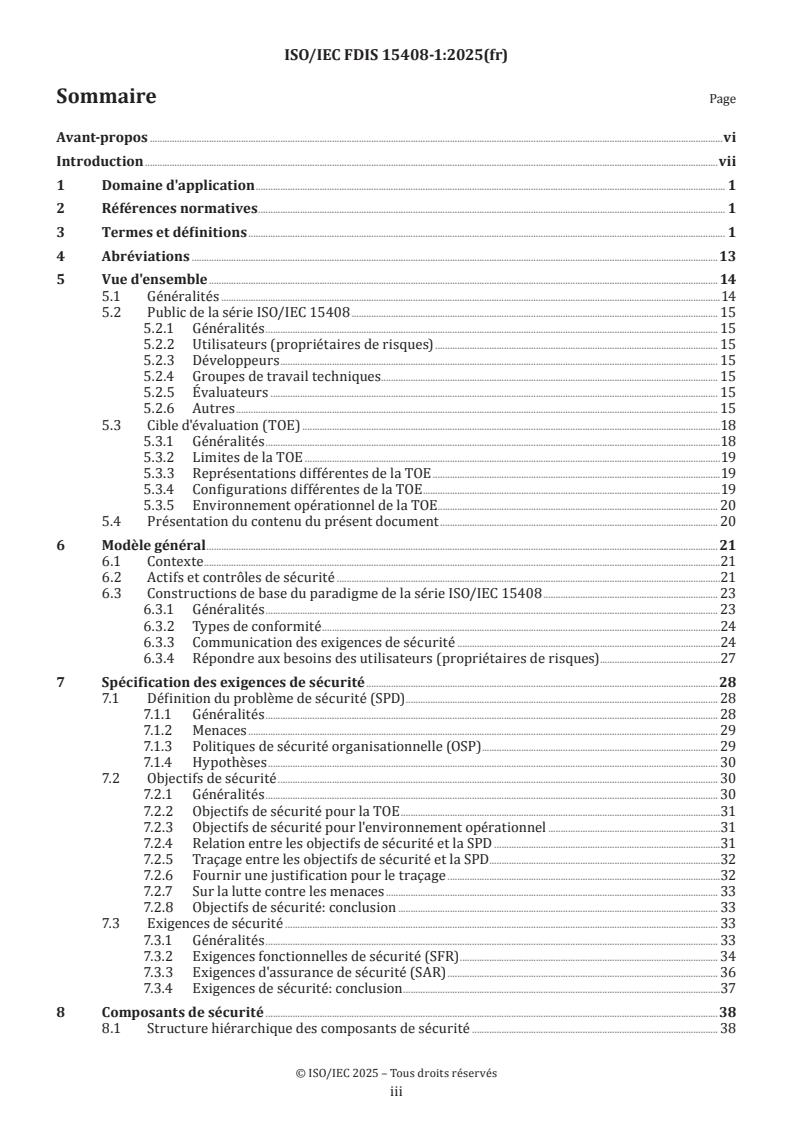
Sommaire Page
Avant-propos .vi
Introduction .vii
1 Domaine d'application . 1
2 Références normatives . 1
3 Termes et définitions . 1
4 Abréviations .13
5 Vue d'ensemble . 14
5.1 Généralités .14
5.2 Public de la série ISO/IEC 15408 . 15
5.2.1 Généralités . 15
5.2.2 Utilisateurs (propriétaires de risques) . 15
5.2.3 Développeurs . 15
5.2.4 Groupes de travail techniques. 15
5.2.5 Évaluateurs . 15
5.2.6 Autres . 15
5.3 Cible d'évaluation (TOE) .18
5.3.1 Généralités .18
5.3.2 Limites de la TOE .19
5.3.3 Représentations différentes de la TOE .19
5.3.4 Configurations différentes de la TOE .19
5.3.5 Environnement opérationnel de la TOE . . 20
5.4 Présentation du contenu du présent document . 20
6 Modèle général .21
6.1 Contexte .21
6.2 Actifs et contrôles de sécurité .21
6.3 Constructions de base du paradigme de la série ISO/IEC 15408 . 23
6.3.1 Généralités . 23
6.3.2 Types de conformité .24
6.3.3 Communication des exigences de sécurité .24
6.3.4 Répondre aux besoins des utilisateurs (propriétaires de risques) .27
7 Spécification des exigences de sécurité .28
7.1 Définition du problème de sécurité (SPD) . 28
7.1.1 Généralités . 28
7.1.2 Menaces . 29
7.1.3 Politiques de sécurité organisationnelle (OSP) . 29
7.1.4 Hypothèses . 30
7.2 Objectifs de sécurité . 30
7.2.1 Généralités . 30
7.2.2 Objectifs de sécurité pour la TOE .31
7.2.3 Objectifs de sécurité pour l'environnement opérationnel .31
7.2.4 Relation entre les objectifs de sécurité et la SPD .31
7.2.5 Traçage entre les objectifs de sécurité et la SPD .32
7.2.6 Fournir une justification pour le traçage .32
7.2.7 Sur la lutte contre les menaces . 33
7.2.8 Objectifs de sécurité: conclusion . 33
7.3 Exigences de sécurité . 33
7.3.1 Généralités . 33
7.3.2 Exigences fonctionnelles de sécurité (SFR) . 34
7.3.3 Exigences d'assurance de sécurité (SAR) . 36
7.3.4 Exigences de sécurité: conclusion .37
8 Composants de sécurité .38
8.1 Structure hiérarchique des composants de sécurité . 38
© ISO/IEC 2025 – Tous droits réservés
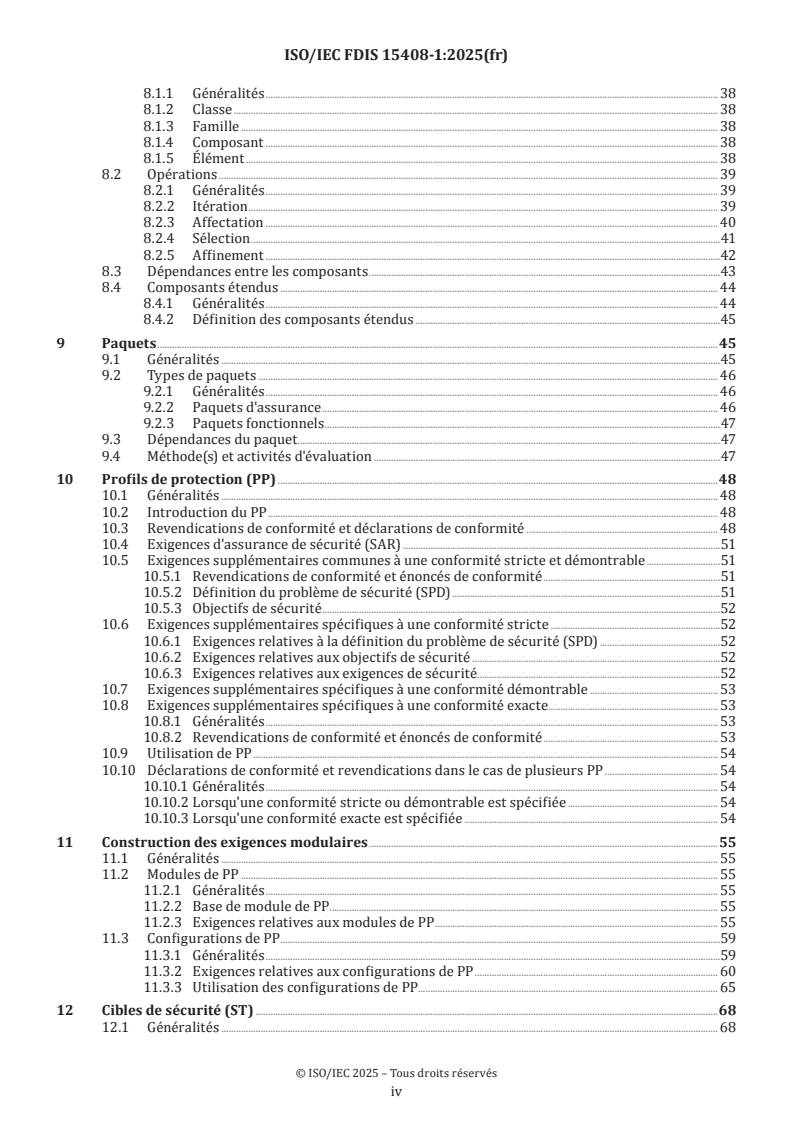
iii
8.1.1 Généralités . 38
8.1.2 Classe . 38
8.1.3 Famille . 38
8.1.4 Composant . 38
8.1.5 Élément . 38
8.2 Opérations . 39
8.2.1 Généralités . 39
8.2.2 Itération . 39
8.2.3 Affectation . 40
8.2.4 Sélection .41
8.2.5 Affinement .42
8.3 Dépendances entre les composants .43
8.4 Composants étendus . 44
8.4.1 Généralités . 44
8.4.2 Définition des composants étendus .45
9 Paquets .45
9.1 Généralités .45
9.2 Types de paquets . 46
9.2.1 Généralités . 46
9.2.2 Paquets d'assurance . 46
9.2.3 Paquets fonctionnels .47
9.3 Dépendances du paquet . .47
9.4 Méthode(s) et activités d'évaluation .47
10 Profils de protection (PP) .48
10.1 Généralités . 48
10.2 Introduction du PP . 48
10.3 Revendications de conformité et déclarations de conformité . 48
10.4 Exigences d'assurance de sécurité (SAR) .51
10.5 Exigences supplémentaires communes à une conformité stricte et démontrable .51
10.5.1 Revendications de conformité et énoncés de conformité .51
10.5.2 Définition du problème de sécurité (SPD) .51
10.5.3 Objectifs de sécurité .52
10.6 Exigences supplémentaires spécifiques à une conformité stricte .52
10.6.1 Exigences relatives à la définition du problème de sécurité (SPD) .52
10.6.2 Exigences relatives aux objectifs de sécurité .52
10.6.3 Exigences relatives aux exigences de sécurité.52
10.7 Exigences supplémentaires spécifiques à une conformité démontrable . 53
10.8 Exigences supplémentaires spécifiques à une conformité exacte . 53
10.8.1 Généralités . 53
10.8.2 Revendications de conformité et énoncés de conformité . 53
10.9 Utilisation de PP . 54
10.10 Déclarations de conformité et revendications dans le cas de plusieurs PP . 54
10.10.1 Généralités . 54
10.10.2 Lorsqu'une conformité stricte ou démontrable est spécifiée . 54
10.10.3 Lorsqu'une conformité exacte est spécifiée . 54
11 Construction des exigences modulaires .55
11.1 Généralités . 55
11.2 Modules de PP . 55
11.2.1 Généralités . 55
11.2.2 Base de module de PP . . 55
11.2.3 Exigences relatives aux modules de PP . 55
11.3 Configurations de PP .59
11.3.1 Généralités .59
11.3.2 Exigences relatives aux configurations de PP . 60
11.3.3 Utilisation des configurations de PP. 65
12 Cibles de sécurité (ST) .68
12.1 Généralités . 68
© ISO/IEC 2025 – Tous droits réservés
iv
12.2 Revendications de conformité et déclarations de conformité . 69
12.3 Exigences d'assurance .71
12.4 Exigences supplémentaires dans le cas d'une conformité exacte . 72
12.4.1 Exigences supplémentaires pour la revendication de conformité . 72
12.4.2 Exigences supplémentaires pour la SPD . 72
12.4.3 Exigences supplémentaires pour les objectifs de sécurité . 72
12.4.4 Exigences supplémentaires pour les exigences de sécurité . 73
12.5 Exigences supplémentaires dans le cas multi-assurance . 73
13 Évaluation et résultats de l'évaluation .75
13.1 Généralités . 75
13.2 Contexte d'évaluation . 77
13.3 Évaluation des PP et des configurations de PP . 78
13.4 Évaluation des ST . 78
13.5 Évaluation des TOE . 78
13.6 Méthodes d'évaluation et activités d'évaluation . 79
13.7 Résultats de l'évaluation . 79
13.7.1 Résultats d'une évaluation de PP . 79
13.7.2 Résultats d'une évaluation de configuration de PP . 79
13.7.3 Résultats d'une évaluation de ST/TOE . 79
13.8 Évaluation multi-assurance . 80
14 Composition de l'assurance .81
14.1 Généralités . 81
14.2 Modèles de composition . 82
14.2.1 Modèle de composition stratifiée . 82
14.2.2 Modèle de composition réseau ou bidirectionnel . 83
14.2.3 Modèle de composition intégrée . 83
14.3 Techniques d'évaluation pour fournir l'assurance dans les modèles de composition . 84
14.3.1 Généralités . 84
14.3.2 Classe ACO pour les TOE composées . 84
14.3.3 Évaluation composite des produits composites . 85
14.4 Exigences relatives aux évaluations utilisant des techniques de composition . 96
14.4.1 Réutilisation des résultats d'évaluation . 96
14.4.2 Problèmes d'évaluation de la composition . 97
14.5 Évaluation par composition et multi-assurance . 98
Annexe A (normative) Spécification des paquets .100
Annexe B (normative) Spécification des profils de protection (PP) .104
Annexe C (normative) Spécification des modules de PP et des configurations de PP .115
Annexe D (normative) Spécification des cibles de sécurité (ST) et des ST d'argumentaire direct .130
Annexe E (normative) Conformité du PP/de la configuration de PP .141
Bibliographie .146
© ISO/IEC 2025 – Tous droits réservés
v
Avant-propos
L'ISO (Organisation internationale de normalisation) et l'IEC (Commission électrotechnique internationale)
forment le système spécialisé de la normalisation mondiale. Les organismes nationaux membres de l'ISO ou
de l'IEC participent au développement de Normes internationales par l'intermédiaire des comités techniques
créés par l'organisation concernée afin de s'occuper des domaines particuliers de l'activité technique.
Les comités techniques de l'ISO et de l'IEC collaborent dans des domaines d'intérêt commun. D'autres
organisations internationales, gouvernementales et non gouvernementales, en liaison avec l'ISO et l'IEC
participent également aux travaux.
Les procédures utilisées pour élaborer le présent document et celles destinées à sa mise à jour sont décrites
dans les Directives ISO/IEC, Partie 1. Il convient, en particulier de prendre note des différents critères
d'approbation requis pour les différents types de documents. Le présent document a été rédigé conformément
aux règles de rédaction données dans les Directives ISO/IEC, Partie 2 (voir www.iso.org/directives ou
www.iec.ch/members_experts/refdocs).
L'ISO et l’IEC attire l'attention sur le fait que la mise en application du présent document peut entraîner
l'utilisation d'un ou de plusieurs brevets. L'ISO et l’IEC ne prend pas position quant à la preuve, à la validité
et à l'applicabilité de tout droit de propriété revendiqué à cet égard. À la date de publication du présent
document, l'ISO et l’IEC n'avaient pas reçu notification qu'un ou plusieurs brevets pouvaient être nécessaires
à sa mise en application. Toutefois, il y a lieu d'avertir les responsables de la mise en application du présent
document que des informations plus récentes sont susceptibles de figurer dans la base de données de
brevets, disponible aux adresses www.iso.org/brevets et https://patents.iec.ch. L'ISO et l'IEC ne sauraient
être tenues pour responsables de ne pas avoir identifié de tels droits de propriété et averti de leur existence.
Les appellations commerciales éventuellement mentionnées dans le présent document sont données pour
information, par souci de commodité, à l'intention des utilisateurs et ne sauraient constituer un engagement.
Pour une explication de la nature volontaire des normes, la signification des termes et expressions
spécifiques de l'ISO liés à l'évaluation de la conformité, ou pour toute information au sujet de l'adhésion de
l'ISO aux principes de l'Organisation mondiale du commerce (OMC) concernant les obstacles techniques au
commerce (OTC), voir www.iso.org/avant-propos. Pour l’IEC, voir www.iec.ch/understanding-standards.
Le présent document a été élaboré par le comité technique conjoint ISO/IEC JTC 1, Technologies de
l'information, sous-comité SC 27, Sécurité de l'information, cybersécurité et protection de la vie privée, en
collaboration avec le Comité Technique CEN/CLC/JTC 13, Cybersécurité et protection des données du Comité
européen de normalisation (CEN), conformément à l'accord de coopération technique entre l'ISO et le CEN
(Accord de Vienne).
Cette cinquième édition annule et remplace la quatrième édition (ISO/IEC 15408-1:2022), qui a fait l'objet
d'une révision technique.
Les principales modifications sont les suivantes:
— la terminologie a été revue et mise à jour;
— la revendication de conformité du paquet pour les cibles de sécurité, les profils de protection et les
modules de PP, respectivement, a été revue et alignée sur l'ISO/IEC 18045;
— la spécification de plusieurs bases de module de PP a été améliorée pour la précision;
— corrections d'erreurs.
Une liste de toutes les parties de la série ISO/IEC 15408 se trouve sur les sites Web de l'ISO et de l'IEC.
Il convient que l'utilisateur adresse tout retour d'information ou toute question concernant le présent
document à l'organisme national de normalisation de son pays. Une liste exhaustive desdits organismes se
trouve aux adresses www.iso.org/fr/members.html et www.iec.ch/national-committees.
© ISO/IEC 2025 – Tous droits réservés
vi
Introduction
La série ISO/IEC 15408 permet de comparer les résultats d'évaluations de la sécurité indépendantes en
proposant un ensemble commun d'exigences applicables aux fonctionnalités de sécurité des produits TI et
aux mesures d'assurance appliquées à ces produits TI au cours d'une évaluation de sécurité. Ces produits TI
peuvent être mis en œuvre dans du matériel, des microprogrammes ou des logiciels.
Le processus d'évaluation établit un niveau de confiance selon lequel les fonctionnalités de sécurité de ces
produits TI et les garanties qui leur sont appliquées satisfont aux exigences correspondantes.
Les résultats d'évaluation peuvent aider les utilisateurs à déterminer si ces produits TI répondent à leurs
besoins de sécurité.
La série ISO/IEC 15408 constitue un guide utile pour le développement, l'évaluation ou l'acquisition de
produits TI dotés de fonctionnalités de sécurité.
La série ISO/IEC 15408 est volontairement souple pour permettre d'appliquer diverses approches
d'évaluation à différentes propriétés de sécurité d'une vaste gamme de produits TI. Il est par conséquent
recommandé aux utilisateurs du présent document de s'assurer qu'une telle flexibilité n'est pas utilisée à
mauvais escient. Par exemple, l'utilisation de la série ISO/IEC 15408 combinée à des méthodes/activités
d'évaluation inappropriées, à des propriétés de sécurité inadaptées ou à des produits TI incompatibles peut
conduire à des résultats d'évaluation dénués de sens.
Ainsi, le fait qu'un produit TI ait été évalué n'a de sens que dans le contexte des propriétés de sécurité
qui ont été évaluées et des méthodes d'évaluation qui ont été employées. Il est recommandé aux autorités
d'évaluation de vérifier soigneusement les produits, propriétés et méthodes afin de déterminer si une
évaluation donne des résultats pertinents. Par ailleurs, les acheteurs de produits évalués sont invités à tenir
compte scrupuleusement de ce contexte pour déterminer si le produit évalué est utile et s'il s'applique à leur
situation et à leurs besoins spécifiques.
La série ISO/IEC 15408 traite de la protection des biens sensibles contre toute divulgation, modification ou
perte d'usage non autorisée. Les catégories de protection relatives à ces trois types de faille de sécurité sont
communément désignées par les termes confidentialité, intégrité et disponibilité. La série ISO/IEC 15408
peut également s'appliquer aux aspects de la sécurité des TI en dehors de ces trois catégories. La série
ISO/IEC 15408 s'applique aux risques liés aux activités humaines (mauvaises ou autres) et aux risques
liés aux activités non humaines. La série ISO/IEC 15408 peut être appliquée dans d'autres domaines de
l'informatique, mais ne revendique aucune applicabilité dans ces domaines.
La série ISO/IEC 15408 est présentée sous la forme d'un ensemble de parties distinctes, mais connexes,
comme indiqué ci-dessous.
a) L'ISO/IEC 15408-1 est l'introduction de la série ISO/IEC 15408. Elle définit les concepts généraux et les
principes de l'évaluation de la sécurité des TI et présente un modèle général d'évaluation.
b) L'ISO/IEC 15408-2 établit un ensemble de composants fonctionnels qui servent de modèles standard
sur lesquels reposent les exigences fonctionnelles de sécurité (SFR) pour les cibles d'évaluation (TOE).
L'ISO/IEC 15408-2 répertorie l'ensemble des composants fonctionnels de sécurité et les organise en
familles et classes.
c) L'ISO/IEC 15408-3, établit un ensemble de composants d'assurance qui servent de modèles standard
sur lesquels reposent les exigences d'assurance de sécurité pour les TOE. L'ISO/IEC 15408-3
répertorie l'ensemble des composants d'assurance de sécurité et les organise en familles et classes.
L'ISO/IEC 15408-3 définit également des critères d'évaluation pour les PP, les ST et les TOE.
d) L'ISO/IEC 15408-4 fournit un cadre normalisé pour la spécification des méthodes et activités
d’évaluation qui peuvent être incluses dans les PP, les ST et tout document les accompagnant, à utiliser
par les évaluateurs à l’appui des évaluations utilisant le modèle décrit dans les autres parties de la série
ISO/IEC 15408. L'ISO/IEC 18045 est fondamentale pour l'ISO/IEC 15408-4.
e) L'ISO/IEC 15408-5 fournit des paquets d'assurance de sécurité et de SFR qui ont été identifiés comme
utiles à l'appui d'une utilisation courante par les parties prenantes. Parmi les exemples de paquets
© ISO/IEC 2025 – Tous droits réservés
vii
fournis figurent les niveaux d'assurance de l'évaluation (EAL) et les paquets d'assurance composés
(CAP).
NOTE 1 L'ISO/IEC 18045 fournit la méthodologie de référence pour les évaluations de sécurité des TI effectuées
conformément à la série ISO/IEC 15408.
Certains sujets, qui impliquent des techniques spécialisées ou sont quelque peu périphériques à la sécurité
des TI, sont considérés comme ne relevant pas du domaine d'application de la série ISO/IEC 15408. La liste
de sujets suivante n'est pas couverte par la série ISO/IEC 15408:
f) critères d'évaluation de la sécurité relatifs aux mesures administratives de sécurité non directement
liées à la fonctionnalité de sécurité des TI. Il est cependant établi que l'utilisation ou l'appui de mesures
administratives, telles que des contrôles organisationnels ou physiques, l'intervention de personnel ou
l'application de procédures, peut souvent contribuer à obtenir une sécurité significative;
g) la méthodologie d'évaluation selon laquelle il convient d'appliquer les critères;
NOTE 2 La méthodologie d'établissement des bases de référence est définie dans l'ISO/IEC 18045.
L'ISO/IEC 15408-4 peut être utilisée pour déduire davantage les activités et les méthodes d'évaluation de
l'ISO/IEC 18045.
h) cadre administratif et juridique dans lequel les critères peuvent être appliqués par les autorités
d'évaluation. Il est cependant prévu que la série ISO/IEC 15408 soit utilisée à des fins d'évaluation dans
le contexte d'un tel cadre;
i) les procédures d'utilisation des résultats d'évaluation dans l'accréditation. Une accréditation désigne le
processus administratif consistant à accorder l'autorisation d'exploiter un produit TI (ou un ensemble
ces produits) dans son environnement opérationnel, y compris pour l'ensemble de ses composants
ne relevant pas des technologies de l'information. Les résultats du processus d'évaluation servent de
données d'entrée au processus d'accréditation. Cependant, puisque d'autres techniques se révèlent
plus adaptées pour l'appréciation des propriétés qui ne relèvent pas des technologies de l'information
ainsi que de leur relation avec les composants de sécurité des TI, les organismes d'accréditation doivent
formuler des dispositions distinctes pour traiter de ces aspects;
j) le sujet des critères d'évaluation des qualités inhérentes des algorithmes cryptographiques. Dans le
cas où une évaluation indépendante des propriétés mathématiques de la cryptographie est requise, le
schéma d'évaluation dans lequel la série ISO/IEC 15408 est appliquée peut prévoir de telles évaluations.
Le présent document introduit:
— les concepts clés des profils de protection (PP), des modules de PP, des configurations de PP, des paquets,
des cibles de sécurité (ST) et des types de conformité;
— une description de l'organisation des composants de sécurité sur l'ensemble du modèle;
— décrit les diverses opérations dans le cadre desquelles les composants fonctionnels et d'assurance décrits
dans l'ISO/IEC 15408-2 et dans l'ISO/IEC 15408-3 peuvent être adaptés par l'utilisation d'opérations
autorisées;
— des informations générales relatives aux méthodes d'évaluation données dans l'ISO/IEC 18045;
— des recommandations pour l'application de l'ISO/IEC 15408-4 dans le but de développer des méthodes
d'évaluation (EM) et des activités d'évaluation (EA) dérivées de l'ISO/IEC 18045;
— des informations générales relatives aux niveaux d'assurance de l'évaluation (EAL) définis dans
l'ISO/IEC 15408-5;
— des informations concernant le domaine d'application des schémas d'évaluation.
Le texte qui suit apparaît dans d'autres parties de la série ISO/IEC 15408 et dans l'ISO/IEC 18045 pour
décrire l'utilisation des caractères gras et italiques dans ces documents. Le présent document peut utiliser
ces conventions seulement dans des exemples, mais les notes ont été conservées pour s'aligner avec le reste
de la série.
© ISO/IEC 2025 – Tous droits réservés
viii
Les caractères gras sont utilisés pour mettre en évidence les relations hiérarchiques entre les exigences.
Cette convention d'écriture impose les caractères gras à toute nouvelle exigence.
Pour les exigences fonctionnelles de sécurité, l'utilisation de l'italique indique les éléments d'attribution et
de sélection.
Pour les exigences d'assurance de sécurité, les verbes spéciaux relatifs aux activités d'évaluation obligatoires
sont présentés en caractères gras et italiques.
© ISO/IEC 2025 – Tous droits réservés
ix
PROJET FINAL Norme internationale ISO/IEC FDIS 15408-1:2025(fr)
Sécurité de l'information, cybersécurité et protection de
la vie privée — Critères d'évaluation pour la sécurité des
technologies de l'information —
Partie 1:
Introduction et modèle général
1 Domaine d'application
Le présent document établit les concepts et principes généraux de l'évaluation de la sécurité des technologies
de l'information (TI). Il spécifie le modèle général d'évaluation donné dans le présent document, qui, dans
son intégralité, est destiné à servir de base à l'évaluation des propriétés de sécurité des prod
...
Questions, Comments and Discussion
Ask us and Technical Secretary will try to provide an answer. You can facilitate discussion about the standard in here.
Loading comments...