


ISO 17365:2013
(Main)Supply chain applications of RFID — Transport units
Supply chain applications of RFID — Transport units
ISO 17365:2013 defines the basic features of RFID for use in the supply chain when applied to transport units. In particular it a) provides specifications for the identification of the transport unit, b) makes recommendations about additional information on the RF tag, c) specifies the semantics and data syntax to be used, d) specifies the data protocol to be used to interface with business applications and the RFID system, e) specifies the minimum performance requirements, f) specifies the air interface standards between the RF interrogator and RF tag, and g) specifies the reuse and recyclability of the RF tag.
Applications de chaîne d'approvisionnements de RFID — Unités de transport
General Information
- Status
- Withdrawn
- Publication Date
- 21-Feb-2013
- Technical Committee
- ISO/IEC JTC 1/SC 31 - Automatic identification and data capture techniques
- Current Stage
- 9599 - Withdrawal of International Standard
- Start Date
- 25-May-2023
- Completion Date
- 14-Feb-2026
Relations
- Effective Date
- 06-Jun-2022
- Effective Date
- 07-Nov-2009


Get Certified
Connect with accredited certification bodies for this standard

BRCGS (Brand Reputation Compliance Global Standards)
Global food safety and quality standards owner.
Sponsored listings
Frequently Asked Questions
ISO 17365:2013 is a standard published by the International Organization for Standardization (ISO). Its full title is "Supply chain applications of RFID — Transport units". This standard covers: ISO 17365:2013 defines the basic features of RFID for use in the supply chain when applied to transport units. In particular it a) provides specifications for the identification of the transport unit, b) makes recommendations about additional information on the RF tag, c) specifies the semantics and data syntax to be used, d) specifies the data protocol to be used to interface with business applications and the RFID system, e) specifies the minimum performance requirements, f) specifies the air interface standards between the RF interrogator and RF tag, and g) specifies the reuse and recyclability of the RF tag.
ISO 17365:2013 defines the basic features of RFID for use in the supply chain when applied to transport units. In particular it a) provides specifications for the identification of the transport unit, b) makes recommendations about additional information on the RF tag, c) specifies the semantics and data syntax to be used, d) specifies the data protocol to be used to interface with business applications and the RFID system, e) specifies the minimum performance requirements, f) specifies the air interface standards between the RF interrogator and RF tag, and g) specifies the reuse and recyclability of the RF tag.
ISO 17365:2013 is classified under the following ICS (International Classification for Standards) categories: 55.020 - Packaging and distribution of goods in general. The ICS classification helps identify the subject area and facilitates finding related standards.
ISO 17365:2013 has the following relationships with other standards: It is inter standard links to ISO/IEC 17360:2023, ISO 17365:2009. Understanding these relationships helps ensure you are using the most current and applicable version of the standard.
ISO 17365:2013 is available in PDF format for immediate download after purchase. The document can be added to your cart and obtained through the secure checkout process. Digital delivery ensures instant access to the complete standard document.
Standards Content (Sample)
INTERNATIONAL ISO
STANDARD 17365
Second edition
2013-03-01
Supply chain applications of RFID —
Transport units
Applications de chaîne d’approvisionnements de RFID — Unités de
transport
Reference number
©
ISO 2013
© ISO 2013
All rights reserved. Unless otherwise specified, no part of this publication may be reproduced or utilized otherwise in any form
or by any means, electronic or mechanical, including photocopying, or posting on the internet or an intranet, without prior
written permission. Permission can be requested from either ISO at the address below or ISO’s member body in the country of
the requester.
ISO copyright office
Case postale 56 • CH-1211 Geneva 20
Tel. + 41 22 749 01 11
Fax + 41 22 749 09 47
E-mail copyright@iso.org
Web www.iso.org
Published in Switzerland
ii © ISO 2013 – All rights reserved
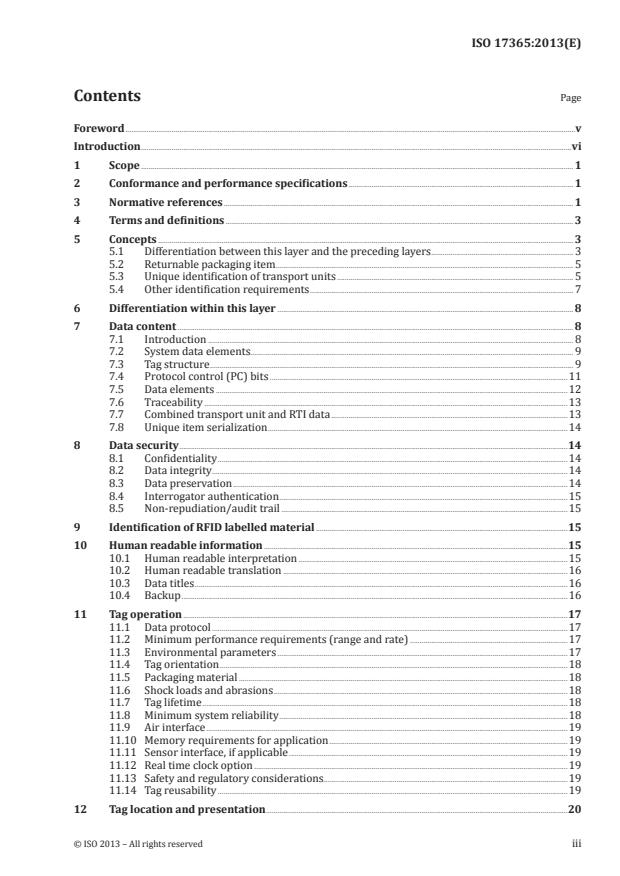
Contents Page
Foreword .v
Introduction .vi
1 Scope . 1
2 Conformance and performance specifications . 1
3 Normative references . 1
4 Terms and definitions . 3
5 Concepts . 3
5.1 Differentiation between this layer and the preceding layers . 3
5.2 Returnable packaging item . 5
5.3 Unique identification of transport units . 5
5.4 Other identification requirements . 7
6 Differentiation within this layer . 8
7 Data content . 8
7.1 Introduction . 8
7.2 System data elements . . 9
7.3 Tag structure . 9
7.4 Protocol control (PC) bits .11
7.5 Data elements .12
7.6 Traceability .13
7.7 Combined transport unit and RTI data .13
7.8 Unique item serialization .14
8 Data security .14
8.1 Confidentiality .14
8.2 Data integrity .14
8.3 Data preservation .14
8.4 Interrogator authentication .15
8.5 Non-repudiation/audit trail .15
9 Identification of RFID labelled material .15
10 Human readable information .15
10.1 Human readable interpretation .15
10.2 Human readable translation .16
10.3 Data titles .16
10.4 Backup .16
11 Tag operation .17
11.1 Data protocol .17
11.2 Minimum performance requirements (range and rate) .17
11.3 Environmental parameters .17
11.4 Tag orientation .18
11.5 Packaging material .18
11.6 Shock loads and abrasions .18
11.7 Tag lifetime .18
11.8 Minimum system reliability .18
11.9 Air interface .19
11.10 Memory requirements for application .19
11.11 Sensor interface, if applicable .19
11.12 Real time clock option .19
11.13 Safety and regulatory considerations.19
11.14 Tag reusability .19
12 Tag location and presentation .20
12.1 Material on which the tag is mounted or inserted .20
12.2 Geometry of the package/tag environment .20
13 Interrogator and reader requirements.20
13.1 Safety and regulatory considerations.20
13.2 Data privacy .20
14 Interoperability, compatibility and non-interference with other RF systems .20
Annex A (normative) Encoding .21
Bibliography .31
iv © ISO 2013 – All rights reserved
Foreword
ISO (the International Organization for Standardization) is a worldwide federation of national standards
bodies (ISO member bodies). The work of preparing International Standards is normally carried out
through ISO technical committees. Each member body interested in a subject for which a technical
committee has been established has the right to be represented on that committee. International
organizations, governmental and non-governmental, in liaison with ISO, also take part in the work.
ISO collaborates closely with the International Electrotechnical Commission (IEC) on all matters of
electrotechnical standardization.
International Standards are drafted in accordance with the rules given in the ISO/IEC Directives, Part 2.
The main task of technical committees is to prepare International Standards. Draft International
Standards adopted by the technical committees are circulated to the member bodies for voting.
Publication as an International Standard requires approval by at least 75 % of the member bodies
casting a vote.
Attention is drawn to the possibility that some of the elements of this document may be the subject of
patent rights. ISO shall not be held responsible for identifying any or all such patent rights.
ISO 17365 was prepared by Technical Committee ISO/TC 122, Packaging.
This second edition cancels and replaces the first edition (ISO 17365:2009), which has been
technically revised.
This International Standard has one annex, Annex A, which provides normative information.
Introduction
The ‘Supply Chain’ is a multi-level concept that covers all aspects of taking a product from raw materials
to a final product including shipping to a final place of sale, use and maintenance, and potentially
disposal. Each of these levels covers many aspects of dealing with products and the business process for
each level is both unique and overlapping with other levels.
This International Standard has been created in order to ensure compatibility at the physical, command
and data levels with the four other International Standards under the general title Supply chain applications
of RFID. Where possible, this compatibility takes the form of interchangeability. Where interchangeability
is not feasible, the International Standards within this suite are interoperable and non-interfering. The
International Standards within the complete series of Supply chain applications of RFID include
— ISO 17363, Supply chain applications of RFID — Freight containers;
— ISO 17364, Supply chain applications of RFID — Returnable transport items (RTIs) and returnable
packaging items (RPIs);
— ISO 17365, Supply chain applications of RFID — Transport units;
— ISO 17366, Supply chain applications of RFID — Product packaging;
— ISO 17367, Supply chain applications of RFID — Product tagging.
These International Standards define the technical aspects and data hierarchy of information required
in each layer of the supply chain. The air-interface and communications protocol standards supported
within the Supply chain applications of RFID International Standards are ISO/IEC 18000; commands and
messages are specified by ISO/IEC 15961 and ISO/IEC 15962; semantics are defined in ISO/IEC 15418;
syntax is defined in ISO/IEC 15434.
Although not pertinent to this International Standard, the following work is considered valuable:
— ISO/IEC JTC 1, Information technology, SC 31, Automatic identification and data capture techniques, in
the areas of air interface, data semantic and syntax construction and conformance standards, and
— ISO/TC 104, Freight containers, in the area of freight container security, including electronic seals
(e-seals) (i.e. ISO 18185) and container identification.
This International Standard defines the requirements for RFID tags for transport units. Transport units
are defined here as either a transport package or a unit load (see ISO 17364:2013, 4.6 and 4.9).
An important concept here is the use cases of such things as unitized loads, pallets and returnable
transport items. How a pallet is used can determine whether it is covered under ISO 17364 as a returnable
transport item or within this International Standard as a transport unit. If ownership title of the pallet
remains with its owner then the applicable International Standard is ISO 17364. If the ownership title of
a pallet is transferred to the customer as part of a unitized load then it is considered an element of that
unitized load, and this International Standard is applicable.
Specific to transport units is the grouping of (packaged) products, in order to make these more suitable
for efficient and effective transport and distribution. The transport unit provides an added value for
the product being sold, mostly in terms of logistics performance. RFID tagged transport units can help
further optimize the supply chain.
Additionally, this edition of this International Standards introduces the concept of returnable packaging
items (RPIs). RPIs are components of the transport unit that must be tracked as well as the transport
unit itself as an asset of the owner/shipper. Annex A in ISO 17364:2013 provides guidance on RPIs.
vi © ISO 2013 – All rights reserved
INTERNATIONAL STANDARD ISO 17365:2013(E)
Supply chain applications of RFID — Transport units
1 Scope
This International Standard defines the basic features of RFID for use in the supply chain when applied
to transport units. In particular it
— provides specifications for the identification of the transport unit,
— makes recommendations about additional information on the RF tag,
— specifies the semantics and data syntax to be used,
— specifies the data protocol to be used to interface with business applications and the RFID system,
— specifies the minimum performance requirements,
— specifies the air interface standards between the RF interrogator and RF tag, and
— specifies the reuse and recyclability of the RF tag.
2 Conformance and performance specifications
All of the devices and equipment that claim conformance with this International Standard shall also
conform to the appropriate sections and parameters specified in ISO/IEC 18046 for performance, and
ISO/IEC 18047-6 (for ISO/IEC 18000-63, Type C) and ISO/IEC/TR 18047-3 (for the ASK interface of
ISO/IEC 18000-3, Mode 3) for conformance.
When through trading-partner agreement, other specific ISO/IEC 18000 air interfaces are employed
(i.e. ISO/IEC 18000-2, Type A) the corresponding part of ISO/IEC 18047 shall be used.
3 Normative references
The following referenced documents are indispensable for the application of this document. For dated
references, only the edition cited applies. For undated references, the latest edition of the referenced
document (including any amendments) applies.
ISO 445, Pallets for materials handling — Vocabulary
ISO 830, Freight containers — Vocabulary
ISO 8601, Data elements and interchange formats — Information interchange — Representation of
dates and times
ISO/IEC/IEEE 8802-15-4, Information technology — Telecommunications and information exchange
between systems — Local and metropolitan area networks — Specific requirements Part 15.4: Wireless
Medium Access Control (MAC) and Physical Layer (PHY) Specifications for Low-Rate Wireless Personal Area
Networks (WPANs)
ISO/IEC 15418, Information technology — Automatic identification and data capture techniques — GS1
Application Identifiers and ASC MH10 Data Identifiers and maintenance
ISO/IEC 15434, Information technology — Automatic identification and data capture techniques — Syntax
for high-capacity ADC media
ISO/IEC 15459-1, Information technology — Automatic identification and data capture techniques —
Unique identification — Part 1: Individual transport units
ISO/IEC 15961, Information technology — Radio frequency identification (RFID) for item management —
Data protocol: application interface
ISO/IEC 15962, Information technology — Radio frequency identification (RFID) for item management —
Data protocol: data encoding rules and logical memory functions
ISO/IEC 15963, Information technology — Radio frequency identification for item management — Unique
identification for RF tags
ISO/IEC 16022, Information technology — Automatic identification and data capture techniques — Data
Matrix bar code symbology specification
ISO 17364:2013, Supply chain applications of RFID — Returnable transport items (RTIs) and Returnable
packaging items (RPIs)
ISO/IEC 18000-3, Information technology — Radio frequency identification for item management — Part 3:
Parameters for air interface communications at 13,56 MHz
ISO/IEC 18000-63, Information technology — Radio frequency identification for item management —
Part 63: Parameters for air interface communications at 860 MHz to 960 MHz Type C
ISO/IEC 18004, Information technology — Automatic identification and data capture techniques — QR
Code bar code symbology specification
ISO/IEC 18046 (all parts), Information technology — Radio frequency identification device performance
test methods
ISO/IEC 18047 (all parts), Information technology — Radio frequency identification device conformance
test methods
ISO/IEC 19762, Information technology — Automatic identification and data capture (AIDC) techniques —
Harmonized vocabulary
ISO 21067, Packaging — Vocabulary
ISO/IEC/IEEE 21451-7, Information technology — Smart transducer interface for sensors and actuators —
Part 7: Transducer to radio frequency identification (RFID) systems communication protocols and Transducer
Electronic Data Sheet (TEDS) formats
ISO/IEC/TR 24729-1, Information technology — Radio frequency identification for item management —
Implementation guidelines — Part 1: RFID-enabled labels and packaging supporting ISO/IEC 18000-6C
ISO/IEC 29160, Information technology — Radio frequency identification for item management — RFID Emblem
ANS MH10.8.2, Data Identifiers and Application Identifiers
GS1 EPC, Tag Data Standard, Version 1.6
GS1 General Specifications
ICNIRP Guidelines, Guidelines for limiting exposure to time-varying electric, magnetic, and electromagnetic
fields (up to 300 GHz)
IEEE C95-1, IEEE Standard for Safety Levels with Respect to Human Exposure to Radio Frequency
Electromagnetic Fields, 3 kHz to 300 GHz
2 © ISO 2013 – All rights reserved
4 Terms and definitions
For the purposes of this document, the terms and definitions given in ISO 445, ISO 830, ISO 17364,
ISO/IEC 19762 (all parts), and ISO 21067 apply.
For the purposes of this document, hexadecimal characters are represented as 0xnn, where “nn” is the
hexadecimal value.
5 Concepts
5.1 Differentiation between this layer and the preceding layers
Figures 1 and 2 give a graphical representation of supply chain layers. They show a conceptual model
of possible supply chain relationships, not a one-for-one representation of physical things. Although
several layers in Figure 2 have clear physical counterparts, some common supply chain physical items
fit in several layers depending on the use case. For example, as shown in Figure 2, a repetitively used
pallet under constant ownership would be covered by ISO 17364 as an RTI; a pallet that is part of a
consolidated unit load would be covered by this International Standard as a transport unit; and a pallet
that is integral to a single item would be covered by ISO 17366 as product packaging.
The term “supply chain layers” is a multi-level concept that covers all aspects of taking a product from
raw materials to a final product to shipping to a final place of sale, use, maintenance and potentially
disposal and returned goods. Each of these levels covers many aspects of dealing with products and the
business process for each level is both unique and overlapping with other levels.
The Item Level through Freight Container Level layers are addressed within the suite of standards for
“supply chain applications of RFID” and are intended to enhance supply chain visibility. The Movement
Vehicle Level is the purview of ISO/TC 204/WG 7.
The Transport Unit Level in Figure 2, and specifically transport units (as defined in ISO 17364:2013, 4.7)
is the subject of this International Standard.
Transport unit layer tags can be distinguished from following or preceding layer tags by use of a group select
methodology contained in the RFID interrogator/reader. This group select function allows the interrogator
and supporting automated information systems (AIS) to quickly identify transport unit layer tags.
Key
1 primary packaging – consumer packaging – (product)
2 secondary packaging – outer packaging – (product package)
3 tertiary packaging – transport packaging – (transport unit)
4 tertiary packaging – unitized transport packaging – (transport unit)
5 pallet – (returnable transport item – RTI)
Figure 1 — Packaging
4 © ISO 2013 – All rights reserved
Layer 5
Movement Vehicle
Movement Vehicle Level
(truck, ship, train, airplane)
Defined by Transport Mode
(Movement vehicle)
Returnable Packaging Item
Layer 4
Freight Container Level
ISO 17363
Container
433 MHz or 2,45 GHz
20/40 Foot Marine and Multi-Modal Container
(8802-15-4 or 18000-7 TPA)
(Freight containers)
Returnable Packaging Item
Layer 3
RTI Level
Returnable Transport Returnable Transport
ISO 17364
Item (RTI) Item (RTI)
(860-960 MHz)
(Various 18000 with TPA)
(Tertiary packaging)
Returnable Packaging Item
Layer 2
Transport Unit Level
Transport Transport
Transport Transport
Unit
ISO 17365 Unit
Unit Unit
(Various 18000 with TPA)
(Tertiary packaging)
Returnable Packaging Item
Layer 1
Product Package Level
Prod Prod Prod Prod
ISO 17366 Prod Prod Prod Prod
Pkg Pkg Pkg Pkg Pkg Pkg Pkg
(860-960 MHz with TPA) Pkg
(13,56 MHz with TPA)
(Secondary packaging)
Returnable Packaging Item
Layer 0
Item Level
ISO 17367
Item Item Item Item
Item Item Item Item Item Item Item Item Item Item Item Item
(860-960 MHz with TPA)
(13,56 MHz with TPA)
(Primary packaging)
Components, Parts, Materials, Subassemblies, etc.
Figure 2 — Supply chain layers
5.2 Returnable packaging item
At all layers within the supply chain are materials that are shipped to a customer with full expectation
that such devices will be returned to the supplier. These returnable packaging items (RPIs) are assets of
value as well as potentially the physical transport unit. RPIs and their identification are well addressed
in Annex A of ISO 17364.
5.3 Unique identification of transport units
5.3.1 General
Unique transport unit identification is a process that assigns a unique data string to an individual
transport unit, or in this case to an RFID tag that is associated to the transport unit. The unique data
string is called the unique transport unit identifier. Unique item identification of transport units allows
data collection and management at a granular level. The benefits of granular level data are evident in
such areas as maintenance, warranties and enabling electronic transactions of record. This granularity
is possible only if each tagged item has a unique item identifier.
The information on items in the supply chain is often held on computer systems and may be exchanged
between parties involved via electronic data interchange (EDI) and extensible mark-up language (XML)
schemas. The unique item identifier is used as a key to access this information.
The unique transport unit identifier described above shall be the unique identifier as described in
ISO/IEC 15459-1. The unique item identifier (UII) provides granular discrimination between like items that
are identified with RFID tags. The unique tag ID (as defined by ISO/IEC 15963) is a mechanism to uniquely
identify RFID tags and is not the unique transport unit identifier defined in this International Standard.
Transport unit tagging provides unique identification of transport units. The minimum data elements
required for unique identification are an enterprise identifier/company identification number and a
serial number that is unique within that enterprise identifier.
This International Standard uses the following identification mechanisms for unique transport unit
identification:
— unique identifier for transport units (ISO/IEC 15459-1;
— GS1 Serial Shipping Container Code (SSCC).
5.3.2 International unique identification of transport units
The unique identifier of ISO/IEC 15459 provides identification schemes for various layers of the supply chain,
from layer 1 (products) up to layer 4 (returnable transport items). The unique identification of transport
units shall use ISO/IEC 15459-1. Unique identification is provided contextually by three components:
a) issuing agency code (IAC),
b) company identification number (CIN),
c) serial number (SN),
preceded by an AFI and Data Identifier (DI). The AFI code assignments table in ISO/IEC 15961-3, Data
Constructs Register and shown below in Table 1 permits identification of the supply chain layer, i.e.
product = 0xA1, transport unit = 0xA2 returnable transport item = 0xA3, and product package = 0xA5.
,
Table 1 — 1736x AFI Assignments
AFI Assigned organization or function
0xA1 ISO 17367 product tagging
0xA2 ISO 17365 transport unit
0xA3 ISO 17364 returnable transport item or returnable packaging item
0xA4 ISO 17367 product tagging, containing hazardous materials
0xA5 ISO 17366 product packaging
0xA6 ISO 17366 product packaging, containing hazardous materials
0xA7 ISO 17365 transport unit, but containing hazardous materials
0xA8 ISO 17364 returnable transport item or returnable packaging item, containing hazardous materials
0xA9 ISO 17363 freight containers
0xAA ISO 17363 freight containers, containing hazardous materials
EPC does not use AFIs; consequently, there are no AFIs used for transport units employed in retail
applications using EPC. AFI 0xA2 may be used for transport units intended solely for commodities other
than consumer goods. Annex A provides an in-depth discussion of the ISO approach to encoding.
The Data Identifier shall be one of the “J” series shown in Table 2. To define its class (in the ISO/IEC 15459
sense), the unique identifier of transport units ‘J, 1J, 2J, 3J and 4J’ can be up to 35 alphanumeric characters
in length, excluding the Data Identifier (an.2+an.35) and the unique identifier of transport units ‘5J, and
6J’ can be up to 20 alphanumeric characters in length, excluding the Data Identifier (an.2+an.20). With
the mutual agreement of the trading partners the length may be extended to 50 characters (an3+an.50).
See Table 2.
6 © ISO 2013 – All rights reserved
Table 2 — ISO UII element string
Format of the license plate
Data Identifier IAC, company identification number (CIN), serial number
J, 1J, 2J, 3J, 4J N N N N N N N N N N N N N N N N N . . . N
1 2 3 4 5 6 7 8 9 10 11 12 13 14 15 16 17 35
5J, 6J N N N N N N N N N N N N N N N N N . . . N
1 2 3 4 5 6 7 8 9 10 11 12 13 14 15 16 17 20
5.3.3 Serial shipping container code (SSCC)
The serial shipping container code (SSCC) is a unique item identifier (UII) capable of providing unique
item identification of transport units.
To define its class, the UII shall have an associated class identifier, which is the Application Identifier “00”.
A logistic unit is an item of any composition established for transport and/or storage that needs to be
managed through the supply chain. The identification and symbol marking of logistic units enables a
large number of user applications. In particular, the SSCC provides a link between the physical logistic
unit and information pertaining to the logistic unit that is communicated between trading partners
using electronic data interchange (EDI).
The SSCC element string AI (00) is used for the identification of logistic units. Each individual logistic
unit is allocated a unique number, which remains the same for the life of the logistic unit. When assigning
an SSCC, the rule is that an individual SSCC number shall not be reallocated within one year of the
shipment date from the SSCC assignor to a trading partner. However, prevailing regulatory or industry
organization specific requirements may extend this period.
In principle, the SSCC provides a unique reference number that can be used as the key to access information
regarding the logistic unit in computer files. However, attributes relating to the logistic unit (e.g. ship-to
information, logistic weights) are also available as standardized element strings. See Table 3.
Table 3 — SSCC element string
Format of the element string
SSCC
Application Extension GS1 Company Prefix/Serial Reference Check digit
Identifier digit
00 N N N N N N N N N N N N N N N N N N
1 2 3 4 5 6 7 8 9 10 11 12 13 14 15 16 17 18
The Application Identifier (00) indicates that the data field contains an SSCC.
The extension digit is used to increase the capacity of the Serial Reference within the SSCC. The company
that constructs the SSCC assigns the extension digit.
GS1 Member Organizations allocate the GS1 Company Prefix to a system user (see GS1 General
Specifications). This makes the SSCC unique worldwide but does not identify the origin of the unit.
The structure and content of the Serial Reference is at the discretion of the system user responsible for
its assignment.
The check digit is explained in the GS1 General Specifications. Its verification, which shall be carried out
in the application software, ensures that the number is correctly composed.
5.4 Other identification requirements
This International Standard does not supersede or replace any applicable safety or regulatory marking
or labelling requirements.
This International Standard is meant to satisfy the minimum transport unit identification requirements
of numerous applications and industry groups. As such, its applicability is to a wide range of industries,
each of which may have specific implementation guidelines for this International Standard. This
International Standard is to be applied in addition to any other mandated labelling requirements.
6 Differentiation within this layer
The layer represented by the transport unit is characterized by the following unique aspects.
Individual transport units are identified by a shipment control number (SSCC or J-series Data Identifier).
The transport unit is the source of information about the environmental condition of the unit or
package. This includes data on temperature, humidity, shock, and other physical characteristics.
The RF tag associated with the transport unit is written to or read from as part of one or more of the
following business processes:
building a transport unit;
assembly of the next higher level in the supply chain;
— shipment;
— in transit;
— cross-docking;
— in-check/receipt;
— de-aggregation of the transport unit.
In conclusion, the transport unit and the system in which it is used are closely intertwined. Additionally,
all variations possible in different supply chains are also observed in the transport unit layer of the
supply chain due to the nature of the transport unit and its usage.
7 Data content
7.1 Introduction
Subclauses 7.2 to 7.8 describe the data content of RFID tags for the transport unit layer. They identify,
amongst others,
— the data elements that shall or may be present on the tag,
— the way in which the data elements are identified (semantics),
— the representation of data elements in tag memory, and
— the placement of data elements in the memory of the tag.
NOTE 1 As specified elsewhere in this International Standard, use is made of ISO/IEC 18000-63, and
ISO/IEC 18000-3, Mode 3 tags. Where necessary, use is made of the specific (memory) terminology of those tags.
NOTE 2 For the purpose of transport unit tagging only, both write once/read many (WORM) and read/write tags
are used. This is done to enable transport unit owners to assign specific and permanent UIIs to their transport units.
8 © ISO 2013 – All rights reserved
7.2 System data elements
7.2.1 Unique transport unit identification
The first data element on a compliant tag shall be the unique identification described in ISO/IEC 15459-1.
The length and nature of this unique identification is defined in this data element. For an ISO/IEC 18000-63
compliant tag, the unique identification data element is segregated from any additional (User Data) by
the memory architecture. The unique identification data element shall be stored in UII memory (Bank
01), with any additional data being stored in user memory (Bank 11). A unique identifier of transport
units ‘J, 1J, 2J, 3J and 4J’ can be up to 35 alphanumeric characters in length, excluding the Data Identifier
(an.2+an.35) and the unique identifier of transport units ‘5J and 6J’ can be up to 20 alphanumeric
characters in length, excluding the Data Identifier (an.2+an.20). With the mutual agreement of the
trading partners this length can be extended to 50 characters (an3+an.50). Annex A provides an in-
depth analysis of encoding.
7.2.2 Data semantics
Tags that only encode the unique transport unit identity should conform to ISO/IEC 15961. This data
structure shall conform to Annex A. Tags containing complex data structures or larger data sets shall
include semantics that conform to ISO/IEC 15418 and Annex A of this International Standard.
7.2.3 Data syntax
Tags that only encode identity are considered to have no syntax. Tags containing complex data structures
or larger data sets shall conform to Annex A of this International Standard.
7.2.4 Tag character set
Tags using Data Identifiers shall employ characters from the character set 0, 1, 2, 3, 4, 5, 6, 7, 8, 9, A, B,
C, D, E, F, G, H, I, J, K, L, M, N, O, P, Q, R, S, T, U, V, W, X, Y, Z, [, \, ], :, ;, <, =, >, ?, @, (, ), *, +, -, ., /, , ,
, , , and Space, as shown in Table A.1.
7.3 Tag structure
7.3.1 Unique item identifiers (UIIs) for transport units
Memory Bank “01” of a transport unit shall contain either an ISO/IEC defined AFI or an EPC GS1 defined
EPC. The ISO/IEC 15961, AFI for transport units is 0xA2, in bits 0x18 – 0x1F as described in Tables 1 and
4. Support for ISO standards (including AFIs) is indicated when bit 0x17 is set to “1”. Alternatively, support
for GS1 EPC coding is indicated when bit 0x17 is set to “0” as described in the GS1 EPC Tag Data Standard.
NOTE A 96-bit SSCC is represented by EPC header 0x31.
7.3.2 Tag memory
Figure 3 provides a graphical representation of tag memory.
MSB LSB
• DSFID
Precursor, [OID], length,
•
Object
Extended DSFID [7:0]
10 1F <
Add’l Access Methods,
DSFID [7:0] sensors, battery-assist
00 0F
• See ISO/IEC 15961
Binary
Memory Bank
and ISO/IEC 15962
MSB LSB
Bank
• MDID
USER
• Tag model number
Bank
• Serial number
TID
10 TID [15:0] 1F
• Burned in or written
00 TID [31:16] 0F
and permalocked by
Bank
UII
IC manufacturer
MSB LSB
Bank
RESERVED
220 22F
Optional XPC_W2 [15:0]
210 21F
Optional XPC_W1 [15:0]
UII [15:0]
Memory Bank is definedy
as follows
• UII (must be ISO or EPC)
Binary
UII [N:N-15]
20 2F
00 Reserved
PC (Protocol Control) bits,
10 StoredPC [15:0] 1F •
01 UII
including UII length indicator
00 StoredCRC-16 [15:0] 0F • CRC confirms content of
10 TID
UII memory
11 User
MSB LSB
• Contains all write lock
and kill passwords
30 Access Password [15:0] 3F
20 Access Password [31:16] 2F
10 Kill Password [15:0] 1F
00 Kill Password [31:16] 0F
Memory Locations
To The Left and Right of
Expanded Memory Locations
Shown As Hexadecimal
Figure 3 — Segmented memory map
7.3.3 Tag memory banks
Tag memory shall be logically separated into four distinct banks, each of which may comprise one or
more memory words. A logical memory map is given in Figure 3. The memory banks are as follows.
a) Reserved memory (MB00): shall contain the kill and access passwords. The kill password shall
be stored at memory addresses 0x00 to 0x1F; the access password shall be stored at memory
addresses 0x20 to 0x3F. If a tag does not implement the kill and/or access password(s), the tag
shall act as though it had zero-valued password(s) that are permanently read/write locked, and the
corresponding memory locations in reserved memory need not exist.
b) UII memory (MB01): shall contain a CRC-16 at memory addresses 0x00 to 0x0F, Protocol-Control
(PC) bits at memory addresses 0x10 to 0x1F, and a code, i.e. a UII, that identifies the object to which
the tag is or will be attached beginning at address 0x20. The PC word is subdivided (see Table 4 and
Figure A.2). The CRC-16, PC, and UII shall be stored MSB first (the UII’s MSB is stored in location 0x20).
c) TID memory (MB10): shall contain an 8-bit ISO/IEC 15963-allocation class identifier at memory
locations 0x00 to 0x07. TID memory shall contain sufficient identifying information above 0x07 for an
Interrogator to uniquely identify the custom commands and/or optional features that a tag supports.
10 © ISO 2013 – All rights reserved
… … … … …
…
For EPC tags whose ISO/IEC 15963-allocation class identifier is 111000102 (0xE2), this identifying
information shall comprise a 12-bit tag mask-designer identifier at memory locations 0x08 to 0x13
and a 12-bit tag model number at memory locations 0x14 to 0x1F. Tags may contain tag- and vendor-
specific data (for example, a tag serial number) in TID memory above 0x1F.
For ISO/IEC 15459-1 tags operating conformant to ISO/IEC 18000-63, Type C and whose
ISO/IEC 15963 allocation class identifier is 11100000 (0xE0), this identifying information shall
comprise an 8-bit IC manufacturer registration number at memory locations 0x08 to 0x0F and a
48-bit serial number allocated by the IC manufacturer from memory locations 0x10 to 0x3F.
For ISO/IEC 15459-1 tags operating conformant to ISO/IEC 18000-3, Mode 3 and whose ISO/IEC 15963
allocation class identifier is 11100000 (0xE0), this identifying information shall comprise an 8-bit
IC manufacturer registration number at memory locations 0x08 to 0x0F and a 48-bit serial number
allocated by the IC manufacturer from memory locations 0x10 to 0x3F.
For ISO/IEC 15459-1 tags operating conformant to ISO/IEC 18000-63, Type C or ISO/IEC 18000-3,
Mode 3 and whose ISO/IEC 15963 allocation class identifier is 111000112 (0xE3), this identifying
information shall comprise an 8-bit IC manufacturer registration number at memory locations
0x08 to 0x0F, a 16-bit user memory and size definition according to ISO/IEC 15963 from memory
locations 0x10 to 0x1F, and a 48-bit serial number allocated by the IC manufacturer from memory
locations 0x20 to 0x4F.
For ISO/IEC 15459-1 tags operating conformant to ISO/IEC 18000-63, Type C and ISO/IEC 18000-3,
Mode 3 and whose ISO/IEC 15963 allocation class identifier is 11100011 (0xE3), this identifying
information shall comprise an 8-bit IC manufacturer registration number at memory locations
0x08 to 0x0F, a 16-bit user memory and size definition according to ISO/IEC 15963 from memory
locations 0x10 to 0x1F, and a 48-bit serial number allocated by the IC manufacturer from memory
locations 0x20 to 0x4F.
For ISO/IEC 15459-1 tags operating conformant to ISO/IEC 18000-7 and whose ISO/IEC 15963
allocation class identifier is 00010001 (0x11), this identifying information shall comprise an 8-bit
tag mask-designer identifier at memory locations 0x08 to 0x0F and a 32-bit tag serial number at
memory locations 0x16 to 0x1F.
For ISO/IEC 15459-1 tags operating conformant to ISO/IEC 18000-2, Type A and whose ISO/IEC 15963
allocation class identifier is 11100000 (0xE0), this identifying info
...
Questions, Comments and Discussion
Ask us and Technical Secretary will try to provide an answer. You can facilitate discussion about the standard in here.
Loading comments...