

ISO/TS 20077-3:2024
(Main)Road vehicles — Extended vehicle (ExVe) methodology — Part 3: Upstream process to develop services
General Information
- Abstract
This document describes the process to initiate and facilitate the communication between independent stakeholders and vehicle manufacturers (VMs), whereby service providers (SPs) express the intention to obtain data and functions access from the ExVe interfaces for the purpose of developing services. Data and functions of the vehicle are basic information that are key for the development of services for the vehicle owner, driver, and user. Vehicle data and functions, in this context, comprises onboard, offboard or a combination of the two. This document, in conjunction with ISO 20077-1 and ISO 20077-2, describes the full process for the provision of data and functions access from the ExVe interfaces between the SP and the VM. All the situations where requested data and functions are dedicated to internal development and design or product quality improvements from the VMs' and suppliers' side, when they are not acting as service providers, are excluded from this document. Also, commercial aspects are out of the scope of this document.
- Status
- Published
- Publication Date
- 24-Jan-2024
- Technical Committee
- ISO/TC 22 - Road vehicles
- Drafting Committee
- ISO/TC 22 - Road vehicles
- Current Stage
- 6060 - International Standard published
- Start Date
- 25-Jan-2024
- Due Date
- 26-Jul-2024
- Completion Date
- 25-Jan-2024


Overview
ISO/TS 20077-3:2024 - Road vehicles - Extended vehicle (ExVe) methodology - Part 3: Upstream process to develop services - defines a standardized, vendor-neutral process to initiate and facilitate requests from service providers (SPs) to vehicle manufacturers (VMs) for access to vehicle data and functions via Extended Vehicle (ExVe) interfaces. The Technical Specification complements ISO 20077-1 and ISO 20077-2 and focuses on the upstream steps: identification, request submission, confidentiality, basic need expression, VM analysis, iterative co‑design, and decisions on service deployability. Commercial negotiation and internal VM/supplier R&D use cases are explicitly excluded.
Key topics and technical requirements
- Request initiation and identification form: SPs are expected to complete a minimum identification template (Annex A) on the VM’s web entry point to clarify the requester profile and use case intent.
- Findability and keywords: VMs should publish clear contact/process pages and use searchable keywords (Annex B) to improve discovery of ExVe access points.
- Confidentiality: Mutual confidentiality agreements (e.g., NDAs/MoUs) are recommended to protect intellectual property during exchanges.
- API catalogue and availability: VMs should supply an API catalogue for already available data/functions to expedite access without repeating the full request process.
- Basic need expression: Use the technical request template referenced in ISO 20077-2 to describe use cases, especially where safety and security are involved.
- Response timelines and communication: VMs shall acknowledge requests within 15 working days and provide timely updates and a conclusive answer within a reasonable timeframe.
- Co-design iterative process: SPs and VMs engage in iterative negotiation to determine feasibility, acceptable compromises, data/function limits, and implementation constraints.
- Service deployability decision: Parties jointly assess viability; if viable, they proceed toward technical implementation (and potentially contractual phases). If not, the VM must justify refusal.
- SLA guidance: Application of SLA principles per ISO/IEC 20000-1 is recommended for operational service delivery expectations.
Applications and who uses it
- Primary users: Service providers, vehicle manufacturers, offering parties (API/platform providers), and suppliers integrating with ExVe interfaces.
- Secondary stakeholders: telematics firms, fleet operators, mobility-as-a-service (MaaS) developers, regulators and integrators who need a repeatable upstream process to request vehicle data or functions.
- Practical benefits: faster onboarding of third‑party services, clearer legal/technical expectations, reduced time-to-market for telematics and mobility services, and a structured co‑design path to resolve technical, legal, or safety constraints.
Related standards
- ISO 20077-1 (ExVe architecture and concepts)
- ISO 20077-2 (technical request template and downstream access provisions)
- ISO/IEC 20000-1 (service level agreement best practices)
- ISO 20078-1 (related terminology for connected vehicles)
Keywords: ISO/TS 20077-3, Extended Vehicle, ExVe, vehicle data access, API catalogue, service provider onboarding, upstream process, co-design, SLA.
Get Certified
Connect with accredited certification bodies for this standard

TÜV Rheinland
TÜV Rheinland is a leading international provider of technical services.

TÜV SÜD
TÜV SÜD is a trusted partner of choice for safety, security and sustainability solutions.

BSI Group
BSI (British Standards Institution) is the business standards company that helps organizations make excellence a habit.
Sponsored listings
Frequently Asked Questions
ISO/TS 20077-3:2024 is a technical specification published by the International Organization for Standardization (ISO). Its full title is "Road vehicles — Extended vehicle (ExVe) methodology — Part 3: Upstream process to develop services". This standard covers: This document describes the process to initiate and facilitate the communication between independent stakeholders and vehicle manufacturers (VMs), whereby service providers (SPs) express the intention to obtain data and functions access from the ExVe interfaces for the purpose of developing services. Data and functions of the vehicle are basic information that are key for the development of services for the vehicle owner, driver, and user. Vehicle data and functions, in this context, comprises onboard, offboard or a combination of the two. This document, in conjunction with ISO 20077-1 and ISO 20077-2, describes the full process for the provision of data and functions access from the ExVe interfaces between the SP and the VM. All the situations where requested data and functions are dedicated to internal development and design or product quality improvements from the VMs' and suppliers' side, when they are not acting as service providers, are excluded from this document. Also, commercial aspects are out of the scope of this document.
This document describes the process to initiate and facilitate the communication between independent stakeholders and vehicle manufacturers (VMs), whereby service providers (SPs) express the intention to obtain data and functions access from the ExVe interfaces for the purpose of developing services. Data and functions of the vehicle are basic information that are key for the development of services for the vehicle owner, driver, and user. Vehicle data and functions, in this context, comprises onboard, offboard or a combination of the two. This document, in conjunction with ISO 20077-1 and ISO 20077-2, describes the full process for the provision of data and functions access from the ExVe interfaces between the SP and the VM. All the situations where requested data and functions are dedicated to internal development and design or product quality improvements from the VMs' and suppliers' side, when they are not acting as service providers, are excluded from this document. Also, commercial aspects are out of the scope of this document.
ISO/TS 20077-3:2024 is classified under the following ICS (International Classification for Standards) categories: 43.020 - Road vehicles in general. The ICS classification helps identify the subject area and facilitates finding related standards.
ISO/TS 20077-3:2024 is available in PDF format for immediate download after purchase. The document can be added to your cart and obtained through the secure checkout process. Digital delivery ensures instant access to the complete standard document.
Standards Content (Sample)
Technical
Specification
ISO/TS 20077-3
First edition
Road vehicles — Extended vehicle
2024-01
(ExVe) methodology —
Part 3:
Upstream process to develop
services
Véhicules routiers — Méthodologie du véhicule étendu (ExVe) —
Partie 3: Processus amont pour le développement de services
Reference number
© ISO 2024
All rights reserved. Unless otherwise specified, or required in the context of its implementation, no part of this publication may
be reproduced or utilized otherwise in any form or by any means, electronic or mechanical, including photocopying, or posting on
the internet or an intranet, without prior written permission. Permission can be requested from either ISO at the address below
or ISO’s member body in the country of the requester.
ISO copyright office
CP 401 • Ch. de Blandonnet 8
CH-1214 Vernier, Geneva
Phone: +41 22 749 01 11
Email: copyright@iso.org
Website: www.iso.org
Published in Switzerland
ii
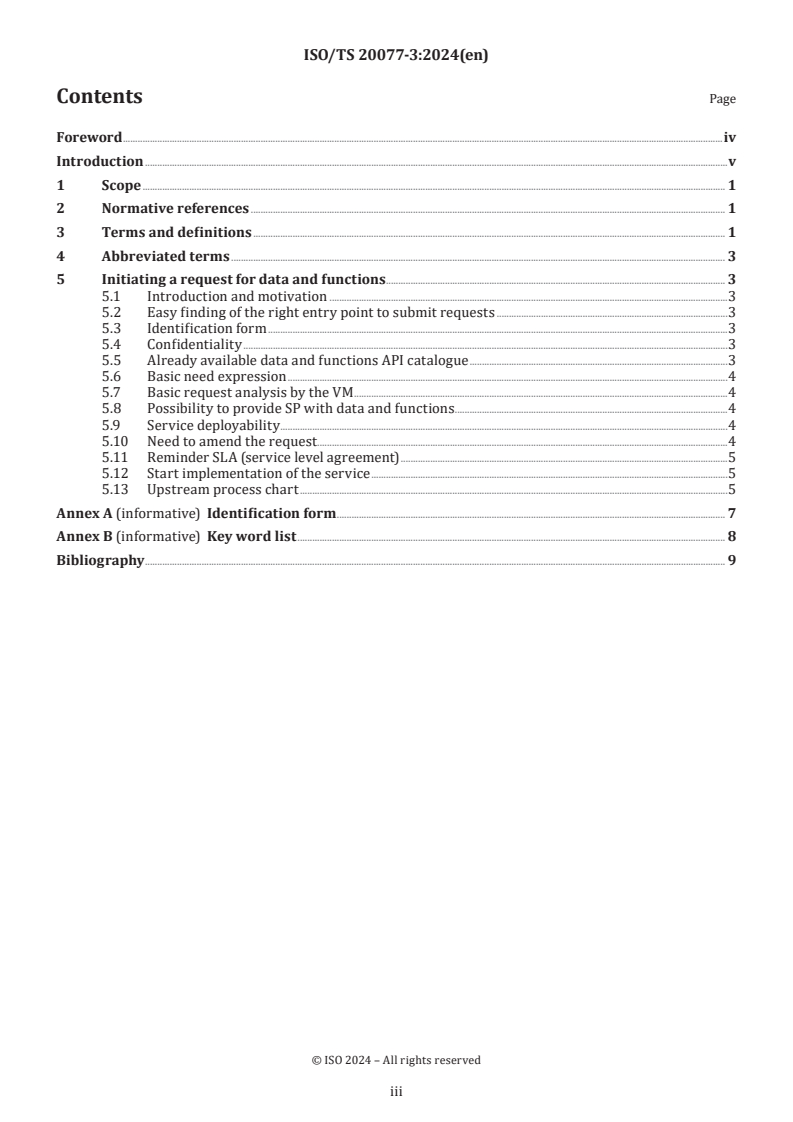
Contents Page
Foreword .iv
Introduction .v
1 Scope . 1
2 Normative references . 1
3 Terms and definitions . 1
4 Abbreviated terms . 3
5 Initiating a request for data and functions . 3
5.1 Introduction and motivation .3
5.2 Easy finding of the right entry point to submit requests .3
5.3 Identification form .3
5.4 Confidentiality .3
5.5 Already available data and functions API catalogue .3
5.6 Basic need expression .4
5.7 Basic request analysis by the VM .4
5.8 Possibility to provide SP with data and functions .4
5.9 Service deployability .4
5.10 Need to amend the request .4
5.11 Reminder SLA (service level agreement) .5
5.12 Start implementation of the service .5
5.13 Upstream process chart .5
Annex A (informative) Identification form . 7
Annex B (informative) Key word list . 8
Bibliography . 9
iii
Foreword
ISO (the International Organization for Standardization) is a worldwide federation of national standards
bodies (ISO member bodies). The work of preparing International Standards is normally carried out through
ISO technical committees. Each member body interested in a subject for which a technical committee
has been established has the right to be represented on that committee. International organizations,
governmental and non-governmental, in liaison with ISO, also take part in the work. ISO collaborates closely
with the International Electrotechnical Commission (IEC) on all matters of electrotechnical standardization.
The procedures used to develop this document and those intended for its further maintenance are described
in the ISO/IEC Directives, Part 1. In particular, the different approval criteria needed for the different types
of ISO document should be noted. This document was drafted in accordance with the editorial rules of the
ISO/IEC Directives, Part 2 (see www.iso.org/directives).
ISO draws attention to the possibility that the implementation of this document may involve the use of (a)
patent(s). ISO takes no position concerning the evidence, validity or applicability of any claimed patent
rights in respect thereof. As of the date of publication of this document, ISO had not received notice of (a)
patent(s) which may be required to implement this document. However, implementers are cautioned that
this may not represent the latest information, which may be obtained from the patent database available at
www.iso.org/patents. ISO shall not be held responsible for identifying any or all such patent rights.
Any trade name used in this document is information given for the convenience of users and does not
constitute an endorsement.
For an explanation of the voluntary nature of standards, the meaning of ISO specific terms and expressions
related to conformity assessment, as well as information about ISO's adherence to the World Trade
Organization (WTO) principles in the Technical Barriers to Trade (TBT), see www.iso.org/iso/foreword.html.
This document was prepared by Technical Committee ISO/TC 22, Road vehicles, Subcommittee SC 31, Data
communication.
A list of all parts in the ISO 20077 series can be found on the ISO website.
Any feedback or questions on this document should be directed to the user’s national standards body. A
complete listing of these bodies can be found at www.iso.org/members.html.
iv
Introduction
There is a need to facilitate starting a process of requesting data and functions from the various interfaces
of the extended vehicle as defined in ISO 20077-1.
It is indeed useful to help any requesting party to quickly find the right way to express their needs towards
the right place or the right resource provider without wasting time due to the multiplicity of providers.
This document is intended to facilitate the communication process between independent stakeholders
and vehicle manufacturers (VMs), whereby service providers (SPs) seek to acquire data for the purpose of
developing services.
The proposed process and template aim at helping to initiate a request by independent stakeholders and/or
SPs for data and functions made available by the VMs or their offering parties.
v
Technical Specification ISO/TS 20077-3:2024(en)
Road vehicles — Extended vehicle (ExVe) methodology —
Part 3:
Upstream process to develop services
1 Scope
This document describes the process to initiate and facilitate the communication between independent
stakeholders and vehicle manufacturers (VMs), whereby service providers (SPs) express the intention to
obtain data and functions access from the ExVe interfaces for the purpose of developing services. Data and
functions of the vehicle are basic information that are key for the development of services for the vehicle
owner, driver, and user. Vehicle data and functions, in this context, comprises onboard, offboard or a
combination of the two.
This document, in conjunction with ISO 20077-1 and ISO 20077-2, describes the full process for the provision
of data and functions access from the ExVe interfaces between the SP and the VM.
All the situations where requested data and functions are dedicated to internal development and design
or product quality improvements from the VMs' and suppliers' side, when they are not acting as service
providers, are excluded from this document. Also, commercial aspects are out of the scope of this document.
2 Normative references
There are no normative references in this document.
3 Terms and definitions
For the purposes of this document, the following terms and definitions apply.
ISO and IEC maintain terminology databases for use in standardization at the following addresses:
— ISO Online browsing platform: available at https:// www .iso .org/ obp
— IEC Electropedia: available at https:// www .electropedia .org/
3.1
extended vehicle
entity, still in accordance with the specifications of the vehicle manufacturer (VM) (3.5), that extends beyond
the physical boundaries of the road vehicle and consists of the road vehicle, off-board systems, external
interfaces, and the data communication between the road-vehicle and the off-board systems
Note 1 to entry: Road vehicles without off-board systems and road vehicles eq
...