

ISO 20760-2:2025
(Main)Water reuse in urban areas — Guidelines for centralized water reuse system — Part 2: Management of a centralized water reuse system
General Information
- Abstract
This document provides guidelines for the management of centralized water reuse systems and water reuse applications in urban areas. This document addresses centralized water reuse systems in their entirety and is applicable to any water reclamation system component (e.g. source water, treatment, storage, distribution, operation and maintenance and monitoring). This document provides: — principles and methodology of reclaimed water management; — management issues in each system component of a centralized water reuse system; — water quality monitoring; — specific aspects for consideration and emergency response. This document excludes monitoring parameters and regulatory values (e.g. water quality limits) of a centralized water reuse system.
- Status
- Published
- Publication Date
- 13-Nov-2025
- Technical Committee
- ISO/TC 282/SC 2 - Water reuse in urban areas
- Drafting Committee
- ISO/TC 282/SC 2/WG 1 - Centralized system design
- Current Stage
- 6060 - International Standard published
- Start Date
- 14-Nov-2025
- Due Date
- 18-Dec-2025
- Completion Date
- 14-Nov-2025


Overview
ISO 20760-2:2025 - "Water reuse in urban areas - Guidelines for centralized water reuse system - Part 2: Management of a centralized water reuse system" provides comprehensive guidance for the management of centralized water reuse systems in urban areas. The standard covers the full system lifecycle - from source water and treatment to storage, distribution, operation, maintenance and monitoring - and focuses on management principles, risk control and operational continuity. It does not prescribe specific monitoring parameters or regulatory values (water quality limits).
Key topics and technical requirements
ISO 20760-2 emphasizes practical management measures and includes guidance on:
- Principles and methodology for reclaimed water management and integration with broader water resources planning.
- Risk management and health-protection strategies tailored to centralized reuse systems.
- Management of each system component:
- Source water characterization and control
- Treatment systems operation and performance monitoring
- Storage systems (location, operational considerations)
- Distribution systems: delivery pressure/flow, colour‑coding, signage, backflow and cross‑connection control, leakage and corrosion control, service connections
- Water quality monitoring frameworks: baseline, validation, operational and verification monitoring (types and roles rather than numerical limits).
- Incident and emergency management: response planning and corrective actions for unintended use or contamination events.
- Supporting recommendations and periodic review of management plans and key performance indicators, including considerations for online data management and process KPIs.
Practical applications and users
ISO 20760-2 is intended for organizations responsible for planning, operating and regulating urban water reuse systems, such as:
- Water utilities and reclaimed water providers
- Urban planners and municipal authorities
- System designers and consultants
- Treatment plant and distribution system operators
- Environmental and public health regulators
- Facility managers for large developments using centralized reuse
Typical applications include landscape irrigation, toilet and urinal flushing, firefighting, street cleaning, industrial uses, vehicle washing, and replenishment of ornamental/recreational water bodies where centralized reclaimed water supplies are provided.
Related standards
- ISO 20760-1 - Design guidance for centralized water reuse systems (complements management guidance)
- ISO 23056 - Design and management of decentralized/onsite water reuse systems
- ISO 20670 - Water reuse vocabulary (terminology used across ISO 20760 series)
- Regional regulations (e.g., EU minimum requirements for water reuse) can inform local implementation although ISO 20760-2 does not set regulatory limits.
ISO 20760-2 is a practical reference for building safe, resilient and fit‑for‑purpose centralized water reuse programs in urban settings, helping stakeholders manage risks, operations and public acceptance while integrating reuse into wider water resource strategies.
Relations
- Effective Date
- 27-Jan-2024
Get Certified
Connect with accredited certification bodies for this standard

CIS Institut d.o.o.
Personal Protective Equipment (PPE) certification body. Notified Body NB-2890 for EU Regulation 2016/425 PPE.

Kiwa BDA Testing
Building and construction product certification.
Kmetijski inštitut Slovenije
Agricultural Institute of Slovenia. Soil testing, plant health, agricultural product analysis.
Sponsored listings
Frequently Asked Questions
ISO 20760-2:2025 is a standard published by the International Organization for Standardization (ISO). Its full title is "Water reuse in urban areas — Guidelines for centralized water reuse system — Part 2: Management of a centralized water reuse system". This standard covers: This document provides guidelines for the management of centralized water reuse systems and water reuse applications in urban areas. This document addresses centralized water reuse systems in their entirety and is applicable to any water reclamation system component (e.g. source water, treatment, storage, distribution, operation and maintenance and monitoring). This document provides: — principles and methodology of reclaimed water management; — management issues in each system component of a centralized water reuse system; — water quality monitoring; — specific aspects for consideration and emergency response. This document excludes monitoring parameters and regulatory values (e.g. water quality limits) of a centralized water reuse system.
This document provides guidelines for the management of centralized water reuse systems and water reuse applications in urban areas. This document addresses centralized water reuse systems in their entirety and is applicable to any water reclamation system component (e.g. source water, treatment, storage, distribution, operation and maintenance and monitoring). This document provides: — principles and methodology of reclaimed water management; — management issues in each system component of a centralized water reuse system; — water quality monitoring; — specific aspects for consideration and emergency response. This document excludes monitoring parameters and regulatory values (e.g. water quality limits) of a centralized water reuse system.
ISO 20760-2:2025 is classified under the following ICS (International Classification for Standards) categories: 13.060.01 - Water quality in general. The ICS classification helps identify the subject area and facilitates finding related standards.
ISO 20760-2:2025 has the following relationships with other standards: It is inter standard links to ISO 20760-2:2017. Understanding these relationships helps ensure you are using the most current and applicable version of the standard.
ISO 20760-2:2025 is available in PDF format for immediate download after purchase. The document can be added to your cart and obtained through the secure checkout process. Digital delivery ensures instant access to the complete standard document.
Standards Content (Sample)
International
Standard
ISO 20760-2
Second edition
Water reuse in urban areas —
2025-11
Guidelines for centralized water
reuse system —
Part 2:
Management of a centralized water
reuse system
Réutilisation de l'eau en milieu urbain — Lignes directrices
concernant les systèmes centralisés de réutilisation de l'eau —
Partie 2: Gestion d'un système centralisé de réutilisation de l'eau
Reference number
© ISO 2025
All rights reserved. Unless otherwise specified, or required in the context of its implementation, no part of this publication may
be reproduced or utilized otherwise in any form or by any means, electronic or mechanical, including photocopying, or posting on
the internet or an intranet, without prior written permission. Permission can be requested from either ISO at the address below
or ISO’s member body in the country of the requester.
ISO copyright office
CP 401 • Ch. de Blandonnet 8
CH-1214 Vernier, Geneva
Phone: +41 22 749 01 11
Email: copyright@iso.org
Website: www.iso.org
Published in Switzerland
ii
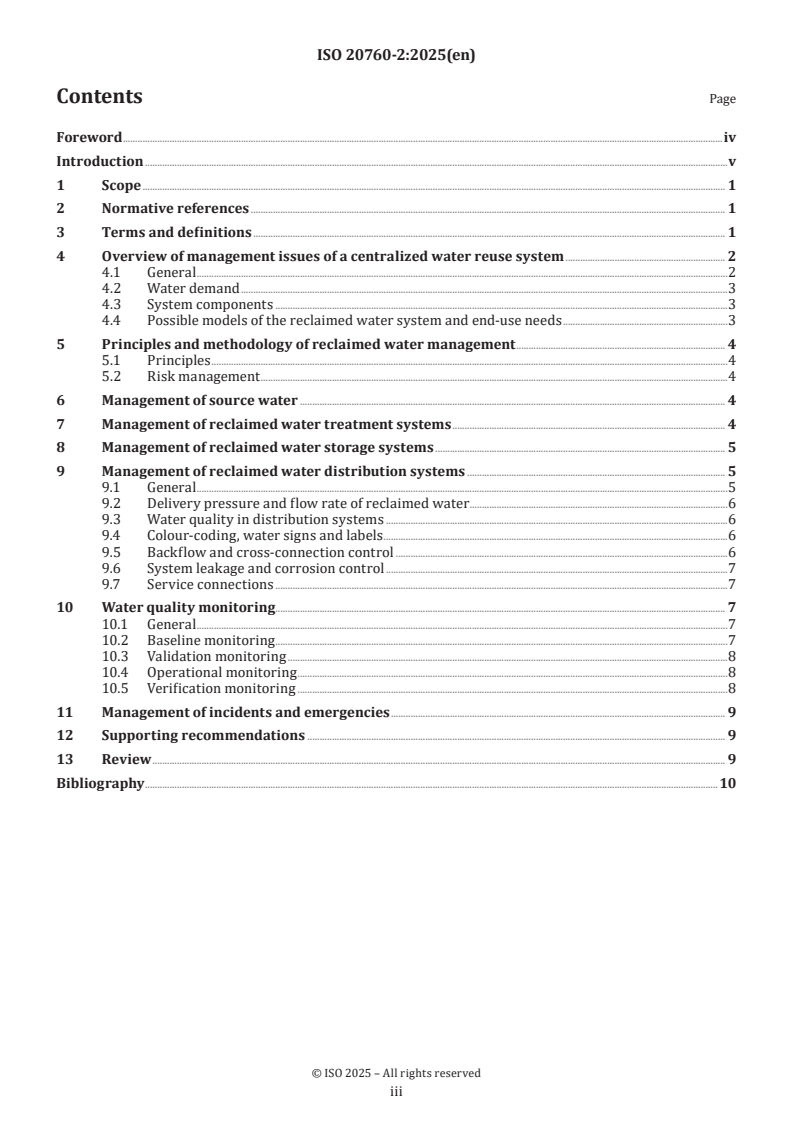
Contents Page
Foreword .iv
Introduction .v
1 Scope . 1
2 Normative references . 1
3 Terms and definitions . 1
4 Overview of management issues of a centralized water reuse system . 2
4.1 General .2
4.2 Water demand .3
4.3 System components .3
4.4 Possible models of the reclaimed water system and end-use needs .3
5 Principles and methodology of reclaimed water management . 4
5.1 Principles .4
5.2 Risk management .4
6 Management of source water . 4
7 Management of reclaimed water treatment systems . 4
8 Management of reclaimed water storage systems . 5
9 Management of reclaimed water distribution systems . 5
9.1 General .5
9.2 Delivery pressure and flow rate of reclaimed water .6
9.3 Water quality in distribution systems .6
9.4 Colour-coding, water signs and labels .6
9.5 Backflow and cross-connection control .6
9.6 System leakage and corrosion control .7
9.7 Service connections .7
10 Water quality monitoring . 7
10.1 General .7
10.2 Baseline monitoring . .7
10.3 Validation monitoring .8
10.4 Operational monitoring .8
10.5 Verification monitoring .8
11 Management of incidents and emergencies . 9
12 Supporting recommendations . 9
13 Review . 9
Bibliography .10
iii
Foreword
ISO (the International Organization for Standardization) is a worldwide federation of national standards
bodies (ISO member bodies). The work of preparing International Standards is normally carried out through
ISO technical committees. Each member body interested in a subject for which a technical committee
has been established has the right to be represented on that committee. International organizations,
governmental and non-governmental, in liaison with ISO, also take part in the work. ISO collaborates closely
with the International Electrotechnical Commission (IEC) on all matters of electrotechnical standardization.
The procedures used to develop this document and those intended for its further maintenance are described
in the ISO/IEC Directives, Part 1. In particular, the different approval criteria needed for the different types
of ISO documents should be noted. This document was drafted in accordance with the editorial rules of the
ISO/IEC Directives, Part 2 (see www.iso.org/directives).
ISO draws attention to the possibility that the implementation of this document may involve the use of (a)
patent(s). ISO takes no position concerning the evidence, validity or applicability of any claimed patent
rights in respect thereof. As of the date of publication of this document, ISO had not received notice of (a)
patent(s) which may be required to implement this document. However, implementers are cautioned that
this may not represent the latest information, which may be obtained from the patent database available at
www.iso.org/patents. ISO shall not be held responsible for identifying any or all such patent rights.
Any trade name used in this document is information given for the convenience of users and does not
constitute an endorsement.
For an explanation of the voluntary nature of standards, the meaning of ISO specific terms and expressions
related to conformity assessment, as well as information about ISO’s adherence to the World Trade
Organization (WTO) principles in the Technical Barriers to Trade (TBT), see www.iso.org/iso/foreword.html.
This document was prepared by Technical Committee ISO/TC 282, Water reuse, Subcommittee SC 2, Water
reuse in urban areas.
This second edition cancels and replaces the first edition (ISO 20760-2:2017), which has been technically
revised.
The main changes are as follows:
— updated example regarding water reuse management initiatives in the European Union;
— updated information on the typical disinfection techniques;
— added information on the key performance indicators for typical treatment processes;
— added information regarding online data management.
A list of all parts in the ISO 20760 series can be found on the ISO website.
Any feedback or questions on this document should be directed to the user’s national standards body. A
complete listing of these bodies can be found at www.iso.org/members.html.
iv
Introduction
With economic development, climate change and increases in population and rapid urbanization, water has
become a strategic resource especially in arid and semi-arid regions. Water shortages are considered as one
of the most serious threats to sustainable development of society. To address these shortages, reclaimed
water is increasingly being used to satisfy water demands and this strategy has proven useful in increasing
the reliability of long-term water supplies in many water-scarce areas.
The role of water reuse is growing for urban areas in many countries including landscape irrigation,
industrial uses, toilet and urinal flushing, firefighting and fire suppression, street cleaning, environmental
and recreational uses (ornamental water features, water bodies’ replenishment, etc.) and vehicle washing.
These centralized water reuse systems have been developed to the degree that they are now considered as
an effective component of urban water management and are used in many cities and countries.
The essential components of a centralized water reuse system include wastewater collection systems
(sewers and pumping stations), water source, a reclaimed water treatment system, reclaimed water storage,
a reclaimed water distribution system, and a water quality monitoring system. The management concepts
and principles are suggested to be implemented throughout the whole system, from the source water to the
end users. Each component should be characterized and managed with appropriate strategies.
This document provides management concepts and principles for centralized water reuse systems in urban
areas. It considers and addresses the critical issues or factors during management, which will facilitate water
authorities and reclaimed water providers or practitioners, or both, to conduct cost-effective approaches for
safe and reliable fit-for-purpose water reuse. For details on the design of a centralized water reuse system,
see ISO 20760-1. Additionally, for details on the design and management of decentralized or onsite water
reuse systems in urban areas, see ISO 23056.
v
International Standard ISO 20760-2:2025(en)
Water reuse in urban areas — Guidelines for centralized
water reuse system —
Part 2:
Management of a centralized water reuse system
1 Scope
This document provides guidelines for the management of centralized water reuse systems and water reuse
applications in urban areas.
This document addresses centralized water reuse systems in their entirety and is applicable to any
water reclamation system component (e.g. source water, treatment, storage, distribution, operation and
maintenance and monitoring).
This document provides:
— principles and methodology of reclaimed water management;
— management issues in each system component of a centralized water reuse system;
— water quality monitoring;
— specific aspects for consideration and emergency response.
This document excludes monitoring parameters and regulatory values (e.g. water quality limits) of a
centralized water reuse system.
2 Normative references
The following documents are referred to in the text in such a way that some or all of their content constitute
requirements of this document. For dated references, only the edition cited applies. For undated references,
the latest edition of the referenced document (including any amendments) applies.
ISO 20670, Water reuse — Vocabulary
3 Terms and definitions
For the purposes of this document, the terms and definitions given in ISO 20670 apply.
ISO and IEC maintain terminology databases for use in standardization at the following addresses:
— ISO Online browsing platform: available at https:// www .iso .org/ obp
— IEC Electropedia: available at https:// www .electropedia .org/
4 Overview of management issues of a centralized water reuse system
4.1 General
The system analysis and management of a centralized water reuse system should have an understanding of
the entire system, which generally includes several aspects:
a) water supply needs;
b) assessment of the reclaimed water system (e.g. environmental sustainability and health risk);
c) preventive maintenance measures for reclaimed water management;
d) operational procedures and process control;
e) verification of reclaimed water quality to ensure public health protection while providing environmental
benefits;
f) social and public aspects on water supply needs and the water quality needs;
g) incident and emergency management.
The management framework can be supplemented with supporting recommendations and should be
periodically reviewed and modified. The planning of review periods should take into account the influencing
technical and environmental factors. As the wastewater production of an area differs (e.g. seasonal and
tourist activities, cultural influence) the management practices and review periods should be adjusted.
Water reuse management should be consistent with the overall water resources management objectives.
A good example is the EU Regulation on Minimum Requirements for Water Reuse which builds in line with
the provisions of the Water Framework Directive and the Urban Wastewater Treatment Directive in the
European Union. The application of an integrated or global water management approach is a means of
improving water resource management, and water reuse and the reduction of waste streams can be key
[12][13][14]
factors in this holistic planning method.
For instance, a centralized water reuse management plan can be developed considering the following issues:
— management principles and objectives:
— risk and health issues;
— site conditions and urban planning;
— demands and expectations of the users and other stakeholders;
— financial capability and environmental benefits to initiate an urban water reuse system development;
— management considerations for each system component:
— source water, treatment systems, storage systems, distribution systems, water quality monitoring, etc.;
— corrective actions:
— deficiencies identified through the planning and operational processes;
— unintended use control such as cross-connections and unintended discharges;
— control and improvement of the quality of the source water (e.g. secondary effluents delivered by the
wastewater treatment plant) in cooperation with the users and stakeholders;
— preventive maintenance measures:
— staff responsibility to develop new user agreements, utilities, onsite design and retrofit needs, public
education programs, etc.;
— social and public aspects:
— affordability and acceptance of the service to users;
— public consultation (e.g. a communication plan and a feedback system);
— public awareness on pollution prevention;
— cultural aspects;
— notification signs to make sure the public is aware of reclaimed water use.
4.2 Water demand
The water consumption and the ratio between planned demand and current use of reclaimed water should
be followed and analysed on a regular basis. New demands for reclaimed water should also be assessed
including the type and location of potential end users that can be served by reclaimed water and the ability to
economically meet their demands. The reclaimed water supply characteristics can include quantity, quality,
diurnal and seasonal variations, weather, delivery pressures, water flow rates, existing and potential new
customers.
4.3 System components
A centralized water reuse system is generally comprised of five essential components: water source, treatment,
storage, distribution and monitoring. Effective management should have an overall understanding of the
reclaimed water system from the source to the end user. Each part of the system should be characterized
and managed with appropriate strategies. For instance, the strategies should establish goals for treatment
process effectiveness and efficiency, storage specificities, distribution system performance, etc. Regular
monitoring is suggested to determine compliance with the goals and take appropriate actions if goals are
not achieved. However, the detailed needs can depend on the complexity of the system. For example, the
storage systems can be located either before or after the distribution system, or both, depending on the
distribution system hydraulic design and should equalize reclaimed water quantity and system pressures.
4.4 Possible models of the reclaimed water system and end-use needs
There are different models of a reclaimed water reuse system from a simple usage pattern to more
complicated ones for either single or multiple application purposes, or both. The management of a system
should take into account end-use needs to maximize reliability to all customers, such as:
a) assessment of the suitability of reclaimed water (e.g. quantity, quality and location) to end-user purpose;
b) installation of additional equipment (e.g. a booster pumping station to increase system pressures);
c) prevention of inappropriate use of reclaimed water.
Specifically, risk assessment and good operation practices should be developed and implemented. In all cases,
special considerations can be given to financial, public health, environmental and public awareness issues.
5 Principles and methodology of reclaimed water management
5.1 Principles
When managing the centralized water reuse system, the basic principles include safety, effectiveness,
reliability, efficiency and economic viability. In particular, water quality safety and reliability should
[15]
be analysed in each system component to protect human health and the environment. Specific risk
management principles include the following.
a) Protection of public and environmental health is of paramount importance and should never be
compromised.
b) Protection of public and environmental health depends on implementing a preventive risk management
approach.
c) Application of corrective actions and preventive measures for water quality should be commensurate
with the source of reclaimed water and the intended uses.
5.2 Risk management
Depending on the system scale and end use applications, risk management approaches can be considered for
certain applications (e.g. vehicle washing, toilet flushing, recreational uses). For instance, a hazard analysis
and critical control point (HACCP) plan for monitoring the performance of ultrafiltration (UF) membranes
towards the removal of human pathogens may be either daily pressure decay tests or inline turbidity
monitoring, or both. For end uses without direct or close human contact, simplified risk assessment, water
safety or other methodologies or tools should be considered, see ISO 20761, ISO 20426, ISO 22000 and
References [16], [17], [18],[19] and [20].Corrective actions can be programmed into the system if any of the
critical control points (CCPs) are out of range. Operators should implement preventive measures and control
to ensure the effectiveness and efficiency of the processes, anticipate potential problems and respond before
problems become critical.
6 Management of source water
A source water management program should be carried out by proponents or authorized practitioners.
[21]
The program should be consistent with facilities’ management practices to measure and monitor the
quality of reclaimed water. For example, an early warning system can be included in the program which
can provide timely information to detect sudden changes in source water quality (e.g. caused by heavy
[22]
rains, flooding, or industrial accidents). Knowledgeable decisions or responses can be made concerning
changing treatment and operational methods or closing intakes. Accordingly, a source control program
(e.g. wastewater treatment plants can have an agreement with industries to prevent hazards entering the
wastewater collection system, see ISO 24511) can be implemented to document contaminant concentrations
and diversion alternatives.
In addition, a response and management plan for mitigating reclaimed water shortages can be developed and
maintained depending on whether reclaimed water supply is critical to customers. The plan should include
provisions of backup water resources for short-term essential services and strategies to allow seasonal or
interruptible reclaimed water use, or scheduling deliveries (e.g. defined watering schedule).
7 Management of reclaimed water treatment systems
The management of a reclaimed water treatment system should be undertaken in a manner that optimizes
the use of equipment and resources involved, while protecting public health. Treatment operation and
management objectives should be clearly defined based on the specific needs, intended uses, financial and
environmental concerns and other factors.
A multiple-barrier approach together with a monitoring, sampling and testing plan should be developed
throughout the treatment pr
...