


ISO 16840-6
(Main)Wheelchair seating - Part 6: Determination of changes in properties of seat cushions following simulated use
Wheelchair seating - Part 6: Determination of changes in properties of seat cushions following simulated use
ISO 16840-6:2015 specifies apparatus, test methods, and disclosure requirements for generating aging effects in a seat cushion that reproduce those seen in use. It also provides methods of determining changes in the physical and mechanical properties of seat cushions based on their age and use. ISO 16840-6:2015 provides a set of tests that simulate wear and tear, which can be useful to validate warranty claims and to provide information about product, life, and performance limitations associated with product use.
Sièges de fauteuils roulants — Partie 6: Détermination des changements de propriétés des coussins de sièges après simulation d'utilisation
ISO 16840-6:2015 spécifie l'appareillage, les méthodes d'essai et les exigences de diffusion de documentation pour la production d'effets de vieillissement dans un coussin de siège reproduisant les effets observés lors de l'utilisation. Elle fournit également des méthodes de détermination des changements de propriétés physiques et mécaniques des coussins de siège en fonction de leur âge et de leur utilisation. La présente partie de l'ISO 16840 spécifie une série d'essais d'usure qui peuvent être utiles pour valider les recours en garantie et pour fournir des informations sur la durée de vie du produit et les limites de performance liées à l'utilisation du produit.
General Information
- Status
- Not Published
- Technical Committee
- ISO/TC 173/SC 1 - Wheelchairs
- Drafting Committee
- ISO/TC 173/SC 1/WG 11 - Wheelchair seating
- Current Stage
- 6000 - International Standard under publication
- Start Date
- 05-Dec-2025
- Completion Date
- 13-Dec-2025
Relations
- Effective Date
- 08-Jun-2024
Overview
ISO 16840-6 (Wheelchair seating - Part 6) defines laboratory apparatus, test methods, and disclosure requirements to reproduce and measure the ageing effects that occur in wheelchair seat cushions through simulated use. The standard establishes repeatable procedures for generating wear (accelerated ageing, cyclic loading, heat/humidity, soiling, laundering, UV/ozone, etc.) and for quantifying resulting changes in physical and mechanical properties. It is maintained by ISO/TC 173/SC 1 (secretariat: SABS) and, at the time of the source document, appears at a DIS/FDIS stage indicating updates in progress.
Key Topics and Requirements
- Apparatus and test environment: Specification of equipment for characterization and controlled ageing of cushions.
- Test sequence and reporting: Preparation, selection and order of tests plus required reporting and disclosure to support consistent data.
- Simulated ageing methods: Accelerated ageing, heat and humidity exposure, UV and ozone, cold exposure, laundering, and disinfection procedures.
- Soiling and cyclic loading: Bacterial, urinary, and faecal soiling combined with cyclic mechanical loading to reproduce real-world contamination and wear.
- Mechanical property tests: Pressure mapping (interface pressure measurement), impact damping, loaded contour depth/overload deflection, lateral/forward stiffness, column buckling, hysteresis, 10% force deflection, sliding resistance and leak testing.
- Performance metrics and calculation methods: Methods for evaluating and reporting changes (e.g., deflection, compression set, damping, stiffness, pressure distribution) after simulated use.
- Disclosure requirements: Information manufacturers should provide on expected life, performance limitations and validated claims (useful for warranties).
Applications and Who Uses It
- Manufacturers and product developers: Validate cushion durability, design improvements, and substantiate performance claims.
- Quality assurance and testing labs: Perform standardized ageing and mechanical tests to certify product consistency.
- Clinicians and seating specialists: Understand how cushions will perform over time and choose products appropriate for pressure care and mobility needs.
- Procurement, regulators and warranty managers: Use standardized data to set procurement specifications, regulatory compliance, and warranty validation.
- Researchers: Compare materials and cushioning systems using repeatable, objective methods.
Related Standards
- ISO 16840-6 is part of the broader ISO 16840 series (wheelchair seating). Refer to other parts of the series for related test methods, dimensions and assessment procedures for seating systems.
Keywords: ISO 16840-6, wheelchair seating, seat cushions, simulated use, accelerated ageing, pressure mapping, cyclic loading, cushioning durability, test methods, disclosure requirements.
ISO/FDIS 16840-6 - Wheelchair seating — Part 6: Determination of changes in properties of seat cushions following simulated use Released:9/25/2025

REDLINE ISO/FDIS 16840-6 - Wheelchair seating — Part 6: Determination of changes in properties of seat cushions following simulated use Released:9/25/2025
Frequently Asked Questions
ISO 16840-6 is a draft published by the International Organization for Standardization (ISO). Its full title is "Wheelchair seating - Part 6: Determination of changes in properties of seat cushions following simulated use". This standard covers: ISO 16840-6:2015 specifies apparatus, test methods, and disclosure requirements for generating aging effects in a seat cushion that reproduce those seen in use. It also provides methods of determining changes in the physical and mechanical properties of seat cushions based on their age and use. ISO 16840-6:2015 provides a set of tests that simulate wear and tear, which can be useful to validate warranty claims and to provide information about product, life, and performance limitations associated with product use.
ISO 16840-6:2015 specifies apparatus, test methods, and disclosure requirements for generating aging effects in a seat cushion that reproduce those seen in use. It also provides methods of determining changes in the physical and mechanical properties of seat cushions based on their age and use. ISO 16840-6:2015 provides a set of tests that simulate wear and tear, which can be useful to validate warranty claims and to provide information about product, life, and performance limitations associated with product use.
ISO 16840-6 is classified under the following ICS (International Classification for Standards) categories: 11.180.10 - Aids and adaptation for moving. The ICS classification helps identify the subject area and facilitates finding related standards.
ISO 16840-6 has the following relationships with other standards: It is inter standard links to ISO 16840-6:2015. Understanding these relationships helps ensure you are using the most current and applicable version of the standard.
ISO 16840-6 is available in PDF format for immediate download after purchase. The document can be added to your cart and obtained through the secure checkout process. Digital delivery ensures instant access to the complete standard document.
Standards Content (Sample)
FINAL DRAFT
International
Standard
ISO/FDIS 16840-6
ISO/TC 173/SC 1
Wheelchair seating —
Secretariat: SABS
Part 6:
Voting begins on:
2025-10-09
Determination of changes in
properties of seat cushions
Voting terminates on:
2025-12-04
following simulated use
RECIPIENTS OF THIS DRAFT ARE INVITED TO SUBMIT,
WITH THEIR COMMENTS, NOTIFICATION OF ANY
RELEVANT PATENT RIGHTS OF WHICH THEY ARE AWARE
AND TO PROVIDE SUPPOR TING DOCUMENTATION.
IN ADDITION TO THEIR EVALUATION AS
BEING ACCEPTABLE FOR INDUSTRIAL, TECHNO-
LOGICAL, COMMERCIAL AND USER PURPOSES, DRAFT
INTERNATIONAL STANDARDS MAY ON OCCASION HAVE
TO BE CONSIDERED IN THE LIGHT OF THEIR POTENTIAL
TO BECOME STAN DARDS TO WHICH REFERENCE MAY BE
MADE IN NATIONAL REGULATIONS.
Reference number
ISO/FDIS 16840-6:2025(en) © ISO 2025
FINAL DRAFT
ISO/FDIS 16840-6:2025(en)
International
Standard
ISO/FDIS 16840-6
ISO/TC 173/SC 1
Wheelchair seating —
Secretariat: SABS
Part 6:
Voting begins on:
Determination of changes in
properties of seat cushions
Voting terminates on:
following simulated use
RECIPIENTS OF THIS DRAFT ARE INVITED TO SUBMIT,
WITH THEIR COMMENTS, NOTIFICATION OF ANY
RELEVANT PATENT RIGHTS OF WHICH THEY ARE AWARE
AND TO PROVIDE SUPPOR TING DOCUMENTATION.
© ISO 2025
IN ADDITION TO THEIR EVALUATION AS
All rights reserved. Unless otherwise specified, or required in the context of its implementation, no part of this publication may
BEING ACCEPTABLE FOR INDUSTRIAL, TECHNO-
LOGICAL, COMMERCIAL AND USER PURPOSES, DRAFT
be reproduced or utilized otherwise in any form or by any means, electronic or mechanical, including photocopying, or posting on
INTERNATIONAL STANDARDS MAY ON OCCASION HAVE
the internet or an intranet, without prior written permission. Permission can be requested from either ISO at the address below
TO BE CONSIDERED IN THE LIGHT OF THEIR POTENTIAL
or ISO’s member body in the country of the requester.
TO BECOME STAN DARDS TO WHICH REFERENCE MAY BE
MADE IN NATIONAL REGULATIONS.
ISO copyright office
CP 401 • Ch. de Blandonnet 8
CH-1214 Vernier, Geneva
Phone: +41 22 749 01 11
Email: copyright@iso.org
Website: www.iso.org
Published in Switzerland Reference number
ISO/FDIS 16840-6:2025(en) © ISO 2025
ii
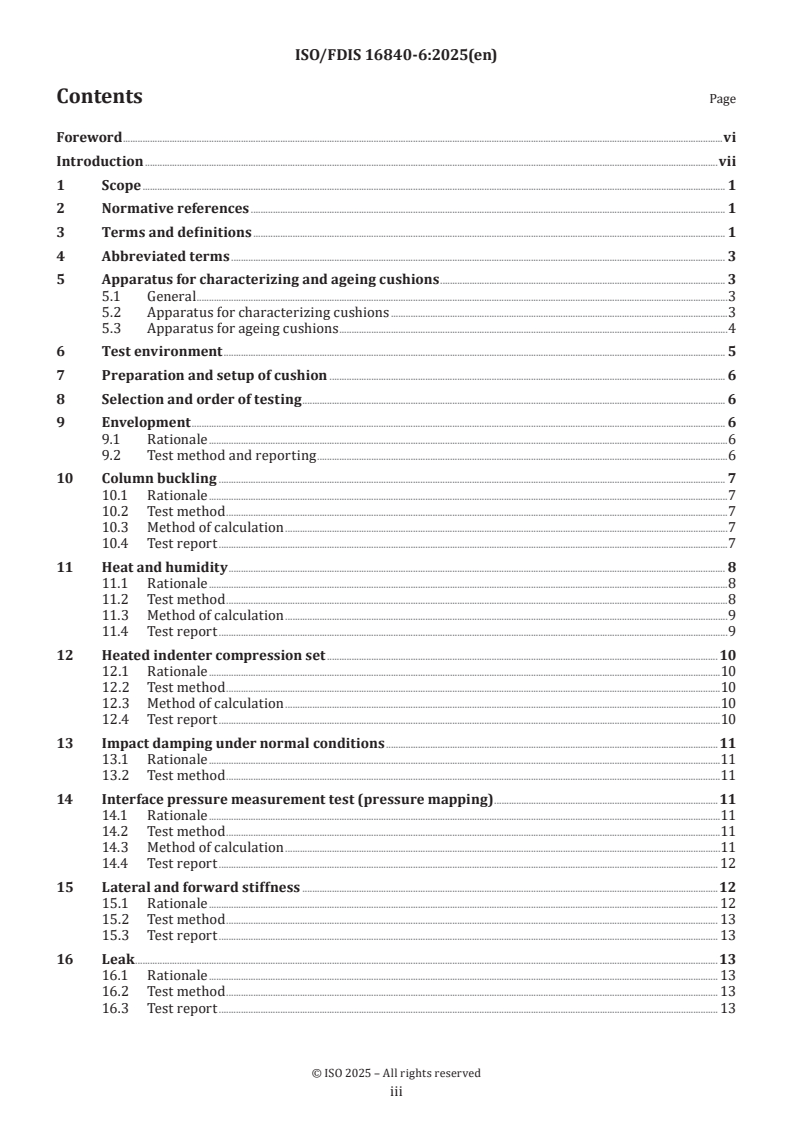
ISO/FDIS 16840-6:2025(en)
Contents Page
Foreword .vi
Introduction .vii
1 Scope . 1
2 Normative references . 1
3 Terms and definitions . 1
4 Abbreviated terms . 3
5 Apparatus for characterizing and ageing cushions . 3
5.1 General .3
5.2 Apparatus for characterizing cushions .3
5.3 Apparatus for ageing cushions .4
6 Test environment . 5
7 Preparation and setup of cushion . 6
8 Selection and order of testing . 6
9 Envelopment . 6
9.1 Rationale .6
9.2 Test method and reporting .6
10 Column buckling . 7
10.1 Rationale .7
10.2 Test method .7
10.3 Method of calculation .7
10.4 Test report .7
11 Heat and humidity . 8
11.1 Rationale .8
11.2 Test method .8
11.3 Method of calculation .9
11.4 Test report .9
12 Heated indenter compression set . 10
12.1 Rationale .10
12.2 Test method .10
12.3 Method of calculation .10
12.4 Test report .10
13 Impact damping under normal conditions .11
13.1 Rationale .11
13.2 Test method .11
14 Interface pressure measurement test (pressure mapping) .11
14.1 Rationale .11
14.2 Test method .11
14.3 Method of calculation .11
14.4 Test report . 12
15 Lateral and forward stiffness .12
15.1 Rationale . 12
15.2 Test method . 13
15.3 Test report . 13
16 Leak .13
16.1 Rationale . 13
16.2 Test method . 13
16.3 Test report . 13
iii
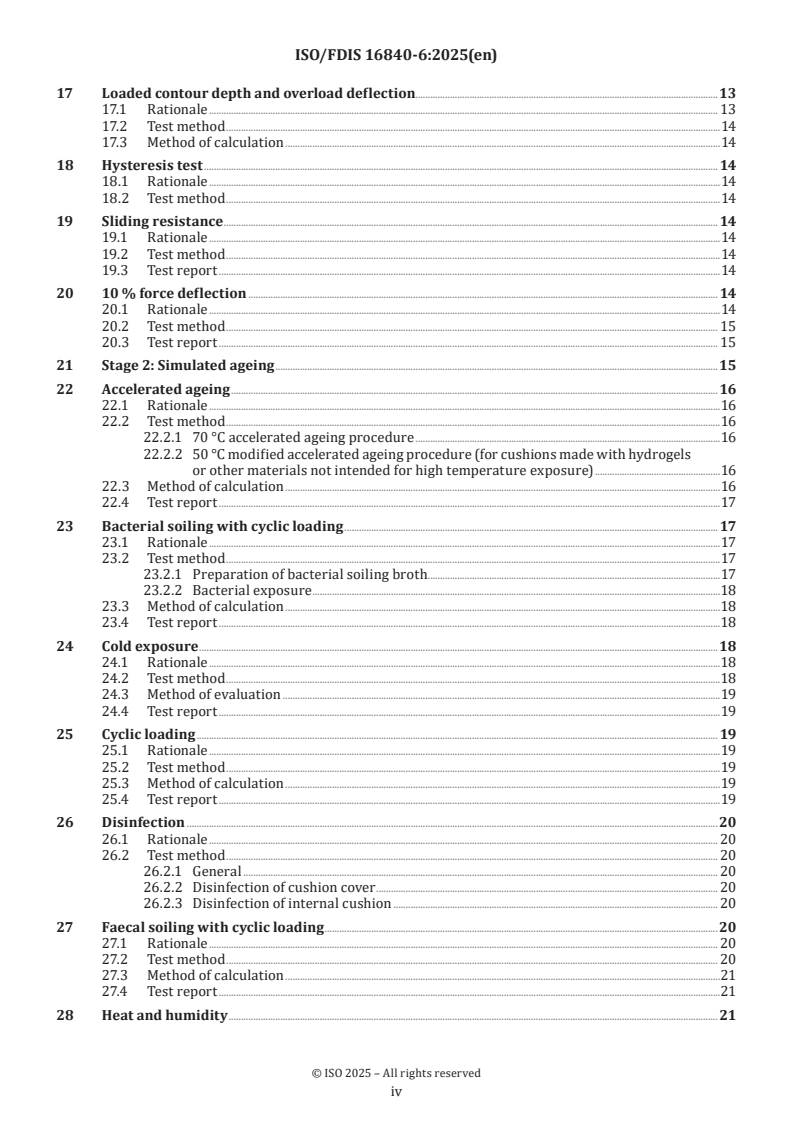
ISO/FDIS 16840-6:2025(en)
17 Loaded contour depth and overload deflection .13
17.1 Rationale . 13
17.2 Test method .14
17.3 Method of calculation .14
18 Hysteresis test . 14
18.1 Rationale .14
18.2 Test method .14
19 Sliding resistance . 14
19.1 Rationale .14
19.2 Test method .14
19.3 Test report .14
20 10 % force deflection . 14
20.1 Rationale .14
20.2 Test method . 15
20.3 Test report . 15
21 Stage 2: Simulated ageing .15
22 Accelerated ageing . 16
22.1 Rationale .16
22.2 Test method .16
22.2.1 70 °C accelerated ageing procedure .16
22.2.2 50 °C modified accelerated ageing procedure (for cushions made with hydrogels
or other materials not intended for high temperature exposure) .16
22.3 Method of calculation .16
22.4 Test report .17
23 Bacterial soiling with cyclic loading . 17
23.1 Rationale .17
23.2 Test method .17
23.2.1 Preparation of bacterial soiling broth .17
23.2.2 Bacterial exposure .18
23.3 Method of calculation .18
23.4 Test report .18
24 Cold exposure .18
24.1 Rationale .18
24.2 Test method .18
24.3 Method of evaluation .19
24.4 Test report .19
25 Cyclic loading . 19
25.1 Rationale .19
25.2 Test method .19
25.3 Method of calculation .19
25.4 Test report .19
26 Disinfection .20
26.1 Rationale . 20
26.2 Test method . 20
26.2.1 General . 20
26.2.2 Disinfection of cushion cover . 20
26.2.3 Disinfection of internal cushion . 20
27 Faecal soiling with cyclic loading .20
27.1 Rationale . 20
27.2 Test method . 20
27.3 Method of calculation .21
27.4 Test report .21
28 Heat and humidity .21
iv
ISO/FDIS 16840-6:2025(en)
28.1 Rationale .21
28.2 Test method .21
28.3 Method of calculation .21
28.4 Test report .21
29 Laundering .21
29.1 Rationale .21
29.2 Test method . 22
29.2.1 General . 22
29.2.2 Laundering cushion cover . 22
29.2.3 Laundering internal cushion . 22
29.3 Method of calculation . 22
29.4 Test report . 22
30 Urinary soiling with cyclic loading .22
30.1 Rationale . 22
30.2 Test method . 22
30.3 Method of calculation . 23
30.4 Test report . 23
31 UV and ozone exposure.23
31.1 Rationale . 23
31.2 Test method . 23
31.3 Method of calculation .24
31.4 Test report .24
32 Stage 3: Post-aged cushion testing .24
33 Method of calculations .24
34 Test report .24
Annex A (informative) Influences that drive changes in seat cushion performance .26
Bibliography .27
v
ISO/FDIS 16840-6:2025(en)
Foreword
ISO (the International Organization for Standardization) is a worldwide federation of national standards
bodies (ISO member bodies). The work of preparing International Standards is normally carried out through
ISO technical committees. Each member body interested in a subject for which a technical committee
has been established has the right to be represented on that committee. International organizations,
governmental and non-governmental, in liaison with ISO, also take part in the work. ISO collaborates closely
with the International Electrotechnical Commission (IEC) on all matters of electrotechnical standardization.
The procedures used to develop this document and those intended for its further maintenance are described
in the ISO/IEC Directives, Part 1. In particular, the different approval criteria needed for the different types
of ISO documents should be noted. This document was drafted in accordance with the editorial rules of the
ISO/IEC Directives, Part 2 (see www.iso.org/directives).
ISO draws attention to the possibility that the implementation of this document may involve the use of (a)
patent(s). ISO takes no position concerning the evidence, validity or applicability of any claimed patent
rights in respect thereof. As of the date of publication of this document, ISO had not received notice of (a)
patent(s) which may be required to implement this document. However, implementers are cautioned that
this may not represent the latest information, which may be obtained from the patent database available at
www.iso.org/patents. ISO shall not be held responsible for identifying any or all such patent rights.
Any trade name used in this document is information given for the convenience of users and does not
constitute an endorsement.
For an explanation of the voluntary nature of standards, the meaning of ISO specific terms and expressions
related to conformity assessment, as well as information about ISO’s adherence to the World Trade
Organization (WTO) principles in the Technical Barriers to Trade (TBT), see www.iso.org/iso/foreword.html.
This document was prepared by Technical Committee ISO/TC 173, Assistive products, Subcommittee SC 1,
Wheelchairs.
This second edition cancels and replaces the first edition (ISO 16840-6:2015), which has been technically
revised.
The main changes are as follows:
— testing has been made less onerous and therefore more practicable; this involves the selection of tests
being made by the manufacturer so as to be relevant to the construction of the cushion and its intended use.
A list of all parts in the ISO 16840 series can be found on the ISO website.
Any feedback or questions on this document should be directed to the user’s national standards body. A
complete listing of these bodies can be found at www.iso.org/members.html.
vi
ISO/FDIS 16840-6:2025(en)
Introduction
Wheelchair seat cushions provide improved support and injury prevention for the user. They are used by
those with a variety of needs and by those with varying degrees of disability. Wheelchair seat cushions are
prescribed based on the cushions’ ability to perform under a range of circumstances, from intermittent use to
robust sports use, or use by those with regular incontinence. Each application presents different conditions
that can change the performance of the cushion and can expose the user to hidden risks. Standards for the
evaluation of wheelchair cushions under a wide range of conditions are paramount.
This document describes test methods that characterize the changes in physical and mechanical properties
of seat cushions based on their use and age. This document offers a suite of test methods, not all of which will
be appropriate for all cushions. Therefore, the manufacturer is guided to determine which are appropriate
for their cushion construction and use. It is designed to provide a close approximation of the changes
that have been observed to occur over time. The protocol consists of performing tests to characterize the
properties of a new cushion, subjecting the cushion to multiple simulated ageing processes, then re-testing
the cushion proprieties. Changes that occur are reported.
Prior to following the protocol, the manufacturer is guided to recommend the environment of use of the
cushion, the anticipated failure modes of the cushion, and the cushion characterization tests appropriate
for their product. Just as not all tests are appropriate for all cushions, the exposures within the tests
might not be appropriate for all cushions. Tests can be modified or eliminated based on suitability for
materials, architecture, or use conditions, e.g. a rotational component could be added to the cyclic loading
test, generating additional wear. For some materials, 70 °C can change the failure mode from typical
to temperature-based, depending on the material properties of this cushion. In such a case, 50 °C can be
selected to accelerate the ageing of the cushion over a longer period of time to simulate a failure more typical
of ageing.
These tests are not appropriate for ranking or scoring cushions or for matching these characteristics
directly with the requirements of individual users. While the results of these tests can aid the clinician
in providing care to the patient through selection of support surface characteristics that will, in their
professional judgment, aid the care, treatment, or recovery of the patient, these tests are not there to be
interpreted as prescriptive in and of themselves. The link to clinical efficacy, although implied, has not been
validated. It is intended that this document will evolve when clinical relevance is confirmed. Other parts of
the ISO 16840 series describe test methods for characterizing other support surface characteristics that can
aid the clinician further in the care and treatment of patients.
vii
FINAL DRAFT International Standard ISO/FDIS 16840-6:2025(en)
Wheelchair seating —
Part 6:
Determination of changes in properties of seat cushions
following simulated use
1 Scope
This document specifies apparatus, test methods, and disclosure requirements for generating ageing effects
in a seat cushion that reproduce those seen in use. It provides methods of determining changes in the
physical and mechanical properties of seat cushions based on their age and use. This document provides
a set of tests that simulate wear and tear, which can be useful to validate warranty claims and to provide
information about product, life, and performance limitations associated with product use.
2 Normative references
The following documents are referred to in the text in such a way that some or all of their content constitutes
requirements of this document. For dated references, only the edition cited applies. For undated references,
the latest edition of the referenced document (including any amendments) applies.
ISO 554, Standard atmospheres for conditioning and/or testing — Specifications
ISO 4892-3, Plastics — Methods of exposure to laboratory light sources — Part 3: Fluorescent UV lamps
ISO 9073-8, Nonwovens — Test methods — Part 8: Determination of liquid strike-through time (simulated urine)
for nonwoven coverstocks
ISO 16840-2, Wheelchair seating — Part 2: Determination of physical and mechanical characteristics of seat
cushions intended to manage tissue integrity
ISO 16840-12, Wheelchair seating — Part 12: Envelopment and immersion characterization of seat cushions
using a dual semispherical indenter
AAMI TIR 12, Designing, testing, and labeling medical devices intended for processing by health care facilities:
A guide for device manufacturers
ASTM D395-03, Standard Test Methods for Rubber Property — Compression Set
ASTM D4265-98, Standard Guide for Evaluating Stain Removal Performance in Home Laundering
ASTM F1980-07, Standard Guide for Accelerated Aging of Sterile Barrier Systems for Medical Devices
RESNA SS-1:2019, Section 3, Standard protocol for measuring heat and water vapor dissipation
characteristics of full body support surfaces — body analog method
3 Terms and definitions
For the purposes of this document, the terms and definitions given in ISO 16840-2 and the following apply.
ISO and IEC maintain terminology databases for use in standardization at the following addresses:
— ISO Online browsing platform: available at https:// www .iso .org/ obp
ISO/FDIS 16840-6:2025(en)
— IEC Electropedia: available at https:// www .electropedia .org/
3.1
column buckling
collapse of a structure resulting from a compression load
3.2
compression set
difference between the initial thickness and the final thickness of a test piece of a material after compression
for a given time at a given temperature and after a given recovery time
Note 1 to entry: The difference is referred to the initial thickness.
3.3
disinfection
process to inactivate viable microorganisms to a level previously specified as being appropriate for a
defined purpose
[SOURCE: ISO 11139:2018, 3.84]
3.4
permanent set
irreversible change from the original dimensions that remains after the removal of stress
3.5
failure
change in properties or a loss of integrity that inhibits the ability of a cushion to perform as intended
Note 1 to entry: Changes in properties can include fractures, leaks, delamination, seam failure, etc.
3.5.1
seam failure
change in integrity as demonstrated by one or more of
— fabric tear at a seam,
— breakage of two or more sewing threads within a 25 mm seam length,
— partial or complete slippage (“comb out”) of fabric yarns at a seam creating a gap of 5 mm or more
between adjacent fabric surfaces,
— visible separation of the mating surfaces
Note 1 to entry: Separation can include partial separation, such as peeling of the edges, or a full gap between the layers
extended transverse to the direction of a seam.
3.6
hysteresis
measure of the loading energy lost during a cycle of loading and unloading
Note 1 to entry: A lag in response exhibited by a material reacting to changes in force.
3.7
impact damping
characterization of a material’s ability to absorb vibration and impact
3.8
sliding resistance
characterization of the interaction between the skin and the support surface while force is applied laterally
ISO/FDIS 16840-6:2025(en)
4 Abbreviated terms
IPSA interface pressure sensor array
LCI loaded contour indenter
RCLI rigid cushion loading indenter
5 Apparatus for characterizing and ageing cushions
5.1 General
This clause lists the apparatus that shall be used for the tests. The user shall refer to the referenced
documents for specific apparatus.
5.2 Apparatus for characterizing cushions
The following apparatus are associated with the related test in this document.
5.2.1 Column buckling.
a) Apparatus constructed to apply a load and displacement to a 13 mm diameter glass rod indenter.
b) A 13 mm diameter glass rod, ground to a sphere on one end and mounted in a collet or other device to
allow the application of force and displacement to the rod as an indenter.
c) Mechanism to record both displacement and force applied to the glass rod.
5.2.2 Heat and humidity.
A system equivalent to that specified in RESNA SS-1:2019, Section 3.
5.2.3 Heated indenter compression set.
Heated rigid cushion loading indenter (RCLI) or chamber that can maintain a cushion under compression
testing at the nominal (70 ± 2) °C. The RCLI shall be as specified in ISO 16840-2 and able to apply a constant
load to the cushion over the period of the test.
5.2.4 Impact damping rigid cushion loading indenter (IDRCLI).
The IDRCLI is a means of loading a cushion using an RCLI with a uniformly distributed mass of 500 N ± 10 N
with an accelerometer attached to the reference plane to measure the deceleration of the indenter as it
suddenly loads the cushion, as specified in ISO 16840-2.
5.2.5 Interface pressure sensing array.
A means of applying a 500 N load to a cushion using an RCLI as defined in ISO 16840-2 or performing human
subject testing with an interface pressure sensing array (IPSA) (pressure map).
5.2.6 Lateral and forward movement rig.
A means to support an RCLI at the end of a rigid shaft, allowing the RCLI to move in the lateral and forward
direction on the seat cushion in one plane as described in ISO 16840-2.
ISO/FDIS 16840-6:2025(en)
5.2.7 Leak detection apparatus.
Apparatus capable of detecting the escape of a cushion fill material.
NOTE This can include a water immersion tank to detect escaping bubbles, a magnifying glass, stereo microscope,
or other instrument capable of inspecting seals under magnification for escaping cushion fill material. While a
microscope is not required, it can be useful in some situations.
5.2.8 Loaded contour indenter (LCI) (for loaded contour depth and overload deflection).
A means to load cushions with an LCI representing the ischial tuberosities and trochanters as described in
ISO 16840-2.
5.2.9 Rigid cushion loading indenter (RCLI) (for hysteresis).
An RCLI as described in ISO 16840-2.
5.2.10 Force deflection apparatus (for 10 % force deflection).
A flat circular indenter 200 mm in diameter connected by means of a swivel joint capable of accommodating
the angle of the test sample to a device that can vertically displace the indenter at a speed of 50 mm/min and
measure force. The apparatus shall have a means to support the test cushion on a level horizontal base plate
which is perforated with 6,5 mm diameter holes on 20 mm centres to allow for rapid escape of air during the
test (Figure 1).
Figure 1 — Test apparatus set-up for force deflection measurement
5.3 Apparatus for ageing cushions
5.3.1 Accelerated ageing chamber.
Enclosed chamber with minimal air flow to eliminate thermal gradients and means for controlling and
maintaining a specific temperature within ±2 °C, as described in ASTM F1980-07.
5.3.2 Bacterial soiling.
Cyclic loader (5.3.3) and incubation chamber. Polyimide bags capable of containing the cushion.
5.3.3 Cyclic loading at temperature — Cyclic loading apparatus.
Cyclic loading fixture with compressive loading that contains a rigid cushion loading indenter (RCLI) as
specified in ISO 16840-2, with high resolution test gauge, capable of repeatedly applying a load of (500 ± 10) N
to the material, with a cyclic rate of 20 cycles to 40 cycles per minute. The cyclic loading apparatus should
ISO/FDIS 16840-6:2025(en)
include
...
ISO/DISFDIS 16840-6
ISO/TC 173/SC 1
Secretariat: SABS
Date: 2025-03-2709-25
Wheelchair seating —
Part 6:
Determination of changes in properties of seat cushions following
simulated use
DISFDIS stage
Warning for WD’s and CD’s
This document is not an ISO International Standard. It is distributed for review and comment. It is subject to change
without notice and may not be referred to as an International Standard.
Recipients of this draft are invited to submit, with their comments, notification of any relevant patent rights of which
they are aware and to provide supporting documentation.
ISO/DISFDIS 16840-6:20242025(en)
All rights reserved. Unless otherwise specified, or required in the context of its implementation, no part of this publication
may be reproduced or utilized otherwise in any form or by any means, electronic or mechanical, including photocopying,
or posting on the internet or an intranet, without prior written permission. Permission can be requested from either ISO
at the address below or ISO’s member body in the country of the requester.
ISO copyright office
CP 401 • Ch. de Blandonnet 8
CH-1214 Vernier, Geneva
Phone: + 41 22 749 01 11
E-mail: copyright@iso.org
Website: www.iso.org
Published in Switzerland
iii
ISO/DISFDIS 16840-6:20242025(en)
Contents
Foreword . vii
Introduction . viii
1 Scope . 1
2 Normative references . 1
3 Terms and definitions . 1
4 Abbreviated terms . 3
5 Apparatus for characterizing and ageing cushions . 3
5.1 General . 3
5.2 Apparatus for characterizing cushions . 3
5.3 Apparatus for ageing cushions . 5
6 Test environment . 6
7 Preparation and setup of cushion . 6
8 Selection and order of testing . 7
9 Envelopment . 7
9.1 Rationale . 7
9.2 Test method and reporting . 7
10 Column buckling . 8
10.1 Rationale . 8
10.2 Test method . 8
10.3 Method of calculation . 8
10.4 Test report . 8
11 Heat and humidity . 9
11.1 Rationale . 9
11.2 Test method . 9
11.3 Method of calculation . 10
11.4 Test report . 10
12 Heated indenter compression set . 11
12.1 Rationale . 11
12.2 Test method . 11
12.3 Method of calculation . 11
12.4 Test report . 11
13 Impact damping under normal conditions . 12
13.1 Rationale . 12
13.2 Test method . 12
14 Interface pressure measurement test (pressure mapping) . 12
14.1 Rationale . 12
14.2 Test method . 12
14.3 Method of calculation . 13
14.4 Test report . 13
15 Lateral and forward stiffness . 14
15.1 Rationale . 14
15.2 Test method . 14
15.3 Test report . 14
iv
ISO/DISFDIS 16840-6:20242025(en)
16 Leak . 14
16.1 Rationale . 14
16.2 Test method . 14
16.3 Test report . 14
17 Loaded contour depth and overload deflection . 15
17.1 Rationale . 15
17.2 Test method . 15
17.3 Method of calculation . 15
18 Hysteresis test . 15
18.1 Rationale . 15
18.2 Test method . 15
19 Sliding resistance . 15
19.1 Rationale . 15
19.2 Test method . 16
19.3 Test report . 16
20 10 % force deflection . 16
20.1 Rationale . 16
20.2 Test method . 16
20.3 Test report . 16
21 Stage 2: Simulated ageing . 17
22 Accelerated ageing . 17
22.1 Rationale . 17
22.2 Test method . 17
22.3 Method of calculation . 18
22.4 Test report . 18
23 Bacterial soiling with cyclic loading . 18
23.1 Rationale . 18
23.2 Test method . 19
23.3 Method of calculation . 20
23.4 Test report . 20
24 Cold exposure . 20
24.1 Rationale . 20
24.2 Test method . 20
24.3 Method of evaluation . 21
24.4 Test report . 21
25 Cyclic loading . 21
25.1 Rationale . 21
25.2 Test method . 21
25.3 Method of calculation . 21
25.4 Test report . 21
26 Disinfection . 22
26.1 Rationale . 22
26.2 Test method . 22
27 Faecal soiling with cyclic loading . 22
27.1 Rationale . 22
27.2 Test method . 22
27.3 Method of calculation . 23
27.4 Test report . 23
28 Heat and humidity . 23
v
ISO/DISFDIS 16840-6:20242025(en)
28.1 Rationale . 23
28.2 Test method . 23
28.3 Method of calculation . 23
28.4 Test report . 23
29 Laundering . 24
29.1 Rationale . 24
29.2 Test method . 24
29.3 Method of calculation . 24
29.4 Test report . 24
30 Urinary soiling with cyclic loading . 24
30.1 Rationale . 24
30.2 Test method . 25
30.3 Method of calculation . 25
30.4 Test report . 25
31 UV and ozone exposure. 25
31.1 Rationale . 25
31.2 Test method . 25
31.3 Method of calculation . 26
31.4 Test report . 26
32 Stage 3: Post-aged cushion testing . 26
33 Method of calculations . 26
34 Test report . 26
Annex A (informative) Influences that drive changes in seat cushion performance . 28
Bibliography . 29
vi
ISO/DISFDIS 16840-6:20242025(en)
Foreword
ISO (the International Organization for Standardization) is a worldwide federation of national standards
bodies (ISO member bodies). The work of preparing International Standards is normally carried out through
ISO technical committees. Each member body interested in a subject for which a technical committee has been
established has the right to be represented on that committee. International organizations, governmental and
non-governmental, in liaison with ISO, also take part in the work. ISO collaborates closely with the
International Electrotechnical Commission (IEC) on all matters of electrotechnical standardization.
The procedures used to develop this document and those intended for its further maintenance are described
in the ISO/IEC Directives, Part 1. In particular, the different approval criteria needed for the different types of
ISO documents should be noted. This document was drafted in accordance with the editorial rules of the
ISO/IEC Directives, Part 2 (see www.iso.org/directives).
ISO draws attention to the possibility that the implementation of this document may involve the use of (a)
patent(s). ISO takes no position concerning the evidence, validity or applicability of any claimed patent rights
in respect thereof. As of the date of publication of this document, ISO had not received notice of (a) patent(s)
which may be required to implement this document. However, implementers are cautioned that this may not
represent the latest information, which may be obtained from the patent database available at
www.iso.org/patents. ISO shall not be held responsible for identifying any or all such patent rights.
Any trade name used in this document is information given for the convenience of users and does not
constitute an endorsement.
For an explanation of the voluntary nature of standards, the meaning of ISO specific terms and expressions
related to conformity assessment, as well as information about ISO’s adherence to the World Trade
Organization (WTO) principles in the Technical Barriers to Trade (TBT), see www.iso.org/iso/foreword.html.
This document was prepared by Technical Committee ISO/TC 173, Assistive products, Subcommittee SC 1,
Wheelchairs.
This second edition cancels and replaces the first edition (ISO 16840-6:2015), which has been technically
revised.
The main changes are as follows:
— — have been to make testing has been made less onerous and therefore more practicable. This; this
involves the selection of tests being made by the manufacturer so as to be relevant to the construction of
the cushion and its intended use.
A list of all parts in the ISO 16840 series can be found on the ISO website.
Any feedback or questions on this document should be directed to the user’s national standards body. A
complete listing of these bodies can be found at www.iso.org/members.html.
vii
ISO/DISFDIS 16840-6:20242025(en)
Introduction
Wheelchair seat cushions provide improved support and injury prevention for the user. They are used by
those with a variety of needs and by those with varying degrees of disability. Wheelchair seat cushions are
prescribed based on the cushions’ ability to perform under a range of circumstances, from intermittent use to
robust sports use, or use by those with regular incontinence. Each application presents different conditions
that can change the performance of the cushion and can expose the user to hidden risks. Standards for the
evaluation of wheelchair cushions under a wide range of conditions are paramount.
This document describes test methods that characterize the changes in physical and mechanical properties of
seat cushions based on their use and age. This document offers a suite of test methods, not all of which will be
appropriate for all cushions, and therefore. Therefore, the manufacturer is guided to determine which are
appropriate for their cushion construction and use. It is designed to provide a close approximation of the
changes that have been observed to occur over time. The protocol consists of performing tests to characterize
the properties of a new cushion, subjecting the cushion to multiple simulated ageing processes, then re-testing
the cushion proprieties. Changes that occur are reported.
Prior to following the protocol, the manufacturer is guided to recommend the environment of use of the
cushion, the anticipated failure modes of the cushion, and the cushion characterization tests appropriate for
their product. Just as not all tests are appropriate for all cushions, the exposures within the tests might not be
appropriate for all cushions. Tests can be modified or eliminated based on suitability for materials,
architecture, or use conditions, e.g. a rotational component could be added to the cyclic loading test, generating
additional wear. For some materials, 70 °C can change the failure mode from typical to temperature-based,
depending on the material properties of this cushion. In such a case, 50 °C can be selected to accelerate the
ageing of the cushion over a longer period of time to simulate a failure more typical of ageing.
These tests are not appropriate for ranking or scoring cushions or for matching these characteristics directly
with the requirements of individual users. While the results of these tests can aid the clinician in providing
care to the patient through selection of support surface characteristics that will, in their professional
judgment, aid the care, treatment, or recovery of the patient, these tests are not there to be interpreted as
prescriptive in and of themselves. The link to clinical efficacy, although implied, has not been validated. It is
intended that this document will evolve when clinical relevance is confirmed. Other parts of the ISO 16840
series describe test methods for characterizing other support surface characteristics that can aid the clinician
further in the care and treatment of patients.
viii
ISO/DISFDIS 16840-6:20242025(en)
Wheelchair seating —
Part 6:
Determination of changes in properties of seat cushions following
simulated use
1 Scope
This document specifies apparatus, test methods, and disclosure requirements for generating ageing effects
in a seat cushion that reproduce those seen in use. It provides methods of determining changes in the physical
and mechanical properties of seat cushions based on their age and use. This document provides a set of tests
that simulate wear and tear, which can be useful to validate warranty claims and to provide information about
product, life, and performance limitations associated with product use.
2 Normative references
The following documents are referred to in the text in such a way that some or all of their content constitutes
requirements of this document. For dated references, only the edition cited applies. For undated references,
the latest edition of the referenced document (including any amendments) applies.
ISO 554, Standard atmospheres for conditioning and/or testing — Specifications
ISO 4892-3, Plastics — Methods of exposure to laboratory light sources — Part 3: Fluorescent UV lamps
ISO 9073-8, TextilesNonwovens — Test methods for nonwovens — Part 8: Determination of liquid strike-
through time (simulated urine) for nonwoven coverstocks
ISO 16840-2, Wheelchair seating — Part 2: Determination of physical and mechanical characteristics of seat
cushions intended to manage tissue integrity
ISO 16840-12, Wheelchair seating — Part 12: Envelopment and immersion characterization of seat cushions
using a dual semispherical indenter
AAMI TIR 12, Designing, testing, and labeling reusable medical devices intended for reprocessing inprocessing
by health care facilities: A guide for medical device manufacturers
ASTM D395-03, Standard Test Methods for Rubber Property — Compression Set
ASTM D4265-98, Standard Guide for Evaluating Stain Removal Performance in Home Laundering
ASTM F1980-07, Standard Guide for Accelerated Aging of Sterile Barrier Systems for Medical Devices
RESNA SS-1:2019, Section 3, Standard Protocolprotocol for Measuring Heatmeasuring heat and Water Vapor
Dissipation Characteristicswater vapor dissipation characteristics of Full Body Support Surfaces — Body
Analog Methodfull body support surfaces — body analog method
3 Terms and definitions
For the purposes of this document, the terms and definitions given in ISO 16840-2 and the following apply.
ISO and IEC maintain terminology databases for use in standardization at the following addresses:
— — ISO Online browsing platform: available at https://www.iso.org/obp
ISO/DISFDIS 16840-6:20242025(en)
— — IEC Electropedia: available at https://www.electropedia.org/
3.1
column buckling
collapse of a structure resulting from a compression load
3.2
compression set
difference between the initial thickness and the final thickness of a test piece of a material after compression
for a given time at a given temperature and after a given recovery time
Note 1 to entry: The difference is referred to the initial thickness.
3.3
disinfection
process to inactivate viable microorganisms to a level previously specified as being appropriate for a defined
purpose
[SOURCE: ISO 11139:2018, 3.84]
3.4
permanent set
irreversible change from the original dimensions that remains after the removal of stress
3.5
failure
change in properties or a loss of integrity that inhibits the ability of a cushion to perform as intended
Note 1 to entry: Changes in properties can include fractures, leaks, delamination, seam failure, etc.
3.5.1
seam failure
change in integrity as demonstrated by one or more of
— fabric tear at a seam;,
— breakage of two or more sewing threads within a 25 mm seam length;,
— partial or complete slippage (“comb out”) of fabric yarns at a seam creating a gap of 5 mm or more between
adjacent fabric surfaces;,
— visible separation of the mating surfaces
Note 1 to entry: Separation can include partial separation, such as peeling of the edges, or a full gap between the layers
extended transverse to the direction of a seam.
3.6
hysteresis
measure of the loading energy lost during a cycle of loading and unloading
Note 1 to entry: A lag in response exhibited by a material reacting to changes in force.
3.7
impact damping
characterization of a material’s ability to absorb vibration and impact
ISO/DISFDIS 16840-6:20242025(en)
3.8
sliding resistance
characterization of the interaction between the skin and the support surface while force is applied laterally
4 Abbreviated terms
IPSA interface pressure sensor array
LCI loaded contour indenter
LCI loaded contour indenterrigid cushion loading indenter
RCLI
5 Apparatus for characterizing and ageing cushions
5.1 General
This clause lists the apparatus that shall be used for the tests. The user shall refer to the referenced documents
for specific apparatusApparatus for characterizing cushionsapparatus.
5.2 Apparatus for characterizing cushions
The following apparatus are associated with the related test in this document.
5.1.15.2.1 Column buckling.
a) Apparatus constructed to apply a load and displacement to a 13 mm diameter glass rod indenter;.
b) A 13 mm diameter glass rod, ground to a sphere on one end and mounted in a collet or other device to
allow the application of force and displacement to the rod as an indenter;.
c) Mechanism to record both displacement and force applied to the glass rod.
5.1.25.2.2 Heat and humidity.
A system equivalent to that specified in RESNA SS-1:2019, Section 3.
5.1.35.2.3 Heated indenter compression set.
Heated rigid cushion loading indenter (RCLI) or chamber that can maintain a cushion under compression
testing at the nominal (70 ± 2) °C + 2 °C. The RCLI shall be as specified in ISO 16840-2 and able to apply a
constant load to the cushion over the period of the test.
5.1.45.2.4 Impact damping rigid cushion loading indenter (IDRCLI).
The IDRCLI is a means of loading a cushion using an RCLI with a uniformly distributed mass of 500 N ± 10 N
with an accelerometer attached to the reference plane to measure the deceleration of the indenter as it
suddenly loads the cushion, as specified in ISO 16840-2.
5.1.55.2.5 Interface pressure sensing array.
A means of applying a 500 N load to a cushion using an RCLI as defined in ISO 16840-2 or performing human
subject testing with an interface pressure sensing array (IPSA) (pressure map).
5.1.65.2.6 Lateral and forward movement rig.
ISO/DISFDIS 16840-6:20242025(en)
A means to support an RCLI at the end of a rigid shaft, allowing the RCLI to move in the lateral and forward
direction on the seat cushion in one plane as described in ISO 16840-2.
5.1.75.2.7 Leak detection apparatus.
Apparatus capable of detecting the escape of a cushion fill material.
NOTE This can include a water immersion tank to detect escaping bubbles, a magnifying glass, stereo microscope,
or other instrument capable of inspecting seals under magnification for escaping cushion fill material. While a microscope
is not required, it can be useful in some situations.
5.1.85.2.8 Loaded contour indenter (LCI) (for loaded contour depth and overload deflection).
A means to load cushions with an LCIrepresentingLCI representing the ischial tuberosities and trochanters as
described in ISO 16840-2.
5.1.95.2.9 Rigid cushion loading indenter (RCLI) (for hysteresis).
An RCLI as described in ISO 16840-2.
5.1.105.2.10 Force deflection apparatus (for 10 % force deflection).
A flat circular indenter 200 mm in diameter connected by means of a swivel joint capable of accommodating
the angle of the test sample to a device that can vertically displace the indenter at a speed of 50 mm/min and
measure force. The apparatus shall have a means to support the test cushion on a level horizontal base plate
which is perforated with 6,5 mm diameter holes on 20 mm centres to allow for rapid escape of air during the
test (Figure 1. (Figure 1).).
ISO/DISFDIS 16840-6:20242025(en)
Figure 1 — Test apparatus set-up for force deflection measurement
5.25.3 Apparatus for ageing cushions
5.2.15.3.1 Accelerated ageing chamber.
Enclosed chamber with minimal air flow to eliminate thermal gradients, and means for controlling and
maintaining a specific temperature within ±2 °C, as describedindescribed in ASTM F1980-07.
5.2.25.3.2 Bacterial soiling.
Cyclic loader (5.3.3(5.3.3)) and incubation chamber. Polyimide bags capable of containing the cushion.
5.2.35.3.3 Cyclic loading at temperature — Cyclic loading apparatus.
Cyclic loading fixture with compressive loading that contains a rigid cushion loading indenter (RCLI) as
specified in ISO 16840-2, with high resolution test gauge, capable of repeatedly applying a load of (500 ± 10) N
to the material, with a cyclic rate of 20 cycles to 40 cycles per minute. The cyclic loading apparatus should
include a means to heat the cushion to either 50 °C or 70 °C as appropriate for the cushion construction
materials.
5.2.45.3.4 Cold exposure apparatus.
Commercial chest freezer capable of maintaining a temperature of –23 °C.
NOTE Cold constriction of polymers is shown to drive out plasticizers and reduce flexibility of the polymer after it
is rewarmed.
ISO/DISFDIS 16840-6:20242025(en)
5.2.55.3.5 Means for disinfection.
Apparatus to employ in performing the disinfection process as described by the cushion manufacturer. In the
absence of such instructions, a basin large enough to receive the cushion and provide for full immersion with
a mechanism to maintain submersion of the cushion (weights, wire rack, bars, etc.) during the disinfection
period.
5.2.65.3.6 Faecal soiling with cyclic loading.
Polyimide bag capable of containing the cushion soiled with artificial faecal soil while being aged in the cyclic
loader (5.3.3(5.3.3)) or accelerated ageing chamber.
5.2.75.3.7 Heat and humidity.
As specified in 5.2.2.
5.2.85.3.8 Laundering.
Washing machine capable of performing domestic level agitation or tumble style wash as described in
ASTM D4265-98. Consideration shall be given to the laundry composition (i.e. washing separate or with other
laundry) on the outcome of this test.
5.2.95.3.9 Urinary soiling with cyclic loading.
Polyimide bag capable of containing the cushion soiled with artificial urine while being aged in the cyclic
loader (5.3.3(5.3.3)) or accelerated ageing chamber.
5.2.105.3.10 UV light and ozone exposure apparatus.
The design of the exposure chamber shall meet the following criteria:
a) construction from inert material;
b) closed chamber;
c) temperature control;
d) fluorescent UV lamp with emission in the ultraviolet region of the spectrum (below 400 nanometres nm)
that provides at least 80 % of the total light output with uniform irradiance.
6 Test environment
An environment with ambient temperature of (23 °C ± 2) °C and relative humidity of (50 % ± 5) % as specified
in ISO 554.
NOTE For heat and humidity tests this tolerance range can be too great for accurate comparative data.
This document does not attempt to address all safety concerns. Always utilize appropriate safety equipment
and conditions.
7 Preparation and setup of cushion
Obtain an unused sample seat cushion for testing. If a cover is provided, ensure that it is fitted to the cushion
in the orientation specified by the manufacturer.
Precondition the seat cushion prior to each test as specified in ISO 16840-2.
ISO/DISFDIS 16840-6:20242025(en)
8 Selection and order of testing
There are three consecutive stages of testing (Stage 1 is on pre-aged cushions, Stage 2 is the ageing process,
and Stage 3 is on the aged cushions)), with test methods applicable to each of the three stages:
— Stage 1: Pre-aged cushion testing includes all tests in Clauses 9Clauses to 20. These tests can be conducted
in any order. See Table 1 for a list of tests.
Table 1 — Stage 1 Listlist of tests
Test name Clause
Envelopment 99
Column buckling 1010
Heat and humidity 1111
Heated indenter compression set 1212
Impact damping under normal conditions 1313
Interface pressure measurement (pressure mapping) 1414
Lateral and forward stiffness 1515
Leak 1616
Loaded contour depth and overload deflection 1717
Hysteresis test 1818
Sliding resistance 1919
10 % force deflection 2020
NOTE The tests listed in Table 1 have varying levels of validation. Some come from published standards (heat and
humidity, heated indenter compression set, loaded contour depth, 10 % force deflection, hysteresis, envelopment, impact
damping), others from widely utilized industry protocols (leak), with the remainder under multilabmultilaboratory
validation.
— Stage 2: Simulated age testing is based on the tests in Clauses 22Clauses to 31. Refer to Clause 21 for the
description of methods that shall be applied.
— Stage 3: Post-aged cushion testing (repeat Stage 1 tests, Clauses 9 to 20).).
9 Envelopment
9.1 Rationale
This test characterizes and compares wheelchair cushions. The test applies two loads (425 N and 525 N) to
each of two bulbous indenters (22 cm and 25,5 cm bulbous indenter) to the cushion, and the immersion,
interface pressure magnitude, and interface pressure distribution are examined through the use of pressure
sensors mounted in a bulbous indenter loaded onto the cushion surface.
9.2 Test method and reporting
Follow the method and reporting specified in ISO 16840-12.
ISO/DISFDIS 16840-6:20242025(en)
10 Column buckling
10.1 Rationale
The use of columnar structures in a cushioning device, usually air or fluid filled, creates a naturally stiff
element that typically cushions due to buckling or elastic deformation of the column. The structure or shape,
the material of construction, or the material filling the column (e.g. air or other fluid) affect cushioning
performance. When ageing occurs, the column’s ability to support load and rebound when load is removed
can be drastically reduced due to changes in the properties of the material. This test is designed to characterize
the shape and material of construction, before and after ageing, and independentindependently of the fill
material.
This test is applicable to any cushion technology that contains air or other fluids, whether the structure
consists of single or multiple cells, or bladders, regardless of whether or not the cushion functions by transfer
of air or other fluid between cells. This clause does not apply to cushions that comprise small free elements
within a larger containment cover, or substructures that are not self-supporting when cut from the cushion.
10.2 Test method
a) Cut a single column structure from the test cushion and place the individual cushion column so that the
bottom of the cushion column is completely open and free standing.
b) Measure and record the height of the cushion column from the highest point to the lowest point.
c) Place the cushion column on the test table in the same orientation as when in use.
d) Apply a vertical load adequate to compress the cushion column (10 mm ± 0,5) mm at the apex of the
sample. Record, at 10 Hz or faster, the force applied throughout the 10 mm deformation at 30 mm/min.
e) Release the load.
f) Record a “No Buckling” status if the column returned to full height within 5 min or record a “Buckling”
status if it did not return to the full height.
g) Measure and record the height of the cushion column.
h) Repeat steps a) to g) two more times to generate three total data sets.
10.3 Method of calculation
Calculate the percentage change in height of the column.
10.4 Test report
a) Report individual buckling percentage.
b) Report median force.
c) Report all “No Buckling” and “Buckling”.
d) Report any deviations from the method.
ISO/DISFDIS 16840-6:20242025(en)
11 Heat and humidity
11.1 Rationale
The purpose of this test is to describe the heat and water vapour retention or dispersion characteristics of the
test cushion. A heated indenter provides the mass, moisture, and heat for this test. This test characterizes the
cushion performance in interface temperature and interface relative humidity.
NOTE Some regulatory bodies recommend the use of cyclic humidity changes to challenge the life of polymers.
11.2 Test method
Follow the method specified in RESNA SS-1:2019, Section 3 with the following modifications to allow the test
to be applicable to cushions:
a) Place the test cushion on a flat, horizontal surface.
b) Place five temperature/humidity sensors on the indenter as shown in Figure 2. A sensor can be placed
inside the indenter. Sensors are set to gather data (temperature and relative humidity) at selected
intervals at a minimum of once every 30 s.
c) Place the indenter on the cushion with base points of the indenter (lowest
...
Questions, Comments and Discussion
Ask us and Technical Secretary will try to provide an answer. You can facilitate discussion about the standard in here.
Loading comments...