

ISO/TS 10303-5001:2010
(Main)Industrial automation systems and integration — Product data representation and exchange — Part 5001: Guidance on the usage of ISO 10303-214 for gear units
General Information
- Abstract
ISO/TS 10303-5001:2010 provides guidance on the usage of ISO 10303-214 application reference model (ARM) for the scope and information requirements for the exchange of information between the applications that support the development process of the mechanical aspects of gear units.
- Status
- Published
- Publication Date
- 31-Oct-2010
- Technical Committee
- ISO/TC 184/SC 4 - Industrial data
- Drafting Committee
- ISO/TC 184/SC 4/WG 12 - STEP product modelling and resources
- Current Stage
- 9093 - International Standard confirmed
- Start Date
- 21-Jun-2026
- Completion Date
- 29-Aug-2026
Buy Documents
ISO/TS 10303-5001:2010 - Industrial automation systems and integration -- Product data representation and exchange
ISO/TS 10303-5001:2010 - Industrial automation systems and integration — Product data representation and exchange — Part 5001: Guidance on the usage of ISO 10303-214 for gear units/1/2010
Overview
ISO/TS 10303-5001:2010 - "Industrial automation systems and integration - Product data representation and exchange - Part 5001: Guidance on the usage of ISO 10303-214 for gear units" is a technical specification that provides guidance for applying the ISO 10303-214 (AP214) application reference model (ARM) to the specific domain of gear units. It defines the scope and information requirements needed to exchange product data between applications that support the mechanical development lifecycle of gear units. This guidance supports consistent product data representation and product data exchange for gear design, manufacturing and supply-chain integration.
Key Topics
- Information requirements: defines what information must be exchanged for gear units, including parts, assemblies and relationships.
- Application objects and ARM mapping: extensive list of domain objects (e.g., gear, gear_pair, gear_unit, shafts, bearings, housings, lubricants, seals, couplings, clutch/brake) and how they map to AP214 data constructs.
- Geometry and models: references to geometric_model, external_geometric_model and part_shape_definition for sharing CAD geometry and shape descriptions.
- Material and property data: material_definition, material_property, hardness, surface_condition and related property_value definitions to ensure consistent material and specification exchange.
- Manufacturing and lifecycle aspects: manufacturing, document_assignment, part_version and related objects for traceability across design-to-production.
- Supporting concepts: coordinate_definition, placement_relationship, assembly_definition, efficiency_loss, load_capacity and performance-related properties relevant to gear units.
Applications and Users
Who uses ISO/TS 10303-5001:2010:
- CAD/CAM and PLM vendors implementing AP214-based interfaces for gear-machinery data exchange.
- Gear manufacturers and OEMs exchanging detailed gear-unit design, BOM, geometry and specification data with suppliers.
- Systems integrators and industrial automation teams ensuring interoperability across design, analysis, manufacturing and maintenance systems.
- Quality, procurement and service organizations using standardized data for traceability, spare-parts and lifecycle management.
Typical uses:
- Exchanging gear-unit models and properties between CAD and analysis tools.
- Standardizing BOM and part definitions for supplier collaboration.
- Implementing STEP/AP214-compliant data exchange workflows for gear design and manufacturing.
Related Standards
- ISO 10303 (STEP) - overarching standard for product data representation and exchange.
- ISO 10303-214 (AP214) - application reference model that ISO/TS 10303-5001:2010 tailors for gear units.
Keywords: ISO/TS 10303-5001:2010, ISO 10303-214, STEP AP214, gear units, product data representation, product data exchange, industrial automation, gear data interoperability, CAD/PLM.
Buy Documents
ISO/TS 10303-5001:2010 - Industrial automation systems and integration -- Product data representation and exchange
ISO/TS 10303-5001:2010 - Industrial automation systems and integration — Product data representation and exchange — Part 5001: Guidance on the usage of ISO 10303-214 for gear units/1/2010
Get Certified
Connect with accredited certification bodies for this standard

DVS-ZERT GmbH
German welding certification society.
CARES (UK Certification Authority for Reinforcing Steels)
UK certification for reinforcing steels and construction.
EWF/IIW (European/International Welding Federation)
International welding personnel certification.
Sponsored listings
Frequently Asked Questions
ISO/TS 10303-5001:2010 is a technical specification published by the International Organization for Standardization (ISO). Its full title is "Industrial automation systems and integration — Product data representation and exchange — Part 5001: Guidance on the usage of ISO 10303-214 for gear units". This standard covers: ISO/TS 10303-5001:2010 provides guidance on the usage of ISO 10303-214 application reference model (ARM) for the scope and information requirements for the exchange of information between the applications that support the development process of the mechanical aspects of gear units.
ISO/TS 10303-5001:2010 provides guidance on the usage of ISO 10303-214 application reference model (ARM) for the scope and information requirements for the exchange of information between the applications that support the development process of the mechanical aspects of gear units.
ISO/TS 10303-5001:2010 is classified under the following ICS (International Classification for Standards) categories: 25.040.40 - Industrial process measurement and control. The ICS classification helps identify the subject area and facilitates finding related standards.
ISO/TS 10303-5001:2010 is available in PDF format for immediate download after purchase. The document can be added to your cart and obtained through the secure checkout process. Digital delivery ensures instant access to the complete standard document.
Standards Content (Sample)
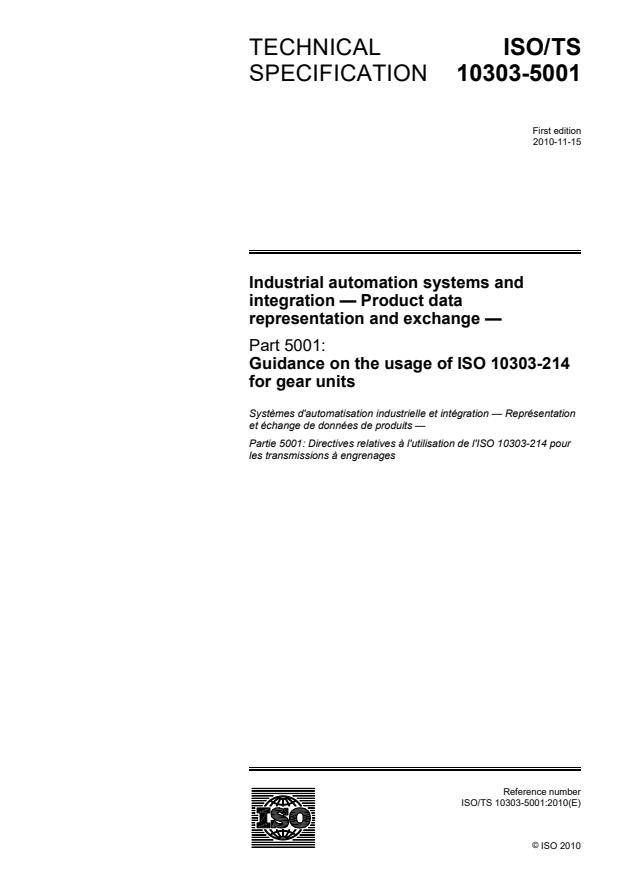
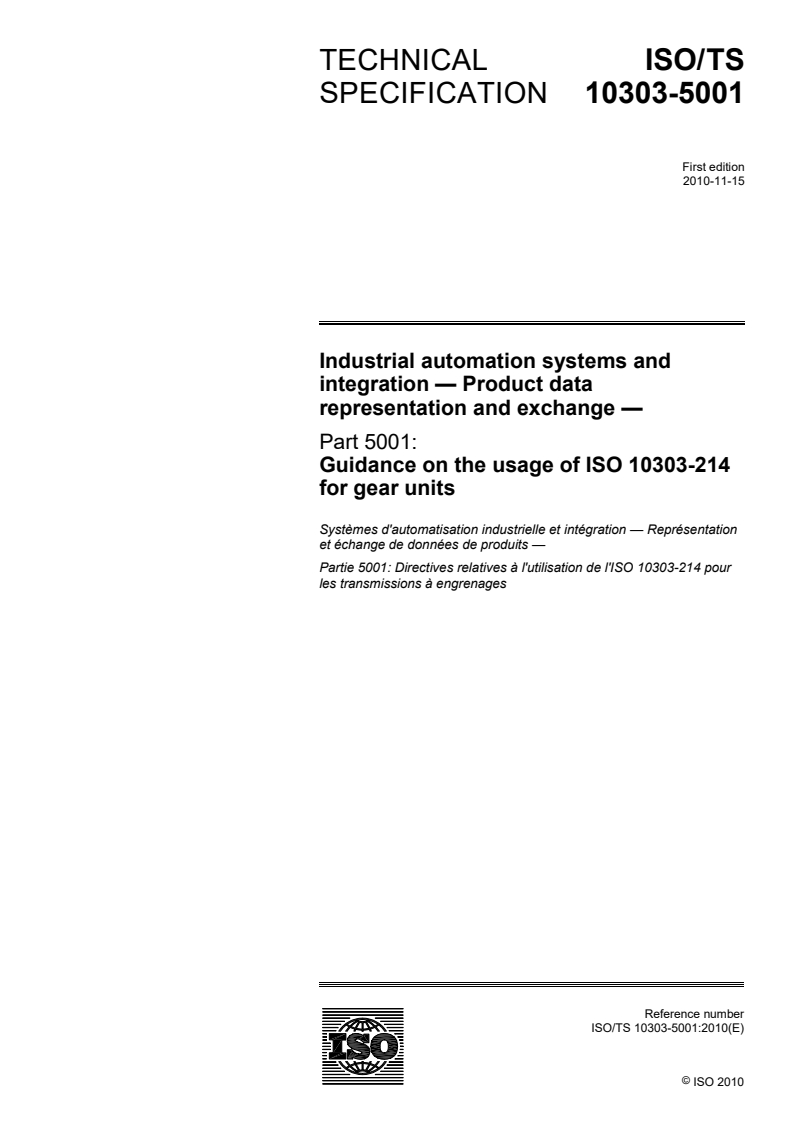
TECHNICAL ISO/TS
SPECIFICATION 10303-5001
First edition
2010-11-15
Industrial automation systems and
integration — Product data
representation and exchange —
Part 5001:
Guidance on the usage of ISO 10303-214
for gear units
Systèmes d'automatisation industrielle et intégration — Représentation
et échange de données de produits —
Partie 5001: Directives relatives à l'utilisation de l'ISO 10303-214 pour
les transmissions à engrenages
Reference number
©
ISO 2010
PDF disclaimer
This PDF file may contain embedded typefaces. In accordance with Adobe's licensing policy, this file may be printed or viewed but
shall not be edited unless the typefaces which are embedded are licensed to and installed on the computer performing the editing. In
downloading this file, parties accept therein the responsibility of not infringing Adobe's licensing policy. The ISO Central Secretariat
accepts no liability in this area.
Adobe is a trademark of Adobe Systems Incorporated.
Details of the software products used to create this PDF file can be found in the General Info relative to the file; the PDF-creation
parameters were optimized for printing. Every care has been taken to ensure that the file is suitable for use by ISO member bodies. In
the unlikely event that a problem relating to it is found, please inform the Central Secretariat at the address given below.
© ISO 2010
All rights reserved. Unless otherwise specified, no part of this publication may be reproduced or utilized in any form or by any means,
electronic or mechanical, including photocopying and microfilm, without permission in writing from either ISO at the address below or
ISO's member body in the country of the requester.
ISO copyright office
Case postale 56 • CH-1211 Geneva 20
Tel. + 41 22 749 01 11
Fax + 41 22 749 09 47
E-mail copyright@iso.org
Web www.iso.org
Published in Switzerland
ii © ISO 2010 – All rights reserved
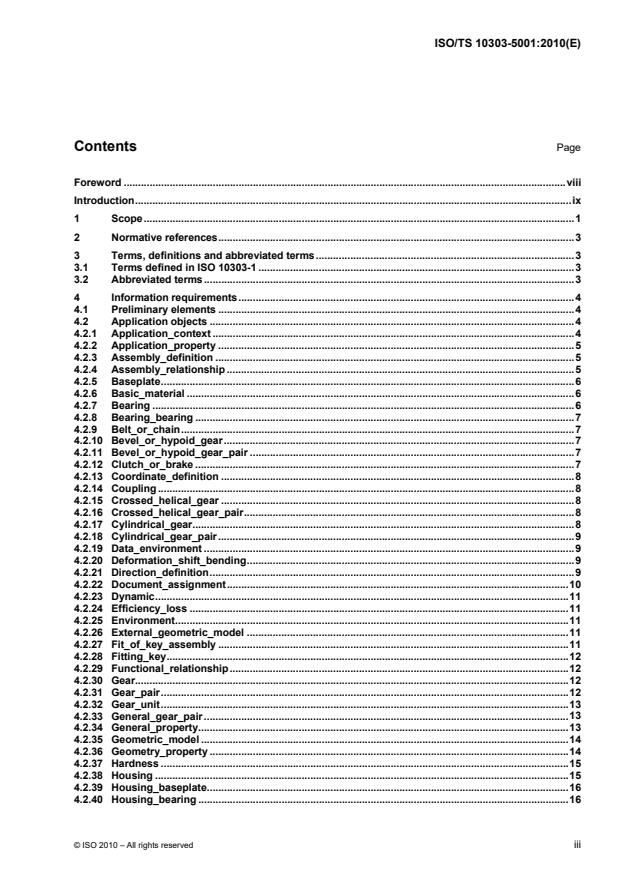
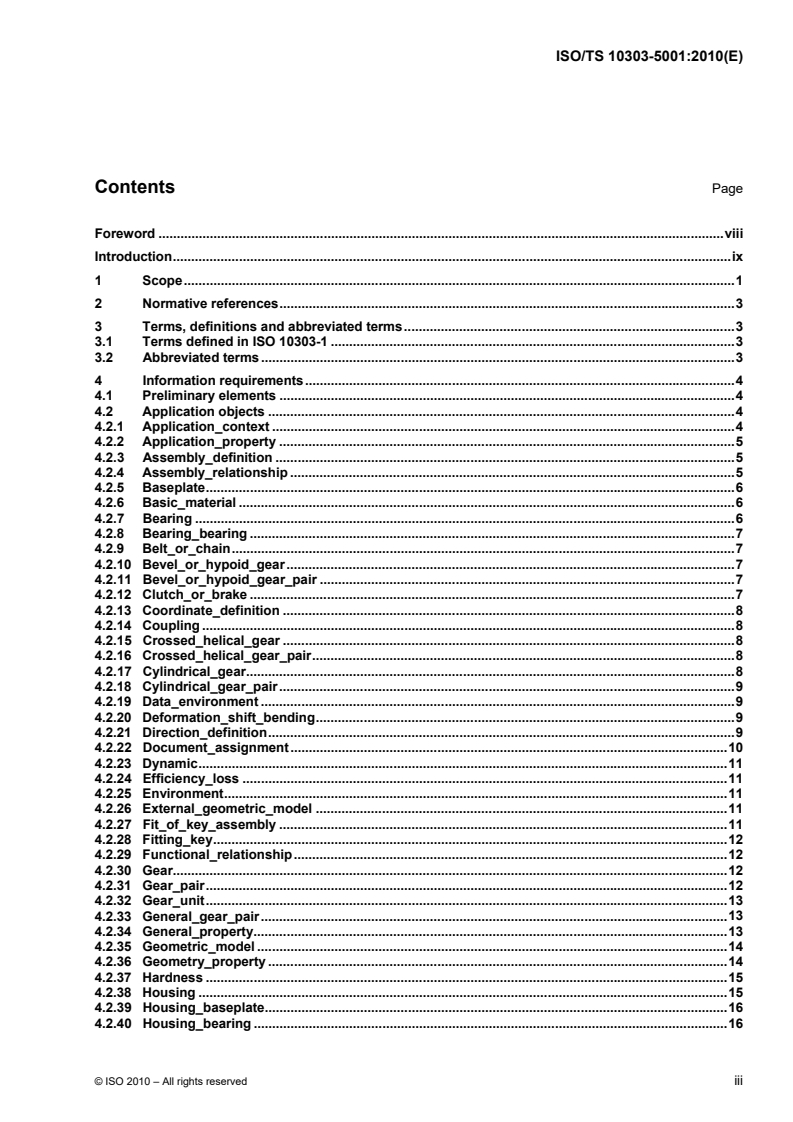
Contents Page
Foreword .viii
Introduction.ix
1 Scope.1
2 Normative references.3
3 Terms, definitions and abbreviated terms.3
3.1 Terms defined in ISO 10303-1 .3
3.2 Abbreviated terms.3
4 Information requirements.4
4.1 Preliminary elements .4
4.2 Application objects.4
4.2.1 Application_context .4
4.2.2 Application_property.5
4.2.3 Assembly_definition .5
4.2.4 Assembly_relationship.5
4.2.5 Baseplate.6
4.2.6 Basic_material.6
4.2.7 Bearing .6
4.2.8 Bearing_bearing.7
4.2.9 Belt_or_chain.7
4.2.10 Bevel_or_hypoid_gear.7
4.2.11 Bevel_or_hypoid_gear_pair .7
4.2.12 Clutch_or_brake.7
4.2.13 Coordinate_definition.8
4.2.14 Coupling.8
4.2.15 Crossed_helical_gear .8
4.2.16 Crossed_helical_gear_pair.8
4.2.17 Cylindrical_gear.8
4.2.18 Cylindrical_gear_pair.9
4.2.19 Data_environment.9
4.2.20 Deformation_shift_bending.9
4.2.21 Direction_definition.9
4.2.22 Document_assignment.10
4.2.23 Dynamic.11
4.2.24 Efficiency_loss .11
4.2.25 Environment.11
4.2.26 External_geometric_model.11
4.2.27 Fit_of_key_assembly .11
4.2.28 Fitting_key.12
4.2.29 Functional_relationship.12
4.2.30 Gear.12
4.2.31 Gear_pair.12
4.2.32 Gear_unit.13
4.2.33 General_gear_pair.13
4.2.34 General_property.13
4.2.35 Geometric_model.14
4.2.36 Geometry_property.14
4.2.37 Hardness.15
4.2.38 Housing.15
4.2.39 Housing_baseplate.16
4.2.40 Housing_bearing .16
4.2.41 Housing_clutch_or_brake.16
4.2.42 Housing_coupling .16
4.2.43 Housing_sealing .17
4.2.44 Interference_fit_assembly.17
4.2.45 Life_time.17
4.2.46 Load_capacity.17
4.2.47 Lubricant.17
4.2.48 Lubricant_definition.18
4.2.49 Lubricant_part.18
4.2.50 Manufacturing.18
4.2.51 Material_definition .18
4.2.52 Material_part.19
4.2.53 Material_property.19
4.2.54 Material_property_association.19
4.2.55 Material_property_value_definition .19
4.2.56 Mesh.20
4.2.57 Numerical_value .20
4.2.58 Parameter_property.20
4.2.59 Part.21
4.2.60 Partial_document_assignment.21
4.2.61 Partial_part_shape_definition .22
4.2.62 Part_definition.24
4.2.63 Part_definition_relationship.24
4.2.64 Part_instance.25
4.2.65 Part_shape_definition.25
4.2.66 Part_version .26
4.2.67 Pinion_shaft.26
4.2.68 Placement_reference_relationship .26
4.2.69 Placement_relationship.27
4.2.70 Plain_bearing.27
4.2.71 Planetary_gear_train.27
4.2.72 Position_orientation_property .27
4.2.73 Position_orientation_property_value .28
4.2.74 Position_orientation_property_value_definition.28
4.2.75 Power_rotation_speed.29
4.2.76 Pressure_stress.29
4.2.77 Property.29
4.2.78 Property_value.30
4.2.79 Property_value_definition.30
4.2.80 Rolling_element_bearing.31
4.2.81 Safety.31
4.2.82 Sealing.31
.................................................................................................................................32
4.2.83 Service_property
4.2.84 Shaft.32
4.2.85 Shaft_bearing.32
4.2.86 Shaft_clutch_or_brake.32
4.2.87 Shaft_collar.32
4.2.88 Shaft_sealing.33
4.2.89 Shaft_shaft.33
4.2.90 Shaft_wheel.33
4.2.91 Shape_description_association.33
4.2.92 Single_part_definition.34
4.2.93 Sliding_wear.34
4.2.94 Specification_property.34
4.2.95 Stiffness_suspension.34
4.2.96 String_value.34
4.2.97 Surface_condition.35
4.2.98 Surface_condition_association.35
4.2.99 Surface_texture.35
4.2.100 Surface_texture_parameter .36
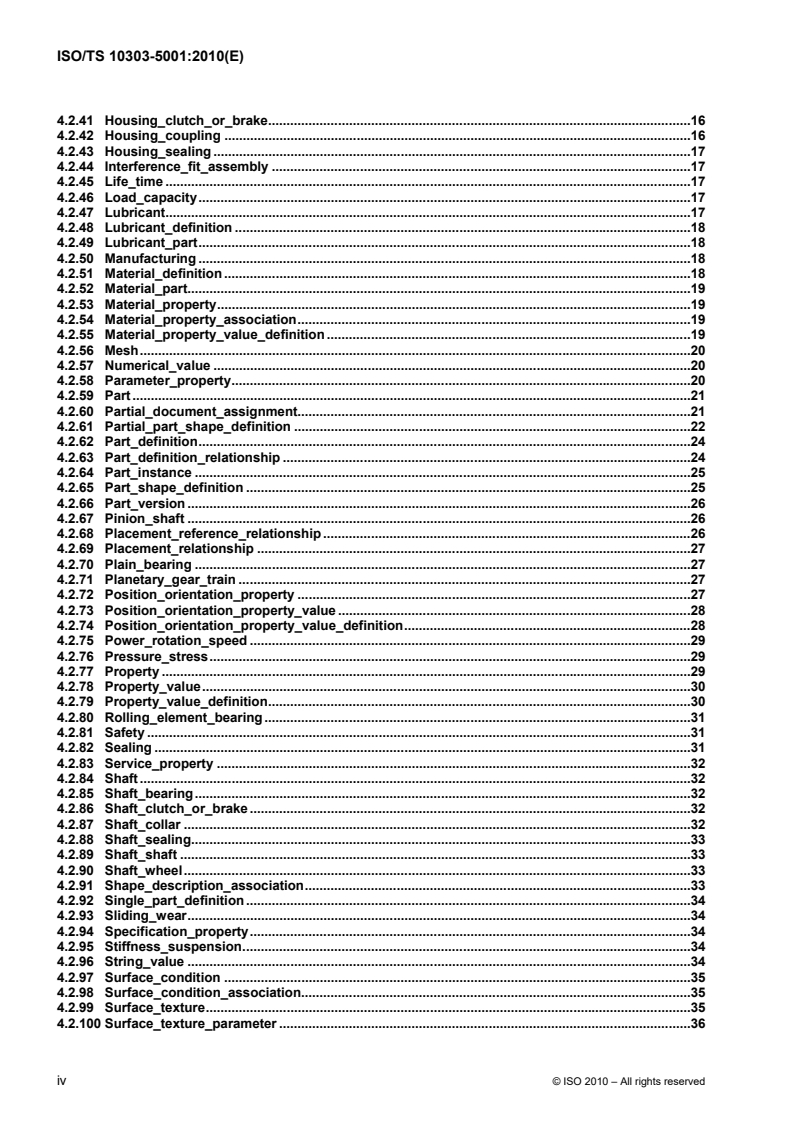
iv © ISO 2010 – All rights reserved
4.2.101 Temperature.37
4.2.102 Tool .37
4.2.103 Tool_part_relationship.37
4.2.104 Torque_force.38
4.2.105 Unit.38
4.2.106 User_defined_part.38
4.2.107 User_defined_ relationship .39
4.2.108 Value_association .39
4.2.109 Value_limit.39
4.2.110 Value_list.40
4.2.111 Value_range .40
4.2.112 Value_with_unit .41
4.2.113 Wheel .41
4.2.114 Wheel_bearing .41
4.2.115 Wheel_belt_or_chain.42
4.2.116 Wheel_wheel .42
4.2.117 Worm.42
4.2.118 Worm_gear_pair .42
4.2.119 Worm_wheel .42
4.3 Application assertions.43
4.3.1 Assembly_relationship to Assembly_definition .43
4.3.2 Assembly_relationship to Part_instance.43
4.3.3 Coordinate_definition to Value_with_unit .43
4.3.4 Direction_definition to Value_with_unit.43
4.3.5 Document_assignment to Assembly_ relationship.43
4.3.6 Document_assignment to Partial_part_shape_definition.43
4.3.7 Document_assignment to Part_definition .43
4.3.8 Document_assignment to Part_definition_relationship.43
4.3.9 Document_assignment to Part_shape_definition.44
4.3.10 Document_assignment to Tool_part_relationship .44
4.3.11 Geometry_property to Partial_Part_shape_definition.44
4.3.12 Geometry_property to Part_shape_definition.44
4.3.13 Hardness to Value_with_unit.44
4.3.14 Material_definition to Part_definition.44
4.3.15 Material_property_association to Material_definition.44
4.3.16 Material_property_association to Material_property_value_definition.44
4.3.17 Material_property_value_definition to Material_property.45
4.3.18 Material_property_value_definition to Data_environment.45
4.3.19 Part_definition to Application_context .45
4.3.20 Part_definition to Part_version .45
4.3.21 Part_definition_relationship to Part_definition .45
4.3.22 Part_instance to Part_definition .45
4.3.23 Partial_part_shape_definition to Part_shape_definition.45
4.3.24 Part_shape_definition to Part_definition .45
4.3.25 Part_shape_definition to Part_instance.46
4.3.26 Part_version to Part .46
4.3.27 Placement_reference_relationship to Position_orientation_property_value_definition.46
4.3.28 Placement_relationship to Position_orientation_property_value_definition .46
4.3.29 Placement_relationship to Property_value_definition .46
4.3.30 Position_orientation_property_value to Coordinate_definition.46
4.3.31 Position_orientation_ property_value to Direction_definition .46
4.3.32 Position_orientation _property_value_definition to Position_orientation_property .46
4.3.33 Position_orientation _property_value_definition to Position_orientation_property_value.46
4.3.34 Property to Unit .47
4.3.35 Property_value_definition to Property.47
4.3.36 Property_value_definition to Property_value.47
4.3.37 Shape_description_association to External_geometric_model.47
4.3.38 Shape_description_association to Geometric_model .47
4.3.39 Shape_description_association to Partial_part_shape_definition .47
4.3.40 Shape_description_association to Part_shape_definition .47
4.3.41 Surface_condition_association to Part_shape_definition .47
4.3.42 Surface_condition_association to Partial_part_shape_definition .48
4.3.43 Surface_condition_association to Surface_condition .48
4.3.44 Surface_texture_parameter to Surface_texture .48
4.3.45 Surface_texture_parameter to Value_with_unit .48
4.3.46 Tool_part_relationship to Part_definition .48
4.3.47 Value_association to Assembly_relationship .48
4.3.48 Value_association to Partial_part_shape_definition .48
4.3.49 Value_association to Part_definition.49
4.3.50 Value_association to Part_definition_relationship .49
4.3.51 Value_association to Part_shape_definition .49
4.3.52 Value_association to Property_value_definition.49
4.3.53 Value_association to Tool_part_relationship.49
4.3.54 Value_list to Property_value.49
5 Mapping to ISO 10303-214 .49
6 Conformance requirements.71
Annex A (informative) Product model for gear units.72
Annex B (informative) Property tables for gear units.84
Annex C (informative) Mapping mechanism .148
Annex D (informative) Mapping to relevant explicit ARM constructs of ISO 10303-224.149
Bibliography.150
Index .152
Figures
Figure A.1 — Product model for gear units EXPRESS-G diagram: 1 of 11. 73
Figure A.2 — Product model for gear units EXPRESS-G diagram: 2 of 11.74
Figure A.3 — Product model for gear units EXPRESS-G diagram: 3 of 11.75
Figure A.4 — Product model for gear units EXPRESS-G diagram: 4 of 11.76
Figure A.5 — Product model for gear units EXPRESS-G diagram: 5 of 11.77
Figure A.6 — Product model for gear units EXPRESS-G diagram: 6 of 11.78
Figure A.7 — Product model for gear units EXPRESS-G diagram: 7 of 11.79
Figure A.8 — Product model for gear units EXPRESS-G diagram: 8 of 11.80
Figure A.9 — Product model for gear units EXPRESS-G diagram: 9 of 11.81
Figure A.10 — Product model for gear units EXPRESS-G diagram: 10 of 11.82
Figure A.11 — Product model for gear units EXPRESS-G diagram: 11 of 11.83
Figure C.1 — Connection between product model for gear units and ISO 10303-214. .148
Tables
Table 1 — Mapping table for ARM level of ISO 10303-214 .51
Table B.1 — Deformation shift bending .88
Table B.2 — Dynamic .89
Table B.3 — Efficiency loss.90
Table B.4 — Environment .92
Table B.5 — Geometry property.93
Table B.6 — Hardness.102
Table B.7 — Life time .103
Table B.8 — Load capacity – factors .104
Table B.9 — Load capacity – strength.113
Table B.10 — Manufacturing .116
Table B.11 — Mesh .118
Table B.12 — Parameter property.122
Table B.13 — Power rotation speed.129
Table B.14 — Pressure stress .131
Table B.15 — Safety .133
Table B.16 — Service property.134
Table B.17 — Sliding wear.136
Table B.18 — Specification property .137
Table B.19 — Stiffness suspension.140
vi © ISO 2010 – All rights reserved
Table B.20 — Surface texture.141
Table B.21 — Temperature .142
Table B.22 — Torque force.145
Table D.1 — Mapping table for ARM level of ISO 10303-224.149
Foreword
ISO (the International Organization for Standardization) is a worldwide federation of national standards bodies
(ISO member bodies). The work of preparing International Standards is normally carried out through ISO
technical committees. Each member body interested in a subject for which a technical committee has been
established has the right to be represented on that committee. International organizations, governmental and
non-governmental, in liaison with ISO, also take part in the work. ISO collaborates closely with the
International Electrotechnical Commission (IEC) on all matters of electrotechnical standardization.
International Standards are drafted in accordance with the rules given in the ISO/IEC Directives, Part 2.
The main task of technical committees is to prepare International Standards. Draft International Standards
adopted by the technical committees are circulated to the member bodies for voting. Publication as an
International Standard requires approval by at least 75 % of the member bodies casting a vote.
In other circumstances, particularly when there is an urgent market requirement for such documents, a
technical committee may decide to publish other types of normative document:
— an ISO Publicly Available Specification (ISO/PAS) represents an agreement between technical experts in
an ISO working group and is accepted for publication if it is approved by more than 50 % of the members
of the parent committee casting a vote;
— an ISO Technical Specification (ISO/TS) represents an agreement between the members of a technical
committee and is accepted for publication if it is approved by 2/3 of the members of the committee casting
a vote.
An ISO/PAS or ISO/TS is reviewed after three years in order to decide whether it will be confirmed for a
further three years, revised to become an International Standard, or withdrawn. If the ISO/PAS or ISO/TS is
confirmed, it is reviewed again after a further three years, at which time it must either be transformed into an
International Standard or be withdrawn.
ISO/TS 10303-5001 was prepared by Technical Committee ISO/TC 184, Automation systems and integration,
Subcommittee SC 4, Industrial data.
Each part of ISO 10303 is a member of one of the following series: description methods, implementation
methods, conformance testing methodology and framework, integrated generic resources, integrated
application resources, application protocols, abstract test suites, application interpreted constructs, application
modules and usage guidance.
A complete list of parts of ISO 10303 is available from the Internet:
http://www.tc184-sc4.org/titles/
viii © ISO 2010 – All rights reserved
Introduction
ISO 10303 is an International Standard for the computer-interpretable representation of product information
and for the exchange of product data. The objective is to provide a neutral mechanism capable of describing
products throughout their life cycle. This mechanism is suitable not only for neutral file exchange, but also as a
basis for implementing and sharing product databases, and as a basis for archiving.
This part of ISO 10303 is a member of a series of guidance documents for application protocols (APs). This
part of ISO 10303 specifies guidance for gear mechanical design processes.
This guidance document defines the context, scope, and information requirements for various development
phases during the design of a gear unit and specifies the ISO 10303-214 resources necessary to satisfy these
requirements.
NOTE 1 ISO 10303-214 is an application protocol for automotive mechanical design processes. It might also be
applicable to other forms of vehicles, such as rail, agricultural, and construction vehicles.
Clause 1 defines the scope of the usage guide and summarizes the functionality and data covered by the
usage guide. Clause 3 lists the words defined in this part of ISO 10303 and gives pointers to words defined
elsewhere. The information requirements of the application are specified in Clause 4 using terminology
appropriate to the application. A graphical representation of the information requirements, referred to as the
application reference model, is given in Annex A.
This part of ISO 10303 is an optional addition to ISO 10303-214 that specifies requirements for the
representation and exchange of product model data related to gear units using ISO 10303-214. This part of
ISO 10303 contains a product model for gear units. This product model covers gear units with all their
machine elements, tools for the manufacturing of gears, and properties that arise during the product
development process of gear units. The properties can be assigned to machine elements, functional part
relations or an entire gear unit. Only the mechanical aspects of gear units and their components are covered
by this part of ISO 10303; electrical, electronic, hydraulic, and pneumatic aspects are not included.
While the product model for gear units contains some high-level concepts defined in ISO 10303-214, it is not
an extension (through subtyping or some other formal means) of the ISO 10303-214 application reference
model (ARM). The product model for gear units is a requirements model and is not intended to be
implemented directly. Instead, the ISO 10303-214 ARM or application interpreted model (AIM) should be used.
Clause 5 shows the correspondence between the information requirements specified in this part of ISO 10303
and the ISO 10303-214 ARM.
NOTE 2 ISO 10303-214 includes a mapping between the ISO 10303-214 ARM and AIM.
NOTE 3 Because the product model for gear units is mapped to the ISO 10303-214 ARM, the ISO 10303-214 ARM or
AIM can be used, unchanged, to represent and exchange product model data related to gear units.
Annex A provides the product model for gear units. The product model is a graphical representation of the
structure and constraints of the application objects presented in EXPRESS-G.
Annex B contains tables that show recommendations for properties of the product model for gear units.
Annex C describes the connection between the product model for gear units and ISO 10303-214 which
consists of a mechanism that defines a data structure in ISO 10303-214 equivalent to the product model for
gear units.
Annex D describes a divergent mapping mechanism for the application objects of the product model for gear
units to explicit ARM constructs of ISO 10303-224.
TECHNICAL SPECIFICATION ISO/TS 10303-5001:2010(E)
Industrial automation systems and integration — Product
data representation and exchange — Part 5001: Guidance
on the usage of ISO 10303-214 for gear units
1 Scope
This part of ISO 10303 specifies guidance on the usage of ISO 10303-214 application reference
model (ARM) for the scope and information requirements for the exchange of information between the
applications that support the development process of the mechanical aspects of gear units.
The following are within the scope of this part of ISO 10303:
— parts related to gear units:
— baseplate;
— basic material;
— belt;
— bevel gear;
— brake;
— chain;
— clutch;
— coupling;
— crossed helical gear;
— fit of key assembly
— fitting key;
— helical gear;
— housing;
— hypoid gear;
— interference fit assembly;
— lubricant;
— pinion shaft;
— plain bearing;
— planetary gear train;
— rolling element bearing;
— sealing;
— shaft;
— spur gear;
— tool;
— user defined machine element;
— wheel;
— worm and worm wheel;
— basic materials used to produce those parts;
— lubricants for gear units;
— tools used for the manufacturing of gear units;
— gear technology properties that can be assigned to parts, assemblies, tools, lubricants and
basic materials:
— deformations, shift and bending;
— dynamic;
— efficiency loss;
— environment;
— forces and moments;
— geometry, topology and geometry dependent data;
— hardness;
— life time;
— load capacity data (wear, pitting, breakage, scuffing);
— manufacturing data;
— mesh data;
— operating data;
— power, rotation and speed;
— pressure and stress;
— safety;
— service data;
— sliding and wear;
— stiffness, suspension;
— surface texture;
— temperature data.
The following are outside the scope of this part of ISO 10303:
— manufacturing of elements other than gears;
— items that are outside the
...
TECHNICAL ISO/TS
SPECIFICATION 10303-5001
First edition
2010-11-15
Industrial automation systems and
integration — Product data
representation and exchange —
Part 5001:
Guidance on the usage of ISO 10303-214
for gear units
Systèmes d'automatisation industrielle et intégration — Représentation
et échange de données de produits —
Partie 5001: Directives relatives à l'utilisation de l'ISO 10303-214 pour
les transmissions à engrenages
Reference number
©
ISO 2010
PDF disclaimer
This PDF file may contain embedded typefaces. In accordance with Adobe's licensing policy, this file may be printed or viewed but
shall not be edited unless the typefaces which are embedded are licensed to and installed on the computer performing the editing. In
downloading this file, parties accept therein the responsibility of not infringing Adobe's licensing policy. The ISO Central Secretariat
accepts no liability in this area.
Adobe is a trademark of Adobe Systems Incorporated.
Details of the software products used to create this PDF file can be found in the General Info relative to the file; the PDF-creation
parameters were optimized for printing. Every care has been taken to ensure that the file is suitable for use by ISO member bodies. In
the unlikely event that a problem relating to it is found, please inform the Central Secretariat at the address given below.
© ISO 2010
All rights reserved. Unless otherwise specified, no part of this publication may be reproduced or utilized in any form or by any means,
electronic or mechanical, including photocopying and microfilm, without permission in writing from either ISO at the address below or
ISO's member body in the country of the requester.
ISO copyright office
Case postale 56 • CH-1211 Geneva 20
Tel. + 41 22 749 01 11
Fax + 41 22 749 09 47
E-mail copyright@iso.org
Web www.iso.org
Published in Switzerland
ii © ISO 2010 – All rights reserved
Contents Page
Foreword .viii
Introduction.ix
1 Scope.1
2 Normative references.3
3 Terms, definitions and abbreviated terms.3
3.1 Terms defined in ISO 10303-1 .3
3.2 Abbreviated terms.3
4 Information requirements.4
4.1 Preliminary elements .4
4.2 Application objects.4
4.2.1 Application_context .4
4.2.2 Application_property.5
4.2.3 Assembly_definition .5
4.2.4 Assembly_relationship.5
4.2.5 Baseplate.6
4.2.6 Basic_material.6
4.2.7 Bearing .6
4.2.8 Bearing_bearing.7
4.2.9 Belt_or_chain.7
4.2.10 Bevel_or_hypoid_gear.7
4.2.11 Bevel_or_hypoid_gear_pair .7
4.2.12 Clutch_or_brake.7
4.2.13 Coordinate_definition.8
4.2.14 Coupling.8
4.2.15 Crossed_helical_gear .8
4.2.16 Crossed_helical_gear_pair.8
4.2.17 Cylindrical_gear.8
4.2.18 Cylindrical_gear_pair.9
4.2.19 Data_environment.9
4.2.20 Deformation_shift_bending.9
4.2.21 Direction_definition.9
4.2.22 Document_assignment.10
4.2.23 Dynamic.11
4.2.24 Efficiency_loss .11
4.2.25 Environment.11
4.2.26 External_geometric_model.11
4.2.27 Fit_of_key_assembly .11
4.2.28 Fitting_key.12
4.2.29 Functional_relationship.12
4.2.30 Gear.12
4.2.31 Gear_pair.12
4.2.32 Gear_unit.13
4.2.33 General_gear_pair.13
4.2.34 General_property.13
4.2.35 Geometric_model.14
4.2.36 Geometry_property.14
4.2.37 Hardness.15
4.2.38 Housing.15
4.2.39 Housing_baseplate.16
4.2.40 Housing_bearing .16
4.2.41 Housing_clutch_or_brake.16
4.2.42 Housing_coupling .16
4.2.43 Housing_sealing .17
4.2.44 Interference_fit_assembly.17
4.2.45 Life_time.17
4.2.46 Load_capacity.17
4.2.47 Lubricant.17
4.2.48 Lubricant_definition.18
4.2.49 Lubricant_part.18
4.2.50 Manufacturing.18
4.2.51 Material_definition .18
4.2.52 Material_part.19
4.2.53 Material_property.19
4.2.54 Material_property_association.19
4.2.55 Material_property_value_definition .19
4.2.56 Mesh.20
4.2.57 Numerical_value .20
4.2.58 Parameter_property.20
4.2.59 Part.21
4.2.60 Partial_document_assignment.21
4.2.61 Partial_part_shape_definition .22
4.2.62 Part_definition.24
4.2.63 Part_definition_relationship.24
4.2.64 Part_instance.25
4.2.65 Part_shape_definition.25
4.2.66 Part_version .26
4.2.67 Pinion_shaft.26
4.2.68 Placement_reference_relationship .26
4.2.69 Placement_relationship.27
4.2.70 Plain_bearing.27
4.2.71 Planetary_gear_train.27
4.2.72 Position_orientation_property .27
4.2.73 Position_orientation_property_value .28
4.2.74 Position_orientation_property_value_definition.28
4.2.75 Power_rotation_speed.29
4.2.76 Pressure_stress.29
4.2.77 Property.29
4.2.78 Property_value.30
4.2.79 Property_value_definition.30
4.2.80 Rolling_element_bearing.31
4.2.81 Safety.31
4.2.82 Sealing.31
.................................................................................................................................32
4.2.83 Service_property
4.2.84 Shaft.32
4.2.85 Shaft_bearing.32
4.2.86 Shaft_clutch_or_brake.32
4.2.87 Shaft_collar.32
4.2.88 Shaft_sealing.33
4.2.89 Shaft_shaft.33
4.2.90 Shaft_wheel.33
4.2.91 Shape_description_association.33
4.2.92 Single_part_definition.34
4.2.93 Sliding_wear.34
4.2.94 Specification_property.34
4.2.95 Stiffness_suspension.34
4.2.96 String_value.34
4.2.97 Surface_condition.35
4.2.98 Surface_condition_association.35
4.2.99 Surface_texture.35
4.2.100 Surface_texture_parameter .36
iv © ISO 2010 – All rights reserved
4.2.101 Temperature.37
4.2.102 Tool .37
4.2.103 Tool_part_relationship.37
4.2.104 Torque_force.38
4.2.105 Unit.38
4.2.106 User_defined_part.38
4.2.107 User_defined_ relationship .39
4.2.108 Value_association .39
4.2.109 Value_limit.39
4.2.110 Value_list.40
4.2.111 Value_range .40
4.2.112 Value_with_unit .41
4.2.113 Wheel .41
4.2.114 Wheel_bearing .41
4.2.115 Wheel_belt_or_chain.42
4.2.116 Wheel_wheel .42
4.2.117 Worm.42
4.2.118 Worm_gear_pair .42
4.2.119 Worm_wheel .42
4.3 Application assertions.43
4.3.1 Assembly_relationship to Assembly_definition .43
4.3.2 Assembly_relationship to Part_instance.43
4.3.3 Coordinate_definition to Value_with_unit .43
4.3.4 Direction_definition to Value_with_unit.43
4.3.5 Document_assignment to Assembly_ relationship.43
4.3.6 Document_assignment to Partial_part_shape_definition.43
4.3.7 Document_assignment to Part_definition .43
4.3.8 Document_assignment to Part_definition_relationship.43
4.3.9 Document_assignment to Part_shape_definition.44
4.3.10 Document_assignment to Tool_part_relationship .44
4.3.11 Geometry_property to Partial_Part_shape_definition.44
4.3.12 Geometry_property to Part_shape_definition.44
4.3.13 Hardness to Value_with_unit.44
4.3.14 Material_definition to Part_definition.44
4.3.15 Material_property_association to Material_definition.44
4.3.16 Material_property_association to Material_property_value_definition.44
4.3.17 Material_property_value_definition to Material_property.45
4.3.18 Material_property_value_definition to Data_environment.45
4.3.19 Part_definition to Application_context .45
4.3.20 Part_definition to Part_version .45
4.3.21 Part_definition_relationship to Part_definition .45
4.3.22 Part_instance to Part_definition .45
4.3.23 Partial_part_shape_definition to Part_shape_definition.45
4.3.24 Part_shape_definition to Part_definition .45
4.3.25 Part_shape_definition to Part_instance.46
4.3.26 Part_version to Part .46
4.3.27 Placement_reference_relationship to Position_orientation_property_value_definition.46
4.3.28 Placement_relationship to Position_orientation_property_value_definition .46
4.3.29 Placement_relationship to Property_value_definition .46
4.3.30 Position_orientation_property_value to Coordinate_definition.46
4.3.31 Position_orientation_ property_value to Direction_definition .46
4.3.32 Position_orientation _property_value_definition to Position_orientation_property .46
4.3.33 Position_orientation _property_value_definition to Position_orientation_property_value.46
4.3.34 Property to Unit .47
4.3.35 Property_value_definition to Property.47
4.3.36 Property_value_definition to Property_value.47
4.3.37 Shape_description_association to External_geometric_model.47
4.3.38 Shape_description_association to Geometric_model .47
4.3.39 Shape_description_association to Partial_part_shape_definition .47
4.3.40 Shape_description_association to Part_shape_definition .47
4.3.41 Surface_condition_association to Part_shape_definition .47
4.3.42 Surface_condition_association to Partial_part_shape_definition .48
4.3.43 Surface_condition_association to Surface_condition .48
4.3.44 Surface_texture_parameter to Surface_texture .48
4.3.45 Surface_texture_parameter to Value_with_unit .48
4.3.46 Tool_part_relationship to Part_definition .48
4.3.47 Value_association to Assembly_relationship .48
4.3.48 Value_association to Partial_part_shape_definition .48
4.3.49 Value_association to Part_definition.49
4.3.50 Value_association to Part_definition_relationship .49
4.3.51 Value_association to Part_shape_definition .49
4.3.52 Value_association to Property_value_definition.49
4.3.53 Value_association to Tool_part_relationship.49
4.3.54 Value_list to Property_value.49
5 Mapping to ISO 10303-214 .49
6 Conformance requirements.71
Annex A (informative) Product model for gear units.72
Annex B (informative) Property tables for gear units.84
Annex C (informative) Mapping mechanism .148
Annex D (informative) Mapping to relevant explicit ARM constructs of ISO 10303-224.149
Bibliography.150
Index .152
Figures
Figure A.1 — Product model for gear units EXPRESS-G diagram: 1 of 11. 73
Figure A.2 — Product model for gear units EXPRESS-G diagram: 2 of 11.74
Figure A.3 — Product model for gear units EXPRESS-G diagram: 3 of 11.75
Figure A.4 — Product model for gear units EXPRESS-G diagram: 4 of 11.76
Figure A.5 — Product model for gear units EXPRESS-G diagram: 5 of 11.77
Figure A.6 — Product model for gear units EXPRESS-G diagram: 6 of 11.78
Figure A.7 — Product model for gear units EXPRESS-G diagram: 7 of 11.79
Figure A.8 — Product model for gear units EXPRESS-G diagram: 8 of 11.80
Figure A.9 — Product model for gear units EXPRESS-G diagram: 9 of 11.81
Figure A.10 — Product model for gear units EXPRESS-G diagram: 10 of 11.82
Figure A.11 — Product model for gear units EXPRESS-G diagram: 11 of 11.83
Figure C.1 — Connection between product model for gear units and ISO 10303-214. .148
Tables
Table 1 — Mapping table for ARM level of ISO 10303-214 .51
Table B.1 — Deformation shift bending .88
Table B.2 — Dynamic .89
Table B.3 — Efficiency loss.90
Table B.4 — Environment .92
Table B.5 — Geometry property.93
Table B.6 — Hardness.102
Table B.7 — Life time .103
Table B.8 — Load capacity – factors .104
Table B.9 — Load capacity – strength.113
Table B.10 — Manufacturing .116
Table B.11 — Mesh .118
Table B.12 — Parameter property.122
Table B.13 — Power rotation speed.129
Table B.14 — Pressure stress .131
Table B.15 — Safety .133
Table B.16 — Service property.134
Table B.17 — Sliding wear.136
Table B.18 — Specification property .137
Table B.19 — Stiffness suspension.140
vi © ISO 2010 – All rights reserved
Table B.20 — Surface texture.141
Table B.21 — Temperature .142
Table B.22 — Torque force.145
Table D.1 — Mapping table for ARM level of ISO 10303-224.149
Foreword
ISO (the International Organization for Standardization) is a worldwide federation of national standards bodies
(ISO member bodies). The work of preparing International Standards is normally carried out through ISO
technical committees. Each member body interested in a subject for which a technical committee has been
established has the right to be represented on that committee. International organizations, governmental and
non-governmental, in liaison with ISO, also take part in the work. ISO collaborates closely with the
International Electrotechnical Commission (IEC) on all matters of electrotechnical standardization.
International Standards are drafted in accordance with the rules given in the ISO/IEC Directives, Part 2.
The main task of technical committees is to prepare International Standards. Draft International Standards
adopted by the technical committees are circulated to the member bodies for voting. Publication as an
International Standard requires approval by at least 75 % of the member bodies casting a vote.
In other circumstances, particularly when there is an urgent market requirement for such documents, a
technical committee may decide to publish other types of normative document:
— an ISO Publicly Available Specification (ISO/PAS) represents an agreement between technical experts in
an ISO working group and is accepted for publication if it is approved by more than 50 % of the members
of the parent committee casting a vote;
— an ISO Technical Specification (ISO/TS) represents an agreement between the members of a technical
committee and is accepted for publication if it is approved by 2/3 of the members of the committee casting
a vote.
An ISO/PAS or ISO/TS is reviewed after three years in order to decide whether it will be confirmed for a
further three years, revised to become an International Standard, or withdrawn. If the ISO/PAS or ISO/TS is
confirmed, it is reviewed again after a further three years, at which time it must either be transformed into an
International Standard or be withdrawn.
ISO/TS 10303-5001 was prepared by Technical Committee ISO/TC 184, Automation systems and integration,
Subcommittee SC 4, Industrial data.
Each part of ISO 10303 is a member of one of the following series: description methods, implementation
methods, conformance testing methodology and framework, integrated generic resources, integrated
application resources, application protocols, abstract test suites, application interpreted constructs, application
modules and usage guidance.
A complete list of parts of ISO 10303 is available from the Internet:
http://www.tc184-sc4.org/titles/
viii © ISO 2010 – All rights reserved
Introduction
ISO 10303 is an International Standard for the computer-interpretable representation of product information
and for the exchange of product data. The objective is to provide a neutral mechanism capable of describing
products throughout their life cycle. This mechanism is suitable not only for neutral file exchange, but also as a
basis for implementing and sharing product databases, and as a basis for archiving.
This part of ISO 10303 is a member of a series of guidance documents for application protocols (APs). This
part of ISO 10303 specifies guidance for gear mechanical design processes.
This guidance document defines the context, scope, and information requirements for various development
phases during the design of a gear unit and specifies the ISO 10303-214 resources necessary to satisfy these
requirements.
NOTE 1 ISO 10303-214 is an application protocol for automotive mechanical design processes. It might also be
applicable to other forms of vehicles, such as rail, agricultural, and construction vehicles.
Clause 1 defines the scope of the usage guide and summarizes the functionality and data covered by the
usage guide. Clause 3 lists the words defined in this part of ISO 10303 and gives pointers to words defined
elsewhere. The information requirements of the application are specified in Clause 4 using terminology
appropriate to the application. A graphical representation of the information requirements, referred to as the
application reference model, is given in Annex A.
This part of ISO 10303 is an optional addition to ISO 10303-214 that specifies requirements for the
representation and exchange of product model data related to gear units using ISO 10303-214. This part of
ISO 10303 contains a product model for gear units. This product model covers gear units with all their
machine elements, tools for the manufacturing of gears, and properties that arise during the product
development process of gear units. The properties can be assigned to machine elements, functional part
relations or an entire gear unit. Only the mechanical aspects of gear units and their components are covered
by this part of ISO 10303; electrical, electronic, hydraulic, and pneumatic aspects are not included.
While the product model for gear units contains some high-level concepts defined in ISO 10303-214, it is not
an extension (through subtyping or some other formal means) of the ISO 10303-214 application reference
model (ARM). The product model for gear units is a requirements model and is not intended to be
implemented directly. Instead, the ISO 10303-214 ARM or application interpreted model (AIM) should be used.
Clause 5 shows the correspondence between the information requirements specified in this part of ISO 10303
and the ISO 10303-214 ARM.
NOTE 2 ISO 10303-214 includes a mapping between the ISO 10303-214 ARM and AIM.
NOTE 3 Because the product model for gear units is mapped to the ISO 10303-214 ARM, the ISO 10303-214 ARM or
AIM can be used, unchanged, to represent and exchange product model data related to gear units.
Annex A provides the product model for gear units. The product model is a graphical representation of the
structure and constraints of the application objects presented in EXPRESS-G.
Annex B contains tables that show recommendations for properties of the product model for gear units.
Annex C describes the connection between the product model for gear units and ISO 10303-214 which
consists of a mechanism that defines a data structure in ISO 10303-214 equivalent to the product model for
gear units.
Annex D describes a divergent mapping mechanism for the application objects of the product model for gear
units to explicit ARM constructs of ISO 10303-224.
TECHNICAL SPECIFICATION ISO/TS 10303-5001:2010(E)
Industrial automation systems and integration — Product
data representation and exchange — Part 5001: Guidance
on the usage of ISO 10303-214 for gear units
1 Scope
This part of ISO 10303 specifies guidance on the usage of ISO 10303-214 application reference
model (ARM) for the scope and information requirements for the exchange of information between the
applications that support the development process of the mechanical aspects of gear units.
The following are within the scope of this part of ISO 10303:
— parts related to gear units:
— baseplate;
— basic material;
— belt;
— bevel gear;
— brake;
— chain;
— clutch;
— coupling;
— crossed helical gear;
— fit of key assembly
— fitting key;
— helical gear;
— housing;
— hypoid gear;
— interference fit assembly;
— lubricant;
— pinion shaft;
— plain bearing;
— planetary gear train;
— rolling element bearing;
— sealing;
— shaft;
— spur gear;
— tool;
— user defined machine element;
— wheel;
— worm and worm wheel;
— basic materials used to produce those parts;
— lubricants for gear units;
— tools used for the manufacturing of gear units;
— gear technology properties that can be assigned to parts, assemblies, tools, lubricants and
basic materials:
— deformations, shift and bending;
— dynamic;
— efficiency loss;
— environment;
— forces and moments;
— geometry, topology and geometry dependent data;
— hardness;
— life time;
— load capacity data (wear, pitting, breakage, scuffing);
— manufacturing data;
— mesh data;
— operating data;
— power, rotation and speed;
— pressure and stress;
— safety;
— service data;
— sliding and wear;
— stiffness, suspension;
— surface texture;
— temperature data.
The following are outside the scope of this part of ISO 10303:
— manufacturing of elements other than gears;
— items that are outside the
...