


ISO 19901-2:2004
(Main)Petroleum and natural gas industries — Specific requirements for offshore structures — Part 2: Seismic design procedures and criteria
Petroleum and natural gas industries — Specific requirements for offshore structures — Part 2: Seismic design procedures and criteria
ISO 19901-2:2004 contains requirements for defining the seismic design procedures and criteria for offshore structures; guidance on the requirements is included. The requirements are applicable to fixed steel structures and fixed concrete structures. The effects of seismic events on floating structures and partially buoyant structures are also briefly discussed. The site-specific assessment of jack-ups in elevated condition is only covered in ISO 19901-2:2004 to the extent that the requirements are applicable. Only earthquake-induced ground motions are addressed in detail. Other geologically-induced hazards such as liquefaction, slope instability, faults, tsunamis, mud volcanoes and shock waves are mentioned and briefly discussed. The requirements are intended to reduce risks to persons, the environment, and assets to the lowest levels that are reasonably practicable. This intent is achieved by using seismic design procedures which are dependent on the platform's exposure level and the expected intensity of seismic events and a two-level seismic design check in which the structure is designed to the ultimate limit state (ULS) for strength and stiffness and then checked to abnormal environmental events or the accidental limit state (ALS) to ensure that it meets reserve strength and energy dissipation requirements. For high seismic areas and/or high exposure level fixed structures, a site-specific seismic hazard assessment is required; for such cases, the procedures and requirements for a site-specific probabilistic seismic hazard analysis (PSHA) are addressed. However, a thorough explanation of PSHA procedures is not included. Where a simplified design approach is allowed, worldwide offshore maps are included that show the intensity of ground shaking corresponding to a return period of 1 000 years. In such cases, these maps may be used with corresponding scale factors to determine appropriate seismic actions for the design of a structure.
Industries du pétrole et du gaz naturel — Exigences spécifiques relatives aux structures en mer — Partie 2: Procédures de conception et critères sismiques
General Information
- Status
- Withdrawn
- Publication Date
- 17-Nov-2004
- Withdrawal Date
- 17-Nov-2004
- Technical Committee
- ISO/TC 67/SC 7 - Offshore structures
- Drafting Committee
- ISO/TC 67/SC 7/WG 3 - Fixed steel structures
- Current Stage
- 9599 - Withdrawal of International Standard
- Start Date
- 15-Nov-2017
- Completion Date
- 14-Feb-2026
Relations
- Effective Date
- 12-Feb-2026
- Effective Date
- 06-Jun-2022
- Effective Date
- 10-Dec-2011

Get Certified
Connect with accredited certification bodies for this standard

ABS Quality Evaluations Inc.
American Bureau of Shipping quality certification.

Element Materials Technology
Materials testing and product certification.

ABS Group Brazil
ABS Group certification services in Brazil.
Sponsored listings
Frequently Asked Questions
ISO 19901-2:2004 is a standard published by the International Organization for Standardization (ISO). Its full title is "Petroleum and natural gas industries — Specific requirements for offshore structures — Part 2: Seismic design procedures and criteria". This standard covers: ISO 19901-2:2004 contains requirements for defining the seismic design procedures and criteria for offshore structures; guidance on the requirements is included. The requirements are applicable to fixed steel structures and fixed concrete structures. The effects of seismic events on floating structures and partially buoyant structures are also briefly discussed. The site-specific assessment of jack-ups in elevated condition is only covered in ISO 19901-2:2004 to the extent that the requirements are applicable. Only earthquake-induced ground motions are addressed in detail. Other geologically-induced hazards such as liquefaction, slope instability, faults, tsunamis, mud volcanoes and shock waves are mentioned and briefly discussed. The requirements are intended to reduce risks to persons, the environment, and assets to the lowest levels that are reasonably practicable. This intent is achieved by using seismic design procedures which are dependent on the platform's exposure level and the expected intensity of seismic events and a two-level seismic design check in which the structure is designed to the ultimate limit state (ULS) for strength and stiffness and then checked to abnormal environmental events or the accidental limit state (ALS) to ensure that it meets reserve strength and energy dissipation requirements. For high seismic areas and/or high exposure level fixed structures, a site-specific seismic hazard assessment is required; for such cases, the procedures and requirements for a site-specific probabilistic seismic hazard analysis (PSHA) are addressed. However, a thorough explanation of PSHA procedures is not included. Where a simplified design approach is allowed, worldwide offshore maps are included that show the intensity of ground shaking corresponding to a return period of 1 000 years. In such cases, these maps may be used with corresponding scale factors to determine appropriate seismic actions for the design of a structure.
ISO 19901-2:2004 contains requirements for defining the seismic design procedures and criteria for offshore structures; guidance on the requirements is included. The requirements are applicable to fixed steel structures and fixed concrete structures. The effects of seismic events on floating structures and partially buoyant structures are also briefly discussed. The site-specific assessment of jack-ups in elevated condition is only covered in ISO 19901-2:2004 to the extent that the requirements are applicable. Only earthquake-induced ground motions are addressed in detail. Other geologically-induced hazards such as liquefaction, slope instability, faults, tsunamis, mud volcanoes and shock waves are mentioned and briefly discussed. The requirements are intended to reduce risks to persons, the environment, and assets to the lowest levels that are reasonably practicable. This intent is achieved by using seismic design procedures which are dependent on the platform's exposure level and the expected intensity of seismic events and a two-level seismic design check in which the structure is designed to the ultimate limit state (ULS) for strength and stiffness and then checked to abnormal environmental events or the accidental limit state (ALS) to ensure that it meets reserve strength and energy dissipation requirements. For high seismic areas and/or high exposure level fixed structures, a site-specific seismic hazard assessment is required; for such cases, the procedures and requirements for a site-specific probabilistic seismic hazard analysis (PSHA) are addressed. However, a thorough explanation of PSHA procedures is not included. Where a simplified design approach is allowed, worldwide offshore maps are included that show the intensity of ground shaking corresponding to a return period of 1 000 years. In such cases, these maps may be used with corresponding scale factors to determine appropriate seismic actions for the design of a structure.
ISO 19901-2:2004 is classified under the following ICS (International Classification for Standards) categories: 75.180.10 - Exploratory, drilling and extraction equipment. The ICS classification helps identify the subject area and facilitates finding related standards.
ISO 19901-2:2004 has the following relationships with other standards: It is inter standard links to EN ISO 19901-2:2004, ISO 12175:1994, ISO 19901-2:2017. Understanding these relationships helps ensure you are using the most current and applicable version of the standard.
ISO 19901-2:2004 is available in PDF format for immediate download after purchase. The document can be added to your cart and obtained through the secure checkout process. Digital delivery ensures instant access to the complete standard document.
Standards Content (Sample)
INTERNATIONAL ISO
STANDARD 19901-2
First edition
2004-11-15
Petroleum and natural gas industries —
Specific requirements for offshore
structures —
Part 2:
Seismic design procedures and criteria
Industries du pétrole et du gaz naturel — Exigences spécifiques
relatives aux structures en mer —
Partie 2: Procédures de conception et critères sismiques
Reference number
©
ISO 2004
PDF disclaimer
This PDF file may contain embedded typefaces. In accordance with Adobe's licensing policy, this file may be printed or viewed but
shall not be edited unless the typefaces which are embedded are licensed to and installed on the computer performing the editing. In
downloading this file, parties accept therein the responsibility of not infringing Adobe's licensing policy. The ISO Central Secretariat
accepts no liability in this area.
Adobe is a trademark of Adobe Systems Incorporated.
Details of the software products used to create this PDF file can be found in the General Info relative to the file; the PDF-creation
parameters were optimized for printing. Every care has been taken to ensure that the file is suitable for use by ISO member bodies. In
the unlikely event that a problem relating to it is found, please inform the Central Secretariat at the address given below.
© ISO 2004
All rights reserved. Unless otherwise specified, no part of this publication may be reproduced or utilized in any form or by any means,
electronic or mechanical, including photocopying and microfilm, without permission in writing from either ISO at the address below or
ISO's member body in the country of the requester.
ISO copyright office
Case postale 56 • CH-1211 Geneva 20
Tel. + 41 22 749 01 11
Fax + 41 22 749 09 47
E-mail copyright@iso.org
Web www.iso.org
Published in Switzerland
ii © ISO 2004 – All rights reserved
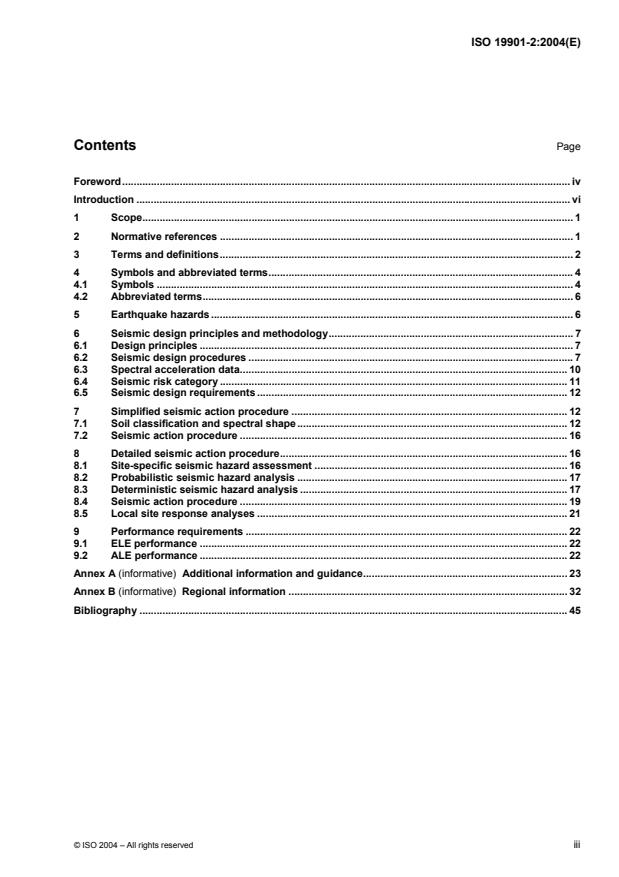
Contents Page
Foreword. iv
Introduction . vi
1 Scope. 1
2 Normative references . 1
3 Terms and definitions. 2
4 Symbols and abbreviated terms. 4
4.1 Symbols . 4
4.2 Abbreviated terms. 6
5 Earthquake hazards . 6
6 Seismic design principles and methodology. 7
6.1 Design principles . 7
6.2 Seismic design procedures . 7
6.3 Spectral acceleration data. 10
6.4 Seismic risk category . 11
6.5 Seismic design requirements . 12
7 Simplified seismic action procedure . 12
7.1 Soil classification and spectral shape . 12
7.2 Seismic action procedure . 16
8 Detailed seismic action procedure. 16
8.1 Site-specific seismic hazard assessment . 16
8.2 Probabilistic seismic hazard analysis . 17
8.3 Deterministic seismic hazard analysis . 17
8.4 Seismic action procedure . 19
8.5 Local site response analyses . 21
9 Performance requirements . 22
9.1 ELE performance . 22
9.2 ALE performance . 22
Annex A (informative) Additional information and guidance. 23
Annex B (informative) Regional information . 32
Bibliography . 45
Foreword
ISO (the International Organization for Standardization) is a worldwide federation of national standards bodies
(ISO member bodies). The work of preparing International Standards is normally carried out through ISO
technical committees. Each member body interested in a subject for which a technical committee has been
established has the right to be represented on that committee. International organizations, governmental and
non-governmental, in liaison with ISO, also take part in the work. ISO collaborates closely with the
International Electrotechnical Commission (IEC) on all matters of electrotechnical standardization.
International Standards are drafted in accordance with the rules given in the ISO/IEC Directives, Part 2.
The main task of technical committees is to prepare International Standards. Draft International Standards
adopted by the technical committees are circulated to the member bodies for voting. Publication as an
International Standard requires approval by at least 75 % of the member bodies casting a vote.
Attention is drawn to the possibility that some of the elements of this document may be the subject of patent
rights. ISO shall not be held responsible for identifying any or all such patent rights.
ISO 19901-2 was prepared by Technical Committee ISO/TC 67, Materials, equipment and offshore structures
for petroleum, petrochemical and natural gas industries, Subcommittee SC 7, Offshore structures.
ISO 19901 consists of the following parts, under the general title Petroleum and natural gas industries —
Specific requirements for offshore structures:
Part 1: Metocean design and operating considerations
Part 2: Seismic design procedures and criteria
Part 4: Geotechnical and foundation design considerations
Part 5: Weight control during engineering and construction
Part 7: Stationkeeping systems for floating offshore structures and mobile offshore units
The following parts of ISO 19901 are under preparation:
Part 3: Topsides structure
Part 6: Marine operations
ISO 19901 is one of a series of standards for offshore structures. The full series consists of the following
International Standards.
ISO 19900, Petroleum and natural gas industries — General requirements for offshore structures
ISO 19901 (all parts), Petroleum and natural gas industries — Specific requirements for offshore
structures
ISO 19902, Petroleum and natural gas industries — Fixed steel offshore structures
ISO 19903, Petroleum and natural gas industries — Fixed concrete offshore structures
ISO 19904-1, Petroleum and natural gas industries — Floating offshore structures — Part 1: Monohulls,
semi-submersibles and spars
iv © ISO 2004 – All rights reserved
ISO 19904-2, Petroleum and natural gas industries — Floating offshore structures — Part 2: Tension leg
platforms
ISO 19905-1, Petroleum and natural gas industries — Site-specific assessment of mobile offshore
units — Part 1: Jack-ups
ISO/TR 19905-2, Petroleum and natural gas industries — Site-specific assessment of mobile offshore
units — Part 2: Jack-ups commentary
ISO 19906, Petroleum and natural gas industries — Arctic offshore structures
Introduction
The series of International Standards applicable to types of offshore structure, ISO 19900 to ISO 19906,
constitutes a common basis covering those aspects that address design requirements and assessments of all
offshore structures used by the petroleum and natural gas industries worldwide. Through their application, the
intention is to achieve reliability levels appropriate for manned and unmanned offshore structures, whatever
the nature or combination of the materials used.
It is important to recognize that structural integrity is an overall concept comprising models for describing
actions, structural analyses, design rules, safety elements, workmanship, quality control procedures and
national requirements, all of which are mutually dependent. The modification of one aspect of design in
isolation can disturb the balance of reliability inherent in the overall concept or structural system. The
implications involved in modifications, therefore, need to be considered in relation to the overall reliability of all
offshore structural systems.
The series of International Standards applicable to types of offshore structure is intended to provide a wide
latitude in the choice of structural configurations, materials and techniques without hindering innovation.
Sound engineering judgement is therefore necessary in the use of these International Standards.
The overall concept of structural integrity is described above. Some additional considerations apply for
seismic design. These include the magnitude and probability of seismic events, the use and importance of the
platform, the robustness of the structure under consideration and the allowable damage due to seismic
actions with different probabilities. All of these, and any other relevant information, need to be considered in
relation to the overall reliability of the structure.
Seismic conditions vary widely around the world, and the design criteria depend primarily on observations of
historical seismic events together with consideration of seismotectonics. In many cases, site-specific seismic
hazard assessments will be required to complete the design or assessment of a structure.
This part of ISO 19901 is intended to provide general seismic design procedures for different types of offshore
structures, and a framework for the derivation of seismic design criteria. Further requirements are contained
within the general requirements standard ISO 19900 and within the structure-specific standards, ISO 19902,
ISO 19903, ISO 19904 and ISO 19906. The consideration of seismic events in connection with mobile
offshore units is addressed in ISO 19905.
Some background to and guidance on the use of this part of ISO 19901 is provided in informative Annex A.
The clause numbering in Annex A is the same as in the normative text to facilitate cross-referencing.
Regional information on expected seismic accelerations for offshore areas is provided in informative Annex B.
vi © ISO 2004 – All rights reserved
INTERNATIONAL STANDARD ISO 19901-2:2004(E)
Petroleum and natural gas industries — Specific requirements
for offshore structures —
Part 2:
Seismic design procedures and criteria
1 Scope
This part of ISO 19901 contains requirements for defining the seismic design procedures and criteria for
offshore structures; guidance on the requirements is included in Annex A. The requirements are applicable to
fixed steel structures and fixed concrete structures. The effects of seismic events on floating structures and
partially buoyant structures are also briefly discussed. The site-specific assessment of jack-ups in elevated
condition is only covered in this part of ISO 19901 to the extent that the requirements are applicable.
Only earthquake-induced ground motions are addressed in detail. Other geologically induced hazards such as
liquefaction, slope instability, faults, tsunamis, mud volcanoes and shock waves are mentioned and briefly
discussed.
The requirements are intended to reduce risks to persons, the environment, and assets to the lowest levels
that are reasonably practicable. This intent is achieved by using:
a) seismic design procedures which are dependent on the platform's exposure level and the expected
intensity of seismic events;
b) a two-level seismic design check in which the structure is designed to the ultimate limit state (ULS) for
strength and stiffness and then checked to abnormal environmental events or the accidental limit state
(ALS) to ensure that it meets reserve strength and energy dissipation requirements.
For high seismic areas and/or high exposure level fixed structures, a site-specific seismic hazard assessment
is required; for such cases, the procedures and requirements for a site-specific probabilistic seismic hazard
analysis (PSHA) are addressed. However, a thorough explanation of PSHA procedures is not included.
Where a simplified design approach is allowed, worldwide offshore maps are included in Annex B that show
the intensity of ground shaking corresponding to a return period of 1 000 years. In such cases, these maps
may be used with corresponding scale factors to determine appropriate seismic actions for the design of a
structure.
NOTE For design of fixed steel offshore structures, further specific requirements and recommended values of design
parameters (e.g. partial action and resistance factors) are included in ISO 19902, while those for fixed concrete offshore
structures are contained in ISO 19903. Specific seismic requirements for floating structures are to be contained in
[2] [3]
ISO 19904 , for site-specific assessment of jack-ups and other MOUs in ISO 19905 , for arctic structures in
[4] [1]
ISO 19906 and for topsides structures in ISO 19901-3 .
2 Normative references
The following referenced documents are indispensable for the application of this document. For dated
references, only the edition cited applies. For undated references, the latest edition of the referenced
document (including any amendments) applies.
ISO 19900, Petroleum and natural gas industries — General requirements for offshore structures
1)
ISO 19902 , Petroleum and natural gas industries — Fixed steel offshore structures
1)
ISO 19903 , Petroleum and natural gas industries — Fixed concrete offshore structures
3 Terms and definitions
For the purposes of this document, the terms and definitions given in ISO 19900 and the following apply.
3.1
abnormal level earthquake
ALE
intense earthquake of abnormal severity under the action of which the structure should not suffer complete
loss of integrity
NOTE The ALE event is comparable to the abnormal event in the design of fixed structures which are described in
ISO 19902 and ISO 19903. When exposed to the ALE, a manned structure is supposed to maintain structural and/or
floatation integrity for a sufficient period of time to enable evacuation to take place.
3.2
attenuation
decay of seismic waves as they travel from a source to the site under consideration
3.3
directional combination
combination of response values due to each of the three orthogonal components of an earthquake motion
3.4
escape and evacuation systems
systems provided on a platform to facilitate escape and evacuation in an emergency
NOTE Escape and evacuation systems include passageways, chutes, ladders, life rafts and helidecks.
3.5
extreme level earthquake
ELE
earthquake with a severity which the structure should sustain without major damage
NOTE The ELE event is comparable to the extreme environmental event in the design of fixed structures which are
described in ISO 19902 and ISO 19903. When exposed to an ELE, a structure is supposed to retain its full capacity for all
subsequent conditions.
3.6
fault movement
movement occurring on a fault during an earthquake
3.7
ground motions
accelerations, velocities or displacements of the ground produced by seismic waves radiating away from
earthquake sources
NOTE A fixed offshore structure is founded in or on the seabed and consequently only seabed motions are of
significance. The term ground motions is used rather than seabed motions for consistency of terminology with seismic
design for onshore structures.
1) To be published.
2 © ISO 2004 – All rights reserved
3.8
liquefaction
fluidity of cohesionless soil due to the increase in pore pressures caused by earthquake action under
undrained conditions
3.9
modal combination
combination of response values associated with each dynamic mode of a structure
3.10
mud volcanoes
diapiric intrusion of plastic clay causing high pressure gas-water seepages which carry mud, fragments of rock
(and occasionally oil) to the surface
NOTE The surface expression of a mud volcano is a cone of mud with continuous or intermittent gas escaping
through the mud.
3.11
probabilistic seismic hazard analysis
PSHA
framework permitting the identification, quantification and rational combination of uncertainties in earthquakes'
intensity, location, rate of recurrence and variations in ground motion characteristics
3.12
probability of exceedance
probability that a variable (or that an event) exceeds a specified reference level given exposure time
EXAMPLES Examples of probabilities of exceedance during a given exposure time are the annual probability of
exceedance of a specified magnitude of ground acceleration, ground velocity or ground displacement.
3.13
response spectrum
plot representing structural response in terms of absolute acceleration, pseudo velocity, or relative
displacement values against natural frequency or period
3.14
safety systems
systems provided on a platform to detect, control and mitigate hazardous situations
NOTE Safety systems include gas detection, emergency shutdown, fire protection, and their control systems.
3.15
sea floor
interface between the sea and the seabed
3.16
sea floor slide
failure of sea floor slopes
3.17
seabed
materials below the sea in which a structure is founded
NOTE The seabed can be considered as the half-space below the sea floor.
3.18
seismic risk category
SRC
category defined from the exposure level and the expected intensity of seismic motions
3.19
seismic hazard curve
curve showing the probability of exceedance against a measure of seismic intensity
NOTE The seismic intensity measures can include parameters such as peak ground acceleration, spectral
acceleration, or spectral velocity.
3.20
seismic reserve capacity factor
ratio of spectral acceleration which causes structural collapse or catastrophic system failure to the ELE
spectral acceleration
3.21
site response analysis
wave propagation analysis permitting the evaluation of the effect of local geological and soil conditions on the
design ground motions at a given site
NOTE The site response analysis results can include amplitude, frequency content and duration.
3.22
spectral acceleration
maximum absolute acceleration response of a single degree of freedom oscillator subjected to ground
motions due to an earthquake
3.23
spectral velocity
maximum pseudo velocity response of a single degree of freedom oscillator subjected to ground motions due
to an earthquake
3.24
spectral displacement
maximum relative displacement response of a single degree of freedom oscillator subjected to ground motions
due to an earthquake
3.25
static pushover method
static pushover analysis
application and incremental increase of a global static pattern of actions on a structure, including equivalent
dynamic inertial actions, until a global failure mechanism occurs
3.26
tsunami
long period sea waves caused by rapid vertical movements of the sea floor
NOTE The vertical movement of the sea floor is often associated with fault rupture during earthquakes or with
seabed mud slides.
4 Symbols and abbreviated terms
4.1 Symbols
a slope of the seismic hazard curve
R
C site coefficient, a correction factor applied to the acceleration part of a response spectrum
a
C correction factor applied to the spectral acceleration to account for uncertainties not captured in a
c
seismic hazard curve
4 © ISO 2004 – All rights reserved
C seismic reserve capacity factor, see Equation (7)
r
C site coefficient, a correction factor applied to the velocity part of a response spectrum
v
c undrained shear strength of the soil
u
c average undrained shear strength of the soil of the top 30 m of the seabed
u
D scaling factor for damping
G low amplitude shear modulus of the soil
max
g acceleration due to gravity (9,81 m/s )
M magnitude of a given seismic source
N scale factor for conversion of the site 1 000 year acceleration spectrum to the site ALE
ALE
acceleration spectrum
p atmospheric pressure
a
P annual probability of exceedance for the ALE event
ALE
P probability of exceedance
e
P annual probability of exceedance for the ELE event
ELE
P target annual probability of failure
f
q cone penetration resistance of sand
c
q normalized cone penetration resistance of sand
cl
q average normalized cone penetration resistance of sand of the top 30 m of the seabed
cl
S (T) spectral acceleration associated with a single degree of freedom oscillator period T
a
ST() mean spectral acceleration associated with a single degree of freedom oscillator period T;
a
obtained from a PSHA
S (T) ALE spectral acceleration associated with a single degree of freedom oscillator period T
a,ALE
ST mean ALE spectral acceleration associated with a single degree of freedom oscillator period T;
a,ALE()
obtained from a PSHA
S (T) ELE spectral acceleration associated with a single degree of freedom oscillator period T
a,ELE
ST() mean ELE spectral acceleration associated with a single degree of freedom oscillator period T;
a,ELE
obtained from a PSHA
S (T) 1 000 year rock outcrop spectral acceleration obtained from maps associated with a single
a,map
degree of freedom oscillator period T
NOTE The maps included in Annex B are for oscillator periods of 0,2 s and 1,0 s.
ST mean spectral acceleration associated with a probability of exceedance P and a single degree of
a,Pe()
e
freedom oscillator period T; obtained from a PSHA
ST mean spectral acceleration associated with a target annual probability of failure P and a single
a,Pf()
f
degree of freedom oscillator period T; obtained from a PSHA
S (T) site spectral acceleration corresponding to a return period of 1 000 years and a single degree of
a,site
freedom oscillator period T
T natural period of a simple, single degree of freedom oscillator
T dominant modal period of the structure
dom
T return period
return
u code utilization in time history analysis i
i
uˆ median code utilization
v shear wave velocity
s
v average shear wave velocity of the top 30 m of the seabed
s
ρ mass density of soil
η percent of critical damping
σ logarithmic standard deviation of uncertainties not captured in a seismic hazard curve
LR
σ′ vertical effective stress of soil
v0
4.2 Abbreviated terms
ALE abnormal level earthquake
ALS accidental limit state
ELE extreme level earthquake
L1, L2, L3 exposure level derived in accordance with the International Standard applicable to the type of
2)
offshore structure
MOU mobile offshore unit
PGA peak ground acceleration
PSHA probabilistic seismic hazard analysis
SRC seismic risk category
TLP tension leg platform
ULS ultimate limit state
5 Earthquake hazards
Actions and action effects due to seismic events shall be considered in the structural design of offshore
structures in seismically active areas. Areas are considered seismically active on the basis of previous records
of earthquake activity, both in frequency of occurrence and in magnitude. Annex B provides maps indicative of
seismic accelerations, however for many areas, depending on indicative accelerations and exposure levels,
seismicity shall be determined on the basis of detailed investigations, see 6.5.
2) International Standards applicable to types of offshore structure, include ISO 19902 and ISO 19903, and when
available, ISO 19904 (all parts), ISO 19905 (all parts) and ISO 19906. See the Bibliography.
6 © ISO 2004 – All rights reserved
Consideration of seismic events for seismically active regions shall include investigation of the characteristics
of ground motions and the acceptable seismic risk for structures. Structures in seismically active regions shall
be designed for ground motions due to earthquakes. However, other seismic hazards shall also be considered
in the design and should be addressed by special studies. The following hazards can be caused by a seismic
event:
soil liquefaction;
sea floor slide;
fault movement;
tsunamis;
mud volcanoes;
shock waves.
Effects of seismic events on subsea equipment, pipelines and in-field flowlines shall be addressed by special
studies.
6 Seismic design principles and methodology
6.1 Design principles
Clause 6 addresses the design of structures against base excitations, i.e. accelerations, velocities and
displacements caused by ground motions.
Structures located in seismically active areas shall be designed for the ultimate limit state (ULS), abnormal
environmental events and the accidental limit state (ALS) using different levels of earthquake.
The ULS requirements are intended to provide a structure which is adequately sized for strength and stiffness
to ensure that no significant structural damage occurs for a level of earthquake ground motion with an
adequately low likelihood of being exceeded during the design service life of the structure. The seismic ULS
design event is the extreme level earthquake (ELE). The structure shall be designed such that an ELE event
will cause little or no damage. Shutdown of production operations is tolerable and the structure should be
inspected subsequent to an ELE occurrence.
The ALS requirements are intended to ensure that the structure and foundation have sufficient reserve
strength, displacement and/or energy dissipation capacity to sustain large inelastic displacement reversals
without complete loss of integrity, although structural damage can occur. The seismic ALS design event is the
abnormal level earthquake (ALE). The ALE is an intense earthquake of abnormal severity with a very low
probability of occurring during the structure's design service life. The ALE can cause considerable damage to
the structure, however, the structure shall be designed such that overall structural integrity is maintained to
avoid structural collapse causing loss of life and/or major environmental damage.
Both ELE and ALE return periods depend on the exposure level and the expected intensity of seismic events.
The target annual failure probabilities given in 6.4 may be modified to meet targets set by owners in
consultation with regulators, or to meet regional requirements where they exist.
6.2 Seismic design procedures
6.2.1 General
Two alternative procedures for seismic design are provided. A simplified method may be used where seismic
considerations are unlikely to govern the design of a structure, while the detailed method shall be used where
seismic considerations have a significant impact on the design. The selection of the appropriate procedure
depends on the exposure level of the structure and the expected intensity and characteristics of seismic
events. The simplified procedure (Clause 7) allows the use of generic seismic maps provided in Annex B;
while the detailed procedure (Clause 8) requires a site-specific seismic hazard study. In all cases, the
simplified procedure may be used to perform appraisal and concept screening for a new offshore development.
Figure 1 presents a flowchart of the selection process and the steps associated with both procedures.
6.2.2 Extreme level earthquake design
During the ELE event, structural members and foundation components are permitted to sustain localized and
limited non-linear behaviour (e.g. yielding in steel, tensile cracking in concrete). As such, ELE design
procedures are primarily based on linear elastic methods of structural analysis with, for example, non-linear
soil-structure interaction effects being linearized. However, if seismic isolation or passive energy dissipation
devices are employed, non-linear time history procedures shall be used.
For structures subjected to base excitations from seismic events, either of the following two methods of
analysis are allowed for the ELE design check:
a) the response spectrum analysis method, or
b) the time history analysis method.
In both methods, the base excitations shall be composed of three motions, i.e. two orthogonal horizontal
motions and the vertical motion. Reasonable amounts of damping compatible with the ELE deformation levels
3)
are used in the ELE design. The International Standard applicable to the type of offshore structure shall be
consulted when available. Higher values of damping due to hydrodynamics or soil deformation shall be
substantiated with special studies. The foundation may be modelled with equivalent elastic springs and, if
necessary, mass and damping elements; off-diagonal and frequency dependence can be significant. The
foundation stiffness and damping values shall be compatible with the ELE level of soil deformations.
In a response spectrum analysis, the methods for combining the responses in the three orthogonal directions
shall consider correlation between the modes of vibration. When responses due to each directional
component of an earthquake are calculated separately, the responses due to the three earthquake directions
may be combined using the root of the sum of the squares method. Alternatively, the three directional
responses may be combined linearly assuming that one component is at its maximum while the other two
components are at 40 % of their respective maximum values. In this method, the sign of each response
parameter shall be selected such that the response combination is maximized.
If the time history analysis method is used, a minimum of 4 sets of time history records shall be used to
capture the randomness in seismic motions. The earthquake time history records shall be selected such that
they represent the dominating ELE events. Component code checks are calculated at each time step and the
maximum code utilization during each time history record shall be used to assess the component performance.
The ELE design is satisfactory if the code utilization maxima are less than 1,0 for half or more of the records;
a scale factor of 1,05 shall be applied to the records if less than 7 sets of records are used.
Equipment on the deck shall be designed to withstand motions that account for the transmission of ground
motions through the structure. Deck motions can be much higher than those experienced at the sea floor. The
time history analysis method is recommended for obtaining deck motions (especially relative motions) and
deck motion response spectra.
The effects of ELE-induced motions on pipelines, conductors, risers and other safety-critical components shall
be considered.
3) International Standards applicable to types of offshore structure, include ISO 19902 and ISO 19903, and when
available, ISO 19904 (all parts), ISO 19905 (all parts) and ISO 19906. See the Bibliography.
8 © ISO 2004 – All rights reserved
a
SRC 3 structures may be designed using either a simplified or detailed seismic action procedure, see Table 4.
Figure 1 — Seismic design procedures
6.2.3 Abnormal level earthquake design
In most cases, it is not economical to design a structure such that the ALE event would be resisted without
major non-linear behaviour. Therefore, the ALE design check allows non-linear methods of analysis, e.g.
structural elements are allowed to behave plastically, foundation piles are allowed to reach axial capacity or
develop plastic behaviour, and skirt foundations are allowed to slide. In effect, the design depends on a
combination of static reserve strength, ductility, and energy dissipation to resist the ALE actions.
Structural and foundation models used in an ALE analysis shall include possible stiffness and strength
degradation of components under cyclic action reversals. The ALE analysis shall be based on best estimate
values of modelling parameters such as material strength, soil strength and soil stiffness. This can require
reconsideration of the conservatism that is typically present in the ELE design procedure.
For structures subjected to base excitations from seismic events, either of the following two methods of
analysis are allowed for the ALE design check:
a) the static pushover or extreme displacement method, or
b) the non-linear time history analysis method.
The two methods can complement each other in most cases. The requirements in 6.2.2 for the composition of
base excitations from three orthogonal components of motion and for damping also apply to the ALE design
procedure.
The static pushover analysis method may be used to determine possible and controlling global mechanisms of
failure, or the global displacement of the structure (i.e. beyond the ELE). The latter may be achieved by
performing a displacement controlled structural analysis. The non-linear time history analysis method is the
most accurate method of ALE analysis. A minimum of 4 time history analyses shall be used to capture the
randomness in a seismic event. The earthquake time history records shall be selected such that they
represent the dominating ALE events. If 7 or more time history records are used, global structure survival shall
be demonstrated in half or more of the time history analyses. If fewer than 7 time history records are used,
global survival shall be demonstrated in at least 4 time history analyses.
Extreme displacement methods may be used to assess survival of compliant or soft-link systems, e.g. tethers
on a tension leg platform (TLP), or portal action of TLP foundations subjected to lateral actions. In these
methods, the system is evaluated at the maximum ALE displacement, including the associated action effects
for the structure. The hull structure of the TLP is designed elastically for the corresponding actions. The effect
of large structure displacements on pipelines, conductors, risers and other safety-critical components shall be
considered separately.
6.3 Spectral acceleration data
Generic seismic maps of spectral accelerations for the offshore areas of the world are presented in Annex B.
These maps should be used in conjunction with the simplified seismic action procedure (Clause 7). For each
area, two maps are presented in Annex B:
one for a 0,2 s oscillator period;
the other for a 1,0 s oscillator period.
The acceleration values are expressed in g and correspond to 5 % damped spectral accelerations on bedrock
outcrop, defined as site class A/B in 7.1. These accelerations have an average return period of 1 000 years
and are designated as S (0,2) or S (1,0).
a,map a,map
Results from a site-specific seismic hazard assessment may be used in lieu of the maps in a simplified
seismic action procedure.
10 © ISO 2004 – All rights reserved
6.4 Seismic risk category
The complexity of a seismic action evaluation and the associated design procedure depends on the
structure's seismic risk category, SRC, as determined below. Acceleration levels taken from Annex B define
the seismic zones, which are then used to determine the appropriate seismic design procedure. The selection
of the procedure depends on the structure's exposure level as well as the severity of ground motion. The
following steps shall be followed to determine the SRC:
a) Determine the site seismic zone: from the worldwide seismic maps in Annex B, read the value for the
1,0 s horizontal spectral acceleration, S (1,0); using this value, determine the site seismic zone from
a,map
Table 1.
Table 1 — Site seismic zone
S (1,0) < 0,03 g 0,03 g to 0,10 g 0,11 g to 0,25 g 0,26 g to 0,45 g > 0,45 g
a,map
Seismic zone 0 1 2 3 4
b) Determine the structure's exposure level [consult the International Standard, when available, applicable to
4)
the type of offshore structure ]. The target annual probabilities of failure associated with each exposure
level are given in Table 2; these are required in the detailed procedure to determine seismic actions.
Other target probabilities may be used in the detailed seismic action procedure if recommended or
approved by local regulatory authorities. The simplified seismic action procedure has been calibrated to
the target probabilities given in Table 2.
Table 2 — Target annual probability of failure, P
f
Exposure level P
f
−4
L1 4 × 10 = 1/2 500
−3
L2 1 × 10 = 1/1 000
−3
L3 2,5 × 10 = 1/400
c) Determine the structure's seismic risk category, SRC, based on the exposure level and the site seismic
zone the SRC is determined from Table 3.
Table 3 — Seismic risk category, SRC
Exposure level
Site seismic zone
L3 L2 L1
0 SRC 1 SRC 1 SRC 1
1 SRC 2 SRC 2 SRC 3
2 SRC 2 SRC 2 SRC 4
3 SRC 2 SRC 3 SRC 4
4 SRC 3 SRC 4 SRC 4
If the design lateral seismic action is smaller than 5 % of the total vertical action comprising the sum of
permanent actions plus variable actions minus buoyancy actions, SRC 4 and SRC 3 structures may be
recategorized as SRC 2.
4) International Standards applicable to types of offshore structure, include ISO 19902 and ISO 19903, and when
available, ISO 19904 (all parts), ISO 19905 (all parts) and ISO 19906. See the Bibliography.
6.5 Seismic design requirements
Table 4 gives the seismic design requirements for each SRC; these requirements are also shown in Figure 1.
In seismically active areas, the designer shall strive to produce a robust and ductile structure, capable of
withstanding extreme displacements in excess of normal design values. Where available for a given structure
type, architectural and detailing requirements and recommendations for ductile design should be followed for
all cases (except SRC 1). Consult the International Standard, when available, applicable to the type of
5)
offshore structure .
For floating structures, consideration of riser stroke, tether rotation angle, and similar geometric allowances
shall be sufficient to address the ALE requirements.
Table 4 — Seismic design requirements
SRC Seismic action procedure Evaluation of seismic activity Non-linear ALE analysis
1 None None None
2 Simplified ISO maps or regional maps Permitted
Simplified Site-specific, ISO maps or regional maps Recommended
a
Detailed Site-specific Recommended
4 Detailed Site-specific Required
a
For an SRC 3 structure, a simplified seismic action procedure is in most cases more conservative than a detailed seismic action
procedure. For evaluation of seismic activity, results from a site-specific probabilistic seismic hazard analysis (PSHA), see 8.2, are
preferred and should be used, if possible. Otherwise regional or ISO seismic maps may be used. A detailed seismic action procedure
requires results from a PSHA whereas a simplified seismic action procedure may be used in conjunction with either PSHA results or
seismic maps (regional or ISO maps).
7 Simplified seismic action procedure
7.1 Soil classification and spectral shape
Having obtained the bedrock spectral accelerations at oscillator periods of 0,2 s and 1,0 s, S (0,2) and
a,map
S (1,0), from Annex B, the following steps shall be followed to define the site response spectrum
a,map
corresponding to a return period of 1 000 years:
a) Determine the site class as follows.
The site class depends on the seabed soils on which a structure is founded and is a function of the
average properties of the top 30 m of the effective seabed (see Table 5).
The average shear wave velocity in the top 30 m of effective seabed ( v ) shall be determined from
s
Equation (1):
n
d
i
v = 30 (1)
s
∑
v
s,i
i=1
where
n is the number of distinct soil layers in the top 30 m of effective seabed;
5) International Standards applicable to types of offshore structure, include ISO 19902 and ISO 19903, and when
available, ISO 19904 (all parts), ISO 19905 (all parts) and ISO 19906. See the Bibliography.
12 © ISO 2004 – All rights reserved
d is the thickness of layer i;
i
v is the shear wave velocity of layer i.
s,i
Similarly, the average of normalized cone penetration resistance ( q ) or soil undrained shear strength
cl
( c ) shall be determined according to Equation (1) where v is replaced by q or c .
u
s cl u
Table 5 — Determination of site class
Average properties in top 30 m of effective seabed
Sand: normalized
Soil shear wave Clay: soil undrained
Site class Soil profile name
cone penetration
velocity shear strength
resistance
v c
s a u
q
cl
m/s kPa
Hard rock/rock,
A/B thickness of soft v > 750 Not applicable Not applicable
s
sediments < 5 m
Very dense hard soil
C 350 < v u 750 q W 200 c W 200
s cl u
and soft rock
D Stiff to very stiff soil 180 < v u 350 80 u q < 200 80 u c < 200
s cl u
E Soft to firm soil 120 < v u 180 q < 80 c < 80
s cl u
Any profile, including those otherwise classified as A to E, containing
soils having one or more of the following characteristics:
v u 120;
s
soils vulnerable to potential failure or collapse under seismic actions
such as li
...
Questions, Comments and Discussion
Ask us and Technical Secretary will try to provide an answer. You can facilitate discussion about the standard in here.
Loading comments...