

ISO 18868:2013
(Main)Commercial road vehicles — Coupling equipment between vehicles in multiple vehicle combinations — Strength requirements
General Information
- Abstract
ISO 18868:2013 defines different multiple-vehicle combinations (vehicle combinations with more than one coupling point) and the formulae to calculate the requirement of performance for the coupling equipment used in those vehicle combinations. Vehicle categories concerned are N2, N3, O3, and O4.
- Status
- Published
- Publication Date
- 23-Jun-2013
- Technical Committee
- ISO/TC 22/SC 40 - Specific aspects for light and heavy commercial vehicles, busses and trailers
- Drafting Committee
- ISO/TC 22/SC 40/WG 1 - Mechanical couplings
- Current Stage
- 9093 - International Standard confirmed
- Start Date
- 04-Jun-2024
- Completion Date
- 29-Aug-2026
Buy Documents
ISO 18868:2013 - Commercial road vehicles -- Coupling equipment between vehicles in multiple vehicle combinations -- Strength requirements
ISO 18868:2013 - Commercial road vehicles — Coupling equipment between vehicles in multiple vehicle combinations — Strength requirements/24/2013
Overview - ISO 18868:2013 (Coupling equipment strength requirements)
ISO 18868:2013 specifies strength and performance calculation methods for coupling equipment used in multiple‑vehicle combinations (combinations with more than one coupling point). The standard defines five ISO vehicle combinations (e.g., truck + dolly + semi‑trailer, B‑train) and provides formulae to calculate the minimum required D‑value (longitudinal force capability) and V‑value (vertical force capability) for each coupling point. Vehicle categories covered include N2, N3, O3, and O4. The document also contains worked numerical examples to illustrate calculations.
Key topics and technical requirements
- Vehicle combinations defined: ISO combinations 1–5 (e.g., tractor + A‑semi + centre‑axle trailer; tractor + link‑trailer + A‑semi).
- Coupling types addressed: drawbar couplings and drawbar eyes, fifth wheels and king pins - used on tractors, trucks, converter dollies, semi‑trailers, link‑trailers and full trailers.
- Performance metrics:
- D‑value - comparative measure for longitudinal forces (expressed in kN).
- V‑value - comparative measure for vertical forces (support/vertical loading).
- Calculation rules:
- Minimum D and V requirements are calculated per coupling point using the formulae in Clause 5.2.2.
- The highest required value for a given type of coupling in the combination applies throughout the combination.
- Some parameters and sample constants appear in the standard (e.g., typical CAT support load S often shown as 1 000 kg in examples; equivalent vertical acceleration a depends on suspension type - ~1.8 m/s² for air suspension, ~2.4 m/s² for other suspension).
- Prerequisites: vehicle combination design must ensure acceptable handling and ride stability before applying coupling strength calculations.
- Testing note: although ISO 18868 provides design/calculation rules for multiple‑coupling situations, the actual capability of coupling equipment is still determined by test procedures referenced in other coupling standards.
Practical applications
- Ensures correct sizing and specification of couplings for road trains, modular systems and multi‑unit freight combinations.
- Used by:
- Vehicle and trailer manufacturers designing converter dollies, fifth wheels, drawbars and link‑trailers.
- Component suppliers specifying D/V ratings for coupling equipment.
- Regulatory bodies and type‑approval labs assessing compliance for multi‑vehicle combinations.
- Fleet operators and specifiers deploying B‑trains or multi‑trailer combinations seeking safe, certified coupling choices.
- Helpful for route planning and interoperability where multi‑vehicle combinations are becoming more common (e.g., European modular systems).
Related standards
- ISO 18868 interacts with single‑coupling formulae and test methods referenced elsewhere (the standard notes it overrides formulae in several single‑coupling references for multi‑coupling cases). Symbols align with UNECE R55 conventions. For laboratory testing and type approval, consult the test standards referenced in ISO 18868.
Relations
- Effective Date
- 27-Nov-2021
Buy Documents
ISO 18868:2013 - Commercial road vehicles -- Coupling equipment between vehicles in multiple vehicle combinations -- Strength requirements
ISO 18868:2013 - Commercial road vehicles — Coupling equipment between vehicles in multiple vehicle combinations — Strength requirements/24/2013
Get Certified
Connect with accredited certification bodies for this standard

TÜV Rheinland
TÜV Rheinland is a leading international provider of technical services.

TÜV SÜD
TÜV SÜD is a trusted partner of choice for safety, security and sustainability solutions.

DEKRA Certification Inc.
DEKRA US certification services.
Sponsored listings
Frequently Asked Questions
ISO 18868:2013 is a standard published by the International Organization for Standardization (ISO). Its full title is "Commercial road vehicles — Coupling equipment between vehicles in multiple vehicle combinations — Strength requirements". This standard covers: ISO 18868:2013 defines different multiple-vehicle combinations (vehicle combinations with more than one coupling point) and the formulae to calculate the requirement of performance for the coupling equipment used in those vehicle combinations. Vehicle categories concerned are N2, N3, O3, and O4.
ISO 18868:2013 defines different multiple-vehicle combinations (vehicle combinations with more than one coupling point) and the formulae to calculate the requirement of performance for the coupling equipment used in those vehicle combinations. Vehicle categories concerned are N2, N3, O3, and O4.
ISO 18868:2013 is classified under the following ICS (International Classification for Standards) categories: 43.040.70 - Couplings. The ICS classification helps identify the subject area and facilitates finding related standards.
ISO 18868:2013 has the following relationships with other standards: It is inter standard links to ISO 18868:2013/Amd 1:2020. Understanding these relationships helps ensure you are using the most current and applicable version of the standard.
ISO 18868:2013 is available in PDF format for immediate download after purchase. The document can be added to your cart and obtained through the secure checkout process. Digital delivery ensures instant access to the complete standard document.
Standards Content (Sample)
INTERNATIONAL ISO
STANDARD 18868
First edition
2013-07-01
Commercial road vehicles — Coupling
equipment between vehicles in
multiple vehicle combinations —
Strength requirements
Véhicules routiers utilitaires — Équipement de couplage entre
véhicules dans des combinaisons de véhicules multiples — Exigences
de résistance
Reference number
©
ISO 2013
© ISO 2013
All rights reserved. Unless otherwise specified, no part of this publication may be reproduced or utilized otherwise in any form
or by any means, electronic or mechanical, including photocopying, or posting on the internet or an intranet, without prior
written permission. Permission can be requested from either ISO at the address below or ISO’s member body in the country of
the requester.
ISO copyright office
Case postale 56 • CH-1211 Geneva 20
Tel. + 41 22 749 01 11
Fax + 41 22 749 09 47
E-mail copyright@iso.org
Web www.iso.org
Published in Switzerland
ii © ISO 2013 – All rights reserved
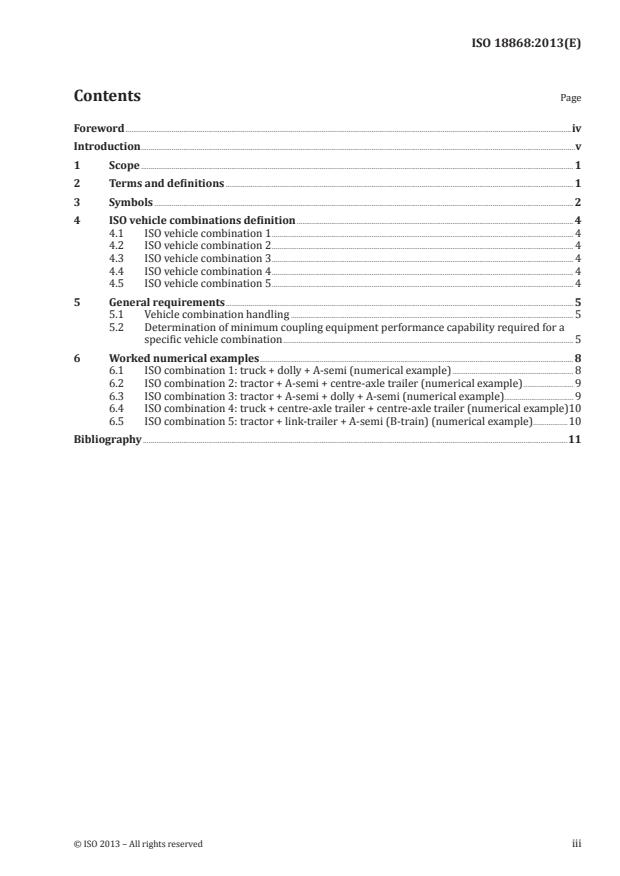
Contents Page
Foreword .iv
Introduction .v
1 Scope . 1
2 Terms and definitions . 1
3 Symbols . 2
4 ISO vehicle combinations definition . 4
4.1 ISO vehicle combination 1 . 4
4.2 ISO vehicle combination 2 . 4
4.3 ISO vehicle combination 3 . 4
4.4 ISO vehicle combination 4 . 4
4.5 ISO vehicle combination 5 . 4
5 General requirements . 5
5.1 Vehicle combination handling . 5
5.2 Determination of minimum coupling equipment performance capability required for a
specific vehicle combination . 5
6 Worked numerical examples . 8
6.1 ISO combination 1: truck + dolly + A-semi (numerical example) . 8
6.2 ISO combination 2: tractor + A-semi + centre-axle trailer (numerical example) . 9
6.3 ISO combination 3: tractor + A-semi + dolly + A-semi (numerical example) . 9
6.4 ISO combination 4: truck + centre-axle trailer + centre-axle trailer (numerical example) 10
6.5 ISO combination 5: tractor + link-trailer + A-semi (B-train) (numerical example).10
Bibliography .11
Foreword
ISO (the International Organization for Standardization) is a worldwide federation of national standards
bodies (ISO member bodies). The work of preparing International Standards is normally carried out
through ISO technical committees. Each member body interested in a subject for which a technical
committee has been established has the right to be represented on that committee. International
organizations, governmental and non-governmental, in liaison with ISO, also take part in the work.
ISO collaborates closely with the International Electrotechnical Commission (IEC) on all matters of
electrotechnical standardization.
The procedures used to develop this document and those intended for its further maintenance are
described in the ISO/IEC Directives, Part 1. In particular the different approval criteria needed for the
different types of ISO documents should be noted. This document was drafted in accordance with the
editorial rules of the ISO/IEC Directives, Part 2. www.iso.org/directives
Attention is drawn to the possibility that some of the elements of this document may be the subject of
patent rights. ISO shall not be held responsible for identifying any or all such patent rights. Details of
any patent rights identified during the development of the document will be in the Introduction and/or
on the ISO list of patent declarations received. www.iso.org/patents
Any trade name used in this document is information given for the convenience of users and does not
constitute an endorsement.
The committee responsible for this document is ISO/TC 22, Road vehicles, Subcommittee SC 15,
Interchangeability of components of commercial vehicles and buses.
iv © ISO 2013 – All rights reserved
Introduction
This International Standard specifies general requirements and definitions to secure the safe operation
of mechanical couplings between individual vehicles in a multiple-vehicle combination.
The expanded application of multiple-vehicle combinations brings new perspectives and needs into
the area of trailer couplings. This has made evident the need for a consolidated method to handle the
dimensioning of mechanical couplings applied in multiple-vehicle combinations. This International
Standard is meant to facilitate the interaction between International Standards and relevant regulations.
The drivers for the introduction of this International Standard are
— the development of the European modular system making multiple-vehicle combinations (road
trains) more of a global application, and
— the lack of rules for the dimensions of couplings used together with converter dolly. Those
applications are already very common on the roads today.
The limited number of types of multiple-vehicle combinations addressed in this International Standard
is the result of a voting process among the nations. Other types may be added in later editions as
experience is gained.
INTERNATIONAL STANDARD ISO 18868:2013(E)
Commercial road vehicles — Coupling equipment
between vehicles in multiple vehicle combinations —
Strength requirements
1 Scope
This International Standard defines different multiple-vehicle combinations (vehicle combinations with
more than one coupling point) and the formulae to calculate the requirement of performance for the coupling
equipment used in those vehicle combinations. Vehicle categories concerned are N2, N3, O3, and O4.
NOTE For these vehicle combinations, the formulae in this International Standard override the formulae in
References [6], [7], [8], and [9] that apply to vehicle combinations with one coupling point only. However, the
capability of the coupling equipment is still determined through tests as defined in References [6], [7], [8], and [9].
2 Terms and definitions
For the purposes of this document, the following terms and definitions apply.
2.1
centre-axle trailer (CAT)
trailer where the axle(s) is(are) positioned close to the centre of gravity of the trailer such that (when uniformly
loaded) only a small static vertical load, not exceeding 10 % of the load corresponding to the maximum
design total mass of the trailer or 1 000 daN (whichever is less), is transmitted to the towing vehicle
2.2
converter dolly
towed vehicle with one axle group or single axle and a fifth wheel coupling, designed to be combined
with a semi-trailer
Note 1 to entry: In cases where the drawbar of the converter dolly is hinged, the combination of a converter dolly
and a semi-trailer is equivalent to a full trailer.
Note 2 to entry: The drawbar of a converter dolly may be rigid or hinged. A hinged drawbar is free to pivot around
an axle that is perpendicular to the vertical plane.
Figure 1 — Converter dolly
2.3
drawbar trailer
trailer having at least two axles, of which at least one is a steered axle, equipped with a towing device
(drawbar) which can move vertically (in relation to the trailer) and that transmits less than 100 daN as
a static vertical load to the towing vehicle
2.4
semi-trailer
trailer which is designed and constructed to be by means of a kingpin coupled to a tractor unit or to a
converter dolly and that impose a substantial vertical load on the towing vehicle
2.5
A-trailer
semi-trailer in a multiple-vehicle combination that is towed on a converter dolly
2.6
link–trailer (or B-trailer)
semi-trailer with a fifth wheel mounted at the rear such that a semi-trailer could be towed by the link-trailer
2.7
tractor
motor vehicle built to tow a semi-trailer
2.8
truck
motor vehicle built to tow a full trailer or a centre-axle trailer
1)
3 Symbols
3.1
S
mass imposed vertically on the coupling under static conditions by the CAT loaded to its maximum
design total mass
3.2
T
technically permissible maximum total mass, in tonnes, of the towing vehicle including, as applicable,
the vertical static load, S, of a CAT or the vertical static load, U, imposed by a semi-trailer
3.3
R
technica
...
INTERNATIONAL ISO
STANDARD 18868
First edition
2013-07-01
Commercial road vehicles — Coupling
equipment between vehicles in
multiple vehicle combinations —
Strength requirements
Véhicules routiers utilitaires — Équipement de couplage entre
véhicules dans des combinaisons de véhicules multiples — Exigences
de résistance
Reference number
©
ISO 2013
© ISO 2013
All rights reserved. Unless otherwise specified, no part of this publication may be reproduced or utilized otherwise in any form
or by any means, electronic or mechanical, including photocopying, or posting on the internet or an intranet, without prior
written permission. Permission can be requested from either ISO at the address below or ISO’s member body in the country of
the requester.
ISO copyright office
Case postale 56 • CH-1211 Geneva 20
Tel. + 41 22 749 01 11
Fax + 41 22 749 09 47
E-mail copyright@iso.org
Web www.iso.org
Published in Switzerland
ii © ISO 2013 – All rights reserved
Contents Page
Foreword .iv
Introduction .v
1 Scope . 1
2 Terms and definitions . 1
3 Symbols . 2
4 ISO vehicle combinations definition . 4
4.1 ISO vehicle combination 1 . 4
4.2 ISO vehicle combination 2 . 4
4.3 ISO vehicle combination 3 . 4
4.4 ISO vehicle combination 4 . 4
4.5 ISO vehicle combination 5 . 4
5 General requirements . 5
5.1 Vehicle combination handling . 5
5.2 Determination of minimum coupling equipment performance capability required for a
specific vehicle combination . 5
6 Worked numerical examples . 8
6.1 ISO combination 1: truck + dolly + A-semi (numerical example) . 8
6.2 ISO combination 2: tractor + A-semi + centre-axle trailer (numerical example) . 9
6.3 ISO combination 3: tractor + A-semi + dolly + A-semi (numerical example) . 9
6.4 ISO combination 4: truck + centre-axle trailer + centre-axle trailer (numerical example) 10
6.5 ISO combination 5: tractor + link-trailer + A-semi (B-train) (numerical example).10
Bibliography .11
Foreword
ISO (the International Organization for Standardization) is a worldwide federation of national standards
bodies (ISO member bodies). The work of preparing International Standards is normally carried out
through ISO technical committees. Each member body interested in a subject for which a technical
committee has been established has the right to be represented on that committee. International
organizations, governmental and non-governmental, in liaison with ISO, also take part in the work.
ISO collaborates closely with the International Electrotechnical Commission (IEC) on all matters of
electrotechnical standardization.
The procedures used to develop this document and those intended for its further maintenance are
described in the ISO/IEC Directives, Part 1. In particular the different approval criteria needed for the
different types of ISO documents should be noted. This document was drafted in accordance with the
editorial rules of the ISO/IEC Directives, Part 2. www.iso.org/directives
Attention is drawn to the possibility that some of the elements of this document may be the subject of
patent rights. ISO shall not be held responsible for identifying any or all such patent rights. Details of
any patent rights identified during the development of the document will be in the Introduction and/or
on the ISO list of patent declarations received. www.iso.org/patents
Any trade name used in this document is information given for the convenience of users and does not
constitute an endorsement.
The committee responsible for this document is ISO/TC 22, Road vehicles, Subcommittee SC 15,
Interchangeability of components of commercial vehicles and buses.
iv © ISO 2013 – All rights reserved
Introduction
This International Standard specifies general requirements and definitions to secure the safe operation
of mechanical couplings between individual vehicles in a multiple-vehicle combination.
The expanded application of multiple-vehicle combinations brings new perspectives and needs into
the area of trailer couplings. This has made evident the need for a consolidated method to handle the
dimensioning of mechanical couplings applied in multiple-vehicle combinations. This International
Standard is meant to facilitate the interaction between International Standards and relevant regulations.
The drivers for the introduction of this International Standard are
— the development of the European modular system making multiple-vehicle combinations (road
trains) more of a global application, and
— the lack of rules for the dimensions of couplings used together with converter dolly. Those
applications are already very common on the roads today.
The limited number of types of multiple-vehicle combinations addressed in this International Standard
is the result of a voting process among the nations. Other types may be added in later editions as
experience is gained.
INTERNATIONAL STANDARD ISO 18868:2013(E)
Commercial road vehicles — Coupling equipment
between vehicles in multiple vehicle combinations —
Strength requirements
1 Scope
This International Standard defines different multiple-vehicle combinations (vehicle combinations with
more than one coupling point) and the formulae to calculate the requirement of performance for the coupling
equipment used in those vehicle combinations. Vehicle categories concerned are N2, N3, O3, and O4.
NOTE For these vehicle combinations, the formulae in this International Standard override the formulae in
References [6], [7], [8], and [9] that apply to vehicle combinations with one coupling point only. However, the
capability of the coupling equipment is still determined through tests as defined in References [6], [7], [8], and [9].
2 Terms and definitions
For the purposes of this document, the following terms and definitions apply.
2.1
centre-axle trailer (CAT)
trailer where the axle(s) is(are) positioned close to the centre of gravity of the trailer such that (when uniformly
loaded) only a small static vertical load, not exceeding 10 % of the load corresponding to the maximum
design total mass of the trailer or 1 000 daN (whichever is less), is transmitted to the towing vehicle
2.2
converter dolly
towed vehicle with one axle group or single axle and a fifth wheel coupling, designed to be combined
with a semi-trailer
Note 1 to entry: In cases where the drawbar of the converter dolly is hinged, the combination of a converter dolly
and a semi-trailer is equivalent to a full trailer.
Note 2 to entry: The drawbar of a converter dolly may be rigid or hinged. A hinged drawbar is free to pivot around
an axle that is perpendicular to the vertical plane.
Figure 1 — Converter dolly
2.3
drawbar trailer
trailer having at least two axles, of which at least one is a steered axle, equipped with a towing device
(drawbar) which can move vertically (in relation to the trailer) and that transmits less than 100 daN as
a static vertical load to the towing vehicle
2.4
semi-trailer
trailer which is designed and constructed to be by means of a kingpin coupled to a tractor unit or to a
converter dolly and that impose a substantial vertical load on the towing vehicle
2.5
A-trailer
semi-trailer in a multiple-vehicle combination that is towed on a converter dolly
2.6
link–trailer (or B-trailer)
semi-trailer with a fifth wheel mounted at the rear such that a semi-trailer could be towed by the link-trailer
2.7
tractor
motor vehicle built to tow a semi-trailer
2.8
truck
motor vehicle built to tow a full trailer or a centre-axle trailer
1)
3 Symbols
3.1
S
mass imposed vertically on the coupling under static conditions by the CAT loaded to its maximum
design total mass
3.2
T
technically permissible maximum total mass, in tonnes, of the towing vehicle including, as applicable,
the vertical static load, S, of a CAT or the vertical static load, U, imposed by a semi-trailer
3.3
R
technica
...