

ISO 24544:2024
(Main)Rare earth — Recyclable Neodymium iron boron (NdFeB) resources — Classification, general requirements and acceptance conditions
General Information
- Abstract
This document specifies the classification, general requirements and acceptance conditions for recyclable neodymium iron boron (NdFeB) resources. This document is applicable to recyclable NdFeB resources from end-of-life (EOL) products and manufacture processes.
- Status
- Published
- Publication Date
- 05-Feb-2024
- Technical Committee
- ISO/TC 298 - Rare earth
- Drafting Committee
- ISO/TC 298 - Rare earth
- Current Stage
- 6060 - International Standard published
- Start Date
- 06-Feb-2024
- Due Date
- 04-Sep-2023
- Completion Date
- 06-Feb-2024
Overview
ISO 24544:2024 - Rare earth - Recyclable Neodymium iron boron (NdFeB) resources - Classification, general requirements and acceptance conditions defines an international framework for identifying, handling and accepting recyclable NdFeB materials. The scope covers recyclable NdFeB resources from end-of-life (EOL) products and manufacturing processes, and addresses sintered (S‑NdFeB), bonded (B‑NdFeB) and deformed (D‑NdFeB) magnet streams. The standard supports consistent rare earth recycling practices and reliable trade in recyclable NdFeB feedstocks.
Key topics and requirements
- Classification and coding: Sets categories for recyclable NdFeB resources (EOL vs industrial; S‑NdFeB, B‑NdFeB, D‑NdFeB; magnet scrap vs sludge) to enable clear communication and material tracking.
- Sampling: Defines general principles and specific considerations for sampling recyclable NdFeB from EOL and industrial sources to ensure representative testing.
- Testing and analysis: Requires appropriate analytical methods for composition and contamination assessment (references include wavelength dispersive X‑RF methods for magnet scrap).
- Packaging, transport and storage: Specifies requirements to prevent oxidation, contamination or material loss during logistics.
- Labelling and information exchange: Emphasizes standardized labeling and data to accompany recyclable NdFeB shipments (composition, source, code).
- Acceptance conditions: Provides criteria purchasers and recyclers can use to accept or reject inbound recyclable NdFeB resources based on classification, composition and contamination levels.
Applications and who uses it
ISO 24544:2024 is intended for organizations and stakeholders involved across the NdFeB value chain:
- Recycling companies assessing feedstock quality and acceptance criteria for magnet scrap and sludge.
- Magnet and materials manufacturers sourcing recycled NdFeB input for re‑melting, powder production or remanufacturing.
- EOL processors and dismantlers who collect and prepare NdFeB-containing components from end-of-life products.
- Waste managers, traders and logistics providers handling packaging, storage and transport of recyclable rare earth resources.
- Laboratories and QA teams performing sampling, analysis and certification.
- Policymakers and procurement teams implementing circular economy and critical‑materials strategies.
Benefits include improved feedstock quality control, reduced environmental impact by boosting rare earth recovery, and clearer commercial transactions for recyclable NdFeB materials.
Related standards
This document is linked to existing ISO and IEC publications used for measurement and information exchange, including:
- ISO 22450:2020 (information on industrial waste and EOL products)
- ISO/TS 22451 (methods for measurement of REEs in waste/EOL products)
- ISO 22453 (exchange of information on REEs in wastes and EOL products)
- ISO 22928‑1 (WD‑XRFS analysis for magnet scraps)
- IEC 60404‑1 (magnetic materials classification)
Keywords: ISO 24544:2024, NdFeB, recyclable neodymium iron boron, rare earth recycling, EOL magnets, magnet scrap, sintered NdFeB.
Get Certified
Connect with accredited certification bodies for this standard

CIS Institut d.o.o.
Personal Protective Equipment (PPE) certification body. Notified Body NB-2890 for EU Regulation 2016/425 PPE.

Kiwa BDA Testing
Building and construction product certification.
Kmetijski inštitut Slovenije
Agricultural Institute of Slovenia. Soil testing, plant health, agricultural product analysis.
Sponsored listings
Frequently Asked Questions
ISO 24544:2024 is a standard published by the International Organization for Standardization (ISO). Its full title is "Rare earth — Recyclable Neodymium iron boron (NdFeB) resources — Classification, general requirements and acceptance conditions". This standard covers: This document specifies the classification, general requirements and acceptance conditions for recyclable neodymium iron boron (NdFeB) resources. This document is applicable to recyclable NdFeB resources from end-of-life (EOL) products and manufacture processes.
This document specifies the classification, general requirements and acceptance conditions for recyclable neodymium iron boron (NdFeB) resources. This document is applicable to recyclable NdFeB resources from end-of-life (EOL) products and manufacture processes.
ISO 24544:2024 is classified under the following ICS (International Classification for Standards) categories: 13.030.30 - Special wastes; 13.030.50 - Recycling. The ICS classification helps identify the subject area and facilitates finding related standards.
ISO 24544:2024 is available in PDF format for immediate download after purchase. The document can be added to your cart and obtained through the secure checkout process. Digital delivery ensures instant access to the complete standard document.
Standards Content (Sample)
International
Standard
ISO 24544
First edition
Rare earth — Recyclable
2024-02
Neodymium iron boron (NdFeB)
resources — Classification, general
requirements and acceptance
conditions
Terres rares — Ressources en néodyme-fer-bore (NdFeB)
recyclable — Classification, exigences générales et conditions de
recette
Reference number
© ISO 2024
All rights reserved. Unless otherwise specified, or required in the context of its implementation, no part of this publication may
be reproduced or utilized otherwise in any form or by any means, electronic or mechanical, including photocopying, or posting on
the internet or an intranet, without prior written permission. Permission can be requested from either ISO at the address below
or ISO’s member body in the country of the requester.
ISO copyright office
CP 401 • Ch. de Blandonnet 8
CH-1214 Vernier, Geneva
Phone: +41 22 749 01 11
Email: copyright@iso.org
Website: www.iso.org
Published in Switzerland
ii
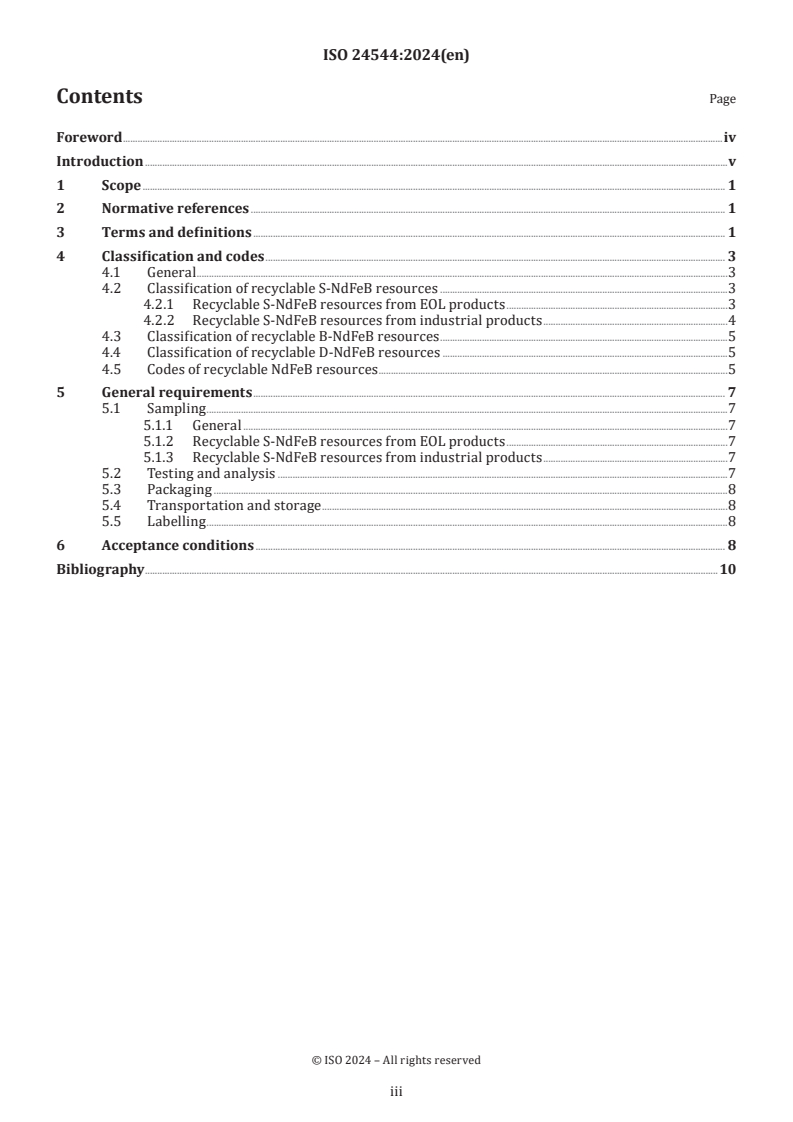
Contents Page
Foreword .iv
Introduction .v
1 Scope . 1
2 Normative references . 1
3 Terms and definitions . 1
4 Classification and codes . 3
4.1 General .3
4.2 Classification of recyclable S-NdFeB resources .3
4.2.1 Recyclable S-NdFeB resources from EOL products .3
4.2.2 Recyclable S-NdFeB resources from industrial products .4
4.3 Classification of recyclable B-NdFeB resources .5
4.4 Classification of recyclable D-NdFeB resources .5
4.5 Codes of recyclable NdFeB resources .5
5 General requirements . 7
5.1 Sampling .7
5.1.1 General .7
5.1.2 Recyclable S-NdFeB resources from EOL products .7
5.1.3 Recyclable S-NdFeB resources from industrial products .7
5.2 Testing and analysis .7
5.3 Packaging .8
5.4 Transportation and storage .8
5.5 Labelling .8
6 Acceptance conditions . 8
Bibliography .10
iii
Foreword
ISO (the International Organization for Standardization) is a worldwide federation of national standards
bodies (ISO member bodies). The work of preparing International Standards is normally carried out through
ISO technical committees. Each member body interested in a subject for which a technical committee
has been established has the right to be represented on that committee. International organizations,
governmental and non-governmental, in liaison with ISO, also take part in the work. ISO collaborates closely
with the International Electrotechnical Commission (IEC) on all matters of electrotechnical standardization.
The procedures used to develop this document and those intended for its further maintenance are described
in the ISO/IEC Directives, Part 1. In particular, the different approval criteria needed for the different types
of ISO document should be noted. This document was drafted in accordance with the editorial rules of the
ISO/IEC Directives, Part 2 (see www.iso.org/directives).
ISO draws attention to the possibility that the implementation of this document may involve the use of (a)
patent(s). ISO takes no position concerning the evidence, validity or applicability of any claimed patent
rights in respect thereof. As of the date of publication of this document, ISO had not received notice of (a)
patent(s) which may be required to implement this document. However, implementers are cautioned that
this may not represent the latest information, which may be obtained from the patent database available at
www.iso.org/patents. ISO shall not be held responsible for identifying any or all such patent rights.
Any trade name used in this document is information given for the convenience of users and does not
constitute an endorsement.
For an explanation of the voluntary nature of standards, the meaning of ISO specific terms and expressions
related to conformity assessment, as well as information about ISO’s adherence to the World Trade
Organization (WTO) principles in the Technical Barriers to Trade (TBT), see www.iso.org/iso/foreword.html.
This document was prepared by Technical Committee ISO/TC 298, Rare earth.
Any feedback or questions on this document should be directed to the user’s national standards body. A
complete listing of these bodies can be found at www.iso.org/members.html.
iv
Introduction
Rare earth elements (REEs) are an important ingredient in products such as magnets, luminous devices and
catalysts. Among these, magnets, especially neodymium iron boron (Nd Fe B or NdFeB in shortened form),
2 14
consume more than a mass fraction of 30 % of rare earths. The process of exploring and producing rare
earths is causing pressure on the environment due to the use of different kinds of chemical agents as well as
the resulting emissions of waste water, slag, dust and gas. In addition, there are limited primary rare earth
resources available for economically viable production across the world. The recovery of rare earth from
industrial products (including scraps and sludge) and end-of-life (EOL) products will help address these
problems, particularly from a long-term perspective.
The NdFeB magnet is the permanent magnet of choice in many products, including in the motors of electronic
vehicles and hard discs in computers, and is a key component of air conditioners. The use of both sintered
and bonded NdFeB products has grown steadily during the last several decades at an average annual growth
[1]
rate of around 9 % and 6,2 %, respectively. The steady growth of NdFeB production has led to an increase
in recyclable resources, especially sintered NdFeB scrap. These recyclable NdFeB resources contain not only
about 30 % of REEs, but also other valuable elements such as Co, Ni, Ga, etc., which shows there is significant
potential in recycling these resources to effectively supplement rare earth resources.
In addition, when the products containing NdFeB magnets come to the end of their lives, there will be an
increase in EOL products. Therefore, recycling rare earth from recyclable NdFeB resources can meet a
substantial part of the demand for global light (Nd and Pr) REEs and heavy (Dy and Tb) REEs.
However, a challenge for recycling rare earth is that the recyclable NdFeB resources from different sources
and processes can vary significantly in form, shape, chemical composition, phase structure, etc., leading to
quite complex and diverse recycling methods. Figure 1 provides an example of sintered NdFeB (S-NdFeB),
[2]
which accounts for about 90 % of the total market, to illustrate some of the typical recyclable resources
from EOL products and industrial processes, and the recycled products that can be created using a highly
efficient and low polluting recovery method as follows:
— For some large sintered NdFeB magnets from EOL products, after removing the coating, the cleaned
magnet can be used as raw materials and can be further manufactured into sintered NdFeB magnets.
— NdFeB sludge from industrial products in the machining stage is usually recycled into NdFeB powders
or magnets by using a combination of calcium thermal reduction and sintering, or into REE compounds
by using hydrometallurgy or thermometallurgy, depending on the oxidation and main phase structure
of the sludge.
— Scraps including unqualified bulk, residual powder and other recyclable resources from different
processing stages can be applied in different steps of the sintering process and regenerated into recycled
NdFeB magnets according to the phase, and the degree of contamination and oxidation.
v
Figure 1 — Typical examples of recyclable NdFeB resources from different sources, and possible
methods to recycle to different products
Therefore, it is important to determine the characteristics of different recyclable NdFeB resources. This
document provides the classification, general requirements and acceptance conditions for recyclable NdFeB
resources, considering the unique characteristics of the different resources and the industrial recycling
methods that can be used.
This document promotes the efficient recycling of valuable REE elements across countries that produce and
consume magnets.
vi
International Standard ISO 24544:2024(en)
Rare earth — Recyclable Neodymium iron boron (NdFeB)
resources — Classification, general requirements and
acceptance conditions
1 Scope
This document specifies the classification, general requirements and acceptance conditions for recyclable
neodymium iron boron (NdFeB) resources.
This document is applicable to recyclable NdFeB resources from end-of-life (EOL) products and manufacture
processes.
2 Normative references
The following documents are referred to in the text in such a way that some or all of their content constitutes
requirements of this document. For dated references, only the edition cited applies. For undated references,
the latest edition of the referenced document (including any amendments) applies.
ISO 22450:2020, Recycling of rare earth elements — Requirements for providing information on industrial
waste and end-of-life products
ISO/TS 22451, Recycling of rare earth elements — Methods for the measurement of rare earth elements in
industrial waste and end-of-life products
ISO 22453, Exchange of information on rare earth elements in industrial wastes and end-of-life cycled products
ISO 22928-1, Rare earth — Analysis by wavelength dispersive X-ray fluorescence spectrometry (WD-XRFS) —
Part 1: Determination of composition of rare earth magnet scraps using standardless XRF commercial packages
IEC 60404-1, Magnetic materials — Part 1: Classification
3 Terms and definitions
For the purposes of this document, the following terms and definitions apply.
ISO and IEC maintain terminology databases for use in standardization at the following addresses:
— ISO Online browsing platform: available at https:// www .iso .org/ obp
— IEC Electropedia: available at https:// www .electropedia .org/
3.1
rare earth element
REE
collective name for scandium (Sc), yttrium (Y) and the lanthanides (La, Ce, Pr, Nd, Pm, Sm, Eu, Gd, Tb, Dy, Ho,
Er, Tm, Yb, Lu), which was approved by the International Union for Pure and Applied Chemistry (IUPAC) in
[1]
its 2005 Nomenclature of Inorganic Chemistry Recommendations
Note 1 to entry: Certain terms and corresponding abbreviated terms are common such as rare earth element (REE or
RE) and rare earth oxide (REO).
Note 2 to entry: Rare earth elements are frequently referred to as being either light rare earth (LREE), medium rare
earth (MREE) or heavy rare earth (HREE), with LREE including the elements between lanthanum (La) and neodymium
(Nd), MREE including the elements between samarium (Sm) and gadolinium (Gd), and HREE including the elements
from terbium (Tb) to lutetium (Lu) as well as scandium (Sc) and yttrium (Y).
Note 3 to entry: Didymium is commonly used to express a mixture of the elements Pr and Nd.
Note 4 to entry: Characteristics of rare earth elements are described in ISO 22444-1:2020, Annex A.
[SOURCE: ISO 22444-1:2020, 3.1]
3.2
neodymium iron boron
NdFeB
kind of permanent magnet made from an alloy of neodymium, iron, and boron to form the
Nd Fe B tetragonal crystalline structure
2 14
3.3
sintered neodymium iron boron
S-NdFeB
NdFeB (3.2) magnet prepared by a powder metallurgy method
Note 1 to entry: In the powder metallurgy method, the raw materials are melted and casted into flake-like ingots with
strip-casting technique; the ingots are pulverized with hydrogen decrepitation technique and then milled into single-
crystal powders with jet-milling technique; the powders are aligned in magnetic field and pressed into green compacts
and then sintered into dense blocks; the blocks are heat-treated, cut to shape, surface treated and magnetized.
Note 2 to entry: Sintered NdFeB magnets are the most widely used rare earth magnet and contribute to about 92 %
market supply of all NdFeB magnets. They have the strongest energy density of all kinds of permanent magnets.
3.4
bonded neodymium iron boron
B-NdFeB
NdFeB (3.2) magnet prepared by mixing NdFeB powders and binders such as organic or inorganic adhesives,
and then compressed or injected into dense blocks, surface treated and magnetized
Note 1 to entry: Bonded NdFeB magnets contribute to 6 % to 7 % of the market supply of all NdFeB magnets. They
usually exhibit lower magnetic properties than S-NdFeB (3.3) magnets but can be prepared directly into a net shape or
near net shape with complex shapes.
3.5
deformed neodymium iron boron
D-NdFeB
NdFeB (3.2) magnet prepared with hot pressing and hot deformation of nanocrystalline NdFeB ribbons
Note 1 to entry: Deformed NdFeB magnets contribute to about 1 % to 2 % of the market supply of all NdFeB magnets.
They have a similar energy density to S-NdFeB (3.3) magnets and are usually prepared into ring-shape magnets with
strong magnetic anisotropy.
3.6
recyclable neodymium iron boron resource
recyclable NdFeB resource
resource usually collected from end-of-life (EOL) and manufacture processed S-NdFeB, B-NdFeB, and
D-NdFeB magnet component
...