


ISO/IEC 21000-22:2016
(Main)Information technology — Multimedia framework (MPEG-21) — Part 22: User Description
Information technology — Multimedia framework (MPEG-21) — Part 22: User Description
ISO/IEC 21000-22:2016 standardizes the four data formats: User Description (UD), Context Description (CD), Service Description (SD), and Recommendation Description (RD). - User Description (UD): a set of descriptions which may contain static and dynamic information about the user, including some other data like the history of the user's interactions, preferences, security settings regarding these information, etc. - Context Description (CD): a set of descriptions of the environmental situation in which the user operates, e.g., user's device in use, physical position, environmental variables (temperature, humidity, sound level, etc.), security settings regarding these inform ation, etc. - Service Description (SD): a set of descriptions containing information (including security settings) about the service (or a set of sub-services), that is offered to the end-user application, e.g. video on demand, maps, etc. - Recommendation Description (RD): a set of descriptions containing information about recommended items, provided when a customer requests a service in a certain context and in a certain environment. RD may include 1) the recommended content, 2) information extracted from UD, CD, SD, 3) additional logical relations among UD/CD/SD (or their subsets) and 4) metadata from UD/CD/SD. ISO/IEC 21000-22:2016 specifies User Description, Context Description, Service Description and Recommendation Description. Description Managers, Recommendation Engine and Application are outside of the scope of this document.
Technologies de l'information — Cadre multimédia (MPEG-21) — Partie 22: Description de l'utilisateur
General Information
- Status
- Withdrawn
- Publication Date
- 15-Nov-2016
- Withdrawal Date
- 15-Nov-2016
- Current Stage
- 9599 - Withdrawal of International Standard
- Start Date
- 13-Aug-2019
- Completion Date
- 14-Feb-2026
Relations
- Effective Date
- 06-Jun-2022
- Effective Date
- 25-Dec-2021
- Effective Date
- 19-May-2018
Get Certified
Connect with accredited certification bodies for this standard

BSI Group
BSI (British Standards Institution) is the business standards company that helps organizations make excellence a habit.

NYCE
Mexican standards and certification body.
Sponsored listings
Frequently Asked Questions
ISO/IEC 21000-22:2016 is a standard published by the International Organization for Standardization (ISO). Its full title is "Information technology — Multimedia framework (MPEG-21) — Part 22: User Description". This standard covers: ISO/IEC 21000-22:2016 standardizes the four data formats: User Description (UD), Context Description (CD), Service Description (SD), and Recommendation Description (RD). - User Description (UD): a set of descriptions which may contain static and dynamic information about the user, including some other data like the history of the user's interactions, preferences, security settings regarding these information, etc. - Context Description (CD): a set of descriptions of the environmental situation in which the user operates, e.g., user's device in use, physical position, environmental variables (temperature, humidity, sound level, etc.), security settings regarding these inform ation, etc. - Service Description (SD): a set of descriptions containing information (including security settings) about the service (or a set of sub-services), that is offered to the end-user application, e.g. video on demand, maps, etc. - Recommendation Description (RD): a set of descriptions containing information about recommended items, provided when a customer requests a service in a certain context and in a certain environment. RD may include 1) the recommended content, 2) information extracted from UD, CD, SD, 3) additional logical relations among UD/CD/SD (or their subsets) and 4) metadata from UD/CD/SD. ISO/IEC 21000-22:2016 specifies User Description, Context Description, Service Description and Recommendation Description. Description Managers, Recommendation Engine and Application are outside of the scope of this document.
ISO/IEC 21000-22:2016 standardizes the four data formats: User Description (UD), Context Description (CD), Service Description (SD), and Recommendation Description (RD). - User Description (UD): a set of descriptions which may contain static and dynamic information about the user, including some other data like the history of the user's interactions, preferences, security settings regarding these information, etc. - Context Description (CD): a set of descriptions of the environmental situation in which the user operates, e.g., user's device in use, physical position, environmental variables (temperature, humidity, sound level, etc.), security settings regarding these inform ation, etc. - Service Description (SD): a set of descriptions containing information (including security settings) about the service (or a set of sub-services), that is offered to the end-user application, e.g. video on demand, maps, etc. - Recommendation Description (RD): a set of descriptions containing information about recommended items, provided when a customer requests a service in a certain context and in a certain environment. RD may include 1) the recommended content, 2) information extracted from UD, CD, SD, 3) additional logical relations among UD/CD/SD (or their subsets) and 4) metadata from UD/CD/SD. ISO/IEC 21000-22:2016 specifies User Description, Context Description, Service Description and Recommendation Description. Description Managers, Recommendation Engine and Application are outside of the scope of this document.
ISO/IEC 21000-22:2016 is classified under the following ICS (International Classification for Standards) categories: 35.040 - Information coding; 35.040.40 - Coding of audio, video, multimedia and hypermedia information. The ICS classification helps identify the subject area and facilitates finding related standards.
ISO/IEC 21000-22:2016 has the following relationships with other standards: It is inter standard links to ISO 11146-2:2021, ISO/IEC 21000-22:2016/Amd 1:2018, ISO/IEC 21000-22:2019. Understanding these relationships helps ensure you are using the most current and applicable version of the standard.
ISO/IEC 21000-22:2016 is available in PDF format for immediate download after purchase. The document can be added to your cart and obtained through the secure checkout process. Digital delivery ensures instant access to the complete standard document.
Standards Content (Sample)
INTERNATIONAL ISO/IEC
STANDARD 21000-22
First edition
2016-11-15
Information technology — Multimedia
framework (MPEG-21) —
Part 22:
User Description
Technologies de l’information — Cadre multimédia (MPEG-21) —
Partie 22: Description de l’utilisateur
Reference number
©
ISO/IEC 2016
© ISO/IEC 2016, Published in Switzerland
All rights reserved. Unless otherwise specified, no part of this publication may be reproduced or utilized otherwise in any form
or by any means, electronic or mechanical, including photocopying, or posting on the internet or an intranet, without prior
written permission. Permission can be requested from either ISO at the address below or ISO’s member body in the country of
the requester.
ISO copyright office
Ch. de Blandonnet 8 • CP 401
CH-1214 Vernier, Geneva, Switzerland
Tel. +41 22 749 01 11
Fax +41 22 749 09 47
copyright@iso.org
www.iso.org
ii © ISO/IEC 2016 – All rights reserved
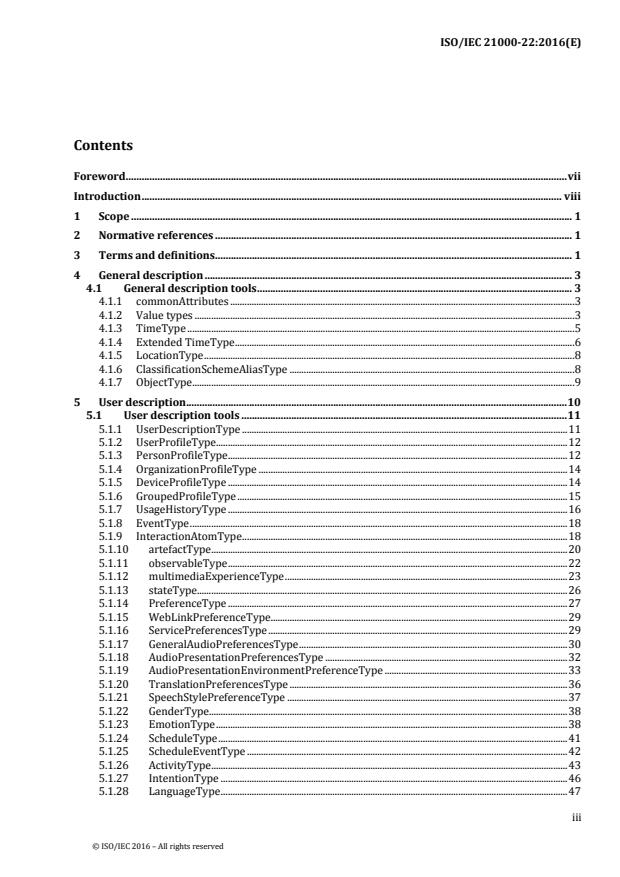
Contents
Foreword . vii
Introduction . viii
1 Scope . 1
2 Normative references . 1
3 Terms and definitions . 1
4 General description . 3
4.1 General description tools . 3
4.1.1 commonAttributes .3
4.1.2 Value types .3
4.1.3 TimeType .5
4.1.4 Extended TimeType .6
4.1.5 LocationType .8
4.1.6 ClassificationSchemeAliasType .8
4.1.7 ObjectType .9
5 User description . 10
5.1 User description tools . 11
5.1.1 UserDescriptionType . 11
5.1.2 UserProfileType. 12
5.1.3 PersonProfileType . 12
5.1.4 OrganizationProfileType . 14
5.1.5 DeviceProfileType . 14
5.1.6 GroupedProfileType . 15
5.1.7 UsageHistoryType . 16
5.1.8 EventType . 18
5.1.9 InteractionAtomType . 18
5.1.10 artefactType . 20
5.1.11 observableType . 22
5.1.12 multimediaExperienceType . 23
5.1.13 stateType. 26
5.1.14 PreferenceType . 27
5.1.15 WebLinkPreferenceType. 29
5.1.16 ServicePreferencesType . 29
5.1.17 GeneralAudioPreferencesType . 30
5.1.18 AudioPresentationPreferencesType . 32
5.1.19 AudioPresentationEnvironmentPreferenceType . 33
5.1.20 TranslationPreferencesType . 36
5.1.21 SpeechStylePreferenceType . 37
5.1.22 GenderType. 38
5.1.23 EmotionType . 38
5.1.24 ScheduleType . 41
5.1.25 ScheduleEventType . 42
5.1.26 ActivityType . 43
5.1.27 IntentionType . 46
5.1.28 LanguageType . 47
iii
© ISO/IEC 2016 – All rights reserved
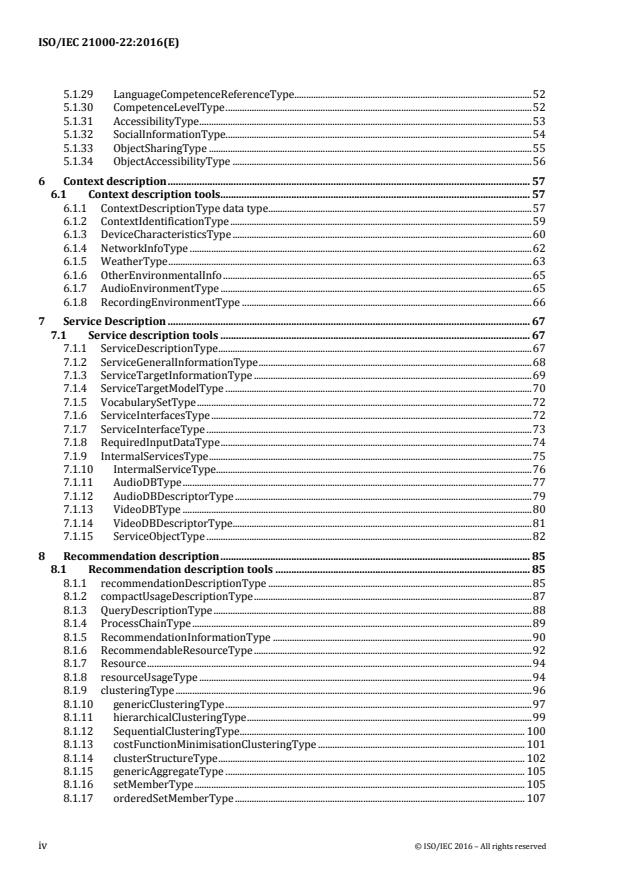
5.1.29 LanguageCompetenceReferenceType. 52
5.1.30 CompetenceLevelType . 52
5.1.31 AccessibilityType . 53
5.1.32 SocialInformationType. 54
5.1.33 ObjectSharingType . 55
5.1.34 ObjectAccessibilityType . 56
6 Context description . 57
6.1 Context description tools . 57
6.1.1 ContextDescriptionType data type. 57
6.1.2 ContextIdentificationType . 59
6.1.3 DeviceCharacteristicsType . 60
6.1.4 NetworkInfoType . 62
6.1.5 WeatherType . 63
6.1.6 OtherEnvironmentalInfo . 65
6.1.7 AudioEnvironmentType . 65
6.1.8 RecordingEnvironmentType . 66
7 Service Description . 67
7.1 Service description tools . 67
7.1.1 ServiceDescriptionType . 67
7.1.2 ServiceGeneralInformationType . 68
7.1.3 ServiceTargetInformationType . 69
7.1.4 ServiceTargetModelType . 70
7.1.5 VocabularySetType . 72
7.1.6 ServiceInterfacesType . 72
7.1.7 ServiceInterfaceType . 73
7.1.8 RequiredInputDataType . 74
7.1.9 IntermalServicesType . 75
7.1.10 IntermalServiceType. 76
7.1.11 AudioDBType . 77
7.1.12 AudioDBDescriptorType . 79
7.1.13 VideoDBType . 80
7.1.14 VideoDBDescriptorType. 81
7.1.15 ServiceObjectType . 82
8 Recommendation description . 85
8.1 Recommendation description tools . 85
8.1.1 recommendationDescriptionType . 85
8.1.2 compactUsageDescriptionType . 87
8.1.3 QueryDescriptionType . 88
8.1.4 ProcessChainType . 89
8.1.5 RecommendationInformationType . 90
8.1.6 RecommendableResourceType . 92
8.1.7 Resource . 94
8.1.8 resourceUsageType . 94
8.1.9 clusteringType . 96
8.1.10 genericClusteringType . 97
8.1.11 hierarchicalClusteringType . 99
8.1.12 SequentialClusteringType . 100
8.1.13 costFunctionMinimisationClusteringType . 101
8.1.14 clusterStructureType . 102
8.1.15 genericAggregateType . 105
8.1.16 setMemberType . 105
8.1.17 orderedSetMemberType . 107
iv © ISO/IEC 2016 – All rights reserved
8.1.18 genericSetType . 109
8.1.19 labelledSetType . 109
8.1.20 orderedSetType . 112
8.1.21 equivalenceSetType . 113
8.1.22 linkageSetType . 114
8.1.23 Member . 116
8.1.24 OrderedMember . 117
8.1.25 queryClauseType . 118
8.1.26 ORqueryClauseType . 119
8.1.27 ANDqueryClauseType. 120
Annex A (normative) MPEG-21 UD technologies . 122
Annex B (normative) Classification schemes . 123
B.1 General . 123
B.2 User specialty CS . 123
B.3 User interaction ontology . 149
B.4 DeviceCategoryCS . 154
B.5 IntentionActionCS . 155
B.6 ServiceCategoryCS . 157
B.7 SeasonCS . 160
B.8 StatesSemanticRelationshipsCS . 162
B.9 InteractionAtomRolesCS . 162
B.10 ObjectCategoryCS . 162
Bibliography . 165
v
© ISO/IEC 2016 – All rights reserved
vi © ISO/IEC 2016 – All rights reserved
Foreword
ISO (the International Organization for Standardization) and IEC (the International Electrotechnical
Commission) form the specialized system for worldwide standardization. National bodies that are
members of ISO or IEC participate in the development of International Standards through technical
committees established by the respective organization to deal with particular fields of technical activity.
ISO and IEC technical committees collaborate in fields of mutual interest. Other international
organizations, governmental and non-governmental, in liaison with ISO and IEC, also take part in the
work. In the field of information technology, ISO and IEC have established a joint technical committee,
ISO/IEC JTC 1.
The procedures used to develop this document and those intended for its further maintenance are
described in the ISO/IEC Directives, Part 1. In particular the different approval criteria needed for the
different types of document should be noted. This document was drafted in accordance with the
editorial rules of the ISO/IEC Directives, Part 2 (see www.iso.org/directives).
Attention is drawn to the possibility that some of the elements of this document may be the subject of
patent rights. ISO and IEC shall not be held responsible for identifying any or all such patent rights.
Details of any patent rights identified during the development of the document will be in the
Introduction and/or on the ISO list of patent declarations received (see www.iso.org/patents).
Any trade name used in this document is information given for the convenience of users and does not
constitute an endorsement.
For an explanation on the meaning of ISO specific terms and expressions related to conformity
assessment, as well as information about ISO's adherence to the World Trade Organization (WTO)
principles in the Technical Barriers to Trade (TBT) see the following URL:
www.iso.org/iso/foreword.html.
The committee responsible for this document is ISO/IEC JTC 1, Information technology, Subcommittee
SC 29, Coding of audio, picture, multimedia and hypermedia information.
A list of all parts in the ISO/IEC 21000 series can be found on the ISO website.
vii © ISO/IEC 2016 – All rights reserved
Introduction
The use of multimedia is pervading more and more our daily life and services are becoming more and
more customized to user needs. Although MPEG has already developed other standards such as MPEG-
7, MPEG-21, and MPEG-M that address User Description, the level of specification in those standards
cannot cope with the needs of current and upcoming services such as augmented reality and social
networks.
In a context of a large number of competing service providers, a user typically relies on a
Recommendation Service that suggests choices to Users. Conceivably, the use of more than one
Recommendation Service in combination could provide better choices to users. However, comparing
different recommendations can be difficult if the users seeking recommendations, the contexts in which
they operate and the services they are using are described in incompatible fashions.
The aim of the MPEG-21 User Description standard, referred to as MPEG-21 UD, is to enable
Recommendation Services that provide standard, i.e. compatible, recommendations. To achieve this
goal, standards for the following input and output formats of a Recommendation Engine are needed:
a) the input format that includes
1) Description of User (UD) seeking recommendation,
2) Description of Context (CD) in which User operates, and
3) Description of Service (SD) offering content sought by User;
b) the output format, called Recommendation Description (RD), that includes
1) subsets of UD/CD/SD,
2) additional logical relations,
3) metadata related to the subsets, and
4) recommendation.
The scope of MPEG-21 UD can be exemplified by the following use scenario. A Smart TV manufacturer
has included a new type of recommendation functionalities in the TV set to help customers select
programmes. The TV set supports standard User Description (UD), Context Description (CD) and
Service Description (SD). With these data, User can access different Recommendation Services each of
which provides a standard Recommendation Description (RD). The TV set has an application which
mashes up the different recommendations and provides customized recommendations to User.
The Description Managers of Figure 1 are in charge of
a) updating UD, CD and SD, e.g. as a result of a User selection, and
b) providing UD, CD and SD in response to requests coming from the Recommendation Engine.
Recommendation Engines process UD, CD and SD and provide Recommendations in the form of
Recommendation Description (RD) typically to an Application.
viii © ISO/IEC 2016 – All rights reserved
Figure 1 — Conceptual model of MPEG-21 User Description (red elements UD/CD/SD/RD
indicate the formats specified by MPEG-21 User Description)
ix
© ISO/IEC 2016 – All rights reserved
INTERNATIONAL STANDARD ISO/IEC 21000-22:2016(E)
Information technology — Multimedia framework (MPEG-21) —
Part 22: User Description
1 Scope
This document standardizes the four data formats: User Description (UD), Context Description (CD),
Service Description (SD), and Recommendation Description (RD).
— User Description (UD): a set of descriptions which may contain static and dynamic information
about the user, including some other data like the history of the user’s interactions, preferences,
security settings regarding these information, etc.
— Context Description (CD): a set of descriptions of the environmental situation in which the user
operates, e.g., user’s device in use, physical position, environmental variables (temperature,
humidity, sound level, etc.), security settings regarding these inform ation, etc.
— Service Description (SD): a set of descriptions containing information (including security settings)
about the service (or a set of sub-services), that is offered to the end-user application, e.g. video on
demand, maps, etc.
— Recommendation Description (RD): a set of descriptions containing information about
recommended items, provided when a customer requests a service in a certain context and in a
certain environment. RD may include 1) the recommended content, 2) information extracted from
UD, CD, SD, 3) additional logical relations among UD/CD/SD (or their subsets) and 4) metadata
from UD/CD/SD.
This document specifies User Description, Context Description, Service Description and
Recommendation Description. Description Managers, Recommendation Engine and Application are
outside of the scope of this document.
2 Normative references
There are no normative references cited in this document.
3 Terms and definitions
For the purposes of this document, the following terms and definitions apply.
ISO and IEC maintain terminological databases for use in standardization at the following addresses:
— IEC Electropedia: available at http://www.electropedia.org/
— ISO Online browsing platform: available at http://www.iso.org/obp
3.1
MPEG-21 UD
four standard descriptions that contain information about user, context, service and recommendation
© ISO/IEC 2016 – All rights reserved 1
3.2
user description
UD
set of data which may contain static and/or dynamic information about the user, e.g. identity,
interactions, preferences, security settings regarding these information, etc.
3.3
context description
CD
set of data that describes the context and environmental situation in which the user is located, e.g.
device in use, physical position, environmental variables (temperature, humidity, etc.), traffic
conditions, security settings regarding these information, etc.
3.4
service description
SD
set of data containing pertinent information (including security settings) about services (or a set of sub-
services)
3.5
recommendation description
RD
set of recommendation data, containing subsets from UD/CD/SD and additional logical relations and
metadata related to the subsets
Note 1 to entry: The application may subsequently process the RD to build final recommendation for the user.
3.6
user
human or a software agent, an industrial process or a device that is performing autonomous activities
3.7
service
independent, value-adding operation, which brings values to users, or applications providing benefits
responding to user’s needs
3.8
context
environmental situation for the user, e.g. device in use, physical location, etc.
3.9
application
an entity in charge of responding to the user’s requests (e.g. an interface allowing users to choose their
preferred programs on a Smart TV)
3.10
UD/CD/SD managers
entities that provide functionalities of filtering, accessing, storing, editing, updating and securing
UD/CD/SD
3.11
recommendation engine
process (or a set of processes) in charge of exploiting all available information contained in UD, CD and
SD to produce a recommendation, i.e. RD, for an enriched user experience
2 © ISO/IEC 2016 – All rights reserved
4 General description
This clause specifies Common Types (CT). This technology is available as presented in Annex A and the
classification schemes are detailed in Annex B.
4.1 General description tools
4.1.1 commonAttributes
This commonAttributes can be used to describe properties of each sub element for UD, CD, SD and
RD.
4.1.1.1 Syntax
4.1.1.2 Semantics
Name Definition
commonAttributes
Describes properties of each sub element for UD, CD, SD and RD.
generatedTime
Specifies generated time of description.
4.1.1.3 Examples
ID_132534
4.1.2 Value types
These several value types can be used to precisely express the data according to various conditions.
These simple types define a basic scale type and specify the constraints and information.
4.1.2.1 Syntax
© ISO/IEC 2016 – All rights reserved 3
type="ct:ZeroToOnehundredOrdinalType"/>
4.1.2.2 Semantics
Name Definition
valueByNominal
Describes categorically discrete value such as type of car,
name of interest or type of personality. This one is easy
to remember and describe. But it is difficult to
standardize an intermal name or naming convention.
valueByOrdinal
Describes a natural ordering value such as ranking of
priorities, the order of people’s place in a line, the choice
on a rating scale from 1 to 100. In ordinal measurement,
the attributes can be rank-ordered. The interval between
values is not interpretable in an ordinal measure. On a
10 point scale, the difference between a 9 and a 10 is not
necessarily the same difference as the difference
between a 1 and a 2.
valueByInterval
Describes interval data. Interval data is like ordinal
except it is clearly defined that the intervals between
each value are equally split. The most common example
is temperature in degrees Celsius or Fahrenheit. The
difference between 10° and 150° is the same as the
4 © ISO/IEC 2016 – All rights reserved
Name Definition
difference between 30° and 170°. In interval scales, it is
possible to add, subtract and average, but multiplication
and division are not possible.
valueByRatio
Describes the ratio value that can be divided and
multiplied. For example, weight and height are ratio
values, and these variables can be meaningfully added,
subtracted, multiplied and divided.
valueByAll
Describes the value including nominal, ordinal, interval
and ratio value type.
ZeroToOneRatioType
Describes the ratio value type of which the range is from
0 to 1. The value shall be a floating point number and
cannot be lower than 0 or greater than 1.
ZeroToOnehundredRatioType
Describes the ratio value type of which the range is from
0 to 100. The value shall be a floating point number and
cannot be lower than 0 or greater than 100.
ZeroToTenOrdinalType
Describes the ordinal value type of which the range is
from 0 to 10. The value shall be a integer number and
cannot be lower than 0 or greater than 10.
ZeroToOnehundredOrdinalType
Describes the ordinal value type of which the range is
from 0 to 100. The value shall be a integer number and
cannot be lower than 0 or greater than 100.
normalizedRatioValueType
Describes the normalized ratio value. Based on this type,
only one of ZeroToOneRatio or
ZeroToOnehundredRatio element shall be
instantiated.
normalizedOrdinalValueType
Describes the normalized ordinal value. Based on this
type, only one of ZeroToTenOrdinal or
ZeroToOnehundredOrdinal element shall be
instantiated.
4.1.2.3 Examples
0.5
-------------
3
4.1.3 TimeType
TimeType describes a specific time point or a period of time, such as the starting and the ending time.
4.1.3.1 Syntax
© ISO/IEC 2016 – All rights reserved 5
4.1.3.2 Semantics
Name Definition
TimeType
Specifies a time point and duration to describe the specific time
information. It describes start time and end time or duration.
startTime
Describes a start time point based on dateTime type defined in the XML
Schema Part 2 (XML Schema).
When neither endTime nor duration is defined, the startTime denotes a
specific time point.
endTime
Describes an end time point based on dateTime type.
duration
Describes a duration time based on duration type.
4.1.3.3 Examples
2015-06-04T18:13:51.0Z
2015-06-04T18:14:51.0Z
4.1.4 Extended TimeType
The ExtendedTimeType can be used to describe added time information. The time interval may recur
periodically, as indicated by the recurrence and numOfRecurrences attributes. The
ExtendedTimeType can be used to describe a repetitive task.
4.1.4.1 Syntax
6 © ISO/IEC 2016 – All rights reserved
4.1.4.2 Semantics
Name Definition
ExtendedTimeType
Describes added time information. The time interval may recur
periodically, as indicated by the recurrence and
numOfRecurrences attributes
Recurrence
Indicates whether the time interval recurs periodically, and the
recurrence frequency. The values allowed are defined as follows:
— none - indicates that the associated temporal interval is non-
recurring;
— daily - indicates that the associated temporal interval recurs on a
daily basis;
— weekly - indicates that the associated temporal interval recurs on a
weekly basis;
— monthly - indicates that the associated temporal interval recurs on a
monthly basis;
— annually - indicates that the associated temporal interval recurs on
an annual basis.
Other values that are datatype-valid with respect to string (XML
Schema Part 2) are reserved. By default, the time interval is non-
recurring. If the value of this attribute is not “none”, the date and time
given in this description specifies the date and time of the first
occurrence of the event.
numOfRecurrences
Indicates how many times the time interval recurs (optional). For
example, when recurrence="daily", the value of
numOfRecurrences denotes the number of days that the
PreferenceCondition shall be in effect. This attribute shall not be
used when the time interval is not recurring (recurrence="none").
When a time interval recurs (as indicated by the recurrence
attribute) and the numOfRecurrences attribute is not present, the
time interval when the PreferenceCondition shall be in effect
recurs indefinitely. When the time interval recurs and the
numOfRecurrences attribute is present, the time interval indicated
by the Time element is the first interval in the sequence of time
intervals when the PreferenceCondition shall be in effect. In this
case, the Time element shall include a specific time instant (date and
time) that specifies the start of the first interval.
4.1.4.3 Examples
descriptionMethod="byAgent" eventName="103rd Meeting" startTime="2015-09-
30T10:00:00Z">
2015-09-30T10:00:00Z
P10D
© ISO/IEC 2016 – All rights reserved 7
4.1.5 LocationType
This subclause describes a structure of LocationType element. LocationType include Location
and SemanticLocation elements.
4.1.5.1 Syntax
minOccurs="0"/>
4.1.5.2 Semantics
Semantics of the LocationType:
Name Definition
LocationType
This data type represents geographical and semantic location of the
user.
GeographicLocation
Describes a geographical location.
SemanticLocation
Describes a semantic location.
4.1.5.3 Examples
This example indicated use of Location. In this case, the place is a university in Madrid, Spain.
Madrid
Madrid
E.T.S.Ing. Telecommunication
Universidad Politecnica de Madrid
Ciudad Universitaria s/n
E-2804
4.1.6 ClassificationSchemeAliasType
The ClassificationSchemeAliasType assigns an alias to a classification scheme. When a
classification scheme is referenced, an abbreviated reference form can be used.
8 © ISO/IEC 2016 – All rights reserved
4.1.6.1 Syntax
4.1.6.2 Semantics
Name Definition
ClassificationSchemeAlia
Describes an alias for a ClassificationScheme referenced by a
sType
URI
alias
Describes the alias assigned to the classification scheme. The scope of
the alias assigned shall be the entire description regardless of where
the ClassificationSchemeAlias appears in the description.
href
Describes a reference to the classification scheme that is being aliased
using a URI. The classification schemes shall be referenced using the
identifying value defined by the uri attribute of the
ClassificationScheme.
4.1.6.3 Examples
:S1:1
4.1.7 ObjectType
This ObjectType describes the object which is used by user, service provider and recommendation
engine.
4.1.7.1 Syntax
minOccurs="0" maxOccurs="unbounded"/>
minOccurs="0"/>
minOccurs="0"/>
Questions, Comments and Discussion
Ask us and Technical Secretary will try to provide an answer. You can facilitate discussion about the standard in here.
Loading comments...