

ISO/TS 22990:2019
(Main)Traditional Chinese medicine — Categories of clinical terminological system to support the integration of clinical terms from traditional Chinese medicine and Western medicine
General Information
- Abstract
This document establishes the core classification framework for the integration of clinical terms from traditional Chinese medicine (TCM) and Western medicine. This structure supports terminology integration in standardized electronic medical records, including professional clinical terms in TCM and Western medicine. Non-technical terms for electronic medical records are also included.
- Status
- Published
- Publication Date
- 15-May-2019
- Technical Committee
- ISO/TC 249 - Traditional Chinese medicine
- Drafting Committee
- ISO/TC 249/JWG 1 - Joint ISO/TC 249 - ISO/TC 215 WG: Informatics
- Parallel Committee
- ISO/TC 215 - Health informatics
- Current Stage
- 9060 - Close of review
- Completion Date
- 02-Sep-2029
Buy Documents
ISO/TS 22990:2019 - Traditional Chinese medicine — Categories of clinical terminological system to support the integration of clinical terms from traditional Chinese medicine and Western medicine Released:5/16/2019
ISO/TS 22990:2019 - Traditional Chinese medicine — Categories of clinical terminological system to support the integration of clinical terms from traditional Chinese medicine and Western medicine/16/2019
Overview
ISO/TS 22990:2019 defines a core classification framework to support the integration of clinical terminology from Traditional Chinese Medicine (TCM) and Western medicine. Its purpose is to provide a structured, top-level categorial system for organizing professional and non-technical terms used in standardized electronic medical records (EMR) and other health IT systems. The specification helps ensure TCM and biomedical concepts can be indexed, retrieved and aggregated consistently for clinical care, research and system interoperability.
Key topics
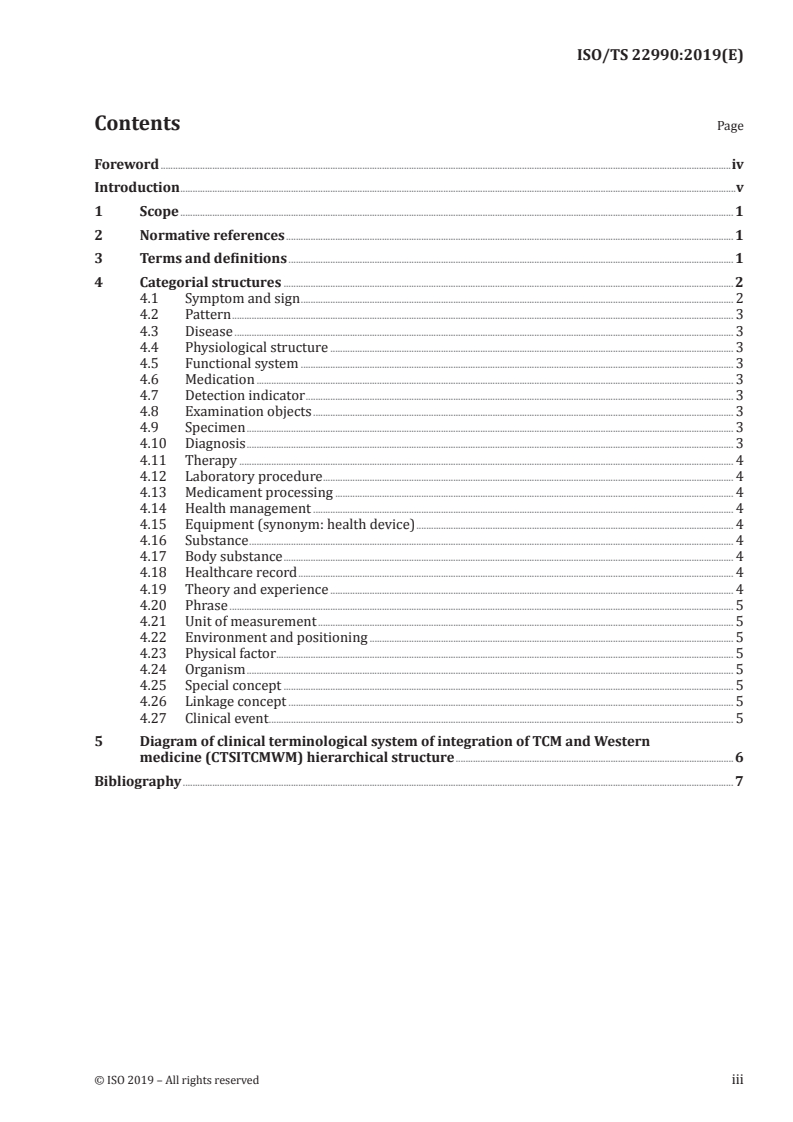
- Core categorial structure: the document establishes 27 top-level categories (for example: Symptom and sign, Pattern, Disease, Physiological structure, Functional system, Medication, Diagnosis, Therapy, Laboratory procedure, Specimen, Health management, Equipment, Healthcare record, Theory and experience, Clinical event, etc.).
- Integration focus: designed to bridge TCM‑specific concepts (e.g., pattern/syndrome identification) with Western medicine clinical terms within a single terminological system.
- EMR applicability: supports both professional clinical terms and non-technical record items used in electronic medical records.
- Terminology engineering foundations: emphasizes class hierarchies, concept systems and the need for categorial structures to manage large term sets.
- Interoperability context: acknowledges existing resources such as SNOMED CT and complements TCM terminology standardization efforts (e.g., ISO 19465).
Practical applications
- EHR / EMR implementation: provides a reference framework for mapping and classifying TCM and biomedical terms in patient records.
- Terminology development: guides terminologists and ontology engineers when constructing computable TCM–Western integrated vocabularies.
- Health IT vendors: use the categorial framework to design data models, search/indexing functions, and clinical decision support that span both medical traditions.
- Hospitals and clinics: standardize documentation for mixed-practice settings (integrative medicine departments, TCM hospitals).
- Research & analytics: enables consistent aggregation and comparison of clinical data across TCM and Western medicine for outcomes research and public health surveillance.
- Regulators and policymakers: inform interoperability and coding policy where integration of traditional and conventional medicine is required.
Who should use this standard
- Health informaticians, terminology specialists, EHR vendors, clinical coders, integrative medicine practitioners, standards bodies and healthcare organizations implementing cross‑discipline clinical documentation and data exchange.
Related standards
- ISO 19465 (standardization of TCM clinical terminology) - complementary reference for TCM term content.
- SNOMED CT - commonly used clinical terminology system referenced for integration and mapping considerations.
Keywords: ISO/TS 22990:2019, traditional Chinese medicine, TCM, clinical terminological system, terminology integration, electronic medical records, EMR, interoperability, SNOMED CT, classification framework.
Buy Documents
ISO/TS 22990:2019 - Traditional Chinese medicine — Categories of clinical terminological system to support the integration of clinical terms from traditional Chinese medicine and Western medicine Released:5/16/2019
ISO/TS 22990:2019 - Traditional Chinese medicine — Categories of clinical terminological system to support the integration of clinical terms from traditional Chinese medicine and Western medicine/16/2019
Get Certified
Connect with accredited certification bodies for this standard

BSI Group
BSI (British Standards Institution) is the business standards company that helps organizations make excellence a habit.

TÜV Rheinland
TÜV Rheinland is a leading international provider of technical services.

TÜV SÜD
TÜV SÜD is a trusted partner of choice for safety, security and sustainability solutions.
Sponsored listings
Frequently Asked Questions
ISO/TS 22990:2019 is a technical specification published by the International Organization for Standardization (ISO). Its full title is "Traditional Chinese medicine — Categories of clinical terminological system to support the integration of clinical terms from traditional Chinese medicine and Western medicine". This standard covers: This document establishes the core classification framework for the integration of clinical terms from traditional Chinese medicine (TCM) and Western medicine. This structure supports terminology integration in standardized electronic medical records, including professional clinical terms in TCM and Western medicine. Non-technical terms for electronic medical records are also included.
This document establishes the core classification framework for the integration of clinical terms from traditional Chinese medicine (TCM) and Western medicine. This structure supports terminology integration in standardized electronic medical records, including professional clinical terms in TCM and Western medicine. Non-technical terms for electronic medical records are also included.
ISO/TS 22990:2019 is classified under the following ICS (International Classification for Standards) categories: 01.040.11 - Health care technology (Vocabularies); 11.020.99 - Other standards related to health care in general. The ICS classification helps identify the subject area and facilitates finding related standards.
ISO/TS 22990:2019 is available in PDF format for immediate download after purchase. The document can be added to your cart and obtained through the secure checkout process. Digital delivery ensures instant access to the complete standard document.
Standards Content (Sample)
TECHNICAL ISO/TS
SPECIFICATION 22990
First edition
2019-05
Traditional Chinese medicine —
Categories of clinical terminological
system to support the integration of
clinical terms from traditional Chinese
medicine and Western medicine
Reference number
©
ISO 2019
© ISO 2019
All rights reserved. Unless otherwise specified, or required in the context of its implementation, no part of this publication may
be reproduced or utilized otherwise in any form or by any means, electronic or mechanical, including photocopying, or posting
on the internet or an intranet, without prior written permission. Permission can be requested from either ISO at the address
below or ISO’s member body in the country of the requester.
ISO copyright office
CP 401 • Ch. de Blandonnet 8
CH-1214 Vernier, Geneva
Phone: +41 22 749 01 11
Fax: +41 22 749 09 47
Email: copyright@iso.org
Website: www.iso.org
Published in Switzerland
ii © ISO 2019 – All rights reserved
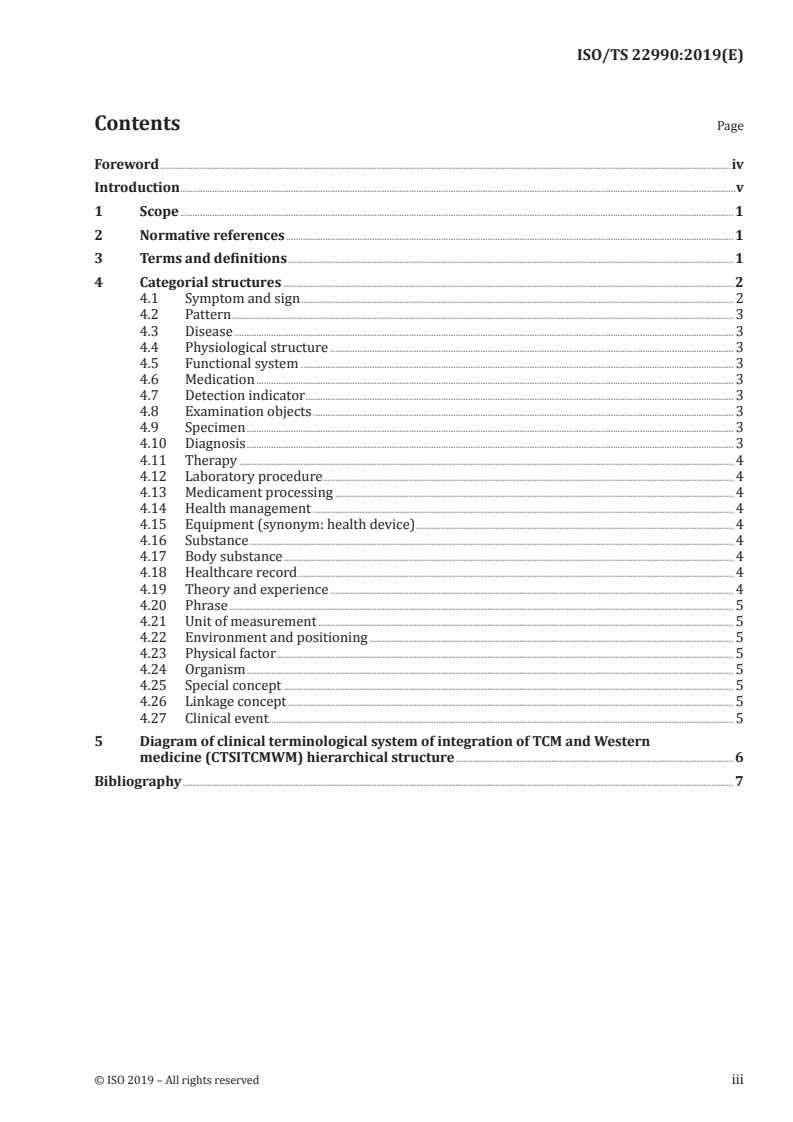
Contents Page
Foreword .iv
Introduction .v
1 Scope . 1
2 Normative references . 1
3 Terms and definitions . 1
4 Categorial structures . 2
4.1 Symptom and sign . 2
4.2 Pattern . 3
4.3 Disease . 3
4.4 Physiological structure . 3
4.5 Functional system . 3
4.6 Medication . 3
4.7 Detection indicator . 3
4.8 Examination objects . 3
4.9 Specimen . 3
4.10 Diagnosis . 3
4.11 Therapy . 4
4.12 Laboratory procedure . 4
4.13 Medicament processing . 4
4.14 Health management . 4
4.15 Equipment (synonym: health device) . 4
4.16 Substance . 4
4.17 Body substance . 4
4.18 Healthcare record . 4
4.19 Theory and experience . 4
4.20 Phrase . 5
4.21 Unit of measurement . 5
4.22 Environment and positioning . 5
4.23 Physical factor . 5
4.24 Organism . 5
4.25 Special concept . 5
4.26 Linkage concept . 5
4.27 Clinical event . 5
5 Diagram of clinical terminological system of integration of TCM and Western
medicine (CTSITCMWM) hierarchical structure . 6
Bibliography . 7
Foreword
ISO (the International Organization for Standardization) is a worldwide federation of national standards
bodies (ISO member bodies). The work of preparing International Standards is normally carried out
through ISO technical committees. Each member body interested in a subject for which a technical
committee has been established has the right to be represented on that committee. International
organizations, governmental and non-governmental, in liaison with ISO, also take part in the work.
ISO collaborates closely with the International Electrotechnical Commission (IEC) on all matters of
electrotechnical standardization.
The procedures used to develop this document and those intended for its further maintenance are
described in the ISO/IEC Directives, Part 1. In particular, the different approval criteria needed for the
different types of ISO documents should be noted. This document was drafted in accordance with the
editorial rules of the ISO/IEC Directives, Part 2 (see www .iso .org/directives).
Attention is drawn to the possibility that some of the elements of this document may be the subject of
patent rights. ISO shall not be held responsible for identifying any or all such patent rights. Details of
any patent rights identified during the development of the document will be in the Introduction and/or
on the ISO list of patent declarations received (see www .iso .org/patents).
Any trade name used in this document is information given for the convenience of users and does not
constitute an endorsement.
For an explanation of the voluntary nature of standards, the meaning of ISO specific terms and
expressions related to conformity assessment, as well as information about ISO's adherence to the
World Trade Organization (WTO) principles in the Technical Barriers to Trade (TBT) see www .iso
.org/iso/foreword .html.
This document was prepared by Technical Committee ISO/TC 249, Traditional Chinese medicine.
Any feedback or questions on this document should be directed to the user’s national standards body. A
complete listing of these bodies can be found at www .iso .org/members .html.
iv © ISO 2019 – All rights reserved
Introduction
The clinical terms used in traditional Chinese medicine (TCM) are distinct from those used in
[29]
healthcare systems based on Western medicine. Although the SNOMED CT has become more
mature and the TCM clinical term framework has already been published, the clinical terms of TCM and
Western medicine are used in combination in real medical records, and therefore cannot and should not
be completely separated. Specific standards are urgently needed to support the increase of computer
applications and electronic communication in healthcare. An encompassing terminological system
is required to support a consistent way of indexing, reserving, retrieving and aggregating TCM and
Western medicine clinical data. The standardization of TCM clinical terminology (ISO 19465) cannot
fully meet the needs of electronic medical record processing for hospitals. The large number of clinical
terms cannot be effectively managed without classification. Development of a categorial framework is a
fundamental requirement for the development of the terminological system.
The objective of this document is to express a core categorial structure of clinical terms of TCM and
Western medicine, based upon existing structures. The development of this document will help existing
users to develop a robust logical clinical terminology system.
TECHNICAL SPECIFICATION ISO/TS 22990:2019(E)
Traditional Chinese medicine — Categories of clinical
terminological system to support the integration of clinical
terms from traditional Chinese medicine and Western
medicine
1 Scope
This document establishes the core classification framework for the integration of clinical terms from
traditional Chinese medicine (TCM) and Western medicine. This structure supports terminology
integration in standardized electronic medical records, including professional clinical terms in TCM
and Western medicine. Non-technical terms for electronic medical records are also included.
2 Normative references
There are no normative references in this document.
3 Terms and definitions
For the purposes of this document, the following terms and definitions apply.
ISO and IEC maintain terminological databases for use in standardization at the following addresses:
— ISO Online browsing platform: available at https: //www .iso .org/obp
— IEC Electropedia: available at http: //www .electropedia .org/
3.1
concept
internal conception, general notion or idea of something
Note 1 to entry: Concepts are not necessarily bound to particular languages. They are, however, influenced by
the social or cultural background often leading to different categorizations.
[SOURCE: ISO/TS 18876-1:2003, 3.1
...
TECHNICAL ISO/TS
SPECIFICATION 22990
First edition
2019-05
Traditional Chinese medicine —
Categories of clinical terminological
system to support the integration of
clinical terms from traditional Chinese
medicine and Western medicine
Reference number
©
ISO 2019
© ISO 2019
All rights reserved. Unless otherwise specified, or required in the context of its implementation, no part of this publication may
be reproduced or utilized otherwise in any form or by any means, electronic or mechanical, including photocopying, or posting
on the internet or an intranet, without prior written permission. Permission can be requested from either ISO at the address
below or ISO’s member body in the country of the requester.
ISO copyright office
CP 401 • Ch. de Blandonnet 8
CH-1214 Vernier, Geneva
Phone: +41 22 749 01 11
Fax: +41 22 749 09 47
Email: copyright@iso.org
Website: www.iso.org
Published in Switzerland
ii © ISO 2019 – All rights reserved
Contents Page
Foreword .iv
Introduction .v
1 Scope . 1
2 Normative references . 1
3 Terms and definitions . 1
4 Categorial structures . 2
4.1 Symptom and sign . 2
4.2 Pattern . 3
4.3 Disease . 3
4.4 Physiological structure . 3
4.5 Functional system . 3
4.6 Medication . 3
4.7 Detection indicator . 3
4.8 Examination objects . 3
4.9 Specimen . 3
4.10 Diagnosis . 3
4.11 Therapy . 4
4.12 Laboratory procedure . 4
4.13 Medicament processing . 4
4.14 Health management . 4
4.15 Equipment (synonym: health device) . 4
4.16 Substance . 4
4.17 Body substance . 4
4.18 Healthcare record . 4
4.19 Theory and experience . 4
4.20 Phrase . 5
4.21 Unit of measurement . 5
4.22 Environment and positioning . 5
4.23 Physical factor . 5
4.24 Organism . 5
4.25 Special concept . 5
4.26 Linkage concept . 5
4.27 Clinical event . 5
5 Diagram of clinical terminological system of integration of TCM and Western
medicine (CTSITCMWM) hierarchical structure . 6
Bibliography . 7
Foreword
ISO (the International Organization for Standardization) is a worldwide federation of national standards
bodies (ISO member bodies). The work of preparing International Standards is normally carried out
through ISO technical committees. Each member body interested in a subject for which a technical
committee has been established has the right to be represented on that committee. International
organizations, governmental and non-governmental, in liaison with ISO, also take part in the work.
ISO collaborates closely with the International Electrotechnical Commission (IEC) on all matters of
electrotechnical standardization.
The procedures used to develop this document and those intended for its further maintenance are
described in the ISO/IEC Directives, Part 1. In particular, the different approval criteria needed for the
different types of ISO documents should be noted. This document was drafted in accordance with the
editorial rules of the ISO/IEC Directives, Part 2 (see www .iso .org/directives).
Attention is drawn to the possibility that some of the elements of this document may be the subject of
patent rights. ISO shall not be held responsible for identifying any or all such patent rights. Details of
any patent rights identified during the development of the document will be in the Introduction and/or
on the ISO list of patent declarations received (see www .iso .org/patents).
Any trade name used in this document is information given for the convenience of users and does not
constitute an endorsement.
For an explanation of the voluntary nature of standards, the meaning of ISO specific terms and
expressions related to conformity assessment, as well as information about ISO's adherence to the
World Trade Organization (WTO) principles in the Technical Barriers to Trade (TBT) see www .iso
.org/iso/foreword .html.
This document was prepared by Technical Committee ISO/TC 249, Traditional Chinese medicine.
Any feedback or questions on this document should be directed to the user’s national standards body. A
complete listing of these bodies can be found at www .iso .org/members .html.
iv © ISO 2019 – All rights reserved
Introduction
The clinical terms used in traditional Chinese medicine (TCM) are distinct from those used in
[29]
healthcare systems based on Western medicine. Although the SNOMED CT has become more
mature and the TCM clinical term framework has already been published, the clinical terms of TCM and
Western medicine are used in combination in real medical records, and therefore cannot and should not
be completely separated. Specific standards are urgently needed to support the increase of computer
applications and electronic communication in healthcare. An encompassing terminological system
is required to support a consistent way of indexing, reserving, retrieving and aggregating TCM and
Western medicine clinical data. The standardization of TCM clinical terminology (ISO 19465) cannot
fully meet the needs of electronic medical record processing for hospitals. The large number of clinical
terms cannot be effectively managed without classification. Development of a categorial framework is a
fundamental requirement for the development of the terminological system.
The objective of this document is to express a core categorial structure of clinical terms of TCM and
Western medicine, based upon existing structures. The development of this document will help existing
users to develop a robust logical clinical terminology system.
TECHNICAL SPECIFICATION ISO/TS 22990:2019(E)
Traditional Chinese medicine — Categories of clinical
terminological system to support the integration of clinical
terms from traditional Chinese medicine and Western
medicine
1 Scope
This document establishes the core classification framework for the integration of clinical terms from
traditional Chinese medicine (TCM) and Western medicine. This structure supports terminology
integration in standardized electronic medical records, including professional clinical terms in TCM
and Western medicine. Non-technical terms for electronic medical records are also included.
2 Normative references
There are no normative references in this document.
3 Terms and definitions
For the purposes of this document, the following terms and definitions apply.
ISO and IEC maintain terminological databases for use in standardization at the following addresses:
— ISO Online browsing platform: available at https: //www .iso .org/obp
— IEC Electropedia: available at http: //www .electropedia .org/
3.1
concept
internal conception, general notion or idea of something
Note 1 to entry: Concepts are not necessarily bound to particular languages. They are, however, influenced by
the social or cultural background often leading to different categorizations.
[SOURCE: ISO/TS 18876-1:2003, 3.1
...