

ISO 9712:2021
(Main)Non-destructive testing — Qualification and certification of NDT personnel
General Information
- Abstract
This document specifies requirements for the qualification and certification of personnel who perform industrial non-destructive testing (NDT) in the following methods. a) acoustic emission testing; b) eddy current testing; c) leak testing (hydraulic pressure tests excluded); d) magnetic testing; e) penetrant testing; f) radiographic testing; g) strain gauge testing; h) thermographic testing; i) ultrasonic testing; j) visual testing (direct unaided visual tests and visual tests carried out during the application of another NDT method are excluded). The system specified in this document is also applicable to other NDT methods or to NDT techniques within an established NDT method, provided a comprehensive scheme of certification exists and the NDT method or NDT technique is covered by international, regional or national standards or the NDT method or the NDT technique has been demonstrated to be effective to the satisfaction of the certification body. NOTE 1 The term "industrial" implies the exclusion of applications in the field of medicine. NOTE 2 CEN/TR 14748 provides guidance on the methodology for qualification of non-destructive tests. NOTE 3 This document specifies requirements for what are, in effect, third party conformity assessment schemes. These requirements do not directly apply to conformity assessment by second or first parties, but relevant parts of this document can be referred to in such arrangements. NOTE 4 The term “direct unaided visual testing” implies where there is an uninterrupted optical path from the observer’s eye to the test area and the observer uses no tools or devices (e.g. mirror, endoscope, fibre optic). NOTE 5 Calculations of strain based on other NDT methods are excluded.
- Status
- Published
- Publication Date
- 20-Dec-2021
- Technical Committee
- ISO/TC 135/SC 7 - Personnel qualification
- Drafting Committee
- ISO/TC 135/SC 7 - Personnel qualification
- Current Stage
- 6060 - International Standard published
- Start Date
- 21-Dec-2021
- Due Date
- 07-Sep-2021
- Completion Date
- 21-Dec-2021
Buy Documents

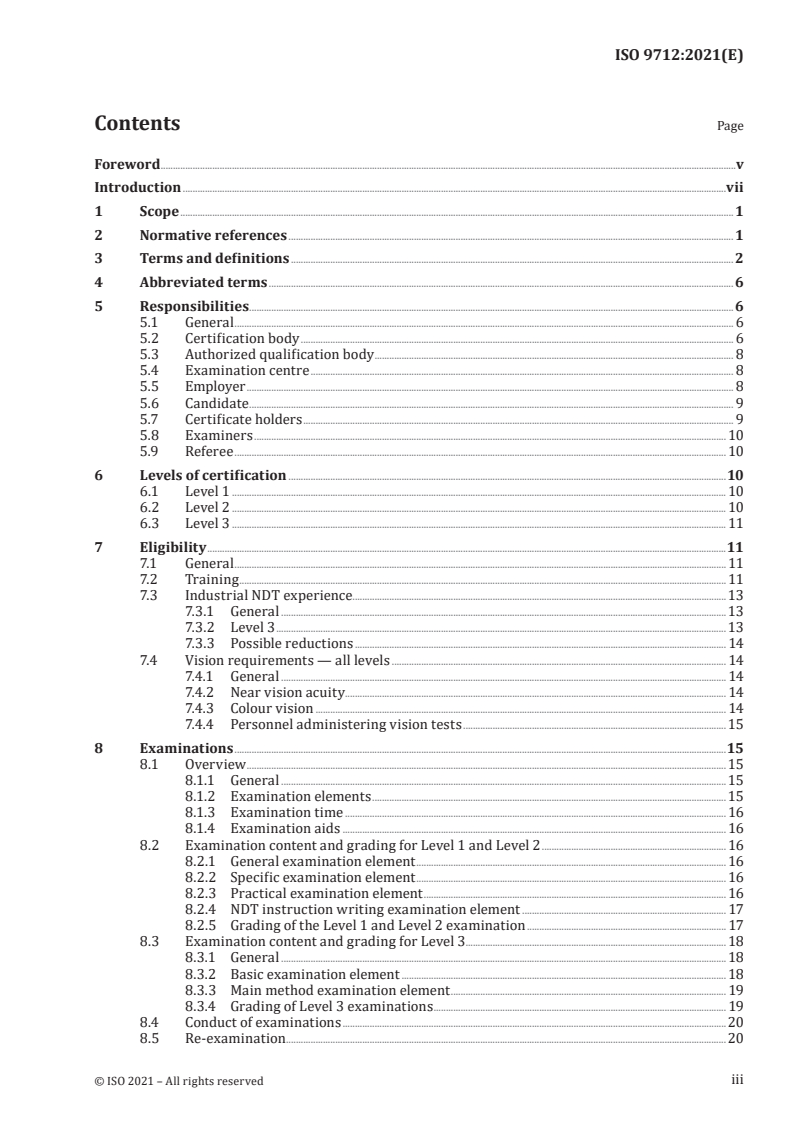
ISO 9712:2021 - Non-destructive testing -- Qualification and certification of NDT personnel

ISO 9712:2021 - Non-destructive testing — Qualification and certification of NDT personnel/21/2021

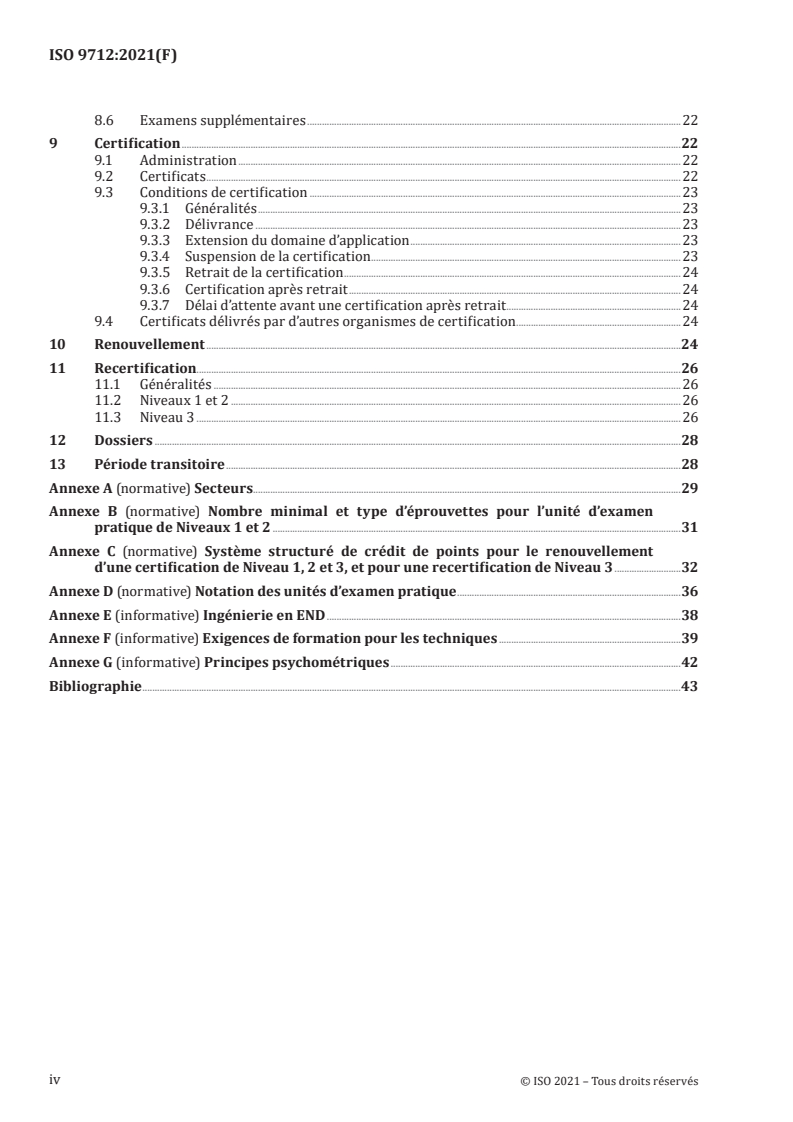
ISO 9712:2021 - Essais non destructifs -- Qualification et certification du personnel END
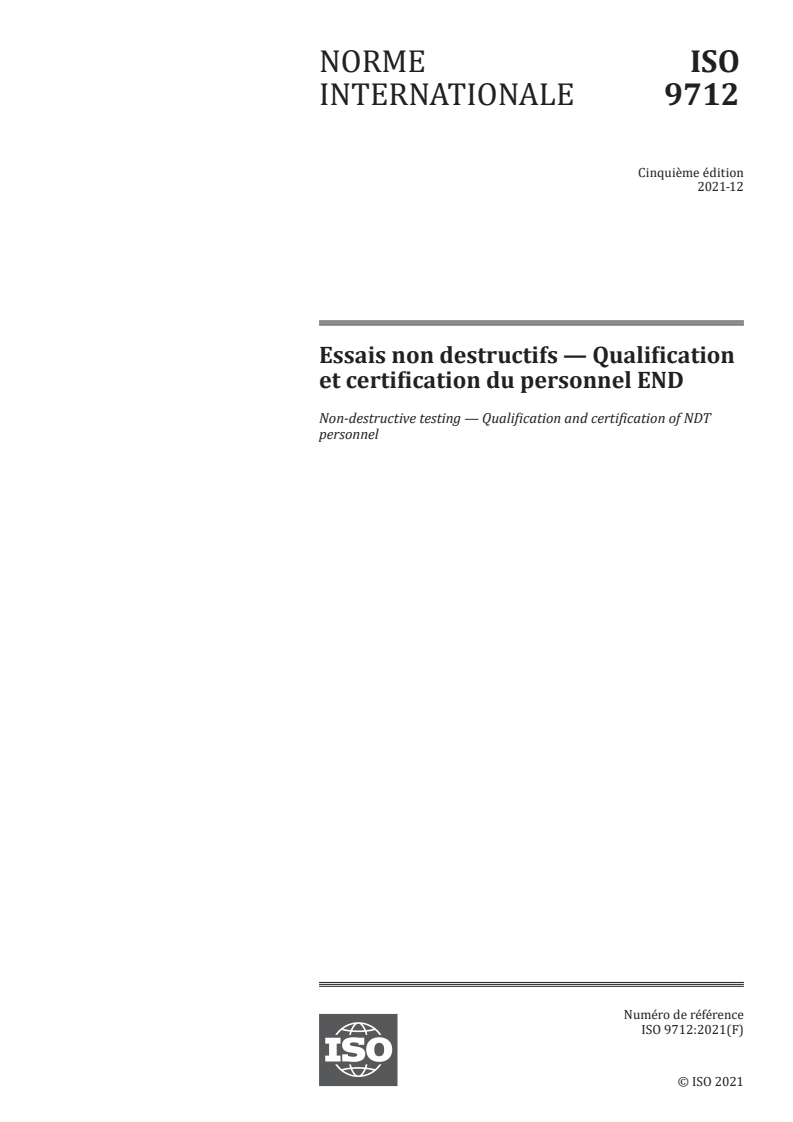

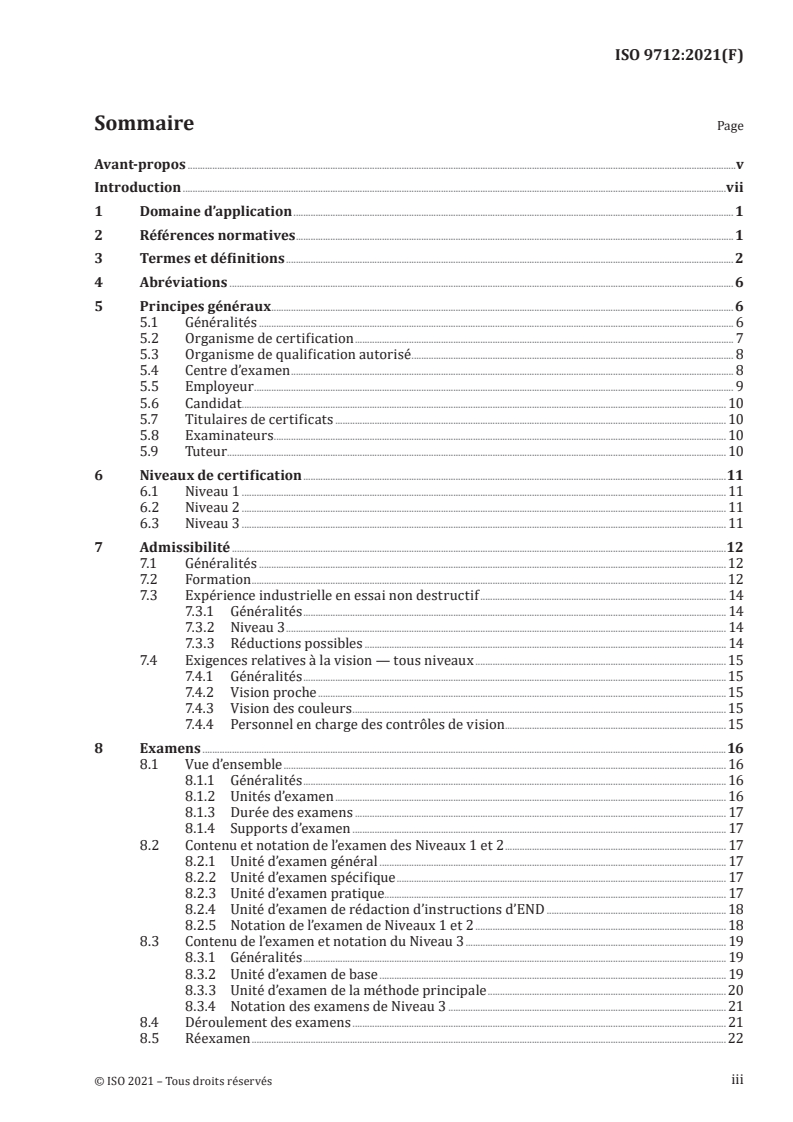
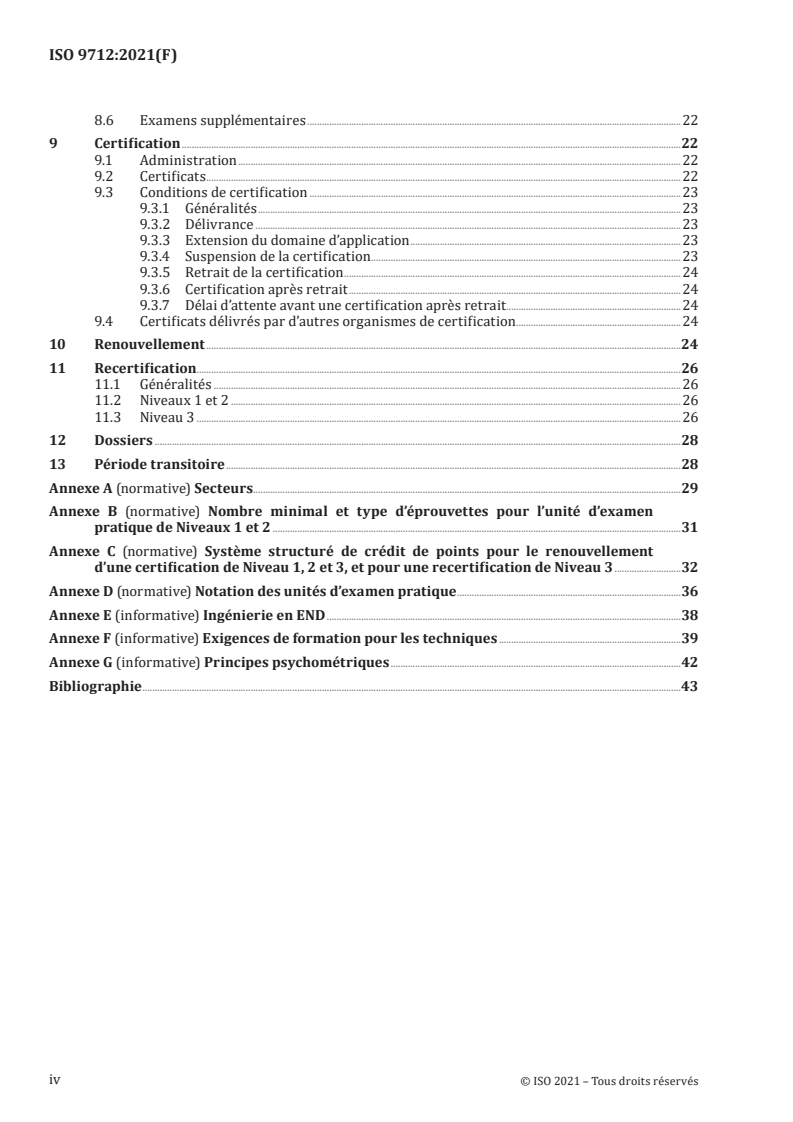
ISO 9712:2021 - Essais non destructifs — Qualification et certification du personnel END/21/2021
Overview
ISO 9712:2021 - "Non-destructive testing - Qualification and certification of NDT personnel" - defines requirements for third‑party certification of industrial NDT personnel. It sets out the framework for qualifying and certifying technicians and engineers working in common NDT methods (see list below), including training, industrial experience, examination, certification administration, renewal and recertification. The standard applies to industrial (non‑medical) NDT and can be extended to other NDT techniques where a comprehensive certification scheme and supporting standards exist.
Keywords: ISO 9712:2021, non‑destructive testing, NDT personnel certification, NDT qualification.
Key Topics
- Covered NDT methods: acoustic emission, eddy current, leak testing (excluding hydraulic pressure tests), magnetic testing, penetrant testing, radiographic, strain gauge, thermographic, ultrasonic, and visual testing (note: direct unaided visual tests and visual tests performed during another NDT method are excluded).
- Certification levels: defined Levels 1, 2 and 3 with distinct roles, responsibilities and competency expectations.
- Eligibility requirements: specified training duration, documented industrial NDT experience, and vision requirements (near acuity and colour vision) for all levels.
- Examinations: modular structure including general, specific and practical elements; grading rules; provisions for re‑examination and supplementary exams. Practical specimen requirements and grading criteria are covered in normative annexes.
- Certification administration: roles and responsibilities for the certification body, authorized qualification bodies, examination centres, employers, examiners and referees; issuance, scope, suspension, withdrawal and re‑instatement of certificates.
- Maintenance: renewal, recertification and a structured credit system (including Level‑3 recertification) to ensure continued competence.
- Assessment options: allows use of psychometric processes at the certification body’s discretion.
- Scope extensions: applicability to other NDT methods if supported by international, regional or national standards or demonstrated effectiveness.
Applications
- Used by certification bodies to design compliant NDT personnel schemes.
- Used by training organisations and employers to develop curricula and experience pathways that meet certification requirements.
- Reference for NDT technicians and engineers seeking certification or renewal.
- Useful for inspection companies, asset owners and regulators requiring proof of personnel competence for safe, reliable NDT.
SEO keywords: NDT certification, NDT qualification, ISO 9712 training, NDT exams, industrial NDT standards.
Related Standards
- CEN/TR 14748 (guidance on methodology for qualification of non‑destructive tests).
- ISO/IEC Directives and relevant national or regional NDT standards referenced within ISO 9712 for method‑specific requirements.
Relations
- Effective Date
- 25-Aug-2026
- Effective Date
- 25-Aug-2026
- Effective Date
- 25-Aug-2026
- Effective Date
- 25-Aug-2026
- Effective Date
- 25-Aug-2026
- Effective Date
- 25-Aug-2026
- Effective Date
- 25-Aug-2026
- Effective Date
- 25-Aug-2026
- Effective Date
- 25-Aug-2026
- Effective Date
- 25-Aug-2026
- Effective Date
- 25-Aug-2026
- Effective Date
- 25-Aug-2026
- Effective Date
- 25-Aug-2026
- Effective Date
- 25-Aug-2026
- Effective Date
- 25-Aug-2026
Buy Documents
ISO 9712:2021 - Non-destructive testing -- Qualification and certification of NDT personnel
ISO 9712:2021 - Non-destructive testing — Qualification and certification of NDT personnel/21/2021
ISO 9712:2021 - Essais non destructifs -- Qualification et certification du personnel END
ISO 9712:2021 - Essais non destructifs — Qualification et certification du personnel END/21/2021
Get Certified
Connect with accredited certification bodies for this standard

BSI Group
BSI (British Standards Institution) is the business standards company that helps organizations make excellence a habit.

Bureau Veritas
Bureau Veritas is a world leader in laboratory testing, inspection and certification services.

DNV
DNV is an independent assurance and risk management provider.
Sponsored listings
Frequently Asked Questions
ISO 9712:2021 is a standard published by the International Organization for Standardization (ISO). Its full title is "Non-destructive testing — Qualification and certification of NDT personnel". This standard covers: This document specifies requirements for the qualification and certification of personnel who perform industrial non-destructive testing (NDT) in the following methods. a) acoustic emission testing; b) eddy current testing; c) leak testing (hydraulic pressure tests excluded); d) magnetic testing; e) penetrant testing; f) radiographic testing; g) strain gauge testing; h) thermographic testing; i) ultrasonic testing; j) visual testing (direct unaided visual tests and visual tests carried out during the application of another NDT method are excluded). The system specified in this document is also applicable to other NDT methods or to NDT techniques within an established NDT method, provided a comprehensive scheme of certification exists and the NDT method or NDT technique is covered by international, regional or national standards or the NDT method or the NDT technique has been demonstrated to be effective to the satisfaction of the certification body. NOTE 1 The term "industrial" implies the exclusion of applications in the field of medicine. NOTE 2 CEN/TR 14748 provides guidance on the methodology for qualification of non-destructive tests. NOTE 3 This document specifies requirements for what are, in effect, third party conformity assessment schemes. These requirements do not directly apply to conformity assessment by second or first parties, but relevant parts of this document can be referred to in such arrangements. NOTE 4 The term “direct unaided visual testing” implies where there is an uninterrupted optical path from the observer’s eye to the test area and the observer uses no tools or devices (e.g. mirror, endoscope, fibre optic). NOTE 5 Calculations of strain based on other NDT methods are excluded.
This document specifies requirements for the qualification and certification of personnel who perform industrial non-destructive testing (NDT) in the following methods. a) acoustic emission testing; b) eddy current testing; c) leak testing (hydraulic pressure tests excluded); d) magnetic testing; e) penetrant testing; f) radiographic testing; g) strain gauge testing; h) thermographic testing; i) ultrasonic testing; j) visual testing (direct unaided visual tests and visual tests carried out during the application of another NDT method are excluded). The system specified in this document is also applicable to other NDT methods or to NDT techniques within an established NDT method, provided a comprehensive scheme of certification exists and the NDT method or NDT technique is covered by international, regional or national standards or the NDT method or the NDT technique has been demonstrated to be effective to the satisfaction of the certification body. NOTE 1 The term "industrial" implies the exclusion of applications in the field of medicine. NOTE 2 CEN/TR 14748 provides guidance on the methodology for qualification of non-destructive tests. NOTE 3 This document specifies requirements for what are, in effect, third party conformity assessment schemes. These requirements do not directly apply to conformity assessment by second or first parties, but relevant parts of this document can be referred to in such arrangements. NOTE 4 The term “direct unaided visual testing” implies where there is an uninterrupted optical path from the observer’s eye to the test area and the observer uses no tools or devices (e.g. mirror, endoscope, fibre optic). NOTE 5 Calculations of strain based on other NDT methods are excluded.
ISO 9712:2021 is classified under the following ICS (International Classification for Standards) categories: 03.100.30 - Management of human resources; 19.100 - Non-destructive testing. The ICS classification helps identify the subject area and facilitates finding related standards.
ISO 9712:2021 has the following relationships with other standards: It is inter standard links to EN ISO 17635:2025, EN ISO 15708-2:2025, EN ISO 17636-2:2022, EN ISO 17636-1:2022, EN ISO 16811:2025, EN ISO 17405:2022, EN ISO 16810:2024, EN ISO 15551:2023, EN ISO 18081:2024, EN ISO 10855-1:2024, EN ISO 18563-3:2024, EN ISO 10855-3:2024, EN 14870-1:2023, EN 14870-4:2023, EN ISO 13703-3:2023. Understanding these relationships helps ensure you are using the most current and applicable version of the standard.
ISO 9712:2021 is available in PDF format for immediate download after purchase. The document can be added to your cart and obtained through the secure checkout process. Digital delivery ensures instant access to the complete standard document.
Standards Content (Sample)
INTERNATIONAL ISO
STANDARD 9712
Fifth edition
2021-12
Non-destructive testing —
Qualification and certification of NDT
personnel
Essais non destructifs — Qualification et certification du personnel
END
Reference number
© ISO 2021
All rights reserved. Unless otherwise specified, or required in the context of its implementation, no part of this publication may
be reproduced or utilized otherwise in any form or by any means, electronic or mechanical, including photocopying, or posting on
the internet or an intranet, without prior written permission. Permission can be requested from either ISO at the address below
or ISO’s member body in the country of the requester.
ISO copyright office
CP 401 • Ch. de Blandonnet 8
CH-1214 Vernier, Geneva
Phone: +41 22 749 01 11
Email: copyright@iso.org
Website: www.iso.org
Published in Switzerland
ii
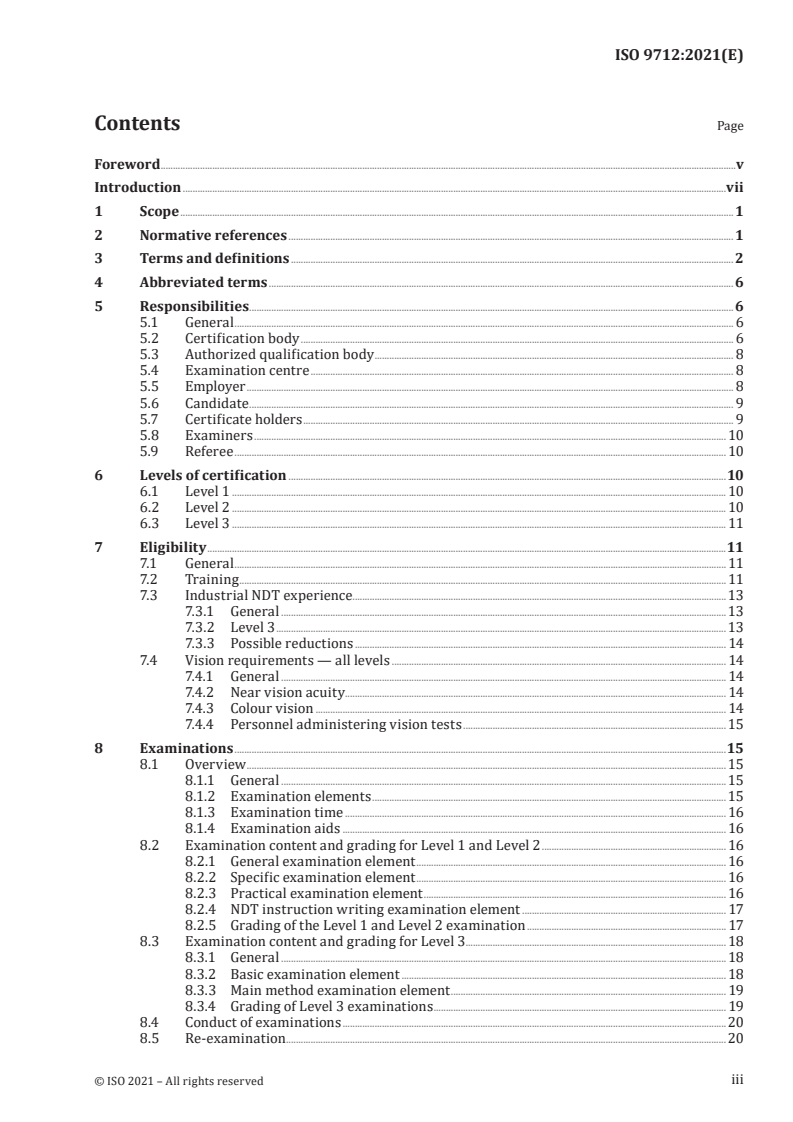
Contents Page
Foreword .v
Introduction .vii
1 Scope . 1
2 Normative references . 1
3 Terms and definitions . 2
4 Abbreviated terms . 6
5 Responsibilities . .6
5.1 General . 6
5.2 Certification body . 6
5.3 Authorized qualification body . 8
5.4 Examination centre . 8
5.5 Employer . 8
5.6 Candidate . 9
5.7 Certificate holders . 9
5.8 Examiners . 10
5.9 Referee . 10
6 Levels of certification .10
6.1 Level 1 . 10
6.2 Level 2 . 10
6.3 Level 3 . 11
7 Eligibility .11
7.1 General . 11
7.2 Training . 11
7.3 Industrial NDT experience.13
7.3.1 General .13
7.3.2 Level 3 . 13
7.3.3 Possible reductions . 14
7.4 Vision requirements — all levels . 14
7.4.1 General . 14
7.4.2 Near vision acuity . 14
7.4.3 Colour vision . 14
7.4.4 Personnel administering vision tests . 15
8 Examinations .15
8.1 Overview . 15
8.1.1 General .15
8.1.2 Examination elements . 15
8.1.3 Examination time . 16
8.1.4 Examination aids . 16
8.2 Examination content and grading for Level 1 and Level 2 . 16
8.2.1 General examination element . 16
8.2.2 Specific examination element . 16
8.2.3 Practical examination element . 16
8.2.4 NDT instruction writing examination element . 17
8.2.5 Grading of the Level 1 and Level 2 examination . 17
8.3 Examination content and grading for Level 3. 18
8.3.1 General . 18
8.3.2 Basic examination element . 18
8.3.3 Main method examination element . 19
8.3.4 Grading of Level 3 examinations . 19
8.4 Conduct of examinations .20
8.5 Re-examination . 20
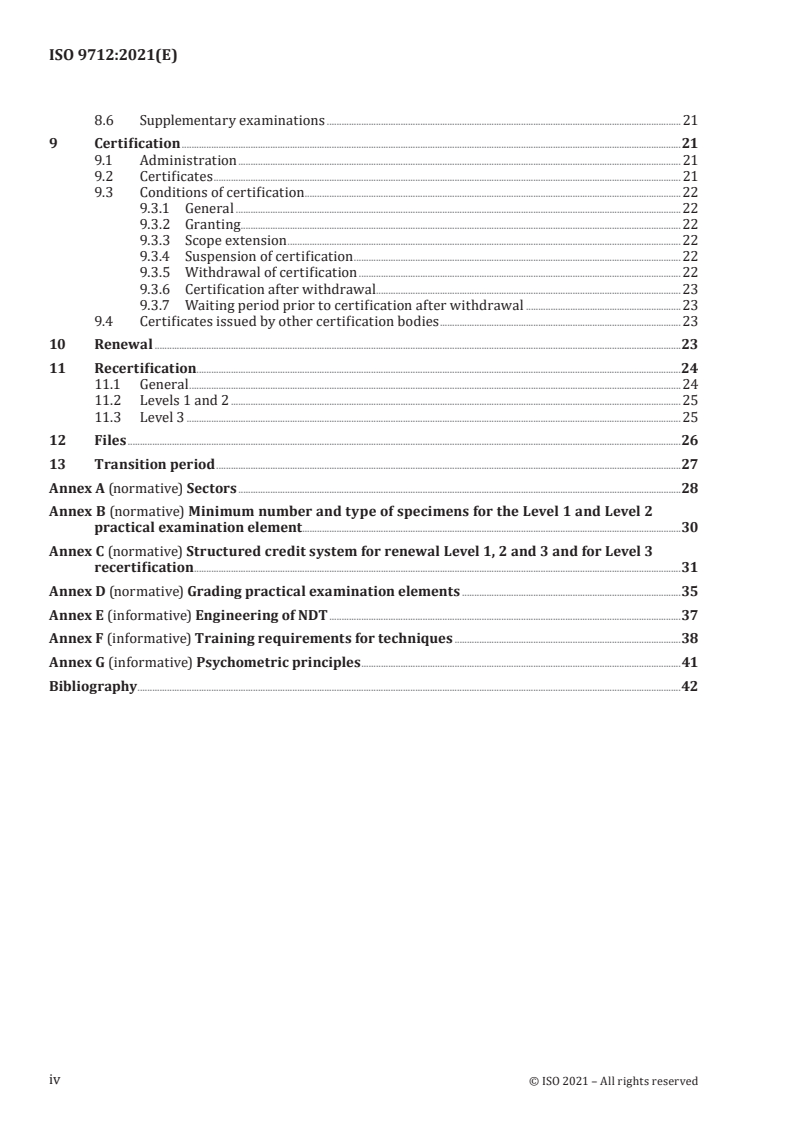
iii
8.6 Supplementary examinations . 21
9 Certification .21
9.1 Administration . 21
9.2 Certificates . 21
9.3 Conditions of certification .22
9.3.1 General .22
9.3.2 Granting. 22
9.3.3 Scope extension . 22
9.3.4 Suspension of certification . 22
9.3.5 Withdrawal of certification . 22
9.3.6 Certification after withdrawal. 23
9.3.7 Waiting period prior to certification after withdrawal .23
9.4 Certificates issued by other certification bodies . 23
10 Renewal .23
11 Recertification.24
11.1 General . 24
11.2 Levels 1 and 2 . 25
11.3 Level 3 . 25
12 Files .26
13 Transition period .27
Annex A (normative) Sectors .28
Annex B (normative) Minimum number and type of specimens for the Level 1 and Level 2
practical examination element . .30
Annex C (normative) Structured credit system for renewal Level 1, 2 and 3 and for Level 3
recertification .31
Annex D (normative) Grading practical examination elements .35
Annex E (informative) Engineering of NDT .37
Annex F (informative) Training requirements for techniques .38
Annex G (informative) Psychometric principles .41
Bibliography .42
iv
Foreword
ISO (the International Organization for Standardization) is a worldwide federation of national standards
bodies (ISO member bodies). The work of preparing International Standards is normally carried out
through ISO technical committees. Each member body interested in a subject for which a technical
committee has been established has the right to be represented on that committee. International
organizations, governmental and non-governmental, in liaison with ISO, also take part in the work.
ISO collaborates closely with the International Electrotechnical Commission (IEC) on all matters of
electrotechnical standardization.
The procedures used to develop this document and those intended for its further maintenance are
described in the ISO/IEC Directives, Part 1. In particular, the different approval criteria needed for the
different types of ISO documents should be noted. This document was drafted in accordance with the
editorial rules of the ISO/IEC Directives, Part 2 (see www.iso.org/directives).
Attention is drawn to the possibility that some of the elements of this document may be the subject of
patent rights. ISO shall not be held responsible for identifying any or all such patent rights. Details of
any patent rights identified during the development of the document will be in the Introduction and/or
on the ISO list of patent declarations received (see www.iso.org/patents).
Any trade name used in this document is information given for the convenience of users and does not
constitute an endorsement.
For an explanation of the voluntary nature of standards, the meaning of ISO specific terms and
expressions related to conformity assessment, as well as information about ISO's adherence to
the World Trade Organization (WTO) principles in the Technical Barriers to Trade (TBT), see
www.iso.org/iso/foreword.html.
This document was prepared by Technical Committee ISO/TC 135, Non-destructive testing,
Subcommittee SC 7, Personnel qualification, in collaboration with the European Committee for
Standardization (CEN) Technical Committee CEN/TC 138, Non-destructive testing, in accordance with
the Agreement on technical cooperation between ISO and CEN (Vienna Agreement).
This fifth edition cancels and replaces the fourth edition (ISO 9712:2012), which has been technically
revised.
The main changes compared to the previous edition are as follows:
— clarified responsibilities for the certification body, the authorized qualification body, the examination
centre and the employer;
— added and revised definitions;
— defined responsibilities for examiners and referees;
— revised requirements for the duration of training and industrial experience;
— modified requirements for visual acuity testing;
— revised requirements for examinations;
— included an option for the use of a psychometric process at the discretion of the certification body;
— revised requirements for the certification documents;
— revised requirements for the conditions of certification;
— added requirements for candidates for the renewal of certificates;
— revised structured credit system for Level 3 recertification;
— included a new Annex F for techniques;
v
— included a new Annex G for psychometric principles;
— other minor technical and editorial changes.
Any feedback or questions on this document should be directed to the user’s national standards body. A
complete listing of these bodies can be found at www.iso.org/members.html.
vi
Introduction
Since the effectiveness of any application of non-destructive testing (NDT) depends upon the
capabilities of the persons who perform or are responsible for the test, a procedure has been developed
to provide a means of evaluating and documenting the competence of personnel whose duties require
the appropriate theoretical and practical knowledge of the non-destructive tests they perform, specify,
supervise, monitor or evaluate. An added incentive stems from the worldwide comparability of a wide
range of industrial applications requiring common non-destructive testing approaches.
When certification of NDT personnel is required in product standards, regulations, codes or
specifications, it is important to certify the personnel in accordance with this document. When
latitude is provided in the criteria within this document, the certification body has the final decision in
determining specific requirements.
When there is no requirement in legislation, in standard or in the order for certification of NDT
personnel, it is for employers of such personnel to decide how to assure themselves that they are
competent to do the work assignments. Thus, they may employ people who are already certified or
they may apply their own expertise so as to assure themselves that their employee has the necessary
competence. In this last case, prudent employers would no doubt use this document as a reference
document.
vii
INTERNATIONAL STANDARD ISO 9712:2021(E)
Non-destructive testing — Qualification and certification of
NDT personnel
1 Scope
This document specifies requirements for the qualification and certification of personnel who perform
industrial non-destructive testing (NDT) in the following methods.
a) acoustic emission testing;
b) eddy current testing;
c) leak testing (hydraulic pressure tests excluded);
d) magnetic testing;
e) penetrant testing;
f) radiographic testing;
g) strain gauge testing;
h) thermographic testing;
i) ultrasonic testing;
j) visual testing (direct unaided visual tests and visual tests carried out during the application of
another NDT method are excluded).
The system specified in this document is also applicable to other NDT methods or to NDT techniques
within an established NDT method, provided a comprehensive scheme of certification exists and
the NDT method or NDT technique is covered by international, regional or national standards or the
NDT method or the NDT technique has been demonstrated to be effective to the satisfaction of the
certification body.
NOTE 1 The term "industrial" implies the exclusion of applications in the field of medicine.
NOTE 2 CEN/TR 14748 provides guidance on the methodology for qualification of non-destructive tests.
NOTE 3 This document specifies requirements for what are, in effect, third party conformity assessment
schemes. These requirements do not directly apply to conformity assessment by second or first parties, but
relevant parts of this document can be referred to in such arrangements.
NOTE 4 The term “direct unaided visual testing” implies where there is an uninterrupted optical path from
the observer’s eye to the test area and the observer uses no tools or devices (e.g. mirror, endoscope, fibre optic).
NOTE 5 Calculations of strain based on other NDT methods are excluded.
2 Normative references
The following documents are referred to in the text in such a way that some or all of their content
constitutes requirements of this document. For dated references, only the edition cited applies. For
undated references, the latest edition of the referenced document (including any amendments) applies.
ISO/IEC 17024:2012, Conformity assessment — General requirements for bodies operating certification of
persons
ISO 18490:2015, Non-destructive testing — Evaluation of vision acuity of NDT personnel
3 Terms and definitions
For the purposes of this document, the following terms and definitions apply.
ISO and IEC maintain terminology databases for use in standardization at the following addresses:
— ISO Online browsing platform: available at https:// www .iso .org/ obp
— IEC Electropedia: available at https:// www .electropedia .org/
3.1
applicant
person who has submitted an application to be admitted into the certification process (3.8)
3.2
authorized qualification body
body, independent of the employer (3.11), authorized by the certification body (3.6) to prepare and
administer examinations (3.12)
3.3
basic examination element
written examination (3.12), at Level 3, which demonstrates the candidate’s (3.4) knowledge of the
materials science and process technology and types of discontinuities, the specific qualification (3.33)
and certification system, and the basic principles of NDT methods (3.25) as required for Level 2
Note 1 to entry: For an explanation of the three levels of qualification, see Clause 6.
Note 2 to entry: The qualification and certification system is specified in this document.
3.4
candidate
applicant (3.1) who has fulfilled specified prerequisites and has been admitted to the certification
process (3.8)
3.5
certificate
document in the form of a letter, card or other medium (e.g. digital certificate), issued by a certification
body (3.6) under the provisions of this document, indicating that the named person has fulfilled the
certification requirements (3.9)
3.6
certification body
body that administers procedures for certification according to specified requirements
3.7
certification cycle
maximum period of time permitted from the date of certification to the date of recertification (3.34)
inclusive of the renewal (3.36) period
3.8
certification process
activities by which a certification body (3.6) determines that a person fulfils certification requirements
(3.9), including application, assessment, decision on certification, renewal (3.36), recertification (3.34)
and use of certificates (3.5) and logos/marks
3.9
certification requirements
set of specified requirements, including requirements of the scheme to be fulfilled in order to establish
or maintain certification
3.10
competence
ability to apply knowledge and skills to achieve intended results
3.11
employer
legal entity by whom the candidate (3.4) is employed
Note 1 to entry: A candidate may be self-employed.
3.12
examination
mechanism that is part of the assessment which measures a candidate's (3.4) competence (3.10) by one
or more means
3.13
examination centre
centre approved by the certification body (3.6) where examinations (3.12) are carried out
3.14
examination element
component of an examination (3.12)
3.15
examiner
person competent to conduct and score an examination (3.12), where the examination requires
professional judgement
3.16
general examination element
written examination (3.12), at Level 1 or Level 2, concerned with the principles of an NDT method (3.25)
3.17
higher education
formal learning that occurs after completion of secondary education in the field of engineering or
science
3.18
industrial experience
work activities (3.46) performed under supervision (3.45), in the NDT method (3.25) in the sector (3.37)
concerned, needed to acquire the skill and knowledge to fulfil the provisions of qualification (3.33)
3.19
invigilator
proctor
test administrator
person authorized by the certification body (3.6) who supervises an examination (3.12), but does not
evaluate the competence (3.10) of the candidate (3.4)
3.20
job-specific training
training, provided by the employer (3.11) (or their agent) to the certificate (3.5) holder in aspects of
non-destructive testing specific to the employer’s products, NDT equipment, NDT procedures (3.27),
and applicable codes, standards, specifications (3.40) and procedures, leading to the award of operating
authorizations (3.30)
3.21
main method examination element
written examination (3.12), at Level 3, which demonstrates the candidate’s (3.4) general and specific
knowledge, and the ability to write NDT procedures (3.27) for the NDT method (3.25) as applied in the
industrial or product sector(s) (3.37) for which certification is sought
3.22
multiple choice examination question
wording of a question giving rise to potential replies, only one of which is correct, the remaining being
incorrect or incomplete
3.23
NDT instruction
written description of the precise steps to be followed in testing to an established standard, code,
specification (3.40) or NDT procedure (3.27)
3.24
NDT media
testing products used to create visible indications caused by imperfections or flaws
EXAMPLE Magnetic powder, contrast aid paints, colour contrast penetrant, developer.
3.25
NDT method
discipline applying a physical principle in non-destructive testing
EXAMPLE Ultrasonic testing.
3.26
NDT personnel
personnel who perform non-destructive testing
3.27
NDT procedure
written description of all essential parameters and precautions to be applied when non-destructively
testing products in accordance with standard(s), code(s) or specification(s) (3.40)
3.28
NDT technique
specific way of utilizing an NDT method (3.25)
3.29
NDT training
process of instruction in theory and practice in the NDT method (3.25) in which certification is sought,
which takes the form of training courses to a syllabus approved by the certification body (3.6)
3.30
operating authorization
written statement issued by the employer (3.11), based upon the scope of certification, authorizing the
individual to carry out specified tasks
Note 1 to entry: Such authorization can be dependent on the provision of job-specific training (3.20).
3.31
practical examination element
assessment of practical skills, in which the candidate (3.4) demonstrates familiarity with, and the
ability to perform, the test
3.32
psychometric process
statistical process to verify examinations (3.12) are fair, reliable and discriminate between a competent
and non-competent individual
3.33
qualification
demonstrated education, training, and work experience
3.34
recertification
process for revalidation of a certificate (3.5) by examination (3.12) or by otherwise satisfying the
certification body (3.6) that the published criteria for recertification have been met
3.35
referee
individual that attests the validity of the candidate’s (3.4) industrial experience (3.18)
3.36
renewal
process for revalidation of a certification at any time up to five years after success in an initial,
supplementary or recertification (3.34) examination (3.12)
3.37
sector
section of industry or technology where specialized NDT practices are used, requiring specific product-
related knowledge, skill, equipment or training
Note 1 to entry: A sector can be interpreted to mean a product (welded products, castings) or an industry
(aerospace, in-service testing). See Annex A.
3.38
significant interruption
absence or change of work activity (3.46) which prevents the certified individual from practising the
duties corresponding to the level in the method and the sector(s) (3.37) within the certified scope, for
either a continuous period in excess of one year, or two or more periods for a total time exceeding two
years
Note 1 to entry: Legal holidays or periods of sickness or training courses of less than 30 days are not taken into
account when calculating the interruption.
3.39
specific examination element
written examination (3.12), at Level 1 or Level 2, concerned with testing techniques applied in a
particular sector(s) (3.37), including knowledge of the product(s) tested and of codes, standards,
specifications (3.40), procedures and acceptance criteria
3.40
specification
document stating requirements
3.41
specimen
sample used in practical examinations (3.12), possibly including radiographs and data sets, which is
representative of products typically tested in the applicable sector (3.37)
Note 1 to entry: A specimen can include more than one area or volume to be tested.
3.42
specimen master report
model answer, indicating the optimum result for a practical examination (3.12) given a specified set
of conditions (equipment type, settings, technique, specimen (3.41), etc.) against which the candidate’s
(3.4) test report is graded
3.43
structured credit system
point system based on the NDT activities of the candidate (3.4) used as an alternative to examination
(3.12) for renewal (3.36) or recertification (3.34)
3.44
structured experience program
SEP
program approved by the certification body (3.6) to reduce industrial experience (3.18)
3.45
supervision
act of directing the application of NDT performed by other NDT personnel (3.26), which includes the
control of actions involved in the preparation of the test, performance of the test and reporting of the
results
3.46
work activity
performance of NDT-related functions and tasks
Note 1 to entry: See Clause 6.
4 Abbreviated terms
For the purposes of this document, the abbreviated terms listed in Table 1 are used to identify NDT
methods.
Table 1 — Methods and abbreviated terms
NDT method Abbreviated terms
Acoustic emission testing AT
Eddy current testing ET
Leak testing LT
Magnetic testing MT
Penetrant testing PT
Radiographic testing RT
Strain gauge testing ST
Thermographic testing TT
Ultrasonic testing UT
Visual testing VT
5 Responsibilities
5.1 General
The certification system, which shall be controlled and administered by a certification body, includes
all procedures necessary to demonstrate the qualification and the competence of an individual to carry
out tasks in a specific NDT method and product or industrial sector, leading to certification.
5.2 Certification body
5.2.1 The certification body shall fulfil the requirements of ISO/IEC 17024.
5.2.2 The certification body:
a) shall initiate, promote, maintain and administer the certification scheme according to ISO/IEC 17024
and this document;
b) shall be independent of any single interest;
c) shall be responsible for the definition of sectors (see Annex A);
d) shall publish information regarding the scope of the certification scheme and a general description
of the certification process;
e) shall provide information for training courses that include the syllabi which embody the content of
recognized documents; ISO/TS 25107 or equivalent can be used as guidance;
f) shall conduct an initial audit and subsequent periodic surveillance audits of the authorized
qualification body(ies) to ensure their conformity to the specifications;
g) shall monitor, in accordance with a documented procedure, all delegated functions;
h) shall approve properly staffed and equipped examination centres, which it shall monitor on a
periodic basis;
i) shall administer examinations through approved examination centres;
j) shall bear full responsibilities for examinations conducted on temporary basis at external premises;
k) shall be responsible for ensuring the security of all examination materials (examination specimens,
specimen master reports, question banks, examination papers, etc.) and shall ensure that these
materials are not in use for training purposes;
l) shall be responsible for granting, extension, suspension, withdrawal or revalidation of certification;
m) shall establish an appropriate system for the maintenance of records, which shall be retained for at
least one certification cycle;
n) shall require all candidates and certificate holders to give a signed or stamped undertaking to
abide by a code of ethics which it shall develop for the purpose and publish;
o) may approve training bodies; ISO/TS 25108 can be used as guidance;
p) may delegate, under its direct responsibility, the detailed administration of qualification to
authorized qualification bodies, to which it shall issue specifications and/or procedures covering
facilities, personnel, verification and control of NDT equipment, examination materials, specimens,
conduct of examinations, examination grading, records, etc.;
q) shall establish a process to authorize examiners;
r) shall establish the conditions for the supervision of work activities, which candidates may claim
experience under 7.3;
s) shall establish a process for the recognition of higher education;
t) shall establish a process for the approval of non-certified individuals as a referee;
u) shall establish a process for the approval of a structured credit system, where used;
v) may specify a minimum age requirement for candidates under 7.1;
w) shall maintain and update the question bank and the examination specimens along with their
specimen master report;
x) shall conduct the examination only in the presence of, and under the control of, an authorized
invigilator of the certification body, to ensure that impartiality is maintained;
y) shall establish a process for the approval of a structured experience program, where used.
5.3 Authorized qualification body
Where established, the authorized qualification body shall:
a) work under the control of and apply the specifications issued by the certification body;
b) be independent of any single predominant interest;
c) ensure that it is impartial with respect to each candidate seeking qualification, bringing to the
attention of the certification body any actual or potential threat to its impartiality;
d) apply a documented quality management system approved by the certification body;
e) have the resources and expertise necessary to establish, monitor and control examinations centres,
including examinations and the verification and control of the equipment;
f) conduct qualification of candidates including review of application and decision on eligibility;
g) prepare, supervise and administer examinations;
h) provide the certification body with the results of qualification needed to make a decision on
certification by the certification body;
i) maintain appropriate qualification and examination records according to the requirements of the
certification body.
5.4 Examination centre
5.4.1 The examination centre shall:
a) work under the control of the certification body or authorized qualification body;
b) apply a documented quality procedure approved by the certification body;
c) have the resources needed to prepare and conduct examinations, including the verification and
control of equipment;
d) have adequate qualified staff, premises and equipment to ensure satisfactory examinations for the
levels, methods, and sectors concerned; the use of external premises is allowed;
e) prepare and conduct examinations under the responsibility of an examiner authorized by the
certification body, using only examination questionnaires and specimens established or approved
by the certification body for that purpose;
f) maintain appropriate examination documents according to the requirements of the certification
body.
5.4.2 An examination centre may operate within the certification body; or within an authorized
qualification body; or be an independent legal entity or part of a legal entity. An examination centre
can be situated at an employer’s premises. In this case, the certification body shall require controls
to preserve impartiality and protect confidentiality of the examinations. The examinations shall
be conducted only in the presence of, and under the control of, an authorized representative of the
certification body.
5.5 Employer
5.5.1 The employer shall document the personal information which shall include the declaration
of education, training and industrial experience and visual acuity needed to determine the eligibility
of the candidate. If the candidate is self-employed, the industrial experience shall be attested to by a
referee.
All documentation obtained from the employer shall be verified by the certification body.
5.5.2 In respect of certified NDT personnel under their control the employer shall be responsible for:
a) all that concerns the authorization to operate, i.e. providing job-specific training (if necessary);
b) issuing the written authorization to operate;
c) the results of NDT activities;
d) ensuring that the annual vision requirements of 7.4 are met;
e) maintaining documentary evidence confirming the continuous application of the NDT method in
the relevant sector(s) without significant interruption; this action shall be done every 12 months;
f) ensuring that personnel hold valid certification relevant to their tasks within the organization;
g) maintaining appropriate records.
These responsibilities shall be described in a documented procedure.
5.5.3 A self-employed individual shall assume all responsibilities ascribed to the employer.
5.5.4 Certification to this document provides an attestation of general competence of the certified
NDT personnel. It does not represent an authorization to operate, since this remains the responsibility
of the employer; and the certified NDT personnel may require additional specialized knowledge of
parameters such as equipment, NDT procedures, materials and products specific for the employer.
Where required by regulatory requirements and codes, the authorization to operate shall be given in
writing by the employer in accordance with a quality procedure that specifies any employer-required
job-specific training and examinations designed to verify the certificate holder's knowledge of relevant
industry code(s), standard(s), NDT procedures, equipment, and acceptance criteria for the tested
products.
5.6 Candidate
Candidates shall:
a) provide documentary evidence of training in accordance with 7.2;
b) provide documentary evidence that the required experience has been gained under supervision;
c) provide documentary evidence of vision satisfying the requirements of 7.4;
d) abide by a code of ethics published by the certification body;
e) provide other requisites requested by the certification body.
5.7 Certificate holders
Certificate holders shall:
a) abide by a code of ethics published by the certification body;
b) maintain records demonstrating evidence that vision requirements have been fulfilled in
accordance with 7.4;
c) notify the certification body and the employer if the conditions of certification are not maintained
(see 9.3).
5.8 Examiners
5.8.1 Examiners shall:
— be authorized by the certification body to conduct, supervise and grade examinations;
— be certified to Level 3 in the NDT method in the product and/or industrial sector for which they are
authorized.
5.8.2 An examiner shall not be permitted to examine any candidate:
— that they have trained for the examination for a period of two years from the date of the conclusion
of the training;
— who is working (permanently or temporarily) in the same facility as the examiner unless the
certification body has established a documented confidentiality and impartiality management
procedure for such a situation.
5.9 Referee
A referee shall be:
a) certified to Level 2 or 3 in any NDT method; or
b) non-certified personnel who, approved by the certification body, possess the knowledge, skill,
training and experience required to attest to the candidate’s industrial experience.
6 Levels of certification
6.1 Level 1
6.1.1 An individual certified to Level 1 has demonstrated competence to carry out NDT according
to written instructions and under the supervision of Level 2 or Level 3 personnel. Within the scope of
the competence specified on the certificate, Level 1 personnel may be authorized by the employer
...
INTERNATIONAL ISO
STANDARD 9712
Fifth edition
2021-12
Non-destructive testing —
Qualification and certification of NDT
personnel
Essais non destructifs — Qualification et certification du personnel
END
Reference number
© ISO 2021
All rights reserved. Unless otherwise specified, or required in the context of its implementation, no part of this publication may
be reproduced or utilized otherwise in any form or by any means, electronic or mechanical, including photocopying, or posting on
the internet or an intranet, without prior written permission. Permission can be requested from either ISO at the address below
or ISO’s member body in the country of the requester.
ISO copyright office
CP 401 • Ch. de Blandonnet 8
CH-1214 Vernier, Geneva
Phone: +41 22 749 01 11
Email: copyright@iso.org
Website: www.iso.org
Published in Switzerland
ii
Contents Page
Foreword .v
Introduction .vii
1 Scope . 1
2 Normative references . 1
3 Terms and definitions . 2
4 Abbreviated terms . 6
5 Responsibilities . .6
5.1 General . 6
5.2 Certification body . 6
5.3 Authorized qualification body . 8
5.4 Examination centre . 8
5.5 Employer . 8
5.6 Candidate . 9
5.7 Certificate holders . 9
5.8 Examiners . 10
5.9 Referee . 10
6 Levels of certification .10
6.1 Level 1 . 10
6.2 Level 2 . 10
6.3 Level 3 . 11
7 Eligibility .11
7.1 General . 11
7.2 Training . 11
7.3 Industrial NDT experience.13
7.3.1 General .13
7.3.2 Level 3 . 13
7.3.3 Possible reductions . 14
7.4 Vision requirements — all levels . 14
7.4.1 General . 14
7.4.2 Near vision acuity . 14
7.4.3 Colour vision . 14
7.4.4 Personnel administering vision tests . 15
8 Examinations .15
8.1 Overview . 15
8.1.1 General .15
8.1.2 Examination elements . 15
8.1.3 Examination time . 16
8.1.4 Examination aids . 16
8.2 Examination content and grading for Level 1 and Level 2 . 16
8.2.1 General examination element . 16
8.2.2 Specific examination element . 16
8.2.3 Practical examination element . 16
8.2.4 NDT instruction writing examination element . 17
8.2.5 Grading of the Level 1 and Level 2 examination . 17
8.3 Examination content and grading for Level 3. 18
8.3.1 General . 18
8.3.2 Basic examination element . 18
8.3.3 Main method examination element . 19
8.3.4 Grading of Level 3 examinations . 19
8.4 Conduct of examinations .20
8.5 Re-examination . 20
iii
8.6 Supplementary examinations . 21
9 Certification .21
9.1 Administration . 21
9.2 Certificates . 21
9.3 Conditions of certification .22
9.3.1 General .22
9.3.2 Granting. 22
9.3.3 Scope extension . 22
9.3.4 Suspension of certification . 22
9.3.5 Withdrawal of certification . 22
9.3.6 Certification after withdrawal. 23
9.3.7 Waiting period prior to certification after withdrawal .23
9.4 Certificates issued by other certification bodies . 23
10 Renewal .23
11 Recertification.24
11.1 General . 24
11.2 Levels 1 and 2 . 25
11.3 Level 3 . 25
12 Files .26
13 Transition period .27
Annex A (normative) Sectors .28
Annex B (normative) Minimum number and type of specimens for the Level 1 and Level 2
practical examination element . .30
Annex C (normative) Structured credit system for renewal Level 1, 2 and 3 and for Level 3
recertification .31
Annex D (normative) Grading practical examination elements .35
Annex E (informative) Engineering of NDT .37
Annex F (informative) Training requirements for techniques .38
Annex G (informative) Psychometric principles .41
Bibliography .42
iv
Foreword
ISO (the International Organization for Standardization) is a worldwide federation of national standards
bodies (ISO member bodies). The work of preparing International Standards is normally carried out
through ISO technical committees. Each member body interested in a subject for which a technical
committee has been established has the right to be represented on that committee. International
organizations, governmental and non-governmental, in liaison with ISO, also take part in the work.
ISO collaborates closely with the International Electrotechnical Commission (IEC) on all matters of
electrotechnical standardization.
The procedures used to develop this document and those intended for its further maintenance are
described in the ISO/IEC Directives, Part 1. In particular, the different approval criteria needed for the
different types of ISO documents should be noted. This document was drafted in accordance with the
editorial rules of the ISO/IEC Directives, Part 2 (see www.iso.org/directives).
Attention is drawn to the possibility that some of the elements of this document may be the subject of
patent rights. ISO shall not be held responsible for identifying any or all such patent rights. Details of
any patent rights identified during the development of the document will be in the Introduction and/or
on the ISO list of patent declarations received (see www.iso.org/patents).
Any trade name used in this document is information given for the convenience of users and does not
constitute an endorsement.
For an explanation of the voluntary nature of standards, the meaning of ISO specific terms and
expressions related to conformity assessment, as well as information about ISO's adherence to
the World Trade Organization (WTO) principles in the Technical Barriers to Trade (TBT), see
www.iso.org/iso/foreword.html.
This document was prepared by Technical Committee ISO/TC 135, Non-destructive testing,
Subcommittee SC 7, Personnel qualification, in collaboration with the European Committee for
Standardization (CEN) Technical Committee CEN/TC 138, Non-destructive testing, in accordance with
the Agreement on technical cooperation between ISO and CEN (Vienna Agreement).
This fifth edition cancels and replaces the fourth edition (ISO 9712:2012), which has been technically
revised.
The main changes compared to the previous edition are as follows:
— clarified responsibilities for the certification body, the authorized qualification body, the examination
centre and the employer;
— added and revised definitions;
— defined responsibilities for examiners and referees;
— revised requirements for the duration of training and industrial experience;
— modified requirements for visual acuity testing;
— revised requirements for examinations;
— included an option for the use of a psychometric process at the discretion of the certification body;
— revised requirements for the certification documents;
— revised requirements for the conditions of certification;
— added requirements for candidates for the renewal of certificates;
— revised structured credit system for Level 3 recertification;
— included a new Annex F for techniques;
v
— included a new Annex G for psychometric principles;
— other minor technical and editorial changes.
Any feedback or questions on this document should be directed to the user’s national standards body. A
complete listing of these bodies can be found at www.iso.org/members.html.
vi
Introduction
Since the effectiveness of any application of non-destructive testing (NDT) depends upon the
capabilities of the persons who perform or are responsible for the test, a procedure has been developed
to provide a means of evaluating and documenting the competence of personnel whose duties require
the appropriate theoretical and practical knowledge of the non-destructive tests they perform, specify,
supervise, monitor or evaluate. An added incentive stems from the worldwide comparability of a wide
range of industrial applications requiring common non-destructive testing approaches.
When certification of NDT personnel is required in product standards, regulations, codes or
specifications, it is important to certify the personnel in accordance with this document. When
latitude is provided in the criteria within this document, the certification body has the final decision in
determining specific requirements.
When there is no requirement in legislation, in standard or in the order for certification of NDT
personnel, it is for employers of such personnel to decide how to assure themselves that they are
competent to do the work assignments. Thus, they may employ people who are already certified or
they may apply their own expertise so as to assure themselves that their employee has the necessary
competence. In this last case, prudent employers would no doubt use this document as a reference
document.
vii
INTERNATIONAL STANDARD ISO 9712:2021(E)
Non-destructive testing — Qualification and certification of
NDT personnel
1 Scope
This document specifies requirements for the qualification and certification of personnel who perform
industrial non-destructive testing (NDT) in the following methods.
a) acoustic emission testing;
b) eddy current testing;
c) leak testing (hydraulic pressure tests excluded);
d) magnetic testing;
e) penetrant testing;
f) radiographic testing;
g) strain gauge testing;
h) thermographic testing;
i) ultrasonic testing;
j) visual testing (direct unaided visual tests and visual tests carried out during the application of
another NDT method are excluded).
The system specified in this document is also applicable to other NDT methods or to NDT techniques
within an established NDT method, provided a comprehensive scheme of certification exists and
the NDT method or NDT technique is covered by international, regional or national standards or the
NDT method or the NDT technique has been demonstrated to be effective to the satisfaction of the
certification body.
NOTE 1 The term "industrial" implies the exclusion of applications in the field of medicine.
NOTE 2 CEN/TR 14748 provides guidance on the methodology for qualification of non-destructive tests.
NOTE 3 This document specifies requirements for what are, in effect, third party conformity assessment
schemes. These requirements do not directly apply to conformity assessment by second or first parties, but
relevant parts of this document can be referred to in such arrangements.
NOTE 4 The term “direct unaided visual testing” implies where there is an uninterrupted optical path from
the observer’s eye to the test area and the observer uses no tools or devices (e.g. mirror, endoscope, fibre optic).
NOTE 5 Calculations of strain based on other NDT methods are excluded.
2 Normative references
The following documents are referred to in the text in such a way that some or all of their content
constitutes requirements of this document. For dated references, only the edition cited applies. For
undated references, the latest edition of the referenced document (including any amendments) applies.
ISO/IEC 17024:2012, Conformity assessment — General requirements for bodies operating certification of
persons
ISO 18490:2015, Non-destructive testing — Evaluation of vision acuity of NDT personnel
3 Terms and definitions
For the purposes of this document, the following terms and definitions apply.
ISO and IEC maintain terminology databases for use in standardization at the following addresses:
— ISO Online browsing platform: available at https:// www .iso .org/ obp
— IEC Electropedia: available at https:// www .electropedia .org/
3.1
applicant
person who has submitted an application to be admitted into the certification process (3.8)
3.2
authorized qualification body
body, independent of the employer (3.11), authorized by the certification body (3.6) to prepare and
administer examinations (3.12)
3.3
basic examination element
written examination (3.12), at Level 3, which demonstrates the candidate’s (3.4) knowledge of the
materials science and process technology and types of discontinuities, the specific qualification (3.33)
and certification system, and the basic principles of NDT methods (3.25) as required for Level 2
Note 1 to entry: For an explanation of the three levels of qualification, see Clause 6.
Note 2 to entry: The qualification and certification system is specified in this document.
3.4
candidate
applicant (3.1) who has fulfilled specified prerequisites and has been admitted to the certification
process (3.8)
3.5
certificate
document in the form of a letter, card or other medium (e.g. digital certificate), issued by a certification
body (3.6) under the provisions of this document, indicating that the named person has fulfilled the
certification requirements (3.9)
3.6
certification body
body that administers procedures for certification according to specified requirements
3.7
certification cycle
maximum period of time permitted from the date of certification to the date of recertification (3.34)
inclusive of the renewal (3.36) period
3.8
certification process
activities by which a certification body (3.6) determines that a person fulfils certification requirements
(3.9), including application, assessment, decision on certification, renewal (3.36), recertification (3.34)
and use of certificates (3.5) and logos/marks
3.9
certification requirements
set of specified requirements, including requirements of the scheme to be fulfilled in order to establish
or maintain certification
3.10
competence
ability to apply knowledge and skills to achieve intended results
3.11
employer
legal entity by whom the candidate (3.4) is employed
Note 1 to entry: A candidate may be self-employed.
3.12
examination
mechanism that is part of the assessment which measures a candidate's (3.4) competence (3.10) by one
or more means
3.13
examination centre
centre approved by the certification body (3.6) where examinations (3.12) are carried out
3.14
examination element
component of an examination (3.12)
3.15
examiner
person competent to conduct and score an examination (3.12), where the examination requires
professional judgement
3.16
general examination element
written examination (3.12), at Level 1 or Level 2, concerned with the principles of an NDT method (3.25)
3.17
higher education
formal learning that occurs after completion of secondary education in the field of engineering or
science
3.18
industrial experience
work activities (3.46) performed under supervision (3.45), in the NDT method (3.25) in the sector (3.37)
concerned, needed to acquire the skill and knowledge to fulfil the provisions of qualification (3.33)
3.19
invigilator
proctor
test administrator
person authorized by the certification body (3.6) who supervises an examination (3.12), but does not
evaluate the competence (3.10) of the candidate (3.4)
3.20
job-specific training
training, provided by the employer (3.11) (or their agent) to the certificate (3.5) holder in aspects of
non-destructive testing specific to the employer’s products, NDT equipment, NDT procedures (3.27),
and applicable codes, standards, specifications (3.40) and procedures, leading to the award of operating
authorizations (3.30)
3.21
main method examination element
written examination (3.12), at Level 3, which demonstrates the candidate’s (3.4) general and specific
knowledge, and the ability to write NDT procedures (3.27) for the NDT method (3.25) as applied in the
industrial or product sector(s) (3.37) for which certification is sought
3.22
multiple choice examination question
wording of a question giving rise to potential replies, only one of which is correct, the remaining being
incorrect or incomplete
3.23
NDT instruction
written description of the precise steps to be followed in testing to an established standard, code,
specification (3.40) or NDT procedure (3.27)
3.24
NDT media
testing products used to create visible indications caused by imperfections or flaws
EXAMPLE Magnetic powder, contrast aid paints, colour contrast penetrant, developer.
3.25
NDT method
discipline applying a physical principle in non-destructive testing
EXAMPLE Ultrasonic testing.
3.26
NDT personnel
personnel who perform non-destructive testing
3.27
NDT procedure
written description of all essential parameters and precautions to be applied when non-destructively
testing products in accordance with standard(s), code(s) or specification(s) (3.40)
3.28
NDT technique
specific way of utilizing an NDT method (3.25)
3.29
NDT training
process of instruction in theory and practice in the NDT method (3.25) in which certification is sought,
which takes the form of training courses to a syllabus approved by the certification body (3.6)
3.30
operating authorization
written statement issued by the employer (3.11), based upon the scope of certification, authorizing the
individual to carry out specified tasks
Note 1 to entry: Such authorization can be dependent on the provision of job-specific training (3.20).
3.31
practical examination element
assessment of practical skills, in which the candidate (3.4) demonstrates familiarity with, and the
ability to perform, the test
3.32
psychometric process
statistical process to verify examinations (3.12) are fair, reliable and discriminate between a competent
and non-competent individual
3.33
qualification
demonstrated education, training, and work experience
3.34
recertification
process for revalidation of a certificate (3.5) by examination (3.12) or by otherwise satisfying the
certification body (3.6) that the published criteria for recertification have been met
3.35
referee
individual that attests the validity of the candidate’s (3.4) industrial experience (3.18)
3.36
renewal
process for revalidation of a certification at any time up to five years after success in an initial,
supplementary or recertification (3.34) examination (3.12)
3.37
sector
section of industry or technology where specialized NDT practices are used, requiring specific product-
related knowledge, skill, equipment or training
Note 1 to entry: A sector can be interpreted to mean a product (welded products, castings) or an industry
(aerospace, in-service testing). See Annex A.
3.38
significant interruption
absence or change of work activity (3.46) which prevents the certified individual from practising the
duties corresponding to the level in the method and the sector(s) (3.37) within the certified scope, for
either a continuous period in excess of one year, or two or more periods for a total time exceeding two
years
Note 1 to entry: Legal holidays or periods of sickness or training courses of less than 30 days are not taken into
account when calculating the interruption.
3.39
specific examination element
written examination (3.12), at Level 1 or Level 2, concerned with testing techniques applied in a
particular sector(s) (3.37), including knowledge of the product(s) tested and of codes, standards,
specifications (3.40), procedures and acceptance criteria
3.40
specification
document stating requirements
3.41
specimen
sample used in practical examinations (3.12), possibly including radiographs and data sets, which is
representative of products typically tested in the applicable sector (3.37)
Note 1 to entry: A specimen can include more than one area or volume to be tested.
3.42
specimen master report
model answer, indicating the optimum result for a practical examination (3.12) given a specified set
of conditions (equipment type, settings, technique, specimen (3.41), etc.) against which the candidate’s
(3.4) test report is graded
3.43
structured credit system
point system based on the NDT activities of the candidate (3.4) used as an alternative to examination
(3.12) for renewal (3.36) or recertification (3.34)
3.44
structured experience program
SEP
program approved by the certification body (3.6) to reduce industrial experience (3.18)
3.45
supervision
act of directing the application of NDT performed by other NDT personnel (3.26), which includes the
control of actions involved in the preparation of the test, performance of the test and reporting of the
results
3.46
work activity
performance of NDT-related functions and tasks
Note 1 to entry: See Clause 6.
4 Abbreviated terms
For the purposes of this document, the abbreviated terms listed in Table 1 are used to identify NDT
methods.
Table 1 — Methods and abbreviated terms
NDT method Abbreviated terms
Acoustic emission testing AT
Eddy current testing ET
Leak testing LT
Magnetic testing MT
Penetrant testing PT
Radiographic testing RT
Strain gauge testing ST
Thermographic testing TT
Ultrasonic testing UT
Visual testing VT
5 Responsibilities
5.1 General
The certification system, which shall be controlled and administered by a certification body, includes
all procedures necessary to demonstrate the qualification and the competence of an individual to carry
out tasks in a specific NDT method and product or industrial sector, leading to certification.
5.2 Certification body
5.2.1 The certification body shall fulfil the requirements of ISO/IEC 17024.
5.2.2 The certification body:
a) shall initiate, promote, maintain and administer the certification scheme according to ISO/IEC 17024
and this document;
b) shall be independent of any single interest;
c) shall be responsible for the definition of sectors (see Annex A);
d) shall publish information regarding the scope of the certification scheme and a general description
of the certification process;
e) shall provide information for training courses that include the syllabi which embody the content of
recognized documents; ISO/TS 25107 or equivalent can be used as guidance;
f) shall conduct an initial audit and subsequent periodic surveillance audits of the authorized
qualification body(ies) to ensure their conformity to the specifications;
g) shall monitor, in accordance with a documented procedure, all delegated functions;
h) shall approve properly staffed and equipped examination centres, which it shall monitor on a
periodic basis;
i) shall administer examinations through approved examination centres;
j) shall bear full responsibilities for examinations conducted on temporary basis at external premises;
k) shall be responsible for ensuring the security of all examination materials (examination specimens,
specimen master reports, question banks, examination papers, etc.) and shall ensure that these
materials are not in use for training purposes;
l) shall be responsible for granting, extension, suspension, withdrawal or revalidation of certification;
m) shall establish an appropriate system for the maintenance of records, which shall be retained for at
least one certification cycle;
n) shall require all candidates and certificate holders to give a signed or stamped undertaking to
abide by a code of ethics which it shall develop for the purpose and publish;
o) may approve training bodies; ISO/TS 25108 can be used as guidance;
p) may delegate, under its direct responsibility, the detailed administration of qualification to
authorized qualification bodies, to which it shall issue specifications and/or procedures covering
facilities, personnel, verification and control of NDT equipment, examination materials, specimens,
conduct of examinations, examination grading, records, etc.;
q) shall establish a process to authorize examiners;
r) shall establish the conditions for the supervision of work activities, which candidates may claim
experience under 7.3;
s) shall establish a process for the recognition of higher education;
t) shall establish a process for the approval of non-certified individuals as a referee;
u) shall establish a process for the approval of a structured credit system, where used;
v) may specify a minimum age requirement for candidates under 7.1;
w) shall maintain and update the question bank and the examination specimens along with their
specimen master report;
x) shall conduct the examination only in the presence of, and under the control of, an authorized
invigilator of the certification body, to ensure that impartiality is maintained;
y) shall establish a process for the approval of a structured experience program, where used.
5.3 Authorized qualification body
Where established, the authorized qualification body shall:
a) work under the control of and apply the specifications issued by the certification body;
b) be independent of any single predominant interest;
c) ensure that it is impartial with respect to each candidate seeking qualification, bringing to the
attention of the certification body any actual or potential threat to its impartiality;
d) apply a documented quality management system approved by the certification body;
e) have the resources and expertise necessary to establish, monitor and control examinations centres,
including examinations and the verification and control of the equipment;
f) conduct qualification of candidates including review of application and decision on eligibility;
g) prepare, supervise and administer examinations;
h) provide the certification body with the results of qualification needed to make a decision on
certification by the certification body;
i) maintain appropriate qualification and examination records according to the requirements of the
certification body.
5.4 Examination centre
5.4.1 The examination centre shall:
a) work under the control of the certification body or authorized qualification body;
b) apply a documented quality procedure approved by the certification body;
c) have the resources needed to prepare and conduct examinations, including the verification and
control of equipment;
d) have adequate qualified staff, premises and equipment to ensure satisfactory examinations for the
levels, methods, and sectors concerned; the use of external premises is allowed;
e) prepare and conduct examinations under the responsibility of an examiner authorized by the
certification body, using only examination questionnaires and specimens established or approved
by the certification body for that purpose;
f) maintain appropriate examination documents according to the requirements of the certification
body.
5.4.2 An examination centre may operate within the certification body; or within an authorized
qualification body; or be an independent legal entity or part of a legal entity. An examination centre
can be situated at an employer’s premises. In this case, the certification body shall require controls
to preserve impartiality and protect confidentiality of the examinations. The examinations shall
be conducted only in the presence of, and under the control of, an authorized representative of the
certification body.
5.5 Employer
5.5.1 The employer shall document the personal information which shall include the declaration
of education, training and industrial experience and visual acuity needed to determine the eligibility
of the candidate. If the candidate is self-employed, the industrial experience shall be attested to by a
referee.
All documentation obtained from the employer shall be verified by the certification body.
5.5.2 In respect of certified NDT personnel under their control the employer shall be responsible for:
a) all that concerns the authorization to operate, i.e. providing job-specific training (if necessary);
b) issuing the written authorization to operate;
c) the results of NDT activities;
d) ensuring that the annual vision requirements of 7.4 are met;
e) maintaining documentary evidence confirming the continuous application of the NDT method in
the relevant sector(s) without significant interruption; this action shall be done every 12 months;
f) ensuring that personnel hold valid certification relevant to their tasks within the organization;
g) maintaining appropriate records.
These responsibilities shall be described in a documented procedure.
5.5.3 A self-employed individual shall assume all responsibilities ascribed to the employer.
5.5.4 Certification to this document provides an attestation of general competence of the certified
NDT personnel. It does not represent an authorization to operate, since this remains the responsibility
of the employer; and the certified NDT personnel may require additional specialized knowledge of
parameters such as equipment, NDT procedures, materials and products specific for the employer.
Where required by regulatory requirements and codes, the authorization to operate shall be given in
writing by the employer in accordance with a quality procedure that specifies any employer-required
job-specific training and examinations designed to verify the certificate holder's knowledge of relevant
industry code(s), standard(s), NDT procedures, equipment, and acceptance criteria for the tested
products.
5.6 Candidate
Candidates shall:
a) provide documentary evidence of training in accordance with 7.2;
b) provide documentary evidence that the required experience has been gained under supervision;
c) provide documentary evidence of vision satisfying the requirements of 7.4;
d) abide by a code of ethics published by the certification body;
e) provide other requisites requested by the certification body.
5.7 Certificate holders
Certificate holders shall:
a) abide by a code of ethics published by the certification body;
b) maintain records demonstrating evidence that vision requirements have been fulfilled in
accordance with 7.4;
c) notify the certification body and the employer if the conditions of certification are not maintained
(see 9.3).
5.8 Examiners
5.8.1 Examiners shall:
— be authorized by the certification body to conduct, supervise and grade examinations;
— be certified to Level 3 in the NDT method in the product and/or industrial sector for which they are
authorized.
5.8.2 An examiner shall not be permitted to examine any candidate:
— that they have trained for the examination for a period of two years from the date of the conclusion
of the training;
— who is working (permanently or temporarily) in the same facility as the examiner unless the
certification body has established a documented confidentiality and impartiality management
procedure for such a situation.
5.9 Referee
A referee shall be:
a) certified to Level 2 or 3 in any NDT method; or
b) non-certified personnel who, approved by the certification body, possess the knowledge, skill,
training and experience required to attest to the candidate’s industrial experience.
6 Levels of certification
6.1 Level 1
6.1.1 An individual certified to Level 1 has demonstrated competence to carry out NDT according
to written instructions and under the supervision of Level 2 or Level 3 personnel. Within the scope of
the competence specified on the certificate, Level 1 personnel may be authorized by the employer
...
NORME ISO
INTERNATIONALE 9712
Cinquième édition
2021-12
Essais non destructifs — Qualification
et certification du personnel END
Non-destructive testing — Qualification and certification of NDT
personnel
Numéro de référence
DOCUMENT PROTÉGÉ PAR COPYRIGHT
© ISO 2021
Tous droits réservés. Sauf prescription différente ou nécessité dans le contexte de sa mise en œuvre, aucune partie de cette
publication ne peut être reproduite ni utilisée sous quelque forme que ce soit et par aucun procédé, électronique ou mécanique,
y compris la photocopie, ou la diffusion sur l’internet ou sur un intranet, sans autorisation écrite préalable. Une autorisation peut
être demandée à l’ISO à l’adresse ci-après ou au comité membre de l’ISO dans le pays du demandeur.
ISO copyright office
Case postale 401 • Ch. de Blandonnet 8
CH-1214 Vernier, Genève
Tél.: +41 22 749 01 11
E-mail: copyright@iso.org
Web: www.iso.org
Publié en Suisse
ii
Sommaire Page
Avant-propos .v
Introduction .vii
1 Domaine d’application . 1
2 Références normatives .1
3 Termes et définitions . 2
4 Abréviations . 6
5 Principes généraux . 6
5.1 Généralités . 6
5.2 Organisme de certification . 7
5.3 Organisme de qualification autorisé . 8
5.4 Centre d’examen . 8
5.5 Employeur . 9
5.6 Candidat . 10
5.7 Titulaires de certificats . 10
5.8 Examinateurs . . . 10
5.9 Tuteur. 10
6 Niveaux de certification .11
6.1 Niveau 1 . 11
6.2 Niveau 2 . 11
6.3 Niveau 3 . 11
7 Admissibilité .12
7.1 Généralités .12
7.2 Formation .12
7.3 Expérience industrielle en essai non destructif . 14
7.3.1 Généralités . 14
7.3.2 Niveau 3 . 14
7.3.3 Réductions possibles . 14
7.4 Exigences relatives à la vision — tous niveaux . 15
7.4.1 Généralités .15
7.4.2 Vision proche .15
7.4.3 Vision des couleurs . 15
7.4.4 Personnel en charge des contrôles de vision. 15
8 Examens .16
8.1 Vue d’ensemble . 16
8.1.1 Généralités . 16
8.1.2 Unités d’examen . 16
8.1.3 Durée des examens . 17
8.1.4 Supports d’examen . 17
8.2 Contenu et notation de l’examen des Niveaux 1 et 2 . 17
8.2.1 Unité d’examen général . 17
8.2.2 Unité d’examen spécifique . 17
8.2.3 Unité d’examen pratique. 17
8.2.4 Unité d’examen de rédaction d’instructions d’END . 18
8.2.5 Notation de l’examen de Niveaux 1 et 2 . 18
8.3 Contenu de l’examen et notation du Niveau 3 . 19
8.3.1 Généralités . 19
8.3.2 Unité d’examen de base . 19
8.3.3 Unité d’examen de la méthode principale . 20
8.3.4 Notation des examens de Niveau 3 . 21
8.4 Déroulement des examens . 21
8.5 Réexamen . 22
iii
8.6 Examens supplémentaires .22
9 Certification .22
9.1 Administration . 22
9.2 Certificats . 22
9.3 Conditions de certification .23
9.3.1 Généralités .23
9.3.2 Délivrance .23
9.3.3 Extension du domaine d’application . 23
9.3.4 Suspension de la certification . 23
9.3.5 Retrait de la certification . 24
9.3.6 Certification après retrait . 24
9.3.7 Délai d’attente avant une certification après retrait . 24
9.4 Certificats délivrés par d’autres organismes de certification . 24
10 Renouvellement .24
11 Recertification.26
11.1 Généralités . 26
11.2 Niveaux 1 et 2 . 26
11.3 Niveau 3 . 26
12 Dossiers .28
13 Période transitoire .28
Annexe A (normative) Secteurs .29
Annexe B (normative) Nombre minimal et type d’éprouvettes pour l’unité d’examen
pratique de Niveaux 1 et 2 .31
Annexe C (normative) Système structuré de crédit de points pour le renouvellement
d’une certification de Niveau 1, 2 et 3, et pour une recertification de Niveau 3 .32
Annexe D (normative) Notation des unités d’examen pratique .36
Annexe E (informative) Ingénierie en END .38
Annexe F (informative) Exigences de formation pour les techniques .39
Annexe G (informative) Principes psychométriques .42
Bibliographie .43
iv
Avant-propos
L'ISO (Organisation internationale de normalisation) est une fédération mondiale d'organismes
nationaux de normalisation (comités membres de l'ISO). L'élaboration des Normes internationales est
en général confiée aux comités techniques de l'ISO. Chaque comité membre intéressé par une étude
a le droit de faire partie du comité technique créé à cet effet. Les organisations internationales,
gouvernementales et non gouvernementales, en liaison avec l'ISO participent également aux travaux.
L'ISO collabore étroitement avec la Commission électrotechnique internationale (IEC) en ce qui
concerne la normalisation électrotechnique.
Les procédures utilisées pour élaborer le présent document et celles destinées à sa mise à jour sont
décrites dans les Directives ISO/IEC, Partie 1. Il convient, en particulier, de prendre note des différents
critères d'approbation requis pour les différents types de documents ISO. Le présent document a
été rédigé conformément aux règles de rédaction données dans les Directives ISO/IEC, Partie 2 (voir
www.iso.org/directives).
L'attention est attirée sur le fait que certains des éléments du présent document peuvent faire l'objet de
droits de propriété intellectuelle ou de droits analogues. L'ISO ne saurait être tenue pour responsable
de ne pas avoir identifié de tels droits de propriété et averti de leur existence. Les détails concernant
les références aux droits de propriété intellectuelle ou autres droits analogues identifiés lors de
l'élaboration du document sont indiqués dans l'Introduction et/ou dans la liste des déclarations de
brevets reçues par l'ISO (voir www.iso.org/brevets).
Les appellations commerciales éventuellement mentionnées dans le présent document sont données
pour information, par souci de commodité, à l’intention des utilisateurs et ne sauraient constituer un
engagement.
Pour une explication de la nature volontaire des normes, la signification des termes et expressions
spécifiques de l'ISO liés à l'évaluation de la conformité, ou pour toute information au sujet de l'adhésion
de l'ISO aux principes de l’Organisation mondiale du commerce (OMC) concernant les obstacles
techniques au commerce (OTC), voir www.iso.org/avant-propos.
Le présent document a été élaboré par le comité technique ISO/TC 135, Essais non destructifs, sous-
comité SC 7, Niveau de compétence du personnel, en collaboration avec le comité technique CEN/TC 138,
Essais non destructifs, du Comité européen de normalisation (CEN), conformément à l’Accord de
coopération technique entre l’ISO et le CEN (Accord de Vienne).
Cette cinquième édition annule et remplace la quatrième édition (ISO 9712:2012), qui a fait l’objet d’une
révision technique.
Les principales modifications sont les suivantes:
— clarification des responsabilités pour l’organisme de certification, l’organisme de qualification
autorisé, le centre d’examen et l’employeur;
— ajout et révision de définitions;
— définition des responsabilités des examinateurs et tuteurs;
— révision des exigences concernant la durée de formation et d’expérience industrielle;
— modification des exigences en matière de contrôle d’acuité visuelle;
— révision des exigences en matière d’examens;
— inclusion d’une option pour l’utilisation d’un processus psychométrique à la discrétion de l’organisme
de certification;
— révision des exigences concernant les documents de certification;
— révision des exigences concernant les conditions de certification;
v
— ajout d’exigences supplémentaires pour les candidats au renouvellement de certificats;
— révision du système structuré de crédit de points pour une recertification de Niveau 3;
— inclusion d’une nouvelle Annexe F pour les techniques;
— inclusion d’une nouvelle Annexe G pour les principes psychométriques;
— autres modifications rédactionnelles et techniques mineures.
Il convient que l’utilisateur adresse tout retour d’information ou toute question concernant le présent
document à l’organisme national de normalisation de son pays. Une liste exhaustive desdits organismes
se trouve à l’adresse www.iso.org/fr/members.html.
vi
Introduction
Étant donné que l’efficacité de l’application des essais non destructifs (END) dépend des capacités du
personnel qui réalise l’essai ou qui en est responsable, une procédure a été mise au point pour mettre
à disposition un moyen permettant d’évaluer et d’enregistrer les compétences du personnel dont la
mission exige une connaissance théorique et pratique appropriée des essais non destructifs qu’il réalise,
spécifie, contrôle, surveille ou évalue. La motivation est renforcée par la comparabilité, à l’échelle
mondiale, d’une large gamme d’applications industrielles qui nécessitent des approches communes en
matière d’essais non destructifs.
Lorsque la certification du personnel END est exigée dans des normes de produits, des règlements,
codes ou spécifications, il est important de certifier ce personnel conformément au présent document.
Quand les critères établis dans le présent document sont assortis d’une marge, la décision finale pour la
détermination des exigences spécifiques est prise par l’organisme de certification.
Si aucune exigence ne figure dans la réglementation, la norme ou la commande de certification du
personnel END, il incombe à l’employeur du personnel en question de décider de la manière dont il va
s’assurer que le personnel présente les compétences suffisantes pour s’acquitter de ses obligations.
Ainsi, il peut employer du personnel déjà certifié ou mobiliser sa propre expertise pour s’assurer que
son employé a les compétences nécessaires. Dans ce dernier cas, un employeur avisé se référera sans
nul doute au présent document en tant que document de référence.
vii
NORME INTERNATIONALE ISO 9712:2021(F)
Essais non destructifs — Qualification et certification du
personnel END
1 Domaine d’application
Le présent document spécifie des exigences de qualification et de certification du personnel chargé
d’effectuer des essais non destructifs (END) industriels dans les méthodes suivantes:
a) contrôle par émission acoustique;
b) contrôle par courants de Foucault;
c) contrôle d’étanchéité (les essais de pression hydrauliques étant exclus);
d) contrôles magnétiques (contrôle par magnétoscopie et par flux de fuite);
e) contrôle par ressuage;
f) contrôle par radiographie;
g) contrôle des contraintes par jauge;
h) contrôle par thermographie;
i) contrôle par ultrasons;
j) contrôle visuel (à l’exclusion des contrôles visuels directs à l’œil nu et des contrôles visuels effectués
dans l’application d’une autre méthode d’END).
Le système spécifié dans le présent document peut également s’appliquer à d’autres méthodes ou
techniques d’END employées dans une méthode d’END établie, à condition qu’un programme de
certification complet existe et que la méthode ou technique d’END soit couverte par des normes
internationales, régionales ou nationales, ou que la méthode ou technique d’END ait démontré son
efficacité de façon satisfaisante aux yeux de l’organisme de certification.
NOTE 1 Le terme «industriel» implique l’exclusion d’applications dans le domaine médical.
NOTE 2 Le CEN/TR 14748 fournit des recommandations relatives à la méthodologie de qualification des essais
non destructifs.
NOTE 3 Le présent document spécifie des exigences pour des systèmes qui, en pratique, sont des systèmes
d’évaluation de la conformité par tierce partie. Ces exigences ne s’appliquent pas directement à l’évaluation de
la conformité par première ou seconde partie, mais des parties appropriées du présent document peuvent être
utilisées comme référence dans de tels cas.
NOTE 4 Le terme «contrôle visuel direct à l’œil nu» implique qu’il y a un chemin optique ininterrompu entre
l’œil de l’observateur et la zone d’essai et que l’observateur n’utilise ni outil ni dispositif (par exemple, miroir,
endoscope, fibre optique).
NOTE 5 Les calculs de contrainte basés sur d’autres méthodes d’END sont exclus.
2 Références normatives
Les documents suivants sont cités dans le texte de sorte qu’ils constituent, pour tout ou partie de leur
contenu, des exigences du présent document. Pour les références datées, seule l’édition citée s’applique.
Pour les références non datées, la dernière édition du document de référence s'applique (y compris les
éventuels amendements).
ISO/IEC 17024:2012, Évaluation de la conformité — Exigences générales pour les organismes de
certification procédant à la certification de personnes
ISO 18490:2015, Essais non destructifs — Évaluation de l'acuité visuelle du personnel END
3 Termes et définitions
Pour les besoins du présent document, les termes et définitions suivants s’appliquent.
L’ISO et l’IEC tiennent à jour des bases de données terminologiques destinées à être utilisées en
normalisation, consultables aux adresses suivantes:
— ISO Online browsing platform: disponible à l’adresse https:// www .iso .org/ obp
— IEC Electropedia: disponible à l’adresse https:// www .electropedia .org/
3.1
demandeur
personne qui a soumis une candidature en vue de son admission à un processus de certification (3.8)
3.2
organisme de qualification autorisé
organisme, indépendant de l’employeur (3.11), autorisé par l’organisme de certification (3.6) à préparer
et à administrer les examens (3.12)
3.3
unité d’examen de base
examen (3.12) écrit de Niveau 3 qui démontre les connaissances du candidat (3.4) en matière de
science des matériaux, technologie des procédés et types de discontinuités des matériaux, du système
spécifique de qualification (3.33) et de certification, et des principes de base des méthodes d’END (3.25)
requis pour le Niveau 2
Note 1 à l'article: Voir l’Article 6 pour une explication des trois niveaux de qualification.
Note 2 à l'article: Le système de qualification et de certification est spécifié dans le présent document.
3.4
candidat
demandeur (3.1) qui satisfait à des prérequis spécifiés et est admis au processus de certification (3.8)
3.5
certificat
document se présentant sous la forme d’une lettre, d’une carte ou de tout autre support (par exemple,
certificat numérique), émis par un organisme de certification (3.6) dans le cadre des dispositions du
présent document et indiquant que la personne désignée a satisfait aux exigences de certification (3.9)
3.6
organisme de certification
organisme qui administre les procédures de certification conformément à des exigences spécifiées
3.7
cycle de certification
période maximale autorisée entre la date de certification et la date de recertification (3.34), incluant la
période de renouvellement (3.36)
3.8
processus de certification
activités par lesquelles un organisme de certification (3.6) établit qu’une personne répond aux exigences
de certification (3.9), y compris la candidature, l’évaluation, la décision en matière de certification, le
renouvellement (3.36), la recertification (3.34), l’utilisation des certificats (3.5) et des logos/marques
3.9
exigences de certification
ensemble des exigences spécifiées, incluant les exigences du dispositif à satisfaire pour délivrer ou
maintenir une certification
3.10
compétence
aptitude à mettre en pratique des connaissances et un savoir-faire pour obtenir les résultats escomptés
3.11
employeur
entité juridique par laquelle le candidat (3.4) est employé
Note 1 à l'article: Un candidat peut être son propre employeur.
3.12
examen
dispositions qui font partie de l’évaluation, permettant de mesurer la compétence (3.10) d’un candidat
(3.4) par un ou plusieurs moyens
3.13
centre d’examen
centre agréé par l’organisme de certification (3.6), dans lequel les examens (3.12) ont lieu
3.14
unité d’examen
composante d’un examen (3.12)
3.15
examinateur
personne ayant la compétence pour diriger et noter un examen (3.12) lorsque l’examen nécessite un
jugement professionnel
3.16
unité d’examen général
examen (3.12) écrit de Niveau 1 ou 2 concernant les principes d’une méthode d’END (3.25)
3.17
enseignement supérieur
apprentissage formel qui a lieu après l’achèvement de l’enseignement secondaire dans le domaine de
l’ingénierie ou des sciences
3.18
expérience industrielle
activités professionnelles (3.46) accomplies sous surveillance (3.45), dans l’application de la méthode
d’END (3.25) dans le secteur (3.37) concerné, nécessaire à l’acquisition de l’aptitude et de la connaissance
requises pour satisfaire aux dispositions de qualification (3.33)
3.19
surveillant
superviseur
administrateur d’examen
personne habilitée par l’organisme de certification (3.6) qui supervise un examen (3.12), mais qui
n’évalue pas la compétence (3.10) du candidat (3.4)
3.20
formation spécifique à l’activité
formation fournie par l’employeur (3.11) (ou son représentant) au titulaire du certificat (3.5) sur les
aspects des essais non destructifs propres aux produits, appareils END et procédures d’END (3.27)
de l’employeur, et aux codes, normes, spécifications (3.40) et procédures applicables, conduisant à
l’attribution d’autorisations d’opérer (3.30)
3.21
unité d’examen de la méthode principale
examen (3.12) écrit de Niveau 3 qui démontre les connaissances générales et spécifiques du candidat
(3.4) et son aptitude à rédiger des procédures d’END (3.27) pour la méthode d’END (3.25) appliquée dans
le ou les secteurs (3.37) industriels ou secteurs produits pour lesquels la certification est demandée
3.22
question d’examen à choix multiple
énoncé d’une question donnant lieu à des réponses potentielles dont une seule est correcte, les autres
étant fausses ou incomplètes
3.23
instruction d’END
description écrite détaillant les étapes précises à suivre lors d’un essai réalisé selon un texte reconnu:
norme, code ou spécification (3.40) ou procédure d’END (3.27)
3.24
supports d’END
produits pour essai utilisés pour faire apparaître des indications visibles causées par des imperfections
ou des défauts
EXEMPLE Poudre magnétique, peintures de contraste, pénétrant coloré, révélateur.
3.25
méthode d’END
discipline appliquant un principe physique à un essai non destructif
EXEMPLE Contrôle par ultrasons.
3.26
personnel END
personnel en charge des essais non destructifs
3.27
procédure d’END
description écrite de tous les paramètres essentiels et des précautions à observer lors de la réalisation
d’essais non destructifs sur des produits, conformément à un(e) ou des codes, normes ou spécifications
(3.40)
3.28
technique d’END
utilisation spécifique d’une méthode d’END (3.25)
3.29
formation en END
processus d’instruction théorique et pratique de la méthode d’END (3.25) pour laquelle la certification
est demandée, qui prend la forme de cours de formation selon un contenu approuvé par l’organisme de
certification (3.6)
3.30
autorisation d’opérer
déclaration écrite délivrée par l’employeur (3.11), fondée sur le domaine d’application de la certification,
autorisant l’agent à réaliser des tâches spécifiées
Note 1 à l'article: Cette autorisation peut être subordonnée au suivi d’une formation spécifique à l’activité (3.20).
3.31
unité d’examen pratique
évaluation des compétences pratiques au cours de laquelle le candidat (3.4) démontre sa connaissance
de l’essai et son habileté à le réaliser
3.32
processus psychométrique
processus statistique permettant de vérifier que les examens (3.12) sont équitables et fiables et qu’ils
opèrent une distinction entre les personnes compétentes et non compétentes
3.33
qualification
enseignement, formation et expérience professionnelle démontrés
3.34
recertification
procédure de revalidation d’un certificat (3.5) par un examen (3.12) ou par la satisfaction d’une autre
manière à l’exigence de l’organisme de certification (3.6) que les critères publiés de recertification soient
remplis
3.35
tuteur
personne qui atteste la validité de l’expérience industrielle (3.18) du candidat (3.4)
3.36
renouvellement
processus de revalidation d’une certification à tout moment dans un délai de cinq ans à compter de la
réussite d’un examen initial, d’un examen (3.12) complémentaire ou d’une recertification (3.34)
3.37
secteur
domaine d’une industrie ou d’une technologie où des pratiques d’END spécialisées sont utilisées,
requérant une connaissance spécifique du produit concerné, des compétences, un appareillage ou une
formation spécifique
Note 1 à l'article: Un secteur peut être interprété comme étant un produit (assemblages soudés, pièces moulées)
ou une industrie (aérospatiale, essais en exploitation). Voir l’Annexe A.
3.38
interruption significative
absence ou changement d’activité professionnelle (3.46) ne permettant pas à l’agent certifié d’exécuter
les tâches correspondant à son niveau dans la méthode et le(s) secteur(s) (3.37) du domaine de
certification, pendant une période continue supérieure à un an ou plusieurs périodes dont la durée
cumulée est supérieure à deux ans
Note 1 à l'article: Les congés légaux ou les périodes de maladie ou de cours de formation de moins de 30 jours ne
sont pas pris en compte dans le calcul de l’interruption.
3.39
unité d’examen spécifique
examen (3.12) écrit de Niveau 1 ou 2 concernant l’application de techniques d’essai non destructif dans
un (des) secteur(s) (3.37) particulier(s), qui inclut la connaissance du (des) produit(s) à contrôler et des
codes, normes, spécifications (3.40), procédures et critères d’acceptation
3.40
spécification
document énonçant des exigences
3.41
éprouvette
échantillon utilisé pour des examens (3.12) pratiques, pouvant inclure des radiogrammes et des fichiers,
qui est représentatif des produits typiquement soumis à essai dans le secteur (3.37) concerné
Note 1 à l'article: l’éprouvette peut comprendre plus d’une zone ou plus d’un volume à soumettre à essai.
3.42
fiche d’identification d’éprouvette
corrigé type indiquant le résultat optimal pour un examen (3.12) pratique conduit selon un ensemble
spécifié de conditions [type d’appareillage, réglages, technique, éprouvette (3.41), etc.] par rapport
auquel sera noté le rapport d’essai du candidat (3.4)
3.43
système structuré de crédit de points
système à point basé sur les activités d’essai non destructif du candidat (3.4) et utilisé comme solution
alternative à l’examen (3.12) pour le renouvellement (3.36) ou la recertification (3.34)
3.44
programme d’expérience structuré
PES
programme approuvé par l’organisme de certification (3.6) en vue de réduire l’expérience industrielle
(3.18)
3.45
surveillance
acte qui consiste à diriger l’application d’un END effectué par un autre membre du personnel END (3.26),
et qui comprend le contrôle des actions intervenant dans la préparation de l’essai, sa réalisation et
l’enregistrement des résultats
3.46
activité professionnelle
exécution des tâches et fonctions associées aux essais non destructifs
Note 1 à l'article: Voir l’Article 6.
4 Abréviations
Pour les besoins du présent document, les abréviations figurant dans le Tableau 1 sont utilisées pour
identifier les méthodes d’END.
Tableau 1 — Méthodes et abréviations
Méthode d’END Abréviation
Contrôle par émission acoustique AT
Contrôle par courants de Foucault ET
Contrôle d’étanchéité LT
Contrôles magnétiques MT
Contrôle par ressuage PT
Contrôle par radiographie RT
Contrôle des contraintes par jauge ST
Contrôle par thermographie TT
Contrôle par ultrasons UT
Contrôle visuel VT
5 Principes généraux
5.1 Généralités
Le système de certification, qui doit être contrôlé et administré par un organisme de certification,
comprend toutes les procédures nécessaires pour démontrer la qualification et les compétences
d’un agent à réaliser les tâches relatives à une méthode d’END et un produit ou un secteur industriel
spécifiques, conduisant à la certification.
5.2 Organisme de certification
5.2.1 L’organisme de certification doit satisfaire aux exigences de l’ISO/IEC 17024.
5.2.2 L’organisme de certification:
a) doit initier, promouvoir, maintenir et gérer le programme de certification conformément à
l’ISO/IEC 17024 et au présent document;
b) doit être indépendant de tout intérêt particulier;
c) doit être responsable de la définition des secteurs (voir l’Annexe A);
d) doit publier des informations concernant le domaine d’application du programme de certification
et une description générale du processus de certification;
e) doit fournir des informations pour les cours de formation, comprenant les programmes qui
reflètent le contenu de documents reconnus; l’ISO/TS 25107, ou équivalent, peut être utilisée
comme document d’orientation;
f) doit réaliser un audit initial, puis des audits périodiques de surveillance des organismes de
qualification autorisés, pour s’assurer de leur conformité aux spécifications;
g) doit contrôler toutes les fonctions déléguées, conformément à une procédure documentée;
h) doit approuver les centres d’examens disposant de l’appareillage et du personnel appropriés, qu’il
doit contrôler régulièrement;
i) doit gérer les examens par l’intermédiaire de centres d’examen approuvés;
j) doit assumer l’entière responsabilité des examens organisés à titre provisoire dans des locaux
externes;
k) doit être chargé d’assurer la sécurité de tous les matériaux d’examen (éprouvettes, fiches
d’identification des éprouvettes, banques de questions, documents d’examen, etc.) et doit s’assurer
que ces matériaux ne sont pas utilisés pour la formation;
l) doit être responsable de l’octroi, de l’extension, de la suspension, du retrait ou de la revalidation de
la certification;
m) doit établir un système approprié de mise à jour des enregistrements, qui doivent être conservés
pendant au moins un cycle de certification;
n) doit exiger de tous les candidats et titulaires de certificats qu’ils signent un engagement de respect
d’un code d’éthique qu’il doit établir à cette fin et publier;
o) peut approuver des organismes de formation (l’ISO/TS 25108 peut être utilisée comme document
d’orientation);
p) peut déléguer, sous sa responsabilité directe, l’administration détaillée de la qualification à
des organismes de qualification autorisés auxquels il doit fournir des spécifications et/ou des
procédures qualité couvrant les installations, le personnel, la vérification et le contrôle de
l’appareillage END, les matériaux d’examen, les éprouvettes, la conduite des examens, la notation
des examens, les enregistrements, etc.;
q) doit établir un processus d’autorisation des examinateurs;
r) doit établir les conditions de supervision des activités professionnelles dans lesquelles les candidats
peuvent déclarer avoir de l’expérience au titre de 7.3;
s) doit établir un processus de reconnaissance d’enseignement supérieur;
t) doit établir un processus d’approbation des agents non certifiés en tant que tuteur;
u) doit établir un processus d’approbation de système structuré de crédit de points, le cas échéant;
v) peut spécifier un âge minimal requis pour les candidats au titre de 7.1;
w) doit gérer et mettre à jour la banque de questions et les éprouvettes avec leurs fiches d’identification;
x) ne doit conduire l’examen qu’en présence et sous le contrôle d’un surveillant autorisé de l’organisme
de certification afin de garantir le maintien de l’impartialité;
y) doit établir un processus d’approbation de programme d’expérience structuré, le cas échéant.
5.3 Organisme de qualification autorisé
Lorsqu’il est établi, l’organisme de qualification autorisé doit:
a) opérer sous le contrôle de l’organisme de certification et appliquer les spécifications publiées par
celui-ci;
b) être indépendant de tout intérêt particulier prédominant;
c) assurer qu’il est impartial vis-à-vis de chaque candidat à la certification et porter à la connaissance
de l’organisme de certification tout risque présent ou futur en lien avec son impartialité;
d) appliquer un système de management de la qualité documenté, approuvé par l’organisme de
certification;
e) avoir l’expérience et les ressources nécessaires pour créer, gérer et contrôler les centres d’examen,
y compris les examens, la vérification et le contrôle de l’appareillage;
f) conduire la qualification des candidats, y compris l’examen de la candidature et la décision relative
à l’admissibilité;
g) préparer, superviser et gérer les examens;
h) fournir à l’organisme de certification les résultats de la qualification nécessaires à ce dernier pour
prendre une décision concernant la certification;
i) conserver les dossiers de qualification et d’examen appropriés selon les exigences de l’organisme de
certification.
5.4 Centre d’examen
5.4.1 Le centre d’examen doit:
a) opérer sous le contrôle de l’organisme de certification ou de l’organisme de qualification autorisé;
b) appliquer une procédure qualité documentée approuvée par l’organisme de certification;
c) avoir les ressources nécessaires pour préparer et effectuer les examens, y compris la vérification et
le contrôle de l’appareillage;
d) disposer du personnel qualifié approprié, des locaux et de l’appareillage pour assurer des examens
satisfaisants pour les niveaux, méthodes et secteurs concernés; l’utilisation de locaux externes est
autorisée;
e) préparer et conduire les examens sous la responsabilité d’un examinateur autorisé par l’organisme
de certification, en utilisant uniquement les questionnaires et les éprouvettes établis ou approuvés
à cette fin par l’organisme de certification;
f) conserver les documents d’examen appropriés conformément aux exigences de l’organisme de
certification.
5.4.2 Un centre d’examen peut opérer au sein de l’organisme de certification ou d’un organisme de
qualification autorisé, être une entité juridique indépendante ou faire partie d’une entité juridique. Un
centre d’examen peut être situé dans les locaux d’un employeur. Dans ce cas, l’organisme de certification
doit exiger des contrôles pour garantir l’impartialité et protéger la confidentialité des examens. Les
examens ne doivent être conduits qu’en présence et sous le contrôle d’un représentant autorisé de
l’organisme de certification.
5.5 Employeur
5.5.1 L’employeur doit documenter les informations personnelles, qui doivent inclure les attestations
d’éducation, de formation et d’expérience industrielle et d’acuité visuelle nécessaires à l’admissibilité
du candidat. Si le candidat est son propre employeur, l’expérience industrielle doit être attestée par un
tuteur.
Tous les documents fournis par l’employeur doivent être vérifiés par l’organisme de certification.
5.5.2 Vis-à-vis du personnel END certifié sous son contrôle, l’employeur doit être responsable:
a) de tout ce qui concerne l’autorisation d’opérer, par exemple la fourniture d’une formation spécifique
à l’activité (si nécessaire);
b) de l’émission de l’autorisation écrite d’opérer;
c) des résultats des activités d’END;
d) de la vérification annuelle que les exigences concernant l’acuité visuelle de 7.4 sont satisfaites;
e) de la conservation des preuves documentées confirmant l’application continue de la méthode d’END
dans le ou les secteurs concernés sans interruption significative; cette action doit être répétée tous
les 12 mois;
f) de l’assurance que l’agent détient une certification valide, en rapport avec ses activités dans
l’organisation;
g) de la conservation des enregistrements appropriés.
Ces responsabilités doiven
...
NORME ISO
INTERNATIONALE 9712
Cinquième édition
2021-12
Essais non destructifs — Qualification
et certification du personnel END
Non-destructive testing — Qualification and certification of NDT
personnel
Numéro de référence
DOCUMENT PROTÉGÉ PAR COPYRIGHT
© ISO 2021
Tous droits réservés. Sauf prescription différente ou nécessité dans le contexte de sa mise en œuvre, aucune partie de cette
publication ne peut être reproduite ni utilisée sous quelque forme que ce soit et par aucun procédé, électronique ou mécanique,
y compris la photocopie, ou la diffusion sur l’internet ou sur un intranet, sans autorisation écrite préalable. Une autorisation peut
être demandée à l’ISO à l’adresse ci-après ou au comité membre de l’ISO dans le pays du demandeur.
ISO copyright office
Case postale 401 • Ch. de Blandonnet 8
CH-1214 Vernier, Genève
Tél.: +41 22 749 01 11
E-mail: copyright@iso.org
Web: www.iso.org
Publié en Suisse
ii
Sommaire Page
Avant-propos .v
Introduction .vii
1 Domaine d’application . 1
2 Références normatives .1
3 Termes et définitions . 2
4 Abréviations . 6
5 Principes généraux . 6
5.1 Généralités . 6
5.2 Organisme de certification . 7
5.3 Organisme de qualification autorisé . 8
5.4 Centre d’examen . 8
5.5 Employeur . 9
5.6 Candidat . 10
5.7 Titulaires de certificats . 10
5.8 Examinateurs . . . 10
5.9 Tuteur. 10
6 Niveaux de certification .11
6.1 Niveau 1 . 11
6.2 Niveau 2 . 11
6.3 Niveau 3 . 11
7 Admissibilité .12
7.1 Généralités .12
7.2 Formation .12
7.3 Expérience industrielle en essai non destructif . 14
7.3.1 Généralités . 14
7.3.2 Niveau 3 . 14
7.3.3 Réductions possibles . 14
7.4 Exigences relatives à la vision — tous niveaux . 15
7.4.1 Généralités .15
7.4.2 Vision proche .15
7.4.3 Vision des couleurs . 15
7.4.4 Personnel en charge des contrôles de vision. 15
8 Examens .16
8.1 Vue d’ensemble . 16
8.1.1 Généralités . 16
8.1.2 Unités d’examen . 16
8.1.3 Durée des examens . 17
8.1.4 Supports d’examen . 17
8.2 Contenu et notation de l’examen des Niveaux 1 et 2 . 17
8.2.1 Unité d’examen général . 17
8.2.2 Unité d’examen spécifique . 17
8.2.3 Unité d’examen pratique. 17
8.2.4 Unité d’examen de rédaction d’instructions d’END . 18
8.2.5 Notation de l’examen de Niveaux 1 et 2 . 18
8.3 Contenu de l’examen et notation du Niveau 3 . 19
8.3.1 Généralités . 19
8.3.2 Unité d’examen de base . 19
8.3.3 Unité d’examen de la méthode principale . 20
8.3.4 Notation des examens de Niveau 3 . 21
8.4 Déroulement des examens . 21
8.5 Réexamen . 22
iii
8.6 Examens supplémentaires .22
9 Certification .22
9.1 Administration . 22
9.2 Certificats . 22
9.3 Conditions de certification .23
9.3.1 Généralités .23
9.3.2 Délivrance .23
9.3.3 Extension du domaine d’application . 23
9.3.4 Suspension de la certification . 23
9.3.5 Retrait de la certification . 24
9.3.6 Certification après retrait . 24
9.3.7 Délai d’attente avant une certification après retrait . 24
9.4 Certificats délivrés par d’autres organismes de certification . 24
10 Renouvellement .24
11 Recertification.26
11.1 Généralités . 26
11.2 Niveaux 1 et 2 . 26
11.3 Niveau 3 . 26
12 Dossiers .28
13 Période transitoire .28
Annexe A (normative) Secteurs .29
Annexe B (normative) Nombre minimal et type d’éprouvettes pour l’unité d’examen
pratique de Niveaux 1 et 2 .31
Annexe C (normative) Système structuré de crédit de points pour le renouvellement
d’une certification de Niveau 1, 2 et 3, et pour une recertification de Niveau 3 .32
Annexe D (normative) Notation des unités d’examen pratique .36
Annexe E (informative) Ingénierie en END .38
Annexe F (informative) Exigences de formation pour les techniques .39
Annexe G (informative) Principes psychométriques .42
Bibliographie .43
iv
Avant-propos
L'ISO (Organisation internationale de normalisation) est une fédération mondiale d'organismes
nationaux de normalisation (comités membres de l'ISO). L'élaboration des Normes internationales est
en général confiée aux comités techniques de l'ISO. Chaque comité membre intéressé par une étude
a le droit de faire partie du comité technique créé à cet effet. Les organisations internationales,
gouvernementales et non gouvernementales, en liaison avec l'ISO participent également aux travaux.
L'ISO collabore étroitement avec la Commission électrotechnique internationale (IEC) en ce qui
concerne la normalisation électrotechnique.
Les procédures utilisées pour élaborer le présent document et celles destinées à sa mise à jour sont
décrites dans les Directives ISO/IEC, Partie 1. Il convient, en particulier, de prendre note des différents
critères d'approbation requis pour les différents types de documents ISO. Le présent document a
été rédigé conformément aux règles de rédaction données dans les Directives ISO/IEC, Partie 2 (voir
www.iso.org/directives).
L'attention est attirée sur le fait que certains des éléments du présent document peuvent faire l'objet de
droits de propriété intellectuelle ou de droits analogues. L'ISO ne saurait être tenue pour responsable
de ne pas avoir identifié de tels droits de propriété et averti de leur existence. Les détails concernant
les références aux droits de propriété intellectuelle ou autres droits analogues identifiés lors de
l'élaboration du document sont indiqués dans l'Introduction et/ou dans la liste des déclarations de
brevets reçues par l'ISO (voir www.iso.org/brevets).
Les appellations commerciales éventuellement mentionnées dans le présent document sont données
pour information, par souci de commodité, à l’intention des utilisateurs et ne sauraient constituer un
engagement.
Pour une explication de la nature volontaire des normes, la signification des termes et expressions
spécifiques de l'ISO liés à l'évaluation de la conformité, ou pour toute information au sujet de l'adhésion
de l'ISO aux principes de l’Organisation mondiale du commerce (OMC) concernant les obstacles
techniques au commerce (OTC), voir www.iso.org/avant-propos.
Le présent document a été élaboré par le comité technique ISO/TC 135, Essais non destructifs, sous-
comité SC 7, Niveau de compétence du personnel, en collaboration avec le comité technique CEN/TC 138,
Essais non destructifs, du Comité européen de normalisation (CEN), conformément à l’Accord de
coopération technique entre l’ISO et le CEN (Accord de Vienne).
Cette cinquième édition annule et remplace la quatrième édition (ISO 9712:2012), qui a fait l’objet d’une
révision technique.
Les principales modifications sont les suivantes:
— clarification des responsabilités pour l’organisme de certification, l’organisme de qualification
autorisé, le centre d’examen et l’employeur;
— ajout et révision de définitions;
— définition des responsabilités des examinateurs et tuteurs;
— révision des exigences concernant la durée de formation et d’expérience industrielle;
— modification des exigences en matière de contrôle d’acuité visuelle;
— révision des exigences en matière d’examens;
— inclusion d’une option pour l’utilisation d’un processus psychométrique à la discrétion de l’organisme
de certification;
— révision des exigences concernant les documents de certification;
— révision des exigences concernant les conditions de certification;
v
— ajout d’exigences supplémentaires pour les candidats au renouvellement de certificats;
— révision du système structuré de crédit de points pour une recertification de Niveau 3;
— inclusion d’une nouvelle Annexe F pour les techniques;
— inclusion d’une nouvelle Annexe G pour les principes psychométriques;
— autres modifications rédactionnelles et techniques mineures.
Il convient que l’utilisateur adresse tout retour d’information ou toute question concernant le présent
document à l’organisme national de normalisation de son pays. Une liste exhaustive desdits organismes
se trouve à l’adresse www.iso.org/fr/members.html.
vi
Introduction
Étant donné que l’efficacité de l’application des essais non destructifs (END) dépend des capacités du
personnel qui réalise l’essai ou qui en est responsable, une procédure a été mise au point pour mettre
à disposition un moyen permettant d’évaluer et d’enregistrer les compétences du personnel dont la
mission exige une connaissance théorique et pratique appropriée des essais non destructifs qu’il réalise,
spécifie, contrôle, surveille ou évalue. La motivation est renforcée par la comparabilité, à l’échelle
mondiale, d’une large gamme d’applications industrielles qui nécessitent des approches communes en
matière d’essais non destructifs.
Lorsque la certification du personnel END est exigée dans des normes de produits, des règlements,
codes ou spécifications, il est important de certifier ce personnel conformément au présent document.
Quand les critères établis dans le présent document sont assortis d’une marge, la décision finale pour la
détermination des exigences spécifiques est prise par l’organisme de certification.
Si aucune exigence ne figure dans la réglementation, la norme ou la commande de certification du
personnel END, il incombe à l’employeur du personnel en question de décider de la manière dont il va
s’assurer que le personnel présente les compétences suffisantes pour s’acquitter de ses obligations.
Ainsi, il peut employer du personnel déjà certifié ou mobiliser sa propre expertise pour s’assurer que
son employé a les compétences nécessaires. Dans ce dernier cas, un employeur avisé se référera sans
nul doute au présent document en tant que document de référence.
vii
NORME INTERNATIONALE ISO 9712:2021(F)
Essais non destructifs — Qualification et certification du
personnel END
1 Domaine d’application
Le présent document spécifie des exigences de qualification et de certification du personnel chargé
d’effectuer des essais non destructifs (END) industriels dans les méthodes suivantes:
a) contrôle par émission acoustique;
b) contrôle par courants de Foucault;
c) contrôle d’étanchéité (les essais de pression hydrauliques étant exclus);
d) contrôles magnétiques (contrôle par magnétoscopie et par flux de fuite);
e) contrôle par ressuage;
f) contrôle par radiographie;
g) contrôle des contraintes par jauge;
h) contrôle par thermographie;
i) contrôle par ultrasons;
j) contrôle visuel (à l’exclusion des contrôles visuels directs à l’œil nu et des contrôles visuels effectués
dans l’application d’une autre méthode d’END).
Le système spécifié dans le présent document peut également s’appliquer à d’autres méthodes ou
techniques d’END employées dans une méthode d’END établie, à condition qu’un programme de
certification complet existe et que la méthode ou technique d’END soit couverte par des normes
internationales, régionales ou nationales, ou que la méthode ou technique d’END ait démontré son
efficacité de façon satisfaisante aux yeux de l’organisme de certification.
NOTE 1 Le terme «industriel» implique l’exclusion d’applications dans le domaine médical.
NOTE 2 Le CEN/TR 14748 fournit des recommandations relatives à la méthodologie de qualification des essais
non destructifs.
NOTE 3 Le présent document spécifie des exigences pour des systèmes qui, en pratique, sont des systèmes
d’évaluation de la conformité par tierce partie. Ces exigences ne s’appliquent pas directement à l’évaluation de
la conformité par première ou seconde partie, mais des parties appropriées du présent document peuvent être
utilisées comme référence dans de tels cas.
NOTE 4 Le terme «contrôle visuel direct à l’œil nu» implique qu’il y a un chemin optique ininterrompu entre
l’œil de l’observateur et la zone d’essai et que l’observateur n’utilise ni outil ni dispositif (par exemple, miroir,
endoscope, fibre optique).
NOTE 5 Les calculs de contrainte basés sur d’autres méthodes d’END sont exclus.
2 Références normatives
Les documents suivants sont cités dans le texte de sorte qu’ils constituent, pour tout ou partie de leur
contenu, des exigences du présent document. Pour les références datées, seule l’édition citée s’applique.
Pour les références non datées, la dernière édition du document de référence s'applique (y compris les
éventuels amendements).
ISO/IEC 17024:2012, Évaluation de la conformité — Exigences générales pour les organismes de
certification procédant à la certification de personnes
ISO 18490:2015, Essais non destructifs — Évaluation de l'acuité visuelle du personnel END
3 Termes et définitions
Pour les besoins du présent document, les termes et définitions suivants s’appliquent.
L’ISO et l’IEC tiennent à jour des bases de données terminologiques destinées à être utilisées en
normalisation, consultables aux adresses suivantes:
— ISO Online browsing platform: disponible à l’adresse https:// www .iso .org/ obp
— IEC Electropedia: disponible à l’adresse https:// www .electropedia .org/
3.1
demandeur
personne qui a soumis une candidature en vue de son admission à un processus de certification (3.8)
3.2
organisme de qualification autorisé
organisme, indépendant de l’employeur (3.11), autorisé par l’organisme de certification (3.6) à préparer
et à administrer les examens (3.12)
3.3
unité d’examen de base
examen (3.12) écrit de Niveau 3 qui démontre les connaissances du candidat (3.4) en matière de
science des matériaux, technologie des procédés et types de discontinuités des matériaux, du système
spécifique de qualification (3.33) et de certification, et des principes de base des méthodes d’END (3.25)
requis pour le Niveau 2
Note 1 à l'article: Voir l’Article 6 pour une explication des trois niveaux de qualification.
Note 2 à l'article: Le système de qualification et de certification est spécifié dans le présent document.
3.4
candidat
demandeur (3.1) qui satisfait à des prérequis spécifiés et est admis au processus de certification (3.8)
3.5
certificat
document se présentant sous la forme d’une lettre, d’une carte ou de tout autre support (par exemple,
certificat numérique), émis par un organisme de certification (3.6) dans le cadre des dispositions du
présent document et indiquant que la personne désignée a satisfait aux exigences de certification (3.9)
3.6
organisme de certification
organisme qui administre les procédures de certification conformément à des exigences spécifiées
3.7
cycle de certification
période maximale autorisée entre la date de certification et la date de recertification (3.34), incluant la
période de renouvellement (3.36)
3.8
processus de certification
activités par lesquelles un organisme de certification (3.6) établit qu’une personne répond aux exigences
de certification (3.9), y compris la candidature, l’évaluation, la décision en matière de certification, le
renouvellement (3.36), la recertification (3.34), l’utilisation des certificats (3.5) et des logos/marques
3.9
exigences de certification
ensemble des exigences spécifiées, incluant les exigences du dispositif à satisfaire pour délivrer ou
maintenir une certification
3.10
compétence
aptitude à mettre en pratique des connaissances et un savoir-faire pour obtenir les résultats escomptés
3.11
employeur
entité juridique par laquelle le candidat (3.4) est employé
Note 1 à l'article: Un candidat peut être son propre employeur.
3.12
examen
dispositions qui font partie de l’évaluation, permettant de mesurer la compétence (3.10) d’un candidat
(3.4) par un ou plusieurs moyens
3.13
centre d’examen
centre agréé par l’organisme de certification (3.6), dans lequel les examens (3.12) ont lieu
3.14
unité d’examen
composante d’un examen (3.12)
3.15
examinateur
personne ayant la compétence pour diriger et noter un examen (3.12) lorsque l’examen nécessite un
jugement professionnel
3.16
unité d’examen général
examen (3.12) écrit de Niveau 1 ou 2 concernant les principes d’une méthode d’END (3.25)
3.17
enseignement supérieur
apprentissage formel qui a lieu après l’achèvement de l’enseignement secondaire dans le domaine de
l’ingénierie ou des sciences
3.18
expérience industrielle
activités professionnelles (3.46) accomplies sous surveillance (3.45), dans l’application de la méthode
d’END (3.25) dans le secteur (3.37) concerné, nécessaire à l’acquisition de l’aptitude et de la connaissance
requises pour satisfaire aux dispositions de qualification (3.33)
3.19
surveillant
superviseur
administrateur d’examen
personne habilitée par l’organisme de certification (3.6) qui supervise un examen (3.12), mais qui
n’évalue pas la compétence (3.10) du candidat (3.4)
3.20
formation spécifique à l’activité
formation fournie par l’employeur (3.11) (ou son représentant) au titulaire du certificat (3.5) sur les
aspects des essais non destructifs propres aux produits, appareils END et procédures d’END (3.27)
de l’employeur, et aux codes, normes, spécifications (3.40) et procédures applicables, conduisant à
l’attribution d’autorisations d’opérer (3.30)
3.21
unité d’examen de la méthode principale
examen (3.12) écrit de Niveau 3 qui démontre les connaissances générales et spécifiques du candidat
(3.4) et son aptitude à rédiger des procédures d’END (3.27) pour la méthode d’END (3.25) appliquée dans
le ou les secteurs (3.37) industriels ou secteurs produits pour lesquels la certification est demandée
3.22
question d’examen à choix multiple
énoncé d’une question donnant lieu à des réponses potentielles dont une seule est correcte, les autres
étant fausses ou incomplètes
3.23
instruction d’END
description écrite détaillant les étapes précises à suivre lors d’un essai réalisé selon un texte reconnu:
norme, code ou spécification (3.40) ou procédure d’END (3.27)
3.24
supports d’END
produits pour essai utilisés pour faire apparaître des indications visibles causées par des imperfections
ou des défauts
EXEMPLE Poudre magnétique, peintures de contraste, pénétrant coloré, révélateur.
3.25
méthode d’END
discipline appliquant un principe physique à un essai non destructif
EXEMPLE Contrôle par ultrasons.
3.26
personnel END
personnel en charge des essais non destructifs
3.27
procédure d’END
description écrite de tous les paramètres essentiels et des précautions à observer lors de la réalisation
d’essais non destructifs sur des produits, conformément à un(e) ou des codes, normes ou spécifications
(3.40)
3.28
technique d’END
utilisation spécifique d’une méthode d’END (3.25)
3.29
formation en END
processus d’instruction théorique et pratique de la méthode d’END (3.25) pour laquelle la certification
est demandée, qui prend la forme de cours de formation selon un contenu approuvé par l’organisme de
certification (3.6)
3.30
autorisation d’opérer
déclaration écrite délivrée par l’employeur (3.11), fondée sur le domaine d’application de la certification,
autorisant l’agent à réaliser des tâches spécifiées
Note 1 à l'article: Cette autorisation peut être subordonnée au suivi d’une formation spécifique à l’activité (3.20).
3.31
unité d’examen pratique
évaluation des compétences pratiques au cours de laquelle le candidat (3.4) démontre sa connaissance
de l’essai et son habileté à le réaliser
3.32
processus psychométrique
processus statistique permettant de vérifier que les examens (3.12) sont équitables et fiables et qu’ils
opèrent une distinction entre les personnes compétentes et non compétentes
3.33
qualification
enseignement, formation et expérience professionnelle démontrés
3.34
recertification
procédure de revalidation d’un certificat (3.5) par un examen (3.12) ou par la satisfaction d’une autre
manière à l’exigence de l’organisme de certification (3.6) que les critères publiés de recertification soient
remplis
3.35
tuteur
personne qui atteste la validité de l’expérience industrielle (3.18) du candidat (3.4)
3.36
renouvellement
processus de revalidation d’une certification à tout moment dans un délai de cinq ans à compter de la
réussite d’un examen initial, d’un examen (3.12) complémentaire ou d’une recertification (3.34)
3.37
secteur
domaine d’une industrie ou d’une technologie où des pratiques d’END spécialisées sont utilisées,
requérant une connaissance spécifique du produit concerné, des compétences, un appareillage ou une
formation spécifique
Note 1 à l'article: Un secteur peut être interprété comme étant un produit (assemblages soudés, pièces moulées)
ou une industrie (aérospatiale, essais en exploitation). Voir l’Annexe A.
3.38
interruption significative
absence ou changement d’activité professionnelle (3.46) ne permettant pas à l’agent certifié d’exécuter
les tâches correspondant à son niveau dans la méthode et le(s) secteur(s) (3.37) du domaine de
certification, pendant une période continue supérieure à un an ou plusieurs périodes dont la durée
cumulée est supérieure à deux ans
Note 1 à l'article: Les congés légaux ou les périodes de maladie ou de cours de formation de moins de 30 jours ne
sont pas pris en compte dans le calcul de l’interruption.
3.39
unité d’examen spécifique
examen (3.12) écrit de Niveau 1 ou 2 concernant l’application de techniques d’essai non destructif dans
un (des) secteur(s) (3.37) particulier(s), qui inclut la connaissance du (des) produit(s) à contrôler et des
codes, normes, spécifications (3.40), procédures et critères d’acceptation
3.40
spécification
document énonçant des exigences
3.41
éprouvette
échantillon utilisé pour des examens (3.12) pratiques, pouvant inclure des radiogrammes et des fichiers,
qui est représentatif des produits typiquement soumis à essai dans le secteur (3.37) concerné
Note 1 à l'article: l’éprouvette peut comprendre plus d’une zone ou plus d’un volume à soumettre à essai.
3.42
fiche d’identification d’éprouvette
corrigé type indiquant le résultat optimal pour un examen (3.12) pratique conduit selon un ensemble
spécifié de conditions [type d’appareillage, réglages, technique, éprouvette (3.41), etc.] par rapport
auquel sera noté le rapport d’essai du candidat (3.4)
3.43
système structuré de crédit de points
système à point basé sur les activités d’essai non destructif du candidat (3.4) et utilisé comme solution
alternative à l’examen (3.12) pour le renouvellement (3.36) ou la recertification (3.34)
3.44
programme d’expérience structuré
PES
programme approuvé par l’organisme de certification (3.6) en vue de réduire l’expérience industrielle
(3.18)
3.45
surveillance
acte qui consiste à diriger l’application d’un END effectué par un autre membre du personnel END (3.26),
et qui comprend le contrôle des actions intervenant dans la préparation de l’essai, sa réalisation et
l’enregistrement des résultats
3.46
activité professionnelle
exécution des tâches et fonctions associées aux essais non destructifs
Note 1 à l'article: Voir l’Article 6.
4 Abréviations
Pour les besoins du présent document, les abréviations figurant dans le Tableau 1 sont utilisées pour
identifier les méthodes d’END.
Tableau 1 — Méthodes et abréviations
Méthode d’END Abréviation
Contrôle par émission acoustique AT
Contrôle par courants de Foucault ET
Contrôle d’étanchéité LT
Contrôles magnétiques MT
Contrôle par ressuage PT
Contrôle par radiographie RT
Contrôle des contraintes par jauge ST
Contrôle par thermographie TT
Contrôle par ultrasons UT
Contrôle visuel VT
5 Principes généraux
5.1 Généralités
Le système de certification, qui doit être contrôlé et administré par un organisme de certification,
comprend toutes les procédures nécessaires pour démontrer la qualification et les compétences
d’un agent à réaliser les tâches relatives à une méthode d’END et un produit ou un secteur industriel
spécifiques, conduisant à la certification.
5.2 Organisme de certification
5.2.1 L’organisme de certification doit satisfaire aux exigences de l’ISO/IEC 17024.
5.2.2 L’organisme de certification:
a) doit initier, promouvoir, maintenir et gérer le programme de certification conformément à
l’ISO/IEC 17024 et au présent document;
b) doit être indépendant de tout intérêt particulier;
c) doit être responsable de la définition des secteurs (voir l’Annexe A);
d) doit publier des informations concernant le domaine d’application du programme de certification
et une description générale du processus de certification;
e) doit fournir des informations pour les cours de formation, comprenant les programmes qui
reflètent le contenu de documents reconnus; l’ISO/TS 25107, ou équivalent, peut être utilisée
comme document d’orientation;
f) doit réaliser un audit initial, puis des audits périodiques de surveillance des organismes de
qualification autorisés, pour s’assurer de leur conformité aux spécifications;
g) doit contrôler toutes les fonctions déléguées, conformément à une procédure documentée;
h) doit approuver les centres d’examens disposant de l’appareillage et du personnel appropriés, qu’il
doit contrôler régulièrement;
i) doit gérer les examens par l’intermédiaire de centres d’examen approuvés;
j) doit assumer l’entière responsabilité des examens organisés à titre provisoire dans des locaux
externes;
k) doit être chargé d’assurer la sécurité de tous les matériaux d’examen (éprouvettes, fiches
d’identification des éprouvettes, banques de questions, documents d’examen, etc.) et doit s’assurer
que ces matériaux ne sont pas utilisés pour la formation;
l) doit être responsable de l’octroi, de l’extension, de la suspension, du retrait ou de la revalidation de
la certification;
m) doit établir un système approprié de mise à jour des enregistrements, qui doivent être conservés
pendant au moins un cycle de certification;
n) doit exiger de tous les candidats et titulaires de certificats qu’ils signent un engagement de respect
d’un code d’éthique qu’il doit établir à cette fin et publier;
o) peut approuver des organismes de formation (l’ISO/TS 25108 peut être utilisée comme document
d’orientation);
p) peut déléguer, sous sa responsabilité directe, l’administration détaillée de la qualification à
des organismes de qualification autorisés auxquels il doit fournir des spécifications et/ou des
procédures qualité couvrant les installations, le personnel, la vérification et le contrôle de
l’appareillage END, les matériaux d’examen, les éprouvettes, la conduite des examens, la notation
des examens, les enregistrements, etc.;
q) doit établir un processus d’autorisation des examinateurs;
r) doit établir les conditions de supervision des activités professionnelles dans lesquelles les candidats
peuvent déclarer avoir de l’expérience au titre de 7.3;
s) doit établir un processus de reconnaissance d’enseignement supérieur;
t) doit établir un processus d’approbation des agents non certifiés en tant que tuteur;
u) doit établir un processus d’approbation de système structuré de crédit de points, le cas échéant;
v) peut spécifier un âge minimal requis pour les candidats au titre de 7.1;
w) doit gérer et mettre à jour la banque de questions et les éprouvettes avec leurs fiches d’identification;
x) ne doit conduire l’examen qu’en présence et sous le contrôle d’un surveillant autorisé de l’organisme
de certification afin de garantir le maintien de l’impartialité;
y) doit établir un processus d’approbation de programme d’expérience structuré, le cas échéant.
5.3 Organisme de qualification autorisé
Lorsqu’il est établi, l’organisme de qualification autorisé doit:
a) opérer sous le contrôle de l’organisme de certification et appliquer les spécifications publiées par
celui-ci;
b) être indépendant de tout intérêt particulier prédominant;
c) assurer qu’il est impartial vis-à-vis de chaque candidat à la certification et porter à la connaissance
de l’organisme de certification tout risque présent ou futur en lien avec son impartialité;
d) appliquer un système de management de la qualité documenté, approuvé par l’organisme de
certification;
e) avoir l’expérience et les ressources nécessaires pour créer, gérer et contrôler les centres d’examen,
y compris les examens, la vérification et le contrôle de l’appareillage;
f) conduire la qualification des candidats, y compris l’examen de la candidature et la décision relative
à l’admissibilité;
g) préparer, superviser et gérer les examens;
h) fournir à l’organisme de certification les résultats de la qualification nécessaires à ce dernier pour
prendre une décision concernant la certification;
i) conserver les dossiers de qualification et d’examen appropriés selon les exigences de l’organisme de
certification.
5.4 Centre d’examen
5.4.1 Le centre d’examen doit:
a) opérer sous le contrôle de l’organisme de certification ou de l’organisme de qualification autorisé;
b) appliquer une procédure qualité documentée approuvée par l’organisme de certification;
c) avoir les ressources nécessaires pour préparer et effectuer les examens, y compris la vérification et
le contrôle de l’appareillage;
d) disposer du personnel qualifié approprié, des locaux et de l’appareillage pour assurer des examens
satisfaisants pour les niveaux, méthodes et secteurs concernés; l’utilisation de locaux externes est
autorisée;
e) préparer et conduire les examens sous la responsabilité d’un examinateur autorisé par l’organisme
de certification, en utilisant uniquement les questionnaires et les éprouvettes établis ou approuvés
à cette fin par l’organisme de certification;
f) conserver les documents d’examen appropriés conformément aux exigences de l’organisme de
certification.
5.4.2 Un centre d’examen peut opérer au sein de l’organisme de certification ou d’un organisme de
qualification autorisé, être une entité juridique indépendante ou faire partie d’une entité juridique. Un
centre d’examen peut être situé dans les locaux d’un employeur. Dans ce cas, l’organisme de certification
doit exiger des contrôles pour garantir l’impartialité et protéger la confidentialité des examens. Les
examens ne doivent être conduits qu’en présence et sous le contrôle d’un représentant autorisé de
l’organisme de certification.
5.5 Employeur
5.5.1 L’employeur doit documenter les informations personnelles, qui doivent inclure les attestations
d’éducation, de formation et d’expérience industrielle et d’acuité visuelle nécessaires à l’admissibilité
du candidat. Si le candidat est son propre employeur, l’expérience industrielle doit être attestée par un
tuteur.
Tous les documents fournis par l’employeur doivent être vérifiés par l’organisme de certification.
5.5.2 Vis-à-vis du personnel END certifié sous son contrôle, l’employeur doit être responsable:
a) de tout ce qui concerne l’autorisation d’opérer, par exemple la fourniture d’une formation spécifique
à l’activité (si nécessaire);
b) de l’émission de l’autorisation écrite d’opérer;
c) des résultats des activités d’END;
d) de la vérification annuelle que les exigences concernant l’acuité visuelle de 7.4 sont satisfaites;
e) de la conservation des preuves documentées confirmant l’application continue de la méthode d’END
dans le ou les secteurs concernés sans interruption significative; cette action doit être répétée tous
les 12 mois;
f) de l’assurance que l’agent détient une certification valide, en rapport avec ses activités dans
l’organisation;
g) de la conservation des enregistrements appropriés.
Ces responsabilités doiven
...