


ISO 3046-1:1995
(Main)Reciprocating internal combustion engines — Performance — Part 1: Standard reference conditions, declarations of power, fuel and lubricating oil consumptions, and test methods
Reciprocating internal combustion engines — Performance — Part 1: Standard reference conditions, declarations of power, fuel and lubricating oil consumptions, and test methods
Specifies standard reference conditions and methods of declaring the power, fuel consumption, lubricating oil consumption and test methods for reciprocating internal combustion engines. Applicable to engines used to propel road construction and earth-moving machines and industrial trucks. Engines used to propel agricultural tractors, road vehicles and aircraft are excluded.
Moteurs alternatifs à combustion interne — Performances — Partie 1: Conditions normales de référence, déclaration de la puissance et de la consommation de carburant et d'huile de lubrification, méthodes d'essai
General Information
- Status
- Withdrawn
- Publication Date
- 06-Dec-1995
- Withdrawal Date
- 06-Dec-1995
- Technical Committee
- ISO/TC 70 - Internal combustion engines
- Drafting Committee
- ISO/TC 70 - Internal combustion engines
- Current Stage
- 9599 - Withdrawal of International Standard
- Start Date
- 08-May-2002
- Completion Date
- 14-Feb-2026
Relations
- Effective Date
- 09-Feb-2026
- Effective Date
- 12-Feb-2026
- Consolidates
ISO 5833-1:1979 - Implants for surgery — Acrylic resin cements — Part 1: Orthopaedic applications - Effective Date
- 06-Jun-2022
- Effective Date
- 15-Apr-2008
- Effective Date
- 15-Apr-2008
Buy Documents
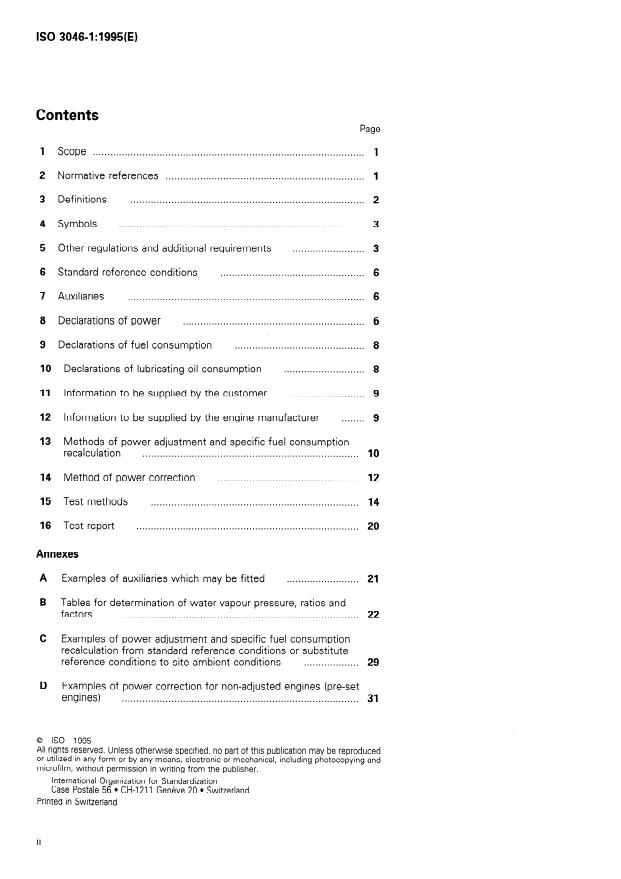

ISO 3046-1:1995 - Reciprocating internal combustion engines -- Performance
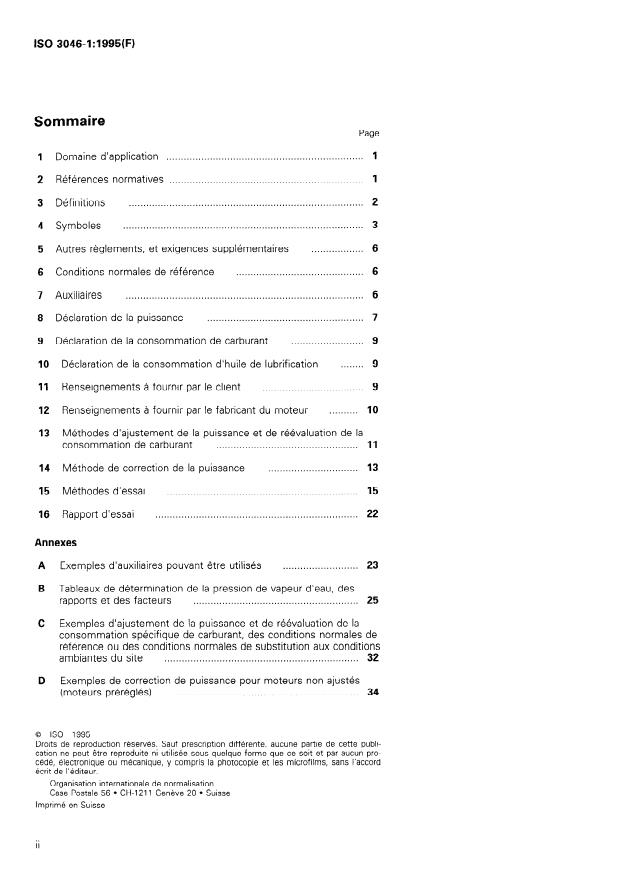
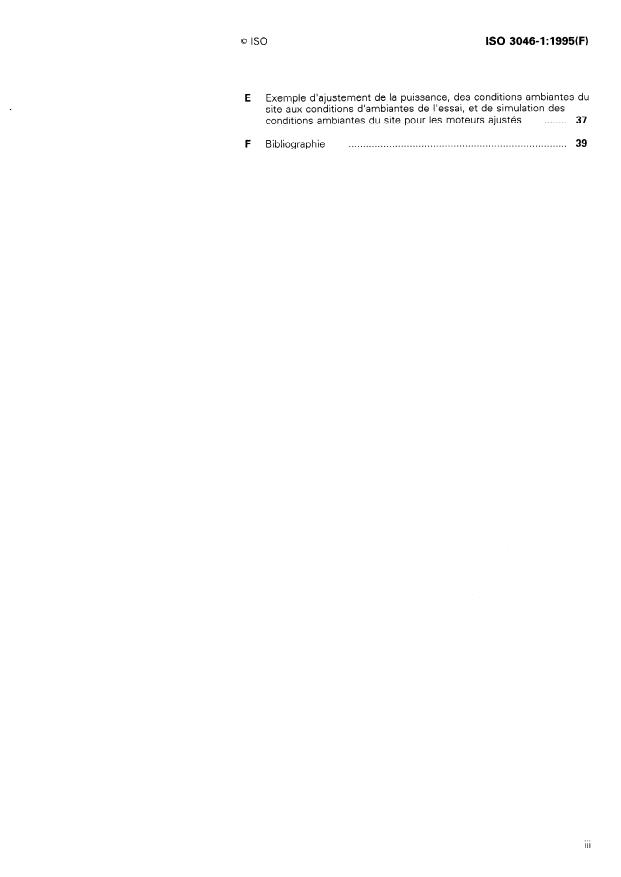
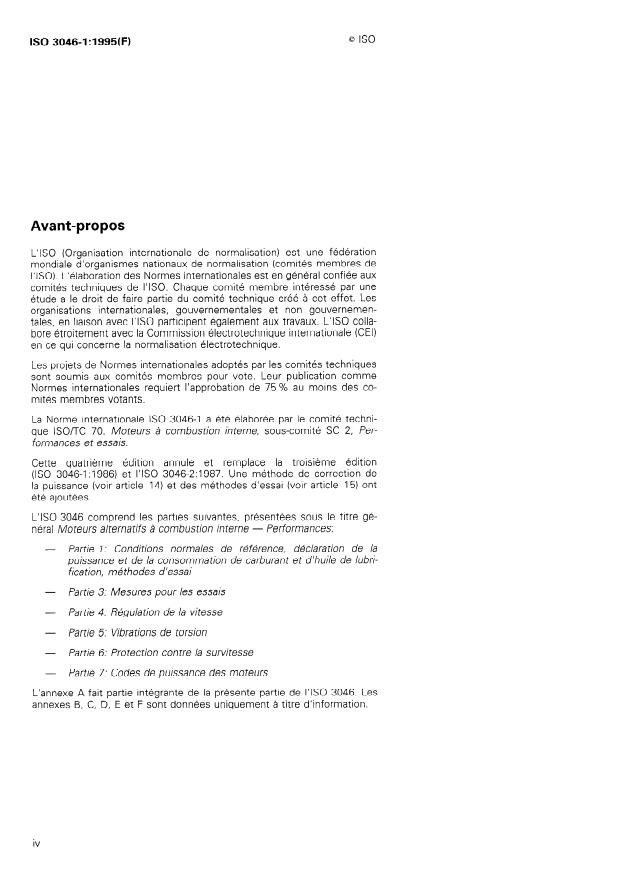
ISO 3046-1:1995 - Moteurs alternatifs a combustion interne -- Performances
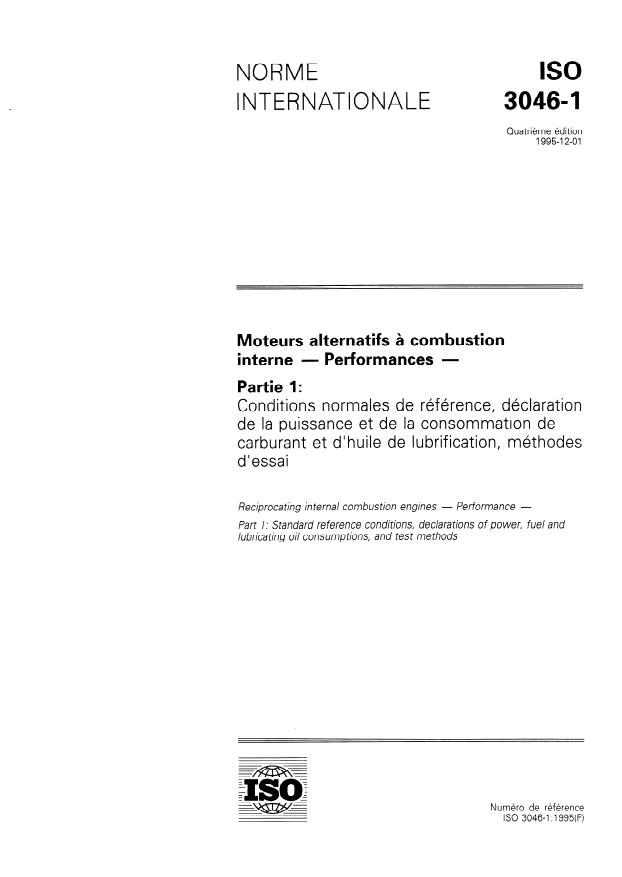
ISO 3046-1:1995 - Moteurs alternatifs a combustion interne -- Performances
Get Certified
Connect with accredited certification bodies for this standard

DNV
DNV is an independent assurance and risk management provider.

Lloyd's Register
Lloyd's Register is a global professional services organisation specialising in engineering and technology.
DNV Energy Systems
Energy and renewable energy certification.
Sponsored listings
Frequently Asked Questions
ISO 3046-1:1995 is a standard published by the International Organization for Standardization (ISO). Its full title is "Reciprocating internal combustion engines — Performance — Part 1: Standard reference conditions, declarations of power, fuel and lubricating oil consumptions, and test methods". This standard covers: Specifies standard reference conditions and methods of declaring the power, fuel consumption, lubricating oil consumption and test methods for reciprocating internal combustion engines. Applicable to engines used to propel road construction and earth-moving machines and industrial trucks. Engines used to propel agricultural tractors, road vehicles and aircraft are excluded.
Specifies standard reference conditions and methods of declaring the power, fuel consumption, lubricating oil consumption and test methods for reciprocating internal combustion engines. Applicable to engines used to propel road construction and earth-moving machines and industrial trucks. Engines used to propel agricultural tractors, road vehicles and aircraft are excluded.
ISO 3046-1:1995 is classified under the following ICS (International Classification for Standards) categories: 27.020 - Internal combustion engines. The ICS classification helps identify the subject area and facilitates finding related standards.
ISO 3046-1:1995 has the following relationships with other standards: It is inter standard links to EN ISO 8861:1998, EN ISO 2897-2:1999, ISO 5833-1:1979, ISO 3046-1:2002, ISO 3046-1:1986. Understanding these relationships helps ensure you are using the most current and applicable version of the standard.
ISO 3046-1:1995 is available in PDF format for immediate download after purchase. The document can be added to your cart and obtained through the secure checkout process. Digital delivery ensures instant access to the complete standard document.
Standards Content (Sample)
IS0
INTERNATIONAL
3046-l
STANDARD
Fourth edition
1995-I Z-01
Reciprocating internal combustion
Performance -
engines -
Part 1:
Standard reference conditions, declarations of
power, fuel and lubricating oil consumptions,
and test methods
Moteurs altematifs i combustion interne - Performances -
Partie I: Conditions normales de r&f&ence, dklaration de la puissance
et de la consomma tion de carburan t et d ’huile de lubrifica tion, m6 thodes
d ‘essai
Reference number
IS0 3046-I :1995(E)
IS0 3046-l :1995(E)
Contents
Page
1 Scope . . . . . . . . . . . . . . . . . . . . . . . . . . . . . . . . . . . . . . . . . . . . . . . . . . . . . . . . . . . . . . . . . . . . . . . . . . . . . . . . . . . . . . . . . . . . . .
2 Normative references . . . . . . . . . . . . . . . . . . . . . . . . . . . . . . . . . . . . . . . .*. 1
3 Definitions . . . . . . . . . . . . . . . . . . . . . . . . . . . . . . . . . . . . . . . . . . . . . . . . . . . . . . . . . . . . . . . . . . . . . . . . . . . . . . . . . 2
4 Symbols . . . . . . . . . . . . . . . . . . . . . . . . . . . . . . . . . . . . . . . . . . . . . . . . . . . . . . . . . . . . . . . . . . . .*.
. . . . . . . . . . . . . . . . . . . . . . . . . 3
5 Other regulations and additional requirements
. . . . . . . . . . . . . . . . . . . . . . . . . . . . . . . . . . . . . . . . . . . . . . . . . . 6
6 Standard reference conditions
7 Auxiliaries . . . . . . . . . . . . . . . . . . . . . . . . . . . . . . . . . . . . . . . . . . . . . . . . . . . . . . . . . . . . . . . . . . . . . . . . . . . . . . . . . . 6
8 Declarations of power . . . . . . . . . . . . . . . . . . . . . . . .*. 6
. . . . . . . . . . . . . . . . . . . . . . . . . . . . . . . . . . .*. 8
9 Declarations of fuel consumption
. . . . . . . . . . . . . . . . . . . . . . . . . . . . 8
IO Declarations of lubricating oil consumption
11 Information to be supplied by the customer . . . . . . . . . . . . . . . . . . . . . . . . . . 9
12 Information to be supplied by the engine manufacturer . . . . . . . . 9
13 Methods of power adjustment and specific fuel consumption
recalculation . . . . . . . . . . . . . . . . . . . . . . . . . . . . . . . . . . . . . . . . . . . . . . . . . . . . . . . . . . . . . . . . . . . . . . . . . . .
. . . . . . . . . . . . . . . . . . . . . . . . . . . . . . . . . . . . . . . . . . . . . . . . . 12
14 Method of power correction
15 Test methods . . . . . . . . . . . . . . . . . . . . . . . . . . . . . . . . . . . . . . . . . . . . . . . . . . . . . . . . . . . . . . . . . . . . . . . . 14
16 Test report . . . . . . . . . . . . . . . . . . . . . . . . . . . . . . . . . . . . . . . . . . . . . . . . . . . . . . . . . . . . . . . . . . . . . . . . . . . . . 20
Annexes
. . . . . . .a. 21
A Examples of auxiliaries which may be fitted
B Tables for determination of water vapour pressure, ratios and
factors . . . . . . . . . . . . . . . . . . . . . . . . . . . . . . . . . . . . . . . . . . . . . . . . . . . . . . . . . . . . . . . . . . . . . . . . . . . . . . . . . . . . 22
C Examples of power adjustment and specific fuel consumption
recalculation from standard reference conditions or substitute
. . . . . . . . . . . . . . . . . . . 29
reference conditions to site ambient conditions
D Examples of power correction for non-adjusted engines (pre-set
engines) . . . . . . . . . . . . . . . . . . . . . . . . . . . . . . . . . . . . . . . . . . . . . . . . . . . . . . . . . . . . . . . . . . . . . . . . . . . . . . . . . . 31
0 IS0 1995
All rights reserved. Unless otherwise specified, no part of this publication may be reproduced
or utilized in any form or by any means, electronic or mechanical, including photocopying and
microfilm, without permission in writing from the publisher.
International Organization for Standardization
Case Postale 56 l CH-1211 Geneve 20 l Switzerland
Printed in Switzerland
ii
0 IS0 IS0 3046=1:1995(E)
E Example of power adjustment from site ambient conditions to test
ambient conditions and simulation of site ambient conditions for
adjusted engines . . . . . . . . . . . . . . . . . . . . . . . . . . . . . . . . . . . . . . . . . . . . . . . . . . . . . . . . . . . . . . . . . . . .
F Bibliography . . . . . . . . . . . . . . . . . . . . . . . . . . . . . . . . . . . . . . . . . . . . . . . . . . . . . . . . . . . . . . . . . . . . . . . . . . . .
. . .
III
Q IS0
IS0 3046=1:1995(E)
Foreword
IS0 (the International Organization for Standardization) is a worldwide
federation of national standards bodies (IS0 member bodies). The work
of preparing International Standards is normally carried out through IS0
technical committees. Each member body interested in a subject for
which a technical committee has been established has the right to be
represented on that committee. International organizations, governmental
and non-governmental, in liaison with ISO, also take part in the work. IS0
collaborates closely with the International Electrotechnical Commission
(I EC) on all matters of electrotechnical standardization.
Draft International Standards adopted by the technical committees are
circulated to the member bodies for voting. Publication as an International
Standard requires approval by at least 75 % of the member bodies casting
a vote.
International Standard IS0 3046-I was prepared by Technical Committee
ISO/TC 70, internal combustion engines, Subcommittee SC 2, Perform-
ance and tests.
This fourth edition cancels and replaces the third edition
(IS0 3046-1:1986), IS0 3046-2:1987 and IS0 3046-1:1986/Amd. 1:1987.
A method of power correction (see clause 14) and test methods (see
clause 15) have been added.
IS0 3046 consists of the following parts, under the general title
Reciprocating in ternal combustion engines - Performance:
- Part 1: Standard reference conditions, declarations of power, fuel
and lubricating oil consumptions, and test methods
- Part 3: Test measurements
Part 4: Speed governing
Part 5: Torsional vibrations
- Part 6: Overspeed protection
- Part 7: Codes for engine power
Annex A forms an integral part of this part of IS0 3046. Annexes B, C,
D, E and F are for information only.
iv
0 IS0
IS0 3046=1:1995(E)
Introduction
The standard reference conditions defined in this edition of IS0 3046-I
were first introduced in the third edition (IS0 3046-I :1986). The 5 year
transition period, which permitted the use of IS0 3046-I :I 981 conditions,
expired at the end of 1991. Users of this part of IS0 3046 are therefore
now required to adopt the values quoted in clause 6.
This page intentionally left blank
INTERNATIONAL STANDARD 0 IS0 IS0 3046=1:1995(E)
Reciprocating internal combustion engines -
Performance -
Part 1:
Standard reference conditions, declarations of power, fuel
and lubricating oil consumptions, and test methods
possibility of applying the most recent editions of the
1 Scope
standards indicated below. Members of IEC and IS0
maintain registers of currently valid International
This part of IS0 3046 specifies standard reference
Standards.
conditions and methods of declaring the power, fuel
lubricating oil consumption and test
consumption,
IS0 1204: 1990, Reciprocating internal combustion
methods for reciprocating internal combustion (RIG)
engines - Designation of the direction of rotation and
engines in commercial production using liquid or
of cylinders and valves in cylinder heads, and defi-
gaseous fuels. Where necessary, individual require-
nition of right-hand and left-hand in-line engines and
ments are given for particular engine applications.
locations on an engine.
This part of IS0 3046 covers RIC engines for land,
IS0 3046-3: 1989, Reciprocating internal combustion
rail-traction and marine use, excluding engines used
engines - Performance - Part 3: Test measure-
to propel agricultural tractors, road vehicles and air-
men ts.
craft.
This part of IS0 3046 may be applied to engines used
I SO 3046-4:-l’,
Reciprocating in ternal combustion
to propel road construction and earth-moving ma-
engines - Performance - Part 4: Speed governing.
chines, industrial trucks, and for other applications
where no suitable International Standard for these IS0 3046-5: 1978, Reciprocating internal combustion
engines exists. engines - Performance - Part 5: Torsional vi-
bra tions.
This part of IS0 3046 may be applied to tests on a
test bed at the manufacturer ’s works and to tests on
IS0 3046-6: 1990, Reciprocating internal combustion
site (see 15.4.4).
engines - Performance - Part 6: Overspeed pro-
tection.
2 Normative references
IS0 3046-7: 1995, Reciprocating internal combustion
engines -
Performance - Part 7: Codes for engine
The following standards contain provisions which,
power.
through reference in this text, constitute provisions
of this part of IS0 3046. At the time of publication, the
IS0 8528-l : 1993, Reciprocating internal combustion
editions indicated were valid. All standards are subject
engine driven alternating current generating sets -
to revision, and parties to agreements based on this
Part 7: Application, ratings and performance.
part of IS0 3046 are encouraged to investigate the
1) To be published. (Revision of IS0 3046-4:1978)
3.3.2 indicated power: The total power developed
3 Definitions
in the working cylinders as a result of the pressure
of the working medium acting on the pistons.
For the purposes of this part of IS0 3046, the follow-
[ISO 2710:1978, 10.3.11
ing definitions apply.
3.3.3 brake power: The power or the sum of the
3.1 Auxiliary
powers measured at the driving shaft or shafts.
[ISO 2710:1978, 10.3.21
3.1.1 dependent auxiliary: Item of equipment, the
presence or absence of which affects the final shaft
3.3.4 continuous power: The power which an en-
output of the engine.
gine is capable of delivering continuously, between
the normal maintenance intervals stated by the
3.1.2 independent auxiliary: Item of equipment
manufacturer, at the stated speed and under stated
which uses power supplied from a source other than
ambient conditions, the maintenance prescribed by
the engine.
the manufacturer being carried out.
3.1.3 essential auxiliary: Item of equipment which
3.3.5 overload power: The power which an engine
is essential for the continued or repeated operation may be permitted to deliver, with a duration and fre-
of the engine.
quency of use depending on the service application,
at stated ambient conditions, immediately after oper-
ating at the continuous power.
3.1.4 non-essential auxiliary: Item of equipment
which is not essential for the continued or repeated
3.3.6 fuel stop power: The power which an engine
operation of the engine.
is capable of delivering during a stated period corre-
sponding to its application, and stated speed and un-
3.2 Engine
der stated ambient conditions, with the fuel limited
so that this power cannot be exceeded.
3.2.1 engine adjustment: Physical procedure of
modifying an engine for the purpose of adapting it to
3.3.7 IS0 power: The power determined under the
a different set of ambient conditions, such as by
operating conditions of the manufacturer ’s test bed
moving limiting fuel stop, re-matching the turbo-
and adjusted or corrected as determined by the
charger, changing the fuel injection timing or other
manufacturer to the standard reference conditions
mechanical changes. In that case the engine is an
specified in clause 6.
adjusted engine (see 3.3.11).
3.3.8 IS0 standard power: The continuous brake
3.2.2 non-adjusted engine: Engine which is preset
power which the engine manufacturer declares that
so that no physical procedure of modifying the engine
an engine is capable of delivering using only the es-
for the purpose of adapting it to a different set of
sential dependent auxiliaries, between the normal
ambient conditions is carried out.
maintenance intervals stated by the manufacturer,
and under the following conditions:
3.2.3 engine speed: The number of revolutions of
the crankshaft in a given period of time.
a) at a stated speed at the operating conditions of
[ISO 2710:1978, 10.2.11
the engine manufacturer ’s test bed;
b) with the declared power adjusted or corrected as
speed
3.2.4 declared engine speed: The engine
determined by the manufacturer to the standard
corresponding to the declared power.
reference conditions specified in clause 6;
NOTE 1 In some applications, the declared engine speed
is named “rated speed ”.
c) with the maintenance prescribed by the engine
manufacturer being carried out.
3.3 Power and load
3.3.9 service power: The power delivered under the
ambient and operating conditions of an engine appli-
3.3.1 declared power: The value of the power, de-
cation.
clared by the manufacturer, which an engine will de-
liver under a given set of circumstances.
3.3.10 service standard power: The continuous
brake power which the engine manufacturer declares
NOTE 2 In some applications, the declared power is
named “rated power ”. that an engine is capable of delivering, using only the
0 IS0
IS0 3046=1:1995(E)
3.4.3 IS0 specific fuel consumption: The name
essential dependent auxiliaries, between the normal
maintenance intervals stated by the manufacturer and given to the specific fuel consumption at the IS0
standard power.
under the following conditions:
a) at a stated speed at the ambient and operating
3.4.4 fuel delivery: Metered volume (mass) of fuel
conditions of the engine application;
delivered by a fuel injection system during one work-
ing cycle. [ISO 7876-l :I 990, IO.241
b) with the declared power adjusted or corrected as
determined by the manufacturer to the stated
3.4.5 specific fuel delivery: Metered volume (mass)
ambient and operating conditions of the engine
of fuel delivered by a fuel injection system during one
application;
working cycle per litre of engine swept volume.
c) with the maintenance prescribed by the engine
3.4.6 lubricating oil consumption: The quantity of
manufactuer being carried out.
lubricating oil consumed by an engine per unit of time.
[ISO 2710:1978, 10.4.31
3.3.11 power adjustment: Calculation procedure by
3.5 Tests
which a power value under one set of ambient con-
ditions is modified to represent the power value ex-
pected under another set of ambient conditions, to
3.5.1 acceptance test: Test carried out as an overall
maintain approximately constant thermal and/or
check on the manufacturing quality, and to establish
mechanical load in critical engine components. (See
that the contractual commitments have been fulfilled.
clause 13.)
3.5.2 type test: Test carried out on a representative
engine of a certain engine type to establish the main
3.3.12 power correction: Calculation procedure by
performance data of the engine and, as far as poss-
which a power value determined under engine test
ible, to enable their reliability and durability in service
conditions is modified so that it represents the power
to be assessed.
value expected under other operating or reference
conditions without any engine adjustment. In that
3.5.3 special test: Test additional to acceptance or
case, the power and performance parameters may
type tests carried out to meet the requirements of
vary as a function of ambient conditions. (See
inspecting and legislative authorities, classification
clause 14.)
societies or customers.
3.3.13 load: A general term describing the magni-
tude of the “power” or “torque” demanded from the
4 Symbols
engine by its driven machinery and usually expressed
relative to a declared power or torque. [ISO
The symbols used in this part of IS0 3046 are given
2710: 1978, 10.3.41
in table 1. Subscripts are given in table 2.
NOTE 3 The term “load” is physically imprecise and
should be avoided. For quantitative purposes terms
“power” or “torque” should be used, instead of “load ”,
together with a statement of speed.
5 Other regulations and additional
requirements
3.4 Consumption and delivery
5.1 For engines used on board ships and offshore
installations which have to comply with rules of a
3.4.1 fuel consumption: The quantity of fuel con-
sumed by an engine per unit of time at a stated power classification society, the additional requirements of
the classification society shall be observed. The
and under stated ambient conditions.
classification society shall be stated by the customer
prior to placing the order.
3.4.2 specific fuel consumption: The quantity of
For non-classed engines, such additional require-
fuel consumed by an engine per unit of power and
ments are, in each case, subject to agreement be-
time.
tween the manufacturer and customer.
IS0 3046=1:1995(E)
Table 1 - Symbols
,ols
Definition
Unit
EDP ’)
common use
representation
a A Humidity factor
BR Specific fuel consumption under standard reference conditions
4 kg/(kWW
BX Specific fuel consumption under site ambient conditions
bx kg/NW
BY Specific fuel consumption under test ambient conditions
kg/NW-h)
by
FA Atmospheric factor
f 1
a
FM Engine factor (characteristic parameter for each type of engine)
f m
k K Ratio of indicated power
m M Exponent of the dry air pressure ratio or total barometric pressure
ratio
n N Exponent of the ambient air thermodynamic temperature ratio
PR Standard reference total barometric pressure
kPa
Pr
PRA Substitute reference total barometric pressure
kPa
Pra
PSR Standard reference saturated water vapour pressure
P kPa
ST
PSX Ambient saturated water vapour pressure on site
P kPa
sx
Ambient saturated water vapour pressure during test
PSY
kPa
PSY
Ambient total barometric pressure on site
PX kPa
Px
PY Ambient total barometric pressure during test
kPa
h
PPR Brake power under standard reference conditions kW
pr
Brake power under substitute reference conditions
PPRA kW
Pra
Brake power under ambient conditions on site
PPX kW
PX
PPY Brake power under ambient conditions during test kW
pY
Q Fuel mass per cycle per litre of engine swept volume
4 /(cycle.l)
mg
QC Fuel mass per cycle per litre of air available for combustion
/(cycle4
qc w
r
R Boost pressure ratio (ratio of absolute air pressure at the 1
compressor outlet to that at the compressor inlet)
RR Boost pressure ratio under standard reference conditions
r
RRMAX Maximum allowable boost pressure ratio under standard reference
r,max
conditions
S S Exponent of the charge air coolant thermodynamic temperature ra-
tio
t
TCR Standard reference charge air coolant temperature
“C
Cl-
t
TCX Ambient charge air coolant temperature on site
cx “C
TR Standard reference ambient air temperature
4 “C
TX Ambient air temperature on site
tX “C
TTCR Standard reference charge air coolant thermodynamic temperature
Tcr K
T
TTCRA Substitute reference charge air coolant thermodynamic temperature
era K
K
TTR Standard reference ambient air thermodynamic temperature
7-r
TTRA Substitute reference ambient air thermodynamic temperature
Tra
TTX Ambient air thermodynamic temperature on site
TX
Ambient air thermodynamic temperature during test
TY
0 IS0
IS0 3046=1:1995(E)
Symbols
Definition Unit
EDP ’)
common use
representation
Power adjustment factor 1
a ALP
Power correction factor for spark-ignition engines 1
ALPA
Oca
ALPC Power correction factor for compression-ignition engines
a,
Fuel consumption recalculation factor 1
BET
B
ETAM Mechanical efficiency
Vrn
%
PPHIR Standard reference relative humidity
r
PPHIX Ambient relative humidity on site %
X
Ambient relative humidity during test %
PPHIY
Y
1) EDP = electronic data processing if using upper-case letters only.
Table 2 - Subscripts
Subscript Meaning
a Atmospheric
Compression ignition engine ’)
CoolantI)
C
CorrectedI)
m Mechanical
Maximum
max
r Standard reference conditions
Substitute reference conditions
ra
S Saturated
Site conditions
X
Test conditions
Y
1) Depending on the application.
IS0 3046=1:1995(E)
5.2 If special requirements from regulations of any 8 Declarations of power
other authority (e.g. inspecting and/or legislative
authorities) have to be met, the authority shall be
8.1 General
stated by the customer prior to placing the order.
8.1.1 Purpose of statement of power
5.3 Any further additional requirements shall be
Statements of power are required for two main pur-
subject to agreement between the manufacturer and
poses, as follows.
customer.
a) The declaration of the value of the power.
6 Standard reference conditions
b) The verification by measurement that the engine
delivers the power which has been declared in a),
For the purpose of determining the power and fuel
under the same set of circumstances or after
consumption of engines, the following standard ref-
proper allowance has been made for any differ-
erence conditions shall be used.
ence in circumstances.
Total barometric pressure:
To specify the set of circumstances under which the
J+= 100 kPa
declared value of a power would be achieved, the
declaration shall state:
Air temperature:
a) the type of statement of power (see 8.4, standard
T, = 298 K (tr = 25 “C)
or service power) and, if necessary, the ambient
and operating conditions (see 8.4);
Relative humidity:
or = 30 %
the type of power application (see 8.3, continuous
b)
power with overload power and/or fuel stop
Charge air coolant temperature:
power);
= 298 K (tcr = 25 “C)
Tcr
the type of power (see 8.2, indicated or brake
d
power);
Relative humidity of 30 % at a temperature of
NOTE 4
298 K corresponds to a water vapour pressure of 1 kPa.
the declared engine speed (see 3.2.4).
d
Hence the corresponding dry barometric pressure is
99 kPa.
I-
t-or the methodology of expressing the engine power
according to a), b) and c), see figure 1. For appropriate
codes, where necessary, refer to IS0 3046-7.
7 Auxiliaries
NOTE 6 The terms used in a) to c) may be combined, for
In order to show clearly the conditions under which
example, continuous brake fuel stop service power.
the power output is determined, it is necessary to
distinguish those auxiliaries which affect the final
Where appropriate to the engine application and the
shaft output of the engine and also those which are
method of manufacture, the power achieved may be
necessary for the continuous or repeated use of the
subject to a tolerance on the declared power. The
engine. For examples, see annex A.
existence of such a tolerance and its magnitude shall
be stated by the manufacturer.
Items of equipment fitted to the engine and without
which the engine could not under any circumstances
8.1.2 Power and torque
operate at its declared power are considered to be
engine components and are not, therefore, classed
For engines delivering power by a shaft or shafts, any
as auxiliaries.
power according to this part of IS0 3046 is a quantity
proportional to the mean torque, calculated or meas-
NOTE 5 Items such as fuel injection pump, exhaust
ured, and to the mean rotational speed of the shaft
turbocharger and charge air cooler are in this category of
or shafts transmitting this torque.
engine components.
IS0 3046=1:1995(E)
Q IS0
b) Type of power application cl Type of power d) Engine speed
a) Type of statement
of power
Brake power (3.3.3)
with dependent
auxiliaries not
restricted to
Declared engine
I
NOTE --II applies to ” IS0 standard power ”.
~1113 applies to “service standard power ”.
Figure 1 - Diagram showing the methodology to be used in power statements
c) non-essential dependent auxiliaries as defined in
For engines delivering power other than by a shaft or
3.1.1 and 3.1.4.
shafts, reference shall be made to the appropriate
International Standard for the driven machine.
The power absorbed by the auxiliaries listed in b) and
c) may be significant. In such cases, their power re-
8.1.3 Engine with integral gearing
quirement shall be declared.
When stating the power of an engine fitted with an
Examples of typical auxiliaries are listed in annex A.
. .
integral (built-in) speed increasing or reducing device,
the speed of the driving shaft extremity shall also be
8.3 Types of power application
given at the declared engine speed.
Continuous power, overload power and fuel stop
8.2 Types of power power are types of power application.
The duration and frequency of use of the overload
8.2.1 Indicated power and brake power are types of
power which is permitted will depend on the service
power.
application, but adequate allowance shall be made in
setting the engine fuel stop to permit the overload
8.2.2 Except in the cases of IS0 standard power and power to be delivered satisfactorily. The overload
service standard power, any statement of brake
power shall be expressed as a percentage of the
power shall be supported by the following list of continuous power, together with the duration and
auxiliaries: frequency permitted and the appropriate engine
speed.
a) essential dependent auxiliaries as defined in 3.1 .I
Unless otherwise stated, an overload power of
and 3.1.3;
110 % of the continuous power at a speed corre-
b) essential independent auxiliaries as defined in sponding to the engine application is permitted for a
3.1.2 and 3.1.3; period of 1 h, with or without interruptions, within a
IS0 3046=1:1995(E)
period of 12 h of operation. This period also applies
9 Declarations of fuel consumption
to any overload power up to 110 % of the continuous
power.
9.1 Fuel consumption
NOTE 7 The power of marine propulsion engines is
The quantity of liquid fuels shall be expressed in mass
normally limited to the continuous power, so that the over-
units (kg) or in energy units (J).
load power cannot be given in service. However, for special
applications, marine propulsion engines may develop over-
The quantity of gaseous fuels shall be expressed in
load power in service.
energy units (J).
For engines for electrical power generation, the
If not otherwise specified by the manufacturer, a de-.
specifications given in IS0 8528-l :I 993, 13.3, apply.
clared specific fuel consumption shall be considered
to be the IS0 specific fuel consumption.
9.2 Calorific value of fuels
92.1 Liquid-fuel engines
. Types of statement of power
Where a distillate type of fuel is specified, any de-
IS0 power and service power are types of statement
clared specific fuel consumption of a liquid-fuel engine
of power. given in mass units shall be related to a lower calorific
value of 42 700 kJ/kg.
To establish service power, the following conditions
Where any other type of fuel is specified, the declared
shall be taken into account:
specific fuel consumption shall either be expressed in
energy units, or both the specific fuel consumption in
a) the ambient conditions, or any nominal ambient
mass units and the associated lower calorific value
conditions according to the special requirements
shall be stated.
of inspecting and/or legislative authorities and/or
classification societies, as specified by the cus-
tomer (see clause 1 I). 9.2.2 Gas engines
NOTE 8 For example, the following nominal ambient
Any declared specific fuel consumption of a gas en-
conditions apply to marine propulsion and auxiliary RIC
gine shall be related to a stated lower calorific value
engines on ships for International Association of
of the gas. The type of gas shall be declared.
Classification Societies (IACS) unrestricted service:
9.3 Specific fuel consumption declarations
Total barometric pressure:
px = 100 kPa
The specific fuel consumption of an engine shall be
declared at:
Air temperature:
= 318 K (tX = 45 “C) a) the IS0 standard power;
TX
b) (if required by special agreement) any other de-
Relative humidity:
clared power and at specified engine speeds ap-
4, = 60 %
propriate to the particular engine application.
Sea or raw water temperature (charge air coolant inlet):
Unless otherwise stated, a deviation of + 5 % is per-
Tcx = 305 K (tcX = 32 “C) mitted for the specific fuel consumption for the de-
clared power.
the normal duty of the engine;
b)
10 Declarations of lubricating oil
c) the expected interval between maintenance per-
consumption
iods;
10.1 The value of the lubricating oil consumption is
d) the nature and amount of supervision required;
used for guidance. It shall be expressed in litres or
kilograms per engine operating hour at the declared
any information relevant to the operation of the
power and engine speed.
engine in service (see clauses 11 and 12).
0 IS0 IS0 3046=1:1995(E)
g) Any other information appropriate to the particular
IO.2 The lubricating oil consumption after a stated
engine application.
period of running-in shall be declared.
10.3 The oil discarded during an engine oil change
12 Information to be supplied by the
shall not be included in the lubricating oil consumption
engine manufacturer
declaration.
The engine manufacturer shall supply the following
IO.4 The lubricating oil used shall be declared.
information.
a) The declared brake powers and, where appropri-
ate, their tolerances.
11 Information to be supplied by the
b) The corresponding engine speeds.
customer
NOTE 9 For certain applications of variable-speed
The customer shall supply the following information.
engines, it is common practice to supply a power speed
diagram covering the ranges of power over which the
required from the
The applica tion and the p ower
a) engine may be used in continuous and in short-period
engine and details a rising from these. operation.
A typical example for a marine propulsion engine with
b) The expected frequency and duration of the re-
a fixed-pitch propeller is given in figure2. For the prep-
quired powers and the corresponding engine
aration of such a diagram, the customer should supply
speeds, preferably as a load profile.
the required information according to clause 11.
c) Site conditions
c) The direction of rotation (see IS0 1204).
) site barometric pressure: highest and lowest
d) The number and arrangement of cylinders (see
readings available; if no pressure data are
IS0 1204).
available, the altitude above sea level;
e) Whether the engine is two-stroke or four-stroke,
) the average of the monthly mean minimum
naturally aspirated, mechanically pressure-charged
and maximum ambient air temperatures on
or turbocharged, and whether with or without a
site during the hottest and coldest months of
charge air cooler.
the year;
f) The air flow required for the operation of the en-
3) the highest and lowest ambient air tempera-
gine for
tures on site around the engine;
1) combustion and scavenging;
4) the relative air humidity (or alternatively, the
water vapour pressure or the wet and dry bulb
2) cooling and ventilation.
temperature) at the maximum ambient air
temperature on site;
g) The met hod of sta rting ratus supplied and
aPPa
additiona I apparatus red.
5) the maximum and minimum temperatures of
the cooling water available.
h) The type and grade of lubricating oil rec-
ommended.
d) The specification and lower calorific value of the
fuel available.
i) The type of governing, with speed droop if re-
quired (see IS0 3046-4 and IS0 3046-6).
e) Whether the engine is to comply with the re-
quirements of any classification society or with
For va ria ble speed duties, the working engine
special requirements.
speed range and the
idling speed.
Characteristics of the essential dependent auxili- If necessary, the critical engine speed range shall
f 1
aries supplied by the customer. be indicated.
IS0 3046-l :1995(E)
Overload power
Nominalpropellercurve
Continuous power
Speed
1 Range of continuous power
2 Range of intermittent operation
.3 Range of short-time overload operation for special applications
Example of a power/speed diagram
Figure 2 -
) Characteristics of the essential independent
j) The method of cooling and the capacity of the
auxiliaries supplied by the manufacturer.
cooling system with the rates of circulation of the
cooling fluids.
) Any other information appropriate to the particular
engine application.
k) Whether hot air discharge ducting can be fitted
(for air-cooled engines only).
I) A schedule of recommended maintenance and
overhaul periods.
m) Specifications and lower calorific values of fuels 13 Methods of power adjustment and
recommended.
specific fuel consumption recalculation
n) Engine fuel supply temperature and/or viscosity.
13.1 General
o) Maximum permissible back-pressure in the ex-
The engine manufacturer shall indicate the amounts
haust system and the maximum permissible air-
intake depression. by which the test or site ambient conditions may dif-
fer from the standard reference conditions without
‘0 IS0
IS0 3046-I :1995(E)
Formulae (5) and (6) shall then be used instead of
having to adjust the power and recalculate the specific
formula (3).
fuel consumption.
Replacing the dry air pressure ratio in formula (3) by
13.2 Application
the total barometric pressure ratio, the ratio of the in-
dicated power is given by
The procedures given in this part of IS0 3046 shall
be applied to calculate:
k= (+$$(yn(ys . . .
(5)
- the expected power and specific fuel consumption
for site ambient conditions from values known for
where the substitute reference total barometric
standard reference conditions (see 13.3 and
pressure 1s
13.4);
Y,
. . .
- whether the values of power and fuel consump-
Pra = Pr 7 (6)
r,max
i 1
tion attained under engine test ambient conditions
correspond to the declared values (see 13.3 and
The factor a and exponents m, ~2 and s have the nu-
13.4).
merical values given in table3 (see 13.3.4).
NOTES
13.3 Adjustment of power for ambient
conditions
IO See also the tables in annex B, and the nu merical ex-
amples in ann exes C, D and E.
13.3.1 When it is required that the engine be oper-
ated under conditions different from the standard ref-
11 When the test or site ambient conditions are more
erence conditions given in clause 6 and if it is favourable than the standard reference conditions or sub-
stitute reference conditions (see 13.3.2), the declared
required that the power output shall be adjusted to
power under the test or site ambient conditions may be
or from the standard reference conditions, the fol-
limited by the manufacturer to the declared power under
lowing formulae shall be used if other methods are
the standard reference conditions or substitute reference
not stated by the manufacturer (see note 12 in 13.3.2
conditions.
and also 13.3.4).
12 If the relative humidity is not known, a value of 30 %
Px = tit-
should be assumed in formula references A, E and G in ta-
ble 3.
where the power adjustment factor, a, is given by
For all other formula references, the power adjustment is
. . .
cc.=k-0,7(1 -k)
(2
inde pendent of humidity (a = 0).
13.3.3 The value of the mechanical efficiency shall
(see note 13 in 13.32)
be stated by the engine manufacturer. In the absence
where the ratio of indicated power is
of any such statement, the value of qrn = 0,80 shall
be assumed.
. . .
k= ( ;:;;;;;)m($)n(~)s (3)
13.3.4 When declaring the IS0 standard power, the
engine manufacturer shall state which of the formula
For examples, see C.1, 0.3 and annex E.
references in table3 is applicable.
13.3.2 In the case of turbocharged engines in which
13.4 Recalculation of fuel consumption for
the limits of turbocharger speed, turbocharger turbine
test or site ambient conditions for adjusted
inlet temperature and maximum combustion pressure
engines
have not been reached at the declared power under
standard reference conditions, the manufacturer may
When it is required that the engine be operated under
declare substitute reference conditions to or from
test or site ambient conditions different from the
which power adjustment shall be made. (For an ex-
standard reference conditions given in clause 6, the
ample, see C.2.)
specific fuel consumption will differ from that de-
clared for the standard reference conditions and shall
In this case:
be recalculated for or from the standard reference
. . .
(4)
PX = aP,a conditions.
0 IS0
IS0 3046~1:1995( E)
Numerical values for power adjustment
Table 3 -
Factor Exponents
Formula
Engine type Conditions
reference
n
u m S
Power limited by insufficient
A 1 1 0,75 0
excess air
Non-turbocharged
Power limited by thermal
B 0 1 1 0
Compression-
reasons
ignition oil engines
Turbocharged with-
and dual-fuel en-
out charge air cool- C 0 2 0
a7
gines
Low and medium speed
ing
four-stroke engines
Turbocharged with
D 0 1
a7 12
charge air cooling
Non-turbocharged E 1 0,86 0,55 0
Spark-ignition en-
gines using gaseous
Turbocharged with Low and medium speed
F
0 0,57 0,55 I,75
fuel
charge air cooling four-stroke engines
Spark-ignition en-
G 1 1 0
gines using liquid Naturally aspirated 015
fuel
NOTES
1 The formula references and the exponents have been derived by CIMAC. (CIMAC = International Council on Combustion
Engines.)
2 The factors and exponents have been established by tests on a number of engines to be generally representative and
shall be used if not otherwise stated by the manufacturer; for example in formula reference D, for an engine with the charge
air cooled by engine jacket water, the value for exponent s could be zero. At present, they apply only to the types of engine
specified, but the table will be extended to include other types when sufficient data are available. For these engines, the
power adjustment shall be stated by the engine manufacturer.
3 The formula references A, C and G are applied in examples given in annexes C, D and E.
The following formulae shall be used if other methods This power correction method shall be applied to de-
termine by calculation the power corrected to the
are not declared by the manufacturer:
standard reference conditions specified in clause 6
. . .
(7)
bx = Bbr
from the power observed (determined) under test
ambient conditions.
where
k
=- For the purpose of power correction, the observed
. . .
(8)
B
a
(determined) power shall be multiplied by a factor cx
as follows:
NOTE 13 See also the tables in annex B, and the nu-
merical example in C.I.
for spark-ignition engines:
Pr = Cia X Py . . .
(9)
14 Method of power correction
or, for compression-ignition engines:
This power correction method, which conforms with
Pr = Ct, X Py . . .
(lo>
the method given in IS0 1585, has been verified by
tests on a representative number of pre-set engines
NOTES
with engine speeds of 2 000 min-’ and above.
14 In formulae (9) and (IO), the mathematical approach is
Manufacturers may extend this method to other en-
the inverse of that of formula (1) in 13.3.
gines as considered appropriate, or restrict it, if justi-
fied by experience.
0 IS0 IS0 3046=1:1995(E)
15 Examples illustrating how correction factors are applied
when testing pre-set engines are given in annex D. fa= (;I;;;) ($) “‘7 . . .
(13)
14.1 Correction factor a, for naturally
b) For turbocharged engines without charge air
aspirated and pressure-charged
cooling or with charge air cooling by air to air
charge air cooler:
spark-ignition engines
low-
The correction factor a, is calculated from the fo
fa= ( f++;g;) “‘7(+q ’2 . . .
(14)
ing formula:
c) For turbocharged engines with charge air cooling
a,= ( ;:;;;)1 ’2($)o ’6 .#
(11)
by air to liquid charge air cooler:
Formula (11) applies to engines with carburettors and
fa= ( ;I,mg;) “‘7(qo ’7 . .(15)
to other engines where the fuel management system
is designed to maintain a relatively constant fuel/air
ratio as ambient conditions change. For other engine
types, see 14.3.
14.2.2 Engine factor, fm
Formula (1 I) is only applicable if the correction factor
a, is between 0,93 and 1,07, the ambient temperature
Factor&, is dependent on the type of engine and the
at the air inlet to the engine is T, + 10 K (lr + 10 “C)
trapped air/fuel ratio corresponding to the fuel setting.
and the dry barometric pressure is 80 kPa to
110 kPa. If these limits are exceeded, the corrected
The engine factor fm is a function of the corrected
value obtained shall be given, and the test ambient
specific fuel delivery qC, as follows:
and pressure) precisely
conditions (temperature
fm = O,O36q, - I,14 . . .
(16)
stated in the test report.
14.2 Correction factor a, for
=-
. . .
compression-ignition engines
qc
The power correction factor a, for compression-
NOTE 16 For two-stage turbocharging, rr is the overall
ignition engines with pre-set fuel settings is calculated
pressure ratio (I-~ = 1 for naturally aspirated engines).
from the following formula:
Formula (16) is valid for the following range of qC, in
. . .
(12)
a, = &lfm
milligrams per cycle per litre of air available for com-
bustion:
Formula (12) is only applicable where the correction
factor a, is between 0,9 and 1 ,I, the ambient tem- 37,2< qc < 65
perature of the air inlet of the engine is Tr + 15 K
(tl k 15 “c> and the dry barometric pressure is
For qC values lower than 37,2, a constant value of fm
80 kPa to 110 kPa. If these limits are exceeded, the
equal to 0,2 shall be taken. For qC values higher than
corrected value obtained shall be given and test am-
65, a constant value of fm equal to I,2 shall be taken
bient conditions (temperature and pressure) precisely
(see figure 3).
stated in the test report.
14.2.1 Atmospheric factor, fa
14.3 Other types of engine
Factor fa indicates the effect of environmental con-
For engines not covered by 14.1 and 14.2, a cor-
ditions (pressure, temperature and humidity) on the
rection factor equal to 1 shall be applied when the
air drawn in by the engine. The atmospheric factor
ambient air density does not vary by more than
differs according to the type of engine and is calcu-
+ 2 % from the density under standard reference
-
lated from the following formulae.
conditions. When the ambient air density is beyond
these limits, no correction shall be applied, but the
a) For naturally aspirated engines and mechanically
test conditions shall be stated in the test report.
pressure-charged engines:
IS0 3046-I :1995(E)
W3
0~5
20 30 37,2 40 so 60 70 Qc
Engine factor&& as a function of corrected specific fuel delivery, qC
Figure 3 -
15 Test methods
Table 4 - Engine groups for selection of test
measurements
Acceptance tests, if required, shall be included in the
contract. Type tests and/or special tests are subject
Engine
to agreement between the manufacturer and cus-
Typical characteristics of engine group
group
tomer.
number
Engines whose operating conditions are
not measured in service; usually with
15.1 Designation of tests
maximum design engine speeds of more
than 1 800 min- ‘.
This part of IS0 3046 gives two test categories; ref-
erence may be made to the relevant category of test
Naturally aspirated engines with maximum
as follows.
2 design engine speeds of approximately
1 500 min- ’ and above.
For acceptance tests (see 3.5.1):
Pressure-charged engines with maximum
I SO 3046-I - A 3 design engine speeds of approximately
1 500 min-’ and above.
For type tests (see 3.5.2):
Engines with maximum design engine
4 speeds of approximately 250 min-’ to
SO 3046-I - T
1 500 min.
Engines with maxim
...
ISO
NORME
3046-l
INTERNATIONALE
Quatrième édition
1995-l Z-OI
Moteurs alternatifs à combustion
interne - Performances -
Partie 1:
Conditions normales de référence, déclaration
de la puissance et de la consommation de
carburant et d’huile de lubrification, méthodes
d’essai
Reciprocating in ternal combustion engines - Performance -
Part 7: Standard reference conditions, declarations of power, fuel and
lubrica ting oil consump tiens, and test me thods
Numéro de référence
ISO 3046-I :1995(F)
ISO 3046=1:1995(F)
Sommaire
Page
. . . . . . . . . . . . . . . . . . . . . . . . . . . . . . . . . . . . . . . . . . . . . . . . . . . . . . . . . . . . . . . . . . . .
1 Domaine d’application
2 Références normatives .
3 Définitions .
4 Symboles . .
5 Autres règlements, et exigences supplémentaires . . . . . . . . . . . . . . . . . .
. . . . . . . . . . . . . . . . . . . . . . . . . . . . . . . . . . . . . . . . . . . . 6
6 Conditions normales de référence
. . . . . . . . . . . . . . . . . . . . . . . . . . . . . . . . . . . . . . . . . . . . . . . . . . . . . . . . . . . . . . . . . . . . . . . . . . . . . . . . . . 6
7 Auxiliaires
. . . . . . . . . . . . . . . . . . . . . . . . . . . . . . . . . . . . . . . . . . . . . . . . . . . . . . 7
8 Déclaration de la puissance
. . . . . . . . . . . . . . . . . . . . . . . . . 9
9 Déclaration de la consommation de carburant
10 Déclaration de la consommation d’huile de lubrification . . . . . . . . 9
11 Renseignements à fournir par le client .I.
Renseignements à fournir par le fabricant du moteur . . . . . . . . . . 10
13 Méthodes d’ajustement de la puissance et de réévaluation de la
. . . . . . . . . . . . . . . . . . . . . . . . . . . . . . . . . . . . . . . . . . . . . . . . . 11
consommation de carburant
. . . . . . . . . . . . . . . . . . . . . . . . . . . . . . . 13
14 Méthode de correction de la puissance
15 Méthodes d’essai . . . . . . . . . . . . . . . . . . . . . . . . . . . . . . . . . . . . . . . . . . . . . . . . . . . . . . . . . . . . . . . . . .
. . . . . . . . . . . . . . . . . . . . . . . . . . . . . . . . . . . . . . . . . . . . .*.*.
16 Rapport d’essai
Annexes
. . . . . . . . . . . . . . . . . . . . . . . . . . 23
Exemples d’auxiliaires pouvant être utilisés
Tableaux de détermination de la pression de vapeur d’eau, des
rapports et des facteurs . . . . . . . . . . . . . . . . . . . . . . . . . . . . . . . . . . . . . . . . . . . . . . . . . . . . . . . . .
Exemples d’ajustement de la puissance et de réévaluation de la
consommation spécifique de carburant, des conditions normales de
référence ou des conditions normales de substitution aux conditions
ambiantes du site . . . . . . . . . . . . . . . . . . . . . . . . . . . . . . . . . . . . . . . . . . . . . . . . . . . . . . . . . . . . . . . . . . . 32
Exemples de correction de puissance pour moteurs non ajustés
(moteurs préréglés) . . . . . . . . . . . . . . . . . . . . . . . . . . . . . . . . . . . . . . . . . . . . . . . . . . . . . . . . . . . . . . . . 34
0 60 1995
Droits de reproduction réservés. Sauf prescription différente, aucune partie de cette publi-
cation ne peut être reproduite ni utilisée sous quelque forme que ce soit et par aucun pro-
cédé, électronique ou mécanique, y compris la photocopie et les microfilms, sans l’accord
écrit de l’éditeur.
Organisation internationale de normalisation
Case Postale 56 l CH-1 211 Genève 20 l Suisse
Imprimé en Suisse
ii
0 ISO ISO 3046=1:1995(F)
E Exemple d’ajustement de la puissance, des conditions ambiantes du
site aux conditions d’ambiantes de l’essai, et de simulation des
conditions ambiantes du site pour les moteurs ajustés . . . . . . . . 37
F Bibliographie . . . . . . . . . . . . . . . . . . . . . . . . . . . . . . . . . . . . . . . . . . . . . . . . . . . . . . . . . . . . . . . . . . . . . . . . . . .
0 ISO
ISO 3046-I :1995(F)
Avant-propos
LYS0 (Organisation internationale de normalisation) est une fédération
mondiale d’organismes nationaux de normalisation (comités membres de
I’ISO). L’élaboration des Normes internationales est en général confiée aux
comités techniques de I’ISO. Chaque comité membre intéressé par une
étude a le droit de faire partie du comité technique créé à cet effet. Les
organisations internationales, gouvernementales et non gouvernemen-
tales, en liaison avec I’ISO participent également aux travaux. L’ISO colla-
bore étroitement avec la Commission électrotechnique internationale (CEI)
en ce qui concerne la normalisation électrotechnique.
Les projets de Normes internationales adoptés par les comités techniques
sont soumis aux comités membres pour vote. Leur publication comme
Normes internationales requiert l’approbation de 75 % au moins des co-
mités membres votants.
La Norme internationale ISO 3046-I a été élaborée par le comité techni-
que lSO/TC 70, Moteurs à combustion interne, sous-comité SC 2, Per-
formances et essais.
Cette quatrième édition annule et remplace la troisième édition
(ISO 3046-I :1986) et I’ISO 3046-2:1987. Une méthode de correction de
la puissance (voir article 14) et des méthodes d’essai (voir article 15) ont
été ajoutées.
L’ISO 3046 comprend les parties suivantes, présentées sous le titre gé-
néral Moteurs alternatifs à combustion interne - Performances:
- Partie 7: Conditions normales de référence, déclaration de la
puissance et de la consommation de carburant et d’huile de lubri-
fica tion, méthodes d’essai
-
Partie 3: Mesures pour les essais
-
Partie 4: Régulation de la vitesse
- Partie 5: Vibrations de torsion
- Partie 6: Protection contre la survitesse
- Partie 7: Codes de puissance des moteurs
L’annexe A fait partie intégra nte d e la présente partie de I’ISO 3046. Les
F sont donn
annexes B, C, D, E et ées uniquement à titre d’information.
ISO 3046=1:1995(F)
0 ISO
Introduction
Les conditions normales de référence définies dans la présente édition de
I’ISO 3046-I ont été pour la première fois introduites dans la troisième
édition (ISO 3046-I :1986). La période transitoire de cinq ans qui permettait
d’utiliser les conditions définies dans I’ISO 3046-I :1981 s’est terminée fin
1991. Les utilisateurs de la présente partie de I’ISO 3046 sont donc, do-
rénavant, tenus d’adopter les valeurs données à l’article 6.
Page blanche
ISO 3046-I : 1995(F)
NORME INTERNATIONALE 0 Ko
Moteurs alternatifs à combustion interne -
Performances -
Partie 1:
Conditions normales de référence, déclaration de la
puissance et de la consommation de carburant et d’huile
de lubrification, méthodes d’essai
1 Domaine d’application 2 Références normatives
Les normes suivantes contiennent des dispositions
qui, par suite de la référence qui en est faite, consti-
tuent des dispositions valables pour la présente partie
La présente partie de I’ISO 3046 prescrit les condi- de I’ISO 3046. Au moment de la publication, les édi-
tions indiquées étaient en vigueur. Toute norme est
tions normales de référence, les méthodes de décla-
sujette à révision et les parties prenantes des accords
ration de la puissance, de la consommation de
fondés sur la présente partie de I’ISO 3046 sont invi-
carburant, de la consommation d’huile de lubrification
tées à rechercher la possibilité d’appliquer les éditions
et les méthodes d’essai des moteurs alternatifs à
combustion interne, fonctionnant avec des carburants les plus récentes des normes indiquées ci-après. Les
liquides ou gazeux. Des prescriptions spéciales sont membres de la CEI et de I’ISO possèdent le registre
données, si nécessaire, pour des applications particu- des Normes internationales en vigueur à un moment
lières des moteurs. donné.
ISO 1204: 1990, Moteurs alternatifs à combustion
La présente partie de I’ISO 3046 est applicable aux
in terne - Désignation du sens de rotation et des cy-
moteurs alternatifs à combustion interne à usages
lindres et des soupapes dans les culasses, et défini-
terrestre, ferroviaire et marin, à l’exclusion des mo-
tion des moteurs en ligne à droite et à gauche et des
teurs utilisés pour la propulsion des tracteurs agrico-
emplacements sur un moteur.
les, des véhicules routiers et des aéronefs.
I SO 3046-3: 1989, Moteurs alterna tifs à combustion
La présente partie de I’ISO 3046 peut être appliquée
interne - Performances - Partie 3: Mesures pour
aux moteurs de propulsion des engins de travaux pu-
les essais.
blics et de terrassement, des chariots de manuten-
tion, ainsi que pour d’autres applications, s’il n’existe
I SO 3046-4:---J, Moteurs alternatifs à combustion
aucune Norme internationale appropriée.
interne - Performances - Partie 4: Régulation de la
vitesse.
La présente partie de I’ISO 3046 peut être utilisée
pour les essais au banc d’essai du fabricant et pour
ISO 3046-5:1978, Moteurs à combustion interne -
ies essais sur site (voir 15.4.4).
Performances - Partie 5: Vibrations de torsion.
1) À publier. (Révision de NS0 3046-4:1978)
0 ISO
ISO 3046=1:1995(F)
NOTE 1 Dans certaines applications, la vitesse moteur
ISO 3046-6: 1990, Moteurs alternatifs à combustion
déclarée est appelée «vitesse assignée)).
interne - Performances - Partie 6: Protection
contre la survitesse.
3.3 Puissance et charge
ISO 3046-7: 1995, Moteurs alternatifs à combustion
Performances - Partie 7: Codes de puis-
interne -
3.3.1 puissance déclarée: Valeur de la puissance,
sance des moteurs.
déclarée par le fabricant, qu’un moteur peut délivrer
dans des circonstances données.
ISO 8528-l :1993, Groupes électrogènes à courant al-
ternatif entraînés par moteurs alternatifs à combus-
Dans certaines applications, la puissance décla-
NOTE 2
tion in terne - Partie 7: Application, caractéristiques rée est appelée ((puissance assignée)).
et performances.
3.3.2 puissance indiquée: Puissance totale déve-
loppée dans les cylindres moteurs, résultant de la
3 Définitions
pression du fluide moteur agissant sur les pistons.
Pour les besoins de la présente partie de I’ISO 3046, [ISO 2710:1978, 10.3.11
les définitions suivantes s’appliquent.
3.3.3 puissance au frein: Puissance ou somme des
3.1 Auxiliaires
puissances mesurée(s) sur l’arbre (les arbres)
moteur(s). [ISO 2710:1978, 10.3.21
3.1 .l auxiliaire dépendant: Partie de l’équipement
dont la présence ou l’absence affecte la puissance fi-
3.3.4 puissance continue: Puissance qu’un moteur
nale de sortie de l’arbre du moteur.
est capable de fournir en permanence, entre les in-
tervalles normaux de maintenance spécifiés par le fa-
3.12 auxiliaire indépen dant: Partie de I’équi-
I I
bricant, à la vitesse spécifiée et dans des conditions
t qui utilise ae la puissance tournie par une
pemen
ambiantes spécifiées, la maintenance spécifiée par le
moteur.
source autre que le
fabricant ayant été effectuée.
3.1.3 auxiliaire essentiel: Partie de l’équipement
qui est essentielle au fonctionnement continu ou in- 3.3.5 puissance de surcharge: Puissance qu’un
termittent du moteur. moteur peut fournir, dans des conditions ambiantes
spécifiées, immédiatement après un fonctionnement
3.1.4 auxiliaire non essentiel: Partie de I’équi- à puissance continue, pendant une durée et à une
pement qui n’est pas essentielle au fonctionnement fréquence d’emploi dépendant du service envisagé.
continu ou intermittent du moteur.
3.3.6 puissance en butée: Puissance qu’un moteur
3.2 Moteur
est capable de fournir durant une période déterminée
correspondant à son utilisation, à une vitesse donnée
3.2.1 ajustement du moteur: Action physique mo-
et dans des conditions ambiantes déterminées, avec
difiant un moteur pour adapter son fonctionnement à
une limitation du carburant telle que cette puissance
des conditions ambiantes différentes, par exemple en
ne puisse pas être dépassée.
agissant sur la butée de carburant, par adaptation des
caractéristiques du turbocompresseur, par réglage du
3.3.7 puissance ISO: Puissance déterminée dans
point d’injection de carburant ou par tout autre moyen
les conditions de fonctionnement du banc d’essai du
mécanique. Dans ce cas, le moteur est un moteur
fabricant et ajustée ou corrigée comme spécifié par le
ajusté (voir 3.3.11).
fabricant, selon les conditions normales de référence
prescrites à l’article 6.
3.2.2 moteur non ajusté: Moteur qui est préréglé
de telle façon qu’aucune action physique modifiant le
3.3.8 puissance normale ISO: Puissance continue
moteur pour adapter son fonctionnement à des
au frein qui peut être fournie, selon la déclaration du
conditions ambiantes différentes ne soit effectuée.
fabricant, par un moteur ne fonctionnant qu’en utili-
sant les auxiliaires dépendants essentiels entre les
3.2.3 vitesse moteur: Nombre de tours du vilebre-
quin dans une période de temps déterminée. intervalles normaux de maintenance indiqués par le
[ISO 2710:1978, 10.2.11 fabricant et dans les conditions suivantes:
3.2.4 vitesse moteur déclarée: Vitesse moteur a) à une vitesse spécifiée, dans les conditions de
correspondant à la puissance déclarée. fonctionnement du banc d’essai du fabricant;
0 ISO ISO 3046=1:1995(F)
les termes ((puissance)) ou ((couple)) doivent être utilisés
b) à une puissance déclarée ajustée ou corrigée,
au lieu du terme ((charge», en mentionnant simultanément
comme spécifié par le fabricant, selon les condi-
la vitesse.
tions normales de référence prescrites à
l’article 6;
3.4 Consommation et débit
c) la maintenance spécifiée par le fabricant du mo-
3.4.1 consommation de carburant: Quantité de
teur ayant été effectuée.
carburant consommée par un moteur, par unité de
temps, à la puissance et dans les conditions am-
3.3.9 puissance de service: Puissance fournie dans
biantes déclarées.
les conditions ambiantes et de fonctionnement pour
l’application considérée du moteur.
3.4.2 consommation spécifique de carburant:
Quantité de carburant consommée par un moteur, par
3.3.10 puissance normale de service: Puissance
unité de puissance et de temps.
continue au frein qui peut être fournie, selon la dé-
claration du fabricant, par un moteur ne fonctionnant
3.4.3 consommation spécifique
ISO de
qu’en utilisant les auxiliaires dépendants essentiels,
carburant: Consommation spécifique de carburant à
entre les intervalles normaux de maintenance indi-
la puissance normale ISO.
qués par le fabricant et dans les conditions suivantes:
3.4.4 débit de carburant: Quantité dosée (masse)
a) à une vitesse spécifiée, dans les conditions am-
de carburant envoyée par un système d’injection de
biantes et de fonctionnement pour l’application
carburant pendant un cycle de travail.
envisagée du moteur;
[ISO 7876-l : 1990, 10.241
b) à une puissance déclarée ajustée ou corrigée,
3.4.5 débit spécifique de carburant: Quantité do-
comme spécifié par le fabricant, selon les condi-
sée (masse) de carburant envoyée par un système
tions ambiantes et de fonctionnement pour I’ap-
d’injection de carburant pendant un cycle de travail,
plication envisagée du moteur;
par litre de cylindrée du moteur.
c) la maintenance spécifiée par le fabricant du mo-
teur ayant été effectuée. 3.4.6 consommation d’huile de lubrification:
Quantité d’huile de lubrification consommée par un
3.3.11 ajustement de puissance: Méthode de
moteur par unité de temps. [ISO 2710:1978, 10.4.31
calcul par laquelle la puissance prévue pour des
conditions ambiantes données peut être déduite de la
3.5 Essais
puissance connue dans d’autres conditions ambiantes
pour maintenir approximativement constantes les 3.51 essai de réception: Essai effectué lors du
contraintes thermiques et mécaniques des éléments contrôle final de la qualité de fabrication, pour vérifier
du moteur les plus sollicités. (Voir article 13.) que les clauses du contrat ont été respectées.
3.3.12 correction de puissance: Méthode de calcul
3.5.2 essai de type: Essai effectué sur des moteurs
permettant d’évaluer, à partir de la puissance mesu-
représentatifs d’un certain modèle, pour en fixer les
rée dans les conditions d’essai, la puissance prévue
principales performances et, autant que possible, pour
dans d’autres conditions de fonctionnement, ou dans
évaluer leur fiabilité et leur durée en service.
les conditions de référence sans ajustement du mo-
teur. Dans ce cas, la puissance et les performances 3.5.3 essais spéciaux: Essais venant s’ajouter aux
peuvent varier en fonction des conditions ambiantes.
essais de type ou aux essais de réception, réalisés
(Voir article 14.)
pour vérifier que les exigences des autorités Iégisla-
tives ou des organismes de contrôle, des sociétés de
3.3.13 charge: Terme général définissant la gran-
classification ou des clients sont satisfaites.
deur de la puissance ou du couple demandé au mo-
teur par les machines qu’il entraîne, et habituellement
4 Symboles
exprimé par rapport à la puissance ou au couple dé-
claré. [ISO 2710:1978, 10.3.41
Les symboles utilisés dans la présente partie de
I’ISO 3046 sont indiqués dans le tableau 1. Les indi-
NOTE 3 Du fait de son imprécision physique, il convient
d’éviter le terme ((charge)). Pour des utilisations chiffrées, ces utilisés sont expliqués dans le tableau 2.
ISO 3046-M 995(F)
Tableau 1 - Symboles
oles
pour le
Unité
Définition
traitement
commun
électronique
des données
A Facteur d’humidité 1
a
BR Consommation spécifique de carburant dans les conditions nor-
kg/WW
br
males de référence
BX Consommation spécifique de carburant dans les conditions am-
kg/WW
bx
biantes du site
BY Consommation spécifique de carburant dans les conditions am- kg/(kW-h)
hv
biantes de l’essai
.
FA Facteur atmosphérique
.f a
FM Facteur moteur (paramètre caractéristique pour chaque type de
.m f
moteur)
K
k Rapport des puissances indiquées
M
m Exposant du rapport des pressions d’air sec ou du rapport des
pressions atmosphériques
n N 1
Exposant du rapport des températures absolues de l’air ambiant
PR Pression atmosphérique totale dans les conditions normales de ré- kPa
Pr
férence
PRA Pression atmosphérique totale dans les conditions de référence de kPa
Pra
substitution
PSR Pression de vapeur d’eau saturante dans les conditions normales kPa
P
ST
de référence
kPa
PSX Pression de vapeur d’eau saturante dans les conditions ambiantes
P
sx
du site
PSY Pression de vapeur d’eau saturante dans les conditions ambiantes kPa
PSY
de l’essai
PX Pression atmosphérique totale dans les conditions ambiantes du kPa
Px
site
PY Pression atmosphérique totale dans les conditions ambiantes de kPa
PV
l’essai
kW
PPR Puissance au frein dans les conditions normales de référence
Pr
kW
PPRA Puissance au frein dans les conditions de référence de substitution
Pr,
kW
PPX Puissance au frein dans les conditions ambiantes du site
PX
PPY Puissance au frein dans les conditions ambiantes de l’essai kW
pY
Q Masse de carburant par cycle par litre de cylindrée totale du moteur mg/(cycleJ)
QC Masse de carburant par cycle par litre d’air de combustion disponi- mg/(cycle.l)
qc
ble
r R Rapport des pressions de suralimentation (rapport des pressions 1
entre l’entrée et la sortie du compresseur de suralimentation)
RR Rapport des pressions de suralimentation dans les conditions nor- 1
males de référence
r RRMAX Rapport maximal admissible des pressions de suralimentation dans 1
r,max
les conditions normales de référence
S S Exposant du rapport des températures absolues du fluide de re- 1
froidissement de l’air de suralimentation
0 ISO
Symboles
pour le
Unité
Définition
traitement
commun
électronique
des données
Température du fluide de refroidissement de l’air de suralimentation “C
t TCR
CT
dans les conditions normales de référence
TCX Température du fluide de refroidissement de l’air de suralimentation “C
t
cx
dans les conditions ambiantes du site
TR Température de l’air ambiant dans les conditions normales de réfé- “C
rente
“C
TX Température de l’air ambiant dans les conditions ambiantes du site
tX
K
TTCR Température absolue du fluide de refroidissement de l’air de sur-
*cr
alimentation dans les conditions normales de référence
K
T TTCRA Température absolue du fluide de refroidissement de l’air de sur-
cra
alimentation dans les conditions de référence de substitution
Température absolue du fluide de refroidissement de l’air de sur- K
T TTCX
cx
alimentation dans les conditions ambiantes du site
Température absolue du fluide de refroidissement de l’air de sur- K
T TTCY
CY
alimentation dans les conditions ambiantes de l’essai
Température absolue de l’air ambiant dans les conditions normales K
TTR
*r
de référence
TTRA Température absolue de l’air ambiant dans les conditions de réfé- K
*r a
rente de substitution
K
TTX Température absolue de l’air ambiant dans les conditions ambiantes
TX
du site
K
TTY Température absolue de l’air ambiant dans les conditions ambiantes
TV
de l’essai
01 ALP Facteur d’ajustement de puissance
ALPA Facteur de correction de puissance pour les moteurs à allumage par
O1a
étincelle
ALPC Facteur de correction de puissance pour les moteurs à allumage par
compression
Facteur de réévaluation de la consommation de carburant
BET
ETAM Rendement mécanique
Humidité relative dans les conditions normales de référence
PPHIR
Humidité relative dans les conditions ambiantes du site
PPHIX
Humidité relative dans les conditions ambiantes de l’essai
PPHIY
ISO 3046-I: 1995( F)
Tableau 2 - indices
Signification
Indice
Atmosphérique
a
Moteur à allumage par compressionl)
C Fluide de refroidissementl)
Corrigél)
m Mécanique
Maximal
max
Conditions normales de référence
Conditions de référence de substitution
Saturation
Conditions ambiantes du site
Conditions ambiantes de l’essai
1 1) Dépend de l’application.
Pression atmosphérique totale:
5 Autres règlements, et exigences
supplémentaires
J+= 100 kPa
Température de l’air:
5.1 Pour les moteurs utilisés à bord des navires et
des installations au large qui doivent satisfaire aux rè-
Tr = 298 K (lr = 25 “C)
gles d’une société de classification, les exigences
complémentaires de la société de classification doi-
Humidité relative:
vent être satisfaites. La société de classification doit
& = 30 %
être déclarée par le client avant la passation de la
commande.
Température du fluide de refroidissement de l’air de
suralimentation:
Pour les moteurs non classés, de telles exigences
complémentaires doivent, dans tous les cas, faire
= 298 K (t,r = 25 “C)
Ter
l’objet d’un accord entre le fabricant et le client.
NOTE 4 À une humidité relative de 30 % et une tempé-
5.2 Lorsque des exigences particulières émanant
rature de 298 K correspond une pression de vapeur d’eau
de 1 kPa. Par conséquent, la pression de l’air sec corres-
d’autres autorités (par exemple d’organismes de
pondante est de 99 kPa.
contrôle et/ou d’agences gouvernementales) doivent
être satisfaites, l’autorité correspondante doit être
déclarée par le client avant la passation de la com-
mande. 7 Auxiliaires
Afin d’indiquer clairement les conditions dans les-
5.3 Toute exigence supplémentaire doit faire l’objet
quelles la puissance de sortie a été déterminée, les
d’un accord entre le fabricant et le client.
auxiliaires qui influent sur la puissance finale de sortie
de l’arbre du moteur, ainsi que ceux nécessaires à son
6 Conditions normales de référence
fonctionnement continu ou intermittent, doivent être
signalés. Voir l’annexe A pour des exemples.
Lors de la détermination de la puissance et de la
consommation de carburant des moteurs, les condi- Les éléments montés sur le moteur et sans lesquels
tions normales de référence suivantes doivent être celui-ci ne peut en aucun cas fonctionner à sa puis-
utilisées. sance déclarée sont considérés comme des compo-
ISO 3046~1:1995( F)
0 ISO
a) la catégorie de déclaration de la puissance (puis-
sants du moteur et, en conséquence, ne sont pas
sance normale, puissance de service - voir 8.4)
classés dans la catégorie des auxiliaires.
et, si nécessaire, les conditions ambiantes et les
Des éléments tels que pompe d’injection de
NOTE 5
conditions de fonctionnement (voir 8.4);
combustible, compresseur actionné par une turbine à gaz
d’échappement ou refroidisseur d’air entrent dans la caté-
b) la catégorie de puissance de sortie (puissance
gorie des composants du moteur.
continue avec puissance de surcharge et/ou puis-
sance en butée - voir 8.3);
8 Déclaration de la puissance
c) la catégorie de puissance (puissance indiquée ou
puissance au frein - voir 8.2);
8.1 Généralités
d) la vitesse moteur déclarée (voir 3.2.4).
8.1.1 Objet d’une déclaration de puissance
Pour la méthode de désignation de la puissance du
Des déclarations de puissance sont nécessaires pour moteur selon a), b) et c) voir la figure 1. Pour les codes
les deux raisons principales suivantes. de puissance appropriés, voir, si nécessaire,
I’ISO 3046-7.
a) La déclaration de la valeur de la puissance.
NOTE 6 L’énoncé des mentions a) à c) peut être combiné
(par exemple: puissance de service continue au frein en
b) La vérification, par mesurage, que le moteur four-
butée).
nit la puissance déclarée en a), dans les mêmes
conditions, ou compte tenu de différences de
Lorsque l’utilisation et la méthode de fabrication du
conditions.
moteur le permettent et/ou le nécessitent, la puis-
Pour indiquer l’ensemble des conditions dans les- sance obtenue peut être l’objet d’une tolérance (sur
la valeur déclarée). Une telle tolérance et sa valeur
quelles la valeur déclarée d’une puissance doit être
doivent être fixées par le fabricant.
réalisée, la déclaration doit mentionner:
b) Categorie d’application c> Cateqorie de puissance d) Vitesse moteur
a) Cateqorie de décla-
de puissance
ration de puissance
I I
I
I I
I ~_ ~_ ~_
.
I I
I I
I Puissance au frein i
I
Puissance ’
I -.
(3.3.3) avec les
1 a continue (3.3.4)
I
Puissance ISO
dants non limités
aux essentiels
Puissance en Vitesse moteur
-
butee (3.3.6)
service (3.3.9)
I
Puissance de
I
L _~_~ _~
I
NOTE -Il s’applique h la puissance normale ISO
E-I:] s’applique h la puissance normate de service
Figure 1 - Schéma indiquant l’ordre des éléments à faire figurer dans les déclarations de puissance
0 ISO
La durée et la fréquence d’emploi de la puissance de
8.1.2 Puissance et couple
surcharge autorisée dépendent du service envisagé,
Pour les moteurs fournissant leur puissance par I’in- mais les dispositions nécessaires doivent être prises
termédiaire d’un ou plusieurs arbre(s), toute la puis- en ce qui concerne le réglage de la butée de carburant
sance conforme à la présente partie de I’ISO 3046 est pour que la puissance de surcharge puisse être obte-
une grandeur proportionnelle au couple moyen calculé nue d’une façon satisfaisante. La puissance de sur-
ou mesuré, et à la vitesse moyenne de rotation de charge doit être exprimée en pourcentage de la
l’arbre (des arbres) transmettant ce couple. puissance continue, avec mention de la durée et de
la fréquence admises ainsi que de la vitesse moteur
Pour les moteurs ne fournissant pas leur puissance
correspondante.
par l’intermédiaire d’un ou plusieurs arbre(s), réfé-
rence doit être faite à la Norme internationale corres- Sauf indication contraire, une puissance de surcharge
pondant à la machine entraînée. de 110 % de la puissance continue à une vitesse
correspondant à l’application du moteur est admise
pour une durée de 1 h, avec ou sans interruption,
8.1.3 Moteurs équipés d’une boîte d’engrenages
toutes les 12 h de fonctionnement. Cette période
incorporée
s’applique également à toute puissance de surcharge
jusqu’à 110 % de la puissance continue.
Lorsque la puissance d’un moteur équipé d’un multi-
plicateur ou d’un réducteur de vitesse incorporé est
NOTE 7 La puissance des moteurs marins de propulsion
déclarée, on doit également donner la vitesse du bout
est normalement limitée à la puissance continue, de telle
d’arbre délivrant la puissance à la vitesse déclarée du
sorte que la puissance de surcharge ne puisse être fournie
moteur.
en service. Toutefois, pour certaines applications particu-
lières, les moteurs marins de propulsion peuvent dévelop-
per une puissance de surcharge en service.
8.2 Catégories de puissance
Pour les moteurs utilisés pour la production de puis-
les
sance électrique, prescriptions de
8.2.1 uissance indiquée et la puissance au frein
La P
I’ISO 8528-l :1993, paragraphe 13.3, s’appliquent.
sont des ca tégories de puissa nce.
8.2.2 À l’exclusion de la puissance normale ISO et
de la puissance normale de service, toute déclaration
8.4 Catégories de déclarations de la
de puissance au frein doit être complétée par la liste
puissance
suivante d’auxiliaires:
La puissan ce ISO et la puiss ance de servi ce sont des
a) auxiliaires dépendants essentiels tels que définis
catégories de déclarati on de la pu jssance.
en 3.1.1 et 3.1.3;
Afin de déterminer la pui ssance de servi ce, les
b) auxiliaires indépendants essentiels tels que défi-
tond tions suivantes doivent être prises en CO mpte:
nis en 3.1.2 et 3.1.3;
a) conditions ambiantes ou toutes conditions am-
c) auxiliaires dépendants non essentiels tels que
biantes nominales conformes aux exigences par-
définis en 3.1 .l et 3.1.4.
ticulières des autorités législatives, des
organismes de contrôle et/ou des sociétés de
La puissance absorbée par les auxiliaires indépen-
classification, telles que spécifiés par le client (voir
dants essentiels et dépendants non essentiels peut
article 1 1).
être importante. Dans ces cas, la puissance qu’ils ab-
sorbent doit être déclarée.
NOTE 8 Par exemple, les conditions ambiantes no-
minales suivantes sont applicables aux moteurs marins
L’annexe A donne des exemples d’auxiliaires typi-
de propulsion et aux moteurs auxiliaires dans la caté-
ques.
gorie ((tous services)) définie par l’Association interna-
tionale des sociétés de classification (IACS):
Pression atmosphérique totale:
8.3 Catégories d’application de puissance
pX= 100 kPa
La puissance continue, la puissance de surcharge et
Température de l’air:
la puissance en butée sont des catégories d’applica-
TX=318 K (tx =45 “C)
tion de puissance.
ISO 3046~1:1995( F)
0 ISO
Humidité relative: calorifique inférieur déclaré du gaz. La nature du gaz
doit être indiquée.
,=60%
Température de l’eau de mer ou de l’eau brute (fluide
9.3 Déclaration de la consommation
de refroidissement de l’air de suralimentation, à l’entrée
spécifique de carburant
du refroidisseur d’air):
La consommation spécifique de carburant d’un mo-
T,, = 305 K (tcx = 32 “C)
teur doit être déclarée:
b) emploi normal du moteur;
a) pour la puissance normale ISO;
c) intervalle prévu entre les périodes de mainte-
b) si nécessaire, par accord particulier, à toutes au-
nance;
tres puissances et aux vitesses spécifiées propres
à l’application considérée.
d) nature et étendue de la surveillance requise;
Sauf indication contraire, un écart de + 5 % de la
e) données correspondant à l’emploi du moteur en
consommation spécifique de carburant est admis à la
service (voir articles 11 et 12).
puissance déclarée.
9 Déclaration de la consommation de
10 Déclaration de la consommation
carburant
d’huile de lubrification
9.1 Consommation de carburant
10.1 La valeur de la consommation d’huile de lubri-
fication est donnée à titre indicatif et doit être expri-
La quantité de carburant liquide doit être exprimée en
mée en litres, ou en kilogrammes, par heure de
unités de masse (kg) ou en unités d’énergie (J).
fonctionnement à la puissance et à la vitesse moteur
déclarées.
La quantité de carburant gazeux doit être exprimée
en unités d’énergie (J).
10.2 La consommation d’huile de lubrification après
une période donnée de rodage doit être déclarée.
Sauf spécification contraire du fabricant, la consom-
mation spécifique de carburant déclarée doit être
considérée comme étant la consommation spécifique
10.3 L’huile vidangée ne doit pas être comprise
ISO . dans la déclaration de la consommation.
10.4 L’huile de lubrification utilisée doit être décla-
9.2 Pouvoir calorifique des carburants
rée.
9.2.1 Moteurs à carburant liquide
Lorsqu’un carburant de type distillat est spécifié, toute 11 Renseignements à fournir par le
consommation spécifique de carburant déclarée d’un
client
moteur fonctionnant avec un carburant liquide donné
en unités de masse doit être rapportée au pouvoir
Le client doit fournir les renseignements suivants.
calorifique inférieur de 42 700 kJ/kg.
L’application du moteur, la puissance nécessaire
a)
Lorsqu’un autre type de carburant est spécifié, la
et les autres renseignements qui en découlent.
consommation spécifique de carburant déclarée doit
soit être exprimée en unité d’énergie, soit la
La fréquence et la durée de fonctionnement envi-
b)
consommation spécifique de carburant doit être don-
sagées aux puissances nécessaires et les vites-
née en unités de masse avec la valeur associée du
ses du moteur correspondantes, de préférence
pouvoir calorifique.
sous forme de courbes de charge.
c) Les conditions ambiantes du site:
9.2.2 Moteurs à gaz
1) pression atmosphérique du site: maximum et
Toute consommation spécifique de carburant décla-
minimum constatés. Si l’on ne dispose d’au-
rée d’un moteur à gaz doit être rapportée au pouvoir
0 ISO
ISO 3046-l :1995(F)
cune donnée de pression, altitude au-dessus d) Le nombre et la disposition des cylindres (voir
du niveau de la mer; ISO 1204).
2) moyenne des températures moyennes men- e ) Le type du moteur (à deux ou quatre temps, à
suelles, minimales et maximales, de l’air am- aspiration naturelle, à compresseur mécanique ou
biant du site pendant les mois les plus chauds turbocompresseur, avec ou sans refroidissement
et les plus froids de l’année; de l’air de suralimentation).
3) températures minimale et maximale de l’air f) Le débit d’air nécessaire pour le fonctionnement
ambiant du site autour du moteur; du moteur pour
4) humidité relative de l’air (ou, en variante, 1) la combustion et le balayage;
pression de vapeur d’eau ou températures
2) le refroidissement et la ventilation.
relevées avec thermomètres à bulbe sec et à
bulbe mouillé) aux températures maximales
g) La méthode de démarrage, l’appareillage fourni
de l’air ambiant du site;
et les appareillages supplémentaires nécessaires.
5) températures maximale et minimale de l’eau
h) La nature et la qualité de I’huile (des huiles) de
de refroidissement disponible.
lubrification recommandée(s).
d) La spécification du carburant disponible et son
i)
Le type de système de régulation, et le statisme
pouvoir calorifique inférieur.
si nécessaire (voir ISO 3046-4 et ISO 3046-6).
e) La nécessité d’une conformité du moteur aux
Pour des emplois à vitesse variable, la gamme
prescriptions d’une société de classification ou à
des vitesses de fonctionnement et la vitesse à
toute autre prescription.
vide du moteur.
f) Les caractéristiques des auxiliaires dépendants
essentiels fournis par le client. Si nécessaire, la zone de vitesse critique du mo-
teur doit être indiquée.
g) Tout autre renseignement propre à l’application
particulière du moteur. j) La méthode de refroidissement et la capacité du
système de refroidissement, avec les débits de
circulation des fluides.
12 Renseignements à fournir par le
k) S’il est possible d’adapter une conduite d’éva-
fabricant du moteur
cuation de l’air chaud (seulement pour les mo-
teurs refroidis à l’air).
Le fabricant du moteur doit fournir les rensei-
gnements suivants.
1) Le programme recommandé de maintenance et
les périodes de révision.
a) Les puissances déclarées au frein et, selon le cas,
leurs tolérances.
m) Les spécifications et le pouvoir calorifique infé-
rieur des carburants recommandés.
b) Les vitesses moteur correspc ondantes.
n) La température et/ou la viscosité du carburant
Pour certaines applications de moteurs à vi-
NOTE 9
fourni pour le moteur.
tesse variable, il est habituel de fournir un diagramme
puissance/vitesse définissant les zones de puissance
dans lesquelles le moteur peut être utilisé en fonction-
o) La contre-pression maximale admise dans le sys-
nement continu, et celles où il peut fonctionner par
tème d’échappement et la perte de charge maxi-
périodes de courte durée.
male admise à l’aspiration.
Un exemple est donné à la figure2 pour un moteur
p) Les caractéristiques des auxiliaires indépendants
marin de propulsion avec hélice à pas fixe. Conformé-
essentiels fournis par le fabricant.
ment à l’article 11, il convient que le client fournisse les
informations nécessaires à la réalisation d’un tel dia-
q) Tout autre renseignement propre à l’emploi du
gramme.
moteur en service.
c) Le sens de rotation (voir ISO 1204).
ISO 3046~1:1995( F)
Puissance de surcharge
r
Caractéristique nominale de l’helice
Puissance continue
Vitesse
1 Zone de service continu
2 Zone de fonctionnement intermittent
3 Zone de surcharge pour un temps limité (pour applications spéciales)
Figure 2 - Exemple de diagramme puissance/vitesse
13.2 Application
13 Méthodes d’ajustement de la
puissance et de réévaluation de la
consommation de carburant
Les modes opératoires définis dans la présente partie
de I’ISO 3046 doivent être utilisés pour calculer:
- la puissance et la consommation spécifique de
carburant attendues pour les conditions ambiantes
13.1 Généralités
du site, à partir des valeurs connues obtenues
pour les conditions normales de référence (voir
Le fabricant du moteur doit indiquer l’écart qui peut
13.3 et 13.4),
être observé entre les conditions ambiantes de l’essai
ou du site et les conditions normales de référence - si les valeurs de puissance et de consommation
de carburant obtenues dans les conditions am-
sans qu’il soit besoin d’ajuster la puissance et de
recalculer la consommation spécifique de carburant. biantes de l’essai du moteur correspondent aux
valeurs déclarées.
0 ISO
ISO 3046~1:1995( F)
de la puissance aux
13.3 Ajustement
Y,
. . .
(6)
Pra = Pr -
b, max
conditions ambiantes ( 1
Les valeurs numériques du facteur a et des exposants
13.3.1 Lorsqu’il est nécessaire de faire fonctionner
m, IZ et s sont données dans le tableau 3 (voir 13.3.4).
un moteur dans des conditions différentes des condi-
tions normales de référence données à l’article 6 et
NOTES
s’il est nécessaire que la puissance de sortie soit
ajustée par rapport aux conditions normales de réfé-
10 Voir aussi les tableaux de l’annexe B, ainsi que les
rence, les formules suivantes doivent être utilisées
exemples numériques donnés dans les annexes C, D et E.
contraires du fabricant (voir
sauf spécifications
11 Lorsque les conditions ambiantes du site ou de l’essai
note 12 en 13.3.2, et 13.3.4).
sont plus favorables que les conditions normales de réfé-
P, = RP, . . .
(1) rence ou les conditions de référence de substitution (voir
13.3.2), le fabricant peut limiter la puissance déclarée dans
les conditions ambiantes du site ou de l’essai à la puissance
où le facteur d’ajustement de puissance, a, est calculé
déclarée dans les conditions normales de référence ou dans
comme suit:
les conditions de référence de substitution.
a = k - 0,7 (1 - k) (k-1) . .(2)
12 Si l’on ne connaît pas l’humidité relative, il convient
d’utiliser une valeur de 30 % pour les références A, E et G
(voir note 13 en 13.3.2) du tableau 3.
Pour toutes les autres références, l’ajustement de puis-
avec le rapport de puissance indiqué
sance est indépendant de l’humidité
(a = 0).
13.3.3 La valeur du rendement mécanique doit être
déclarée par le fabricant du moteur. En l’absence de
déclaration, on admettra qrn égal à 0,80.
Des exemples de calcul sont donnés en C.l, 0.3 et
à l’annexe E.
13.3.4 Lorsqu’il déclare la puissance normale ISO, le
fabricant du moteur doit indiquer la référence de la
13.3.2 Dans le cas de moteurs suralimentés par
formule qu’il utilise donnée dans le tableau 3.
turbocompresseur dans lesquels la limite de vitesse
du turbocompresseur, la limite de température à I’en-
13.4 Réévaluation de la consommation de
trée de la turbine du turbocompresseur et la pression
carburant en fonction des conditions
maximale de combustion n’ont pas été atteintes à la
ambiantes de l’essai et du site, pour les
puissance déclarée dans les conditions normales de
référence, le fabricant peut indiquer des conditions de moteurs ajustés
référence de substitution à partir desquelles I’ajus-
Lorsqu’il est nécessaire de faire fonctionner un mo-
tement de la puissance doit être effectué (pour un
teur dans des conditions ambiantes de l’essai ou du
exemple voir C.2).
site différentes des conditions normales de référence
Dans ce cas
données à l’article 6, la consommation spécifique de
carburant diffèrera de celle qui a été déclarée pour les
. . .
(4)
px = ea
conditions normales de référence et doit donc être
recalculée par rapport à celles-ci.
Les formules (5) et (6) suivantes doivent alors être
utilisées à la place de la formule (3).
La formule suivante doit être utilisée, si le fabricant
du moteur n’indique pas d’autres méthodes:
En remplaçant le rapport des pressions d’air sec par
le rapport des pressions atmosphériques totales, le
. . .
(7)
rapport des puissances indiquées devient:
où
k= ($-i” ($-$ (%i’ . .(5)
k
=-
. . .
a
(8)
a
où la pression atmosphérique totale dans les condi-
NOTE 13 Voir aussi les tableaux de l’annexe B, ainsi que
tions de référence de substitution est:
les exemples numériques donnés en C.I.
ISO 3046~1:1995( F)
0 ISO
Tableau 3 - Valeurs numériques pour l’ajustement de la puissance
Référence Facteur Exposants
Conditions de la
Type de moteur
u m n s
formule
Puissance limitée par un ex-
1 1
A 0,75 0
cès d’air insuffisant
Sans turbo-
compresseur
Puissance limitée pour des
B 0 1 1 0
Moteur à huile
raisons thermiques
lourde à allumage
Avec turbo-
par compression et
0 2 0
compresseur, sans C Q7
moteur à deux car-
refroidisseur d’air
Moteurs à quatre temps
burants
lents et semi-rapides
Avec turbo-
D 0
compresseur et re- Q7 12
froidisseur d’air
Sans turbo-
E 1 0,86 0,55 0
compresseur
Moteur à allumage
par étincelle à car-
Avec turbo-
Moteurs à quatre temps
burant gazeux
F 0 0,57 0,55 1,75
compresseur et re-
lents et semi-rapides
froidisseur d’air
Moteur à allumage
À aspiration natu-
G 1 1 0
par étincelle à car- 0,5
relie
burant liquide
NOTES
1 Ces références et exposants proviennent du Conseil international des machines à combustion (CIMAC).
2 Les facteurs et les exposants ont été établis d’après des essais portant sur un nombre de moteurs suffisant pour être représentatif et
doivent être utilisés, sauf spécification contraire du fabricant; par exemple, sous la référence D, l’exposant s peut prendre la valeur ((zéro))
dans le cas d’un moteur avec refroidissement de l’air de suralimentation par l’eau de refroidissement des chemises. Pour l’instant, ils ne
s’appliquent qu’aux types de moteurs énoncés, mais le tableau sera étendu à d’autres types de moteurs dès que l’on disposera de données
suffisantes. Pour ces moteurs, l’ajustement de la puissance doit être spécifié par le fabricant du moteur.
3 Les références A, C et D s’appliquent dans les exemples donnés dans les annexes C, D et
...
ISO
NORME
3046-l
INTERNATIONALE
Quatrième édition
1995-l Z-OI
Moteurs alternatifs à combustion
interne - Performances -
Partie 1:
Conditions normales de référence, déclaration
de la puissance et de la consommation de
carburant et d’huile de lubrification, méthodes
d’essai
Reciprocating in ternal combustion engines - Performance -
Part 7: Standard reference conditions, declarations of power, fuel and
lubrica ting oil consump tiens, and test me thods
Numéro de référence
ISO 3046-I :1995(F)
ISO 3046=1:1995(F)
Sommaire
Page
. . . . . . . . . . . . . . . . . . . . . . . . . . . . . . . . . . . . . . . . . . . . . . . . . . . . . . . . . . . . . . . . . . . .
1 Domaine d’application
2 Références normatives .
3 Définitions .
4 Symboles . .
5 Autres règlements, et exigences supplémentaires . . . . . . . . . . . . . . . . . .
. . . . . . . . . . . . . . . . . . . . . . . . . . . . . . . . . . . . . . . . . . . . 6
6 Conditions normales de référence
. . . . . . . . . . . . . . . . . . . . . . . . . . . . . . . . . . . . . . . . . . . . . . . . . . . . . . . . . . . . . . . . . . . . . . . . . . . . . . . . . . 6
7 Auxiliaires
. . . . . . . . . . . . . . . . . . . . . . . . . . . . . . . . . . . . . . . . . . . . . . . . . . . . . . 7
8 Déclaration de la puissance
. . . . . . . . . . . . . . . . . . . . . . . . . 9
9 Déclaration de la consommation de carburant
10 Déclaration de la consommation d’huile de lubrification . . . . . . . . 9
11 Renseignements à fournir par le client .I.
Renseignements à fournir par le fabricant du moteur . . . . . . . . . . 10
13 Méthodes d’ajustement de la puissance et de réévaluation de la
. . . . . . . . . . . . . . . . . . . . . . . . . . . . . . . . . . . . . . . . . . . . . . . . . 11
consommation de carburant
. . . . . . . . . . . . . . . . . . . . . . . . . . . . . . . 13
14 Méthode de correction de la puissance
15 Méthodes d’essai . . . . . . . . . . . . . . . . . . . . . . . . . . . . . . . . . . . . . . . . . . . . . . . . . . . . . . . . . . . . . . . . . .
. . . . . . . . . . . . . . . . . . . . . . . . . . . . . . . . . . . . . . . . . . . . .*.*.
16 Rapport d’essai
Annexes
. . . . . . . . . . . . . . . . . . . . . . . . . . 23
Exemples d’auxiliaires pouvant être utilisés
Tableaux de détermination de la pression de vapeur d’eau, des
rapports et des facteurs . . . . . . . . . . . . . . . . . . . . . . . . . . . . . . . . . . . . . . . . . . . . . . . . . . . . . . . . .
Exemples d’ajustement de la puissance et de réévaluation de la
consommation spécifique de carburant, des conditions normales de
référence ou des conditions normales de substitution aux conditions
ambiantes du site . . . . . . . . . . . . . . . . . . . . . . . . . . . . . . . . . . . . . . . . . . . . . . . . . . . . . . . . . . . . . . . . . . . 32
Exemples de correction de puissance pour moteurs non ajustés
(moteurs préréglés) . . . . . . . . . . . . . . . . . . . . . . . . . . . . . . . . . . . . . . . . . . . . . . . . . . . . . . . . . . . . . . . . 34
0 60 1995
Droits de reproduction réservés. Sauf prescription différente, aucune partie de cette publi-
cation ne peut être reproduite ni utilisée sous quelque forme que ce soit et par aucun pro-
cédé, électronique ou mécanique, y compris la photocopie et les microfilms, sans l’accord
écrit de l’éditeur.
Organisation internationale de normalisation
Case Postale 56 l CH-1 211 Genève 20 l Suisse
Imprimé en Suisse
ii
0 ISO ISO 3046=1:1995(F)
E Exemple d’ajustement de la puissance, des conditions ambiantes du
site aux conditions d’ambiantes de l’essai, et de simulation des
conditions ambiantes du site pour les moteurs ajustés . . . . . . . . 37
F Bibliographie . . . . . . . . . . . . . . . . . . . . . . . . . . . . . . . . . . . . . . . . . . . . . . . . . . . . . . . . . . . . . . . . . . . . . . . . . . .
0 ISO
ISO 3046-I :1995(F)
Avant-propos
LYS0 (Organisation internationale de normalisation) est une fédération
mondiale d’organismes nationaux de normalisation (comités membres de
I’ISO). L’élaboration des Normes internationales est en général confiée aux
comités techniques de I’ISO. Chaque comité membre intéressé par une
étude a le droit de faire partie du comité technique créé à cet effet. Les
organisations internationales, gouvernementales et non gouvernemen-
tales, en liaison avec I’ISO participent également aux travaux. L’ISO colla-
bore étroitement avec la Commission électrotechnique internationale (CEI)
en ce qui concerne la normalisation électrotechnique.
Les projets de Normes internationales adoptés par les comités techniques
sont soumis aux comités membres pour vote. Leur publication comme
Normes internationales requiert l’approbation de 75 % au moins des co-
mités membres votants.
La Norme internationale ISO 3046-I a été élaborée par le comité techni-
que lSO/TC 70, Moteurs à combustion interne, sous-comité SC 2, Per-
formances et essais.
Cette quatrième édition annule et remplace la troisième édition
(ISO 3046-I :1986) et I’ISO 3046-2:1987. Une méthode de correction de
la puissance (voir article 14) et des méthodes d’essai (voir article 15) ont
été ajoutées.
L’ISO 3046 comprend les parties suivantes, présentées sous le titre gé-
néral Moteurs alternatifs à combustion interne - Performances:
- Partie 7: Conditions normales de référence, déclaration de la
puissance et de la consommation de carburant et d’huile de lubri-
fica tion, méthodes d’essai
-
Partie 3: Mesures pour les essais
-
Partie 4: Régulation de la vitesse
- Partie 5: Vibrations de torsion
- Partie 6: Protection contre la survitesse
- Partie 7: Codes de puissance des moteurs
L’annexe A fait partie intégra nte d e la présente partie de I’ISO 3046. Les
F sont donn
annexes B, C, D, E et ées uniquement à titre d’information.
ISO 3046=1:1995(F)
0 ISO
Introduction
Les conditions normales de référence définies dans la présente édition de
I’ISO 3046-I ont été pour la première fois introduites dans la troisième
édition (ISO 3046-I :1986). La période transitoire de cinq ans qui permettait
d’utiliser les conditions définies dans I’ISO 3046-I :1981 s’est terminée fin
1991. Les utilisateurs de la présente partie de I’ISO 3046 sont donc, do-
rénavant, tenus d’adopter les valeurs données à l’article 6.
Page blanche
ISO 3046-I : 1995(F)
NORME INTERNATIONALE 0 Ko
Moteurs alternatifs à combustion interne -
Performances -
Partie 1:
Conditions normales de référence, déclaration de la
puissance et de la consommation de carburant et d’huile
de lubrification, méthodes d’essai
1 Domaine d’application 2 Références normatives
Les normes suivantes contiennent des dispositions
qui, par suite de la référence qui en est faite, consti-
tuent des dispositions valables pour la présente partie
La présente partie de I’ISO 3046 prescrit les condi- de I’ISO 3046. Au moment de la publication, les édi-
tions indiquées étaient en vigueur. Toute norme est
tions normales de référence, les méthodes de décla-
sujette à révision et les parties prenantes des accords
ration de la puissance, de la consommation de
fondés sur la présente partie de I’ISO 3046 sont invi-
carburant, de la consommation d’huile de lubrification
tées à rechercher la possibilité d’appliquer les éditions
et les méthodes d’essai des moteurs alternatifs à
combustion interne, fonctionnant avec des carburants les plus récentes des normes indiquées ci-après. Les
liquides ou gazeux. Des prescriptions spéciales sont membres de la CEI et de I’ISO possèdent le registre
données, si nécessaire, pour des applications particu- des Normes internationales en vigueur à un moment
lières des moteurs. donné.
ISO 1204: 1990, Moteurs alternatifs à combustion
La présente partie de I’ISO 3046 est applicable aux
in terne - Désignation du sens de rotation et des cy-
moteurs alternatifs à combustion interne à usages
lindres et des soupapes dans les culasses, et défini-
terrestre, ferroviaire et marin, à l’exclusion des mo-
tion des moteurs en ligne à droite et à gauche et des
teurs utilisés pour la propulsion des tracteurs agrico-
emplacements sur un moteur.
les, des véhicules routiers et des aéronefs.
I SO 3046-3: 1989, Moteurs alterna tifs à combustion
La présente partie de I’ISO 3046 peut être appliquée
interne - Performances - Partie 3: Mesures pour
aux moteurs de propulsion des engins de travaux pu-
les essais.
blics et de terrassement, des chariots de manuten-
tion, ainsi que pour d’autres applications, s’il n’existe
I SO 3046-4:---J, Moteurs alternatifs à combustion
aucune Norme internationale appropriée.
interne - Performances - Partie 4: Régulation de la
vitesse.
La présente partie de I’ISO 3046 peut être utilisée
pour les essais au banc d’essai du fabricant et pour
ISO 3046-5:1978, Moteurs à combustion interne -
ies essais sur site (voir 15.4.4).
Performances - Partie 5: Vibrations de torsion.
1) À publier. (Révision de NS0 3046-4:1978)
0 ISO
ISO 3046=1:1995(F)
NOTE 1 Dans certaines applications, la vitesse moteur
ISO 3046-6: 1990, Moteurs alternatifs à combustion
déclarée est appelée «vitesse assignée)).
interne - Performances - Partie 6: Protection
contre la survitesse.
3.3 Puissance et charge
ISO 3046-7: 1995, Moteurs alternatifs à combustion
Performances - Partie 7: Codes de puis-
interne -
3.3.1 puissance déclarée: Valeur de la puissance,
sance des moteurs.
déclarée par le fabricant, qu’un moteur peut délivrer
dans des circonstances données.
ISO 8528-l :1993, Groupes électrogènes à courant al-
ternatif entraînés par moteurs alternatifs à combus-
Dans certaines applications, la puissance décla-
NOTE 2
tion in terne - Partie 7: Application, caractéristiques rée est appelée ((puissance assignée)).
et performances.
3.3.2 puissance indiquée: Puissance totale déve-
loppée dans les cylindres moteurs, résultant de la
3 Définitions
pression du fluide moteur agissant sur les pistons.
Pour les besoins de la présente partie de I’ISO 3046, [ISO 2710:1978, 10.3.11
les définitions suivantes s’appliquent.
3.3.3 puissance au frein: Puissance ou somme des
3.1 Auxiliaires
puissances mesurée(s) sur l’arbre (les arbres)
moteur(s). [ISO 2710:1978, 10.3.21
3.1 .l auxiliaire dépendant: Partie de l’équipement
dont la présence ou l’absence affecte la puissance fi-
3.3.4 puissance continue: Puissance qu’un moteur
nale de sortie de l’arbre du moteur.
est capable de fournir en permanence, entre les in-
tervalles normaux de maintenance spécifiés par le fa-
3.12 auxiliaire indépen dant: Partie de I’équi-
I I
bricant, à la vitesse spécifiée et dans des conditions
t qui utilise ae la puissance tournie par une
pemen
ambiantes spécifiées, la maintenance spécifiée par le
moteur.
source autre que le
fabricant ayant été effectuée.
3.1.3 auxiliaire essentiel: Partie de l’équipement
qui est essentielle au fonctionnement continu ou in- 3.3.5 puissance de surcharge: Puissance qu’un
termittent du moteur. moteur peut fournir, dans des conditions ambiantes
spécifiées, immédiatement après un fonctionnement
3.1.4 auxiliaire non essentiel: Partie de I’équi- à puissance continue, pendant une durée et à une
pement qui n’est pas essentielle au fonctionnement fréquence d’emploi dépendant du service envisagé.
continu ou intermittent du moteur.
3.3.6 puissance en butée: Puissance qu’un moteur
3.2 Moteur
est capable de fournir durant une période déterminée
correspondant à son utilisation, à une vitesse donnée
3.2.1 ajustement du moteur: Action physique mo-
et dans des conditions ambiantes déterminées, avec
difiant un moteur pour adapter son fonctionnement à
une limitation du carburant telle que cette puissance
des conditions ambiantes différentes, par exemple en
ne puisse pas être dépassée.
agissant sur la butée de carburant, par adaptation des
caractéristiques du turbocompresseur, par réglage du
3.3.7 puissance ISO: Puissance déterminée dans
point d’injection de carburant ou par tout autre moyen
les conditions de fonctionnement du banc d’essai du
mécanique. Dans ce cas, le moteur est un moteur
fabricant et ajustée ou corrigée comme spécifié par le
ajusté (voir 3.3.11).
fabricant, selon les conditions normales de référence
prescrites à l’article 6.
3.2.2 moteur non ajusté: Moteur qui est préréglé
de telle façon qu’aucune action physique modifiant le
3.3.8 puissance normale ISO: Puissance continue
moteur pour adapter son fonctionnement à des
au frein qui peut être fournie, selon la déclaration du
conditions ambiantes différentes ne soit effectuée.
fabricant, par un moteur ne fonctionnant qu’en utili-
sant les auxiliaires dépendants essentiels entre les
3.2.3 vitesse moteur: Nombre de tours du vilebre-
quin dans une période de temps déterminée. intervalles normaux de maintenance indiqués par le
[ISO 2710:1978, 10.2.11 fabricant et dans les conditions suivantes:
3.2.4 vitesse moteur déclarée: Vitesse moteur a) à une vitesse spécifiée, dans les conditions de
correspondant à la puissance déclarée. fonctionnement du banc d’essai du fabricant;
0 ISO ISO 3046=1:1995(F)
les termes ((puissance)) ou ((couple)) doivent être utilisés
b) à une puissance déclarée ajustée ou corrigée,
au lieu du terme ((charge», en mentionnant simultanément
comme spécifié par le fabricant, selon les condi-
la vitesse.
tions normales de référence prescrites à
l’article 6;
3.4 Consommation et débit
c) la maintenance spécifiée par le fabricant du mo-
3.4.1 consommation de carburant: Quantité de
teur ayant été effectuée.
carburant consommée par un moteur, par unité de
temps, à la puissance et dans les conditions am-
3.3.9 puissance de service: Puissance fournie dans
biantes déclarées.
les conditions ambiantes et de fonctionnement pour
l’application considérée du moteur.
3.4.2 consommation spécifique de carburant:
Quantité de carburant consommée par un moteur, par
3.3.10 puissance normale de service: Puissance
unité de puissance et de temps.
continue au frein qui peut être fournie, selon la dé-
claration du fabricant, par un moteur ne fonctionnant
3.4.3 consommation spécifique
ISO de
qu’en utilisant les auxiliaires dépendants essentiels,
carburant: Consommation spécifique de carburant à
entre les intervalles normaux de maintenance indi-
la puissance normale ISO.
qués par le fabricant et dans les conditions suivantes:
3.4.4 débit de carburant: Quantité dosée (masse)
a) à une vitesse spécifiée, dans les conditions am-
de carburant envoyée par un système d’injection de
biantes et de fonctionnement pour l’application
carburant pendant un cycle de travail.
envisagée du moteur;
[ISO 7876-l : 1990, 10.241
b) à une puissance déclarée ajustée ou corrigée,
3.4.5 débit spécifique de carburant: Quantité do-
comme spécifié par le fabricant, selon les condi-
sée (masse) de carburant envoyée par un système
tions ambiantes et de fonctionnement pour I’ap-
d’injection de carburant pendant un cycle de travail,
plication envisagée du moteur;
par litre de cylindrée du moteur.
c) la maintenance spécifiée par le fabricant du mo-
teur ayant été effectuée. 3.4.6 consommation d’huile de lubrification:
Quantité d’huile de lubrification consommée par un
3.3.11 ajustement de puissance: Méthode de
moteur par unité de temps. [ISO 2710:1978, 10.4.31
calcul par laquelle la puissance prévue pour des
conditions ambiantes données peut être déduite de la
3.5 Essais
puissance connue dans d’autres conditions ambiantes
pour maintenir approximativement constantes les 3.51 essai de réception: Essai effectué lors du
contraintes thermiques et mécaniques des éléments contrôle final de la qualité de fabrication, pour vérifier
du moteur les plus sollicités. (Voir article 13.) que les clauses du contrat ont été respectées.
3.3.12 correction de puissance: Méthode de calcul
3.5.2 essai de type: Essai effectué sur des moteurs
permettant d’évaluer, à partir de la puissance mesu-
représentatifs d’un certain modèle, pour en fixer les
rée dans les conditions d’essai, la puissance prévue
principales performances et, autant que possible, pour
dans d’autres conditions de fonctionnement, ou dans
évaluer leur fiabilité et leur durée en service.
les conditions de référence sans ajustement du mo-
teur. Dans ce cas, la puissance et les performances 3.5.3 essais spéciaux: Essais venant s’ajouter aux
peuvent varier en fonction des conditions ambiantes.
essais de type ou aux essais de réception, réalisés
(Voir article 14.)
pour vérifier que les exigences des autorités Iégisla-
tives ou des organismes de contrôle, des sociétés de
3.3.13 charge: Terme général définissant la gran-
classification ou des clients sont satisfaites.
deur de la puissance ou du couple demandé au mo-
teur par les machines qu’il entraîne, et habituellement
4 Symboles
exprimé par rapport à la puissance ou au couple dé-
claré. [ISO 2710:1978, 10.3.41
Les symboles utilisés dans la présente partie de
I’ISO 3046 sont indiqués dans le tableau 1. Les indi-
NOTE 3 Du fait de son imprécision physique, il convient
d’éviter le terme ((charge)). Pour des utilisations chiffrées, ces utilisés sont expliqués dans le tableau 2.
ISO 3046-M 995(F)
Tableau 1 - Symboles
oles
pour le
Unité
Définition
traitement
commun
électronique
des données
A Facteur d’humidité 1
a
BR Consommation spécifique de carburant dans les conditions nor-
kg/WW
br
males de référence
BX Consommation spécifique de carburant dans les conditions am-
kg/WW
bx
biantes du site
BY Consommation spécifique de carburant dans les conditions am- kg/(kW-h)
hv
biantes de l’essai
.
FA Facteur atmosphérique
.f a
FM Facteur moteur (paramètre caractéristique pour chaque type de
.m f
moteur)
K
k Rapport des puissances indiquées
M
m Exposant du rapport des pressions d’air sec ou du rapport des
pressions atmosphériques
n N 1
Exposant du rapport des températures absolues de l’air ambiant
PR Pression atmosphérique totale dans les conditions normales de ré- kPa
Pr
férence
PRA Pression atmosphérique totale dans les conditions de référence de kPa
Pra
substitution
PSR Pression de vapeur d’eau saturante dans les conditions normales kPa
P
ST
de référence
kPa
PSX Pression de vapeur d’eau saturante dans les conditions ambiantes
P
sx
du site
PSY Pression de vapeur d’eau saturante dans les conditions ambiantes kPa
PSY
de l’essai
PX Pression atmosphérique totale dans les conditions ambiantes du kPa
Px
site
PY Pression atmosphérique totale dans les conditions ambiantes de kPa
PV
l’essai
kW
PPR Puissance au frein dans les conditions normales de référence
Pr
kW
PPRA Puissance au frein dans les conditions de référence de substitution
Pr,
kW
PPX Puissance au frein dans les conditions ambiantes du site
PX
PPY Puissance au frein dans les conditions ambiantes de l’essai kW
pY
Q Masse de carburant par cycle par litre de cylindrée totale du moteur mg/(cycleJ)
QC Masse de carburant par cycle par litre d’air de combustion disponi- mg/(cycle.l)
qc
ble
r R Rapport des pressions de suralimentation (rapport des pressions 1
entre l’entrée et la sortie du compresseur de suralimentation)
RR Rapport des pressions de suralimentation dans les conditions nor- 1
males de référence
r RRMAX Rapport maximal admissible des pressions de suralimentation dans 1
r,max
les conditions normales de référence
S S Exposant du rapport des températures absolues du fluide de re- 1
froidissement de l’air de suralimentation
0 ISO
Symboles
pour le
Unité
Définition
traitement
commun
électronique
des données
Température du fluide de refroidissement de l’air de suralimentation “C
t TCR
CT
dans les conditions normales de référence
TCX Température du fluide de refroidissement de l’air de suralimentation “C
t
cx
dans les conditions ambiantes du site
TR Température de l’air ambiant dans les conditions normales de réfé- “C
rente
“C
TX Température de l’air ambiant dans les conditions ambiantes du site
tX
K
TTCR Température absolue du fluide de refroidissement de l’air de sur-
*cr
alimentation dans les conditions normales de référence
K
T TTCRA Température absolue du fluide de refroidissement de l’air de sur-
cra
alimentation dans les conditions de référence de substitution
Température absolue du fluide de refroidissement de l’air de sur- K
T TTCX
cx
alimentation dans les conditions ambiantes du site
Température absolue du fluide de refroidissement de l’air de sur- K
T TTCY
CY
alimentation dans les conditions ambiantes de l’essai
Température absolue de l’air ambiant dans les conditions normales K
TTR
*r
de référence
TTRA Température absolue de l’air ambiant dans les conditions de réfé- K
*r a
rente de substitution
K
TTX Température absolue de l’air ambiant dans les conditions ambiantes
TX
du site
K
TTY Température absolue de l’air ambiant dans les conditions ambiantes
TV
de l’essai
01 ALP Facteur d’ajustement de puissance
ALPA Facteur de correction de puissance pour les moteurs à allumage par
O1a
étincelle
ALPC Facteur de correction de puissance pour les moteurs à allumage par
compression
Facteur de réévaluation de la consommation de carburant
BET
ETAM Rendement mécanique
Humidité relative dans les conditions normales de référence
PPHIR
Humidité relative dans les conditions ambiantes du site
PPHIX
Humidité relative dans les conditions ambiantes de l’essai
PPHIY
ISO 3046-I: 1995( F)
Tableau 2 - indices
Signification
Indice
Atmosphérique
a
Moteur à allumage par compressionl)
C Fluide de refroidissementl)
Corrigél)
m Mécanique
Maximal
max
Conditions normales de référence
Conditions de référence de substitution
Saturation
Conditions ambiantes du site
Conditions ambiantes de l’essai
1 1) Dépend de l’application.
Pression atmosphérique totale:
5 Autres règlements, et exigences
supplémentaires
J+= 100 kPa
Température de l’air:
5.1 Pour les moteurs utilisés à bord des navires et
des installations au large qui doivent satisfaire aux rè-
Tr = 298 K (lr = 25 “C)
gles d’une société de classification, les exigences
complémentaires de la société de classification doi-
Humidité relative:
vent être satisfaites. La société de classification doit
& = 30 %
être déclarée par le client avant la passation de la
commande.
Température du fluide de refroidissement de l’air de
suralimentation:
Pour les moteurs non classés, de telles exigences
complémentaires doivent, dans tous les cas, faire
= 298 K (t,r = 25 “C)
Ter
l’objet d’un accord entre le fabricant et le client.
NOTE 4 À une humidité relative de 30 % et une tempé-
5.2 Lorsque des exigences particulières émanant
rature de 298 K correspond une pression de vapeur d’eau
de 1 kPa. Par conséquent, la pression de l’air sec corres-
d’autres autorités (par exemple d’organismes de
pondante est de 99 kPa.
contrôle et/ou d’agences gouvernementales) doivent
être satisfaites, l’autorité correspondante doit être
déclarée par le client avant la passation de la com-
mande. 7 Auxiliaires
Afin d’indiquer clairement les conditions dans les-
5.3 Toute exigence supplémentaire doit faire l’objet
quelles la puissance de sortie a été déterminée, les
d’un accord entre le fabricant et le client.
auxiliaires qui influent sur la puissance finale de sortie
de l’arbre du moteur, ainsi que ceux nécessaires à son
6 Conditions normales de référence
fonctionnement continu ou intermittent, doivent être
signalés. Voir l’annexe A pour des exemples.
Lors de la détermination de la puissance et de la
consommation de carburant des moteurs, les condi- Les éléments montés sur le moteur et sans lesquels
tions normales de référence suivantes doivent être celui-ci ne peut en aucun cas fonctionner à sa puis-
utilisées. sance déclarée sont considérés comme des compo-
ISO 3046~1:1995( F)
0 ISO
a) la catégorie de déclaration de la puissance (puis-
sants du moteur et, en conséquence, ne sont pas
sance normale, puissance de service - voir 8.4)
classés dans la catégorie des auxiliaires.
et, si nécessaire, les conditions ambiantes et les
Des éléments tels que pompe d’injection de
NOTE 5
conditions de fonctionnement (voir 8.4);
combustible, compresseur actionné par une turbine à gaz
d’échappement ou refroidisseur d’air entrent dans la caté-
b) la catégorie de puissance de sortie (puissance
gorie des composants du moteur.
continue avec puissance de surcharge et/ou puis-
sance en butée - voir 8.3);
8 Déclaration de la puissance
c) la catégorie de puissance (puissance indiquée ou
puissance au frein - voir 8.2);
8.1 Généralités
d) la vitesse moteur déclarée (voir 3.2.4).
8.1.1 Objet d’une déclaration de puissance
Pour la méthode de désignation de la puissance du
Des déclarations de puissance sont nécessaires pour moteur selon a), b) et c) voir la figure 1. Pour les codes
les deux raisons principales suivantes. de puissance appropriés, voir, si nécessaire,
I’ISO 3046-7.
a) La déclaration de la valeur de la puissance.
NOTE 6 L’énoncé des mentions a) à c) peut être combiné
(par exemple: puissance de service continue au frein en
b) La vérification, par mesurage, que le moteur four-
butée).
nit la puissance déclarée en a), dans les mêmes
conditions, ou compte tenu de différences de
Lorsque l’utilisation et la méthode de fabrication du
conditions.
moteur le permettent et/ou le nécessitent, la puis-
Pour indiquer l’ensemble des conditions dans les- sance obtenue peut être l’objet d’une tolérance (sur
la valeur déclarée). Une telle tolérance et sa valeur
quelles la valeur déclarée d’une puissance doit être
doivent être fixées par le fabricant.
réalisée, la déclaration doit mentionner:
b) Categorie d’application c> Cateqorie de puissance d) Vitesse moteur
a) Cateqorie de décla-
de puissance
ration de puissance
I I
I
I I
I ~_ ~_ ~_
.
I I
I I
I Puissance au frein i
I
Puissance ’
I -.
(3.3.3) avec les
1 a continue (3.3.4)
I
Puissance ISO
dants non limités
aux essentiels
Puissance en Vitesse moteur
-
butee (3.3.6)
service (3.3.9)
I
Puissance de
I
L _~_~ _~
I
NOTE -Il s’applique h la puissance normale ISO
E-I:] s’applique h la puissance normate de service
Figure 1 - Schéma indiquant l’ordre des éléments à faire figurer dans les déclarations de puissance
0 ISO
La durée et la fréquence d’emploi de la puissance de
8.1.2 Puissance et couple
surcharge autorisée dépendent du service envisagé,
Pour les moteurs fournissant leur puissance par I’in- mais les dispositions nécessaires doivent être prises
termédiaire d’un ou plusieurs arbre(s), toute la puis- en ce qui concerne le réglage de la butée de carburant
sance conforme à la présente partie de I’ISO 3046 est pour que la puissance de surcharge puisse être obte-
une grandeur proportionnelle au couple moyen calculé nue d’une façon satisfaisante. La puissance de sur-
ou mesuré, et à la vitesse moyenne de rotation de charge doit être exprimée en pourcentage de la
l’arbre (des arbres) transmettant ce couple. puissance continue, avec mention de la durée et de
la fréquence admises ainsi que de la vitesse moteur
Pour les moteurs ne fournissant pas leur puissance
correspondante.
par l’intermédiaire d’un ou plusieurs arbre(s), réfé-
rence doit être faite à la Norme internationale corres- Sauf indication contraire, une puissance de surcharge
pondant à la machine entraînée. de 110 % de la puissance continue à une vitesse
correspondant à l’application du moteur est admise
pour une durée de 1 h, avec ou sans interruption,
8.1.3 Moteurs équipés d’une boîte d’engrenages
toutes les 12 h de fonctionnement. Cette période
incorporée
s’applique également à toute puissance de surcharge
jusqu’à 110 % de la puissance continue.
Lorsque la puissance d’un moteur équipé d’un multi-
plicateur ou d’un réducteur de vitesse incorporé est
NOTE 7 La puissance des moteurs marins de propulsion
déclarée, on doit également donner la vitesse du bout
est normalement limitée à la puissance continue, de telle
d’arbre délivrant la puissance à la vitesse déclarée du
sorte que la puissance de surcharge ne puisse être fournie
moteur.
en service. Toutefois, pour certaines applications particu-
lières, les moteurs marins de propulsion peuvent dévelop-
per une puissance de surcharge en service.
8.2 Catégories de puissance
Pour les moteurs utilisés pour la production de puis-
les
sance électrique, prescriptions de
8.2.1 uissance indiquée et la puissance au frein
La P
I’ISO 8528-l :1993, paragraphe 13.3, s’appliquent.
sont des ca tégories de puissa nce.
8.2.2 À l’exclusion de la puissance normale ISO et
de la puissance normale de service, toute déclaration
8.4 Catégories de déclarations de la
de puissance au frein doit être complétée par la liste
puissance
suivante d’auxiliaires:
La puissan ce ISO et la puiss ance de servi ce sont des
a) auxiliaires dépendants essentiels tels que définis
catégories de déclarati on de la pu jssance.
en 3.1.1 et 3.1.3;
Afin de déterminer la pui ssance de servi ce, les
b) auxiliaires indépendants essentiels tels que défi-
tond tions suivantes doivent être prises en CO mpte:
nis en 3.1.2 et 3.1.3;
a) conditions ambiantes ou toutes conditions am-
c) auxiliaires dépendants non essentiels tels que
biantes nominales conformes aux exigences par-
définis en 3.1 .l et 3.1.4.
ticulières des autorités législatives, des
organismes de contrôle et/ou des sociétés de
La puissance absorbée par les auxiliaires indépen-
classification, telles que spécifiés par le client (voir
dants essentiels et dépendants non essentiels peut
article 1 1).
être importante. Dans ces cas, la puissance qu’ils ab-
sorbent doit être déclarée.
NOTE 8 Par exemple, les conditions ambiantes no-
minales suivantes sont applicables aux moteurs marins
L’annexe A donne des exemples d’auxiliaires typi-
de propulsion et aux moteurs auxiliaires dans la caté-
ques.
gorie ((tous services)) définie par l’Association interna-
tionale des sociétés de classification (IACS):
Pression atmosphérique totale:
8.3 Catégories d’application de puissance
pX= 100 kPa
La puissance continue, la puissance de surcharge et
Température de l’air:
la puissance en butée sont des catégories d’applica-
TX=318 K (tx =45 “C)
tion de puissance.
ISO 3046~1:1995( F)
0 ISO
Humidité relative: calorifique inférieur déclaré du gaz. La nature du gaz
doit être indiquée.
,=60%
Température de l’eau de mer ou de l’eau brute (fluide
9.3 Déclaration de la consommation
de refroidissement de l’air de suralimentation, à l’entrée
spécifique de carburant
du refroidisseur d’air):
La consommation spécifique de carburant d’un mo-
T,, = 305 K (tcx = 32 “C)
teur doit être déclarée:
b) emploi normal du moteur;
a) pour la puissance normale ISO;
c) intervalle prévu entre les périodes de mainte-
b) si nécessaire, par accord particulier, à toutes au-
nance;
tres puissances et aux vitesses spécifiées propres
à l’application considérée.
d) nature et étendue de la surveillance requise;
Sauf indication contraire, un écart de + 5 % de la
e) données correspondant à l’emploi du moteur en
consommation spécifique de carburant est admis à la
service (voir articles 11 et 12).
puissance déclarée.
9 Déclaration de la consommation de
10 Déclaration de la consommation
carburant
d’huile de lubrification
9.1 Consommation de carburant
10.1 La valeur de la consommation d’huile de lubri-
fication est donnée à titre indicatif et doit être expri-
La quantité de carburant liquide doit être exprimée en
mée en litres, ou en kilogrammes, par heure de
unités de masse (kg) ou en unités d’énergie (J).
fonctionnement à la puissance et à la vitesse moteur
déclarées.
La quantité de carburant gazeux doit être exprimée
en unités d’énergie (J).
10.2 La consommation d’huile de lubrification après
une période donnée de rodage doit être déclarée.
Sauf spécification contraire du fabricant, la consom-
mation spécifique de carburant déclarée doit être
considérée comme étant la consommation spécifique
10.3 L’huile vidangée ne doit pas être comprise
ISO . dans la déclaration de la consommation.
10.4 L’huile de lubrification utilisée doit être décla-
9.2 Pouvoir calorifique des carburants
rée.
9.2.1 Moteurs à carburant liquide
Lorsqu’un carburant de type distillat est spécifié, toute 11 Renseignements à fournir par le
consommation spécifique de carburant déclarée d’un
client
moteur fonctionnant avec un carburant liquide donné
en unités de masse doit être rapportée au pouvoir
Le client doit fournir les renseignements suivants.
calorifique inférieur de 42 700 kJ/kg.
L’application du moteur, la puissance nécessaire
a)
Lorsqu’un autre type de carburant est spécifié, la
et les autres renseignements qui en découlent.
consommation spécifique de carburant déclarée doit
soit être exprimée en unité d’énergie, soit la
La fréquence et la durée de fonctionnement envi-
b)
consommation spécifique de carburant doit être don-
sagées aux puissances nécessaires et les vites-
née en unités de masse avec la valeur associée du
ses du moteur correspondantes, de préférence
pouvoir calorifique.
sous forme de courbes de charge.
c) Les conditions ambiantes du site:
9.2.2 Moteurs à gaz
1) pression atmosphérique du site: maximum et
Toute consommation spécifique de carburant décla-
minimum constatés. Si l’on ne dispose d’au-
rée d’un moteur à gaz doit être rapportée au pouvoir
0 ISO
ISO 3046-l :1995(F)
cune donnée de pression, altitude au-dessus d) Le nombre et la disposition des cylindres (voir
du niveau de la mer; ISO 1204).
2) moyenne des températures moyennes men- e ) Le type du moteur (à deux ou quatre temps, à
suelles, minimales et maximales, de l’air am- aspiration naturelle, à compresseur mécanique ou
biant du site pendant les mois les plus chauds turbocompresseur, avec ou sans refroidissement
et les plus froids de l’année; de l’air de suralimentation).
3) températures minimale et maximale de l’air f) Le débit d’air nécessaire pour le fonctionnement
ambiant du site autour du moteur; du moteur pour
4) humidité relative de l’air (ou, en variante, 1) la combustion et le balayage;
pression de vapeur d’eau ou températures
2) le refroidissement et la ventilation.
relevées avec thermomètres à bulbe sec et à
bulbe mouillé) aux températures maximales
g) La méthode de démarrage, l’appareillage fourni
de l’air ambiant du site;
et les appareillages supplémentaires nécessaires.
5) températures maximale et minimale de l’eau
h) La nature et la qualité de I’huile (des huiles) de
de refroidissement disponible.
lubrification recommandée(s).
d) La spécification du carburant disponible et son
i)
Le type de système de régulation, et le statisme
pouvoir calorifique inférieur.
si nécessaire (voir ISO 3046-4 et ISO 3046-6).
e) La nécessité d’une conformité du moteur aux
Pour des emplois à vitesse variable, la gamme
prescriptions d’une société de classification ou à
des vitesses de fonctionnement et la vitesse à
toute autre prescription.
vide du moteur.
f) Les caractéristiques des auxiliaires dépendants
essentiels fournis par le client. Si nécessaire, la zone de vitesse critique du mo-
teur doit être indiquée.
g) Tout autre renseignement propre à l’application
particulière du moteur. j) La méthode de refroidissement et la capacité du
système de refroidissement, avec les débits de
circulation des fluides.
12 Renseignements à fournir par le
k) S’il est possible d’adapter une conduite d’éva-
fabricant du moteur
cuation de l’air chaud (seulement pour les mo-
teurs refroidis à l’air).
Le fabricant du moteur doit fournir les rensei-
gnements suivants.
1) Le programme recommandé de maintenance et
les périodes de révision.
a) Les puissances déclarées au frein et, selon le cas,
leurs tolérances.
m) Les spécifications et le pouvoir calorifique infé-
rieur des carburants recommandés.
b) Les vitesses moteur correspc ondantes.
n) La température et/ou la viscosité du carburant
Pour certaines applications de moteurs à vi-
NOTE 9
fourni pour le moteur.
tesse variable, il est habituel de fournir un diagramme
puissance/vitesse définissant les zones de puissance
dans lesquelles le moteur peut être utilisé en fonction-
o) La contre-pression maximale admise dans le sys-
nement continu, et celles où il peut fonctionner par
tème d’échappement et la perte de charge maxi-
périodes de courte durée.
male admise à l’aspiration.
Un exemple est donné à la figure2 pour un moteur
p) Les caractéristiques des auxiliaires indépendants
marin de propulsion avec hélice à pas fixe. Conformé-
essentiels fournis par le fabricant.
ment à l’article 11, il convient que le client fournisse les
informations nécessaires à la réalisation d’un tel dia-
q) Tout autre renseignement propre à l’emploi du
gramme.
moteur en service.
c) Le sens de rotation (voir ISO 1204).
ISO 3046~1:1995( F)
Puissance de surcharge
r
Caractéristique nominale de l’helice
Puissance continue
Vitesse
1 Zone de service continu
2 Zone de fonctionnement intermittent
3 Zone de surcharge pour un temps limité (pour applications spéciales)
Figure 2 - Exemple de diagramme puissance/vitesse
13.2 Application
13 Méthodes d’ajustement de la
puissance et de réévaluation de la
consommation de carburant
Les modes opératoires définis dans la présente partie
de I’ISO 3046 doivent être utilisés pour calculer:
- la puissance et la consommation spécifique de
carburant attendues pour les conditions ambiantes
13.1 Généralités
du site, à partir des valeurs connues obtenues
pour les conditions normales de référence (voir
Le fabricant du moteur doit indiquer l’écart qui peut
13.3 et 13.4),
être observé entre les conditions ambiantes de l’essai
ou du site et les conditions normales de référence - si les valeurs de puissance et de consommation
de carburant obtenues dans les conditions am-
sans qu’il soit besoin d’ajuster la puissance et de
recalculer la consommation spécifique de carburant. biantes de l’essai du moteur correspondent aux
valeurs déclarées.
0 ISO
ISO 3046~1:1995( F)
de la puissance aux
13.3 Ajustement
Y,
. . .
(6)
Pra = Pr -
b, max
conditions ambiantes ( 1
Les valeurs numériques du facteur a et des exposants
13.3.1 Lorsqu’il est nécessaire de faire fonctionner
m, IZ et s sont données dans le tableau 3 (voir 13.3.4).
un moteur dans des conditions différentes des condi-
tions normales de référence données à l’article 6 et
NOTES
s’il est nécessaire que la puissance de sortie soit
ajustée par rapport aux conditions normales de réfé-
10 Voir aussi les tableaux de l’annexe B, ainsi que les
rence, les formules suivantes doivent être utilisées
exemples numériques donnés dans les annexes C, D et E.
contraires du fabricant (voir
sauf spécifications
11 Lorsque les conditions ambiantes du site ou de l’essai
note 12 en 13.3.2, et 13.3.4).
sont plus favorables que les conditions normales de réfé-
P, = RP, . . .
(1) rence ou les conditions de référence de substitution (voir
13.3.2), le fabricant peut limiter la puissance déclarée dans
les conditions ambiantes du site ou de l’essai à la puissance
où le facteur d’ajustement de puissance, a, est calculé
déclarée dans les conditions normales de référence ou dans
comme suit:
les conditions de référence de substitution.
a = k - 0,7 (1 - k) (k-1) . .(2)
12 Si l’on ne connaît pas l’humidité relative, il convient
d’utiliser une valeur de 30 % pour les références A, E et G
(voir note 13 en 13.3.2) du tableau 3.
Pour toutes les autres références, l’ajustement de puis-
avec le rapport de puissance indiqué
sance est indépendant de l’humidité
(a = 0).
13.3.3 La valeur du rendement mécanique doit être
déclarée par le fabricant du moteur. En l’absence de
déclaration, on admettra qrn égal à 0,80.
Des exemples de calcul sont donnés en C.l, 0.3 et
à l’annexe E.
13.3.4 Lorsqu’il déclare la puissance normale ISO, le
fabricant du moteur doit indiquer la référence de la
13.3.2 Dans le cas de moteurs suralimentés par
formule qu’il utilise donnée dans le tableau 3.
turbocompresseur dans lesquels la limite de vitesse
du turbocompresseur, la limite de température à I’en-
13.4 Réévaluation de la consommation de
trée de la turbine du turbocompresseur et la pression
carburant en fonction des conditions
maximale de combustion n’ont pas été atteintes à la
ambiantes de l’essai et du site, pour les
puissance déclarée dans les conditions normales de
référence, le fabricant peut indiquer des conditions de moteurs ajustés
référence de substitution à partir desquelles I’ajus-
Lorsqu’il est nécessaire de faire fonctionner un mo-
tement de la puissance doit être effectué (pour un
teur dans des conditions ambiantes de l’essai ou du
exemple voir C.2).
site différentes des conditions normales de référence
Dans ce cas
données à l’article 6, la consommation spécifique de
carburant diffèrera de celle qui a été déclarée pour les
. . .
(4)
px = ea
conditions normales de référence et doit donc être
recalculée par rapport à celles-ci.
Les formules (5) et (6) suivantes doivent alors être
utilisées à la place de la formule (3).
La formule suivante doit être utilisée, si le fabricant
du moteur n’indique pas d’autres méthodes:
En remplaçant le rapport des pressions d’air sec par
le rapport des pressions atmosphériques totales, le
. . .
(7)
rapport des puissances indiquées devient:
où
k= ($-i” ($-$ (%i’ . .(5)
k
=-
. . .
a
(8)
a
où la pression atmosphérique totale dans les condi-
NOTE 13 Voir aussi les tableaux de l’annexe B, ainsi que
tions de référence de substitution est:
les exemples numériques donnés en C.I.
ISO 3046~1:1995( F)
0 ISO
Tableau 3 - Valeurs numériques pour l’ajustement de la puissance
Référence Facteur Exposants
Conditions de la
Type de moteur
u m n s
formule
Puissance limitée par un ex-
1 1
A 0,75 0
cès d’air insuffisant
Sans turbo-
compresseur
Puissance limitée pour des
B 0 1 1 0
Moteur à huile
raisons thermiques
lourde à allumage
Avec turbo-
par compression et
0 2 0
compresseur, sans C Q7
moteur à deux car-
refroidisseur d’air
Moteurs à quatre temps
burants
lents et semi-rapides
Avec turbo-
D 0
compresseur et re- Q7 12
froidisseur d’air
Sans turbo-
E 1 0,86 0,55 0
compresseur
Moteur à allumage
par étincelle à car-
Avec turbo-
Moteurs à quatre temps
burant gazeux
F 0 0,57 0,55 1,75
compresseur et re-
lents et semi-rapides
froidisseur d’air
Moteur à allumage
À aspiration natu-
G 1 1 0
par étincelle à car- 0,5
relie
burant liquide
NOTES
1 Ces références et exposants proviennent du Conseil international des machines à combustion (CIMAC).
2 Les facteurs et les exposants ont été établis d’après des essais portant sur un nombre de moteurs suffisant pour être représentatif et
doivent être utilisés, sauf spécification contraire du fabricant; par exemple, sous la référence D, l’exposant s peut prendre la valeur ((zéro))
dans le cas d’un moteur avec refroidissement de l’air de suralimentation par l’eau de refroidissement des chemises. Pour l’instant, ils ne
s’appliquent qu’aux types de moteurs énoncés, mais le tableau sera étendu à d’autres types de moteurs dès que l’on disposera de données
suffisantes. Pour ces moteurs, l’ajustement de la puissance doit être spécifié par le fabricant du moteur.
3 Les références A, C et D s’appliquent dans les exemples donnés dans les annexes C, D et
...
Questions, Comments and Discussion
Ask us and Technical Secretary will try to provide an answer. You can facilitate discussion about the standard in here.
Loading comments...