

ISO 19009:2015
(Main)Small craft — Electric navigation lights — Performance of LED lights
General Information
- Abstract
ISO 19009:2015 applies to requirements and testing for navigation lights with permanently fixed light emitting diode (LED) assemblies for small craft up to 24 m length of the hull.
- Status
- Published
- Publication Date
- 10-Sep-2015
- Technical Committee
- ISO/TC 188 - Small craft
- Drafting Committee
- ISO/TC 188 - Small craft
- Current Stage
- 9060 - Close of review
- Completion Date
- 02-Dec-2031
Buy Documents


ISO 19009:2015 - Small craft -- Electric navigation lights -- Performance of LED lights
ISO 19009:2015 - Small craft — Electric navigation lights — Performance of LED lights/11/2015


ISO 19009:2015 - Petits navires -- Feux de navigation électriques -- Performance des feux a LED
ISO 19009:2015 - Petits navires — Feux de navigation électriques — Performance des feux à LED/11/2015
Overview
ISO 19009:2015 - "Small craft - Electric navigation lights - Performance of LED lights" specifies performance, construction and testing requirements for permanently fixed LED navigation light assemblies for small craft up to 24 m hull length. The standard provides uniform criteria to ensure LED navigation lights meet photometric, colorimetric and environmental performance needed for safe marine navigation and regulatory compliance.
Key topics and technical requirements
- Scope: Applies to permanently fixed LED navigation lights for small craft (≤ 24 m).
- Photometric requirements:
- Defines laboratory (rated-voltage) luminous intensity and an operational (in‑service) luminous intensity that accounts for ageing, contamination and supply voltage drop.
- The standard assumes an operational reduction (service factor) relative to laboratory measurements (document specifies a 20% allowance).
- Links luminous intensity to range of visibility; marking of range must match measured values.
- Luminous intensity distribution:
- Horizontal distribution must conform to COLREGs; uniformity criteria require maximum/minimum photometric intensity not to differ by more than a factor of 1.5.
- "Almost zero" or practical cut‑off is defined as ≤ 12.5% of the average photometric luminous intensity.
- Colorimetric requirements:
- Chromaticity coordinates must fall within ranges that satisfy COLREGs and related navigation rules.
- Flashing lights:
- A flashing light is defined as flashing at 120 flashes or more per minute.
- Measurement and verification procedures for flashing signals are specified.
- Environmental and mechanical requirements:
- Tests and criteria cover vibration, shock, rain and spray, solar radiation, salt‑mist corrosion, dry/damp heat, housing temperature, and electromagnetic compatibility (EMC).
- Includes provisions for compass safe distance and reflector performance.
- Testing and documentation:
- Detailed photometric and colorimetric tests, temperature influence measurements, and additional tests either referencing or supplementing IEC 60945:2002.
- Requirements for test order, test voltages, light-source specification, and required documentation and marking.
Practical applications and users
ISO 19009:2015 is used by:
- Manufacturers of LED navigation lights (design, production, conformity testing).
- Boat builders and riggers specifying compliant lights for small craft.
- Test laboratories and certification bodies performing photometric, colorimetric and environmental testing.
- Naval architects, marine equipment suppliers and regulators verifying compliance with COLREGs and national safety regulations.
- Marinas and installers selecting suitable lights for retrofit or new installations.
Practical benefits include consistent performance expectations, clearer compliance paths, reduced trade barriers, and improved safety through verified visibility, color and durability of LED navigation lights.
Related standards
- IEC 60945:2002 - Maritime navigation and radiocommunication equipment - general requirements and tests (used and supplemented by ISO 19009)
- ISO 11664 / CIE colorimetry references used for chromaticity and photometric measurements
- COLREGs - International Regulations for Preventing Collisions at Sea
Keywords: ISO 19009:2015, LED navigation lights, small craft, luminous intensity, range of visibility, photometric tests, colorimetry, COLREGs, IEC 60945, marine navigation lights testing.
Relations
- Consolidates
EN ISO 19009:2015 - Small craft - Electric navigation lights - Performance of LED lights (ISO 19009:2015) - Effective Date
- 12-Feb-2026
- Effective Date
- 06-Jun-2022
Buy Documents
ISO 19009:2015 - Small craft -- Electric navigation lights -- Performance of LED lights
ISO 19009:2015 - Small craft — Electric navigation lights — Performance of LED lights/11/2015
ISO 19009:2015 - Petits navires -- Feux de navigation électriques -- Performance des feux a LED
ISO 19009:2015 - Petits navires — Feux de navigation électriques — Performance des feux à LED/11/2015
Get Certified
Connect with accredited certification bodies for this standard

DNV
DNV is an independent assurance and risk management provider.

Lloyd's Register
Lloyd's Register is a global professional services organisation specialising in engineering and technology.

FSC International
Forest Stewardship Council certification.
Sponsored listings
Frequently Asked Questions
ISO 19009:2015 is a standard published by the International Organization for Standardization (ISO). Its full title is "Small craft — Electric navigation lights — Performance of LED lights". This standard covers: ISO 19009:2015 applies to requirements and testing for navigation lights with permanently fixed light emitting diode (LED) assemblies for small craft up to 24 m length of the hull.
ISO 19009:2015 applies to requirements and testing for navigation lights with permanently fixed light emitting diode (LED) assemblies for small craft up to 24 m length of the hull.
ISO 19009:2015 is classified under the following ICS (International Classification for Standards) categories: 47.080 - Small craft. The ICS classification helps identify the subject area and facilitates finding related standards.
ISO 19009:2015 has the following relationships with other standards: It is inter standard links to EN ISO 19009:2015, ISO/IEC 14496-3:2001/Amd 1:2003/Cor 1:2004. Understanding these relationships helps ensure you are using the most current and applicable version of the standard.
ISO 19009:2015 is available in PDF format for immediate download after purchase. The document can be added to your cart and obtained through the secure checkout process. Digital delivery ensures instant access to the complete standard document.
Standards Content (Sample)
INTERNATIONAL ISO
STANDARD 19009
First edition
2015-09-15
Small craft — Electric navigation lights
— Performance of LED lights
Petits navires — Feux de navigation électriques — Performance
des feux à LED
Reference number
©
ISO 2015
© ISO 2015, Published in Switzerland
All rights reserved. Unless otherwise specified, no part of this publication may be reproduced or utilized otherwise in any form
or by any means, electronic or mechanical, including photocopying, or posting on the internet or an intranet, without prior
written permission. Permission can be requested from either ISO at the address below or ISO’s member body in the country of
the requester.
ISO copyright office
Ch. de Blandonnet 8 • CP 401
CH-1214 Vernier, Geneva, Switzerland
Tel. +41 22 749 01 11
Fax +41 22 749 09 47
copyright@iso.org
www.iso.org
ii © ISO 2015 – All rights reserved
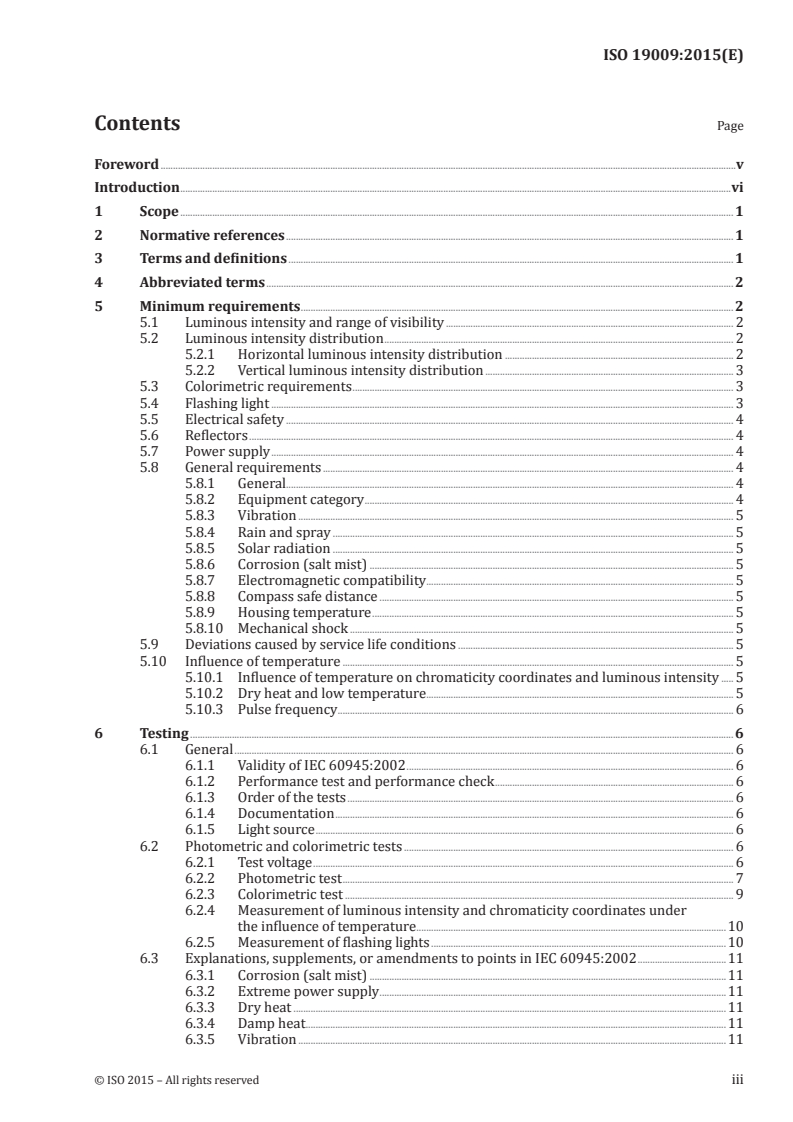
Contents Page
Foreword .v
Introduction .vi
1 Scope . 1
2 Normative references . 1
3 Terms and definitions . 1
4 Abbreviated terms . 2
5 Minimum requirements . 2
5.1 Luminous intensity and range of visibility . 2
5.2 Luminous intensity distribution . 2
5.2.1 Horizontal luminous intensity distribution . 2
5.2.2 Vertical luminous intensity distribution . 3
5.3 Colorimetric requirements . 3
5.4 Flashing light . 3
5.5 Electrical safety . 4
5.6 Reflectors . 4
5.7 Power supply . 4
5.8 General requirements . 4
5.8.1 General. 4
5.8.2 Equipment category . 4
5.8.3 Vibration . 5
5.8.4 Rain and spray . 5
5.8.5 Solar radiation . 5
5.8.6 Corrosion (salt mist) . 5
5.8.7 Electromagnetic compatibility. 5
5.8.8 Compass safe distance . 5
5.8.9 Housing temperature . 5
5.8.10 Mechanical shock . 5
5.9 Deviations caused by service life conditions . 5
5.10 Influence of temperature . 5
5.10.1 Influence of temperature on chromaticity coordinates and luminous intensity . 5
5.10.2 Dry heat and low temperature . 5
5.10.3 Pulse frequency . 6
6 Testing . 6
6.1 General . 6
6.1.1 Validity of IEC 60945:2002 . 6
6.1.2 Performance test and performance check . 6
6.1.3 Order of the tests . 6
6.1.4 Documentation . 6
6.1.5 Light source . 6
6.2 Photometric and colorimetric tests . 6
6.2.1 Test voltage . 6
6.2.2 Photometric test . 7
6.2.3 Colorimetric test . 9
6.2.4 Measurement of luminous intensity and chromaticity coordinates under
the influence of temperature .10
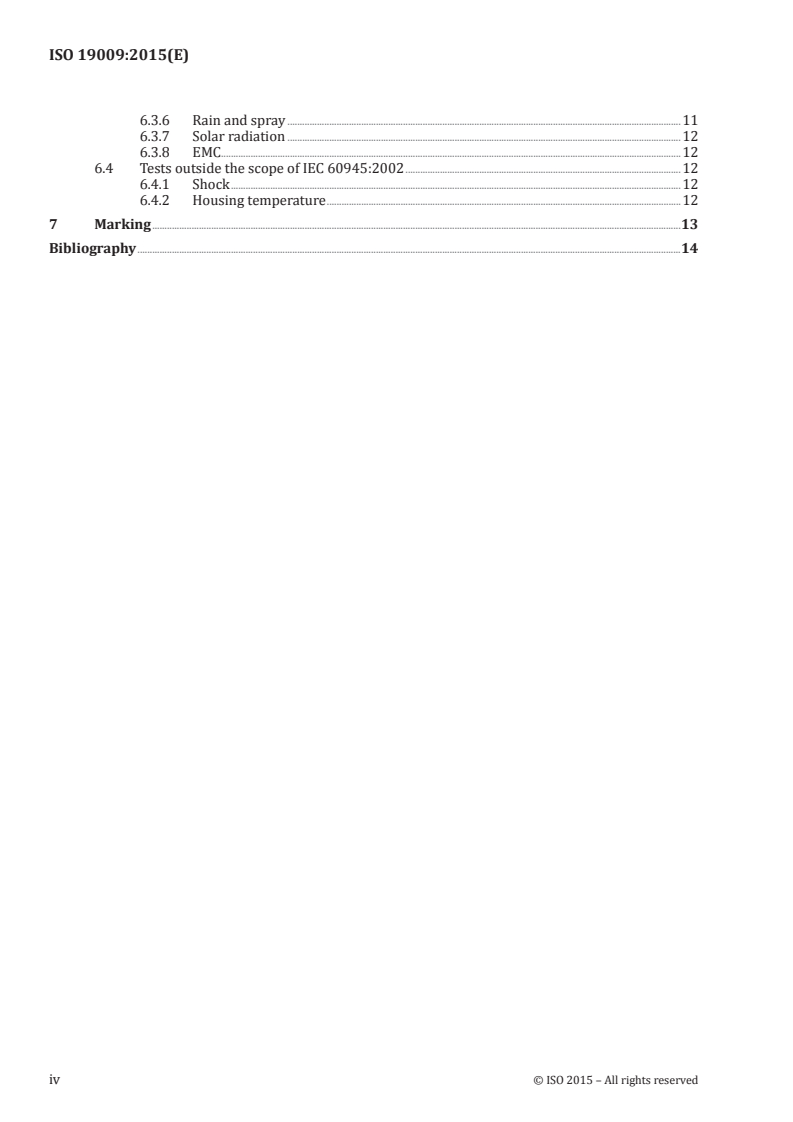
6.2.5 Measurement of flashing lights .10
6.3 Explanations, supplements, or amendments to points in IEC 60945:2002 .11
6.3.1 Corrosion (salt mist) .11
6.3.2 Extreme power supply .11
6.3.3 Dry heat .11
6.3.4 Damp heat .11
6.3.5 Vibration .11
6.3.6 Rain and spray .11
6.3.7 Solar radiation .12
6.3.8 EMC.12
6.4 Tests outside the scope of IEC 60945:2002 .12
6.4.1 Shock .12
6.4.2 Housing temperature .12
7 Marking .13
Bibliography .14
iv © ISO 2015 – All rights reserved
Foreword
ISO (the International Organization for Standardization) is a worldwide federation of national standards
bodies (ISO member bodies). The work of preparing International Standards is normally carried out
through ISO technical committees. Each member body interested in a subject for which a technical
committee has been established has the right to be represented on that committee. International
organizations, governmental and non-governmental, in liaison with ISO, also take part in the work.
ISO collaborates closely with the International Electrotechnical Commission (IEC) on all matters of
electrotechnical standardization.
The procedures used to develop this document and those intended for its further maintenance are
described in the ISO/IEC Directives, Part 1. In particular the different approval criteria needed for the
different types of ISO documents should be noted. This document was drafted in accordance with the
editorial rules of the ISO/IEC Directives, Part 2 (see www.iso.org/directives).
Attention is drawn to the possibility that some of the elements of this document may be the subject of
patent rights. ISO shall not be held responsible for identifying any or all such patent rights. Details of
any patent rights identified during the development of the document will be in the Introduction and/or
on the ISO list of patent declarations received (see www.iso.org/patents).
Any trade name used in this document is information given for the convenience of users and does not
constitute an endorsement.
For an explanation on the meaning of ISO specific terms and expressions related to conformity
assessment, as well as information about ISO’s adherence to the WTO principles in the Technical
Barriers to Trade (TBT) see the following URL: Foreword - Supplementary information
The committee responsible for this document is ISO/TC 188, Small craft.
Introduction
This document was developed to provide uniform criteria for the performance, construction, and
testing of LED navigation lights. Conflicting national standards might lead to confusion on the part of
operators and manufacturers of craft, as well as manufacturers of LED navigation lights. These conflicts
could lead to barriers to trade.
If the colour locus of navigation light is within the coordinates specified in this document, the COLREGs,
[1] [2]
CCNR and CEVNI requirements relating to colour loci are satisfied.
vi © ISO 2015 – All rights reserved
INTERNATIONAL STANDARD ISO 19009:2015(E)
Small craft — Electric navigation lights — Performance
of LED lights
1 Scope
This International Standard applies to requirements and testing for navigation lights with permanently
fixed light emitting diode (LED) assemblies for small craft up to 24 m length of the hull.
2 Normative references
The following documents, in whole or in part, are normatively referenced in this document and are
indispensable for its application. For dated references, only the edition cited applies. For undated
references, the latest edition of the referenced document (including any amendments) applies.
ISO 11664-1, Colorimetry — Part 1: CIE standard colorimetric observers
CIE 15, Colorimetry
CIE 69, Methods of characterizing illuminance meters and luminance meters — Performance, characteristics
and specifications
CIE 70:1987, Measurement of absolute luminous intensity distributions
IEC 60529:1989, Degrees of protection provided by enclosures (IP Code)
IEC 60945:2002, Maritime navigation and radiocommunication equipment and systems — General
requirements — Methods of testing and required test results
IEC 60068-2-27:2008, Environmental testing — Part 2-27: Tests — Test Ea and guidance: Shock
COLREGs, International Regulations for Preventing Collisions at Sea, 1972
3 Terms and definitions
For the purposes of this document, the following terms and definitions apply.
3.1
flashing light
light flashing at regular intervals at a frequency of 120 flashes or more per minute
3.2
navigation light
coloured source of illumination used to signal a craft’s position, heading, and status
3.3
signal light
light radiated by navigation lights
3.4
range of visibility
distance up to which the light of the navigation light can be seen
3.5
rated voltage
voltage or voltage range specified by the manufacturer for the operation of the navigation light
3.6
zero signal direction
horizontal direction of radiation of a navigation light in the centre-line plane or parallel to it
Note 1 to entry: The zero signal direction is designated in this standard as either 0° or “dead ahead”.
4 Abbreviated terms
For the purposes of this document, the following abbreviated terms apply.
CIE International Commission on Illumination
COLREG International Regulations for Preventing Collisions at Sea, 1972
LED Light Emitting Diode
5 Minimum requirements
5.1 Luminous intensity and range of visibility
I is the photometric luminous intensity in candela (cd) that is measured in the laboratory at rated voltage.
I is the luminous intensity under operating conditions in candela (cd) which takes into account, for
B
example, the ageing of the light source, contamination of the optical system, and voltage drop of the
craft’s power supply system.
For the values listed in Table 1, I is assumed to be 20 % less than the photometric luminous intensity I .
B 0
The range of visibility given on the navigation light depends on the interval for I in Table 1 in which
the luminous intensity I actually measured lies. A navigation light shall not be marked with a higher or
lower figure.
Table 1 — Range of visibility, luminous intensities and range of visibility designations
Horizontal Horizontal
Nominal range of Operational minimum maximum
Minimum Maximum
the navigation luminous photometric photometric
range value range value
light intensity (I ) luminous luminous
B
a a
intensity (I ) intensity (I )
0 0
nm nm km nm km cd cd cd
1 1 1,85 2 3,70 0,9 1,1 5,4
2 2 3,70 5 9,26 4,3 5,4 65
3 3 5,56 5 9,26 12 15 65
5 5 9,26 7,5 13,9 52 65 257
a
To be measured in the laboratory.
5.2 Luminous intensity distribution
5.2.1 Horizontal luminous intensity distribution
The requirements of the COLREGs apply.
For the purpose of this document, the COLREGs expression “almost zero” or “practical cut-off” is defined
as a value of not greater than 12,5 % of the average photometric luminous intensity . The angle between
two measurements shall not exceed 0,2°.
2 © ISO 2015 – All rights reserved
In the case of two-colour or three-colour navigation lights, the luminous intensity distribution shall
be uniform so that in the arc of visibility of 3° on each side of the zero signal direction, the maximum
permissible photometric luminous intensity of the port and starboard segments shall not be exceeded
and the minimum required photometric luminous intensity shall not be less than the required value.
The horizontal luminous intensity distribution of the navigation light shall be uniform over the entire
radiation angle so that the maximum and minimum values of the photometric luminous intensity do
not differ by more than a factor of 1,5.
5.2.2 Vertical luminous intensity distribution
The requirements of the COLREGs apply.
In addition, the maximum vertical luminous intensity shall not exceed the horizontal luminous intensity
at 0° by more than a factor of 1,5. Navigation lights with vertical luminous intensity distribution
according to COLREGs, Annex I, 10 (a) specified for engine-driven craft only shall be marked accordingly.
5.3 Colorimetric requirements
The chromaticity areas given in Table 2 apply.
Table 2 — Colour range vertices
Signal light
Coordinates of the vertices
colour
White x 0,310 0,443 0,500 0,500 0,453 0,310
y 0,283 0,382 0,382 0,440 0,440 0,348
Red x 0,690 0,710 0,680 0,660
y 0,290 0,290 0,320 0,320
Green x 0,009 0,284 0,207 0,013
y 0,720 0,520 0,397 0,494
Yellow x 0,612 0,618 0,575 0,575
y 0,382 0,382 0,425 0,406
Blue x 0,136 0,218 0,185 0,102
y 0,040 0,142 0,175 0,105
5.4 Flashing light
The ruling dimension for the range of visibility is the visually effective luminous intensity (I ). I is
EFF EFF
a measure for the conspicuity and efficiency of the flashing light emitted.
I shall attain at least the minimum horizontal photometric luminous intensity values I in Table 1.
EFF 0
I is calculated as follows from the maximum instantaneous luminous intensity in the observation
EFF
direction (I ) according to the Blondel-Rey equation:
MAX
t
Idt
MAX
∫
t
I =
EFF
02, +−tt
()
where
I is the effective luminous intensity, in candela;
EFF
I is the instantaneous value, in candela;
MAX
0,2 is the Blondel-Rey constant for night observation, in seconds;
t , t are the integration time limits, in seconds.
1 2
If the duration of the light phenomenon less the rise time and decay time, i.e. the time in which the
instantaneous luminous intensity attains or exceeds the required minimum luminous intensity, is
greater than 0,3 s, the light may be regarded as a steady light. The effective luminous intensity shall not
then be determined.
The luminous intensity ranges of visibility and chromaticity areas in 5.1 and 5.3 apply, but without the
upper limit for the luminous intensity.
The vertical radiation shall be at least 4°.
With an inclination of the flashing light to the horizontal of up to ±2°, the luminous intensities shall still
be at least 80 % of the luminous intensity at 0°.
5.5 Electrical safety
The electrical safety shall be ensured as described in IEC 60945:2002.
5.6 Reflectors
Reflectors are permitted only in hermetically-sealed systems.
5.7 Power supply
The requirements of IEC 60945:2002 apply except for those regarding the following:
a) extreme power supply;
b) excessive conditions;
c) power supply failure.
5.8 General requirements
5.8.1 General
Unless otherwise indicate
...
INTERNATIONAL ISO
STANDARD 19009
First edition
2015-09-15
Small craft — Electric navigation lights
— Performance of LED lights
Petits navires — Feux de navigation électriques — Performance
des feux à LED
Reference number
©
ISO 2015
© ISO 2015, Published in Switzerland
All rights reserved. Unless otherwise specified, no part of this publication may be reproduced or utilized otherwise in any form
or by any means, electronic or mechanical, including photocopying, or posting on the internet or an intranet, without prior
written permission. Permission can be requested from either ISO at the address below or ISO’s member body in the country of
the requester.
ISO copyright office
Ch. de Blandonnet 8 • CP 401
CH-1214 Vernier, Geneva, Switzerland
Tel. +41 22 749 01 11
Fax +41 22 749 09 47
copyright@iso.org
www.iso.org
ii © ISO 2015 – All rights reserved
Contents Page
Foreword .v
Introduction .vi
1 Scope . 1
2 Normative references . 1
3 Terms and definitions . 1
4 Abbreviated terms . 2
5 Minimum requirements . 2
5.1 Luminous intensity and range of visibility . 2
5.2 Luminous intensity distribution . 2
5.2.1 Horizontal luminous intensity distribution . 2
5.2.2 Vertical luminous intensity distribution . 3
5.3 Colorimetric requirements . 3
5.4 Flashing light . 3
5.5 Electrical safety . 4
5.6 Reflectors . 4
5.7 Power supply . 4
5.8 General requirements . 4
5.8.1 General. 4
5.8.2 Equipment category . 4
5.8.3 Vibration . 5
5.8.4 Rain and spray . 5
5.8.5 Solar radiation . 5
5.8.6 Corrosion (salt mist) . 5
5.8.7 Electromagnetic compatibility. 5
5.8.8 Compass safe distance . 5
5.8.9 Housing temperature . 5
5.8.10 Mechanical shock . 5
5.9 Deviations caused by service life conditions . 5
5.10 Influence of temperature . 5
5.10.1 Influence of temperature on chromaticity coordinates and luminous intensity . 5
5.10.2 Dry heat and low temperature . 5
5.10.3 Pulse frequency . 6
6 Testing . 6
6.1 General . 6
6.1.1 Validity of IEC 60945:2002 . 6
6.1.2 Performance test and performance check . 6
6.1.3 Order of the tests . 6
6.1.4 Documentation . 6
6.1.5 Light source . 6
6.2 Photometric and colorimetric tests . 6
6.2.1 Test voltage . 6
6.2.2 Photometric test . 7
6.2.3 Colorimetric test . 9
6.2.4 Measurement of luminous intensity and chromaticity coordinates under
the influence of temperature .10
6.2.5 Measurement of flashing lights .10
6.3 Explanations, supplements, or amendments to points in IEC 60945:2002 .11
6.3.1 Corrosion (salt mist) .11
6.3.2 Extreme power supply .11
6.3.3 Dry heat .11
6.3.4 Damp heat .11
6.3.5 Vibration .11
6.3.6 Rain and spray .11
6.3.7 Solar radiation .12
6.3.8 EMC.12
6.4 Tests outside the scope of IEC 60945:2002 .12
6.4.1 Shock .12
6.4.2 Housing temperature .12
7 Marking .13
Bibliography .14
iv © ISO 2015 – All rights reserved
Foreword
ISO (the International Organization for Standardization) is a worldwide federation of national standards
bodies (ISO member bodies). The work of preparing International Standards is normally carried out
through ISO technical committees. Each member body interested in a subject for which a technical
committee has been established has the right to be represented on that committee. International
organizations, governmental and non-governmental, in liaison with ISO, also take part in the work.
ISO collaborates closely with the International Electrotechnical Commission (IEC) on all matters of
electrotechnical standardization.
The procedures used to develop this document and those intended for its further maintenance are
described in the ISO/IEC Directives, Part 1. In particular the different approval criteria needed for the
different types of ISO documents should be noted. This document was drafted in accordance with the
editorial rules of the ISO/IEC Directives, Part 2 (see www.iso.org/directives).
Attention is drawn to the possibility that some of the elements of this document may be the subject of
patent rights. ISO shall not be held responsible for identifying any or all such patent rights. Details of
any patent rights identified during the development of the document will be in the Introduction and/or
on the ISO list of patent declarations received (see www.iso.org/patents).
Any trade name used in this document is information given for the convenience of users and does not
constitute an endorsement.
For an explanation on the meaning of ISO specific terms and expressions related to conformity
assessment, as well as information about ISO’s adherence to the WTO principles in the Technical
Barriers to Trade (TBT) see the following URL: Foreword - Supplementary information
The committee responsible for this document is ISO/TC 188, Small craft.
Introduction
This document was developed to provide uniform criteria for the performance, construction, and
testing of LED navigation lights. Conflicting national standards might lead to confusion on the part of
operators and manufacturers of craft, as well as manufacturers of LED navigation lights. These conflicts
could lead to barriers to trade.
If the colour locus of navigation light is within the coordinates specified in this document, the COLREGs,
[1] [2]
CCNR and CEVNI requirements relating to colour loci are satisfied.
vi © ISO 2015 – All rights reserved
INTERNATIONAL STANDARD ISO 19009:2015(E)
Small craft — Electric navigation lights — Performance
of LED lights
1 Scope
This International Standard applies to requirements and testing for navigation lights with permanently
fixed light emitting diode (LED) assemblies for small craft up to 24 m length of the hull.
2 Normative references
The following documents, in whole or in part, are normatively referenced in this document and are
indispensable for its application. For dated references, only the edition cited applies. For undated
references, the latest edition of the referenced document (including any amendments) applies.
ISO 11664-1, Colorimetry — Part 1: CIE standard colorimetric observers
CIE 15, Colorimetry
CIE 69, Methods of characterizing illuminance meters and luminance meters — Performance, characteristics
and specifications
CIE 70:1987, Measurement of absolute luminous intensity distributions
IEC 60529:1989, Degrees of protection provided by enclosures (IP Code)
IEC 60945:2002, Maritime navigation and radiocommunication equipment and systems — General
requirements — Methods of testing and required test results
IEC 60068-2-27:2008, Environmental testing — Part 2-27: Tests — Test Ea and guidance: Shock
COLREGs, International Regulations for Preventing Collisions at Sea, 1972
3 Terms and definitions
For the purposes of this document, the following terms and definitions apply.
3.1
flashing light
light flashing at regular intervals at a frequency of 120 flashes or more per minute
3.2
navigation light
coloured source of illumination used to signal a craft’s position, heading, and status
3.3
signal light
light radiated by navigation lights
3.4
range of visibility
distance up to which the light of the navigation light can be seen
3.5
rated voltage
voltage or voltage range specified by the manufacturer for the operation of the navigation light
3.6
zero signal direction
horizontal direction of radiation of a navigation light in the centre-line plane or parallel to it
Note 1 to entry: The zero signal direction is designated in this standard as either 0° or “dead ahead”.
4 Abbreviated terms
For the purposes of this document, the following abbreviated terms apply.
CIE International Commission on Illumination
COLREG International Regulations for Preventing Collisions at Sea, 1972
LED Light Emitting Diode
5 Minimum requirements
5.1 Luminous intensity and range of visibility
I is the photometric luminous intensity in candela (cd) that is measured in the laboratory at rated voltage.
I is the luminous intensity under operating conditions in candela (cd) which takes into account, for
B
example, the ageing of the light source, contamination of the optical system, and voltage drop of the
craft’s power supply system.
For the values listed in Table 1, I is assumed to be 20 % less than the photometric luminous intensity I .
B 0
The range of visibility given on the navigation light depends on the interval for I in Table 1 in which
the luminous intensity I actually measured lies. A navigation light shall not be marked with a higher or
lower figure.
Table 1 — Range of visibility, luminous intensities and range of visibility designations
Horizontal Horizontal
Nominal range of Operational minimum maximum
Minimum Maximum
the navigation luminous photometric photometric
range value range value
light intensity (I ) luminous luminous
B
a a
intensity (I ) intensity (I )
0 0
nm nm km nm km cd cd cd
1 1 1,85 2 3,70 0,9 1,1 5,4
2 2 3,70 5 9,26 4,3 5,4 65
3 3 5,56 5 9,26 12 15 65
5 5 9,26 7,5 13,9 52 65 257
a
To be measured in the laboratory.
5.2 Luminous intensity distribution
5.2.1 Horizontal luminous intensity distribution
The requirements of the COLREGs apply.
For the purpose of this document, the COLREGs expression “almost zero” or “practical cut-off” is defined
as a value of not greater than 12,5 % of the average photometric luminous intensity . The angle between
two measurements shall not exceed 0,2°.
2 © ISO 2015 – All rights reserved
In the case of two-colour or three-colour navigation lights, the luminous intensity distribution shall
be uniform so that in the arc of visibility of 3° on each side of the zero signal direction, the maximum
permissible photometric luminous intensity of the port and starboard segments shall not be exceeded
and the minimum required photometric luminous intensity shall not be less than the required value.
The horizontal luminous intensity distribution of the navigation light shall be uniform over the entire
radiation angle so that the maximum and minimum values of the photometric luminous intensity do
not differ by more than a factor of 1,5.
5.2.2 Vertical luminous intensity distribution
The requirements of the COLREGs apply.
In addition, the maximum vertical luminous intensity shall not exceed the horizontal luminous intensity
at 0° by more than a factor of 1,5. Navigation lights with vertical luminous intensity distribution
according to COLREGs, Annex I, 10 (a) specified for engine-driven craft only shall be marked accordingly.
5.3 Colorimetric requirements
The chromaticity areas given in Table 2 apply.
Table 2 — Colour range vertices
Signal light
Coordinates of the vertices
colour
White x 0,310 0,443 0,500 0,500 0,453 0,310
y 0,283 0,382 0,382 0,440 0,440 0,348
Red x 0,690 0,710 0,680 0,660
y 0,290 0,290 0,320 0,320
Green x 0,009 0,284 0,207 0,013
y 0,720 0,520 0,397 0,494
Yellow x 0,612 0,618 0,575 0,575
y 0,382 0,382 0,425 0,406
Blue x 0,136 0,218 0,185 0,102
y 0,040 0,142 0,175 0,105
5.4 Flashing light
The ruling dimension for the range of visibility is the visually effective luminous intensity (I ). I is
EFF EFF
a measure for the conspicuity and efficiency of the flashing light emitted.
I shall attain at least the minimum horizontal photometric luminous intensity values I in Table 1.
EFF 0
I is calculated as follows from the maximum instantaneous luminous intensity in the observation
EFF
direction (I ) according to the Blondel-Rey equation:
MAX
t
Idt
MAX
∫
t
I =
EFF
02, +−tt
()
where
I is the effective luminous intensity, in candela;
EFF
I is the instantaneous value, in candela;
MAX
0,2 is the Blondel-Rey constant for night observation, in seconds;
t , t are the integration time limits, in seconds.
1 2
If the duration of the light phenomenon less the rise time and decay time, i.e. the time in which the
instantaneous luminous intensity attains or exceeds the required minimum luminous intensity, is
greater than 0,3 s, the light may be regarded as a steady light. The effective luminous intensity shall not
then be determined.
The luminous intensity ranges of visibility and chromaticity areas in 5.1 and 5.3 apply, but without the
upper limit for the luminous intensity.
The vertical radiation shall be at least 4°.
With an inclination of the flashing light to the horizontal of up to ±2°, the luminous intensities shall still
be at least 80 % of the luminous intensity at 0°.
5.5 Electrical safety
The electrical safety shall be ensured as described in IEC 60945:2002.
5.6 Reflectors
Reflectors are permitted only in hermetically-sealed systems.
5.7 Power supply
The requirements of IEC 60945:2002 apply except for those regarding the following:
a) extreme power supply;
b) excessive conditions;
c) power supply failure.
5.8 General requirements
5.8.1 General
Unless otherwise indicate
...
NORME ISO
INTERNATIONALE 19009
Première édition
2015-09-15
Petits navires — Feux de navigation
électriques — Performance des feux à
LED
Small craft — Electric navigation lights — Performance of LED lights
Numéro de référence
©
ISO 2015
DOCUMENT PROTÉGÉ PAR COPYRIGHT
© ISO 2015, Publié en Suisse
Droits de reproduction réservés. Sauf indication contraire, aucune partie de cette publication ne peut être reproduite ni utilisée
sous quelque forme que ce soit et par aucun procédé, électronique ou mécanique, y compris la photocopie, l’affichage sur
l’internet ou sur un Intranet, sans autorisation écrite préalable. Les demandes d’autorisation peuvent être adressées à l’ISO à
l’adresse ci-après ou au comité membre de l’ISO dans le pays du demandeur.
ISO copyright office
Ch. de Blandonnet 8 • CP 401
CH-1214 Vernier, Geneva, Switzerland
Tel. +41 22 749 01 11
Fax +41 22 749 09 47
copyright@iso.org
www.iso.org
ii © ISO 2015 – Tous droits réservés
Sommaire Page
Avant-propos .v
Introduction .vi
1 Domaine d’application . 1
2 Références normatives . 1
3 Termes et définitions . 1
4 Abréviations . 2
5 Exigences minimales . 2
5.1 Intensité lumineuse et portée lumineuse . 2
5.2 Distribution de l’intensité lumineuse . 3
5.2.1 Distribution horizontale de l’intensité lumineuse . 3
5.2.2 Distribution verticale de l’intensité lumineuse . 3
5.3 Exigences colorimétriques . 3
5.3.1 Généralités . 3
5.4 Feu clignotant . 3
5.5 Sécurité électrique . 4
5.6 Réflecteurs . 4
5.7 Alimentation électrique . 4
5.8 Exigences générales . 4
5.8.1 Généralités . 4
5.8.2 Catégorie d’appareil . 5
5.8.3 Vibrations . 5
5.8.4 Pluie et embruns . 5
5.8.5 Rayonnement solaire . 5
5.8.6 Corrosion (brouillard salin) . 5
5.8.7 Compatibilité électromagnétique . 5
5.8.8 Distance de sécurité d’un compas . 5
5.8.9 Température du boîtier . 5
5.8.10 Choc mécanique . 5
5.9 Déviations provoquées lors de la durée de vie en service . 5
5.10 Influence de la température . 5
5.10.1 Influence de la température sur les coordonnées de chromaticité et
l’intensité lumineuse . 5
5.10.2 Chaleur sèche et basse température . 6
5.10.3 Fréquence d’impulsion . 6
6 Essais . 6
6.1 Généralité . 6
6.1.1 Validité de la IEC 60945:2002 . 6
6.1.2 Essai de performance et vérification de la performance . 6
6.1.3 Ordre des essais . 6
6.1.4 Documentation . 6
6.1.5 Source lumineuse . 6
6.2 . Essais photométriques et colorimétriques . 6
6.2.1 Tension d’essai . 6
6.2.2 Essai photométrique . 7
6.2.3 Essai colorimétrique. . 9
6.2.4 Mesurage de l’intensité lumineuse et des coordonnées de chromaticité
sous l’influence de la température .10
6.2.5 Mesurage des feux clignotants .11
6.3 Explications, suppléments ou amendements aux exigences de la CEI 60945:2002 .11
6.3.1 Corrosion (brouillard salin) .11
6.3.2 Tension extrême .11
6.3.3 Chaleur sèche .11
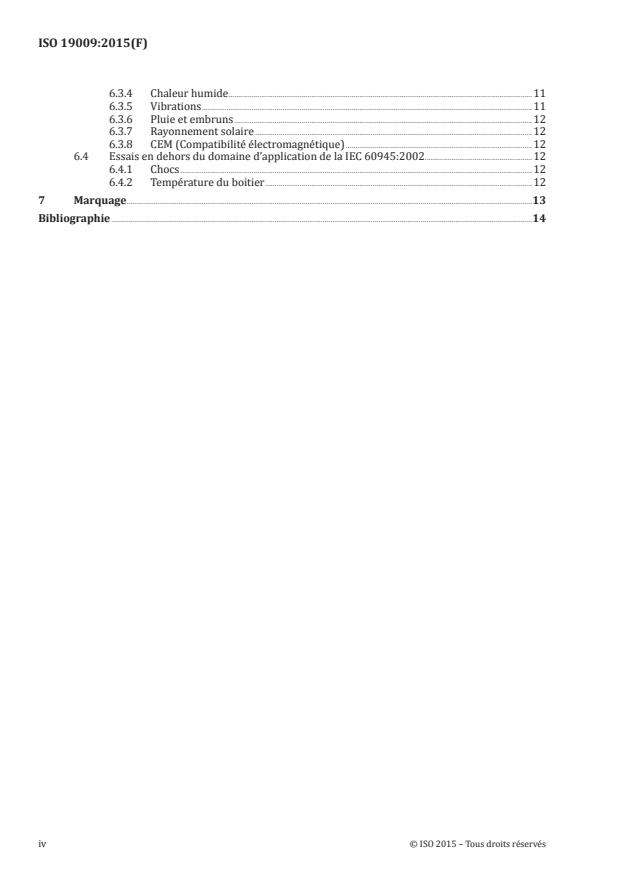
6.3.4 Chaleur humide .11
6.3.5 Vibrations .11
6.3.6 Pluie et embruns .12
6.3.7 Rayonnement solaire .12
6.3.8 CEM (Compatibilité électromagnétique) .12
6.4 Essais en dehors du domaine d’application de la IEC 60945:2002 .12
6.4.1 Chocs .12
6.4.2 Température du boitier .12
7 Marquage .13
Bibliographie .14
iv © ISO 2015 – Tous droits réservés
Avant-propos
L’ISO (Organisation internationale de normalisation) est une fédération mondiale d’organismes
nationaux de normalisation (comités membres de l’ISO). L’élaboration des Normes internationales est
en général confiée aux comités techniques de l’ISO. Chaque comité membre intéressé par une étude
a le droit de faire partie du comité technique créé à cet effet. Les organisations internationales,
gouvernementales et non gouvernementales, en liaison avec l’ISO participent également aux travaux.
L’ISO collabore étroitement avec la Commission électrotechnique internationale (IEC) en ce qui
concerne la normalisation électrotechnique.
Les procédures utilisées pour élaborer le présent document et celles destinées à sa mise à jour sont
décrites dans les Directives ISO/IEC, Partie 1. Il convient, en particulier de prendre note des différents
critères d’approbation requis pour les différents types de documents ISO. Le présent document a été
rédigé conformément aux règles de rédaction données dans les Directives ISO/IEC, Partie 2 (voir www.
iso.org/directives).
L’attention est appelée sur le fait que certains des éléments du présent document peuvent faire l’objet de
droits de propriété intellectuelle ou de droits analogues. L’ISO ne saurait être tenue pour responsable
de ne pas avoir identifié de tels droits de propriété et averti de leur existence. Les détails concernant
les références aux droits de propriété intellectuelle ou autres droits analogues identifiés lors de
l’élaboration du document sont indiqués dans l’Introduction et/ou dans la liste des déclarations de
brevets reçues par l’ISO (voir www.iso.org/brevets).
Les appellations commerciales éventuellement mentionnées dans le présent document sont données
pour information, par souci de commodité, à l’intention des utilisateurs et ne sauraient constituer
un engagement.
Pour une explication de la signification des termes et expressions spécifiques de l’ISO liés à
l’évaluation de la conformité, ou pour toute information au sujet de l’adhésion de l’ISO aux principes
de l’OMC concernant les obstacles techniques au commerce (OTC), voir le lien suivant: Avant-propos —
Informations supplémentaires.
Le comité chargé de l’élaboration du présent document est l’ISO/TC 188; Petits navires .
Introduction
La présente Norme Internationale a été développée afin de fournir des critères uniformes relatifs à la
performance, la construction et aux essais des feux de navigation à diodes électroluminescentes (LED).
Des normes nationales contradictoires peuvent prêter à confusion de la part des opérateurs et des
fabricants de petits navires, ainsi qu’aux fabricants de feux de navigation à LED. Ces conflits peuvent
conduire à des entraves au commerce.
Si les coordonnées de chromaticité des feux de navigation sont conformes aux coordonnées spécifiées
[1] [2]
dans la présente Norme Internationale, les exigences des RIPAM (COLREG,s), CCNR et CEVNI
relatives aux coordonnées de chromaticité sont satisfaites.
vi © ISO 2015 – Tous droits réservés
NORME INTERNATIONALE ISO 19009:2015(F)
Petits navires — Feux de navigation électriques —
Performance des feux à LED
1 Domaine d’application
La présente Norme internationale s’applique aux exigences et aux essais relatifs aux feux de navigation
utilisant des sources lumineuses à diodes électroluminescentes (LED) et fixés à demeure sur les petits
navires de longueur de coque jusqu’à 24 m.
2 Références normatives
Les documents de référence suivants sont indispensables pour l’application de la présente Norme
Internationale. Pour les références datées, seule l’édition citée s’applique. Pour les références non
datées, la dernière édition du document de référence s’applique (y compris les éventuels amendements).
ISO 11664-1, Colorimétrie — Partie 1: Observateurs CIE de référence pour la colorimétrie.
CIE 15, Colorimetry.
CIE 69, Methods of characterizing illuminance meters and luminance meters — Performance, characteristics
and specifications.
CIE 70:1987, Measurment of absolute luminous intensity distributions.
IEC 60529:1989, Degrés de protection procurés par les enveloppes (code IP).
IEC 60945:2002, Matériels et systèmes de navigation et de radiocommunication maritimes — Spécifications
générales — Méthodes d’essai et résultats exigibles.
IEC 60068-2-27:2008, Essais d’environnement — Partie 2-27: Essais — Essai Ea et guide: chocs.
RIPAM, Règlement international pour prévenir les abordages en mer (COLREGs, International Regulations
for Preventing Collisions at Sea) 1972
3 Termes et définitions
Pour les besoins du présent document, les termes et définitions suivants s’appliquent.
3.1
feu clignotant
feu émettant des éclats à intervalle régulier à une fréquence supérieure ou égale à 120 éclats par minute
3.2
feu de navigation
source lumineuse colorée utilisée pour signaler la position du bateau, sa route et son statut
3.3
signal lumineux
lumière émise par les feux de navigation
3.4
portée lumineuse
distance de visibilité
distance jusqu’à laquelle la lumière du feu de navigation peut être vue
3.5
tension assignée
tension ou plage de tensions spécifiée par le fabriquant pour l’utilisation des feux de navigation
3.6
direction de signal nul
direction horizontale de rayonnement d’un feu de navigation dans le plan axial ou dans un plan qui lui
est parallèle
Note 1 à l’article: La direction de signal nul est désignée dans la présente norme soit comme 0° ou «droit devant».
4 Abréviations
Pour le besoins du présent document, les abréviations suivantes s’appliquent.
CIE Commission Internationale de l’éclairage
RIPAM Règlement International pour prévenir les abordages en mer 1972 (COLREG)
LED Diode Électroluminescente (Light Emitting Diode)
5 Exigences minimales
5.1 Intensité lumineuse et portée lumineuse
I est l’intensité lumineuse photométrique, en candela (cd), mesurée en laboratoire à la tension assignée.
I est l’intensité lumineuse en conditions d’utilisation, en candela (cd), qui prend en compte, par
B
exemple, le vieillissement de la source lumineuse, la contamination du système optique et la chute de
tension du système d’alimentation du bateau.
Pour les valeurs données au Tableau 1, I est supposée être de 20 % inférieure à l’intensité lumineuse
B
photométrique I .
La portée lumineuse indiquée sur le feu de navigation dépend de l’intervalle pour I dans le Tableau 1
dans lequel se trouve l’intensité lumineuse I effectivement mesurée. Un feu de navigation ne doit pas
être marqué d’une valeur supérieure ou inférieure.
Tableau 1 — Portée lumineuse, intensités lumineuses et désignation des portées lumineuses
Intensité lumi- Intensité lumi-
neuse photomé- neuse photomé-
Portée lumineuse Portée lumi- Portée lumi- Intensité lumi-
trique horizon- trique horizon-
nominale du feu neuse mini- neuse maxi- neuse opéra-
tale minimale tale maximale
de navigation male male tionnelle (I )
B
à mesurer en à mesurer en
a a
laboratoire (I ) laboratoire (I )
0 0
nm nm km nm km cd cd cd
1 1 1,85 2 3,70 0,9 1,1 5,4
2 2 3,70 5 9,26 4,3 5,4 65
3 3 5,56 5 9,26 12 15 65
5 5 9,26 7,5 13,9 52 65 257
a
A mesurer en laboratoire
2 © ISO 2015 – Tous droits réservés
5.2 Distribution de l’intensité lumineuse
5.2.1 Distribution horizontale de l’intensité lumineuse
Les exigences du RIPAM s’appliquent.
Pour les besoins de la présente Norme Internationale, l’expression «pratiquement nulle» ou «coupure
pratique» du RIPAM est définie comme une valeur ne dépassant pas 12,5 % de l’intensité lumineuse
photométrique moyenne. L’angle entre deux mesures ne doit pas dépasser 0,2°.
Dans le cas de feux de navigation bicolores ou tricolores, la répartition de l’intensité lumineuse doit
être uniforme de sorte que dans l’angle de visibilité à 3° situé de chaque côté du signal zéro, l’intensité
lumineuse photométrique maximale admissible ne doit pas être dépassée et l’intensité lumineuse
photométrique ne doit pas être inférieure à la valeur requise.
La distribution horizontale de l’intensité lumineuse du feu de navigation doit être uniforme sur
tout l’angle de rayonnement de sorte que les valeurs maximale et minimale de l’intensité lumineuse
photométrique ne diffèrent pas de plus d’un facteur 1,5.
5.2.2 Distribution verticale de l’intensité lumineuse
Les exigences du RIPAM s’appliquent.
En supplément, l’intensité lumineuse verticale maximale ne doit pas dépasser l’intensité lumineuse
horizontale à 0° de plus d’un facteur 1,5. Les feux de navigation dont la distribution verticale de
l’intensité lumineuse est conforme au RIPAM, Annexe I, 10 (a) spécifiée pour les bateaux à moteur
uniquement doivent être marqués en conséquence.
5.3 Exigences colorimétriques
5.3.1 Généralités
Les chromaticités des zones de visibilité du Tableau 2 s’appliquent.
Tableau 2 — Limites des angles de chromaticité
Couleur du signal
Coordonnées des sommets des angles
lumineux
x 0,310 0,443 0,500 0,500 0,453 0,310
Blanc
y 0,283 0,382 0,382 0,440 0,440 0,348
x 0,690 0,710 0,680 0,660
Rouge
y 0,290 0,290 0,320 0,320
x 0,009 0,284 0,207 0,013
Vert
y 0,720 0,520 0,397 0,494
x 0,612 0,618 0,575 0,575
Jaune
y 0,382 0,382 0,425 0,406
x 0,136 0,218 0,185 0,102
Bleu
y 0,040 0,142 0,175 0,105
5.4 Feu clignotant
La dimension qui commande la gamme de visibilité est l’intensité lumineuse visuellement efficace
(I ). I est une mesure de la visibilité et l’efficacité de la lumière clignotante émise.
EFF EFF
I doit atteindre au moins les valeurs minimales de l’intensité horizontale photométrique lumineuse
EFF
égale à I dans le Tableau 1.
I est calculé comme suit à partir de l’intensité lumineuse instantanée maximale dans la direction
EFF
d’observation (I ) selon l’équation de Blondel-Re y:
MAX
t
Idt
∫ MAX
t
I =
EFF
02, +−tt
()
où
I est l’intensité lumineuse effective, en candela;
EFF
I est la valeur instantanée, en candela;
MAX
0,2 est la constante de Blondel-Rey pour les observations nocturnes, en secondes;
t , t sont les temps limites d’intégration, en secondes.
1 2
Si la durée du phénomène lumineux, moins le temps de croissance et le temps de décroissance, c’est-à-
dire le temps pendant lequel l’intensité lumineuse instantanée atteint ou dépasse l’intensité lumineuse
minimale prescrite, est supérieure à 0,3 s, la lumière peut être considéré comme une lumière constante.
L’intensité lumineuse effective ne doit pas alors être déterminée.
Les plages d’intensité lumineuse, intensités lumineuses et désignation des portées lumineuses
Les intensités lumineuses, les plages de visibilité et les zones de chromaticité des 5.1 et 5.3 s’appliquent,
mais sans la limite supérieure de l’intensité lumineuse.
Le rayonnement vertical doit être d’au moins 4 °.
Avec une inclinaison du feu clignotant jusqu’à ± 2° de l’horizontale, les intensités lumineuses doivent
toujours être à moins 80 % de l’intensité lumineuse à 0°.
5.5 Sécurité électrique
La sécurité électrique doit être obtenue telle que décrite dans la IEC 60945:2002
5.6 Réflecteurs
Les réflecteurs ne sont autorisés que dans des systèmes hermétiquement scellés
5.7 Alimentation électrique
5.7.1 Les exigences de la IEC 60945:2002 s’appliquent exceptées celles concernant:
a) l’alimentation en conditions extrêmes;
b) les conditions excessives;
c) la défaillance de l’alimentation.
5.8 Exigences générales
5.8.1 Généralités
Sauf spécification contraire indiquées dans la présente Norme Internationale, les exigences de la
IEC 60945:2002 s’appliquent.
4 © ISO 2015 – Tous droits réservés
5.8.2 Catégorie d’appareil
Les feux de navigation appartiennent à la catégorie d’appareil «exposé aux intempéries», comme
spécifié dans la IEC 60945:2002.
5.8.3 Vibrations
Les exigences de le IEC 60945:2002 s’appliquent avec les exigences supplémentaires décrites au 6.3.5.
5.8.4 Pluie et embruns
Les exigences de la IEC 60945:2002 s’appliquent avec l’exig
...
NORME ISO
INTERNATIONALE 19009
Première édition
2015-09-15
Petits navires — Feux de navigation
électriques — Performance des feux à
LED
Small craft — Electric navigation lights — Performance of LED lights
Numéro de référence
©
ISO 2015
DOCUMENT PROTÉGÉ PAR COPYRIGHT
© ISO 2015, Publié en Suisse
Droits de reproduction réservés. Sauf indication contraire, aucune partie de cette publication ne peut être reproduite ni utilisée
sous quelque forme que ce soit et par aucun procédé, électronique ou mécanique, y compris la photocopie, l’affichage sur
l’internet ou sur un Intranet, sans autorisation écrite préalable. Les demandes d’autorisation peuvent être adressées à l’ISO à
l’adresse ci-après ou au comité membre de l’ISO dans le pays du demandeur.
ISO copyright office
Ch. de Blandonnet 8 • CP 401
CH-1214 Vernier, Geneva, Switzerland
Tel. +41 22 749 01 11
Fax +41 22 749 09 47
copyright@iso.org
www.iso.org
ii © ISO 2015 – Tous droits réservés
Sommaire Page
Avant-propos .v
Introduction .vi
1 Domaine d’application . 1
2 Références normatives . 1
3 Termes et définitions . 1
4 Abréviations . 2
5 Exigences minimales . 2
5.1 Intensité lumineuse et portée lumineuse . 2
5.2 Distribution de l’intensité lumineuse . 3
5.2.1 Distribution horizontale de l’intensité lumineuse . 3
5.2.2 Distribution verticale de l’intensité lumineuse . 3
5.3 Exigences colorimétriques . 3
5.3.1 Généralités . 3
5.4 Feu clignotant . 3
5.5 Sécurité électrique . 4
5.6 Réflecteurs . 4
5.7 Alimentation électrique . 4
5.8 Exigences générales . 4
5.8.1 Généralités . 4
5.8.2 Catégorie d’appareil . 5
5.8.3 Vibrations . 5
5.8.4 Pluie et embruns . 5
5.8.5 Rayonnement solaire . 5
5.8.6 Corrosion (brouillard salin) . 5
5.8.7 Compatibilité électromagnétique . 5
5.8.8 Distance de sécurité d’un compas . 5
5.8.9 Température du boîtier . 5
5.8.10 Choc mécanique . 5
5.9 Déviations provoquées lors de la durée de vie en service . 5
5.10 Influence de la température . 5
5.10.1 Influence de la température sur les coordonnées de chromaticité et
l’intensité lumineuse . 5
5.10.2 Chaleur sèche et basse température . 6
5.10.3 Fréquence d’impulsion . 6
6 Essais . 6
6.1 Généralité . 6
6.1.1 Validité de la IEC 60945:2002 . 6
6.1.2 Essai de performance et vérification de la performance . 6
6.1.3 Ordre des essais . 6
6.1.4 Documentation . 6
6.1.5 Source lumineuse . 6
6.2 . Essais photométriques et colorimétriques . 6
6.2.1 Tension d’essai . 6
6.2.2 Essai photométrique . 7
6.2.3 Essai colorimétrique. . 9
6.2.4 Mesurage de l’intensité lumineuse et des coordonnées de chromaticité
sous l’influence de la température .10
6.2.5 Mesurage des feux clignotants .11
6.3 Explications, suppléments ou amendements aux exigences de la CEI 60945:2002 .11
6.3.1 Corrosion (brouillard salin) .11
6.3.2 Tension extrême .11
6.3.3 Chaleur sèche .11
6.3.4 Chaleur humide .11
6.3.5 Vibrations .11
6.3.6 Pluie et embruns .12
6.3.7 Rayonnement solaire .12
6.3.8 CEM (Compatibilité électromagnétique) .12
6.4 Essais en dehors du domaine d’application de la IEC 60945:2002 .12
6.4.1 Chocs .12
6.4.2 Température du boitier .12
7 Marquage .13
Bibliographie .14
iv © ISO 2015 – Tous droits réservés
Avant-propos
L’ISO (Organisation internationale de normalisation) est une fédération mondiale d’organismes
nationaux de normalisation (comités membres de l’ISO). L’élaboration des Normes internationales est
en général confiée aux comités techniques de l’ISO. Chaque comité membre intéressé par une étude
a le droit de faire partie du comité technique créé à cet effet. Les organisations internationales,
gouvernementales et non gouvernementales, en liaison avec l’ISO participent également aux travaux.
L’ISO collabore étroitement avec la Commission électrotechnique internationale (IEC) en ce qui
concerne la normalisation électrotechnique.
Les procédures utilisées pour élaborer le présent document et celles destinées à sa mise à jour sont
décrites dans les Directives ISO/IEC, Partie 1. Il convient, en particulier de prendre note des différents
critères d’approbation requis pour les différents types de documents ISO. Le présent document a été
rédigé conformément aux règles de rédaction données dans les Directives ISO/IEC, Partie 2 (voir www.
iso.org/directives).
L’attention est appelée sur le fait que certains des éléments du présent document peuvent faire l’objet de
droits de propriété intellectuelle ou de droits analogues. L’ISO ne saurait être tenue pour responsable
de ne pas avoir identifié de tels droits de propriété et averti de leur existence. Les détails concernant
les références aux droits de propriété intellectuelle ou autres droits analogues identifiés lors de
l’élaboration du document sont indiqués dans l’Introduction et/ou dans la liste des déclarations de
brevets reçues par l’ISO (voir www.iso.org/brevets).
Les appellations commerciales éventuellement mentionnées dans le présent document sont données
pour information, par souci de commodité, à l’intention des utilisateurs et ne sauraient constituer
un engagement.
Pour une explication de la signification des termes et expressions spécifiques de l’ISO liés à
l’évaluation de la conformité, ou pour toute information au sujet de l’adhésion de l’ISO aux principes
de l’OMC concernant les obstacles techniques au commerce (OTC), voir le lien suivant: Avant-propos —
Informations supplémentaires.
Le comité chargé de l’élaboration du présent document est l’ISO/TC 188; Petits navires .
Introduction
La présente Norme Internationale a été développée afin de fournir des critères uniformes relatifs à la
performance, la construction et aux essais des feux de navigation à diodes électroluminescentes (LED).
Des normes nationales contradictoires peuvent prêter à confusion de la part des opérateurs et des
fabricants de petits navires, ainsi qu’aux fabricants de feux de navigation à LED. Ces conflits peuvent
conduire à des entraves au commerce.
Si les coordonnées de chromaticité des feux de navigation sont conformes aux coordonnées spécifiées
[1] [2]
dans la présente Norme Internationale, les exigences des RIPAM (COLREG,s), CCNR et CEVNI
relatives aux coordonnées de chromaticité sont satisfaites.
vi © ISO 2015 – Tous droits réservés
NORME INTERNATIONALE ISO 19009:2015(F)
Petits navires — Feux de navigation électriques —
Performance des feux à LED
1 Domaine d’application
La présente Norme internationale s’applique aux exigences et aux essais relatifs aux feux de navigation
utilisant des sources lumineuses à diodes électroluminescentes (LED) et fixés à demeure sur les petits
navires de longueur de coque jusqu’à 24 m.
2 Références normatives
Les documents de référence suivants sont indispensables pour l’application de la présente Norme
Internationale. Pour les références datées, seule l’édition citée s’applique. Pour les références non
datées, la dernière édition du document de référence s’applique (y compris les éventuels amendements).
ISO 11664-1, Colorimétrie — Partie 1: Observateurs CIE de référence pour la colorimétrie.
CIE 15, Colorimetry.
CIE 69, Methods of characterizing illuminance meters and luminance meters — Performance, characteristics
and specifications.
CIE 70:1987, Measurment of absolute luminous intensity distributions.
IEC 60529:1989, Degrés de protection procurés par les enveloppes (code IP).
IEC 60945:2002, Matériels et systèmes de navigation et de radiocommunication maritimes — Spécifications
générales — Méthodes d’essai et résultats exigibles.
IEC 60068-2-27:2008, Essais d’environnement — Partie 2-27: Essais — Essai Ea et guide: chocs.
RIPAM, Règlement international pour prévenir les abordages en mer (COLREGs, International Regulations
for Preventing Collisions at Sea) 1972
3 Termes et définitions
Pour les besoins du présent document, les termes et définitions suivants s’appliquent.
3.1
feu clignotant
feu émettant des éclats à intervalle régulier à une fréquence supérieure ou égale à 120 éclats par minute
3.2
feu de navigation
source lumineuse colorée utilisée pour signaler la position du bateau, sa route et son statut
3.3
signal lumineux
lumière émise par les feux de navigation
3.4
portée lumineuse
distance de visibilité
distance jusqu’à laquelle la lumière du feu de navigation peut être vue
3.5
tension assignée
tension ou plage de tensions spécifiée par le fabriquant pour l’utilisation des feux de navigation
3.6
direction de signal nul
direction horizontale de rayonnement d’un feu de navigation dans le plan axial ou dans un plan qui lui
est parallèle
Note 1 à l’article: La direction de signal nul est désignée dans la présente norme soit comme 0° ou «droit devant».
4 Abréviations
Pour le besoins du présent document, les abréviations suivantes s’appliquent.
CIE Commission Internationale de l’éclairage
RIPAM Règlement International pour prévenir les abordages en mer 1972 (COLREG)
LED Diode Électroluminescente (Light Emitting Diode)
5 Exigences minimales
5.1 Intensité lumineuse et portée lumineuse
I est l’intensité lumineuse photométrique, en candela (cd), mesurée en laboratoire à la tension assignée.
I est l’intensité lumineuse en conditions d’utilisation, en candela (cd), qui prend en compte, par
B
exemple, le vieillissement de la source lumineuse, la contamination du système optique et la chute de
tension du système d’alimentation du bateau.
Pour les valeurs données au Tableau 1, I est supposée être de 20 % inférieure à l’intensité lumineuse
B
photométrique I .
La portée lumineuse indiquée sur le feu de navigation dépend de l’intervalle pour I dans le Tableau 1
dans lequel se trouve l’intensité lumineuse I effectivement mesurée. Un feu de navigation ne doit pas
être marqué d’une valeur supérieure ou inférieure.
Tableau 1 — Portée lumineuse, intensités lumineuses et désignation des portées lumineuses
Intensité lumi- Intensité lumi-
neuse photomé- neuse photomé-
Portée lumineuse Portée lumi- Portée lumi- Intensité lumi-
trique horizon- trique horizon-
nominale du feu neuse mini- neuse maxi- neuse opéra-
tale minimale tale maximale
de navigation male male tionnelle (I )
B
à mesurer en à mesurer en
a a
laboratoire (I ) laboratoire (I )
0 0
nm nm km nm km cd cd cd
1 1 1,85 2 3,70 0,9 1,1 5,4
2 2 3,70 5 9,26 4,3 5,4 65
3 3 5,56 5 9,26 12 15 65
5 5 9,26 7,5 13,9 52 65 257
a
A mesurer en laboratoire
2 © ISO 2015 – Tous droits réservés
5.2 Distribution de l’intensité lumineuse
5.2.1 Distribution horizontale de l’intensité lumineuse
Les exigences du RIPAM s’appliquent.
Pour les besoins de la présente Norme Internationale, l’expression «pratiquement nulle» ou «coupure
pratique» du RIPAM est définie comme une valeur ne dépassant pas 12,5 % de l’intensité lumineuse
photométrique moyenne. L’angle entre deux mesures ne doit pas dépasser 0,2°.
Dans le cas de feux de navigation bicolores ou tricolores, la répartition de l’intensité lumineuse doit
être uniforme de sorte que dans l’angle de visibilité à 3° situé de chaque côté du signal zéro, l’intensité
lumineuse photométrique maximale admissible ne doit pas être dépassée et l’intensité lumineuse
photométrique ne doit pas être inférieure à la valeur requise.
La distribution horizontale de l’intensité lumineuse du feu de navigation doit être uniforme sur
tout l’angle de rayonnement de sorte que les valeurs maximale et minimale de l’intensité lumineuse
photométrique ne diffèrent pas de plus d’un facteur 1,5.
5.2.2 Distribution verticale de l’intensité lumineuse
Les exigences du RIPAM s’appliquent.
En supplément, l’intensité lumineuse verticale maximale ne doit pas dépasser l’intensité lumineuse
horizontale à 0° de plus d’un facteur 1,5. Les feux de navigation dont la distribution verticale de
l’intensité lumineuse est conforme au RIPAM, Annexe I, 10 (a) spécifiée pour les bateaux à moteur
uniquement doivent être marqués en conséquence.
5.3 Exigences colorimétriques
5.3.1 Généralités
Les chromaticités des zones de visibilité du Tableau 2 s’appliquent.
Tableau 2 — Limites des angles de chromaticité
Couleur du signal
Coordonnées des sommets des angles
lumineux
x 0,310 0,443 0,500 0,500 0,453 0,310
Blanc
y 0,283 0,382 0,382 0,440 0,440 0,348
x 0,690 0,710 0,680 0,660
Rouge
y 0,290 0,290 0,320 0,320
x 0,009 0,284 0,207 0,013
Vert
y 0,720 0,520 0,397 0,494
x 0,612 0,618 0,575 0,575
Jaune
y 0,382 0,382 0,425 0,406
x 0,136 0,218 0,185 0,102
Bleu
y 0,040 0,142 0,175 0,105
5.4 Feu clignotant
La dimension qui commande la gamme de visibilité est l’intensité lumineuse visuellement efficace
(I ). I est une mesure de la visibilité et l’efficacité de la lumière clignotante émise.
EFF EFF
I doit atteindre au moins les valeurs minimales de l’intensité horizontale photométrique lumineuse
EFF
égale à I dans le Tableau 1.
I est calculé comme suit à partir de l’intensité lumineuse instantanée maximale dans la direction
EFF
d’observation (I ) selon l’équation de Blondel-Re y:
MAX
t
Idt
∫ MAX
t
I =
EFF
02, +−tt
()
où
I est l’intensité lumineuse effective, en candela;
EFF
I est la valeur instantanée, en candela;
MAX
0,2 est la constante de Blondel-Rey pour les observations nocturnes, en secondes;
t , t sont les temps limites d’intégration, en secondes.
1 2
Si la durée du phénomène lumineux, moins le temps de croissance et le temps de décroissance, c’est-à-
dire le temps pendant lequel l’intensité lumineuse instantanée atteint ou dépasse l’intensité lumineuse
minimale prescrite, est supérieure à 0,3 s, la lumière peut être considéré comme une lumière constante.
L’intensité lumineuse effective ne doit pas alors être déterminée.
Les plages d’intensité lumineuse, intensités lumineuses et désignation des portées lumineuses
Les intensités lumineuses, les plages de visibilité et les zones de chromaticité des 5.1 et 5.3 s’appliquent,
mais sans la limite supérieure de l’intensité lumineuse.
Le rayonnement vertical doit être d’au moins 4 °.
Avec une inclinaison du feu clignotant jusqu’à ± 2° de l’horizontale, les intensités lumineuses doivent
toujours être à moins 80 % de l’intensité lumineuse à 0°.
5.5 Sécurité électrique
La sécurité électrique doit être obtenue telle que décrite dans la IEC 60945:2002
5.6 Réflecteurs
Les réflecteurs ne sont autorisés que dans des systèmes hermétiquement scellés
5.7 Alimentation électrique
5.7.1 Les exigences de la IEC 60945:2002 s’appliquent exceptées celles concernant:
a) l’alimentation en conditions extrêmes;
b) les conditions excessives;
c) la défaillance de l’alimentation.
5.8 Exigences générales
5.8.1 Généralités
Sauf spécification contraire indiquées dans la présente Norme Internationale, les exigences de la
IEC 60945:2002 s’appliquent.
4 © ISO 2015 – Tous droits réservés
5.8.2 Catégorie d’appareil
Les feux de navigation appartiennent à la catégorie d’appareil «exposé aux intempéries», comme
spécifié dans la IEC 60945:2002.
5.8.3 Vibrations
Les exigences de le IEC 60945:2002 s’appliquent avec les exigences supplémentaires décrites au 6.3.5.
5.8.4 Pluie et embruns
Les exigences de la IEC 60945:2002 s’appliquent avec l’exig
...