

ISO 20760-1:2025
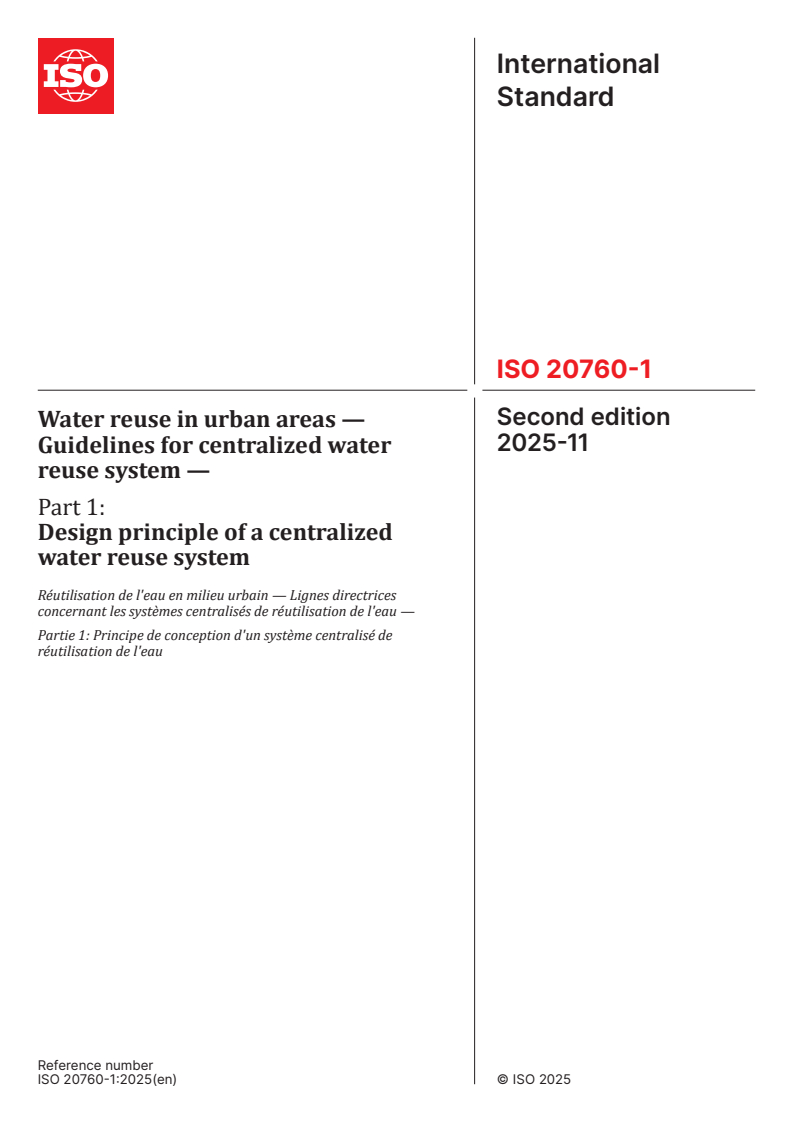
(Main)Water reuse in urban areas — Guidelines for centralized water reuse system — Part 1: Design principle of a centralized water reuse system
General Information
- Abstract
This document provides guidelines for the planning and design of centralized water reuse systems and water reuse applications in urban areas. This document addresses centralized water reuse systems in their entirety and is applicable to any water reclamation system component (e.g. source water, treatment, storage, distribution, operation and maintenance and monitoring). This document provides: — system components and possible models of a centralized water reuse system; — design principles of a centralized water reuse system; — common assessment criteria and related examples of water quality indicators, all without setting any target values or thresholds; — specific aspects for consideration and emergency response. This document excludes design parameters and regulatory values of a centralized water reuse system.
- Status
- Published
- Publication Date
- 13-Nov-2025
- Technical Committee
- ISO/TC 282/SC 2 - Water reuse in urban areas
- Drafting Committee
- ISO/TC 282/SC 2/WG 1 - Centralized system design
- Current Stage
- 6060 - International Standard published
- Start Date
- 14-Nov-2025
- Due Date
- 18-Dec-2025
- Completion Date
- 14-Nov-2025

Overview
ISO 20760-1:2025 - Water reuse in urban areas: Guidelines for centralized water reuse system - Part 1: Design principle of a centralized water reuse system provides high-level, non‑prescriptive guidance for planning and designing centralized water reuse systems in urban settings. The standard covers the system lifecycle - from source water and treatment through storage, distribution, operation, monitoring and emergency response - and defines system components, possible system models, design principles and common assessment criteria (including example water‑quality indicators). It intentionally does not set numeric design parameters or regulatory threshold values.
Key topics and technical focus
- System planning and design principles
- Estimation of reclaimed water demand and review of potential end uses
- Consideration of site conditions and reliability
- System components and models
- Source water, treatment trains, storage (open/closed/aquifer storage and recovery), distribution and user interfaces
- Four example system models including single application, multiple applications, environmental storage and cascading uses
- Source water considerations
- Types of source water (e.g., treated wastewater, untreated sewer flows, other sources)
- Water‑quality and reliability assessment guidance
- Reclaimed water treatment
- Design principles emphasizing safety, reliability, stability, economic viability and environmental protection
- Possible treatment configurations and processes (high-level guidance)
- Storage and distribution
- Storage sizing and turnover, open vs closed reservoirs, ASR considerations
- Distribution design: pumping, flow/pressure, pipe materials, avoiding stagnation, color‑coding and service connections
- Monitoring and control
- Monitoring locations (source, treatment, storage, distribution, end‑user) and operational control approaches
- Guidance on water quality indicators without prescribing targets
- Emergency response
- Specific aspects for contingency planning and incident response
Practical applications and users
ISO 20760-1:2025 is intended for professionals and organizations involved in urban water reuse projects, including:
- Water and wastewater utilities
- Municipal planners and infrastructure authorities
- Consulting engineers and system designers
- Treatment technology suppliers and integrators
- Operators, asset managers and public‑health policymakers
Typical applications include reclaimed water systems for irrigation, industrial cooling and processing, environmental flows, toilet flushing, and integrated cascading reuse schemes within cities - where centralized planning, consistent monitoring and operational reliability are required.
Related standards and implementation notes
- Use ISO 20760-1 alongside national regulations and local water‑quality standards (the document does not provide regulatory target values).
- Complementary guidance and standards on wastewater treatment, potable reuse, and water quality monitoring should be consulted during detailed design and permitting.
ISO 20760-1:2025 is a practical resource for establishing robust, safe and sustainable centralized water reuse systems in urban areas while aligning multidisciplinary stakeholders around common design principles.
Relations
- Effective Date
- 27-Jan-2024
Get Certified
Connect with accredited certification bodies for this standard

CIS Institut d.o.o.
Personal Protective Equipment (PPE) certification body. Notified Body NB-2890 for EU Regulation 2016/425 PPE.

Kiwa BDA Testing
Building and construction product certification.
Kmetijski inštitut Slovenije
Agricultural Institute of Slovenia. Soil testing, plant health, agricultural product analysis.
Sponsored listings
Frequently Asked Questions
ISO 20760-1:2025 is a standard published by the International Organization for Standardization (ISO). Its full title is "Water reuse in urban areas — Guidelines for centralized water reuse system — Part 1: Design principle of a centralized water reuse system". This standard covers: This document provides guidelines for the planning and design of centralized water reuse systems and water reuse applications in urban areas. This document addresses centralized water reuse systems in their entirety and is applicable to any water reclamation system component (e.g. source water, treatment, storage, distribution, operation and maintenance and monitoring). This document provides: — system components and possible models of a centralized water reuse system; — design principles of a centralized water reuse system; — common assessment criteria and related examples of water quality indicators, all without setting any target values or thresholds; — specific aspects for consideration and emergency response. This document excludes design parameters and regulatory values of a centralized water reuse system.
This document provides guidelines for the planning and design of centralized water reuse systems and water reuse applications in urban areas. This document addresses centralized water reuse systems in their entirety and is applicable to any water reclamation system component (e.g. source water, treatment, storage, distribution, operation and maintenance and monitoring). This document provides: — system components and possible models of a centralized water reuse system; — design principles of a centralized water reuse system; — common assessment criteria and related examples of water quality indicators, all without setting any target values or thresholds; — specific aspects for consideration and emergency response. This document excludes design parameters and regulatory values of a centralized water reuse system.
ISO 20760-1:2025 is classified under the following ICS (International Classification for Standards) categories: 13.060.01 - Water quality in general. The ICS classification helps identify the subject area and facilitates finding related standards.
ISO 20760-1:2025 has the following relationships with other standards: It is inter standard links to ISO 20760-1:2018. Understanding these relationships helps ensure you are using the most current and applicable version of the standard.
ISO 20760-1:2025 is available in PDF format for immediate download after purchase. The document can be added to your cart and obtained through the secure checkout process. Digital delivery ensures instant access to the complete standard document.
Standards Content (Sample)
International
Standard
ISO 20760-1
Second edition
Water reuse in urban areas —
2025-11
Guidelines for centralized water
reuse system —
Part 1:
Design principle of a centralized
water reuse system
Réutilisation de l'eau en milieu urbain — Lignes directrices
concernant les systèmes centralisés de réutilisation de l'eau —
Partie 1: Principe de conception d'un système centralisé de
réutilisation de l'eau
Reference number
© ISO 2025
All rights reserved. Unless otherwise specified, or required in the context of its implementation, no part of this publication may
be reproduced or utilized otherwise in any form or by any means, electronic or mechanical, including photocopying, or posting on
the internet or an intranet, without prior written permission. Permission can be requested from either ISO at the address below
or ISO’s member body in the country of the requester.
ISO copyright office
CP 401 • Ch. de Blandonnet 8
CH-1214 Vernier, Geneva
Phone: +41 22 749 01 11
Email: copyright@iso.org
Website: www.iso.org
Published in Switzerland
ii
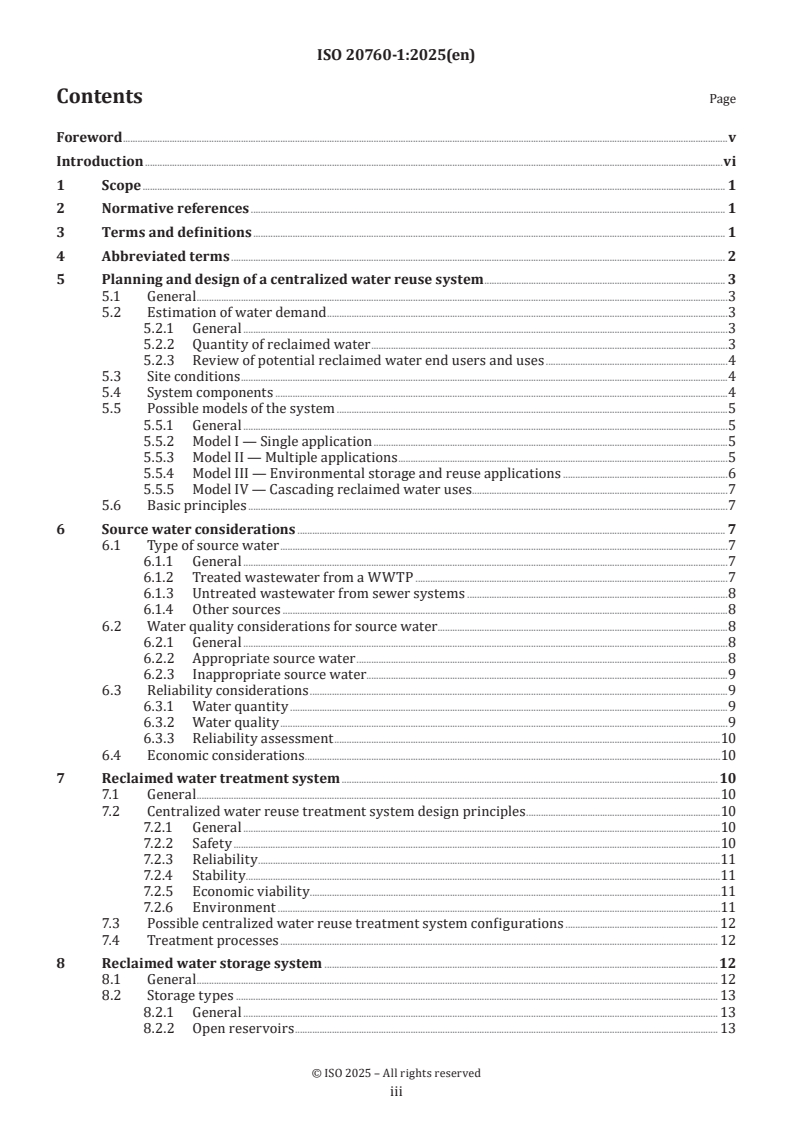
Contents Page
Foreword .v
Introduction .vi
1 Scope . 1
2 Normative references . 1
3 Terms and definitions . 1
4 Abbreviated terms . 2
5 Planning and design of a centralized water reuse system . 3
5.1 General .3
5.2 Estimation of water demand .3
5.2.1 General .3
5.2.2 Quantity of reclaimed water .3
5.2.3 Review of potential reclaimed water end users and uses .4
5.3 Site conditions .4
5.4 System components .4
5.5 Possible models of the system .5
5.5.1 General .5
5.5.2 Model I — Single application .5
5.5.3 Model II — Multiple applications .5
5.5.4 Model III — Environmental storage and reuse applications .6
5.5.5 Model IV — Cascading reclaimed water uses .7
5.6 Basic principles .7
6 Source water considerations . 7
6.1 Type of source water .7
6.1.1 General .7
6.1.2 Treated wastewater from a WWTP .7
6.1.3 Untreated wastewater from sewer systems .8
6.1.4 Other sources .8
6.2 Water quality considerations for source water .8
6.2.1 General .8
6.2.2 Appropriate source water .8
6.2.3 Inappropriate source water.9
6.3 Reliability considerations .9
6.3.1 Water quantity .9
6.3.2 Water quality .9
6.3.3 Reliability assessment .10
6.4 Economic considerations . .10
7 Reclaimed water treatment system . 10
7.1 General .10
7.2 Centralized water reuse treatment system design principles .10
7.2.1 General .10
7.2.2 Safety .10
7.2.3 Reliability .11
7.2.4 Stability .11
7.2.5 Economic viability . .11
7.2.6 Environment .11
7.3 Possible centralized water reuse treatment system configurations . 12
7.4 Treatment processes . 12
8 Reclaimed water storage system .12
8.1 General . 12
8.2 Storage types . 13
8.2.1 General . 13
8.2.2 Open reservoirs . 13
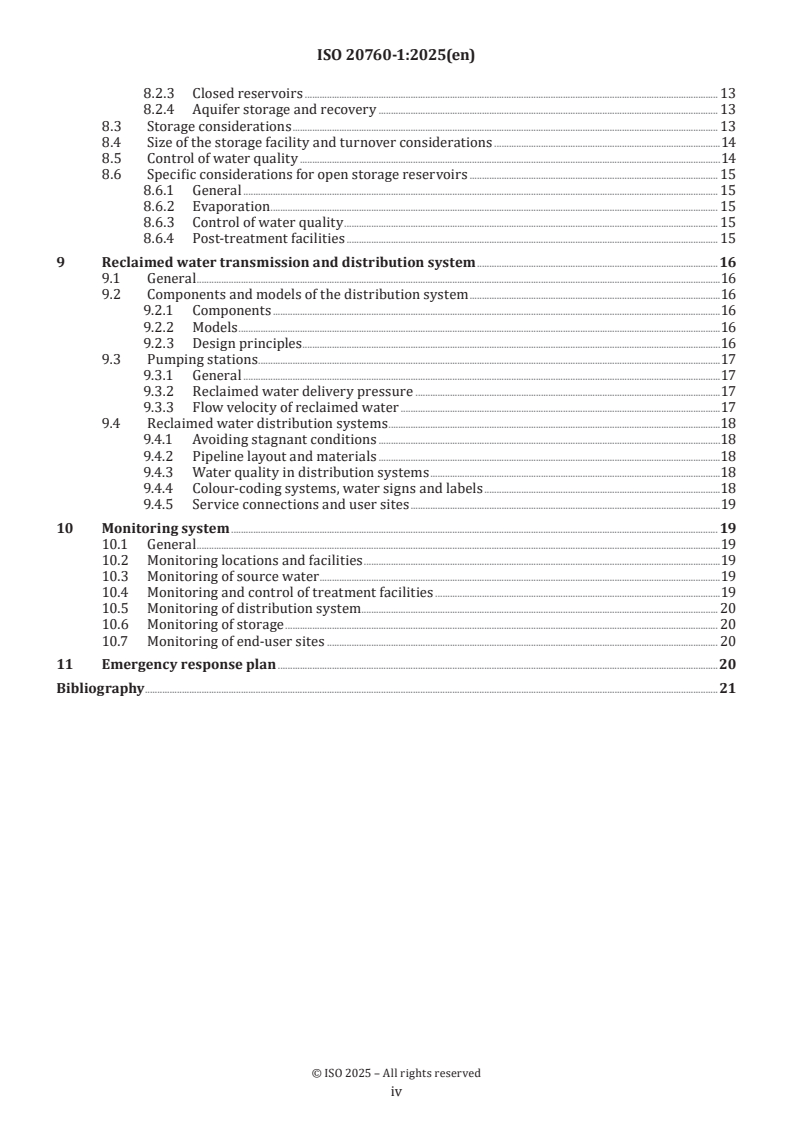
iii
8.2.3 Closed reservoirs . 13
8.2.4 Aquifer storage and recovery . 13
8.3 Storage considerations . 13
8.4 Size of the storage facility and turnover considerations .14
8.5 Control of water quality .14
8.6 Specific considerations for open storage reservoirs . 15
8.6.1 General . 15
8.6.2 Evaporation . 15
8.6.3 Control of water quality . 15
8.6.4 Post-treatment facilities . 15
9 Reclaimed water transmission and distribution system .16
9.1 General .16
9.2 Components and models of the distribution system .16
9.2.1 Components .16
9.2.2 Models .16
9.2.3 Design principles .16
9.3 Pumping stations . .17
9.3.1 General .17
9.3.2 Reclaimed water delivery pressure .17
9.3.3 Flow velocity of reclaimed water .17
9.4 Reclaimed water distribution systems .18
9.4.1 Avoiding stagnant conditions .18
9.4.2 Pipeline layout and materials .18
9.4.3 Water quality in distribution systems .18
9.4.4 Colour-coding systems, water signs and labels .18
9.4.5 Service connections and user sites .19
10 Monitoring system . 19
10.1 General .19
10.2 Monitoring locations and facilities .19
10.3 Monitoring of source water .19
10.4 Monitoring and control of treatment facilities .19
10.5 Monitoring of distribution system . . 20
10.6 Monitoring of storage . 20
10.7 Monitoring of end-user sites . 20
11 Emergency response plan .20
Bibliography .21
iv
Foreword
ISO (the International Organization for Standardization) is a worldwide federation of national standards
bodies (ISO member bodies). The work of preparing International Standards is normally carried out through
ISO technical committees. Each member body interested in a subject for which a technical committee
has been established has the right to be represented on that committee. International organizations,
governmental and non-governmental, in liaison with ISO, also take part in the work. ISO collaborates closely
with the International Electrotechnical Commission (IEC) on all matters of electrotechnical standardization.
The procedures used to develop this document and those intended for its further maintenance are described
in the ISO/IEC Directives, Part 1. In particular, the different approval criteria needed for the different types
of ISO documents should be noted. This document was drafted in accordance with the editorial rules of the
ISO/IEC Directives, Part 2 (see www.iso.org/directives).
ISO draws attention to the possibility that the implementation of this document may involve the use of (a)
patent(s). ISO takes no position concerning the evidence, validity or applicability of any claimed patent
rights in respect thereof. As of the date of publication of this document, ISO had not received notice of (a)
patent(s) which may be required to implement this document. However, implementers are cautioned that
this may not represent the latest information, which may be obtained from the patent database available at
www.iso.org/patents. ISO shall not be held responsible for identifying any or all such patent rights.
Any trade name used in this document is information given for the convenience of users and does not
constitute an endorsement.
For an explanation of the voluntary nature of standards, the meaning of ISO specific terms and expressions
related to conformity assessment, as well as information about ISO’s adherence to the World Trade
Organization (WTO) principles in the Technical Barriers to Trade (TBT), see www.iso.org/iso/foreword.html.
This document was prepared by Technical Committee ISO/TC 282, Water reuse, Subcommittee SC 2, Water
reuse in urban areas.
This second edition cancels and replaces the first edition (ISO 20760-1:2018), which has been technically
revised.
The main changes are as follows:
— added information regarding the stability evaluation and corresponding evaluation parameters;
— added information regarding the performance evaluation of typical treatment processes.
A list of all parts in the ISO 20760 series can be found on the ISO website.
Any feedback or questions on this document should be directed to the user’s national standards body. A
complete listing of these bodies can be found at www.iso.org/members.html.
v
Introduction
With economic development, climate change and increases in population and rapid urbanization, water has
become a strategic resource especially in arid and semi-arid regions. Water shortages are considered as one
of the most serious threats to sustainable development of society. To address these shortages, reclaimed
water is increasingly being used to satisfy water demands and this strategy has proven useful in increasing
the reliability of long-term water supplies in many water-scarce areas.
The role of water reuse is growing for urban areas in many countries including landscape irrigation,
industrial uses, toilet and urinal flushing, firefighting and fire suppression, street cleaning, environmental
and recreational uses (ornamental water features, water bodies’ replenishment, etc.) and vehicle washing.
These centralized water reuse systems have been developed to the degree that they are now considered as
an effective component of urban water management and are used in many cities and countries.
The essential components of a reclaimed water treatment system include water sources, wastewater
collection systems (sewers and pumping stations), a wastewater treatment facility, a reclaimed water
distribution system, reclaimed water storage, a water quality monitoring system and operation and
maintenance provided by experienced and certified operators. The variable nature and diversity in source
water present a challenge to ensuring water safety and reliability in each system component. A further
complication to distributing the reclaimed water is that different water reuse applications can have different
levels of water quality, which would consider more complex water use patterns and system models.
This document provides design principles for centralized water reuse systems in urban areas. It considers
and addresses the critical issues and factors in the design of the different system components and is intended
to assist water engineers, authorities, decision-makers and stakeholders in considering feasible and cost-
effective approaches for safe and reliable fit-for-purpose water reuse. For details on the management
of a centralized water reuse system, see ISO 20760-2. Additionally, for details on the design principles of
decentralized or onsite water reuse systems in urban areas, see ISO 23056.
vi
International Standard ISO 20760-1:2025(en)
Water reuse in urban areas — Guidelines for centralized
water reuse system —
Part 1:
Design principle of a centralized water reuse system
1 Scope
This document provides guidelines for the planning and design of centralized water reuse systems and
water reuse applications in urban areas.
This document addresses centralized water reuse systems in their entirety and is applicable to any
water reclamation system component (e.g. source water, treatment, storage, distribution, operation and
maintenance and monitoring).
This document provides:
— system components and possible models of a centralized water reuse system;
— design principles of a centralized water reuse system;
— common assessment criteria and related examples of water quality indicators, all without setting any
target values or thresholds;
— specific aspects for consideration and emergency response.
This document excludes design parameters and regulatory values of a centralized water reuse system.
2 Normative references
The following documents are referred to in the text in such a way that some or all of their content constitute
requirements of this document. For dated references, only the edition cited applies. For undated references,
the latest edition of the referenced document (including any amendments) applies.
ISO 20670, Water reuse — Vocabulary
3 Terms and definitions
For the purposes of this document, the terms and definitions given in ISO 20670 and the following apply.
ISO and IEC maintain terminology databases for use in standardization at the following addresses:
— ISO Online browsing platform: available at https:// www .iso .org/ obp
— IEC Electropedia: available at https:// www .electropedia .org/
3.1
backflow
movement of the fluid from downstream to upstream within an installation
[SOURCE: EN 1717:2000, 3.5]
3.2
backflow protection device
device which is intended to prevent contamination of potable water by backflow (3.1)
[SOURCE: EN 1717:2000, 3.6]
3.3
destratification system
use of mechanical devices to reduce water column stratification and increase the vertical transfer of
dissolved oxygen and heat in a tank or reservoir, in order to improve chemical water quality and to control
phytoplankton growth
Note 1 to entry: Mechanical devices can include bubble plumes, draft-tube mixers or unconfined mixers.
3.4
reliability assessment
formal determination and review of the reliability of reclaimed water system components and equipment
Note 1 to entry: The assessment reviews and details the operating standards, maintainability, critical operating
conditions, spare parts requirements and availability, and any other issues that affect the reliability or the treatment
performance of the water reclamation facility (3.5).
3.5
water reclamation facility
facility for recovering reclaimed water of a quality that is suitable for beneficial use
4 Abbreviated terms
AGP algal growth potential
AI alkalinity index
AOC assimilable organic carbon
BDOC biodegradable dissolved organic carbon
BGP bacterial growth potential
BOD biochemical oxygen demand
CAPEX capital expense
COD chemical oxygen demand
HPC heterotrophic plate count
LR Larson ratio
LSI Langelier saturation index
OPEX operating expense
POU point-of-use
RSI Ryznar stability index
TN total nitrogen
TP total phosphorus
TSS total suspended solids
TWW treated wastewater
WWTP wastewater treatment plant
5 Planning and design of a centralized water reuse system
5.1 General
Planning is fundamental to ensure the effectiveness of a centralized water reuse system. When a reclaimed
water master plan is being developed, the following aspects should be considered and carefully defined:
— planning principles and targets, including human health and environment protection;
— planning scope and project timeline;
— water reclamation facility construction, operation and maintenance and potential operational challenges;
— reclaimed water production, storage, transmission and distribution system reliability and redundancy;
— reclaimed water applications and related water quality and quantity;
— the urban area to which reclaimed water will be supplied;
— the scale and layout of the system and links/compliance with local or regional water planning;
— economic feasibility and the availability of funding, including tariff strategies and concession agreements;
— stakeholder consultation, open meetings and dialogues;
— customer surveys to determine industrial and domestic demands, value of the reclaimed water
(willingness to pay), economic viability and sustainability;
— environmental-conscious design and minimization of environmental impacts;
— public comment and social acceptance.
The reclaimed water master plan should be reviewed periodically (by competent authorities) and updated
and refined as new information becomes available. For example, water authorities can work together
with internal and external stakeholders, including the potential reclaimed water end users and the public,
[10][11]
throughout the process to ensure that issues and concerns are understood and considered.
5.2 Estimation of water demand
5.2.1 General
In the planning stage, the needs of each water reuse application should be assessed, including the reclaimed
water quantity and quality. Various methods can be applied to estimate current demands and to analyse end-
use applications. Additionally, when transitioning from standard drinking water or wastewater systems to
a water reuse system, the sizing of the potable drinking water infrastructure should be strictly evaluated to
ensure water quality or water age factors are still intact (i.e. avoiding oversized servicing, increased water
age and decreased disinfectant residuals).
5.2.2 Quantity of reclaimed water
When determining the quantity of reclaimed water that is available for reuse, several factors should be
considered, including:
a) the quantity and quality characteristics of wastewater discharged to sewer from the various sources
(e.g. types of industrial, commercial and institutional discharges, number of houses, infiltration or
inflow, surface runoff, combined or separate sewers);
b) the topography of the service area and location of existing wastewater treatment facilities;
c) diurnal and seasonal dynamics of collected and treated wastewater quantity;
d) the volume of reclaimed water that could be available after treatment and storage.
5.2.3 Review of potential reclaimed water end users and uses
An assessment should be carried out to identify potential users of reclaimed water, their locations and their
water quantity and quality considerations, particularly those users with high quantity or quality needs, or
both, and cost-effective applications. Special attention should be paid to potential drivers and benefits for
the use of reclaimed water, in particular for the large end users.
5.3 Site conditions
When selecting the site for the centralized water reuse system, the following criteria should be considered:
a) location and proximity of current and projected future reclaimed water demands and users;
b) availability of land, routes and rights-of-way space for the necessary treatment, storage, transmission
and distribution systems and pumping facilities;
c) scoping assessment of the land area;
d) land use conflicts and local water reuse policies;
e) proximity (location and quantity of wastewater sources);
f) hydraulic and civil construction factors;
g) opportunities for partnership with other agencies;
h) environmental framework such as climate, geography and topography;
i) water resources such as surface water or groundwater;
j) level of social acceptance of water reuse.
A centralized water reuse system may have two configurations:
— adding advanced treatment to an existing centralized wastewater treatment facility;
— constructing a new centralized reclamation facility for additional wastewater treatment or polishing, or
both, and production of reclaimed water.
It can be difficult to find a site where all site conditions are optimal, and adjustments can be considered
to compensate for site deficiencies. Planning should consider both the current and future demand for
all potential reclaimed water uses. The growth in demand can be different for the various users being
considered. A market assessment should be carried out, particularly in communities with established
infrastructure, to determine the needs for reclaimed water. Other issues that should also be considered
include the impact of potential land-use zoning changes and the possibility of future land development.
5.4 System components
The following five essential water reclamation components should be considered when planning a
centralized water reuse system:
a) source water (quality and quantity);
b) treatment;
c) reclaimed water storage;
d) reclaimed water distribution;
e) monitoring.
The storage systems can be located before or after the main transmission pipeline, or both, depending on
the distribution system hydraulic design and should equalize reclaimed water quantity and pressures.
5.5 Possible models of the system
5.5.1 General
There are four generic models of a centralized water reuse system, namely single application, multiple
applications, environmental storage and reuse applications, and cascading uses, ranging from simple to
more complicated water-use patterns considered in this document.
5.5.2 Model I — Single application
Model I produces reclaimed water for only one type of water reuse quality application. This model is relatively
simple (Figure 1). Secondary treated wastewater (TWW) is typically used as source water in a centralized
water reuse system. In some cases, when water reclamation is integrated in the wastewater treatment with
the intended purpose of water reuse, untreated wastewater from sewer systems is considered as source
water (see detailed descriptions in 6.1). A typical example of Model I is given in Figure 1.
NOTE Additional treatment is optional and not compulsory, which depends on the reclaimed water quality and use.
Figure 1 — Typical example of Model I for single application
Model I should be considered when
a) reclaimed water is being provided to a single end user, such as one industrial plant or an individual
building, or
b) reclaimed water is being provided to a single reclaimed water use or standard for a single end user or
multiple similar end users, such as a regional or community-based residential area where the quality of
the reclaimed water should meet all the water reuse applications.
Using accepted design principles, the treatment technology or combination of technologies should be
selected to achieve the reclaimed water quality targets for the specific uses and the overall reclaimed water
system performance, see ISO 20761, ISO 20468-1 and Reference [12].
5.5.3 Model II — Multiple applications
Model II produces multiple reclaimed water streams, each with a different water quality criterion. This
model is more complex in design and operation and the treatment is organized into a hierarchical structure.
A typical example of Model II is given in Figure 2.
Figure 2 — Typical example of Model II for multiple applications
Model II should be used when reclaimed water is supplied to multiple end uses with different water
requirements, such as in an industrial park with several industries, or a region with industrial and domestic
applications for reclaimed water.
The following issues should be considered when selecting a reclaimed water treatment technology or
technology combinations:
a) treatment Unit 1 is designed to satisfy the water quality and quantity specialities for the large and high
priority users;
b) small users with higher quality demands can connect to the main treatment unit (Unit 1) and either
provide an additional treatment unit before distribution or at the point-of-use (POU). The control and
responsibility of an end user at the utility site would demand a very detailed contract and access to the
site to ensure quality is maintained to their needs. There are two scenarios that could be applied:
— the reclaimed water utility contracts with the end user for a system with a specified quantity and
quality and the utility controls the additional treatment;
— the small user contracts for the quantity that is being provided and builds the enhanced treatment at
its own site where the user has control and responsibility of the system construction and operation;
c) small users with quality demands that are generally lower than the quality of the produced reclaimed
water can connect directly to the main treatment unit (Unit 1) without consideration for further
treatment.
The minimum water quality should be guaranteed by the service provider (operator). The water quality
demands for specific users could be achieved using additional treatment (e.g. Units 2 and 3).
5.5.4 Model III — Environmental storage and reuse applications
Model III should be considered when bodies of water such as natural or artificial wetlands, ponds, lakes, rivers
and streams are located in close proximity to the treatment system and can be used as storage reservoirs or
treatment units, or both, in which reclaimed water can undergo further purification. Storage aims to provide
buffer capacity or environmental enhancement, or both, to achieve high level of environmental benefits and
to avoid adverse impacts on end users. On-site storage and treatment could be optional as a function of end-
user needs. A typical example of Model III is given in Figure 3.
Figure 3 — Typical example of Model III for environmental storage and reuse applications
5.5.5 Model IV — Cascading reclaimed water uses
Model IV provides a cascading system for reclaimed water, with sequential or cascading use of reclaimed
water for different reuse applications. For instance, when the reclaimed water is applied for industrial
uses, wastewater can be reclaimed from that same industrial process and applied to subsequent reuse
applications, such as cleaning, or ornamental landscape irrigation, without additional specific water quality
needs. If a higher water quality is demanded for the subsequent reuse applications, additional treatment can
be provided, or the reuse water can be mixed with higher quality water to attain the desired water quality
for the reuse application. A typical example of Model IV is given in Figure 4.
Figure 4 — Typical example of Model IV for cascading use
5.6 Basic principles
Basic principles of safety, reliability, stability and economic viability should be incorporated in all applicable
clauses when designing a centralized water reuse system.
6 Source water considerations
6.1 Type of source water
6.1.1 General
The quality of the source water should not have any negative impacts on the subsequent reuse applications
as well as on human health and the environment.
Water reclamation facility sources can include either untreated wastewater from sewer systems or TWW
from wastewater treatment plants (WWTP), with the treatment technology and level of treatment based
on the source of water and the reclaimed water quality needs, and with consideration given to principles of
safety, reliability, stability, economic viability and protection of the environment and public health.
In most circumstances, it is expected that secondary TWW will be used as source water in a centralized water
reuse system. The quality of the secondary TWW is typically established. Alternatively, water reclamation
can be directly integrated into a WWTP with intended purpose for water reuse. In this integrated system,
untreated wastewater from sewer systems is the source water as long as treatment and reliability (water
quality and quantity) meet water reuse demands.
6.1.2 Treated wastewater from a WWTP
Secondary TWW is commonly used as the source of reclaimed water in areas where centralized wastewater
treatment facilities already exist. This typically should consider the existing WWTP to either be expanded
or upgraded, or the nearby construction of a new water reclamation facility. For expansion or upgrade of
existing WWTPs, compatibility with existing treatment processes is important and several factors should
be considered, including the secondary TWW quality, space for new facilities, plant hydraulic profile,
piping modifications, operating considerations and ancillary systems. In all cases, future demand, regional
planning and land availability should be considered.
6.1.3 Untreated wastewater from sewer systems
Untreated wastewater from sewer systems is typically considered as the source water, such as for
— newly developed areas where centralized wastewater treatment facilities do not yet exist, and
— areas with limited-capacity wastewater treatment facilities such as primary treatment plants.
Untreated wastewater from sewer systems is generally available in proportion to the population of the area
covered by the collection system.
In general, untreated wastewater from sewer systems has the following characteristics:
a) higher concentrations of nutrients and organic and inorganic chemical contaminants (including
household and industrial chemicals, pharmaceuticals and personal care products and endocrine
disruptors) compared to secondary TWW;
b) high amounts of solids (e.g. grit, paper, plastic, wipes) that could clog or plug pumps, strainers and other
equipment;
c) higher load and broader range of pathogens;
d) generally collected and available at a lower elevation of the collection system.
The constituents of, and variations in, untreated wastewater quality and quantity are important for the
design of subsequent treatment, storage, distribution and application stages and should be accurately
assessed.
6.1.4 Other sources
During an emergency, unexpected event, or interruption in the source water supply, backup supplies of
water meeting the water quality specification for the reuse applications should be available to meet essential
service supply (e.g. toilet flushing). Possible backup water resources include potable water, storm water,
river or lake sources that are located in close proximity to the centralized water reuse system.
When the available sources of reclaimed water are insufficient to meet the user demand, supplementary
sources should be considered where possible. In such cases, these sources can demand additional treatment,
storage or mixing with other sources.
If potable water is to be used as a backup source or supplementary source, the potable water distribution
system should be protected from potential contamination from the reclaimed water through the use of
backflow protection devices, preferably an air gap separation.
6.2 Water quality considerations for source water
6.2.1 General
The quality and quantity of source water should meet the safety considerations for human health and
environmental safety of the reclaimed water production and supply processes. These two issues should be
addressed.
6.2.2 Appropriate source water
Reclaimed water sourced from domestic wastewater with a controlled proportion of industrial wastewater
can be considered as an appropriate raw source water for water reuse applications.
6.2.3 Inappropriate source water
Although the sources of municipal wastewater are normally expected to include a mixture of domestic,
industrial, commercial and institutional (e.g. hospital) discharges, wastewater from industries and
institutions that contains toxic chemicals or pathogens at levels that exceed the specified acceptable
levels should be excluded from consideration for reclamation and beneficial reuse, as the high content of
contaminants can negatively impact the quality of the reclaimed water. In particular, caution should be
taken when considering wastewater with a significant propor
...