

ISO 14620-4:2025
(Main)Space systems — Safety requirements — Part 4: Spacecraft assembly, integration and test
General Information
- Abstract
This document provides requirements for the safety management and operation of assembly, integration and test (AIT) activities related to spacecraft projects and applications including the responsibilities of the organization involved in the AIT operations for spacecraft products. This document provides a method to identify hazards, control and reduce safety risk to acceptable levels in the activities of spacecraft assembly, integration, testing, hoisting, logistics and handling. This document is applicable to space test centres and entities providing operating infrastructure and facilities for spacecraft AIT. It can serve as a reference for the AIT of the spacecraft system, its subsystems and equipment.
- Status
- Published
- Publication Date
- 18-Feb-2025
- Technical Committee
- ISO/TC 20/SC 14 - Space systems and operations
- Drafting Committee
- ISO/TC 20/SC 14 - Space systems and operations
- Current Stage
- 6060 - International Standard published
- Start Date
- 19-Feb-2025
- Due Date
- 11-Apr-2025
- Completion Date
- 19-Feb-2025
Overview
ISO 14620-4:2025 – Space systems - Safety requirements - Part 4: Spacecraft assembly, integration and test is an internationally recognized safety standard developed by ISO. It specifies safety management and operational requirements for activities involved in the assembly, integration, and testing (AIT) of spacecraft. The standard applies to space test centres, ground support infrastructure, and any organizations responsible for spacecraft AIT processes. It provides a structured method for hazard identification, risk assessment, and risk mitigation to ensure the safety of personnel, equipment, inventories, and the overall environment during space system development.
Key Topics
- Safety Organization: ISO 14620-4 requires clear establishment of safety organizations, including defined roles such as safety representatives and qualified personnel for hazardous operations. Training and competence are emphasized, particularly when handling hazardous materials or conducting high-risk tasks.
- Hazard Identification and Risk Management: The standard details systematic hazard analysis, encompassing hazardous materials, abnormal system conditions, environmental factors, and lessons from previous operations. Each risk is assessed on likelihood, severity, and is classified and managed with appropriate mitigation measures.
- Operational Controls and Procedures: Documented safety procedures and checks are mandated for different phases of spacecraft AIT, from facility and equipment standards, to ground support equipment (GSE), hoisting, integration of pyrotechnics or radioactive products, and emergency responses.
- Documentation and Traceability: The requirement for comprehensive safety documentation supports traceability, accountability, and continual improvement. Incident records, safety summary reports, and inspection documentation must be maintained throughout the spacecraft’s lifecycle.
- Verification and Continuous Improvement: Safety risk controls are verified at specified intervals and after any system changes. Lessons learned from incidents are used for enhancing safety measures going forward.
Applications
Who Should Use ISO 14620-4?
- Space Test Centres: Organizations operating spacecraft test facilities benefit from standardized safety frameworks, ensuring consistent practices that protect assets, personnel, and mission objectives.
- Spacecraft Manufacturers and Integrators: Ensures systematic safety approaches during intricate operations like subsystem integration or environmental testing, supporting product reliability and regulatory compliance.
- AIT Service Providers: Entities providing logistics, hoisting, or assembly infrastructure can adopt ISO 14620-4 to structure their safety management systems and demonstrate best practice competence to clients and partners.
- Ground Support Equipment Designers: Engineers and manufacturers can refer to the standard to ensure GSE meets rigorous safety specifications, minimizing risks of mechanical or electrical failures.
Practical Value
Implementing ISO 14620-4 enhances operational safety, minimizes risk of injury or equipment failure, improves efficiency, and fulfills contractual and legal safety obligations. The structured approach to hazard identification and documentation supports audit readiness and aligns with international norms, fostering trust among stakeholders.
Related Standards
When applying ISO 14620-4:2025, cross-reference these related ISO standards for a robust space safety framework:
- ISO 14620-1: Space systems - Safety requirements - Part 1: System safety
- ISO 14620-2: Space systems - Safety requirements - Part 2: Launch site operations
- ISO 14625: Space systems - Ground support equipment for use at launch, landing or retrieval sites - General requirements
- ISO 10795: Space systems - Programme management and quality - Vocabulary
- ISO 17666: Space systems - Risk management
- ISO 18322: Space systems - General management requirements for space test centres
Adoption of these international standards ensures comprehensive safety management throughout space project lifecycles, from design and testing to operation and maintenance.
Get Certified
Connect with accredited certification bodies for this standard

BUREAU VERITAS Certification Germany
Bureau Veritas certification in Germany.

Element Materials Technology
Materials testing and product certification.

AQMS Ltd.
AQMS provides ISO certification to SMEs across the UK.
Sponsored listings
Frequently Asked Questions
ISO 14620-4:2025 is a standard published by the International Organization for Standardization (ISO). Its full title is "Space systems — Safety requirements — Part 4: Spacecraft assembly, integration and test". This standard covers: This document provides requirements for the safety management and operation of assembly, integration and test (AIT) activities related to spacecraft projects and applications including the responsibilities of the organization involved in the AIT operations for spacecraft products. This document provides a method to identify hazards, control and reduce safety risk to acceptable levels in the activities of spacecraft assembly, integration, testing, hoisting, logistics and handling. This document is applicable to space test centres and entities providing operating infrastructure and facilities for spacecraft AIT. It can serve as a reference for the AIT of the spacecraft system, its subsystems and equipment.
This document provides requirements for the safety management and operation of assembly, integration and test (AIT) activities related to spacecraft projects and applications including the responsibilities of the organization involved in the AIT operations for spacecraft products. This document provides a method to identify hazards, control and reduce safety risk to acceptable levels in the activities of spacecraft assembly, integration, testing, hoisting, logistics and handling. This document is applicable to space test centres and entities providing operating infrastructure and facilities for spacecraft AIT. It can serve as a reference for the AIT of the spacecraft system, its subsystems and equipment.
ISO 14620-4:2025 is classified under the following ICS (International Classification for Standards) categories: 49.140 - Space systems and operations. The ICS classification helps identify the subject area and facilitates finding related standards.
ISO 14620-4:2025 is available in PDF format for immediate download after purchase. The document can be added to your cart and obtained through the secure checkout process. Digital delivery ensures instant access to the complete standard document.
Standards Content (Sample)
International
Standard
ISO 14620-4
First edition
Space systems — Safety
2025-02
requirements —
Part 4:
Spacecraft assembly, integration
and test
Systèmes spatiaux — Exigences de sécurité —
Partie 4: Assemblage, intégration et test d'engins spatiaux
Reference number
© ISO 2025
All rights reserved. Unless otherwise specified, or required in the context of its implementation, no part of this publication may
be reproduced or utilized otherwise in any form or by any means, electronic or mechanical, including photocopying, or posting on
the internet or an intranet, without prior written permission. Permission can be requested from either ISO at the address below
or ISO’s member body in the country of the requester.
ISO copyright office
CP 401 • Ch. de Blandonnet 8
CH-1214 Vernier, Geneva
Phone: +41 22 749 01 11
Email: copyright@iso.org
Website: www.iso.org
Published in Switzerland
ii
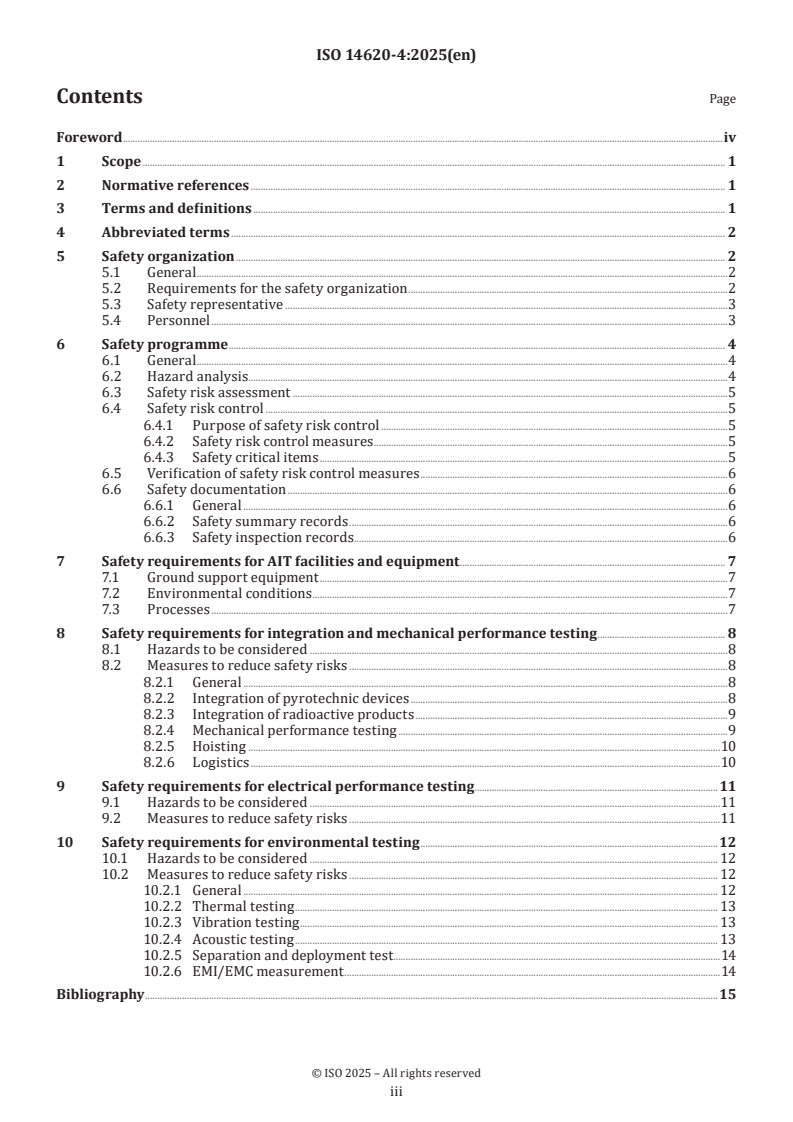
Contents Page
Foreword .iv
1 Scope . 1
2 Normative references . 1
3 Terms and definitions . 1
4 Abbreviated terms . 2
5 Safety organization . 2
5.1 General .2
5.2 Requirements for the safety organization .2
5.3 Safety representative .3
5.4 Personnel .3
6 Safety programme . 4
6.1 General .4
6.2 Hazard analysis.4
6.3 Safety risk assessment .5
6.4 Safety risk control .5
6.4.1 Purpose of safety risk control .5
6.4.2 Safety risk control measures .5
6.4.3 Safety critical items .5
6.5 Verification of safety risk control measures .6
6.6 Safety documentation .6
6.6.1 General .6
6.6.2 Safety summary records .6
6.6.3 Safety inspection records . .6
7 Safety requirements for AIT facilities and equipment . 7
7.1 Ground support equipment .7
7.2 Environmental conditions .7
7.3 Processes .7
8 Safety requirements for integration and mechanical performance testing . 8
8.1 Hazards to be considered .8
8.2 Measures to reduce safety risks .8
8.2.1 General .8
8.2.2 Integration of pyrotechnic devices .8
8.2.3 Integration of radioactive products .9
8.2.4 Mechanical performance testing .9
8.2.5 Hoisting .10
8.2.6 Logistics .10
9 Safety requirements for electrical performance testing .11
9.1 Hazards to be considered .11
9.2 Measures to reduce safety risks .11
10 Safety requirements for environmental testing .12
10.1 Hazards to be considered . 12
10.2 Measures to reduce safety risks . 12
10.2.1 General . 12
10.2.2 Thermal testing . 13
10.2.3 Vibration testing . 13
10.2.4 Acoustic testing . 13
10.2.5 Separation and deployment test .14
10.2.6 EMI/EMC measurement .14
Bibliography .15
iii
Foreword
ISO (the International Organization for Standardization) is a worldwide federation of national standards
bodies (ISO member bodies). The work of preparing International Standards is normally carried out through
ISO technical committees. Each member body interested in a subject for which a technical committee
has been established has the right to be represented on that committee. International organizations,
governmental and non-governmental, in liaison with ISO, also take part in the work. ISO collaborates closely
with the International Electrotechnical Commission (IEC) on all matters of electrotechnical standardization.
The procedures used to develop this document and those intended for its further maintenance are described
in the ISO/IEC Directives, Part 1. In particular, the different approval criteria needed for the different types
of ISO document should be noted. This document was drafted in accordance with the editorial rules of the
ISO/IEC Directives, Part 2 (see www.iso.org/directives).
ISO draws attention to the possibility that the implementation of this document may involve the use of (a)
patent(s). ISO takes no position concerning the evidence, validity or applicability of any claimed patent
rights in respect thereof. As of the date of publication of this document, ISO had not received notice of (a)
patent(s) which may be required to implement this document. However, implementers are cautioned that
this may not represent the latest information, which may be obtained from the patent database available at
www.iso.org/patents. ISO shall not be held responsible for identifying any or all such patent rights.
Any trade name used in this document is information given for the convenience of users and does not
constitute an endorsement.
For an explanation of the voluntary nature of standards, the meaning of ISO specific terms and expressions
related to conformity assessment, as well as information about ISO's adherence to the World Trade
Organization (WTO) principles in the Technical Barriers to Trade (TBT), see www.iso.org/iso/foreword.html.
This document was prepared by Technical Committee 20, Aircraft and space vehicles, Subcommittee SC 14,
Space systems and operations.
Any feedback or questions on this document should be directed to the user’s national standards body. A
complete listing of these bodies can be found at www.iso.org/members.html.
iv
International Standard ISO 14620-4:2025(en)
Space systems — Safety requirements —
Part 4:
Spacecraft assembly, integration and test
1 Scope
This document provides requirements for the safety management and operation of assembly, integration
and test (AIT) activities related to spacecraft projects and applications including the responsibilities of the
organization involved in the AIT operations for spacecraft products.
This document provides a method to identify hazards, control and reduce safety risk to acceptable levels in
the activities of spacecraft assembly, integration, testing, hoisting, logistics and handling.
This document is applicable to space test centres and entities providing operating infrastructure and
facilities for spacecraft AIT. It can serve as a reference for the AIT of the spacecraft system, its subsystems
and equipment.
2 Normative references
The following documents are referred to in the text in such a way that some or all of their content constitutes
requirements of this document. For dated references, only the edition cited applies. For undated references,
the latest edition of the referenced document (including any amendments) applies.
ISO 10795, Space systems — Programme management and quality — Vocabulary
ISO 14620-1, Space systems — Safety requirements — Part 1: System safety
ISO 14620-2, Space systems — Safety requirements — Part 2: Launch site operations
ISO 14625, Space systems — Ground support equipment for use at launch, landing or retrieval sites — General
requirements
ISO 17666, Space systems — Risk management
ISO 18322, Space systems — General management requirements for space test centres
3 Terms and definitions
For the purposes of this document, the terms and definitions given in ISO 10795 and the following apply.
ISO and IEC maintain terminology databases for use in standardization at the following addresses:
— ISO Online browsing platform: available at https:// www .iso .org/ obp
— IEC Electropedia: available at https:// www .electropedia .org/
3.1
logistics
science and practice of interconnecting, and finding the best way of goal attainment, for bringing material
objects or living beings in sufficient quantity to the right place in the right time.
[SOURCE: ISO 5127:2017, 3.1.2.26]
3.2
operator
governmental or non-governmental entities, international organization, or natural person carrying out a
space operation independently and under its responsibility.
[SOURCE: ISO 14620-2:2019, 3.15]
3.3
risk
undesirable situation or circumstance that has both a likelihood of occurring and a potential negative
consequence on a project
Note 1 to entry: Risks arise from uncertainty due to lack of predictability or control of events. Risks are inherent to
any project and can arise at any time during the project life cycle; reducing these uncertainties reduces the risks.
[SOURCE: ISO 17666:2016, 3.1.12]
3.4
space test centre
complete entity including the organization which provides, maintains, develops and operates test facilities
for space project and applications including accompanied services
[SOURCE: ISO 18322:2017, 3.7]
3.5
safety risk
measure of the potential consequences of a hazard considering the probability of the associated mishap, the
harm caused to people and the damage caused to public and private property and the environment
Note 1 to entry: The safety risk is defined to be differentiated from political, financial, industrial, project, and other
risks (3.3).
Note 2 to entry: An example of a safety risk is the expected number of casualties.
[SOURCE: ISO 14620-2:2019, 3.19]
3.6
safety representative
representative from the space test centre (3.4) management with designated responsibility for safety
[SOURCE: ISO 18322:2017, 3.5, modified — Note 1 to entry has been removed.]
4 Abbreviated terms
AIT assembly, integration and test
GSE ground support equipment
5 Safety organization
5.1 General
The safety organization shall be established to organize, inspect and implement safety activities in the AIT
process.
5.2 Requirements for the safety organization
The following requirements apply to the safety organization.
a) The safety organization shall be established in accordance with ISO 14620-1.
b) Operations at the launch site shall conform to the safety requirements specified in ISO 14620-2.
c) Ground support equipment used for launch, landing or retrieval operations shall meet the general
requirements specified in ISO 14625.
d) Space test centres shall meet the general management requirements specified in ISO 18322.
e) The safety organization shall ensure that safety requirements and related AIT tasks are appropriately
integrated into all project plans and procedures.
f) The implementation of safety requirements shall be verified at defined intervals.
5.3 Safety representative
The following requirements apply to the safety representative.
a) The safety representatives shall coordinate with all relevant bodies, including the safety launcher
authority, medical boards, radiation protection committees, industrial safety organizations and
environmental protection agencies.
b) The safety representative:
1) shall have the right to obtain all safety-related information;
2) shall report to the project manager;
3) shall have access to top management;
4) shall have the authority to report safety issues independently;
5) shall not be restricted by any organization in any aspect of safety.
5.4 Personnel
The following requirements apply to operating personnel involved in spacecraft AIT.
a) Personnel shall be qualified in fundamental safety skills related to inspection, testing, maintenance and
operation in the AIT process.
b) Personnel performing or controlling hazardous operations, or handling, using or transporting hazardous
materials, shall be trained and qualified with the necessary knowledge, skills and, if specified in the job
description, abilities to perform the job safely.
NOTE This rule applies to tasks that pose an immediate danger to the operator (death or injury) if not
performed correctly, or that can endanger others nearby (death or injury) or cause damage to surrounding
equipment or facilities.
c) Personnel shall have successfully completed safety and technical training and shall be familiar with the
safety measures, safety plans and responsibilities associated with the operations they perform.
d) All contractor personnel engaged in potentially hazardous operations or the handling of hazardous
materials shall be qualified through similar training as described in item c).
e) Operators shall wear dust resistant and anti-static work clothes, safety helmets and safety belts.
f) During spacecraft integration, operators shall wear:
1) split suit anti-static work clothes with tight cuffs and without pockets and buttons;
2) anti-static wristbands according to the needs of work.
g) When handling thermal control materials or other sensitive spacecraft products, operators shall wear
masks and anti-static gloves or finger covers.
h) Operators shall wear protective equipment in the work area.
i) Unauthorized personnel shall not enter the work area.
6 Safety programme
6.1 General
a) The safety programme:
1) shall be established in accordance with ISO 14620-1:2018, Clause 4, to ensure that during AIT
activities, the safety of spacecraft products, personnel (including customers and visitors), ground
support equipment, facilities and the environment is fully addressed, taking full responsibility for
safety performance during products testing;
2) shall take into account the applicable safety requirements of either the spacecraft or the project, or both;
NOTE The objective of the safety programme is to ensure that all safety risks associated with the AIT,
handling and logistics of spacecraft products are adequately identified, assessed, minimized, controlled
and finally accepted. The safety programme includes the identification of hazards, assessment of safety
risks, implementation of control measures for unacceptable risks, reassessment of risks following control
measures and the reduction of risks to an acceptable level.
3) shall ensure that all hazards related to spacecraft AIT are systematically identified, risks are
assessed, and where risks are unacceptable, control measures are recommended to eliminate or
mitigate the hazards.
b) Information, data and analysis results obtained during hazard analysis and safety risk assessment shall
be communicated to design, operations and management teams in a timely manner to implement early
measures for effectively ensuring safety.
c) Interfaces shall be established between the safety programme and other plans and programmes (e.g.
AIT, handling, reliability, quality assurance) to integrate relevant data and information into hazard
analysis and safety risk assessment.
6.2 Hazard analysis
The purpose of the hazard analysis is to identify, at an early stage, hazards related to spacecraft AIT that can
pose a threat to the safety of personnel, spacecraft products and facilities.
The AIT phase hazard analysis shall cover at least the following aspects:
a) hazardous materials (e.g. propellants, gunpowder, explosive devices, toxic substances, power supplies,
radioactive materials, and high-pressure gas sources);
b) the environment in which the system operates, including the natural environment and induced
environments (e.g. vibration, shock, extreme temperatures, vacuum, electromagnetic interference);
c) system functional faults or abnormal operating conditions;
d) defects in safety-critical instructions and control software;
e) risks that may arise or be introduced during AIT, handling or logistics;
f) incorrect operation;
g) the storage, handling and transportation of hazardous materials;
h) safety-related equipment, safety protection devices and other safety assurance measures;
i) analysis of safety requirements and lessons learned from similar previous operations.
6.3 Safety risk assessment
The purpose of the safety risk assessment is to analyse the identified hazards related to spacecraft AIT by
evaluating the risk level based on severity and occurrence probability and to determine the need for risk
reduction measures.
The following requirements apply for safety risk assessment.
a) The safety risk assessment shall be performed for each identified hazard in accordance with ISO 17666.
b) The safety risk assessment shall determine the risk level for each identified hazard based on severity
and occurrence probability.
c) Hazard severity shall be classified as catastrophic, critical, marginal and negligible in accordance with
the definitions in ISO 14620-1.
d) The safety risk assessment shall determine the acceptability of each risk based on the safety policy and
accordingly, identify the need for control measures.
e) A safety risk assessment report shall be prepared; and the results of the assessment shall be considered
a key element in the special safety review to ensure that any remaining risks are acceptable.
6.4 Safety risk control
6.4.1 Purpose of safety risk control
The purpose of safety risk control is to reduce unacceptable safety risks or safety-critical items to an
acceptable level.
6.4.2 Safety risk control measures
For the selection and imple
...