

ISO 25552:2022
(Main)Ageing societies — Framework for dementia-inclusive communities
General Information
- Abstract
This document provides a framework for dementia-inclusive communities, including principles and the considerations of inclusion, quality of life, built environments, special needs groups, and stakeholder engagement. It also provides guidance on how to systematically leverage, improve, and interconnect their existing assets and structures and transform efficiently into a dementia-inclusive community. This document does not provide any clinical standards.
- Status
- Published
- Publication Date
- 03-Feb-2022
- Technical Committee
- ISO/TC 314 - Ageing societies
- Drafting Committee
- ISO/TC 314/WG 2 - Dementia inclusive
- Current Stage
- 6060 - International Standard published
- Start Date
- 04-Feb-2022
- Due Date
- 08-Oct-2021
- Completion Date
- 01-Feb-2022

Overview
ISO 25552:2022 - Ageing societies: Framework for dementia‑inclusive communities provides a practical, non‑clinical framework to help communities become more inclusive of people with dementia. The standard outlines principles, process elements, and guidance for systematically leveraging and improving existing assets (built environment, services, networks) so communities can transform into dementia‑inclusive communities that support quality of life, safety, participation, and autonomy.
Key points:
- Focuses on community-level planning and stakeholder engagement rather than clinical practice.
- First edition published 2022 by ISO/TC 314 (Ageing societies).
- Emphasizes integration of social, built, health and voluntary sectors to support people with dementia and their carers.
Key topics
The standard breaks down the framework into actionable topics and guidance, including:
- Systematic development process: establishing processes and basic elements to plan and implement inclusion programs.
- Guiding principles: outcomes (choice, accessibility, protection) and enabling factors (competence, awareness, sustainability, cultural considerations).
- Integrated community networks: creating coordinated health, social care, emergency, business, transport and leisure responses to dementia needs.
- Action areas / community sectors: housing, public space, transport, businesses, infrastructure, leisure, health and social care, education, faith and voluntary groups.
- Support for carers: informal care system assessment, education, training, and self‑care guidance.
- Implementation tools: annexes with considerations, stages of dementia implications, other frameworks, and an implementation/progress evaluation checklist.
Applications and who uses it
ISO 25552:2022 is designed for practical use by a wide range of stakeholders seeking to make communities dementia‑friendly:
- Local authorities and city planners developing policy, zoning, housing and transport strategies.
- Health and social care networks coordinating integrated, phased care pathways.
- Community organizations, NGOs and faith groups planning programs to reduce stigma and increase participation.
- Businesses and service providers adapting customer service, retail and workplace design.
- Architects and built environment professionals improving accessibility and orientation in public spaces.
- Carers, families and advocacy groups using the framework to evaluate local services and support needs.
Practical uses include community action plans, cross‑sector partnerships, public‑awareness campaigns, inclusive design audits, and monitoring progress with the standard’s evaluation checklist.
Related standards
- Complements person‑centred and accessibility guidance (see ISO/IEC Guide 71 referenced in the document).
- Works alongside local health and social care regulations; ISO 25552:2022 does not set clinical standards.
This standard is a strategic tool for communities aiming to reduce stigma, improve quality of life, and create sustainable, dementia‑inclusive environments.
Get Certified
Connect with accredited certification bodies for this standard

BSI Group
BSI (British Standards Institution) is the business standards company that helps organizations make excellence a habit.

TÜV Rheinland
TÜV Rheinland is a leading international provider of technical services.

TÜV SÜD
TÜV SÜD is a trusted partner of choice for safety, security and sustainability solutions.
Sponsored listings
Frequently Asked Questions
ISO 25552:2022 is a standard published by the International Organization for Standardization (ISO). Its full title is "Ageing societies — Framework for dementia-inclusive communities". This standard covers: This document provides a framework for dementia-inclusive communities, including principles and the considerations of inclusion, quality of life, built environments, special needs groups, and stakeholder engagement. It also provides guidance on how to systematically leverage, improve, and interconnect their existing assets and structures and transform efficiently into a dementia-inclusive community. This document does not provide any clinical standards.
This document provides a framework for dementia-inclusive communities, including principles and the considerations of inclusion, quality of life, built environments, special needs groups, and stakeholder engagement. It also provides guidance on how to systematically leverage, improve, and interconnect their existing assets and structures and transform efficiently into a dementia-inclusive community. This document does not provide any clinical standards.
ISO 25552:2022 is classified under the following ICS (International Classification for Standards) categories: 11.020.10 - Health care services in general. The ICS classification helps identify the subject area and facilitates finding related standards.
ISO 25552:2022 is available in PDF format for immediate download after purchase. The document can be added to your cart and obtained through the secure checkout process. Digital delivery ensures instant access to the complete standard document.
Standards Content (Sample)
INTERNATIONAL ISO
STANDARD 25552
First edition
2022-02
Ageing societies — Framework for
dementia-inclusive communities
Vieillissement de la population — Collectivités inclusives à l'égard des
personnes atteintes de démence
Reference number
© ISO 2022
All rights reserved. Unless otherwise specified, or required in the context of its implementation, no part of this publication may
be reproduced or utilized otherwise in any form or by any means, electronic or mechanical, including photocopying, or posting on
the internet or an intranet, without prior written permission. Permission can be requested from either ISO at the address below
or ISO’s member body in the country of the requester.
ISO copyright office
CP 401 • Ch. de Blandonnet 8
CH-1214 Vernier, Geneva
Phone: +41 22 749 01 11
Email: copyright@iso.org
Website: www.iso.org
Published in Switzerland
ii
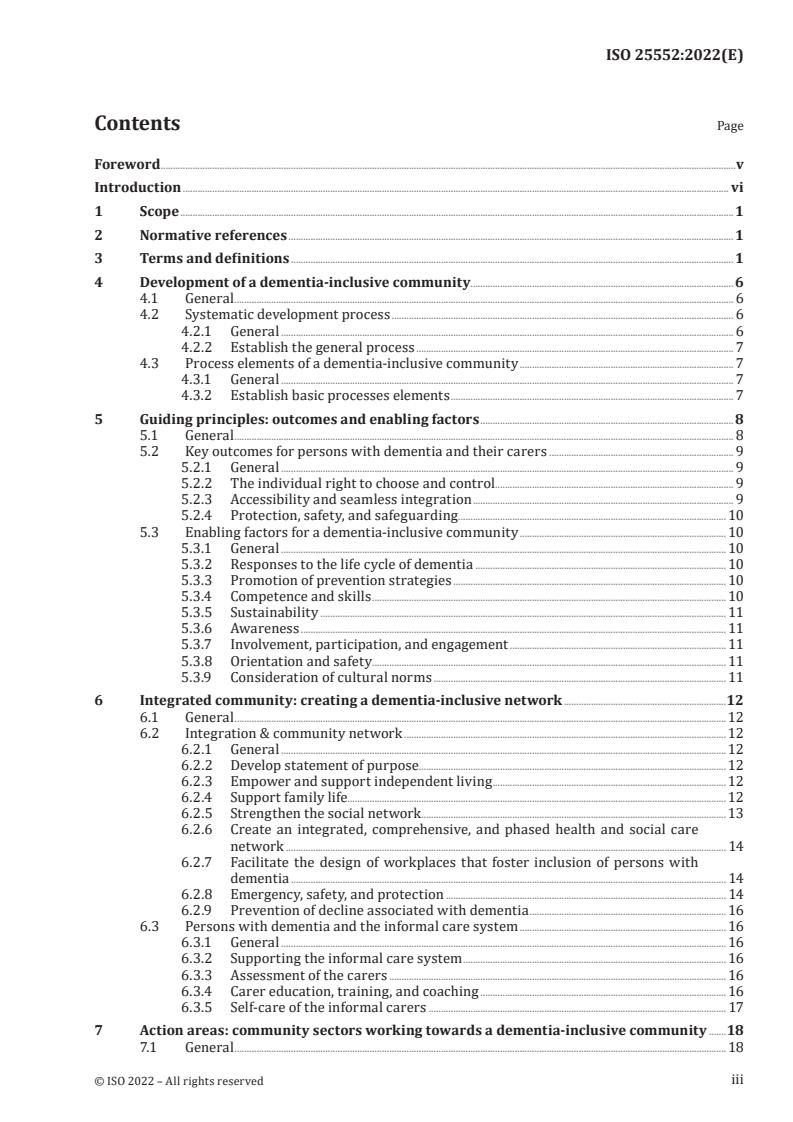
Contents Page
Foreword .v
Introduction . vi
1 Scope . 1
2 Normative references . 1
3 Terms and definitions . 1
4 Development of a dementia-inclusive community . 6
4.1 General . 6
4.2 Systematic development process . 6
4.2.1 General . 6
4.2.2 Establish the general process . 7
4.3 Process elements of a dementia-inclusive community . 7
4.3.1 General . 7
4.3.2 Establish basic processes elements . 7
5 Guiding principles: outcomes and enabling factors . 8
5.1 General . 8
5.2 Key outcomes for persons with dementia and their carers . 9
5.2.1 General . 9
5.2.2 The individual right to choose and control . . 9
5.2.3 Accessibility and seamless integration . 9
5.2.4 Protection, safety, and safeguarding . 10
5.3 Enabling factors for a dementia-inclusive community . 10
5.3.1 General . 10
5.3.2 Responses to the life cycle of dementia . 10
5.3.3 Promotion of prevention strategies . 10
5.3.4 Competence and skills . 10
5.3.5 Sustainability . 11
5.3.6 Awareness . 11
5.3.7 Involvement, participation, and engagement . 11
5.3.8 Orientation and safety . . 11
5.3.9 Consideration of cultural norms . 11
6 Integrated community: creating a dementia-inclusive network .12
6.1 General .12
6.2 Integration & community network .12
6.2.1 General .12
6.2.2 Develop statement of purpose.12
6.2.3 Empower and support independent living .12
6.2.4 Support family life.12
6.2.5 Strengthen the social network . 13
6.2.6 Create an integrated, comprehensive, and phased health and social care
network . 14
6.2.7 Facilitate the design of workplaces that foster inclusion of persons with
dementia . 14
6.2.8 Emergency, safety, and protection . 14
6.2.9 Prevention of decline associated with dementia . 16
6.3 Persons with dementia and the informal care system . 16
6.3.1 General . 16
6.3.2 Supporting the informal care system . 16
6.3.3 Assessment of the carers . 16
6.3.4 Carer education, training, and coaching . 16
6.3.5 Self-care of the informal carers . 17
7 Action areas: community sectors working towards a dementia-inclusive community .18
7.1 General . 18
iii
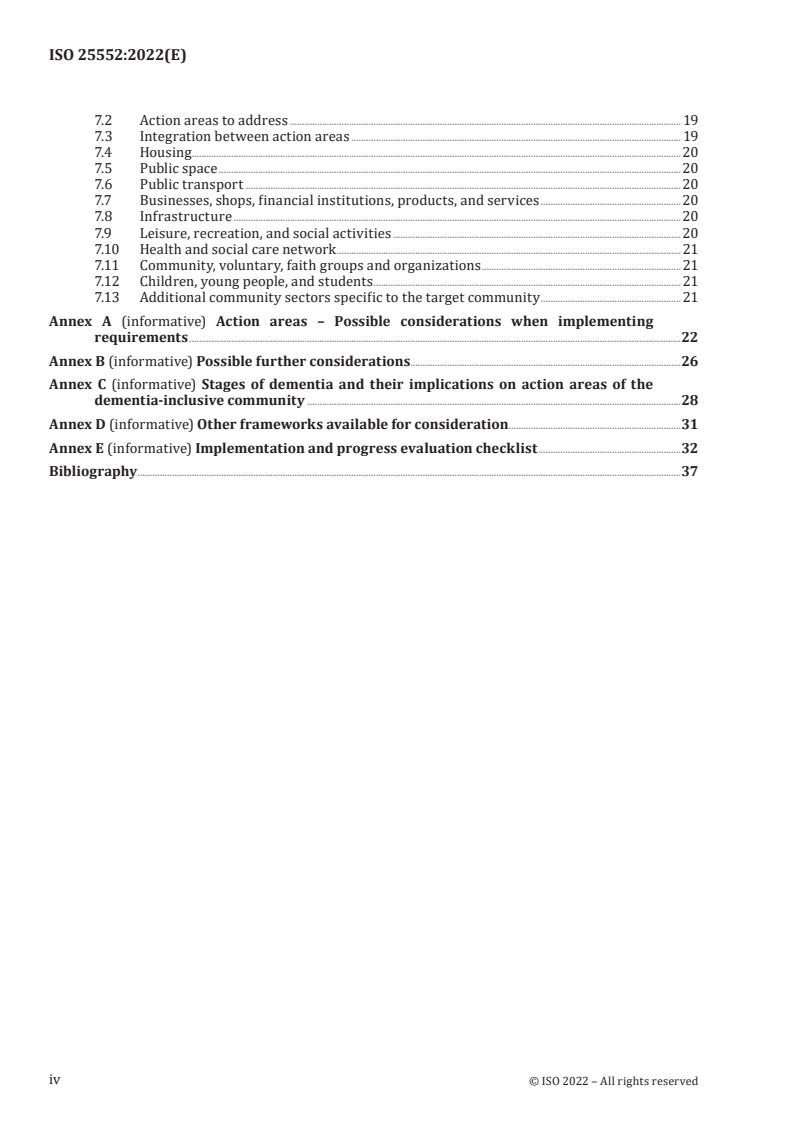
7.2 Action areas to address . 19
7.3 Integration between action areas . 19
7.4 Housing. 20
7.5 Public space . 20
7.6 Public transport . 20
7.7 Businesses, shops, financial institutions, products, and services . 20
7.8 Infrastructure .20
7.9 Leisure, recreation, and social activities . 20
7.10 Health and social care network . 21
7.11 Community, voluntary, faith groups and organizations . 21
7.12 Children, young people, and students . 21
7.13 Additional community sectors specific to the target community . 21
Annex A (informative) Action areas – Possible considerations when implementing
requirements .22
Annex B (informative) Possible further considerations.26
Annex C (informative) Stages of dementia and their implications on action areas of the
dementia-inclusive community .28
Annex D (informative) Other frameworks available for consideration .31
Annex E (informative) Implementation and progress evaluation checklist .32
Bibliography .37
iv
Foreword
ISO (the International Organization for Standardization) is a worldwide federation of national standards
bodies (ISO member bodies). The work of preparing International Standards is normally carried out
through ISO technical committees. Each member body interested in a subject for which a technical
committee has been established has the right to be represented on that committee. International
organizations, governmental and non-governmental, in liaison with ISO, also take part in the work.
ISO collaborates closely with the International Electrotechnical Commission (IEC) on all matters of
electrotechnical standardization.
The procedures used to develop this document and those intended for its further maintenance are
described in the ISO/IEC Directives, Part 1. In particular, the different approval criteria needed for the
different types of ISO documents should be noted. This document was drafted in accordance with the
editorial rules of the ISO/IEC Directives, Part 2 (see www.iso.org/directives).
Attention is drawn to the possibility that some of the elements of this document may be the subject of
patent rights. ISO shall not be held responsible for identifying any or all such patent rights. Details of
any patent rights identified during the development of the document will be in the Introduction and/or
on the ISO list of patent declarations received (see www.iso.org/patents).
Any trade name used in this document is information given for the convenience of users and does not
constitute an endorsement.
For an explanation of the voluntary nature of standards, the meaning of ISO specific terms and
expressions related to conformity assessment, as well as information about ISO's adherence to
the World Trade Organization (WTO) principles in the Technical Barriers to Trade (TBT), see
www.iso.org/iso/foreword.html.
This document was prepared by Technical Committee ISO/TC 314, Ageing societies.
Any feedback or questions on this document should be directed to the user’s national standards body. A
complete listing of these bodies can be found at www.iso.org/members.html.
v
Introduction
0.1 Overview
This document was developed in response to a worldwide recognition that individuals, families, and
communities need to be more inclusive concerning persons with dementia. One goal of this document is
to engage and include persons with dementia and their families, and carers, in communities of all types,
sizes, and locations.
A dementia-inclusive community is one that is committed to working together to promote a better
understanding of dementia, reduce stigma, raise public awareness, and that facilitates social inclusion
and participation. By fostering a dementia-inclusive environment, communities can support persons
with dementia to be independent citizens, to be connected as much as they want to, to feel safe and
comfortable, and to be able to maximise their abilities and opportunities to participate.
0.2 Challenges and solutions
The worldwide rise in the number of persons with dementia has led to a growing need to increase
understanding of dementia in all societies. Stigmatisation and discrimination towards persons with
dementia sometimes occur within their community, creating barriers to diagnosis, treatment, and care,
which can significantly impact their quality of life. Many societies do not support persons with dementia
adequately and discourage them from exerting maximum control over their own lives. Additional
support to enable continued engagement for persons with dementia in daily activities and community
life, or to enable participation in decision-making in life, is often provided too late or not at all.
There is a need for education to address knowledge about what a dementia diagnosis can mean for
persons with dementia and those around them, including treatment and care options as key elements,
which would support development of a dementia-inclusive community within an integrated care
approach.
NOTE Integrated care can include primary care, all allied health professionals, e.g. occupational therapists,
social workers, physiotherapists, and dementia advisers.
The creation of supportive, safe, and inclusive communities for persons with dementia and those who
care for them is essential to maximizing everyone’s quality of life.
This document provides a comprehensive and interdisciplinary framework to develop a dementia-
inclusive community.
Moreover, this document recognizes that training, resources, experience, personnel availability, and
existing organizational structures are constraints that can have a direct impact on how quickly and
effectively a dementia-inclusive community can be planned and implemented. Therefore, this document
provides guidance on how to identify these constraints and address them as part of the process of
designing a dementia-inclusive community.
A person with dementia possibly experiences physical, sensory, cognitive, social, and communication
challenges and these need to be considered as part of a dementia-inclusive community. ISO/IEC Guide 71
provides information on various human capabilities and characteristics relevant to this document.
0.3 Expected outcomes and users of this document
Some of the expected outcomes from the use of this document include the following:
— improvement of the quality of life for anyone with dementia in a community;
— development of quality services for persons with dementia;
— ability to obtain recognition for establishing a dementia-inclusive community;
— optimization of the resources needed to develop a dementia-inclusive community;
vi
— creation of new opportunities for all stakeholders in a dementia-inclusive community;
— more inclusive communities generally, where the participation of everybody, including persons
with dementia, is facilitated and encouraged.
This document is aimed towards, but not limited to, user categories such as the following:
— authorities having jurisdiction within communities;
— organizations, congregations, and community groups;
— individuals, carers, and families;
— persons of interest in education, research, and development;
— decision makers;
— planners, designers, and providers of products, services, the built environment, and the community
infrastructures.
0.4 Other requirements
There can exist other requirements, including regulatory requirements that can affect aspects of
a dementia-inclusive community as addressed in this document (e.g. revoking drivers’ licenses,
provisions, and regulations for the restriction of freedom and decision-making in later stages of
dementia). Consequently, those developing a dementia-inclusive community should identify potential
regulatory, health and other requirements that can be in conflict with a dementia-inclusive community
and discuss how these conflicts can be resolved or mitigated.
0.5 Approach and structure of this document
The challenges and solutions outlined above set the subject matter and objectives for this document.
An integrated community network is built on the development and integration of the community
sectors, referred to as action areas.
Clause 4 provides a process-based framework for the development, maintenance, and continuous
improvement of dementia-inclusive communities. To transform into a dementia-inclusive community,
a set of generic guiding principles is presented in Clause 5. Clause 6 provides a set of requirements for
the design of a dementia-inclusive network, while Clause 7 provides information about the action areas
and integration between them.
The annexes provide additional information on aspects such as possible considerations when
implementing requirements (see Annexes A and B) stages of dementia (see Annex C), other frameworks
available for consideration (see Annex D), and a compact implementation and progress evaluation
checklist (see Annex E).
vii
INTERNATIONAL STANDARD ISO 25552:2022(E)
Ageing societies — Framework for dementia-inclusive
communities
1 Scope
This document provides a framework for dementia-inclusive communities, including principles and the
considerations of inclusion, quality of life, built environments, special needs groups, and stakeholder
engagement. It also provides guidance on how to systematically leverage, improve, and interconnect
their existing assets and structures and transform efficiently into a dementia-inclusive community.
This document does not provide any clinical standards.
2 Normative references
There are no normative references in this document.
3 Terms and definitions
For the purposes of this document, the following terms and definitions apply.
ISO and IEC maintain terminology databases for use in standardization at the following addresses:
— ISO Online browsing platform: available at https:// www .iso .org/ obp
— IEC Electropedia: available at https:// www .electropedia .org/
3.1
dementia
set of symptoms affecting brain function that are caused by neurodegenerative and vascular diseases
or injuries
Note 1 to entry: Dementia is characterized by a decline in cognitive abilities such as memory; awareness of
person, place, and time; language, basic math skills; judgement; and planning. Dementia can also affect mood
and behaviour. As a chronic and progressive condition, dementia can significantly interfere with the ability to
maintain activities of daily living, such as eating, bathing, toileting, and dressing.
Note 2 to entry: Alzheimer’s disease, vascular disease, and other types of illnesses all contribute to dementia.
Other common types of dementia include Lewy body dementia, frontotemporal dementia, and mixed dementias.
In rare instances, dementia can be linked to infectious diseases, including Creutzfeldt-Jakob disease.
3.2
dementia-inclusive
providing equal access to opportunities and resources for persons with dementia (3.1), including, but not
limited to, a focus on stigma reduction, accessibility (3.9), individual tailored services, and participation
Note 1 to entry: In a dementia-inclusive community, people are educated about dementia, its progression, and
know that a person with dementia can sometimes experience the world differently. Persons with dementia,
their families, and their carers are empowered, supported, and included in the community. The rights and full
potential of the person with dementia are recognized and understood by all communities.
Note 2 to entry: In a dementia-inclusive community, the community facilitates persons with dementia and carers
to optimize their health and wellbeing; live as independently as possible; be understood and supported; safely
navigate and access their local communities, and to maintain their social networks.
3.3
community
place or group of people with an arrangement of responsibilities, activities and relationships
Note 1 to entry: A location such as a city, town, neighbourhood, village, or rural area, but it can also include groups
of people with shared interests or features, such as professional groups, religious organizations and businesses.
Note 2 to entry: In many, but not all, contexts, a community has a defined geographical boundary.
Note 3 to entry: The following are also considered as actors in the community:
— authorities having jurisdiction within the community;
— organizations, congregations, and community groups;
— individuals, carers, and families;
— persons of interest in education, research, and development;
— planners and providers of products, services, the built environment, and the community infrastructures.
[SOURCE: ISO/TS 37151:2015, 3.1, modified — “place or” has been added, Note 1 to entry has been
modified, and Note 2 to entry and Note 3 to entry have been added.]
3.4
community-based services
community-based care
community-based programmes
health and social services integration provided to an individual or family at their place of residence
or at other non-institutional locations within the community (3.3) for the purpose of promoting,
maintaining, or restoring health, minimizing the effects of illness and disability, and supporting and
facilitating autonomy (3.5) and self-care
Note 1 to entry: Services and programmes can include healthcare workers, befriending services, delivered meals,
home care, community mental health, health education, screening, immunizations, family planning, sexual
health, palliative care etc.
[SOURCE: ISO/IWA 18:2016, 2.2, modified — “health and social services integration provided to an
individual or family at their place” has replaced “blend of health and social services provided to an
individual or family in his/her place”, “or at other non-institutional locations within the community” has
been added, “on his/her normal lifestyle” has been removed, “and supporting and facilitating autonomy
and self-care” has been added, Note 1 to entry has been removed, “community-based programmes” has
been added as admitted term, and new Note 1 to entry has been added.]
3.5
autonomy
ability to control, cope with and make personal decisions about how one lives on a daily basis, according
to one’s own rules and preferences
3.6
independent living
living at home or in a community (3.3) without the need for continuous help from another person and
with a degree of self-determination or control over one's activities
Note 1 to entry: Independent living can refer to a range of housing and community arrangements that maximize
independence and self-determination.
[SOURCE: WHO Ageing and Health Technical Report, Vol.5 and U.S. National Library of Medicine]
3.7
participation
active involvement in a life/community situation
Note 1 to entry: Situation can also be understood to be the community.
[SOURCE: ICF 2001, WHO; ISO 9999:2016, 2.13, modified — “active” has been added, “life/community
situation” has replaced “life situation”, and Note 1 to entry has been added.]
3.8
engagement
involvement in, and contribution to, activities to achieve shared objectives
Note 1 to entry: This involves:
— active involvement of persons with dementia in activities (social, physical, mental) that have a positive
influence on their health and wellbeing and eventually autonomy and independence;
— activities that strengthen their family life and relationships;
— active contributions to the community to enhance the persons with dementia feeling of being of value to their
community.
3.9
accessibility
extent to which products, systems, services, environments and facilities can be used by people from a
population with the widest range of user needs, characteristics and capabilities to achieve identified
goals in identified contexts of use
Note 1 to entry: Context of use includes direct use or use supported by assistive technologies.
[SOURCE: ISO 9241-112:2017, 3.15]
3.10
meaningful life
construct having to do with the purpose, significance, fulfilment, participation (3.7), and satisfaction of
life
Note 1 to entry: A meaningful life can signify many different things for different people depending on culture,
age, etc.
Note 2 to entry: What is seen as a “meaningful life” varies between cultures.
[SOURCE: A Dementia Strategy for Canada, June 2019]
3.11
quality of life
product of the balance between social, spiritual, physical, and mental health, economic and
environmental conditions that affect human and social development
Note 1 to entry: It is a broad-ranging concept, incorporating a person’s physical health, psychological state, level
of independence, social relationships, personal beliefs, and relationship to salient features in the environment.
[SOURCE: ISO/IWA 18:2016, 2.22, modified — “spiritual, physical, and mental” has been added.]
3.12
ethical aspect
aspect of organizational/community behaviour that is in accordance with a human rights-based
approach with a focus on the values of honesty, equity, and integrity related to the creation, design/
development, maintenance, and improvement of a dementia-inclusive (3.2) community (3.3)
3.13
prevention
action aimed at promoting, preserving, and restoring health when it is impaired and to minimize
suffering and distress
Note 1 to entry: Prevention refers specifically to all aspects (medical, social, physical, cognitive, behavioural,
etc.) potentially associated with having dementia.
Note 2 to entry: In public health, ‘prevention’ includes primary prevention, secondary prevention and tertiary
prevention. Primary prevention refers to actions performed to prevent the development or delay the onset of
diseases. Healthy lifestyle promotion and vaccinations are examples of primary prevention. Secondary prevention
is the early detection of disease before the symptoms or signs of ill-health arise, to intervene and thereby prevent
or delay their progress. Screening for chronic diseases and cancers fall under this category. Tertiary prevention
aims to prevent a recurrence, complications, and further negative impact of the diseases after they have already
occurred, to maximize longevity and quality of life. Examples of this include rehabilitation of a person who
survives a stroke, and the environment enhancement for a person with dementia, etc.
[SOURCE: ISO/IWA 18:2016, 2.19, modified — Note 1 to entry, and Note 2 to entry have been added.]
3.14
care
provision of what is necessary for the health, welfare, maintenance, and protection of someone
3.15
carer
caregiver
person who provides care (3.14)
3.16
culturally appropriate care
consideration given to cultural background, personal experiences and norms in the context of providing
any formal or informal services to a person with dementia (3.1)
[SOURCE: A Dementia Strategy for Canada, June 2019]
3.17
formal carer
formal caregiver
paid professional who provides regular care (3.14)
3.18
formal care
care (3.14) provided on a regular, paid basis by organizations or persons representing organizations or
by other persons
Note 1 to entry: Organizations can be profit-making or non-profit-making, public or private. Persons typically
exclude family, friends or neighbours.
3.19
informal carer
informal caregiver
generally unpaid person who provides care (3.14) from time to time
Note 1 to entry: This term does not include trained care providers affiliated with home care agencies when
working with clients at those agencies.
Note 2 to entry: An informal carer is likely to be a family member, relative, close friend, neighbour or volunteer.
Support provided by an informal carer may include assisting with the activities of daily living, and helping with
advance care planning.
3.20
informal care
care (3.14) provided by family, friends, or neighbours
3.21
person-centred care
way of organising and conducting care (3.14) that promotes the provision of care centred on a specific
person’s needs and preferences, identity, and their engagement (3.8) in the care process
Note 1 to entry: Person-centred care usually relies on concepts such as individualisation, personalisation,
autonomy, participation, and engagement to achieve its goals.
3.22
family
combination of two or more persons who are bound together over time by ties of mutual consent, birth
and/or adoption or placement and who, together, assume responsibilities for various roles and functions
Note 1 to entry: This can include “chosen families,” such as strong friendships and communities where unrelated
persons provide care normally provided by nuclear family members.
3.23
integrated community network
network of human relationships that facilitates autonomy (3.5), integration, and engagement (3.8) of
persons with dementia (3.1) and their carers (3.15) and provides community-based services (3.4)
Note 1 to entry: The activities of the integrated community network are based on taking measures, such as
the strengthening of family life, design of an integrated and phased health and social care network, and the
integration across community sectors and the continuous improvement of the dementia inclusiveness of these
sectors.
3.24
guiding principle
generic and essential principle or design specificity that informs the design of the dementia-inclusive
(3.2) community (3.3) as a whole at all stages of planning, design, operation, and improvement
Note 1 to entry: In particular, guiding principles inform the design of the integrated community network and the
design of the action areas.
3.25
action area
community sector involved in developing an integrated community network (3.23) to establish a
dementia-inclusive (3.2) community (3.3)
Note 1 to entry: An action area, for example, can include housing, infrastructure, leisure, etc.
3.26
active assisted living
AAL
concepts, products, services, and systems combining technologies and social environment with the aim
of improving the quality of people’s lives
[SOURCE: IEC 60050-871: 2018, 871-01-02]
3.27
active assisted living service
AAL service
action or function of an AAL system creating an added value for customers
EXAMPLE An AAL service could comprise, for example
— configuration and maintenance of AAL systems,
— assistant systems to support the home environment.
Note 1 to entry: An AAL service can consist of several individual services.
[SOURCE: IEC 60050-871: 2018, 871-01-04]
3.28
assistive technology
equipment, product system, hardware, software or service that is used to increase, maintain or improve
capabilities and safety of individuals
Note 1 to entry: Assistive technology can include assistive services and professional services needed for
assessment, recommendation, and provision.
[SOURCE: ISO/IEC Guide 71: 2014, 2.16, modified — “and safety” has been added, Note 1 to entry has
been removed, Note 2 to entry has become Note 1 to entry.]
3.29
assistive product
product (including devices, equipment, instruments and software), especially produced or generally
available, used by or for persons with disability
Note 1 to entry: An assistive product can be used
— for participation,
— to protect, support, train, measure or substitute for body functions/structures and activities, or
— to prevent impairments, activity limitations or participation restrictions.
[SOURCE: ISO 9999:2016, 2.3, modified — Note 1 to entry has been removed, bullet points from
definition have been added as new Note 1 to entry.]
3.30
process
set of interrelated or interacting activities that use inputs to deliver an intended result
Note 1 to entry: Whether the “intended result” of a process is called, output, product, or service, depends on the
context of the reference.
Note 2 to entry: Inputs to a process are generally the outputs of other processes and outputs of a process are
generally the inputs to other processes.
Note 3 to entry: Two or more interrelated and interacting processes in series can also be referred to as a process.
[SOURCE: ISO 9000:2015, 3.4.1, modified — Notes 4, 5 and 6 to entry have been removed.]
3.31
elder abuse
single, or repeated act, or lack of appropriate action, occurring within any relationship where there is
an expectation of trust, which causes harm or distress to an older person
[SOURCE: WHO Fact sheet elder abuse, 2021]
4 Development of a dementia-inclusive community
4.1 General
The development of a dementia-inclusive community is a continuous and dynamic process.
4.2 Systematic development process
4.2.1 General
A systematic, formalised, and phased process should be applied to properly conceive, plan, implement,
assess, and improve a dementia-inclusive community.
4.2.2 Establish the general process
The community shall establish, document, and maintain a systematic process for setting up, adjusting
and developing the dementia-inclusive community. This process should guide the implementation of
the requirements and recommendations set out in Clauses 5 to 7.
The process approach should:
— be coupled with a structured and cyclic development methodology such as the “Plan-Do-Check-Act”
(PDCA) cycle;
— incorporate analysing and addressing possible risks.
NOTE 1 The PDCA cycle refers to a four-part management method that provides guidance for continuous
[36]
improvement. It is also referred to as the Deming cycle .
Where applicable and desired, the development process and the incorporation of the requirements and
recommendations provided in this document can be implemented in line with, or as part of a formalised
management or quality management process.
NOTE 2 Management or quality management processes in this case refer to management structures already
existing in the community, a quality management process (e.g. according to ISO 9001 or any domain specific
quality management process or standard), or a management system standard.
4.3 Process elements of a dementia-inclusive community
4.3.1 General
Requirements and recommendations in this clause are process and management-oriented and facilitate
the efficient implementation of the function and object-oriented requirements and recommendations in
Clauses 5 to 7.
4.3.2 Establish basic processes elements
When establishing a systematic development process, the following aspects should be considered:
— build on and improve existing structures in the community, ensuring in particular the development
and retention of an inclusive community identity and an efficient and effective development process
and use of resources;
— apply risk governance and management strategies to ensure that there is adequate risk-benefit
assessment, and assurance that the benefits outweigh the risks when implementing elements of the
dementia-inclusive community;
— communicate plans and progress to persons with dementia, families, carers, other key stakeholders
and the public in clear, transparent, appropriate, accessible formats, and provide updates at regular,
planned intervals;
— throughout all process phases and iteration cycles, systematically identify, incorporate and ensure
cross-compatibility with other relevant standards that can have relevance regarding any stage or
action of the process of creating a dementia-inclusive community;
NOTE 1 To make its development process over time more efficient, the community can develop its own tools
and templates based on the requirements and recommendations set out in this document.
NOTE 2 To facilitate that a holistic community development approach is adopted, Annex D provides an
overview of other frameworks available for consideration. The framework presented in this document is open
and encourages community specific additions and adaptations.
NOTE 3 The Bibliography contains a comprehensive but non-exhaustive list of potentially relevant standards.
— understand dementia, types of dementia, epidemiological data about dementia in the community,
and the progression of dementia;
— use supported decision-making to involve persons with dementia, and carers in the analysis process
(e.g. through focus group meetings, community listening sessions);
— analyse the potential of involving or incorporating research and development;
— examine the possibilities of incorporating products and services considered under the umbrella
term active assisted living;
— analyse physical, sensory and cognitive accessibility in the community, including built environment,
transportation, technology, etc.;
— define vision and goals (including stages of the progression of dementia covered) for the dementia-
inclusive community;
— define measures to improve data collection and analysis, and the use of active assisted living
products and services;
— define a set of suitable and community-specific indicators that allow progress and performance
evaluation.
To ensure continuity, sustainability, and accountability of dementia-inclusive communities over time,
the communities should ensure the equitable allocation of resources.
A community that is dementia-inclusive, or aiming to become so, should analyse and assess the existing
situation, while advocating and creating a climate for change. This will enable the community to build
on and improve existing structures.
The community should establish a structure to oversee the development of the dementia-inclusive
community. This can include a steering committee and an advisory committee. This structure should
also include representatives of stakeholder organizations, persons with lived experience of dementia
and those caring for persons with dementia, and other interested members of society. Cultural
minorities should also be represented. An impact statement for the dementia-inclusive community
should be written.
NOTE 4 Clause B.2 provides additional considerations regarding an extended person-centred and
personalisation-oriented development of the community.
NOTE 5 Annex E provides an implementation and progress evaluation checklist.
5 Guiding principles: outcomes and enabling factors
5.1 General
To achieve real and sustainable change within communities, a change in societal culture about dementia
is needed. A systematic, formalized, and phased process can support community actors involved in the
dementia-inclusive community development.
Guiding principles are generic and inform the design of the integrated community network and the
action areas. A dementia-inclusive community takes the applicable guiding principles into account at all
stages of planning, design, operation, and evaluation. Integrated community networks and the action
areas are addressed in Clauses 6 and 7.
These guiding principles address the lack of awareness and understanding of dementia that result
in stigmatization and barriers to diagnosis and care. Quality of life for persons with dementia
encompasses physical, psychological, social, ethical, and existential aspects. The stigma surrounding
dementia informs stereotypes that are generally inaccurate as they focus on the symptoms of
dementia rather than recognising the abilities and skills of the person with dementia. This can lead
to mistreatment, exploitation, abuse, isolation, and poor mental health for persons with dementia.
Over time the enabling factors required to develop and sustain a dementia-inclusive community can
lead to a reduction in stigma, and the elimina
...