


ISO 7240-6:2004
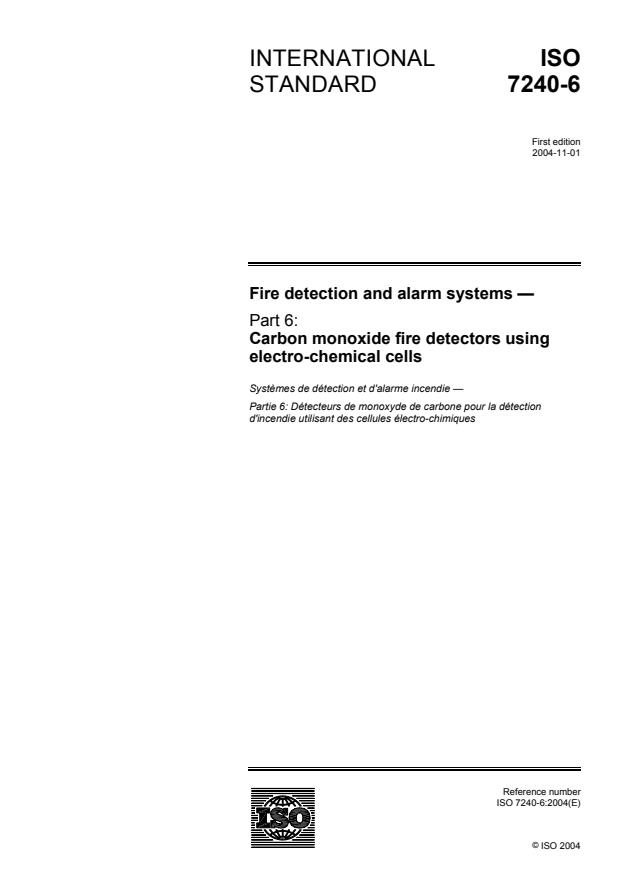
(Main)Fire detection and alarm systems — Part 6: Carbon monoxide fire detectors using electro-chemical cells
Fire detection and alarm systems — Part 6: Carbon monoxide fire detectors using electro-chemical cells
ISO 7240-6:2004 specifies requirements, test methods and performance criteria for point fire detectors using electro-chemical cells that operate using carbon monoxide detection principles for use in fire detection and fire alarm systems installed in buildings (see ISO 7240-1). CO fire detectors conforming to ISO 7240-6:2004 might not be suitable for other uses. For the testing of other types of fire detectors, or smoke detectors working on different principles, ISO 7240-6:2004 should be used only for guidance. Fire detectors with special characteristics and developed for specific risks are not covered by ISO 7240-6:2004.
Systèmes de détection et d'alarme incendie — Partie 6: Détecteurs de monoxyde de carbone pour la détection d'incendie utilisant des cellules électro-chimiques
General Information
- Status
- Withdrawn
- Publication Date
- 02-Nov-2004
- Withdrawal Date
- 02-Nov-2004
- Technical Committee
- ISO/TC 21/SC 3 - Fire detection and alarm systems
- Drafting Committee
- ISO/TC 21/SC 3 - Fire detection and alarm systems
- Current Stage
- 9599 - Withdrawal of International Standard
- Start Date
- 27-May-2011
- Completion Date
- 14-Feb-2026
Relations
- Effective Date
- 24-Jul-2008
Get Certified
Connect with accredited certification bodies for this standard

NSF International
Global independent organization facilitating standards development and certification.

CIS Institut d.o.o.
Personal Protective Equipment (PPE) certification body. Notified Body NB-2890 for EU Regulation 2016/425 PPE.

Kiwa BDA Testing
Building and construction product certification.
Sponsored listings
Frequently Asked Questions
ISO 7240-6:2004 is a standard published by the International Organization for Standardization (ISO). Its full title is "Fire detection and alarm systems — Part 6: Carbon monoxide fire detectors using electro-chemical cells". This standard covers: ISO 7240-6:2004 specifies requirements, test methods and performance criteria for point fire detectors using electro-chemical cells that operate using carbon monoxide detection principles for use in fire detection and fire alarm systems installed in buildings (see ISO 7240-1). CO fire detectors conforming to ISO 7240-6:2004 might not be suitable for other uses. For the testing of other types of fire detectors, or smoke detectors working on different principles, ISO 7240-6:2004 should be used only for guidance. Fire detectors with special characteristics and developed for specific risks are not covered by ISO 7240-6:2004.
ISO 7240-6:2004 specifies requirements, test methods and performance criteria for point fire detectors using electro-chemical cells that operate using carbon monoxide detection principles for use in fire detection and fire alarm systems installed in buildings (see ISO 7240-1). CO fire detectors conforming to ISO 7240-6:2004 might not be suitable for other uses. For the testing of other types of fire detectors, or smoke detectors working on different principles, ISO 7240-6:2004 should be used only for guidance. Fire detectors with special characteristics and developed for specific risks are not covered by ISO 7240-6:2004.
ISO 7240-6:2004 is classified under the following ICS (International Classification for Standards) categories: 13.220.20 - Fire protection. The ICS classification helps identify the subject area and facilitates finding related standards.
ISO 7240-6:2004 has the following relationships with other standards: It is inter standard links to ISO 7240-6:2011. Understanding these relationships helps ensure you are using the most current and applicable version of the standard.
ISO 7240-6:2004 is available in PDF format for immediate download after purchase. The document can be added to your cart and obtained through the secure checkout process. Digital delivery ensures instant access to the complete standard document.
Standards Content (Sample)
INTERNATIONAL ISO
STANDARD 7240-6
First edition
2004-11-01
Fire detection and alarm systems —
Part 6:
Carbon monoxide fire detectors using
electro-chemical cells
Systèmes de détection et d'alarme incendie —
Partie 6: Détecteurs de monoxyde de carbone pour la détection
d'incendie utilisant des cellules électro-chimiques
Reference number
©
ISO 2004
PDF disclaimer
This PDF file may contain embedded typefaces. In accordance with Adobe's licensing policy, this file may be printed or viewed but
shall not be edited unless the typefaces which are embedded are licensed to and installed on the computer performing the editing. In
downloading this file, parties accept therein the responsibility of not infringing Adobe's licensing policy. The ISO Central Secretariat
accepts no liability in this area.
Adobe is a trademark of Adobe Systems Incorporated.
Details of the software products used to create this PDF file can be found in the General Info relative to the file; the PDF-creation
parameters were optimized for printing. Every care has been taken to ensure that the file is suitable for use by ISO member bodies. In
the unlikely event that a problem relating to it is found, please inform the Central Secretariat at the address given below.
© ISO 2004
All rights reserved. Unless otherwise specified, no part of this publication may be reproduced or utilized in any form or by any means,
electronic or mechanical, including photocopying and microfilm, without permission in writing from either ISO at the address below or
ISO's member body in the country of the requester.
ISO copyright office
Case postale 56 • CH-1211 Geneva 20
Tel. + 41 22 749 01 11
Fax + 41 22 749 09 47
E-mail copyright@iso.org
Web www.iso.org
Published in Switzerland
ii © ISO 2004 – All rights reserved
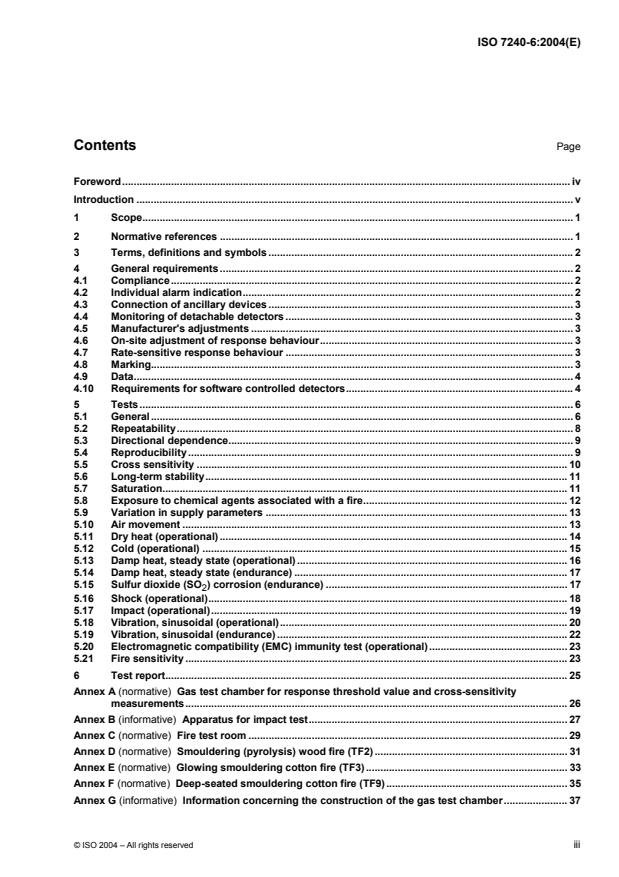
Contents Page
Foreword. iv
Introduction . v
1 Scope. 1
2 Normative references. 1
3 Terms, definitions and symbols . 2
4 General requirements. 2
4.1 Compliance. 2
4.2 Individual alarm indication. 2
4.3 Connection of ancillary devices . 3
4.4 Monitoring of detachable detectors . 3
4.5 Manufacturer's adjustments. 3
4.6 On-site adjustment of response behaviour. 3
4.7 Rate-sensitive response behaviour . 3
4.8 Marking. 3
4.9 Data. 4
4.10 Requirements for software controlled detectors. 4
5 Tests. 6
5.1 General. 6
5.2 Repeatability. 8
5.3 Directional dependence. 9
5.4 Reproducibility. 9
5.5 Cross sensitivity. 10
5.6 Long-term stability. 11
5.7 Saturation. 11
5.8 Exposure to chemical agents associated with a fire. 12
5.9 Variation in supply parameters . 13
5.10 Air movement. 13
5.11 Dry heat (operational). 14
5.12 Cold (operational). 15
5.13 Damp heat, steady state (operational) . 16
5.14 Damp heat, steady state (endurance) . 17
5.15 Sulfur dioxide (SO ) corrosion (endurance) . 17
5.16 Shock (operational). 18
5.17 Impact (operational). 19
5.18 Vibration, sinusoidal (operational). 20
5.19 Vibration, sinusoidal (endurance) . 22
5.20 Electromagnetic compatibility (EMC) immunity test (operational). 23
5.21 Fire sensitivity. 23
6 Test report. 25
Annex A (normative) Gas test chamber for response threshold value and cross-sensitivity
measurements. 26
Annex B (informative) Apparatus for impact test. 27
Annex C (normative) Fire test room . 29
Annex D (normative) Smouldering (pyrolysis) wood fire (TF2). 31
Annex E (normative) Glowing smouldering cotton fire (TF3). 33
Annex F (normative) Deep-seated smouldering cotton fire (TF9). 35
Annex G (informative) Information concerning the construction of the gas test chamber. 37
Foreword
ISO (the International Organization for Standardization) is a worldwide federation of national standards bodies
(ISO member bodies). The work of preparing International Standards is normally carried out through ISO
technical committees. Each member body interested in a subject for which a technical committee has been
established has the right to be represented on that committee. International organizations, governmental and
non-governmental, in liaison with ISO, also take part in the work. ISO collaborates closely with the
International Electrotechnical Commission (IEC) on all matters of electrotechnical standardization.
International Standards are drafted in accordance with the rules given in the ISO/IEC Directives, Part 2.
The main task of technical committees is to prepare International Standards. Draft International Standards
adopted by the technical committees are circulated to the member bodies for voting. Publication as an
International Standard requires approval by at least 75 % of the member bodies casting a vote.
Attention is drawn to the possibility that some of the elements of this document may be the subject of patent
rights. ISO shall not be held responsible for identifying any or all such patent rights.
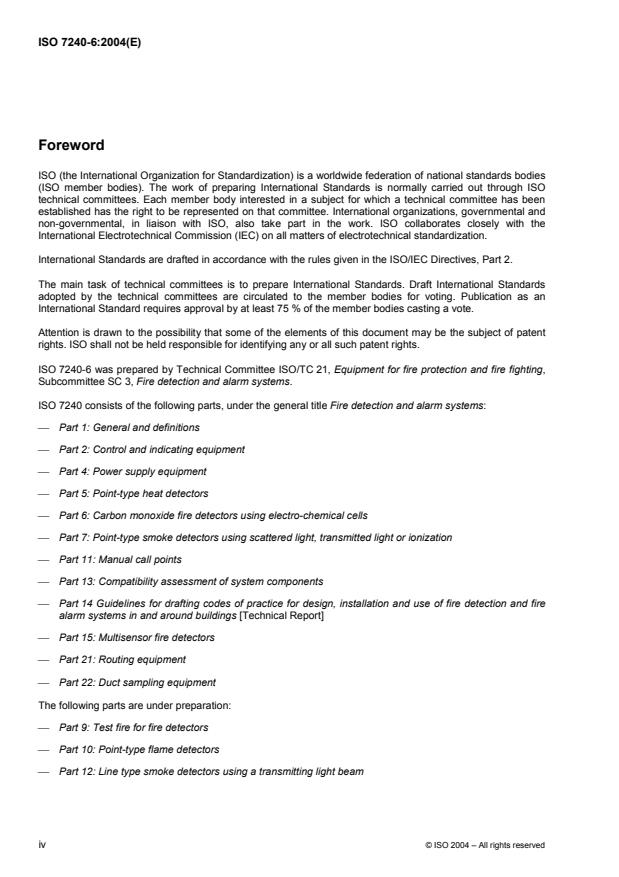
ISO 7240-6 was prepared by Technical Committee ISO/TC 21, Equipment for fire protection and fire fighting,
Subcommittee SC 3, Fire detection and alarm systems.
ISO 7240 consists of the following parts, under the general title Fire detection and alarm systems:
Part 1: General and definitions
Part 2: Control and indicating equipment
Part 4: Power supply equipment
Part 5: Point-type heat detectors
Part 6: Carbon monoxide fire detectors using electro-chemical cells
Part 7: Point-type smoke detectors using scattered light, transmitted light or ionization
Part 11: Manual call points
Part 13: Compatibility assessment of system components
Part 14 Guidelines for drafting codes of practice for design, installation and use of fire detection and fire
alarm systems in and around buildings [Technical Report]
Part 15: Multisensor fire detectors
Part 21: Routing equipment
Part 22: Duct sampling equipment
The following parts are under preparation:
Part 9: Test fire for fire detectors
Part 10: Point-type flame detectors
Part 12: Line type smoke detectors using a transmitting light beam
iv © ISO 2004 – All rights reserved
Introduction
This part of ISO 7240 has been drawn up by the Sub-Committee ISO/TC 21/SC 3 and is based on a Standard
prepared by Standards Australia International Technical Committee FP-002 “Fire detection, warning, control
and intercom systems”.
A fire detection and fire alarm system is required to function satisfactorily not only in the event of a fire, but
also during and after exposure to conditions likely to be met in practice such as corrosion, vibration, direct
impact, indirect shock and electromagnetic interference. Some tests specified are intended to assess the
performance of the fire detectors under such conditions.
The performance of fire detectors is assessed from results obtained in specific tests; this part of ISO 7240 is
not intended to place any other restrictions on the design and construction of such detectors.
Carbon monoxide (CO) fire detectors can react promptly to slow smouldering fires involving carbonaceous
materials because CO does not depend solely on convection, but also moves by diffusion and CO fire
detectors might be better suited to applications where other fire detection techniques are prone to false alarms,
i.e. due to dust, steam and cooking vapours.
Whilst CO gas has greater mobility than smoke, it can be diluted by ventilation systems and be affected by
convection currents. Hence the same considerations as for point smoke detectors should be taken into
account. Recirculating systems confined to a single room have little effect on dilution, as this is similar to the
natural diffusion of the CO gas.
CO fire detectors might be less affected by stratification than other types of fire detectors.
It is important that the location of CO fire detectors take into account areas where false operation or non-
operation is likely. CO fire detectors might not be suitable for detecting fires involving
clean-burning liquids;
PVC-insulated cables;
combustible metals;
certain self-oxidizing chemicals;
non-carbonaceous materials.
Some typical locations where it is important to carefully evaluate the use of CO fire detectors are as follows:
a) areas where CO gas may be present from exhausts and normal manufacturing processes.
EXAMPLES Car parks, car-park return air plenums, loading docks.
b) Generally cigarette smoke will not have sufficient CO present to cause alarms even though smoke may be
clearly visible. However, in heavy smoking or incense-burning areas, it is important to measure the CO
concentration before installing CO fire detectors.
This part of ISO 7240 includes a number of Electromagnetic Compatibility (EMC) immunity requirements. The
details for these requirements have been taken from European standard EN 50130-4 “Alarm Systems —
Part 4: Electromagnetic compatibility — Product family standard: Immunity requirements for components of
fire, intruder and social alarm systems”.
INTERNATIONAL STANDARD ISO 7240-6:2004(E)
Fire detection and alarm systems —
Part 6:
Carbon monoxide fire detectors using electro-chemical cells
1 Scope
This part of ISO 7240 specifies requirements, test methods and performance criteria for point fire detectors
using electro-chemical cells that operate using carbon monoxide detection principles for use in fire detection
and alarm systems installed in buildings (see ISO 7240-1). CO fire detectors conforming to this part of
ISO 7240 might not be suitable for other uses.
For the testing of other types of fire detectors, or smoke detectors working on different principles, this part of
ISO 7240 should be used only for guidance. Fire detectors with special characteristics and developed for
specific risks are not covered by this part of ISO 7240.
2 Normative references
The following referenced documents are indispensable for the application of this document. For dated
references, only the edition cited applies. For undated references, the latest edition of the referenced
document (including any amendments) applies.
ISO 209-1, Wrought aluminium and aluminium alloys — Chemical composition and forms of products —
Part 1: Chemical composition
ISO 7240-1, Fire detection and alarm systems — Part 1: General and definitions
ISO 7240-7. Fire detection and alarm systems — Part 7: Point-type smoke detectors using scattered light,
transmitted light or ionization
IEC 60068-1, Environmental testing — Part 1: General and guidance
IEC 60068-2-1, Environmental testing — Part 2: Tests. Tests A: Cold
IEC 60068-2-2, Environmental testing — Part 2: Tests. Tests B: Dry heat
IEC 60068-2-6, Environmental testing — Part 2: Tests — Test Fc: Vibration (sinusoidal)
IEC 60068-2-27, Environmental testing. Part 2: Tests. Test Ea and guidance: Shock
IEC 60068-2-30, Environmental testing — Part 2: Tests. Test Db and guidance: Damp heat, cyclic
(12 + 12-hour cycle)
IEC 60068-2-42, Environmental testing — Part 2-42: Tests —Test Kc: Sulphur dioxide test for contacts and
connections
IEC 60068-2-78, Environmental testing — Part 2-78: Tests — Test Cab: Damp heat, steady state
EN 50130-4, Alarm systems — Part 4: Electromagnetic compatibility — Product family standard: Immunity
requirements for components of fire, intruder and social alarm systems
3 Terms, definitions and symbols
For the purposes of this document, the terms, definitions and symbols given in ISO 7240-1 and the following
apply.
3.1
m
absorbance index
measured light attenuation characterizing the concentration of particulates in smoke or an aerosol
NOTE The equation for m is given in ISO 7240-7.
3.2
response threshold value
CO concentration in the proximity of the specimen at the moment that it enters an alarm state when tested as
specified in 5.1.5
NOTE The response threshold value might depend on signal processing in the detector and in the control and
indicating equipment.
3.3
y
dimensionless variable, reflecting the change in the current flowing in an ionization chamber as a known
function of the concentration of particulates in the smoke or aerosol
NOTE The equation for y is given in ISO 7240-7.
4 General requirements
4.1 Compliance
In order to comply with this part of ISO 7240, the detector shall meet the requirements of this clause, which
shall be verified by visual inspection or engineering assessment, shall be tested as specified in Clause 5 and
shall meet the requirements of the tests.
4.2 Individual alarm indication
Each detector shall be provided with an integral red visual indicator, by which the individual detector that
released an alarm may be identified, until the alarm condition is reset. Where other conditions of the detector
might be visually indicated, these shall be clearly distinguishable from the alarm indication, except when the
detector is switched into a service mode. For detachable detectors, the indicator may be integral with the base
or the detector head.
The visual indicator shall be visible from a distance of 6 m in an ambient light intensity up to 500 lx at an angle
of up to
a) 5° from the axis of the detector in any direction and
b) 45° from the axis of the detector in at least one direction.
2 © ISO 2004 – All rights reserved
4.3 Connection of ancillary devices
The detector may provide for connections to ancillary devices (e.g. remote indicators, control relays, etc.), but
open- or short-circuit failures of these connections shall not prevent the correct operation of the detector.
4.4 Monitoring of detachable detectors
For detachable detectors, a means shall be provided for a remote monitoring system (e.g. the control and
indicating equipment) to detect the removal of the head from the base, in order to give a fault signal.
4.5 Manufacturer's adjustments
It shall not be possible to change the manufacturer's settings except by special means (e.g. the use of a
special code or tool) or by breaking or removing a seal.
4.6 On-site adjustment of response behaviour
If there is provision for on-site adjustment of the response behaviour of the detector then
a) for all of the settings, at which the manufacturer claims compliance with this part of ISO 7240, the
detector shall comply with the requirements of this part of ISO 7240 and access to the adjustment means
shall be possible only by the use of a code or special tool or by removing the detector from its base or
mounting;
b) any setting(s) at which the manufacturer does not claim compliance with this part of ISO 7240 shall be
accessible only by the use of a code or special tool, and it shall be clearly marked on the detector or in
the associated data that if these setting(s) are used the detector does not comply with this part of
ISO 7240.
These adjustments may be carried out at the detector or at the control and indicating equipment.
4.7 Rate-sensitive response behaviour
The response threshold value of the detector might depend on the rate of change of CO concentration in the
vicinity of the detector. Such behaviour may be incorporated in the detector design to improve the
discrimination between ambient CO concentrations and those generated by a fire. If such rate-sensitive
behaviour is included, then it shall not lead to a significant reduction in the sensitivity of the detector to fires,
nor shall it lead to a significant increase in the probability of unwanted alarms.
Since it is not practical to make tests with all possible rates of increase in CO concentration, an assessment of
the rate sensitivity of the detector shall be made by analysis of the circuit/software and/or physical tests and
simulations.
The detector shall be deemed to meet the requirements of this clause if this assessment shows that
a) for any rate of increase in CO concentration less than 1 µl/l per minute, the detector will signal an alarm
condition before the CO concentration reaches 60 µl/l, and
b) the detector does not produce an alarm condition when subjected to a step change in CO concentration
of 10 µl/l, superimposed on a background concentration of between 0 µl/l and 5 µl/l.
4.8 Marking
Each detector shall be clearly marked with the following information:
a) number of this part of ISO 7240 (i.e. ISO 7240-6);
b) name or trademark of the manufacturer or supplier;
c) model designation (type or number);
d) wiring-terminal designations;
e) some mark(s) or code(s) (e.g. serial number or batch code), by which the manufacturer can identify, at
least, the date or batch and place of manufacture, and the version number(s) of any software contained
within the detector;
f) life-expectancy of the electro-chemical cell under normal operating conditions.
For detachable detectors, the detector head shall be marked with a), b), c), e) and f), and the base shall be
marked with, at least c), i.e. its own model designation, and d).
Where any marking on the device uses symbols or abbreviations not in common use, then these should be
explained in the data supplied with the device.
The markings shall be visible during installation of the detector and shall be accessible during maintenance.
The markings shall not be placed on screws or other easily removable parts.
4.9 Data
Detectors shall either be supplied with sufficient technical, installation and maintenance data to enable their
correct installation and operation or, if all of these data are not supplied with each detector, reference to the
appropriate data sheet shall be given on or with each detector.
To enable correct operation of the detectors, these data should describe the requirements for the correct
processing of the signals from the detector. This may be in the form of a full technical specification of these
signals, a reference to the appropriate signalling protocol or a reference to suitable types of control and
indicating equipment, etc.
Installation and maintenance data shall include reference to an in situ test method to ensure that detectors
operate correctly when installed.
NOTE Additional information might be required by organizations certifying that detectors produced by a manufacturer
conform to the requirements of this part of ISO 7240.
4.10 Requirements for software controlled detectors
4.10.1 General
The requirements of 4.10.2, 4.10.3 and 4.10.4 shall apply to detectors that rely on software control in order to
fulfil the requirements of this part of ISO 7240.
4.10.2 Software documentation
4.10.2.1 The manufacturer shall submit documentation that gives an overview of the software design. This
documentation shall be in sufficient detail for the design to be inspected for compliance with this part of
ISO 7240 and shall include at least the following:
a) functional description of the main program flow (e.g. as a flow diagram or schema) including the following:
1) a brief description of the modules and the functions that they perform,
2) the way in which the modules interact,
3) the overall hierarchy of the program,
4 © ISO 2004 – All rights reserved
4) the way in which the software interacts with the hardware of the detector,
5) the way in which the modules are called, including any interrupt processing;
b) description of which areas of memory are used for the various purposes (e.g. the program, site-specific
data and running data);
c) designation, by which the software and its version can be uniquely identified.
4.10.2.2 The manufacturer shall have available detailed design documentation, which needs to be
provided only if required by the testing authority. It shall comprise at least the following:
a) overview of the whole system configuration, including all software and hardware components;
b) description of each module of the program, containing at least:
1) name of the module,
2) description of the tasks performed,
3) description of the interfaces, including the type of data transfer, the valid data range and the checking
for valid data;
c) full source-code listings, as hard copy or in machine-readable form (e.g. ASCII-code), including all global
and local variables, constants and labels used, and sufficient comment for the program flow to be
recognized;
d) details of any software tools used in the design and implementation phase (e.g. CASE-Tools, Compilers,
etc.).
4.10.3 Software design
In order to ensure the reliability of the detector, the following requirements for software design shall apply.
a) The software shall have a modular structure.
b) The design of the interfaces for manually and automatically generated data shall not permit invalid data to
cause error in the program operation.
c) The software shall be designed to avoid the occurrence of deadlock of the program flow.
4.10.4 Storage of programs and data
The program necessary to comply with this part of ISO 7240 and any preset data, such as manufacturer's
settings, shall be held in non-volatile memory. Writing to areas of memory containing this program and data
shall be possible only by the use of some special tool or code and shall not be possible during normal
operation of the detector.
Site-specific data shall be held in memory that will retain data for at least two weeks without external power to
the detector, unless provision is made for the automatic renewal of such data, following loss of power, within
1 h of power being restored.
5 Tests
5.1 General
5.1.1 Atmospheric conditions for tests
Unless otherwise stated in a test procedure, the testing shall be carried out after the test specimen has been
allowed to stabilize in the standard atmospheric conditions for testing as specified in IEC publication 60068-1
as follows:
temperature: (15 to 35) °C;
relative humidity: (25 to 75) %;
air pressure: (86 to 106) kPa.
The temperature and humidity shall be substantially constant for each environmental test where the standard
atmospheric conditions are applied.
5.1.2 Operating conditions for tests
If a test method requires a specimen to be operational, then the specimen shall be connected to suitable
supply and monitoring equipment with characteristics as required by the manufacturer's data. Unless
otherwise specified in the test method, the supply parameters applied to the specimen shall be set within the
manufacturer's specified range(s) and shall remain substantially constant throughout the tests. The value
chosen for each parameter shall normally be the nominal value, or the mean of the specified range. If a test
procedure requires a specimen to be monitored to detect any alarm or fault signals, then connections shall be
made to any necessary ancillary devices (e.g. through wiring to an end-of-line device for conventional
detectors) to allow a fault signal to be recognized.
The details of the supply and monitoring equipment and the alarm criteria used shall be given in the test report
(Clause 6).
5.1.3 Mounting arrangements
The specimen shall be mounted by its normal means of attachment in accordance with the manufacturer's
instructions. If these instructions describe more than one method of mounting, then the method considered to
be most unfavourable shall be chosen for each test.
5.1.4 Tolerances
Unless otherwise stated, the tolerances for the environmental test parameters shall be as given in the basic
reference standards for the test (e.g. the relevant part of IEC 60068).
If a specific tolerance or deviation limit is not specified in a requirement or test procedure, then a deviation
limit of ± 5 % shall be applied.
5.1.5 Measurement of response threshold value
5.1.5.1 Install the specimen for which the response threshold value is to be measured in the gas test
chamber, as specified in Annex A, in its normal operating position, by its normal means of attachment. The
orientation of the specimen, relative to the direction of gas flow, shall be the least sensitive orientation as
determined in the directional dependence test, unless otherwise specified in the test procedure.
5.1.5.2 Before commencing each measurement, the gas test chamber shall be purged to ensure that the
carbon monoxide concentration is less than 1 µl/l prior to each test.
6 © ISO 2004 – All rights reserved
5.1.5.3 The air velocity in the proximity of the specimen shall be (0,2 ± 0,04) m/s during the measurement,
unless otherwise specified in the test procedure.
5.1.5.4 Unless otherwise specified in the test procedure, the air temperature in the gas test chamber shall
be (23 ± 5) °C and shall not vary by more than 5 K for all the measurements on a particular detector type.
5.1.5.5 Connect the specimen to its supply and monitoring equipment as specified in 5.1.2, and allow it to
stabilize for a period of at least 15 min, unless otherwise specified by the manufacturer.
5.1.5.6 Introduce carbon monoxide gas into the chamber such that the rate of increase of gas concentration is
between 1 µl/l/min and 6 µl/l/min to a concentration of 18 µl/l.
5.1.5.7 For detectors whose response is rate sensitive, the manufacturer may specify a rate of increase within
this range to ensure that the measured response threshold value is representative of the static response threshold
value of the detector. The rate of increase in CO concentration shall be similar for all measurements on a particular
detector type.
5.1.5.8 Allow the detector to stabilize at a concentration of 18 µl/l for a period of 10 min. The detector shall not
respond with an alarm to this concentration. Report the results.
5.1.5.9 Increase carbon monoxide gas concentration at a rate of between 1 µl/l/min and 6 µl/l/min until either
the specimen has entered an alarm state or the concentration has reached 100 µl/l. Record the time and carbon
monoxide concentration at the moment the specimen gives an alarm. This shall be taken as the response
threshold value, S.
5.1.6 Provision for tests
The following shall be provided for testing compliance with this part of ISO 7240:
a) for detachable detectors, twenty detector heads and bases; for non-detachable detectors, twenty
specimens;
b) data required in 4.10.
NOTE Detachable detectors are comprised of at least two parts: a base (socket) and a head (body). If the specimens
are detachable detectors, then the two, or more, parts together are regarded as a complete detector.
The specimens submitted shall be deemed representative of the manufacturer's normal production with
regard to their construction and calibration. This implies that the mean response threshold value of the sixteen
specimens found in the reproducibility test (5.4), should also represent the production mean, and that the
limits specified in the reproducibility test should also be applicable to the manufacturer's production.
5.1.7 Test schedule
Test the specimens in accordance with the test schedule in Table 1. Number the specimens 1 to 20 arbitrarily.
Table 1 — Test schedule
Test Clause Specimen no(s).
repeatability 5.2 one chosen arbitrarily
directional dependence 5.3 one chosen arbitrarily
reproducibility 5.4 all specimens
cross sensitivity 5.5 one chosen arbitrarily
long-term stability 5.6 1
saturation 5.7 one chosen arbitrarily
exposure to chemical agents associated with a fire 5.8 one chosen arbitrarily
variation in supply parameters 5.9 2
air movement 5.10 3
dry heat (operational) 5.11 4
cold (operational) 5.12 5
damp heat, steady state (operational) 5.13 6
damp heat, steady state (endurance) 5.14 7
sulfur dioxide SO corrosion (endurance) 5.15 8
shock (operational) 5.16 9
impact (operational) 5.17 10
vibration, sinusoidal (operational) 5.18 11
vibration, sinusoidal (endurance) 5.19 11
electromagnetic compatibility (EMC) immunity tests (operational) 5.20
a
a) electrostatic discharge 12
a
b) radiated electromagnetic fields 13
a
c) conducted disturbance induced by electromagnetic fields 14
a
d) fast transient bursts 15
a
e) slow high-energy transients 16
fire sensitivity 5.21 17, 18, 19, 20
a
In the interests of test economy, it is permitted to use the same specimen for more than one EMC test. In that case,
intermediate functional test(s) on the specimen(s) used for more than one test can be deleted, and the full functional test
conducted at the end of the sequence of tests. However, it should be noted that in the event of a failure, it may not be
possible to identify which test exposure caused the failure.
5.1.8 Test report
The test results shall be reported in accordance with Clause 6.
5.2 Repeatability
5.2.1 Object of test
To show that the detector has stable behaviour, with respect to its sensitivity, even after a number of alarm
conditions.
5.2.2 Test procedure
Measure the response threshold value of the specimen to be tested six times as specified in 5.1.5.
8 © ISO 2004 – All rights reserved
The orientation of the specimen, relative to the direction of airflow is arbitrary, but it shall be the same for all
six measurements.
Designate the maximum response threshold value as S ; the minimum value as S .
max min
5.2.3 Requirements
The lower response threshold value S shall be not less than 25 µl/l.
min
The upper response threshold value S shall be not greater than 45 µl/l.
max
The ratio of the response threshold values S : S shall be not greater than 1,6.
max min
5.3 Directional dependence
5.3.1 Object of test
To confirm that the sensitivity of the detector is not unduly dependent on the direction of airflow around the
detector.
5.3.2 Test procedure
Measure the response threshold value of the specimen to be tested eight times as specified in 5.1.5, the
specimen being rotated 45° about its vertical axis between each measurement, so that the measurements are
taken for eight different orientations relative to the direction of airflow.
Designate the maximum response threshold value as S ; the minimum value as S .
max min
Record the least sensitive and the most sensitive orientations. The orientation for which the maximum
response threshold is measured is referred to as the least sensitive orientation, and the orientation for which
the minimum response threshold is measured is referred to as the most sensitive orientation.
5.3.3 Requirements
The lower response threshold value S shall be not less than 25 µl/l.
min
The upper response threshold value S shall be not greater than 45 µl/l.
max
The ratio of the response threshold values S : S shall be not greater than 1,6.
max min
5.4 Reproducibility
5.4.1 Object of test
To show that the sensitivity of the detector does not vary unduly from specimen to specimen and to establish
response threshold value data for comparison with the response threshold values measured after the
environmental tests.
5.4.2 Test procedure
Measure the response threshold value of each of the test specimens as specified in 5.1.5.
Calculate the mean of these response threshold values, which shall be designated S.
Designate the maximum response threshold value as S ; the minimum value as S .
max min
5.4.3 Requirements
The lower response threshold value S shall be not less than 25 µl/l.
min
The upper response threshold value S shall be not greater than 45 µl/l.
max
The ratio of the response threshold values S : S shall not be greater than 1,33, and the ratio of the response
max
threshold values SS: shall not be greater than 1,5.
min
5.5 Cross sensitivity
5.5.1 Object of test
To show that the detector has immunity to alarm states when exposed to specified concentrations of
nominated substances, other than carbon monoxide.
5.5.2 Test procedure
Install the specimen in the gas test chamber, as specified in Annex A, in its normal operating position, by its
normal means of attachment. Orient the specimen, relative to the direction of gas flow, to the most sensitive
orientation, as determined in the directional dependence test.
Before commencing each measurement, purge the gas test chamber to ensure that the carbon monoxide
concentration and test gas concentration are less than 1 µl/l prior to each test.
The air velocity in the proximity of the specimen shall be (0,2 ± 0,04) m/s during the measurement.
The air temperature in the tunnel shall be (23 ± 5) °C and shall not vary by more than 5 K for all the
measurements on the specimen.
Connect the specimen to its supply and monitoring equipment as specified in 5.1.2, and allow the specimen to
stabilize for a period of at least 15 min, unless otherwise specified by the manufacturer.
Introduce a single gas into the gas test chamber such that the gas concentration reaches the required
concentration as specified in Table 2 within 10 min. Allow the detectors to stabilize for a period of 1 h at the
elevated gas concentration. Where the response threshold value is adjustable, the cross sensitivity shall be tested
at the maximum sensitivity setting provided.
Purge the gas test chamber at the completion of each test period.
Table 2 — Gas and vapour concentrations
Concentration
Substance
µl/l
methane 500
butane 300
heptane 500
ethyl acetate 200
ethanol 500
isopropyl alcohol 200
carbon dioxide 5 000
10 © ISO 2004 – All rights reserved
5.5.3 Requirements
No alarm or fault signals shall be given during the conditioning. Report the results.
5.6 Long-term stability
5.6.1 Object of test
To show that the detector suffers no significant changes to its response behaviour after a long period of
operation.
5.6.2 Test procedure
Connect the detector to its supply and monitoring equipment as specified in 5.1.2 and operate in standard
atmospheric conditions for a period of 84 days.
At the end of the test period, measure the response threshold value as specified in 5.1.5.
Designate the greater of the response threshold value measured in this test and that measured for the same
specimen in the reproducibility test as S ; the lesser as S .
max min
5.6.3 Requirements
No alarm signal or fault signal, attributable to the stability test, shall be given during the test.
The lower response threshold value S shall be not less than 25 µl/l.
min
The upper response threshold value S shall be not greater than 45 µl/l.
max
The ratio of the response threshold values S : S shall not be greater than 1,6.
max min
5.7 Saturation
5.7.1 Object of test
To show that the detector suffers no significant changes to its response behaviour after exposure to high
levels of carbon monoxide gas.
5.7.2 Test procedure
Install the specimen in the gas test chamber, specified in Annex A, in its normal operating position, by its
normal means of attachment. The orientation of the specimen, relative to the direction of gas flow, shall be the
least sensitive orientation, as determined in the directional dependence test.
Before commencing each measurement, purge the gas test chamber to ensure that the carbon monoxide
concentration and test gas concentration is less than 1 µl/l prior to each test.
The air velocity in the proximity of the specimen shall be (0,2 ± 0,04) m/s during the measurement.
The air temperature in the tunnel shall be (23 ± 5) °C and shall not vary by more than 5 K for all the
measurements on the specimen.
Connect the specimen to its supply and monitoring equipment as specified in 5.1.2, and allow it to stabilize for a
period of at least 15 min, unless otherwise specified by the manufacturer.
Introduce carbon monoxide gas into the chamber such that the rate of increase of gas concentration is 50 µl/l/min
to a concentration of 500 µl/l. Maintain the gas concentration for a period of 2 h.
After a recovery period of 4 h at the standard atmospheric conditions, reset the detector and measure the
response threshold value as specified in 5.1.5.
Designate the greater of the response threshold value measured in this test and that measured for the same
specimen in the reproducibility test as S ; and the lesser as S .
max min
5.7.3 Requirements
The lower response threshold value S shall be not less than 25 µl/l.
min
The upper response threshold value S shall be not greater than 45 µl/l.
max
The ratio of the response threshold values S :S shall not be greater than 1,6.
max min
5.8 Exposure to chemical agents associated with a fire
5.8.1 Object of test
To show that the detector sensitivity does not change significantly following simultaneous exposure to
chemical agents that may be present in a fire and carbon monoxide gas.
5.8.2 Test procedure
Install the specimen in the gas test chamber specified in Annex A, in its normal operating position, by its
normal means of attachment. The orientation of the specimen, relative to the direction of gas flow, shall be the
least sensitive orientation, as determined in the directional dependence test.
Before commencing each measurement, purge the gas test chamber to ensure that the carbon monoxide
concentration is less than 1 µl/l prior to each test.
The air velocity in the proximity of the specimen shall be (0,2 ± 0,04) m/s during the measurement.
The air temperature in the tunnel shall be (23 ± 5) °C and shall not vary by more than 5 K for all the
measurements on a particular detector type.
Connect the specimen to its supply and monitoring equipment as specified in 5.1.2, and allow it to stabilize for a
period of at least 15 min, unless otherwise specified by the manufacturer.
Introduce a single gas into the gas test chamber such that the gas concentration reaches the required
concentration as specified in Table 3 within 10 min. Allow the detectors to stabilize for a period of 1 h at the
elevated gas concentration.
Introduce carbon monoxide gas into the chamber such that the rate of increase of gas concentration is between
1 µl/l/min and 6 µl/l/min to a concentration of 50 µl/l.
Purge the gas test chamber at the completion of each test period and reset the detector.
5.8.3 Requirements
The specimen shall not enter an alarm state following the introduction of the gas listed in Table 3, but then
shall enter an alarm state following the introduction of the carbon monoxide.
12 © ISO 2004 – All rights reserved
Tableau 3 — Gas
Concentration
Substance
µl/l
carbon dioxide 5 000
nitrogen dioxide 50
sulfur dioxide 50
5.9 Variation in supply parameters
5.9.1 Object of test
To show that, wit
...
Questions, Comments and Discussion
Ask us and Technical Secretary will try to provide an answer. You can facilitate discussion about the standard in here.
Loading comments...